
Cuban Families Try to Equip Their Children for the School Year Without Ruining Themselves

With more than 1,750,000 students enrolled at all levels of education, the next school year has unleashed a race against the clock in state stores and the black market. (Laura I.)

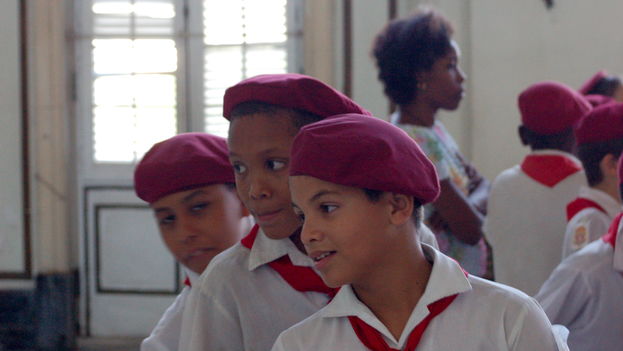
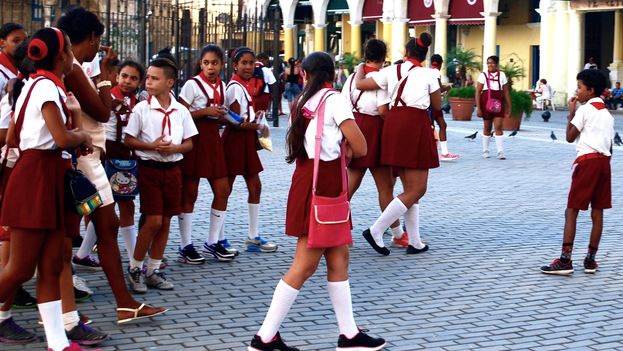
14ymedio bigger14ymedio, Luz Escobar, Havana, 30 August 2017 — These are frantic days. The uniform has to be ready, and a supply of pencils, erasers and pencil sharpeners collected. The school year begins on Monday, and each year the cost of equipping a student for the classroom increases. Cuban families spend nearly an entire month’s average salary on these preparations, according to interviews conducted with several parents by 14ymedio.

Yampier Lopéz and his wife, parents of two children, keep a detailed account of the money invested to prepare their children for classes. Shoes and backpacks are the most expensive, but the list continues to grow with two water bottles, a compass for the older brother who is beginning the study of geometry, and two lunch boxes.

With a total of 1,750,000 students enrolled at all levels of education, the new school year unleashes a race against the clock in state stores and in the black market. Families are guided by the simple motto: buy the most durable products at the lowest possible price. continue reading

For each child, Lopéz and his wife have so far invested 740 Cuban pesos (CUP), the equivalent of an average monthly salary according to the latest data provided by the National Bureau of Statistics and Information (ONEI), but they predict that the figure will exceed 1,000 CUP by the time they acquire some missing items.

Families are guided by the simple motto: buy the most durable products at the lowest possible price.

“We have to try to find most of the things that are used throughout the school year and now is the time to buy,” says the father. “You almost always think of the most visible, but you also have to look for socks, shorts for PE and notebooks.”

Lopez is a designer, while his wife works as a secretary in a branch of the Ministry of Transportation. Both remember the 1980s when they entered primary school and “in school they gave us almost everything.” But the collapse of socialism in Eastern Europe and the economic crisis have reduced those subsidies to the minimum.

The Government has significantly reduced its investment in the education sector, from 14.1% of GDP in 2005 to 9% in 2017

In recent years the Government has significantly reduced its investment in the education sector, from 14.1% of GDP in 2005 to 9% in 2017. The cut affects the physics and chemistry labs, audiovisual equipment, and the teaching materials given to each student.

For the 2017-2018 academic year, the Minister of Education, Ena Elsa Velázquez Cobiella, told the official press that “all textbooks and workbooks are guaranteed,” although she acknowledged that there are problems with “paper, because there is a delay in the arrival of that resource from abroad.”
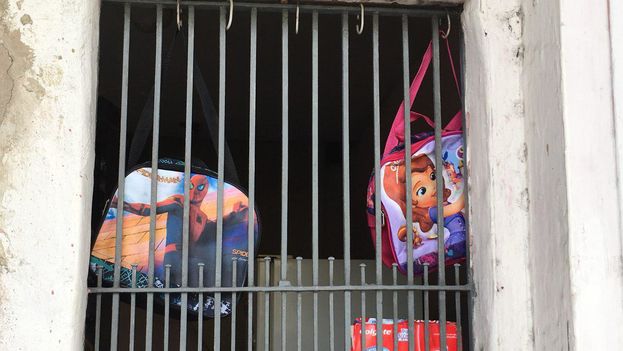
Although the uniform is mandatory social inequalities arise in the quality of shoes or backpacks. (14ymedio)

School uniforms cost less than 10 Cuban pesos (about 40¢ US) at subsidized prices, but the quantity delivered is limited and there is little variety in sizes. In Miami, with a large Cuban community, several stores offer the uniform pieces — blouses, shirts, skirts, shorts and trousers — the students are required to wear in primary and secondary education on the island. These days the emigrants receive frequent orders for these products from their families in Cuba.

“To guarantee a clean uniform every day, I have to buy at least three blouses and two skirts, says Damy, a 34-year-old Santiagan whose daughter is starting the second grade in September. Resellers offer each piece at a price ranging from 50 to 75 CUP, more than five times the cost  in the state stores, which offer only one uniform per child at the subsidized price.

After the uniform, shoes are one of the main concerns because in the state stores they cost between 140 and 380 CUP. To that is added the amount for the socks (25 CUP per pair) and the backpack (never less than 300 CUP) which brings the sum to the monthly salary of an engineer or a teacher.

“This is not over, the next few months my wife and I will be working almost exclusively so that our children can go to school with a clean uniform, pencils, notebooks and some cookies for a snack”

There are no official data on the expenses incurred by an average family for each child who starts school, but several economists consulted by this newspaper agree that it represents a difficult challenge given that the purchasing power of the Cuban worker has declined in recent years to only 28% of what was received in 1989.

Last July, the economist Carmelo Mesa-Lago told the conference of the Association for the Study of the Cuban Economy (ASCE) that although “free and universal access are important and redeemable points” of the Cuban education system, it is necessary “to focus resources on those provinces and people who cannot pay for their studies.”

The situation becomes tense a few days before the beginning of September. Although the uniform is mandatory, social inequalities arise in the quality of the footwear or the backpack. In the past, school officials have tried to prevent students bringing snacks or sandwiches that indicate greater purchasing power to the classroom, but they’ve lost the battle because the schools no longer are able to provide free snacks, as they did in the past.

“Before they gave the students crayons, pencils and notebooks of better quality, but now all that is up to the family,” complains Yander Lopéz. Books are distributed among students free of charge, but must be returned at the end of the course. Higher income families buy part of these “basic study materials” on the black market.

This school year, families’ pockets are emptied a little more by the costs of the school snack, the so-called “reinforcement” of the school-provided lunch by which the families improve their children’s nutrition in the semi-boarding schools, and the purchase of cleaning supplies, which parents must provide for some schools that are receiving fewer and fewer tools and supplies to clean the buildings.

“This is not over, the next few months my wife and I will be working almost exclusively so that our children can go to school with a clean uniform, pencils, notebooks and some cookies for a snack,” laments Lopéz.
Goodbye August, Nobody is Going to Miss You

The August of our irritability. (E. Marrero)

14ymedio bigger14ymedio, Generation Y, Yoani Sanchez, Havana, 24 August 2017 — August is the cruelest month, the poet T.S. Eliot would have written had he been born in Cuba. Because by the end of July, and before the beginning of September, everything becomes much more complicated. To the high temperatures are added the massive vacations of thousands of students and state employees, which make life move slowly, gluey, like a dense and hot liquid.

The telephones in the ministries ring and no one answers them, the functionaries are not at their posts and the secretaries take advantage of heatwave to spend more time painting their nails. Everyone justifies it with summer, everyone puts the blame on this month, as if it were a virus whose only treatment is to wait for it to pass.

Irritability is everywhere. People whine in the long lines, utter an insult at the first opportunity and curse the weather, this lethargy that barely lets them think. September becomes the goal, the longed for month.

However, when August is overcome daily life continues to drag along. Be it the heat, the rain, a hurricane or a political demonstration, in Cuba there is always an excuse for apathy and idleness.

Five Cuban Opposition Organizations Break With MUAD and #Otro18

Manuel Cuesta Morúa, leader of the Democratic Action Roundtable. (Wilson Center)

14ymedio bigger14ymedio, Havana, 29 August 2017 — Five opposition organizations have withdrawn from the coalition of more than seventy independent groups that form the Democratic Action Roundtable (MUAD), as well as the #Otro18 (another 2018) campaign, which is demanding a new electoral law in Cuba. The split has become “irreversible” according to comments from the veteran dissident Aida Valdés Santana speaking to 14ymedio.

The Human Rights Platform, which includes the five organizations recently separated from MUAD, issued a document in which the opposition leader, Manuel Cuesta Morúa, is blamed for the rupture. “His ambitions and his excesses of nepotism were the main obstacle to progress in the struggle for freedom and democracy,” the text reads.

The five groups that have decided to withdraw from MUAD are the National Coordinator of Prisoners and Former Political Prisoners, the Pro Arte Libre Association, the Rights of the People Project, the Youth Network and the Cuban Workers’ Coordinator. All of them accuse Cuesta Morúa of “inflexibility” and “pride.” continue reading

The split comes a few days before the Cuban electoral process begins

“We are consulting with everyone to redefine their status and define their role in the democratic process, that implies that some organizations that do not want to define a political profile as a dialog in democracy will take another path,” Cuesta Morua told 14ymedio.

The split comes a few days before the Cuban electoral process begins, in which the citizen platform #Otro18 has announced that it will present more than 170 candidates. Cuesta Morúa denounced in a recent press conference that all of them have been “harassed and threatened” by State Security.

The withdrawal of the Human Rights Platform damages the unity of a project that seeks to achieve nominations in municipal elections with a “strict adherence to the electoral law,” as described by its main promoters.

In July 2016, MUAD lost two of its most representative organizations when the Cuban Patriotic Union (UNPACU) and the United Antitotalitarian Front (FANTU) disassociated themselves from the opposition coalition

In July 2016, MUAD lost two of its most representative organizations: Cuban Patriotic Union (UNPACU) and the United Antitotalitarian Front (FANTU)

At that time Cuesta Morúa attributed the rupture to the “lack maturity in coexistence within a single proposal with different visions” and “different concrete strategies for change.”

For Cuesta Morúa, the arrests and threats against both initiatives have intensified in recent weeks and are instigated against independent initiatives that promote a change from “from the law to the law*” through the electoral system.

Formed in August 2015, taking off from the Progressive Arc project and the Democratic Action Roundtable, the #Otro18 initiative will soon have to pass the test of municipal elections, after losing several of the most important organizations that promoted the project.

*Translator’s note: That is working within the existing laws for change.

Conjunctivitis Jeopardizes Beginning of School Year in Cuba

Cuban schools are scheduled to open next week. (Flickr/Emma)

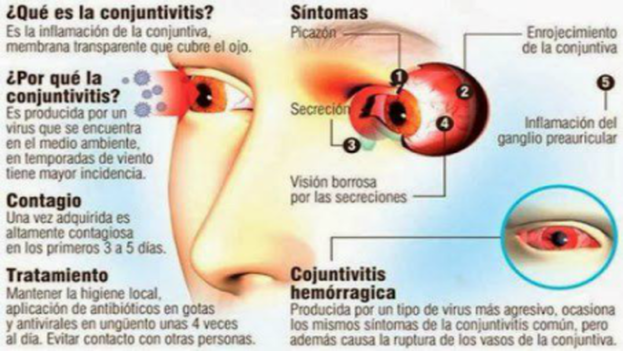
14ymedio bigger14ymedio, Zunilda Mata, Havana, 28 August 2017 — With only a week to go before the school year begins, Cuban health authorities fear that the arrival of thousands of students in the classroom will fuel the epidemic of hemorrhagic conjunctivitis that is plaguing the country. Preparing for the new school year includes gathering all the supplies needed to operate, and right now also includes epidemiological inspections to assess the health risks.

The Ministry of Public Health released a report on Saturday stating that there are seven provinces and 46 municipalities in the country affected by this form of conjunctivitis, with a total of 1,427 cases throughout the island. The real number could be greater, however, since many patients do not go to polyclinics or hospitals.

The advance of the virus has forced a review of the sanitary conditions in each school before they open to students on 4 September. Among the indispensable requirements is the guarantee of drinking water and its quality, according to comments in the official press from Gretza Sánchez, director of the Provincial Center for Hygiene and Epidemiology in the province of Villa Clara. continue reading

More than 1,750,000 students are enrolled in the 2017-2018 academic year in the 10,698 country’s educational institutions, Education Minister Ena Elsa Velázquez Cobiella said on Thursday.

A teaching assistant laments that the authorities impose many demands but that the schools do not have the circumstances to fulfill them

The controls require that every school have the necessary cleaning tools and wastebaskets installed in every classroom, along with disinfectants for the bathrooms and, if there are kitchens in the building, a stable supply of detergent, according to Ministry of Education source who spoke with 14ymedio and who preferred anonymity.

“They have already inspected and found several problems, so we are asking parents to help us with cleaning implements and products such as bleach, as well as cloths to clean the floor and brooms,” says Milagros, a teaching assistant in a primary school in Havana’s Cerro neighborhood.

The assistant laments that the authorities impose many demands but that the schools do not have the circumstances to fulfill them. They have managed to keep the schools clean “because parents collect money among themselves and buy what is needed.”

For Milagros, the lack of cleaning staff is the main problem to maintaining hygiene in schools. “Nobody wants to work cleaning in a school for less than 20 CUC a month, when in a hotel or in a private house you get double or triple,” she says. “Last year we were without a cleaning assistant for a full semester,” she complains.

The hygiene work is often undertaken by the parents themselves and the management of the schools convenes voluntary work days frequently to clean and beautify the classrooms.

Hemorrhagic conjunctivitis is of viral origin and highly transmissible. Its contagion occurs by contamination with ocular fluids or drops of saliva, as well as through the hands. (WHO)

As a result of these inspections it was revealed that 136 of the 600 schools of Villa Clara received a poor evaluation from the sanitary authorities for their hygienic conditions. Facility workers must solve the problems before the end of summer.

“Every year we parents complain about the problems with water and the cleaning of the bathrooms,” explains Lázara Roque, mother of a student at Camilo Cienfuegos Elementary School in Santa Clara. The woman fears that these difficulties will become an ideal breeding ground for the spread of the disease.

Hemorrhagic conjunctivitis is of viral origin and highly transmissible. Its contagion occurs through contamination with ocular fluids or drops of saliva, as well as through the hands and objects that have touched an individual infected by the disease.

“I have told my son to only drink boiled water that he carries from home, but it is very difficult to control him touching his eyes with his hands,” explains the mother. “The Ministry of Education should evaluate postponing the start of the school year in neighborhoods where the situation is the worst,” she suggests.

As a result of these inspections it was revealed that 136 of the 600 schools of Villa Clara received a poor evaluation from the sanitary authorities for their hygienic conditions

Since last May, health authorities have warned of the presence of the epidemic hemorrhagic conjunctivitis virus on the island. The first confirmed patients were reported in Santiago de Cuba and Havana, but with the arrival of summer, the outbreak spread to Ciego de Ávila and other provinces.

Currently, the territories with the highest number of cases are Guantanamo (858), Santiago de Cuba (359), Havana (154), Ciego de Ávila (35) and Las Tunas (21), according to data from the Ministry of Public Health.

Doctors warn that people suffering symptoms such as eye irritation, sensitivity to light, tearing, eyelid edema or redness of the eyes should go immediately to the health services. They also advise avoiding the use of home remedies to relieve discomfort.

Central America and the Caribbean is experiencing one of the worst outbreaks of conjunctivitis in its history

Official media have emphasized that eye drops and medications used for other types of conjunctivitis should not be applied, only cold water sprays should used.

Central America and the Caribbean is experiencing one of the worst outbreaks of conjunctivitis in its history. In Nicaragua, more than 11,000 people are reported affected this year, almost five times more than in 2016. In Panama, the number of people infected has climbed to 50,000 cases.

“The Caribbean Public Health Agency is monitoring the situation and urges people to take the necessary actions to prevent and reduce the spread of the virus,” said Dr. Virginia Asin-Oostburg, Director of Surveillance for that regional organization.

The increase in the number of passengers between Panama and Cuba, a frequent route for ‘mules’ importing goods for the informal market, worries authorities. In the main airports of the country medical personnel have been instructed to include in their screening of travelers questions about possible itching or irritation in the eyes.

In Havana’s La Pera Park Art Anticipates Technology

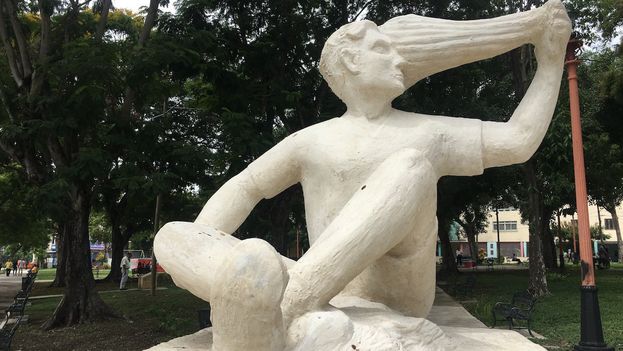
Art celebrating wi-fi has arrived in Havana’s Park in advance of well-functioning wi-fi itself. (14ymedio)

14ymedio bigger14ymedio, Luz Escobar, Havana, 28 August 2017 – The sun is rising and a teenager is unsuccessfully trying to find the presence of a wireless network. After months of waiting, the residents of La Pera Park, in Havana, are losing hope that an internet browsing point will be installed there. However, an artist got there before the Telecommunications Company of Cuba (ETECSA) and has placed a monument to the Wi-Fi on a pedestal in the park.

La Pera park is named after a peculiar shaped fruit – the pear – that is barely harvested in Cuba. Located on Almendares Street, between Bruzón and Lugareño in the Plaza of the Revolution municipality, the space is filled every day with families, with children who scurry everywhere and with internet users eager for a “dose of kilobytes.”

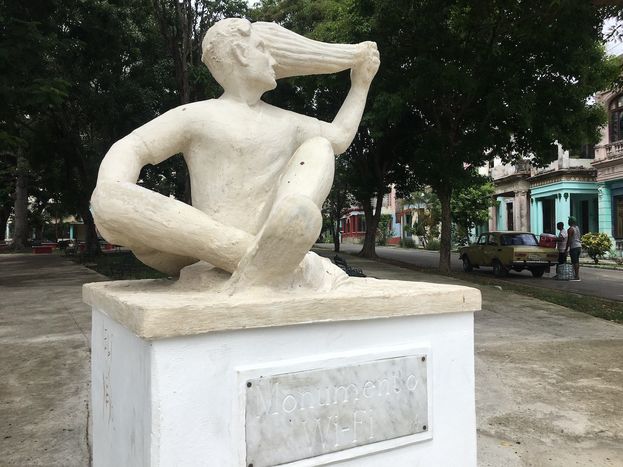
The plaque reads “Wi-Fi Monument.” (14ymedio)

Months ago in the Accountability Assemblies of the Popular Power – where delegates and citizens take stock of what has or has not been accomplished – it was announced that the state communications monopoly was going to set up a wi-fi zone in the park. It was all very exciting with the placement of new garbage containers, the repair of sidewalks, and the installation of lamps and benches. But no wi-fi.

In the absence of technology meeting expectations, art arrived first. The artist Yosniel Olay Mirabal, born in Havana in 1987, decided to give shape, through a sculpture, to that wireless technology that is changing the face of Cuban streets and squares.

Now, on a pedestal, the figure of a man attuned to a beam of signals challenges ETECSA to realize the dream of thousands.

Miguel Díaz-Canel Commits An Electoral Crime

Banner: (…) It is necessary that these elections be superior to all others. It is necessary that these elections show what the Revolution is, and the strength of the Revolution (…) We All Vote! (Yusmila Reyna / Twitter)

14ymedio bigger14ymedio, Reinaldo Escobar, Havana, 28 August 2017 — A video posted on social networks shows the first vice president, Miguel Diaz-Canel, concerned that critical activists with the Communist Party (PCC) will become candidates in the next elections. The “favored youngest son” of the power elite does not hesitate to propose actions to block the opposition candidates, thus committing a crime under the current electoral law.

The official alludes to six projects that are running “counterrevolutionary people as candidates for People’s Power delegates.” If the dissidents “become delegates, they will reach the Municipal Assembly and could reach the Provincial Assembly,” he warns. If they enter Parliament “it would be a way of legitimizing the counterrevolution within our civil society.” continue reading

Not satisfied with these assertions, Diaz-Canel insists on violating the law that regulates elections in the country, confessing to his audience, made up of cadres of the PCC, that “we are now taking every possible step to discredit this, so that people sense there is a risk. ”

The “favored youngest son” of the power elite does not hesitate to propose actions to block the opposition candidates, thus committing a crime under the current electoral law

Coincidentally, last Thursday the newspaper Granma reported on the actions that are considered crimes against the process. Among them is to violate article 171 of the legislation, which states that “every elector will only take into account, in order to determine which candidate he will cast his vote in favor of, the candidate’s personal circumstances, prestige, and ability to serve the people.”

The rules in force are strict: “The propaganda that will be offered will be the dissemination of the biographies, accompanied by reproductions of the image of the candidates.” No individual or organization is entitled to add details about any programs they support, their political tendencies, or any other publicity, to these few elements.*

The ruling party also insists that the party does not nominate any candidate, an assertion that has just been denied by Diaz-Canel when he reveals that the organization will discredit opponents or, and it’s the same thing, will post negative propaganda against them and boycott their candidacy.

The absence of electoral campaigns has been offered up years by the Government as one of the basic principles that differentiates the Cuban electoral process — which is “alien, in principle, to all forms of opportunism, demagogy and politicking” — from contemporary international political practice.

Behind the scenes there are other powerful forces: intimidation of the electorate, vigilance of State Security and tight monitoring by the Party

Beyond Cuba’s borders, campaigns of this type are based on two essential components: highlighting a candidate’s values ​​and discrediting political opponents. Unfortunately, on too many occasions the competition between programs takes second place, while personal attacks and insults prevail, intended to insure that “people have a perception of risk” of what would happen if the candidate being attacked is elected to a public position.

On the island, the Popular Power elections are presented as the upper echelon in democracy as they do not appeal to clashes between antagonists, television debates and advertising paraphernalia. However, behind the scenes there are other powerful forces: intimidation of the electorate, vigilance of State Security and tight monitoring by the Party.

Many citizens dreamed that the upcoming elections, which will end with Raul Castro’s farewell to the presidency, would be governed by a new electoral law that would allow election campaigns between different parties. Rather than relying on such changes to be driven by the powers-that-be, initiatives like #Otro18 (Another 2018) and Candidates for Change set out to promote them from the bottom up.

The fear of losing political control has, however, prevented such transformations and has led Diaz-Canel to commit an electoral crime. It is paradoxical that what the current law considers an infraction is what opponents are demanding be included in a future electoral law: the ability to run a political campaign, to present proposals, and to publicly discredit the adversary.

*Translator’s note: Briefly, election campaigning is illegal in Cuba. Candidate biographies are drafted by the Communist Party and posted, with the candidate’s photo, on a single sheet of paper in a window in the candidate’s district. In the rare instance of a candidate not approved by the party making it through the first round, the official biography will make assertions along the lines of “the candidate is a counterrevolutionary who accepts funds from foreign sources.” An example of such a biography can be seen here.

Cuba Ignores Sanitary Crisis To Not Frighten The Tourists / Juan Juan Almeida

Setting up for Carnival

Juan Juan Almeida, 16 August 2016 — Holguín, the Cuban province reporting the greatest increase in cases of zika, dengue and haemorragic conjunctivitis, might experience an increase in the level of contagion with the arrival of travellers wanting to visit the area in the upcoming carnivals programmed from 17th to 20th August.

Doctor Luis Arlet González, Provincial Director of Public Health, Julio Caballero, First Secretary of the Communist Party in the town, and Julio César Estupiñán, President of the Provincial Assembly of People Power (the local government), have more than once warned about the danger of celebrating  carnivals in the middle of this epidemic. But the First Secretary of the Communist Party in the province, during the last meeting of official organisations, made known the decision not to cancel the merriment for fear of frightening the tourists. continue reading

“It seems unbelievable that with the number of cases of zika, dengue and conjunctivitis reported daily, they could think of holding celebrations. For the Party, as always, all they are interested in is the income raised by filling the nearly 5,400 homes dedicated to tourism and they play the game without thinking that the city’s principal value lies in the inhabitants’ welcome and the beauty of the town set in 60 kilometers of beach and sun. Tourists look for contact and that, without a doubt, increases the contagion which is expected to soon reach pandemic levels”, says a frightened doctor at the “Vladimir Ilich Lenin” University General Hospital in the town.

The government recently provided funding for what is called “Operation Good Health”, which involves mobilising volunteers to carry out fumigations, and includes personnel able to locate infected people and raise awareness using the local media. But, in spite of these efforts, the number of patients increases daily.

Travel agencies receiving inquiries from travellers worried about the local situation avoid raising fear and uncertainty among overseas visitors. The provincial authorities decided to lock away those patients labelled as most contagious, but when the admissions at the “Lucía Iñiguez Landín” Hospital Clínico Quirúrgico in Holguín were overwhelmed they found themselves obliged to open up the nursing facility to take in the affected people.

People with contagious epidemic haemorragic conjunctivitis are being locked away in classrooms and lodgings in Celia Sánchez Manduley University, a long-established school for social workers, which, incidentally, has announced that the start of the next course will be postponed until September 20th, or until further notice.

Nevertheless, in the face of the incomprehensible decision to proceed with the carnival preparations, and in the closing stages of the preparations for the festivities in the provincial stadium and the busy Los Álamos and Libertadores Avenues, the local authorities have pronounced themselves satisfied on becoming aware on August 10th that Havana has ordered the activation in the province of the protection and security plan.

All the infantry units were quartered, the air force, the anti-aircraft defences and the navy were put on alert. But as the saying goes, nothing good lasts forever; such a colossal military mobilisation was not because of the epidemic, but because  General Raúl Castro, president of the Council of State and the Ministries of the Republic, was on vacation this weekend in his paradise hideaway in Cayo Saetía, on the north coast of East Cuba.

Translated by GH

Cuba Is No Country For Mothers

Note: Our apologies that this video is not subtitled, but hopefully the images will be of interest to all.

14ymedio bigger14ymedio, Zunilda Mata, Havana, 26 August 2017 – She walks slowly constantly fanning herself. With each step her full-skirted flowery dress swishes from side to side. Yadira Ramos is 34 and will give birth for the first time in just two weeks. With a degree in accounting, the young woman postponed maternity for professional reasons, but the decision to have only one child was made for economic reasons.

For almost forty years Cuba’s fertility rate has failed to rise. In 2016, the average number of children per woman was only 1.63, with 8,192 fewer children born than in the previous year, according to the Statistical Yearbook of Health. The island’s difficult demographic situation threatens to become the most serious of its problems.

Authorities are alarmed by the low birth rate, which leads to an accelerated process of population decline. Aging increases the cost of pensions and healthcare in a country that ended 2016 in an economic recession. continue reading

Cubans are living longer and longer and life expectancy I now close to 79.5 years, while the period couples dedicate to reproduction is shorter, as it conflicts with the time that women can spend on their careers.

For the past forty years, the fertility rate has not risen in Cuba. (Andrea María)

When she was little, Yadira Ramos called her dolls with the names she dreamed of for her future daughters: “Lucrecia, Lucia and Amanda.” However, the plans for a large family collided with reality. “The situation is such that there is not enough to have more than one child,” the pregnant woman explains to 14ymedio.

Married to a waiter working in a state-owned restaurant, the future mother belongs to a social stratum that lives day-to-day, without being able to afford luxuries. Most of her last year’s salary has been used for the purchase of diapers, bottles and a cradle. “The budget doesn’t stretch and without the gifts people have given me I do not know how I would manage,” she says.

Like many other Cubans, Ramos preferred to postpone motherhood until she had a “more solid” job position. She says that “after a woman gives birth, it becomes very difficult for her to assume management responsibilities at work because she has to take on more tasks at home.”

Like many other Cubans, Ramos preferred to postpone motherhood until she had a “more solid” job position

In February of this year, the Government launched new provisions to encourage births, such as the paying other family members for the care of minors and tax cuts for women workers in the private sector who have two or more children. However, the measures are far from solving a problem that goes beyond the low salaries and the insufficient payments for maternity leave.

The search for the causes of the decline in births has become a point of friction. Official voices point to the freedoms enjoyed by women as the reason they delay pregnancy and have fewer children. While on the street, comments from ordinary people point to the economy and housing problems.

Women serve as heads of household in 45% of families and hold 66% of technical jobs, but the distribution of domestic work remains inequitable. Machismo still determines that women are responsible for most of the care of a newborn.

Machismo still determines that women are responsible for most of the care of a newborn. (Charles)

This disproportion of tasks discourages many women from becoming mothers. “I have not yet found a man who can serve as the father of my children,” said Tania, 24, a nursing assistant at a polyclinic in Havana’s Plaza of the Revolution municipality. “It’s a decision that needs to be taken very seriously.”

Tania has had six abortions so far. “I do not have the circumstances to have a child and I will not bring one into the world to work,” she says. She feels that “many pregnancies end in interruption because the family can not assume the expenses of a baby.”

In 2016, 85,445 induced abortions were carried out in Cuba, according to data from the Statistical Yearbook of Health, while only 116,725 children were born.

In 2016, 85,445 induced abortions were carried out in Cuba, according to data from the Statistical Yearbook of Health, while only 116,725 children were born

In Tania’s case, the search for the appropriate father is joined by an old dream of emigration. “With a child it becomes much more difficult to get a visa for anywhere and it is very difficult to start from scratch in another country,” the nurse said. Emigration is another of the many reasons that fertility is plunging on the island.

According to Juan Carlos Alfonso Fraga, Director and Researcher for the Center for Population and Development Studies of the National Office of Statistics and Information, the decline in the birth rate is associated with advances in “the conditions of the family and of women” along with “policies for the exercise of sexual and reproductive rights.”

However, the specialist acknowledges that “unresolved, material problems associated with housing shortages, lack of goods” and “high prices” also contribute to reducing the number of births.

Despite the fall in the number of births, Cuban women continue to receive strong social pressure to be mothers

Despite the fall in the number of births, Cuban women continue to receive strong social pressure to be mothers. In the collective imagination, motherhood is the “consecration” of women and those who postpone the arrival of a child are criticized by friends and family.

The poet and writer Irela Casaña reflects on these social pressures and says that she is often asked why she has not had a baby. “Who’s going to take care of you when you’re old?” a friend asked her recently. The writer laments that this means “now children are an investment, a natural loan and with high interest rates.”

Yadira Ramos has already chosen a name for the baby she expects in a few weeks. “She will be called Amanda, like one of my childhood dolls,” she says.

______________________

Editor’s Note: This report was made with the support of the Howard G Buffet Fund for Women Journalists from the International Women’s Media Foundation.


Private Taxi Drivers: The Government Always Looks for a Way to Fuck Us Over / Iván García

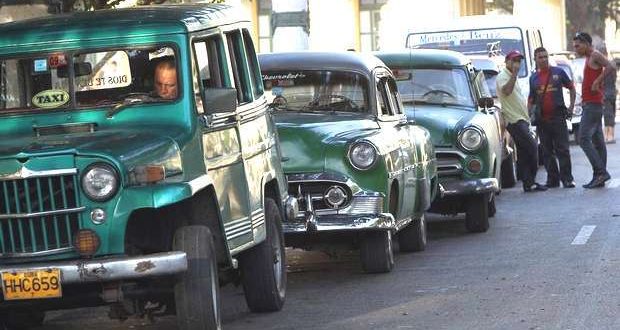
Taxis in Havana. Source: El Nuevo Herald

Ivan Garcia, 26 August 2017 — Shortly after five in the morning, before walking a quarter-mile to the house of the owner of a Ford with a 1948 chassis, Reinerio, 56, wolfed down his egg sandwich and the usual strong breakfast coffee.

The owner of the Ford rents it for 600 Cuban pesos a day (about 27 dollars) and Reinerio drives it for twelve hours through the poorly maintained streets of Havana.

The car was made in the Detroit factories with the scraps of World War II armaments. In Cuba the old American cars are known as almendrones (after their “almond” shapes) and have featured on magazine covers and been the object of comments by foreign politicians who advocate economic reforms on the island. continue reading

But you can ask any owner of these last century jalopies what they have had to invent to keep them rolling. Scarcities engender creativity. Thanks to the talents of the local mechanics, the Fords, Chevrolets, Cadillacs, Chryslers and other brands of 60 or 70 years ago today serve as taxis in the noisy, dirty and dilapidated Cuban capital, which, despite state neglect, resists losing its charm.

More than a few drivers have crafted nicknames for their vehicles. “I call my Ford ‘The UN,’ because it has pieces from at least fifteen countries,” says Sergio, the owner of the car he rents to Reinerio.

“I have two cars and a jeep that I rent as taxis. For the cars, with five seats, I charge 600 Cuban pesos daily from Monday to Saturday, Sunday is for the driver. If he wants to work that day, the profit is his. The jeep, with ten seats, I rent it for one thousand Cuban pesos a day. I only have three drivers, people I trust. They decide how many hours they want to work. The fuel is bought by them,” says Sergio.

Reiner checks the engine, fuel and oil before getting behind the wheel. The interior of the car is upholstered in black with white trim. Glued to the front windshield is an American flag and a plastic crucifix. When he arrives at the Calzada de Diez de Octubre, he begins to pick up passengers. It is time to turn on the audio equipment, almost always with an unbearable reggaeton at full volume.

“I try not to kill myself at work. There are good days and bad days. On average, driving twelve hours a day, I get 600 Cuban pesos of profit. But any botero (literally ’boatman’ as taxi drivers are called), be it the owner of the car or someone who rents it, knows that you have to have a reserve for when the car breaks down or you need to buy tires or spare parts. In my case, those expenses are split half-and-half half with Sergio, the owner,” says Reinerio.

Before becoming a private taxi driver, Reierio drove a ‘guagüita*’ in a state company. His monthly salary was 300 Cuban pesos (less than 14 dollars). “Today, with the money I earn, my family has breakfast, lunch and dinner, as well as clothing and personal hygiene. Once a year I rent a week in an all-inclusive hotel in Varadero or one of the cayos. Do you think that’s a luxury? Compadre, that’s the most normal thing in the world in any country where you break your back working,” says Reinerio.

When asked about the new measures that the State intends to implement toward private taxi drivers in Havana, getting them to join transport cooperatives through the incentives of selling the fuel at subsidized prices and spare parts (if any) at a 20 percent discount, Reinerio responds angrily:

“Nine out of ten taxi drivers will not join a cooperative. Man, this government has never been good. This is a way to control you. They are afraid of us. The taxi drivers have been surveyed and most have put their foot down and we will continue to charge the rates we understand. I prefer to buy fuel in the CUPET (state network) and operate the routes and set the prices that I consider convenient. This idea of selling parts at a 20 percent discount is a bad joke. In foreign currency stores parts are sold at prices that are taxed at 300 percent, and unless it’s an emergency, taxi drivers buy the parts and tires from people who bring them from abroad and sell them much more cheaply than the state does.”

Private work has never been looked on favorably by the the Castro brothers’ autocracy. Economic independence, the possibility of saving money and not being affiliated with a union — which is more like a foreman than a union — transforms the man or woman who up to that moment has been obedient, indoctrinated and dependent on a state salary to eat, clothe and entertain themselves, into a free human being.

That autonomy is a worry to the olive -green regime. The majority of the 900 thousand Cubans who were able to be tourists in their own country and the more than 700 thousand who traveled abroad in 2016, and with their efforts paid for a cruise or a stay in Punta Cana, they are private workers.

Of course, it is a myth that they earn money hand over fist. Impossible, with huge taxes and the audits of the police court. But the more than 560 thousand self-employed perceive that they live better by depending on themselves.

Their salaries are triple the state salaries and they do not have to attend the tedious meetings of state workplaces to celebrate the 91st birthday of the late Fidel Castro or sign a pamphlet in support of the dictatorial Constituent Assembly convened by the insufferable Venezuelan president Nicolás Maduro.

“Better that I never work for the State any more. If they want to remove the private taxis, they will have to take off the mask, and not try to make up more stories or camouflage mechanisms whose goal is to control us. The government always looks for a way to fuck us over,” says Reinerio, while maneuvering over the potholes in Calzada de Diez de Octubre.

The dozen taxi drivers consulted for Diario Las Americas suspect that the government intends to put them out of business using as a pretext the illegal purchase of parts and fuel from a state agency and for allegedly violating the rules of private employment, declaring income lower than what they receive.

“This government has not lasted 60 years on a whim. They have good memories and they haven’t forgotten the strike the taxi drivers wanted to hold and our not giving in to their demands,” says Reinerio.

Now, the drivers fear, the regime is coming for them.

Translator’s note: The word for bus in Cuba in guagua (of disputed origin); guagüita is a diminutive of that term.

Private Initiative and Settling Scores / Juan Juan Almeida

Juan Juan Almeida, 24 August 2017 — In Cuba there is an imprecise, almost palpable point at which good intention disappears. This time it is the owners of the Starbien restaurant who are facing the horror of the gallows.

José Raúl Colomé, son of former Interior Minister Abelardo (Furry) Colomé Ibarra, and Osmani Cisneros, son of the late Cuban leader Ángel (Angelito) Cisneros, have created a cozy atmosphere in a location with superb food and excellent service. But in spite of having extensive experience in the restaurant business, the pair fell under the predatory gaze of Alejandro Castro Espín and his broad ranging powers.

The opening of the Cuban economy to private business has allowed those who are well-placed to fluourish. continue reading

Over the last few years, the self-employed have shown themselves to be that part of Cuban civil society that can accomplish more than any political party. They have very positive social impact, help the community and generate employment while their purposeful entrepreneurial ingenuity fascinates the population. It is precisely because of these achievements that they are always under the watchful eyes of suspicious members of the status quo. The reasons for their recent actions against the restaurant, however, are not very clear.

The investigation, which is being led by the attorney general’s office, has not come to any conclusion. Technically speaking, there are no problems nor have any financial irregularities been uncovered. Nevertheless, even though there were no violations that would warrant legal action, the passports of José Raúl Colomé, Osmani Cisneros and some of their relatives were confiscated following a cursory conversation.

Located at 205 29th Street between avenues B and C in Havana’s Vedado district, Starbien became a favorite of local customers and foreign tourists alike. As a result of an unusual fusion of attentive service, a distinctive, innovative cuisine and a setting in the middle of Havana, many consider it to be one of the best restaurants in Cuba.

The real motive behind Starbien’s closure is obscured by rumors among government loyalists and sources who prefer not to express an opinion for fear of putting themselves in jeopardy. But there is a clue in this unique case, a missing link that suggests this is something between a punishment, a scolding and a settling of old scores.

“Everyone wants the truth but few are being honest. Criminal sanctions in this country always have two sides: the spoken and the unspoken,” says a source close to the investigation who uses the pseudonym “El Misteriso.”

“It’s not hard to figure out that this sort of prosecution without trial will end in some sort of agreement,” explains the anonymous source, “because it follows no legal logic. Given that there are no criminal charges in the case, it’s very clear that confiscating the passports and reviewing the restaurant’s finances are not actions aimed at either the owners or the employees of Starbien. Nor is it a case of corruption or violation of the regulations governing private sector restaurants. Financial audits by ONAT indicate there are no irregularities. Therefore, I would call it a settling of scores. The order came from above and was aimed at retired general Abelardo Colomé Ibarra who, as we all know, fell afoul of the younger brother of the Agha and was forced to resign his positions as government minister and member of the Council of State in October 2015, citing health reasons.”

“There is no better way to ruin a father than to trample on his son,” concludes the informer. “It’s a question of semantics. How to milk a plant to get soy milk.”

Private Businesses in Cuba Sound the Alarm / Iván García

Photo:CiberCuba

Iván García, 18 August 2017 — While slicing pork and a half-dozen chicken breasts into cutlets, which he then weighs on a digital scale, the owner of a cafe in Havana’s south side that serves light meals and sandwiches gets a call on his cell phone.

“Hey. Listen, partner, have you got any beef? Or fish?” he asks as sits down, nodding his head as he listens to the answer on the other end of the line.

Two hours later, a driver in a truck with government license plates drops off, without undue discretion, several boxes of frozen chickens and smoked pork loin. The merchandise is carried to a freezer in the kitchen of house where the cafe is located. continue reading

Let’s call the owner Antonio, a man with a strong build and decades of experience in the precarious world of private sector employment. “In the 1970s,” he explains, “I was a manager at a state-owned restaurant. Later, I was in the handicraft ’business,’ selling leather sandals in Cathedral Square. After that, I was had a stall in a privately-run farmer’s market. Then, when self-employment became legal in 1993, I opened a cafe. I have lived long enough to know how the state works. They give you rope but, just at the right time, they grab the other end of it and you get screwed.”

For Antonio, Cuba is not a normal country. “Ideally, there would be a well-supplied wholesale market and taxes would be reasonable. But that’s not the case. ONAT (the National Office of Tax Administration) lets you sell beef, fish and shellfish. But where are people supposed to get it? The retail price of a kilogram of beef is 12 CUC and getting shrimp or lobster from a state-run establishment is impossible. A big portion of a private food service’s inventory is purchased under the table, usually from state-owned companies or tourist resorts. I don’t see anything wrong with them trying to get their house in order. But in order to set everything straight, the government first has to accept that, by not creating wholesale markets, it hasn’t met its obligations,” he says.

He pauses to give instructions to his employees: “Hey, this juice is watery. When you season the meat, don’t be stingy. Why is the rice and beans dish taking so long?” Drinking coffee from an aluminum mug, he continues:

“The problem is that these people (the regime) have lied so many times that when they presumably do tell the truth, they lack credibility. I don’t believe that this restructuring of self-employment is being done in good faith. As long as taxes are high, people who make more than 20,000 (Cuban) pesos a month (about $750 USD) will be subject to a 50% tax rate, businesses will keep two sets of books and income will be underreported. As as long as there is scarcity and food is hard to get, there will be schemes to get it. That’s not going to stop anybody. The government has never wanted people to make money. That’s why there are so many controls and restrictions,” he says.

The new measures, which temporarily put a halt to licenses for the most profitable private businesses, has set off alarm bells among the island’s private sector businesspeople. The decree was published in the Official Gazette on August 5 but passed on July 18 at the closing session of the National Assembly.

José, an architect who offers interior design services to owners of private businesses, believes, “The government has always treated private business owners as though they were criminal suspects. The Cuban state is programmed to direct and control its citizens’ lives, all the way from their salaries, recreation and housing to what they eat. Don’t forget that many of the bigwigs who launched the Revolutionary Offensive of 1968, closed private-sector farmers’ markets in the 1980s and decelerated self-employment in the 1990s, still govern the country. A guy with money is more likely to have his own opinions and not rely on the state to feed his family. In the end it boils down to an ideological conflict, especially when they hear American presidents expressing support for private business. They see us as Trojan horses who will strangle the socialist system.”

The economist Omar Everleny believes that the government should come up with a list of unauthorized jobs and should favor professionals who could also open businesses, which would add value to the private sector.

Diana, a former ONAT official, says, “It’s the government, with its inconsistent policies, that is encouraging rule bending and illegality. Their only concern is how to collect the most money while punishing those they think violate their precepts. They forget that in any social contract there are rights and responsibilities. They demand their rights but ignore their responsibilities.”

Carlos, a sociologist, believes, “Almost 60 years of revolutionary government have shown that, the more things are prohibited, the more the door opens to clandestine businesses. In 2011, they ordered the closure of 3D cinemas and private clothing stores. These businesses continue to operate but do so illegally. In fact, by the time the regime decided to legalize self-employment, some businesses had been operating illegally for years.”

Yosvany, a professor of political science, believes, “Cuba’s aging leaders carry intransigence in their DNA. If one segment of the population starts to make money, no matter how small that segment is, they see it as a threat to the power they’ve held since 1959. In China and Vietnam the communist party shrewdly allied themselves with entrepreneurs and the new rich. But in Cuba they view them as public enemies.”

Oscar, the owner of a rental property, says, “The government has exaggerated the success of private businesses. Of the 201 authorized jobs, they stopped issuing licenses to about twenty. But if these business are up and running, and their owners know how to manage well, they can make a profit. That’s not the case with button stampers, palm tree trimmers and other jobs where they make just enough to survive.”

The widespread perception among several private sector workers interviewed by Martí Noticias is that the new rules of the game as drafted by the government will halt the advancement of private initiative on the island.

The military dictatorship has never hidden its disdain for so-called cuentapropismo.* That is why it prohibits the accumulation of capital and resorts to decrees to hinder private enterprises from prospering.

If anyone did not understand this, it was because they refused to do so.


*Translator’s note: A term unique to Cuba that was coined by the government to avoid using a more generic and politically fraught term like self-employment

Díaz-Canel: Killer of Illusions / Cubanet, Luis Cino Alvarez

Miguel Díaz-Canel and Raúl Castro (Reuters)

Cubanet, Luis Cino Alvarez, 24 August 2017 — In his hardline speech to Cuban Communist Party (PCC) cadres, Vice President Miguel Díaz-Canel killed any illusions some may have harbored that a future government headed by him, following Raúl Castro’s retirement,* would tend towards reforms and be less authoritarian and repressive.

Assuming the stance of a prison warden and speaking in a more commanding voice than usual, Díaz-Canel came across as considerably menacing–and not only with respect to the open opposition. Into the same bag of what he called “subversive projects” and “counterrevolution” Díaz-Canel also tossed the loyal oppositionists of Cuba Posible, the pro-government journalists who collaborate on non-state media, centrists and other ideologically diverse actors–no matter if they declare themselves to be within the Revolution.** As if this were not enough, he also warned that there would be no consolidations of a private sector that could break away from the State and turn into an agent of change. continue reading

All of this in a tone that more reminiscent of a State Security official than of a technocrat of the party bureaucracy. So intransigent and backward did Díaz-Canel come across, that in his place could have stood the uncouth Ramiro Valdés, or Machado Ventura himself were he not so busy cleaning up agricultural disasters.

If a medium as mild in its treatment of the regime as OnCuba Magazine irritates Díaz-Canel, we can only imagine what he thinks of Cubanet and Martí Noticias, among others, and what he has in store for independent journalists.

Could it be that the heir apparent, if he wants to make it to February 2018, could not spare any harshness in his lecture? How could he disappoint the little old commie fanatics who keep the fuse lit, even at the risk of it all exploding in their hands?

There is no need to dig deep and expect surprises from Díaz-Canel. For now, he called the play and it truly sets my teeth on edge. It is more of the same. Without much variation in the score.

There was no reason to expect otherwise–why insist on sniffing out a Gorbachev or Deng Xiao Ping in Díaz-Canel? He must have learned in cadre school that this type of system does not allow reforms that do not come apart at the seams; that rats, regardless of how they might beg for it, cannot be fed cheese, because then they will want water, and then more cheese, and will continue begging for it until the pantry runs out.

Actually, it was only the usual naifs, those given to wishful thinking, the extreme optimists, who harbored illusions about Díaz-Canel. He might have been able to appear liberal with the gays and rock fans of the Club Mejunje in his native Santa Clara, back when he had not yet put on weight, would ride his bicycle, and looked like Richard Gere. But once he got to Holguín as first provincial secretary of the PCC, he did not hesitate to order evacuations of marginal neighborhoods: apparently he preferred the invasive marabú* weed to squatters.

Starting now, he is giving advance notice, as if he were just another general–and of the praetorian kind–that he wants a calm and orderly classroom, and that he will not balk at ordering State Security (after seeing to the extinction of the dissident movement) to take care of the insubordinate, lackadaisical and diversionist elements. And it could be that later on, given his inclination to social media, he will tweet–cock of the walk that he is–that “there is no reason to make the least concession to the Yankee imperialists.”

Díaz-Canel is of a younger generation, but as in his school days, he remains disciplined, a follower of orders. And very attentive to what his preservation instinct dictates. Apparently it has not failed him yet. It is no accident that he has gotten to where he is today.

luicino2012@gmail.com

Translator’s Notes:

*In 2013, Raúl Castro told the Assembly of People’s Power (the Cuban Parliament), that he will retire from the presidency of the Council of State and the Council of Ministers on Feb. 24, 2018. At the time of that announcement, Díaz-Canel was promoted to first vice-president of both councils.

**A reference to Fidel Castro’s Words to the Intellectuals speech of June 30, 1961, in which he set limits to the free expression of artists and writers: “Within the Revolution, everything; outside the Revolution, nothing.”

Translated By: Alicia Barraqué Ellison

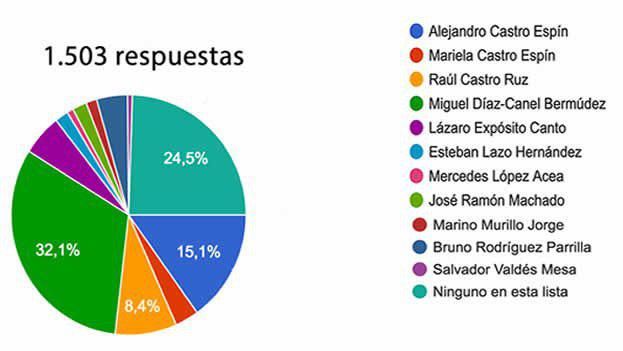
Cuba’s Next President? Díaz-Canel and Castro Espín Lead in 14ymedio’s Survey

14ymedio’s survey asked readers who they thought was most likely to be the next president of Cuba. (14ymedio)

14ymedio bigger14ymedio, Havana, 25 August 2017 — In a period of 48 hours the survey released by 14ymedio on Wednesday, 23 August, received 1,503 valid responses. The poll asked which official figure is most likely to be Cuba’s President of the Council of State on 24 February 2018.

According to our readers, Miguel Díaz-Canel, the country’s current vice-president, led the list with 482 votes (32.1%) and is the candidate most likely to replace the current president, Raul Castro. In second place is the son of the current president, Alejandro Castro Espín, with 227 votes (15.1%).

However, 24.5% of the respondents (368 votes) believe that no one on the survey list would come to power.

The final results are as follows:

Miguel Díaz-Canel: 482 votes (32.1%)

None of those on the list: 368 votes (24.5%)

Alejandro Castro Espín: 227 votes (15.1%)

Raúl Castro Ruz: 127 votes (8.4%)

Lázaro Expósito Canto: 83 votes (5.5%)

Bruno Rodríguez Parrilla: 64 votes (4.3%)

Mariela Castro Espín: 49 votes (3.3%)

José Ramón Machado Ventura: 30 votes (2.0%)

Esteban Lazo Hernández: 28 votes (1.9%)

Marino Murillo Jorge: 22 votes (1.5%)

Mercedes López Acea: 13 votes (0.9%)

Salvador Valdés Mesa: 10 votes (0.7%)

Centralism Again? / Rebeca Monzo

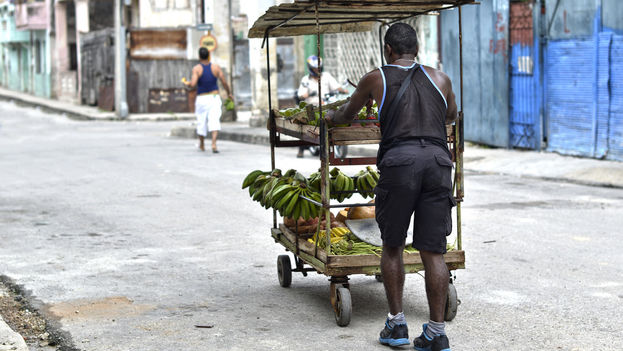
Pushcart vendor on a Havana street (CC)

Rebeca Monzo, 25 August 2017 — Once again the Cuban government wants to “tighten the screws” on initiative and private business.

It has suspended issuing “until further notice” all self-employment licenses, which run the gamut from the smallest, most humble pushcarts to family-run restaurants and homeowners who rent out rooms to tourists. Word has it that taxes will also go up — an exploitative move considering that they are already extremely high — and that there will be an increase of 240% or more on the price of basic necessities, whether priced in hard currency (Cuban convertible pesos) or Cuban pesos.

Meanwhile, poverty-level salaries and pensions remain the same even as taxes increase on merchandise Cubans need to survive under an absolutist regime.

Being allowed to once again rent or sell our properties, or to travel abroad, does not amount to some gift from the totalitarian system. It is simply Raul’s way of reinstating some of the rights that he himself usurped from us 58 years ago.

Let’s see how well they lead to the famous changes the regime has bragged so much about. Far from opening up and facilitating the country’s economic growth, it retrenches ever further into statism and intolerance. Given the dual currency and lack of universal internet access, foreigners are losing interest in investing in the country with each passing day. Does that mean that perhaps they will try once again to impose centralism on us?

Opposition Organization UNPACU Turns Six In Very Difficult Circumstances

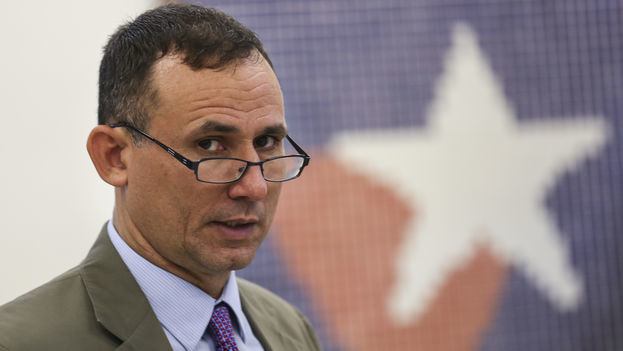
José Daniel Ferrer, leader of the Patriotic Union of Cuba (UNPACU). (Matias J. Ocner for 14ymedio)

14ymedio bigger14ymedio, Luz Escobar, Havana, 2 August 2017 — The Cuban Patriotic Union (UNPACU) is celebrating its six years in the midst of the complicated situation faced by the island’s opposition, assaulted by repression and limited by laws that penalize any form of organized dissidence.

Under the leadership of José Daniel Ferrer, UNPACU was born in 2011, after the release of the last prisoners of the Black Spring of 2003. Ferrar says that his experience within the Christian Liberation Movement (MCL) proved to be momentous in shaping his political development.

Ferrer described the situation of the last year as “much more repressive” than the organization had experienced since its founding. Speaking to 14ymedio, Ferrer said that his greatest achievement in this new scenario has been “surviving” and finding “new actions and strategies to maintain a close bond with the community.” continue reading

Ferrer believes that UNPACU and its activists are the definition of “courage and service.” In the current political context, some dissident groups barely survive for a few months and others go through ups and downs. “They courageously face tyranny and serve the people, especially those most in need,” he said.

Ferrer described the situation of the last year as “much more repressive” than the organization had experienced since its founding

The leader of the organization explained that since the beginning of August they have undertaken activities to celebrate the founding of the opposition organization, “despite the increase of repression.”

“We have been moving our activists to different places in activities that have developed in a wifi zone, a river, a baseball or soccer camp.”

Ferrer denounced a police operation on Thursday that surrounded the organization’s headquarters in Santiago de Cuba.

“The operation coincided with the day UNPACU’s activist get together. Everyone who enters or leaves is searched or detained,” he said.

Carlos Amel Oliva Torres, youth leader of that organization, stressed that to its credit the organization has “not ceased activism in the streets,” but agreed with Ferrer that it has become more difficult because in the past year they have faced “more prisoners and more repression.”

Regarding the arrests, he said that they may have diminished, but that this is not due to “a better situation in the country” but to the fact that “many leaders are already in prison.”

UNPACU has spread all over the island and has more than 3,000 members, according to its leaders

UNPACU has spread all over the island and has more than 3,000 members, according to its leaders. In Havana, the provincial coordinator, Zaqueo Báez, has breathed new life into the movement, Oliva said.

Baez’s face appeared on the front pages of the media when, during the Pope’s Mass in the Plaza of the Revolution last September, he and other colleagues approached the bishop of Rome and called for the release of political prisoners.

UNPACU has a very dynamic YouTube channel where it shares material to publicize its community work and the opinions of the people of the street.

In a recent video, a resident of El Cristo neighborhood called for “greater support” for the organization because “any group that seeks freedom and the rights of any man is what represents the common good for this country.”

According to Oliva Torres, UNPACU continues “with social assistance” despite having been heavily attacked. He recalled that months ago the government “raided and closed a children’s nursery” run by the organization.

“We continue despite the fact that the regime has often predicted the end of UNPACU, today we are still here with the same willingness of the first day, assuming all the risks and consequences,” said the activist via telephone from Santiago de Cuba.