
Cuban “Collaborators” on Foreign Missions Will Pay Customs Duties in Cuban Pesos

Cuban legislation stipulates that Cubans and foreigners residing on the island can pay customs duties on imports in Cuban pesos only once per year.

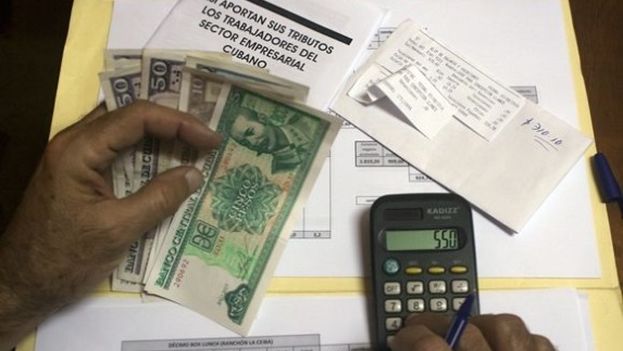
14ymedio bigger14ymedio, Mario Penton, Miami, 24 August 2017 – Currently, Cubans and foreigners residing in Cuba are permitted to pay customs duty on imported products in Cuban pesos only once per year. Subsequent import duties must be paid in Cuba’s other currency, the Cuban convertible peso (CUC), which is worth 25 times the Cuban peso (CUP). New rules will allow doctors, teachers and other “Cuban collaborators abroad” – that is professionals that the state “rents out” to other nations – to pay subsequent customs duties in CUP. Tourists and Cubans residing abroad must pay all customs duties in CUC.

The new measure from the Ministry of Finance and Prices seeks to stop the hemorrhaging of professionals who are working on “missions” abroad, which bring the country great economic benefits.

According to data from the National Bureau of Statistics, Cuba earned more than $11.8 billion from the export of services in 2016, although some analysts believe the figure is unlikely, given that medical personnel in some countries such as Brazil and Venezuela have “deserted” from their postings. continue reading

Many of the professionals that Cuba sends to third countries are contracted through Cuban government agencies, which keep the vast majority of the money paid by the other countries for their services. However, these “missions” are attractive to the workers because they offer the ability to purchase clothes and domestic appliances abroad, as well as paying a salary higher than they would receive on the island.

The new measure of the Ministry of Finance and Prices seeks to stop the hemorrhaging of professionals who are sent to work in “missions” abroad, which bring the country great economic benefits

“They [the government] know that we are tired of being exploited. This has been a demand we have made for a long time,” says a Cuban doctor living in the state of Sao Paulo, Brazil, who asks to remain anonymous for fear of retaliation.

Those who desire to pay the customs duty in Cuban pesos on a second set of imports will have the right to do so only if “the head of the Organ or Body of the Central Administration of the State to which the collaborator belongs” sends a request to the General Customs of the Republic, and it will only apply to those who have to return to Cuba for “official business,” because of a delay in their vacations, or because their work on the mission abroad has ended prior to the planned date due to changes in the workforce.

“In Venezuela, the situation is worse than in Cuba. The only reason that we come here at the risk of our lives is the chance to bring something to our families because we have to ask even to send our soap there,” an intensive care nurse in Caracas explains to 14ymedio.

This health worker, who fears for his life due to the political and economic crisis of Venezuela, does not explain how it is possible that, even with all the profits that he contributes to the Government of the Island, the authorities impose a fee on him to send cellphones to his family.

“They were stealing from us twice: first they took our salary and then, when we arrived in Cuba, they bled us dry at Customs,” says the professional.

According to the current import law, residents who import goods with a value between 50 pesos and 500 pesos have to pay 100% of the value of the product and goods valued between 501 pesos and 1,000 must pay 200%.
Soup Kitchen for Havana’s Poor Can Barely Cope

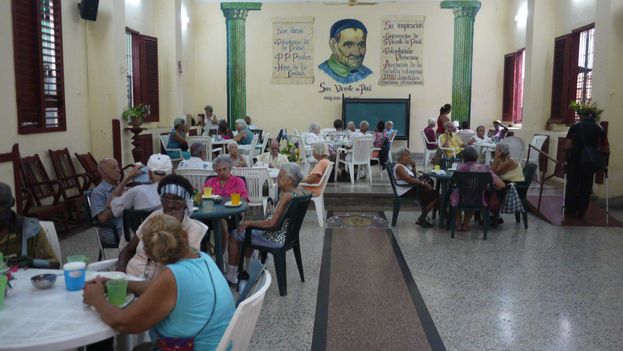
Dining room of La Milagrosa parish in Havana. (14ymedio)

14ymedio bigger14ymedio, Marcelo Hernandez, Havana, 24 August 2017 – He arrives close to noon with a tin cup and a plastic bag. Roberto is one of the many elderly who eat lunch at the Milagrosa parish hall in Havana’s Santos Suarez neighborhood. The ration he receives for breakfast, lunch and a snack is the 78-year-old retiree’s main sustenance; his pension is 220 Cuban pesos (CUP) a month, less than ten dollars.

The place, managed by the Catholic Church, is packed during meal times and the nuns who manage the kitchen say they can barely help all those in need. The humanitarian service will continue, despite the recent death of its leading light, the priest Jesus Maria Lusarreta, who was 80. continue reading

Since he settled on the island in the early 1990s, the parish priest, born in 1937 in the Navarre town of Lumbier, in Spain, promoted various programs to help the elderly and disabled, as well as providing a space for children and young people with Down’s Syndrome. However, the impoverishment of the surrounding neighborhoods has limited the temple’s capacity to help all who knock on its doors.

The place, managed by the Catholic Church, is packed during meal times and the nuns who manage the kitchen say they can barely help all those in need

Lusarreta also established a system of home help to bring food to people who could not get to the parish, and he not infrequently asked for money from his own family in Spain to defray the expenses of a support system that has not stopped growing in recent years.

According to data from the Provincial Directorate of Assistance and Social Security in Havana, 335,178 retirees live in the capital city, with a monthly average income of 272 CUP apiece. Although some have relatives abroad who send them remittances, others must sell cigarettes and newspapers to survive, or live off public charity.

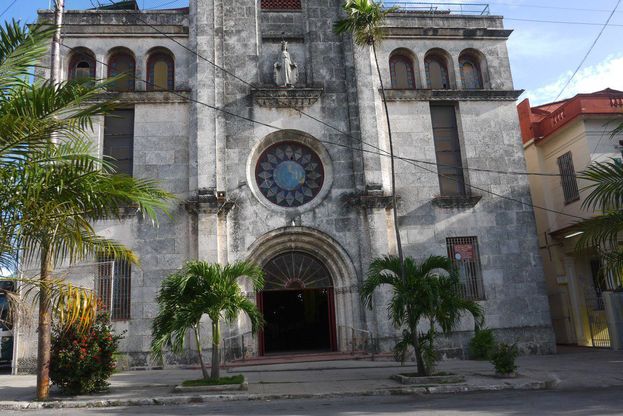
La Milagrosa Parish, in Havana. (14ymedio)

The center, a two-story building attached to the Roman-style temple built in 1947, also has a hairdresser offering free personal grooming, laundry and manicure services. At first there were only a dozen elderly people but today more than 200 show up every day.

In a statement to 14ymedio, a few weeks before his death, the priest regretted that the facilities where they kept some of the resources to help the most disadvantaged frequently fell victim to “robberies and vandalism.” However, he said that, despite the damage caused, he could understand “why people did it.”

One of the retirees, Roberto, separates some of the beans and rice he just received for lunch. “Next to my house is a man who has nothing and I always take him part of what they give me,” he explains.

Roberto and the other neighbors of La Milagrosa cross their fingers so that the project does not falter now that its main inspiration has died.

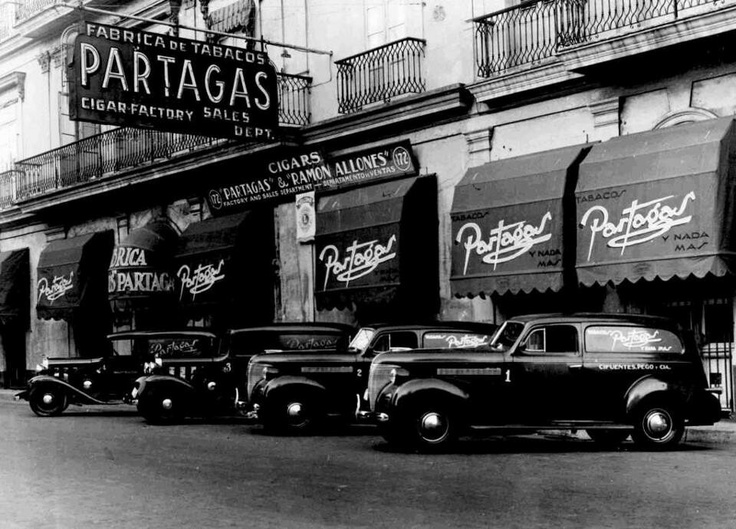
Awnings and Advertisements / Fernando Dámaso

Havana. Source: Cuba Before Castro – Odalys Ruiz

Fernando Damaso, 24 August 2017 — The narrow streets of Havana, in the colonial and early years of the Republic, were covered with awnings from one side of the street to the other, to protect passers-by from the inclement tropical sun and heavy rains. They were mainly placed, along with their commercials, by the owners of the establishments located in them. The awnings and advertisements were part of the image of the city and helped to make it more colorful. Corroborating this are the chronicles of visitors and photographic and cinematographic images, as well as different works of art.

With the development of the city and the widening of its streets, the awnings adapted to the new conditions, occupying only the space of the sidewalks, whether narrow or wide and, without disappearing totally, giving way to the portals in our main shopping streets (Galiano, Reina, Monte, Belascoaín and others) and, in the fifties, returning to the modern avenues of the newly urbanized areas and their commercial centers, enriching the urban environment with their striped designs and colors. continue reading

Something similar happened with commercial announcements: small and mainly textual in their beginnings, they were transformed, gaining in size and artistic quality, until becoming the original illumination of the fifties, adorning the streets and avenues of our cities and towns , Enriching them by day with their color and at night with their luminosity.

Starting in 1959 the awnings began to disappear, destroyed by the weather and indolence and never restored, and the commercial announcements were removed from cities and towns and even prohibited. Then came the unique political propaganda, directed and controlled by the Party: streets, commercial establishments, public fences and artistic and sports centers, still today, display their heavy ideological, dogmatic, repetitive, boring and unbearable weight. Only in some international event that requires it, are the spaces of the propaganda enlivened with some commercial advertisements. It is a secret to no one that commercial advertisements could serve to defray the costs of maintenance of these facilities.

Currently, due to one of the many absurdities, both the installation of awnings and advertisements, especially if they belong to the self-employed, require a long and complicated chain of authorizations and bureaucratic procedures, excessive payments and regulations, which make them unlikely, even if this is detrimental to the comfort of customers and the advertising of businesses.

It would be interesting to know which urban bureaucrat can be blamed for these barbarities and which leader approved them. Awnings and advertisements, in every city in the world, embellish sidewalks and boulevards. In Havana, in addition to the streets, they existed everywhere: at first in front of the restaurants, cafes and bars, as the famous ones in the “open airs” of Paseo del Prado, in front of the National Capitol, and later, also surrounding the whole environment, on the roofs of buildings, both in Central Park and Fraternity Park as well as and along the Malecon, just to name a few.

The authorities of the city and the National Institute of Physical Planning should be more interested in solving the serious problems that affect Havana, than waging a war to awnings and advertisements. This schematic application of the austere, monotonous, gray and unbearable socialist order, has brought as a consequence public spaces (stadiums, sports halls, cinemas, theaters, shops, establishments and even parks) that are ugly, cold and unfamiliar, something different from what happens in any self-respecting city. Regulation is one thing and prevention is something totally different: our authorities have always been prodigal in the second.

If by day our streets are bustling and broken, dirty and stinking, at night they become somber and dark. Then, only the small spaces dedicated to international tourism shine, as if the foreigners were the only ones who deserve to enjoy the beauty and the light, perhaps for the currencies that they contribute to the coffers of the State; while this is denied to Cubans.

Republican Era Cuba, Patrimony Of The Ruling Party

Cuba’s ruling party appropriates the cultural images of Republican era Cuba. (14ymedio)

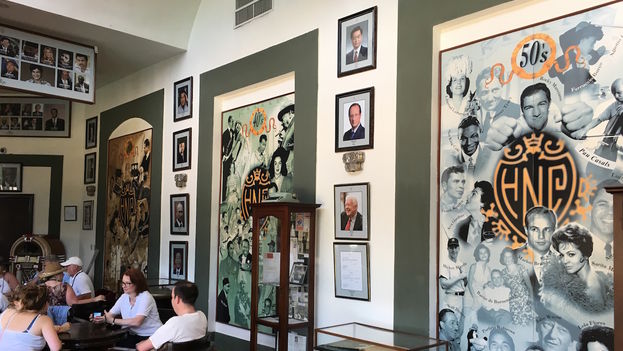
14ymedio bigger14ymedio, Generation Y, Yoani Sanchez, Havana, 24 August 2017 — The gallery near the garden displays the faces of dozens of celebrities who stayed at the Havana’s Hotel Nacional. In one corner we see mobster Meyer Lansky, in another the sensual legs of ballerina Josephine Baker and the broad torso of actor Johnny Weissmüller. All belong to that “cocktail of the past” that gives the foreigners who come to visit an ecstatic rush.

The ruling party has converted the Republican era into its exclusive patrimony. It brings economic benefits to buildings constructed under capitalism, makes the places that served the nightlife of that era profitable, and appropriates the cultural scene of “mediatized Cuba,” as the history books call it. continue reading

The first half of the twentieth century has become a commodity, a product sold in tourist packages, souvenirs and through repetitive “canned” music, which appeals to those who want a shot of nostalgia; but it can also spark disgust when the private sector takes advantage of this scenography with its odor of mothballs.

Most of the images disseminated by the Ministry of Tourism exploit the symbolism of the Island during the first half of the 20th century

Cuba’s first vice president Miguel Díaz-Canel expressed his annoyance in a video filmed last February, for what he considers the “eulogy to the Batista era” promoted by many restaurants and cafes through a décor of photos from the era of the Republic. However, in his speech the official conveniently avoided mentioning the use the state itself makes of marketing that country that no longer exists.

Most of the images disseminated by the Ministry of Tourism exploit the symbolism of the island during the first half of the twentieth century, showing the Floridita restaurant/bar, the Bodeguita del Medio or the Tropicana cabaret. The senior officials of Gaviota and other hotel groups collect dollars in exchange for visually exploiting years that they themselves contributed to destroying.

Like all totalitarianism, the Cuban system seeks to control information and silence; the press and rumors; the past and present. Now, it has ended up closing the circle around the memories of Republican Cuba. Only power has the right to evoke that moment and, of course, it does it in its own way.

The Enigmas of Successions

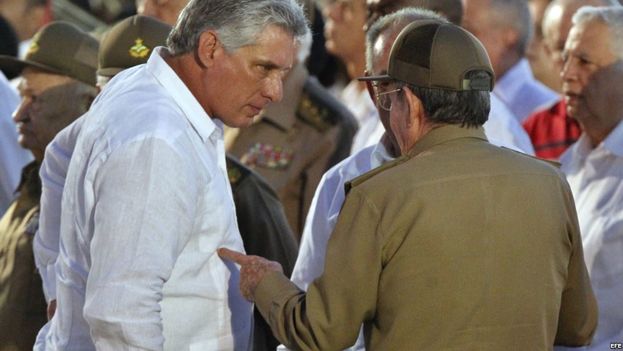
The First Cuban Vice-President, Miguel Díaz-Canel, shown here listening to Raul Castro, is one of the candidates to occupy the presidency. (EFE)

14ymedio bigger14ymedio, Miriam Celaya, Havana, 6 August 2017 – Only half a year before the announced general-president Raúl Castro’s departure from his duties as President of Cuba, it is still not known with certainty who his successor will be. It is undeniable is that whoever the Power choses to give continuity to the failed socio-political and economic model imposed by the olive-green clan will inherit not only a country in ruins with an astronomical debt and an aging population, depleted by the emigration of a large segment of the best of its workforce, but also a very different regional panorama from that memorable summer of 2006, when Fidel Castro proclaimed himself  “provisionally” retired from the Government after placing country’s direction in the hands of a clique led by the current president.

In recent times the continent’s left has been suffering its worst setbacks in decades, after losing the political power that had spread like an epidemic and even seemed fused to some of the most economically strong nations of this hemisphere, such as Brazil and Argentina. continue reading

At the same time, Venezuela, once the capital of this shady Castro experiment known as “socialism, XXI century style,” continues to sink in what many experts consider the greatest economic and political crisis in that country’s history, which has affected a significant contraction of the oil subsidies destined for Cuba, with its implications for an economy as fragile and dependent as ours.

Gone are the fleeting glories of the entelechies born in the wake of the late Hugo Chávez and Fidel Castro, like the Bolivarian Alliance for the Peoples of Our America (ALBA-TCP), created in 2004 in Havana, or Petrocaribe, which was founded in Venezuela in 2005, in order to politically influence the small oil-poor Caribbean nations and buy their support in international forums, in exchange for oil quotas at extremely magnanimous prices.

Despite such an adverse scenario for his interests, it is assumed that whomever is sentenced by Raúl Castro to be his successor will be “reliable”: sufficiently pliable to lend himself to the management of those who really move the political threads

Despite such an adverse scenario for his interests, it is assumed that whomever is sentenced by Raúl Castro to be his successor will be “reliable”: sufficiently pliable to lend himself to the management of those who really move the political threads – and all other threads – behind the scenes, and be reasonably cautious not to attempt the rehearsal of too abrupt a turn that would dislodge the ever-unpredictable social balance in a country saturated with shortages and frustrations. Autocrats do not like surprises.

It is necessary to consider the possibility that – similar to his elder brother when he left power in 2006 – the general-president has conceived a kind of collegial succession, leaving specific functions to several representatives of the different tendencies which, according to widely spread but never confirmed opinions, exist among the groups close to the Power. The bad guys’ great advantage is that they know how to be cohesive when they have common interests to defend.

Thus, a collegial government after the partial withdrawal of the general-president is a perfectly possible variable in a nation where there is only one political party “as the superior governing force of society and the state,” where, as a norm, the ruling caste ominously tends to ignore all the other commandments of the Cuban Constitution and what they themselves have legislated without obstacles in the last 40 years, and where all the political and economic maneuvers are hidden in the most absolute secrecy and come to light only as fait accompli, which saves the mokogos* of the Palace of  Revolution the cumbersome process of requesting approval from the bland Parliament or of also submitting the most important matters of State to the consideration of the (dis)governed.

In fact, this variant of collegial succession – not necessarily explicit – headed by a visible string-puppet does not seem very remote. Especially if one takes into account the experiences of other regional successions, such as that of Nicolás Maduro in Venezuela, elected by the deceased Hugo Chávez at the touch of his finger, but devised to the last detail by his comrade and mentor, Fidel Castro, in order to guarantee the survival of their respective so-called “socialist” projects and their leaders.

The once rampant Chavismo, just as its maker conceived it, has ended up succumbing to the ineptitude of the “successor” and the Castro greed

Suffice it to examine the composition of the Maduro cohort to understand that the red-olive/green arrangement was not only forged in Havana, but was already a done deal long before the Chavez, the “Eternal Commander,” was planted in the Mountain Barracks to end up transmuted into a little bird**.

However, despite the careful calculations of the most experienced conspirators, the ambush that Maduro has led Venezuela into is so complicated and profound that it overwhelms any control. Sooner or later, the dictatorial power will fall, because the situation has become ungovernable and, by appealing to repression and crime to retain power, the Government has lost all traces of legitimacy. The once rampant Chavismo, as conceived by its maker, has succumbed to the ineptitude of the “successor” and to the Castro greed.

Another planned succession, but of very different character, is the one that took place in Ecuador after the triumph of the candidate of the ruling party, Alianza País, in the person of Lenín Moreno in the second round of elections last May.

Moreno, surprisingly and quickly, soon began to detach from the hard and belligerent politics of his predecessor and has developed a conciliatory, inclusive, measured and serene style, seeking dialogues and agreements with different social sectors and with the opposition, which has provoked the virulent reaction of an angry Rafael Correa, who has described Moreno as “a traitor,” among other equally strong accusations.

The cases of Venezuela and Ecuador confirm that changes in power are not always “more of the same”, but can lead to unpredictable turns

 The confrontation has led to a deep fracture within the heart of party, according to the sympathies of its militants, between Correa and Moreno. Nevertheless, during the festival of Lenín Moreno’s electoral victory, a radiant and happy Rafael Correa could be seen celebrating the triumph at full sail, shouting slogans and thundering on the microphones with songs of the radical left (“here is the clear, the affectionate transparency”) as if instead of Lenín Moreno, he himself had won the elections.

Just as all autocrats dream of or aspire to it, Correa certainly believed that the person who was at the moment his cabinet vice-president would now, at the head of the new Government, be a docile follower of his dictates, the visible figure behind which he would somehow continue to exercise the power and iron social control. It has not been the case, and this avoids deepening the country’s internal conflicts and opens the way to a possible process of pacts that will overcome the tensions and social polarization suffered in Ecuador through all these years.

It would be premature to say how successful or not Moreno’s performance might turn out, but it is clear that this veteran does not feel indebted to the previous government, but has his own agenda. If it will benefit democracy and the citizens of Ecuador, let’s welcome it.

The cases of Venezuela and Ecuador allow us to confirm that changes in power, beyond successions or ruptures, are not always “more of the same,” but can lead to unpredictable turns. Thus, succession in Venezuela has resulted in the fraudulent attempt to legitimize a corrupt and repressive dictatorship, while succession in Ecuador seems to favor a return of the democratic spaces violated by the previous ruler. We will wait to see if the Cuban succession offers us a Maduro or a Moreno.

Translator’s notes:
*Ceremonial figure in Kundu settlements of southwestern Cameroon.
** Maduro has claimed that Chavez comes to him in the guise of a “very small bird” and speaks to him through whistles.

Translated by Norma Whiting

License to Kill

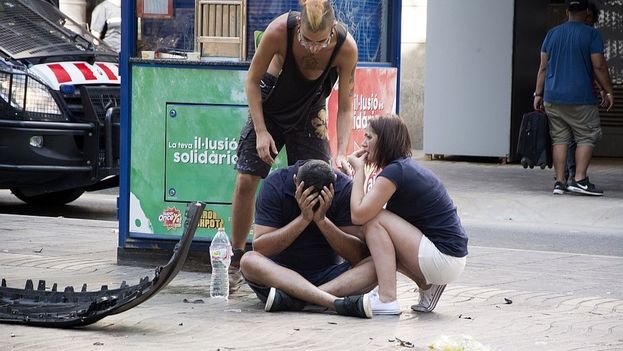
Several young people remain beside the remains of a vehicle, at the scene of the attack last Thursday on Barcelona’s La Rambla. (EFE)

14ymedio bigger14ymedio, Reinaldo Escobar, Havana, 21 August 2017 — The most complex ethical dilemma facing a human being is to make the decision to die or to kill. Faced with this conflict, there are those who justify themselves by arguing that only by taking a life can they defend their family, their patrimony, the sovereignty of a nation, ideological principles or religious beliefs.

The terrorist attacks of the recent years have been committed mostly by Islamic fundamentalist groups convinced that “the infidels” should be eliminated wherever they are. The perpetrators of these acts are willing to sacrifice themselves to the cry of “Allah is great” as they leave a trail of civilian casualties.

There is no novelty in these hate crimes. In Spain itself, where last week a truck hit dozens of people, more than half a century ago Republicans shot the priests and the Falangists killed the poet Federico García Lorca, accused of being a communist and a homosexual. In 2004, in a single day, on 11 March, terrorists killed 193 passengers on four trains in Madrid. continue reading

The revulsion in the face of the attack on Barcelona’s La Rambla now becomes energetic but not unanimous, because revolutionaries find it hard to condemn such actions. The reason for this timidity is simple: Marxist ideology is based on the philosophical principle that the elimination of the opposition — by means of violent action — is the only formula for solving an antagonistic contradiction.

In his well-known Message to the Peoples of the World, published in April 1967 in the journal Tricontinental, Ernesto ‘Che’ Guevara defined in a radical way the sentiment that should accompany every revolutionary soldier: “Hatred as an element of the struggle; a relentless hatred of the enemy, impelling us over and beyond the natural limitations that man is heir to and transforming him into an effective, violent, selective and cold killing machine.”

As if he is advising the jihadists of today, the guerrilla concluded his recommendation warning, “We must carry the war into every corner the enemy happens to carry it: to his home, to his centers of entertainment; a total war.” A phrase that fits with the scene of the pedestrians who were walking along, last Thursday, on the Paseo Marítimo in Cambrils, unaware that the terrorists were preparing to turn their stroll into tragedy.

Revolutionary morality justifies murder and can be used by members of any political or religious sect. There is no difference between killing in the name of social justice, the supremacy of a race, or the imposition of a faith. Hate is intrinsic to the Marxist dialectic because, in the face of the “other,” the position that promotes this ideology does not come to accept it, but to annihilate it. Where the two do not fit, the solution is not to enlarge the space but to eliminate the excess.

Revolutionaries suspect that if they renounce this maxim they will lose the power they obtained by force, and that by showing themselves too tolerant they weaken their authority. A guerrilla, although disguised in the suit and tie of a statesman, knows that he cannot undermine the legitimacy of the armed struggle or violent acts, because they are part of his ideological DNA, they are in each of the chromosomes of his political actions.

These radicals, once they have society under control, undertake another form of extermination against their political opponents. They cut off their economic autonomy, prohibit their free association through laws, prevent them from expressing themselves in the media, and enact laws that penalize their disagreement. They are socially murdered.

The attempt to impose a single religion is similar to that of implementing the doctrine of a single party. In both cases, the promoters of fundamentalism are willing to denigrate, silence and kill “the infidels.”

A Lost Bet / Fernando Dámaso

Fernando Damaso, 19 August 2017 — After more than half a century of absolute power, many of the real and imagined problems that have historically served as the rationale for the Cuban revolution have not been resolved. Most have gotten worse; others have arisen that had previously not existed.

The housing shortage — thousands of families living in precarious and overcrowded conditions, thousands of people housed in inadequate facilities — offers a clear demonstration of its failure. The insufficient and inefficient public transport system, which has for years has been unable meet people’s most basic needs, along with a wide variety of abysmal and unreliable public services are other indications of failure. If we include the significant loss of agricultural capacity, industrial obsolescence, the failure to make major investments or infrastructure improvements, and pervasive low productivity, the situation becomes chaotic. continue reading

Political and social promises have still not been fulfilled. Civil liberties and basic human rights remain in short supply. Meanwhile, salaries and pensions are low while racial and gender discrimination, violence on the street and in the home, poor education, anti-social attitudes, drug addiction, corruption and disregard for the natural environment continue.

Blame for this chain of calamities has always been placed on the “embargo.” But even before it was a topic of conversation, and at a time when the country enjoyed huge Soviet subsidies, these problems never improved much less got resolved. Instead, abundant resources were squandered on foreign wars, subsidized insurgencies, absurdly grandiose and ultimately doomed projects, and other daredevil adventures.

Though they adopt revolutionary rhetoric, the socialist state and its leaders have irrefutably demonstrated that in Cuba the system does not work, that it is impractical, just as has happened in all other socialist countries that bet on it.

Advocating for “a prosperous, efficient, sustainable, sovereign, independent and democratic socialism” is advocating for a contradiction. It amounts to yet another utopian ideal intended to delude citizens and hold onto power for a bit longer, knowing that, in the end, it will fail just as it has in the past. While perhaps attractive in theory, socialism is a failure in practice. Betting on it, in any of its guises, means certain loss.

“I’m Not Going To Erase My Graffiti,” Yulier Tells Police, Who Gave Him Seven Days To Do So

Graffiti artist Yulier Rodríguez was arrested by police last Thursday and released after 36 hours. (14ymedio)

14ymedio bigger14ymedio, Havana, 20 August 2017 — Graffiti artist Yulier Rodríguez was arrested by police last Thursday and released after 36 hours. The arrest occurred while he was painting a collapsed wall at the corner of San Lazaro and Escobar, in the municipality of Central Havana, the artist told 14ymedio.

The police warned Rodríguez that he had committed the crime of “mistreatment of social property” and took him to the National Revolutionary Police (PNR) Unit in Zanja Street, where he spent most of his time locked in a well-known dungeon known as the deposit.

“It is a horrible place, with nothing, dirty and immensely hot,” the street artist to told this newspaper. “There is no room to sit down given the number of people they put in there.” continue reading

In these conditions Rodriguez remained for about twelve hours until an investigator called him to take a statement about the State’s charge against him for “mistreatment of property.”

The graffiti artist, better known as Yulier P, defended himself by insisting that his work “does not mistreat property” because it is done on walls and buildings “that are in ruins.” He added that his interest is “to redecorate these spaces through culture,” with the aim of “creating a more tolerant, more honest, more humane and sensitive society.”

After the interrogation, the investigator informed him that he was being processed and that he was “under Investigation by Counterintelligence (CI).” On Friday night a police officer told him he could pick up his belongings to be released.

“I left half tormented by that situation, and they told me to sign a warning letter where I pledge to erase my work in seven days,” says the artist.

Rodríguez denounced that he was pressured to initial the document, but on the back of the statement he wrote that he did not agree with the measure that directly affected his career, his work and his person.

He explains that after he signed the letter they released him and warned him that “if I didn’t erase all the graffiti I would go back to jail.”

Regarding his plans in the face of this new situation, he said the he wants to “seek international support for people to be aware of this injustice,” and hire a lawyer who can defend him.

“I doubt very much that I will find one because most people flee when they are involved in cases with Counterintelligence, but I’m going to look for one.” The urban artist calls the police decision arbitrary and unjust. “I am not going to erase my graffiti,” he insists.

Yulier Rodríguez Pérez (b. 1989) was born in Florida, Camagüey, but from a very young age settled in Havana with the obsession of being a painter. Although he was never accepted in the academy of San Alejandro, he has turned the walls of the city into his own gallery.

Three #Otro18 Activists Detained On Their Way To The Electoral Commission

Juan Antonio Madrazo was on his way to the National Electoral Commission when he was arrested. (14ymedio)

14ymedio bigger14ymedio, Havana, 17 August 2017 — Three activists from the citizen platform #Otro18 (Another 2018*) were arrested Wednesday when they were on their way to deliver “some suggestions” to the National Electoral Commission in Havana, according the opponent Manuel Cuesta Morúa speaking to 14ymedio.

Those detained are Lisbetty Darias González, Marthadela Tamayo and Juan Antonio Madrazo. “I have been trying to locate them since yesterday but I have not been able to find them, I have gone to all the police stations in the city, there are only four places left to visit,” Cuesta Morúa said.

The three detainees are involved in the Citizens Observer of Electoral Processes initiative, which works together with #Otro18 to promote new laws governing elections, the freedom of association, and political parties. continue reading

Gonzalez was cited Wednesday to appear at the Zapata and C police station, in Vedado, where according to Cuesta Morúa, he is detained. In the case of Tamayo and Madrazo, they went to the National Electoral Commission, located at 82nd Street between 9th and 11th, to deliver “a text with some suggestions from #Otro18.”

The recommendations were intended to “better regulate the voting process and have more citizen control, more transparency from the study of the law,” but so far it has not been possible to confirm “if they delivered the document,” Cuesta Morúa said.

The arrests have prompted a postponement of a press conference scheduled for Thursday, moving it to next week “depending on how things play out.”

For Cuesta Morúa, this week’s arrests are part of an offensive against independent initiatives that promote changes in the laws through the electoral system.

“#Otro18 candidates are the voice of citizens, not the voice of the state, they are fighting for transparency and propose electoral reforms that are supported by citizens,” the opponent clarifies.

Born in August 2015 from a project of the Progressive Arch and the Democratic Action and Unity Roundtable, the #Otro18 initiative has in recent weeks been the target of a repressive escalation aimed at activists seeking to run for positions as delegates in Popular Power districts, this coming October.

*Translator’s note: Raul Castro has said he will step down as president in February 2018. The election process in Cuba has a local component, but it is tightly controlled by the Communist Party. It is illegal to campaign and there is no popular vote of any kind for the position of president.

Cuba to Increase Control over Doctors Working Abroad / Juan Juan Almeida

Cuban healthcare personnel ready to be deployed abroad, to earn hard currency for Cuba.

Juan Juan Almeida, 16 August 2017 — The Cuban government will immediately strengthen controls and political indoctrination of Cuban doctors chosen for overseas medical missions.

According to reports obtained by Martí Noticias, the leaders from Cuba’s Ministry of Public Health of Cuba (MINSAP) met last Friday with all its national and provincial directors to provide them with new directives that will take effect on Monday, August 14.

“The e-mail announcing the meeting warned that we should be ready to report on compliance with Resolution 279 in each of the provinces and to discuss in detail the status of the personnel rotation plan along with the status of current pending cases,” says a source from the medical sector.* continue reading

Resolution 279, which was adopted by MINSAP in 2014, outlines procedures for training and providing human resources associated with providing medical and health services abroad.

The to-do list was distributed to attendees at the meeting, which began at 8:30 A.M.in the main meeting room of the Central Medical Cooperation Unit (UCCM), and consisted of a set of measures aimed at increasing control over Cuban aid workers on medical missions.

At the meeting officials were also informed of directives from the minister of public health, Roberto Morales, to the heads of Cuban medical missions overseas and analyzed the reasons behind the recent rejection by the Angolan government of 189 Cuban aid workers.

According to reports, ANTEX, the Cuban military-run company which provides services and training for joint ventures with the Angolan government, has prepared a new contract to be delivered to the authorities of the African nation.

Some key points of the meeting are as follows:

Political work

Due to the alarming increase in desertions and deactivations of personnel in various missions, it is suggested that a more careful selection of candidates be made.

Pay increased attention to aid workers. Revitalize meetings at the municipal level and pay personal attention to the relatives of those who have died while on a mission.

Review the annual personnel rotation plan

Due to numerous cases of non-compliance with the rotation program, it is necessary to review the current situation regarding shortages of specialists in Venezuela.

As a participating aid workers, directors should record how new resources from the Revolutionary Armed Forces are being used. Also, directors should review compliance with the personnel rotation plan in Brazil and provide information regarding recent changes to the collaboration agreement with that country.

Priority is being given to achieving 100% compliance in current cases. Therefore, it is strongly suggested that directors coordinate with State Security to expedite the approval of candidates.

189 Cuban aid workers’ applications returned by Angola

According to ANTEX, the factors that led to the rejection of aid workers included suspicions of desertion, incomplete documentation, confiscation of contracts, complaints about service provided and conflicts over billing. However, a new dispatch of qualified personnel is being readied and will be assigned as soon as possible to fulfill the commitment to the African sister nation.

Full Name, Specialty and Home Province of Personnel Approved for Upcoming Travel Overseas:

Carlos Emilio Alvarez Segrera, MD, Geriatrics, Granma

Fernando Raúl Rivero Martínez, MD, Neurophysiology, Granma

Rosaida Marrero Rodríguez, MD, Pediatrics, Holguín

Orlando Araujo Herrera, MD, Endocrinology, Havana

Carlos Demetrio Zamora Espinosa, Immunology, Havana

Adonis Montero Barrientos, MD, Neonatology, Las Tunas

Alejandro Virelles Pacheco, MD, Obstetrics & Gynecology, Granma

Silvio Valdés Avila Vera, MD, Obstetrics & Gynecology, Guantánamo

Tania de la Caridad Fernández Nuñez, MD, Microbiology, Mayabeque

Nolberto Rafael Monteagudo Garces, Hygiene and Epidemiology, Las Tunas

Caridad Luisa Mejias Mayo, MD, Microbiology, Las Tunas

Maile Paez Padrón, MD, Obstetrics & Gynecology, Artemisa

Keyly Fernández Garcia, MD, Ophtalmology, Havana

Milagro Sánchez Sarduy, RN, Ciego de Avila

Dolores Enriqueta Colet Figueredo, RN, Granma

Bessel Dieguez Ortiz, Licensed Clinician, Ciego de Avila

Asuncion Fortunata Rodríguez Morris, MD, General Surgery, Havana

Guadalupe Soliman Díaz, RN, Artemisa

Cecilio Vladimir Díaz Noda, MD, Obstetrics & Gynecology, Pinar del Rio

Madelyn Urquiola Mariño, Lab Clinician, Pinar del Rio

Lien Gómez Estacio, MD, Human Anatomy, Villa Clara

Arle Luís Ramos Arencibia, MD, Human Anatomy, Pinar del Rio

Rodney Kidman Nieves Armas, Licensed Lab Technician, Cienfuegos

Mabel Guzman Anglada, Licensed Biologist, Holguín

Rosa Coralia Cisneros Reyna, RN, Holguín

Osmani Becerra Peña, RN, Cienfuegos

Daisy Iliana Luaces Carballo, MD, Psychiatry, Havana

Luisa Bello Zamora, RN, Granma

Giorbis Watson Veola, MD, Obstetrics & Gynecology, Guantánamo

Griselda González Salazar, Secretary-Lecturer, Havana

Angélica González Medina, MD, Dermatology, Guantánamo

Leonardo Naranjo Aguilar, Licensed Lab Techinician, Granma

Ivette Mulens Ramos MD, Obstetrics & Gynecology, Havana

Alina Caraballo Díaz, Licensed Biologist, Sancti Spiritus

Carlos Tablada Cobiella, Telecommunications Engineer, Granma

Gladys Barbara Barberis Pérez, MD, Cienfuegos

Iliana Otero Rodríguez, PhD, Stomalogy, Pinar del Rio

Yainet Medina Magaña, RN, Havana

Adolfo Cruz Carrera, Special Education, Sancti Spiritus

Barbara Fortunata Salabarria Remedios, Licensed Clinical Lab Technician, Sancti Spiritus

Martina Sabina Jiménez Suárez, Special Education in Biology, Cienfuegos

*Translator’s note: As part of a program which generates hard currrency for the Cuban government, Cuban medical personnel are sent to overseas medical missions in developing countries for fixed periods of time. Their services are provided to patients free of charge and costs are covered by the host country. However, increasing numbers of Cuban medical personnel are defecting to other countries before their terms of service have expired and before they can be replaced. The Cuban government has tried, without great success, to stem the exodus.

“We Will Defend Our Cooperative Through Administrative and Political Channels,” Says Cuban Firm, Scenius

The non-agricultural cooperative Scenius is still promoting its accounting services through its website. (Screen capture Scenius.coop)

14ymedio bigger14ymedio, Havana, 5 August 2017 — Alarms have soared in the non-state sector after the independent magazine El Toque announced, on Friday, the authorities’ decision to close the Scenius cooperative, which specializes in economic, accounting and tax advice

“We allegedly incurred a violation of our ‘Corporate Purpose’, but we disagree and we will appeal,” Alfonso Larrea Barroso, a lawyer and the commercial director of the cooperative, told 14ymedio. From the official notification of closure, the executives have 30 days to liquidate operations with their fifty clients.

Two years ago Larrea offered statements to the official Juventud Rebelde (Rebel Youth) newspaper in which he said Scenius is “the infantry of the cooperativism,” being the first cooperative to provide economic, accounting and financial services. continue reading

At that time, Larrea was optimistic and estimated that by 2016 the country would have some 12,000 non-agricultural cooperatives (CNA), a form of management authorized since 2012. “With an average of ten members in each, there would be almost 120,000 members. And thinking about the traditional family, there would be 480,000 people directly affected by this form of management,” he predicted.

However, that projected figure was never achieved and only 431 CNAs were constituted as of the end of the first half of this year.

Now, Larrea and his colleagues have hired a lawyer, who will appeal the decision of the Ministry of Finance and Prices. The entrepreneur regrets not only the end of his project, but also the more than 320 people who will be without work after the closure.

The commercial director also told this newspaper that at present “one hundred percent” of his clients “are state-owned enterprises, for example the Ministry of Agriculture, the Ministry of Communications and the Center for Neuroscience.”

After they were informed of the decision, Scenius managers held a meeting with the partners and the employees. “The decision was taken to defend the cooperative in every possible way, first by administrative means and second on the political side, that is, to demand that there be a discussion,” says Larrea.

Scenius has been dedicated, since its creation, to verifying the quality of accounting records and working with bookkeepers, and was also involved in the development and execution of economic plans, the preparation of investment budgets and the management of collections or payments. Their motto speaks of this approach: “Every champion has a coach.”

In the most recent session of the National Assembly, the CNA form of management was the target of Raul Castro’s criticism during his closing speech. “We decided to allow the cooperatives, we tried with some and immediately we launched ourselves to create dozens,” said the leader.

Castro said that many of the decisions in this sector have been made with “a good dose of superficialities and an excess of enthusiasm… We have not renounced the deployment and development of self-employment, nor the continuance of the experiment of non-agricultural cooperatives.”

This week the government also announced the temporary and final suspension in the delivery of licenses for several forms of self-employment, a decision that has caused great nervousness in the private sector.

Real Men Don’t Use Umbrellas

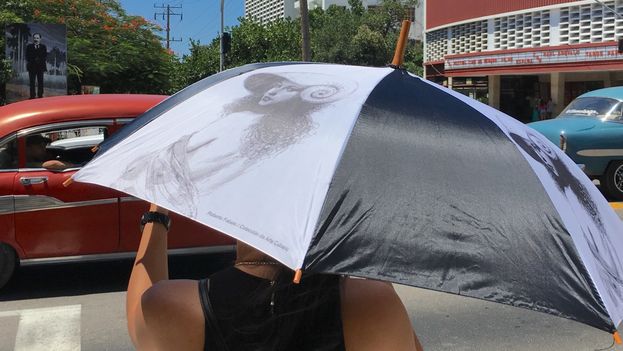
A woman walks along the Havana Rampa with an umbrella from the Artex chain of shops. (14ymedio)

14ymedio bigger14ymedio, Havana, 16 August 2016 — “A man who is a man does not eat soup or sleep on his stomach,” says the popular quip, to which should be added that nor he does not use an umbrella. Despite the overwhelming heat that characterizes the Cuban summers, protecting oneself from the sun is still “a women’s thing,” a “female affectation,” think the macho.

On the streets of the island, there are hardly any men sheltering under an umbrella, wearing wide-brimmed hats – unless they have just left work in the fields – let alone using sunscreen. Taking shelter from El Indio (the burning sun) is somehow “weak” and masculinity is seldom associated with caution in the face of weather scourges.

However, the most common cancer on the island is skin cancer. In 2013, there were 10,432 cases of people affected by this disease and three years later 461 patients died as a result of this disease, of which 281 were men and 180 women.

Three Activists Arrested At Santiago Cathedral Receive Their First Prison Visit

14ymedio bigger14ymedio, Havana, 15 August 2017 — The Aguadores prison authorities authorized on Monday the first family visit to the three activists arrested during the protest at the cathedral of Santiago de Cuba on July 26, 14ymedio was told by Reina Silvia González, wife of Alberto Antonio Ramírez Odio, one of the detainees.

During the meeting, which lasted half an hour, Gonzalez was also able to see her brother-in-law Leonardo Ramirez Odio, and the father of both young people, Alberto de la Caridad Ramírez Baró. The three men were transferred to the prison last week on a provisional basis while the investigation process is underway, in advance of filing charges against them. continue reading

Gonzalez, who went to the prison along with the brothers’ grandmother, told this newspaper that “they are in good health.” Since they arrived at the prison “everyone is eating” and “they are all together,” although the authorities “have threatened to separate them” and send each to a different prison.

“They did not tell me the date of the trial yet, but I was able to learn that, from now on, the visits will be every two weeks,” Gonzalez said. She also reported that the prison guards spoke to her in “very bad form.”

The woman said that the prison is far from the city of Santiago de Cuba, in a location that complicates the travel of relatives to the visits.

The activists belong to the Committee of Citizen Defenders of Human Rights (CCDH) and had demonstrated along with the opponent José Carlos Girón Reyes. They held up posters that read “58 years of deceit, hunger and misery,” and “The people demand freedom, Justice, democracy” and “Viva the right of expression, opinion and of the press.”

The protest occurred a few yards from the headquarters of the People’s Power of Santiago and was recorded in a video produced by the Patriotic Union of Cuba (UNPACU). Opponents also shouted “Down with the dictatorship, Down with Fidel, Down with Raul, Down with Congress.”

The action was a challenge precisely on the day that commemorated the 64th anniversary of the assault on the Moncada barracks. A few minutes after the protest began, the National Police and State Security intervened and detained the activists.

Trade Between Cuba And Venezuela Falls 70% In The Last Two Years

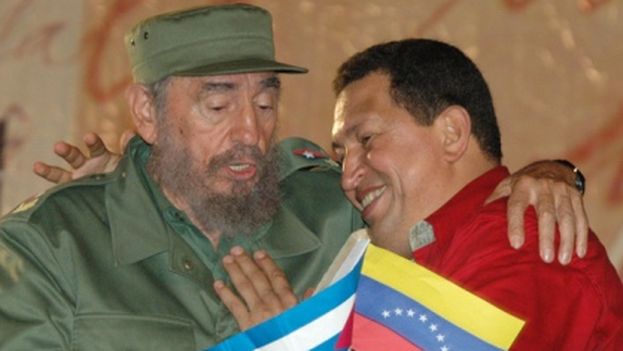
The deceased Fidel Castro and Hugo Chavez signed a Cooperation Agreement between Cuba and Venezuela in 2000, but the economy of the latter has lost its strength since then. (Embassy of Cuba in Venezuela)

14ymedio bigger14ymedio (With agency information), Havana, 16 August 2017 – The effect of the Venezuelan crisis on the Cuban economy is greater than expected, judging by the latest data from the National Statistics Office (ONE) that reveals a 70% fall in trade between the two countries in only two years.

The trade in merchandise was $2.2 billion in 2016, compared to $4.2 billion a year earlier and $7.3 billion in 2014. Cuba has had to reduce imports from Venezuela and there has also been a cut in fuel shipments which has affected Cuba’s domestic economy, which fell into recession for the first time last year with 0.9% fall in the Gross Domestic Product.

Venezuela’s exports fell to $ 1.6 billion in 2016 from $ 2.8 billion in 2015 and $ 5.1 billion a year earlier. On the other hand, Cuba exported to Venezuela 642 million dollars in goods in 2016 compared to 1.4 billion dollars in 2015 and 2.0 billion in 2014. continue reading

Cuba’s trade in goods totaled $12.6 billion in 2016, down from $15 billion in 2015. The economy has grown by 1.1% in the first half of the year, according to official figures, but the tightening will continue and could be extended, according to the government.

Cuba’s dependence on Venezuela continues to be very strong and Cuban has no solid alternative plan, the prospects in this regard are not good. In 2017 so far, the Venezuelan government has sent Cuba 13% less crude oil and other fuels, compared to the same period last year.

The governments of Cuba and Venezuela maintain an alliance forged by the late Fidel Castro and Hugo Chavez. As a part of this alliance the island exports professional services to Caracas, particularly in the health sector, in exchange for oil and fuel. At the high point of the accords, in 2008, Havana received some 115,000 barrels of crude oil a day at subsidized prices, but due to the economic crisis in Venezuela, that amount has been reduced to 72,350 barrels a day.

Cuba intends to supply these energy deficiencies through Russia after more than a decade without having to resort to that country.

Meaningless Nonsense About the Flag / Fernando Dámaso

The flag, better “well adjusted” some think. (14ymedio)

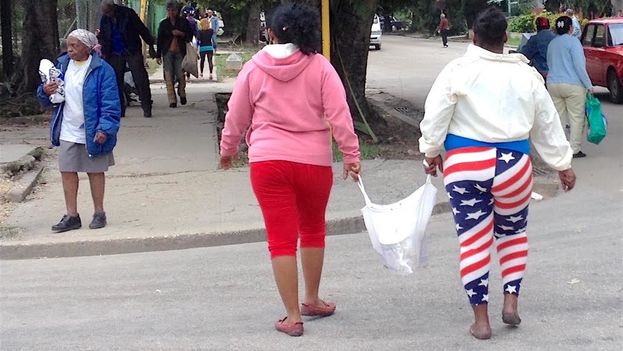
Fernando Damaso, 24 April 2017 — The “official experts” continue talking and writing about the “correct” use of the national flag. Some of the arguments they trot out are laughable. The problem is not so much the rejection of the use of the national flag on clothing, as criticising the use of the American flag by many, mostly young, Cubans. It is something ideologically unacceptable  for fossilised minds. Let´s take ít one bit at a time.

In the United States, from when it was born as a nation, the flag has had an important place in the life of its citizens. Honoured and respected, it can be seen in government institutions and in front of many houses, as well as on the facades of many buildings. It is also everywhere in sporting and leisure facilities, and framed ones adorn the rooms of young people and adults alike and even the walls of commercial organisations. As if that weren´t enough, it appears on clothing and different consumer goods, with original and bold designs. It has never been idolised, but forms part of the daily life of every American. Something similar, though to a lesser extent, happens with the British flag. continue reading

In Cuba, the flag accompanied the Mambisas (a mixture of Cuban, Dominican and Filipino fighters for independence) who fought for independence in the 19th century but, when the republic was established, it became an official symbol of state, on display only in state institutions from dawn to dusk. It never featured in peoples’ day-to-day lives, apart from certain patriotic dates, like 10th of October, 24th of February or the 20th May.  During the years of the Cuban republic it was an object of respect, and its use was well regulated.

After 1959, the flag began to be used in a thoughtless way by the authorities, often without worrying about the established norms for its use, for any kind of political event and, over time, for many people, losing its emotional impact. And more than that, they put other flags next to it which had nothing to do with it, and that compete with it for importance (which is what happened with the 26th of July flag).

This totally anomalous situation changed it, for many, into more of a symbol of a government which had appropriated it, rather than of the Cuban people. In other words, the flag had become “official”, like the guayabera (a kind of mens’ shirt similar to what barbers wear), “safaris” and checked shirts that government officials are in the habit of wearing.

Nowadays no Cubans wear such clothes, least of all young people. They appear to be repudiated. Also, very few Cubans are interested in putting up a flag in their home or displaying it as a part of their clothing. The problem does not have to do with regulating, or stimulating, its use, as some suggest, but in honestly pointing out why many young people, and some not so young, wear clothing with the American flag on it.

Listen, you brainy ideologues,  don’t you understand that it’s a subtle way of demonstrating a preferance for a different system to the one we have here?

It isn’t, as you think, a problem about “trashy merchandise”, nor about “imperialist aggression”. Test it out, design some clothing with the flag, or parts of it incorporated, and you will see how few people actually buy it.

Translated by GH