Censorship / Regina Coyula

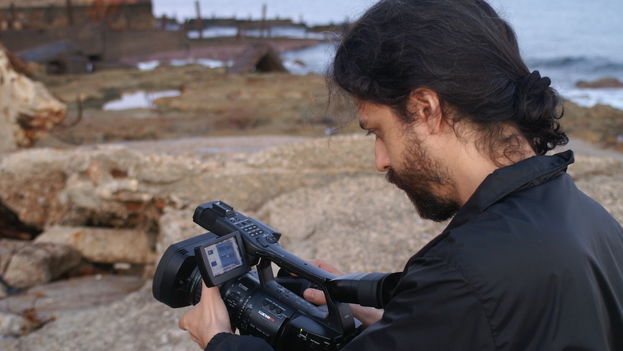
The filmmaker Miguel Coyula shooting. (Personal file MC)

Jorge Enrique Lage interviews Miguel Coyula (extracts) 6

[Miguel speaking]… I am against censorship, as we’ve seen what happened with that film in the Havana Film Festival in New York; it spreads beyond the geographical limits of the island for extra-artistic interests. I mean, politics touches everything.

The worsening of the position goes back to the censorship of the film El Rey se Muere (translated into English both as “Exit the King” and “The King is Dying”) in 2015. Many people defended Juan Carlos Cremata’s work, saying they did not believe that the censors would interpret the king as being Fidel. That is, they used the language of the government to try to address the problem, when it was clear that the reference point was him. What they should have said was “Yes, it’s Fidel. And what of it?” continue reading

To the extent that artists draw up their mental blueprint to go “as far as they can” there will never be a truly independent art form. It ends up affecting not just the content, but also the form.

Liberty has to be absolute, in order to be able to take risks, and to take off. Nothing can be sacred. At least, that’s how I see art. I’ve never been interested in being part of the political game, of religion, of the consumer society, or of drugs. It seems like a nothing, but a film-maker, interested in social or political issues, who cannot have one of his characters say “when are Fidel and Raul going to die?”, which is a such a common thing to say in Cuban homes, along with much more agressive variants on the theme, is symptomatic of a dysfunctional whole.

The artist documents his time, but, looking at Cuban films made in the island over the last seventy years, you’d think that no Cuban had ever asked that sort of question. Recently I was told, by way of advice: “You can fiddle with the chain, but not with the monkey, otherwise you are out of the game”. To which I replied: “Who said I see it as a game?”

It is essential that film producers are ready to completely defend their work,  because a half-assed attitude only gets you a slow-motion impact, which is inevitably reflected in subsequent works. You can’t give an inch.

But, returning to your question, the most recent case of censorship had to do with Nadie (Nobody), April 15th just gone, when the State Security and the PNR (National Revolutionary Police) blockaded the entrance to the El Circulo Gallery where they were going to show it. This censorship is not an institutional arrangement but a blatant governmental act, a complete invasion of a private space by way of a show of police force.

Many people outside Cuba ask me how can it be possible that no Cuban intellectual living in the island made any public protest about what happened. The film had its international premiere in the Dominican Global Film Festival, where it was awarded the Best Documentary prize, but it has been ignored by the island critics.

We don’t know if it’s good, or bad, or they were left feeling indifferent to it, or if, simply, they were afraid of writing about it, as it’s difficult to make a critical appraisal of Nadie without mentioning Fidel Castro. And, to this day, that’s the line almost no-one has dared to cross.The rock group Porno para Ricardo is one of the few who have dared to confront it, and, well, the price they have paid is that they are not allowed to play in Cuba.

Translated by GH
Machado Ventura Denies Cuba’s Mediation In The Venezuelan Conflict

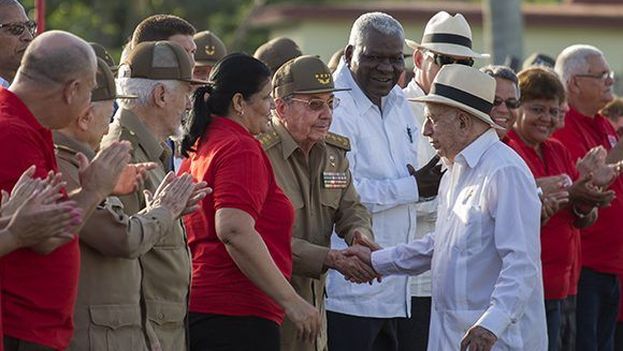
Machado Ventura and Raul Castro greet each other in Cuba on the 26th of July Celebration. (EFE)

14ymedio bigger14ymedio, Marcelo Hernandez, Havana, 26 July 2017 – There were few surprise in Jose Ramon Machado Ventura’s speech this Wednesday during the ceremony for National Rebellion day in Pinar del Rio. The Cuban Communist Party number two reiterated that “the direction of the Revolution is laid out,” and denied that Cuba was participating in the solution to the Venezuelan conflict, as suggested by the British newspaper the Financial Times.

The national celebration of the 64th anniversary of the assault on the Moncada Barracks in Santiago de Cuba and the Carlos Manuel de Céspedes Barracks in Bayamo, was the last that Raúl Castro would attend in his capacity as president of the country before his retirement on 24 February of next year, and also the first after the death of Fidel Castro in November. continue reading

The ceremony took place in “a provisional place of the Revolution,” according to local media, in the absence of a permanent space for official ceremonies. Controls on the roads have increased since the weekend and during the day of the event vehicles were not allowed to circulate near the ceremony site.

Machado Ventura, as the main speaker of the event, called for respect for Venezuela’s autonomy and attacked Luis Almagro, secretary general of the Organization of American States (OAS), whose performance he described as “disgusting” and “at the service of imperialism.”

The Cuban vice president strongly criticized Almagro’s appearance before the subcommittee for Latin America of the United States Senate last week, when the OAS Secretary General denounced the “collapse of democracy” in Venezuela.

“In recent weeks, the interventionist and destabilizing actions against the Bolivarian and Chavez government led by constitutional president Nicolás Maduro Moros have increased,” Machado Ventura said Wednesday. He criticized the recent threat of sanctions on Venezuela announced by Donald Trump’s administration.

“A few days ago an influential American (sic) newspaper was discussing the alleged involvement of our country in an eventual international mediation related to the situation in Venezuela,” he said. “Cuba flatly rejects such insinuations and claims absolute respect for [Venezuela’s] sovereignty and self-determination,” he added.

Last week the British newspaper said that Colombian President Juan Manuel Santos had traveled to Cuba to convince Havana to mediate in the “growing” Venezuelan crisis, which left more than 90 dead after three months of protests.

Those who attempt, from the outside, to give lessons in democracy and human rights while encouraging the violence of coups and terrorism must take their hands off that nation

“Those who attempt, from the outside, to give lessons in democracy and human rights while encouraging the violence of coups and terrorism must take their hands off that nation,” Machado Ventura said pointedly to the island’s senior government officials, local officials and a small number of foreign guests.

The rest of the speech was devoted to the historical review of the revolutionary process and to comparing the current situation of Pinar del Rio with that of January 1959. “We have programmatic documents that set the direction and scope of the changes that we will continue to make with the aim of achieving a prosperous and sustainable socialism,” he explained about the future of the country.

The speech shunned the national reality, ignoring issues such as self-employment or cooperatives that have generated concern among citizens after Raul Castro, speaking to the National Assembly of People’s Power, warned of deviations and irregularities detected in the non-state sector.

Maduro Takes Venezuela One Step Closer To ‘Cubanization’

President Maduro learned from the Cuban regime that he can justify the lack of freedoms with supposed external threats. (EFE / Cubadebate)

14ymedio bigger14ymedio, Havana, 31 July 2017 –This Sunday Nicolás Maduro buried what was left of Venezuelan democracy. He did so in spite of international criticism, national protests that for more than a hundred days have demonstrated disapproval of the Constituent Assembly, and the difficult economic situation that the country is going through. The new organ of power that is born of this vote copies the Cuban model and closes off any peaceful path to a change in the system.

Havana rushed on Monday to announce the official victory in Venezuela. The headlines appearing in the newspaper Granma, an organ of the Communist Party of Cuba, have all the traces of news previously dictated by a Plaza of the Revolution that has neatly packaged Sunday’s election. Not even the reality of poor turnout and the rejection of several Latin American governments has managed to reverse that script. continue reading

Venezuela has begun to walk a path with no turning back. It awaits the dismantling of the few independent structures that could confront the craving for control from Miraflores Palace. From now on, the battle against all vestiges of citizenship will be protected in a supposed entity of “popular power” tailored to the interests of the United Socialist Party of Venezuela (PSUV) and a pitiful copy of the Cuban National Assembly.

In his first statements after the vote, Maduro has already signaled what is coming and made threats against Parliament, the Prosecutor’s Office, opposition leaders and the press. This diatribe will intensify in the coming days and, as the president warned, could end up leading those most critical of these events to “a prison cell, under the command of necessary justice.”

As Fidel Castro once disarmed Cuban civil society, pushed thousands of people into exile and imprisoned or shot his antagonists, chavismo is now preparing to ruin Venezuela for political diversity and civic participation. In order to achieve this, Maduro turns to the carrot and the stick, just as it has been done for almost six decades in this Island.

An army of public workers forced to do what the ruling party dictates, thousands of families dependent on subsidized food products, and a rhetoric of hate to frighten his detractors are some of the weapons that Maduro uses to control a Venezuela assaulted by crisis and political absurdity.

Ranged against the totalitarian longings of Hugo Chavez’s heir is a part of the population that tries to recover in the streets what has been taken away in the institutions, but it can not sustain the battle for long against the military and trained police forces. There is also the international community, accustomed to expressing itself in memorandums and declarations with little practical effect.

Maduro knows that time and diplomacy can appease international agencies and foreign governments. He has learned to lobby the United Nations and to buy the blessing of influential figures who bray for the respect of Venezuelan sovereignty. He understands that a dictatorship can be enthroned and can justify a lack of freedoms with supposed external threats, as he has been taught by the Cuban regime.

This Sunday’s fraud barely leaves two possible paths: the capitulation of civil society and the consummation of totalitarianism or the terrible path of social conflict. Whatever happens, the country will be faced, for decades, with the ghost awakened by this Constituent Assembly.