14ymedio, Eliecer Avila, 28 February 2015 — A topic that is raised for discussion these days is the obsolete argument that some official voices never stop repeating at every opportunity they have to strain relations between Cuba and the United States or rather between Cuba and the Outside World. I am referring to the supposed “need” of implementing “appropriate measures designed to avoid the penetration that the enemy hopes to make into Cuban society.”
Just a few days ago, in the context of the first National Workshop on Computing and Cyber-Security held in Havana, with the physical or virtual presence of thousands of computer engineers, really absurd speeches continue reading
were heard that, far from inviting the use of emerging opportunities to propel development, called for “being on guard” in the face of new “maneuvers” by the enemy to “penetrate” Cuban society.
I would like for some of these birds of ill omen really to explain, with what does the United States want to penetrate us? Or at least, with what negative thing? Maybe a virus? For that there are anti-viruses. With information about our own reality? We, the people, are screaming for that on our own.
Our youth (…) already think about the world and conceive their aspirations in the same way as do the youth of New York
With capitalist propaganda? Our youth do not need it, they already think about the world and conceive their aspirations in the same way as do the youth of New York, sometimes even a little more capitalistic than those. With TV series, soap operas, shows? That is what the Cuban family watches every night, just a week behind. With vice and prostitution? Please, those are fields of enormous potential for replacing imports.
The more I think about it, I do not really find the harmful impact about which these things of which gentlemen speak. Could it be rather that they are preparing the terrain in order to justify the excessive and paranoid control that is planned for the future Cuban web surfer?
I believe that the old scheme of being able to try to survive at all costs, defending its privilege of being the only one that can “penetrate” the minds, every day, 24 hours a day, of all Cubans and many others out there. . .
The reality is that we do not need the Cuban government to “protect” us from any external influence. We are millions of Cuba adults responsible enough to make own decisions in the physical world as well as in the virtual one, who want for our country the same access to the Internet that is widespread on the planet. With all its risks and infinite possibilities.
Do not defend us anymore; no one has asked you to.
Rebeca Monzo, 8 February 2015 — After reading an article from the January 31, 2015 issue of the newspaper Granma about Cuba and the United Nations Development Program (UNDP) entitled “Cooperation Leads the Way,” a ton of questions came to mind about the subject at hand.
It has been forty years since a UNDP office was established in our country with the objective to collaborate with the island’s government on the promotion of social development and public well-being.
From my meager understanding, the only party to have benefited from this has been the government itself, especially in terms of the favorable publicity it has received. They make up a negligible part continue reading
of the population but the Cubans who work for this and other UN organizations are paid in CUC (Cuban convertible peso), which surpass by leaps and bounds the highest salaries of the most qualified professionals in our society, who are paid in CUP (Cuban pesos).
According to the aforementioned article, Granma “chatted” with Mrs. Jessica Faieta, Director of the UNDP Regional Bureau for Latin America and the Caribbean as well as the Assistant Secretary-General of the UN, who discussed the improvement of the quality of life of our citizens. She recognized the efforts of the Cuban government in regards to food security and the strengthening of the agricultural and non-agricultural cooperatives, pointing out, in addition, that the Cuban healthcare system has been strengthened.
With all due respect, it strikes me that this official had only a limited view of the situation, as is the case with everyone who visits us. Guests are taken only to those organizations that have been prepared in advance by the government and which serve as “display windows” for foreigners.
Perhaps if she had to depend on the ration book for a while or to seek medical help at one of our clinics — those used by the average citizen — it is quite possible she might think differently. I do not understand how UNDP, based in our country for four decades, has not been given the task of investigating on their own — in closer contact with the population — to verify the “wonderful statistics” provided by the government, which does not at all reflect our reality.
One need only take a stroll through Central Havana, Old Havana (provided one ventures beyond the historic center), Cerro, Tenth of October Arroyo Naranjo, San Miguel del Padron and even Vedadao and other neighborhhoods to see the poor sanitation conditions and overcrowding in which the Cuban people must live. and the lack of specialists in our health centers, for being these missions abroad, being replaced mostly by students, many of them foreigners. There is also the issue of a shortage of specialists in our health system due to the large number of them serving abroad in medical missions. They are being replaced mainly by medical students, many of them foreigners.
In terms of our society’s standard of living, it should be pointed out that the disappearance of the middle class — the very mark of a country’s wealth — has led to the emergence of an impoverished class (with equality for all) with salaries that do not cover even the most basic necessities. The contrast is made even more striking by the emergence of a leadership class with an affluent lifestyle which only accentuates the differences.
However, Mrs. Faieta and I are in full agreement when it comes to the positive steps taken towards normalization of diplomatic relations between the governments of the United States of America and Cuba. Once there is a successful outcome — one hopes sooner rather than later — it will be to the benefit of all Cubans. I believe that it is time to end once and for all the blindness that until now has led the way.
After the Tenth Assembly of the Central Committee (CC) of the Communist Party of Cuba (PCC) the news about the next “enactment of a new electoral law; and the subsequent holding of general elections” has begun to circulate in the official media. Such an important announcement in a country where, for more than 60 years ago no general election has taken place, is mentioned almost tangentially, just nine words in an informational note on the above Assembly, whose “focal point” had to do with issues related to the preparations for the celebration of the April 2016 Sixth Congress of the single party.
So this is how the casual style of the announcement turns out so very misleading, downplaying a code continue reading
whose nature would be essential in any minimally democratic society.
It is unknown what motivates this renewal of the law in a country whose government, until recently, boasted of having the most fair, transparent and participatory electoral process in the world, able to summon an overwhelming majority of voters to the polls. The case provokes many questions, some very basic: Why change a law that is supposedly a paradigm of democracy even for the most civilized nations on the planet? Why does the proposal arise from the central committee and not from the higher authorities of the People’s Power, as might be expected? What reason is there for the urgency in enacting a new Electoral Law?
Once again, we only have speculation in the face of official secrecy and conspiracy. In fact, this time they have not announced the completion of an extensive process of “popular consultation”, though it was conducted – at least in a formal manner — for several months in 2013, before the creation of the new Work Code currently in effect. The time span between the April 2015 “partial elections” and the enactment of the new Electoral Law was not clearly established either, though judging from the official information that was disclosed we can assume it will be brief.
In this society, alien to all politics and stripped of every right to elect its leaders, the news has not caused the least impression
In principle, the announcement has accomplished the government’s purpose: to not awaken dangerous expectations among Cubans, especially after the wave of enthusiasm that seized many with the December 17th announcement about the restoration of relations between Cuba and the U.S.
In that vein, subsequent statements by the General-President during the last meeting of CELAC cooled the wildest fires, and, at the same time, they have widened the gap between the Government and citizens. No doubt that the olive green tower has proven that the hope for effective changes for Cubans focuses more in the future steps of the “enemy” government than in the “actualization of the model” endorsed by mediocre Raulista reforms. The Revolution has become a succession of failures, and today the old Sierra Maestra combatants and their side troops sense that the smallest of openings could end in a loss of control.
For now, it seems impossible to imagine what “new” democratic clauses the same dictatorship that has dominated life and property for 56 years might have in store for us
It is fair to say that the fears of those in power are well founded. Wouldn’t it be right to expect that the multiparty system requirements or, at least, a strong controversy about the one-party system would emerge from an extensive debate by Cuban society? Are we not in a favorable scenario for claiming genuine democratic participation and transparent general elections to replace the electoral farce practiced for the past 40 years? Obviously, the elderly leaders will not want to take too many risks.
For now, it seems impossible to imagine what “new” democratic clauses the same dictatorship that has dominated life and property for 56 years has in store for us. In any case, the sacred scriptures say that you cannot pour new wine into old wineskins.
Everything indicates that the new electoral law will yet another plot of the power and its claque, just a hasty move to bolster up the makeup that minimally covers the dictatorial nature of the regime, and to silence the scruples and demands of the nations gathered at the Americas Summit this fast approaching April. Presumably, the olive green cohort – who might do away with uniforms and decorations and dress impeccably in civil garb for the occasion — will brag about the partial election results and offer the new electoral code as irrefutable proof of his willingness to change and his democratic calling. If it weren’t so twisted, such a pathetic pantomime would be laughable.
However, we could be facing a dangerous move here that would entail a high cost for the democratic aspirations of the Cuban people. Civic orphan-hood and generalized apathy are the best cards the Havana regime is counting on. It is urgent that public opinion be alerted about a possible ploy that – in the style of “eternal socialism” style — would only want to artificially postpone the end of the most persistent and pernicious dictatorship of the many that have blossomed in this Hemisphere.
Cubanet, Roberto Jesus Quinones, Guantanamo, 16 February 2015 — A rumor is keeping the medical sector in Guantanamo euphoric, and it provokes immediate outbursts of joy in hospital corridors, in homes and in every place the supposedly good news is known. No one knows the origin of the rumor nor its hidden intent.
According to those who are in charge of spreading it, very soon the government will increase the salary for doctors. And, as happens with every rumor, there are always those who know everything about it and affirm that the new increase will be put into force to try to contain the exodus of physicians abroad by way of continue reading
a 30-day exit permit, a type of safe conduct that helps them flee.
These experts assure that the new increase will raise physicians’ salaries to 5,000 pesos per month (200 dollars), an astronomical pay in Cuba, but that they’ll only receive it if they agree to sign a document saying they will remain in the country for five or ten years without asking for the exit permit.
However, a few days after the rumor appeared, the voices of others begin to be heard. They speak clearly, affirming that not even with this increase, which would place the doctors in the vanguard of the Castro Communist labor aristocracy — now made up of Party and governmental bureaucracy along with the sportsmen of high performance and the high officials of the armed forces and the Ministry of the Interior — would they be able to contain the massive exodus of these professionals abroad. Above all to Ecuador, a country that doesn’t request visas and where there already exists a developing but prosperous Cuban medical community that has taken care of communicating to its colleagues on the Island the high lifestyle that is rapidly achieved in the land of Eloy Alfaro.
Because 5,000 Cuban pesos are around 200 dollars, a sum very inferior to what any Cuban doctor could earn abroad.
Between the well-being within reach and the promises of a prosperous and sustainable socialism, which no one knows when it will arrive nor if also there is another rumor or a new feverish chimera of the Cuban leaders, you don’t have to rack your brains to decide. Stupid people are more scarce every day, and the ideological teque* has been in intensive care for some time.
I don’t know what the government will do to stop this flight of doctors, which has a direct effect on one of its most trumpeted social accomplishments — currently in a very precarious state, among other things because of the lack of specialists — and on the export of health services, which is perhaps, together with tourism, the most lucrative activity of the Cuban economy at this time.
In case the rumor becomes a certainty, let’s see what happens with the other professionals, because the flight of qualified personnel is not limited to the medical sector. Pandora’s Box is open, and the government doesn’t give any signs that will let us believe it is possible to close it and, above all, to convince us.
*Translator’s note: “Teque” is literally a spinning top, and is used in Cuba to mean old, worn out, political harangues.
Imagine you are at a party where a suckling pig is being roasted and all of a sudden, at the height of the festivities, Raúl Castro comes along with a bucket of water and douses out the fire. I cannot conjure a more apt image to illustrate the effect the army general’s speech at the Community of Latin American and Caribbean States (CELAC) summit had on the spirits of Cuba’s dissidents.
What Raul said was a recycling of what the secretary of state was saying. It was the spitting image, cut to size, to summarize the state of affairs. While the inhospitable bucket of water was being filled, he left it to the Cuban Communist Party (PCC) to release the statement by the American government indicating that the reestablishment of diplomatic ties between that country and ours did not include a lifting of the embargo, the closure of the U.S. naval base at Guantanamo or permission for American tourists continue reading
to travel to Cuba.
“So the Americas have not had to hang their heads as low as TV and newspapers have been telling us,” noted one party stalwart while waiting in line at a pharmacy.
With the PCC not being terribly secretive on this issue, one dissident was heard to express the following words of despair:
“Rather than making our work for democracy easier, this could make it more difficult. The United States and the Soviet Union had diplomatic relations and even then it was a cat and mouse game. Given that experience, if up till now they have imprisoned us, in the future they could execute dissidents for being American spies, which is what happened to Russian democracy advocates in Soviet times.”
Other dissidents are less pessimistic. After the initial impact of the unwelcome bucket of water that Raul used to dampen the festivities, some began to look at the glass and realized it was not half empty but rather half full.
Times have changed. No matter how much Raul might like to resurrect the tactics of the USSR, he cannot. According to Marx every organism contains the seeds of its own destruction, as I heard said to a proverbially enthusiastic dissident and learned man. Such is the case with socialism, to which Raul Castro must ever increasingly apply capitalist remedies in order to survive. The now almost five-hundred thousand self-employed workers — an army that just keeps growing — will be the gravediggers of the system.
Clearly, they are not politicians; they are merchants. They are in the business of making money and, not surprisingly, would prefer not to court problems with the government that might stand in the way of their making even more money. The great paradox, however, is that, by choosing to be economically independent, they have become a potent political force.
Behold a people, a sector of workers, with initiative but with no knowledge of their rights, as the dissident scholar of my story keeps saying. For example, the “botero” still does not know that, by paying taxes, he has the right to demand streets without potholes. The same applies case by case, sector by sector, to the restaurant owner, to the mechanic. Before you know it, you have created a public with intentions similar to the multitudes who stormed the Bastille.
Based on what they have told me, other dissidents more optimistic than the one mentioned above are betting on the perhaps exaggerated notion that Raul and his few remaining cohorts from the old days do not have many civilians from which to choose. And with perhaps even more exaggerated optimism, they do not see anyone in the Council of State with the status to command respect in their homes much less, they claim, under circumstances in which a fixty-six-year-old government has shown that socialism is no more than a fantasy dreamt up by Karl Marx.
Havana, the Cuban city from where I am gauging the pulse of the political situation, is experiencing a period of forecasting comparable to that of the Institute of Meteorology during hurricane season. Except that, unlike cyclones, no one knows when or where things will happen.
Meanwhile, the public — the frowning general public — is dying from trying to catch a bus while waiting for remittances from overseas, as if the guy with the bucket is not on their side. Neither the divinations of dissenters nor the enthusiastic forecasts of the governement’s new economic model matters to them. Trying to interpret this feeling, a seasoned retired teacher who sells empanadas in hospitals told me the following:
“Don’t waste your time listening to them. It’s not going to happen here. And they can stop talking about Raul and his opponents. What happens will be what God wants.”
There aren’t enough of the stupid-ass songs. Because those same songs, the ones we joked stupid-assedly about in our rage-filled adolescence, are now the only thing left that allows us to know what we were, what we are, what we will be.
With those songs, we can forget about everything and everybody. It seems like we have it all if we have them, these jingles from our bad memory. And then we don’t feel that malady we carry that weighs us down, that ruins this life we have and can’t live. Much less do confront destiny, that deviation that destabilizes us from despotism to despotism, and from corpse to corpse, without their ever sparking in our breast that semi-magical, semi-mendacious flame of love continue reading
, always so hesitant.
A rose in your hair would be redundant. Not stars in the sky nor medals hanging from the neck would give off more light than that which illumines the nights on our long trek — which in the wind seems the accent of a musical voice sounding at the least movement of our body as we walk. This is the danger of rheumatic rhymes. They entwine themselves ridiculously around our heart until one day we realize that our blood pump is no more than that: a mortal wound that we endeavor to heal until now all we know is what we were not, what we are not, and what we will not be.
Today the YouTube dawn of the United States is tenuous, tender and so troubled that it knocks us down. In that word millions and millions of us Cubans will perish here. Into a countryless grave we will enter without peace a number much greater than the statistics of the Island and of Exile, because each one will die multiple times the death of his memories, but without ever coming across Eternity.
Archaeology in the United States is also a digital discovery. We click on sound tunnels that hardly fit into the interactivity of an internet navigator. They and we are hollow echoes, echoes of bones. We reproduce those miracles of bits and their intact state of preservation is incredible after having been abandoned so long after the stampede. In our escape we have spinelessly left behind the music, fossilized notes confiscated by the dictator’s delirious marshalls and his hymns at the level of history (the level history).
However, it was not the Tyrant of Pentagrams, but rather ourselves, the ones without history, who sacrificed the sonorous band of our biographies under the resentful boot of the Revolution. This is why God, who supposedly was mysterious music for the sicknesses of the soul, such as love, took revenge on us by inflicting an atrocious amnesia, with an emotional arrhythmia that makes us cry like stupid-asses at the first chords of decrepit songs from our other life.
The United States, for Cubans, are the silent states of the spirit of that other nation, so stuffed with bad verses, dreadful versifiers, decadent melodies, as is right for a real life that has made us more implausible with each new performance of those fossilized clips recorded in another Cuba just a few decades ago.
Exile is this: the betrayal of the eardrum. Totalitarianism never dreamed of converting us to socialism, but rather to deafness. He who does not hear gives his consent by not speaking. And the more we desire it amidst the decency of any country lost in common, the less we hear ourselves now among Cubans.
Oh, Love, a rose in your hair doesn’t even know what it looks like.
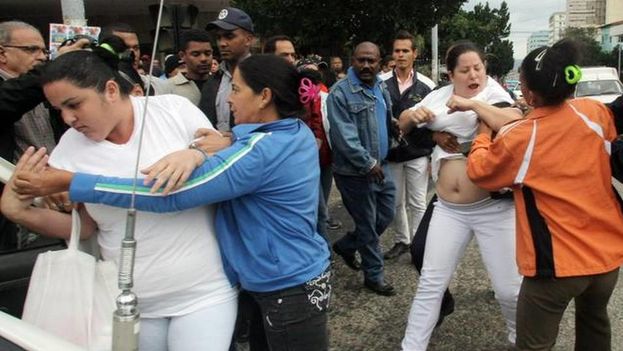
Members of State Security arrest women from the Ladies in White organization (Ernesto Mastruscusa/EFE)
14ymedio, Havana, 24 February 2015 — Short-duration detentions increased considerably in Cuba in 2014, according to the annual report published today by Amnesty International. The human rights organization, with headquarters in London, emphasizes that the situation with respect to freedom of expression, association and assembly, infringed on by criminal prosecutions for political reasons, did not improve. Amnesty International expects, nevertheless, that the announcement of the re-establishment of diplomatic relations between the Island and the United States may help produce a significant change in the matter of human rights.
The report highlights the 27% increase in short-duration detentions last year, according to data from the Cuban Commission for Human Rights and National Reconciliation, which counted almost 9,000 brief arrests. The Ladies in White organization suffers the most from this type of repression continue reading
, although Amnesty International also mentions the arrests produced at the end of 2014 on the occasion of the Community Summit of Latin American and Caribbean States (CELAC).
The annual report, which offers an overview of the human rights situation in 160 countries and forecasts trends in this arena for the next year, addresses the issue of the control that Raul Castro’s government exercises over all means of communication and the difficulties of accessing information on the Internet. Among the harassments that independent journalists have suffered, the organization cites the case of 14ymedio, which, on the day of its launch last May 21, suffered an attack on its web page. Since then this digital daily has been blocked on the Island.
The report dedicates a special section to prisoners of conscience and notes that laws that classify “dangerousness” and the likelihood of future offense as crimes have been used frequently to incarcerate citizens critical of the Government. Also, they point to the restriction on travel outside of Cuba imposed on the 12 prisoners of the Black Spring who were released without a clarification of their legal status.
Amnesty International appreciates the immigration reform of 2013 which has permitted Cubans to travel abroad but points out that the government has confiscated materials and documents from opponents and critics on their return to the Island. The international organization complains that Cuba has not yet ratified the International Treaty of Civil and Human Rights or the International Treaty of Economic, Social, and Cultural rights, both signed in February 2008. Also, the Government has not responded to the petition made in October by the special rapporteur on torture and other cruel, inhumane or degrading treatments and punishments. Cuban authorities have denied Amnesty International access to the country since 1990.
A “cruel” year on a regional scale
Amnesty International stresses that 2014 was a “cruel” year in all of the Americas, characterized by outbreaks of protests and impunity for criminal networks.
“Last year, insecurity and conflicts grew on the American continent. Protests exploded in several countries, among them Venezuela, Brazil, Mexico and the United States, often violently repressed by state forces. We also were witness to the tragic increase in violence by criminal networks that acted with total impunity,” Erika Guevara Rosas, director of the organization’s program for the Americas, asserts.
“From the disappeared students in Mexico through the revelations about torture at the hands of CIA agents in the United States and the shooting of protesters by Brazilian police, 2014 was a shameful year in the whole region,” she adds.
Amnesty International warns that, if significant structural changes are not put in place, the region will see an increase of protests and demonstrations, while organized crime and violence will continue devastating countries like Mexico, El Salvador and the English-speaking Caribbean.
The organization notes as positive the peace talks between the Colombian government and the Armed Revolutionary Forces of Colombia (FARC) for the purpose of putting a definitive end to the continent’s oldest armed internal conflict. Nevertheless, the report stresses that at the end of last year both parties continued abuses and violations of human rights.
As for Venezuela, the report insists that security organizations employed excessive force to disperse protests and emphasizes that dozens of people were detained arbitrarily and denied access to doctors and lawyers.
Amnesty International nevertheless harbors a certain hope that movements in defense of human rights in the Americas may improve their form of organization thanks to the help of new technologies and social networks.
While the government exports thousands of doctors, old diseases are coming back, such as dengue fever, tuberculosis, whooping cough, chikungunya, and cholera, and new exotic diseases are appearing that had never before been seen on the Island.
Cubanet, Miriam Celaya, Havana, 18 February 2015 – For a few days, Maritza thought that her four-year-old son’s persistent cough was due to a combination of a cold and his chronic allergies. The crisis had started with a fever and a few episodes of hacking cough, and had escalated over the next couple of days, even though he was no longer running a fever. The pediatrician’s diagnosis confirmed Maritza’s suspicions: Alain was suffering from a viral infection, so they would follow the normal treatment in cases like his: they would watch him, give him plenty of liquids, expectorants and antihistamines
But after two weeks, his coughing got so much stronger and frequent that Maritza ended up having to go to Pediatric Hospital at Centro Habana so that her son – already cyanotic and having respiratory spasms continue reading
— could be treated with oxygen. Almost by happenstance, an experienced doctor who heard the child cough took an interest in the case, and, after a more detailed examination, made her diagnosis as whooping cough, a disease Maritza had never heard of and against which – at least in theory — all Cuban children are protected, thanks to subsidized national health system vaccination programs. Furthermore, according to official statistical records, whooping cough (pertussis) was eradicated from Cuba many years ago.
Thanks to that doctor’s providential presence, Alain was treated with the appropriate antibiotics and, following the advice of the doctor, Maritza asked a relative who resides abroad for an emergency shipment of a medication that does not exist in Cuba, pertussis suppositories, used in the treatment to lessen the child’s coughing crisis.
Alain is recovering now, but his convalescence may take up to three months or more. Maritza has overcome her anxiety, but wonders how many children will be in the same predicament, considering that this highly infectious disease is circulating around the Island, and health authorities have not sounded the alarm. In fact, she recently found out that in the past several years the incidence of whooping cough has been on the rise, not only among children, but also among adults.
The lack of information in the official media results in the population not having a clear perception of the risk, and turns Article 50 of the Constitution of the Republic of Cuba into meaningless babble. The article establishes the right of all Cubans to medical care and health protection, and points to the State as guarantor of that right.
Turning back the clock
Dengue fever, tuberculosis, whooping cough, chikungunya*, cholera … With the reappearance of old diseases, the introduction of others that did not exist on the Island and the lack of effective drugs, it would seem that Cuba has regressed to the nineteenth century. However, the Cuban national health system remains a prestigious benchmark for international agencies, particularly since lending Cuban medical services abroad has become the most important source of the government’s capital income and a powerful political tool, given that it allows displaying as example of solidarity and altruism what is actually a poorly disguised form of modern slavery.
So, while the government exports the service of tens of thousands of medical professionals at the expense of a loss of attention to Cubans, and the exposure of the Cuban population to multiple imported diseases, the institutional bureaucracy of international organizations congratulates itself on being able to count on a whole army of doctors mobilized by the regime to deal with epidemics and other pathologies. The government of any moderately democratic nation would never be able to recruit doctors as if they were mercenaries.
The truth is that Cuba currently has two opposing systems: one of “health”, which only exists in theory and today is a sad imitation of what it once was; and the other of “unhealth”, much more efficient, endorsed in a completely dismal hospital and services infrastructure, and in the continuing incursion of exotic diseases, imported by our doctors from the most infected corners of the globe, since, upon their return home to Cuba, the practice of a rigorous quarantine plan and infection risk control is not followed.
All this in a nation that, in the late 50s of the last century, stood out among the top in terms of health care at the regional and global levels, with a respectable hospital network in addition to membership clinics, emergency clinics, maternity hospitals and other health services, both free and private.
At this rate, it is likely that, when the Castro regime finally ends, we may have to request emergency services from the World Health Organization itself and from the International Red Cross in order to address Cubans’ health crisis, as occurred during the US occupation after the 1898 War of Independence, which created the basis for what would become, during the Republic, one of the most enviable health systems of its time.
*A viral disease transmitted by the bite of infected mosquitoes.
Iván García, 4 February 2015 — For the prolific and noteworthy Cuban composer, Jorge Luis Piloto Alsar, born in the winter of 1955 in Cárdenas in the town of Matanzas, some 145 kilometers north of Havana, not in his wildest dreams could he have imagined that his songs would achieve international fame.
Let’s get into the time machine. An ordinary day in the ’70’s. Culturally speaking, Cuba was going through a rough period. Writers, poets and composers are being administered by the state, following Fidel Castro’s decree.
The cinema, novels, la guaracha, and sound must highlight the exploits of the revolution. The government controls all of it. In your profile, you have to indicate how many marches you have been on and how much voluntary work you have participated in, if you want to pass the summer in a house on the beach, have a Russian fridge continue reading
, or reserve a table in a restaurant.
The Communist party membership card and loyalty to the “bearded one” [Fidel] are more important than talent. In the middle of all this greyness, where ideas, and the future, are whispers from on high, Jorge Luis Piloto was a social misfit.
He arrived in the capital at the age of 15, his cajónover his shoulder, and plans for the future. With his mother, Beba, he ended up in a room in an old apartment building in Romay 67 between Monte and Zequeira, in Pilar, in the Cerro district of Havana.
Looking like a long-haired freak, devoted to rock and caring nothing about Castro’s lengthy speeches. He took refuge among his friends, like the black man William (may God rest his soul) or his girl friend, who suspected that Cuba was not the place for them.
He distracted himself by going to Latino Stadium to watch his baseball team, the Industriales, play. Or by sitting in a corner or on the Malecón, dreaming of a different future.
1980 was an amazing year. One hundred and twenty-five thousand Cubans, including Piloto, took advantage of the opportunity to leave their country. Before they left, they had to put up with the regime’s vendettas, camouflaged in fascist-style acts of repudiation.
Or personal humiliations. Before getting on the boat to go to Florida, they had to sign a document in which they admitted that they were delinquents, prostitutes or homosexuals. The government owes a public apology to the honest Cubans who emigrated in the Mariel Boatlift
Piloto arrived in Miami on a rainy day in May 1980. Without either his guitar or any money. He only had his wishes. He worked very hard doing different things, not much of it playing music. One morning his wife reminded him that he hadn’t left Cuba to live as a labourer.
“Where is the Jorge who dreamed of being a composer?” she asked him. With his next wage he bought a cajón. His first song, La Noche, co-written with Ricardo Eddy Martínez, was recorded with Lissette Álvarez in 1983.
Jorge Luis Piloto was A & R with Sony Music (1988 – 1996) and was nominated nine times for Grammy Latino. He gained the first one with his song Yo no sé mañana, co-written with Jorge Villamizar and recorded by the Nicaraguan Luis Enrique. In 2010, the Society of American Authors, ASCAP, awarded him the Golden Note prize for his 25 years of work and his musical contribution to the Hispano-American repertory.
His ballads have been interpreted by singers of the calibre of Gilberto Santa Rosa, Christina Aguilera and the incomparable Celia Cruz. In 2012 he wrote a song for the Damas de Blanco which was played when they marched through the streets of the island.
On Monday, November 17, after 34 years, I met Jorge, my neighbour from the Pilar neighbourhood, in Miami. We chatted for seven hours. He still had a youthful physique, although he was almost 60. “There is no way I can put on any weight”, he says. He remembers his past in Cárdenas and Havana and his friends from that time.
But he is fond of Miami. His pride in this south Florida city is apparent. We drive along in his car, through every space, residential development, and places of interest, like the Marlins Stadium, the cruise ship port, the Ermita de la Caridad and the tunnel which goes under the port.
He showed me the only statue there is in the city and we ate in a tourist cafe on the banks of the Miami River. I asked him if he has thought about returning to Cuba the democratic future which we are all hoping for.
“No, I belong here, with my son, my wife, and my mother. I could contribute to whatever needs doing. But Miami is my home now,” he points out, while he talks in English to his son on his cellphone about Giancarlo Stanton’s fabulous contract with the Marlins. The Industriales aren’t his team any more.
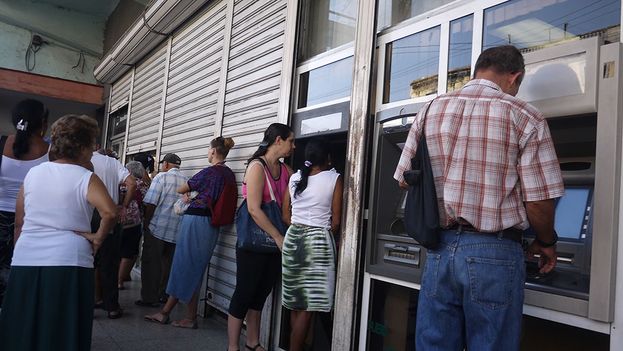
14ymedio, Rosa Lopez, Havana, 23 February 2015 – The line reached the corner and was moving with agonizing slowness. They were not selling eggs or potatoes. It wasn’t even a line for seeking a visa. Those who waited just wanted access to the automatic teller, the only one working last Saturday afternoon near Havana’s Central Park.
A few days before MasterCard can be used in Cuba, many are asking how the Cuban bank network will deal with the increased demand for money if it can barely keep its service afloat for domestic users and tourists.
The congestion in front of the machines grows even though only 1.3 million magnetic cards have been issued in the country, and for the moment only retirees, customers with accounts in convertible pesos, businesses that have contracts with the bank, self-employed workers and international collaborators can get them. The rest of society continues to depend exclusively on paper currency.
“When the subject is money, people fume,” says a young man whose Saturday night hangs by a thread because of the congested ATM. Even though this weekend the temperature dropped in the city, no one seemed ready to leave before getting their cash.
The scene is repeated at most of the 550 ATMs (Automated Teller Machines or automatic tellers) of Chinese manufacture, of which 398 are in Havana. In 2013 200 new units were purchased in China, but the majority were to replace defective terminals and did not solve the serious deficit of tellers. Cash payment is still the most common method in Cuba for acquiring products and services.
The scarcity of terminals combines with the deficient functioning of the system, affected by electrical outages, frequent connection failures between the ATM and the bank and lack of cash
The terminals are only available in private businesses with great resources and obvious official backing
Almost all the self-employed workers offer their services for cash payment. The use of point of sale terminals (TPVs) for card scanning and payment, also known as POS, is only available in private businesses with great resources and obvious official backing.
In state business networks, the landscape is different but not very promising either. Although there exist POS terminals in most big department stores and hard currency shops, their service is unstable and slow. “When a client comes to pay with a card, the line stops for minutes because sometimes the communication with the bank is down and you have to try it several times,” explains a cashier from the busy market at 70th Street and 3rd in Miramar.
In the provincial cities and above all in the townships, where they are practically non-existent, the ATM and POS situation is even worse. Tourists who travel deep into Cuba must carry cash with them, increasing the risk of theft and loss in addition to the demand for liquidity.
The problem hits natives and foreigners. “Why do they pay me on the card if in the end I have to go get the money at the bank because I can make purchases almost nowhere with this?” complains Marilin Ruiz, a former elementary school teacher who also was waiting in line on Saturday for the ATM near Central Park. The delay was so long that she wound sharing recipes for making flan without milk and knitting suggestions with another woman.
“I have a pension of less than 200 pesos (about $8 US) and I spend up to two hours in line at the teller to collect it,” an old woman complained
Between the 4th and 6th of each month, Cuban retirees go to ATMs to collect their pensions. “I have a pension of less than 200 pesos (about $8 US) and I spend up to two hours in line at the teller to collect it,” explained Asuncion, an old woman of close to eighty years of age. Meanwhile, some kids scamper from one side to the other. They are the children of a couple waiting at the end of the line without much hope of getting money before nightfall.
“We are late for everything; when the world has spent decades using plastic, now it is that we are trying it,” laments Asuncion. The first ATMs, of French manufacture, were installed in Cuba in 1997, but after 2004 only Chinese terminals arrived.
Asuncion keeps in her wallet a Visa card that her son sent her from Madrid. “I use this only every three months when he puts a little on it for my expenses.” There are no public statistics about how many of the country’s residents might be making frequent use of debit or credit cards associated with a foreign bank account of an emigrated relative, but the phenomenon has grown in the last decade.
In the line several Chinese student also put their Asian patience to the test with the red and blue cards in hand from the Chinese banking conglomerate UnionPay. More than 3000 citizens of that country study or work on the Island, and they receive their family remittances through that channel. Also, in 2013 alone some 22,000 Chinese tourists visited Cuba.
“We Cubans and Chinese are good at waiting, but let the gringos arrive in great numbers, they are more desperate, they want everything fast,”
“We Cubans and Chinese are good at waiting, but let the gringos arrive in great numbers, they are more desperate, they want everything fast,” says Lazaro, a teen with tight clothes, to a friend with whom he waits in the line.
The alternative to the ATM, which might be the window of the bank branch, is not recommended. In Havana there are 90 branches of the Banco Metropolitano, but at the end of 2014 at least twelve offices were partially or completely closed because of problems ranging from leaks, sewer network blockages, danger of building collapse or other infrastructure issues. Insufficient attention and lack of trust in the banking system make many continue to prefer hiding money “under the mattress.”
The limited work schedule of banks and the scarcity of offices open on weekends cause long lines on weekends in front of ATMs. The more optimistic, however, manage to profit from the wait. Marilin managed to achieve everything by renting a room in her house to the Chinese students who must, of course, pay in cash.
Asuncion could not stand the pain in her legs and left without her money, while the couple at the end of the line had to buy some ice cream to pacify their restless children. Lazaro was luckier, and in addition to exchanging phone numbers with a French woman whom he met in the crowd, he managed to extract twenty convertible pesos from the ATM to spend that same night. At least this time the blue screen did not appear with the “out of service” announcement, nor was there a power outage and, yes, the machine had cash.
Rebeca Monzo, 23 February 2015 — In the Plaza de San Francisco in the historic center of Old Havana there is a traveling art installation, United Buddy Bear, made up of huge bears that surround the square. Each of them represents a country in the western hemisphere and they are decorated by an artist from each nation. Representing Cuba is the work of painter Nancy Torres.
The exhibition is like a cry, like a hymn to tolerance, which has captured the attention of both the Cuban public and tourists alike. Sometimes people even line up to be photographed in front of their favorite bears, especially those of Cuba and the United States, perhaps due to the historic moment in which we now find ourselves.
Besides these beautiful multi-colored artworks, a lovely bronze sculpture recently appeared in the square at the entrance to the Lonja del Comercio building. The sculptor, Vittorio Perotta, has given it a very evocative title: The Conversation.
Something that also caught my attention is the restoration work being done in this area and along the waterfront. It is being carried out by the Office of the City Historian and includes large potted plants, outdoor lighting and date palms, all of which give the place a touch of freshness and elegance. Upon seeing this, there was one thought I could not get out of my head: “When this whole of fifty-six-year nightmare of destruction is over, the only government official whose name will not be on the blacklist will be Eusebio Leal (Havana City Historian).”
The video above was published on the first anniversary of the death of Orlando Zapata Tamayo.
Testimony from Abel Lopez Perez can be read here. A few days before the 3rd of December, Abel was transferred from the Provincial Prison of Guantanamo (in his native city and where he served a political prison sentence) to the horrid dungeons of a prison in Camaguey, where Orlando Zapata was also taken.