Reflections from Companero Juan Juan / Juan Juan Almeida

1421794998_base-naval

As the debate continues, visitors come and go. It’s normal and forms part of the process of re-establishing relations between the United States and Cuba. Also in this exchange, in a not-too-distant future, the American government will return to its Cuban counterpart the territory occupied by the naval base at Guantanamo. And to reciprocate, the government of the island will accept that finally the imperial eagle will return to its original nest continue reading

at the top of the two columns that, together with the canons, human figures and chains, compose the monument to the victims of the Maine explosion.

I feel that both these things will happen, and I’m not making up scenarios in order to encourage a debate.

Time has shown us that, although the present economic environment is still challenging since there could be negative surprises, as far as the political structure goes, the Caribbean has been and is one of the most stable zones on the planet. So that keeping a military installation of such size in the heart of a place where there are no international conflicts, not even of low intensity, represents an excessive waste of time and an important squandering of money.

The Guantanamo Naval Base was established in 1898, when the United States military occupied the island after defeating Spain in what many of us know as the Hispano-Cuban-American War. Later, with the signature of the first president of the Republic of Cuba, Don Tomas Estrada Palma, on February 23, 1903, the U.S. obtained that much-discussed perpetual lease. It emerged as an historic anomaly and today makes no sense. Neither military, strategic, or regional.

1421794999_maine

For its part, the monument to the Maine was constructed in 1926, and in 1961 the man who “reflected” on it* ordered the imperial eagle taken down from the pedestal, because its figure was warping the new marketing image of the revolutionary government.

But given present circumstances and the indefinite absence of the insufferable “reflector,” the eagle means nothing more than the piece needed to complete the sculpture. I would dare say that because of the strange culture of rejection that we islanders have for everything that daily surrounds us, out of the two million Cubans who now live in Havana, not even 100 of them have bothered to read the inscription at the foot of the monument.

The return of the territory occupied by the naval base in the municipality of Caimanera in Oriente will be welcome, as will be the return of the image of the raptor to its environment on the Malecon.

Both events will be historic, but of no value. Since nothing about this presses the principle of democracy for a country that requests change and transformation, from the interior of a tempest hidden below a sea of apparent calm.

As that Cuban virtuoso said, known for being the king of the tambor** players and for the charming way he told a joke: “The agendas of governments are divorced from the people; politics get done in the street. The others react with the same naivety as an inexperienced mother.”

Translator’s notes:

*Fidel Castro’s column in Granma newspaper is called “Reflections of Fidel

**African drum

Translated by Regina Anavy

A Writer With More Talent Than Fear / Angel Santiesteban

Literature has its decorum, as do those who live by it. José Martí

Nelton Pérez is a Cuban writer who recently won the Alejo Carpentier prize, which is the highest literary award for writers on a national scale, and also the best financially-endowed prize, comparable only to the Casa de las Américas International Prize.

His winning novel “Infidente”, deals with José Martí’s stay at the El Abra estate, on the Isle of Pines, following his release from political prison, when Sr. Sardá, a friend of his father’s, invited him to recover his good health there, while he awaited his deportation to Spain.

Taking as his starting point the limited historical information about Martí’s stay on the island, Nelton recreates, imagines, supposes — and he does it so well that the reader ends up believing that the letters written by the young Martí are real. Once when he visited me in prison, I had the privilege of him bringing me the manuscript. continue reading

“I am a meddlesome peasant” / 14ymedio, Juan Carlos Fernandez

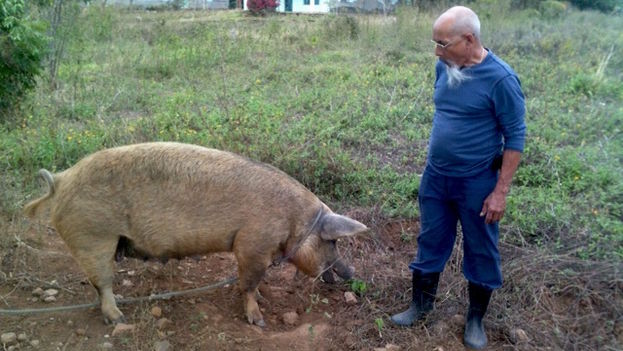
Eduardo Diaz Fleitas on his farm.  (14ymedio)
Eduardo Diaz Fleitas on his farm. (14ymedio)

14ymedio bigger14ymedio, Juan Carlos Fernandez, Entronque de Herradura, 31 January 2015 – Entronque de Herradura is a little village in the Pinar municipality of Consolacion del Sur. I go there in search of Eduardo Diaz Fleitas, a Cuban with rapid speech, skill with the ten-line stanza and proven courage. He was among the 75 dissidents sentenced during the Black Spring of 2003, but not even a long prison stay made him lose his smile or wit.

Fleitas asserts that he is “just a meddlesome peasant.” In this interview he speaks of his life, his early activism and of that other passion, which is the land where he has worked as long as he can remember. continue reading

Question: In other interviews your work as an opponent always comes up, but I would like to speak of your personal history. What did you do before that fateful March of 2003?

Answer: As a child I worked in the fields. I had to grow up fast, and I studied auto mechanics. Later I became a driver and even drove a bus. In 1989 I started driving a taxi and later became a transport inspector. However, in 1993 I stopped working for the State, demanding that they pay me with dollars to be able to buy in the hard currency stores because the national currency had no value. Since then I have worked on the plantation with my father.

Q: Where did the ethical and moral values that guide your life come from?

A: My father taught me respect, kindness, honesty and love of work, spirit of service and help to others. From my mother, a farmer and housewife, I learned effort and integrity as well as loyalty and also love, which I have seen in them, because they have been married since 1950.

Q: What was the process that led you to be disappointed in the political and social process which, from its beginnings, said it was defending the peasantry?

A: With the triumph of the Revolution we thought, like many, that it was something good. But after three or four months things began to get bad; the executions, the land was no longer ours. The discourse ran one way and reality the other. All that was waking me up.

Q: But it’s a long way from discontent to activism. When did you begin to be a dissident publicly?

A: In the year 1988. Since then and until now I have been active in several opposition organizations and held different responsibilities.

Q: During the Black Spring of 2003 you were arrested along with other dissidents, journalists, librarians and independent trade unionists. They sentenced you to 21 years imprisonment and you were behind bars almost nine years. How hard was jail?

A: What most struck me about the Cuban penitentiary system is the great cruelty with which the inmate is treated, whether political or not. There you are not a person, you are at the mercy of your jailers. I saw extremely sick prisoners ask for medical attention, and the guards laughed in their faces. We must humanize Cuban prisons!

I also have to say that prison offered me the chance to see, to my surprise, how many people support, in one way or another, the peaceful opposition movement in Cuba. I never felt alone inside. Prison also gave me the opportunity to harbor not even a drop of hatred against my victimizers. In my heart there exists neither hatred nor rancor towards them.

Q: You have participated in several unity initiatives among opposition forces, the latest of them the Open Space of Civil Cuban Society. Do you believe consensus can be achieved in spite of differences?

A: All proposals of this type are excellent. What I do consider unjustifiable is the dismissive insult and personal attack among ourselves. That is the method the Cuban government uses against us, it is anti-democratic and not at all ethical. No activist should fall for something like that. We must have consensus on basic points, and that is what Open Space has achieved and what we have sought for years. I am happy to be able to participate in that initiative.

Q: What do you think about the intention of the governments of Cuba and the United States to re-establish diplomatic relations after more than half a century of confrontation?

A: As of last December 17 a new era for Cuba began. The government of the United States has realized that the prior policy was a dead end with no way out, and now a host of opportunities is opening for our people.

I have asked people about the measures announced by the American government, and they look favorably on them, because they mean prosperity for the people. But when I have asked them what they think of the Cuban government in the face of this challenge, they answer that they do not trust it. Nevertheless, I am optimistic. We must create awareness that dialog is best. I believe that the United States is committed to us and has intelligently confronted the regime.

We have to have the courage to reclaim democracy and to respect our rights. The era of change may be coming for all Cubans, and it falls to everyone to do it in harmony. Cuba has to flourish again for everyone and for the good of all!
Unanimity is not good. We must live in diversity. But it is good for us to be unanimous when dealing with differences. Well…better I say it in verse:

Cuban,
Why is it that it doesn’t matter to you
To ruin your dignity?
Because so much calamity
Will never produce heroism.
Bury that pessimism
That daily assaults you.
Raise your voice, you are able
To be the example of the titan
Awaken those who are
Prisoners of their own webs.

Translated by MLK

The Last Days of That Amorphous Thing Called “The Masses” / Cubanet, Rafael Alcides

Young Cubans marching in a government sponsored "protest"
Young Cubans marching in a government sponsored protest against the United States

Whatever the Cuban government does, that amorphous thing with no head or eyes, that they call “the masses,” is in its final days. And with it are also ending the repudiation rallies, detentions, physical attacks on the Ladies in White, and other forms of repression.

cubanet square logoCubanet, Rafael Alcides, Havana, 29 January 2015 — In the first elections of Cuban socialism, an old Communist leader would call the voters from his neighborhood and would instruct them which candidate they should vote for. I, being a provocateur and also a friend of his, told him, “Didn’t we agree to let the masses decide?” He replied to me, with a complicit irony while stopping the next voter in order to instruct him, “Yes, but we need to orient them.” continue reading

I say complicit irony, because that leader understood that I, by that time, should have known all too well that the trappings of democracy are a farce in socialism, mere props. Being, after all, totalitarian, one thing the Socialist State fears is that the citizenry – “the masses” as those who “orient” them call it – could think for itself.

From there proceeds the State’s lifelong fear of the artist, the intellectual – even of those whom it pretends to honor with its paper roses – and its fear of the individual, of the loner. In Cuba, the State – the better to keep an eye on him, and beyond that to convert him into one of “the masses” – made the peasant a member of a cooperative, he who had been granted two plots of land, and whenever possible made him live in housing developments where the units were joined window to window, allowing the residents to watch and overhear each other at good advantage.

Clearly, this fear had to be hidden. Taking advantage of the political circumstances of the moment (we’re talking of the months following the Bay of Pigs), the “Within the revolution, everything; outside the revolution, nothing”* pills were quickly manufactured, which had a certain flavor of patriotism on the outside, and much Soviet medicine on the inside.

Even though they appear to have been produced for use by the intellectuals, these pills have been a daily dose administered to the masses. We observe them when, arguing that “the enemy** is listening,” Cubans are prohibited to speak unless it is to praise the Revolution. Or when, without consulting the people, the government declares wars in which the country will participate with tens of thousands of men. Or when, as right now, the government makes peace with the “enemy” of just a minute ago, according to the surprising announcement by Raúl this past December 17.

All right, now. Following this announcement, which the people have greeted with emotion, these pills have lost their potency. Or, we must re-think this. Besides, logic and the reasoning of the Socialist State tend to not coincide. The foreign press continues mentioning (while the national press doesn’t discuss it) new detentions, operatives stationed outside residences, all with the object of preventing the opposition from attending anti-establishment events, and reporting names of dissidents whose passports have been confiscated or not renewed – who rightfully fear being returned to their former condition of “prisoners at large.”

But, why? When, after all, ‘round about two years ago, they were allowed to travel outside the country, and the government did not collapse. So, then, why this regression? And besides, why now, at this moment, when the hackneyed and same old song about the “plaza besieged” can no longer be invoked?

We are not so Hellenic, although anything can happen in a government full of secrets.

In any case, let the government do what it will now, that amorphous thing with no head or eyes, which the government leaders privately call “the masses,” is in its final days. And with it are also ending the repudiation rallies, detentions, physical attacks on the Ladies in White, and all manner of repression that has up to today been the government’s common practice.

Because, with the ratification of the United Nations Covenants on Civil and Political Rights and on Economic, Social and Cultural Rights – without which as a precondition for the agreements announced on December 17, 2014, Obama would have become a super-generous Santa Claus to Raúl Castro – the dissidents will, finally, enter into possession of the rights that will allow them to dedicate themselves, without government interference, to the formation of political parties, societies, professional schools and institutions, all essential to a democratic civil society. Why? Because in those little pills that are the Covenants — and the reason the government has not wanted to ratify them — is contained all that is necessary to articulate a democracy wherein the citizen can enter an electoral college and vote with decency, without anybody “orienting” him.

Translated by: Alicia Barraqué Ellison

* Translator’s note: A line from Fidel Castro’s so-called “Speech to the Intellectuals,” delivered in June 1961.

** Translator’s note: The “enemy” is a common epithet used by the Castro government and its supporters to refer to the United States.

Rosa Maria Paya meets at the White House with negotiator on Cuba / 14ymedio

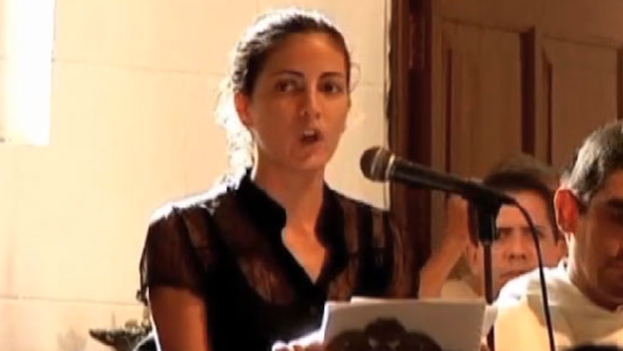
Rosa Maria Paya
Rosa Maria Paya

14ymedio bigger24 January 2015 (EFE) –Rosa MariaPayá, daughter of the late Cuban activist OswaldoPayá, in a meeting today with the senior advisor for Latin America at the White House, defended the need to “stop the impunity” of the Cuban government against dissidents on the island, and the right to decide for Cubans.

Payá, who left the island a year ago, participated in a forum on human rights, before meeting with Ricardo Zúñiga, who is part of the White House delegation that, since June 2013, secretly negotiated with Cuba the rapprochement between the two countries.

Speaking with EFE after the meeting, the activist explained that she sent the US official some “very specific” points that, in her judgment, continue reading

“should be addressed with the Cuban government, which of course address ending the impunity with which State Security operates on the island.”

The Christian Liberation Movement (MCL) activist (as was her father), lamented the harassment to which some of her compatriots are subjected, a complaint that has been elevated to international organizations such as the Inter-American Commission on Human Rights (IACHR), before which she asked in 2013 for protective measures for her family.

“We want the democratic governments which are in communication with the Cuban government, to approach not only the Government but also Cuban citizens,” said the activist.

The 26-year-old daughter of dissident Oswaldo Payá — who died along with activist Harold Cepero in a traffic accident in 2012 — used the meeting at the White House to call for an independent investigation into what happened.

“What they have said to me is that there will be a discussion on human rights and that is where we want to influence, not only on the subject of independent investigation, (…) but in favor of that which is the basis of Cuban democracy,” he said.

This week negotiations begin in Havana to restore diplomatic relations after the thaw announced by both governments last December 17.

In this new scenario, Payá believes that “there are some possibilities to bring pressure for the rights of Cubans,” supporting some demands “consistent with democratic values” such as a plebiscite to “ask citizens if they want to participate in free and pluralistic elections.”

“No Cuban who is younger than 80 has ever participated in fair, competitive and free elections, so it is time that Cubans can decide their own future,” said the young woman who asked the democracies of the world to “support the right of Cubans to decide.”

“The Chileans did it in the eighties, the international community supported the Chilean plebiscite, Cubans deserve no less,” she said.

Payá’s hope, she said, lies “not in what a foreign government can do for Cuba, but what we Cubans can do for ourselves, and I hope the democracies of the world will support this.”

The young woman said that a commitment to the request for an independent investigation into the death of her father will be on the negotiating table, as well as support for the right of Cubans to decide.