Ernesto Santana, a Needle in the Haystack / Angel Santiesteban

It’s very rare to find an artist belonging to the Cuban Artists and Writers Union (UNEAC) who leaves the narrow fold of the government. We all know that those who have done it will pay for their boldness at some point.

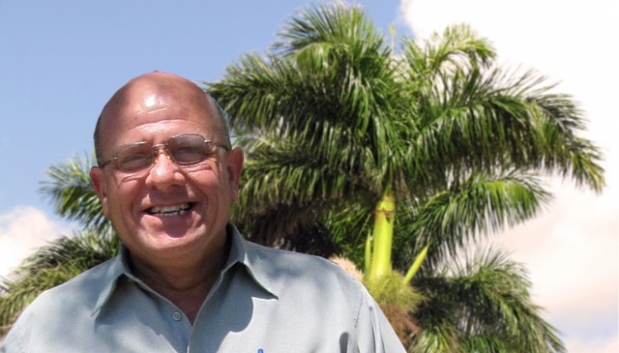
When I met the writer Ernesto Santana Zaldivar at a meeting of Estado de Sats, his solidarity made my soul happy. After the hug, I was pleased to hear that he was aware of my situation and it was his intention to help make these absurd accusations against me better known by publishing them in Cubanet. And we agreed that he had no intention to destabilize my harmony, thus damaging my creativity and — from exhaustion or the logic of survival — causing me to abandon my blog and my demands for democracy.

Ernesto Santana was aware of every story that happened in the crude process that  brought me here. his continued solidarity has proven through phone calls, opening his home to me, or arranging in some place in Havana to make known the tricks of the regime for silencing me. His solidarity also makes me happy because he is a Cuban who exposes his life in the pursuit of individual rights. It was not enough to travel abroad, win prizes, be published or receive the gifts of the powers-that-be if he could not be honest with himself.

It is a pleasure to make this journey at his wide for the freedom we need and that we are not willing to renounce, at the risk of abuse and prison, from this child nobody wanted. An honor to share him with my readers.

Ángel Santiesteban-Prats

Lawton Prison Settlement. February 2014


Sign the Amnesty International petition to support Angel.
21 February 2014

Let’s Go Venezuela / Orlando Luis Pardo Lazo

Beautiful Venezuela, so weighed down for such a long time with your own revolution. Is that what you wanted? No! That’s why we are going to save ourselves.

So much left wing higher education, so much nostalgia for Silvio Rodríguez and so many other dogs’ breakfasts of patriotic poetry, so much Castroism disguised as uncomfortable intellectualism, so many arms smuggled from Havana (the scroungers were previously the guerrillas), so much of our parents’ out of date Marxist social criticism. Is that what you wanted? No! That’s why we already saved ourselves.

Thanks, Venezuela.

Fidel Castro hates the Venezuelans as much as he hates Cubans a much as he hates human beings. Much more now, because he will die soon. And he hates the idea that millions and millions of people should live when he doesn’t.

The Venezuelans resisted Fidel too much, since January 1959 when the Commander in Chief proposed a diabolical pact to President Rómulo Betancourt: Venezuela will give Cuba all its oil and also its land as a trampoline for expanding the Revolution: in return, Fidel held out the promise of the destruction of the United States in a few years’ time and the damned imposition of the dream of Bolívar and Martí (he almost managed it in October 1962, at the cost of the Russian nuclear missiles, which showed that Bolívar and Martí, far from having dreams, had terrible nightmares). continue reading

Fidel tried military invasion of Venezuela several times. The continental consequences were negligible. No-one had any faith in his invasions. There were fabrications of Yankee imperialism and of national oligarchy. And the repressed people applauded that argument which seemed at the time to be conciliatory rather than totalitarian terrorism. Do you get it now, my dear Venezuela? Yes, I know, my strong and beloved little girl.

Also, it is possible that the Venezuelans felt a certain demoniacal left-wing pride at having been invaded time and again from the little island. You agree? Doesn’t matter.

Finally, when Fidel noticed that the world had changed, and that he had become older, he recruited thousands of Venezuelans, taught them his jargon of hate and thuggery, and he gave them the money to empower them (money which in fact came blood-soaked from Libya and Iran)

In this disgusting chess game, Rafael Caldera was the anonymous ally of Castroism, which cost many Venezuelan lives, including countless soldiers who were massacred in “accidents” authorised by Hugo Chavez and including later the assassination of Chavez himself when the very obedient one let the wild beasts know that he, Chavez, ought to be Fidel’s successor.

Beautiful Venezuela, so pregnant for so long, to give birth also to your own Revolution. Is that what you wanted? No! Now all of this is about to happen. Maybe it has already happened.

Today, those who don’t know about any of this, are angry on the streets in Venezuela.  They are a legion of heroes. They are life. They are beauty. They are truth. They don’t yet have the strength to give up. They are not going to surrender. Let’s not abandon them, please. We are not going to abandon them.

Those free Venezuelans don’t want to live a life without liberty until the end of time. They are as tired as the Cubans, but they still have a last breath of hope. Best of all, this little ray of light may also wake up us apathetic Cubans.

Free little Venezuelans do not want to exist in a caricature of Castroism without Castros. In Venezuela today the future is showing itself, for fuck’s sake, and they are slaughtering that future in full view of the world. Don’t abandon them, please.

Please

What do we do?

I propose some International Peace Brigades, to put together a Freedom Fleet in a couple of days, and then sail from all the ports in America to Venezuela, loaded up with all our love, and more love (and food and clothes and medicines to cure the wounds of torture, and arms to close ranks by your side, and togetherness in our looks that we will never turn our backs), and once we are there, relaunch a country where words are not a perverse parody, where despotism is just a relic of the Corpse in Chief cooking in his dreadful nearly ninety years old delirium in a buried, inhuman Havana.

Venezuela, I love you.

Venezuela, let’s go.

Translated by GH
21 February 2014

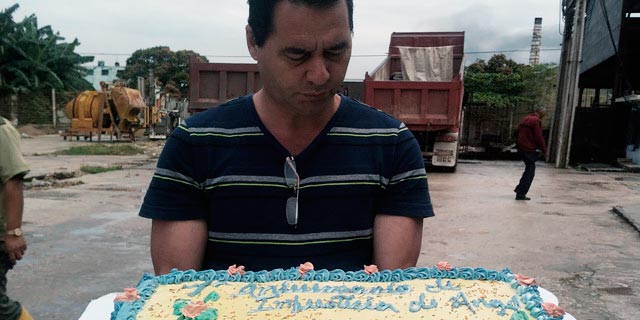
Angel Santiesteban Celebrates His First Year in Prison With a Cake

First anniversary in prison of the intellectual and writer Ángel Santiesteban-Prats

This 28th February marks the first anniversary of the unjust punishment imposed by the Havana provincial tribunal on the prize-winning writer Ángel Santiesteban-Prats. Judgement prepared by the Cuban government.

Santiesteban-Prats, has passed more than 5 months locked up in the Lawton centre, situated in the 10 de Octubre area, under constant restriction by the Heads of the Havana headquarters.

The celebrated literary figure, holder of various international and national prizes. In his critical blog of the¨Los hijos que nadie quiso¨(The Children Nobody Wanted) he has continued in his perennial role as stone-thrower into the middle of a pond. He redoubled his efforts. When the government attacked him, his ability to do this reduced.

In these 12 months he has suffered physical and psychological torture.

He found out that the appeal process which was presented to the Ministry of Justice (MINJUS) on July 4, 2013, had been filed away for more than six months on the basis of lack of a contractual agreement. Finally he presented another document, which is proceeding, has been accepted and is to be found in the Provincial Review Department, where they are keeping it while they wait for the sanctioning tribunal to forward them the lawsuit.

The injustice perpetrated against Santiesteban-Prats has served to strengthen him more. He has maintained his writing as a sacred space for this celebrated creator.

We hope that the Cuban government will accept responsibility for committing a grave error. Santiesteban, when he is free again, will continue to insist on the rights of all Cubans, because not even imprisonment has been able to stop him.

To all his readers, lovers of literature, do not give up the fight for his immediate release.

This day he was presented with a cake so he could celebrate his first anniversary in prison.

So that Amnesty International will declare the Cuban dissident Angel Santiesteban to be a prisoner of conscience you can sign the petition: please click on this link.

Published by: Dania Virgen García on 2nd March 2014 in Desde Cuba.

Translated by GH
3 March 2014

From Teddies to Flat Screens / Yoani Sanchez

6a00d8341bfb1653ef01a3fccd0da4970bOnce there were stuffed animals. Bears or dogs with enormous ears as the doors of the Havana airport opened, arriving on the suitcases of the recently arrived. Dolls that parents, after a trip to the socialist camp, brought home as trophies to the kids they’d left behind. Status symbols for those who could leave the island, those toys represented the world that stretched across to the other side of the ocean and that also promised the future.

Those teddies dominated part of the eighties until the cassette radios arrived. Then the most precious booty that could be acquired on a trip abroad was one of those gadgets with speakers and buttons. Their happy owners turned them on right in customs and emerged winners, blaring their new acquisition at full volume.

Now the new cult objects of these travelers are flat screen TVs. These emblems of modernity travel in vividly colored rectangular boxes. Plasma, LCD, LED are on the front line of the technologies most brought into Cuba via travelers’ suitcases. No one knows the exact number of these items that arrive every day, but it’s enough to glance at the luggage belt to see them everywhere.

On the black market, the price of these TVs has fallen almost by half in the last year. A 32-inch Samsung is less than 380 CUCs (about 340 USD), delivered right to your door. Meanwhile, the price in the state stores could be triple that and they barely manage to sell a few units a year.

Marco Polo Cuban style…

Richard is one of the prosperous TV merchants. He has a network of “mules” who bring them directly from Panama. For the most part they’re Cuban citizens with Spanish passports who can travel without visa restrictions. They also move through Florida, Nassau, the Caiman Island and other countries in the area to buy appliances they can later resell on the Island. In a country with so many shortages, every product brought from abroad can pay dividends.

“I offer them by catalog, the customer chooses which he wants,” boasts Richard, describing his business. A young man asks if he also has 3D TVs, to which the clever merchant answers, “How many inches do you want?” Despite the restrictions on selling important merchandise, these tropical Marco Polos manage to bring them into the country and sell them.

Audiovisual players are in greatest demand. The house may have a collapsed hydraulic system, empty fridge, and mattresses with the springs poking out, but in the living room most families want to hang a modern and very thin TV.

In less than three decades Cuban airports have been the scene of a peculiar metamorphosis. The teddy bear transmuted into music equipment and then into these shiny screens of pixels and cells.

5 March 2014

The Hard Fate of Those Who Grow Old / Alberto Mendez Castello

Cuba, old age, selling little cones of peanuts on the street.

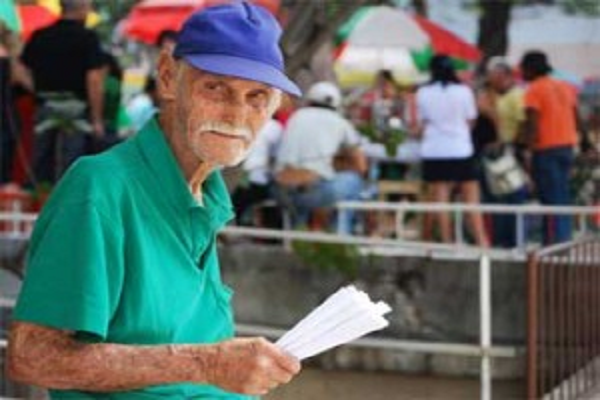
PUERTO PADRE, Cuba — Old Raul was a worker for Communal Services, but an unyielding cervical disease at age 54 made the Medical Commission discharge him. Now he is 74 years old and has a pension of 242 pesos, “but I go over 40 just on my wife’s drugs,” he says.  Most of the time he stays seated on the sidewalk in front of a market that sells unrationed products, and sells spices and homemade bags to take on errands.

Raul gets around on a bicycle, but old Gilberto has to fight on foot, with short steps, in order to sell the occasional homemade cumin packet.  He was a truck driver.  He spent 41 years behind the steering wheel:  “I was driving throwing rods since I was 11 or 12 years old,” he says.

Skeletal illnesses took Gilbert from work.  Now a septuagenarian, he and his wife “live” with a pension of 242 pesos, and of those some seventy go for medicine. Those retired because of illness cannot get a license to work for themselves:  “The other day an inspector wanted to give me a fine of 700 pesos.  Take me to the police, to say there everything I have to say.  In the end he left me alone.”

Mariano had a better position than Raul and Gilberto, and unlike them, did not retire because of illness but because he finished his years of work.  At the time he retired, he held an administrative post in the municipal hospital.  After retirement, other institutions took advantage of him until his health took a bad turn.  Now Mariano is a paraplegic. Pedalling a tricycle with his hands, he tries to earn a living selling prú, a soft drink made of herbs and fermented roots.

Blanco also pedals a tricycle with his hands.  He is an ex-operator and driver of tow trucks, who was transformed into a babbling paraplegic by two thromboses.  Now he has to get by with a pension of 242 pesos for him and his aged mother:  “More than 40 pesos go for nothing more than medicines; if I don’t sell knives we die of hunger,” he told me at the same time he was lamenting the difficulty of finding knives to sell because Customs has limited their entry into the country.

In Puerto Padre there exists a Grandfather House where, for 25 pesos a month, old people receive breakfast, lunch, dinner and two snacks.  “Sometimes here we even have beef, today we have chicken,” said Jimenez, a retired bricklayer.  But this Grandfather House only has capacity for 40 old people, who have to go sleep in their homes.  So it is no more than a small remedy for this great wound that is old age, not only in Puerto Padre but in all of Cuba.

Hundreds of old people, almost all of them sick, almost always in precarious conditions and not a few on the edge of the law, have to pursue working in order to earn a living in this city.  False reasoning does not produce a good soup.  According to Law No. 117 of the State Budget for 2014, incomes for contribution to Social Security are 3,034.5 million pesos, but the expenses exceed 5,122.7 million pesos, therefore there is a deficit of 2,088.2 million pesos, to be covered by the central budget account.  That is okay if the numbers are real.  But they are not.

Cubanet, March 3, 2014,

Translated by mlk.

Open Letter to the European Community / Angel Santiesteban

I am addressing each one of the twenty-eight nations which make up the European Community, to demand more depth, through an exhaustive investigation with free people, unencumbered and unafraid, to find a just consensus to the national issues of the Island, more so when we know that the historic practice, in more than a half century of socialism, has not been the welfare of the people, but the maintenance of the cruel machinery for the sake of their “Iron Totalitarian Power,” the imprisonment and daily repression of dissenters, and the mysterious deaths of opposition leaders.

I appeal to you, in the light of the recent decision of your Foreign Ministers, to open up a bargaining agreement with Havana, which we consider to be a grave mistake, in view of the fact that while the European Union was arriving at this agreement, the regime was imprisoning its opponents.

We hope that you do not see Cuba as a palliative to help you solve the crisis you are dealing with, at the cost of permitting the violation of our rights.

Exposing ourselves to risk, we have learned that the Castro brothers will never permit any imposition which gives any space for opposition, so that they have not even signed the United Nations Covenants, which in this 21st century should be the minimum indispensable requirement for the self-respect of any state, in the face of the international community; achieving this, and thus liberty and respect for the opposition, would be the contribution that the European Community could present to the Cuban people, and in turn this would be a credible step forward on the part of the Raúl Castro government, showing that it really is its intention to provide openings and improvements in terms of the Human Rights of the Cuban people.

In actual fact, they have filled up the jails with young people who, without any other option, have preferred to be criminals rather than submit to hunger and the absence of basic necessities. In those prisons, you will find many professionals, “embezzlers”, who have had the same misfortune as those who haven’t studied, since they haven’t had the opportunity to emigrate, as is the case with the overwhelming majority.

With respect, we urgently request that the European Community does not change its Common Position, without previously assuring itself in respect of the necessary change for the political democratisation of the Cuban archipelago.

Sincerely,

Ángel Santiesteban-Prats

Lawton prison settlement. February 2014.
Please sign the petition for Amnesty International declare the dissident Cuban Angel Santiesteban to be a prisoner of conscience

Translated by GH
26 February 2014

Collapse in Havana Leaves More Than 600 People on the Street / Agusto Cesar San Martin and Pablo Mendez

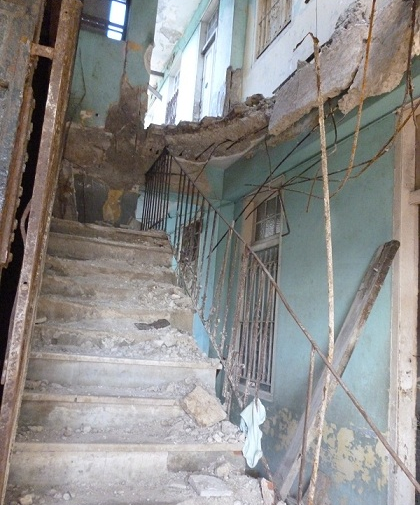
Building in danger of total collapse — photo Augusto Cesar San Martin

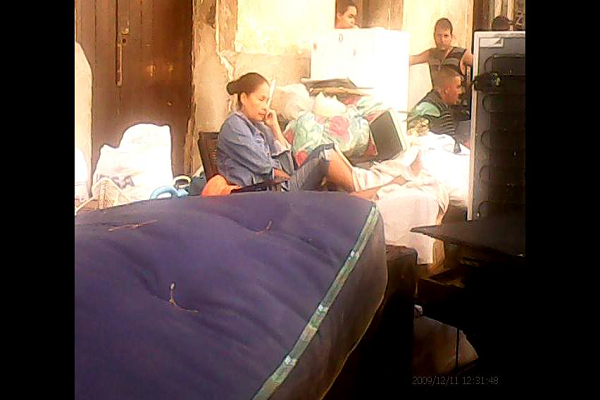
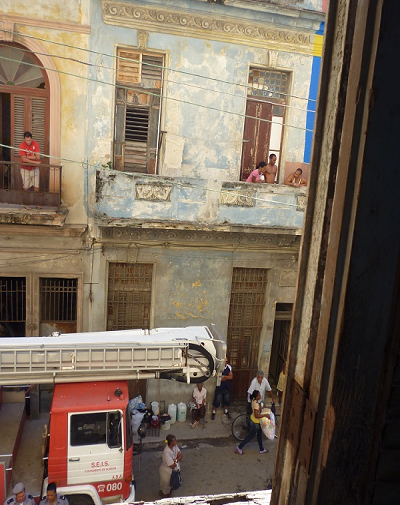
HAVANA, Cuba. — Since the afternoon of last Thursday the 27th, the residents of the building located at 308 Oquendo, between San Rafael and San Miguel, Centro Havana remain on the street.

The partial collapse of the upper floors put in danger the structure of the five story building of 120 apartments.

From the first concrete crashes, the more than 600 residents began to abandon the property, transferring their belongings to the street.  Facing the imminence of total collapse, the local authorities ordered an evacuation.

The residents keep doors, bathroom tiles, toilets, electric appliances, beds and all kinds of belongings on the street.  These people have not been evacuated.

At 7:00 pm on Saturday the police ordered the electricity cut off and prohibited entry into the building until Sunday morning.  The order caused a disruption for the residents who have not finished gathering their belongings.

On Friday, local government officials met with some of those affected.  According to one of the victims, they made assurances that they would evacuate everyone gradually.

One of the building’s residents who did not want to be identified told the independent press said:

“We don’t know where to go.  Yesterday nine buses came by here in order to take us to shelters, and they were empty. . .  We want homes, not shelter.”

It is also known that some affected families were installed in apartments of buidlings located in Santa Fe, Playa township.  The provision of dwellings is prioritized by the composition of nuclear families with children.

The building constructed in 1928 was declared in danger of collapse in 1988.  All the victims consulted agree on the reiteration of the government alerts about the deterioration of the building.

Photo gallery of collapse in Centro Havana, sent by Augusto Cesar San Martin and Pablo Mendez

1 El-derrube-en-los-pisos-superiores-puso-en-peligro-la-edificacion-420x5052 Edificio-desalojado.-2.3-53 Edificio-desalojado.-2.3-1 4 Derrumbe-1-feb-2014-5-400x505Cubanet, March 3, 2014, Augusto Cesar San Martin and Pablo Mendez

Translated by mlk.

Criticism: Constructive or Complacent? / Yoani Sanchez

Revolutionary Vigilance, a Permanent Task

He raised his hand at the meeting. The director had told them “don’t hold back,” so he took advantage of the chance to say what he’d remained silent about for months. He started with the very low wages paid to public health workers. Then he talked about the dirty bathrooms, the water shortages, that the only sterilizer was broken, the leaks all over the hospital. He continued with the heat in the waiting room packed with patients and the lack of surgical instruments. He finished up with the exclamation, “it’s more than anyone can stand,” which plunged the room into a heavy and uncomfortable silence.

At the end someone approached him to say that his criticism hadn’t been constructive but merely a catharsis. So he didn’t speak again at any other meeting.

Behind the argument of looking for opportune and uplifting criticisms, hide those who in reality do not want any kind of criticism. For them, being proactive means bowing and preceding every statement with a flattering phrase. One should never, according to these encouragers of applause — question the system, much less the inefficiencies that don’t allow it to function. Being “constructive” amounts to not calling to account the current leaders of the political process, much less questioning the ideological model. One also needs to show a blind faith that everything will be resolved with “wise leadership” at the highest levels.

If someone deviates from the script of tolerated criticism, the disqualifiers will rain down upon them. Chip on the shoulder, whiner, crybaby… will be the first insults, although later it’ll move on to the already hackneyed “CIA agent,” “counterrevolutionary” or “enemy of the nation.” Their observations will never find the opportune moment, because they don’t include submission or self-blame.

Criticism doesn’t need a name. It doesn’t need to be classified as “constructive” or “destructive,” but it should be delivered with total rigor, regardless. Like rubbing medicine on a festering sore, criticism hurts, it makes you cry, it’s torture… but it cures.

5 March 2014

The Experiment of Hope / Francis Sanchez

Dagoberto Valdés, director of the periodical ‘Convivencia’. (BARACUTEYCUBANO.BLOGSPOT.COM)

On the 15th of February 2008, with the uploading to the internet of Issue 1 (January-February), the magazine Convivencia was born in Pinar del Río.  Since then, six years have passed of uninterrupted bimonthly publication.  The new publication invited one to live on a horizon at once broad and intimate, democratic, heavy with possibilities and without the scourge of restrictive determinations.  “A dawn for the citizenry and civil society in Cuba”, the title of the first edition’s editorial, would become the motto of the magazine.

The beginning of the new alternative project within Casa Cuba, passing between the homogeneity and impersonality of the official press, brought a signal of hope or possible restoration of diversity from the westernmost of the Cuban provinces, after the retirement had taken place in 2006 of the bishop José Siro González Bacallao to a farm in Mantua.

Confusions and disappointments have taken place, at times imperceptibly, but knowing the difference between one and the other helps us to understand and to hope.  Let us see.  It is known how, during the nineties, a weave of publications belonging to the Catholic Church was assembled in Cuba — although sociocultural in ecumenical spirit — that allowed intellectual communities in many provinces to have a means of expression for the first time.  I met Dagoberto Valdés in that setting: we founded the Catholic Press Union of Cuba (UCLAP-Cuba) in November 1996, in the church La Merced of Camagüey.

The new magazine movement was thriving (Vitral in Pinar del Río, Palabra Nueva in Havana, Amanecer in Villa Clara, Enfoque in Camagüey, Cocuyo in Holguín, Iglesia en Marcha in Santiago de Cuba, etc.) and independent of state control, which, as it must be supposed, would influence the State to respond by assembling a national system of editing houses and territorial magazines.

The unique impact of Vitral, its operation, its alternative editions, compelled the Government to strengthen the world of Pinareño culture in proportions that would have otherwise been unthinkable.  Great sums were thus expended on projects such as, for example, the beautiful Ediciones Cauce and the Hermanos Loynaz Centre, elements that taken together would subsequently pay for themselves by achieving such a rich diversity there that this province would stand out in the civic, cultural, and editorial spectrum of the country.

The magazine Vitral, the Church, Dagoberto Valdés, and Pinar del Río were key points of reference in a phase of optimism that was marked by the first visit of a Pope to Cuba. Days of illumination were lived then — before, during, and after the brief crossing of Wojytla, the Pilgrim Pope.  “Have no fear,” he said in mass in the José Martí Civic Plaza on the 25th of January of 1998, and at some moment everyone or most of the people present there were springing up — we were springing up — calling out “Liberty, liberty.”  Either we no longer had fear, or we did not want to have, indeed, any more fear.  Two days before, John Paul II had held the Encounter with the World of Culture, in the Great Hall of the University of Havana.  continue reading

Among the few photographs that came out of those I took at that meeting, I save one in which I appear standing next to Dagoberto Valdés on a wing of the second floor.  He was attending as a representative of Vitral, while I found myself in that hall as a young writer who was creating, along with others, a similar magazine: Imago, founded in 1996 and belonging to the diocese of Ciego de Ávila.

The opportunity of that encounter with the world of culture and John Paul II has been moreover the only day of my life in which I have seen Fidel Castro in the flesh, dressed strangely in a collar and tie there below in the first row, likewise to hear the religious leader, and, certainly, he seemed to me then very pinched, perhaps as an effect of the contrast with the image I had formed in my mind.  I think I took some pictures from afar with my modest camera, but they did not come out.

Why stir up such memories to refer to the fifth anniversary of the magazine Convivencia?  I have come back to the mentioned photo, and to another in which I am raising up a little Cuban flag in a very packed square, and with an enormous Heart of Jesus covering the façade of the National Library.  Without a doubt, a new phase of the old and complicated experiment that time and again has seemed easy was being tested or beginning, although in the long run it shows signs of error: the experiment of hope.  The hope of liberty.

Cuba must open itself to Cuba

Up to what point hasn’t the search for a spiritual and collective liberty been a controlled trial, condemned to failure?  Who motivates our reactions and rations out our actions?  Who distributes the social reach of intimate or true result?

Apparently a return of Cuba to the universal accord of democracy is tried once and again, and what is sad is that we who live out this trial from below and within, repeating it it, putting into every expression all of the energy and urgent need of our mortal nature, at times simply cannot get nor give answers.

The international repercussion of the first visit of a Pope to the island brought back to us, with great underscores, the petition that Cuba open itself to the world and that the world open itself to Cuba.  It was urged at the coexistence between hemispheres without the great polarities of the Cold War.  Without a doubt, that invitation impressed well, but although such a call-up and the wake of open expectations aimed to create a point of rotation in the tradition of rigidities, they continued giving preeminence to the problem of the role of a nation constructed for an international political conflict.

An emblematic scheme has continuously been inflated which has been incapacitating, agonizing for we who live it from within and beneath in Cuba, scheme or favorite script of those who enjoy power, and some who covet it, where this tale would supposedly have only two actors obliged to share one same scene: Cuba and the world.  An enormous tale of love-hate.  A libretto not for liberty, but rather to depersonalize.

That assumption, used as a straitjacket, has served to pretend justifying a stop to civic liberties and rights on the island.  It has been brandished to silence or make invisible all the rest of us subjects who fill what they wish to present to us merely as a great international “scenario”, historic laboratory table, when it is no more than the area and the time of life, like the life of every human being: inexorable, unrepeatable.  Lives, or unique novels where everyone is either protagonist of himself, or has been no one.

In light of the suspicion that we suffer artificial experiments, ill-constructed scenarios, we human beings have a metaphysical dilemma which remodels our civil condition: to open up to ourselves, to be, to live as we consciously are, then it will only be possible to build other reliable ontological and social figures, to open up among ourselves, to coexist.  Cuba must open itself to Cuba.

Not for fun have despotisms based themselves historically in a false gigantism that claims to annul faith in free will and the mortal, real, imperfect but infinitely worthy nature of the human being: from the untouchable castes, representatives of the afterlife, kings that were considered the direct descendants of gods, up to leaders and political groups that in modern history have declared themselves “the vanguard of society” or claim to head up scientifically superior social classes.

Another invitation of John Paul II’s extended in that giant plaza had more effect in my heart, where for the first and only time –also surely the last one– I found myself among the multitude when he invited us to be “protagonists of our personal and national history.”  Words taken as though by an annotator under a shell in an old theatre, at the bottom of our hearts that were wounded, half forgotten, thrown into the trash, to put them in our ears when the sky seemed clearer.

This last quote of John Paul II’s appears crowning the first editorial of the magazine Convivencia, where one can also read a programmatic maxim that became perhaps the necessary echo rising up from the earth, inevitable, personal: “We believe in the strength of the small.”

A renovation of the interior of Cuba

Somehow, despite the poor quality of the roads inside the country, and all of the broken bridges, I always get the magazine Convivencia.  I believe in this inner weave, cell to cell.  It is the same ethical motivation — for me in the final instance an active choice will always have a metaphysical reason — for which I also endeavour to make Árbol Invertido, “inland literary review”, without more interest but also with less illusion than this– the word which opens and closes the editorial “Tierradentrismo” from the first issue of the 2nd period of Árbol Invertido, corresponding to January-April of 2013: to be.

Convivencia is.  A word with a very deep power of announcement.  It does not enter the game of artificial paradises to substitute one old utopia for another, supposedly new or better, in that poor tradition of idealisms with which spiritually insufferable, baseless policies have sought to adorn themselves.  It sounds like the future and is full of reality.  Soft yet hardy.  Open.  Abundant.  It changes.  It flows.  It grows upon itself.  It branches out.  It shelters.  It explores.  It deluges and demands.  It arrives and it leaves.  Coexistence as a challenge, a possibility, arises from the condensation of life experiences.

Convivencia looks like itself.  Imperfect.  It imagines, it reflects the image, the metaphor of Casa Cuba that it has made its own from the identifier that appears on each title page.  If a person can accept themselves, or better put, should do it, as a plural being, box of echoes, impulses, defects, good and bad memories, the alternative of a civil society that bases itself on the creative relation of different peoples seems no less concrete.

From its structure, as a “socio-cultural magazine”, comes a model of inclusive edition.  Through its pages run the popular outcry or murmur, the calculus, the song of the artist, the prayer of the believer and the intellectual discourse, among an infinity of themes dear to natural people.  The Casa of the magazine Convivencia is not held up by the nails of so many dogmas, but rather moving upon the crests of the waves, in a spiritual impulse, when it is defined as “from Christian inspiration.” And I believe that here, in its entrance to tremblingly small things in the middle of the night, in its contribution to the light of spirituality, can be felt its most transcendent consequences.

We are not in need of another restoration, we who within a same residence felt that time and space were running out.  Let them take them from us.  Because definitively, a lasting “spiritual response” from anyone who feels oppressed may be based on the great ignorance of the institutions of hatred, not recognizing their perceived authority: do not do it with fear, but neither with more hatred.

One of the gratifying testimonies that I have found in Convivencia was that of doctor Hilda Molina.  I did not know her until I read this account of her life, it being revealing that a scientist like her — founder of the Cuban and Latin American schools of Neurological Restoration and the International Center for Neurological Restoration –, after living close-up the dogmas of practiced atheism and even suffering uncountable problems when she decided to express herself differently, would arrive at the following affectionate, perhaps idealistic? conclusion:
“Nevertheless, any reconstruction of material sort will prove useless, if we do not prioritize from this precise moment onward the spiritual reconstruction of our afflicted country, the rescue of its confiscated souls; and the resurrection of its faith, and its hopes.”

Convivencia is and resembles a too-ideal house, so real that it has only been possible for some as a miracle and for others, of course, as a great sin.  It is occupied and under construction.  It opens and connects communicating veins.  It is filling a stronger void: the hope in the necessary restoration of the “inside” of Cuba, in the soul.

Every time that a new issue of Convivencia arrives before my eyes from the other side of the walls of Havana and all the unexpected, I aspire to relive, to star in a free reading of the infinitely small time and space that is mine to live in, to embrace.  An edifying read, personal, making contact with other experiences no less authentic.  Can one ask for more?

Francis Sánchez, Ciego de Ávila

Diario de Cuba, 15 February 2014

Translated by russell conner

Transition to Dictatorship Rhythm / Jorge Olivera Castillo

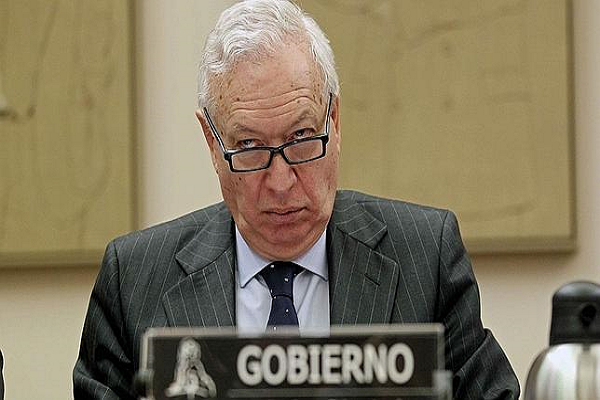
Jose Manuel Garcia-Margallo, Spanish Foreign Minister, believes that the European Common Position towards Cuba is correct, but can be more flexible

HAVANA, Cuba, March — Latin America and now the European Union approach the Cuban dictatorship without great demands. Respect for fundamental rights, as a requisite for closer relations with Havana passes to a more distant plane than previously.

The priority is to guarantee the survival of the regime as an assurance of political stability within the Island, and maybe to manage a soft landing towards some form of less authoritarian government. It is risky, at the very least, to say that the end point of this journey that is barely beginning is democracy with all its attributes.

Single-party socialism is not going to disappear from Cuba because of a civilian-military revolution. Neither does it appear that its end is associated with a negotiating table formed by people of the current regime, the Catholic Church and the opposition groups. If history grants the possibility of such a scenario, it would settle for when the heirs of the gerontocracy assume control at a time impossible to determine.

Whoever says to the contrary is, as they say, lost in the weeds. The weakness of the opposition, in a social climate where anarchy stopped being exceptional some time ago, is a reality that counts when the time comes to define policies. Of course they are not the only motivations, but there is no doubt that they have contributed to things flowing in favor of conservative pragmatism. continue reading

To this one would have to add the little importance of our country in the geopolitical order. Without great economic attractions or strategic relevance for the centers of world power, the topic of Cuba dissolves between indifference and the castlings of very specific interest. Nothing of commitments with respect to a political evolution that overcomes single party rule and the impossibility of exercising fundamental rights without conditions. That would come associated with the development of economic openness.

The only government that maintains a policy of confrontation is the United States, although of little benefit for advancing the pro-democracy agenda. The embargo increasingly loses effectiveness following a moderating trend that includes important sectors linked to the politics and economy of this nation.

At times it seems that the incidents of abuse perpetrated by the regime fall on deaf ears. Except for a few non-governmental organizations, the majority of governments remain impassive in the face of statistics about arbitrary arrests, acts of repudiation and prison sentences for political reasons.

Resignation would not be a good option facing the sequence of irrefutable facts, but also one has to be careful about romantic visions.

A deep reflection about the circumstances is necessary. The opposition and the members of alternative civil society that do not do it will fall by the wayside. One must insist on efforts to be more creative and to eliminate the recurrence of old errors that continue burdening the pro-democratic plans.

Cubanet, March 3, 2014, Jorge Olivera Castillo

oliverajorge75@yahoo.com

Translated by mlk

What Will Happen if Chavism Falls? / Arnaldo Ramos Lauzurique

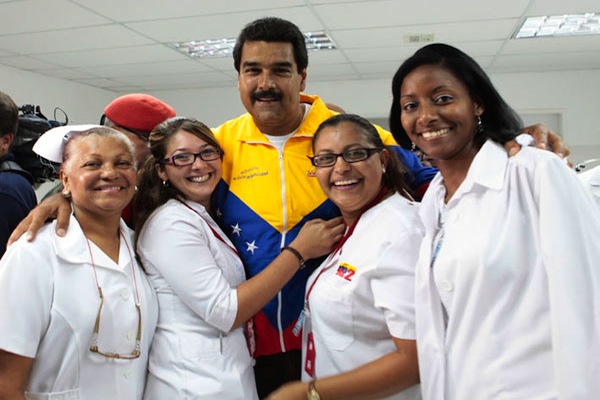
Nicolas Maduro with Cuban doctors in Venezuela

Some 18 thousand Cuban doctors in Venezuela earn the government 4 billion dollars. And what about the oil?

HAVANA, Cuba – The Cuban regime is on tenterhooks about the situation in Venezuela, whose economic support, primarily through payment for medical services and the supply of oil is very advantageous.

Currently there are about 18,000 doctors from the Island in Venezuela, whose earnings bring the Cuban state at least 4 billion dollars.

At the recent closing session of the 20th Congress of the Cuban Workers Confederation, Raul Castro said that, “… the main income of the country right now comes from the thousands of doctors working abroad,” but he should have referenced not the work of these people but their exploitation by the regime.

Of the 82,065 doctors reported by the National Statistics Office at the end of 2012, Minister of Health Robert Morales said that as of two months ago, 56,600 were working outside the country.

This explains why the goods and services balance is a positive 1.265 billion dollars, while exports were down, mainly in nickel, sugar and oil, which in the latter case has become an export thanks to the resale of the Venezuelan oil on the international market. continue reading

In the tourism sector, whose gross income is currently in the range of 2.7 billion dollars, the national income is only about 65% because more than 900 million dollars in imports goes to supporting the activity. Net revenues are also affected by the quality and flow of visitors, which although the number of tourists are increasing, they are spending less.

Cuban doctors on health mission abroad
Cuban doctors on a health mission abroad

The financial situation has already worsened in 2014, with the expected fall in export prices of sugar and nickel, so that a worsening of the situation in Venezuela, with any decrease in the oil shipments and payments for services, would be catastrophic for the regime.

The general president, in his last speech, gave forthwith unforgivable gibberish when he confessed, “… wages don’t meet all the needs of the worker and his family, which generates demotivation and apathy toward work…” However, he also said it would be “… irresponsible and have counterproductive effects to give across the board increases in wages… which could cause an inflationary spiral in prices, if not appropriately backed by a sufficient increase in the offerings of goods and services.”

Did he not know what he was saying, or did he, perhaps, think to get the workers, demotivated by their low wages, to produce more? A Workers Congress like ours is just a caricature if they could listen so passively to such arguments.

No wonder that Castro is very worried about the worsening crisis looming over Cuba and that on this occasion he dedicated a long tirade, published in bold type in the official press, about the recent events in Venezuela. In addition, he stressed his full support for Chavism and Nicolás Maduro, and attitude that could have high reaching consequences if, as is likely, Maduro and his followers fail to weather the storm.

Indeed, such declarations are frankly interventionist and contradict the statement of the Second Summit of CELAC , where the principle of non-intervention in the internal affairs of States is proclaimed.

Cubanet, 4 March 2014,

More Chalas Than Carmelas / Miriam Celaya

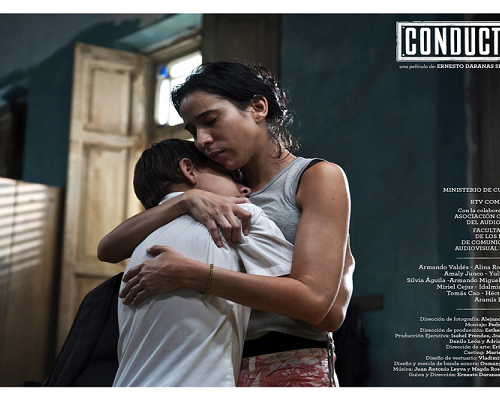
conducta_02-500x400HAVANA, Cuba- I confess that I have some animosity against Cuban fiction film, so prone — with few exceptions — to clichés, stereotypes, overly cryptic messages, implied story morals, or what is perhaps worse, the search for easy and superficial acceptance through humor, catharsis or bad satire. I will not list examples, because there are too many, but anyone who has seen a vernacular film of the last 15 to 20 years knows exactly what I mean. Personally, I hate the delight in trying to provoke laughter at the expense of our own misfortunes, derived largely from the pernicious tendency to exploit mockery in order to avoid deep reflection and collective responsibility for the reality that chokes us.

Only a handful of movies from this period preserve dignity, and most of them do not properly fit the genre of fiction, they are documentaries, such as the masterful and unforgettable Suite Habana (2003), directed by Fernando Pérez, to quote a valid example.

That is why, since the beginning of this cinematic phenomenon called Conduct, with the fanatic public filling theaters and with the general approval of viewers and critics, I decided to go see it, only after a process of self-estrangement, and to not write about it as cinematographic product film — something the critics and a whole host of admiring amateurs have already done — but from the perception of the public’s reaction and what it means.

It is fair to recognize that, in the presence of this movie, it is impossible for a Cuban to put distance between the screen and his emotions. The imagery, the dialogue, the plot and sub-plots, the settings and the conflicts it exposes so crudely, are elements that combine to place before a viewer’s eyes the reality of the lives we share and which we hardly notice, immersed in the necessity of an existence full of shortages and unresolved problems.

The plot consists of a central drama, a child of an alcoholic and substance abusing mother. At the same time he pursues elementary school studies, the child also works tending fighting dogs and raising pigeons, which he sells in order to earn money, thus helping his mother. He simultaneously maintains a close bond with his teacher, an experienced educator and very dedicated to her profession, her main reason for living. The child (Chala) and his teacher (Carmela) are characters of great strength and intensity, perfectly articulated and credible. continue reading

Meanwhile, the sub-plots complement the storyline, offering the viewer elements that reinforce human situations and character profiles. Nothing is lacking and nothing is superfluous in this moving film, which the public has embraced with unprecedented warmth. The director, Ernesto Daranas, uncovers the marginality, violence, corruption and neglect of the most financially disadvantaged social classes; the indifference of institutions and officials; the strict mechanisms and prejudices of a system not designed for free people but for obedient herds.

The setting, beautiful despite its squalor, is the beautiful crumbling city, the corners that do not appear in tourist postcards, the neighborhoods where common, lesser people live, without whom we would not recognize Havana; everyone living alongside vices – and many living off them — those vices that the official discourse declared as having been exiled by the revolution over five decades ago.

The script points directly to many of the ills of today’s Cuba: corrupt police, political prisons, the absurdity that a Cuban from the provinces is considered an “illegal” in the capital, the emigration which is draining us. But present in every showing is the apotheosis of a public that applauds with emotion, standing in the darkness of the movie houses when Carmela, the character of the teacher, openly refers to the length of time that this government is in power. That is why Conducta is, more than a film, an event one cannot stop talking about.

The movie seems great and sad at the same time, with the sepia tones of slovenliness and decadence in which we may glimpse, despite it all, kindness, love, human solidarity, tenderness, innocence and hope. And, paradoxically, that same hope is the director’s gift to us at the movie’s end, without resolving the conflicts. Daranas does not pursue the complacency of a glib public, but when he rattles the audience, he compromises awareness. Maybe that explains why Conducta does not have an open, shut, tragic, or happy ending. It’s like a ball being thrown from the screen to the audience, just so we can stop being spectators; a smart and complicit way to remind us that we are all part of the same drama, that it’s up to all of us to construct that inconclusive ending. In that sense, the movie could not have come at a better time.

Too bad that so much empathy, so much complicity and so much fused energy will manifest themselves only in the dark cover of the movie theaters. It’s a shame that the vessel of our proverbial patience is so deep that there isn’t a drop capable of making it run over.

Too bad, too, that the opposition sectors have not found a way to capitalize on people’s empathy and use it creatively in favor of democratic changes. For now, it is expected that this sort of referendum –through projections- may continue to be produced as the first showings of Conducta reach all corners of the country, but beyond values and the undeniable success of the movie, one thing is true: we have too many Chalas but not enough Carmelas.

Cubanet, 3 March 2014, Miriam Celaya

Translated by Norma Whiting