
The photo is of a Cuban Trogon, el tocororo.
Translated by Regina Anavy
27 February 2014
English Translations of Cubans Writing From the Island
The photo is of a Cuban Trogon, el tocororo.
Translated by Regina Anavy
27 February 2014
Para un domingo, mucho amor <– Click here. For a Sunday, much love.
Before so much violence in the world, a spiritual relaxation and a very timely touch of love.
Watch the video.
Translated by Regina Anavy
2 March 2014
 Leftist dictators never quit. So says a killer subject called World History.
The leftist dictatorships of Latin America will not be an exception. They are establishing eternal systems like the Castro dynasty, to the humiliation of the Cuban people. Or imposing their feast of crimes before and after being thrown out of power, like Salvador Allende’s radical regime in Chile. In both cases, the price of any change is criminally expensive.
Today, Venezuela is in the streets debating between these two endpoints. Having already crossed both.
The infamous interference of the Castro regime incubated mass manipulation there, sowing the poison of irreconcilable classes, the inherent evil of Marxism. Sowing victimhood as a justification for impunity; political crime disguised as a plane crash, or hunger strike or criminal assault, within and beyond national borders; the lifelong self-coup of the State; the idea of a foreign archenemy; coercion and blackmail as a technique of governance; legislation beyond all legality; and even falling into that morbid medievalism of a leader consecrated by the bones of the Liberator.
It’s sad. It’s embarrassing, with so many Latin Americans devoted to harmony and progress, that at the end of the Castro regime it reaches out from the Antilles to fall, with more force than ever, across our American lands. An invasion that is now at the cost of a populist carnival of some social programs obligatorily free in their theatrical sensationalism. And still, as is now shamefully obvious to the world, it is still an avalanche that doesn’t abandon its barbaric custom of voting with bullets and more bullets, preferably into the heads of the voters.
In the case of Diosdado Cabello, and the presidential figure of Nicolas Maduro behind whom this citizen shields himself, their lightening assault troops — the “collectives” of criminals trained and armed by the State at the expense of the public coffers — recalling the worst style of the Blackshirts or the SS of the European genocide, who decades ago dreamed of a world under a single command in perpetuity.
Thus, perhaps, the obscene obsession of the Bolivarian rulers, including the region’s communist parties — with an emphasis on the Chilean complicity — in hurling the epithet fascist to the right and left: we already know that the thief always shouts “catch him, he’s a thief” to distract attention from his own misdeeds.
Neither students nor exiles, deputies or ministers, opponents or informants, top-stars or generals, are safe from these thugs with no nationality. Technically, with too many nationalities, because the motorcycle herds — on their Suzukis and Geelys in Cuba, for example — are the operational tactics of the island’s political police, as a modus operandi in the totalitarian left’s new crusade-of-no-return: eternity or death, comrades.
In effect, the Castro regime has committed even its lack of soul to the socialist submission of Venezuela, at least until Fidel and Raul die. And afterwards their Putin-inspired heir, Raul Castro Espin.
For this, to the ruinous repression against innocents, they now join an international plot against Venezuela, loving it to death. Authoritarian Asia has offered financial rescue to this dictatorship-in-ruins, formerly an exceptional economy. From civilized Europe they sell arms for the genocide, along with advice on human rights as compensation. From the United States, complicity privately promises no intervention in the hemisphere’s democracies. Wipe the cadaver clean.
The 49.12% of the Venezuelan people certified by the vote count of the Chavistas themselves in the 2013 elections is outraged but helpless before an abusive army of state intervention. The lack of solidarity of the thousand and one dignitaries of the free West is outrageous, people who should have already closed ranks with the Venezuelan students to avoid a Latin American Tiananmen, a vile vortex so useful to the Castro regime as it enthrones itself.
The new generations of our America are being massacred for demanding at least this 49.12% of the country that belongs to them by right. The price of not responding will be the loss of 100% of everyone’s country for ever, within and beyond the nation’s borders. From the debacle direct to an irreversible Made-in-Havana despotism, with metastases not only in Moscow, but in Iran and China and North Korea.
For God’s sake. A mistake in Venezuela is a mistake in the Americas, is a mistake in the future of the world.
“The Party is immortal” was one of the first communist slogans. It was a declaration of the Party’s right to annihilate its “class enemies” and to keep hold of power by means of a “dictatorship of the proletariat” that would eradicate the “enemies of the people.”
For decades, communists were murdered in every country they turned up in. As a result, once they were in power for the first time in history, from the upper echelons of Stalinism to the satellite nations of the USSR, they began their revenge for all the crimes committed against them. And continue today.
I am not anti-communist. As a Cuban, I have spent 40 years living in a communist nation. Many of my friends and relatives are communists. I probably could have been a communist myself during my teenage years, perhaps through the apathy of belonging to the only legal political youth organization in Cuba, even though by then nobody believed in ideologies. We were professional impersonators, pretending to be somebody else to survive.
The fact is, not a single communist government has ever respected anyone who pretends to be “someone else.” Both within and beyond international borders, they have never demonstrated a single shred of diversity. Or compassion. This is logical, since in totalitarian materialism there is no other god but the State, incarnated in one Great Leader.
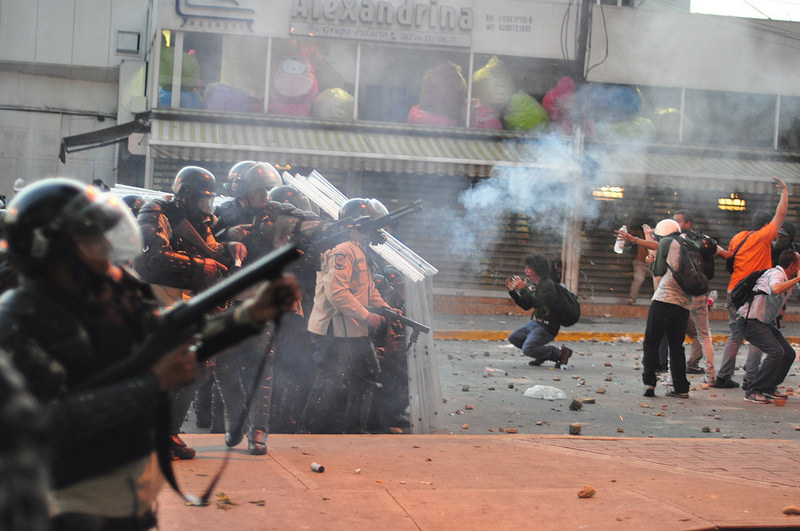
Now death is again laying waste to those who are youngest and most free. It’s happening in Venezuela, where the army is killing peaceful protesters in the streets. And the response from the world’s Communist parties was unexpected: They have applauded, and all the more-so in Latin America, the region where death is in charge.
In Chile, the Deputy and General Secretary of the Chilean Communist Party, Lautaro Carmona, has even boasted of his own complicity: Nicolás Maduro’s Venezuelan executioners have been sent a message of solidarity. The Venezuelan president is ruling under a law whereby he can be re-elected time and again.
With this obituary note, Augusto Pinochet’s Chilean crimes of the twentieth century are being avenged with impunity today. Today the chant “Long live death!” echoes the anti-communist slogan of genocidal Europe.
These are criminal coincidences, complicit comrade Lautaro.
FROM SAMPSONIA WAY MAGAZINE, published in English.
3 March 2014
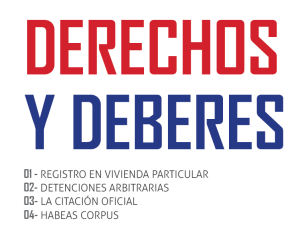 Most Cuban citizens do not know the legal system in force on the Island, and the procedures they must follow to exercise a certain legal action, be it a civil, penal, administrative, family matter, etc., principally those that relate to their civil and political rights. Frequently they are victims of the arbitrary and selective application of the law.
With respect to Cubalex — the Center for Legal Information — tries to expand the pro bono representation and legal analysis available in Cuba, as well as the capacity for self-defense by dissidents, human rights activists and citizens who have no apparent political motivations, living inside or outside the national territory.
Cubalex offers its clients detailed information about the Cuban legal system, the legal the legal rules that apply to their case and the procedures to be followed in response to government, regional or international institutions.
The Manual of Rights and Duties / on-line, offers information about the ways in which Cubans can defend their rights as citizens facing an arrest, official summons, and search of their homes.
8 March 2014

Orlando Luis Pardo Lazo
Venezuela, Life or Abyss: Let’s Not Abandon Them Now
Left-wing dictators never step down. Thus says a killer subject called Universal History.
Left-wing Latin-American dictatorships have no reason to be the exception. They institute eternal systems like the Castro dynasty to the humiliation of the Cuban people. Or they impose their feast of outrages before and after being deposed from power, such as in Chile with the radical regime of Salvador Allende. In both cases, the price of any change is criminally high.
Today, Venezuela is struggling in the streets between these two limits. They have already gone beyond both.
Translated by: M. Ouellette
8 March 2014
 Like anyplace else, a successful business has many ingredients. Here many have failed because they engaged in activities they knew nothing about. But others prosper, become very visible, and then fall under the evil gaze of those who would give up an eye if they could see a neighbor get screwed over.
A quiet street of Nuevo Vedado had frequently become jammed with people, all wanting to buy at La Fontanella, a bakery that began modestly but then put up an eye-catching lighted sign. What began as a business in part of a house became exclusively a factory and sales outlet, with rotating shifts, open to the public from nine in the morning until nine at night.
Such prosperity drew attention and/or aggravation, and Monday dawned this week to find the business closed. The commentaries are various: stolen flour; workers walking off; problems with the ownership of the old family home, now converted into a bakery. The truth is that La Fontanella had become a troublesome twig on that bonsai which Minister Murillo, and the updating of the economic model, had designed to be kept well pruned.
Translated by Tomás A.
7 March 2014
 Hundreds of paintings were stolen from the National Fine Arts Museum in Havana. According to the police, this would make it the most important embezzlement of Cuban pictorial heritage in the last decades.
The works were in the warehouse of the former building of the Department of Technical Investigations, which now belongs to the entity after being remodeled. Police custodians were in charge of the security of the premises, and the robbery was detected when some of these paintings began to appear in Miami, offered to art dealers.
It’s said that there’s an investigation by specialists in works of heritage and police specialists looking into the “How,” “When” and “What”; but if they were stolen from a MININT building, under police custody, and taken out of the country, the “Who” is solved: some acolyte of Alibaba with the support of the 40 thieves of the Central Committee; and the “when” and “how” stops being important.
Translated by Regina Anavy
28 February 2014

HAVANA, Cuba. – The open crisis in Venezuela confuses all of Latin America and the Caribbean. It has an important economic component. Many of the small countries of the Caribbean basin, turned client-states, foresee the loss of the cheap oil prices Venezuela has been providing. This may be a small consideration for most, except for Cuba.
A shift should be easy to navigate for those barely viable and sparsely populated nations; no one knows why they changed a safer and more stable economic relation with the US, for a cheaper but clearly less reliable one with Venezuela. Surely, we know that strategic thinking is what the region lacks. To change oil and freedom, for oil and conditioning is a very strange move to secure independence.
However, the most important point of the Venezuelan crisis at the hemispheric level, is the one that connects the strategic possibility of a model of integration that is trying to develop, in Latin America and the Caribbean, the awareness and commitment of its elite with the values of its institutions, the growing struggle of citizens for self-recognition and the political intelligence of the leaders in the region.
Amid the silence of ALBA, Evo Morales withdraws to a nationalist but not at all anti-capitalist economic model despite his extravagant and poorly articulated rhetoric. His advisers seem to have more influence on him than those of Rafael Correa, who does not know how to respond to the crisis of his own model and the consequences of his erratic policies; one day he wants to be reelected, another day he swears he does not want to be reelected only to appear later, in a seeming act of despair which says little about his seriousness, threatening to seek reelection where we all thought was about a Citizens’ Revolution.
Meanwhile, Cristina Fernández de Kichner cavorts even better, defending democracy from the left and right; stating her support is not for Maduro but for the democratic process itself, while at the same time saying that the protests, which are precisely part of that democratic process, are a “soft coup.”
Juan Manuel Santos, trapped between the left and right, tries to save his difficult relations with Venezuela; while talking with the FARC and Havana, he is also forced to point out the value of democratic institutions and the need for dialogue in the other side of Tachira, even if it means being humiliated by Maduro. Mujica barely knows what to say, invokes UNASUR, which has little to contribute. Meanwhile, Piñera, on his way out, takes care to remind us that this happens because in Latin America almost everyone is dedicated to blaming the foreigners of the north, not the south, instead of looking for problems in their own entrails.
At the beginning of the Venezuelan crisis, Michelle Bachelet had the strategic intelligence to recognize a constitutional crisis in the country and recommend a plebiscite. She has been the only one in this sea of confusion to show vision. Unlike Rouseff who forgets her past as a student victim of the Carioca repression, and in this dramatic moment, allows herself to be lead exclusively by the economic interests of Brazil.
Nothing unusual in the pragmatic tradition of Brazil and a Lula with global ambitions, whom we all envisioned at the International Labour Organization battling for workers worldwide. He steps from being a union leader to President of Brazil and finally ends up a representative of Odebrecht, a transnational if there ever was one. And, in Havana, he allows himself the luxury of pointing out that Maduro is a man of good intentions. Thank God.
There is total disorientation. Even rhetorical. Maduro blames the Yankees, expels its diplomats while asking to talk to Obama and naming a new ambassador in Washington, almost all at the same time and within the closed cycle of events. He had earlier threatened to use the full force of the army against civilians, precisely what all fascists do, while accusing them of being Nazi-facists and inviting them to a peace dialogue for which he has no resources in his political and verbal memory.
The OAS seems to be slipping by Insulza, this man has lost every opportunity to show some kind of leadership and allows himself the luxury of coming to Havana to be rebuffed by his hosts in the face of the OAS. This is however, the only organization that has established consolidated mechanisms with reference, tradition and experience, but which has to be invoked in Mexico by Obama, the enemy, to the silence of Peña Nieto, the new Mexican friend of Castro, the coldness of Canada and the indifference of the rest.
And the Community of Latin American and Caribbean States (CELAC)? A newly released political ghost that no one in their right mind will talk about for a long time, if it even has a future. Without mechanisms, institutions, political representation and experience, CELAC, of course missed the opportunity to proactively respond to events in Venezuela through the vigorous defense of the democratic basis on which its integrative effort was founded, a defense that the presidents who participated in this political rock should have made. Not wanting to speak, from CELAC, about democracy in Cuba, has left Latin America and the Caribbean unable to talk about democracy in Venezuela, invoking the help of the ghost.
If it had done this, the youth of this new integration effort would have compensated with a clear and visible commitment in the right direction, and now Maduro’s rhetoric would have more legitimacy to obtain clear and consistent backups, alienating Washington, whom he has foolishly wanted to approach, from the shores of Venezuela. CELAC in Havana did not do the best it could and anyway, its leaders had to jump over the old principles of respect for sovereignty and non-interference in the affairs of other states they solemnly swore to respect: one way or another, they have gotten into the internal affairs of Venezuela, now that many things are at stake. Starting with Havana, who has turned that country into a juicy backyard of oil, resources and XXI century essays. Until it dries up, if patriots there are unable to succeed.
No one really knows how to react in front of a crisis that once more puts in evidence the lack of leadership in Latin America: a leadership that, by the way, can only be reached by combining the values, interests and strategic vision of where the region wants to go. No wonder some elites, with some clarity, look to the Pacific where, as in the China syndrome, the United States appears once more. A region and a country that were not in the integrationist plans of Marti or Bolivar.
Cubanet, March 5, 2014, Manuel Cuesta Morúa
Translated by: Eleruss

HAVANA, Cuba. This past February 28, Reporters without Borders issued a statement attaching the second Open Letter from Angel Santiesteban to General-President of Cuba, Raul Castro, on exactly the day that the writer finished a year in jail. Santiesteban published the first letter, addressed to the same leader, on his blog a few days before being taken to jail for a crime of which he declares he is innocent.
The place where he is currently held is a military settlement in Lawton, Havana, with the appearance of a housing construction company. It houses 19 prisoners. His companions have committed crimes of theft, drug trafficking and murder. They are required to stay in a regimen of forced labor. We went there to visit him, a group of friends and this reporter, who could obtain his statements.
Previously he was in La Lima, a prison establishment located in Guanabacoa, and afterwards in the prison known as the “1580,” situated in San Miguel del Padron.
The writer’s people skills guarantee respectful relationships with the inmates. While they are going to work at the ironworks or carpenter’s shop, he stays writing all day. But this he has gotten by force of protest.
Compared with the other jails where he has been, the place is less severe:
“The only explanation that I give you for the fact that they have brought me here is that I publish complaints. Within the jails there are beatings constantly on the part of the authorities. In the ’1580’ I made 70 complaints in four and half months,” explains the writer who receives us in the penal enclosure.
This is the second time he has been a prisoner. The first was when he was 17 years of age. He spent nine months awaiting trial in the La Cabana jail. He had gone to the coast to say goodbye to a part of his family that was leaving Cuba clandestinely. They were caught, and all were taken to jail. From the memories of those nine months, which for him were interminable, came the book that won him the Casa de las Americas Prize in 2006: Blessed Are Those Who Mourn. continue reading
He has lost a lot of weight. He accepts no food except that supplied by his family. He came to have a diet as strict as milk with cookies at mid-day and a soup of dehydrated substances, made with boiling water, at the end of the afternoon.
Twice, in the “1580” prison during a hunger strike, he was shackled at his feet and hands. Then the jailers took him by the throat opening his mouth to make him swallow some foul liquid.
He is about to finish a novel:
“It will be an homage to Cirilo Villaverde, for his Cecilia Valdes,” he comments. But he has another in the editing stage of the detective genre in order to entertain, which breaks with his usual style:
“I wanted to have fun,” he explains.
He has also written a book of stories about prison.
“I wanted to tell how riots occur. I condensed the stories that prisoners have told me.”
He was able to get the manuscripts out of jail, and now the texts are saved on a computer. In the “1580” he began writing at eight in the morning and only stopped when the guards turned off the light at ten at night.
“I wrote as if I were going to die. In spite of everything, this is going to be a time that I am going to miss for the rest of my life.”
The case against Santiesteban started weaving itself one afternoon in July 2009 when he was in the company of three people who can attest to his presence. On the other side of the city, his ex-wife, Kenia Diley Rodriguez, presented herself at the police station at the same time in order to accuse him of having forced entry into her home and attacked her. After three days, Rodriguez added the accusation of the crime of “theft; after almost two months following the supposed assault, added “rape” and “attempted murder.”
None of these accusations had the least physical evidence, as the accused himself has demonstrated.
The background is a soap opera, except that it ended in tragedy for the main character:
Santiesteban had abandoned his relationship with Diley Rodriguez. By then, he already had a romantic relationship with a well-known Cuban actress.
Meanwhile, there was someone else interested in damaging him: State Security.

Little time passed between the publication of Santiesteban’s blog and the day and time of his trial.
Without guarantees in this country for respect for the presumption of innocence (the law is not dealt out equally, and courts are not independent), the ill will of the woman against her ex-spouse, an intellectual dissident, got him put in jail.
Recently, the Motion for Review of the judgment was received, which his lawyer presented to the Ministry of Justice last year. Now the Court needs to send the trial record to the Review Department. In the motion, it is expressed that the sanction against Angel Santiesteban is an enormous injustice because “he has been the victim of a vulgar hoax originated in the express lies of his ex-wife.” At the end of the document, the nullification of the judgment is requested; acquittal for the charged crimes.
The writer’s family managed to find out that the document was filed for a long time in the Ministry of Justice. They told them informally that the case was famous there and that all the authorities had met.
“It’s one thing for the Ministry of Justice to accept the review and another for them to be able to be honest,” says the writer.
The video in which the most important prosecution witness appears confessing to having lied in favor of Kenia Diley Rodriguez, because of the financial benefits she offered, was not received by the Court as proof of exoneration. But it served to erode the body of charges that was initially brought.
In spite of all logic, he was sentenced for “breaking into the residence” and “injuries.”
The person of good will who managed to turn on the camera at the right moment saved Santiesteban from the prosecutor’s request for 54 years in jail.
“The guy did not know that they were recording him. When he found out he went to the police unit with my son’s mother to accuse me of ’assault.’”
The video was analyzed by the Central Crime Laboratory which assessed it as perfect. The court simply dismissed the material “as not contributing elements of interest to the process.”
The question that his lawyer asks in the document is the following: If the authorities came to the conclusion that the greater part of the accusations of Kenia Diley Rodriguez against Santiesteban were false, what degree of credibility can be acknowledged in those that still stand?
Cubanet, March 8, 2014, Lilianne Ruiz
Translated by mlk.

It’s difficult for a cell to maintain its health inside a sick organism. In an inefficient society the bubble of functionality bursts. In the same way, certain ethical values — selected and filtered — cannot be strengthened in the midst of a debacle of moral integrity. Rescuing codes of social conduct implies also accepting those that clash with the prevailing ideology.
We are now being called upon by the official media to recover lost values. According to the version put forth by the commentators on TV, responsibility for the deterioration falls mainly on the family, a portion on the schools… but not at all on the government. They talk about bad manners, rudeness, lack of solidarity and the extent of bad habits such as stealing, lying and laziness. In a country where for half a century the educational system, the entire press, and all the mechanisms of cultural production and distribution have been monopolized by a single party, one can only ask: what is the source of such impoverishment?
I remember that when I was a little girl no one dared to address another person as “señor” — mister — because it was a bourgeois throwback. As the use of “compañero” — comrade — is associated with an ideological position, many of us began to adopt new forms: “cousin,” “young man,” “hey you,” “Pop”… along with a long list of phrases derived from vulgar speech. Now they complain on TV that when we address others we are insulting, but… who started this deterioration?
The Cuban system opted for social engineering, and toyed with individual and collective alchemy. The most perfect example of this failed laboratory was the so-called “New Man.” This Homus Cubanis would supposedly come of age in sacrifice, obedience and loyalty. His uniformity was incompatible with the particular ethics of each home. So to achieve him, millions of Cuban children were removed — as much as they could be — from the family environment.
We went to daycare centers just 45 days after we were born; the Pioneer Camps took us in right after we learned our first letters; we went to schools in the countryside as soon as we left childhood, and spent our adolescence in high schools in the middle of nowhere. The State believed it could take over the formative role of our parents, thought it could exchange the values we brought from home for the new communist moral code. But the resulting creature deviated greatly from the one they had planned. We didn’t even manage to convert ourselves into the “New Man.”
They also launched themselves against religion, ignoring that dissimilar creeds transmit a share of the ethic and moral values that molded human civilization and our own national customs. They made us denigrate those who were different, we insulted the presidents of other countries with obscenities, mocked historic figures from the past, stuck our tongues out or blew raspberries when passing a foreign embassy.
They instilled in us the “Revolutionary promiscuity” that they themselves had already practiced in the Sierra Maestra, and incited us to laugh at those who spoke well, were deeply cultured, or showed any kind of refinement. This was carried out with such intensity that many of us faked speaking vulgarly, left off syllables when we talked, or shut up about our reading, so no one would notice that we were “weirdos” or potentially “counterrevolutionaries.”
One man — from the podium — screamed at us for fifty years. His diatribes, his hatred, his inability to listen calmly to an opposing argument, were the “exemplary” postures we learned in school. He instilled in us the gibberish, the constant tension, and the authoritarian index finger when we address others. He — who thought he knew everything but in reality knew very little — conveyed to us the pride of never asking forgiveness and of lying, that deception of rogues and scam artists that he was so good at.
Now, when the ethical picture of the nation looks like a mirror shattered against the floor, they call on the family to fix it. They ask us to shape values at home and to pass on order and discipline to our children. But how can we do it? If we ourselves were shaped to disrespect every code? How can we do it? If there’s no process for the powers-to-be to criticize themselves, for those who played at social engineering with our lives to recognize what they did?
Ethical codes are not so easily reassembled. A morality devalued by public discourse can’t be put back together overnight. And now, how are we going to fix this disaster?
7 March 2014
 Since the decontrol of the contracting of mobile phone services in 2008, the number of lines rented has reached almost two millions, which has given ETECSA [Empresa de Telecomunicaciones de Cuba S.A.Telecommunications Company of Cuba, which is a government owned telecoms company] an income of about $2bn. Now, with the announcement that they will include the astronomically expensive internet service with mobile phones, the Cuban state monopoly ETECSA will end up valued at about $3bn.
Good heavens, and not for one moment are they going to soften the blow by dropping their prices a little.
Translated by GH
6 March 2014
Raul Castro, are you satisfied now?

By The Editor (of Angel’s blog while he is in prison)
One year can be a sigh in time or an interminable nightmare; it depends on how you pass the year. To be deprived of freedom is always a bitter drink, but when in addition you’re innocent, when you’re condemned and incarcerated by a judicial system answering to the guidelines of political power of a dictatorship like that of the dynasty that you incarnate today, it’s much worse.
To this you have to add the characteristics of the prisons and concentration camps elaborated on by your Regime, which in no way resemble, neither in form nor in treatment, what you tried to make the national and international journalists who visited last year believe. They cowardly and immorally endorsed the farce to which they were subjected, ridiculing the tragic reality of the thousands of Cubans who, the length and width of the island, are brutally treated, tortured, humiliated and living in conditions that are absolutely inhumane.
As if the dirty complicity of the press wouldn’t have been enough the year before, this year, you, Castro II, tried – and with great success – to gain support for your dictatorship from the member presidents of CELAC, the secretary of the OAS, the director general of the United Nations and the European Union – which only a few days ago, announced that it would resume negotiations with your dictatorship, without caring in the slightest about the destiny of the 11 million inhabitants of the island. Economic interests are more powerful than the fundamentals at the dawn of the 21st century, but the OAS and the UN seem not to notice that they are consenting silently to letting other nations enrich themselves at the cost of Cuban blood and tears. Pathetic but true.
Meanwhile, in the concentration camps and penitentiaries of the Prison Island, more than a hundred political prisoners wait in vain for justice and freedom, and much of the opposition who are being besieged today will, before long, be political prisoners also. continue reading
The existence of the opposition in these circumstances should cause an international scandal, but on the contrary, it’s ignored obstreperously by those who can do something. Only the governments of Chile and Costa Rica showed interest and concern for the reality of the opposition in Cuba, and not for the Chinese story that they sold to all the rest of Havana in the context of the Second Summit of CELAC.
How far can the hypocrisy of the bigshots of the world and their selective blindness go? If the clamor for freedom, democracy and justice by the Cuban people isn’t enough for them, they should lend an ear to the people of Venezuela, whose country was colonized by its dictatorship in order to exploit the natural resources, to submit to its people and thereby perpetuate the badly-named “Revolution,” whose true name is “military dictatorship,” which attains power through a coup in order to subvert another military dictatorship.
Now we can’t understand the suffering of Cuba without understanding what’s happening in its sister country, Venezuela. There you have 30 million inhabitants who are submitted to the designs of Havana through its dauphin, Maduro, who came to power through electoral fraud, and since then has only intensified the task of “Castroization” of the country initiated by the deceased Chavez, another general who attempted a coup, and who governed as a dictator for 14 years in spite of having come to the presidency through the ballot box. The same as Adolf Hitler.
Venezuela also has an increasing number of political prisoners; the communications media are being accosted and gagged; and the students who go into the street demanding freedom are brutally massacred by the FANB and paramilitary groups. There are many denunciations with photographs of Cuban State Security agents who are infiltrated into these barbarous acts and who, only by seeing the images, are clearly recognized by their “style.”
In Cuba we can’t talk about electoral fraud because the whole communist system set up by the dictatorship is a fraud. For 55 years they call “elections” with a system of one party and candidates chosen by the elite of the Communist Party. Only they are chosen; only they can be voted for.
All this terrible situation that both countries live, twinned by the stomp of your boot, Castro II, unites the whopping number of 41 million people who cry out and need liberty and democracy NOW, and the full presence of their rights and guarantees.
Ángel Santiesteban-Prats is a talented Cuban writer, a national and international award-winner, who one day decided to take off the mask and – whatever it cost – denounce to the world the sufferings of his country through his blog, opened in 2008, The Children Nobody Wanted.
Once he opened the blog, the “good” and the “bad” started arriving: the messages and warnings that he abandon his path. The pressure didn’t matter to him, and he went forward with his moral duty as a citizen of denouncing the Regime and reclaiming the rights that all sovereign people should have.
He undertook a long and difficult path the day he took the side of liberty and democracy, from physical aggressions, all types of threats, even ostracism and marginalization, including from those who called themselves good friends; and of course, betrayals here and there. None of this stopped him.
Finally the biggest infamy happened: His ex-wife and mother of his son made a false accusation with the support and advice of her then-partner, an agent of the political police. It didn’t matter to her to lie shamelessly and buy a false witness to send her ex-mate to prison because she couldn’t handle – after having abandoned him and leaving him with a small child during two and a half years – coming back to him to try again, and at that point he was involved in a happy and stable relationship.
These Machiavellian false denunciations finished by sending Angel to five years in prison for crimes that he did not commit after a farce of a trial that should be the shame of the Cuban judicial system. But no, in place of that, they insist on multiplying the violations of Angel’s rights, now ignoring the request for review of his trial that was presented in July last year by his lawyer, Amelia Rodriguez Cala, (recently disqualified – in a surprise move – for six months from exercising her profession in the courts).
He has been assaulted, harassed and threatened by his jailers, and they invented disciplinary punishments for him, like taking away the 70-day pass required for his type of penalty. In seven months he has left prison only once, at the end of September. That’s to say, not only are they violating rights universally consecrated but also they’re violating their own law, because it’s a right in force in the Cuban constitution to repeat the trial if the condemned requests it.
Today, February 28, 2014, Angel completes one year of imprisonment, hoping for a justice that doesn’t come, nor can it come while a dictatorship continues to occupy power in Cuba illegally. International solidarity can pressure the Regime to demand not only justice for him but also that the United Nations pacts be ratified. But that solidarity must be huge in order to counteract the immense harm that the presidents of the region have caused to Cubans: Secretary Inzulsa, Mr. Ban Ki Moon and the European Union, which drools over the chance to profit by doing business on the island.
I am calling for international solidarity on the part of governments, organizations and well-meaning citizens, to mobilize for Cuba and for all its political prisoners.
And meanwhile, I remind you, Raul Castro, of your absolute responsibility for the life and integrity of Angel, and for all political prisoners and members of civil society who are punished every day for expressing themselves and demanding freedom.
And I ask – now that you’re trying to make the world believe that you’re a reformist president and that you’re bringing change to Cuba – at least hide it a bit and take democratic steps that show your “good will.” Free all the political prisoners, ratify the UN pacts and call for open and free elections. If you don’t take these three steps, it will only go to prove that you continue being a ruthless dictator as you have been up to now, the same as your older brother.
I know perfectly that the ambition for power blinded your brother the same as you, but at that height of life, you should ask yourself if you can feel satisfied and rectify the course, so that at least the few haggard people who still have confidence in you don’t feel so defrauded when freedom finally comes and they can recognize the difference. And by the way, may God forgive you.
The Editor
Translated by Regina Anavy
28 February 2014

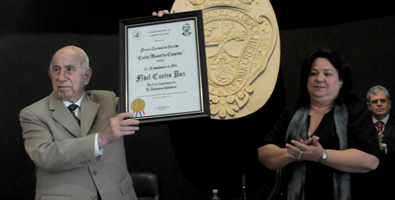
The awarding of the National Law Prize to Fidel Castro—who abolished the judicial branch, established “revolutionary courts,” did away with procedural guarantees, and outlawed unfettered advocacy—is a mockery of justice.
I acknowledge that when I read that item my first thought was: “But hadn’t he already been given that?” We know that in these totalitarian regimes dominated by Marxism-Leninism, the bosses, by virtue of being that, are destined for all the distinctions, recognitions, and awards that have been or might be given. That the alumnus Fidel Alejandro Castro Ruz had not been previously considered when this Prize was first granted probably cost some bureaucrat in the judicial sector a good scolding.
Now that it is an accomplished fact we should ask: What objective reasons exist for granting it? Was it based on the person’s performance before or after coming to power? The dilemma warrants that we briefly address these issues in order to give a response.
The professional practice of the older Castro after graduating as a lawyer was practically nil. In this he is no different from other figures who have gotten into history carrying a law degree. Internationally: Robespierre, Karl Marx, Lenin. In Cuba: Agramonte, Céspedes, Martí. These are just a few examples.
Of course I’m not making value judgments, simply naming people who, for better or worse, have earned a place in history. “Lawyer” is the title that is generally used to describe those figures. Although the appellation is not false, it is not really accurate nor illuminating. To more accurately describe what is common in these characters, we have to use a slightly longer phrase: “Lawyers without cases.” continue reading
This last characteristic is what distinguishes these beings. Unlike their colleagues, their activity is not devoted to drafting legal documents, outlining legal theories, or obtaining the acquittal of an accused. No; in the universities they were outfitted with the same tools, but they use them, if at all, to achieve more ambitious and broader political or social objectives. If they represent a clientele, it is political and not professional.
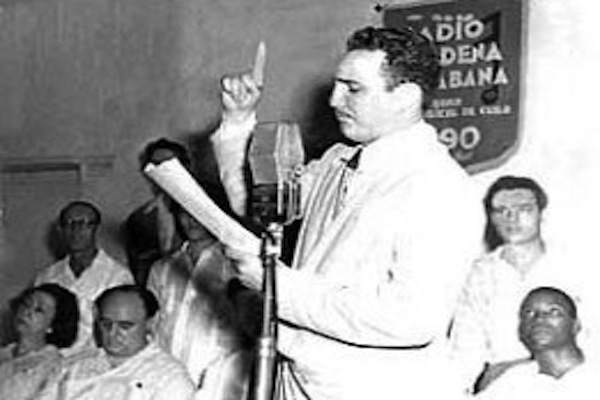
In the case of Fidel Castro, the grantors argue that the Prize is granted “to mark the 60th anniversary of his self-proclaimed defense ’History will absolve me.’” According to Granma, the obliging colleagues of the association of legal officials described this document as “a seamless legal piece . . . that has transcended the boundaries of space and time.”
We know that if anything has characterized the honoree, it is his overwhelming verbosity (rightly documented in The Guinness Book of Records). But the tens of thousands of pages containing his discourses, such as History Will Absolve Me, cannot be found anywhere else; they are not quoted in history books or cited alongside philosophers of past centuries. Haven’t the obsequious jurists noticed? Can’t they draw any conclusions from this?
In his plea, Castro criticized the mechanism (reminiscent of the classic tale of the chicken and the egg) established in the Constitutional Laws of the Batista regime: The President of the Republic appointed the ministers, and these in turn elected him. The curious thing is that after the climb to power of the revolutionary team in 1959, the Basic Law established exactly the same vicious mechanism.
A detailed description of the illegal acts perpetrated by the recipient during the scores of years of his absolute rule would require a collection of books. He did away with the judicial branch, established “revolutionary courts” composed of guerrilla fighters lacking legal education, eliminated procedural guarantees, outlawed the unfettered practice of law, and converted the prosecution into a body guided by political criteria. In a word, he dismantled the solid Cuban legal system.
If the bureaucrats of the Union of Cuban Jurists consider that the perpetrator of such acts deserves the National Law Prize, they are saying very clearly what they really think about this award, which they both created and bestowed.
Cubanet, March 6, 2014 / René Gómez Manzano
Translated by Tomás A.