A Few Days With Nauta / Yoani Sanchez

Now you can read your @nauta.cu email on your cellphone

“The line’s long but it’s moving fast,” someone tells me outside a Cubacel Office. After an hour and several shouts from the guard whom we crowded around at the door, I managed to enter. The clerk is bleary-eyed and warns me that I can only open a Nauta email account there, but “under no circumstances is the account configured for a mobile phone.” This provokes a little, “It doesn’t matter, I know how to do it, I already downloaded the Internet manual.” The little twist of the knife works because she asks me, curious, “Oh really… and could you help a friend of mine who doesn’t know how to do it?”

This won’t surprise my readers, we’re in Cuba where restrictions and chaos mix. Where the same entity that should help its clients ends up asking them for help. So I lent a hand with the friend and her email activation.

After gaining her trust, I was able to get a little information from the bored clerk. “I’m sure the Internet will be available soon on cellphones,” I let fall, just another comment. She clicked her tongue and offered, “Don’t get your hopes up,” turning to me from the desk. Then I attacked, “Well, if it’s the Venezuelan cable, I imagine the service will expand.” And that’s when the employee hinted to me, “This cable comes from somewhere else,” while putting her index finger near her eye as the signal for “vigilance.”

I go home, stumbling at every step because I’m looking at the cellphone screen where it shows new messages. First I write several friends and family members warning them that “this email @nauta.cu is not reliable or secure, but…” And then a long list of ideas for the uses of a mailbox that isn’t private, but that I can check any time from my own cellphone. I ask several acquaintances to sign me up for national and international news services via email. Within an hour a flood of information and opinion columns is stuffing my inbox.

I spend the following days searching out the details of the service, its limits and potential. I conclude that for sending photos it’s much cheaper than the previous method through MMS messaging. Before, the only option was to send an image, with agonizing slowness, costing 2.30 CUC ($2 USD). Now, I can do it through Flickr, TwitPic and Facebook through their email publication service, paying 0.01 CUC for each kilobyte. The average photo for the web doesn’t exceed 100 Kb.

Among its possibilities, is also the ability to maintain a flow of long texts — far beyond the 160 characters of an SMS — with Cubacel users who have already activated the service. In the first 48 hours I managed to create news feeds for other activists in several areas of Cuba. So far all the messages have arrived… even thought the Nauta contract threatens to cut off the service if it is used for “activities…against national independence and sovereignty.”

I also tested the effectiveness of the GPRS connection, needed to send and receive emails, from several provinces. In Havana, Santiago de Cuba, Holguín, Camagüey and Matanzas I was able to connect without major problems. There are some stretches of road where there aren’t even signals to make calls, but the rest of the tries were successful.

 It’s not all good news

Coinciding with the new email service on cellphones, there has been a noted deterioration in the sending of text messages. Hundreds of messages in recent days never reached their recipients, although the telephone company quickly charged for them, which points to an act of censorship or the collapse of the networks. I would prefer to think it’s the latter, if it weren’t for the fact that among the greatest failures were activists, opponents, independent journalists and other “uncomfortable” citizens.

On the other hand, let’s not be naive. Nauta has all the hallmarks of a carnivorous network that swallows information and processes our correspondence for monitoring purposes. Very likely there is a filter for key words and minute-by-minute observation of certain people. I don’t discard the possibility that the content of private messages will be published in the official media, should the government deem it appropriate. Nor do I rule out phishing to damage the prestige of some customers, or the use of information–such as emails published on social networks–to impersonate others.

All these possibilities need to be taken into account when using the new service, because there is no independence between the telephone company and the country’s intelligence services. So every word written, every name referenced, every opinion sent via Nauta, could end up in State Security’s archives. We need to avoid making their job easier.

After a week with Nauta, my impression is that it is a crack that is widening. Through which we can project our voices, but also through which we could be abducted. A poor imitation of the web, a handicapped internet, their service is very far from what we have demanded as 21st century citizens.

Nevertheless, I suggest using this new option and pushing its limits, like we have done with text-only messaging. Used cautiously, but with a civic conscience, this path can help us to improve the quality and quantity of information we receive and of our own presence on the social networks. Its own name already says it, if we can’t be internauts… at least we can try being nautas.

24 March 2014

S.O.S.: They Continue Harassing Angel Santiesteban in Prison / Angel Santiesteban

My incarceration is not enough for the dictatorship

At dawn on last March 22, we prisoners, once again, were awakened by henchmen’s boots for another search procedure.  Several officers, directed again by Major Cobas, ousted us from the barracks with the intention of distancing us from our belongings. I objected and asked to remain present while they inspected my property which Cobas himself refused. I warned that I was not responsible for what they might find in my absence. The officer persisted in moving me away.

As has always happened, I was the only one of interest although they searched the rest. The majority gathered around my bed searching among books, reading each paper of the many that I posses, and setting aside those they found “interesting,” always news that brings me national and international reality and that generally is far away and different from that of government censors and authorized in their official media. They also read the back covers of the books in order to practice the look of the political police, and as on other occasions, to take them.

In the end, they only confiscated personal documents, printed news, two CDs, one with the images of the false “witness” that the Prosecution prepared against me in complicity with the police and the complainant when they came to demand 54 years in jail for me and later, thanks to those images, they had to desist.  They also took another CD with the sad documentary “Gusanos” which is about the fascist action of the government against State of Sats (Estado de Sats). I suppose that if those officers had the least bit of embarrassment and humanity, they would feel shame.

The alarming thing is that they showed me an instrument that looked like a screwdriver which can be used as a punch and which they claimed to have found within a dark suitcase that I possess. I assured that it did not belong to me, and the officer who said he found it blatantly lied and claimed it was true. A prisoner interrupted to claim that it was his property because he was trying it as a shoemaker’s needle, and he sewed work boots with it; then they left laughing with absolute cynicism.

It is no secret that they are searching desperately to implicate me even more and add some crime in order again, as on prior occasions, to erase the five year maximum sentence as stipulated by the Penal Code. Or a tangible vengeance for the “Second Open Letter to Raul Castro,” which I dedicated this past February 28 on completing a “Year of Unjust Incarceration.”

As always, they are plotting something, and also as always, they will not find in me even an iota of giving in to their constant torture for the “Crime” of thinking “DIFFERENTLY.”

Angle Santiesteban-Prats

Lawton prison settlement.  March 2014.

Follow the link to sign the petition for Amnesty International to declare Cuban dissident Angel Santiesteban a prisoner of conscience.

Translated by mlk.

Me in Venezuela’s “El Nacional” / Orlando Luis Pardo Lazo

Yesterday, the OAS voted for much more than the silence of María Corina Machado. Yesterday the OAS sentenced her to the murderous loneliness of nasty socialism, which is the only one that germinates in America. Yesterday the OAS made itself an accomplice to a crime against morality which, like the coercive quotas of Venezuelan oil, muddies the miserable hands and tarnishes the reactionary faces of half a continent. Read the entire article here.

23 March 2014

Cuban Doctors in Stampede to Brazil / Juan Juan Almeida

According to the Official Journal of the European Union, the Brazilian government decided to triple the number of Cuban collaborators in its program of popular health “More Doctors.” And to cover the increase of the Cuban medical contingent in Brazil, Dilma Rousseff updated the contract it has with the Pan American Health Organization (PAHO/WHO), bringing to 973.94 million reals ($ 415 million dollars) as the resources for this expansion for the next six months.

What is blatantly obvious on the Brazilian news is that the Cuban doctors expected to arrive in Brazil, are those who — given the unstable and turbulent situation facing Caracas — are preparing to flee Venezuela.

15 March 2014

ETECSA’s New Offers May be Affecting the Cuban Network / Anddy Sierra Alvarez

Alfredo has tried several times to get in touch with his brother. He doesn’t bother with sending an SMS because he has sent various messages on other occasions which haven’t arrived on time.

Following ETECSA informing most of its users of the new service, they can access their emails via NAUTA.cu from their mobile phones. The SMS service won’t work as it did before.

These problems with ETECSA’s service have affected all the Cuban government’s opponents, even leaving them without access to the internet. But what’s happening now is no more than possible overloading being experienced by ETECSA in carrying out what they have promised.

Does ETECSA have the ability to offer a quality service?

Another one of the services affected is MMS. In spite of the fact that it isn’t popular among Cubacel’s users because they don’t know about it. Those people who have been able to use it have found it difficult to send an MMS.

“Yesterday I sent a photo of her granddaughter to my mother and she wasn’t able to see it because the service isn’t working”, said Michel.

Is ETECSA going to get worse? Just as everything that the government touches does. Or is it just a question of getting used to a poor to middling service quality which varies from month to month?

Translated by GH

17 March 2014

Ammonia Leak in Artemisa / Juan Juan Almeida

On February 11, while a toxic product was being worked with on one of the fields of the Jose Antonio Labrador Agricultural Cooperative, produced an ammonia leak that affected several villages. At Ciro Redondo Hospital in Artemisa more than 45 patients were seen with respiratory problems, all of whom were released except for two girls who remain under observation in Comandante Pinares Hospital.

The causes of the leak are still being investigated.

15 February 2014

The Havana That the Castros are Going to Leave Us / Ivan Garcia

Sixty percent of the buildings cry out for basic repairs

Autocrats always want to transcend their own times. The Roman emperors, Hitler, Mussolini and the communist dictators Stalin, Honecker or Ceaucescu, bequeathed their own styles of architecture.

In Rome they still retain coliseums and palaces. Mussolini left hundreds of works, constructed under the label of fascist rationalist architecture, rolled out in Italy at the end of the 1920s in the last century.

Hitler also put up buildings and spaces in the Nazi cult, with the patronage of Albert Speer, in an original architectural style inspired by neo-classicism and art deco.

Sixty-nine years after the psychopathic Führer shot himself in his Berlin underground bunker, just before the defeat of the Third Reich, the Germans are still driving along the magnificent autobahns built in the Hitler period.

A serial criminal like Stalin left us socialist realism – horrible, certainly – which encompassed all the arts. Nicholas Ceaucescu, another dictator doing it by the book, demolished a fifth of Bucharest and put up new buildings.

His greatest project was the Palace of the People, the second biggest building in the world, after the Pentagon in Washington.

Fidel Castro won’t leave any timeless architectural works. He put up thousands of schools and hospitals, but, apart from the Instituto Superior de Arte, in the Playa Council area of Havana, the rest of his designs disfigure the landscape.

And forget about quality of construction. Most of the buildings put up after the bearded people came to power look older than many built at the beginning of the 20th century.

In Havana, capital of the first communist country in America, the architectural legacy will be irrelevant. You’d have to search with a magnifying glass to spot any high calibre work.

Among them would be the Coppelia ice cream shop, designed by Mario Girona in the centre of Vedado, or Antonio Quintana’s Palacio de Convenciones in the suburb of Cubanacán. You could also make an exception of Camilo Cienfuegos city, in East Havana, and Lenin Park, a green lung provided on the outskirts of the city.

But architectural design from 1959 onwards is, to say the least, odd. If you could demolish the dormitory suburbs of Alamar, Mulgoba, San Agustín, Bahía, or the twenty or so horrible apartment blocks built with Yugoslavian technology in Nuevo Vedado, you would partly put right some clumsy construction mistakes.

Havana, a city which is pretty and conceited with its several kilometers of gateways and columns, and a splendid esplanade among its architectural offerings, maintains the greatest variety of styles.

It was designed for 600,000 inhabitants. Today 2.5 million people live there. The regime has neither modernised nor widened its streets or avenues or a site as important as the Albear aqueduct.

They have only patched and asphalted the principal arteries. They have not improved the roads of Las calzadas de Monte, Diez de Octubre, Luyanó, Cerro, Infanta, Avenida 51 or Puentes Grandes to deal with the increase in vehicular traffic.

Some 70% of the side streets are full of potholes and water leaks. 60% of the buildings are crying out for fundamental repairs.

Let me give you a fact. According to an official of Physical Planning in Havana, 83% of works carried out are done privately. The urgent need for homes to be built has resulted in constructions all over the length and breadth of Havana without benefit of professional advice.

Thousands of home-made cast-iron windows with hideous grills make the capital look even uglier. The impression you get is of a large prison. Without any order or harmony, desperate families refurbish buildings and houses of great architectural value, trying to improve their lives a little.

The once cosmopolitan Havana, at the forefront of new technologies like the telephone, radio, or long distance TV transmissions, has now turned its back on globalisation.

The internet is a science fiction dream for many of its citizens. And what was once a beautiful colonnaded city, which would inspire Alejo Carpentier, is, in the 21st century, a heap of ruined buildings and ancient automobiles.

The Castro brothers haven’t even been able to leave any legacy in the city where they have been governing for years.

Iván García

Photo:  Taken from Juan Valdés César’s blog where you can see more images showing the current state of Havana.

Translate by GH

23 March 2014

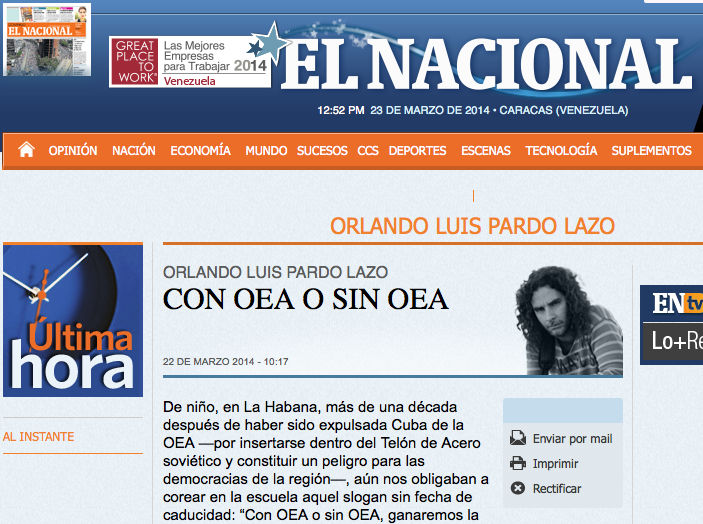
With or Without the Organization of American States (OAS) / Orlando Luis Pardo Lazo

Screen Shot 2014-03-23 at 10.27.44 AMAs a child in Havana, more than a decade after Cuba had been expelled from the Organization of American States (OAS)—for placing itself within the Soviet Iron Curtain and constituting a danger to the region’s democracies—we were still forced to chant at school that slogan with no expiration date: “With or without OAS, we will win the fight.”

As kids we had no idea what “OAS” might mean. We imagined it as the imperialist bald eagle that frightened us in so many children’s songs of that era.

But our childish innocence wasn’t important, as long as we never flagged in our discipline as “Moncada pioneers”: that is, children capable of assaulting the Moncada barracks and dying fighting at dawn, disguised in the uniforms of those soldiers who were taken by surprise in Carnival season, as Fidel Castro did in the putsch of Sunday, 26 July 1953.

All that mattered then was to show and demonstrate our patriotic devotion in the classroom, shouting this slogan until the veins in our necks ached. We had no idea what “living in chains is to live in dishonor and ignominy” meant, but we just sang that line in our National Anthem with grim theatricality at every morning assembly.

It seems that the slogan of the Cuban Communists remains strongly in force. The government in Havana boasts it will never return to the OAS, and promotes parallel organizations—like the Community of Latin American and Caribbean States—to diminish the prestige and power of the OAS. And to top it off, Cuba controls, through a headless Venezuela, the geopolitical interests and economic dependence of the region, given that many Latin American ambassadors appearing in front of the OAS are nothing more than puppets, supporting or boycotting as a block in response to neocastroism’s strategic interests, be they “Twenty-first Century Socialism,” or “State Capitalism” or “Raulpolitik.”

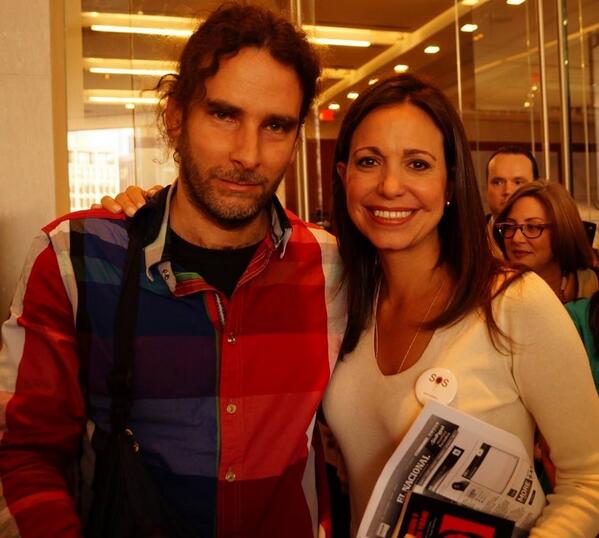
Orlando and Maria in Washington DC
Orlando Luis Pardo Lazo and Maria Corina Machado in Washington DC on 21 March

Yesterday, Friday March 21, I spent the day at the OAS in Washington DC. An odious odyssey of fears and lies was taking place within, in the opaque style of dictatorships, under the pretext that every people have exercised their right to decide through majority vote. But, in reality, we’re not talking about 100% sovereign nations. In the best of cases they are the pawns and parasites of the authoritarian chess game controlled from behind the Havana Curtain. In the worst of cases, they are despotic-populist regimes where the caudillo and his clan are legally “reelected” to the end of time, with no options for the opposition, and with an infiltration of intelligence forces comparable only to the criminal Plan Condor from decades back.

Yesterday, María Corina Machado was treated by a miserable majority at the OAS as a fugitive from supposed Venezuelan justice. Her companions—the student leader Carlos Vargas, the union leader Iván Freitas, and Rosa Orozco who became an activist after the assassination of her daughter Geraldine Moreno—were rudely censored and almost ejected in handcuffs from the building by OAS Security (not to be confused with State Security, much less with the murky Cuban G-2, which coerces without batting an eye—by force of blackmail and terror—Eurodiplomats, global magnates and Yankee congressmen and women: remember that Castro spies have been captured inside the Pentagon).

The message could not be more repugnant, with or without the OAS: the leaders of the area are delivering María Corina Machado into the jaws of some desperate usurpers between Havana and Caracas, who no longer care about formal procedures because they know their time is up and that only slaughter will keep them in their positions in perpetuity, if they finally manage to impose in Venezuela and the rest of nations that call themselves “Bolivarian”—that word which, like “revolution,” means nothing and is the cause of all the impunity—the civil cemetery in which we Cubans have lived since the first year of “our” Revolution.

María Corina Machado has humbly declared that there are millions of citizen leaders in Venezuela today. True, but this formula is completely useless to the rage of the repressors, who need to stigmatize, isolate, disable, imprison, exile, and even execute, as if by accident, a specific number of leaders.  A sacrificial relationship with good Venezuelans whom she and Leopoldo López now definitely represent. A limited list that is a limitless list of hope for finally eradicating—after more than half a century of myths and bullying—continental Castroism.

Yesterday, the OAS voted for much more than the silence of María Corina Machado. Yesterday the OAS sentenced her to the murderous loneliness of nasty socialism, which is the only one that germinates in America. Yesterday the OAS made itself an accomplice to a crime against morality which, like the coercive quotas of Venezuelan oil, muddies the miserable hands and tarnishes the reactionary faces of half a continent.

22 March 2014

The Powerful Ex-Son-in-Law of Raul Castro, Exiled / Juan Juan Almeida

For a long time there have been countless comments within the circle of Cuban power, where the name of the cunning and not-at-all innocent Colonel Luis Alberto Rodrigues Lopez-Calleja persists, as the “Czar of the Military Economy.” A fictional creation, a legend.

So today, February 24, instead of writing about this group of brave men who in 1895 shouted “Independence of Death!” resuming the struggle for Cuban independence; I prefer to comment on Luis Alberto; an arrogant character, insensitive, calculating, abusive, with the last name of a porn actress, lover of numbers that always add up in his favor, clever with arithmetic and epics, who despite all his positions (CEO of the Business Administration Group of the Revolutionary Armed Forces and member of the Communist Party Central Committee), trying to escape himself and adulterate his destiny.

A difficult thing, he knows how to do business with the clam and wants to enter “The Family” always bringing negative consequences. His many year marriage to Deborah Castro went on, as we all know, with a long history of abuse and infidelities which were always tolerated. But suspicious, as usual, he understood that in this new economic transition taking the country from paleolithic times to the middle ages, he was losing power and tried, unsuccessfully, to use Deborah as a shield.

It’s clear that his ex, the oldest of the Castro Espins, is a huge mistake that corrects its errors by committing others, worse; but the always seductive Rodríguez López-Calleja, instead of snorting cocaine smoked composure and put on the boxing gloves. He gave her a brutal thrashing, Deborah ended up in the hospital with serious contusions.

A coward, like any batterer, he doesn’t need an Aladdin’s lamp to understand that, in a country like Cuba, where low class is very low, the average is not high, and the high lacks class, his old superiority became a cage. He knew very well that it went against him, and wanting to revenge the sadness of his father-in-law-leader, is a completely obedient army that, in frank restructuring, needs to hang medals.

To judge him wouldn’t be right, but in a case like this, quite logically, to parents it seems to use that the job is not usually fair.

Raul’s government has skillfully navigated several crises, and doesn’t want to do this, a news scandal. So he ordered the criminal case dismissed and will send, or already sent, the father of his grandchildren to serve a mission in Angola, a dangerous land for a Cuban in disgrace.

But now, Luis Alberto, urgently, strategizing, is moving heaven and earth to keep a grip, however little, on the armrest of the couch that already has termites. We know very well that the underworld is unforgiving, he knows that in any place protected from prying eyes, the final bill will arrive.

Perhaps he won’t even get to step on African soil, perhaps he won’t board the plane; or perhaps, because there is always a perhaps, when we least expect it, we’ll have him over here.

25 February 2014

The Garden of Congratulations / Angel Santiesteban

Interpreting the triptych “The Garden of Delights,” by El Bosco, we can find, ironically speaking, a comparison with the winner of the Frank Kafka 2012 award, “Long is the Night,” by Cuban writer Frank Correa, who delights in telling stories, just like emptying oil paint onto the palette and passing the brush through it so that the paint moves, becomes confused, converting itself into a range of unimaginable colors for the painter himself, who accepts it as a revelation under discovery.

Correa, through his narration, invites us on a journey to discover alongside him impoverished Cuban society. Like a mannequin, he undresses the social reality of a country inhabited by ghosts. His characters live a constant day-to-day agony, a balancing act sensation on the razor’s edge that is tipped by the tiniest of bad things. With fresh and colloquial reading, his more than two hundred pages are read. He plays with ironies, and in moments–like the flash of a camera–the humor hidden in the circumstance appears, an intrinsic part of Cuban idiosyncrasy.

Thanks to the generosity of the organizations of the “International Franz Kafka Prize of Novels from the Drawer” competition, held in the Czech Republic, it was avoided, as the name indicates–novels from the drawer–that this work remains in the dark oblivion of an artist, that it clamors and struggles, for rights of its own, a space in national literature.

The fiction of the novel culminates with my most absolute reality: prison. His character and I intertwine, between fable and reality, invention and nature; our silhouettes cross and skip times, with that protest of wanting to awaken and abandon the dangers of prison, and–with much to write and to invent itself another space–always finish with the caning of the guards against the fence, yelling TO SLEEP!

Ángel Santiesteban-Prats

Lawton prison settlement. March 2014

To sign the petition for Amnesty International to declare Angel Santiesteban a prisoner of conscience, follow the link.

Translated by LW
17 March 2014

Reopening Marti Theater / Juan Juan Almeida

After its closure in the late sixties, the emblematic Marti theater in the Cuban capital reopens its doors after nine years of intense repair work on its valued architecture.

The property underwent an accelerated process of destruction, to the point that only the stone facade was preserved. A simile of the national decline. To everyone’s satisfaction, the coliseum of 100 doors, as the poet said, is ready. Moving forward, even when the recovery starts from zero, is worth the trouble. We go for the push.

26 February 2014

Over and Out / Juan Juan Almeida

According to a note in the newspaper Granma, the Council of State, on a proposal from its President–Raul Castro, or “El Chino” as we call him–agreed to promote to Minister of Culture the compañero Julian Gonzalez Toledo. A suspicious agreement, knowing that Toledo doesn’t understand much about culture because he spent his whole life at the Senior Party Cadre School.

Now the curious comment that the ex-minister Bernal will be assigned other tasks: a nice shower accompanied by a white guayabara and a straw sombrero, so when he’s bored on the “pajama plan” (as we call forced retirement), he can go out in his backyard and entertain himself watering his plants. That is, if he leaves the house.
6 March 2014

Answering the Requests of Those Who Are Looking for Holes / Angel Santiesteban

Many people ask me to clarify some points that tarnish the credibility of my case and situation. As Internet is the playground of all, we can utter truths, but also otherwise. And every time, after every event, positive or negative, that happens in my life, I have a bunch of people trying to highlight an insidious observation, creating doubt and suggesting, in general, that I’m lying.

Among them, some even tell me that there are people who think I’m imprisoned because of a family dispute. That possibility seems impossible to me since the all evidence of my innocence can be found on the Internet, and nothing, not a single thing, against me.

So how can anyone even suggest that what the government in power says about me is true. I have exposed to public review all my proofs, I proved that I am innocent. On top of that, I made a video of an alleged witness for State Security’s Prosecution and the “plaintiff” against me. I absolute believe that, after seeing this proof, among many others, no one can accept the version of the State against me.

After someone makes a pact with the State, with its political police, and its legal arm, it could appear plausible. I’ve said a thousand times before opening my blog I was [in the eyes of the regime itself] an exemplary citizen, save for my writing which was already, from my start, rebellious.

I was also an exemplary father, and spent more than two and half years lovingly and physically separated from my ex, with whom I have a beloved son.

I have also offered the name of Major Pablo, chief of the sector chiefs of the municipality of Plaza.

In my blog you can read all the irregularities of the trial, it was just a circus, and a month before the sentence was handed down the henchman Camilo announced my sentence to me, with the number of years I would serve. Is he psychic?

It can also be seen in the sentence, after the appeal and review, that I was badly sentenced, but nonetheless they are not interested in amending it. Anywhere in the world, that sentence should be thrown out. And in front of the whole world, I ask for a new trial.

File of Angel Santiesteban’s Case (click to open)

To make matters worse, the journalist Juan Carlos Linares Balmaseda, from Cubanet, interviewed me. They immediately asked how it was possible that he could have access to me. I urge those who have questions to ask the journalist to see how terrified he was, and how he had to escape before finishing so he wouldn’t be arrested. In that interview he took a picture, the one where I am at the end of the unit where they keep me locked up, which adjoins a street and homes. That was the appropriate space to do it.

Under my sentence (five years), I have the right to leave on a pass every sixty days. After eight months in prison, I was awarded the first pass and visited the home of Antonio Rodiles and in the happiness of family, they gave me a cake and me took a portrait.

That day gave rise to more gossip, sowing doubts, saying I was released and just pretending to be a prisoner, and so many stupid things that they don’t deserve mention. Then Aimara Pérez came to Cuba and spent a day visiting my family. I allowed her to photograph me. This prison settlement ends at the end of a street. Then some said I was in the street. At the end there is a Girón bus they keep here, and others said that the picture was taken on a public street. It is like looking for the detail to fit the official version.

I have no doubt that those who are interested in these false details have another interest which is not the freedom of Cuba. It only remains to add that anyone who has any doubts can look for evidence on the internet or can approach me, can find ways to reach me, and after that conversation, then you will be allowed to issue an opinion supported by your own inquiries.

Ángel Santiesteban-Prats

Prison settlement of Lawton, January 2014

Waking up in a Dictatorship / Angel Santiesteban

From the time I was a kid I discovered that my feelings forced me to show solidarity with the weakest. In sports I wanted to play on the most competitive teams, and today it’s the same. But I’ve always been on the side against the Cuban dictatorship.

In the eighties, when my generation started thinking, we hated the dictatorships in the world, especially those in Latin American; at that time we didn’t understand that Cuba lived under a totalitarian regime.

I still don’t know where my need to express my feelings without worrying about the consequences came from, even if the price is my own life.

The Cuban opposition, if I were asked to express it through a painting, would be a huge tree in a gale of wind raging against its structure, and despite its trunk, sometimes it leans, seeming as if it could touch the ground, and even so, it endures all things, at times the wind carrying away its branches, leaves, fruits, but always, irremediably always, it recovers, and stands to wait and face the next onslaught.

The time remaining without freedom is impossible to predict, but the forces of resistance seem to be sufficient and are multiplying.

Ángel Santiesteban-Prats

Prison settlement of Lawton. March 2014.

Please sign the petition so that Amnesty International will declare Angel a prisoner of conscience.