The Two Mariels: Mega-Port and Ghetto / Polina Martinez Shvietsova

HAVANA, Cuba — The mega-port of Mariel and the impoverished town of Mariel are two sides of the “prosperous and sustainable socialism” — wealth and poverty — which Raul Castro promotes as a “solution” to Cuba’s problems.

The Brazilian company Odebrecht S.A. and Cuba’s Almacenes Universales S.A. — a subsidiary of the GAESA business group, run by the Cuban Armed Forces — make up the ZDEM business partnership. These two companies formed the Mariel Comprehensive Development Zone (ZDIM), which is managed by Almacenes Universales. Its mission is to provide services to the shipping companies that operate in the mega-port and use its container terminal. These facilities were built to meet the needs of Cuba and provide services to other countries in the area.

Brazil has agreed to provide 800 million dollars of credit subsidies to Cuba. The president of Brazil, Dilma Rousseff, and Raul Castro inaugurated the first phase of the port’s operation. continue reading

The town of Mariel covers 270.6 square kilometers and has a population of 44,597. It is divided into five people’s councils: Mariel Urbano, Boca Mojica-Henequén, Cabañas, Zayas-Ingenito y Quiebra Hacha. The average monthly salary for state workers not employed by the mega-port is 19.50 dollars.

“The town itself is in ruins,” a young pediatrician at the Orlando Santana Hospital tells us. “Why is it so neglected,” she asks, “when we have a multi-million dollar project like ZDEM so close-by?

Silence hangs over the House de Culture. A woman who works there, Consuelo, notes, “The art instructors keep giving lessons as best they can, but young people would rather go to the La Cañita nightclub where regaetton bands and some other son or timba groups play. They sell watered-down draft beer. People are always getting drunk and it leads to violence.”

Emblematic of Mariel is Motel La Puntilla. Built in the 1960s, it remained in operation until sometime after 2000. Now only a small private-event space remains open.

“You are not allowed to take photos as La Puntilla,” an employee who requested anonymity warns me. “Word has it that a company from Artemisa is going to renovate the motel, that a budget has been approved by the province, but no one knows when that will happen,” she adds.

We stroll around the abandoned motel. The swimming pools are empty but otherwise seem to be in good shape. The building, however, requires a significant capital investment.

If you have money you can find pork, beans, fruits and vegetables, but I have to pedal a lot just to eat,” says a bicycle taxi driver, who operates from one end of town to the other, adding, “A pound of pork cutlet is 40 pesos. A pound of rice costs 5 pesos. And you have to buy it from private sources because of shortages at the state-run markets. To give you an idea, a pair of shoes costs 20 CUC.

Leonel, another bicycle taxi driver, explains, “Public transport is a disaster. There is a bus that runs three times a day between Mariel and Havana and costs 2 pesos. A fleet of private taxis charges 30 pesos for the ride to Havana but not everyone can afford to pay that.”

An elderly man in his eighties noted, “They let us fish in the right side of the bay. And if we catch something one week, we reel it in. We can sell needlefish, emperor fish and marlin for 30 pesos a pound.”

In the town of Mariel only the main streets are paved, including the stretch where the Cuban Communist Party headquarters are located. The the rest are full of potholes, leaks, empty trenches and standing water. While its inhabitants look with hope towards the mega-port, there are rumors that foreign investors want to demolish the old Mariel and construct a new town around mega-port.

Cubanet, May 12, 2014,

12 May 2014

Total Abandonment / Juan Juan Almeida

Theodor Friedrich, the Cuban representative of the United Nations Organization for Food and Agriculture (FAO) who is participating these recent days in the second International Conference on Animal Health Surveillance which is being held in Havana, asserted to Prensa Latina that animal epidemiological surveillance is a topic that transcends the borders of isolated countries and congratulated Cuban authorities for their leading work in this area.

How nice, altruistic and caring that 116 delegates from 39 countries of the world meet in Havana to talk about animal health; but before arriving at the unreasonable conclusion, they should go out to the streets, immerse themselves among the people and enhance their view strolling through the city that has the most stray dogs in all of Latin America.  So, rather than health, they will talk about the absolute abandonment of animals.

Translated by mlk

9 May 2014

Soviet Cuba Remains in the Official Imagination / Ivan Garcia

Dmitri-Medvedev-Raúl-Castro-620x330It’s hard to bury faith in any God, ideology, or vices. For others, like Vladimir, the passion for the Soviet era, like old rockers, never dies.

Son of Communist parents, he studied at universities in the former USSR. He speaks Russian like a Muscovite and still reads Gorki or the poems of Yevstushenko in the original language.

On a pine shelf he has a bunch of Soviet writers in the style of Borís Polevói, Nikolái Ostrovski, Mijaíl Shólojov or Ilya Ehrenburg, who wrote the epic of the Red Army in World War II.

Vladimir is not considered a fanatic. In his room there are no canvases of Stalin, Marx or Lenin . “The USSR may seem like an old newspaper. But it is not dead yet. In Cuba people don’t find Russian cartoons or corned beef strange. It is in the power structures where still latent are certain mechanisms of the Soviet era.”

Dismantling this shed is an arduous task. A vertical government, omnipresent secret police, a broad sector of the planned economy and the usual unanimity of approving laws in the boring national parliament, are vestiges of the official Soviet Cuba that resists death.

Cubans like Vladimir worked for years on building institutions modeled on the Soviet Union. From the Constitution to the Pioneer organizations. continue reading

“All of us who believed in the USSR assumed that the short-term future was Communism. And that the disappearance of capitalism was a question of time. But it wasn’t. Now Putin’s Russia is as imperialistic as the United States,” says the nostalgic Havana Communist

There is very little left of the USSR among ordinary Cubans. Some Slavic names, drinking vodka and orange juice, and hundreds of marriages that still remain from that Red era.

Not a few of regime’s officials feel nostalgia for the past. It was a golden era where rubles were wasted and the armies had the most current versions of conventional Russian armaments.

From the USSR came oil, fertilizers and tractors. Magazines, books and movies flooded the country. Then, it was in good taste to hang portraits of the current Soviet leader at the same level as those of Fidel Castro.

The current president, Raul Castro, had an enormous portrait of Stalin, the butcher of Georgia, in his office at the Ministry of the Armed Forces.

What remains to be seen is if the Castros were Communists of convenience, or chose the ideology to cling to power. The quirky Euro-Asiatic system had irresistible charms for any apprentice autocrat.

There were no presidential elections. Nor free press. Nor independent unions. Justice was administered by the State. And they created a competent political police, dissident citizens could complain only in their own living rooms, or leave on a raft.

The love story between the USSR and an intellectual and political sector of Cuba is longstanding. Many who swear they are firm nationalists, accuse those who admire the U.S. lifestyle are accused of being “annexationists.”

But Communism is the first of all annexations, the importing of Marxism-Leninism and wanting to clone the Soviet model on a Caribbean island 6,000 miles from Moscow.

And it wasn’t the illiterate or stupid who were applauding the theory of a Soviet Cuba. Within the ranks of the People’s Socialist Party (PSP), intellectuals such as Juan Marinello, Carlos Rafael Rodríguez, Salvador García Agüero and Nicolás Guillén stood out.

With the coming to power of Fidel Castro, political opportunism coupled the Communist imagination of tanned men of Cuban unionism, and the Marxist proselytizing in various academic and intellectual sectors.

Before 1959, the PSP branded Castro a gangster, sucker, and petty bourgeoisie. According to Anastas Mokoyan’s son, who accompanied his father on the visit of a Soviet delegation to Havana in February 1960, witnessed the following dialog between Fidel and Ernesto Guevara:

“They (Castro and Guevara) said that they could only survive with Soviet help and would have to hide this from the capitalists in Cuba… Fidel said: We have to cope with these conditions in Cuba for five or ten years. Then Che interrupted him: If you don’t do it in two or three years, it’s over.”

The rest of the story is known. Castro Sovietized the island and 55 years alter, the main political institutions of the State continue using their methodology. From the special services to diplomacy, which when it aligns itself with a partner, approves political expansionism like Putin in Crimea, or joins with repugnant dictatorships only because they are the enemies of their enemy.

The current labor legislation — which still hasn’t been officially published — or the aberrant Foreign Investment Law, demonstrated that the current Cuban government only considers its people as an instrument to legitimate their tepid economic reforms and not to benefit them.

Separating from an ideological faith is too costly. Even when the reality shows its inefficiency.

Iván García

Photo: January 2009. Then Russian president Dmitry Medvedev buttoning the coat that he had just put on his counterpart, Raul Castro, before the beginning of the informal talks at a residence in Zavidovo, north of Moscow. It had been 24 years since a high Cuban leader had visited the former Soviet Union. Taken from Listín Diario.

18 May 2014

The Enchanted Island / Rebeca Monzo

Meeting someone through the social networks can bring us very agreeable surprise or, on occasions, the complete opposite. I’ve had the good fortune of establishing very good relationships and contracts through my blog, Twitter and Facebook, despite my restricted Internet access.

One of the most faithful followers during these almost five years since I opened “Through the eye of the needle” is a marvelous Cuban woman who has lived in Puerto Rico since the early seventies, who not only brings me support, but who has also also confided in me, and on sending me an invitation to meet in person, hosted me in her house.

During the years of contact through the social networks, we have identified — greatly coinciding in our opinions — an issue that brings us strongly together.

My brief stay on the beautiful “Enchanted Island” — in addition to my stay with her and her lovely family in Palmas del Mar, where they live — put me in touch with many personalities in the areas of arts and literature, in this paradise, and I participated as a guest artist in a bit “Meet the Chefs” Forest Fundraising Auction, haled every year to promote and finance the care of the native forest of this blessed place. At this event I was honored to donate one of my patchworks, coincidentally titled “Forest.”

Time, the “cruel enemy,” went too fast, as usually happens when we are enjoying something so much. I had to leave my new friends of this marvelous island and head home full of lovely images, much love, appreciation and great desires to return, still hearing in my ears the lovely song of their “coquís.”

18 May 2014

News / Regina Coyula

Starting this month I will be on  BBC Mundo’s blog about Cuba. I still haven’t seen it, I don’t know what it’s called, but the project interests me because I will share it with Nórido, journalist from the newspaper Trabajadores (Workers); with the author of a blog called Alego33, which I’ve read and which seems excellent to me; and with Leonardo Padura, journalist and novelist who needs no introduction.

In the group, I am the woman, the only one who didn’t study journalism, and the dissident; several people approached me to object to the adjective in the introduction to the blog, but it’s not a lie, I dissent.

I will try to keep up, although this will continue to be the more personal space, a bit ignored lately, it’s true, because I have had work to do, but especially, study. I will also publish in 14ymedio. Not bad for someone at my age.

19 May 2014

What Happened to the Cuban Cigar? / Juan Juan Almeida

The story goes that Cuban natives consumed tobacco long before the Genovese admiral Christopher Colombus landed on the island.

The studies and evidence show that our natives used it as a medicine, narcotic, aphrodisiac, and in religious rituals and celebrations.  They smoked it, breathing through the nose and even drank it in concoctions.

Rodriguo de Jerez was one of the sailors who arrived in the Americas with Colombus and returned to old Europe with the habit of smoking.  The Inquisition, after alleging that only the devil could concede to a man the power of taking smoking through the mouth, sentenced him to seven years in prison.

Nevertheless, the vice prevailed; tobacco became an industry, and although studies make clear that the plant has its origin in the Andean region between Peru and Ecuador, Cuban tobacco rapidly achieved the qualifier of “the best in the world.” And the term Havana appeared to conceptualize all the cigars where 100% of the product is cultivated and manufactured in Cuba after multiple and severe controls both at the level of agriculture and at the drying and twisting process. continue reading

It was 1800 and by then tobacco, like sugar, had fused with the history of our country; but the characteristics of the market and the pleasure of the smokers made the Havana, distinguished now by its provenance, start to be classified by the zone of the crop.  So emerged prestigious brands like Partagas, H Upmann, La Corona, Por Larranaga, El Figaro, and others until 1966 when Fidel Castro created Cohiba, the leading brand of Cuba, which carries his name thanks the suggestion of his then chief bodyguard, Chicho.

Cohiba not only is the name of the tobacco of the highest prestige in the world, it is also a commercial brand that moves political influences, traffics in power and manages millions of dollars. It is sold at astronomical prices and is consumed in every corner of this planet. The Rolls-Royce of tobaccos is a golden bubble where pleasure finds a select group of people who only have money and power in common.

Throughout all its history the leaves used to handmake the bast cigar in the world have been jealously chosen, and marketing specifies that they come from the five best meadows from the region of Vuelta Abajo, Pinar del Rio.

Inclement weather, the Special Period, lack of fertilizers, financial liquidity, the fight against smoking and other series of factors made Cuban tobacco production decline. As hard as they tried they could not meet the commitments or the claims of a market that demanded greater quantity and quality from our leading product. The Commander in Chief himself, who by then was also a microbiologist, ordered the use of an in vitro production technique that would guarantee massive quantities of tobacco plant starts with the same high levels of excellence; but obviously, the plan did not bear fruit.  And so we arrive, as always, at deception.

“The country of tobacco” clandestinely bought selections of leaves in Nicaragua and small quantities in Ecuador, countries where it is known that the tobacco plantations pass through a strict quality control with international standards. The quasi-contraband leaves were used for the manufacture of tobacco that was sold, and which was given to influential leaders. A real joke, “the best Havana in the world” without guarantee of origin.

Just the Cuban part of the joint venture Habanos S.A. can answer if this government scam persists. One more.

Translated by mlk.

13 May 2014

Napoleon and El Comandante, A Dangerous Fusion / Juan Juan Almeida

Latin Press reported that this coming July the XII International Congress of the Napoleonic Society will meet in our country.  So far delegates from several countries have confirmed their attendance.

The director of the Cuban Napoleonic Museum and organizer of the event, Dr. Sadys Sanchez, let loose her tongue, and after comparing Fidel with Napoleon, announced that the central theme of said event, “the Napoleonic revolutions around the world,” will prove how close we are to the ruler who sat down to eat with his troops; and will demonstrate that his conquests transcended geographic, military and political levels in order to surface in our culture.

Maybe I am a bit paranoid but this makes me think that this Napoleonic fair has a second purpose.  Luckily the newspaper also serves to clean the windows.

Translated by mlk.

16 May 2014

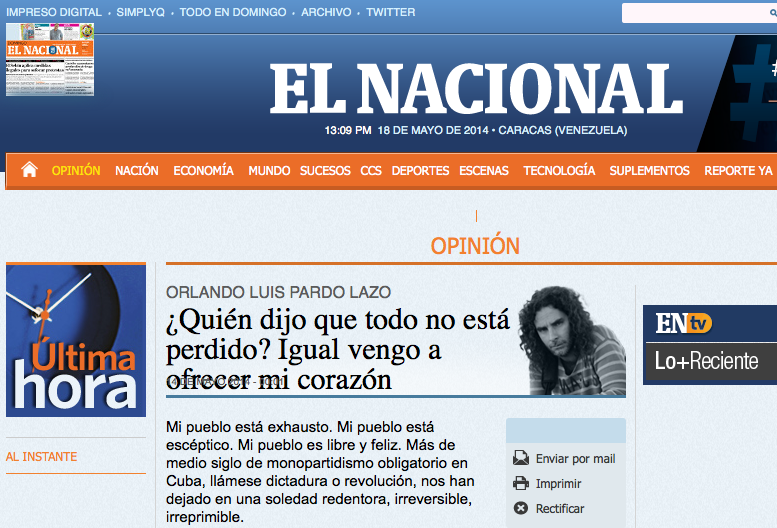
Who Said All Is Not Lost? Anyway, I Come to Offer My Heart / Orlando Luis Pardo Lazo

Screen Shot 2014-05-18 at 10.40.26 AMMy people are exhausted. My people are skeptical. My people are free and happy. Over half a century of forced one-party rule in Cuba, call it a dictatorship or a Revolution, has left us in n a redemptive, irreversible, irrepressible loneliness.

Cubans escape from Cuba. That is now our victory, our permanent plebiscite. We are leaving. Goodbye, intimate and intimidating little island of my love. Goodbye, homeland lost and unforgettable forever. Goodbye, finally, Fidel.

We did the best we could while we could. For decades and decades trying to place a magic bullet in the heart of Castro. To kill death. Or busting his head in his convertible Mercedes Benz, like Dallas. Very diabolical, perhaps also very vaudeville.

But we lost that first marathon of who killed whom. We didn’t even dare to poison him. To put him in a wetsuit with skin toxins. To give him an exploding cigar, to make him fly into a thousand splinters in the worst half of our country. A foreign woman, Evita excited that she sat on Fidel and squeezed from him a couple of olive green orgasms, cost the CIA thousands and thousands and all for what. The Commander amply demonstrated his criminal ability was second to none. Whoever kills first, can not be killed later. That’s how it is. continue reading

We Cubans knew, but today we do not want to acknowledge that assassination was, from the beginning, the only magnanimous alternative against Castroism in perpetuity. Our dead, disappeared, tortured and deported numbered in the thousands in every generation and, in turn, they are bodies that will count for nothing. Bodies that nobody will count. Detritus for the databases. Latin America laughed to the rhythm of the revolution. We were dying. But it already happened.

In the end, we are all going to die on a bed, in posthumous peace. No more bodies in the streets of Cuba. We got tired of falling. A blow-up pillow, this will be our best shroud. Like Castroism is not an octogenarian orthography. Kills just coasting. His immortality discolors every moment drop by drop. And, as the image and likeness of Fidel was designed and imposed on the country, pregnant Cubans today give birth to octogenarians as obsolete as he is. We are aging as a nation. From delirium to decrepitude without transition.

My people are impossible, postnational. My people are the most perfect possible. I wonder if it has not been this excruciating victory, at the turn of more than a half century of dictatorship and revolution , we Cuban catch ourselves, irreconcilably between them, making ourselves at once ungovernable, unFidelable, condemned to, or better yet decorated with, the malevolent medal of a perpetual diaspora. To err is preferable to the horror.

Fidel, you won. We let you live. Peoplecide. But prepare yourself for what is coming  You will have no country to scatter your ashes. There will be no history where you are glorified. There will be no time to pay attention to you. We will be so happy without you. I love you. From this unlikely unlimited freedom, we love you. We return you to the disappointment, this proud orphanage from where you can never return.

From El Nacional, Venezuela

14 May 2014

Game Changer / Fernando Damaso

Photo by Rebeca

Accustomed to the crumbs of a patriarchal government, incapable of assuring productions, dedicated for years to false egalitarianism in distributing misery among ordinary Cubans, on beginning to put the laws of economics into practice and, with them, those of supply and demand, some citizens are screaming bloody murder at the high prices of products for popular consumption, principally those related to agriculture.

It’s natural that this should happen: as long as production doesn’t meet and exceed demand, prices won’t fall.

Acting as if they’ve discovered warm water, some propose fixing price caps on products, without understanding that this bad practice, applied for years,was one of the causes of the national agricultural debacle, because it doesn’t stimulate production. Others speak of fixing a maximum profit percentage, without considering its impracticability, because it’s precisely the State and its commercial networks that have established profits of 100%, 200%, 300%, 400% and more above the costs of the products for sale, whether imported or from the scarce national production, and I doubt they’re disposed to turn off this spigot of foreign currency and even local currency.

Therefore, using a baseball analogy: we have to stop playing loose and learn to play hard.

18 May 2014

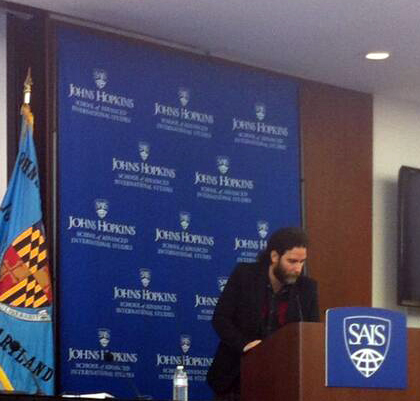
OLPL Speaks at Johns Hopkins / Orlando Luis Pardo Lazo

Bnxj5_DIcAASRLXSpeech by OLPL in Kenney Auditorium, Johns Hopkins University School of Advanced International Studies, Washington DC, 16 May 2014.

Dear friends:

As a Cuban from the Island —and all Cubans are, no matter how far and how much time has passed since we left or were expelled from the Island—, as a critical intellectual —that is, a writer and photographer who believes in the beauty of truth, even when nobody listened— and also as a Cuban from the exile, of course —because all Cubans are as well, no matter if we still live inside the Island, where we are “inxiles”—, it’s a privilege and a great honor to be invited here to share my experiences and my vision with you today.

I hope that my words can give voice to the countless alternative voices that exist and resist in my country. These are real men and women who cannot live normal lives in their birthplace, since their whole existence is disrupted day by day —and decade after decade— by the perverse nature of a regime never elected by my people, by the propaganda machinery and the impunity of the political police, in a despotic version of socialism that, as in any totalitarian State, starts by abolishing private property, only to end up destroying private life as such, harassing citizens whether or not they become aware of the power of the powerless and decide to bear witness to their own reality. continue reading

Indeed, the concept of citizen itself is officially obsolete inside Cuba, since the term is used exclusively by the authorities when the police carry out a detention or when a tribunal opens a trial. So, if they call you “ciudadano” (citizen), then you know you are lost even if you are innocent or, worse —as in a Kafka novel—, even if you don’t have any idea of what you are guilty of. Therefore, perhaps the crime is the social process itself.

On the one hand, I speak here quite confident, after so many walls that seemed would never fall and yet they did fall in the last 25 years. On the other hand, I also speak so very worried in front of other walls that should have been brought down already and still have not been. I’m particularly concerned about the new walls that many governments seem to be building, in a battle that may well be developing in perfect peace, little by little, corroding the basis of democracy on our planet, by the use of democratic disguises that hide the intentions of the system, until it’s too late for the people to react and get rid of the oppressors.

The Cuban people might have suffered this process twice:

1. Not only after the military takeover of January 1st 1959, but before the victory of the so-called Revolution, the confidence of a whole nation was betrayed by secret agendas that involved the hegemonic potencies of the Cold War world back then, plus the never-ending hunger for power of Fidel Castro and his closest followers. Believe it or not, many of those men —those who were not devoured by the rage of a Revolution so similar to Saturn, who eats his own children— those men are still alive and in absolute control in Cuba now, although they are not mentioned in the manipulative billboards of the CubaNow campaign that this month is being displayed in the stations of Washington DC metro. This gerontocracy is an elite so cynical as to call themselves “the historical generation”. Or maybe they are just being transparent, since it’s really impossible that history will forget or forgive this generation created in the image and likeliness of the Maximum Leader. Thus, despite the previous dictatorship, in 1959 Cuba lost a democratic republic with a then recent Constitution that even today would be considered a paradigm in the recognition of differences within unity.

2. In the 21st century itself, in this 2014 that looked like science-fiction for the teenagers that we were in the late 80’s, a Transition is now taking place in my country, but not from Law to Law —as in the Spanish democratization model— but from Dictator to Dictator, in the Caribbean style, including a dynastic tradition of blood: from the original Castro to his brother Raul; then, when he steps down most likely after 2018, to his daughter Mariela (now Deputy in the National Assembly of People’s Power) or to his son Alejandro (a high-ranked intelligence officer, the much feared tropical version of Vladimir Putin and other autocrats of the kind), or to both. Indeed, since its independence from Europe centuries ago, Latin America is a region devastated by criminal caudillos that call themselves Liberators, Saviors, and ultimately Fathers of our homeland. So, 55 years after the enthusiasm of a Revolution, just when the light at the end of the tunnel is a growing illusion in the soul of my nation —inside and outside the Island—, once again a secret operation is on its way to abort our hopes to be free.

However, nowadays an emerging civic society is peacefully struggling in Cuba, face to face against such a transition from Communism to State Capitalism, a strategy for the system’s survival that relies on the populist regimes of the region, on geopolitical globalization, and on the irresponsible greed for profits of both foreign and, most sadly, Cuban investors living abroad, the majority in the United States, now under an administration that, like European Union, seems more than willing to “normalize” the relations with an “abnormal” regime, disregarding the violations of human rights in Cuba, as part of a time left behind long ago. Thus ensuring, by the way, a fossil future for all Cubans wherever we may live. The rationale here appears to be that, if democracies cannot prevail over the enemies of freedom, then it’s better to make an alliance and, preferably, to do business with them. In free nations maybe nobody conceives a Cold War II scenario, but the rationale of totalitarianism is totally different for sure.

Please, allow me to re-write the famous poem of Allen Ginsberg: America, you’ve given them all and now you’re nothing… I wouldn’t like to be the spokesman of bad news for the Western world, but next time we take a close look at the politic equilibrium in our hemisphere, for example, we might be surprised that it will be too late to react and get rid of the oppressors.

Dear friends: since I became an independent blogger and journalist in Cuba, I was told, by the former Minister of Culture, Abel Prieto, and the former director of the Cuban Book Institute, Iroel Sanchez, that I will never publish again in my country. They were both removed from their positions later (Saturn’s law), but the unholy war of the Castros against critical intellectuals goes on and on.

While I talk here, the Havanan novelist Angel Santiesteban languishes a 5-year sentence for a common crime announced to him —by State Security agents— as a punishment for his opinion columns in his blog: Los hijos que nadie quiso /The Children Nobody Wanted.

While I talk here, a journalist from the free-lance agency Hablemos Press / Let’s Talk Press, Calixto Ramon Martinez was kept many months in prison for reporting an outbreak of cholera in Cuba, which still constitutes a serious health risk there, even for tourists, a fact that the Cuban government refuses to recognize in its due importance. Finally he was released without any explanation, documentation of his case, or at least an attempt to give him an apology or indemnify him.

While I talk here, a Catholic Afrocuban young mother and her husband, both peaceful pro-democracy activists, Sonia Garro and Ramon Alejandro Muñoz, have been for two years and two months in several Cuban prisons, subject to physical abuse and isolation periods, just because they protested when they were forbidden to attend the Holy Mass of the Pope Benedict XVI in the Revolution Square of Havana city, in March 2012. Hundreds of human rights activists were then arrested, including me, kidnapped for three days with my girlfriend, apparently accused of attempting to take counter-revolutionary photographs of His Holiness with the Heroic Guerrilla Ernesto Che Guevara behind him, in the façade of the mysterious Ministry of Interior where the mass took place.

While I talk here, an American citizen under contract by USAID, Alan Gross, is being held hostage since December 2009 in a Cuban jail, serving a 15-year sentence for charges that included espionage. A Jew himself, he was just helping the Cuban Jewish community to have a ready access to the internet, since the right to independent information is not recognized by my government. In fact, it constitutes a major crime: enemy propaganda, diffusion of negative news, among other brutalities of our actual Penal Code. This was a miserable mafia message thrown to the fair-play face of America: mind your own business, do not dare to try to help the Cuban civic society or you will pay a dirty price too.

Besides, dozens of well-known terrorists have found safe haven to grow old in Cuba and take care of their families and their fortunes, after a whole life devoted to international delinquency, including USA fugitives, ex CIA agents and hit-men associated with dictators and paramilitary bands worldwide.

To put an end to this very limited list —which cannot explain the thousands of death penalties by firing squad nor the untold number of Cubans dead in the Florida Straits trying to escape from our proletarian paradise— on July 22nd 2012, a car with two Cubans and two foreigners was intercepted in a remote province of Cuba. The two foreigners, young politicians from Spain and Swede, were beaten, taken away from the scene, drugged in a hospital, incarcerated, and threatened with death if they did not accept —in a public video shown by Cuban TV— that they just had had a car crash.

The two Cubans were assassinated, God knows if after one of those private “revolutionary trials” on the spot, so frequent at the beginning of the Revolution, on the very highway that remained closed to car traffic for over an hour. Their names were —their names are and will always be— Harold Cepero and Oswaldo Payá. Payá was the leader and is the founder of the Christian Liberation Movement. He won the Sakharov Prize for Freedom of Thought from the European Parliament in 2002. He was a dear friend to Lech Walesa and Vaclav Havel. And certainly he was the main candidate to conduct a true Transition to Democracy in Cuba, and maybe he could have turned into the first president of the free Cuba that is to come. A liberated Cuba that our government is indeed delaying thanks to deaths like these and that of Laura Pollan, the leader and founder of the Ladies in White Movement, also a winner of the Sakharov Prize from the European Parliament, in 2005.

The family of Oswaldo Payá is now looking for solidarity to open an independent investigation upon this extrajudicial killings, where Harold Cepero was cruelly considered just a “collateral damage” to the murderers paid by La Habana (maybe they were not even Cubans, so that’s easier to make them disappear now).

In the middle of all this tragedy, I kept writing and taking pictures out of the ruins and the splendor of my beloved and lost La Habana. In the middle of all this pain, hypocrisy coming from my neighbors and relatives and even from the hierarchy of the Cuban church, many have kept informing the world about our unreal reality. Surrounded by a lot of apathy, but also with the pleasure of staying to work for the well-being of the only spot on the planet that we can call our home. Surrounded by hatred and hopelessness, I hopelessly fell in love there, with someone more courageous and with much more peace in her heart to struggle for freedom in my homeland, after half a century of civil apartheid, military impunity, lack of solidarity from the international community, and a massive anthropological damage that has turned Cuba into a post-national country that only cares about escaping from itself, and where disappointment is paving the way to defeat for those of us who still cherish hope.

We, Cubans, do need your help now, please, to overcome all the frustration that is extending its roots in a people that has been traditionally noble, friendly, truthful, hard-working, brave, fond of freedom and also full of joy.

Dear friends: I won’t be the spokesman of bad news for this session, but let’s not forget for a minute that the oppressors are active out there, and they have an incisive instinct for self-preservation. Allow me to finish by re-writing the Cuban repressed and finally exiled poet Heberto Padilla, with his “Prayer for the end of the century” / “Oración para el fin de siglo”: Nosotros, hijos y nietos de terroristas melancólicos y de científicos supersticiosos, sabemos que en el día de hoy está el error que alguien habrá de condenar mañana. We, children and grandchildren of melancholy terrorists and superstitious scientists, we do know that deep in today lies the error that someone shall condemn tomorrow.

Contrary to the famous and infamous speech of Fidel Castro in 1953 —“La Historia me absolverá” (History will absolve me) —, the world may absolve them, it doesn’t matter. History will condemn them anyway.

Thank you very much.

Note: The speech was written and delivered in English.

14ymedio: Neither the First nor the Last / Reinaldo Escobar

14ymedio_logoAs Yoani Sanchez has already announced, midweek this coming week a new digital medium, baptized 14ymedio, will see the light. We have the intention to update it daily and, if possible, more than once a day.

When the Internet becomes, for Cubans, something simple and accessible as it is for every other 21st Century Latin American, perhaps them we’ll be on the list of favorites of housewives who want to make a dessert, of entrepreneurs who want to know where to invest their money, or why not to, of politicians who need to know the trends in public opinion. continue reading

Visiting us will be those who are looking to make plans to amuse themselves on the weekend, and those who want to be up-to-date on the latest theater offerings, the best concerts, the newest releases in the bookstores.

We hope to be a reference for every Cubanologist who needs to check a precise date or submerge themselves in the conceptual complexity of the new social thinking, and a reference as well for the absent-minded tourists hearing the name of the country for the first time in their lives. A window into what is happening, our fingers on every pulse, the re-visitor of history, a messenger from the future, all this is what we want to be.

Just because most people will have Internet we won’t begin to be a people without problems, and so 14ymedio proposes to be the voice of the protestors, those persecuted by whatever power, and, most particularly, the longed for space of all those who have a divergent or convergent opinion but who lack a public platform where they can expound on it and submit it for discussion.

Obviously these are long term intentions, but we are starting now because we don’t want the new and inevitable realities that will come to wait for us. In fact, we are not the first to have such ambitious dreams, nor to work to conquer them. Hopefully we won’t be the last!

16 May 2014

Ah… You’re Not in the “Package” / Yoani Sanchez

Collective taxi

Climbing into a collective taxi at midday, with its whole body heated by the sun and creaking at every pothole, is a shocking experience. You duck your head and make yourself small to sit on the improvised seats. A loose thread hanging from your pants leg or skirt catches on a badly set screw, its metal tip never rounded off. Then comes the hardest test: accepting the driver’s musical taste, which is playing full blast. But it’s also a unique sociological experience, a journalistic look that calls you to reflect on this peculiar reality we inhabit. continue reading

Some days ago I boarded one of these old “submersibles” that roll through Havana. Pure scrap metal but with the powerful speakers of a disco. The reggaeton was deafening. Most of the lyrics were sexist, repetitive… predictable, until there was one that got me thinking. The singer was making fun of someone and spit at them, “Ah… you’re not in the package.” It only lasted a few seconds, “Ah… you’re not in the package,” but it was enough. He was referring, perhaps, to another musician or artist who didn’t appear in the compilations of the so-called “combos,” selections of audiovisuals distributed in alternative ways, which the government abhors.

It’s noteworthy that in the popular repertoire, to be left out of the “package” means to be at the lowest rung of popularity. If a certain video clip, documentary, or movie isn’t included in these alternative compilations, it’s a sign of lack of fame. Most striking is when people have the ability to put together their own “television programming,” in those gigabytes of soap operas, documentaries or musicals… they never include the official programs. That is, the Roundtable show could be the target of the acid chorus, “Ah… you’re not in the package,” and it’s true, of the primetime news, the political events and whatever speech or government declaration is broadcast on the national channels.

The voice of the Cuban Communist Party has been left out of the “package”… because it’s boring, bland, repetitive… and lacks credibility.

16 May 2014

New Machine Without Production / Juan Juan Almeida

Cuban paradoxes. There is a new type of combine designed in Cuba and built in China being tried out in the cane fields in Las Tunas province, with a view to starting serious production starting next year.

The machine was created by technicians and specialists at the 60th Anniversary of the October Revolution factory, in Holguin.

So far everything is going smoothly, all that’s missing is the sugarcane.

14 May 2014