Loss of Values

For some time the Cuban authorities have been turning their attention to “the construction of values to guarantee the continuity of the Revolution.” In speaking about the importance of family in the regeneration of values such as patriotism and honestly, and the need for social discipline, mutual respect, citizen education and good behavior, their objective is to assure the success of the official political project, ignoring that the nation, as such, is much more important and essential than the former. continue reading

In short, those values were lost in the overwhelming and unrestrained takeover of the so-called Revolution, which ceased to take them into account and, in many cases, discriminated against them to make them disappear, without offering any better substitutes, leaving the vacuum in which we now find ourselves.

We all agree that we must rescue them in reinstall them in the spaces which by right belong to them, but not to save a failed political, economic and social project, but rather to save Cuba.

To accomplish this we need to abandon the cheap politicking, barrio patriotism, absurd political and ideological manipulation and other evils, and responsibly dedicate ourselves to the very difficult and complex task that, starting with the family and the schools, must recover the entire social framework, respecting individuals and differences of every kind among those who comprise the people, which is a concept that goes far beyond simple political or ideological positioning. The rescue of values should be based in the work of Cubans and Cuba and not in any political party or government.

27 May 2014

The Castros in Their Labyrinth / Yoani Sanchez (Fromthe New York Times)

HAVANA — A mix of grease and melted cheese drips from the pizza to the concrete floor. It’s a hot day and the man is holding the slice at the counter of a coffee shop. While he waits, the clerk comments on how this is “a country where no one understands.” To which the customer replies, now with his mouth full: “Well yes, and that 21st-century socialism thing is going to have to wait until the 22nd century.”

So far, the government of Raúl Castro has issued nearly half a million licenses for people to work in the private sector. This is a huge change from 1968, when every single job — even shining shoes — was nationalized. During the revolutionary offensive, all small businesses ended up in the hands of the government. Private Cuba was swept away and stigmatized, only to be reborn decades later. In 1993, spurred by an economic crisis, Fidel Castro permitted the reopening of the private sector. This turned out to be Mr. Castro’s worst defeat — one he tried to mask as a victory, as he usually did whenever he stumbled. continue reading

But it was left up to his brother Raúl to make the most concessions to the free market. “The longest distance between capitalism and capitalism is socialism,” according to a joke heard on the streets of Havana. This confirms the economic course taken by the administration in the last five years. Voices in the circle loyal to the system are accusing the government of betraying the regime’s Marxist-Leninist principles.

Those critics are right. Since taking power in 2008, Raúl Castro has granted a series of concessions that spin the island’s compass toward a system without paternalism, but also without rights. Permission to set up small private companies coincided with the layoffs of hundreds of thousands of Cubans, who held government positions for decades and are now unemployed. The term for them in the official lexicon is “available.” This way no one can say they have lost their job in the proletarian paradise.

It is like trying to control a car that has been stranded for decades, but now that it is in motion, nobody knows which direction it will take — not even the driver.

The Castro regime has lost power with these small changes. Allowing Cubans to sign cellphone contracts helped swell the state coffers but gave citizens a tool for information and communication. Every little move toward flexibility has provided some economic relief to the administration and, simultaneously, a relative loss of control.

When immigration reform was enacted in January 2013, the new ability to travel without major restrictions eased social unrest. But dozens of dissidents and activists are now able to attend international conferences where only official representatives were allowed before. What Fidel Castro had prevented for decades began to happen.

Various governing bodies and other groups around the world can now hear the proposals, arguments and demands of Cuba’s democratic forces. The myth of the Cuban Revolution suffered a great loss as soon as its critics’ voices started to be heard. It is no longer a monologue. Now there’s a different and polyphonic choir, one the official propaganda tries to silence with the useless strategies of demonization and fear.

On the economic field, caution, fear and slowness characterize the so-called “Raúlist reforms.” The octogenarian leader appears to know that if he speeds up change, the entire sociopolitical model could dismantle before his eyes. While he keeps delivering the same message and proclaiming that changes are “for more socialism,” the reality makes it clear that Cuba is transitioning to a sort of capitalism exempt of labor rights and civic freedom.

On a street in Havana, a woman asks another if she watched the “educational channel three” the night before. She is cryptically referring to the signal captured illegally by satellite dishes — a phenomenon the police have tried but failed to eradicate. A growing number of Cubans build their own receivers to enjoy television programming from Florida. Copies of those shows, popularly known as “the package,” are distributed on USB sticks or external hard drives by clandestine networks.

Officials criticize “the package” as consumerist and banal, but the truth is the government fears the weakening of the information monopoly it holds. If children do not grow up watching shows and cartoons loaded with nationalism and slogans, it will be hard to have them behave like loyal soldiers of the Revolution. The television screen has always been a very effective means for government indoctrination.

It is probably this fear that is prompting the official propaganda backlash against technology. When the “Cuban Twitter,” known as Zunzuneo, came to light, the government media used the situation to demonize mobile phones, email, social networking and every single peripheral with which we communicate in these modern times. A few days ago, the newspaper Juventud Rebelde ran a cartoon of the Statue of Liberty holding a cellphone instead of a torch. The message was clear: Information and communication technology are the tools of the enemy.

Castrismo, however, is losing the battle. Biology is ending the historic generation, while the economic opening is creating a class that does not depend on government salaries, the growing dissident faction is slashing the regime’s international prestige, and the loss of control over information is reducing its leverage over people. All of these are, at the very least, death-threatening obstacles in its way.

The clock of history is advancing in Cuba, but in daily life time still struggles to move forward.

Yoani Sánchez, a Cuban writer, has launched the island’s first independent digital newspaper, 14ymedio.

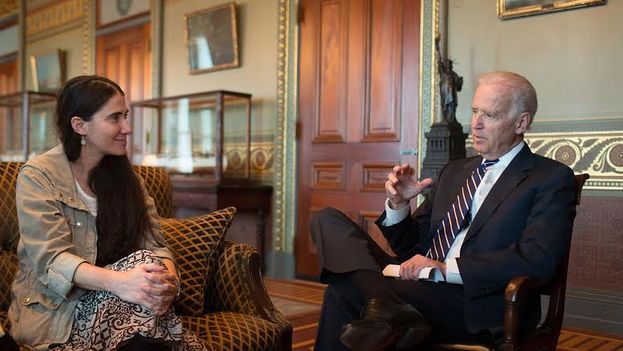
“We can act creatively with respect to Cuba.” Interview with U.S. Vice President Joe Biden / 14ymedio, Yoani Sanchez

U.S. Vice President Joe Biden and Yoani Sanchez
U.S. Vice President Joe Biden during the interview with Yoani Sanchez

Yoani Sánchez, Washington | May 27, 2014

The debate about relations between Cuba and the United States has heated up following the publication of a letter signed by 40 American personalities asking President Barack Obama for flexibility toward the Island. The proposal has unleashed passions and speculation, also fueled by the imminent arrival in Havana of representatives from the U.S. Chamber of Commerce.

Cuban society, however, seems to remain out of the headlines, the hot articles, the replies — or support — like the so-called “letter of the 40” already circulating on the networks and in emails. Thinking about this uninformed population submerged in the big problems of everyday life, I did this interview with U.S. Vice President Joe Biden, who received me in Washington a few weeks before the launch of 14ymedio.

Question. The Cuban government has recently passed a new foreign direct investment law that has been met with both critics as well as a certain level of expectation. Will the promotion of this law change anything in U.S. Policy with respect to Cuba, specifically in regard to the ability of U.S. Citizens to invest in the Island?

Answer. U.S. Policy with respect to Cuba is guided by the commitment to support the desire of the Cuban people to freely determine their own future, supporting U.S. interests and promoting universal values. continue reading

Since President [Barack] Obama took office, we have shown that we are willing to promote pragmatic changes in our Cuba policies based on our interests and those of the Cuban people. Our policies with regards to travel, remittances and personal contacts are reducing the gap between divided Cuban families and promoting the free flow of information and humanitarian assistance to the Cuban people. These measures help to put resources in the hands of the Cuban people and help promote, in the words of the President, “spaces of freedom” in Cuba.

We note the Cuban government has made changes in its investment laws, and we expect that these efforts to attract foreign investment in Cuba to be accompanied by an expansion of the rights and freedoms so the Cuban people can develop their full potential.

    “We will continue looking for practical ways to support greater connectivity in Cuba”

Q. Although Cubans are able of circumventing censorship and the high price of Internet access, we still don’t have access to a number of websites and services because of current U.S. law. This includes access to online stores for Android or iOS apps and selected Google services. Is there any possibility of reducing these restrictions in the near future?

A. We will continue looking for practical ways to support greater connectivity and to help remove the obstacles that stand in the way of open communication and freedom of expression. In 2010, the United States eased restrictions and allowed for greater access in Cuba to free services that help connect to the Internet, such as instant messaging, chat and email. Earlier, in 2009, we changed our policies so that U.S. citizens could donate cell phones and other electronics to the people of Cuba. We also encourage U.S. companies to provide services and fiber optic and satellite communication services to Cuba, as we began talks with the Cuban government to establish direct mail service between the United States and Cuba. We want Cuban citizens to be more easily able to communicate with each other and with the outside world.

In 2009, in an interview with President Obama, I asked about a possible U.S. invasion of Cuba . His answer was a categorical “no.” However, Cuban leaders don’t stop talking about an imminent U.S. plan to overthrow the government in Havana. Beyond the official U.S. position, I would like to hear a simple answer to give to my son. What do I say when he asks me? Should we be concerned ?

A. I can give you the simplest of answers, and the answer is no. As President Obama said.

We support the development of a prosperous, secure and democratic Cuba and continue to support the brave Cubans who seek to exercise their freedoms. Our position is firm: only Cubans can or should determine the future of Cuba. These accusations are a relic of a distant past. They are being used to strike fear into the hearts of decent Cuban to divert their attention from the problems closer to home. The Cuban people deserve more honesty from their government.

    “To promote a change so that Cubans can enjoy a normal life”

Q. In recent months, your government has repeatedly used the term “creative” to describe the direction of U.S. Policy with respect to Cuba. I’m intrigued by this word: could you be more explicit?

A. President Obama has stated that he was not yet born when the United States declared a trade embargo against Cuba. Our goal is to promote positive change on the Island for Cubans to enjoy normal, productive lives in their own country, to have the freedom to express their views and the benefits of an inclusive and democratic political system. We have seen positive movement in some areas, such as increasing the ability of Cubans to travel abroad, but we remain deeply concerned about the continued detention and mistreatment of Cubans for exercising freedoms that are protected in other parts of the Americas.

The question is how we can act creatively to promote positive trends and show our support to the Cuban people while pressing to improve the conditions of human rights. Our opinion is that the President’s measures to facilitate family travel, personal contacts, communications, remittances and humanitarian donations have had a positive impact and contributed to the welfare of Cubans. Similarly, our work with the Cuban government on matters of mutual interest has benefited the citizens of both countries. We established these policy changes while defending our values and promoting democratic reforms in Cuba.

Finally, I want to emphasize that the detention of Alan Gross in Cuba is an important obstacle to improved relations between the U.S. and Cuba. We can be as creative as we want with our policy, but Alan’s case continues to be at the top of the list of issues to be resolved. He should be released on humanitarian grounds.

The True Liberation of the Cuban Woman / Rebeca Monzo

University students of the ’30’s.

Much is said and published through the media in our country about the “achievements” obtained for the Cuban woman after the Revolution. But never is a word said about the social, political, and economic advantages achieved by our feminine population before the year 1959 in the last century.

For that we are going to refer to some very revealing information from the “1953 Population and Electoral Census,” the last one carried out during the Republic, published and edited by P. Fernández y Cía.  These censuses were carried out approximately every ten years. continue reading

Total population of the country: 5,829,029 (2,985,156 males and 2,843,874 females).

School attendance between ages 5 and 24:  (428,334 males and 411,861 females).

Last grade passed: Baccalaureate (High School) 88,562 (54,121 males and 34,441 females). University 53,464 (35,967 males and 17,497 females). There was an average of 3.8 universities per 1,000 residents.  Cuba occupied first place in Latin America along with Argentina, Mexico and Uruguay.

As interesting information we can say that in the year 1940 everyone who involved in the teaching profession was certified, a unique condition among all the countries of Latin America.

Our country then had one of the lowest levels of illiteracy in our continent:  23.6% (41.7% rural and 11.8% urban).

In addition, we can point out that Cuba in 1918 became the first country in Latin America to recognize the right of couples in conflict to divorce.  We must also add that in the Constitution of 1940 is recognized, for the first time in Latin America, a woman’s right to vote, equality of the sexes, the right of a woman to work, the right to open a bank account, and to get a passport, besides granting her authority over her children.

Of the economically active population in 1953, 22% were female, in addition to a work force in professional fields where 16% were women and 3% men.

As can clearly be seen in these statistics, women’s participation was increasingly present.

For this it is good to note that in the same way that the participation of the “weaker sex” was becoming more active in the life of the country, they were implementing home courier services such as the delivery of milk, bread, mineral water, food, pharmaceutical products, dry cleaning, laundry, etc., which relieved the woman extraordinarily in her domestic work, enabling her to dedicate more time to the attention of the home and the education of her children.

I believe, without fear of equivocation, that we can assure that already the Cuban woman had become liberated in the Republican era, and her equality of civil, social, political and employment rights was on the rise.

Translated by mlk.

27 May 2014

Prosperous and Sustainable (2) / Regina Coyula

My troubles did not end with the molars. Thinking myself clever, a month ago I bought a combined ceiling fan and light fixture at the Plaza Carlos III shopping mall. From an initial price of 120.00 CUCs, it had been reduced to 35 because it was missing its shade. I did not think twice because the phallic bulbs they have been selling since the “energy revolution” will not fit inside any shade anyway. But to paraphrase a popular saying, when something seems too good to be true, it probably is. I should have thought twice and walked away.

The electrician installing the new appliance pointed out that the screws used to attach the blades were not original. There was also evidence it had been repainted, indicating that the fan had been installed and for some reason uninstalled. He recommended that I return it. continue reading

With the item still under warranty, I went back to Carlos III to ask for a refund. The same employee who had sold me the fan told me that, although it was Wednesday, the day they handle returns, I would first have to go to the studio several blocks away where they would give me the paperwork authorizing the return.

The box the fan came in was bulky and quite heavy. As everyone knows, I am a certified expert in public transport, so I had the foresight to call to my brother, who owns a car, to help with the transaction.

It exhausts me just thinking about all the neurons I wasted trying to explain this to the employee, more neurons than she ever had. Fearing I would have a heart attack, a young man, clearly someone of importance in the chain of command there, came to my assistance. He understood and simplified the issue:

“I don’t know why they told you to come here,” he said, “because the problem is with the store, not with us.”

Back again to Carlos III. The same employee reiterated that this was not her problem, pointing to a faintly printed piece paper on the wall behind the counter. Even with perfect vision a customer could still only guess that it had something to do with the store’s return policy. But I had my own plan. I put the fan in the middle of the counter and asked to speak to the floor manager. Since this was preventing her from attending to the other “users” — at this point you will have noticed that being a customer in Cuba is highly unusual and no doubt considered unpatriotic — the employee told a young man to go get Alain. Upon hearing my explanation, Alain told the employee, “Give her a refund.”

And with money in hand I could not help but blurt out a well-worn phrase:

“That is why this thing must fail.”

At a minimum I enjoyed the gestures and words of affirmation from the line of people behind me.

11 May 2014

Prosperous and Sustainable (1) / Regina Coyula

My adolescence coincided with the era in which almost all Cuba’s dentists left the country. When I finally saw one, the most expeditious course of treatment was to remove two of my molars that in other circumstances would have been saved. But those battle-hardened dentists could not be bothered with such details as a teenager’s smile, no matter how cheerful it may have been. So as soon as I could, I had a permanent bridge made. My little bridge allowed me laugh without embarrassment until two years ago when old age began to move things around. Every time the bridge came loose, I — more stubborn than it — put it back in place. But by the end of last year it finally gave out.

In the judgement of the prosthetist a new permanent bridge was required because neither removable bridges nor dental implants were suitable in my case due to the shallowness of the occlusion. These bridges are metal but the clinic did not make them, which meant I would have to go to the School of Dentistry. continue reading

So off I went to see a Doctor Lorenzo, the only person authorized to treat patients at the school. I went on a Wednesday but Lorenzo only sees patients on Mondays. Come early, I was warned.

The following Monday I arrived at seven in the morning. At eight the doctor’s secretary appeared at the doorway and announced that the doctor had to deal with a personal matter and would not be coming to work. The following Monday I was unable to go and the Monday after that I found out, also at eight, that Lorenzo would not be seeing patients since the school was closed for a week-long break.

Last Monday the orbital paths of Dr. Lorenzo’s and myself were finally in alignment but it was for naught. Sitting behind his desk, Dr. Lorenzo was seeing patients while on auto-pilot. In my case that meant there was nothing that could be done since the metal fabricating machine had been broken since November.

Caramba! Considering how easy it is to post a little announcement, a note could have saved me three trips here.”

Whenever I asked Lorenzo where I could have the work done, he responded with the mantra, “Go to your healthcare provider.”

“But my healthcare provider told me to come here!” I said.

“Go to your healthcare provider.”

“And you can’t tell me where else to go?” I asked.

“Go to your healthcare provider.”

I went to my healthcare provider, the national reference center, and in my conversation with the prosthetist she described the conditions of her workplace. There had been no equipment in place since 2011, visitors spill out into the hallway and no journalist had looked into it.

She mentioned other places where it was possible to have the work done but I would have to go on a personal basis since the clinic only referred cases to the School of Dentistry. She did not say it but “on a personal basis” sounded to me like, for the right amount, I would be able to laugh out loud without any molars missing.

9 May 2014

A Preview of the Next Cuba / 14ymedio, Manuel Cuesta Morua, Reinaldo Escobar

  • Interview with Manuel Cuesta Morúa from Constitutional Consensus
  • Options under discussion: Change the 1940 Constitution, the 1976 update or create a new constitution
  • The Project involves most of the relevant organizations from the civic and political community, inside and outside Cuba
Manuel Cuesta Morua
Manuel Cuesta Morúa

Reinaldo Escobar, Havana | May 23, 2014

Question. What is the objective of the Constitutional Consensus project?

Response. To convene civil society and citizens to work for constitutional change, and to create a new Cuban constitution that is based on three key realities and requirements: citizen control of the State, which is the premise of democracy; the rule of law, which ensures that no one is above the law; and the limitation of power, without which there is no respect for fundamental freedoms. This is the central objective, seen through three integral and interdependent paths.

    We are still governed by what is probably the last Constitution in the Soviet mold still in existence in the world continue reading

There is another collateral purpose, basic to the consistency of a society and a constitutional state. This purpose is the cultural empowerment of Cubans with regard to laws, citizenship and the rule of law, accompanied by and based on the contributions of the independent organizations of Cuban jurists. As experience shows, the best constitutions sleep the sleep of the righteous if they are not based on a culture of rights and law. And the issue of constitutional culture in Cuba needs to be tackled hard for two main reasons: the first is that as the so-called Revolution has been and is the quintessential source of law, we Cubans are not familiar with the law and its value for coexistence; the second is that we are still governed by what is probably the last Constitution in the Soviet mold still in existence in the world — I do not know if you remember the Russian Constitution of 1936 that became the model for the current Cuban constitution — and as you know, it has nothing to do with our traditions and culture.

Q. What organizations sponsor you?

R. Constitutional Consensus is a horizontal proposal without hierarchies or rigid organizational charts. Participating are the majority of the most relevant organizations of the civic and political community, inside and outside Cuba. At www.consensoconstitucional.com you can see a list of all the sponsors, which I am not mentioning here because the list should continue to grow.

Q. At what stage are you now, and when (not in terms of a date but in signs) will you consider you have fulfilled your purpose?

A. Right now we are preparing Constitutional Initiative Discussions across the country, and we are preparing for the various meetings to be held outside of Cuba. In late May, between 8 and 10 people will meet in each of these Constitutional Initiative Discussions with the purpose of bringing us to a reasonable point for constitutional change: if is it the Reformed Constitution of 1976, if it is the paradigmatic Constitution of 1940, or if it is a new constitution. We first want to find a consensus that focuses on public legitimacy, unfortunately it cannot be among all Cubans, and then start designing a draft that will be drawn up by the Constitutional Initiative Committees, formed by lawyers and specialists in various law-related materials within a constitution.

These meetings will also be held in Madrid and Puerto Rico, and in July multiple organizations will come together in Miami at Florida International University (FIU).

We will have achieved our purpose, and for now I’m being a minimalist, when we have drawn up this draft that reflects the consensus of all participants, when we have collected up a critical mass of citizens’ signatures demanding a new constituent process, and when we have managed to stabilize Constitutional Initiative Discussions in each municipality as permanent spaces for interaction and exchange with citizens throughout the legal process. If we citizens do not set up a monitoring program over the quality of laws, compliance with legality, and the arbitrariness inherent to all immune and unpunished power, it’s worthless to have the best constitution. We had the Constitution of 1940 and Cuba finds itself rating less than zero on constitutional and legal culture.

There is, of course, a maximalist goal: to have a constitutional and legal system that is an expression of our needs, of our rights and of our demands to coexist in a truly civilized way. Uncivil behavior is the deepest reality of our country, from top to bottom. Fromthe powers-that-be to society. The rules of the game require a constitution that includes all Cubans. Inside and out of Cuba.

The Constitutional Consensus is to define the what, not the who. We care more about the nature of power than the individuals who exercise it.

Q. Do you believe that the country’s leadership has an essential quota of good faith that is required for the project not be aborted or even treated as a hostile action intended to overthrow the government?

R. The Cuban government is not characterized by good faith. The logic of power is not born able to understand the rational tie with the rest of the mortals, but is one of pure and hard domination. So there can be no good faith. However, this government shows capacity for pragmatism precisely because it wants to retain power. Reality force, and hopefully in this case, that of the constitutional change, the facts will impose themselves. In Latin America there is a strong movement towards constitutional reform that can and should include Cuba. Moreover, there is always an unspoken consensus, at times explicit, on the need for reforms in the laws.

Promoted from other spaces, albeit with an elitist viewpoint, is the need to reform the current constitution. And the designated President himself has expressed this direction. Our proposal, on the other hand, is not conceived with the mentality of toppling those up above. We care more about the nature of power than the individuals who exercise it. So there is no hostility towards power, but an attempt to define new rules of the game from where it is exercised. If among them citizens decide that the government should be in the hands of the same people who hold it today, I won’t like it but I have to respect those rules that contributed to defining it along the rest of the citizens. The authentic and interesting thing from this constitutional perspective is that the next be of the citizens.

A Cuba where citizen safety and effective control over the uncertainties allow the defense of fundamental freedoms and the creative explosion, in all directions, of Cuban society.

We Were Young / Reinaldo Escobar

Almost 27 years ago the magazine Somos Jóvenes (We Are Young) was born. That edition was historic because of the publication of two investigations, one, The Sandra Case, about prostitution, and the other titled Academic Fraud? In that era we were able to publish a note in the state-owned newspaper Juventude Rebelde (Rebel Youth) announcing the launch of the controversial magazine.

Under the title Academic Fraud? we unmasked one of the negative phenomena of our society, which went far beyond that committed by the students facing their university exams, and manifested itself in other sectors that had nothing to do with the teaching process, at least formally. continue reading

Supported by a wide investigation, where there was a survey of students at different schools, Academic Fraud? renounced the expositive style to immerse itself in analysis, provoking among its readers a wealth of questions and solutions.

27 years later thousands of young Havanans were forced to retake a Mathematics exam to get into the university, because the contents of the exam had been leaked and a still unknown number of students had acquired it, in many cases for pay.

I would like to invite the author of that investigation, Luis Manuel Garcia, to update us on his opinion.

And by the way, I recommend reading what he published in this regard in August of 2009 in his Habaneceres* blog .

*Translator’s note: The lead off to this post (in Spanish) is that 280 students were surveyed and asked if they had ever committed academic fraud (i.e. cheated), and 280 admitted to having done it at least once.

26 May 2014

Reaping the Whirlwind / 14ymedio, Yoani Sanchez

Today, while I publish this text, thousands of students from Havana are sitting in front of their Mathematics exam. The schedule for admission to the University has had to incorporate a new test date for this subject, after a scandalous case of fraud. The leaking and selling of the questions ended with the cancellation of the previous test results, three teachers arrested, and an unknown number of students investigated.

Although fraudulent practices are common in Cuban schools, this case has provoked a profound reflection in our society, including in the official press. We have seen on our small screens dozens of interviews with people who repudiate cheating by copying another, and the lie of procured knowledge you don’t have. Few, if any, reflect on the environment of hypocrisies, double standards and simulations in which these teenager, now between sixteen and seventeen, have come of age. continue reading

This batch of students has been educated under educational experiments such as the so-called “emerging teachers.” Is it a greater fraud to put someone at the front of a classroom and call them a teacher when they possess neither the ethical values nor the knowledge to exercise such a worthy profession? How can we ask them to be honest, if the TV screen from which they receive their tele-classes never managed to transmit adequate moral codes? It is these kids, at this very minute seated in front of the math test, the children of my generation, who are surrounded by artificial academic results and inflated credentials.

It is worth remembering that for decades the schools and teachers whose classes failed to achieve grades of ninety or almost one hundred, were scolded, stripped of their credentials, and even administratively and materially penalized. Those were the days when from the dais Fidel Castro read the academic results of the high schools with their elevated promotion rate, knowing–in his heart–that this was a huge lie created for him.

It turns out that the teachers often dictate the exam questions in advance, walking among the desks of those who take longer, to whisper the answers to them or, simply, leave the room so the students are left alone to copy the answers from each other. Those of us who studied hard were always frustrated by the complicity of so many teachers and education experts with the practice of academic fraud. We are the parents of this generation that is today being evaluated in Havana’s classrooms. How could they have turned out differently? How can we ask them not to do what they have seen done?

Yoani Sánchez, Havana | 26 May 2014 | 14ymedio

Thinking of a Homage to Jose Marti / Juan Juan Almeida

Many times I have asked myself why we, those who want change in Cuba, lend ourselves to coloring the past of an island that, however idyllic, perhaps never  existed, why we work so hard not to look to the future, or why we don’t throw ourselves whole-heartedly into solutions where we can all co-exist.

Of course the past matters; without it we wouldn’t know where we came from or possibly where we are going; but holding onto yesterday is like a living death. It is time to raise anchors and throw aside the culture of confrontation, hatred and frustration. continue reading

On accepting and digesting that much of what I learned in school, and by repetition at home, punished and threatened the rights of my people, I changed.  And believe me, it was not simple. I am part of the so-called “New Man” that so many people criticize for not being virtuous or moral; but he has fewer vices, because tired of partisanship he looks with equal apathy at Raul Castro’s government and the “nation savers,” those who go hollow at the mere mention of the word democracy.

And it is that both barkers, those from one corner or the other, united unfortunately by their lack of ability and their love for mirrors, are simply politicians who speak with the same despotism about the actions of the people, as if “the people” was an amorphous mass and not a set of wise people.

Trying to exclude passions, and without much effort, we could see that in Cuba conditions are created for transformation. The old structures no longer can support the growing economic, ethical, political and even legal needs.

We see it in the news, and Raul Castro himself has recognized it.  But we don’t see change, and we excuse ourselves blaming such inactivity on fear of our fellow citizens.

It may be, in fact I know from experience, that fear only stimulates the imagination to develop defense; but I do not believe that today in Cuba there exists such a dose of fear; I believe that on analyzing we must be more serious.  The Revolution is falling, yes, of that I have no doubt; but it’s going to fall on us if we don’t take a moment to review what we are doing. And before falling into the grave danger of judging blindly, why not accept that we lack the capacity to strike and that we must adapt ourselves to more real conditions?

We cannot attract and much less convince if we are not inclusive. There is a suggestive and catchy sentence that appears on some cereal boxes that says: “Publicity is based on selling happiness.” Let’s adopt it as our own, let’s forget the catastrophic language and even come to understand that a plural society is built by eliminating the words enemy, trench, violence and battle.

I am a follower of Marti and I could not overlook that a day like today, May 19, but in 1895, Jose Marti fell in Dos Rios. The greatest of all Cubans. It would be a perfect homage if from both sides of the Florida Strait we try to begin to reunify our fragmented and divided country, quoting the man we call our “apostle,” who said, “With all and for the good of all.”

 Translated by mlk.

20 May 2014

Everyone Deserves Freedom / 14ymedio

Inalkis Rodriguez Lora, Havana | 23 May 2014

The lives of birds are wonderful, especially when they are free.

But in Cuba, being free is hard, thanks to the human predators. For example, the Cuban grassquit, an endemic bird, is now captured at such a high rate that we fear its future extinction.

Another bird injured in this subject of prisons is the mockingbird, which is not endemic but lives permanently in our country. They say that if someone catches a mockingbird chick, takes it home and, of course, locks it in a cage, the parents of the captured chick, if they find it, bring it poisoned food so that it will die immediately because they would rather see it dead than a prisoner for life. In this country story, true or not, there’s a love for freedom. continue reading

Humans also go after parakeets, parrots and bullfinches, doomed to be amusements for human beings, as if their vocal qualities or plumage were a terrible crime. And it doesn’t give people any pangs of conscience. On the street in Camagüey it’s common to see, in broad daylight, the cages hanging with their prisoners for life.

It seems that certain people like to run roughshod over nature. I remember my grandfather, to whom I owe all my love for the natural world, was a passionate and jealous caretaker of flora and fauna, to the point that no one on our farms and its surroundings dared to hurt even the least plant or animal. If some little boy thought to pull out a slingshot in front of him, he immediately grabbed it and threw it in the kitchen fire, while giving the boy a good talking to about why he should care for nature.

And today, are there no people or laws in Cuba to stop the unjustified abuses against nature and freedom, like my grandfather did on his farm?

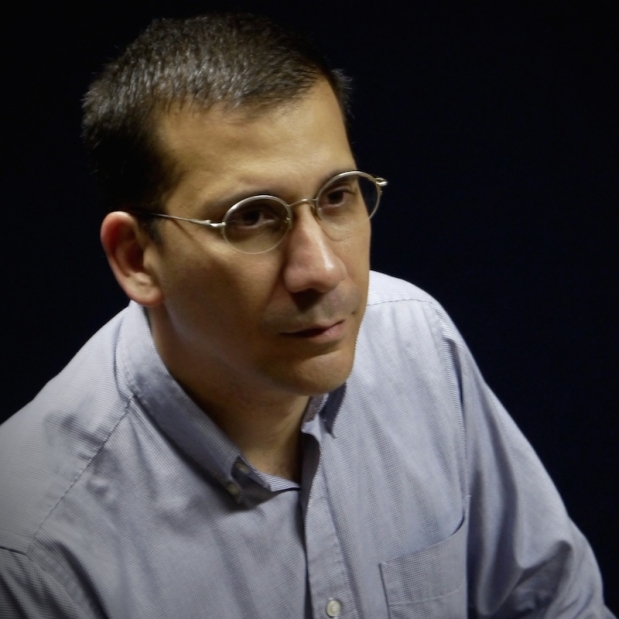
“All discussion with the regime should be based on the issue of fundamental rights and freedoms” / Antonio Rodiles

Antonio Rodiles. (AILER GONZÁLEZ)

Pablo Diaz Espi: How do you read the current moment inside the country?

Antonio Rodiles: I daresay we are experiencing today the transfer of power from the “old guard” to their heirs, who are desperately seeking legitimacy and agreements. Facing a Cuba without their progenitors won’t be an easy task and they can’t wait for this time to begin establishing themselves inside and outside the Island.

Cuba citizens every day have to deal with a power that demands more obligations and which, in exchange, grants very few rights. Living conditions are degrading with special emphasis on the vulnerable sectors, such as old people. The so-called new entrepreneurs are swimming in a sea of corruption and the informal economy and the stampede to leave the country continues to be the objective of thousands and thousands of Cubans, especially the young. continue reading

The opposition scenario is clearly being realigned. The escape of talents and entrepreneurs has generated a sensitive vacuum in the group of social actors who should be pushing and supporting change. The impunity with which the State practices violence leaves little room for political groups to move, but the growing discontent generates increasing hotspots that are controlled with declining effectiveness.

PDE: A media intensive initiative asking President Obama to lift the embargo has just been released. What do you think about it?

AR: We should be very clear about what we want for our nation. We need, first and foremost, the reestablishment of basic rights and freedoms. The international pressure, which includes the American embargo, is very necessary to at least contain the impunity enjoyed by the totalitarian regime.

If Cuban citizens continue to be totally defenseless, the cost in political changes will be very high. Certain attitudes that border on masochism and that ask for complacency have been very visible lately and have devastated the country. Prominent figures of civil society have become too evasive and unclear about their political positions, which undoubtedly benefits the regime.

While it would be immature and a little cowardly to close all the doors, it would also be fatal to accept a complicit relativism without a base of principles or axioms that guide our actions.

For decades on our Island we’ve been ruled by lies and simulation, and it’s time for honesty and verticality to claim space in a nation that has been beaten down with regards to those principles.

I think that asking for changes toward the regime without demanding respect for our rights, is an act of contempt towards those of us directly confronting the Cuban dictatorship. Human decency implies verticality toward those who have been the executioners of our nation. Those who brandish the false discourse of tolerance and reconciliation and who hide their opportunism behind a call for plurality of opinions, don’t deserve my respect.

PDE: The regime’s attempts at rapprochement with the United States are increasing to the extent that the political and social crisis in Cuba is worsening. At times, the focus on bilateral relations gains prominence to the detriment of the internal situation in Cuba.

AR: The survival of the regime has always depended on its capacity to be a parasite. Cuba is a totally ruined country, without the least possibility of supporting itself, and Cubans outside the Island possess a power they are not using while allowing the regime to continue to benefit from emotional blackmail. Without the remittances from Miami on the island, we would be facing an even more extreme situation.

Today Cubans live on the remittances sent by their families, but these resources are not sufficient to support the bloated repressive apparatus. The capital required for this comes not from the European Union, nor China, nor Russia, that capital could only come from the “empire.”

Paradoxically, the “empire” is the key to the survival of neocastrismo and everything is focused on it. No wonder the battleground on the issue of Cuba has moved to Cuba-US relations, with the regime being the one showing the most interest in this movement. For the pro-democracy actors we have no alternative but to sustain that duel.

However, it is our responsibility to bring to the fore the inescapable issue of basic rights and freedoms. Any discussion should raise these rights as a condition for any interaction with the regime. The basic freedoms of Cubans should not be a negotiation point but a fundamental premise.

PDE: I understand that the campaign For Another Cuba is entering a new phase. What is that about? (Additional link)

AR: After a year and a half without any response to the petition delivered to the National Assembly of People’s Power, we are calling on every Cuban citizen within and outside Cuba to submit their own complaint demanding the ratification of the United Nations covenants (signed by the Cuban government in 2008), which requires a response by the State within a period of 60 days. It’s not the same to ignore responding to a citizen’s request, that thousands of citizens make this same request.

Moreover, we are anticipating a possible ratification maneuver without the required implementation. I believe the possibility of pushing the regime to ratify is high, we shouldn’t sit and wait for them to develop an evasion strategy, but rather as of right now we must prepare a response to this reality.

PDE: What has the campaign For Another Cuba accomplished so far?

AR: The campaign has had an unquestionable success in bringing to the forefront the ratification of the Covenants, which is essentially the issue of fundamental freedoms. The most notable example is the exhortation during the last Community of Latin American and Caribbean States (CELAC) summit made by Secretary General Ban Ki Moon, for the regime to ratify them.

At the same time, a group of activists, professionals and artists has come together around the campaign, seeing this demand as a concrete and effective way of working for the democratization of the country. With the collaboration of dozens of activists, we have distributed among the population a ton of printed and audiovisual material. We can say that today, thanks to the campaign, a large group of Cubans know about their rights.

However, realistically, we know that the work is just beginning. The implementation of our fundamental rights entails a process of democratic transition and no one has to tell you how complicated this issue is after 55 years of dictatorship.

PDE: Some critics, or rather skeptics argue that the regime could ratify the Covenants and then not implement them.

AR: I believe that’s one of the most probably scenarios. The regime will see itself forced to ratify them at some not too distant time and will probably try to do so through reservations and still evade their implementation. However, the sole fact of seeing them forced to accept an opposition demand is a victory for us.

How to respond to a possible ratification if they try to use it as maneuver? Well we must have a package ready for necessary transformations in the legal framework and other orders to prevent the violation of the commitments assumed. We are working on identifying all possible violations of fundamental rights in current laws as well as the regulations and provisions arising from the totalitarian structure of the regime in which they violate the letter of these international conventions.

It’s important to clarify they these proposals would be specifically aimed at issues directly connected with the Covenants and not those that presume a possible democratic scenario. I think we shouldn’t lose ourselves in a range of future possibilities when we still don’t know what directions current conditions will take.

PDE: In the campaign, in the new phase you’re talking about, will there be specialized committees working on it? I know there is something about legal security and tax policy. Why start there? What is the current situation and what is the draft proposal about how they will work?

AR: The legal framework of a country establishes the rules that prevail in the dynamic society. Without a legal framework that guarantees fundamental freedoms the result of any process would be too hazardous, no one can guarantee the final destination in a society that works through political patronage, State violence, corruption and a lack of basic principles. We’ll have to find a way to restore basic concepts that govern modern societies.

Moreover, the creation of a legal basis for the emergence of a class of micro, small and medium entrepreneurs is essential. An efficient tax system is also a key to creating the foundations of a healthy state.

Our work has begun on the basic transformations that will have to be made in the Cuban Constitution so that Cubans will recover the minimum rights of citizens. The tax issue is now one of the damaging to Cubans.

PDE: Are there other areas you consider priorities?

AR: There are several areas that have to be reformed in the face of the possible ratification of these international covenants, and one of them is education. Ideology must be separated from education and parents must be able to choose the type of school they want their children to attend; there are old dreams and a demand that must be pressed with the greatest intensity.

The education system faces a terrible crisis, not only material but also one of corruption and a lack of a clear educational policy. Not to mention the disaster caused by the absence of the Internet and the free flow of information.

PDE: The interaction between the internal opposition and the organizations of exile have increased lately. Do you see as positive the new balance of work. What more could or should be done?

AR: I believe this interaction is vital. I can’t say that it’s always been for the benefit of the pro-democracy struggle. Some political actors in exile have tried to impose or stimulate visions barely anchored in the island, visions that presume a non-existent scenario, and far from helping a process of change they generate counterproductive situations.

The motives and interests are many, but it’s clear that several factors must undergo basic changes for the new impulses to prevail. Successes and failures are part of the maturation process that has to happen, the times demand substantial changes.

The joint work along all Cubans who feel a commitment to democratic change must be a sustained collaboration among actors inside and outside of Cuba, especially in the professional, or knowledge, arena. We have mentioned that you can’t think about the transition and the later reconstruction of the nation without a wide participation of the entire human capital today living outside the country.

It would be a leap into the void to ignore so much talent that has abandoned our little island. I dream of having my friends at my side working to create this country that has been missing for so many decades.

Pablo Díaz Espí | Madrid | 22 Mayo 2014

25 May 2014

Fraud, It’s Olive Green / Juan Juan Almeida

On May 6 in Cuba the entrance exams for Higher Education began. That day the mathematics test was held.  After the conclusion of the test, information was received, through several avenues, about the leakage and knowledge of its contents for students from several high schools in the capital.

The curious thing is that now, after several days, the newspaper Granma says that it has been able to determine that unscrupulous people stole the exams and gave it to the students who obtained it through lucrative offers. So far there are three high school teachers  involved.

Why do they do it?  I don’t know; but I learned years ago that the child (generic) does more what he sees done, than what they tell him to do.

Translated by mlk.

22 May 2014

A Light on My Path / Angel Santiesteban

I Raise My Glass to Freedom Day

I must confess that when they seized Raul Rivero in the Black Spring, and he was part of “The Group of 75″ that was seeking political change in Cuba, at that time I had no political conscience, or maybe I did not want to have one.  My thinking protected me and I needed to believe my literary teachers who insisted that the work was primary and that from writing we should fight for change, that books were our rifles and words our bullets.

I do not doubt that is true, but there was a moment in which it was not enough for me, and so I have recognized on many occasions, and when I ripped off the mask that covered my face — stuck there since my birth, weathered and clinging to my skin throughout the time of my education — then I felt for the first time the cool, clean air caressing my skin. continue reading

My shame obliged me to start the blog. I felt that I had a double debt:  to all the national readership — where I perceived the need for the fight — and to my contemporaries, in particular and especially to the great Cuban poet Raul Rivero, who abandoned the life of a passive writer with which he collected great achievements in order to become one of the fiercest critics of totalitarianism. There was an instant where it all began, and his face, poetry and attitude towards life were made present, and I wanted to continue in his footsteps.  The bar is very high, like his poetry.

Maybe you will not believe it, but at this moment, while I write this post, I was interrupted by Officer Abat — one of the many bosses of this prison — and he tried to assert his authority over me, he wanted me to notice that he was prohibiting my family from coming to see me.

When I ignored him, he asserted that he was going to win — I suppose he was referring to a dose of suffering for me — then I assured him that he would never beat me because for me a cell was a badge of honor, but that I recognized that he could do it as a henchman, abuser, weak in manhood, and several other things that — in the heat of the moment — occurred to me.

He screamed at me to shut up, and I told him that they would never achieve it, certainly not on a day like today.  Finally, he left threatening, surely looking for help in the headquarters to make me pay for my rebelliousness.

Today is Free Press Day, and this is the best way I have to honor it.  And it is also the best day to express my gratitude to the great Raul Rivero, who lights the free path with his lantern of poetry, who in his turn inherited from the master of all, Jose Marti.

Angel Santiesteban-Prats

Lawton prison settlement.  May 2014.

To sign the petition for Amnesty International to declare Cuban dissident Angel Santiesteban a prisoner of conscience follow this link.

Translated by mlk.

15 May 2014

Too Much Noise / Fernando Damaso

The hype around the Mathematics entrance exam for higher education is exaggerate and ridiculous. As if it were something new, without taking into account that it also happened last year at a different level of instruction, as well as has been happening, in the face of the silence and complacency of many, for many years.

Have people already forgotten about the massive promotions of a 100% in most of the High Schools in the Countryside, which were always an institutionalized fraud?

Who doesn’t know that, in many schools, for years the teachers have been helping their students to the content of the exams, with the objective of their passing the grade, which means the teachers will get good evaluations? continue reading

Are we forgetting how many high school diplomas have been bought, to be able to get a job in certain economically privileged sectors?

To announce today, in the press, that these events won’t go unpunished, is to unleash a witch hunt in search of scapegoats to bear the full weight of the law, doesn’t exempt the truly responsible: a system that hasn’t been able of preserving nor developing the civil and moral values that always characterized the majority of Cubans of whatever social level, as well as forcing citizens to live in poverty, struggling every day to live on their miserable wages, which has generated corruption, stealing, crimes and other greater evils well known to all.

This is not a unique situation that shows up only in education. It also exists in many other areas: healthcare, services, production, culture, sports, etc.

The bad thing is, although we try to minimize it, it corrodes our society and, in order to rid ourselves of it, it’s not enough to go after certain isolated events that come to light now and again, rather we must make decisions and take serious and deep measures to attack the roots, which, to date, are striking in their absence.

23 May 2014