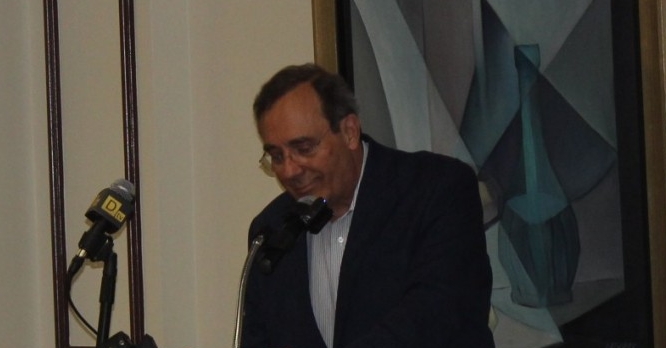
Will a Complaint Be Enough to Defend Our Rights? / Laritza Diversent

According to international legal instruments, “Everyone has the right to an effective remedy by the competent national tribunals to be protected from acts violating their fundamental rights granted them by the constitution or by law.”

No national competent institution regarding the promotion and protection of human rights is recognized within the Constitution of the Republic of Cuba[1]. The Cuban government considers that such an institution is not an identified need for the people of Cuba, based on their willingness to continue to build a society that guarantees all justice[2].

According to the Cuban government, the state has a complex and effective inter-institutional system, which includes the participation of NGOs, in order to receive, transact and respond to any complaint or request made by individuals or groups, concerning the enjoyment of any human right.

The system provides for the reception of complaints, mandatory responses but no restitution if it was proven, and their transmission through the courts. The term to respond is too long and doesn’t provide for an exception for urgent cases or for irreparable damages.

In practice, none of them will go deep into the investigation of the case to verify alleged violations. Nevertheless, according to the government “this system has proven effective in practice and has the capacity to respond to the interests, complaints and denunciations of alleged human rights violations”.

Learn about the state bodies that intervene in this system and the obligations they have on: “National Institutions for Promotion and Protection of Human Rights”, in the legal Cuban system?

[1] Information brochure No. 19 of the United Nations Office of High Commissioner for Human Rights, “National Institution for Promotion and Protection of Human Rights”

[2] Report of the working group for the Universal Periodic Review – Cuba, Council of Human Rights, 2009

Translated by: Michaela Klicnikova

11 June 2014

A Ninth Cuban Dancer Defects to the United States / 14ymedio

June 11, 2014 (With information from El Nuevo Herald and EFE) – The number of dancers from the National Ballet of Cuba who have defected to the United States has increased to nine. Jaime Reytor joins the eight members of the company that fled last weekend in Puerto Rico and are already in Miami. The artists revealed Wednesday that they decided to defect from the island because “there is no future for young people.” They will perform next Sunday with the Cuban Classical Ballet of Miami at a gala dedicated to the Russian ballet.

Eight dancers (Jorge Oscar Sanchez, Raizel Cruz, Carlos Ignacio Galindez, Ariel Soto, Monica Gomez, Yaima Mendez, Lisette Santander and Yinet Fernandez) participated in a press conference organized by the Cuban Classical Ballet of Miami, in which they described their flight from the City of San Juan in Puerto Rico, where they were to participate in the show “The Magic of Dance,” where the Cuban director of art education, Alicia Alonso, was to be present.

“This is the country of the future. There are many options for work and places to choose from. We came here in order to dance and we will dance,” Jorge Oscar Sanchez, age 23, told EFE. He decided not to return to Cuba but to stay in the United States “in search of opportunities,” despite his sadness “at leaving behind family and friends,” because on the island “there is no future for young people.”
continue reading

Since 2007, at least 35 dancers have sought asylum in the U.S. and other countries, according to figures from the Cuban Classical Ballet of Miami. The artistic director of the company, Pedro Pablo Peña, said the steady drip of defections shows “the absolute discontent” of artists with the Cuban regime.

“At first I was a little nervous because it was a very strong impact. It was leaving your family behind to go and find your profession, to be a dancer . . . It’s very hard. I keep thinking about my family,” said Ariel Soto. “They didn’t give us the opportunity of showing us how to reach our potential. I didn’t want to be frustrated because I have a life ahead of me. I’m 23 years old and I want to grow and not stagnate,” he said.

Another dancer, Yaima Mendez admitted that “I’ve been working since I was a child, and could not see the final result of that sacrifice” and that “it always hurts. It’s something very tough, very heavy, but I needed it to fulfill my dreams in a big country.”

According to Raizel Cruz, all dancers in Cuba support the decision of any artist who defects. “I dance, but I come with the mindset of doing anything. Whatever it takes,” he said.

According to the América Tevé channel, Cuban tennis players Randy Blanco (age 21) and Ernesto Alfonso (age 24), who participated in the Davis Cup elimination rounds, also held in Puerto Rico, fled and arrived yesterday at Miami International Airport.

Translated by Tomás A.

Public Health In Cuba, Between Missions, Rabies and Dengue Fever / Juan Juan Almeida

The Cuban Ministry of Public Health turned 105 years old.  Congratulations. Personally I think that health is the most precious non-material heritage a human being can count on.  It should be considered a right for all citizens of the world and a responsibility of each State.

It is sad to know that in spite of the wide arsenal and enormous development that medicine world wide counts on, almost 10 million infants and pregnant women die prematurely each year for causes that, in large measure, are preventable.  Such a powerful reason leads me to applaud the collaboration that, in medical matters, the Ministry of Public Health (MINSAP) and Cuban doctors offer in different countries.

Ignoring this would be a form of blindness; but clearly, because there is always a why, we should not forget that behind this so fiercely kind action, health has also a conquistador nature. continue reading

Sending doctors to the world is a charming and very wise way of creating an army of believers comprised of grateful people.  For each cured patient, there is much more than a satisfied human being.  It seems to me a false altruism that goes in search of lights, flowers, applause and followers.

It is a subtle way of manipulating the opinion of each assisted patient, his friends, acquaintances and family members, in order to capitalize on his logical and sincere appreciation.  It is investing in publicity to provide in pills “revolutionary” ideals.  Sad paradox, because such performance is much more than a simple act of charity; it is a crude strategy to increase the influence of the Cuban government in the Americas and the world, or to change the balance of forces in certain parts of the planet.

Right now, with the purpose of silencing the students who daily protest in the streets of Venezuela, in order to promote votes in favor of the ruling government, President Nicolas Maduro, with a plain loss in popularity, asked his Cuban counterpart to increase, within the next 45 days, the personnel of the medical mission with a new campaign called “Neighborhood inside but well inside,” which is forecast to place medical clinics in places of difficult access with the help of the army, mayor’s offices, and community leaders.

In this new binge of politicized healthiness, Cuban doctors will confront very adverse scenarios, and not because of dealing with going to areas in which extreme poverty reigns, but because in these zones — according to the report that Havana’s MINSAP has — there are no guarantees of security for medical personnel who will live badly in tents where there do not even exist adequate conditions for storing medicine.  Nevertheless, this month of June will be “the month of missions” with the launch and “re-launch” of social programs to buy votes and bully hopes.

Of all this, the worst is that while they send thousands of Cuban doctors abroad, domestic health is neglected.  Some days ago, the health and epidemiological group from Havana City issued an alert that they have tried to hide; but however much they persist in regulating the contents of the national press under constant censorship; “when the press shuts up, the walls speak.”  It is rumored in the halls of the Ministry of Public Health about the recent detection of at least two cases of an illness that many years ago was eradicated on the Island, rabies in humans transmitted by ferrets, bats, and/or stray dogs.

When I say it; the Revolution’s book should be entitled “55 Years of Lies and Perversion.”

Translated by mlk.

9 June 2014

Travelling by Tram / Fernando Damaso

Fernando Dámaso | La Habana | 1 Jun 2014 –- My generation used trams when we were kids and early adolescents. After that they disappeared, to be replaced by English Leyland buses, supplied by Autobuses Modernos, known as “nurses” because they were white with a blue stripe running along the bodywork, which looked like the white uniform with a blue cape, which nurses wore.

A Havana tramway token: “Good for one journey” (FD)

Taking a ride on a tram was a whole experience in itself, with its hard basket seats, its wooden windows which you could slide up and down, and the motorman and conductor – that’s what they called the fare collector – with their ’20’s style uniforms, trying to connect the end of the  trolley pole with the electric wires, pulling on two ropes, when the pole had become detached after going too fast around a bend. continue reading

The trams had platforms at the front and the back, at a lower level than the floor of the car itself, which you used to get on and off at the stops. The former had a grill, looking like a moustache which stuck out to push away possible objects on the road, the motorman had the use of a gadget located to his left which allowed him to regulate the speed in a range of between one and nine. If he needed to, he could put it in reverse, making the wheels turn in the opposite direction. The brake was a crank located at the front, which you operated by turning it. The right pedal was used, when going up or down hills, or when it rained, to drop sand on the rails from boxes over the wheels, improving the grip and avoiding skids.

There was also an iron lever used to move the points to change the direction of the rails.

A traffic jam of trams, when one of them had a problem, lasted some time, until the broken-down one was towed out of the way onto a siding. Opposite the stairway to the University, in San Lázaro Street, in the days of the student protests, the students put pieces of soap on the rails, and the trams, abandoned by their passengers, with the motorman trying to control them with their shiny bronze crank handles, shot off downhill, crossing Infanta at top speed, and often getting as far as Belascoaín, so long as they hadn’t derailed on the way. It was also very impressive going down the Loma de Jesús del Monte, where they got up to a high speed, until they arrived at Toyo.

The trams were made of wood and iron and were painted white with yellow stripes. On their front platforms, over the windows and on the right, there was a large letter which indicated the stop – V, Vedado: P, Príncipe; C, Cerro; S, Santos Suárez; and M and L, Jesús del Monte – followed by a number for the route or line, and, on the centre another number which was the vehicle series number.

Under the windows and above the grill, a flag with colours indicating the itinerary: Lawton-Parque Central, Víbora-Vedado, Cerro-Muelle de Luz, etc.

You paid with a special token showing an H in the centre, which had engraved on one side “Havana Electric Railway Co.” (the name of the company), and on the other side “Good for one journey”.

Crossing in a tram over the Puente de Pote, now called the Puente de Hierro, you could see the transparent and clear water of the Almendares River, which was not contaminated in those days. The El Vedado trams looked more elegant. The passengers got on them and got off again in a ceremonious manner at the different stops. It was a comfortable, slow, democratic and safe mode of transport, belonging to a world now gone. It had more to do with a straw hat than a cloth hat.

The Jesús del Monte stop, popularly known as the “The Viper”, was a hub, with cars entering and leaving, with all type of businesses around it. When the bigger buses came along, the traffic got worse: trams and buses crossing and overtaking with just a few centimetres separation, only avoiding scrapes by the expertise of the bus drivers, since the trams moved on fixed rails and couldn’t manoeuvre to one side.

When it was decided to take them out of service, most of them, after having the motors, bearings and trolley poles removed, were used as filling for new streets and avenues, principally in El Vedado and Miramar. Now they are lying under them. They removed the overhead cables and the tracks, some of which were simply covered over with asphalt. Sometimes they stuck out of the many potholes that existed. One of the last trams, converted into a cafe called “Desiree”, remained for several years on a site near the Fuente Luminosa.

The tramway was noisy, and open to the elements, the best way to enjoy it. When it rained, everyone ran about, trying to close the windows which, given their primitive system, they tried several times, and the conductor had to come and help the passengers. If the tramway was near the pavement, there was no big problem in getting on and off, but if it was far away, nearer the middle of the street, it was impossible not to get wet, apart from having to be careful not to be run over by any motor vehicle. There were lots of accidents like that. The tramways were part of an era, and disappeared when it did, leaving those of us who enjoyed it with happy memories

Translated by GH
8 June 2014

Internet in Cuba: A Success in Spite of Everything / Ivan Garcia

CUBA-INTERNET ACCESSEight in the morning. On the ground floor of the Focsa building  – Cuba’s Empire State – on M between 17 and 19 Vedado, in a shop between the Guiñol theatre and a beaten-up bar at the entrance to the Scherezada club, a queue of about 15 people are waiting to enter the internet room.

It is one of 12  in Havana. They are few, and badly distributed for a city with more than two and a half million inhabitants. In El Vedado and Miramar there are four, two in each neighbourhood. Nevertheless, 10 de Octubre, the municipality with the most inhabitants in the island, doesn’t have any at all.

Poorer municipalities like San Miguel, Cotorro and Arroyo Naranjo (the metropolitan district with the greatest incidence of acts of violence in the country), don’t have anywhere to connect  to the internet either.

On June 4, 2013, they opened 118 internet rooms for the whole island. According to an ETECSA (Telecommunications Company of Cuba) official, around 900,000 users have accessed the service. Not very impressive figures. continue reading

On average, each internet room has received 7,600 customers a month in the first 12 months. Some 250 internet users a day. 25 an hour: the internet premises are open 10 and a half hours every day of the week, from 8:30 am to 7 pm.

But remember that Cuba is the country with the lowest connectivity in Latin America. Some people continue to regard the internet as something exotic with hints of espionage or science fiction.

The murmurings of the NSA analyst Edward Snowden, accusing the Unted States Special Services of eavesdropping on half the world, added to the paranoia of the Castro regime, which compares the world wide web with a Trojan Horse designed by the CIA, along with the USAID’s trickery, trying to demolish the olive green autocracy with a blow from twitter, inhibits many ordinary Cubans from exploring the virtual world.

The oldest people get panicky when they sit at a machine – the way they do. Lourdes, 65-years-old, housewife, only knows the internet by references. “Seeing it in American films on the television on Saturdays. I have never sat down in front of a computer. That is something for the youngsters”

There are plenty of people who see a James Bond in every internet surfer. Norberto, president of a CDR (Committee for the Defence of the Revolution) considers that “the internet is a Yankee military invention which is used to subvert and drive the youngsters crazy with frivolities. An instrument of virtual colonisation. Our organs of State Security have to meticulously regulate those of surf the web.”

And they do it. The Cuban Special Services have taken note of the way the social networks operate during the Middle East uprisings.

According to an ETECSA source, who prefers not to be named, there exists a formidable virtual policy police which controls all the access services to the internet in Cuba with a magnifying glass.

“From the spy programs and the army of information analysts to hack into dissidents’ accounts, up to following social networks like Facebook, Twitter or Instagram. All surfers are under suspicion. Before ETECSA opens a new internet  service, the State Security surveillance tools are already working,” indicates the informant.

A technician tells me that, right now, the Ministry of the Interior (MININT) has a fleet of vehicles equipped to detect illegal internet signals and cable satellite channels.

“Month in and month out there are MININT and ETECSA personnel working together to remove cabled games networks or illegal wifi which are connected up by kids where they live. They also pursue pirate internet connections, illegal international phone call connections, and cable television. A couple of years ago, in one of these investigations, even Amaury Pérez, a musician loyal to the government, had an illegal cable dish connected” recalls the technician.

In spite of everything, the internet is an unstoppable phenomenon for many Cubans, who don’t care about the absurd prices. Although you pay 4.50 CUC (112 pesos, a third of the average salary in the island) an hour, in internet rooms like the one in Focsa, there is always a queue.

Just to open an account in the Nauta mail on their mobile phone, in order to read their emails, a little over 100,000 Cubans stood in queues from the early hours of dawn.

“There were so many people waiting, that we had to assign 30 daily shifts,” indicates a lady working in the Focsa internet room.

The international press tends to incorrectly refer to the Cuban internet rooms as “cyber cafes”. Nothing further from the truth. In none of the 118 premises do they sell coffee, refreshments or sandwiches.

They are commercial offices, where people also pay their phone bills, they sell flash cards and charge up mobile phones. They are big and have air conditioning like the one at Focsa or the Business Centre of Miramar, with 9 computers. The one which has more pc’s, with 12 of them, is situated in Obispo Street, in the heart of Old Havana.

The connection speed can’t be compared with what you find in other countries: between 512 Kb and 2 Mb. It’s a huge difference in comparison with the narrow band connection of 56 Kb offered by ETECSA to the state-approved users.

Even in 5 star hotels, like the Saratoga or Parque Central, the connection is no more than 100 Kb. The price they charge in the tourist locations is very high. One hour costs between 6 and 10 CUC. There is no business strategy. In spite of charging more, the connection is slower.

Because of that it is normal to see lots of foreign tourists or Latin Americans and Africans studying in Cuba, standing in queues outside one of the 118 ETECSA internet rooms.

The internet rooms are called Nauta. The staff are friendly although some have limited ability to advise people who are using the internet for the first time.

I only go onto the internet twice a week. And, apart from striking up conversations with anonymous surfers, who are not known to be dissidents or independent journalists, I have noted that their ages range between 18 and 55, approximately.

There are more whites and mestizos than black people surfing. When you talk to them, 90% say that they are going to look at their Facebook account, look for friends or boyfriends/girlfriends, or to read news about sport, and deal with processes for migration or working abroad.

For those who like to read the international media, the favourites are the BBC, El Pais and the Financial Times. Of the Cuban pages, the most visited are Diario de Cuba and Havana Times, and, of the Miami newspapers, El Nuevo Herald and Diario de las Américas. Martí Noticias, Cubanet and Cubaencuentrohave always been blocked  by the govenrment.

Of the blogs or webs originating in Cuba, like Primavera Digital, out of every 100 people consulted, only 9% said they copy the contents onto a pendrive to read later at home.

Cuba is a country of extremes. The internet arouses affection and fear. A country which limits it, disconnects itself from scientific advances. Puts shackles on progress and throws away the keys in the bottom of the ocean.

he government’s fear of a possible seditious uprising, has reined back the world information superhighway, at the expense of torpedoing the economy and branches of cultural and technological knowledge. That’s what happening in Cuba.

Iván García

Translated by GH

29 May 2014

What Is Known Is Not Questioned / Juan Juan Almeida

According to Martin Pupo, director of the Holguin Operations Base Business Unit, since March 2013 they put into operation Fleet Management and Control (on board computers known as GPS) in trucks that supply the business network far and wide in the Holguin municipalities.

The idea is to stop fuel loss; but a recent inquiry carried out by MINAL found that the business in question used monthly something more than 21 tons of fuel.  And it is logical that the costly measure will not achieve its objective because the neighbors say that in reality those who know “where the bodies are buried” are the ones who are implicated, those who steal and sell petrol are not the truck drivers but the managers signing false delivery orders.  I did not tell them.

Translated by mlk.

3 June 2014

The Other Side Of The Coin / Rebeca Monzo

She is a beautiful woman, petite, friendly, very intelligent, with a great sense of humor and even a certain naivete that makes her appear still younger than she is.  Also, bachelors and masters in science, with many accumulated scientific achievements in her long career.

She lives in the heart of El Vedado, in a building from which in another epoch was observed a beautiful view of what was once one of the most architecturally important and lovely sports parks of our city, with a blue, almost always calm sea as a backdrop.

This park, like all the city, including, it is clear, the building where she resides, has been deteriorating with the passage of time and government apathy, to the point of becoming ghosts from a shining era now passed.  In any case, the same was remodeled and completed in 1960 to form five zones:  park, stadium, gymnasium, pool, children’s playground and volleyball and basketball court, with stands for 1,020 spectators, where the architect Octavio Buigas was showcased with the solution of the spectacular tiers that seated 3,150 people, covered by a light structure of concrete “domed shells” 125 meters long “kindred” to the famous Zarzuela Hippodrome in Madrid. continue reading

Her balcony is just across from this pitiful panorama today.  She lives alone and works in a hospital, so that for more than eight hours a day she is required to abandon her home, fearing the delinquents who take refuge in said tiers.  She, when she is home, usually peeks out to the balcony costumed on different occasions, sometimes as a firefighter, others with cap and sport suit and with hat and glasses, thinking in this way to mislead that element she so fears, with the objective that they believe that several people live in her apartment and so that it will not occur to them to plan anything twisted against her.

As she explains to me, there, under the tiers that are falling to pieces, live “homeless,” drug addicts, and all kinds of “characters” who even carry out clandestine dog fights, without the police trying to impede these criminal activities, given that, from what she and the neighbors have been able to observe, they are not only complicit, but also participants.  While in our country the Media “extols” discipline, order and socialist integrity, this only shows the other side of the coin.

Translated by mlk.

4 June 2014

Who is Writing History? / 14ymedio, Miriam Celaya


Miriam Celaya, La Habana | Junio 02, 2014

Themes

No one could have anticipated a short time ago that the formulas to define the Cuban reality would be so radically transformed. In the last five years, we have been witnessing the gradual extinction of phrases and words that constituted an indispensable part of the official lingo, and the emergence of others which had been demonized, since they were considered remnants of a shameful bourgeois past which from which the revolution of 1959 had saved us.

Our language is foreseeing a scenario which is very different than that of the last 50 years. Lately, we rarely hear such terms as “comrade”, while in the official media, such phrases as “revolutionary intransigence”, “socialist emulation”, “voluntary labor” “collective vanguard” and “moral incentives” are infrequent, as are others, typical of the inescapable dialect of the old Soviet-Marxist period.

Thus, Cubans have once again become “señor” and “señora” and we have also stopped being “users” or “consumers” and have been transformed into “customers”. It is not the same or equal. It is a question of category based on a consumption level of access. For example, those who enter a store to buy the products of “local industries” in national currency remain “consumers”, but shoppers in stores dealing in hard currency are “clients”. continue reading

Now being a “comrade” means belonging to the lowest social ladder.

Cubans are also considered “clients” when they open a cellular phone account at the telephone company, as are those who can allow themselves a few vacation days in all-inclusive beach resort. It is worth mentioning that a Cuban client is not the same as a foreign client, because, after all, prosperity here always comes from “outside” No wonder foreigners or Cubans living abroad are the only ones who have a legitimate right to invest on the Island.

All this explains the extinction of the “comrade” among Cubans with greater purchasing power, and, by extension, among those who dream of attaining that level. Now to be a “comrade” means belonging to the bottom of the social scale or -to define it in the popular undying parlance- to be “broke”. Comrades are out of style.

At the same time, terms such as “investor”, “foreign capital”, “performance”, “competition”, “economic strategies”, “business autonomy”, “trade”, “tax culture” “legal guarantees for investments”, etc. have become commonplace, which point to the gestation of a paradigm diametrically opposite.to the old revolutionary discourse

We shouldn’t think that all euphemisms have been abandoned completely. To Cuban authorities, the private sector does not exist in Cuba, but “non-state forms of employment” do, and there are no Cuban-born entrepreneurs, but “self-employed workers”.

But the discourse is not being transformed from just the Cuban political authorities. Now that the interests of the ex-communist Castro regime graciously coincide with foreign capital interests, changes are also being observed in the discourse and the attitudes of certain Cuban-American entrepreneurs, as well as in intellectual and political US sectors.

The interests of the ex-communist Castro regime graciously coincide with foreign capital.

They are not limited to reinventing vocabulary terms, but they go beyond that, to interpret the so-called Raúl reforms as the driving force behind “significant changes” that are leading to the “development of business potential” of Cuban “citizens” by virtue of which “half a million entrepreneurs“ currently exist. These are the “leading democratic catalysts” that will “empower civil society”.  In fact, these “entrepreneurs”, forged in the heat of the reforms, are “starting to rewrite” the history of the country.

Inexplicably, a group of those who, at the beginning of this “revolutionary” process, felt compelled to pack and leave their homeland, but not before being stripped of their property and their capital, today seem to assume this “economic autonomy” as a possibility in the absence of political and civil liberties, and even believe that it’s possible to go forward with the democratization of Cuba by taking advantage of the economic “openings” in recent years and an imaginary Cuban entrepreneurship.

This formula is inconsistent with historical facts, since these same bilked-out millionaires, with their great capitals, did not stop the consolidation of the regime that bamboozled them at that time. In the new democratizing strategy, what possibilities could our measly native entrepreneurs have –taxi drivers, cart owners, trinket vendors, bike-taxi drivers, owners of small eateries and cafeterias– when they can’t even count on the basic right of free association

We are not against the vital need for change and the power of capital, but let’s not disguise certain private interests with rhetorical discourses and good intentions. Capital and good wishes have poured into China and Viet-Nam, those two exemplary jewels of innovation and prosperity that nobody would wish for themselves.

I agree that the history of Cuba is, in effect, being rewritten, but, so far, the Castro regime has been dictating its script.

Our Own Dangerous “Twin Towers” / 14ymedio, Victor Ariel Gonzalez

Tejas Corner. 14ymedio
Texas Corner. 14ymedio

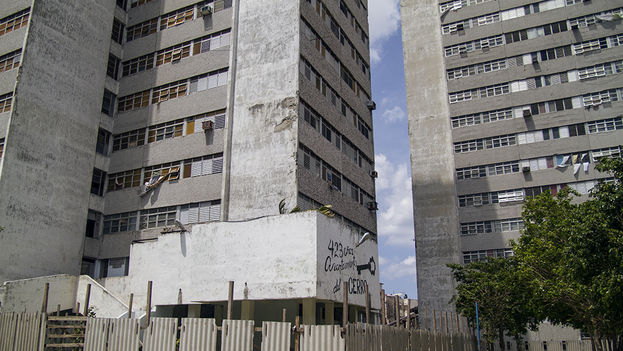
Havana, June 9, 2014, Victor Ariel Gonzalez — Corrugated fiber-cement sheets and wooden planks form a security fence in the shadow of the two tallest buildings of an iconic Havana site: the “Twin Towers” at Texas Corner, where 240 families live, marooned, as the buildings crumble.

Every day many people walk past, where the sidewalks of Calzada Del Cerro and Diez de Octubre intersect. Life goes on as usual at the foot of the gray structures, 20 floors and 200 feet high, which dangerously dominate the landscape.

A glance behind the makeshift wall leaves no doubt about the problem: chunks of rust-stained concrete detached from the walls are scattered in the grass, evidence of the deterioration of the buildings. If you look up, the poor state of the structural walls, which support thousands of tons, is revealed, with their broken edges and numerous areas where rebar is exposed. continue reading

The corrosion causes the metal framework inside the concrete to expand, creating pressure on the covering, cracking and loosening pieces. People say the concrete is “bursting.” This is inevitable in construction using low-quality materials or inadequate technology in the concrete-fabricating process. The phenomenon now affects both 20-story structures on Texas Corner.

An unpredictable and deadly shower of concrete hailstones weighing several pounds

With rust replacing metal, the reinforcing steel loses its structural strength, which is its sole purpose. The building weakens, significantly shortening its useful life. Those who inhabit the buildings are at risk, but not only them. Before the agency responsible for repairing properties extended the protective perimeter in October 2013, passersby were exposed to an unpredictable and deadly shower of concrete hailstones weighing several pounds.

Children play after school in the portion of the park remaining outside the fence. A neighbor, whose little granddaughter is running around there, recalls that construction of the towers was completed in 1992: “I myself participated in the work because during that time I was in the micro.” She is referring to the “microbrigades,” crews of unskilled laborers who built multifamily housing in exchange for a place to live. “They gave me an apartment here, but I’ve always had problems. The windows don’t keep the rain out.”

She remembers that the south tower was built entirely by prisoners, while the north was under the control of those who would be the future owners. In both cases, the work left much to be desired technically. “One time they came around collecting money to retouch the exterior bearing walls, but the people wouldn’t agree because the windows were going to stay the same and the problem was not really going to be solved.” That was several years ago.

Now emergency intervention is needed. But those who installed the fence in only a few days—supposedly the same ones who would repair the towers—have not continued the work, which has been postponed indefinitely. The residents have not been informed of a date for the work to be done. The months go by and the risk increases every day as the corrosion silently advances.

Translated by Tomás A.

Women in Battle Dress / Juan Antonio Madrazo Luna

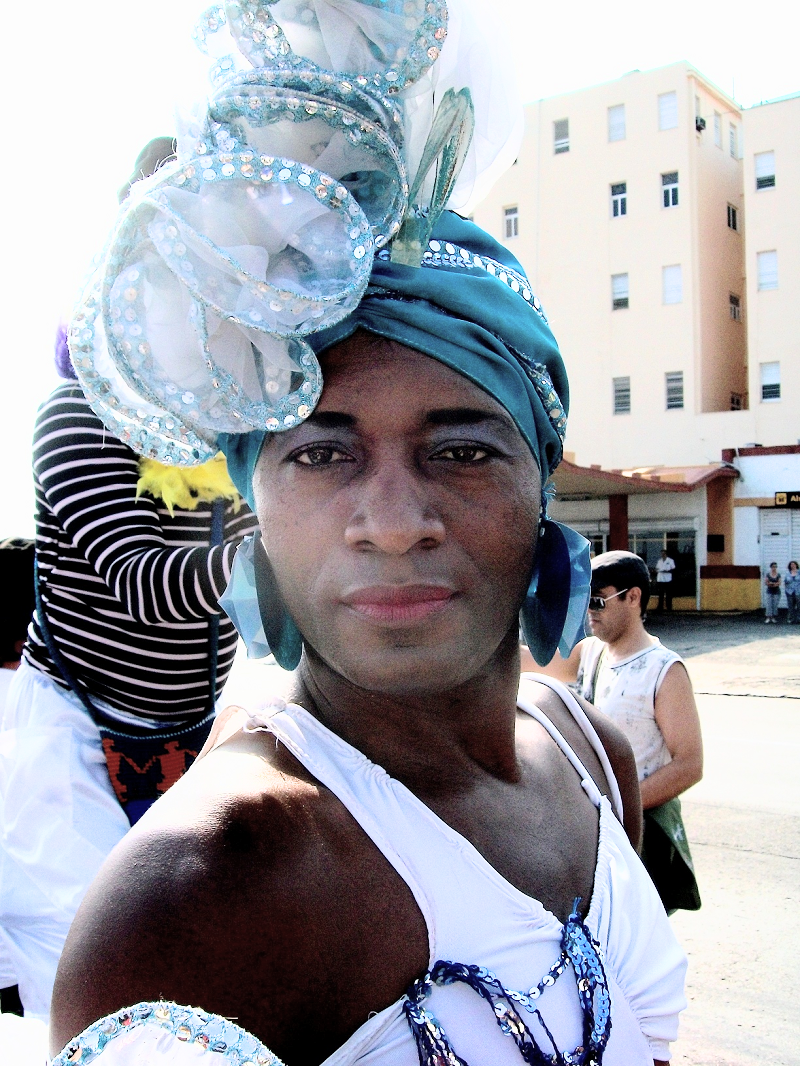
The drag queens warm up Havana with the steam of their bodies. Prostitution has been their lifesaver.

HAVANA, Cuba – Lolita, Alejandra, Samantha, Paloma, and África María are drag queens who stamp their feet on every Havana street corner during the night, while the city sleeps. Some with warrior faces and others as shy princesses patrol the streets and avenues of a broken Havana.

Lady Gaga is not the icon for them anymore. She has been replaced by Conchita Wurst, the “bearded Austrian” who won the Eurovision Festival. They don’t believe in political surgery or the “factory of genders” that the National Center of Sexual Education (CENESEX) proposes, after converting Adela, a transsexual from Caibarién, into the first delegate of Popular Power.

In the stories of these drag queens we find dysfunctional homes, school drop- outs, sexual violation by a relative, and above all, humiliation and rejection since childhood for being different.

As they consider themselves to be in the wrong body, they have transformed it with accessories, paper-mache tits, hormones, or surgery. The will to live has allowed some of them to work in hospitals, as hairdressers, or by singing in small clubs. For others, prostitution has been their lifesaver. continue reading

Africa Maria is an athletic “Negro” of 27 years. Her corn-blonde wig contrasts with her dark skin. With her spike heels and fleshy lips painted red, she goes out every night, from the male chauvinist district of Los Sitios in Central Havana up to the slums of Vedado. Her theater of operation is 23rd Street. Africa tells us, “We have displaced the hookers from the streets. They don’t consider us true women, because the men who look for us know very well who we are. They come in search of a repressed fantasy.

And she adds, “I came out of the closet when I was 17. I didn’t finish sports school since my father, an awesome solider with medals, who was ascending the ranks, kicked me out into the street. And since then I have not stopped selling my skin. And I’m proud, because in Cuba, to be black, gay, and a transvestite, you have to have big balls.”

Samantha, who considers herself one of the most sought-after transvestites of homoerotic Havana, agrees.

“We render a service, we relieve our clients’ tensions. And no one imagines the dangers we face. Cubans have forgotten the fear of AIDS, that we can get infected. But that’s not our greatest fear. The worst is the macho abusers who abuse us. We walk with a pocket knife or a scissors to defend ourselves. Similarly, a tourist or the police can hurt us. We gamble with life. Although sometimes we experience the tenderness of a desperate Negro, who searches in us for the fantasy of enjoying a white women, a pleasure, sometimes unattainable, because of the racial prejudice in our society.”

Lolita, Alejandra, Samantha, Paloma and Africa Maria warm up Havana, with the steam of their bodies. Every day they look at the sea, at the hope of the arrival of a cruise ship full of sailors. They don’t give up. They are “women in battle dress,” who don’t fear the night.

madrazoluna44@gmail.com

Friday, May 30, 2014, Juan Antonio Madrazo Luna

Translated by: Alberto and Regina Anavy

1 June 2014

The Embargo and Absolute Power / Miriam Celaya

Lifting or easing the embargo will strengthen the Castros’ power. No economic benefit justifies the absence of democracy. Lifting the embargo would allow the Cuban government to apply for credit at US banks, and would make it legal for US citizens to visit Cuba as tourists.

clip_image002-1HAVANA, Cuba- In the last week, various opinions have circulating about a letter sent to the president of the US, signed by US and Cuban-American intellectuals and political personalities asking for further easing of the embargo. Debating opinions sparked following the publication of the letter shows at once the relevance of relations between both governments in an eventual political transition in Cuba and the complexity derived from the many facets of a too long-drawn-out dispute.

So far, it is not known what strategy would take place in “drawing near” to the regime which would lead to an effective advance in human rights and democracy on the Island. The extreme positions have tinged a controversy which –judging by the signals stemming from it- will probably settle between the Cuban exile community’s economic power interested in investing in Cuba, some US political sectors and the political power of the Cuban regime. And what role do the common Cubans play in all this? That of passive recipients, the same as in the last 55 years.

It is undeniable that, under conditions of absolute power, the lifting or easing of the embargo will reflect its full benefit in favor of the consolidation of power of the Castros and their elite. However, does this mean that the embargo, or -as some sectors propose- its intensification, will be positive for the present and future of Cubans? At a time when the Cuban government is in desperate need of foreign investment capital, wouldn’t it be possible for those participating in the dialogue to establish a rational agenda to foster an evolution to a multilateral political and inclusive scenario for Cubans? continue reading

But this leads to other equally important questions: is there at least the intention to create such an agenda? would the opposing sectors and those of civil society be invited or allow to participate in its construction? Who would assume the public engagement of its compliance?

Without getting answers to these essential questions we will not be at the gates of a dialogue aimed at a solution for Cubans, but to an arrangement that would require their demonstration of faith once again, such as the one that made the empowerment of a dictatorship possible 50 years ago. So it is that, even for some of us who have declared ourselves opponents of the embargo as obsolete and retrograde politics, its unilateral and unconditional relaxation could be more harmful than beneficial at this juncture, given the regime’s ability to maneuver advantageously in critical situations. A negotiation, to be effective, requires certain conditions.

On the other hand, the intensification of the embargo would only lead to further hardship for Cubans, to an emphasis on violence in Cuba, the exodus, and the possibility of social chaos of unpredictable consequences. No opposition leader would be able to control such a scenario.

As we can see, is not a simple problem.

The Cuban opposition doubts

Internally, among members of the Cuban opposition, a climate of reserve prevails about the efficacy of a “negotiating” proposal that has not been clearly defined. Thus, in the absence of formulas that will allow solid advantages for Cubans or the attainment of long coveted democratic conquests, all optimism becomes intangible.

If the embargo is unconditionally adjusted, the Cuban government would be gaining momentum and consolidating its economic power. As a result, we would run the risk of “going forward” in reverse, towards capitalism with the Castro elite at the helm. A grim scenario.

The success of the negotiations would then consist in drawing such a clever and innovative strategy that it would allow trade and investments derived from “the easing” in effect reach Cubans, and that they might “gain autonomy” and advance in their rights, in a time period that the parties might consider reasonable. Because no discreet economic benefit should justify the absence of political and civil rights.

Official Cuban propaganda in Havana streets.  From the internet.
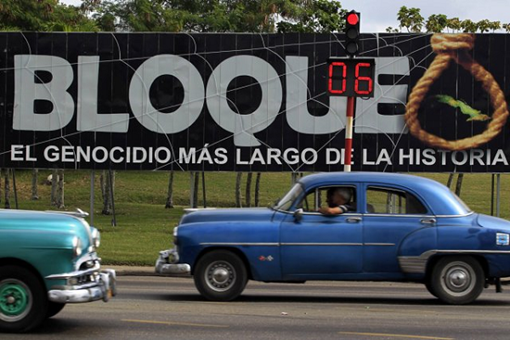
“Blockade. The longest genocide in history.” Official Cuban propaganda in Havana streets. From the internet.

The opposition fears are not unfounded. Certain personalities conveniently interpret the effect of Raúl’s reforms, magnifying them, which is more alarming if the opinion comes from an experienced politician like Arturo Valenzuela –one of the signers of the letter to Obama- who considers the release of “the Cuba interchange” as a way to give power to Cuban citizens (…) the best way to empower the people”. Valenzuela speaks about “a Cuba that’s significantly changing” (interview published by the BBC/Mundo May 19th, 2014). And he really doesn’t lie: Cuba is changing, but not exactly for the benefit of Cubans, as the deterioration of the economy shows six years after “updating the model”, the growing exodus and the increment in repression against the dissidence.

It should be understood that Valenzuela isn’t necessarily interested in the aspect of Cuban civil liberties. After all, he is a politician from a foreign country and, as such, he defends other interests, not ours. However, his claims border on insult by stating that “there is a policy change in Cuba that encourages citizens to develop their business potential. At this time, about half a million entrepreneurs are beginning to rewrite the history of their country by starting their own businesses, creating jobs for their families and communities”. He is obviously referring, in such pompous terms, to the proto-entrepreneurs of small shops –like owners of small restaurants, rolling carts, taxis, trinket stands, and the whole gamut labeled under the insignia “small business owners”- out of which only a tiny minority would qualify as “entrepreneur” under the standards of a half decent country. In fact, the Cuban “civil society” does not even have the right to freely associate.

On the other hand, it seems counterproductive that any of the proposals that advocate “the momentum of the Cuban civil society” might include even their representation in their pro-democracy planning. Seemingly, not one of those aspiring to mediator-debater sees a modicum of talent or legitimacy among us.

In this sense, the 2010 experience was sobering, when the Catholic Church mediated with the government (at the government’s request) in the liberation process of the prisoners of Black Spring, but, to date, this has not yielded any advance as far as respect for their rights and freedoms or for the rights and freedoms of the rest of the Cuban people. The expectations raised by that process ended in another civic shipwreck.

Indeed, civil society is a weaker and minority sector, as befits a nation that has lived under a dictatorship for more than half a century.  However, this is no reason for the influential exile sectors to exclude dissident voices and the claims of the opposition in the right to participate in changes they have been demanding for decades. Such exclusion extends not only to the staunch defenders of the tightening of the embargo, but to those dissident sectors that have been opposed to it. The handiest pretext is that the regime would not approve negotiations if the opposition was represented. Thus, it is more productive to ignore it.

It is clear that we are living in times of change, though no one knows for sure if the changes will be for the better. Since we continue to be the kite at the mercy of the string and the wind, it wouldn’t be so bad that, for once, at least we might know where we are being led.

Friday, May 30th, 2014 | Miriam Celaya

Translated by Norma Whiting

Carolos Alberto Montaner: Someday God Will Awaken / Angel Santiesteban

I thank Neo Club Editions, Armando Anel and Idabell, his wife; Barcardi House of the University of Miami and the Institute of Cuban and Cuban-American Studies, and the Alexandria Library for the opportunity to present this excellent novel by Angel Santiesteban Prats, The Summer that God Slept, winner of the Franz Kafka literary prize, Novels Genre 2013.

I want to especially mention the writer Amir Valle who, at the time, called to my attention Santiesteban’s human and professional quality revealing to me an exceptional writer.  Amir’s devotion to Santiesteban and his generous solidarity is good proof that communism has not been able to destroy the ties of friendship, although it has tried to control the emotional life of Cubans.

Repression as general punishment and intimidation

Santiesteban is a magnificent Cuban narrator, born in 1966.  He was incarcerated by the dictatorship and condemned to five years in prison, supposedly for a crime of domestic violence that was never proved. In reality, what they punished were his criticisms of the system and his confrontation with the regime. The accusation was only the formal alibi to hide political repression.

Naturally, the Cuban regime hides its repressive hand behind the supposed independence of a judicial power that in Cuba is only another feared expression of the apparatus of terror.

If the Castro regime, really, felt that it should pursue those guilty of great atrocities, and if it did not use the tribunals selectively in order to harass its adversaries, it would have severely punished commander Universo Sanchez when he shot to death an inconvenient neighbor. Or it would have initiated a responsible investigation into the assassination of dozens of innocents on the tug boat March 13th. Or it would have delved seriously into the accusation made by Angel Carromero about the probable execution of Oswaldo Paya and Harold Cepero in July 2012, to mention only three cases among the hundreds of unpunished crimes and abuses that Cubans have had to endure.

I have seen, lived and suffered enough to know that the dictatorship invariably lies about the nature of its adversaries. It accuses them of being terrorists, CIA agents, alcoholics, traitors, or, as in this case, even of domestic violence, in order not to have to assume an unpleasant truth: they use defamation, acts of repudiation, beatings, jail and, sometimes, the firing squad, to reign in critical people who have the audacity of saying what they think.

At the same time, those maltreated by word or deed sow terror with the objective of making an example that will not be spread. It is preventive punishment. They strike so that others will lower their heads.

Repression in Cuba, well, it has two clear purposes that Lenin was already recommending at the beginning of the Bolshevik revolution: punish those guilty of deviating from the official line and intimidate the rest of the population. They are, of course, the same mafia methods converted into government measures.

That process of destruction of the reputation of the dissident or of the simply disaffected, especially if dealing with a famed intellectual, is always the prelude to jail or physical aggression. It begins with the insult and evolves into a savage kicking, ostensible and public, aimed at “giving him a lesson” so that he does not dare to contradict the sacred gospels of the tribe of thugs who occupy power.

Angel Santiestebal has gone through all this. They have beaten him, defamed him, they have tried futilely to silence him, but what they have managed is to convert his case into what is called “a cause celebre” that has awakened the attention of half the world.

Something similar to what, in the past, happened to Heberto Padilla, Jose Mario, Armando Valladares, Jorge Valls, Angel Cuadra, Reinaldo Arenas, Rene Ariza, Hector Santiago, Maria Elena Cruz Varela, Juan Manuel Cao, or Raul Rivero, and to so many other writers and artists who suffered various forms of the same ordeal.

The novel and the escape

The Summer That God Slept tells of the flight of a group of Cubans on board a raft. The narrator relates, almost always in the first person, the ups and downs of the trip, and describes the characters who accompany him from the time they embark on the Cuban coast, full of dreams, until they return to the island, on board a ship of the US Navy which takes them to the Guantanamo camps where an uncertain destiny awaits them.

In this case, the eventful journey is less important that the author’s disquisitions on Cuban history and the failed communist government.  It is interesting to note a frequent presence in the novelist’s reflections: Jose Marti. Santiesteban, like so many Cubans, rightly, venerates Marti and uses his life and work as ideal and measure by which to judge what is happening on the Island.

The story is strong and dramatic for two reasons. The first, because thousands of Cubans have died of drowning or being devoured by sharks and barracudas in the seas near Cuba trying to escape from the communist system. That is to say, Santiesteban, in his fiction, which has so much of reality, gives a powerful voice to those thousand of victims. His novel, although the author has not proposed it, has a very important historical component.

How many Cubans have died in the attempt?  They are dozens of thousands.  It is not known exactly, but they are many.  Some speak of 75,000, others double that. Without doubt, many more than those who have died in combat in all the wars fought on the Island since Colombus set foot at the end of the 15th century.  And if they are not more, it is because Jose Basulto conceived and put in the air Brothers to the Rescue in order to help the rafters, until the dictatorship destroyed two of the unarmed airplanes that flew above international waters, killing four people who were just trying to help their fellow countrymen in danger of death.

The second reason that this novel is of notable importance is the theme of the relentless exodus of Cubans.  Why or rather from what do they flee, if since the 18th, 19th and very particularly the 20th centuries, until the triumph of the Cuban revolution in 1959, the Island had been a net receiver of hundreds of thousand of immigrants, to the point of being the American nation that received the most foreigners in relation to its population?  (More, proportionally, than Argentina and the United States).

They flee the lack of freedom, translated into lack of opportunity.  Successive generations of Cuban residents always perceived the promising experience of living better than their parents and grandparents, something that they routinely achieved.

Until the Comandantes arrived, mandated that the dreams of prosperity stop and imposed on Cubans a system of government that impedes the creation of wealth, is incapable of maintaining infrastructure, and destroys accumulated fiscal capital, as is observed in those cities devastated by the unmitigated stupidity of Castro-ism.

When you are born in Cuba, you know that, as much as you may study or try, you will not be able to improve your quality of life because the system prevents it. That is why Cuba is the only country in the world from which engineers, doctors, writers and all those who yearn to do something constructive with their lives and undertake a lucrative activity to achieve their own well being and that of their families escape on rafts, risking death.

They flee also the lying and tiresome discourse that tries to justify more than half a century of social failures with heroic references to violent activities that lost all connection with the young generation.

What the hell does the remote battle of Uvero — a shootout elevated to the category of epic combat — or Che’s disastrous adventure in Bolivia mean for some young kids who want to have fun and normal lives that permit them to spread their wings and pursue their individual dreams?

And when they achieve it, when finally, they have managed to emigrate, they experience another facet of the horror:  The State, that rancorous communist dictatorship bent on harming those who have fled and harassing and mortifying those who have stayed, denies them access to the academic titles that they legitimately acquired, sells them documents at exorbitant prices, describes them as scum or worms, treats them as enemies, and intends that the host country keep them in a legal limbo so that they cannot make their way.

While the rest of the nations of Latin America ask the United States to protect their undocumented citizens with such legal measures as the Law of Adjustment that protects Cubans when they touch US soil, the miserable State forged by the Castros tries to repeal such legislation.  Not satisfied with the damage inflicted on Cubans when they live on the Island, it tries to prolong their suffering in exile, creating for them difficulties so that they cannot adequately develop.

Nothing of what is said here is different from what is quietly muttered by Cuban intellectuals who have not been able to or desired to seek exile, including many of those miserable ones who sign letters in UNEAC to support the tyranny or to applaud executions, pressured by the political police.

That’s why a voice like that of Angel Santiesteban Prats is so uncomfortable.  Each time that a writer on the Island — and I think of Padilla, Maria Elena Cruz Varela, Antonio Jose Ponte, Raul Rivero, Yoani Sanchez, Ivan Garcia, and so many others — dares to describe reality without fear or swallowing the fear, their cowardly colleagues are victims of the disagreeable phenomenon of moral dissonance.  They think one thing but say another, while they applaud what, really, deep in their hearts, repels them.  The regime has managed to domesticate them, they know it, and they live with that annoying imprint that shackles always leave.

In the end, it must be very sad to live always masked officiating in the temple of the double standard.  Angel Santiesteban Prats freed himself from that ignominy and wrote, in order to test it, a splendid book.  Someday God will awaken, and he will come out of his cell.  Thousands of readers await him thankful to give him the embrace that he deserves.

Published in NeoClubPress.
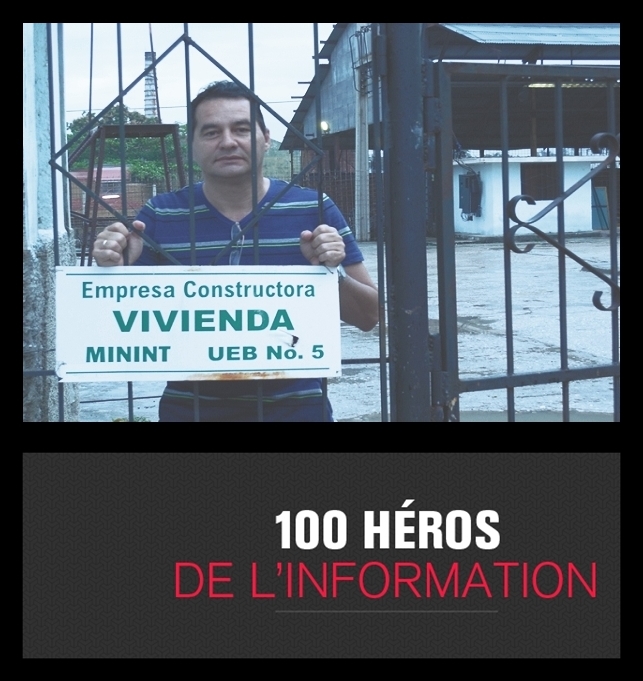
Translated by mlk.

4 June 2014
Amir Valle, the Apple of theDiscord / Angel Santiesteban

He was introduced to me in 1986, in a meeting of young writers that I attended, invited as an observer, in the Alejo Carpentier Center. I believe I was the last writer who arrived at the then so-called “Generation of the Newest.” There I knew those who later would be my brothers in the profession, and we would share literary, existential and family conflicts.

Jorge Luis Arzola was as thin as a thread of water; his shyness was complete and competed with his naivety. Their first images are those that I’ve always remembered. They remain frozen in my memory: Guillermo Vidal, Jose Mariano Torralbas, Alberto Garrido, Daniel Morales, among others.

Amir came to Havana to finish his journalism studies, which made us closer. He brought that form of rebellion of the literary group, ” Six of eighty,” that State Security, at such early ages, had added to their black list, and they were persecuted, interrogated, and their families were summoned before the Political Police. They were marginalized from literary activities in the province. Once you show your dissent, they never forgive you, although they dissimilate and even smile.

Amir was watched since that time and they never trusted him; they stayed on alert, suffering his literary triumphs, his prolific work.

The writers of preceding generations warned us. In particular, they told me that I shouldn’t trust Amir, that he was not my friend, that he was deceitful, that surely he would betray me, and even his condition of being from Santiago served them to sow discord.

Amir left the country — or they made him leave — and for his political detractors it was a relief. He never stopped contacting us, keeping up with our lives and experiences. In an interview of me that Amir did for his digital magazine, “Otro lunes,” (Another Monday) he raised hives among Cuban officials, and some told me about his nonconformity, but always dropping a hint that he wanted to harm me.

When I opened my blog he appeared very worried. He told me, “Be careful about what will happen, little brother.” He supported me at each terrible accusation, and we suffered together, like brothers do.

From my entrance into prison, Amir has kept representing me and promoting my books, and has taken care of every detail that has to do with my person; and in a great irony, those who betrayed me were those who counseled me to be careful of my brother writer. What’s sad is that they did it out of fear and to obtain benefits, because I heard what they thought of the Regime, and I am sure they are more radical that I am.

That’s the sad reality of the Cuban intellectuals, and at the same time, the immense happiness I have to be able to count on a brother like Amir Valle Ojeda.

Angel Santiesteban-Prats

Lawton prison settlement. May 2014.

Have Amnesty International declare the dissident Cuban Angel Santiesteban a prisoner of conscience. To sign the petition, follow the link.

Translated by Regina Anavy
2 June 2014

Another Unfulfilled Promise / Cuban Law Association, Dayanara Vega

Source: yusanby.com

The National Assembly of People’s Power quickly passed the economic regulations recently proposed by the Cuban Communist Party Congress and public opinion in the country is mixed. Some believe the economy now will be put back on track while others believe this will be “just one more of the many unfulfilled promises the party has made.”

Among the new regulations was the expansion of self-employment options along with their related tax schedules. Forgotten once again, however, were guarantees that would have allowed self-employed workers to keep all the income that their business skills and personal efforts generated based on the activities carried out and the services or products offered to the public for purchase.

We are talking about the the self-employed workers, who cannot buy anything wholesale. Their only option is to turn to the retail market or, even worse, the underground or black market to find the necessary raw materials. The latter constitutes an illegal activity because merchandise sold there has been stolen from the state’s food service industry, retail outlets or other businesses. This means the product or service is expensive because the cost of production goes up, sometimes exorbitantly.

2 June 2014