“Indiscipline” Unites* Us / Fernando Damaso

The Electric Union (UNE), considered a Socialist State Great Enterprise, offers citizens some really original services, regardless of whether or not they are requested. Among them are:

Programmed weekly defrosting of refrigeration equipment through power cuts of eight hours or more, to avoid their clients having to be concerned with and waste their precious time with such trivial matters.

Destruction of trees in streets and cities through indiscriminate and savage pruning, to avoid unscrupulous people undertaking this on their own account. continue reading

Keeping the National Health System in business, principally their orthopedic services, with injuries and fractures from falling in unfilled post holes and tripping over unremoved sawn posts.

Systematic breaks in electrical appliances through surprise voltage surges.

Failing to light the streets and avenues at night, promoting the work of thieves and assailants.

I don’t know if in their quest for perfection, consistent with the government’s guidelines, the Electric Union (UNE) will maintain these additional services or increase them.

The title of this post, duly corrected, corresponds to the phrase the company uses in its advertising: “Discipline unites (UNE*) us.”

*Translator’s note: In Spanish “unite” is “une”; Fernando is making a play on words with the acronym of the state electric company, “UNE.”

7 June 2014

Paperwork / Fernando Damaso

Photo by Rebeca

If, in Cuba, you are one of those who has the bad luck of needing to engage in any legal process, as simple as you can imagine, prepare yourself to navigate Niagara Falls on a bicycle. The official in question, and even more so if it’s an attorney or notary, after you start to talk to inform them of the problem, they will take a piece of paper and, without looking you in the eyes, begin to detail all the original documents you will have to present to initiate the process, starting with the obligatory recently issued birth certificate, and if you have one from some time ago it won’t do. continue reading

Several questions present themselves here: Why not the Identity Card, where all this data is found, and which is the principal identification document of every citizen? Why not use it for this? Why a recently issued certification? Is it that over time a person’s birthdate changes? These are the bureaucratic absurdities established by our legal system.

Something similar happens when you have a pain and have to go to the family doctor or clinic. You barely present yourself and aren’t even checked out before the doctor starts to fill out controls, orders for analysis and other tests and, in the end, perhaps some prescription. You’re left with the pain and decide to find a friend who’s a doctor who will really check you out.

These simple events are repeated so often that, at times, they even appear in the citizen complaint sections in the official press, but they are not resolved and are expanded in justifications for the mentally retarded.

The socialist government bureaucracy has to rooted itself in these fifty-six years, such that it is more difficult to eradicate than the invasive marabou weed. This is the officials’ way of being and doing in any hierarchy: they are raised this way, educated this way, and act this way.

16 June 2014

The Ghost of a Preventable Death / Rebeca Monzo

It is painful and embarrassing to travel along the Avenue of the Presidents, more commonly known as G Street and, on reaching the huge monument erected to  President José Miguel Gómez, which fortunately is solid and erect, to glance to the right and observe with amazement this enormous skeletal ghost of what was the Pedro Borras Hospital, the largest example of the Art Deco style in America, dedicated to health, a work of the architects Govantes and Cobarroca, whose work was similar in style and use, but not as big, as that found in Chicago, USA, in perfect condition and providing medical services, while ours is a victim of abandonment and government neglect, which has left it in its current sad state. continue reading

The official media blames its deterioration on structural deficiencies that never existed, but they don’t speak of the detonations carried out on the sidewalk in front of it at the foot of Calixto Garcia Hospital, when the fever of explosions to build tunnels, ordered by the official Nomenklatura, infected the whole city, which very possibly caused the damage to its structure. Nor was it ever adequately maintained, nor was the damage that was caused repaired, despite the fact that more than thirty years ago a group of architects, concerned about the conservation of this patrimony, submitted projects (which were shelved) to restore and save the building.

This healthcare colossus remains closed and totally abandoned, a victim of bureaucratic apathy, squatters, depredations and robberies in its facilities. Now it levitates, remaining upright, a static miracle, ready at any moment to collapse and finally fall down, to become a ghost whose death could have been prevented. One more valued heritage lost, like the emblematic Alaska building in the same neighborhood, the responsibility for which will fall historically on the same authorities who have been ruling us during these fifty-five years.

If urgent measures aren’t taken to restore these grande exponents of our architecture, we will also have to painfully witness the death of the Lopez Serrano apartment building, as well as the America Arias Maternity Hospital, both also examples of the most refined art deco style, now in precarious conditions.

By this means I am making an urgent appeal to the sensibilities of those in whose hands  is the power to address and solve this situation, affecting all Cubans in general and our architectural and historical heritage in particular.

15 June 2014

A Chronicle Owed / Regina Coyula

To Carlos and my traveling companions

When someone asks me what I thought of Lima, I amswer that I was not in Lima but in Miraflores, an area of the city located along the seacoast where the green spaces are impeccable, and the traffic-filled streets are clean and crowded with the Toyotas and Kias. Even the dogs and cats are looked after by the local government. There are tall buildings, enormous stores and restaurants. That’s Miraflores, a district of Lima where anyone would enjoying living, even in spite of high walls and electrical fences.

I was invited by the Institute for Freedom to participate in a seminar on digital journalism and communication technology. These were luxurious conferences, attended by people highly-qualified in their fields. I went to learn and I learned a lot. I also had the opportunity to meet some wonderful people. It felt strange to be treated so cordially in the markets, restaurants, stores and when asking for directions on the street. continue reading

OLYMPUS DIGITAL CAMERAOne sees a different Lima in Gamarra, an impressive commercial perimeter whose counterpart — if there is one — might only be found in some Asian megalopolis. In Gamarra you can hear money growing. This pedestrian-oriented rectangle produces more wealth than many countries. All the activity can make you feel dizzy. Not far from here I can see a hill encrusted with little houses, which arouses my curiosity. It is a poor area where the police do not dare enter, where the recipe for material success goes unfulfilled. We have to leave Gamarra before nightfall.OLYMPUS DIGITAL CAMERA

I would have liked to check out the bar frequented by Zavalita and Ambrosio in Conversation in the Cathedral, or to walk through the University of San Marcos and see if there is a bust, at least a plaque, commemorating Vallejo’s time there.* I had to settle for a bridge and the Chabuca Granda shopping mall in Barranco — a beautiful old area — and a delicious ride on a double-decker tour bus to the city center.

We Cubans always end up talking about food, but to go to Peru and not talk about its food would be a crime. The seviche — which is also spelled with a c and a b — in the food market is unforgettable, as are the huancaína fries and the enormous sweet corn kernels.

mirafloresI must admit that I never dreamt that in a such busy week I would make new friends who will forever stay with me. And there was the city itself, which I pretended to recognize even when Miraflores did not resemble the opulent and modern residential area of Vargas Llosa’s novels.


Translator’s note: A reference to a novel, Conversation in the Cathedral, by Peruvian author Mario Vargas Llosa. The plot revolves around the lives of Santiago Zavala and Ambrosio — one the son of a government minister, the other his chauffeur. A chance meeting leads to a conversation between the two at a bar known as the Cathedral. Zavala is a student activist at the National University of San Marcos who opposes the Peruvian dictatorship of the 1950s.

13 June 2014

The Sewer Waters’ Phantom Truck / Gladys Linares

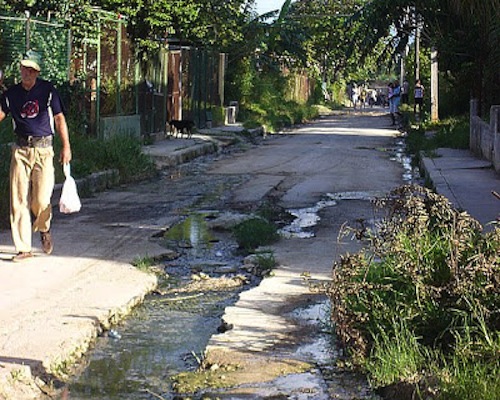
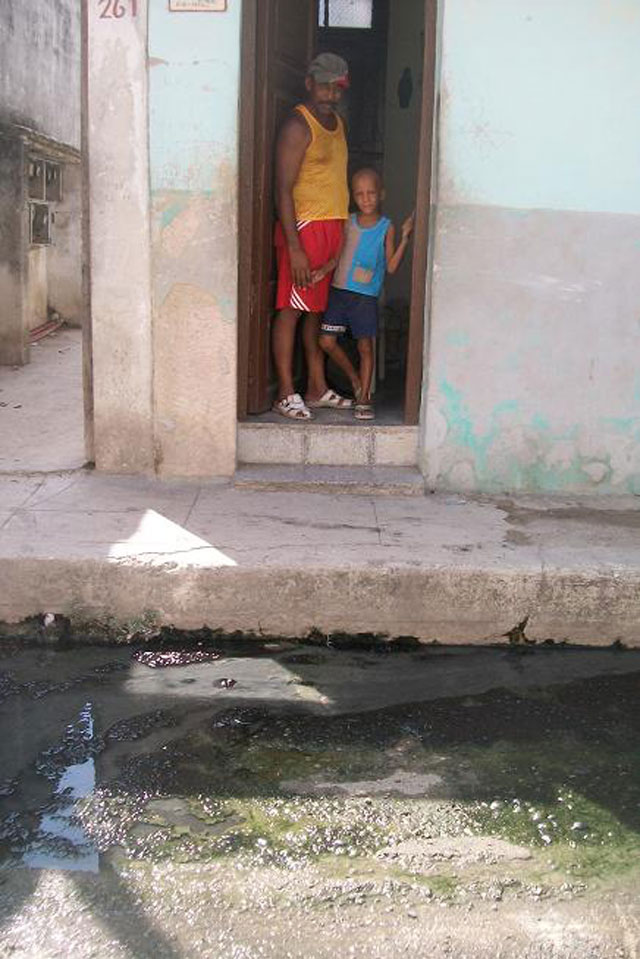
Many Havana streets barely have any pavement. The drains are clogged. With the rains the overflowing sewers allow sewage out. They try to justify these difficulties with the Special Period, everyone knows that the neglect began in 1959.

Cubanet, HAVANA, Cuba, June 13, 2014 — We residents of the capital have seen how the streets and avenues have been deteriorating for more than 50 years, arriving at the critical situation in which they are today. Although roads are an expensive activity, and the government says it has assigned millions to the rehabilitation of the capital’s main arteries, if a profound drainage restoration is not undertaken, the situation, which is critical, the problem of the floods, as well as the sewer water in our streets, will not be resolved.

The sewer system was designed for a certain number of residents, but Havana’s population has been growing by leaps and bounds, and this creates difficulties. A few days ago through the media it was announced that the government was engaged in improving the capital’s pipeline system.

Barely two years ago the official media released a lot of propaganda about the repair of the avenues, among them Calzada de Dolores, Lacret, Porvenir, Diez de Octubre. But, as is already customary, these jobs were not well done, and a few days ago it made headlines again that the avenues already need new repairs. continue reading

Today many city streets are practically back roads, full of dirt, because there is barely any pavement left. The drains are clogged, and as the sewage system networks are not rehabilitated, when heavy rains flood the streets, the overflowing sewers allow sewage waters to get out. Although there is an effort to justify these problems with the Special Period, everyone knows that the neglect dates from 1959.

Many Havana neighborhoods exemplify this reality. To just mention one, in Santos Suarez, Diez de Octubre municipality, in Rabi and Enamorados streets the situation is critical. But that is not the only place where this occurs. Today Ricardo, a young man who lives on Lagueruela street in Lawton, told me that his patio was full of dirty water that smelled like a grave, and that as the downpour got worse, more came out and ran through the halls towards the street. Also the neighbor, an older lady, called him, startled because water was coming out of her bath drain.

For some time, some people have been removing the drain covers when the streets flood. They think that this way the water will drain faster and so they will prevent the flooding of their houses. But as these grills almost always are in the middle of the streets, this constitutes a danger not only for the pedestrians who try to cross the streets, but also for vehicles like bicycles and motorcycles. Jorge, a neighbor, tells me that recently a man caught his attention and directed him to call the high pressure truck that extracts black water, and he looked at him mockingly and shot back: “Buddy, that truck is a ghost!  I’m tired of calling it and it not coming!”

Translated by mlk.

14 June 2014

My Father, Jennifer and Me / Orlando Luis Pardo Lazo

We both fell in love at the same time with the same girl, who wasn’t my mother, in front of an Elektron-216 black-and-white TV, on an afternoon in the seventies in Lawton, another of those lost words that no one in the world would think are Cuba, except Cubans.

She died on screen, Jennifer. But before, she ran with him, Oliver, through the unknown streets of a miracle called The United States. And they both were beautiful and free like love, and so tender and irascible, immortals.  And they ate snow and threw snowballs at each other’s heads. And neither of them had ever heard of Fidel or the Revolution.

My father had just retired. He’s been a gray bureaucrat in a nationalized industry dealing with the importing of polymers. Of the Lili Dolls of Havana Plastics. His successive offices, like his checked shirts, smelled of nicotine and that salvific smile that didn’t belong for a single minute to his environment. continue reading

I’ve said before that he was called Dionisio Manuel, but if now and again I don’t repeat his double name, we run the risk that it will disappear before its time from my memory of late exile, of fugitive props, gossiping in the face of totalitarianism itself only to take refuge in sight of those snowy mansions and hockey stadiums and phrases Made in English, in a country that wasn’t so much a homeland, but rather an open space in which to die meekly in front of strangers without the least fuss.

American movies were our consolation against Communism. Our rope made of sheets to climb down from heaven. I was the son of his old age (when I was born he was 53). He saved for me, intact, his collection from the fifties of Life, National Geographic, Reader’s Digest, and a huge maze of pocket-books which my father apparently stole, one by one, from the Jose Marti National Library (picket-books).

These books and magazines, this dead language called English, were our secret promise that there would be a survival, a future without fidelities, a history without hypocrisy, a no-place where we would both fall in love with the same girl, who wasn’t my mother, but nor was she inside the Elektron-216 black-and-white TV, but rather in an illusion of the phonetic fossil called The United States.

Well, I came here now. I have run among the hockey stadiums. I have laughed along the rivers. I have eaten snow (another way to eat the white, the trash, the emptiness). I have, I as well, a love to run with toward the abyss, with political death stepping on our heels and our parents.

For Dionisio Manuel time ran out long before B2 5-year multiple-entry visas to the USA, which now are not denied to anyone in Havana, except my mother, who in any event at age 78 will no longer have much of a girl for someone to fall in love with.

It’s Father’s Day and I am doubly orphaned. And happy. Fundamentally happy.

Even Sundays, bit by bit, begin to resemble the Sundays of our indigent infant imaginations. Hopefully, soon we’ll both be free and beautiful and tender and irascible and immortal and never will have heard of Fidel or the Revolution.

15 June 2014

Super Dad / 14ymedio, Yoani Sanchez

Yoani Sánchez, Havana, 15 June 2014 – Ricardo has raised his two daughters alone. One August morning he woke up and his wife had left. Later he learned she’d been intercepted on the high seas and spent months at the Guantanamo Naval Base before arriving in the United States. At the time, the youngest of the girls still slept in a cradle and the oldest was learning her first letters.

They had hard times. The maternal grandmother’s aggressiveness didn’t respect paternal custody. “These girls need a mother,” she shouted angrily, every time she saw him. Nor was it easy for him in the village. A man abandoned can go unnoticed in Havana, but in the provinces it’s a constant joke, the talk of all the neighbors.

He had to face it all alone. He had to explain to his daughters what it means to start menstruating, and also the importance of using a condom. He had to stand in long lines at the pharmacy to buy sanitary pads and sell some of his belongings to buy them extra cotton every month. He specialized in ironing uniform skirts, mending stockings, and removing nits from their hair. At first his braids were loose at the top and fell apart in a few minutes, but later he was a total master. continue reading

He never went back to sleep in the morning. There was always one of his “women” who had to get up early and he made breakfast and woke them up. One of them says her “papi” makes the best peas in the whole country, while the other still asks him to edit what she writes.

He doesn’t speak ill of their mother. He prefers to build up their hopes that somewhere in California there is a sad-looking lady who is waiting to reunite with her daughters. But the letters don’t come more than once a decade and the last time she was more worried about her own unemployment problems than the girls she left in Cuba.

Ricardo could have disengaged and done what so many others do. Cuban society never would have blamed him for sending his daughters to their grandmother’s house. After all, the popular refrain would justify it, asserting that “a father is nobody.” His case, however, is not so rare. It happens that his story is lost among so many of our everyday emergencies.

Today he went out early, without making any noise, wanting to get a haircut and buy a little rum to celebrate Father’s Day. It’s Sunday, “the girls” will sleep late and the kitchen will already smell of the pot where the beans are cooking.

The Stop: A Citizen Performance / Lilianne Ruiz

Angel Santiesteban and Manuel Cuesta Morua

My blog appears abandoned. But that is not the case. What happens is I want to do many thing and so I am behind in updating it. I follow what’s going on around me, I want to understand our history, our social paralysis. I am not brave. I realize it’s easy to stay home, have a hot drink, read a book, ask others questions. The hard part is going outside, engaging in any form of protest about the arbitrariness in which we live.

So I thought of stopping, in that the same day and the same hour we stop like the world stops and connect with our troubles. Because we are very troubled, everyone has their own personal story for feeling this way.

But Cuba is a country where to protest, you have to be a hero. And I don’t like heroes. Which otherwise only appear in barbaric times. We imagine an individual of such size made in the image and likeness of good, as in the Bible, confronting constitutional walls like those that make socialism, the central control the State and the a single party political system irreversible. Wo we must change the constitution, because there is no lack of heroes, nor are there laws to protect people from the power of the state, Hobbes’ Leviathon.

I someone goes out to protest the police come, such brutes and so brutal, and not only are they arbitrarily detained, but right there the strength is lost because those who have experienced it fall into a kind of revolutionary mockery that doesn’t know the value of time.

A person disappears in this time of gigantic size where nothing nothing nothing happens. And a police officer poorer than you are and with less awareness of his rights is who is sent to shut you up as if to say: abandon all hope, here we mock everything, civil, political, economic rights, everything. Here nothing nothing nothing happens.

So I propose to stop. Stop, as an individual, in the street, for example next Wednesday at two in the afternoon, or any other day, just three minutes, to meditate on everything that hurts us, our impotence as individuals and as a society. No harangue, no poster, looking inward, toward the endless abyss that seems to be our individual and national destiny.

They do not want us to take to the streets because they send the police brutes smelling of mother-of-pearl soap (from the bodega) and bad breath, in their eyes the swamp of binging and the revolutionary rabble which swallows out civic, civilizing and profoundly counterrevoltuonary attemps. Let us stop, then.

Police citation for Manuel Cuesta Morua to appear for “an interview”

6 June 2014

The New Man in Cuba in Search of Anabolic Steroids / Juan Juan Almeida

You don’t need to be an expert critic, clairvoyant sociologist or a wise politician to understand that when you grow up in a totalitarian and absolutist country like Cuba, flooded with numerous afflictions, it’s normal to feel small.

Thus, because of the great restrictions on individual freedom, the meager access to modernity and a determined idleness, every day more young Cubans, trapped in the wrong time of an epoch that doesn’t move on, however much it’s announced, and doesn’t arrive, evade reality by finding refuge in sex, drugs, alcohol, emigration, robbing, lying and in a new sickness that, although it’s not recognized as such by the international medical community, is now all the craze.

The consumption of anabolic steroids has grown into an epidemic, especially among adolescents and young people, who want to improve their physical and esthetic qualities. They also are sure they will lose body fat, which is in vogue. continue reading

In large measure, the creators of the problem are the media of communication. Cinema, television, literature, magazines, trying to sell a gallant beau, aren’t aware of what happens later. Prosecuting them now leads nowhere; what’s worrisome is the increase in young people cared for in the emergency rooms of Cuban hospitals, affected by severe liver and multiorgan failure, brought on by the consumption of anabolics, because the desire to look good, even as a form of social nonconformity, draws them to spend money for these substances that exaggerate their musculature.

Primobolan, Proviron, Winstrol, Parabolan, Anadrol – young people talk about the brand names and doses without having the remotest idea of the secondary effects.

The Cuban government knows about this, has the information, even has referred to the subject in extensive editorials that sound less convincing than Mariela Castro’s curriculum; but understanding that it’s a matter of an invisible hurricane, they prefer to practice their habitual sedentary politics of explaining and not acting. As if Poseidon, the Greek god of the sea, couldn’t stop a tsunami.

The Minister of Public Health, with total shamelessness, assures that the market for this type of substance is controlled; but it’s certain that young people can obtain it without much work in pharmacies, hospitals, sports schools and connections in the black market. But the principal providers of this “destructive spring” are some Cuban functionaries with the medical mission in Venezuela, who through a dark back-route and in complicity with officials of General Customs of the Republic of Cuba, send and let pass the product into the national territory by treating it as regulated but lawful trade.

The “Trafficking and holding of toxic drugs and other similar substances” is well-represented in Chapter V (Crimes against public health) of the Cuban penal code; but its sanction is poor, and by association, the business is easier, more profitable, less prosecuted than trafficking in cocaine, and it guarantees an equal number of dependent clients, creating a host of young people trapped between the weights and this addiction, scientifically called muscular distrophy or vigorexia, which obliges them to fall into the constant nightmare of raising their self-esteem. My aunt always repeated, “Mijo, don’t let yourself be fooled; there are no roses without thorns.”

Translated by Regina Anavy

2 June 2014

A Permissable Violation / Fernando Damaso

Chapter II, Article 32 of the Constitution of the Republic of Cuba stipulates the following: “Cuban citizenship shall be lost: a) by those who acquire foreign citizenship.”

However, for the hundreds of thousands of Cubans who have emigrated and obtained foreign nationality, and for the thousands who have attained residency in Cuba — mainly Spanish nationals — this clause does not apply.

One might think this constitutes a humanitarian, though unconstitutional, action by authorities to benefit those born on the island. The reality, unfortunately, is quite the opposite. By requiring one and all to have a Cuban passport — even if they hold another one — in order to enter or leave the country, the Cuban government brings in a respectable amount of money, especially since a passport is only valid for six years and must be renewed every two, with the resulting monetary expenditure.

In Cuba a passport costs 100 CUC and each renewal costs twenty. Overseas, however, Cuban consulates charge significantly higher fees. This is the economic impact but there is also a legal issue. Upon entering the country, an emigré is completely subject to Cuban law and the government of the country of which he is also a citizen can do nothing to protect him because, as far as Cuba is concerned, he did not enter the country with the other country’s passport but rather with a Cuban one. As is quite clear, the Cuban state commits this constitutional violation purely out of economic interests in order to obtain hard currency. Secondly, the same perverse motivation allows it to maintain complete control.

In today’s globalized world, where geographical borders become less important with every passing day, people have dual and even multiple nationalities. For Cuban authorities updating this legal statute presents no great difficulty. The flattering reference to the Soviet Union was dropped from the constitution once this state ceased to exist while the ridiculous term “irrevocable socialism” was later added.

Cuba, stuck as usual in the past, rejects renewal and refuses to join the present by continuing to promote its outdated image as a “besieged island,” which for over 56 years has generated substantial political dividends. What it does not realize is that the buyers are becoming increasingly scarce.

11 June 2014

What Can an Independent Lawyer do in Cuba? / Laritza Diversent

In Cuba, professionals can’t work for themselves in the specialty in which they graduate. Legal counseling and consulting are not recognized as self-employed activities, the only actions that a lawyer can perform independently. The few that make this decision have to do it for free.

It’s also difficult to form an autonomous association. The red tape required to legalize a non-profit organization assures that the State has absolute control over it.

To these limitations economic dependence is also added. The lawyer who doesn’t work for the State doesn’t earn anything. In order to survive, in a system where the economic crisis is permanent, independent lawyers collect extra honoraria, even when the regulation on the practice of advocacy, among other causes, considers it a serious shortcoming to receive honoraria that are not established or are better than those officially approved, whether in cash or in kind. A double morality is imposed by these conditions on the practice of advocacy in Cuba, and with it comes total submission to the system.

See Artículo 59.3 inciso c, Resolución No. 142/84 “Regulation on the practice of Advocacy and the National Organization of Collective Law Firms.”

From Jurisconsulto de Cuba, by Laritza Diversent

Translated by Regina Anavy

9 June 2014

Being In Prison is Worth It / Angel Santiesteban

Cartoon by Garrincha: 

“Excuse me, but we have a writer who they say beat his wife. Of course there is talk about him.”

“Dude, do I look like a marriage counselor or something?”

“It’s just that this writer is a dissident, you know?”

“Where is that abuser?!”

Seated in the door of my cabaña, many people ask me if it’s worth being a prisoner, and without doubt I say yes.

Here inside I see the internal and profound face of a society submerged in the horror of survival. Furthermore, it permits me to do a unique sociological study; it’s an exceptional experience. Seen in this way the suffering of confinement doesn’t hurt. To this I add the use of time spent in reading and writing.

I am sure that with my imprisonment the government, and particularly the Castro brothers, are the ones who have been harmed the most, because they left in evidence the credibility of the “reforms” that they wish to sell. They showed how they try to deceive the world in order to obtain financing for the ruined Cuban economy. continue reading

My truth and my rights are my armor, and with that I feel invincible before the dictatorship; I also add my illusion that one day I’ll know who planned to silence and humble me, which, no doubt was thought up by Raul Castro and his son, Alejandro, after my first “Open letter to Raul Castro,” which I wrote in November 2012. Also I’ll know who covered up the order, and those who have been willing accomplices in the cultural milieu, and even those who – inside the same opposition – made a pact of silence in exchange for some privilege.

What will be infallible is that sooner or later, all the truth that today we can’t even imagine will be known. Then it will be like opening a book and seeing peoples’ souls. That is my awesome tranquility, and like the Arab, I sit in the door of my cabaña hoping to see the cadaver of my enemies pass by. If before this I have to pay with my life, I shall equally hope for it, because they will purge my death.

What’s certain is that – in one way or another – they won’t escape paying for their injustice to me and to the hundreds of activists who they have beaten, imprisoned and assassinated. The Castros know that this moment is inevitable, and for that reason they are working now. They are pretending to make a transition that apparently satisfies “everybody” when Raul Castro leaves power, but they are leaving secure the threads that move the country, in politics and economics, to avoid being judged for crimes against humanity.

Ángel Santiesteban-Prats

Lawton prison settlement. May 2014.

Follow the link to ask Amnesty International to declare Angel a prisoner of conscience.

Translated by Regina Anavy

9 June 2014

Fidel Castro’s Undesirables / Ivan Garcia

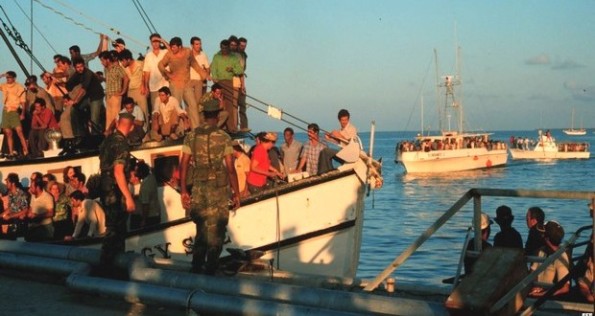
Photo: Over 125,000 Cubans departed from the port of Mariel on boats like these bound for the Florida coast between April 15 and October 31, 1980. Source: Martí Noticias.

It was Spring 1980 in Havana. Before dawn a group of policemen hurriedly entered the cells of the Eastern Consolidated prison, known as the “pizzeria.” After lining the inmates up, their backs to the wall along a narrow corridor, an official of the Ministry of Interior spoke in a loud voice and without beating around the bush.

He was blunt. “You can get on a bus that’s waiting outside and leave for the United States, or within three days your prison sentences will be doubled. You choose,” he said.

“Imagine, I was sentenced to 20 years in prison for murder,” recalls Randolfo, sitting in a park in the Havana neighborhood of La Vibora. “Going to the U.S. was my  passport to freedom.

“I don’t know if my sins can be purged. I stole, killed and caused harm. Since I was sixteen-years-old, prison had been like home. In January 1980 I was transferred from the prison at La Cabaña to Eastern Consolidated, which was still under construction. Before the incident at the Peruvian embassy, which took place before the stampede at the port of Mariel, I was in a prison cell. I didn’t think twice about leaving,” recalls Randolfo. continue reading

1980 was an extraordinary year in Cuba. On April 1, the #79 Lawton-Playa bus, travelling at full speed, smashed through the security barricade at the Peruvian embassy on 5th Avenue and 72nd Street in Miramar. The police crossfire caused the death of one of their comrades, Pedro Ortiz Cabrera, who worked there as a guard.

It was a period in which Fidel Castro and his regime were in complete control of civic life. Insincerity and hypocrisy were at their height. Many people energetically applauded his speeches in the Plaza of the Revolution even as they relished leaving the gray, uniform setting in which an all-powerful state rewarded or punished those it governed by edict.

The jails were full. Anything could be a punishable offense: having dollars, sailing on a rubber raft to Florida or telling a neighbor you had a dream that Fidel had died. And there were also dangerous guys like Randolfo, individuals with short fuses who moved through life with a knife clenched between their teeth.

After Castro’s miscalculation — he never imagined that over ten thousand Cubans would storm the Peruvian embassy within a few hours after his decision to remove police protection — the strategy became one of carrying out a full-scale social cleansing of the country by clogging American society with murderers, the mentally ill and violent criminals. It was a collection of humanity that would have had no place even on Noah’s ark.

At a processing center near the Lucero highway south of the capital heading towards Mariel, homosexuals, silent dissidents, prostitutes, rockers and social misfits were hastily dispatched.

Castro branded them as “scum” and shipped them off in boats owned by Cubans living in Florida, who came out hoping to find their relatives. Before leaving, eggs, insults and punches were hurled at the “repulsive worms” at Fascist-style rallies in which their neighbors or work colleagues happily participated.

Randolfo has a different story. He was transferred from the prison to the processing center and in little more than an hour he was on a boat headed north.

“It was a rainy afternoon,” recalls Randolfo. “I arrived at Key West at the end of May, 1980. The government had released about four thousand inmates and criminally insane individuals. We were processed by immigration officers and the FBI at a detention center in Florida. Those who had no family in the United States, or who were determined to be prisoners or psychiatric patients, were sent straight to prison in Atlanta.”

In 1987 Randolfo participated in a massive prison riot in the southern state of Georgia.

“It was like a movie. We took hostages and things got ugly. Many Cuban prisoners didn’t want to return to the island. We wanted to serve out our sentences and then settle in the United States. But it wasn’t possible, at least in my case “

Randolfo’s was one of the 2,746 names that made up a list of people to be repatriated to Cuba after agreements reached between Ronald Reagan and Fidel Castro in 1984.

“I landed at a Havana airport in night in late 1990. They took off the handcuffs and handed me over to the Cuban guards, who put handcuffs back on and transferred me to Eastern Consolidated. I was a prisoner there for another year. I had not been a free man since 1978. All I knew of the United States was its prisons. I’ve changed. I have a family and my dream is to emigrate to the U.S, to work hard and to get ahead. It’s a society that gives you that opportunity. But my past is holding me back. The U.S. immigration authorities will never give me a visa,” says Randolfo.

Thirty-four years after events at the Peruvian embassy and the mass exodus through the port of Mariel, U.S. customs and immigration authorities continue to deport criminals and the criminally insane sent over by Fidel Castro in 1980. There are five-hundred and two awaiting repatriation.

Iván García

8 June 2014

One Less Thread in the Social Tapestry / 14ymedio, Yoani Sanchez

Yoani Sánchez, Havana, 12 June 2014 — In a country where there are so few spaces for debate, the loss of any one of them is a tragedy. The departure of Roberto Veiga and Lenier Gonzalez from the magazine Lay Space leaves us with even fewer opportunities for debate. Their work was characterized by its willingness to address controversial and difficult topics in the pages of a publication which, in recent years, became an obligatory reference. With a respectful spirit, a true concern for the nation, and the ability to present arguments, these editors opened a reflective space that we, their readers, fear will be missed from now on.

Differences in ideas should not lead us to personal confrontation. A lesson that should be learned by more than one person who takes ideological contradictions as a pretext to channel their lowest passions. So, despite my points of difference with many of the ideas of Veiga and Gonzalez, and especially with their category of “loyal opposition,” I have always respected their work and considered it to be of great value. The public existence of their voices improved the quality of discussions within the Island, encouraging different points of view – which is always a good thing – and brought together political tendencies that seem to run along contrary paths. I regret that they never accepted invitations to also participate in non-official debates within the country. I hope, now they have been “liberated” from their jobs, that we will be able to exchange ideas outside the protection of the Cátedra Félix Varela.

Cuba loses and I can’t imagine who wins with this dismissal. The next archbishop of Havana? Is the church so fickle? One day they snatched the magazine Vitral from us, to turn it into a shadow of the multicolored light it once was. Now, it seems, the same will happen with Lay Space. I am not convinced by the declarations of its current director who assures us that the work of the journal will continue. I believe deeply in the stamp each human being imprints on a work, and in the case of this publication it’s clear that Veiga and Gonzalez were its principal sources of inspiration.

The ragged tapestry of our civil society just suffered the tearing of another thread.