Was Moncada Necessary? / 14ymedio, Fernando Damaso

Moncada Barracks
Moncada Barracks

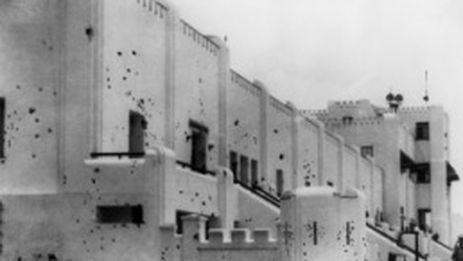
A great deal has been written about the assault on Moncado Barracks in Santiago de Cuba and the Carlos Manuel de Céspedes Barracks in Bayamo on 26 July 1953. At times, with great exaggeration. Some, forgetting the differences in times and objectives, as compared with the Cry of Yara in 1868 or that of Baire in 1895, which started our war of Independence.

About the assault on the Moncada barracks in Santiago de Cuba and Carlos Manuel de Céspedes in Bayamo on 26 July 1953 much has been written.Sometimes exaggerated. Some, forgetting the differences in epochs and objectives, as compared with the 1868 Cry of Yara, or the Cry of Baire in l895, which kicked off our war of independence.

In response to the events of 1953, traditional Cuban political sectors reacted with surprise. They were used to solving national problems through dialogue and peaceful means, and suddenly armed struggle makes its appearance as a method of fighting against tyranny. Even some of those who would later become traveling companions of the revolutionaries, described the act as a putsch, although later they retracted. Others, less dogmatic and more dialectical, saw in the action a path for its principle organizers to rapidly achieve political prominence and popular support. continue reading

There is no doubt that the event became, as noted during the celebration of its eighth anniversary, “the little engine that helped to start the great motor.” The deaths in combat and the murders, the trial of the surviving attackers, their imprisonment, the development of a program document and its clandestine spread among different sectors of society, the campaign for amnesty, and the resulting release of everyone, created that the conditions that later served as a base for the disembarkment from the yacht Granma on 2 December 1956, the guerrilla struggle on different fronts from 31 December 1958, and the triumph of the Revolution on 1 January 1959.

Over the years, and with the knowledge gained from those involved in the action, the event has been the object of several interpretations and evaluations

The assaults on both barracks, there is no doubt, constituted a heroic act of the Cuban youth involved, in honor of the centenary of the birth of José Marti, whom we call the Apostle. Over the years, and with the knowledge gained from those involved in the action–from their telling of it or writing about it–the event has been the object of several interpretations and evaluations, taking into account everything that happened afterwards.

Some believe that it was not necessary and that with political pressure and public opinion, the ouster of Batista could have been accomplished and democracy restored in the country, this without the high-cost paid in the lives at that time, and also the cost in lives and material losses of all kinds which we have continued to pay ever since.

Others believe that it was essential and that the attacks on the barracks were just. Although, subsequently, many of the plans that formed a part of the original platform have been proved unworkable, at that time they were accepted and supported by the majority of Cubans, regardless of the social class to which they belonged.

There are also those who, despite everything, continue to be in total agreement with what happened before and what has happened since.

The Moncada attack, although still present for its living protagonists and the generations that have accompanied them for years, recede in time more and more for new generations. Young people see it as an event of the past, more a part of history than of their daily lives. Lives that are full of contradictions, dissatisfactions, problems and needs of all kinds, both material and spiritual, unresolved and without real prospects of resolution. If that event is to continue to be relevant, it needs to address these events in the day-to-day lives of every Cuban.

A Hilarious Conclusion / Fernando Damaso

Artwork by Rebeca

An article by a young Cuban journalist was just published in the so-called youth newspaper under the arresting title “The Happiest Children in the World.” In it she recalls her childhood of aged, half-bald dolls previously belonging to her older sisters, toys given to her by a neighbor after he was too old to play with them, Soviet nesting dolls, daily blackouts, nights spent in darkness and many other shortages. In the end she comes to the conclusion that she “was born in this country, a place where children have everything they need to be the happiest in the world.”

I do not know if the author is trying to be slyly ironic or if she has been a practicing masochist since early childhood. She presents no evidence that would lead to such a conclusion. It could be that for her this is what constitutes happiness, but such generalization is a bad habit on which Cubans too often rely. Statements about having the best baseball, the best boxing, the best education, the best health care, the most courageous people and so forth are far removed from reality.

If this were true, then we would also have to accept that we are the happiest people in the world. This would be in spite of the fact that more than 80% of our homes are in disrepair, that many families live in inadequate and unsanitary housing, that streets and sidewalks are inaccessible, that neighborhood sewer lines are broken, that potable water is scarce, that public sanitation is notable by its absence, that the health and education systems are poor, that social indiscipline and violence are endemic, that salaries and pensions are at poverty levels, that prices for consumer goods are exorbitant, that public transportation is chaotic, that the economy is not growing, that every day the country moves further backwards, and on top of all this that we live without internet access or civil liberties.

One should be careful about what one writes and publishes as well as a little more responsible. Accepting misery and shortages as a normal way of life without working to change them does nothing to help eliminate them. It is one thing to repeat slogans but quite another to discard objectively in order to fill up pages. You don’t want too much of a good thing.

24 July 2014

Wendy War


Grown in Exercises of Death, Wendy Guerra (Taken from her blog HABÁNAME) (Reposted by Orlando Luis Pardo Lazo in his blog)

I have death as white and truth far away… – Don’t give me your fresh roses; I am terrible for roses. Give me the ocean…Dulce María Loynaz

Death, solicitous and vigilant followed me until my fall. It was my companion – solicitous and loving – Rafaela Chacón Nardi

Dreadful voice in funeral I mourn, that flies from the seas of my homeland to the beaches of Iberia; sadly confused the wind delays it; the sweet song in my throat freezes and shadows of pain cover my mind. Ah, that suffering voice, that America denotes with its pity and on these beaches the ocean casts, “He died,” is uttered, “the ardent patriot…” “He died”, repeated “the Cuban troubador.” And a sad echo moans in the distance, “the sublime singer from Niagara died!” – Gertrudis Gomez de Avellaneda

I carry the subject of death very badly. I bow before death with too much grief. Just by peering at a roof I can fall overwhelmed by fear.

This week I wake with the memory of those who have passed on. My parents, my friends, my poets, my personal saints.

The soul, the body, the emptiness, the abandonment or slipstream that our most beloved dead leave, fight within me with severe injuries.

This week the world’s newspapers talk about death, confinement, the hunger strikes in my country. My head and my body are trapped in a bird cage that is the act of dying.

For many cultures it is a cycle that is closed to open other cycles that are clear and bright. This is the way I should see it, as death to me appears to be the end of everything. But death weighs me down and casts me toward a powerful darkness.

It always appeared normal to me that someone would decide to die rather that live indefinitely with an incurable illness. Always, even when the dilemma of euthanasia touched me closely. I looked at the still living body of my mother, looked at her face and closed myself off from any possibility other than finding a miracle or unearthing a hope. I convinced myself that in the care of the body that still flutters before us, hope lives.

The cage of life opens.

I mishandle death but one must confront it. Six Marches back, I had surrendered before my mother on the day of her death. continue reading

Between wreaths of flowers, ritual lamenting, condolences or visits to the terminally ill I am rendered defenseless.

I do not support the death penalty. I regret each day of a hunger strike.

In my adolescence I dreamed of the same firing squad. I could not see the faces. I heard the gun shot and saw the gray walls full of bullet holes. The nightmare recurred for years.

I am well aware. We have called it so much that we should not be surprised when it appears. Every day, from a very young age, we repeated that phrase in which we had to choose between homeland or death. We swore to be like a man who had already died, and in that death we placed all of the energy of our growth. “Pioneers for communism, we will be like El Che.”

The busts, the hymns, the patriots, the names of long lost heroes and martyrs that our schools had. Every October the flowers in the ocean for Camilo.

We made long lines to see coffins of the dead arriving from wars distant to the island.

We are a culture that has not prepared itself for death, but which names it easily. We do not celebrate the day of the dead as a Mexican could, but we mention it daily like a mantra, staring it in the face like a permanent possibility.

In the 80s, during the events that took place in Granada, we listened to the official narrative of a false sacrifice. Its protagonists, lost in a place far away from the homeland, died fighting wrapped in an enormous Cuban flag. Such a strong image that still overwhelms us. Even though life and the homeland are for me a very real presence, luminous, fertile, continuous and above all everlasting, they are imposed upon us constantly in contrast with death.

Many slogans have a context, but our emphasis on suffocation, in the “no exit,” has welded us to an immobility that leads to DEATH.

“Homeland or death, we will overcome.”

“Whoever attempts to take over Cuba will collect the dust of its soil drenched in blood if they do not perish in the struggle.”

“Our dead lifting up their arms will still know how to defend it.”

“Even after death we are useful”

“Everyone will cry,’”it will be better to drown at sea than to betray the glory that has been lived.’”

At nine years old I imagined “drowning at sea” as the action of pulling a lever that would trigger a huge whirlpool that would drag us to the very bottom of the ocean. My mother would explain that this was a metaphor, but I kept on seeing myself at the bottom, with everything and homeland.

At the Malecon, between the U.S Interests Section in Cuba and our everyday lives, waves a sea of black flags.

A number of our friends lost their parents in the wars in Africa.

The family farewells on the shore, those goodbyes that guaranteed the possibiity of a voyage, marked the 90s during the exodus of the balseros [rafters].

Headlines from my childhood: attacks, sabotages, threats, epidemics. Our parents were paying eternally for a day to come for the Militias of Territorial Troops that would defend us.

The popular tunnels, the rifle ranges, the war reserves. Special Period in Times of Peace. Evacuation plan. Trenches. Air Sirens. “Every Cuban should learn to shoot and to shoot well.” Military preparation as a subject and a military concentration at the end of our university years were essential for being able to earn your degree. In short, the daily possibility of a war, of death. The speeches partially revealed its imminence, which at the time we felt to be very close, at our side. Death has been a small sheet that unites us or separates us.

A guaguanco permeates the air and says that death is calling us. Some torn boleros prefer death in their endings. How many marvelous songs, classics that we will not forget even in death, speak of death.

I ask myself why the hell I just can’t get used to its presence.

In the news and analysis these days death is mentioned as a possible solution. Is it over death that we should constuct the fullness of life? Hunger becomes death and death is part of a hunger that brings about in us emptiness, weakness, mourning.

I want to learn how to transform life from life itself.

I just can’t get used to death. In the cemeteries, where I can go visit a majority of my loved ones, I seek and take communion with life which opens before me underneath the angels and marble cracks. I should greet death normally, but I cannot remain calm in front of it. I love the manner in which Tomas Gutierrez Alea recreated death, relating it with our everyday life, traversing around with her presence.

Today I think of my mother Oya, so attached to Iku, divinity of death. I look toward the street. I keep thinking that Oya fosters the seasons, the strong winds and hurricanes, the lightning strikes and sparks. She symbolizes a violent and rash temperament and lives at the door of the cemeteries. She represents the intensity of gloomy sentiments, the world of the dead. She is the complete reincarnation of ancestors, the lack of memory and feeling of regret in women. The flag, the skirts, and the cloths of Oya are a combination of all the colors…except black.

I ask Oya to help me understand death, because it stalks us, and now runs at our pace. We have invoked it many times, named it, have alluded to it, and now that it is before us and presents itself, what to do? Those who have called it should receive it.

Now, what face are we going to put on death?

 Translated by: Marlena Papavaritis and anonymous.

From Cyberspace to Moringa / 14ymedio, Reinaldo Escobar

The signing of 29 documents between the government of Cuba and various official and business interests from the People’s Republic of China on the occasion of Xi Jinping’s visit to the island has awakened great expectations among Cubans. One of the most striking things was the television news broadcast of the signing ceremony for the documents, which could be seen along with all of the boring protocol details. A parade of ministers and businessmen passed in front of the table placed in the hall the Council of State, and in the background an enormous stained-glass titled The Sun of our America stood under the watchful eyes of the presidents of both countries.

While the television-announcer-turned-master-of-ceremonies was revealing the nature of the initialed documents and saying the names and titles of the signatories, it was difficult to take in what was really happening. What is the difference, many wondered, between a memorandum of understanding, an exchange of letters, a framework accord, a cooperation agreement, a commercial contract, and a funding agreement? How could one discern the hierarchy that distinguishes an exchange agreement from an executive program? What is the basic difference between a framework agreement and a memorandum of cooperation?

What everyone did understand was that the Asian giant granted credits and made donations and investments in very sensitive areas. Examples of these are cyberspace, communications, digital television, improvements in the port of Santiago de Cuba, the supply of raw materials for the production of nickel, oil drilling, and the construction of a building complex associated with a golf course.

The rest, not wanting to overstate their importance, is filled with Chinese water meters, young Chinese learning Spanish in Cuba, packaging lines, office supplies, and transportation.

With regard to what was missing, at least among the 29 documents, nothing was heard about an increase in tourism, nor was there a single word about the Port of Mariel megaproject, and there was nothing about free-trade agreements such as those between China and other Latin American countries.

By chance—or benevolence—the number 13, a number so significant to the former Cuban president, appeared at the top of the Framework Agreement on the Establishment of the Agricultural Demonstration Farm, signed by the ministers of agriculture of both countries, which had among its objectives “cooperation on the science and technology of moringa, mulberry and silk worms.” What it said, a mere detail, passed unnoticed.

Completely dismantled, the farce against Angel Santiesteban continues in an unknown location

Angel continues being held in an unknown location, transferred illegally and without being able to communicate to his family, a few days after his son, Eduardo Angel Santiesteban Rodriguez, told the truth about what happened when he was only a child. He now is a 16-year-old adolescent.

Forced and manipulated by his mother — Kenia Diley Rodriguez — and Castro’s State Security, he has told now that the objective was to harm his father and declare against him. He said that he never saw anything of what his mother said Angel had done to her, and that everything is a plot in order to punish Angel for his dissidence, and that his mother, for motives of “love,” collaborated with the Regime to lie.

It’s important to clarify that the ex-partner was the one who abandoned Angel and the two-and-a half-year-old boy, a little before she started to make up false accusations against him.

She abandoned him after deceiving him with a lover who had made promises to her that later he didn’t keep, and she, disenchanted with that lover, decided to try to win him back, something she couldn’t do, because he had already formed a stable partnership with a very well-known and beautiful Cuban actress. Kenia, disgusted and jealous, formed a new partnership with an agent of the political police, and from that moment the false accusations rained down. continue reading

Here I present a letter that Kenia Diley Rodriguez wrote to a girlfriend explaining all this; the letter, like many more other proofs of Angel’s innocence, is found in the court file, which has been available in complete form in this same blog for almost two years.

Let’s demand Angel’s immediate appearance, and let’s make Raul Castro responsible for Angel’s life and integrity, as well as that of his son, Eduardo Angel.

The Editor

Note:

1-”Ch” is “Chino” (“Chinese man”), a colloquial name that Angel Santiesteban’s family calls him.

2-”Micho” is the name of Kenia Rodriguez’ ex-lover, with whom she cheated on Angel with while they were a couple and for whom she abandoned him, leaving him the boy. When “M” (“Micho”) disappointed her by not giving her what he promised, she tried to go back with Angel.

Have Amnesty International declare the Cuban dissident Angel Santiesteban a prisoner of conscience. To sign the petition, follow the link.

Translated by Regina Anavy

24 July 2014

Extremely Urgent: Angel Santiesteban Remains Missing

Angel’s whereabouts remain unknown; the authorities have not mentioned his transfer, and when his son, a minor, Eduardo Santiesteban calls the prison to obtain information they tell him that Angel “escaped.”

We demand the immediate appearance of Angel in perfect condition, the restoration of ALL of his rights, a review of his trial with all of the guarantees denied until now, and we hold Raul Castro Ruz fully responsible for Angel and his son Eduardo’s safety. We remind you that there are NO possible “accidents” and that everyone’s eyes are upon you and Angel. There is NO place for more impunity.

We will not stop denouncing what you have done and continue to do against this acclaimed writer, and we demand justice and his release.

The Editor

Angel Santiesteban is a peaceful activist who has not committed any crimes for which the Cuban political police are now condemning him.

A video in Spanish with a telephone interview of Angel’s son and others is available here.

Translated by: Marlena Papavaritis

24 July 2014

S.O.S. Imminent Transfer: Am I more dangerous than the murderers? / Angel Santiesteban

In the most total secrecy, State Security is preparing my transfer to a military unit of border guards.

In the last few days, a rumor started that now has become plausible, inasmuch as the prison authorities are waiting for my transfer in order to bring me to a Minister or a Vice-Minister of Construction who keeps convicts for “diversion of resources,” and in no way can they clash with me, fearing that I will get information from them and later divulge it in my blog.

After a prisoner escaped and managed to reach Miami, State Security ordered that the surveillance on me be strengthened, so they set up a 24-hour command post and kept every movement that I make inside the settlement under supervision.

A few minutes ago, they just ordered a welding of some bars to secure the place where they’re taking me, and the bars have to be placed in the frontier-guard unit before morning.

Evidently, they will keep me more guarded and isolated there. Another chapter begins in this journey of injustice, for my dangerous crime of thinking differently.

I reaffirm that I am stronger than the first day of imprisonment. It’s an honor that they commit these extremes against me — for exercising the craft of thinking and expressing my opposition to the dictatorial regime that has suppressed our country for more than a half-century — while they accept murderers, drug traffickers and rapists, whom they barely harass or watch, like they do in my case.

Long live Cuba, and let it be free.

Ángel Santiesteban-Prats

Lawton Prison Settlement, July 2014.

Follow the link to sign the petition to have Amnesty International declare Angel Santestieban-Prats a prisoner of conscience.

Translated by Regina Anavy

21 July 2014

The Scam and the New Man / 14ymedio, Eliecer Avila

Products filled by scammers (14ymedio)

14YMEDIO, Havana, Eliecer Avila, 23 July 2014 – I grew up listening to my teachers saying that our society was building the man of the future, a different one, one that would have no defects, no malice, none of the vices “inherited from capitalism.”

Those of us who over the years strived to bring ourselves closer to something that is a good New Man, today find we are aliens maladapted to this society. It seems we had a monkey painted on our faces and anyone could mock us. Things had reached the point that my father, relentless defender of the best values, today tells me that if I continue trusting in everyone I might end up dead.

Just a few months ago I was at the bus station when a gentleman approached to tell me he’d spent three days sleeping there, on the floor and eating other people’s leftovers, because he didn’t have the money to return to the east. He had spent all he possessed “taking care of my mother who is very old and in the hospital here in Havana.” His eyes were sad, his clothes dirty, and his voice trembled. That boy wasn’t even 30 yet. continue reading

With my hands trembling as well—because I’d brought just enough for the ticket, the necessary bribes and something to eat during the long and uncomfortable journey—I took out 50 pesos and gave it to him. If I hadn’t done it, my conscience would have punished me.

Knowing that this money wouldn’t be enough to cover his passage and the bribes to Holguin—where he told me he lived—I decided to intervene with the authorities in the hopes of persuading someone to be benevolent toward his situation.

At the risk of missing my bus, I went upstairs looking for a boss, knocking on several doors until they indicated that those problems were dealt with directly by the person in charge. On going downstairs, the man I was defending had fled.

Why would such a young, healthy, strong guy prefer to dedicate himself to scamming and not use the same intelligence to survive in a less dirty way? 

Throughout the journey, more than 12 hours, I kept wondering, why would such a young, healthy, strong guy prefer to dedicate himself to scamming and not use the same intelligence to survive in a less dirty way? I have no doubt that this gentleman would shine in any theater audition.

Days later, two boys dressed in EJT (Youth Work Army) uniforms crossed my path, one of them obviously from Santiago, from his accent, and the other from Havana. They told me they were desperate to sell “some perks they’d handed out in the Unit,” as they needed money “for food,” and “you know how hungry you get there,” “shit man, help us out, you’re an easterner too,” pressuring me very strongly…

Already greatly annoyed by the desperate insistence of these two “gualdias” I did my calculations and figured that buying that package of personal toiletries would save me money over the terrible prices in the hard currency stores.

“This stuff you got is trash, I hope you haven’t been cheated…”

Big mistake. When I got home, my wife, more clear-eyed on these issues, looked at me and said, “This stuff you got is crap, I hope you haven’t been cheated again…” Indeed.

When I looked at it closely it was clear the bottles were recycled from the trash. Their contents, an odd mixture with the texture and color to look convincing at a glance, lightly scented with bath conditioner.

To make matters worse, I had to take antihistamines immediately, my forearms started to get red and break out in the places where the “combatants” had, without my permission, rubbed a sample of their products. I can’t imagine what could have happened if I had exposed my eyes and mouth to these suspicious chemicals.

Then I understood why so many pass down my street hawking these wares; they’re selling empty name brand perfume bottles!

Two weeks ago a gentleman, supposedly a friend of the mason repairing my house, appeared with a “sealed” can of Vinyl paint. He told me he got it at “the Mariel workshop” and his boss gave it to him or “scraping a few extra boards.” Already wary from the earlier experiences I was distrustful, and looking at the doubt in my face the gentleman broke the seals of the container and showed me the contents. It all looked good. So I bought it. Three days later the stink in the house was unbearable. We thought it was a broken sewer pipe. It was the paint. It was more than half dirty water and it fermented quickly.

These stories are only a tiny sample of what you face on a daily basis when you go out looking for something in this ever more aggressive capital.

To get wire, a tube, a door latch, or a lamp is a risk-filled operation, in which you are forced to wander through dark nooks and crannies and negotiate with characters who remind you of Colombian drug trafficker from TV shows.

Fortunately, to forget the sorrows of daily life, we can take a gallon of beer on the upcoming 26th of July in Artemisa. Celebrating, as Raul says, that “we are winning against imperialism.” Or is that other scam…

Woe is Me, Who Was a Poet / Regina Coyula

Woe is Me, Who Was a Poet…

…or thought I was, which is worse. In keeping with this, I would have become a “fine poet of felt verses,” as literary criticism says when it has nothing better to say. Common sense and love of writing have left me here, where I feel so comfortable. I found a very yellowed piece of lined paper bearing this text typed by an Underwood, following an interminable train ride from Santa Clara to Havana taken along with a group of youths who were returning from a rock festival. Speaking of Frank Abel, does anyone know what has become of him?

HEAVY METAL

To Frank Abel Dopico 

The rock-and-rollers love the nocturnality of trains

then

the rockers run away from home

they beg for money at the station

and they go to another province

to imagine what it’s like to travel.

In the parks

the rockers are blue

they make love and urinate in the solitude of sidewalks

all pleasure they find in the cross-eyed hands of Jimmy Page.

They have a calling to be cops, the rockers

they raise the decibels

exorcism by percussion

it’s the train and it’s Led Zeppelin

there is a monastic silence in the rockers

they tear their hair and they huddle to weep in the corner of the car.

They don’t think of the following day

they clasp their hands and kiss the crucifix.

The sweet rockers

rehearse with amphetamines and other complications

to imagine how it is

to travel.

(June 19, 1990)

Translated by: Alicia Barraqué Ellison

14 July 2014

The Second Shipwreck of the Granma / 14ymedio, Reinaldo Escobar

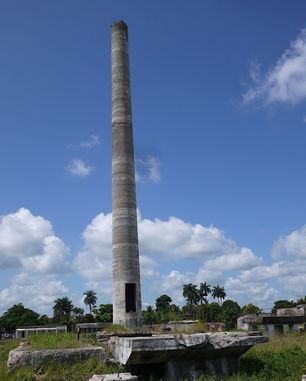
It has a woman’s name and the fatality of a widow. The Carolina center, in Matanzas province, not only ground sugar cane for decades, but gave sustenance and prosperity to an entire village. On dismantling the mill, the former workers and the neighbors had to learn to live in a ghost town.

Carolina was one more among the 161 sugar mills that ground through the middle of the last century. In total, national production approached five million tons of sugar per harvest. The owners of the center, the Mirando Blanco brothers, never suspected that in October 1960 the industry that rose on their own efforts—theirs and others’—would pass into the hands of the State.

Imbued with revolutionary enthusiasm, many believed that the nationalization of the sugar industry would bring higher production and better working conditions. In an assembly where a new name would be selected for the Carolina, worker Piro Martinez suggested that the plant should be called Granma*. The reason was that one of the expeditionaries, Luis Crespo, had been born and spent his childhood in the batey (the sugarcane workers’ village). And so the name of that femme fatal was replaced by the English nickname for grandmother.

In the distance the dismantled sugar mill (14ymedio)
In the distance, the dismantled sugar mill (14ymedio)

continue reading

The disappearance, at the beginning of the nineties, of the “preferred market” established in the socialist countries sent all of Cuba into crisis, but especially the sugar industry. In 2002 the so-called Alvara Reynoso Task began, destined to dismantle 64 of the 156 sugar mills then in existence. Four years after that decision, only 42 mills survived. Granma was one of those chosen to disappear.

During the dismantling, the then Minister, General Ulysses Rosales del Toro, presided over several meetings. In one of them the engineer asked for the floor and challenged the official, “Ulises, do you know many 50 horsepower engines the center has? How many lathes, zinc shingles, angles, oxygen and acetylene tanks?” The question received no answer. Then the man said, with tears in his eyes, “If you don’t know, how will you control it so that the pieces aren’t stolen during the dismantling?”

The Granma tower still stands. (14ymedio)

That uncomfortable question seems to float still over what remains of the old mill. The chimney tower and the fireplaces where the main nave rested are all that couldn’t be torn from the landscape. No one in the village knows where the basic pieces ended up. Only an old American lathe managed to be saved, because a neighbor recovered it to undertake multiple jobs.

Ruben, a coachman who gives tours from the nearby village of Colisea, remembers the good times with nostalgia and looks critically at the present. “This center could have ground all the cane in the area. Now we have to send it to a mill 12 miles away and the resulting sugar isn’t enough to pay for the fuel or transport.”

A passenger in his coach introduces a dramatic note on the matter, “The story no one tells is the damage that was done to our local culture. This village was proud of its center because it was a place where all the problems were solved, from welding a piece to ordering a truck to move furniture.” His words ended with a phrase that still carries some of the sound of the mill, “Never mind those old men who wander the streets looking desolately at the tower, which smoke no longer comes out of.”

Out on the road that leads to the village, remaining as symbols, are a sprocket and an iron arch. On it can be read the name of the sugar mill that no longer exists, crowned with a miniscule replica of the historic shipwrecked yacht.

*Translator’s note: The yacht Fidel and the revolutionaries sailed in from Mexico to Cuba to launch a guerrilla war.

Gerardo Machado: Was He Really an Ass with Claws? / David Canela Pina

MIAMI, Florida. — In the North Cemetery of Woodlawn Park, in Miami, lie the remains of the former Cuban president Gerardo Machado y Morales (1871-1939), who was the politician who constructed the most works during the Republic, and also was the first who opposed the international influence of communism.

To Machado, the new writing of history is simplified by a caricature: the ass with claws, and as all that is not convenient to them, they leave his image, alone and deformed, surrounded by a sea of silence, in which the only thing heard is the murmurings of the communists.

Was he a dictator? Yes. One that induced a reform in the Constitution in 1901, to govern for ten years? Yes, but he was highly adored, in an epoch quite convulsive. Did he close the University of La Habana (Havana), in 1930? Yes, but he had constructed  its staircase, and the then new buildings of the Colina — including the School of Engineers and Architects,which today is in ruins.

Did he suspend constitutional guarantees? Yes, but terrorism had seized control of the streets, and there did not exist negotiations with opposing groups. Did he engage in political assassinations and torture? Yes, but not so much as since 1959. continue reading

According to Ramiro Guerra, some 5,000 revolutionaries were imprisoned provisionally, and Juan Clark affirmed in his book Mito y realidad (Myth and Reality) (1990) that “the prisoners were usually treated correctly, enjoying prisoners’ privileges and amnesties that returned them to liberty after a short stay in the presidio (prison).”

His legacy of modernity

With all his shortcomings  —  of repression, and desires to prolong his mandate — his government defended national interests, and constructed in Cuba, as had never been done before. To mention only a few such works, during the eight years of economic growth, he constructed:

— The Carretera Central (Central Highway) (with its 1,144 kilometers, just under 700 miles), that until today has not been exceeded, in such a project of vital integration of the provinces.

— The Capitolio Nacional (National Capitol) (1929) that remains the paradigmatic building of Cuban architecture, and the most luxurious in the country.

— Important plazas (the Park of Fraternity, or Brotherhood), walkways (the Avenue of the Missions, in front of the Presidential Palace), and avenues (Fifth Avenue, (Avenue) de Playa (beach)). Furthermore, the Paseo del Prado was remodelled.

— Important buildings, such as the National Hotel, the Asturian Center (today the National Museum of Fine Arts), the Bacardi, the Lopez Serrano, the hotel Presidente del Vedado [“forbidden,” probably a place name].

— Public works: the already-mentioned University of Havana, the Technical Industrial School, de Boyeros [“oxherd,” probably also a place name], the Pier of Slaughters or Meat Markets, the Palace of Justice of Santa Clara, the Model Prison of the Isle of Pines, among many others.

He increased tax collections, providing that the Law of Public Works would impose a charge of ten per cent on all imported articles considered to be luxuries, and another of three per cent on all products of foreign origin, except food. That caused a lowering of imports, and the development of national industry, creating works of painting, shoes, matches and of products not linked to sugar cane and tobacco.

And in 1927 he approved a new Law of Customs and Duties (Tariffs) to protect and stimulate agricultural and industrial production. It was the first time that Cuba independently had its own customs tariff, of a modern type, one designed to protect its own interests. The production of birds, eggs, meat, butter, cheese, beer and footwear increased markedly. Likewise, Cuba joined several commercial treaties (Spain, Portugal, Japan, Chile) in a completely independent manner.

Machado was a popular president, during his first term. In April of 1927 he travelled to Washington, and sought from President Coolidge a treaty that would eliminate the Platt Amendment. In the act of inauguration of the Sixth International Conference of American States, in January 1928, a proclamation was declared “a vote of gratitude and applause in favor of the excellent Sir General Don Gerardo Machado.”

And on the 1st of November of that year, in the elections celebrated under the electoral Law of Emergency, Machado was presented as the only candidate and was re-elected without opposition of the other parties, for a mandate that would end on May 20th 1935.

The Enemies of Machado

The discontent towards Machado had above all economic roots. The Great Depression — that began with the bank crash of October  1929, and that only began to ease in the middle of the decade of the Thirties–unleashed a great popular animosity against his government and members of his administration.

The almost total paralyzing of commerce, the sudden devaluation of the price of sugar (which had attained its highest price in 1927), the lack of work, and the reduction and the delay of State payments, brought the country to a state of misery overnight,  that reached its maximum degree in the summer of 1933.

The second obstacle of his government was international communism. Barely three months after he attained the presidency, the first Communist Party of Cuba was founded in Havana, the 16th of August, 1925. The new ideology, that was guided by the soviet ideal, utilized methods that were unknown until that epoch. The terrorism of bombs in the cities was introduced in Cuba by Catalan emigrants.

The Sixth World Congress of International Communism (between July and September of 1928), which took place in Moscow, approved the slogan of “class against class.” Dozens of foreigners were expelled from the country, for being dedicated to “the propagation of communism.”

Machado tried to stop the discontent; but neither the suspension of constitutional guarantees (in June of 1930), nor the imposition of martial law (with the use of military tribunals instead of civil tribunals), nor press censorship, nor assassination and imprisonment of the opposition were able to halt the campaign of terrorism of the revolutionaries, headed by the ABC, the Revolutionary Union, de Guiteras, the Student Left Wing, and the Student Directorate of the University.

The United States followed with concern the political situation in Cuba, until on the 8 August 1933 the ambassador of that country, Sumner Welles, presented himself at the Presidential Palace with a note from the President of the United States, Franklin Roosevelt, in which Roosevelt demanded Machado’s resignation, and with that the end rapidly approached.

The incipient liberty of the press also conspired against Machado, given that the journalists would not write in favor of a government, unless they were given payment,  or they received a “bottle” — that would be worth about 500 pesos. Machado refused to give “bottles” to the press, unlike the previous government, that of Zayas.

But his greatest enemy was the fickleness and immaturity of the Cuban people, which, equal to that in 1959, left them blinded by messianic illusions that promised them heaven on earth. The Revolution of the 30 produced Fulgencio Batista, who would pull multitudes in 1940, with the support of the communists. Then came student leaders like Ramon Grau San Martin and Carlos Prio Socarras, who governed in the name of the revolution.

The magazine Bohemia, in October 1933, published an article by the overthrown president, in which he reflected: “During a time I was the Man God, the New Messiah, the Mentor Man, who could do everything, and afterwords, by the same people who had exalted me, I was Satan, Moloch, Mars uplifted. Thus is all Cuba: the country that appears to be made with the blades of a windmill.”*

The story of the political conflicts cannot be divided into the good and the bad, without defining the relationship of social groups surrounding a power structure. Some kill in the name of the Law, others in the name of the Revolution. But some build, and leave a legacy of modernism, such as Gerardo Machado, while others empty history, and they destroy all in their path, such as Fidel Castro.

Cubanet, June 23, 2014

*Translator’s note:This appears to be a reference to Don Quixote, as if Cuba became what it did by its vain tilting with windmills. 

Translated by: Diego A.
New Measures by Cuban Customs Service Coming in September / Ivan Garcia

Cuban customs warns against carrying items for third parties.

On September 1, 2014 the Customs Service of the Republic of Cuba will begin enforcing new regulations intended to combat illegal trafficking of merchandise by relatives, friends and “mules”* through airports and port facilities.

It’s one more turn of the screw. Every year since 2011 new regulations have been put in place designed to halt the illegal importation of goods destined for families and private businesses on the island.

In Spring 2012 the customs service began charging ten dollars for every kilo above the twenty-kilo limit for personal baggage. For parcel post the charge was ten dollars per kilo above the five-kilo limit.

According to Onelia, a customs official, “The new measures are intended to halt the trade in goods brought in by mules.” continue reading

The military regime quite often resorts to demagogic rhetoric. It eschews the military uniform and takes on the role of victim when talking about the economic and financial embargo that the United States has imposed on Cuba since 1962.

But the embargo does not justify establishing a string of regulations that affect family well-being, private businesses and the quality of life for a wide segment of the population.

Simply put, they are applying a set of prohibitions and laws in order increase sales in the chain of hard-currency stores operated as military businesses. It is a disgrace.

It is monopoly in its purest form. The government would now find itself hard pressed to explain how these measures are benefitting its citizens. Its aberrant customs rules, prohibitions on retail sales of imported clothing and high taxes on the self-employed are anti-populist edicts.

I asked twenty-eight people — friends, neighbors, taxi drivers, public and private sector workers — if they approved of these regulations. Regardless of their political beliefs, the verdict was unanimous: all twenty-eight were opposed to the current measures as well as to those scheduled to take effect on September 1.

Some 80% of Cubans have a relative or friend in the United States or Europe. Some benefit from regular shipments of clothes, food, appliances, video games, computer tablets or smart phones. Others receive occasional shipments.

But it is black market commerce, driven scarcity and a system of economic production that does not satisfy demand, the most important provider of the things people need.

HP laptops, plasma-screen TVs, instant soups and even major league baseball hats arrive on the island from Miami, as do Russian car parts and cloned satellite TV cards, which are banned by the Cuban government.

What businessmen, politicians and exiles living in the United States do not mention when expressing support for relaxing or repealing the embargo is the regime’s obsession with controlling our private lives.

We must navigate an internet packed with filters, watch TV channels that the government authorizes, read books over which the mullahs of censorship pass judgment and pay extortionist prices for cell phone service.

We should be talking more often about the internal blockade the government imposes on its citizens.

Is it legal for a nation to stifle illegal commerce? Yes, it is. But before punishing people, it should provide by offering range of products and prices for the domestic market, living wages and efficient services.

This is not the case in Cuba. State workers earn around twenty dollars a month. The “basic basket” of goods that a ration book covers barely lasts ten days. Putting two meals a day on the table is a luxury in many homes.

The State has become an insatiable overseer. It owns industries that provide us with overpriced mayonnaise, canned tuna and queso blanco.

At no meeting of the boring and monotonous National Assembly did I hear any delegate demand that the state set fair prices. Food prices in Cuban hard currency stores are higher than those in New York.

The price of flat-screen TV or a computer is two and a half times what it is in Miami. Tiles and bathroom fixtures are five times as expensive. And a Peugeot 508 sells for an exorbitant price, comparable to that of a Ferrari.

Thanks to mules, relatives in Florida send us everything from powdered milk to sanitary pads because the state cannot satisfy the monthly demand of women or offer such products for sale at affordable prices.

This is what it’s about. The new measures attempting to stop trafficking by mules are intended to benefit state enterprises and businesses, and to increase their sales, though what becomes of the profits is never revealed.

They are only hampering the transfer of small ticket items, however, not of dollars. Greenbacks are still welcome. The more, the merrier.

Before the Obama administration relaxes that relic of the Cold War called the embargo, those speaking on behalf of the Cuban people should ask Raul Castro for greater freedom and economic independence for his citizens.

And don’t get me started on the denial of political rights. That’s another story.

Photo: From Univision Colorado.

 *Translator’s note: Slang term for couriers of goods from overseas.

18 July 2014

To the Rhythm of the Chinese Horn / 14YMedio, Reinaldo Escobar

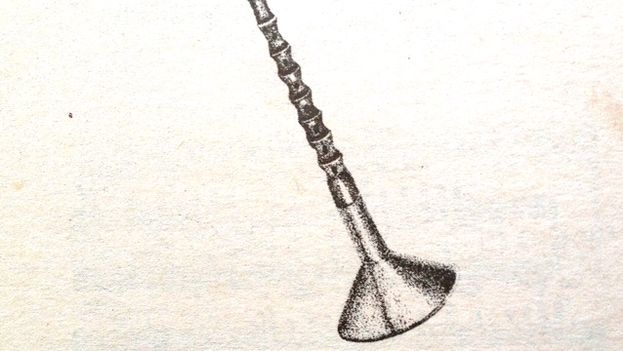
Chinese Horn
Chinese Horn

14YMEDIO, Havana, Reinaldo Escobar, 22 July 2014 – On an unspecified date at the beginning of the twentieth century Havanans heard for the first time the sharp and contagious sound of an as yet unknown instrument, brought by Asian immigrants. It happened in the middle of a carnival parade and was played by members of a troupe called “The Good Chinese.” Soon after, the horn was brought to Santiago de Cuba where it became a main part of Santiago’s conga and was dubbed the Chinese horn.

In remarks to the press on the eve of his visit to Cuba, President Xi Jinping said, “China has sounded the trumpet for the comprehensive deepening of the reform, while Cuba is promoting the updating of its economic model.”

More than a century has passed since that memorable cultural event and another Asian wind instrument arrived in Havana today calling for a change in the rhythm. Perhaps less leisurely than that pushed by Raul Castro, characterized by the gradual introduction of slow and short movements in our society. It would be better if this were another troupe of good Chinese and not the messengers of a new authoritarianism.

The Political Legacy of Oswaldo Paya / 14ymedio

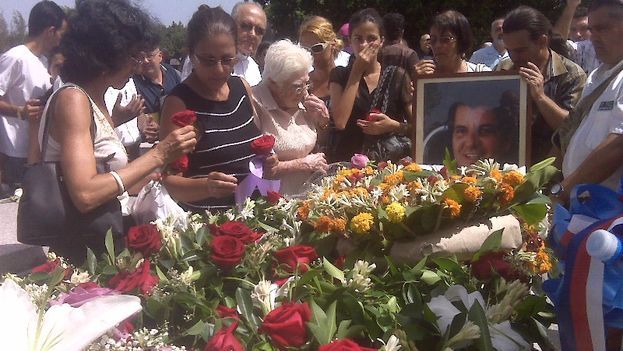
Oswaldo Payá's Funeral (Luz Escobar)
Oswaldo Payá’s Funeral (Luz Escobar)

14YMEDIO, 22 July 2014 – On 22 July 2014, the opposition leader Oswaldo Payá and the activist Harld Cepero died. Payá led the Christian Liberation Movement and promoted the Varela Project, which managed to collect some 25,000 signatures to demand a national referendum. Freedom of expression, of association, freedom of the press and of business, as well as free elections, were some of the demands of that document signed by thousands of Cubans.

Nominated five times for the Nobel Peace Prize, Payá was one of the most visible and respected figures of the Cuban opposition. In 2002  the European Parliament awarded him the Sakharov Prize for Human Rights by and he was able to tour several countries to offer information about the situation on the island. He was also an official candidate for the Prince of Asturias Award and received honorary degrees from Columbia University and the University of Miami.

Paya’s death occurred in the vicinity of the city of Bayamo, while he was traveling accompanied by the Spaniard Angel Carromero, the Swede Aron Modig, and his colleague Harold Cepero. The Cuban government explained the death as the result of a car accident, but his family and many Cuban activists have maintained their doubts about that version. An independent investigation into the events of that tragic July 22 has been requested in various international forums, but Cuban authorities have not responded to those requests.

On the second anniversary of the death of Oswaldo Payá, we asked activists who shared his democratic ideals, “What is the greatest legacy of the leader of the Christian Liberation Movement?”

Guillermo Fariñas, a psychologist and the winner of the European Parliament’s Sakharov Prize

The main legacy left by Oswaldo Payá Sardinas for the Cuban nation, beyond its geographical boundaries, was that he showed his people and the world that the Cuban government breaks its own laws. When the Varela Project submitted almost 25,000 signatures to the People’s Assembly on a citizens’ petition for a plebiscite, the Cuban government refused to hold one and in a crude way changed the Constitution. That in my opinion was his main contribution: demonstrating that the Cuban government is beyond anything that could be construed as the Rule of Law and that it does not even respect its own draconian laws that support Castro’s totalitarian state. continue reading

Manuel Cuesta Morúa, promoter of Constitutional Consensus

I see the legacy of Oswaldo Paya in his pioneering activity to demonstrate that it was possible to generate civic trust towards democratic change. Even he had many doubts that the public would respond positively, would commit itself to a proposed change, especially at a time like the 90s and early 2000s when it was even more difficult for the civic movement. That’s what he sowed, what he left as a legacy, which demonstrated this as a future possibility for all pro-democracy activists on the island.

Dagoberto Valdés, director of the digital magazine Convivencia

First we recall our brother Oswaldo Paya with much love and affection and I would especially emphasize the future, in his legacy, the legacy he has rendered to all Cubans and so I think of the three gifts he left us. First, his posture, his civic attitude. He was a citizen who forged this society and who knew how to awaken a consciousness to fight for democracy in a peaceful way, and from there came his second contribution. Oswaldo was a man who fought tirelessly throughout his life with peaceful methods without being provoked or coming to violence. Finally—I have to say it—as someone who is also a Christian: he was a man who understood that religion could not be alienated or be divorced from the reality in which he lived, and that was why he was deeply committed as a Christian to work for democracy in Cuba.

Jose Conrado Rodriguez Alegre, Catholic priest

Oswaldo has left us a legacy full of sincerity and honesty; a love sacrificed for his country and a genuine commitment to the gospel of Jesus Christ, a gospel embodied in social life, in political life, in the good of others, everything that has to do with society as such. His was a radical commitment to the gospel, but at the same time, as it should be, to every human being. In remembering him, we must pay tribute to the man he was in every dimension, while we feel the pain of the brother we lost and we ask God that there be many others like him, men who can give their lives for others, in silence, in humility, in the midst of the misunderstandings of men, but certainly with a total commitment and a quality of life that today illuminates the existence of those of us still here.

José Daniel Ferrer, leader of the Patriotic Union of Cuba (UNPACU)

There is no doubt that the late Oswaldo Payá left an everlasting impression. We remember him as a determined and courageous Cuban who, from an early date, assumed the method of nonviolent struggle with the intention of bringing Cuba the rights and freedoms that we have lacked for half a century. The work of the Christian Liberation Movement set a tone in peaceful actions in favor of the fair, free, democratic and prosperous Cuba that we all want, this was the side he was on.

The Varela Project, the citizen initiative launched by Oswaldo in which so many of us became involved full-time, also set a tone in the actions of the fighters for democracy. Initially, there were more than 11,000 people, in complex and difficult circumstances, circumstances that were against those who collected signatures and against those who signed that citizen petition. The fact that for the first time so many Cubans defended a proposal, putting their names and identity data, supporting the five points that made up the project, it was a real milestone.

Personally Oswaldo was a great friend with whom I shared both difficult and happy moments. We are very mindful of that. The Cuba Democratic Union (UNPACU) will render the homage he deserves on this second anniversary of his tragic death.

***

Today, from 6:45 PM (Havana time) there will be the premiere of a documentary about Oswaldo Paya of the Varela Hall of Ermita de la Caridad in Miami, Florida. The video can also be viewed simultaneously on www.vocesdecuba.com.

Frida Kahlo / Rebeca Monzo

The daughter of a Mexican mother and German father, Frida Kahlo was born in Coyoacán, Mexico on July 7, 1910.

She attended the Escuela Normal de Maestros and graduated from the Escuela Nacional Preparatoria. She dreamed of becoming a doctor until a terrible accident destroyed her body, forcing her to lay in bed for many months and receive painful treatments, causing her to stop studying medicine.

In the midst of her dramatic convalescence, her iron will and attachment to life led her to become extensively self-taught in the arts and the mysteries of painting. She became an artist and took advantage of her knowledge to teach classes at the Escuela de Artes Plásticas in spite of her physical limitations.

Her first exhibitions demonstrated her talent, which she continued to develop and which culminated in a magnificent work, turning her into one of the most famous painters of her type worldwide.

She impressed upon her work all the pain, feeling, and sensitivity that characterized her life. The memory of Frida is inextricably linked to the great muralist Diego Rivera, who was her husband, lover, confidant, and greatest critic and admirer. In spite of a tempestuous marital relationship, art united them until the end of her life, on July 13, 1954.

This month, Mexico pays homage to those who hold a seat of honor in the plastic arts of the 20th century. I am also joining in this commemoration since Frida was a source of inspiration and presence in my patchwork art.

Frida Kahlo narrated her life through painted images. The painting of this great artist is like no one else’s. As Diego Rivera, her husband, pointed out one day, she “is the only example of the history of art, of someone who tore open her breast and heart to tell the biological truth of what she feels in them.”

Most of her work is unknown; it is held in private collections and by friends. The value of it grows each day.

Translated by: M. Ouellette

21 July 2014