What Purpose Did the Dual Currency System Serve? / 14ymedio, Miriam Celaya

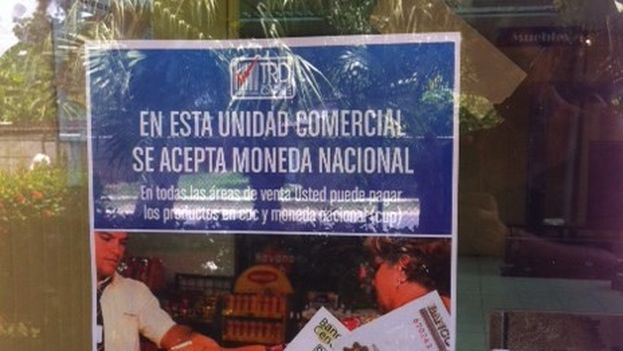
"This commercial site accepts payment in national currency"
“This commercial site accepts payment in national currency”

14ymedio, Havana, Miriam Celaya, 27 August 2014–The information that the Central Bank of Cuba (BCC) published on August 19th in the paper edition of the newspaper Granma about “the next issuance of high denomination bank notes (100, 50 and 20 pesos, CUP) with new security measures” brings back to the forefront the issue of the dual currency and its unification, as announced by the same official press, a change which will take place in the near future.

Security measures that will begin to appear in the above currency issues starting in 2014 consist of the placement of a watermark with each patriot’s image corresponding to each denomination placed in the upper left corner of the front face of such bills. In addition, another watermark will repeat the bill’s denomination on the upper left portion of said image. Meanwhile, lesser denomination bills will continue to carry the watermark with the image of Celia Sánchez, to the right of which will be added the corresponding denomination of the bill.

Some believe that such measures respond primarily to the large amount of counterfeit currency that, according to some, is currently circulating, which should gradually start to disappear as the new notes start to replace the existing ones in circulation. However, most of the random 50 people surveyed in Havana felt that this is a preliminary step to the announced monetary unification, which may be imminent.

This second view seems to be reinforced by the fact that just two weeks before the information of the BCC, Granma had published an article that addressed the issue of the dual currency and the need to eliminate the “distortion of the economy”, especially in the government sector. continue reading

The media’s insistence on the issue of the monetary system in such a short period of time must not be by chance, and it’s in line with the “baseball-informative” style to hit the ball before it’s pitched. This allows for people to assimilate more resignedly (more like passively) the effects that such a step might have on the common pocket. In that experiment is included the recent permission for payment in national currency at the stores that up until recently only accepted CUC (Cuban convertible pesos). So far, no information has leaked as to exactly when the unification process will begin which has already been announced; it will begin at the government level and will gradually extend to all sectors.

Solving a problem and creating another

Dual currency was created only in the interest of the government to collect all circulating currency in the country following the decriminalization of the American dollar.

Economist Joaquín Infante, of the Union of Economists of Cuba, said in a statement to Agence France Presse that eliminating the dual currency “is one of the most important steps” of economic reforms being implemented by President Raul Castro. He also felt that “monetary and exchange rate unification is an urgent, strategic decision” that “should have been made long ago.”

It probably would have been a tall order for him to express a more obvious truth: The dual currency was only created in the interest of the Government to collect all the circulating currency in the country after the decriminalization of the dollar, announced by Fidel Castro in his speech of July 26 1993, and then approved in the Official Gazette of August 13th of that year, dates that show that the then Cuban President took the “enemy” currency issue very personally.

So, the convertible peso (CUC) began circulating in 1994. Comparable to the US dollar, CUCs and dollars began to circulate simultaneously until 2004, when the dollar was finally withdrawn from circulation, though the penalty for its possession was not reinstated. Thus, for at least for 10 years there were not only two, but three currencies in circulation: The two Cuban currencies: the CUC, nicknamed “chavito” or “carnavalito” (little carnival because of its coloring); the CUP or non-convertible peso; and the US dollar. This had not happened since the national currency was created in 1914 during the presidency of Mario Garcia Menocal, when the Cuban peso made its debut as a legitimate currency in the country, with legal value and as the unlimited legal tender for payment of any obligation within Cuba.

More questions than answers

Cuban-style government, and, as a consequence, its monopoly on information too, are based on an unrestrictive conspiring principle: everything is a secret, supposedly “for security reasons, because we are besieged by a powerful enemy”, but on the issue of the much heralded and long-delayed monetary unification, reality points toward more plausible causes, such as a lack of liquidity and the economic and financial crisis that the system–and with it, the country–is going through where monetary duality creates a distortion that hinders the government’s interests in attracting foreign investors.

On the issue of the much heralded and long-delayed monetary unification, reality points to causes such as lack of liquidity and the economic and financial crisis of the system

Indeed, dual currency is not a “Fidel creation”. In China there was also a dual foreign exchange where one of the currencies was hard currency; the other one was not “convertible so it had a much lesser value. However, the reforms that allowed a rising of the economy in that country allowed the unification into one strong currency with internationally recognized value. It’s not the case of Cuba, where after a process of “updating the model” and countless incomplete reforms, the economy shows no signs of recovery and the currency lacks absolutely any value in the international market.

On the other hand, the loss of wages in Cuba by the huge difference in value of two circulating currencies has created uncertainty about the ability for public consumption once unification occurs. The increasing trend of commodity prices in the domestic market, coupled with the many restrictions that hinder the economic empowerment of citizens and the unfair wage regulations that will be applied to workers in foreign companies –onerously taxing hard currency in the change- is not conducive to optimism.

At any rate, the BCC has not yet informed the public about a timetable for unification, much less, the exchange value of the final currency… the humble CUP.

As my colleague Reinaldo Escobar said a while back in an article posted on his blog under the title of ¿Cambio Numismatico? (Currency Change?), “The question we ask ourselves is whether there will be a change in the value of our salaries. How many hours will we have to work–once the currency is unified–to buy 500 grams of spaghetti, a litter of oil or a beer?”

The good news is that from the currency unification on, Cuban workers will have a more clear awareness of what “real salary” is. Perhaps by then the official media will stop informing us about the statistics about poverty levels in other countries, including those “poorer than ours”.

And, at the end of the day, can someone explain what the purpose of the dual currency was for us?

Translated by Norma Whiting

Summer Vacations in Cuba / Ivan Garcia

Photo: Two Brothers campsite in Viñales, Pinar del Río province, by Cuba-Junky.

Raudel and his family have already packed their bags for a six-night stay at a campsite in Mayabeque province near Havana.

They saved some of the money their relatives in Miami send them every month and rented an air-conditioned cabin in Los Cocos along the north shore of Havana.

“It costs us 106 CUC with breakfast. We bring our own food to save money. It’s the best option we could find given our budget,” says Raudel.

Depending on the currency and how much of it you have, there are a variety of vacation options available in Cuba this summer. Having convertible pesos (CUC) — popularly known as chavitos and used by the state to pay monthly bonuses of 10 to 35 CUC to employees in key economic sectors such as tourism, telecommunications and civil aviation — certainly makes a difference.

Others ways of obtaining chavitos include operating a small private business or receiving dollars, euros or other forms of hard currency from relatives overseas.

continue reading

There is also a faction of corrupt bureaucrats and white-collar swindlers on the island who are experts at looting the public coffers. They carry red Communist Party membership cards in their wallets and parrot the harangues of the regime but use financial strategies to embezzle money, food and commodities.

Hugo (a pseudonym) is one of them. He works in a state grocery store and over the course of eighteen years has been careful to cover his tracks. He does not blow thousands of dollars on a quinceniera party or dine at fancy restaurants.

“I fly under the radar,” says Hugo. “There are three types of criminals in Cuba: the thieves who steal from people, the administrators who steal from the state and the consumer, and the high-level officials who through business dealings and illegal activity get hold of anywhere from hundreds of thousands of dollars to a couple of million. The closer they are to the seat of power, the faster the banknotes and the perks pile up. A government minister might spend two weeks at a Varadero resort without paying one cent. His position gives him access to food baskets, a cell phone and a free internet account. These people are the upper class. We — the directors, administrators and business managers — are the middle class,” he says with a straight face.

If you establish good relationships with people in power and are adept at not getting caught, it’s smooth sailing.

“It never pays to show off. But if you know how to walk a tightrope, you can buy a car, a house or a holiday in Cayo Coco or Varadero,” says Hugo.

This summer the wily storekeeper booked a week in a five star hotel. But in Cuba the heads of the “mafia cartels” which control the restaurant industry, foreign trade and tourism are the exceptions.

Much more common are families like Ruben’s, who works eight hours in an office and whose vacations are always more of the same. “A lot of television, a little beach time, dominoes and cheap rum with neighborhood friends,” he says as he cools off in front of a Chinese electric fan.

The military is probably the most privileged caste in Cuba. Joel (a pseudonym) is an official at the Ministry of the Interior. Every year he rents a cabin at a military villa. “I never spend more than a thousand pesos (40 dollars).”

In addition to having their Suzuki motorcycles and mobile phones provided by the state, the security agents who harass dissidents are able to buy clothes and food at modest prices and summer in military-owned villas scattered throughout the island.

While officials like Joel enjoy nice vacations, primary school teacher Elisa looks forward to payday so she can afford the 60 pesos it costs for two seats on the bus to take her eight-year-old daughter to the beach east of the capital.

“Every year a guy who works at a state-owned enterprise gets a bus so those of us from the neighborhood can go to the beach or the aquarium. It costs 30 pesos a person,” notes Elisa. “Teachers are essential to any society but in Cuba educators earn poverty-level wages and we cannot afford to rent a house on the beach or stay in a hotel.”

The problem with summer vacations in Cuba is not a lack of options. It is an issue of hierarchy, influence and hard currency.

Ivan Garcia

16 August 2014

Liberty Costs Dearly, and Angel Santiesteban Decided to Buy It for Its Price

In the world there has to be a certain quantity of decency, just as there has to be a certainly quantity of light. Where there are many men without decency, there are always others who have in themselves the decency of many men. Those are the ones who rebel with terrible force against those who steal from the people their freedoms, which is to steal decency from men. In those men are thousands of men, an entire people, human dignity. Those men are sacred.”  Jose Marti.

Today, August 28, 2014, it has been a year and a half, 18 months, 72 weeks, 548 days or 13,152 hours since Angel was unjustly incarcerated.

In this time, not a single response from the dicatorship in answer to the requests for a Review of his rigged trial after the false complaints by a resentful woman manipulated by State Security.

In this time, his son grew enough to distance himself from his mother, the complainant, and to tell that he was manipulated to lie and testify against his father for the purpose of hurting him. continue reading

Cuban writer Amir Valle presenting Angel’s book

In this time, Angel has continued writing, publishing, and reaping awards.

In this time, Angel has continued denouncing the brutalities of the most pampered dynastic dictatorship in the world where hypocrisy reigns.

But, in this same time, thanks to the same dictatorship that keeps him incarcerated, he has been able to denounce the horrors from the very heart of hell, the Castro penitentiary system.

After the simple words of his son — which dismantled the State Security’s crudely concocted plot against him — they have only increased his isolation in punishment because of them, and that’s why we continue not knowing his own version of the events that had him in an unknown location for a week.Right now, his own reality came to occupy the place of the complaints that he cannot send us.

The silence to which they condemn him, the blind, deaf and mute justice, the illegal transfers and his solo confinement, are the most tangible proof that his complaints are true, that Cuba lives in submission to a ruthless dictatorship, where there exists no separation of powers and that to assume the universal right of free expression one pays very dearly.

Incarcerating him and silencing him, the regime says through Angel much more than he himself; it only corroborates with events what it denies in speeches, that yes, always decorated with supposed reforms and feigned openings that are nothing more than the other such farces to which we have become accustomed.

Angel continues a prisoner but freer than ever. The truth is that they will never be able to silence him. The Jaimanitas cell where there is an officer posted at the door 24 hours a day is the most patent and pathetic proof that Cuba is steeped in terror.

“A just principle, from the depths of a cave, can do more than an army.”  Jose Marti.

The Editor

Click the link for Amnesty International to declare Cuban dissident Angel Santiesteban a prisoner of conscience.

 Translated by mlk.

27 August 2014

Who is Filling the University Classrooms? / Yoani Sanchez

universidad-estudiantes_CYMIMA20140902_0010_13
New students at the University of Havana (14ymedio)

Yoani Sánchez, Havana, 2 September 2014 — Born during the Special Period, they have grown up trapped in the dual currency system, and when they get their degrees Raul Castro will no longer be in power. They are the more than one hundred thousand young people just starting college throughout the country. Their brief biographies include educational experiments, battles of ideas, and the emergence of new technologies They know more about X-Men than about Elpidio Valdés, and only remember Fidel Castro from old photos and archived documentaries.

They are the Wi-Fi kids with their pirate networks, raised with the “packets” of copied shows and illegal satellite dishes. Some nights they would connect through routers and play strategy video games that made them feel powerful and free. Whoever wants to know them should know that they’ve had “emerging teachers” since elementary school and were taught grammar, math and ideology via television screens. However, they ended up being the least ideological of the Cubans who today inhabit this Island, the most cosmopolitan and with the greatest vision of the future.

On arriving at junior high school they played at throwing around around the obligatory snack of bread while their parents furtively passed their lunches through the school gate. They have a special physical ability, an adaptation that has allowed them to survive the environment; they don’t hear what doesn’t interest them, they close their ears to the harangues of morning assemblies and politicians. They seem lazier than other generations and in reality they are, but in their case this apathy acts like an evolutionary advantage. They’re better than us and will live in a country that has nothing to do with what we were promised.

They seem lazier than other generations and in reality they are, but in their case this apathy acts like an evolutionary advantage.

A few months ago, these same young people, starred in the best known case of school fraud uncovered publicly. Some of those hoping to earn a place in higher education bought the answers to an admissions test. They were used to paying for approval, because they had to turn to private tutors to teach them what they should have learned in the classroom. Many of those who recently enrolled in the university had private teachers starting in elementary school. They are the children of a new emerging class that has used its resources so that their children can reach a desk at the right hand—or the left—of the Alma Mater.

These young people dressed in uniforms in their earlier grades, but they struggled to differentiate themselves through the length of a shirt, a fringe of bleached hair, or through pants sagging below their hips. They are the children of those who barely had a change of underwear in the nineties, so their parents tried to make sure they didn’t “go through the same thing,” and turned to the black market for their clothes and shoes. They mock the false austerity and, not wanting to look like militants, they love bright shiny colors and name brand outfits.

Yesterday, with the start of the school year, they received a lecture about the attempts of “imperialism to undermine the Revolution through its youth.” It was like a faint drizzle running over an impervious surface. The Government is right to be worried, these young people who have entered the university will never become good soldiers or fanatics. The clay from which they are made cannot be molded.

Vacations / Regina Coyula

With the heat, my summer option is to sit in front of the TV, but not in front of the summer programming which doesn’t interest me, rather to decide what I watch because in the end I have a TV for the halfway intelligent.

“24” with its thrilling season has been the thriller. And it’s not that I don’t know that later in the third season Jack Bauer will save the world once again with the help of Chloe alone, but he’ll still end up screwed; it’s that in this tacit agreement, I’m disposed to believe in Super Bauer if it’s told well.

Also the action movie, Die Hard, 5? 6? 7? Bruce Willis, Bauer’s putative uncle, does his thing in a Moscow unrecognizable for those left in the USSR.

Not everything is banal. movies like “Siberian Education” or “The Map in the Clouds” have added the dramatic note. Light humor comes at the hands of “Modern Family”; thanks for not putting canned laughter in “Breaking Bad,” excellent black humor, the best of the summer. “The Hammer and Tickle,” a Canadian documentary about USSR and Eastern European humor, made me laugh and made me think of copies, and the current drought of good jokes, in great measure due to the fact that so many of these jokes were island adaptations of the originals beyond what you see, over there.

But the best has been the arrival of Piura, the new puppy in the house. Perky, smart, loving, she’s already the boss of everyone. And like all my dogs, rescued. It’s an odd vacation idea to spend my days cleaning up pee and a good part of the night consoling a little puppy who’s afraid of the dark, but the dogcatcher understands me.

That’s been my vacation. It’s a really nice personal project that has grabbed my attention.

29 August 2014

Unprotected / Fernando Damaso

In Cuba, animals, for the most part, are unprotected. There are no laws or regulations that define how they should be treated, nor sanctions for those who abuse them. Flora and Fauna, for the most part, deals with problems relating to the extinction of species, but doesn’t interest itself in domestic animals, much less pets and other affectionate animals. They depend totally on their owners, consistent with their feelings and financial capabilities.

There is no governmental agency or organization that answers for them. There are some regulations prohibiting their presence, even with their owners, in certain public places, like beaches, recreations centers and others, and fines are imposed if they are violated.

This lack of regulated State attention, as happens in most civilized countries in the world, seems not to be on our authorities’ list of priorities. continue reading

If during the years of the Republic there was a magnificent Veterinary School, situated on Carlos III, where these friends of human beings were looked after for free, today the school is deplorable, and only works thanks to the dedication of its personnel, most of the time without the veterinary resources needed or the drugs to treat them, because we’ve come to the absurdity of prohibiting veterinarians from writing prescriptions, knowing as we know, that many of the drugs used to fight disease in people also work in animals. This requires finding a friendly doctor who will issue them.

There are also private clinics, where they offer to shelter and care for pets when their owners go on vacation. Today the attention, apart from vaccination campaigns or government sterilizations, rests mainly on private vets, who make house calls, or see pets in their own homes.

Public Health, with its Department of Zoonosis (the transmission of infectious diseases between species) is only in charge of picking them up in the street and killing them, without any system of treatment or preparing them to be offered for adoption, without recourse to measures that are too extreme or anti-human.

In addition, the procedures they use to pick them up are wild and violent, causing injury to the poor animals, and when you criticize them they say they lack adequate methods.

The Almiquí y Animalia stores exist principally as means to collect hard currency, but their prices in CUCs are prohibitive for most people, not to mention that pet food and other animal supplies are unavailable for most of the year.

Prohibitions continue to what the authorities know best how to so. We urgently need the development, adoption, and putting into effect a Code of Protection for this friends of human beings, which also establish the duties and rights of their owners, and that sanction acts of cruelty and mistreatement.

Until this happens, the streets of our towns and cities will continue to be filled with dogs, cats and other pets wandering, vulnerable, sick, hungry, scared and looking for food and affection.

30 August 2014

72 Hours to Demolition / 14ymedio, Luz Escobar

Inspectors arrive to demolish an illegal construction (Luz Escobar)

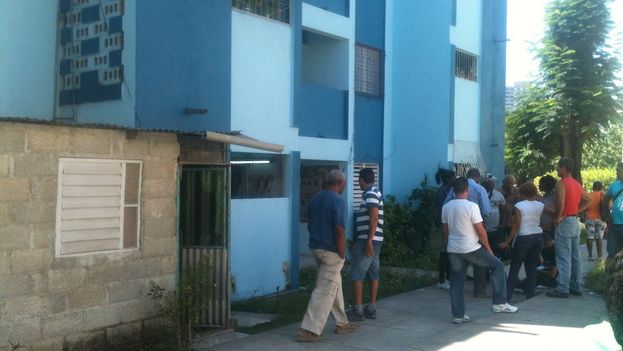
14ymedio, Havana, Luz Escobar, 26 August 2014 — Impotence and indignation has spread among residents of La Timba, in the Plaza de la Revolution municipality, one of the Havana neighborhoods affected by the Government’s war on architectural illegalities. For years, thousands of families with housing needs built additions their homes, took vacant land to expand them, or improvised makeshift parking spaces. A campaign by the authorities against this social indiscipline has put the spotlight on all these irregularities.

The Housing Institute inspectors, in cooperation with the police, travel the neighborhoods looking for these “illegalities” and, once they detect a violation, deliver an order to the homeowner to tear down every inch of the constructions put up without permission. The situation not only hurts those affected but puts the serious construction problem in the country at the center of the debate.

It is estimated that there is a deficit of over 700,000 homes in Cuba. In addition, 8.5 out of 10 existing dwellings need repairs. During the year 2013 only 25,634 units were built in the entire country, of which 47.7% were erected by the occupants’ own efforts. continue reading

Havana is one of the most seriously affected areas, and it is estimated that it would take about 28,000 new homes to ease the situation.

Jazmin, age is 57, is responsible for three teenage granddaughters. She lives in La Timba, at the bottom of 39th Street with her husband, who is about to turn 60. A few years ago, they added two square meters to their home by taking over part of the building’s common garden. Aware of the family problems that had pushed them to do so, none of the neighbors ever complained.

“We live with my husband’s brother and father. Both are alcoholics,” says Jazmin. “They’re good people but when they’re drunk they are completely transformed.” The problems of living together got more acute and, over time, the family felt forced to divide up the house. “We had to figure out this little piece to put a kitchen and a bathroom,” she explained, pointing toward a construction made from blocks and a light roof.

Jazmin decided to commit the architectural illegality after her husband, who worked in construction for three decades, asked for a house but they weren’t given it. The family’s economic hardship keeps them from buying a larger house or renting another space for the problematic relatives. “If they knock this down, we’re going to have defecate in a bucket,” she explains. But the time for herself ended with the collapse of the walls she built. This Monday the police and inspectors put an end to her “social indiscipline.”

“If they knock this done, we’re going to have defecate in a bucket.” A neighbor explains. 

Her case is repeated all over the area. Maria and Juana are two elderly ladies, both over 80, who have surrounded their property with a barbed wire fence to protect themselves against the many robberies in La Timba neighborhood. They, also, were given only three days to dismantle the entire fence, but they’ve resisted doing it and now have legal documents to validate it. The Housing Institute, however, alleges that it was authorized by a prior law and by employees who no longer work for the State.

“What’s happening is they woke up pressured by someone from above and, as it’s easier to obey than to question, here they are,” as they say here, “following orders,” the older of the elderly ladies points out.

In the midst of the conversation Gladys appears, an impulsive neighbor who was also required to remove her fence and who shouted, at the top of her lungs, that she “didn’t feel like removing anything,” because the law says that every citizen has the right to protect their home. Furious, she accuses a neighbor of having built a parking space, sure of having permission because he works in military counter intelligence. “That didn’t go down well with me, I’m not stupid,” she says.

Tempers flare and the clock is ticking. In a few hours the inspectors will arrive.

The Swimmer Diana Nyad Returned to Cuba a Year After Her Feat / 14ymedio, Orlando Palmo

The swimmer Diana Nyad (from her Facebook page)

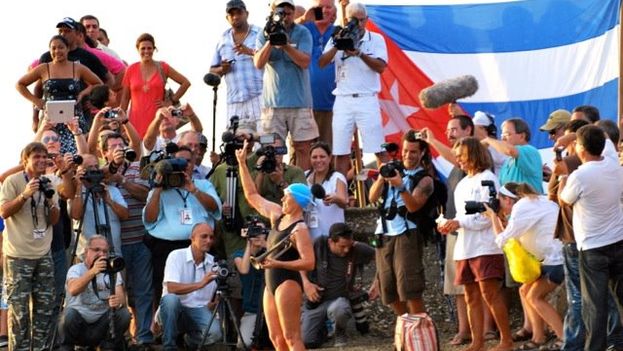
14ymedio, Havana, Orlando Palma, 29 August 2014 — Just twelve months ago, all eyes were on Diana Nyad while she swam between Cuba and Florida. This willful 64-year-old woman was the first person to cross the 100 miles from Havana to Key West without a shark cage, wetsuits or fins. A feat she tried four times, but that only on the fifth opportunity was she able to savor the taste of success. A year after her feat she has returned to the Island. She wanted to visit the place she left from, the Hemingway Marina, and meet athletes, sports authorities, and other people who collaborated in this endeavor.

“You always have to pursue your dreams,” Nyad reiterated, on touching land after 52 hours in the water. The well-known athlete had started the same crossing in 1978, but deteriorating weather conditions caused her to abandon it. Jellyfish stings and asthma came between her and her goal on the three other previous attempts. Last year she finally managed it, beating the record for the greatest distance swum by a woman without a shark cage, previously held by Penny Palfrey. The same route between the two countries had been crossed by the Australian Susie Maroney in 1997, but on that occasion with protection.

The route taken by Diana Nyad is a common route of rafters trying to reach the U.S. coast. The harsh conditions, the dangers of storm waves, and the abundant presence of sharks costs many lives each year.

The First Cuban Forklifts / Juan Juan Almeida

Photo taken from Granma

Nelson Espinosa, director general of MONCAR, a business located in the Havana municipality of Marianao, told the newspaper Granma that the production of the first 15 Cuban forklifts, a result of collaboration with the Chinese entity Auto Caiec LTD, distinguished his business’s performance during 2013.

With 40% national integration in terms of physical components, the equipment is in a testing phase and capable of supporting up to 2.5 tons.  We are now in 2014 and they have not manufactured one more.  I suspect that the future of MONCAR is related to the manufacture of the T-34M war tanks that Raul Castro inaugurated in 1960 and these are the holy hours when he did not build even one tractor.

Translated by mlk.

18 August 2014

To Rigola I Shall Not Return / Rebeca Monzo

Two years ago, after a lot of red tape, long lines and pointless waits at Immigration, the Spanish embassy and the Plaza Military Committee, I finally managed to get the son of a friend — a woman who lives overseas and who had granted me power-of-attorney — exempted from military service so that the family could be briefly reunited.

Then, a few days ago, she, her husband and her son decided to come here on vacation to visit family. Everything seemed to be going very well. The joy of being reunited with family and friends helped mitigate the enduring economic hardship and deterioration of the country, which are very noticeable to anyone who comes back after spending time abroad.

The night that marked the return to the “mother country” finally arrived but a new odyssey had just begun.

After checking their luggage and paying the 25 CUC per person airport exit tax, an immigration official informed the couple that they could leave but that their son would have to stay behind because he had not yet completed his military service. Of course, the parents decided to stay with their son, but this meant losing their airline tickets, the exit tax they had already paid and the time spent waiting for their bags to be returned. There was also the anxiety and aggravation caused by the incompetence of the system.  continue reading

Very early the next morning the three of them headed to the Military Committee to clear up what was clearly a big mistake. The excuse they were given was that the error had been committed by a “neo-fascist” who, fortunately, no longer worked there. From there they went to Immigration to resolve their son’s status.

Finally, after waiting for four hours due to a system-wide computer failure, they left with their problem resolved. The officials offered their apologies but did not offer the couple any sort of reimbursement.

As a result of all this they have had to forfeit their tickets. The earliest date the boy and his mother could get a return flight was October 8, which meant the mother would not be able to get back to work on time and the boy would not be able to take his upcoming exams scheduled for September 1. Given this new predicament, the parents went back to the Military Committee to request a document explaining the situation which they could give to their son’s school in Spain. Their request was denied, the excuse being that officials there were not authorized to issue such a document.

My friend’s husband, who did finally manage to get a ticket, will have to leave tomorrow to get back to work. He will try to explain the situation to the administrators at his son’s school in the hope that they will allow the boy to take the exams upon his return.

When they came over for a visit today, they told us that, unfortunately, due to this recent experience they had no intention of returning to Cuba anytime soon, at least not until they could forget everything that had happened to them.

All told, this may appear to be no big deal. But, to appreciate it, you had to have to experienced it. This is why, when they finally overcome all the obstacles and absurdities and manage to finally leave the country, many Cubans swear to themselves they will never return for fear of having to relive their bad experiences.

When she told us goodbye today, my friend recalled a line from an old song: “To Rigola I shall not return.”

14 August 2014

No, No and No Raul Castro / Jose Luis Garcia Antunez

Jorge Luis Antunez (EFE)
Jorge Luis Gracia Antunez (EFE)

This I believe is the second or third occasion that I write to you, and as always without the least mood or desire that you answer me, because given the absolute contempt and disgust that emanates from your person I can’t feel otherwise.

Señor Dictator and Genocide, 24 years and five months ago at barely 25 years, five months and 15 days of age I dared to defy you.  Surely your lackeys and sycophants in the high command of the political police and the party mentioned it to you.

I remind the dictator, that night you pronounced in the city of Santiago de Cuba that call to the Fourth Congress of the Communist Party of Cuba, and as always with a discourse like so many and like so many of your brother’s, barely a few paid you any attention.

I recall that I was in the plaza that you all call Revolution, where big loudspeakers transmitted to mute, hungry and above all deaf people your verbal diarrhea. That was Thursday March 15, 1990, Stalinist Europe was falling, the old Soviet empire was at the point of disintegrating and here in the Caribbean a senile caste was clinging to power and refusing to implement reforms. continue reading

For demanding them, that evening, your bullying forces savagely beat me, their educational bodies tortured me and instructed me so that months later your lackey judiciary would sentence me to deprivation of liberty for the famous crime of “oral enemy propaganda.”

Señor Dictator, I believe it feasible to confess to you that at the moment of my detention I was still unaware of the long and proven history of crime and terror instituted by your brother and you.

From the forced labor, the concentration camps of the UMAP, the sad history of those captive peoples and not to mention the Castro meddling in the internal affairs of other countries and in international conflicts.  Maybe because of that lack of knowledge, I only asked for reforms and screamed that communism was a mistake and a utopia. Today, after knowing your system better, I ask for its overthrow and I catalog communism as an aberration and a crime: the social plague of the 20th century.

It was only enough for me that day to feel that as a young man and a Cuban, I was not free; that as a social being I lacked something in order to be able to breathe and walk. I felt that I was prohibited from speaking and that I must either continue using the mask in order to avoid problems, or remove it and act and live in accord with myself although that would mean suffering the most horrible repression.

I did that, I defied you, General without battles.  I did it in spite of your known fame as a cruel and bloodthirsty man. I did it, General and the only thing that I regret is not having had the valor, the opportunity or perhaps the possibility of doing it much sooner.

On the other hand, I also have to confess to you that the idea never entered my mind that such a sickening fury of hatred and harassment was going to be applied to me.

That in 1993, three years after the arrest and completing my unjust imprisonment in Cause # 4 of 1990, your famous division for crimes against State Security in the gloomy Popular Provincial Tribunal of Santa Clara condemned me again, now in Cause #5 of that year for supposed acts against your socialist Revolution for which I had to spend 17 years and 38 days of uninterrupted political imprisonment which offered me the possibility of learning firsthand about torture and vexation as a weapon of political repression.

Raul Castro, my case is known to you, because it was you and no one else who ordered the multiple searches and lootings by those who have victimized me in my home during the last weeks where in the grossest flaunting of force and impunity you commanded that your cowards and opportunist assault troops partially destroy my house and steal items left and right on more than one occasion, goods, office materials, medications, food during these acts known in the Cuban jargon as acts of thievery, well, in the end, each does what he is taught.

Señor General, and now that you also title yourself president of the Councils of State and of Ministers, I know well how many letters opponents have sent you from within and without asking you to carry out reforms and political opening as well as to hold elections. They ask it of you as if you really were a president and as if in Cuba a true government were in power and not a tyranny.

We know that at any moment, you, a Machiavellian and opportunistic tyrant, are going to accept what they ask and carry out a referendum, that is to say, an electoral farce under your control, where like in Venezuela the totalitarian officialism will continue in power.

And it is no longer a secret for anyone, the desperate and astute maneuvers that you and your acolytes carry out in order to manufacture supposed opponents and assure with them the dynastic and ideological succession.

But we warn you, General, which is one of the reasons for this missive, that we, the decent Cubans committed to the future of our country, we are not going to accept that fraudulent and cosmetic change that you all forge. Know also that the Cuban Resistance does not expect or want reforms implemented by the criminal tyranny over which you preside. The only reforms to be accepted by us would be after your overthrow or withdrawal from power, which the people will carry out from their base.

Señor Dictator, enough tricks, because you will not get another new mandate, that does not even matter to us. That you carry out reforms in the arena of economics and migration, that is a bunch of lies, and that does not matter to us, either. That your regime carries out an update of its model is another fallacy and another lie. That is more of the same. That you will sell a monetary reform, tremendous trick and lie, General.

We, the people of Cuba, need a democratic system where a market economy prevails. One, two, three or ten thousand currencies, it does not matter, as long as there exists a centralized and asphyxiating economy like your totalitarian system.  We, Señor dictator, we do not want you, nor reforms nor openings, you people are not our owners, nor do you need to dictate our guidelines.

We know that your time on the earth is running out, and that powerful interests have shown the intention of playing the game or dividing juicy profits at the cost of the pain and sacrifice of the Cuban people.

General Raul Catro, warning about the danger of the fraudulent change, you ordered killed Oswaldo Paya and young Harold Cepero.  I doubt that you now have enough goons to keep killing the thousands and thousands that like Paya and Harold will keep denouncing your tricks and constant maneuvers.

For Laura Pollan, a defenseless woman, you sent your paid assassins to get you out of it, because you could not defeat her in her marches every Sunday on Avenue Quinta. It did not matter to you her condition as a woman and the justice of her cry. But also Laura defeated you, coward General, because her valiant troops of the Ladies in White survived the cruel execution of their leader and now spread like patriotic wildfire across the whole Island.

And they have also defeated you: Pedro Luis Boitel, Olegario Charlotte Pileta, Orlando Zpata, Wilman Villar and many others who had the courage to sacrifice themselves in the name of liberty and in respect for their dignity, this honor that you lack as well as your goons who threatened me with death in reprisal for my slogan that “I won’t shut up and I won’t leave Cuba.”

They themselves, also, barely some days ago, during one of the many arrests of which I have been victim, tortured and beat me, now that according to them and you, I sabotage the efforts of your tyranny to normalize relations with the United States.

Know General Raul Castro that neither the absurd precaution of house arrest that weighs against me and the evident threat of being assassinated, will be able to make me change my purpose which is shared by thousands and thousands of Cubans.

You all will not be able, Raul Castro, to crush a people who have grown tired of living without freedom, just as you will not be able to materialize the international conspiracy that is conceived against the cause of freedom for Cuba.  That conspiracy, Raul Castro, will not have success, whether it comes from Havana, Washington, Brussels or Vatican City itself.  You people will not be able, General, because as much as you, your family or that cruel and bloodthirsty party may know, you will be excluded from all process of democratic change because you all mean the negation of democracy itself.

And tell your subordinates, General, that I am here and will be, in my beloved homeland of Placetas from which neither you nor your repressive forces nor anyone will remove me, and that my humble home, although profaned, vandalized and sacked by your faction, will continue being a bastion of Resistance, fight, refuge and sanctuary for my compatriots who fight against you and in favor of liberty and justice.

And tell them also, General, your promoters and accomplices, whether your spokesmen are in Miami, Washington, Brussels, Havana or the Vatican itself to stop rubbing their hands, we say no to your preservation of the status quo because here in Cuba there will be no reconciliation without there first being justice, liberty and democracy.

And, as we foresee, also tell some governments that call themselves democratic and are in on the conspiracy, that they are wasting time, General, that the event that we Cubans need and hope for international solidarity, does not mean that some country or foreign power, as very powerful or influential as it may be, is going to form part of our process of change, because Cubans, those who are within and those who are without, we are convinced that the solution for Cuba has to be and must be resolved among Cubans, excluding of course you people, General, who because of the damage that you have done to our nation, do not even deserve to call yourselves Cubans.

Raul Castro Ruz, in the name of the people of Cuba, my fellow prisoners and the victims of your dictatorship, I tell you no, no and no.

From Placetas, in the heart of Cuba, Jorge Luis Garcia Perez “Antunez,” who will not shut up or leave Cuba.

Translated by mlk.

21 August 2014

Suchel, a State Monopoly With Feet of Talcum Powder / 14ymedio, Rosa Lopez

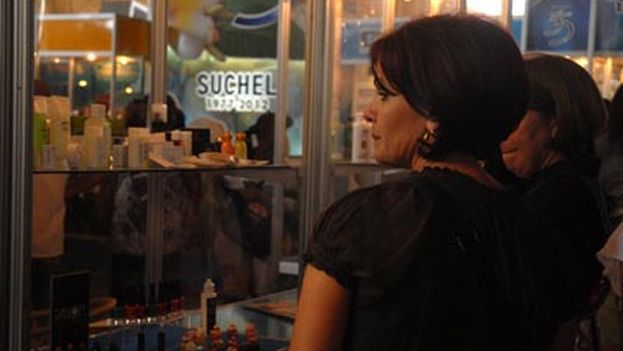
Suchel at the Havana International Fair

14ymedio, Rosa Lopez, Havana, 29 August 2014 — Just outside the Tienda Ultra (Ultra Store), an illegal seller advertises deodorants and colognes. It is precisely in August, this terribly hot month, when the shortage of hygiene products aggravates the bad odors and other annoyances. The problem has made the pages of the official newspaper Granma, which this Thursday published a story looking for answers to the lack of soap, cologne, toilet paper and deodorant. The text reveals the tortuous and inefficient ways of Cuban centralization.

The director general of the Cuban company Union Suchel said that “funding cuts” have limited purchases of raw materials. The statement of this official contrasts with the monopoly status of this well-known industry. Suchel has reigned for decades in the domestic market, given the absence of competitors to push down prices, diversify the product line and improve the quality of the offerings. Instead, the perfume, talcum powder and detergent giant has taken advantage of the privilege of being a State-majority consortium with zigzagging foreign capital.

For 2104, Suchel developed a “reduced production plan” due to the financial problems facing the entity. Even so, the volumes coming out of its factories point to mammoth nature of the company still so influential in its decline. Deliveries for this year in the unrationed market should reach 17 thousand tons of laundry soap, 17.9 thousand tons of hand soap, and 9.6 thousand tons of liquid detergent. Packing, transporting and distributing such quantities has become a real headache, especially in a country where corruption and the diversion of resources act as leaks, sucking dry the sources of products and services.

The position of guard in one of the many company plants trades on the black market for more than 5,000 Cuban convertible pesos

Suchel is undermined by the theft and embezzlement, an issue not addressed by the article published in Granma. The position of guard in one of the many company plants trades on the black market for five thousand Cuban convertible pesos. Working in one of those jobs guarantees the fortunate employee “under the table” earnings that exceed in three days what a doctor earns in a month.

The work of the guard consists of simply looking away, to allow the majority of the merchandise slip away, unregistered in the accounts. These undeclared goods are sold in the State’s own “hard currency collection stores” (as they’re called). The profit is distributed among the managers, drivers and the industry’s own security guards.

In the absence of a free market to test the efficiency of Suchel in competitive circumstances, the monopoly will continue to impose prices, quality standards and high costs, as well as to cause chronic supply problems.

Angel Santiesteban, Being Held in Military Unit to the West of Havana / 14ymedio

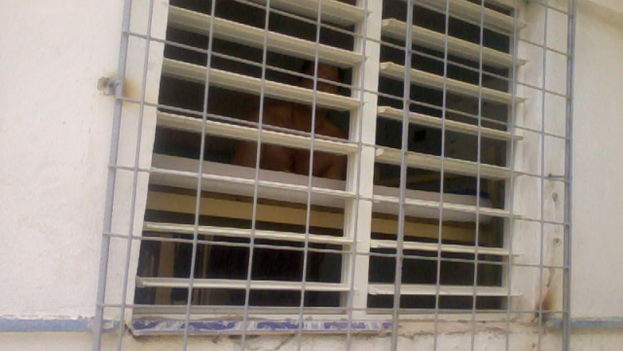
Angel Santiesteban through the blinds (14ymedio)

14ymedio, Havana, 2 August 2014 — Writer Ángel Santiesteban has been relocated to a prison under the control of Border Guard Troops in the Flores neighborhood near the town of Jaimanita, west of Havana. After weeks of uncertainty and conflicting information, a reporter for 14ymedio was able to locate and see this military unit.

For three weeks Santiesteban‘s situation has become even more confusing after the authorities in charge of keeping him under custody in the prison center in the Lawton neighborhood declared that he has “escaped.” He was immediately taken  to the police station at Acosta and Diez de Octubre Streets, where he could only receive visits from his closest relatives.

Freelance journalist Lilianne Ruiz, after touring the different places where it was stated that the writer being held, was able to see him and talk to him through the blinds. The guards of the Border Guard Troops confirmed to the journalist that Santiesteban is considered a “special case.”

Santiesteban himself assured Ruiz that he is not being prosecuted for a new offense, and that a brief letter will appear in his blog, The Children Nobody Wanted, explaining everything that happened during the last days.

Ángel Santiesteban serving a five-year sentence for the alleged crime of violation of domicile. Multiple irregularities during his trial have been denounced by activists and independent lawyers. A couple of weeks ago Reporters Without Borders released a statement calling on the Cuban government to clearly state the fate of the narrator and journalist.

University (for the Tenacious) / 14ymedio, Henry Constantin, Reinaldo Escobar

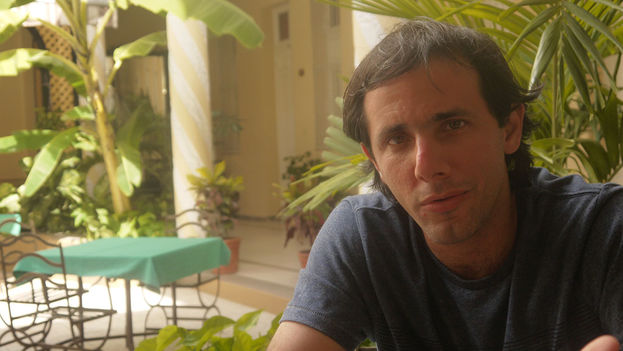
Henry Constantin during the interview (14ymedio)

14ymedio, Reinaldo Escobar, Havana, 28 August 2014 — Henry Constantin is a native of Camagüey province, born in Las Tunas on Valentine’s Day, 30 years ago. He has been expelled from university three times for his ideas, but still believes he will obtain his journalism degree.

This slender, plain-spoken young man has founded two independent publications and has just returned from a cultural exchange program. For years he has been part of the reporting team of the magazine Convivencia (Coexistence), and today he invites the readers of 14ymedio to share the challenges he has faced in his classroom journey.

Question: You hold the sad distinction of three expulsions from university. What was the first time like?

Answer: One day I wrote this question on the board: Who was the Cuban nominee for the Nobel Prize? My fellow students did not know, neither did the professor, so I wrote the name of Oswaldo Payá. continue reading

Later I selected for a research topic the actual level of acceptance enjoyed by the official media in the general population. I was failed, and that report was suggested as possible grounds for my expulsion. Finally, they lowered my grade for poor attendance — a false claim being that the majority of my colleagues had more absences than I did. That was the year my son was born and my professor/advisor had told me, “take care of that and don’t worry about absences.”

My son is now 8 years old – the same age as my problems.

Q: Even so, you tried again…..

A: A year later I was able to enter the University of Santa Clara journalism school. I was the only student who was not a member of the FEU (University Student Federation), and — in the university’s Internet lounge — I learned of the existence of alternative blogs. It was there that we founded a magazine called Abdala*, which we ultimately we named La Rosa Blanca* (The White Rose). We produced it without a computer, but still published five issues, until (another magazine) La Hora de Cuba (Cuba’s Hour) replaced it.

When I completed that course, they failed me for having produced a radio script dealing with the effects of the Huber Matos case on the broadcast media in Camagüey.

Q: Were you allowed to present it?

A: The professor thought it was heresy for me to stir up the case of that Sierra Maestra commander condemned to 20 years in prison for resigning his post. He suggested that I do a project on the journalism of José Martí. So I tackled the censorship suffered by the Apostle** at the hands of the Argentine government for his articles in the newspaper, La Nación. They failed me again, but by that time I had the right to reevaluation.

So I tackled the censorship suffered by José Martí at the hands of the Argentine government for his articles in the newspaper, La Nación.

I went to Camagüey for the weekend and when I returned (to the university) they were waiting to remove me from the premises. They informed me that I had been expelled from the graduate school by virtue of a disciplinary action — nothing ideological, of course!

Four men escorted me to the door and instructed the custodians to keep me from re-entering the building. They also instructed the newspaper Adelante and the Radio Cadena Agramonte station — where I had done my journalism practica — to call the police if I tried to enter.

Q: So that was your definitive goodbye to university classrooms?

A: I don’t surrender easily. In September, 2009, I took the aptitude tests to enroll in the National Institute of Art (ISA), in the school of audio-visual media. I attained the maximum score and was accepted. While at ISA, I worked on the magazine, Convivencia, edited by Dagoberto Valdes in Pinar del Río province. He proposed that I join the Reporting Council and I said yes. I also worked on the independent program Razones Ciudadanas (Civic Reasons).

Another project I participated in while a student at ISA was Hora Cero (Zero Hour). It began after a strike motivated by the bad food we were served. It consisted in staging encounters with persons outside of the institution. Jorge Molina and Gustavo Arcos came, but when we invited Eduardo del Llano, we were obstructed.

In May, 2011, they scheduled me to meet with the dean of ISA, to tell me they had discovered that I had been expelled from the graduate school. At that point I was three days from completing my courses, so I resisted, arguing that the other students should decide my fate. Once again I was removed by force from the premises, in a car that left me at the bus station. So that is the end of my history as a university student, and my obsession with obtaining a degree.

Q: And after the third expulsion?

A: I returned to Camagüey and re-initiated the Hora Cero (Zero Hour) project, at my own risk, in my own home. We started with exhibitions of the photos of Orlando Luís Pardo, a short by Eduardo del Llano, and music by some troubadour friends. Up to now, we have had good attendance by the public. The poet Maikel Iglesias, the theater troupe Cuerpo Adentro, the poet Francis Sánchez, and Eliecer Ávila with his audiovisual work, Un cubano más (Just Another Cuban), have also participated.

To Hora Cero have come university students, professors, neighbors, courageous people who dare to exchange ideas. Some attend who have been instructed to inform about what takes place in these encounters, and others who have been coerced for having received a simple invitation from me to participate.

The first time that State Security visited me, my mother — who at that time was serving on a mission in Venezuela — was threatened. They told her that if she continued supporting me, she could lose the bank account where her salary is deposited. Others have been told that Hora Cero is funded by the CIA.

Q: Have you gone back to your studies?

A: A year ago I heard about a program, Somos un solo pueblo (We Are One People), for young people who have had difficulty pursuing their studies here, and are given the opportunity to do a 6-month course in the United States. Classes in psychology, personal effectiveness, principles of business or sociology, among many others. It was a wonderful experience for me and I learned a lot.

Q: And now?

A: I think I will have my work cut out for me in the next 50 or 60 years, judging by how I see present-day Cuba. If I have any time left over I want to write fiction…but with the way things are, that will have to wait.

Translator’s notes:
* Both of these titles are from the poetry of 19th century Cuban patriot José Martí.
**Martí is referred to as the “Apostle of Cuban Independence”.

Translated by Alicia Barraqué Ellison

Jabitas (Plastic Bags) and Pensions for the Elderly

Selling 'jabitas' (plastic bags) in front of an agricultural market in Havana. (Luz Escobar)
Selling ‘jabitas’ (plastic bags) in front of an agricultural market in Havana. (Luz Escobar)

14ymedio, Yoani Sanchez, Havana, 28 August 2014 – “I need some dark glasses,” Veronica told me one day when I ran into her on the street. Almost seventy, the lady underwent cataract surgery some months ago and now must “take care of my eyes,” as she explained to me. She works in the sun selling jabitas (plastic bags) to the customers of the farmers market on Tulipan Street. The harsh midday glare is hard on her eyesight, but that’s not the worst of her problems. “We have an alarm system to know when the police are coming, although sometimes they’re in plainclothes and catch us by surprise.” Last month she paid a 1,500 Cuban peso fine (roughly $60 US) for engaging in illegal sales, and this week she received a warning letter for recidivism for the same offense.

If you read articles like Randy Alonso’s about the absence of bags in the hard currency stores, you might come to believe this resource is being diverted into the hands of unscrupulous traders. However, it’s enough to simply know Veronica to understand that her business is one more of misery than of profit. For the four decades she worked as a cleaning assistant in a school, the lady now receives a pension that doesn’t exceed ten dollars a month. Without the resale of the plastic bags, she would have to beg, but she asserts that she “would die before asking for money in the streets.” She is not to blame, rather she is a victim of the circumstances that have pushed her into an illegal activity to survive.

Having to carry purchases in one’s hands in the absence of bags is something that annoys any buyer. But realizing that Randy Alonzo, one of the great spokesmen of the current system, doesn’t know the human dramas that lead to the diversion of plastic bags, is even more irritating. It’s not about callous people who are dedicated to enriching themselves through the fruits of State embezzlement, but rather citizens whose economic poverty leads them to resell whatever product comes into their hands. Right now Veronica is outside some business, wearing the old dark glasses they gave her, muttering “I have jabitas, I have jabitas, one peso each.”