Wandering around some of the shopping streets in Havana, with the objective of photographing shop logos embedded in the granite floors of their entrances, I was shocked at the Fontana store on Neptuno Street with the absurdity that accompanies us every dat.
When I was taking the picture, after having come to an agreement with the clerk who was sitting next to one of his dirty shop windows, a character who said he was the manager came out, angry, and told me it was forbidden.
On asking him why, he responded to me, upset, that it was an order from the superior bosses, adding: It is forbidden to photograph the floor, the store inside and out, the display windows and even the bars.
I smiled and answered him: Tell your superior bosses that it is forbidden to photograph the ruins that Havana has been turned into, cannot hide the reality
I’ve confronted this absurd situation in cafes, restaurants, shops, offices and other state property. It seems, indeed, to e a government regulation. Perhaps they think that someone could copy their primitive sales systems and abuse the public. Anything is possible.
But it’s not the case in private establishment, where they’re happy when people take pictures and the employees themselves will push the shutter for you, because it’s free advertising.
Clearly, between the private businesses and the state businesses there is a lot of difference: the former are pleasant, agreeable with good service, while the second, although the sell in hard currency, are dirty, disagreeable and with the worst service.
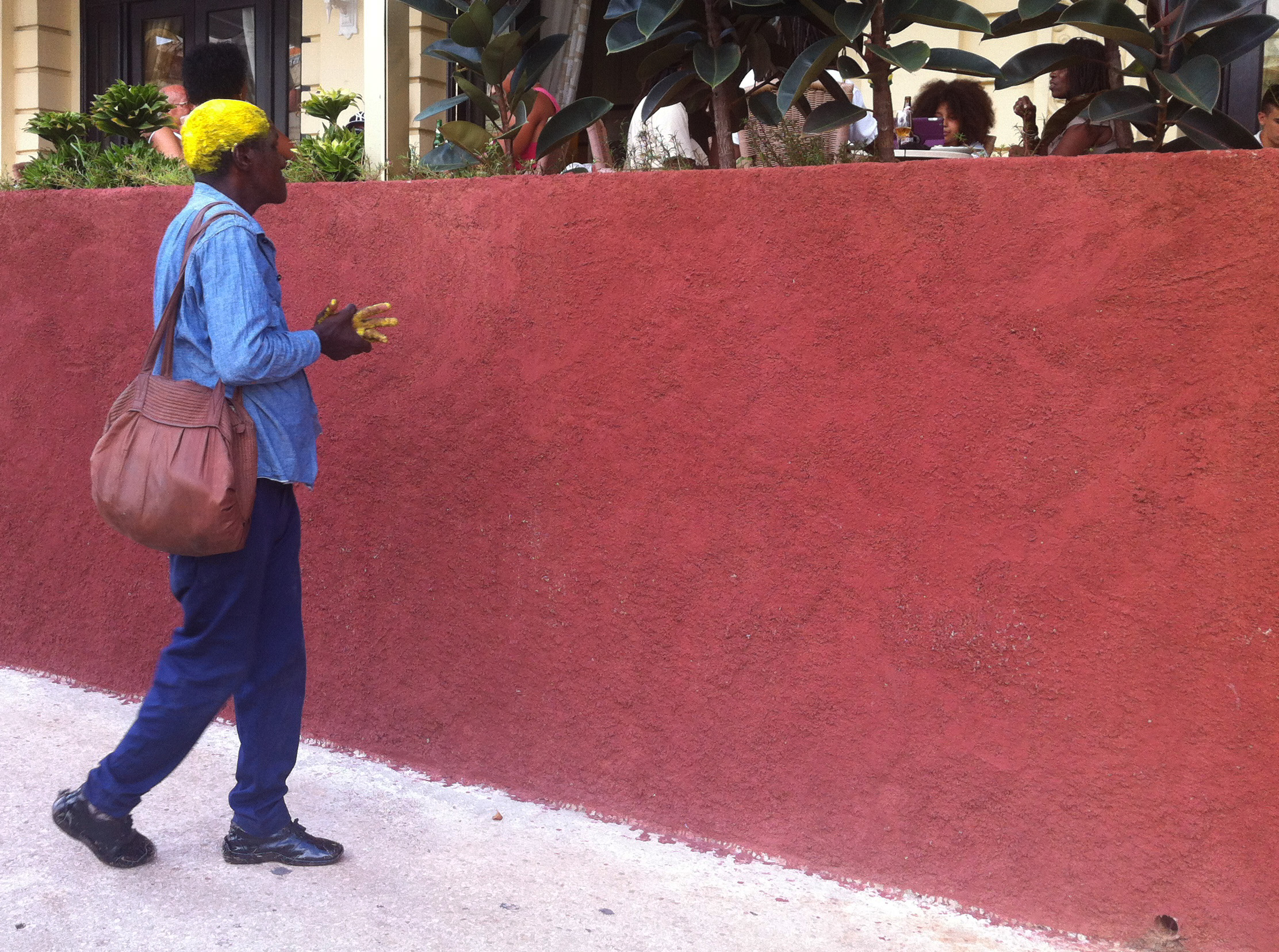
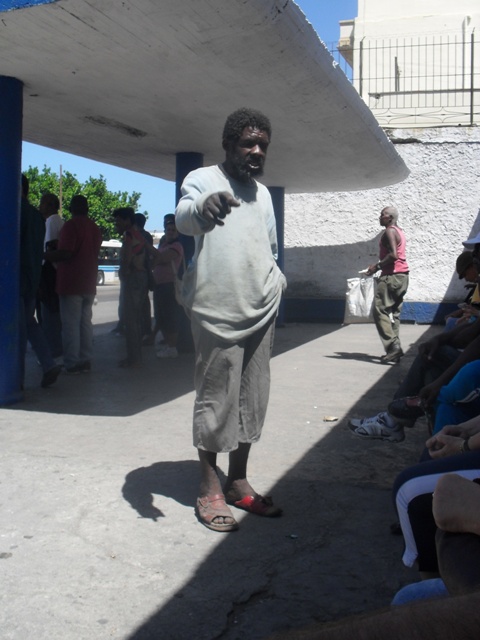
As a photograph is worth a thousand words, here I show you some that speak for themselves. The title photo is the sidewalk on Fontana, taken before the manager came out, the second is Neptuno between Consulado and Industria.
First of all, forgive me for the near abandonment of my blog. It is because of purses — an internationally recognized term for the small handbags I make — as well as other articles of personal and decorative use.
One of the main reasons, among others, for this has been the large stack of work with which I am now dealing in an effort to have enough items for a one-person patchwork exhibition at a gallery in Miami, to which I have been invited. I have also been very limited in my access to the internet as one of our “benefactors” has been on vacation and my finances do not allow me to patronize the cyber-cafes due to their high prices.
Here are some photos of my currently completed work that I hope you might like. I promise to show you others later as well as to provide information regarding the location and date they will be shown.
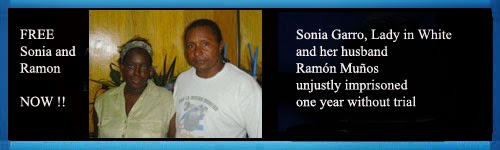
Today, Thursday, 18 September 2014, it has been two-and-a-half years since a black Cuban married couple have been in prison. This hasn’t the least importance, of course. They have never been brought to trial, nor have charges been filed against either of them. What’s the difference. Surely they’re two neighborhood thieves. I’m going to mention their names purely as Cuban gossip, well, as a curiosity in times of barbarity: Sonia Garro and Ramon Alejandro Muñoz.
That poor, black, Catholic and pro-democracy couple, are still today in a legal limbo as atrocious as Gitmo, continue to be separated in regimes that are technically torture, and no one remembers. Blacks, what for? Neither the Pope nor the Cuban bishops have ever asked, from beyond the Malecon. One of them–who knows if he will soon be named our next Cardinal-Minister–was personally presented with the Garro-Muñoz family case, thanks to the prelate coming to Washington DC to collect the indulgent money from exiles to repair who knows what church on the island (as if a temple is worth more than the parishioners). And nothing, obviously. Nothing has happened here. The blacks to the hole and the whites to the chicken.
14ymedio, Ignacio Varona. Havana. 2 September 2014 — In a few bites he polishes off the second pizza of the day. That evening he’ll dine on “bread with something,” accompanied by a shake and a sweet. For years now he has trouble seeing his feet while standing. His stomach hangs over his extremities and other, more lamented parts. Richard was slender in his youth, but a sedentary lifestyle and an excess of calories have caused his neighbors to call him “the fat man from the third floor.” His condition is shared by the more than 43% of the Cuban population which suffers from some degree of overweight.
Obesity, that 21st-century epidemic, also wreaks havoc in our country. In the last two decades, the scales have increasingly shown higher poundage. Does this mean that we’re eating more, or eating worse? Experts such as Dr. Jorge Pablo Alfonso Guerra declare that the first alarming signs of this affliction can already be seen in adolescence. Among the causes of Cubans storing more fat than they should, Dr. Alfonso points to “inadequate nutrition, a tendency towards less physical activity, and false standards of health and beauty.”
The common diet of the country, rich in carbohydrates and animal fats, is a legacy of our culinary heritage, but it is also a result of economic adversity. “There are days when all I eat is rice and hotdogs, because that’s all I can buy,” says Eugenia Suárez, who is 5ft-31/2in tall, and weighs 254 pounds. For years she has suffered from diabetes, high blood pressure and severe knee pain, due to her excess weight. Today she dreams of having bariatric surgery to reduce the size of her stomach.
Eugenia’s children are highly likely to be overweight, as well. Scientific studies have shown that the risk of obesity in children is multiplied by four if at least one parent is obese. A study produced in Havana by the anthropology department, assigned to the biology faculty of the university, determined that, between the ages of 6 and 15 years, 23% of girls and 21% of boys are overweight.
“It’s the children of those who suffered through the Special Period during their adolescence,” says Eloy R. López, endocrinologist and associate of the Institute of Nutrition and Nutritional Hygiene. “Their parents have an obsession with food and pass it on to their little ones.” According to this doctor, “the nutritional hardships that we endured in the 90s have triggered a compulsion towards constant food intake which, combined with bad culinary habits and poor food choices, create a very worrisome situation.”
Erroneous esthetic standards that glorify the “beer belly” and “love handles” make it difficult to treat males for this affliction.
“Sugar consumption is very high, because with it, people try to fill other needs,” López explains. “The same happens with the flour that is often used to make a food ‘go farther’ and feed several diners.” Every week, dozens of people visit his practice who want to make the needle on the scale go backward. His patients are “mostly women because among that population in our country, obesity is more common, and also because they worry more about their physique and tend to seek help.” However, he points out that “men are more difficult to convince that they have a problem. Erroneous esthetic standards that glorify the ‘beer belly’ and ‘love handles’ make it difficult to treat males for this affliction.
“I always encounter difficulties when recommending a healthier diet, because these individuals will tell me, ‘Doctor, I can’t afford that type of food,’ and they have a point, to some extent.” One grapefruit costs two Cuban pesos, the healthy pineapple can cost up to 15, and right now one pound of tomatoes costs no less than 20. “When I add it all up, a healthy diet would cost in one week what a professional earns in one month,” admits the doctor. To eat healthy in Cuba is expensive – but the problem isn’t only a monetary one.
Richard, the one whose neighbors no longer call by name, explains what it is that makes him consume so much junk food. “I live with my parents, my brother, his wife and child, the kitchen is small, and there’s almost always somebody frying or boiling something, so most of the time I have to eat out.” In the dining room at his workplace there are also no options that might help him lose weight. “Almost every day there is rice, sweet potato, custard…and the choice of vegetables is limited to cabbage for a season of the year.”
I am often disappointed that the best dishes on our menu, which are based on vegetables and fresh ingredients, are rarely requested.
It is rare to find anywhere in the country a cafeteria whose menu is not based on sandwiches, fried foods or highly-sweetened juices. Those that attempt to offer more healthy choices have a limited clientele and are forced to impose higher prices. “I am often disappointed that the best dishes on our menu, which are based on vegetables and fresh ingredients, are rarely requested,” says Miguel, a chef in a private restaurant on 3rd Street in Miramar. Instead, “fried pork morsels, pizzas, and sandwiches with mayonnaise are the most popular among diners.”
Following such indulgences, the more vain among the populace try to burn those calories in the gym, or seek faster and riskier methods to drop their extra pounds.
The Weight-Loss Business
“An obese society is a society disposed towards paying to lose weight,” affirms Dayron Castellanos, who sells diet pills. He earned a degree in physical culture and sports, but now he works in the weight-loss business. He sells via catalog such products as the Chinese-made Pai You Guo pills, whose directions for use state that they will promote “appetite reduction and effective evacuation.” To his list of “miracle remedies” are added ketones (supposed fat-burning substances), and green tea capsules.
Castellanos is not licensed to sell any of these products, most of which are not even approved by the country’s pharmaceutical authorities. His business is by word-of-mouth and classified ads. All that is needed is a phone call and a few “convertible pesos” and the customer goes home with what he thinks will be the solution for his “little rolls and spare tires.”
“I have had patients adversely affected by continued consumption of diuretic tea and other weight-loss remedies,” says Dr. R. López. “People want magical, immediate solutions, but to lose weight and keep it off, it is necessary to make permanent lifestyle changes.” However, the doctor’s opinion can barely be heard within the chorus of those hawking weight-loss products of all kinds.
Castellanos’ customers are basically members of Cuba’s emergent middle class. “This doesn’t mean that there are no overweight poor people, only that they can’t afford these pills,” says the prosperous entrepreneur. Many young women looking for quick fixes answer his ads, but older people do, too. In Cuba it is estimated that among the population older than 60, 51% of women and 30% of men are overweight to some degree. The risks of developing cardiovascular diseases and diabetes are causing many of them to be concerned about those extra pounds.
Declining health is a problem, but those suffering from obesity have a harder time emotionally with the social and familial repercussions of their condition. “I want people to start calling me by my name again, and not ‘the fat man from the third floor,’ ” Richard concludes, as he faces a cafeteria board advertising a special of ham-and-double-cheese pizza.
Yoani Sanchez, Havana, 18 September 2014 – A friend visting Cuba for the first time asked me why the government can put an end to the illegal distribution of the so-called “audiovisual packets.” “They just have to detect who makes it and trades in it, to be able to stop it,” the young man speculated. I reminded him of the work Fuenteovejuna, written by Lope de Vega. In three acts, the noted Spanish playwright tells how a town rebels against the abuse of power. The villagers unite against the injustice and together assume responsibility for the death of the local oppressor. “Who killed the Commander? Fuenteovejuna, señor,” we learned from the theater of the Golden Age and have put into practice, at least in the compilation and distribution of programs, documentaries and other digital materials.
My friend listened incredulously to my explanation, so I offered a more concrete example. Some months ago a traveled to Spain to participate in a technology event. Before saying goodbye, my family and friends asked me to bring them various things, as is common in such an undersupplied country. However, unlike other times when I left with a long list of shoe and clothing sizes, this time the requests were very different. A neighbor on the third floor wanted an update of the Avast antivirus and asked that I download a course in small business accounting. Two cousins noted the details of a videogame—with all the updates—so I could bring it back. A niece’s husband asked me for PDFs of some magazines about industrial design and almost all agreed that an off-line copy of Revolico—the Cuban Craigslist—would be fantastic.
The list of things to bring was very significant to me. I alternated the soap and deodorant, unavailable in the stores these days, with drivers for an acquaintance who lost the installation disks. The sweet seller on the corner asked me for a digital encyclopedia of pastry, and a friend who is learning to drive needed a simulator for a PC. A photographer colleague asked me to download some Android apps that wold let her retouch images and a relative learning English demanded all the chapters of a Podcast to practice that language.
The two nights I spent in Granada I barely slept two hours, because the list of what I had to download off the Internet was very long. I took advantage of the connectivity to also download about fifty TED talks, to bring some of the fresh wind of entrepreneurs and creative people to the Island. I renamed some files to be able to find them more easily in the numerous folders containing the requests and returned to Havana. In less than 48 hours the orders were delivered, even a Pilates course on video requested by the owner of a nearby fitness center, and a digital gallery for a university professor who urgently needed images of Egyptian art. Everyone was satisfied.
Several weeks passed and one day I got the latest update of the “packet” that was circulating. To my surprise, the TED talks included in it were exactly the same files I’d downloaded from the web and later renamed. So I could confirm that all of us—in one way or another—form a part of and feed this alternative bulletin board that circulates hand to hand.
Poor Commander, you already know that the packet is “all for one, señor,” like Lope de Vega taught us.
The truth is that I don’t know all the numbers, but I have been browsing the ad pages of Cubatur, Havanatur and all the Cuban “tours” and I found that this year the “all-inclusive” offers have increased which, since the restrictions for Cubans to stay at hotels were lifted, better-off Cubans have been taking advantage of them.
I’m not criticizing anyone for wanting to enjoy a vacation –usually short– at a beach hotel due to lower prices. After all, shortages and discriminations for decades have created a thirst for consumption and pleasure in the Cuban population that manifests itself as soon as the luckier few have an opportunity to escape the everyday filth and misery for a few days.
So, the number of regular Cubans who regularly take advantage of all-inclusive packages has been creating a clientele that feeds on the assorted neo-affluent sectors, corresponding to the most diverse groups and backgrounds: owners and employees of private restaurants, professionals who often have foreign contracts, employees of “enterprises” and shops that operate in hard currencies, the managerial caste, and even black marketers. Everyone wants their piece of Varadero to live the illusion of “I can”, despite the sorrows. And, of course, “everyone stretches out his feet as far down the sheets as they will reach” like my granny used to say, so there are those who save all year to spend a couple of nights at a three-star hotel, up to those who visit a five-star hotel in the outlying resort islands several times a year. It is, definitely, the realization of a long-cherished dream.
Well, it turns out that this year the “offers” to Cubans have skyrocketed. According to an accredited source (with the obligatory reserve), although some press reports state that foreign tourist participation has increased, the truth is that, in order to increase their income and fulfill quotas, tourist operators have had to extend and enhance the offers that so many well-off Cubans purchase. Cubans also serve to fill the gaps, so they will continue to collect fees, making use of what was, until recently, taboo: enjoyment.
This is not disclosed in the press, but it is so. That’s why the media publishes an occasional report in the news and on the regular press where there is a reference to “Cuban workers who enjoy camping facilities and beaches and recreation centers”; but I am absolutely sure that they never have dedicated one to show wealthy Cubans basking in the sun at hotels in Varadero or the outlying islands: we all know that they have already decriminalized the differences among us, but they should not be displayed so brazenly. These are the conditions to enjoy the benefits of Raúl-type socialism, aren’t they?
Before the Portuguese awning maker and salt merchant Matias Perez* disappeared in the world, already Cuba and the United States were maintaining solid ties, including cultural exchanges, which continues being today an important part of our history and identity.
Just by glancing we can find Cuban elements in American culture and vice versa, so much so that “Cuban-American” is the highest expression of that cultural ethnic fusion between both nations.
The cultural reciprocity was frequent, artists came and went constantly. The thing got complicated during the first half of the 20th century when both governments–and I’m going to tell the truth, like it or not–began to have a relationship based on political principles so conflicting that paradoxically they made the arts sector, that of the expression of the spirit and creativity, a prisoner of circumstances. continue reading
The Cuban Government historically has used art and culture as a machinery for social control and as influence, as much national as international. Today, in the era of globalization, the internet and social networks, much more so.
It was for this purpose, and in order to undermine with patience and subtlety the controversial law of the embargo, that at the end of the ’90’s the “Battle of Ideas” was created, a real strategy that built new masks.
In 1998, with a depressed economy and more than fifty percent of Cuban artists unemployed. The financial strain was such that it managed to break even the connection with inspiration and many important names decided to emigrate. But this time, the Cuban Government was not prepared to lose so easily its cultural heritage.
For such purpose it invented the figure of the “independent artist,” a category that still permits them to enjoy more of the destination than the trip, to give them the possibility of, paying a paltry sum of Cuban pesos, establishing legal residence indefinitely outside of Cuba, even in the United States, without losing the status quo.
Other less well known artists also managed to find a legal loophole, many times covered in false work contracts that they get weaving a net of bribes, in order to be domiciled outside the island.
That is how various actors, writers, filmmakers, musicians, artists, dancers and even lecturers leave Cuba, like they left the mango marmalade the coffee, and the guava shells, to produce in liberty.
On living outside the island, these artists hold accounts abroad. Today they come to the United States for cultural exchange, they act, they triumph with poses of lofty urban climbers, and although none of them says it, nothing keeps them from collecting. The embargo law sanctions sending dollars to Cuba; not so the rest of the world.
As a Cuban, I don’t like to stimulate the climate of hostility that separates us as a people and that also serves as a political and economic platform for groups that manipulate us from both shores of the Florida strait. I believe that contact with exponents of the culture coming from the island is a good thing. I am in favor of exchange; but not this lie that turns it into contraband.
Translator’s note: From Wikipedia: Matias Perez was a Portuguese born, Cuban resident, who started a canopy business in Havana in the 19th century. He was carried away with the ever increasing popularity of aerostatic aircraft, and became a balloon pilot, ascending at least three times before he disappeared while attempting an aerostatic flight from Havana’s Plaza de Marte (today, Parque Central) on June 28, 1856. A few days earlier he had made a successful attempt, flying several miles. His second try, however, became part of Cuba’s folklore: when somebody or something disappears into thin air, Cubans say: “Voló como Matías Pérez” (it flew away like Matias Perez)
The temple of the First Baptist Church of Coral Park: “The Whale”
It was my Sunday of rest in the United States (July 20), on this voyage that I made, between July 9th and August 6th, leading a small delegation that included my wife and daughters, and four other brothers of our church in Cuba. It was my day to be seated to receive the Word.
The previous Sunday I preached in the Baptist church “Star of Bethlehem,” in Hialeah; and in the nearly two weeks of the journey that remained, they hoped that I would preach to at least four more congregations: “Jesus Worship Center (www.iglesiadoral.org)” of Doral; the “First Hispanic Presbyterian Church” of Tampa; the “Christian House: JWC” of Kissimee; and the “Hispanic Baptist Church” of Naples. It was very opportune that this Sunday was included, because I had done so much speaking in the previous day that I had ended up literally without a voice.
The stained glass window of the Star of David
First Baptist Church of Coral Park is the congregation where brothers worship deeply and with great love for Cuba that today they wanted to dedicate to us their Sunday and their church. The same church in which pastored the well-remembered Rev. Jorge Comesañas whose name, unsurprisingly, was given to one of the neighboring streets, and especially to whom they arrived from their broken isle seeking healing for their wounds. continue reading
The sign of the street named for Rev. Jorge Comesañas
The congregation is composed largely of Cubans, as is its pastorate, as well, although its web page (coralpark.org) reports that its members come from twenty-five different nations. This very Sunday its current pastor, Carlos Tellez, who many remember as pastor in Santo Domingo and Madruga, in Cuba, completed his first year of ministry in this church, of the twenty-eight that he has completed as pastor.
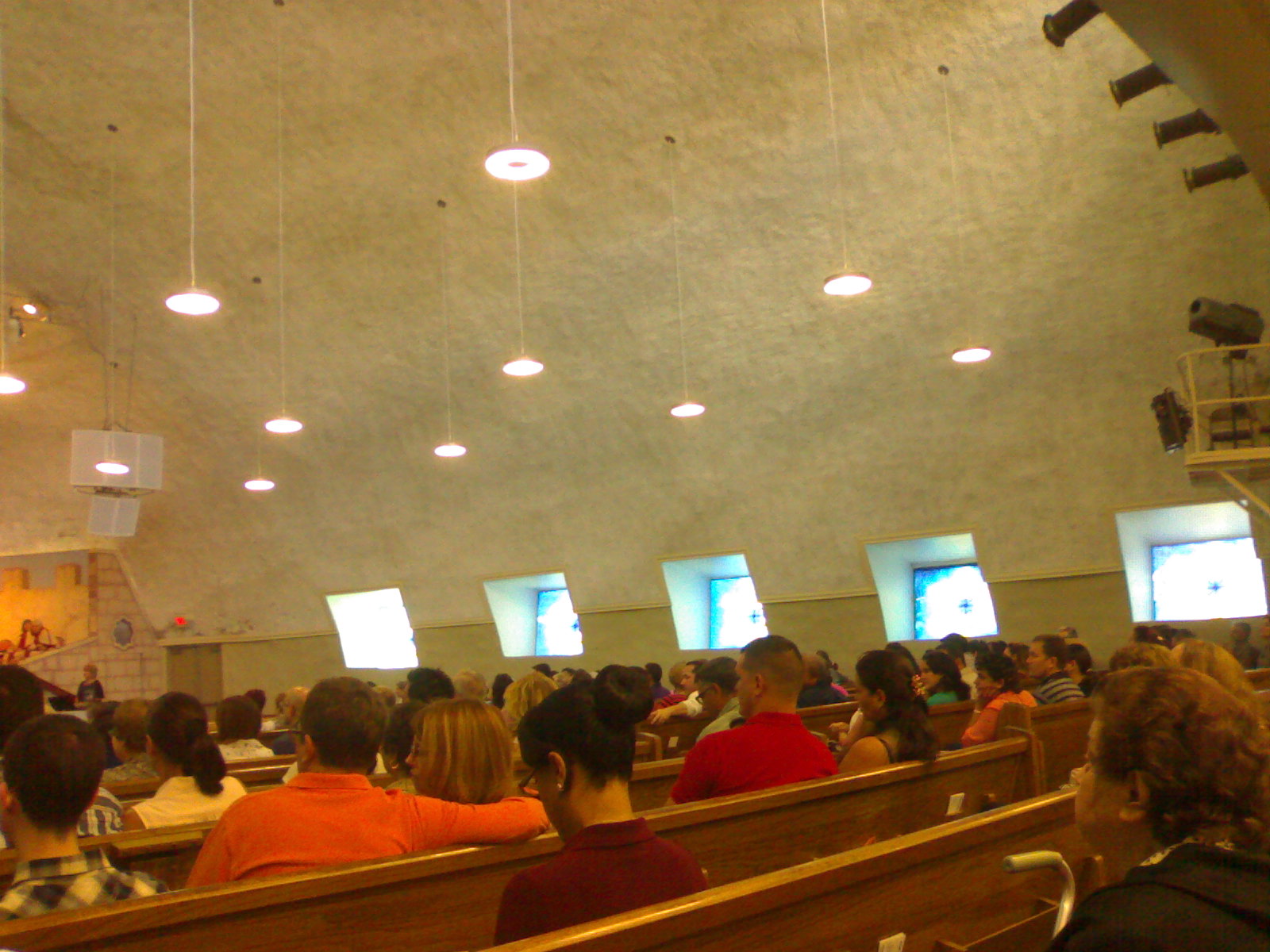
Known locally as “the whale” due to its distinctive architectural form, the temple served as a synagogue from its completion until 1986. The church has respected one of the conditions stipulated in the sales contract: that the building’s Jewish symbols be retained.
The street with the name of the pastor
That is why both inside and outside one can still see stained glass windows with unmistakable Stars of David. But in addition to its surface decoration, the whale retains something of a Jewish spirit.
I felt this when a group of visitors, including myself, were welcomed — in Hebrew no less — with verses to a well-known song: “Hevenu shalom aleichem, Hevenu shalom aleichem, Hevenu shalom aleichem, Hevenu shalom, Shalom. Shalom aleichem” When prayers were later offered for peace in Jerusalem, I had no doubts.
In these days of clamoring for true peace for Jews and Palestinians that do so much harm to each other, and of condemning the terrorist organization Hamas, I rejoice in attending congregations such as these that remember so well the sequence of a historic Christianity that was born in the synagogues and that was moved to similar churches, and that are debtors of them.
The church-synagogue from the inside.
And although this Sunday I rested from preaching the message with which I came this time to the US: “From the end of the earth to Jerusalem,” after, of course, having proclaimed it first in Cuba; I continued in the same spirit and each time more convinced of the word of the apostle Paul when he cited Isaiah and Jeremiah in Romans 11:26b-11:27: “As it is written: there will come out of Zion a Savior, that will take away the impiety of Jacob. And this will be my pact with them, when I forgive their sins.”
And it is the most admirable, and Jewish of the synagogue-church of Coral Park, that it proclaims the only one capable of giving peace both to the Jews as well as to the Palestinians: Jesus the Messiah, who gave his live on the cross for ALL.
I wish I could be happy about the quick response by the Cuban government to the request for assistance from the World Health Organization and the UN general secretary in their efforts to combat the Ebola epidemic, but I cannot.
I am all too aware of the deteriorating state of our hospitals, the lack of hygiene, the poor medical care — provided mainly by students rather than doctors — the poor nutrition provided to patients, the shortage of drugs and many other problems.
I am referring, of course, to the medical centers which serve the average Cuban, which are the majority, not to the specialized centers catering to foreigners, VIPs or people who can pay for their services in hard currency.
A similarly rapid response should be applied to the serious problems that have afflicted our health care system for years. We make the mistake of trying to solve the world’s problems without due regard for our own. This seems to have paid off in that at least it generates a lot of free propaganda.
However, no one who speaks or writes about the magnificent Cuban health system has had to have their illnesses or those of their loved ones treated here. Furthermore, many Cuban bigwigs prefer to seek treatment in other countries, even that of the enemy. There must be some reason for this.
At a press conference in Geneva, Cuba’s minister of public health took the opportunity to propagandize about the country’s achievements and to emphasize yet again how many medical personnel have provided and are now providing care in other countries.
He also talked about the thousands of overseas volunteer workers, though without mentioning how much Cuba charges in dollars for this service — currently one of the country’s main sources of foreign exchange — or how doctors, nurses and other specialists are not being properly paid.
At one point during the press conference the minister stated that the Revolution did not wait for its health services to be developed before beginning to provide assistance to other peoples.
He neglected to mention that Cuba’s health services were already well-developed before 1959 and were among the best not only in the Caribbean but in all of Latin America. One need only look to official statistics from international organizations of the time to confirm this.
Given these questions, I am concerned that what we are dealing with here has more to do with propaganda than with solidarity.
Cuba is like an exaggerated version of the fictional village Macondo,* as is clear to anyone with half a brain. For evidence of this, one need only spend a few minutes reading the country’s state-controlled press.
On Monday new customs regulations went into effect. On Tuesday there were articles by two of our seasoned journalists, who reported how successful these measures were, so much so that they had both travelers and customs officials applauding in unison. It is striking how effective these regulations turned out to be, and in such a short period of time, especially if we consider that it took a full year and a trial run in three provinces to lower the price of natural gas and distribute it for free.
The International Freedom for the Five Day — there are now only three of them — has occupied the front pages of the two main state-run newspapers. This year it will run until October 6, with vigils, marches, exhibitions, book sales, an international symposium, and demonstrations at universities, community centers and workplaces. This will include an event dubbed Kids Paint for Peace in which “all the nation’s children,” which can be interpreted to mean “all children without exception,” will paint asphalt and and fly kites in support of the Five.
It seems that all is going well considering that this campaign will represent the loss of vast amounts of time – including that of private citizens — and a waste of resources in pursuit of a new national pastime. If the state-run media is to be believed, this issue is of concern not only to Cubans on the island but to Cubans throughout the world. Please, let’s not get carried away! Remember that overstatement usually ends up being counterproductive.
As though that were not enough, it seems we must now celebrate the 69th anniversary of Fidel Castro’s college admission, the tenth anniversary of his historic speech at the Aula Magna and the fifth anniversary of his address to university students warning them of the threat of extinction to the human race. Remembrance has its place, but I do not remember any remembrance of the day on which Carlos Manuel de Céspedes, Ignacio Agramonte or José Martí — to mention three examples — began their university studies, much less a remembrance of many of their truly historic speeches.
It seems that a large segment of today’s Cuban youth — at least the ones who appear in the official media — find time to commemorate almost any event. Many years ago the cult of personality as practiced in other countries of the former Soviet bloc was severely criticized here. In light of all the damage it caused, people swore this would never happen in Cuba. Has this been forgotten? It might be a good idea to remind our young student leaders of this.
It is noteworthy that this summer, which was certainly quite a hot one, there were no new measures taken to stimulate the economy, unless you count the new customs regulations. We hope that September brings some new changes, though they are unlikely to meet the expectations of most Cubans. Nevertheless, something is better than nothing, even if it comes in dribs and drabs.
*Translator’s note: The setting of Colombian author Gabriel Garcia Marquez’ novel One Hundred Years of Solitude.
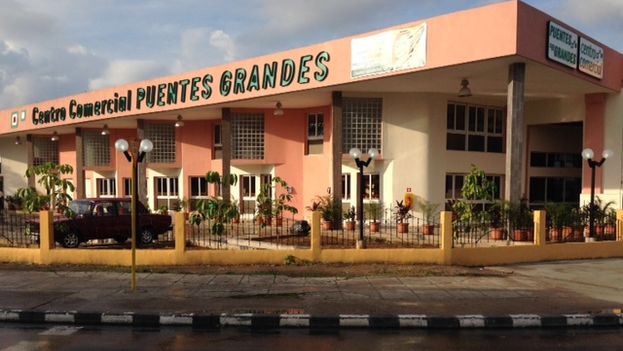
Exterior of the new Puentes Grandes shopping center (14ymedio)
14ymedio, Havana, Regina Coyula, 8 September 2014 — Tiendas Panamericanas [Panamerican Stores], owned by the CIMEX corporation, has just launched a grand (for Cuban national standards) shopping center. Utilizing the building formerly occupied by the old towel factory, Telva, on the corner of 26th Avenue and Calzada del Cerro street, a side addition was built, doubling the space. The opening of Puentes Grandes has been well received, being that until now only small stores have existed in that neighborhood, and the closest shopping centers — La Puntilla, Galerias Paseo, and Plaza Carlos III — are located about two miles away.
Spurred by curiosity, I visited Puentes Grandes last Saturday. Hundreds of people had flocked to the place. There was a line at the handbag security station, because bags and purses are not allowed inside stores that take convertible currency. There was another line at the entrance. We were going on half an hour already. In other circumstances I would have left, but resisted the impulse just to be able to write this article. Finally, I went through a narrow entryway where, as always, are those who wait, and those other, clever ones who butt the line. The interior entrance is quite spacious, with metal shopping carts, and other cute small plastic carts on wheels for which I predict a brief, happy life, and baskets. All is set up for the customer to select his purchases; merchandise is kept behind the counter in the perfume and household appliance departments.
A large interior arcade connects the grocery and housewares area with the hardware department, where I was detained by an employee. To go from one area to the other, you have to now go outside and re-enter, even though just days before you could walk directly between departments and check out at any register. Why is this? The employee doesn’t know, but he was assigned there to enforce the trajectory. I had placed various items in my cart, then had to stand at the register line, go outside, stand in another line to leave my purchases at the handbag security station, then go stand in another line to enter the hardware area.
continue reading
Among my purchases was a pressure cooker — a Columbian one. I don’t know whatever happened to those marvelous pressure cookers from the INPUD factory of the city of Santa Clara, which for a while now have not been on the market. At the exit of every Cuban store there is always an employee who compares purchases to sales slips
Employee: “You’re missing the guarantee for the pressure cooker.”
Me: “And where do I get that?”
Employee: “In Household Appliances.”
Back at Household Appliances, the young (all the employees are very young) lady told me “no,” in that overly-familiar, faux-affectionate way that many mistake for kindness:
“Mami (Mom), do you see a power cord in this pot? My department is *electrical* household appliances. The guarantee is given at the register.”
The check-out girl assured me that she had no guarantee certificates at the register, that it was at Household Appliances where I had to obtain one.
Among my purchases was a pressure cooker — a Columbian one. I don’t know whatever happened to those marvelous pressure cookers from the INPUD factory of the city of Santa Clara, which for a while now have not been on the market.
I know how to be patient. Besides, this ridiculous episode was prime material for my article. I returned to Household Appliances, where I told “my daughter” (she had called me, “Mami,” right?) if she knew the meaning of “back-and-forth.” The girl gamely took my pressure cooker and marched over to the register. The ensuing argument over the pot without a power cord was priceless. A half hour was spent on that silliness, just to conclude in the end that the guarantee for the pressure cooker is the sales slip.
I asked to speak with the management because it is inconceivable to me that a business can operate in this manner. The manager was not available, but there were various people in his office who turned out to be his superiors. I’m not going to repeat my complaint here — you can put two-and-two together and imagine it. The interesting thing is what those officials, who have been spending opening week in a kind of mobilization mode, told me.
For almost all the personnel in the store, this is their first work experience. The cash register system is new, the check-out staff do not understand it very well, and the registers frequently get stuck, producing electrical overloads that trigger the circuit breakers, leaving whole zones of the shopping center in the dark. On opening day they had to suspend a children’s event. Adults and children were run over by the crowd, and nothing less than a sacking of the place occurred, what with many people taking advantage of a power outage to eat and drink for free in the food court. From the hardware area there even disappeared an electric drill, among other, less valuable items. The neighbors (not the officials) say that even a flat-screen TV went out the door without being paid for.
These officials, who themselves are retail veterans, expressed amazement at the level of theft they are encountering here. For example, they told me that on Friday (the day prior to my visit), they had surprised five people in the act of thievery; two customers had had their handbags stolen inside the store and one other in the adjoining cafeteria; and all of this is in addition to the disappearance of many small objects from the shelves. They told me that they had never had such a hard time at any other store, not even at Ultra, which is located in a densely-populated and troubled area of Central Havana.
The solution (?) has been to divide the two areas of the shopping center, creating an inconvenience for the customer which I don’t think will solve the theft problem, because the cause of this phenomenon has to be sought outside the store.
I thanked the officials for their friendly explanation. However, as long as the customer of this center remains nothing more than an annoyance to the staff, the oversized photo at the door of the smiling young woman promoting efficient service and customer satisfaction will be just one more Kafkaesque detail of the whole picture.
14ymedio, Yoani Sanchez, Havana, 12 September 2014 – The school bell rings and the children enter the classroom followed by their parents. The first day of classes triggers joy, although a few tears are shed by some who miss their homes. That’s what happened to Carla, who just started kindergarten at a school in Cerro. The little girl is lucky because she got a teacher who has taught elementary school for several years and has mastered the content. “What luck!” some of the little one’s family members think, just before another mother warns them, “But beware of the teacher, she demands every student bring her a bit of a snack from home.”
On the afternoon of September 1, the first parent meeting took place. After the introductions and welcoming remarks, the teacher enumerated everything that the classroom was lacking. “We have to raise money for a fan,” she said, unsmiling. Carla had already suffered from the morning heat, so her mother gave the 3 Cuban convertible pesos (CUC) that was her daughter’s share, so she would have a little breeze while studying. ”We also need to buy a broom and mop for cleaning, three fluorescent tubes for the lights, and a trash can,” said the teaching assistant.
A list of requests and needs added some disinfectant for the bathroom, “Because we don’t want the flu,” said the teacher herself. The total expenditures began to grow, and a lock was added, “So that no one steals things when there’s no one in the school.” A father offered some green paint to paint the blackboard, and another offered to fix the hinges on the door, which was lopsided. “I recommend that you buy the children’s notebooks on the street because the ones we received to hand out this year are as thin as onion skin and tear just by using an eraser,” the teacher added.
After the meeting Carla’s family calculated some 250 Cuban pesos in expenses to support the little girl’s education, half the monthly salary of her father, who is a chemical engineer. Then the school principal came to the meeting and rounded it off with, “If anyone knows a carpenter and wants to hire him to fix their child’s desk, feel free.”
Reinaldo Escobar, Havana, 12 September 2014 — Passing near the Chinese cemetery on 26th Avenue, a young man leading his bike by the hand, said to me, “Puro, buy my stimulus.” I confess that it took me a few seconds to decipher the code. Clearly the “puro” was a reference to my youth, but what was difficult to understand was the “stimulus.” How can you buy such a thing?
As he explained to me, it was a plastic bag that contained a quart of vegetable oil for cooking, two bath soaps, and some ounces of detergent that he’d been given at work as a “stimulus” for having stood out in socialist emulation.
I didn’t believe a single word and committed the journalistic folly of rejecting his offer. If I had said yes, now I’d have a photo here of the products, laid out on the wall of the cemetery with the graves in the background.
When I told the story to my friend Regina Coyula, author of the blog Bad Handwriting, she told me this is the latest scam. The allusion to having been chosen as the vanguard, a standout, or special prize winner, makes you think that the potential seller is a “true believer” who has no recourse but to sacrifice the material honors his political-social conduct has earned him, to alleviate his urgent needs.
To buy the “stimulus” is almost a sado-political vengeance, but selling fake merchandise, that is oil that isn’t good for cooking, soap that doesn’t produce lather, and lime instead of detergent, is already a mockery… the old scam in new clothes.