“This is going to get good” / 14ymedio, Rosa Lopez

University of Havana (Romtomtom / Flickr)

14ymedio, Rosa Lopez, Havana, 19 December 2014 – The semester is ending at the University of Havana, a time when everything shuts down until the middle of January. But this year is different. Expectation runs through the corridors and the central plaza on University Hill, and the high attendance, on days close to Christmas, is surprising. Many have come to school these days just to talk with their colleagues about the great news: the announcement of the reestablishment of relations between Cuba and the United States.

In the humanities departments the debate is greater. “A couple of weeks ago we held a conference about the dangers of American interference… and now this,” says a young sophomore studying sociology, who adds, “I never thought this moment would come so soon.” He has just turned twenty and, when he says “soon,” he is speaking in relation to his own life. For others, the dispute between the two countries has lasted for an eternity. continue reading

In one of the rooms where some are using their “machine time” to check their email, a young woman complains to a friend. “My inbox is full from people asking me how things are over here.” She is quiet for a moment, realizing I’m listening, but then she continues. “How will things be? The same as always,” she concludes resolutely.

Below the Mathematics Department, in the so-called “park of the pig-headed,” the controversy sinks its roots deeper, given the privacy of the place. But it’s enough to ask a group of young people sitting on a bench if they’ve seen any American students around, for them to bring out the jokes and their thoughts. “No, I haven’t seen any today, but the way things are going we might see a lot of them pretty soon,” spits a girl wearing an iPod and Converse sneakers.

The others continue with jokes. They mock Martí’s verses about his life in the United States, “I lived in the monster and I know its entrails.” In a chorus they convert the phrase to, “I lived in the monster, how I miss it!” [a play on words in Spanish]. “If you see some yumas [a term for Americans that is softer than “gringos”] around here, let me know right away, I’ll be in the Great Hall,” they promise, cackling.

The university remains one of the schools with the greatest ideological control. From the departments located on Colina Hill, the students often leave to participate in acts of repudiation against the Ladies in White headquarters, a short distance from there. Tania, who came to find out if there would soon be some open doors so that she can familiarize herself with the site, believes that it will be her turn to climb the steps “in a new era.”

When asked how she knows this, she exclaims, surprised, “But didn’t you hear Raúl? The thing with the Americans is over. It’s over!” It’s surprising that everyone here seems to be so well aware of it. Especially if you take into account that people this age are the greatest consumers of the audiovisual materials of the so-called “packet.” They watch little television and even make fun of those who still stay home to watch “the Saturday movies” on the national programming. However, everyone says they saw Raúl Castro’s speech.

The classrooms are nearly empty. Exams are over and just a few remain preparing for special meetings. On the wall there are still some old announcements for activities of the University Student Federation (FEU), along with a photo of the five spies who have already “returned to the homeland.” The expectations raised by some of the relaxations announced by Obama are high. “I’m very interested in studying on a scholarship in the United States, if all that is easier now then at least I can try for it,” says a girl who enrolled in the Law School just three months ago.

Everyone seems well adapted to the idea of the new policy change. If you look closely, there’s not much to distinguish them from young people at a university in Los Angeles or Florida. They dress fashionably, some have a tablet or laptop where they read or write, and their frame of reference seems much broader than that of their parents’ generation. “What I want to see starting to come here are videogame championships…” says one with a gleam in his eyes. Everyone agrees that among the most important announcements made on 17 December is the one having to do with telecommunications and connectivity on the island.

“Internet, now comes the internet,” says a young woman looking at the scant menu offerings in the university cafeteria. And so she remains in her reverie, filling her head with the kilobytes that “Obama is going to send over” and a bold prediction: “This is going to get good, you’ll see, you’ll see…”

Winning as a Political Obsession / Fernando Damaso

 File photo

The odd relationship between bread and circuses has been with us since the days of the Roman Empire. When the former is in short supply, the latter is in abundance. Cuban government officials have been putting it to use for years, with a strong emphasis on the latter. Sporting events, among other diversions, have always served as a convenient circus. The recently concluded Veracruz 2014, also known as the XXII Central American and Caribbean Games, have been no exception.

A delegation of top athletes was assembled — one capable of obtaining the most gold medals — with the goal of placing ahead of all the other participating countries. No thought was given to allowing younger athletes to compete with a view to future sporting events more important than Veracruz 2014 — something that other countries took into account, by not sending their principal figures, saving them for higher-level events. continue reading

One notable case was Jamaica’s in track and field and athletics.  It also occurred with some team sports, such as football [soccer] and baseball, in which first-class players did not compete, except in the Cuban teams.

Also well-known is the case of the hammer-thrower Yipsi Moreno who, having already retired from the sport, was called and included in the delegation with the objective of ensuring one more gold medal. And it happened with baseball, for which the Cuban national championship games were delayed so that a team could be assembled that would flatten the competition and ensure a gold medal for Cuba.

It turns out that, for the majority of countries, including the host, Mexico, sports do not constitute a political necessity as they do in Cuba. To sports, therefore, these other countries do not dedicate as many economic resources as, comparatively, the Cuban government does.

It is good to remember that, for years now, our rulers have been obsessed with the idea that the country be seen as a leader in diverse spheres. For this they have tried to prepare and present Cuba as a major force in medicine, education, hydraulics, music, sports and others — in many cases producing more noise than results.

Strangely, never have they been concerned about the country being seen as a political or economic power.

This sick obsession makes our athletes compete under extreme pressure, because they take on — before rulers, political and popular organizations, the people and their families — an obligation to win the gold, given that the other medals are not as valued (although in the official propaganda, when the gold isn’t obtained, it is said that the silver and bronze shine just as brightly). Besides, they have to do it as though fulfilling a patriotic duty. In reality this is too much of a useless burden for a human being to bear. It could be that, among other economic and political reasons, this is also why so many athletes and sports figures decide not to return to Cuba and end up defecting.

 Translated by Alicia Barraqué Ellison and others.

1 December 2014

The First Intelligent Step / Rebeca Monzo

In these eight years that have passed since Raul Castro was designated by his brother as his successor, to take up the government of the country, this 17th of December, a date of only religious significance for the Cuban people until now, will go down in the history of our island as the most transcendent act of these last 50 years, by the announcement of the reestablishment of diplomatic relations with the US.

The previous steps taken by him as president, such as the liberalization of travel, selling and buying homes and automobiles, establishing small private businesses and others, are nothing more than the return of usurped rights to citizens, by the same regime that will soon reach fifty-six years in power. continue reading

Among other fundamental factors that may have influenced the Cuban side, I consider: an economy in crisis without real hopes of improvement; little foreign investment; the exodus of young professionals and the wear and tear and aging of the adult population; among many others that are part of an endless list.  We can add to those the low price of petroleum, that has been arriving generously from Venezuela, and that could fail to turn up at any moment.

Two countries that have joined together to come to an understanding, that necessarily should continue to develop further, to get Cuba out of the economic and social abyss that it finds itself.

 Translated by: BW

19 December 2014

We Shall Fight to the End for the Liberty of Cuba / Cubanet, Ernesto Garcia Diaz

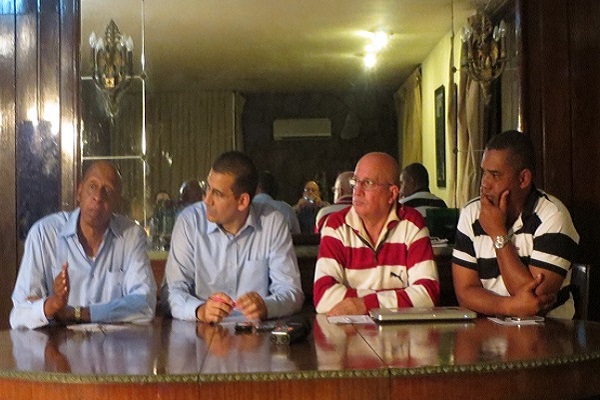
From left to right, Guillermo Fariñas, Antonio G. Rodiles, Félix Navarro and  Ángel Moya (Photo: Ernesto García Díaz)
From left to right, Guillermo Fariñas, Antonio G. Rodiles, Felix Navarro and Á”ngel Moya (photo by author)
  • Leaders of the opposition call Obama’s reconciliation with the Cuban government a “betrayal” during a press conference in Havana

Cubanet, Ernesto García Díaz, Havana, 18 December 2014 — From the headquarters of the Estado de SATS project in Miramar, on Wednesday afternoon (12/17/14), Cuban opposition leaders held a press conference for national and international media, to make known their positions regarding the new political stance of the United States towards Cuba.

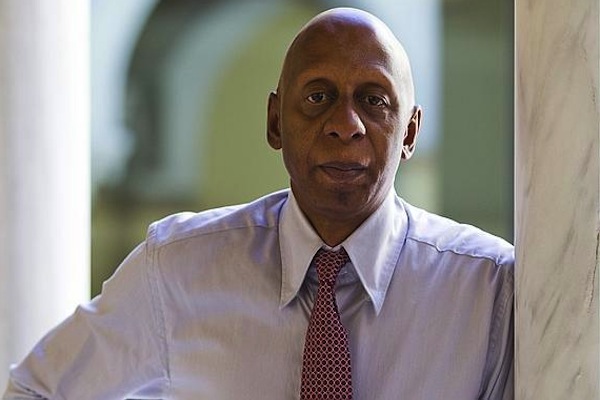
Guillermo Fariñas Hernández, winner of the European Parliament’s Sakharov Prize for the Freedom of Thought and Coordinator General of the United Antitotalitarian Front (FANTU), referring to the steps taken by the governments of Cuba and the United States, stated the following:

“We can applaud the release of Alan Gross, who really was used by the Island’s government to blackmail the American administration. But Obama has been inconsiderate with the civil society that is challenging Cuba’s tyrannical government In Miami, back in November of 2013, Barack Obama promised Bertha Soler and me that any action he would take with respect to Cuba would be consulted with the civil society and nonviolent opposition. Obviously this did not occur. These actions are now accomplished facts, they are reality, and Cuban democrats were not taken into account. continue reading

Guillermo Fariñas
Guillermo Fariñas

This amounts to a betrayal of Cuban democrats. We must now adapt ourselves to the new scenarios, which means that we must ask the American government to keep in mind the demands that these negotiations should require, to avoid colluding with the communist dictatorship of the Island. If the United States government listens to us, I believe that we can hope that this is not one more maneuver of complicity and help towards a regime drawing its last breath.”

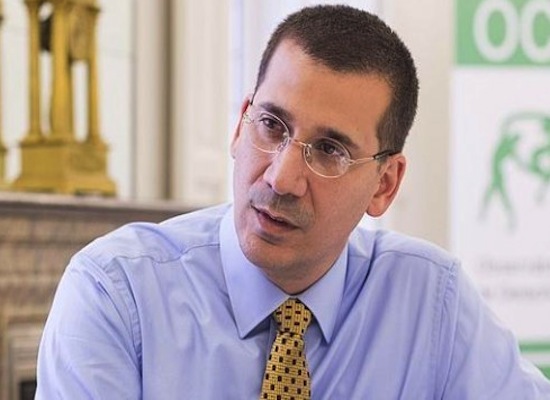
The leader and opposition activist Antonio G. Rodiles, coordinator of the Campaign for Another Cuba and of the Estado de SATS project, made the following assertion:

“History has been made when, in 1994, the country [Cuba] was finding itself in a profound crisis and the explosion of 5 August 1994 occurred. The North American government’s response was to accept the exodus and later to sign the migration accords which provide for an annual cap on [US] visas issued annually [to Cuban nationals]. The result has been that during more than 20 years, the country’s human capital has been bleeding out and Cubans have opted to leave Cuba and not provoke change. This truly has been a disaster and the United States government cast a lifeline to the regime so that it may survive.

“The rancid Castro regime, as is common knowledge, in on the point of ending from natural causes. Obviously what they are trying to do is to cement the foundation for a mutation to Neo-Castroism, which is the family and descendents, who are trying to continue to governing, which is a grave danger for Cuba and for the entire region.”

Antonio Rodiles
Antonio Rodiles

“Today’s measures – without taking into account the opinion of Cuban civil society, of the political actors in the Cuban opposition – is a serious message, it is a bad message, and if the upcoming process of negotiation does not include our participation, the results will not be positive at all. We still have ahead of us the Summit of the Americas [to be held in Panama City in April, 2015], but what happened today does not make us feel optimistic.

Opposition member Ángel Moya Acosta, coordinator of the Democratic Freedom Movement for Cuba, had the following to say:

Angel Moya
Angel Moya

“We rejoice at the liberation of Alan Gross. But the measures that the United States government has implemented today, of relaxing the embargo and reestablishing diplomatic relations with Cuba, will in no way benefit the people of the Island. The steps that have been taken will reinforce the repression against human rights activists by the government of the Castro regime. The regime will augment the resources and sinecures to its forces so that they will continue to harass and repress civil society activists. An example was the military reinforcements exhibited by the regime in advance of anti-demonstration activities on 10 December, ‘International Human Rights Day.’ ”

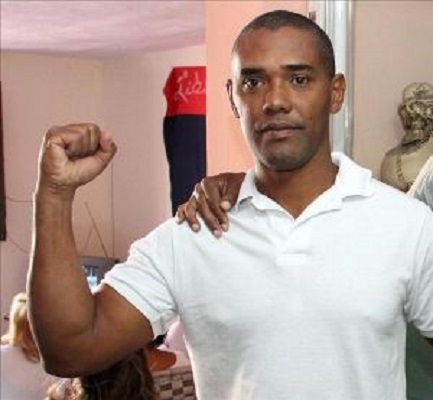
Félix Navarro Rodríguez

Félix Navarro Rodríguez, Coordinator General of the Patriotic Union of Cuba (UNPACU) and president of the Pedro Luis Boitel Party for Democracy, had this to say:

“The conditions that brought about the United States’ embargo against Cuba in 1961 have not changed. It is well known that the government is totalitarian, dynastic, that it does not recognize the rights to free expression, free assembly and freedom of the press. As long as the political opposition, the different strains of political thought and a multi-party system are not recognized and general free elections are not called, we cannot point to anything beneficial for the people.

“We are in total disagreement with what has been produced today, because we consider it a betrayal of those of us who, from inside Cuba, are opposing the regime to obtain a definitive change for the wellbeing of all Cubans.”

Following the opposition leaders’ statements, the floor was opened to questions.

Associated Press (AP): “We walked the streets extensively today, and found the people to be happy, beyond the message. It is notable that all of you hold a position so different from ordinary people. Does this mean that you will alienate yourselves from the will of many people now living in Cuba?”

Antonio Rodiles: “People are disoriented, surprised by what has happened. On the street, in the taxis, people were not excited, others said that the pie was cut, the [Castro] family and the governing elite are strengthening their business positions. It isn’t the people, the person in a small cafeteria who is being watched by inspectors, people don’t know what is going to happen.”

Ángel Moya: “In the midst of the secret negotiations that were going on between the two governments, on 10 December the Havana dictatorship was repressing 75 Ladies in White and 35 human rights activists. In Cuba, laws are in force that are designed to guarantee the impunity with which the repressive forces act. What guarantee is there that the Cuban government will recognize civil society?”

CubaNet: “Has the United States government or any of its officials, following these declarations, contacted the leaders of the opposition, in accordance with the commitments Obama made in 2013?”

Félix Navarro Rodríguez: “We have not been consulted. This has all developed in strict secrecy between the two governments. There has been no encounter with Cuban civil society nor with its leaders. Nor do we know if they are willing to meet with us. As of today, they continue to repress the Ladies in White and twelve of us prisoners from the [2003] Black Spring; we remain on parole, deprived of our rights and liberties.

“The commitment by Obama to Berta Soler and Guillermo Fariñas was not kept. In Cuba everything remains the same. Now, in the midst of this avalanche, we will reorganize and will fight until the end, we will press for the recognition of our civil rights and for democratic freedoms.”

At the end of the press conference, Guillermo Fariñas, by way of concluding remarks, asserted this:

“We need to channel our demands. The government of the United States has a moral obligation to all democracies in the world. It gave to the Cuban government a possibility to start instituting some democratic reforms. Now, it will depend on the actions we Cubans take.”

Attending, among various other officials of accredited diplomatic missions on the Island, were diplomatic representatives of the European Union, and of Sweden. Also present were human rights activists, among them Gorki Águila Carrasco (artist in the group Porno Para Ricardo), Hablemos Press, AP, and others.

ernestogardiaz@gmail.com

Translated by: Alicia Barraqué Ellison

Releases / Regina Coyula

(Published on BBC Mundo 17 December)

It didn’t fail to surprise me although I wasn’t taken unawares. I’d said among friends, who called me crazy, that Gross and the three wouldn’t be exchanged, that without Human Rights there would be no relations.

I respected the point, but I recalled the politics are cooked up with subtle ingredients that don’t appear in the news (much less the news in the newspaper Granma) but there were indications and because of these indications the news of the year didn’t come out of nowhere.

Now, with Gross in the United States and the three in Cuba, the implementation of the conversations that have taken place begin, conversations that open a parenthesis for a calm transition in which the successors of the nomenklatura live with peace of mind and even participate, if they want, in the multiparty politics that will come. continue reading

Before the announcement, workers speculated about what its contents would be.

I don’t believe everyone is happy, neither in the government nor in the dissidence, but the doctor, the closeness of the patient, shouldn’t cloud the judgement when the time comes to made a diagnosis.

The economy, as we know, is very pragmatic, American investors will weigh the risk in numbers and not in violations of human rights.

The Cuban government, for its part, needs to normalize its relations with the neighbor to the north and anxiously await new capital. The Mariel Special Development Zone (ZEDM) will finally fulfill the function for which it was conceived.

Civil society needs to take advantage of this undoubtedly favorable junction to deepen the struggle to establish a true State of rights.

For my part, I think that today, 17 December 2014, opens a new stage in the long journey of Cuba to insert itself among the modern and democratic countries.

19 December 2014

Querido Raul, Dear Obama, Querido Pope Francis / 14ymedio, Tania Bruguera

Images from <a href=

14ymedio, Tania Bruguera, Vatican City, 18 December 2014 – First of all I congratulate you because a historic moment is what is always expected of political men and this moment has been 17 December 2014. You have entered into history by arguing that the embargo/blockade is an apparently empty word, by changing – with the reestablishment of diplomatic relations – the meaning to 53 years of politics defined by one side (U.S.) and used by the other (Cuba), to politicize Cubans’ daily lives, wherever they may be. I wonder if this gesture is also a proposal to kill ideology. Cuba is now defined starting not from death, but finally starting from life, but I wonder, what life and who has the right to these new lives?

Now, querido Raúl:

Today as a Cuban I demand that you let us know what your plans are for our lives, that you establish as a part of this new stage a process of political transparency were we all have a space to participate and the right to have a different opinion without being punished. That when we have to deny many of the things that defined us, this process doesn’t come with the same intolerance and indifference which, up to now, has accompanied the changes in Cuba, where acceptance is the only option. continue reading

Today as a Cuban I demand that there be no privileges or social inequality The Cuban Revolution has distributed privilege as a reward for a sense of trustworthiness, which is synonymous with fidelity to those who are in the Government, or on its side. This has not changed. Privileges have defined the social inequality that we have experience since forever, an inequality that was clothed in Revolutionary meritocracy and that today is transformed into loyal entrepreneurship. I demand that the material and emotional rights of survival of those who may not want to be part of this new stage be defended.

Today as a Cuban I demand that we not be defined by the markets, or the use that the leaders can make of us. I ask for equality for that Cuban who, due to the blockade/embargo gave his life, for example, working in a factory to proudly arrive home with the title of Labor Hero, and who today has no place in the world of foreign investments and can only aspire to a retirement defined in socialist times and not in these times of the market economy. What is the plan to not reproduce the mistakes of the other countries of the former socialist camp? To not turn us into the Cuba of 1958? To repair the emotional abuse that the Cuban people have been subjected to under the politics of recent years. To ensure that there will be social and material justice? To ensure that we will not be a colony nor that we will have to unquestionably accept these benefactors as it happened before with the Soviet Union and with Venezuela?

Today as a Cuban I demand to be able to demonstrate peacefully in the street for or against a government decision and to be able to reclaim political and social rights, without fear of reprisals. That associations and political parties with points of view different from the official be recognized. That civic activism, civil society and those who have a different point of view be decriminalized. That political parties born from popular desire be legalized. That direct elections be established where all parties can participate and that ideological differences be resolved with arguments and not with acts of repudiation.

Today as a Cuban I reclaim the right to be political beings, not just economic entities or tokens of symbolic exchanges to make history.

Today as a Cuban I want to know what is the idea behind the nation we are building.

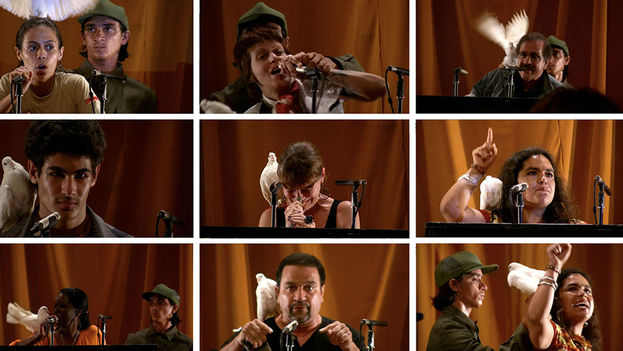
Today as an artist I propose that Raul put the work Tatlin’s Whisper #6 in the Plaza of the Revolution. Let’s open all the microphones and let all voices be heard; that it not be just the clatter of the coins we are offered to fill our lives. That the microphones not be kept off. That we learn to do something with our dreams.

Today I would like to propose to Cubans wherever you are that you take to the streets this coming December 30 to celebrate, not the end of the blockade/embargo, but the principal of your civil rights.

Let us make sure that it is the people who benefit from this new historical moment. The motherland is what we grieve.

Goliath Opens His Wallet / Yoani Sánchez: A New Era for Cuba and the United States

Havana, Cuba. Credit Desmond Boylan/Associated Press (Taken from the New York Times)

[From the New York Times] HAVANA — In one of my earliest memories, I am in a schoolyard before a campfire. The kids are screaming and jumping around it while the teacher stokes the flames, where a ridiculous Uncle Sam puppet is burning. This image came to mind on Wednesday, as I listened to the speeches of Raúl Castro and Barack Obama about the re-establishment of relations between Cuba and the United States.

Generations of Cubans have grown up under the barrage of official propaganda against the United States. As the words directed against our neighbor to the north became more aggressive, our curiosity only grew. Overwhelmed by material precariousness, disillusioned because the so-called Raúl reforms have failed to fill their wallets or their plates, Cubans now dream of the material respite that might arrive from the other side of the Florida Straits. Without a fight, David, smiling, walks toward Goliath, who is about to open his bag of coins. The myth of the enemy is over; the difficult reality of coexistence has begun. continue reading

Sara is a teacher I know at an elementary school in the Plaza of the Revolution municipality. Without the help sent by her daughter every month she couldn’t survive. “Now everything will be easier, especially because we’ll be able to use American credit and debit cards here and my daughter is thinking of sending me one so I can get a little help whenever I need it,” she said.

Sara has decorated her classroom with a poster that includes images of the “Cuban Five,” spies whom the official propaganda considers heroes. (The Americans released the last three of them as part of a swap for a Cuban who had worked as an agent for American intelligence.) “They are back, so we will have to change the bulletin board,” she said with excitement and relief.

Bonifacio Crespo helps a brother with accounting for their private restaurant in Havana. They already have a new business plan. “We have the contacts to start importing raw materials, spices and many products for the menu, all we need is for them to expand the sending of packages from over there,” he said, his finger pointing toward a cardinal point he believed was north.

José Daniel Ferrer, a dissident, said that Havana had lost its “alibi” for political repression and economic control, and the independent magazine Convivencia (Coexistence) welcomed the news, but other dissidents worry that the government has yet to specify what it will do.

The tension between the two governments lasted so long that now some people don’t know what to do with their slogans, their fists raised against imperialism and their sick tendency to justify everything, from droughts to repression, on the grounds of being so close to “the most powerful country in the world.” The worst off are the most recalcitrant members of the Communist Party, those who would die before chewing a stick of gum, drinking a Coke or setting foot in Disney World. The first secretary of their organization just betrayed them. He made a pact with the adversary, behind the scenes and over 18 long months.

On Thursday, the party newspaper, Granma, was slow to reach the newsstands. Sometimes it is delayed when Fidel Castro publishes one of his delirious articles about the immensity of the galaxy or the memory of Hugo Chávez. In the long minutes of waiting, many speculated that Granma would arrive with some reflection from the comandante, but there was nothing. No evidence that would let us know whether he is for or against the risky step just taken by his brother. Many have read this silence as a sign of his delicate state of health, but by saying nothing, he has confirmed his political death, which is even more revealing and symbolic than his physical death will be.

Representatives of civil society do not want the United States to “extend a blank check” to the longest-standing totalitarian regime in the Western Hemisphere unless four demands are met.

First is the immediate release of political prisoners — there are over 100, Elizardo Sánchez of the Cuban Commission for Human Rights and National Reconciliation estimates. Second is the ratification of United Nations human rights covenants. Third is the dismantling of the apparatus of repression: shameful assaults on so-called counterrevolutionaries, arbitrary arrests, demonization and intimidation of those who think differently and police surveillance of activists.

Finally, the Cuban government must accept the existence of civic structures that have the right to express opinions, decide, question and choose — voices that have not been represented in the current negotiations between the governments of Cuba and the United States. The road map drawn by the higher-ups has been hidden from us.

An opportunity has been offered, despite the valid criticisms of many who question whether Uncle Sam has conceded too much, while his counterpart was too stingy to offer meaningful political gestures. Civil society must take advantage of it, elevate its voice, test the new limits of repression and censorship.

Everyone is experiencing this change in his or her own way: Sara, dreaming of her new debit card; Bonifacio, who speculates about the dishes he’ll be able to include on his menu with new imported ingredients; José Daniel Ferrer, who hopes to increase activism in the eastern part of the country. For everyone, a new era has begun. We cannot confirm that it will be better, but at least it will be different.

Yoani Sánchez, a blogger, is the director of 14ymedio, an independent digital news outlet in Cuba. This essay was translated by Mary Jo Porter from the Spanish.

A version of this op-ed appears in print on December 19, 2014, on page A35 of the New York edition of the New York Times with the headline: Goliath Opens His Wallet.

Conquering Democracy is our Task/ 14ymedio, Miriam Celaya

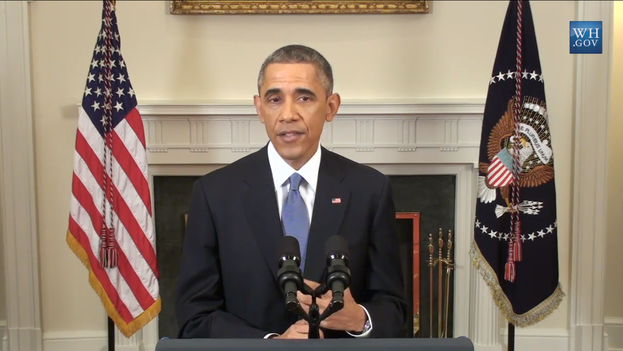
Obama during his speech

14ymedio, Miriam Celaya, Havana, 18 December 2014 — As befits the ripples derived from the polarization and the long-held political conflicts, the surprising news about the release of Alan Gross by the Government of Cuba, and of the three confessed Cuban spies by the US government, coupled with the simultaneous announcement of the re-establishment of diplomatic relations between the two countries, has unleashed a wave of passion on both sides of the Florida Straits.

Some have catalogued it as a “victory for the dictatorship,” others as “the betrayal of the democratic aspirations of Cuba and of the US global leadership,” and there have been some who consider a “moral crime” what they term the exchange of people unjustly imprisoned in Cuba and three criminals who caused deaths and the mourning of Cuban families.

In all conflicts, each party is partially right, but when we talk about such significant historical events as the radical turnaround in the US-Cuba relations after the 50-year dispute, it is necessary to set aside the passions and calmly analyze the new scenario in order to extract the greatest possible benefits. continue reading

On the other hand, we should not perceive as a loss the release of an arbitrarily imprisoned American citizen, who was also used as a hostage by the Cuban dictatorship, as were an important group of political prisoners. All of them have now succeeded in reuniting with their families and moved on with their lives. If this is Raúl Castro’s supposed “victory,” I would call it a Pyrrhic victory.

The Gordian knot that maintained the stagnation and confrontation has been broken, and and now we might want to exploit this window of opportunity

But, in any case, with the liberation of both Alan Gross and the three vassals of the Castros’ fiefdom, those issues have been exhausted. What is really important is that the Gordian knot that maintained the stagnation and confrontation has been broken, and now we might want to exploit this window of opportunity, rather than continue with lamentations and catharsis that do not lead anywhere at all. It is about the old adage of the half empty or half full glass, so to speak. I choose to see it half full and to do whatever possible to fill it to the very brim.

Let’s say, for instance that, going forward, no one will be able to accuse us of being “mercenaries at the service of an enemy country,” especially when we visit the US Embassy or participate in the debates, cultural or academic activities, video-conferences, or courses about technological uses of information and communication and English language that are taught there. Neither will they be able to continue to justify the David and Goliath theory, nor the reluctance to ratify UN Covenants signed February 2008, among many other resources employed by the regime. It is true that they don’t need excuses to suppress and to hijack citizen’s rights; but today, Barack Obama has put the ball in our court, which has placed the Cuban leadership under political pressure.

Another point to monitor will be how the agreements will be applied, and how the US will ensure that the real beneficiaries of such momentous changes are Cubans and, especially, the emerging civil society. In any case, the US government has confirmed its commitment to the long-neglected democratic aspirations on the Island, and it also assumes a great deal of historical responsibility for the consequences arising from such a decisive step.

It is hard to imagine all the juggling that the Cuban government will have to do in order to reconcile the “anti-imperialist” principles of ALBA and its regional allies with this renewal of relations with the Northern villain. If there is something the left does not forgive it is adultery or ideological bigamy. At any rate, Cuba’s side now has a four-month grace period until the Americas Summit, to be held in Panama, to show the US that Cuba is willing to make advances in terms of human rights. Obama’s message was, as such, almost an ultimatum.

Barack Obama represents a new era, while Raúl Castro is the past

To recap, superficially analyzing the respective speeches of the presidents of the two countries, the contrasts are obvious: one, young, smartly dressed in civilian clothes, talking about what he expects for the future of these policy changes from the seat of his government; the other, an octogenarian, stuffed into a ridiculous military uniform and crushed under the weight of medals and epaulets, reading a sheet of paper in a nasal voice and with funereal airs, from a horrible office where there isn’t even a simple computer. Barack Obama represents a new era, while Raúl Castro is the past, even though we try hard to ignore that reality.

In addition, it is pathetic to assume the success or failure of our struggle against the dictatorship will depend on the policies of a foreign government. The US has shown a unique ability and willingness to support Cubans, but winning democracy is, without a doubt, our own task.

The independent civil society, including the whole spectrum of opponents, activists, journalists, etc., can now choose between two attitudes: clinging to the anachronism of belligerency and the entrenchment which we have criticized the regime so much for, or assuming the challenges offered by the new era. The moment can be interpreted as a defeat or as growing pains. Personally, I prefer to grow.

Translated by Norma Whiting

“We hope the government will announce the names of the prisoners benefiting in the coming hours” / 14ymedio, Elizardo Sanchez, Reinaldo Escobar

Elizardo Sanchez
Elizardo Sanchez

14ymedio, Reinaldo Escobar, Havana, 18 December 2014 – The spokesperson for the Commission on Human Rights and National Reconciliation, Elizardo Sánchez, shares with the readers of 14ymedio his reflections on the rapprochement between Havana and Washington announced this Wednesday, after more than five decades of rupture.

Escobar: Does the National Commission for Human Rights and Reconciliation have the names of the 53 prisoners that the Government of the United States expressed an interest in releasing this Wednesday?

Sánchez: We have collected over a hundred documented names of political prisoners, but we have absolutely no idea of who will benefit under this agreement with the list of 53 “plus one.” I can add that in what was, until now, the United States Interest Section, they tell us that they don’t know the details either.

Q. Does “plus one” refer to the person who has been mentioned as a spy for US government?

A. Indeed. It has been said that it is a person “of Cuban origin” and that qualification introduces doubt as to his identity, because it suggests that it is a Cuban-American. We must wait for the Government of Cuba to announce it; we hope they will do so in the coming hours. continue reading

Q. What news do you think is more relevant, the release of the three intelligence officers or the reestablishment of diplomatic relations?

A. What we are seeing as of this Wednesday is a campaign focused on “the great victory obtained by the Cuban government” with the release of these three intelligence officers, but, in my opinion, what is transcendent is the reestablishment of diplomatic relations between Cuba and the United States. That is a truly historic event and from it can come consequences of enormous importance.

Q. What is your impression of the reasons for the silence of Fidel Castro?

A. I do not know what to say. It may be due to health reasons. You cannot forget that he will be 89 in nine months, or perhaps he preferred to keep quiet, or to wait to see the reaction of the people. I don’t know. He knows.

Cuba and the United States Conclude the Cold War / Ivan Garcia

cuba_usa_flags1-620x330

The morning of December 17 had not heralded anything new for Silvio, who is 43 years old. The previous night, after crawling a kilometer and half tied to a stone of considerable proportions along a narrow carriageway road to the Sanctuary of San Lazaro, south of Havana, to fulfill a religious vow and to pray for the health of his wife, his sons and his ailing mother, he thought that his quota of emotions was already exhausted.

“Imagine, all night under a cold damp, praying to St. Lazarus. I arrived home at dawn. About 10 o’clock in the morning I called a cousin who lives in Hialeah [Florida] and he tells me that they had made a swap between the three imprisoned Cuban agents in the United States, for Alan Gross and a spy in the CIA who had been 20 years in a Cuban prison.

“Then at noon, President Raúl Castro in a televised message announces that the relations between the two countries, the financial flow, and communications will resume, in addition to the release of the agents. It was a surprise. It suddenly appears that Americans are no longer enemies,” says Silvio while waiting for a taxi.

Undoubtedly, the news of the day in Havana, and on the island, has been that the United States and Cuba have ended its own particular Cold War. continue reading

The opponent Antonio Rodiles is still digesting the news. “Everything has been sudden, surprising. For the moment one will have to analyze it in order to understand its full scope.”

Felicia, an engineer at ETECSA [Cuban Telecommunications Company], the only telecommunications company in Cuba, says that she had a meeting in the morning with her boss, where they told her that President Obama, thanks to the management of the Government of Cuba, had freed the three spies imprisoned in United States.

“They did not tell me that it was an exchange. I learned that after listening to the words of Raúl Castro. I think this is good. After all, between the two countries, there has never been a war. It was an artificial conflict created by Fidel and fueled by each different US administration. At some point it had to conclude,” says the Havana engineer.

After 56 years of a long journey through the desert, stormy relations between both countries seem to be returning to calm. There are still loose ends. The theme of the economic embargo now is gaining ever more strength for the Olive Green Autocracy and the indefatigable and powerful anti-embargo lobby based in the United States.

But the ball is in the court of Raúl Castro. If he really wants a serious relationship, based on trust, he has to offer something in exchange so that the surly Congress, with both Houses run by the Republicans, will unravel the embargo.

That means taking a substantial 180 degree turn with respect to battered and stepped-upon Cuban dissidents. In recent decades, they have suffered 25 years, imprisonment, banishment, beatings and verbal lynchings for demanding democracy and political freedoms.

General Castro will have to do more than free dissidents. It was positive gesture, to release the peaceful opposition Sonia Garro, her husband, and a political activist.

But what must change is the current scene. It is in the hands of the Cuban Government to sign the UN covenants and legalize the differing political tendencies.

It is difficult that after a year of secret negotiations between the two nations, they have not reached an agreement on the issue. According to the Cuban President, this is only a first step.

Gradually other issues will be discussed which remain on the agenda of one and the other country. The General can make history. His brother was the creator of the Revolution and he ruled with an iron fist for 46 years.

During that time, Raul was the Minister of Defense and he supported the autocratic policies of Fidel. Now, Castro II can put Cuba on the rails along a democratic path.

He has the unique possibility of changing the course of a nation overwhelmed by a leaky economy and a population exhausted by the excess of political discourse and the long embargo, which is not the key element of the current socialized misery in Cuba, but the great pretext used by the Havana regime

Waiting for new reports about the thaw between the two countries so close geographically and so distant politically, people standing on the island hope that a change of strategy will benefit everyone.

Puzzled and surprised, freelance journalist Jorge Olivera believes that it is too early to assimilate the good news. “We have to wait to see if this translates into real change and definite openings for political dissent. I hope that all the drama that we have lived with for so long has reached its end.”

Iván García

Photo: Flags of Cuba and United States inside a private taxi that circulates around the streets of Havana. Taken from América TeVé [television from Miami].

18 December 2014

A New Dawn / 14ymedio, Reinaldo Escobar

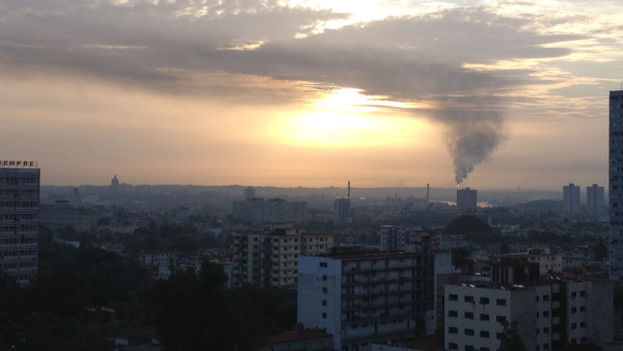
Sunrise in Havana (14ymedio)

14ymedio, Reinaldo Escobar, Havana, 18 December 2014 – At 7:00 in the morning this December 18th the sun appears on the horizon at 120 degrees to the east. The smoke of the refinery and the capricious clouds help create that kitsch of nature that is the sunrise. Everything seems to be the same on the island, but Cubans can now see an invisible ray of hope opening up.

Today is the first day of a healing process, or it could be, not to be guilty of excessive optimism. Starting now, in an almost unexpected way, the historic difference between Cuba and the United States will modify its character. There will be a tweaking of language and the first word to disappear will be “enemy,” for which “neighbor” may be substituted, not the most endearing of terms but also not one that exudes so much hatred. continue reading

Whether the glass is half empty or half full is a sterile speculation, never engaged in by thirsty people living in a desert. We read and reviewed the speeches, surprised by the surprises and disappointed by what omissions. Today is a new day, not in our calendar, but in History. We are obliged to recognize that, at the very least, we had been making fools of ourselves by holding on to an anachronistic agenda.

From here until April, when the Summit of the Americas takes place in Panama, the entire world will have its eyes set on the government of Cuba. There will be many attentive eyes and many proponents of the expected confrontation, be it a brief detention, an impediment to getting to a meeting, the slightest sign that serves to demonstrate that Raúl Castro doesn’t deserve such a vote of confidence. They know it and will have to choose between loosening the repression or letting the world down.

I am betting that they will let the world down, but I am hoping to lose the bet. All the signs and accumulated experience clearly say that this only a new maneuver to win some time and to allow them to get away with their schemes, but this is also an unprecedented move and things can always turn out differently. The most important thing is that the domino game has been shaken up and it is time to move the pieces.

An Intelligent Accord / Fernando Damaso

Finally, after more than fifty years of tensions, contradictions, offenses and mutual aggressions, the governments of Cuba and the United States have reached agreements that demonstrate intelligence and a sense of responsibility on both sides, the primary accord being the reestablishment of diplomatic relations.

This first step has required the efforts of various personalities and governments, strikingly among them the work of Pope Francis and the government of Canada, as well as others which have not been mentioned specifically.

The freeing of prisoners here and there, which was a minor obstacle (although for years it has been inflated and used for propaganda in the national circus) became a springboard for what was truly important. Now today, in spite of the outdated revolutionary rhetoric to which our authorities are addicted, they have faded to the background, outshone by the truly transcendent news. Of course, this doesn’t mean that we will be free of seeing them on our TV screens, like test patterns, for the next few days. This seems to be a necessary evil. continue reading

It’s no secret to anybody that, for a long time now, this decision has been in the works undercover. The build-up of telltale signs was significant. Besides, both the US president, with the setbacks suffered in the so-called mid-term elections which showed his loss of popularity — and the Cuban president, with a country in spiraling crisis and with no truly effective measures to resolve problems nor generous sponsors to give a hand — were edging ever closer to their respective abysses.

The decision that was reached deserves plaudits, not only for what it represents at this time, but also for what it promises, because it will open the way for other fundamental economic, political and social steps in the right direction. To maintain the change announced from this dialogue and the common actions to be taken for the wellbeing of both people, should be the priority of each day.

This will require mutual consideration, the elimination of insults and offensive statements from public statements, respect for differences of all kinds, and a true climate of liberty for all Cubans.

May intelligence and responsibility continue to be at the forefront!

Translated by: Alicia Barraqué Ellison

18 December 2014

The Cuban Wall and the Changes of 1989 / Juan Juan Almeida

Twenty-five years later some people are still trying to knock down a piece of the Berlin Wall.

On November 9 and 10, 1989 Germany experienced an event that quickly and with just enough lubrication sent the rusty wheel of history spinning. It was an event that marked the beginning of the end of European socialism: the fall of the Berlin Wall.

Such a seminal event did not come out of nowhere. It was not a coincidence nor did it happen spontaneously. There were events leading up to it.

Protests were growing in Leipzig, Dresden, East Berlin and other cities demanding democratic change. The government of the former German Democratic Republic was unable to cope with the ever growing number of its citizens fleeing to Federal Republic of Germany and West Berlin. continue reading

Looking for a way to ease the pressure of an untenable situation, on May 2 of that year a group of Hungarian soldiers dismantled the barriers at the border with Austria and for the first time opened the door to the free world, allowing Germans to flee west through Hungary.

But rather than serving as a release valve, it turned out to be a boomerang. Popular discontent grew in breadth and scope. By October a revolution seemed imminent.

Faced with tangible indications of the beginning of a mass exodus and widespread social unrest, the members of the Council of Ministers were forced to resign.  A couple of days later the borders separating the two Germanys and the two Berlins lost their reason for being.

This event and everything that followed were historic. There were also consequences for German unity, for employment, subsidies and the retirement age.

When the archives are opened, which will one day happen, we will be able to delve into and fully analyze the reasons why the roar of communism’s collapse did not create a tsunami in Havana.

During that time Cuba’s leaders certainly were not bothering to hold meetings. As never before, the state and government were subject to the rulings of the Communist Party.

On Fidel Castro’s orders, and without protest or any opportunity to question, an already fragmenting society was shattered to pieces. Propaganda strategies were devised to neutralize opinions coming from the other side and filtering out of Cuba. Warnings were issued and limits were set on free expression.

The ghosts of loneliness, of war and stoicism became the fuel that provided justification for the shift of the nation’s economic development into reverse, which in turn attracted cash and sympathy from overseas Cubans who, as was reasonable to expect, rushed to lend aid to family and friends living on the island.

It is virtually impossible to imagine that at any given moment a massive social uprising would occur in light of the aid coming from family members and because the stagnant economy forced many Cubans to adapt to circumstances.

The government used cunning to alter people’s better judgement. Twenty-five long years have passed since that event and Cuba’s dictatorship is still in place. Isn’t it about time to change strategy?

21 November 2014

The opposition hopes that a dialogue will open between the Government and civil society / 14ymedio

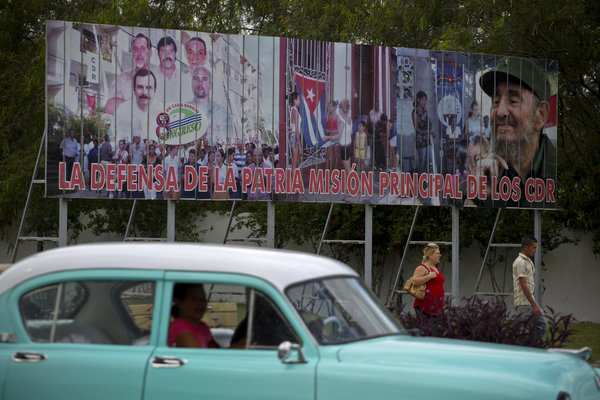
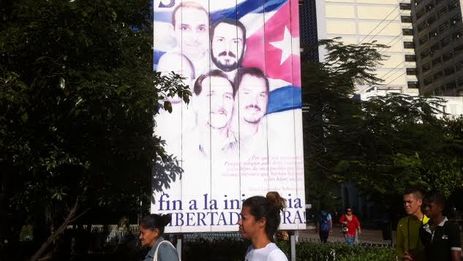
Poster on a Cuban street demanding the release of "The Cuban Five"
Poster on a Cuban street about the release of “The Cuban Five”

14ymedio, Santiago de Cuba, 18 December 2014 — The news of the reestablishment of relations between Cuba and the United States has been embraced by opposition organizations in Cuba with optimism and hope that this agreement may facilitate the establishment of a dialogue between the Government and civil society on the island.

The Patriotic Union of Cuba (UNPACU), in a statement issued on Thursday, stated that the Cuban government has lost its “great alibi” to justify repression and the lack of human rights in Cuba. “Any change, and especially the loss of an excuse for repression, can create a space for the people to reclaim their voice, lost for over half a century.” continue reading

The organization welcomes the commercial opening that can result from negotiations with the European Union and the United States, and states as long as it is accompanied by a change with regards to the rights of Cubans, it could be positive “for post-Castro democratization.”

“Although the increase in funds for a totalitarian State will make repression more effective, UNPACU accepts the challenge of confronting it, if, over the long term, the Cuban people benefit from an increase in economic and material well-being,” the organization said.

The statement concludes by noting that repression has continued in recent days on the island and that the Government has continued to detain opponents, and it calls on all democrats to ensure that “current reality is not subjugated to the latest news.”

The Pinar del Rio magazine Convivencia (Coexistence) founded by Dagoberto Valdés, has also issued a statement through which it welcomes the resumption of diplomatic relations between both countries, and hopes that the climate of dialogue is extended to independent civil society “based on respect for unity” and “the exercise of sovereignty”.

The release of the political prisoners gives joy to the magazine’s Editorial Board, which reminds us that the Cuban Government should ratify the United Nations covenants on Human Rights.

Convivencia places special emphasis on the intervention of Pope Francisco as a mediator in the dialogue between the two countries and hopes that the Church continues to intervene between the opposition and the authorities.

In addition, the Editorial Board said that the agreement between Obama and Castro will show that the fundamental conflict “is between the Cuban government and its citizens, not between Cuba and the United States.”

Convivencia hopes that this historic event and the lifting of all blockades, especially the one the Cuban government sustains over the initiative and entrepreneurship of its own citizens, allows the creation of the conditions necessary for the Cuban people to be the protagonists of their own history,” the statement concludes.

Reactions that won’t appear on the news / Regina Coyula

I was in the salon stretching my feet, and although some of the women there had never heard a thing about Alan Gross and acknowledged their inability to recite the names of “The Five,” the news of the re-establishment of relations with the United States was greeted with jubilation by that heterogeneous group, and yes, there was unanimity in that. While one threw kisses to the image of Obama on Telesur, I had to slightly cool the enthusiasim of those who thought (and it was more than a few) that reestablishing relations and lifting the embargo were the same thing.

The best was the only male, a young man who was getting a complicated haircut with designs. The triumphant boy rose from his seat at the risk of ruining the hairdresser’s work and raised his arms as if he’d scored a goal, with the phrase: “This is our Berlin Wall!”

17 December 2014