Our authorities have always been preoccupied with extolling the originality of anything coming out of Cuba. Our freedoms, socialism, democracy, human rights, political and economic system, electoral process, governmental bodies, political and grass-roots organizations, and everything else are unique and unlike anything comparable in the rest of the world. Furthermore, it is argued — with scant modesty — that they are the best and most perfect. What is striking is that this unhealthy addiction to being different applies only to the outside world. Differences within the country, among Cubans themselves, are not acceptable.
Dictating how things are to be done has become a daily and unhealthy practice over the years, especially when done by those have held and still hold absolute power. We have seen the imposition of a political, economic and social system, one-party rule, a socialist Constitution, basic laws, organizations and associations, educational, cultural, and moral standards, and many other things that should have involved consultation with citizens and should have been freely approved or rejected by them. continue reading
The disastrous results are plain to see. The country has regressed as never before in its history, including even during the most critical times.
Even today, in spite of declarations to the contrary, we continue seeing efforts to dictate.
Wouldn’t it be more intelligent to have a dialogue and look for consensus?
When I suggest dialogue, I do not mean conversations between people who think alike, which is what we have now, but between those with differing opinions. The results would undoubtedly be better. An exchange of views in a respectful and constructive climate might yield wonderful solutions. Why not try it? We stand to lose nothing more than we have already lost from the now obsolete monologue.
Cubanet, Martha Beatriz Roque, Havana, 2 April 2015 — Whenever the topic of democracy and the Cuban regime comes up, the top leaders say that this is the most democratic country in the world. The latest version is that “‘democracy’ is subject to interpretation, and every country understands it in its own way.”
This also occurs with citizen participation, which assumes a receptivity on the part of government officials to listen to what the citizens want to communicate to them, to help improve the politics and management of public concerns. It means that all who want to get involved in matters that affect the people will be heard, and they will be allowed to contribute their points of view, concerns and possible solutions.
Even so, although the regime talks a good game, the totalitarian power looms over the practically null power of the people, which makes citizen involvement quite difficult in Cuba, thus preventing the growth of participatory democracy. continue reading
Today, in the modern democratic society, another way in which citizen participation takes place is through Non-Governmental Organizations (NGOs) which, in most cases, push for certain social and humanitarian causes.
The regime in general pays very little attention to the participation of the citizens, however through “opinion surveys,” which it conducts constantly, it knows perfectly well what they are thinking, but there is no interactivity in the process.
And the issue, according to the Constitution of the Republic in its Article 62, is that none of the recognized liberties of the citizens can be exercised against what is established in the Constitution and the laws of the land, nor against the existence and ends of the Socialist State, nor against the decision of the Cuban people to construct socialism and communism.
It is for this reason that to maintain a majority control of citizen participation, there are those inappropriately named NGOs – the ones which the regime wants to be recognized as members of the civil society, and which in the official context are called “mass organizations.” Notable among these are the Committees for the Defense of the Revolution (CDRs).
This organization was founded by Fidel Castro on September 28, 1960, in a public ceremony in front of what is today the Museum of the Revolution, with the objective of carrying out acts of collective vigilance against foreign meddling and acts of destabilization committed against the Cuban political system.
The CDRs have a structure controlled by the State which, besides their social labors, performs the principal mission of monitoring and controlling the public and private lives of individuals and all the neighbors, on a very close level.
Automobile of the National Leadership of the CDR, with a State license plate (author photo)
Despite their being considered an NGO, it can be publicly seen that the CDR supplies come from the government, even though they collect a monthly per-member fee of 25 cents in national currency for financing their operations. For example, the cars driven by the nomenklatura of the CDR—at all levels—bear the organization’s logo and a State license plate. They have a considerable number of buildings to maintain the provincial, municipal and zone structures. If only one of these organizational levels were eliminated, housing could be provided to some of the families in the country who have no roof over their heads.
One of the official arguments for considering the CDRs as promoters of citizen participation in the common good, is its intervention in elections. According to Article 68 of Law # 72 (the Electoral Law), the CDR includes the Candidacy Commission, along with other supposed NGOs, such as the Cuban Workers Center (which the CDR presides over), the Federation of Cuban Women, the National Association of Small Farmers, the Federation of Secondary Students, and the Federation of University Students.
The CDRs are in charge of keeping current the Registry Book of Addresses, which is the official roll in which all citizens must register when they move from one location to another. In most cases the official in charge of the registry is the president or the person responsible for neighborhood monitoring. It is difficult to comprehend that an official document that serves, among other things, to keep lists of voters, is in the hands of a non-governmental agency. Even less understandable is that the Law stipulates that those responsible for these registries must produce, within fifteen days following the publication of the call to vote in the Official Gazette of the Republic, a list of citizens who reside in their areas of purview who have, in their judgment, the right to vote, according to established law.
In addition, the CDRs are the font of primary information for the “verification” done of individuals by their workplaces, the police, State Security, etc. – which implies, by the same token, an obligation to the state, and an official linkage.
Among other duties they perform: blood donation, street sweeping on designated dates, collection of raw materials, participation in repudiation rallies against those who dissent from the regime, and the constant monitoring of the neighbors in their block. In some coastal areas they support the fight and vigilance against possible drug importations via the seas that surround the Island. They have quotas to achieve in the mobilizing campaigns to recruit participants for the parades and demonstrations in the Plazas of the various provinces.
It wouldn’t be surprising to see a television program of official accounting, from the Interior Ministry, titled, “On the Trail of….,” in which they publicly show that their main source of information are the CDRs.
Site of the National Headquarters of the CDR (author photo)
It is possible that they also consider it citizen participation to nominate those persons, during neighborhood meetings, who should be sold television sets or be assigned telephones. They have been so involved in State matters that, even during the Mariel Boatlift, they were ordered to give away the houses that were left vacant.
The CDRs violate human rights, because they have been involved in “acts of repudiation,” which have included abuse, intimidation, and, on occasion, physical mistreatment, against those who have been deemed “counterrevolutionaries,” or enemies of the Revolution. Still today, in the minds of two of the generations that have lived through the dictatorship, memories persist of the events of Mariel, in which the CDRs actively participated, harassing entire families, physically and verbally mistreating them, simply because they wanted to emigrate.
Although throughout the entire existence of this organization, numerous reasons can be identified which support the contention that the CDR is indeed an “official” entity, one would have to particularly name the fact that its National Coordinators have been members of the Council of State in the eight legislatures conducted to date: Jorge Lezcano Pérez, Armando Acosta Cordero, Sixto Batista Santana, Juan Contino Aslán, and Juan José Rabilero Fonseca. They were all representing this “NGO” until 2013. By the same token they were all at some point members of the Central Committee of the Communist Party of Cuba.
This is the citizen participation of which the Castro dictatorship will boast, through its official spokespersons, at the Seventh Summit of the Americas.
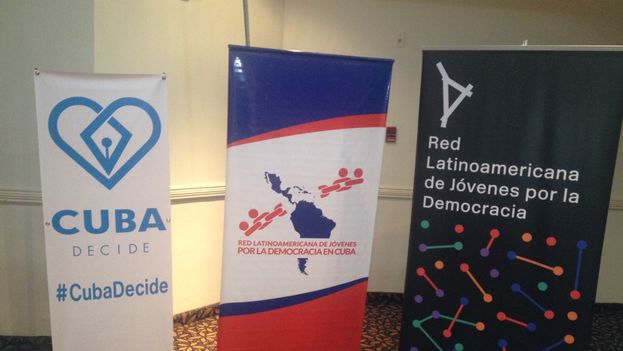
The site of Youth Movements Forum, held Monday in Panama. (14ymedio)
14ymedio, Havana, April 6 2015 – Rosa María Payá, daughter of the late Cuban activist Oswaldo Payá, has announced this Monday the creation of the citizen initiative Cuba Decide, or “Cuba Decides.” The goal of the project, presented during the Forum of Youth Movements in Panama, is for Cubans to pronounce themselves through a plebiscite regarding the changes they would like to implement on the Island.
“We are conscious that only Cubans should define and decide on the changes that our society needs,” states the group’s website. “In order for citizens to be able to design, decide and construct their future, their rights should be guaranteed by the law and an atmosphere of trust and respect for all should also be achieved. That is what we proclaim and we work for a plebiscite that will consult the people in that matter. There will be no transition to democracy in Cuba if Cubans are excluded once again.” continue reading
The initiative advocates for the calling of “free, just, and plural” elections in an atmosphere in which the freedoms of expression, press, and assembly into political parties and plural social organizations are respected.
“No one should question that the changes desired by the Cuban people are those of freedom, reconciliation and full and guaranteed rights. Opposition within Cuba and abroad works and battles peacefully to achieve these goals. However, our greatest deficiency is that we have no voice, nor the democratic tools needed to express ourselves while the government and some others around the world pretend to speak on behalf of our people,” reads Cuba Decide’s website.
The project presented by Rosa María Payá accuses the Cuban government of being responsible for repression and violence against those with alternative opinions and initiatives and blames the absence of an environment that respects the law and self-determination for the “social and economic failures, as well as the constant and massive exodus of citizens” from the Island.
The proposal seeks to give continuity to the Varela Project, promoted in 1998 by Oswaldo Payá with the aim of enlarging individual liberties in Cuba. Payá achieved the collection of the more than 10,000 signatures required by the Cuban Constitution for the proposal of legislative amendments. The National Assemble, however, rejected the proposal as inconsistent with the law.
Cubanet, Luis Cino Alvarez, Havana, 30 March 2015 — Despite the fact that on the three occasions I ever visited Varadero my experiences were not particularly pleasant, that beach – which today for the majority of Cubans is almost as inaccessible as Waikiki – occupies a special place in my nostalgia.
The first time I was at Varadero was in November, 1970, during the Festival of the Song. I was 14 years old. I went with two friends who were more or less my age, fleeing our homes and playing hooky from school, chasing after the Spanish pop groups Los Bravos (without Mike Kennedy), Los Angeles and Los Mustangs. They weren’t really our top favorites (at the time when we had still not resigned ourselves to the break-up of The Beatles, we were crazy for Led Zeppelin, Chicago, Creedence Clearwater Revival and Santana) but in the ideologically pure Cuba of the period, one could not aspire to something greater. Plus, we wanted the performances by those Spanish groups – despite how abysmally bad they sounded – to be our own version of Woodstock.
But the police rained on our parade. We ended up in a police station that stank of shit and where from a poster on the wall the Commander in Chief [Fidel] stared at us, scowling. I don’t know if his angry expression was due to our insolent ideological diversionism, or because the 10 Million Ton Harvest failed, and he had to devote himself to turning the setback into a victory at the expense of Nixon, whose name at that time was invariably spelled with a swastika in the newspaper, Granma. continue reading
By throwing us in the pokey, they almost did us a favor, because outside it was as cold as Kamchatka. The bad part was when the officers started to talk about cutting our hair, and we heard one say, “These guys are gonna get scalped.”Luckily these were no more than idle threats. They let us go at the Cárdenas terminal with the warning, “Get the fuck out here right now, Punks.”
My second visit to Varadero was in the summer of 1979. I went with my wife. We arrived unexpectedly, with a few clothes in a backpack. At that time, Varadero was not only for foreign tourists. Even so, we had to spend the night between the “Park of the Thousand Box Offices” and the sands of the beach. When the police threw us out of the park, we went to the shore. We drank Coronilla brandy, made love among the casuarina trees, and later, despite the mosquitoes, fell asleep in the sand. We were awakened by the border patrol, with dogs and bayonets, who told us that we could not spend the night on the coast. We then returned to the park, sans police. At dawn we returned to the beach and, when the sun was out, got into the water to wake ourselves up.
We were only able to obtain lodging (very reasonably priced) in a little wooden “hotel,” the Miramar. As old and decrepit as it was, I suppose it no longer exists.
We had a great time: all day on the beach, and at night we would go dancing to the beat of The Bee Gees at the La Patana club. The only downside was the couple in the room next door. When they made love, they would screech as if being murdered. Their screams penetrated the wooden walls, as if inviting one to emulate them – or to switch partners, because with all that racket, it was as if we were all entangled together in the same bed. When we finally caught sight of them one morning at the hotel entrance, these sexual athletes turned out to be a little chubby peroxide blonde, and a skinny guy with a mustache, nearsighted glasses and the look of an official from the Central Planning Council.
The third and last time that I was in Varadero was in 1986, during an excursion on a “day for outstanding employees” that my wife won at the State company where she worked. We went with the oldest of our sons, who had not yet turned three years old. All went well, until we ran out of drinking water and, while searching for a faucet where we could fill several bottles, we lost the boy’s left shoe. This was a real tragedy because that pair of Chinese Gold Cup shoes had cost us a fortune at the Yumurí store.
Since that time, I have not returned to Varadero – a place at first reserved for foreign tourists and the privileged elite, and now on the way to becoming a global resort, without an identity, depersonalized, only for the rich. Or rather, what we Cubans in our indigence understand to be “rich.” I don’t want to feel discriminated against, humiliated, or to be expelled in a worse way than I was back in 1970 – keeping in mind that, in the logic of the security personnel who watch me, a dissident would be much more troublesome than a kid disguised as a hippie.
Varadero, in my mind, continues to be associated, in a certain way and in spite of everything, with happiness. I don’t want to ruin that image.
The first time I was at Varadero was in November, 1970, during the Festival of the Song. I was 14 years old. I went with two friends who were more or less my age, fleeing our homes and playing hooky from school, chasing after the Spanish pop groups Los Bravos (without Mike Kennedy), Los Angeles and Los Mustangs. They weren’t really our top favorites (at the time when we had still not resigned ourselves to the break-up of The Beatles, we were crazy for Led Zeppelin, Chicago, Creedence Clearwater Revival and Santana) but in the ideologically pure Cuba of the period, one could not aspire to something greater. Plus, we wanted the performances by those Spanish groups – despite how abysmally bad they sounded – to be our own version of Woodstock. .
But the police rained on our parade. We ended up in a police station that stank of shit and where from a poster on the wall the Commander in Chief [Fidel] stared at us, scowling. I don’t know if his angry expression was due to our insolent ideological diversionism, or because the 10 Million Ton Harvest failed, and he had to devote himself to turning the setback into a victory at the expense of Nixon, whose name at that time was invariably spelled with a swastika in the newspaper, Granma.
By throwing us in the pokey, they almost did us a favor, because outside it was as cold as Kamchatka. The bad part was when the officers started to talk about cutting our hair, and we heard one say, “These guys are going all the way.” Luckily these were no more than idle threats. They let us go at the Cárdenas terminal with the warning, “Get the fuck out here right now, Punks.”
My second visit to Varadero was in the summer of 1979. I went with my wife. We arrived unexpectedly, with a few clothes in a backpack. At that time, Varadero was not only for foreign tourists. Even so, we had to spend the night between the “Park of the Thousand Box Offices” and the sands of the beach. When the police threw us out of the park, we went to the shore. We drank Coronilla brandy, made love among the casuarina trees, and later, despite the mosquitoes, fell asleep in the sand. We were awakened by the border patrol, with dogs and bayonets, who told us that we could not spend the night on the coast. We then returned to the park, sans police. At dawn we returned to the beach and, when the sun was out, got into the water to wake ourselves up.
We were only able to obtain lodging (very reasonably priced) in a little wooden “hotel,” the Miramar. As old and decrepit as it was, I suppose it no longer exists.
We had a great time: all day on the beach, and at night we would go dancing to the beat of The Bee Gees at the La Patana club. The only downside was the couple in the room next door. When they made love, they would screech as if being murdered. Their screams penetrated the wooden walls, as if inviting one to emulate them – or to switch partners, because with all that racket, it was as if we were all entangled together in the same bed. When we finally caught sight of them one morning at the hotel entrance, these sexual athletes turned out to be a little chubby peroxide blonde, and a skinny guy with a mustache, nearsighted glasses and the look of an official from the Central Planning Council.
The third and last time that I was in Varadero was in 1986, during an excursion on a “day for outstanding employees” that my wife won at the State company where she worked. We went with the oldest of our sons, who had not yet turned three years old. All went well, until we ran out of drinking water and, while searching for a faucet where we could fill several bottles, we lost the boy’s left shoe. This was a real tragedy because that pair of Chinese Gold Cup shoes had cost us a fortune at the Yumurí store.
Since that time, I have not returned to Varadero – a place at first reserved for foreign tourists and the privileged elite, and now on the way to becoming a global resort, without an identity, depersonalized, only for the rich. Or rather, what we Cubans in our indigence understand to be “rich.” I don’t want to feel discriminated against, humiliated, or to be expelled in a worse way than I was back in 1970 – keeping in mind that, in the logic of the security personnel who watch me, a dissident would be much more troublesome than a kid disguised as a hippie.
Varadero, in my mind, continues to be associated, in a certain way and in spite of everything, with happiness. I don’t want to ruin that image.
Author’s Email Address: luicino2012@gmail.com
Translator’s Notes:
*The title of this piece is taken from a line in the song, Conocí la paz, sung by legendary Cuban singer, Beny Moré. Varadero is a beach resort town in the province of Matanzas, Cuba.
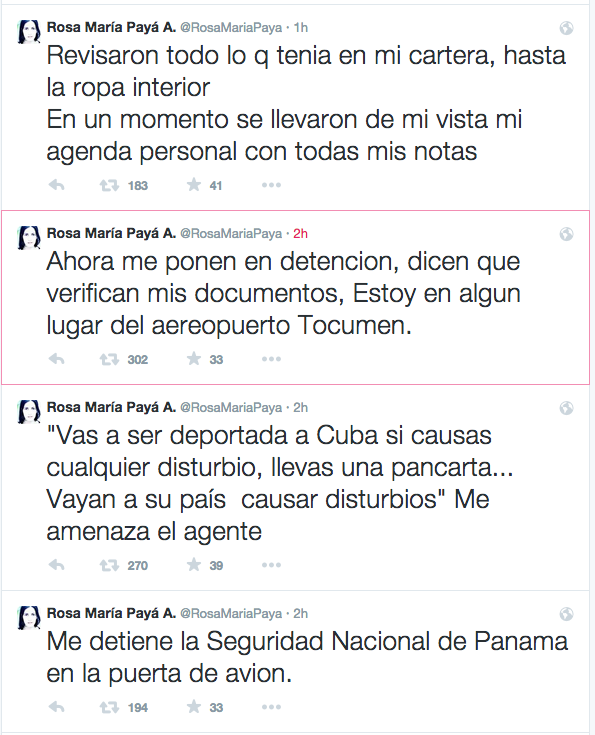
14ymedio, Havana, 4 April 2015 – When they got off the plane at the airport in Panama Saturday, immigration officials confiscated the passports of six young Latin Americans, including three Cubans who arrived from Costa Rica, where they had been participated in activities organized by the Liberation Movement Party and the Latin American Youth Network for Democracy.
The three Cubans are part of the first group of independent civil society arriving in Panama to participate in forums parallel to the Summit of the Americas. They are Eliezer Ávila (Somos+ / We Are More), Kirenia Yalit (Roundtable of Cuban Youth, MDJC) and Yasser Rojas (Cubalex).
“It was very clear that officials had a completely erroneous information about the purposes of our trip,” Eliezer Avila told 14ymedio. “Someone had communicated to them that we were coming to ‘sabotage the activities of the Summit,’ they explained to us during a two-hour interrogation in a closed room.” continue reading
After checking the data of the six young people and crosschecking them with the list of those invited to the forum, they concluded that everything was in order. “They apologized to us for the inconvenience and pointed out that all they want is to ensure that there no problems during the summit,” added the leader of Somos+.
According to Ávila, “This experience should serve those who come after us, because this incident indicates that the long arm of the Plaza of the Revolution came to Panama to undermine the terrain at every step of the way for those with a voice that is not governed the script of the Communist Party.”
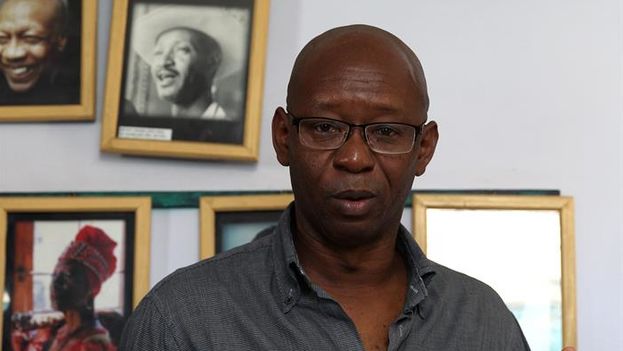
Manuel Cuesta Morua during the press conference this Friday (EFE / Alejandro Ernesto)
14ymedio/EFE, Havana, 3 April 2015 –Several leaders of the Cuban opposition and independent civil society made public Friday a document title “A United Message to the Seventh Summit of the Americas” under the slogan “Yo soy Cuba” (I am Cuba). In the text they point out that the “ the full insertion of the Cuban government in the inter-American system is incompatible with the principles of the Inter-American Democratic Charter.”
The document is signed by Felix Navarro, Pedro Luis Boitel Party for Democracy; Manuel Cuesta Morua, Progressive Arc; Guillermo Fariñas, United Antitotalitarian Front; Iván Hernández Carrillo, Trade Unionist; José Daniel Ferrer, the Patriotic Union of Cuba; Carmelo Bermúdez Rosabal, Progressive Arc; Juan Antonio Madrazo, Committee for Racial Integration, and groups such as Citizens for Democracy, Municipalities in Opposition, among others. continue reading
The signers enumerated at least seven points that demonstrate the undemocratic nature of the Cuban government. Among them are the repression, the existence and political prisoners and prisoners of conscience, the harassment of entrepreneurs, the unwillingness to ratify the United Nations Covenants on Civil, Political, Economic, Social and Cultural Rights, the existence of a single-party regime that does not allow the alternation of power, the inability of citizen to choose among different political alternatives, and the prohibition of multi-party representative democracy.
Their purpose is that the Summit of Americas, on April 10-11, is an “opportunity” to recognize “the legitimacy of the independent Cuban civil society within the island and in the diaspora as a valid interlocutor of the Cuban people,” opponent Manuel Cuesta Morúa, leader of the Cuban Progressive Arc Party said today.
Cuesta Morúa explained that the Ladies in White are not currently included because the project promoters have not been able to talk to the leader of the women’s group, Berta Soler, because she is outside the country, although they have not ruled out that she will join with them in Panama, during the summit.
In any case, there are more than dozen organizations behind this project representing what they call “independent civil society” within Cuba and in exile, groups that “cover the entire political spectrum,” said Cuesta Morúa.
He will be one of those charged with carrying this united proposal to the social forums of the Summit of the Americas, a meeting the Cuban government will attend for the first time and that will be the site of the expected meeting between the presidents of Cuba, Raul Castro, and of the United States, Barack Obama, the first after their diplomatic thaw.
Besides Cuesta Morua and Fariñas, other dissidents who will attend in Panama include Berta Soler, the leader of the Ladies in White; Elizardo Sanchez of the Cuban Commission for Human Rights and National Reconciliation (CCDHRN); and representatives of UNPACU, although not its leader José Daniel Ferrer.
Ferrer, who is not allowed to leave the island because he was one of the political prisoners of the “Group of 75” released on parole in 2010, is one of the charged with organizing a social forum parallel to the summit in Panama within the island.
On April 10 two civil society forums will be held in Cuba, one in Santiago de Cuba and another in Havana, to present the “united message” within the island as well, and to gather people’s proposals with regards to what to work on going forward.
“It will be about a coming together of those of us who feel ourselves to be members of the democratic open forum to share views about the need for changes in human rights, freedoms and the election system, given that Cuba is not the only country on the continent with a single party,” Ferrer explained to EFE.
In the joint statement, these groups demand that Cuba’s participation in the summit for the first time serve the ends of the final insertion of the island into the inter-American system following the principles of the Inter-American Democratic Charter.
In this sense, they denounce the repression of those exercising the rights of expression, assembly and association in Cuba; the existence of political prisoners; the prohibition of a representative and multiparty democracy; the refusal to consult the people about their future; and the unwillingness to ratify the UN Covenants on civil, political, economic, social and cultural rights.
The social forums to be held in parallel with the summit in Panama, will also be attended by more than one hundred representatives of Cuban civil society and government organizations on the island.
The text prepared by these activists expresses different views and the “rich diversity, in the Agreement for Democracy, in the Points of Cuban Consensus, in the proposals of the Forum for Rights and Freedoms, and the Open Forum Four Points of Consensus.”
The document also reflects the willingness of “most of our alternatives” to “working together, in order to return Cuba as a free and sovereign nation to a hemispheric environment where democracy and institutional respect for human rights and fundamental freedoms prevail.”
Cuban Pro-democracy Organizations on the Island and in Exile bring:
A UNITED MESSAGE TO THE SEVENTH SUMMIT OF THE AMERICAS
Cuban Opposition, Civil Society and Democratic Social Actors
The Summits of the Americas must be the place for participation and representation of all the democracies in the Americas. Of their States and of their free citizens. All this passes through the increasing incorporation of civil society and social actors in the process of the Summits, such that the topics of discussion acquire real significance and it is required of governments that they represent their people.
Here we present: In the roles of the Cuban opposition, civil society and the democratic social actors that we have assumed, after a long struggle of establishment and strengthening, principles of agreement expressed from a rich diversity, in the Agreement for Democracy, in the Points of Cuban Consensus, in the proposals of the Forum for Rights and Freedoms, and the Open Forum Four Points of Consensus.
Our shared mission is the defense and promotion of all democratic principles, fundamental freedoms and human rights, that comprise the cultural, historical and political base in this hemisphere, thanks to this rich diversity. continue reading
It is clear that a strong civil society is only possible where the independence of citizens is recognized and their rights and fundamental freedoms are respected. The Seventh Summit of the Americas is the opportunity for the Western Hemisphere to recognize the legitimacy of independent Cuban civil society within the lsland and the Diaspora as a valid interlocutor of the Cuban people.
It is also the scenario to make clear that the full insertion of the Cuban government in the inter-American system is incompatible with the principles of the Inter-American Democratic Charter.
This is because of:
the repression in Cuba of those who exercise the rights of expression, assembly, association and demonstration,
the existence of political prisoners and prisoners of conscience,
the constant harassment of the nascent entrepreneurial sector,
the unwillingness to ratify the United Nations Covenants on Civil and Political Rights; and on Economic, Social and Cultural Rights, signed by the government but not ratified by the National Assembly of People’s Power,
the existence of a single party regime that does not allow the rotation of power,
the refusal to consult the Cuban people about their future and the inability of citizens to choose between political alternatives, and
the prohibition of multi-party representative democracy.
None of the goals of this Summit, which as opposition and civil society we support, may be achieved while Cuba denies the human rights, understood in their entirety, of the Cuban people.
“I am Cuba” is our motto of identity, with which most of our alternatives are committed to working together, in order to return Cuba as a free and sovereign nation to a hemispheric environment where democracy and institutional respect for human rights and fundamental freedoms prevail.
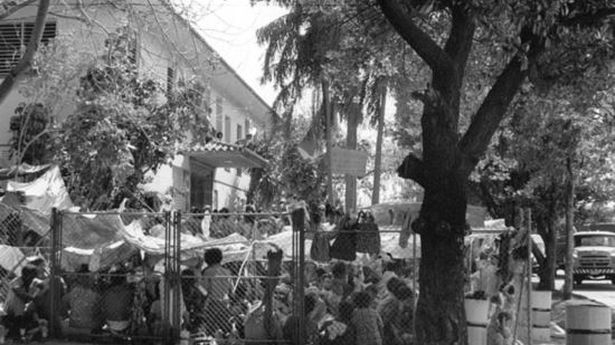
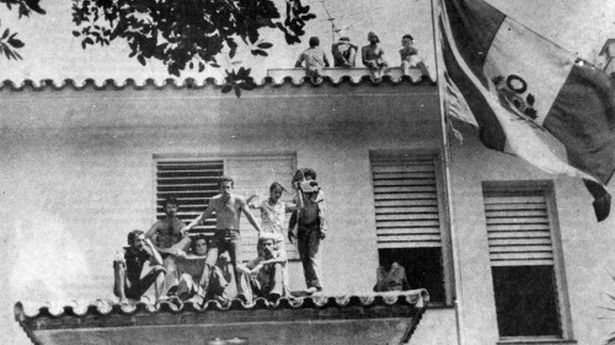
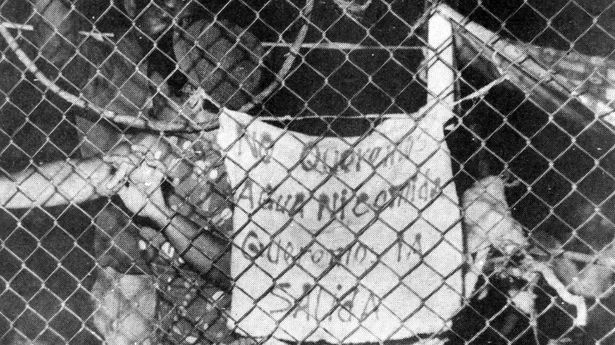
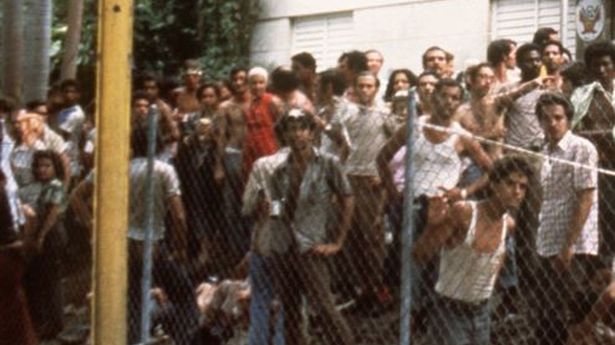
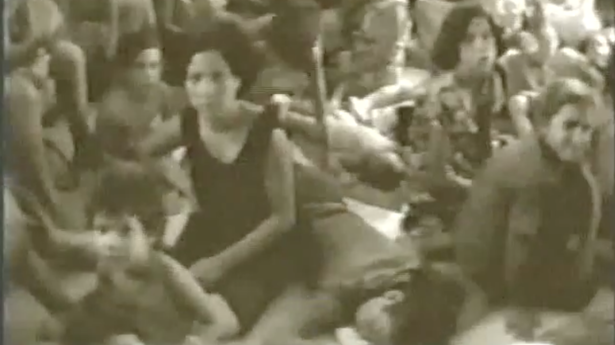
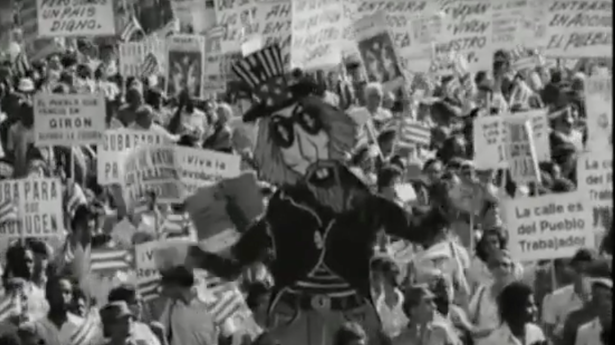
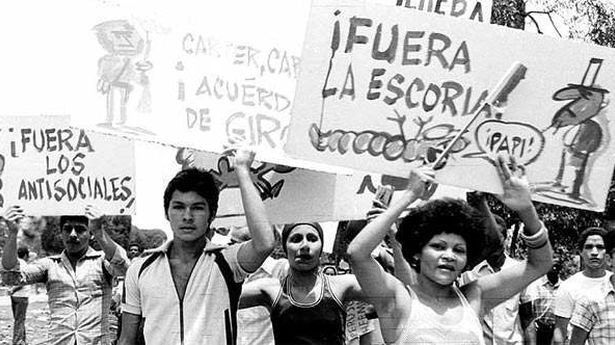
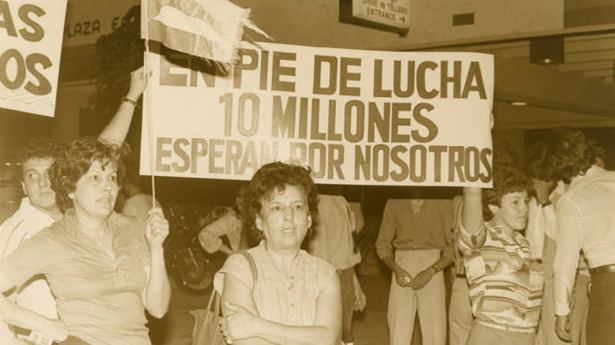
On 1 April 1980, the driver a city bus, on its regular route and full of unsuspecting Cubans, decided to crash the bus through the fence of the Peruvian embassy in Havana, looking for asylum to leave the country. The embassy refused to expel the driver and passengers from the diplomatic site and on April 4, Fidel Castro’s government deiced to withdraw military guards from the site.The Cuban government announced that those people could leave the country if they wanted, if they got a visa from a country that would take them. A few hours later, thousands of Cubans invaded the Peruvian embassy.It is estimated that 10,800 Cubans managed to enter the embassy site in just three days, and Peru offered refuge to 850 of them. Banner: “We don’t want water or food, we want to leave.”
continue reading
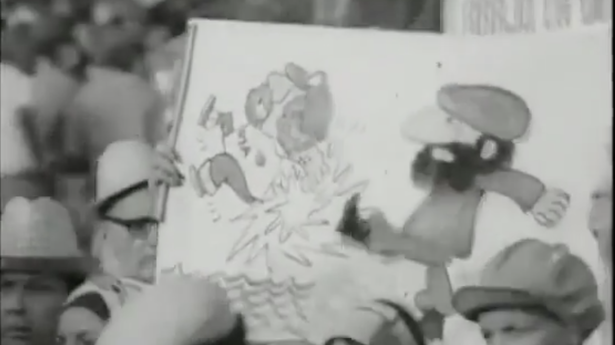
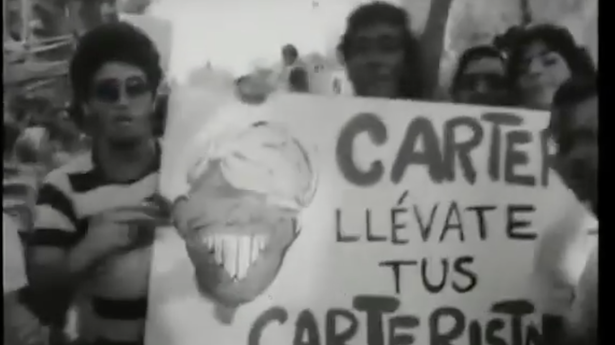
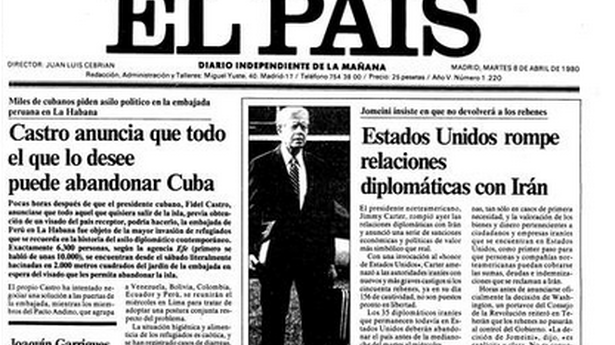
Overcrowding caused diarrhea, dehydration and gastroenteritis among the refugeesOne of the protagonists of those events, wrote in 2004 in the Puerto Rican weekly “El Veraz”: “Making that decision wasn’t easy if we consider that Fidel Castro’s regime was experiencing its best economic and political days, and had the unconditional support of the Soviet Union. The repression of those times was very strong and even having long hair or listening to American music or gathering as a group on a corner could get you arrested.”In an editorial, the newspaper ‘Granma’ branded the refugees “criminals, lumpen, antisocial, bums and parasites” and said that none of them was “politically persecuted nor in need of the sacrosanct right of asylum.”According to the editorial in the government newspaper, in the Peruvian embassy gardens there were many homosexuals, gamblers and drug addicts.Granma asserted that the Cuban people, “Unanimously think: ‘Let the bums go, let the antisocials go, let the lumpen go, let the criminals go, let the scum go’.” Poster: “Carter, take your ‘Carteristas'”Supporters of Fidel Castro’s government marched with signs calling for the “scum” and “antisocials” to be thrown out of the Island.Demonstrations in Miami supported the Cuban refugees in the Peruvian embassy in HavanaOn April 8 the front page of the Spanish newspaper “El Pais” headlined the events in Havana: “Castro announces that anyone who wants to can leave Cuba.”
In the following weeks, as a result of the events in the Peruvian Embassy, more than 125,000 Cubans left through the Port of Mariel, a figure much greater than the Camariocas exodus in 1965, when more then 30,000 Cubans left the island.
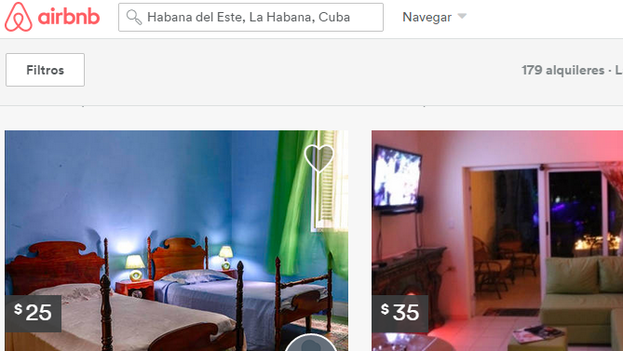
The website Airbnb offers private accommodation all over the world.
14ymedio, Havana, 2 April 2015 – Starting this Thursday, foreign tourists will be able to rent private rooms in Cuba through the service Airbnb, which directly connects homeowners and travelers all over the world.
Airbnb’s site already offers more than 1,000 properties on the Island, mostly in Havana, although also in other localities such as Morón, Camagüey, Santa Clara and Cienfuegos.
More than half of the rooms are in the capital, especially in neighborhoods such as Vedado and the Malecon. The prices for a room in a private apartment in Havana start at 23 dollars a day and go as high as $370 for an entire apartment that sleeps nine. continue reading
Offerings in other cities are much more modest and the prices are below the average for Havana. In Pinar del Rio province, for example, it is possible to reserve a room in Viñales starting at $12 to a maximum of $52 for a more luxurious accommodation.
However, there are several users offering a large number of rooms in different parts of the country. An intermediary calling himself Michael, for example, publishes 232 lodging ads in Varadero, Pinar del Rio, Cienfuegos and Soroa, among other places.
Tourism, with revenues of some 2.5 billion dollars a year, is the third largest source of foreign exchange for Cuba, after the sale of medical services (Cuban doctors working abroad) and family remittances. As of the end of January the sector had grown by 16% this year compared to last, according to official data. In the first month of the year the Island received 371,160 foreign visitors, 51,097 more than last year.
After the White House eased the rules for travel to Cuba in January, the number of travelers from the United States is expected to increase significantly, although they are still not allowed to travel as tourists.
14ymedio, Manuel Cuesta Morua, Havana, 2 April 2015 — The Summit of the Americas is the best opportunity for Cuba. For the first time since 1959, our country has and will take advantage of the occasion provided by the international community to put itself in sync with the world.
Let’s review. In 1985 the Cuban government had an excellent moment to link the country to the height of what was coming. Instead it decided not to take advantage of perestroika and the opportunity it opened, at some point, to stop the country’s structural crisis, although to do so they would have had to recognize the structural crisis of the country’s model.
In all likelihood it would not have saved socialism if the government had used the occasion to transform itself, but if would have saved, for example, the sugar industry. By not making the necessary changes, we’re left today with neither socialism nor sugar. continue reading
This second opportunity is better and distinct. Distinct, because it continues the gradual process of returning to our natural geopolitical space. Better, because for the first time the entire country is invited to this process of integration.
None of the forums in this part of the world engage Cuba in its entirety. Neither the Caribbean Community (CARICOM), nor the Community of Latin American and Caribbean States (CELAC) think about Cuba when they use the mail to open their doors to the country. For them it is about “thinking of the heights,” which only recognizes our nation through the State. No more, no less.
With the VII Summit of the Americans, everything changes. The Americas, half reluctantly among its Latin part, accept that those who disagree with the regime and those who support it against all common sense are on an equal footing.
This is a formidable challenge. Fundamentally for the democratic civil society. There we can do what we have been taught from a young age at all possible levels of education and what is projected almost daily in the Island’s communication media and from the corners of official politics, in those most hidden places of the Island. We can scream, offend, exclude and continue to focus onmoral destruction of the adversary, rather than on rational discussion of the arguments. We can also say, as the political narrative in use accustoms us to do: them no, us yes. That is, we can project ourselves in a negative way, adding impropriety to the complaint. But this is not recommended.
Panama is giving us the opportunity to close the cycle of a long transition from uncivil language to civic language
The Seventh Summit of the Americas will surely be a space of wider exposure and a more intense light than we have had for years. Surely it can be considered the greatest visibility for Cuba at any time since 1962.
And we must take advantage of this in several ways: first, to vindicate an image. The Cuban government has effectively sold, especially in Latin America and more than a few U.S. circles, the idea of an incapable people, kind of rundown without purpose or goals, just asking for benefits, and doing it directly now that we can travel.
Second, to refine the language. The language learned for too many years in Cuba is not a civil language of the civilized. They raised us on insults, on low attacks, on the primary stories of tangled and foul politics that are the ultimate negation of the civic that can’t be understood without moderation, the choice of appropriate words, tolerance and respect for the differences that make the world and civil society. Civil society is basically this: the difference that coexists with independent judgment and from social autonomy. The only thing that makes depersonalization of the conflicts and the same differences possible. Panama is bringing us the opportunity to close the cycle of a long transition from uncivil language to civil language. It brings to the Cuban government the chance to start this same transition. The faster the better.
Third, to calmly assume the legitimacy of Cuban society itself. A misconception, based on the political distortion that many States, particularly Latin American ones, make of social life is that of introducing the concept of representation, which is typical of parties, corporations and assemblies, within the values or requirements of civil society. Civil society can be managed by its representatives, but it is not more or less legitimate because it represents sectors or grups. Its legitimacy comes from the expression of different projects within society. Thus, the nature of civil society is its diversity. The more diverse it is, the richer it is. Thus, quietly: a voice is civil society even though it does not have an army behind it.
We must leave behind the language of the complaint and pain, moving to one where ideas and proposals prevail
Fourth, to send the best message of a civilized civil society: that of inclusion. We have experienced firsthand a fifty-year exclusion, which we repay in kind. A coherent defense of civil society is only possible when we include others. This assumes the risk, like that assumed by Yoani Sanchez, of including the Committees for the Defense of the Revolution (CDR), an organization formed to destroy the civil nature of coexistence from the most basic level, between neighbors and families, within the vast concept of civil society; which means for the CDRs the challenge of supporting citizens without spying on them.
Fifth, and finally, to leave behind the language of complaint and pain, moving to one where ideas and proposals prevail. Possibly the representatives of Revolutionary civil society, which answers to the regime’s discourse, be it in their critical or contemplative vision, will have an idea in one hand and stick in the other, aimed at our heads. But the best thing for us is to have two ideas, one in each hand, to share in a space where many, if not all, will be attentive to our staging. This must be worthy of the best theater.
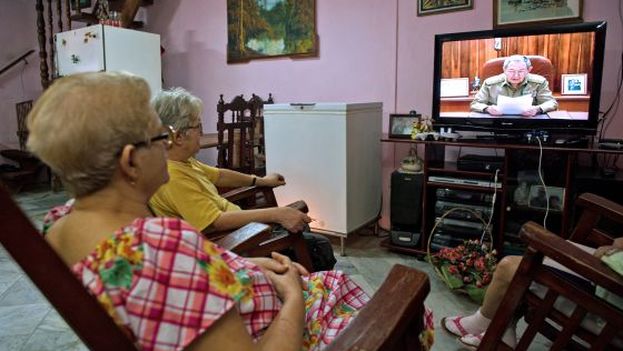
In Cuba, housewives spend six hours a day watching television. (El Pais)
14ymedio, Yoani Sanchez, Havana, 3 April 2015 — He is the king of the room. With his screen and speakers, no one looks away or ignores him. In front of our television sets, millions of Cubans have cried, laughed, and spent a good part of our lives. Now, thanks to new technologies, our relationship with this “idiot box” could begin to change. The devices that convert our little screens into computers are already here and are an option to computerize our families.
Google has launched the market for devices that convert TV sets into intelligent machines that help us to calculate, write, connect to the Internet and countless other functions. The device that achieves such a wonder resembles a USB flash drive, like the ones we’re used to passing from hand-to-hand to share information, audiovisuals, videoclips and programs. However, unlike these flash memories used to store data, the new creature conceived in Mountain View, California, holds within it the potential of a computer. continue reading
In the last census of population and housing, conducted in 2012, Cubans confessed to owning 759,164 black-and-white TVs, while 2,922,099 of their more sophisticated relations throughout the country had color TVs. It’s worth using the word “confess,” because it is still a very common practice to hide from the State’s prying eyes any technological infrastructure one relies on. “To the police, better to throw them off the scent,” we teach our kids at home, and all official surveys will be burdened by this component of popular suspicion.
It should be taken as certain, however, that in the majority of Cuban homes there is one of these “self-sufficient fatties” bellowing away all day long. Even in the poorest households, where there is no supply of drinking water and the sheets covering the bed are worn down to barely more than “onion skins” or lacking altogether, there is a television. Our whole culture is intrinsically linked to this box of miracles that dazzled our grandparents, indoctrinated our parents, and will help to free our children.
A device that manages to convert this screen that talks to us into a piece of equipment that we interact with, will be a necessary and massive change. And if the housewife who consumes a minimum of six hours a day of telenovelas and reality shows is able to conduct business, learn a profession, manage her finances or apply for a loan from the same TV that is already in the living room? Could it transform the passivity of a consumer in to the interactivity of a user?
In collaboration with the Taiwanese technology company Asus, Google has announced the new Chromebit device that connects to modern televisions and makes them function as computers. The apparatus will arrive in the market this summer and will be available for less than $100 (U.S.), according to the company’s statement. It will be able to connect to flat screen TVs with a USB or HDMI port.
The Chromebit continues the saga of previous inventions and will provide a complete version of Google’s operating system, Chrome OS. It will also be able to connect via Bluetooth and WiFi to other devices, as well include applications able to begin working without the need to connect to the great World Wide Web. That it, it will work very well with the Internet, but it will also work without it for the inhabitants of this “Island of the Disconnected.”
Although the statistics published to date don’t tell us how many TVs in Cuba have USB or HMDI ports, a few hours spent at customs at any airport makes it clear that these appliances are flowing into the country. A brief tour of on-line classified sites also give the impression that we are going to be drowning in smart TVs.
Chromebits
Very well, if Cuba meets two characteristics tied to the Chromebit – a need to computerize ourselves and television viewing embedded in our DNA – we shouldn’t have to wait too long to see our country benefit from devices of this type. Now that Google executives have visited our island twice, could Chromebit but a project to encourage here?
If humanitarian aid works based on the concept of “don’t give me fish, teach me how to fish,” the same should apply to these telecommunications companies, which don’t have to teach us to “be free” – we carry this in our genes – but they can offer us the infrastructure to cut the chains for ourselves.
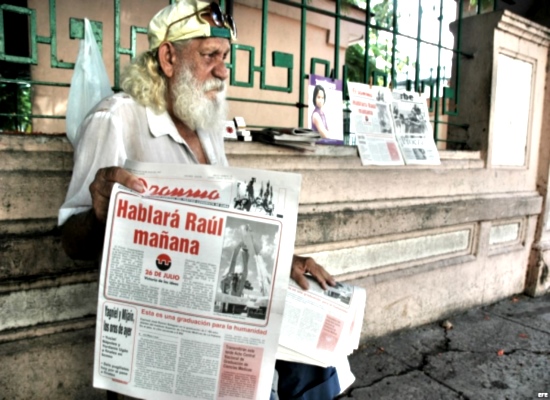
Archive photo Cubanet.org. An elderly man selling Granma. Headline: “Raul will speak tomorrow”
Montonous, grey, controlled, censored, demagogic, jingoistic, for more than half a century as spokesperson for phantom successes
Cubanet.org, Victor Manuel Dominguez, Havana, 31 March 2015 (Cuba Sindical) – The “Revolutionary” Cuban press, characterized as demagogic, monotonous, manipulative, with a grey design, poor quality paper, without stylistic and conceptual diversity, born of the mortal remains of a free press that was censored and later banned from the inception of the Revolution.
Always under state control, the role of spokesperson of governmental policy and ideology, the lack of objectivity is required, and the omission or disguising of what really is happening in the country. Faced with its pathetic role, several Cubans talked about censorship, rumors and secrecy in the national press.
The Tagline
“Still, we are lucky that we are not sentenced to jail for wiping our backsides with the image of Marx, Mao, Stalin, or the victorious face of a leader of the country on a first page, like the followers of Kim Il Sung used to be in Pyongyang,” Ernesto Penalver said ironically. continue reading
The former graphics worker for the newspaper Avance, the first media outlet closed by the revolution (1-19-1960), Penalver, at 75 years of age, resells newspapers in order to live. “Occupational hazard, sir. I cannot help but make the rounds. Although now I do it clandestinely and through the back door,” he said.
According to the septuagenarian typesetter, since the imposition by the Cuban authorities of “The Tagline” (12-27-59), a kind of opinion by the graphics workers who refuted, under each article, the supposed attacks against the Revolution, the end of press freedom that was seen coming.
“We did not write anything. The old communist agitators dictated and imposed it. After Avance, El Pais, El Mundo and the radio and television states CMQ were grouped together on March 31, 1960, into the Independent Front of Free Broadcasters (FIEL).
The unfortunate FIEL was the beginning of the end. Later would fall Diario de la Marina and the magazines Bohemia, Carteles and Vanidades, all with quality, without ideological restrictions, with diverse information, added Penalver. “In that year there was not a monkey with a brain in the press who would oppose Fidel. It was over.”
Newspaper and magazine vendor on Monte Street (photo by Victor Dominguez)
After getting up between five and six in the morning, Penalver says, he takes a swallow of coffee (if there is any), a bowl of Cerelac, if there is any left, and washes with stored water and unscented soap. Then he joins dozens of old people who stand in lines in order to buy and resell today’s national press.
Governmental Secrecy
“In Cuba we have good journalists, said a young woman who said she is named Isel. The only thing is that they are tied hand and foot, and above all, they are castrated of their opinion. Whoever steps out of the official line will never write a line in Cuba. At least in the national press. And examples abound to illustrate this point.
According to the young woman, the role of journalist hero and villain from the daily Granma in Santiago de Cuba, Jose Antonio Torres, first praised by Raul Castro in the newspaper itself and then accused as a spy and sentenced to 14 years in prison, is more than sufficient to discourage any kind of objectivity that questions the interests of the Communist Party and the revolution.
A worker from Water and Sewer Works who is tearing up Escobar Street from San Rafael to Malecon, asked if he likes the Cuban press, said, “I read between the lines. The truth is the opposite of what is said here. But, friend, what will I carry bread in or what are the kids at home going to use for whatever?”
Likewise, a lady who was buying the Cartelera supplement, with information about the month’s artistic events, said: “This is among the little that can be believed. Although sometimes you get to an exhibit or a theater, and the program is completely different. But at least it can be read.”
Later, regarding a question about the objectivity of the national press, she added, “Can print, television or radio press be believable when it talks about over fulfillments, advances, achievements, when the reality is inversely proportional to the report they give, as happens every day in this country?”
Also, she added, that hidden, almost non-existent, are the data about rates of violence in the country, the levels of drug use and prostitution, the alcoholism, thefts, some diseases, government corruption, other reports that could serve as a warning about the population’s behavior.
Another lady, who came from a battle royal to buy some potatoes at a Belascoain farmers market, said, “They don’t even blush when they talk about the victorious deployment of the potato harvest, knowing that people and they themselves have to fight and it’s not enough or to buy it from outside, from the scalpers, at two dollars a kilo. They are wholesale liars.”
Line of old people to buy and resell newspapers (Photo by Victor Dominguez)
In accord with many of those who spoke about the topic, the most read parts of the national press are the daily Juventud Rebelde’s complaints and suggestions section, Acuse de Recibo, and Granma’s letters to the editor, for being a kind of wall of lamentations where the people complain although nothing is resolved.
In these sections – a typical reservoir of calamities – are read complaints about mistreatment, dumps, collapses, blockages, withholding of wages, evictions, unfair penalties, illegal expulsion, lack of medicine, rallies, negligence, lack of control, corruption and fraud, among thousands of other acts that afflict the country’s citizens and are endemic within the Revolution.
Beyond publishing these bouts of complaint, only without solving them although the respective entities should respond to the people’s demands, Cuban journalists devote themselves to praising the phantom successes of the Revolution, and to pointing out the speck in the foreign eye of other nations at an international level, all the better if they are not members of ALBA (Bolivarian Alliance for the Peoples of Our America), CELAC (Community of Latin American and Caribbean States) or CARICOM (Caribbean Community).
Thus the press in Cuba, according to popular opinion, only serves for wrapping trash, plugging holes, stuffing mattresses, and, above all, as toilet paper in hospitals, recreation centers, work places, sports centers, schools, bus stations and homes. And maybe someone can read it from time to time.
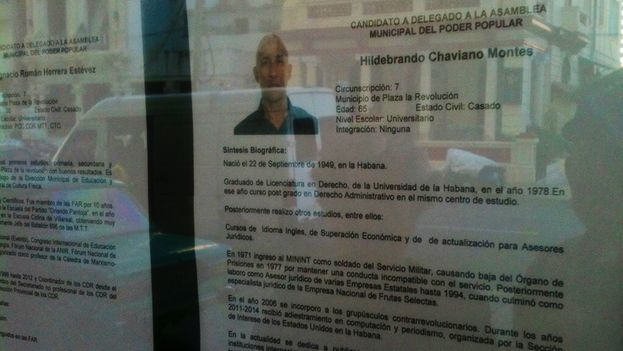
Biography of Hildebrand Chaviano Montes. (14ymedio)
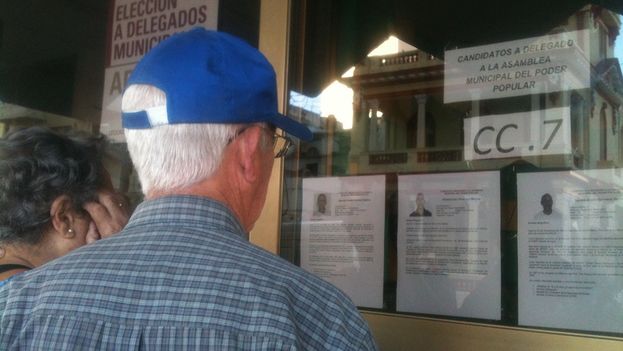
14ymedio, Havana, 2 April 2015 — The official biographies* of Hildebrando Chaviano Montes y Yuniel López O´Farrill have been posted this Thursday for the information of the voters in Havana. The two opposition candidates will stand for election in the upcoming first-round elections for delegates to the Municipal Assemblies of People’s Power — to be held on 19 April – despite having been classified as “counterrevolutionaries” by their respective Municipal Electoral Commissions.
Chaviano’s biography is posted on the ground floor of the Fosca Building in Havana, located in the district to which he belongs, and that of Yuniel Lopez O’Farrill has been placed in an office of the Julian Grimau Policlinic, where presumably the election site will be located. So far, there have been no reports of the posting of the biographies in an accessible form in any other place. continue reading
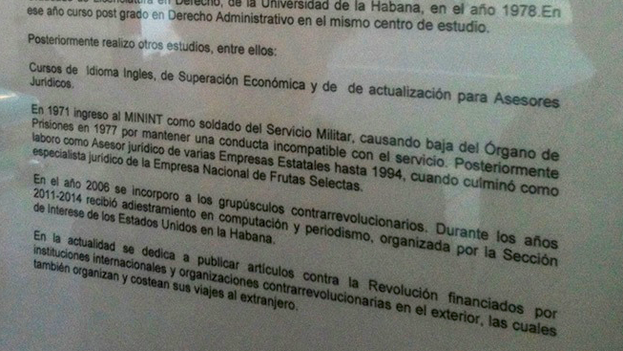
Details biography of Hildebrand Chaviano. The last two paragraphs read: “In 2006 he joined the little counterrevolutionary groups. From 2011-2014 he received training in computers and journalism, organized by the United States Interest Section in Havana. Currently he dedicates himself to publishing articles against the Revolution financed by international organizations and counterrevolutionary organizations abroad, who have also organized and paid for his trips abroad.”
Chaviano, 65, belongs to the Plaza of the Revolutiuon municipality and Yuniel López O’Farrill to the Arroyo Naranjo municipality. The first is a freelance journalist and a Law graduate from the University of Havana. His biography, written by the authorities without consulting him, says that he dedicates himself to “publishing articles against the Revolution financed by international organizations and counterrevolutionary organizations abroad.”
Voters read the biography of Hildebrand Chaviano and the other candidates (14ymedio)
The publication of these biographies, strongly criticizing the candidates, is unprecedented in the history of Cuban elections under the current system. So far nominees have always been described in laudatory tones, emphasizing their professional and personal qualities.
*Translator’s note: In Cuban elections candidates are only allowed to “campaign” through the posting of their “official biographies” – there are no other permitted campaign activities.
14ymedio, Reinaldo Escobar, Havana, 2 April 2015 — “Here the earth sinks to enter the sea,” says a tanned Peasant, whose face is like a map of bays and marches. On the south coast of Mayabeque, there is a piece of land that wants to transcend its fate as a low area and where every year the waters gain a bit in the battle for firm land. Despite its slow disappearance under the tide, Surgidero de Batabanó is also a site appreciated for its abundance of shrimp, lobster and sponges.
“This town has the cheapest seafood in the whole western region,” boasts a man who claims to have a degree in the technical exploitation of maritime transport, in the far off Soviet Union. His degree is from those years when the USSR welcomed Cuban students to its universities to develop an army of builders of the future. Now, the man and his family build illegal cages to hunt crustaceans and sell them on the black market.
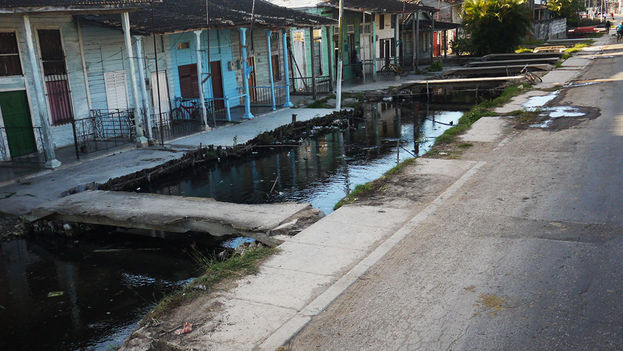
On both sides of Surgidero’s main street there is an open channel that flows with sewage toward the muddy Gulf of Batabanó. continue reading
There everything is all mixed together: salt and filth, foam and debris. As the area is barely fifteen feet above the level of the sea, the ditches that pass in front of the houses are always full and floating on the surface is everything that fails to flow along the weak slope.
Any cynical editor of tourist postcards could draw a parallel with Venice, but the neighbors believe it would be better to build a sewer
Any cynical editor of tourists postcards could draw parallels with Venice, but the neighbors believe it would be better to build a sewer. Each house has its own bridge to cross the stinking gutter, but when it rains it all overflows and there are days when the sewage, instead of flowing, seems to grow, reaching out to the living room of every home.
The inhabitants of the village have never gotten used to this situation, dating from when the streets were laid out and they were promised the drainage ditch would be temporary. Quite the contrary, the issue is no longer raised at meetings of the People’s Power and many are the unanswered letters describing the issue. They expose the dangers to health, landscape and tourists and even the shame of the villagers who don’t know how to explain such a stench to their visitors.
“These waters will end up swallowing us one day,” predicts a neighbor, who has seen how the sea and apathy will win the match against Surgidero de Batabanó.