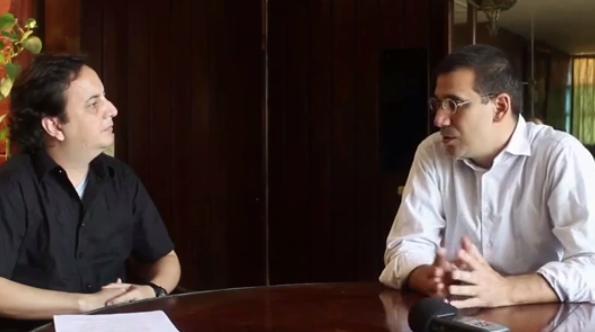
Antonio Rodiles interview: “Truth is on the side of the opposition” / Cubanet, Ernesto Perez Chang

Screen Shot 2015-04-09 at 12.26.11 PM
cubanet square logoCubanet, Ernesto Perez Chang, Havana, 9 April 2015 – The discussion parallel to the Panama Summit (Summit of the Americas) lacks the presence of Antonio G. Rodiles, because the Cuban government, very “opportunistically,” has retained his passport.

A recognized opposition activist and director of the Estado de Sats (State of Sats) civic project, this talkative, jovial, controversial man who was young athlete, doctor of science and professor at prestigious universities in the United States, one day decided to leave the comfort of academic life to return to Cuba and challenge the regime, building, in his own home, a space for public debate as an alternative to the stagnation that affects Cuban society. continue reading

The announcement of the conversations between the governments of the Cuba and the United States has generated different positions among the Cuban dissidence. The opinions of Antonio G. Rodiles in a certain way deviate from those of the rest of the opponents, calling attention to those things that should be paramount at the dialog table where many do not feel represented.

“From my point of view,” warns Rodiles, “is very illogical to accept a path where there is no clear request to the regime in Havana. We all know that the principal objective of the regime is to maintain itself in power. They cannot maintain it much longer because this elite is going to die of natural causes and clearly they are working for the transfer of power to their family. (…)

“If the international community (…) allows them to make this transition without asking anything in return it is going to be happiness for them, and anguish for us Cubans (…). Our position has been made clear against a political process, we are peaceful fighters and we believe the solution for Cuba has to be a peaceful and a political one but this must be through a clearly defined process, there must be transparency, which was not what happened (…).

“It is clear that in a negotiation process not everything is going to be said, not all points are going to be put on the table, but at least the line and the logic of what you want to accomplish should be, and so far we have not seen that Cubans’ civil and political rights are the end point of this conversation, and this is what overwhelmingly concerns us.”

Although the constant dedication of the Estado de Sats project consumes a great part of his social and family life, Antonio G. Rodiles – who affirms that he grew up “hearing the Voice of America and Radio Marti,” and without hearing “that Fidel and Raul Castro were heroes,” despite being the nephew of one of Raul Castro’s trusted confidants – agreed to meet with us, for hours, to talk about what we wanted to know about his past, his obsessions, his personal perspectives on a democratic future, and even his daily life, shaped by a sense of commitment to his ideas and with respect for dialogue, qualities that have made him a true leader for a good part of the opposition within and outside Cuba.

Video below is in Spanish

Castro Followers Attacked Peaceful Dissidents in Panama / Cubanet

Cumbre-cumbre

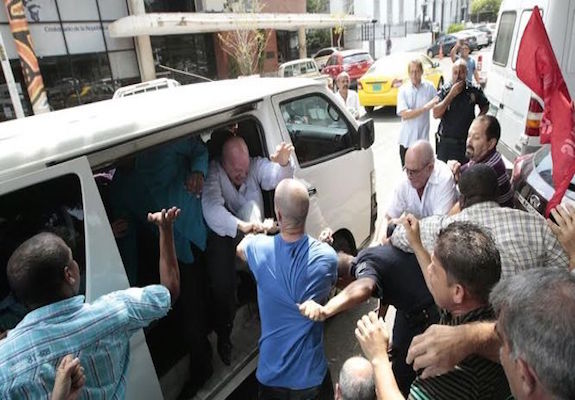
The opponents were putting flowers at a bust of Jose Marti. Cuban diplomats took part in the beating. The Castro-ites also interrupted the Civil Society Forum. See the video.

cubanet square logoCubanet.org, 9 April 2015 – A pro-Castro group today attacked Cuban dissidents in the heart of Panama City, where on Friday the Seventh Summit of the Americas will begin — in which Cuba will have a starring role due to the rapprochement with the United States; President Raul Castro as well as representatives of the opposition have been invited.

The dissidents claimed that on leaving a tribute at the bust of the Cuban national hero Jose Marti in Porras Park, located some yards from the Cuban embassy in Panama, they were surprised by the Castro followers.

“We went to the Jose Marti bust to leave a wreath. There were several people there who began to scream obscenities at us and tell us to leave. A moment later several people from the Cuban embassy came out and physically attacked us,” said Leticia Ramos, a member of the Ladies in White. continue reading

As she reported on the America Teve channel, a man identified as a diplomatic officer struck her. Orlando Gutierrez, Jorge Luis Garcia Perez, known as Antunez, and other opposition leaders were there also and were attacked.

These incidents are in addition to another confrontation that occurred in the opening session of the Civil Society Forum, which is being held parallel to the Americas Summit, when the governmental delegation decided to withdraw. “We as a civil society are defending our own, we cannot be in the same space” as the dissidents, Luis Morlote, a representative of the Cuban Artists and Writers Association (UNEAC), told reporters.

Morlote and several dozen Cubans with Cuban flags and pro-government banners, left the venue and expressed their indignation at the presence of opponents like Guillermo Farinas, Manuel Cuesta and Leonardo Calvo. The Cuban delegation said it was leaving the initial session but would return to the roundtable discussions that would take place Friday.

Cuba’s presence for the first time at the hemispheric event and its collateral activities was marked by the polarization of Cubans supportive of the revolution – the majority group – and the opposition attendees. “And no, we don’t feel like being a US colony” and “Out, out,” the pro-government Cubans shouted for more than an hour and a half; they also handed out a tabloid in which they accused the dissidents of being “mercenaries.”

The demonstration heated up the room and delayed the arrival of many of the forum’s invitees from other countries. “We expect reciprocity and understanding by all who come to our country,” said the annoyed Ruben Castillo, coordinator of the forum. “Civil society is going to participate in an elevated dialog,” he added. The forum, opened by the Panamanian president Juan Carlos Varela and the secretary to the OEA (Organization of American States), Jose Miguel Insulza, takes place from April 8 to 10 and seeks to make recommendations to the presidents attending the seventh summit.


Translated by MLK

“They Have Taken Everything from Me, Even My Family” / 14ymedio

Arian Gonzalez Perez (personal photo)

14ymedio bigger14ymedio, Madrid, 8 April 2015 — “How is it possible that I cannot enter my country?” Arian Gonzalez Perez asks himself time and again. This 26-year old Cuban, originally from Santa Clara, has lived in Barcelona for five years, and for that reason he was recently denied permission to travel to the Island and visit his sick grandmother.

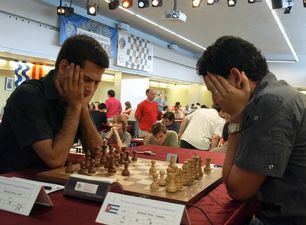
“I feel like an outcast, very depressed,” he explains in a telephone conversation from the Catalan city. In his native country, he devoted himself to chess, but, like all players who remain living outside of Cuba, he was expelled from the ELO list (a chess player’s ranking) two years ago. In order to obtain the title of master of this discipline he will have to search for another national federation to cover him. “They have taken everything from me, even my family. It is very frustrating not to have rights,” he says. continue reading

Gonzalez was 21 years old when he decided to leave his country in search of a better future. “Desperate to leave the country, I left only at the first opportunity I had, but not before the Cuban authorities had denied me three trips. I came directly to Spain and did not even intend to stay, but I had to because of the poverty on the Island. I borrowed money and came, but the tournaments went badly for me and I could not pay the debt, so I stayed,” he says.

This law student thought that, when he had residence in Spain, he would get permission to travel to Cuba, but that was not the case. “It is inconceivable. Cuba is my country, it is my right and my family. This situation violates human rights,” he insists.

Gonzalez visited the Cuban consulate in Barcelona a year ago where they assured him that within a month they would have answered his request to travel to the Island, but the answer never came. “When I found out that my 81-year-old grandmother had fallen and broken her hip, I panicked and returned to the consulate. They told me they had no answer, and the civil servant that assisted me told me that I had defected,” he says sorrowfully.

As a result of these events, he decided to approach the human rights defense organization Amnesty International. “I believe that I should tell the truth and not be afraid of the injustices that are committed in my country; we Cubans cannot continue to permit this outrage,” he stresses. “It is time to add my two cents worth and fight for change.”

Gonzalez left Cuba before the reforms promoted in recent years by President Raul Castro, which he branded as “lies.” With the changes in the migratory law, the time limit for a citizen abroad to be classified as a defector and prohibited for eight years from returning has been extended from 11 months to two years. The young man charges that the rule violates Article 13.2 of the Universal Declaration of Human Rights, according to which “all people have the right to leave any country, including their own, and to return to their country.”

Arian Gonzalez, also stripped of his livelihood, was involved in a controversy in 2013 while participating in competitions under the Cuban flag. The chess player was subject to disqualification by the Spanish Grand Master Victor Moskalenko, who accused him of attending a tournament in Mollet del Valles (Barcelona) while drunk and cheating. Moskalenko extended his accusations to another Cuban federated chess player in Spain, Orlevis Perez Mitjans and asserted: “When you play against Cuban players, the other fellow countrymen are behind your back, bothering you… You are confronted not only with a player but with a team of gangsters.”

Arian Gonzalez Perez plays against Yuniesky Quesada Perez (personal photo)

Gonzalez, who defended himself then by writing a letter to the Competition Committee of the Catalan Chess Federation to seek measures against Moskalenko for libel and slander, denounces the governmental policy on chess. “Chess in Cuba is part of the Cuban government’s political monopoly. As in many other fields, this is a means for young people to be able to have the aspiration of leaving the Island and search for a better future. But many do not do it because chess at the world level is a poor sport while the Cuban government gives the Grand Masters a salary of 100 CUC which is high in comparison with the rest of the population.”

Arian Gonzalez now hopes that Amnesty International will press for authorization for his return to Cuba. The organization promised him an answer after Easter. “It would be an eternal frustration in my life if my grandmother were to die without me being able to see her 5 years after I said goodbye to her when I left Cuba.”

Translated by MLK

Pro-Castro Panamanian groups threaten Cuban activists / 14ymedio

14ymedio bigger14ymedio, 8 April 2105 — Several Panamanian leftist organizations have forwarded to the Minister of Foreign Affairs of Panama, Isabel de Saint Malo, a letter of protest against the activities organized by the groups in opposition to the governments of Cuba and Venezuela in the forums being held before the Summit of the Americas. The letter was sent last Monday and has been published today in the official Cuban media.

The signers of the text consider that the dissidents, “Have as their aim to use our country as a platform to conspire and coordinate actions intended to interfere in the internal matters of these two nations.” Therefore, they ask, “Very respectfully that the national government, through the Foreign Ministry, take measures to prevent these activities.” The agenda of the forums whose suspension they are asking was presumably added to the letter, although it has not been disclosed in the official media. continue reading

The signatories specify that they do not oppose the participation of the opponents in the Summit’s forums, but rather, “The conspiratorial activities and the public demonstrations outside the Summit, that have a perverse intention, against the two sister nations.” However, they warn that if these measures they have requested are not taken they will see themselves “obliged” to respect their country, “and so avoid that it is used for interventionist conspiracies and demonstrations and the internal matters of other brother countries.”

The letter concludes by holding the Government of Panama responsible for what might happen if it does not take measures to avoid the forums. “If these activities and provocation and interference are not prevented, the national government will be responsible for whatever lamentable situation it might present.”

The organizations signing the letter are the Independent Movement of National Refoundation (MIREN), the Panama National Workers Center (CNTP), The Authentic Workers Federation (FAT), the CocaCola Workers Union, The National Brewery and Others (SITRAFCIREBGASCELIS), the Union Federation of the Workers of the Republic of Panama (FSTRP), the Wide Colon Front (FAC), the Veraguas Association of Educators (AEVE), the National Coordinator of Solidarity with Cuba, the Ecological Collective Voices (COVEXC), the Student Group of Transformative Thinking and Action (PAT), the Conscience Renewal Student Group (CORE), the Independent Association of Functionaries of the CSS (AIFCSS), the Panama Journalists Union (SPP), The Polo Citizenry, and the National Front for the Defense of Economic and Social Rights (FRENADESO).

Young Latin Americans call to fight against political apathy / 14ymedio

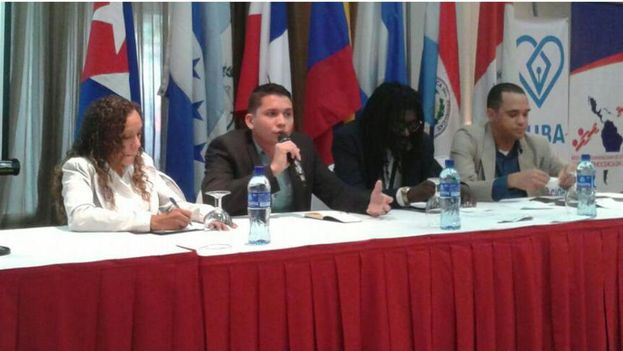
Young Cubans at the 2nd Forum of Youth and Democracy in Panama. (14ymedio)
Young Cubans at the 2nd Forum of Youth and Democracy in Panama. Eliecer Avila with the microphone. (14ymedio)

14ymedio bigger14ymedio, Panama, 8 April 2015 — Young Latin American leaders gathered Tuesday on the second day of the 2nd Youth and Democracy Regional Forum in Panama and addressed issues such as the rise of populist regimes in the region, and agreed on the need to organize civil society at the hemispheric level to fight against political apathy.

The protagonists of the morning session were Micaela Hierro Dori, president of the Argentine civil association CICES, who acted as moderator; Ricardo Antonio Álvarez Arias, vice president of Honduras; Eduardo Stein, former vice president of Guatemala; Guillermo Cochez, former Ambassador of Panama to the Organization of American States (OAS); Martha Lucía Ramírez, former Minister of Defense of Colombia; Gustavo Amaya, executive director of the Center for Training and Promotion of Democracy (CECADE) in San Salvador; and Carolina Quinonez, a journalist from Guatamala’s Antigua Channel.

Political apathy, according to attendees at the meeting, threatens equally countries ruled by totalitarian regimes and those in which the society assumes that “all is well” or at least “better than in other countries,” because in the latter it can leave the door open to the possibility that populism and other deformations will silence thoughtful proposals to take advantage of what the traditional parties have not resolved. continue reading

Carlos Amel Oliva, of the Patriotic Union of Cuba (UNPACU), compared this phenomenon with the rise of fascism in Europe before World War II, ignored by governments until the outbreak of the war. “The democratic countries of the region need to not let the same thing happen with populism. It is not Cuba’s or Venezuela’s problem, it is a regional problem.”

Press freedom was another issue that focused attention during the morning panel. The representative from UNPACU denounced the “media laws that are driving some governments to control and limit freedom of expression under the pretext of preventing the spread of lies and distortions.”

Participants also discussed the problem of parasitism that grows in the region due to both the family remittances from emigrants as well as government “handouts,” especially under populist systems, factors that discourage the growth and development of national economies and create a vicious circle that encourages emigration and at the same time reinforces parasitism.

Participants’ skepticism of transnational organizations and meetings was reflected in the statements of Eduardo Stein, shared by several attendees, who questioned the existence of a regional organization like the OAS. For the former vice president of Guatemala, on the OAS Permanent Council, the alliance of a few countries prevents certain issues from being analyzed in the Summits. “There will be no will to confront the political problems of each country, appealing to the right of national sovereignty,” he added about the Summit of the Americas.

The afternoon of the day was dedicated to the initiatives of young Cubans with regards to democratic opening, with the participation of Kirenia Yalit Núñez, Yasser Rojas, Eliécer Ávila and Roberto Jiménez on behalf of the Roundtable, a proposal of democratic changes on the base of initiatives that seek to involve all Cubans in the solution of the problems that affect the whole population.

Also presented at the meeting was the new Cuba Decides initiative led by Rosa María Payá and Erick Álvarez, members of the Christian Liberation Movement; while Yusmila Reyna and Carlos Amel Oliva spoke of the objectives of UNPACU.

Finally, the Aulas Abiertas (Open Classrooms) project was presented, a project which promotes knowledge of the basic questions inherent in democratic societies, to prepare citizens before the eventual process of transition in which they will be capable of participating with a proactive role.

Unfortunately, it was not possible to expand the debate with questions from the audience due to the frequent and prolonged power outages in the room where the session was being held, which also affected some of the equipment for projecting materials, and which the Forum organizers attributed a deliberate attempt to sabotage the activity.

The Specter of Castro Haunts Panama Summit / Orlando Luis Pardo Lazo

The ghost of North Korean ship Chong Chon Gang and its deadly message for the region haunts Panama. (La Prensa)

PanAm Post, Orlando Luis Pardo Lazo, 8 April 2015 — A ghost ship haunts the halls of this week’s Summit of the Americas in Panama: the Chong Chon Gang.

The vessel, seized in the Panama Canal in July 2013, contained a deadly cargo hidden under 250,000 bags of sugar. The contraband ammunition and weapons on board, bound for North Korea, mocked the whole world and put half of Panama’s population at risk.

It also served as an epitaph for the Castro brothers, who have stirred up all civil wars in the region, and served as a lighthouse of populism that has lured many nations and individuals onto the rocks.

The same drifting-but-dangerous tyranny washes upon on Panama’s shores again this week, as the region’s (un)elected officials arrive to promenade in front of the world’s press for the Summit of the Americas. continue reading

Raúl Castro’s arrogance after his arms trafficking deal with Pyongyang became public is now rewarded with an invitation to attend the Summit in Panama. The military general and head of state — never elected by the Cubans — merely shrugged at the time, claiming that they were “obsolete weapons,” and few cared about the humiliation of the Panamanian people. No one cared either about the embarrassment we Cubans of integrity felt at the aggression the regime committed against our brothers.

Since the end of the Soviet era, the Caribbean island’s socialist elite have always used used Panama as its financial headquarters to launder drug trafficking money. Let the four military officers executed by firing squad in 1989 be a witness to that, plus the hundreds of people kicked out in Cuba weeks prior and during the US invasion of Panama in the same year.

US President Barack Obama and his cheerleaders in the press corps come to the region not to reprimand countries that shoot students and curtail freedom of speech. Rather, reporters can’t wait to be the first to snap the photo between the civilian leader and the despot in army uniform, even while both their days as leaders are numbered.

Only through observing this atmosphere of state-sponsored omerta can we understand how Rosa María Payá, daughter of Cuban pro-democracy martyr Oswaldo Payá — threatened and then killed on the orders of Raúl Castro on July 22, 2012 — was humiliated by anonymous National Security agents at the very door of her plane on Sunday in Panama City.

Neither Cuba nor Panama’s Foreign Ministry have owned up to the blunder, so who leaked the name of Rosa María before she landed and who ordered her detention and intimidation, as if she were an international fugitive?

Unfortunately, the cause of liberty is unlikely to sound at the official Summit of the elites, where the Castro regime calls the shots and the region’s governments duly obey.

The Panamanian thugs acted, it seems, at the behest of Cuba’s intelligence agency — or perhaps they just enjoyed illegally intimidating a free Cuban, going through her underwear, photocopying her private documents (faxed to Havana for sure), and even threatening to deport her to the island where the Castro regime murdered her father and her best friend, Harold Cepero.

They should have asked themselves: after all she has been through, how could she be afraid? They’d sooner be able to kill Rosa María, and more than a generation of young people at home and exiled abroad who proudly see themselves as Cuban (myself included), than scare us.

The apartheid the Cuban military imposed on our people, leaving thousands dead and expelling hundreds of thousands decade after decade, never had any real prestige in the continent. That’s the international left’s doing. That’s why we Cubans distrust so much the backing of Latin American governments of whatever stripe.

Unfortunately, the cause of liberty is unlikely to sound at the official Summit of the elites, where the Castro regime calls the shots and the region’s governments duly obey. They quake before the Cuban tyrant; the presidents of the Americas know that Castro can spoil their party with an eruption of Bolivarian diatribe, protests, and diplomatic boycotts.

That’s why secret agents in Panama target Cuban activists, and why the press release in which the Foreign Ministry formally apologizes to Rosa María is not only disingenuous but pathetic.

Panamanians, you should ask forgiveness, from Cubans and the whole region. Having once allowed a ship of war to enter national territory, you’ve once again permitted the forces of destruction and death to befoul Panama’s waters.

Translated for PanAm Post by Daniel Duarte. Edited by Laurie Blair

Forum for Rights and Freedoms, Declaration, VII Summit of the Americas

Screen Shot 2015-04-08 at 12.21.54 AM

Forum for Rights and Freedoms: Declaration

VII Summit of the Americas

April 2015

Violations of fundamental rights in Cuba are enshrined in the current legal system. The full exercise of these fundamental rights is considered directly opposed to the interests “of the Cuban people in building socialism and communism.”

The so-called constitution establishes the ownership and control of the State and the Communist Party over the communication media and mass distribution. The Law of Protection of National Independence and the Economy of Cuba, known as the Gag Law, sets sentences of up to 20 years for those who attempt to violate this provision.

Trade unions, civic, professional and human rights associations that do not profess the official ideology are not recognized. Those who attempt to organize meetings or found independent associations can suffer imprisonment, dismissal, harassment or intimidation. Thousands of Cubans have paid, even with their lives, for trying to exercise their freedoms. continue reading

The Penal Code defines “pre-criminal dangerousness” and applies it according to the standards of a supposed “socialist morality.” Arrests, imprisonments and beatings of human rights activists, political opponents and independent journalists are recurring.

The use of violence on the part of paralegal groups as a form of social control has been one of the most abhorrent practices of the Castro regime. This deplorable experience has been exported to other Latin American nations, as was the case of the Dignity Brigades 25 years ago in Panama, and the so-called Collectives in Venezuela today.

Economic rights are also violated and the entrepreneurial capacity and character of Cubans struggling against a regime obsessed with control. Corruption, taxes that smother micro-businesses, total State control over imports and exports, the absence of property rights, make up a part of our scenario. The economic situation is dire.

The regime has ratified dozens of international treaties on the issue of Human Rights, although it refuses to ratify the Human Rights Covenants of the United Nations. However, the majority of these standards have not been applied to the legal system, becoming a dead letter. The Castro regime continues to hide fugitives from justice for common crimes and terrorism. It violates international norms as in in the case of the recent arms trafficking and maintains a “complicit silence” about the trafficking of Cubans to the United States through third countries.

We do not accept the mutation of a neo-Castro authoritarianism, where the old elite transfers power to its political and family heirs.

The sovereignty of our country does not rest on a despotic and corrupt regime. It rests in the people and, in particular, in those of us who fight for a true democracy: with political pluralism, an independent judiciary, freedom and human rights. Where we Cubans can define our destinies through consultations and free and transparent electoral processes, as set out in important opposition documents such as: The Agreement for Democracy, or the Forum for Rights and Freedoms Roadmap.

No society can be viable if it oppresses the human being. To accept that there are different interpretations of our freedoms constitutes a tactic that validates authoritarianism as an alternate form to democracy on our continent.

We appeal to the solidarity and the just support of the entire regional and international community to initiate the urgent path to the democratization of our nation.

Young people call to fight against fear and self-censorship / 14ymedio

Several activists of Cuban civil society at the 2nd Youth and Democracy Regional Forum (14ymedio)

14ymedio bigger14ymedio, Havana, 7 April 2015 — The Second Regional Youth and Democracy Forum started Monday in Panama City with the challenge of becoming a “dialogue space for young leaders of student, social and political movements in the region.” The meeting, which runs until Tuesday and is organized by the Latin American Youth for Democracy Network (RLJD), is being held in the framework of the Summit of the Americas and aims to prepare future leaders for democratic governance and citizen participation, two of the priority themes of the Summit.

Most participants concluded, during the day yesterday, that the region is undermined by the cancer of populism, whose origins lie in Cuba. They also consider that democratic governments violate the fundamental principle of the Organization of American States (OAS) by sitting down with Cuba and Venezuela and not recognizing the legitimate voice of civil society in these countries. If the OAS and its organizations are not genetically reformulated, they warn, they will cease to have a reason for being and could lose any credibility as a regional body. continue reading

In the opening session,Guillermo Cochez, Panama’s former Ambassador to the OAS and member of the RLJD Advisory Council, urged the young people not to allow authoritarian governments to appropriate the discourse of social justice and of the continent. “I urge you to continue the fight against the enemies of democracy, who do not rest. You also must not rest in your struggle to defend democracy,” he urged.

Present at the conference were Eduardo Stein, former vice president of Guatemala, and Marta Lucía Ramírez, former Minister of Defense of Colombia, who participated with opinions and questions.

Yesenia Alvarez, director of the Institute for Political Freedom (IPL- Peru) and member of the Iberoamerican Youth Advisory Council, asked the young civil society leaders to look at the problems of each country across the region. “We join with Cuba, and we will continue together with the Cubans until they are free and can choose their destiny as a nation. We will work hard for it. The Latin American presidents will not speak about it, so I ask the civil society not to forget Cuba and Venezuela. Don’t be afraid. Dictatorships live in self-censorship that causes fear,” she added.

Meanwhile, Gina Romero of RedLad (Latin American and Caribbean Network for Democracy), called for developing an awareness of the kind of democracy that seeks and prioritizes the objective that all citizens have a decent life.

The first panel of the day, Youth Participation in Proposals for Strengthening Democracy and Governance, had as participants Pedro Cruz (Youth for Guatemala), Ricardo Sande (Student Federation of the Catholic University of Chile) and Rosa Maria Paya, who spoke of her project Cuba Decides. Also invited was, Rodrigo Diamanti, one of the directors of the video A World Without Gag Laws, who could not attend because the Venezuelan government prevented him from leaving the country. Sande demanded citizen involvement in politics to prevent the State from becoming the only provider of solutions. “There is no point having a democracy if we give the solution of the problems to power, (…) forgetting that citizens are responsible to each other, not to the states.”

Among those attending the second panel, on the Inter-American System of Human Rights and specific cases in the region, was Nizar El Fakih, a human rights lawyer from Venezuela who offered specific data on the situation in the country — including the unofficial count in 2013 showing 6% of the Venezuelan population in extreme poverty. Kirenia Nunez of the Cuban Commission for Human Rights and National Reconciliation (CCDHRN), warned of the known increase in short-term detentions on the island, while Ana Karina Garcia, from the Venezuelan Youth Popular Will, discussed the challenge to sensitize Venezuelan society to the fact that authoritarianism affects not only the opposition but the entire society. “The government is applying the same methods as the Cuban dictatorship, spreading terror to paralyze the population, alongside increasing deprivation and violence,” she said.

The Nicaraguan deputy Edipsia Dubon focused criticism of the government of her country on the Canal Law that will threaten and sweep away indigenous rights, given that 52% of the lands that will be confiscated by the State under the Law belong to those groups. For his part, Mauricio Alarcon, of Fundamedios (Ecuador), called attention to the violation of freedom of expression and press, as well as the attempts by some of the governments of the region to maintain themselves in power.

After a discussion between all the young participants and the social and political leaders from Latin America, the first day closed with a concert with Cuban hip hop artists Michel Matos (Matraka), Soandres del Rio, David D Omni and Aldo Roberto Rodriguez Baquero (of Los Aldeanos).

Another signal of a traffic signal / Reinaldo Escobar

Went former president Fidel Castro passed by, the escorts turned the light red at the corner of 11 and 12. (14ymedio)

Reinaldo Escobar, 6 April 2015 — Recently, there came to light a chance encounter between former Cuban president Fidel Castro and a group of Venezuelans visiting a Havana school. A story broadcast on national TV gave a brief overview of the little school that the then Maximum Leader (today Historic Leader) ordered to be built in the exclusive Siboney neighborhood so that the children wouldn’t have to walk such long distances. Going to school there are the children of the staff serving the place known as “ground zero”, where today Fidel is spending his old age. From his “Castro-mobile” he waved, shook hands, asked questions and offered predictions. “He’s alive,” the excited visitors commented joyously. continue reading

A few miles from his private home, is the block of 11th between 10th and 12th n Vedado. There the commander had another site of work and repose. Those who have visited this sanctuary affirm that it features a gym and a swimming pool and, when “the boss” was enthusiastic about cattle, it came to have one or several cows for experiments. Those were the days when he was more alive than anyone and his compañera in the struggle, Celia Sanchez, shared all her concerns with him in this place.

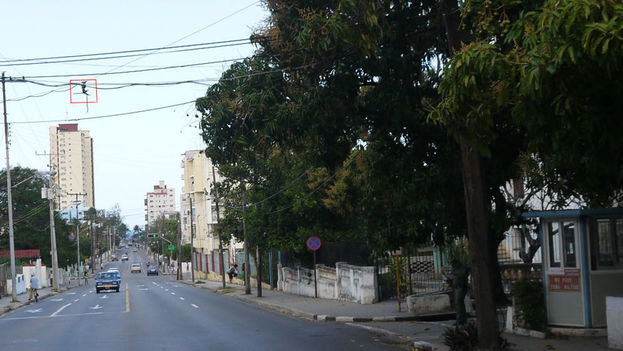
Each time the motorcade that carried him came and went from that house, the guards turned the traffic light red at the corner of 11th and 12th. Poking out of the windows of the Oldsmobiles, the Alfa Romeos, the Mercedes Benzes, according to the time, were the muzzles of his personal security detail and one had to wait for the parsimony of the soldier on duty for the green light to appear.

Time has passed and many vultures have flown over the Plaza of the Revolution. Nobody important passes through there any more. The old traffic light, independent of the traffic network, no longer makes sense and has been retired, literally ripped down. Its supports and cables hang for no reason over the middle of the street. The checkpoint where the guards relax in the shade remains. You still have to identify yourself to enter the block. A life has become a museum piece, and no longer makes any decisions, only memories, documents, photos, correspondence, that some day will be consigned to oblivion.

Adventures and misfortunes of a correspondent in Cuba / 14ymedio, Yoani Sanchez

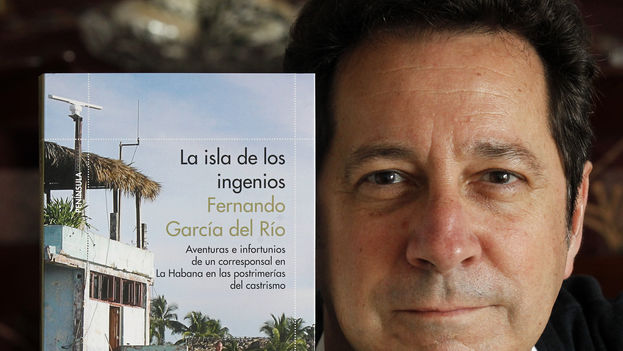
Fernando Garcia poses with a copy of his book 'The Island of the Ingenuous”. (Photo: Esteban Cobo)
Fernando Garcia poses with a copy of his book ‘The Island of the Ingenuous”. (Photo: Esteban Cobo)

14ymedio bigger

14ymedio, Yoani Sanchez, 6 April 2015 — Fernando Garcia del Rio was a correspondent in Cuba for the Spanish newspaper La Vanguardia (Barcelona), from 2007 until his expulsion from Cuba in 2011. He has just published a book,“The Island of the Mills,” where he relates the “adventures and misfortunes of a correspondent in Havana in the final years of the Castro regime.” From Madrid, where he still works for La Vanguardia, the author has responded by email to questions from 14ymedio.

Question. Why did they expel you?

Response. It is obvious that my work did not please the authorities. They did not specify the reasons in detail. One day in March 2011, when I was about to complete four years as a correspondent, an official from the International Press Center (CPI) called me to a meeting the following Saturday morning. For more than a year that organization had let me waiting for the renewal of my accreditation, an essential document to be able to work on the island. I’d also spent some months without receiving any calls or communication from the CPI. And this, as a member of that body explained to me with obvious cynicism, meant that I was in a phase that implied, among other things, “the silence of the mails.” continue reading

The fact is, that at the final meeting at the Center’s site on the Rampa, the official in charge of communicating to me the outcome of the process sat across from me and limited himself to reading what he had brought written on a piece of paper. It was Article 46 of the CPI rules, according to which the entity can withdraw a correspondent’s accreditation when it considers that there has been a lack of ethics or objectivity, or actions “inappropriate” to the mission. I asked how and in what reports had I incurred these suspicions. The official, instead of answering me, unfolded the paper again and repeated to me the contents of the article in question. He did answer my question regarding if there was a timeframe for me to leave, “As soon as possible, as soon as you organize the move and sell your car,” he said.

“I’ve often wondered which article or articles could have bothered them so much. The one I devoted to the significant drop in the rates of Communist Party memberships?”

 In the book I tell the story in detail, but not without noting that the CPI expelled a ton of journalists in similar circumstances. So the event was nothing extraordinary, although telling the story is still illustrative. I’ve often wondered which article or articles could have bothered them so much. The one I devoted to the significant drop in the rates of Communist Party memberships, and how much this fall worried its leadership. Or maybe it was the report about the terribly poor sugar harvests of 2010 and 2011, titled, “Cuba’s bitter sugar”?

Question: It has been four years since your expulsion. Does Cuba remain in your dreams and nightmares?

Answer: Of course it continues in my thoughts and in my memory. Predominantly fond memories. Cuba is a unique and unforgettable country. For starters, coming from outside can feel like a time machine. Or like being in a period film – back to the fifties – where contemporary elements seem like mistakes in the props. That feeds the reverie. Beyond this imaginary sensation there is maybe something superficial, I see Cuba as a country with people hungry for the future who improvise the present minute-by-minute within a system anchored by the past. A broken country, in a material and figurative sense, as so many of its buildings and its streets are broken, but also its economy, communication with the exterior, and the families who remain separated by a stretch of ocean. But Cubans masterfully use an infallible weapon against the breakdown of hope, which is resourcefulness.

The [Spanish] Real Academia dictionary gives this term three principal meanings, as well as one relative to sugar factories. Ingenuity is the “ability of man to devise or invent quickly and easily”; it is also “industry, cunning and artifice of someone to get what they want,” and at the same time, “the spark or talent to rapidly see and display the funny side of things.” I believe that it is thanks to ingenuity, in its different forms, that most Cubans continue to get ahead. With ingenuity to fix the broken and fill the vacuum; to stop and confuse the adversary with humor and constructive spirit. Hence the title of the book, clearly.

Question: How difficult was it to practice journalism onThe Island of the Ingenuous?

Answer: What can I tell you about that?! Of course, the difficulties aren’t the same for a foreign correspondent in Havana – at the end of the day, a kind of passage through the country with someone having your back – than for a Cuban journalist who puts it all on the line. So, I send my respect and sincere admiration to my colleagues on the Island who, against all odds, try to do real journalism inside the country. That said, in my case as a correspondent, the main and most obvious difficulty was maintaining an acceptable balance between a commitment to the readers for the truth and the desire to keep one’s position; that is, to relate events without hiding the essential data but without getting the country’s authorities all stirred up.

“As a correspondent, the main and most obvious difficulty was maintaining an acceptable balance between a commitment to the readers for the truth and the desire to keep one’s position”

On the other hand, in Cuba informative material is peculiar. More than news, what you find are propaganda and rumors. But beyond what circulates in the media and is put at your disposal, the field is enormous. Regardless of the political decisions, the relevant announcements and the more or less substantial official discourse, Cuba seemed to me from the beginning a country that deserves to be told. Because, given that everyone has to invent a life for themselves every morning, things are constantly happening to all Cubans.

So the stories are endless, and almost always interesting because they speak of the daily bread. It’s not about “objective conditions,” figures on the “blockade” or other aspects of the everlasting conflict with the enemy; it’s about raw reality, which is what should come first to us journalists. Reality with a face and eyes, although at times you have to hide identities to avoid problems with the staff. And if, in addition to this reality, you tell it gracefully… Finally, sometimes the system serves you gems, involuntarily, real jewels for the daily chronicle. I’m referring to the reports that Granma or Juventud Rebelde publish from time to time, intending to counter something or meant as a warning, but that for the foreign media are like diamonds in the rough.

I remember discovering an “urbanization” of 350 houses made with railroad rails and sleepers in a coastal neighborhood called La Panchita. The residents, beset by the severe housing shortage suffered by the entire Island, pulled up 15 miles of railroad track to get the construction materials they needed to build their homes. The government published this finding with great scandal and indignation and with the announcement of disciplinary measures. They had to show that in Cuba people are made to pay for their crimes. Meanwhile, what this gave me was excellent raw material for an article on the housing shortage, and the theft of materials as a recourse to alleviate basic needs.

Question: Ingenuity, creativity, “resolve”, “under the table”, “invent” … many different ways of calling the juggling of survival we have to perform every day. Did some of them have a lasting impact on you?

Answer: In my book I dedicate a chapter to the “resurrection of scrap.” Here I report my discovery of what Cubans think is a total classic. I’m referring to the use of the Russian Aurika 70 washing machine for purposes that have nothing to do with the original. I discovered it in a casa particular [private B&B] in Viñales. The owner – his wife told us – couldn’t come out to greet us because he was enjoying a “hydromassage session.”

We went through to look at the courtyard of the house and the guy had his hand in the washing machine. He explained how this had been prescribed by his doctor: he should put his hand in there for 20 minutes a day, I think on the prewash setting, for his injured wrist. Then the man showed us the fan he’d hooked up with the motor from the drier. Later I learned that this was a more or less usual practice, with this and other appliances distributed by the State, and that, being so widespread, it had even set off a national debate about the supposed energy waste.

“The architects of Old Havana say the ruined or  semi-ruined buildings still standing in defiance of the laws of physics are ‘in miraculous static.’ The image is useful to describe the lives of most Cubans”

They told me that the Aurika was also a stupendous tomato crusher. I learned of the electric teakettle converted into a shower heater, the rikimbili (a bicycle converted into a motorcycle), and I don’t know how many more inventions. But it not only made me admire the ability of Cubans when it comes to making utensils from almost any object; as much or more I admired your infinite capacity to fabricate metaphors. It sticks with me, the expression created by the architects of Old Havana to classify ruined or semi-ruined buildings that are still standing, year after year, in apparent defiance of the laws of physics: they are building, they say, “in miraculous static.” In addition to being a poetic and humorous definition, the image is useful to describe the lives of most Cubans. In any event, it’s great.

Question: Last December 17th the restoration of relations between Cuba and the United States was announced. Was this something predictable in the years you lived in Havana?

Answer: No, I didn’t imagine it. Some American officials and academics with good connections to the White House pointed out, then, that Obama could take important steps to approach Havana in his second term, that is, now. But neither I nor the European journalists and diplomats whom I know thought there would be such a warm agreement after 54 years of rupture. I suppose that the process towards full normalization will be slow and not free of surprises. Hopefully, those interested in stopping it will fail this time.
The Cuban regime classifies the opponents are “mercenaries” / 14ymedio

The Union of Journalists of Cuba accuses opposition leaders of orchestrating a provocation in Panama.

14ymedio bigger14ymedio, Havana, 7 April 2015 – The official Cuban civil society delegation that will participate throughout the week of parallel forums at the Summit of the Americas in Panama denounced, this Tuesday, the presence of “mercenaries in the service of a foreign power” in the meeting.

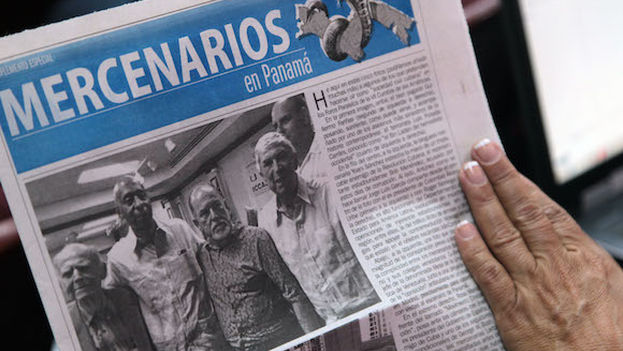
In a press conference, organized at the University of Panama shortly after the arrival from Havana and transmitted in full by the Island’s television monopoly, the members of the official Cuban delegation attacked the Cuban dissidents and independent activists who will also attend the meetings. In addition, the Union of Cuban Journalists distributed a pamphlet titled “Mercenaries,” in which they accuse the opposition leaders of a orchestrating a provocation on Panamanian soil. In the cover image, the deceased Huber Matos appears, along with others. In the press conference, only a few questions from the journalists present were allowed.

Liaena Hernández Martínez, a member of the National Committee of the Federation of Cuban Women, read a statement titled “It is inadmissible that mercenaries paid by enemies of the Island are in Panama,” where “the presence in these mercenary spaces [parallel forums] are paid for by the historical enemies of our nation. ”

A representative of the delegation said “there will definitely be no dialogue with those people,” accused of being part of a “meager ‘opposition’ fabricated from abroad, lacking any legitimacy and propriety.” The regime’s representatives didn’t even hesitate to link some members of civil society with “known terrorists that have caused infinite pain to the Cuban people.”

The Enslavement of Cuban Professionals / Angel Santiesteban

What value is there in loudly bragging about Cuba as a “medical world power” and that it “disinterestedly” sends thousands of doctors around the planet, when in reality the Cuban archipelago, for many years, has been far from this false image as an island paradise, from the moment when the Castro brothers calculated the numbers and dividends from the hugely lucrative business represented by selling the cheap slave labor of these professionals.

Thanks to these medical brigades, the government adds millions to its coffers, which wouldn’t be bad if they paid these doctors, nurses and health technicians a large percentage of the revenue they generate and not the paltry share they currently receive of the contracts signed between States.

What happens to doctors, also happens to athletes, artists, university professors and any professional that serves their interests; but this post is dedicated to the exploited of medicine. continue reading

The Castro brothers, once they took power — secured with populist and social laws — the concerned themselves more with foreign policy, interested in regional influence with the aim of extending their communist ideology, than with domestic issues.

They started exporting the Revolution with the seeding of guerrillas in several continents. One example is the conflict that persists today in Colombia, half a century after that attempt of insurrectional social war, that installed them in power. But that dream — or nightmare — was cut short. It mutated from the original ideals, and — passing through various stages such as the military support in Africa — to an attempt to win elections with popular leftist movements.

The guerrillas were ordered to shift tactics: exchanging their weapons and camouflage, they dressed them in brand name suits and ties to take the floor to manipulate the society’s most economically disadvantaged. Cuban military advisors hang stethoscopes around their necks and dress in white coats.

In short, a great part of this new hidden force is in the nobility of the medical professional, continuing the work of the prior military advisors, in order to influence and support the choice of the Castros for the presidency of this country. Meanwhile, whether or not they achieve that, the Cuban government receives the salaries of its 21st Century slaves.

Ángel Santiesteban-Prats
Border Control Prison Unit, Havana, March 2015

6 April 2015

Children’s Baseball in Cuba / Anddy Sierra Alvarez

First base

The categories of children’s baseball in Cuba are rescued by parents of the “little ballplayers” because, it seems, the National Institute of Sports, Physical Education and Recreation (INDER) has no resources to provide the necessary sports equipment.

The categories of 7-8 years and 9-10 years are supported by the parents of the child athletes, as long as INDeR doesn’t provide the minimum materials, such as: gloves, special balls, bats, among others. It doesn’t allow the development of Cuban baseball.

Rolando Suarez, a 45-year-old coach, spoke of the ingenuity required to get a result in competitions. “Thanks to the parents we can train the children, because INDER gives each school coach only one or two gloves, one bat and two Kenko balls, which last only four months. During the remaining 6 or 7 months, I have to ask the parents for help to continue to coach.” continue reading

According to some instructors, these categories have special rules, one of which regulates to the play to a solid rubber ball (known as Kenko), a different material from the balls for the older ages, which use synthetic materials. The Kenko balls cost about 300 pesos each.

Suarez also explained, “I have an enrollment of 20 students in the 7-8 category, and in 9-10 I have 19 students. What INDER gives me isn’t enough!”

Another children’s coach who asked to remain anonymous, explained that the lack of resources also hits the parents’ budgets, “Several students have left the sport because it’s very expensive.”

Michel Garcia, a 37-year-old father, commented, “My son has his sports uniform, glove and a bad thanks to me but not everyone can spend more than 2,500 pesos for these expenses.”

According to a methodologist in the capital municipality of 10 de Octubre, who is in charge of educating coaches and supervising the training with the purpose of ensuring good preparation, and who asked to remain anonymous, commented that everything the Municipal Sports Authorities delivered to the coaches, is usurped by them.

“They sell gloves, balls and bats to the parents of the students. It is a sport where the majority of the parents have money, and demand creates the market,” he said.

This methodologist continued, explaining that many parents have complained to the Municipal Sports Authority in 10 de Octubre, about the conditions for the children playing baseball, a sport supposedly prioritized in Cuba.

So far, the conditions don’t seem to change. Coaches like Racel Perez, 28, consider another option, “I have to coach a different sport,” he laments.

From Anddy’s blog, previously published in Cubanet

23 March 2015