Relatives abroad, who pay for medicines and supplies that have disappeared on the island, are another source of relief.
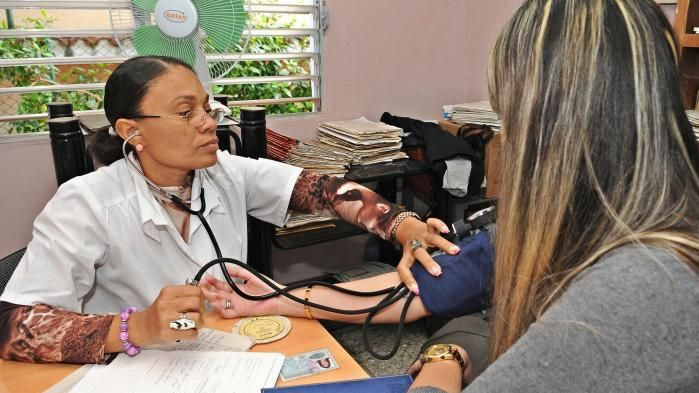
 14ymedio, Havana, May 25, 2025 — Lidia is one of more than 2.5 million Cubans who are diagnosed with hypertension. Last week I heard a shop clerk in Havana say that the yogurt for which she had been lining up for several days was already gone, and she thought she was going to be one less number in the population statistics. After arriving at the polyclinic in her area with blood pressure through the roof, the response of the doctor on duty left her perplexed: “We have nothing here to help you.”
Days after the scare, and after promising her family that she would avoid “tantrums,”Lidia tells 14ymedio that the doctor herself was shocked when she confirmed, thanks to a photo taken by the patient on her blood pressure monitor, that her pressure had risen to almost 200 mmHg (millimeters of mercury). “She asked me how I got to the polyclinic and had me drink a glass of lemonade without sugar. Then she told me to ’keep doing it, because there are no medicines here’.”
In the absence of medicines, the doctor wrote down for Lidia the name of a drug recommended to control high blood pressure. “I found it on the black market, and the saleswoman told me that it was Colombian and that she did not know if it was any good. In the end I took it, and my blood pressure dropped so low that I almost fainted,” she recalls.
If Lidia had to resort to the black market it is not because she needed the Colombian pill at any cost
If Lidia had to resort to the black market it is not because she needed the Colombian pill at any cost. A simple Cuban-made enalapril or captopril would have been sufficient, but both pills have become extinct in the state pharmacies, and her first-aid kit has been depleted at the same rate.
At the risk of running into fake or adulterated medicines, she, like many other patients, has no choice but to turn to the black market, WhatsApp sales groups or Revolico’s Facebook pages to find what they are looking for.
A blood pressure monitor is 30 US dollars, an enalapril strip is 250 pesos or a captopril strip is 280; the prices that hypertensive patients find through informal channels are not easy to pay, especially when doses must be taken regularly. In fact, those with family abroad often ask their relatives to deliver the equipment and, periodically, the pills, to avoid being given faulty blood pressure gauges and medicines of dubious origin.
This request is not exclusive to patients. “We sent my sister, who is a doctor with almost 60 years in the profession, both the blood pressure monitor and the blood oxygen monitor from Miami, because they don’t even have them in the hospitals,” says Orlando, who has been in the US for several years.
Every time that Orlando can travel to Cuba or learns that someone he knows is planning a trip, he puts together a small package of medicines
Every time that Orlando can travel to Cuba or learns that someone he knows is planning a trip, he puts together a small package of medicines that, in addition to the always-needed ibuprofen, paracetamol and antacids, includes blood pressure medications. According to him, they are more expensive, but they guarantee that his relatives “are not taking weird things.”
The rates of hypertension in Cuba have skyrocketed in recent years, influenced by the unhealthy lifestyle on the Island, the limited possibility of having a healthy diet and the constant emotional stress of daily life with the long lines, blackouts and inefficient bureaucracy.
In 2010, according to a Cubadebate report from a health worker last March, 22.4% of the population were diagnosed with hypertension. Last year, with 2,494,098 patients, the figure had risen to 29.5 per cent. Of these, 21% were not “dispensarized”; that is, they did not receive regular medication.
On a smaller scale the numbers may be more alarming. In the municipality of Yaguajay, Sancti Spíritus alone, cases increased by 1,455 in the last year. In total, 13,474 residents of this territory suffer from hypertension, 35.8% of the population.
The health authorities explained to the official newspaper Escambray that among the factors influencing the disease some are not modifiable, but others are: “Those that cannot be modified include age, sex and inheritance, while those that can be modified include inadequate diet, sedentary lifestyle, obesity, smoking and alcoholism.”
Translated by Regina Anavy
____________
COLLABORATE WITH OUR WORK: The 14ymedio team is committed to practicing serious journalism that reflects Cuba’s reality in all its depth. Thank you for joining us on this long journey. We invite you to continue supporting us by becoming a member of 14ymedio now. Together we can continue transforming journalism in Cuba.