If it weren’t for the Cubans abroad and their constant shipments of goods, the company’s workers would not have jobs.
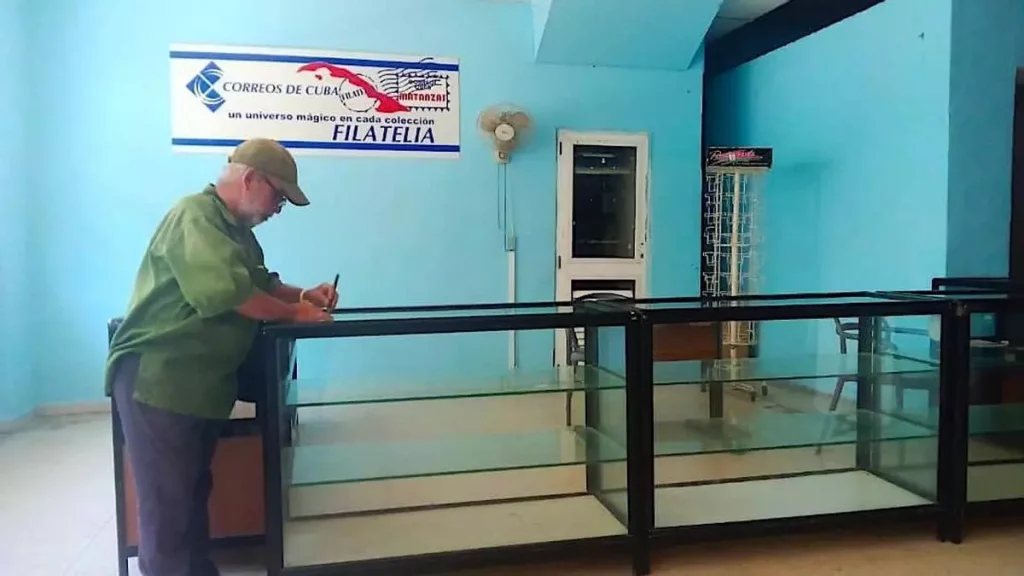
 14ymedio, Julio César Contreras, Matanzas, 24 May 2025 — In a city where people must wait in ever longer lines to buy things, it is surprising to see almost no one at local post offices. The lack of stamps and other supplies for mailing correspondence has turned these establishments into nothing more than pick-up locations for packages sent from abroad. Instead of letters and telegrams, these spaces are now filled with packages of powdered milk and medicine.
At the post office on Medio Street where, just a few years ago, lines used to begin forming early in the morning, it is now common to see workers looking bored. “No, we still don’t have stamps,” repeats one employee, who answers the same question dozens of times a day. “We’re suffering from neglect nationwide,” she says, pointing to the unreliable stamp supply as one of the most obvious signs of decline.
“It seems old-fashioned but some people still send letters, though most who come here need stamps to mail in some paperwork,” she adds. “A magical universe in every collection,” reads a sign pasted on the wall, intended to entice stamp collectors. Meanwhile, the display cases and shelves stand empty. There are no stamps, envelopes, or boxes to send to other provinces, much less glue, pens, or paper for anyone wishing to compose a letter on the spot.
Most people, who typically do not spend much time in here, have only one objective: to pick up packages sent to them by relatives overseas. “We have become a pick-up location and that is what keeps us open,” adds the employee. If not for the constant flow of packages from the Cuban emigre community, Cuba’s postal workers would be unemployed. In 2024 alone, the agency received and processed 503,232 shipments from abroad.

Since 2021 the Ministry of Finance and Prices has assumed that Cubans will buy from abroad what the state does not import. So every three months the tariff on imported medications, cleaning supplies, food and electrical generators is suspended. All these products can enter the country duty-free provided they are not intended for resale. International parcel delivery has been one of the areas that has benefited most from this measure. The steady flow of shipments, however, has not had a spillover affect on the profits of other postal services.
“Some customers complain that we are out of stamps and they are completely right. All I can say is that we might get them sometime next week but I know perfectly well that there is no short-term solution,” the employee explains. One of those irate customers was complaining on Monday — shouting and slamming the door on his way out — after being told that, for weeks, the post office has been out of the 20-peso stamps he needs to mail some notarized documents.
“When we get stamps in those denominations, they come in small quantities and sell out immediately,” an employee at another, less centrally located and even less well-off post office explained. “The busiest days are when we have to pay pensions to retirees.” The employees themselves suggest that customers look for stamps on the black market. “They have everything there,” the employee said.
“I am looking for three 10-peso stamps. I need them urgently,” writes a desperate internet user in one of the many Facebook groups offering everything from household appliances to vacation packages. The request has garnered hundreds of responses in just a few hours. “I have 10, 20, and 1,000-peso stamps. I take transfers but you have to hurry. They’re running out,” says one of the informal stamp sellers.
To discourage scalpers, the Cuban postal service imposed strict rationing. “Sales will be limited to no more than three stamps per person in 10, 20, 40, 50, 125, 500 and 1,000-peso denominations. For five 5-peso stamps, the limit will be five stamps per person,” the postal service stated in an official announcement. But as with so many other controlled products, private brokers have found ways to circumvent the rules.
“They have contacts who are administrators and postal workers. When the stamps come in, they are the first to find out, even before the stamps make it to the sales counter,” complains a Matanzas resident. She grew tired of waiting and decided to buy the stamps she needed for a passport through informal channels. “I had to pay double. For the 2,500-pesos worth of stamps I needed, I ended up paying 5,000.”
Some customers, like 79-year-old Simón, who picked up a package at the post office on Medio Street on Monday, connect the dots and complain about the contradictions of the Cuban postal service’s monopoly. “They get thousands of packages every week. Our relatives abroad pay a high price for this service and sometimes they don’t even have a pen to sign the delivery form,” he explains. “Why don’t they invest all the money they earn from shipping into improving their other services?”

“We are not supplied with paper. What paper we do have has been brought in by workers themselves from home,” an employee complains. “Customers who want to send a letter or a package have to bring it in, ready to mail, because we don’t even have glue,” she explains. It seems as though the service is completely focused on receiving and processing items received from overseas but has forgotten about anyone who wants to mail something within the country or abroad.
“Not long ago I published a book and wanted to send a copy to my nephew in Spain but I haven’t been able to find a medium-sized envelope,” complains a local writer who once even had a post office box located at the entrance to his office. Those boxes, which once welcomed customers, have been abandoned. Some of their doors have been ripped off or their locks broken, a warning that a place that was once dominated by letters and telegrams is now only a delivery area for food, soap, and pharmaceuticals.
____________
COLLABORATE WITH OUR WORK: The 14ymedio team is committed to practicing serious journalism that reflects Cuba’s reality in all its depth. Thank you for joining us on this long journey. We invite you to continue supporting us by becoming a member of 14ymedio now. Together we can continue transforming journalism in Cuba.