An Opulent Hardware Store Opens on One of the Most Impoverished Streets in Havana

Amidst ruined buildings, La Valía sells tools, appliances, furniture and even beauty products.


La Valía hardware store, on Calle Monte in Central Havana / 14ymedio

14ymedio bigger14ymedio, Juan Diego Rodríguez, Havana, 16 June 2025 — A new private business has been illuminating Calle Monte in Central Havana for just a few days. The verb is not exaggerated. On a street filled with ruined buildings, closed premises, rubbish at the corners, beggars asking for alms and a persistent smell of urine, there suddenly emerged a gigantic hardware store selling in pesos called La Valía.

Located on the stretch between Ángeles and Águila, the shop has everything and is perfectly clean and air conditioned. There are work tools, plumbing articles, household appliances (washing machines at 65,000 pesos), electronic devices (televisions, at 150,000 pesos), cookware such as pressure cookers (over 20,000), water pumps (up to 11,340) and even furniture (a set of table and chairs, 152,000 pesos). They also have a section of watches and another of beauty products, including creams and shampoos, some of Japanese (O’ujiashi) and Korean (Roushun) brands.

Located on the stretch between Ángeles and Águila, the shop has everything and is perfectly clean and air conditioned / 14ymedio

Prices, although high, are perceived to be somewhat lower than on sites like Revolico or among informal resellers. “This is awesome,” commented a young man who came out of curiosity this weekend. “They have things I’ve never seen, like electronic door locks and a giant fan – I guess for private businesses, because who’s going to put that in their house, and who’s going to be able to pay?” he said, pointing at the label, which was marked 550,000 pesos.

A woman looks at La Valía through the window / 14ymedio

For months, passers-by and neighbors in the area saw the renovation work going ahead at full speed. Last September, even with walls, doors and ceilings still under construction, an opulent space was expected. In those days of May, the one who seemed to be the owner or manager supervised the work, going back and forth to his car with a K number plate, which indicated that he was a foreigner.

Fan for sale in pesos in La Valía / 14ymedio]

In the WhatsApp group reporting the offers, it is specified that the trade is “retail sale”, although while it was under construction, a poster on the back wall saying “wholesale sale” could be seen. The workers shrugged their shoulders when asked about this change: “I don’t know”.

Water pumps for sale in La Valía / 14ymedio

There is little information about the shop. La Valía, like similar businesses, does not appear on the list of micro, small and medium-sized enterprises (MSMEs) of the Ministry of Economy and Planning. Nor does it have a website, which is normal for new private businesses, and it has only one Facebook page apart from the WhatsApp group.

They also have a watch and beauty products section / 14ymedio

In that sense, it resembles the A&M Bazaar, which, with several branches located in buildings and on unsafe streets, also draws attention for its opulence. Asked if La Valía has anything to do with A&M, an employee categorically denies it.

Last September, even with walls, doors and ceilings under construction, an opulent space was expected / 14ymedio

“Here if you do not buy, at least it serves to get away from the rubbish and lines,” said another woman with a dazed gesture of her hand embracing the panorama on Monte street. “It’s like an oasis in the desert.”

Translated by Regina Anavy

____________

COLLABORATE WITH OUR WORK: The 14ymedio team is committed to practicing serious journalism that reflects Cuba’s reality in all its depth. Thank you for joining us on this long journey. We invite you to continue supporting us by becoming a member of 14ymedio now. Together we can continue transforming journalism in Cuba.

Ballplayer Ediel Ponce Left Cuba To Escape Military Service and Will Now Play in the Major Leagues

Two more players, Ronald Lázaro Mena and Yermin Neyra, have settled in the Dominican Republic.

Ediel Ponce says that Cuba never gave him the ’Rookie of the Year’ trophy in 2024 / Francys Romero

14ymedio bigger14ymedio, Havana, 15 June 2025 — Ediel Ponce reached an agreement with the Los Angeles Angels this Saturday. The ballplayer left Cuba in 2024, resentful because, after representing the island at the pre-World Baseball Championship in the under-18 category in Panama, he received an order to enlist for military service. That was his award for being the top pitcher of the team at the event.

Ponce told the platform Tigres Avileños that, despite their good level of play, he could not avoid the compulsory military service, and no manager did anything to release him from the call. “It hurt a lot. I never thought that would happen to me in Ciego de Ávila,” said the player.

The athlete revealed that he experienced constant neglect by the Provincial Baseball Commission in his native Ciego de Ávila. “When I was in the National Series they told me that I was their ’child’ and that they liked me very much, but all that changed. Nor did I ever receive the ’Rookie of the Year’ trophy in 2024. All that bothered me quite a bit,” he recounted last September.

The young man settled in the Dominican Republic, where his initial goal was to perfect his technique so he could compete for a US Major League contract. He was embraced by the academy continue reading

of Fausto Chiqui Mejías, who is a reference among Major League pitchers.

Ballplayers Ronald Lázaro Mena and Yermin Neyra left the island and settled in the Dominican Republic / Francys Romero

Ponce appeared before the scouts and, according to journalist Francys Romero, “several of them highlighted an innate ability to throw strikes as his strongest asset.” In addition, “his best pitch is the change-up, and he also masters the curve and sinker. He is able to throw a straight between 89 and 91 miles per hour.” With these qualities, he is assured of a rapid advancement in the Minor Leagues.

While the Ponce agreement was being announced, the departure of two other prospects for Cuban baseball to the Dominican Republic was confirmed. These are Ronald Lázaro Mena and Yermin Neyra.

Mena, said Romero, “was one of the best pitchers in the youth category in 2025.” In this stage he recorded 37 strikeouts, four wins and reached a 2.12% ERA. His straight has come close to 92 mph. The athlete was closely followed by teams from the Professional League of Japan.

For his part, Neyra is a central outfielder, with outstanding power and speed in the bases.

Translated by Regina Anavy

____________

COLLABORATE WITH OUR WORK: The 14ymedio team is committed to practicing serious journalism that reflects Cuba’s reality in all its depth. Thank you for joining us on this long journey. We invite you to continue supporting us by becoming a member of 14ymedio now. Together we can continue transforming journalism in Cuba.

Susely Morfa Continues To Rise in the Cuban Communist Party

The “millionaire psychologist” has been named the first secretary of the PCC in Villa Clara.

From left to right: Osnay Miguel Colina, Roberto Morales Ojeda, and Susely Morfa. / PCC/Facebook

14ymedio bigger14ymedio, Havana, 12 June 2025 — Just over a year after stepping down as First Secretary of the Communist Party in Matanzas to serve on the Party’s Central Committee, Susely Morfa has been reappointed as the highest authority in a province: Villa Clara. The psychologist will replace Osnay Miguel Colina Rodríguez, who “will be assigned other responsibilities.”

Roberto Morales Ojeda, who had been in charge of orchestrating the dismissals and promotions within the Central Committee in recent years, presided over the plenary session in which Colina was removed from office “at the request of the Political Bureau.” The meeting participants, the PCC said in a statement, applauded the work of the official, who was in charge of Villa Clara for three years, and his “fulfillment of the priorities defined by the Party during this period.”

The official note briefly outlines Morfa’s career: a graduate in Psychology, 42 years of age of which 21 years—exactly half—have been dedicated to “political leadership activities”; former secretary of the National Committee of the University Student Federation; former first secretary of the PCC in Matanzas; member of the Party’s Executive Bureau; deputy to the National Assembly; and, in her last position, head of the Department of Attention to the Social Sector.

The brief resume does not summarize Morfa’s combative career, having tried by all means to demonstrate that she is a “reliable figure.”

This brief resume doesn’t summarize Morfa’s combative career. She has tried by all means to demonstrate that she is a “reliable figure” for the Party, and her meteoric rise over the last decade proves that her efforts have paid off.

In 2015, the psychologist burst onto the Cuban political scene after her performance at the Summit of the Americas in Panama, where she led several protests and called the Cuban activists and exiles who participated in a parallel event with civil society “lackeys, mercenaries, self-financed, and underpaid by imperialism.” continue reading

During that performance, after being questioned by a journalist from a Florida media outlet, she claimed she had spontaneously traveled to Panama to protest, paying for her stay and travel with her salary as a psychologist. Following that response, people on social media began calling her “the millionaire psychologist.”

Barely a year after the Summit, Morfa was elected to the National Assembly of People’s Power and a member of the Council of State. She was also immediately appointed leader of the Union of Young Communists (UJC), after having held various positions in the youth organization, first in her hometown of Rodas (Cienfuegos) and later as a provincial leader.

After leaving Matanzas, Morfa was hailed as a “great leader” when she received a barrage of praise from representatives of official organizations.

After leaving Matanzas, Morfa was hailed as a “great leader” after receiving a barrage of praise from representatives of official organizations in the province. Osmar Ramírez Ramírez, secretary general of the Cuban Workers’ Union, even noted that the psychologist was “proof that the future of the Revolution is guaranteed.” “During highly complex events such as the fire at the Supertanker Base, the floods in Carlos Rojas, or during the events of 11 July 2021, she has always been on the front lines, something that undoubtedly makes her a great leader,” he added.

Morfa has steadily climbed the political ladder in the country, and some, like journalist Reinaldo Escobar, even believe she could become a presidential candidate when Miguel Díaz-Canel leaves the government in 2028. Furthermore, she has been one of the few high-ranking Party officials to survive the recent waves of dismissals. The latest of these changes occurred last May, when the Party dismissed Yuniasky Crespo, its representative in Mayabeque.

Crespo’s departure, after three years in office and a long career associated primarily with student institutions, follows those carried out in the provinces of Las Tunas and Camagüey in 2025, which were preceded by at least a dozen “cadre movements” – as the regime calls them – the previous year, which the Party has attributed to a routine “renewal” of its members.

____________

COLLABORATE WITH OUR WORK: The 14ymedio team is committed to practicing serious journalism that reflects Cuba’s reality in all its depth. Thank you for joining us on this long journey. We invite you to continue supporting us by becoming a member of 14ymedio now. Together we can continue transforming journalism in Cuba.

Mother of Two Small Children Stabbed in the Street in Niquero, Granma Province, Cuba

The woman was stabbed three times in public.

Gretel Matos was 33 years old when she died /La Hora de Cuba / Facebook

14ymedio bigger14ymedio, Havana, 15 June 2025 — The murder of Gretel Matos, mother of two small children, last Friday in Granma province brings the total of femicides to 15 so far this year in Cuba, according to 14ymedio records. The 33-year-old woman was stabbed three times in the street in the Niquero municipality, where she lived.

Matos’ assailant was named as Didier Almagro, father of her second child, “who fled after committing the crime, near La Plaza del Pueblo,” according to the independent media La Hora de Cuba.

The man was hiding from the law up to this Saturday said a media source, who added that “he said several times he was going to kill her (Matos), after he had tried unsuccessfully to revive their relationship.” continue reading

La Hora de Cuba reported that she was with her present partner when it happened.

Almagro “had said on various occasions that he was going to kill her, after he had tried unsuccessfully to revive their relationship

At the start of the month, the official press, which rarely mentions this type of crime, reported the femicide of Rosa María Santana Álvarez, aged 29, following lots of rumours of her death in social media.

Escambray reported that the aggressor, Santana’s ex-partner, had been caught and confessed to the killing of the woman who was mother of two young children. The main was arrested “less than two hours after he did it,” a Ministry of the Interior committee was pleased to report to the paper. It added that the arrest was “thanks to public support” and the speedy action of the police.

A few weeks before that, at the end of April, Yiliannys Reyes, a girl from Camagüey, hardly 17-years-old, was assaulted, also at the hands of her ex-partner. And before that, 40-year-old Yunisleidy López Milián, had been killed by her partner, who attacked her in her home in Guayos in Cabaiguán municipality.

To date this year, there have been 15 femicides in Cuba according to our records. The feminist associations noted the killing of Odalys Bataille as an instance of this type of violence. She was a 53-year-old nurse in Habana del Este. But up to now it is not known what the link is between the victim and the perpetrator, a presumed ex-convict, and 14ymedio has it registered as a homicide.

Translated by GH

____________

COLLABORATE WITH OUR WORK: The 14ymedio team is committed to practicing serious journalism that reflects Cuba’s reality in all its depth. Thank you for joining us on this long journey. We invite you to continue supporting us by becoming a member of 14ymedio now. Together we can continue transforming journalism in Cuba.

“The People Are an Enemy That Must Be Controlled in the Defense of Power in Cuba”

Priest Alberto Reyes calls on the Security Forces to reflect on their role in defending the Cuban dictatorship.

Reyes is the parish priest of Esmeralda, a municipality in Camagüey. / Courtesy

14ymedio bigger14ymedio, Havana, 14 June 2025 — “How can you lend yourself to harassing and intimidating young people who perhaps have the same thoughts and ideals as your own children?” This is how Father Alberto Reyes addresses those charged with “taking care of the country, protecting its citizens: police, State Security agents, members of elite forces, whether they be red berets, black berets, black wasps…” in a post on his social media on Friday.

The students’ voices aren’t the only ones that have resonated in recent weeks calling for social and political change. From other sectors of society, including the religious community, reflections on the island’s turmoil have reached social media and independent media. Under the title ’He estado pensando’ [I’ve been thinking], the Camagüey priest called on the military forces to reflect on “what you’re doing right and what you’re doing wrong.”

This isn’t a speech from the top of the ecclesiastical hierarchy. The priests and nuns closest to the people—the same ones who came out to defend the protesters on 11 July 2021—have supported the students in a context of harassment of university students who have protested against Etecsa’s tariffs, the ‘tarifazo‘. While State Security agents knock on doors and warn against posting “counterrevolutionary” content on social media, Reyes urges people to listen to their own conscience.

“The social model in which we live, being dictatorial, is based on the conception that the priority of these forces is not serving the people but rather the unquestionable defense of power. Since it is a power against the people, the vision it presents to its military forces is that the people are an enemy to be controlled,” the priest said. continue reading

“These forces’ priority is not serving the people but rather defending power without question.”

According to the parish priest of the municipality of Esmeralda, “being a police officer, a State Security agent, a member of elite forces (…) is fulfilling a beautiful vocation: caring for the country, protecting its citizens, guaranteeing the safety of individuals.” When “you are not an instrument that enables society to feel safe and at peace, then the meaning of your vocation has been corrupted.”

Reyes, whose stances against the regime have earned him several reprimands from State Security and within the Church itself, did not hesitate to question the repression of citizens who already live in “slavery” and “need.”

A few days earlier, Father Lester Zayas also reported the attack on his vehicle due to his statements against the government. “It’s true that coincidences happen, but do they always happen the same way? This is how our car looked this morning after a long night of blackouts throughout El Vedado, right in front of our convent,” he wrote on June 3.

The priest was referring to a lengthy post he published the day after President Miguel Díaz-Canel appeared on a new episode of his podcast to explain the blackouts. Zayas expressed his astonishment at the lack of a “good advisor” at the island’s leader’s side. As a result, and according to the photo accompanying his complaint, the vehicle’s windows were smashed and part of the radio destroyed.

This Friday, in an interview with Martí Noticias, Father Castor José Álvarez—known for his arrest during the 11 June 2021 protests in Camagüey—stated that “the Cuban people are trapped in a political system that not only doesn’t provide them with opportunities, but also denies them the right to live with dignity.” The priest called on the authorities to reflect, explaining that on the island “there can be no peace without freedom.”

This week, 14ymedio also reviewed a Facebook post by Nadieska Almeida, the Mother Superior of the Daughters of Charity in Cuba, in which she denounced that authorities had used a photo of her to simulate an environment of understanding and collaboration between the Church and the government.

During a routine visit at the nursing home run by the religious community, the authorities asked for a photo and the nun agreed.

During a routine visit to the nursing home run by the religious community, the authorities asked for a photo, and the nun agreed. However, days later, she received “the surprise that, without permission, they had posted it on social media with the following message: ’Together for a revolutionary ideal.’” Almeida said she felt “very upset, as is to be expected,” and that was the reason that prompted her to write her text and attack the Revolution.

“I don’t believe, I don’t hope, I don’t see anything valuable in the revolution. So many lies, so many ways to crush my people, so many deceptive promises,” she declared in her post. “How can I believe in a project that continues to claim the lives of young people forced into military service? How can I believe them when they want to silence the cries of hunger of our children and the elderly? How can I believe them when they plunge us once again into isolation and disconnection, when they shamelessly lie to us and once again insult the intelligence of an entire people with [internet and phone] rates unattainable for many?” she said, referring to the Etecsa tarifazo (rate hike).

____________

COLLABORATE WITH OUR WORK: The 14ymedio team is committed to practicing serious journalism that reflects Cuba’s reality in all its depth. Thank you for joining us on this long journey. We invite you to continue supporting us by becoming a member of 14ymedio now. Together we can continue transforming journalism in Cuba.

Lobito, the Star of Matanzas’ Narváez Promenade, Has Died

“Life is difficult for humans, what can we expect for stray animals?”

Lobito, like other stray dogs, was art of the environment of the Matanzas boulevard.

14ymedio bigger14ymedio, Pablo Padilla Cruz, Matanzas, 15 June 2025 — Lobito was a mixed-breed dog, a sato, without a pedigree. Even so, his death last week, when a door fell and struck him, dismayed the workers on Narváez Avenue in the city of Matanzas, who were accustomed to feeding him and watching him frolic with bar patrons.

Lobito arrived on Narváez Avenue after passing through several homes. The Animal Welfare (BAC) staff in Matanzas had taken him in as a puppy, covered in sores. They treated him, bathed him, and tried to put him up for adoption, but Lobito never adapted. “What he liked most was running around the streets and playing with the bar patrons, who gave him food and sometimes held his paw. Little by little, along with other street dogs, he became part of the Matanzas boulevard scene,” says Yordani, a bartender at one of the street cafes.

“A worker at the Artys bar, where the accident happened, told me about it. When I started working here, he was already here. Every day, we brought him his lunch and his dinner along with ours. He was part of the team, not just at this bar but at most of the bars in the area,” explains the young man from Matanzas.

The stray dog wasn’t the only one with a reputation on the boulevard either. “There was Firulais, who went viral when a quinceañera took some studio photos with him.”

Lobito, he recalls, had “free access” to a few establishments, where he took refuge from the heat and entertained diners. “Surprisingly, he didn’t bother the customers; on the contrary, they were the ones who most often called him over and even asked to take pictures with him,” he says. Tourists also photographed him, or he was seen playing with some children, trying to steal a ball from them. continue reading

The stray dog wasn’t the only one with a reputation on the boulevard either. “There was Firulais, who went viral when a quinceañera took some studio photos with him, and the story was reported in a Spanish magazine. We also had El Rubio and his girlfriend, who we weren’t sure if they were dating or not, but they always lay down together to take a nap in some shaded area along the promenade,” says Yordani. Little by little, some due to illness and others due to accidents, Narváez’s community pets began to disappear.

The city’s animal rights activists never stopped caring for Lobito. According to Yordani, “they always kept him clean and took care of his health” despite the lack of resources and institutional support they’ve suffered since the association’s founding a few years ago.

The city’s animal rights activists never stopped caring for Lobito. According to Yordani, “they always kept him clean and took care of his health.”

BAC members, mostly young people, not only make their own resources and pockets available to stray or abandoned animals, but were also the ones who pushed – with a demonstration in front of the Ministry of Agriculture in Havana – for the creation of an Animal Welfare law that was finally approved in 2021. However, interviewed by 14ymedio , some of the young people are not satisfied with the law.

“It’s already outdated and no longer serves the purpose for which it was created,” says one BAC activist. “It’s as if it was created to silence the demands of animal lovers,” adds another.

El Rubio and his girlfriend were also on the promenade.

The young people lament that the crisis the island is mired in, which leaves little room for anything but daily survival, has worsened the situation for domestic animals. “Life is difficult for humans, what can we expect for stray animals? Many of us activists take part of our wages to buy medicine, pay for surgeries, and transport not only our own but also these other animals in critical condition,” the animal rights activist explains. “An operation for a cat can cost over 20,000 pesos and is generally only performed in the capital.”

While acknowledging that many have become aware of the precarious conditions faced by stray animals, he also admits that Cuba is “in its infancy” compared to many countries around the world and on the continent. Lobito is proof of that.

The youth lament that the crisis the island is experiencing has worsened the situation of domestic animals.

____________

COLLABORATE WITH OUR WORK: The 14ymedio team is committed to practicing serious journalism that reflects Cuba’s reality in all its depth. Thank you for joining us on this long journey. We invite you to continue supporting us by becoming a member of 14ymedio now. Together we can continue transforming journalism in Cuba.

A Group of 20 Cuban ‘Balseros’, Including Several Children, Await Deportation in the Bahamas

The migrants join 37 others who were rescued last January by the U.S. Coast Guard.

Cuban balseros boarding the ship ’Margaret Norvell’ / X @USCGSoutheast

14ymedio bigger14ymedio, Havana, June 13, 2025 — Since last Tuesday, a group of 20 Cuban balseros [rafters] have been in custody in the Bahamas and are awaiting deportation. The migrants, in their attempt to reach the United States, were stranded on the uninhabited island of Cayo Anguilla and rescued by the crew of the US Coast Guard ship Margaret Norvell.

According to a statement, agents of the National Security Investigations in Miami were informed of the situation and sent a US HC-144 Ocean Sentry turboprop aircraft, which “dropped food, water and a radio for communications.”

According to Univision journalist Javier Díaz, “several women and children” are among the Cubans. The deportation process in the Bahamas, he said, can take months. “Previously other migrants have been imprisoned in the country for more than six months,” so he recommended that family members “be patient with this return.”

The most recent case is that of 37 Cubans who were rescued last January after being stranded on the islands of Cal Sal Bank and Cayo Anguila. The deportation process for these persons has not yet been finalized. continue reading

US Coast Guard Lieutenant Fernando Pla warned the balseros with a now-familiar statement that “anyone who attempts to enter the United States illegally by sea will be intercepted and repatriated to their country of origin.”

Pla emphasized that they constantly patrol the maritime approaches to the Florida Strait, Windward Passage, Mona Pass and the Caribbean Sea in support of Operation Watchman Sentry.

According to official figures, since the beginning of fiscal year 2025 on October 1, Coast Guard crews have returned 103 migrants to Cuba.

The route of emigration by sea is one of the most dangerous for Cubans. The Missing Migrants Program of the International Organization for Migration reported in August last year that at least 291 people disappeared during their crossing. Of that number, 142 were from the Island.

Translated by Regina Anavy

____________

COLLABORATE WITH OUR WORK: The 14ymedio team is committed to practicing serious journalism that reflects Cuba’s reality in all its depth. Thank you for joining us on this long journey. We invite you to continue supporting us by becoming a member of 14ymedio now. Together we can continue transforming journalism in Cuba.

A Cuban Is Accused of Human Trafficking and Could Spend 50 Years in Prison

Moment of arrest of Yasel Vinent in Cancun, Quintana Roo

14ymedio bigger14ymedio, Ángel Salinas, Mexico City, 13 June 2025 — Cuban Yassel D. Angelo has been in prison since last Tuesday for the crimes of human trafficking and prostitution in Cancun. Authorities found a US resident document with the name Yasel Vinent on it. Officer Ezequiel Marrufo told 14ymedio that if found guilty “he could serve 50 years in prison plus be fined by the judge.”

The Cuban was reported last May by his victim, a 22-year-old woman. She told the authorities that he forced her to prostitute herself. “He charged 2,500 pesos ($132) for having sexual relations in his home.” If the service was in hotels, she had to dress as the client requested. “He charged them 3,000 pesos ($158) for 40 minutes, and the money increased for some services.” According to investigations by the authorities, Vinent obtained up to 25,000 pesos (more than $1,300) in one day.

“The woman was punished for any complaints from customers.” According to the official, “the possible relationship with a trafficking network in the United States is being investigated, but this is not confirmed.” The Cuban was found with a US resident card issued in 2017. “All the evidence is part of the process, as well as the verification of his name, because in the document it appears as Yasel Vincent, and at the time of his capture he said he was named Yassel D. Angelo.” continue reading

Document found on Yasel Vinent at the time of his arrest / Noticias Q. Roo

The Mexican women and Vinent were dating for several months until she agreed last February to move in with him. According to her statement to the authorities, Vinent went from being nice to “beatings and insults.” However, after the aggressive episodes, he always apologized.

On one occasion, she tried to leave him, but he threatened to “kill me and do the same to my family.” On advice from some close friends, the woman “took courage and returned home.” Officer Marrufo says that “such was the control this Cuban had over the girl, that he went to her parents’ house and convinced her to return with the promise that everything would change.”

Upon returning, “I experienced hell,” the woman said. Vinent let her know that she would do whatever he wanted or “my family would pay for it.” He took her cell phone and “when he could, he checked my messages and put my phone on speaker to listen to my conversations.”

The prosecutor’s Office for Combating Human Trafficking took up the case and, following the complaint by the young woman, requested and obtained from a judge an arrest warrant against Yassel D. Angelo.

Translated by Regina Anavy

____________

COLLABORATE WITH OUR WORK: The 14ymedio team is committed to practicing serious journalism that reflects Cuba’s reality in all its depth. Thank you for joining us on this long journey. We invite you to continue supporting us by becoming a member of 14ymedio now. Together we can continue transforming journalism in Cuba.

The Owner of the ‘Cuban Costco’ Has Been on a Hunger Strike for Two Weeks With Deteriorating Health

Cuspinera’s case has caused deep concern in the private business sector / Collage

14ymedio bigger 14ymedio, Havana, June 14, 2025 — Frank Cuspinera, owner of Diplomarket, the “Cuban Costco,” imprisoned in the Combinado del Este, completes two weeks without eating this Saturday. The Cuban-American businessman began his fast on June 1, and his health is deteriorating rapidly, according to a family member who spoke to 14ymedio. ” He remains determined to continue until justice is done in his case,” confirms the source.

“It’s bad,” says Luis, close to the inner circle of Cuspinera, 48 years old, but with his name changed for fear of reprisals. The entrepreneur, who is being investigated for tax evasion, currency trafficking and money laundering, has been in solitary confinement since refusing to eat. The strike also began with a refusal to drink, but last Tuesday the Cuban-American drank “some water”.

The prison authorities have allowed Cuspinera to make phone calls to his family in an attempt to have relatives convince him to stop the hunger strike, but so far they have not managed to get him to eat anything. The first week of fasting, he received a visit from his wife, Camila Castro, who was free but also being investigated for the same crimes, to perform “family dynamics,” says Luis. This is what they call it, “when the relatives of a plantado are brought in to convince him to stop the strike.”

The strategy didn’t work either: “They wanted to appeal to the family dynamic without even knowing Frank’s emotional profile, without even having found out why he is carrying out the strike,” Luis said. “Obviously they were only complying with an institutional protocol, so it will be recorded in some file that they complied with their part, that they met with the family.” continue reading

Cuspinera’s wife did not accept the “dynamic”, and although she traveled to the prison, she was not allowed to see her husband

Cuspinera’s wife did not accept the “dynamic,” and although she traveled to the prison, she was not allowed to see her husband. The relatives fear, says Luis, that the Cuban-American will end up in the hospital, and his body will suffer permanent damage from not eating because he suffers from diabetes and high blood pressure.

Cuspinera announced his hunger strike in a handwritten letter signed on May 21 and sent from the Combinado del Este prison, almost a year after his arrest and with absolutely nothing known about his whereabouts. In the letter, he made “an appeal to the international community and international and human rights organizations,” as well as to the United States Department of State, “to intervene with the Cuban institutions for the constant violations of my rights and the denial of legal guarantees for my defense by the Cuban State institutions and their representatives.”

The businessman attacked State Security and the Cuban judicial apparatus “that are viciously activated against me” and that managed, with “multiple falsehoods,” to start an investigation against him “without the right of defense.”

The case of Cuspinera has caused deep concern in the private business sector on the Island. The lack of procedural guarantees and the ferocity that he denounces from prison have increased the suspicion of entrepreneurs about investing in Cuba. While some accuse the Cuban-American of being naive for putting his money into a local business, others see his arrest as a revenge of the government.

“They had a complaint for tax evasion, without ever having done a prior audit,” says Luis

“They had a complaint for tax evasion, without ever having done a prior audit,” says Luis. These officials “reviewed everything,” and then the Technical Directorate of Investigations was introduced. The entrepreneurs were arrested and their business licenses taken away “immediately” from both Cuspinera SURL, the firm under which the supermarket operated, and Kmila-mart (his wife’s company), leaving them “inoperable.”

For the couple it was, says Luis, a shock: “They thought it would be a misunderstanding, that they would let them reopen the companies after solving it, that they would allow them to return the goods to some suppliers or even that Frank could respond to the process on bail, but they have not agreed to any of this.” The authorities were, he says, “more severe and arbitrary as time went on.”

At the time of the arrest, officials claimed “that the money from the sales was not deposited in the bank and caused damage to the State and discontent among the population,” says Luis. “Here everyone knows that all the MSMEs do currency trafficking, because when they made the private business law, it was done knowing that there would never be availability in the bank to obtain the currency legally. It is known that the largest percentage of everything sold in Cuba are imported products obtained with transactions in currency, because here nothing is produced, so you have to import to produce later,” says the source.

Translated by Regina Anavy

____________

COLLABORATE WITH OUR WORK: The 14ymedio team is committed to practicing serious journalism that reflects Cuba’s reality in all its depth. Thank you for joining us on this long journey. We invite you to continue supporting us by becoming a member of 14ymedio now. Together we can continue transforming journalism in Cuba.

Waking Up From the American Dream and Returning to the Cuban Nightmare

“My mother received an email this morning saying her permit was revoked.”

Before, waiting a year without applying for asylum used to seem like the logical option. Today, it’s become a trap. / 14ymedio

14ymedio bigger14ymedio, Havana, 13 June 2025 — The call came early. “You have to come back at 3:00 pm because we’re short two employees,” she was told. The woman, who had just finished a night shift, didn’t even have time to sleep. When she arrived, she learned that her colleagues hadn’t just been fired, but had lost their US work permits. And they weren’t the only ones.

Many Cubans are waiting in the hope of being able to benefit from the Adjustment Act, since they did not apply for political asylum. Others fear they won’t have time and are preparing psychologically and materially to bid farewell to the American dream and return to the Cuban nightmare.

“I already bought a power generator for my house in Cuba, in case I get deported.”

María Laura has already started packing her bags, both physically and mentally: “I already bought a power generator for my house in Cuba, in case I get deported,” she told 14ymedio. “I also sent an electric motorcycle, a washing machine, and other appliances by courier.” She isn’t interested in starting over in another Latin American country, nor does she have any way to go to Europe. Miami was the closest thing she had to escape the misery on the island without dying of homesickness.

“My mother received an email this morning saying her permit was revoked,” another Cuban resident in the US told 14ymedio. “She officially lost her job and now she’ll have to wait quietly for the Adjustment Act to expire,” he says, with a mixture of resignation and anger. continue reading

But the wait, in this case, is anything but peaceful. “All of this wouldn’t be happening if I had applied for political asylum in time, like the Haitians, Venezuelans, and Nicaraguans did, who don’t have a law that benefits them. But since my mother wanted to visit Cuba, she refused to do so,” he explains. His fear has several facets: “On the one hand, if she applied for asylum, she wouldn’t be able to visit her family on the island. But she also feared that, at any moment, the regime would place her on the list of those ‘regulated’, those who are prohibited from returning.” Being able to hug her family on both shores from time to time outweighed any legal calculations. And that desire, now, may cost her dearly.

Many migrants have been left in a kind of migratory limbo.

With parole suspended and a tense political climate since January 2025, many migrants have been left in a kind of immigration limbo. The Cuban Adjustment Act—that lifeline that has allowed thousands of Cubans to regularize their status after 365 days in the US—remains in place, but new regulations are closing the gap. Previously, waiting that year without requesting asylum seemed like the logical option. Today, it has become a trap. An expert consulted by this newspaper says: “People grew complacent, believing nothing would change. But it did.”

Cubans, at least for now, still have a legal option: the Adjustment Act. But that window isn’t automatic. “If you don’t have legal entry or haven’t managed to complete the year without conflict, the situation becomes more complicated. And even if there’s no immediate deportation, the fear of being expelled becomes a constant looming shadow,” warns the expert. Venezuelans, Haitians, and Nicaraguans, on the other hand, have political asylum as an escape route, because for them, there is no “Adjustment.”

The atmosphere in Cuban communities like Hialeah, Union City, and parts of Houston is one of anxiety. Some lawyers speak of “dozens of panicked clients,” others of “overwhelmed waiting lists.” Law offices are unable to cope. Fear now has a postal address: that letter that arrives and changes everything. “First they tell you they’re taking away your work permit. Then comes the silence. And you start to fear that the next thing you’ll get is a deportation order,” says another migrant who does not want to be identified.

The dilemma: ask for asylum and risk not being able to return to Cuba, or hope that the Adjustment will arrive before the collapse

But many Cubans remain trapped in the dilemma: seek asylum and risk being unable to return to Cuba, or hope that the Adjustment Agreement will arrive before the collapse. Meanwhile, the country they left behind remains impoverished, militarized, and more authoritarian than ever.

And in this limbo, time is running out. Every day without permission is a day without income. Every letter from the government is a threat. Every conversation with a lawyer ends with a list of urgent documents. Some have already started selling their things. Others have taken refuge in friends’ houses. No one knows what will happen in July, August, or December. But everyone knows that Cuba, for now, is not an option.

“I didn’t want to apply for asylum because I was thinking of returning to Cuba,” the unemployed woman’s son repeats. And his voice no longer sounds reproachful. It sounds like pain. That mixture of guilt and sadness that marks the story of so many families divided by the sea, by politics, and by waiting.

____________

COLLABORATE WITH OUR WORK: The 14ymedio team is committed to practicing serious journalism that reflects Cuba’s reality in all its depth. Thank you for joining us on this long journey. We invite you to continue supporting us by becoming a member of 14ymedio now. Together we can continue transforming journalism in Cuba.

“I Don’t Want Any More DTI People in My House,” Complains a Cuban Medical Student in Las Tunas

Another university student warns, in the face of the advance of dollarization, that the country “also belongs to those of us who don’t have dollars.”

The young woman holds State Security responsible for any health problems her mother may suffer due to this coercion. / Screenshot

14ymedio bigger14ymedio, Havana, 13 June 2025 — “I don’t want any more DTI [Department of Technical Investigations] people in my house,” a young medical student blurts out in front of her professors and classmates, with the anger that only comes from being fed up. The scene, captured on video and viral on social media in recent hours, has put a face, name, and anguish to the latest chapter of university repression in Cuba.

Anisleydis Reyes, a student at the University of Medical Sciences of Las Tunas, is no longer afraid to speak out, even though she could lose everything. Her crime: speaking out against the ‘tarifazo‘ — the rate hike recently imposed by Etecsa, the State telecommunications company. The future doctor reports that the political police have visited her home and she holds State Security responsible for any health problems her mother may suffer due to these coercive strategies.

“It would be a shame if you study for six years only to end up not getting your degree,” Reyes was told.

Since data package prices skyrocketed on May 30, classrooms have become trenches. Students protested however they could: they denounced the subservience of their representatives holding positions in the student control apparatus, stopped attending classes, and posted statements on social media. What followed was a well-worn State Security manual: warnings, interrogations, manipulations, veiled (or not so veiled) threats. “It would be a shame if you study for six years only to end up not getting your degree,” they told Reyes, while accusing her of being a ringleader, an instigator, and a counterrevolutionary.

But Reyes’s social media profile isn’t that of an activist, much less an opponent. She’s a teenager, like many others, who shares photos of herself on the beach or with friends, who enjoys reading The Little Prince, and who follows famous soccer players. If these protests have made any difference, it’s that discontent and open confrontation with power are no longer a rarity or an exception; they’re a widespread sentiment among young people.

In the videos that circulate, another student can be heard saying, “This country also belongs to those of us who don’t have dollars.” Another young woman questions, “If our government violates its own laws, how can they claim we violate them?” continue reading

The pressures were not selective. Raymar Aguado Hernández, one of the activists who openly supported the protests from Havana, received an unwelcome visitor at his home. They went to find him, put him in a patrol car, and took him to the Zanja y Dragones station. The initial interrogation was tepid, almost bureaucratic. Then came the confinement in a windowless room and a direct threat, whispering the name of the State Security prison of choice: “Villa Marista is waiting for you.” He didn’t sign the form. They took his documents. And they warned him that, without them, going out onto the street could result in arrest.

Aguado, 24, knows all too well what that means. In 2022, he dropped out of his psychology program after being constantly harassed by the political police. He was told he would never set foot in an official classroom in Cuba again. Today, he studies humanities at the Félix Varela Center, publishes essays, organizes cultural activities, and navigates the ever-narrower space of activism on the island. And although he has gained experience, he has never lost the vulnerability that comes with having those in power throwing their weight around.

The modus operandi is now familiar: nighttime visits, “informal” conversations with deans, threats about academic futures, interrogations that begin as dialogue and end as sentences. In the university hallways, there is fear, but also dignity. Outrage over Etecsa’s rate hike was the spark, but the fuel comes from before: insufficient scholarships, poor-quality food, constant power outages, hearing parents urging them to “speak quietly,” and a sense of unstoppable general deterioration across the country.

Their complaints are not only against the ’tarifazo’

The faces of Aguado and Reyes, on the other hand, have managed to break through the wall of silence. Their protests aren’t just against the rate hike. They’re against a system that turns students into enemies, that responds to protests with surveillance, that reduces the university to a field of political loyalty.

On social media, the video has sparked both solidarity and fury. Many recall that this is not the first time a student protest has ended in closed files, expulsions, or forced exile. In 2021, David Martínez Espinosa was expelled as a professor at the Cienfuegos University of Medical Sciences for posting on digital platforms “questioning the Cuban social process” and demonstrating “with open defiance and criticism” of the political system.

But what’s new about this moment is the synchronicity. The protests against the tarifazo weren’t an isolated outbreak, but a movement that spread spontaneously throughout all regions of the country. And although the government managed to put out the fire with the old method of intimidation, something remained. A crack. A message. A switched-on phone that they couldn’t detect.
____________

COLLABORATE WITH OUR WORK: The 14ymedio team is committed to practicing serious journalism that reflects Cuba’s reality in all its depth. Thank you for joining us on this long journey. We invite you to continue supporting us by becoming a member of 14ymedio now. Together we can continue transforming journalism in Cuba.

In Flor De Itabo, Cuba, “There Is No Life,” Only Resignation for Its 800 Inhabitants

“Nothing comes to the bodega. We’re living off the small and medium-sized businesses, off the hotdogs that cost 450 pesos.”

Flor de Itabo is surrounded by old dairy farms. / 14ymedio

14ymedio bigger14ymedio, José Lassa, Havana, 13 June 2025 — “This place is completely bad. There’s no life. I don’t see any prospects.” With these three phrases, spoken with utter desolation, Pedro sums up the situation in Flor de Itabo, a remote batey in Madruga, in the province of Mayabeque, where he has lived for more than 12 years. Life there has always had its ups and downs, but he doesn’t dare put a name to the situation its residents have been experiencing in recent months.

The town, consisting of about twenty four-story buildings housing nearly 800 people, was founded in 1972. There’s also a bodega , a primary school, a daycare center with about 40 children, a doctor’s office, and a pharmacy. Flor de Itabo is surrounded by old dairy farms. Mayabeque is a cattle-raising province and has always relied on dairy and meat, Pedro recalls. Now, everything is “practically empty.”

With a recent investment, he explains, a few “imported cows” arrived on the farms. But this has not contributed to improving living conditions in the village.

The town consists of about twenty four-story buildings / 14ymedio

Food, Pedro cites as an example, is worse than ever. “Nothing comes to the bodega, we’re waiting for rice, and it doesn’t arrive. We’re living off micro, small and medium-sized businesses, off hot dogs that cost 450 pesos, off an expensive chicken…” Bread, he points out, is also “conspicuous by its absence.” “We don’t know the cause. It hasn’t arrived for days.” continue reading

The MSMEs — small and medium-sized businesses — are a world apart, the guajiro continues, clarifying that while it’s possible to get bread and some other foodstuffs there, the prices aren’t always affordable. “We’re getting by with their bread, at 350 pesos a bag, and we have to eat because otherwise we’ll die.”

Many other problems plague the residents of Flor de Itabo, who have been without running water for about three months because the turbine is broken. “They haven’t said anything, there’s no solution.” When a water truck arrives, many take advantage of the situation to load buckets and tanks that they later resell. “I live on the third floor and buy my little bit of water so I don’t starve to death,” he says. A large tankful, for example, costs 1,000 pesos; but the buckets cost less, he adds.

It’s been about three months since they’ve had running water because the turbine is broken. / 14ymedio

“There are poor people, and there are people who have the budget and give 1,000, but I give as much as I can, and that’s how we get by little by little. We can’t do anything else.” He does the same with coal. “When the power goes out, I have to go and buy a sack, which costs 1,000 pesos more. There’s no life,” he says, resigned.

Pedro has no hope that things in the village will improve anytime soon. “Who do we complain to? No one. Where? We have no choice but to go to those expensive MSMEs. Money doesn’t fall from the sky. Many are doing well because they have their own little business, but others can’t afford it. It’s never a level playing field,” he laments.

Few people in the town are willing to give their opinion when asked by this newspaper. “Telling the truth makes you unpopular. Then you keep quiet, because you could end up in jail. Things are incredibly bad here,” but, Pedro argues, over time they’ve grown accustomed to neglect. “Not me. I’m 65, it doesn’t matter if I die tomorrow, but there’s still a town.”

The village’s children are one of Pedro’s concerns, as he claims the school lacks teachers to teach the few children. Third and fourth grades, he points out, are taught together, as if they were in the same class. And the park, “cramped,” as he tediously describes it, is also useless for them to play in their free time. For recess, they only have a patch of reddish land, with improvised fields made of sticks, which serves as a soccer field.

For recreation, they only have a patch of reddish land, with improvised fields made of sticks, which serves as a soccer field. / 14ymedio

The blackouts are an issue Pedro prefers not to touch on. Although they continue to cause him headaches, they’re a reality that’s already settled into his routine. “We go up to 20 hours without power. I don’t fight it anymore; that topic doesn’t interest me anymore.”

Sitting under a palm tree, taking advantage of the cool shade, Pedro watches from a distance as several children jump enthusiastically on a trampoline. Below, the owner of that and other children’s games—dreary and rickety, awaiting a child’s attention—rests on a sack.

The calm is almost absolute, interrupted by the occasional laughter of the children, and it also spreads to the animals: a cow grazes impassively, and a dog rests beneath an old tractor. Little blooms in Flor de Itabo, and its residents, accustomed to daily problems, are no exception. Meanwhile, says Pedro, “we ’invent’ and continue to fight; we can’t do anything else.”


____________

COLLABORATE WITH OUR WORK: The 14ymedio team is committed to practicing serious journalism that reflects Cuba’s reality in all its depth. Thank you for joining us on this long journey. We invite you to continue supporting us by becoming a member of 14ymedio now. Together we can continue transforming journalism in Cuba.

US Informs Thousands of Cubans, Nicaraguans and Venezuelans of the Cancelation of Humanitarian Parole

“This notice informs you that your [humanitarian] parole has been canceled. If you do not leave the country, you may be subject to enforcement action,” reads the message sent to hundreds of thousands of people.

Several people waiting for their flights at Miami International Airport on April 8, 2023 / 14ymedio

14ymedio biggerEFE (via 14ymedio), Washington, 12 June 2025 — The US Department of Homeland Security has notified hundreds of thousands of immigrants from Cuba, Nicaragua, Venezuela and Haiti that the temporary protections for living and working in the country granted to them by the previous government are no longer valid.

This was reported by CNN, which had access to one of the emails sent to the people concerned.

“This notice informs you that your [humanitarian] parole has been canceled. If you do not leave the country, you could be subject to coercive measures including, among others, detention and expulsion, without the opportunity to do the paperwork and return to this country in an orderly manner,” says the message sent to hundreds of thousands of people.

The email also notifies them that work permits linked to that program will be revoked.

Sending these notifications is part of the Trump administration’s efforts to encourage millions of immigrants to leave the country

This notification is related to a ruling issued by the US Supreme Court on May 30 that allows the Trump administration to withdraw the temporary legal protection that the Biden administration granted to some 532,000 Cubans, Nicaraguans, Venezuelans and Haitians. continue reading

The US Supreme Court granted the emergency request made by the Department of Homeland Security to challenge a federal judge’s ruling that blocked the measure signed by Trump as soon as he returned to the White House in January.

The Biden administration announced in 2023 that it would grant temporary protection to migrants from these countries who meet certain requirements (such as having a sponsor in the US), a program criticized by Republicans that sought to reduce illegal entries into the country.

Sending these notifications is part of the efforts of the Trump administration to encourage millions of immigrants to leave the country and to expel them directly, as shown by the raids at the discretion of the Immigration and Customs Control Service (ICE) that have set off protests and riots for days in Los Angeles.

Many other places in the US are seeing demonstrations these days that criticize the immigration policy of the current government.

Translated by Regina Anavy

____________

COLLABORATE WITH OUR WORK: The 14ymedio team is committed to practicing serious journalism that reflects Cuba’s reality in all its depth. Thank you for joining us on this long journey. We invite you to continue supporting us by becoming a member of 14ymedio now. Together we can continue transforming journalism in Cuba.

Without Tourism or Migrants, Including Cubans, the Economy of Tapachula Declines

Revenues from hotels, shops, restaurants, and pharmacies have fallen by almost 30%.

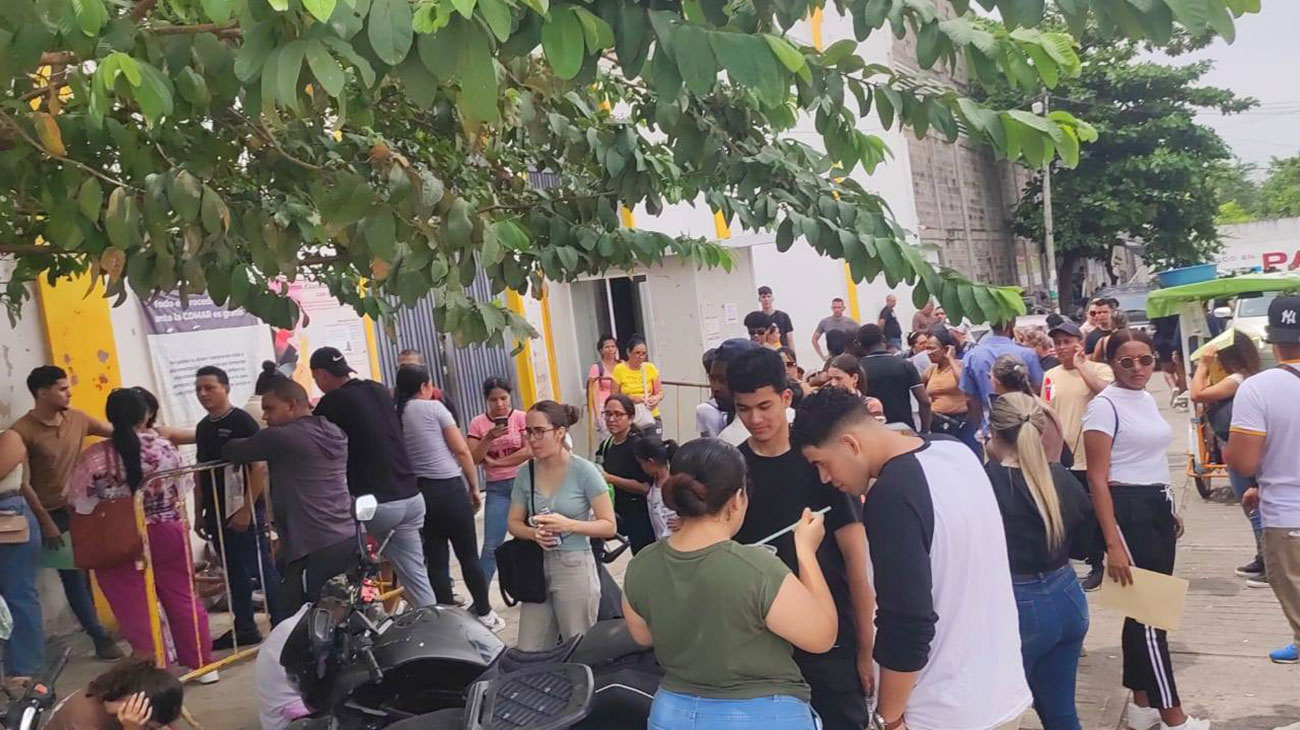
Migrants gather near the Comar (Comar) to apply for asylum. / Facebook/Rey Garcia Villa

14ymedio bigger14ymedio, Angel Salinas, Mexico City, June 11, 2025 — “Some businesses are on the verge of collapse,” says Miguel Reyes del Pino, a hotel entrepreneur from Tapachula, Chiapas. Without migrants, whose number has declined radically with the new US administration, and tourism (the city doesn’t have the charm of other places in Chiapas), the rooming houses, restaurants, inns, shops and pharmacies “look almost empty,” and their income has fallen by almost 30%.

Luis García Villagrán, of the Centro de Dignificación Humana A.C., explains to 14ymedio that an individual migrant’s daily expenses are 300 pesos (almost 16 dollars). “We are talking about basic expenses: travel, meals, water, buying a cigarette, a soft drink or a telephone recharge.”

Villagrán says that it was common to see migrants “eating in the market, shopping in stores, looking for places to sleep and receiving shipments. Now there is hardly anyone in the streets, and without them, the activity has dropped a lot.”

About the various businesses on the verge of collapse, the activist says: “It really hurts them. Before they did not want to see the migrants, but today, now that they’re gone, they feel the blow. Tapachula is largely dependent on migrant money, and that’s what the authorities didn’t understand.” continue reading

Yaniel Ponce de León, a Cuban, is still waiting for an email from the Mexican Commission for Aid to Refugees (COMAR) to finalize his process and regularize his stay. “For a month I ate two meals a day of bread and hotdogs. At first they were from the Oxxo, where they sold me three for 20 pesos (a dollar),” and I got water from the tap. A Coca Cola was too expensive for me.”

“For a month I ate two meals a day of bread and hotdogs. At first they were from the Oxxo, where they sold me three for 20 pesos (one dollar),” says Yaniel Ponce de León

The migrant indicated that he slept for days between cartons in the Bicentennial Park, because renting a room cost 1,500 pesos (79 dollars) for two weeks. It was crazy, I couldn’t pay them.”

Odalys, a Cuban woman, told the local media Diario del Sur that “just to go to work, pay for transport, breakfast, a meal, some water, all simple, I spend 300 pesos, since one meal is between 80 and 90 pesos, and water is 25 or 30 pesos.”

The migrant told the same media that in the eight months she has been in Tapachula, she hasn’t been in a restaurant. “We are spending on the basics and saving money here, because what we earn is not enough for anything.”

The city on the border with Guatemala once housed up to 120,000 migrants who sought to reach the United States, but with the arrival of Donald Trump as president, “the American dream was cut short,” says attorney José Luis Pérez.

The National Institute of Migration has stopped publishing updated reports since last December. “COMAR reported 5,700 applicants at the end of last year. Certainly many migrants have returned to their country, but others continue to arrive,” says Pérez.

Translated by Regina Anavy

____________

COLLABORATE WITH OUR WORK: The 14ymedio team is committed to practicing serious journalism that reflects Cuba’s reality in all its depth. Thank you for joining us on this long journey. We invite you to continue supporting us by becoming a member of 14ymedio now. Together we can continue transforming journalism in Cuba.

Several Spanish Companies Have Gone Bankrupt Due to Defaults of the Cuban Government

An employers’ organization says Havana owes more than 350 million euros to some 300 companies.

Mesol is an importer created by Meliá to bring to everything it needs for its hotels in Cuba / Melia

14ymedio bigger14ymedio, Havana, 12 June 2025 — Cuba’s financial crisis and its informality in paying its debts have made even its historical partners begin to distrust it. This Thursday, resentful of the defaults to several companies in Catalonia, the employers’ organization Fomento del Trabajo Nacional, which brings together entrepreneurs from that region, denounced the debt of more than 350 million euros (406.5 million dollars) that Cuba has with 300 companies in Spain. Fifteen per cent of them, he says, are in a “critical” financial situation or have had to close down.

Bearing in mind that 40% of the companies with which the island is indebted (some 120 companies), mostly SMEs and micro-enterprises, are Catalan, and that the closure of several of them has led to the disappearance of jobs. The association has been operating since 2023 the Platform of Affected by the Cuban Government’s Defaults, which includes companies from all over the country “damaged” by debt.

Also, they say they has notified the Spanish government of the debt, as well as parliamentary groups, “with the aim of activating mechanisms that allow us to recover the amounts owed and avoid the disappearance of the affected export business network.”

“The outstanding debts are mainly related to export operations, many of them humanitarian in nature”

“The outstanding debts are mainly related to export operations, many of them humanitarian in nature, essential for sectors such as health and food in Cuba,” says Fomento, which regrets that the debts persist “despite the historical commercial relationship between Spain and Cuba, with Spain being one of the main investors in the Island.” continue reading

The Island’s private debt with hundreds of Spanish companies has increased from the 336 million dollars last claimed by the then Minister of Industry, Trade and Tourism of Spain, Reyes Maroto, who called for a “gradual” plan for payments during a visit to Havana in 2019.

In November 2024, during a presentation to the Congress of Deputies, the Secretary of State for Economy and Enterprise Support, Israel Arroyo, admitted that Cuba owed another 2 billion euros in debts to multilateral agencies. “It is a difficult problem to solve as long as Cuba cannot pay, because right now the situation is what it is,” said Arroyo with resignation.

The head of the portfolio then explained that most of the debt has a historical origin, which comes from the former Development Assistance Fund, from the 80s and 90s. To try to resolve the situation, three agreements have been signed in recent years with Cuba, the first two in 2015 and 2016, in which there was a restructuring with an extension of the deadlines. In 2021, another agreement was also signed to renegotiate payments, in this case without removing the debt. But the problem with Cuba “is that it cannot pay that debt,” Arroyo insisted.

Cuba’s problem “is that it cannot pay that debt”

In 2015, Cuba signed with the Paris Club the forgiveness of $8.5 billion of the $11.1 billion debt that Havana owed since 1986. Spain, which is part of the group, also negotiated on that occasion the restructuring of the short-term debt for $201 million, most of which was forgiven.

While the small Spanish entrepreneurs are not willing to lose their money, others with less risk of disappearing if business with Cuba falls apart, such as the large hotel companies, continue to invest in Cuban hotels. This is the case of firms such as Meliá, with more than 30 facilities throughout the country, and Iberostar, which recently took over the management of the hotel located in the controversial Torre K hotel project.

The operations of these companies have also not been free from difficulties. With the dramatic drop in the arrival of tourists in recent years, hotels are barely full – Meliá’s occupancy in 2024 was just 40% – and the economic crisis makes supplying hotels with basic products an odyssey. Meliá, for example, had to create its own importer, Mesol, to ensure supplies of all kinds, from food and drink to security measures and maintenance.

The Cuban Government’s eagerness to obtain foreign currency has also hurt foreign entrepreneurs, who last April received with displeasure the news that Cuba would not allow them to repatriate their earnings in foreign currency. To soften the blow to its partners’ finances, the Regime then promised that they could open unlimited hard currency accounts, but their operations would be restricted to the country.

Translated by Regina Anavy

____________

COLLABORATE WITH OUR WORK: The 14ymedio team is committed to practicing serious journalism that reflects Cuba’s reality in all its depth. Thank you for joining us on this long journey. We invite you to continue supporting us by becoming a member of 14ymedio now. Together we can continue transforming journalism in Cuba.