The World Food Program Has Allocated $58 Million to Cuba Since 2021

Of the total, 32% comes from Russia, especially from its Ministry of Civil Protection.
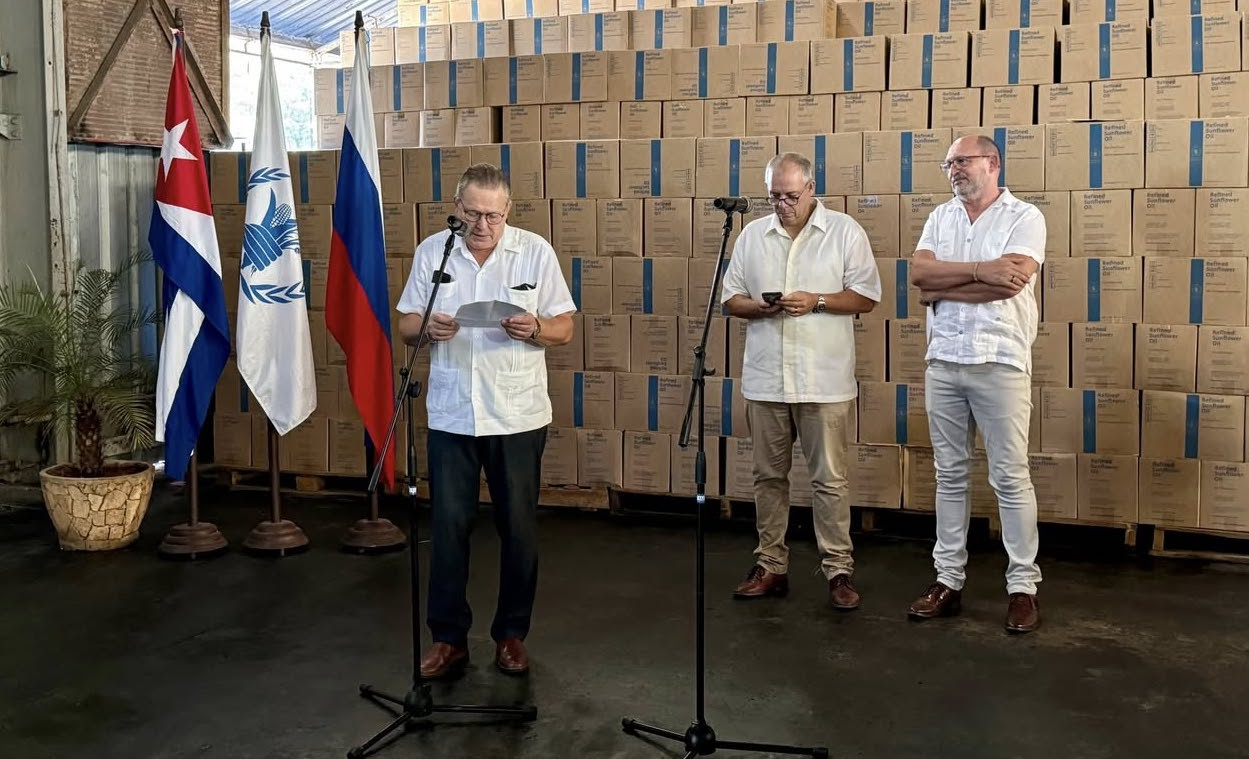

Russian Ambassador to Cuba Victor Koronelli, with donations of vegetable oil, on June 18. / Facebook/Russian Embassy in Cuba

14ymedio bigger14ymedio, Havana, 26 June 2025 — The World Food Programme (WFP) has allocated $57.9 million to Cuba in support of food and nutrition security projects since 2021.

With the funds, the official press reported Thursday, “rice, grains, and oil have been purchased to benefit the most vulnerable people and to respond to food emergencies in the country.”

At least five million dollars of the total was used to “supplement a varied and nutritious diet” for primary school children (ages 5 to 11).

“We will continue to provide support to our sister country, Cuba, both through international organizations and bilaterally.”

Of the total, according to WFP figures, 32% comes from Russia, “with significant contributions made through its Ministry of Civil Protection, Emergencies and Disaster Management” (Emercom).

The Russian aid has made it possible to purchase 844 metric tons (MT) of vegetable oil this year, of which 656 MT have already arrived on the island, according to a report in Adelante. On June 18, 470 MT of the same product also arrived as a donation, “to benefit victims and vulnerable sectors.” continue reading

“We will continue to provide support to our sister Cuba, both through international organizations and bilaterally,” declared the Russian ambassador to the island, Víctor V. Koronelli, at a ceremony held that day at the Ministry of Domestic Trade’s Loading and Unloading Distribution Center in Old Havana, which official media described as “simple.”

The diplomat recalled that in 2024 they delivered to the Cuban Public Health system “emergency modules and medications, as well as fire and rescue motorcycles, bags of sanitary first aid, and water purification filters, and earlier, food donations of sunflower oil and peas arrived.”

In February of last year, in the midst of the systemic crisis from which the island has yet to recover, the Cuban government formally requested assistance from the WFP for the first time to distribute rationed milk to children under seven.

The diplomat recalled that in 2024 they delivered “emergency modules and medications” to the Cuban Public Health system.

The UN program recognized the “urgent need” and, in a statement, emphasized “the importance of this request,” especially in the context of the “deep economic crisis facing Cuba,” which, in its view, was significantly impacting the population’s food and nutritional security.

At the time, the regime had not made public either the request or the initial multilateral contributions. In response to a letter sent by the Ministry of Foreign Trade and Investment to the WFP executive directorate in Rome at the end of 2023, the UN agency indicated that in February 2024 it had managed to deliver “144 metric tons of skimmed milk powder,” benefiting nearly 48,000 children between seven months and three years of age in Pinar del Río and Havana—nearly 6% of the children to whom the government intends to provide subsidized milk.

____________

COLLABORATE WITH OUR WORK: The 14ymedio team is committed to practicing serious journalism that reflects Cuba’s reality in all its depth. Thank you for joining us on this long journey. We invite you to continue supporting us by becoming a member of 14ymedio now. Together we can continue transforming journalism in Cuba.

Even the Dollar Loses the Battle Against Blackouts in Matanzas, Cuba

Without electricity, businesses stop selling and stop accepting all types of money

Stationary bikes for 280 MLC, along with beach umbrellas, were some of the few options at the old Ten Cent / 14ymedio

14ymedio bigger14ymedio, Julio César Contreras, Matanzas, 25 June 2025 -The pattern repeats itself. In any city where a dollar store opens, businesses in freely convertible currency (MLC) accelerate their decline. Matanzas could not be any different, and the Ten Cent store on Medio Street is the latest example of this silent struggle that runs through the commercial fabric. Almost empty, it now appears that the spacious store’s days are numbered.

Since the beginning of April, three stores in the city have switched to foreign currency sales. La Matancera, La Reina, and La Atenas de Cuba were chosen to join the group of markets across the island that sell in dollars or with the Classic Card. The old Ten Cent, renamed Centro Comercial Variedades decades ago, was not included on that list, and since then, its offerings have only diminished.

Some of the products that were previously on the shelves of the market in MLC moved to La Atenas de Cuba, located a few meters away, on Callejón de la Sacristía, at the corner of Milanés. The direction to strip one saint to pay another came from “on high,” according to an employee of the disgraced store who spoke to 14ymedio. Thus, boxes and boxes of merchandise changed both their location and the currency in which they were sold.

When the blackout hits, the lack of electricity affects both locations, in dollars and in MLC. / 14ymedio

“This looks like a gym without people,” a customer could be heard saying this Monday morning as she browsed the spacious sports equipment area in the former Ten Cent. The white granite floor, high ceilings, and a strong, musty smell give the market the appearance of a rarely visited museum. Stationary bikes for 280 MLC, along with beach continue reading

umbrellas, were among the few offerings.

The neglect and disorganization extend to the rest of the store, where the most visited space isn’t the counter with cleaning supplies or the appliance area, but the place where customers can leave their bags. The dynamism is due to the fact that some Matanzas residents store their backpacks and purses there when they want to enter other nearby stores that have restrictions on access with bags or packages. Few even head inside the Variety section.

However, when the blackout hits, the lack of electricity affects both establishments equally. Without power, the workers at La Atenas de Cuba halt sales, and the hard cash dollars stop flowing into their cash registers. The old Ten Cent also sinks further into stagnation. Without electricity, the gap narrows, and both businesses are just two dark, empty buildings.
____________

COLLABORATE WITH OUR WORK: The 14ymedio team is committed to practicing serious journalism that reflects Cuba’s reality in all its depth. Thank you for joining us on this long journey. We invite you to continue supporting us by becoming a member of 14ymedio now. Together we can continue transforming journalism in Cuba.

Havana Proposes a ‘Schengen Area’ in Latin America To Encourage Tourism

Cuba’s Minister of Tourism announced in an interview with the Spanish newspaper ‘El País’ that there will be direct flights between Barranquilla and Santiago de Cuba.

Foreign tourists giving money to a woman on Havana’s Paseo del Prado. / 14ymedio

14ymedio bigger14ymedio, June 25, 2025 — Cuba’s Minister of Tourism, Juan Carlos García Granda, has a proposal to encourage tourism in Cuba: the creation of a visa-free common area in Latin America. The idea does not seem, for now, to be more than in his head, but he outlined it in an interview with the Spanish newspaper El País during a meeting with tourism entrepreneurs in Colombia, held at the Hotel Dann Carlton, north of Bogotá.

“Perhaps we need to start talking about visas that can be used for several countries, as is the case with the Schengen Area in Europe. We must see how the world has done it and apply it in the region to attract common benefits from such distant tourist flows,” says García Granda, who considers it essential to reduce bureaucracy. The official introduces the proposal when asked about the Chinese market, which Cuba has been dreaming about for at least two years.

The minister explains to the journalist that the decline in traditional markets, particularly in Europe, has led his department to try to look for new fishing grounds, including Turkey, China and Russia. “We already have better [tourism] flows that we want to grow. And we want to do so by providing a unique offering as a region that benefits us and by sharing it, he states.

“We already have better [tourism] flows that we want to grow. And we want to do so by providing a unique offering as a region that benefits us and by sharing it”

García Granda omits a part of the reality revealed by his own data. The number of Russian tourists arriving on the island has plummeted so far this year. Until 2024 the evolution was positive, reaching third place by continue reading

origin and with around 185,000 travelers last year, but in 2025, a decline of around 50% began. It is true that the number of Turks (12.6%) and, above all, the Chinese (48.6%) visitors increased, but the figures are still anecdotal: 14,898 and 26,760 respectively.

The minister says that another strategy is to increase connectivity. “Faced with such a difficult scenario, we are trying to strengthen markets that we have always had, like Colombia, Mexico and Brazil,” he says. The last two had a good evolution last year, maintaining the figures of Mexico, which is not small in view of the debacle of the sector, and Brazil rose by 11 percent. However, Colombia did have a substantial drop: 32,604 travelers arrived from that country, 20% fewer than in 2024.

Perhaps the effort to recover the lost quota was part of García Granda’s meeting with some 30 tour operators and sales managers of Colombian airlines. El País reports that beginning July 3, the airlines will have a new route between Barranquilla and Santiago de Cuba, coinciding with the celebration of the Caribbean Festival. “This demonstrates how there are still people with enthusiasm and knowledge of Cuba and the Colombian market. I think they have made a bet that has every chance of winning,” says the minister. Although there are no more details about these routes, the Colombian press has indicated that they are charter flights and also suggests that they will continue after the event.

“All the people know that the economic benefits of the sector bring prosperity and cushion the effects of these very difficult times.”

In the interview, García Granda tries to convince the journalist, as he does in Cuba, that the investment effort made by the State is aimed at improving the conditions of citizens. “All the people know that the economic benefits of the sector bring prosperity and cushion the effects of these very difficult times,” he said, when asked by the journalist about a possible rejection of the population towards the strength of the hotel sector in the middle of the long blackouts. “That [narrative] has tried to provoke the counter-revolution and slanderous campaigns,” he spit out.

Next, García Granda, after claiming that the establishments have their own generators, tries to soften his remarks. “I would not say that there is an isolated system of energy generation, but we work so that the weight of our consumption [that of the hotel sector] does not necessarily fall on the shoulders of the population.”

In the interview, there was also time to talk about the United States. The journalist asks García Granda if Havana plans to improve relations with Washington in order to recover the sector. The minister remarks that the ball is in the court of the White House, which prevents its citizens from traveling to the island. “It is very bad that governments prohibit their citizens from deciding freely, and the world should help citizens to do so and not sell the US as a symbol of freedom,” he argues.

The official also wants the journalist to ask former president Barack Obama – who was in Cuba in April 2016 – “what is the only place where the Beast (Obama’s armored car) has walked and even the people threw a tomato at him.”

Re Obama’s visit: See also

Translated by Regina Anavy

____________

COLLABORATE WITH OUR WORK: The 14ymedio team is committed to practicing serious journalism that reflects Cuba’s reality in all its depth. Thank you for joining us on this long journey. We invite you to continue supporting us by becoming a member of 14ymedio now. Together we can continue transforming journalism in Cuba.
‘Cubans Are Physically and Mentally Exhausted by the Blackouts’

The music cuts out at the Cuban Art Factory and Coppelia closes because the ice cream is melted.

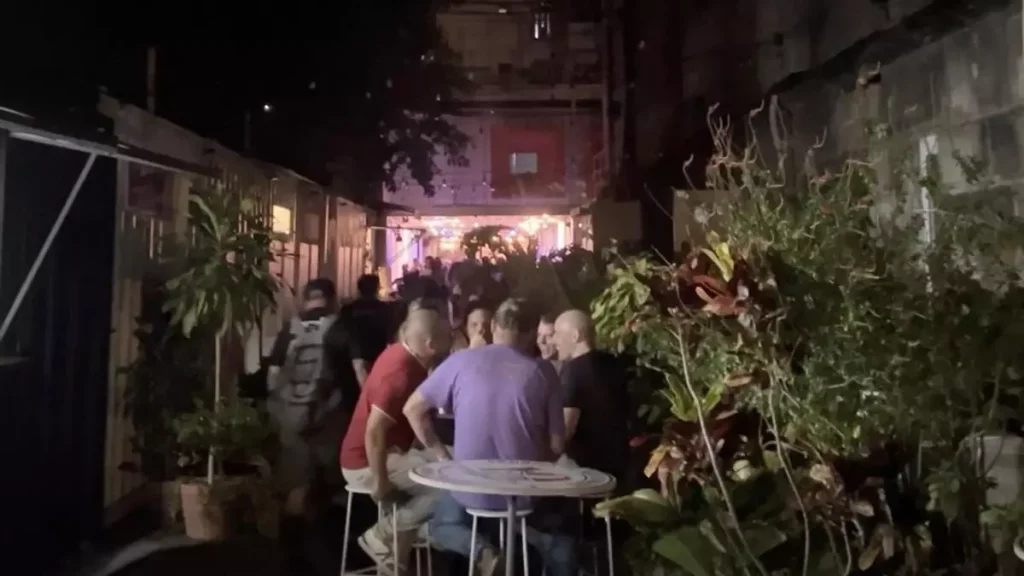
The regulars at the Fábrica de Arte entertain the nights with conversation, with no more air than that of their fans and no more dancing than that of an imaginary rhythm. / 14ymedio

14ymedio bigger14ymedio, Darío Hernández / Juan Diego Rodríguez, Havana, 24 June 2025 —  The increasing number of blackouts respect fewer and fewer hours and fewer neighborhoods. Living in Havana’s most touristy areas doesn’t guarantee a night without power outages. This is true of Vedado, which has had power for just a few hours for several days. Even the most famous entertainment venues, such as the Cuban Art Factory (FAC), are not spared.

“The power goes out almost every day at dawn, and the power lines only give power to the bar,” says a worker at the bar, located on 26th Street and 11th Street. Without music and in the stifling Havana heat, the regulars pass the time chatting away, with no air except that of their fans and no dancing other than to an imaginary rhythm.

Many of the scheduled concerts must be canceled or postponed, the same employee indicates. The courtyard is dark, the auditoriums and exhibition halls dimly lit, mosquitoes hit the lamps at the bars—and the legs of patrons—the FAC is presenting its most subdued appearance these weeks. And not even the rebellion it displayed almost two years ago, when it launched the creative “Bring Your Light!” campaign against the energy-saving measures that the Ministries of Energy and Mines and Culture were attempting to impose on it, is of any use now.

This Tuesday, just a few meters from the luxurious Iberostar Hotel in the K Tower, not even the traffic lights were working. / 14ymedio

During the day, the neighborhood isn’t much luckier. This Tuesday, just a few meters from the luxurious Iberostar Hotel in the K Tower, not even the traffic lights were working. Sitting on the steps of the Banco Metropolitano at 23rd and J Streets, several customers waited for the lights to come back on. At the busy intersection of L and 23rd Streets, by the Habana Libre, a patrol car seemed to be managing the passage of vehicles from one side to the other, but no: the same police car was trying to make its way through the chaos.

Across the street, the iconic Coppelia ice cream parlor did have electricity, but it didn’t matter: it wasn’t open because the ice cream had arrived from the factory already melted. “It’s disrespectful,” exclaimed a mother who had come with her daughter from a distance, only to find the place closed. “The truth is, it doesn’t matter when you come; the ice cream is always served melted, and the water is hot when they serve it,” another woman protested. “This is more like the cathedral of milk shakes.” continue reading

Along with a cordon to keep people out, a candy stand—cookies, sweets, bottled water—was the consolation prize for anyone who came to the ice cream parlor.

At the busy intersection of L and 23rd Streets, below the Habana Libre, a patrol car seemed to be managing the passage of vehicles from one side to the other, but no: the same police car was trying to make its way through the chaos. / 14ymedio

In other areas of the capital, the blackouts are also continuing. “They’ve been cutting off the power practically all night,” says a resident of Guanabacoa. “Here they cut it off last night from 12:20 a.m. to 2:00 a.m. and then from 4:30 a.m. to 7:00 a.m. And now it’s from 11 a.m. to 3 p.m. Not to mention the fact that we’ve been without water for four days.” The woman reports that some friends claimed to have heard people protesting by banging on pos and pans “around the Amphitheater.” The situation is not much different in Cerro, where residents say there were also protests near the Sports Casino.

“I live right next to an avenue, and the silence is incredible,” says the Guanabacoa resident. “People are physically and mentally exhausted. They go to bed nervously knowing that the power could go out at any moment, and with this heat, I assure you it’s impossible to sleep.” What worries her most, though, “is that this is just beginning; the hottest months are coming.”

The iconic Coppelia did have electricity, but it didn’t matter: it wasn’t serving because the ice cream had arrived from the factory. It had melted / 14ymedio

The deficit projected by the Cuban Electricity Union (UNE) for this Tuesday’s peak hour once again exceeds Monday’s forecast . With an availability of 1,830 megawatts (MW) for a peak demand of 3,550 MW, there will be a deficit of 1,720 MW and an estimated impact of 1,790 MW.

Yesterday, according to the UNE report, “the service was affected 24 hours a day and the situation continued throughout the night.” The maximum impact was ultimately 1,760 MW, but this did not coincide with peak demand, but rather later, at 10 p.m.

____________

COLLABORATE WITH OUR WORK: The 14ymedio team is committed to practicing serious journalism that reflects Cuba’s reality in all its depth. Thank you for joining us on this long journey. We invite you to continue supporting us by becoming a member of 14ymedio now. Together we can continue transforming journalism in Cuba.
Rapper Maykel ‘Osorbo’ Is on Hunger Strike Amid Possible Transfer to a Prison in Eastern Cuba

The political prisoner has been in solitary confinement for five days, says Anamely Ramos.

Maykel Osorbo has been in Pinar del Río prison since 2021. / Screenshot

14ymedio bigger14ymedio, Madrid, 24 June 2025 — Rapper Maykel Castillo ‘Osorbo’ has been on a hunger strike for five days and is isolated in a punishment cell at the Kilo 5.5 Provincial Prison in Pinar del Río, according to curator Anamelys Ramos. The activist, who serves as the political prisoner’s spokesperson, had announced the possibility last Friday, attributing it to “inmates in solidarity,” although she only confirmed the news on Monday, without specifying how.

“After two days without news, today we learned that Maykel is indeed on strike and has been isolated in a punishment cell for five days without food. We don’t know if the strike also includes thirst,” she stated on her Facebook account.

According to the curator, “what triggered this new crisis was that Maykel was suddenly removed from his company for disciplinary infraction and was threatened with being transferred to a prison in eastern Cuba. I don’t think it’s necessary to explain why we can’t allow Maykel to be sent more than 800 kilometers from his place of residence,” she said.

Ramos, who has emphasized that Osorbo should never have been imprisoned, points out that whatever happens is the responsibility of the authorities. “I know you believe you own not only the country but also the bodies of Cubans. I also know that you believe your power is irreversible. But there are plenty of examples that you are increasingly weaker and have fewer resources to stabilize a country that has already crossed the threshold of many deaths. I will only tell you that you are not prepared for Maykel’s death,” she warns. The activist urges people to share information to demand the rapper’s release. continue reading

“I know you believe you own not only the country but also the bodies of Cubans. I also know that you believe your power is irreversible. But there are plenty of examples that you are increasingly weak.”

Last Friday, Ramos had already reported the situation as practically certain, based on sources within the prison. At that time, she asserted that Osorbo was standing firm in the face of the threat of transfer.

“The fact that he’s more than 150 kilometers from his place of residence is cruel. And now they intend to send him almost ten times farther. And they expect this to happen without him or us doing anything. You’ve gone crazy,” she warned. “Nothing, except the desire to humiliate Maykel and make his life more difficult, justifies sending him there. Maykel knows full well why they’re doing it, and it’s precisely his survival instinct that drives him to stand his ground.”

Just two months ago, Osorbo was involved in a similar situation. It was at the end of April , when he was held in solitary confinement for five days after a confrontation with a State Security agent “during a routine visit that was suspended.” Ramos stated at the time that the official, like others on various occasions, had provoked the situation by trying to force a reaction that would justify the sanction.

“They’ve been insisting for months that Maykel is behaving badly. They want to convince those close to him, and everyone else, that what’s happening to Maykel, and therefore this punishment, is his fault,” she wrote. At the time, the curator warned that the political prisoner’s health could worsen, as he went into isolation with a virus.

“They’ve been insisting for months that Maykel is behaving badly. They want to convince those close to him, and everyone else, that what’s happening to Maykel, and therefore this punishment, is his fault.”

Osorbo, one of the authors of the song “Patria y Vida” (winner of two Latin Grammys), has been serving a nine-year prison sentence for contempt, assault, public disorder, and “defamation of institutions and organizations, heroes, and martyrs” since May 2022, although he had already spent 13 months in prison—since April 2021—which are being discounted from his sentence. In the same trial, artist Luis Manuel Otero Alcántara was sentenced to five years.

Although the rapper has repeatedly expressed openness to the possibility of being released on the condition of forced exile, the option has not prospered. Nor was he released during the process agreed upon with the mediation of Pope Francis, through which more than 500 people, fewer than half of whom were political prisoners, were released, according to the government, “for the Jubilee Year.” Among those who benefited from that pact—which involved removing Cuba from the US blacklist of sponsors of terrorism for just the week Joe Biden remained in office—were Félix Navarro, José Daniel Ferrer, and Donaida Pérez, whose measures have since been revoked .

____________

COLLABORATE WITH OUR WORK: The 14ymedio team is committed to practicing serious journalism that reflects Cuba’s reality in all its depth. Thank you for joining us on this long journey. We invite you to continue supporting us by becoming a member of 14ymedio now. Together we can continue transforming journalism in Cuba.
Blackout for ‘The Little Prince’, Light for Cuban Communist Party Officials in Matanzas

Some neighborhoods barely suffer any outages, while others live among candles and silent refrigerators.

Members of the Teatro de las Estaciones, in Matanzas, with a poster announcing the suspension of the play. Sign: “Function suspended. Theater for children is not a priority of those who plan electricity service.”/ 14ymedio

14ymedio bigger14ymedio, Pablo Padilla Cruz, Matanzas, 20 June 2025 — “The essential is invisible to the eyes,” says the famous quote from The Little Prince. But when Antoine de Saint-Exupéry wrote it, he was not referring to the blackouts. In Matanzas, the children find it difficult to see the adaptation prepared by the group Teatro de las Estaciones. The city has become a dark pit, in whose abyss the light is distributed with diffuse and often arbitrary criteria. In that abyss, only some – the chosen few, the closest to power – receive the grace of constant electricity. As is often the case on this island, for some to win, others must lose.

“We know what is going on in the country. We know and understand that hospital circuits must have priority. What we don’t understand is how a circuit where there are only houses of Party officials and militants has ten hours more electricity than any other,” says a theater worker who prefers anonymity. While he brings a cup of coffee to his lips, he smiles with irony and adds: “The provincial headquarters of the PCC [Cuban Communist Party] is just there,” and he points to some lights a few meters away.

The comment is not isolated. Parents, artists, technicians and theater managers share the same frustration. It is not just the impossibility of rehearsing or presenting performances, but an implicit message: culture, childhood and art are not priorities. continue reading

It is not just the impossibility of rehearsing or presenting performances, but an implicit message: culture, childhood and art are not priorities

The children who came to the theater with the hope of seeing a puppet show, accompanied by parents who strive during the week to offer them moments of healthy recreation, found the doors closed, lights out, curtains down. “Then we and the kids put our heads in our hands. Places where children can grow up with sensitivity are not valued,” continues the same worker.

The Teatro de las Estaciones is not just any institution. Founded by maestros Rubén Darío Salazar and Zenén Calero, it has been for decades a quarry of creativity and sensitivity for generations of Cubans. Its members have taken the puppetry technique to unexpected levels, combining tradition and avant-garde, raising the genre to a level of respect and recognition. “I don’t say it only because I work here,” insists a woman from Mantanzas. “I say it because we have built it with a lot of effort, with every rehearsal, with every performance under the sun and under the blackouts.”

The work, entitled A Trail in the Stars (Invisible poems to say at twilight), started from the verses of Asteroid B612 by writer José Manuel Espino – a book that pays homage to Saint-Exupéry’s immortal classic. The company has had to suspend performances, adjust rehearsals and reinvent the calendar because of power cuts. But more than a technical contingency, what is perceived is a deep fracture: the lack of equity in the distribution of energy.

The authorities have implemented a rotation system that, according to the official discourse, seeks “equity” in the distribution of electricity. In practice, however, the perception is different. Some neighborhoods barely suffer cuts, while others live among candles, exhausted batteries and silent refrigerators.

Art, like the flower of the Little Prince, needs care. It does not survive without light, without attention, without a space to flourish

Art, like the flower of the Little Prince, needs care. It does not survive without light, without attention, without a space to flourish. And although the rulers proclaim from the grandstands the importance of culture and healthy recreation, administrative decisions contradict that discourse. “They talk about culture as a shield, like a sword, but here we feel forgotten,” says another member of the artistic collective.

And this is not just a cultural anecdote. It is a reflection of how the blackouts – that word so present in Cuban daily life – affect not only domestic life, but also the social fabric, the mood, the soul of the nation. Because when the theaters go out, it’s not just the light bulbs.

Artists don’t ask for privileges. They ask for minimum conditions to do their work, one that often fills educational, emotional and spiritual gaps. In a country where childhood is surrounded by scarcity and uncertainty, theater is something more than a respite.

“We are not a priority. That is clear. But at least don’t keep telling us that we are,” one of the actors concludes with resignation. While in some neighborhoods the air conditioning does not stop buzzing, in others, as in this theater, the heart of Matanzas, the only thing you hear is the silence of a performance that was not. A flower that could not be watered, a child who did not know the fox, an asteroid without light.

Translated by Regina Anavy

____________

COLLABORATE WITH OUR WORK: The 14ymedio team is committed to practicing serious journalism that reflects Cuba’s reality in all its depth. Thank you for joining us on this long journey. We invite you to continue supporting us by becoming a member of 14ymedio now. Together we can continue transforming journalism in Cuba.

Richmeat Brings Dollarization to the Plaza de Cuatro Caminos in Havana

The mysterious company, falsely Mexican, opened a La Favorita butcher shop in the central market

New butcher shop sells in dollars at La Favorita by Richmeat on Cuatro Caminos / 14ymedio

14ymedio bigger14ymedio, Juan Diego Rodríguez / Olea Gallardo, Havana, June 20, 2025 — A new business has just joined the fever of dollarization in Havana. And not just anywhere, but in the largest and oldest market of the capital, Cuatro Caminos, in Centro Habana. This is a butcher shop of the firm Richmeat, which three months ago signed an agreement with Cimex to manage a whole complex of shops under the name of La Favorita, as some of its products are called.

Just a few days after opening, the place looks pristine, clean and perfectly air conditioned. A blue and yellow balloon decoration shows that the opening is recent. All of the employees address anyone who enters with the same question: “Can I help you with something?”

The variety of the offers – pork, boneless or seasoned chicken, house brand picadillo (El Cocinerito), sausages, burgers… – contrast with the freely convertible currency (MLC) part of the Plaza, only a few years ago well stocked and now languishing.

While the store was previously accessed through a door in front of the MLC products, it is now accessed through the main facade on Cuatro Caminos. / 14ymedio

As if to separate the new venue from the old, which is gradually being abandoned, they changed the entrance. Previously accessed through a door in front of the products in MLC, clients now enter through the main facade of Cuatro Caminos. “The hard currency gets the red carpet,” an old man mocked in front of the new butcher shop.

“Here there is almost nothing, but look there, girl, in dollars,” indicated a custodian of the place to a client. Nothing was said about the poor quality of continue reading

Richmeat’s products, which does not prevent the company from becoming increasingly prosperous.

La Favorita will soon open a branch in a privileged enclave, the Náutico de La Habana, a shopping center close to the exclusive club of the same name, in the municipality of Playa. That was going to be the first of the shops according to the agreement between Richmeat and Tiendas Caribe, announced by the authorities, but the one of Cuatro Caminos has advanced without explanations.

An employee confirmed to this newspaper that the plan to open that butcher shop in the western part of the city is still ongoing, predictably also in dollars.

The poor quality of the products of the Richmeat factory does not prevent the company from becoming more and more prosperous

The official press indicated last March that in a “first stage” of the agreement with Cimex they would have not only the Playa store, but three more. As “the project progresses,” said Cubadebate, “its expansion to other territories of the country will be planned.” They did not say at that time, however, that the sale of products would be in dollars.

This agreement was the second of its kind by the state corporation belonging to the Group of Business Administration (Gaesa), after the one signed with Vima for the store at Infanta and Santa Marta, in Centro Habana, inaugurated last January.

This is not the only similarity between the two brands. Like the one founded by the Spaniard Víctor Moro Suárez, Richmeat products are little appreciated by Cubans, although they often represent the only protein option in the basket amid perpetual scarcity. “No one wants to eat the picadillo” is the comment of many consumers when they receive those tubes of 400 and 800 grams, which are marketed under the brand of El Cocinerito and La Favorita, respectively.

Another coincidence with Vima is that both companies are registered abroad, in Mexico in the case of Richmeat, but neither is known in their respective countries. In Cuba they have preeminence and receive all kinds of hospitality.

There is no indication that Richmeat is a truly Mexican company and not a Cuban firm “disguised” as foreign

Beyond its legal registration, effectively in Mexico, and the nationality of both its president, Luis Alberto González Hernández, and its vice president, Alejandra Chapela Díaz – both present at the signing of the recent agreement with Tiendas Caribe – there is no indication that Richmeat is a truly Mexican company and not a Cuban firm “disguised” as foreign.

As 14ymedio found, the most important Mexican meat industry agencies do not have this company registered: neither the National Agri-Food Certification and Verification Agency, nor the National Association of Establishments Type Federal Inspection (ANETIF) or the Mexican Meat Council.

Even more significant is that the National Service of Health, Safety and Agri-food Quality (Senasica), the Mexican authority responsible for issuing animal health certificates for exporting meat and products derived from it, has no news of Richmeat. “This must be because it operates directly in Cuba, and its products do not come from Mexico,” an official of that agency who asked for anonymity told this newspaper.

According to a knowledgeable source, Richmeat sources its meat on the island, not in Mexico. / 14ymedio

According to a knowledgeable source, Richmeat purchases the meat in Cuba, not in Mexico. This would explain the poor quality of the products. Meat in Mexico has an established reputation, and it’s no wonder the country is one of the world’s leading exporters of beef. According to this source, Richmeat buys the meat on the island, and one of the sites where they buy is the Rigoberto Corcho Credit and Service Cooperative (CCS), in Artemisa.

That it is truly Cuban and not Mexican would explain the “constant presence” of Richmeat “for more than eight years,” which the official press often emphasizes, “even in the most critical periods during the covid-19 pandemic”.

What is clear are the privileges received by the firm. It is often praised by the authorities and now has a location in Havana’s main market. This suggests that it is most likely a company controlled by the Cuban leadership, and the view is that it is expanding.

Translated by Regina Anavy

____________

COLLABORATE WITH OUR WORK: The 14ymedio team is committed to practicing serious journalism that reflects Cuba’s reality in all its depth. Thank you for joining us on this long journey. We invite you to continue supporting us by becoming a member of 14ymedio now. Together we can continue transforming journalism in Cuba.

The ‘Pajama Plan’ and Other Ways to Disappear in Cuba

The euphemisms of dismissals in Cuba

Former Cuban Foreign Minister Felipe Pérez Roque, “dismissed” in 2009, recently seen on the streets of Havana / Facebook / Siro Cuarte

14ymedio bigger14ymedio, Yunior García Aguilera, Madrid, June 23,2025 — The Cuban regime, after more than six decades in power, has developed an enormous fondness for the use of euphemisms. Even to dismiss their bureaucrats, ambiguous terms and encrypted phrases are common, as if each token move, rather than a routine partisan maneuver, was a riddle for “the enemy”. And when power is held by force, that enemy can be everywhere, in the streets or within their own ranks.

Also, the graduates of the Ñico López -University of the Communist Party (PCC)- sometimes find it difficult to hit the target when some official note announces the “release” of a Party cadre. Some speculate that there are subtle differences in the language used, which do not mean the same as “duties,” “positions,” “responsibilities,” and “functions.” Each could hide a different cause and effect, as if it were a secret code.

It is here that the parallel euphemisms used in the bread lines and bus stops come into play. If it is a cadre that is promoted to a higher position, on the street it’s called “falling up.” If we never see his face again or hear his name, they have put him on the “pajama plan.” If his dismissal conceals the possibility of an error or a slight suspicion of disloyalty, he was “dethroned.” continue reading

Now the destroying bolt of lightning has hit Roberto Morales Ojeda, although he did not inherit the official title of “second secretary”

During the years 2011 to 2021, the person in charge of “enthroning” was José Ramón Machado Ventura, number two of the PCC’s Central Committee, after Raúl Castro. Now the destroying bolt of lightning is in the hands of Roberto Morales Ojeda, although he did not inherit the official title of “second secretary,” which Machado intends to keep symbolically and for life. The royal hierarchies of power in Cuba are today an undecipherable puzzle.

From his position as head of Organization and Cadre Policy, Morales is responsible for boxing ears, offering promotions and cutting off heads, but some decisions are made over his head.

The year 2024 was his year of glory. He moved his chips in at least seven provinces, replaced three ministers and swept away two deputy prime ministers. Bald and discreet like his predecessor, Morales passes the sword quietly and opportunely. If there is any scandal in sight, the cadre in question must be kept in place at all costs. No “giving weapons to the enemy” or pleasing the dissatisfied plebs. Then, when the waters calm down and no one expects it, the time will come to settle accounts. The best example is, perhaps, Alpidio Alonso -Minister of Culture-,who has survived in office against the current and without any favorable result. They must wait for an independent newspaper to mention him, then “release” him from his responsibilities.

It is necessary to be absolutely inexpressive, repress any aspiration to occupy first place and avoid standing out at all costs

The one in charge of putting someone on the throne must meet some basic requirements. It is necessary to be absolutely inexpressive, repress any aspiration to occupy first place and avoid standing out at all costs. Charisma is a remnant of the era of Fidel Castro, skillfully exterminated by his younger brother. Raúl took it upon himself to annihilate that generation of screamers that emerged during the Battle of Ideas and the Open Forums. Now is the time for Machado’s pupils: disciplined 50-year-olds, preferably mediocre and without any oratory skills.

Some of the cadres removed in 2024 were relocated to other provinces or to the higher structure of the Central Committee. But not all. Luis Antonio Torres Iribar -former first secretary of the PCC in Havana- was “released” in April with the semantic novelty of a “renewal,” something that was not used in other provincial releases. Although he maintains activity on Facebook and X, his agenda is in deadlock: he only shares institutional publications, and no new posts appear on his profiles.

The phrase “release for renewal” was also used in the cases of two other dismissed ministers: Elba Rosa Pérez Montoya -Science, Technology and Environment- and Manuel Santiago Sobrino Martínez -Food Industry. The first one has no profile on X. The second one does, but he hasn’t published anything since 2022. No official media has mentioned them again. Journalists in the State apparatus soon learn not to dig into the names of any released cadres.

“Committed errors in the performance of his duties”

The one seen a few weeks ago was Jorge Luis Perdomo Di-Lella, former deputy prime minister. He appeared for two seconds in the Noticiero del Mediodía, in a report on a tribute to Fidel Castro, where his widow and some of his children were also present. The official note of Perdomo’s dismissal used the expression “removal from office,” and added something worse: “he committed errors in the performance of his duties.”

Translated by Regina Anavy

____________

COLLABORATE WITH OUR WORK: The 14ymedio team is committed to practicing serious journalism that reflects Cuba’s reality in all its depth. Thank you for joining us on this long journey. We invite you to continue supporting us by becoming a member of 14ymedio now. Together we can continue transforming journalism in Cuba.

The Electricity Deficit in Cuba Maintains an ‘Upward Trend’ According to the Electric Union

Sunday saw the second-worst record in history, just 21 megawatts shy of the record set on April 23.

Thermal generation has more than 300 megawatts affected, and the distributed generation almost triples this deficit / 14ymedio

14ymedio bigger14ymedio, Madrid, 23 June 2025 — The night has not given respite to Cubans anywhere on the Island. All the gossip centered on the second historic event for electricity deficit, reached on Saturday and recognized this Sunday by the electric company of Villa Clara, although it affected the entire country. At peak time, the deficit was 1,880 megawatts (MW), only behind April 23, when it reached 1,901 MW.

The data was accompanied by a series of brutal statistics. Five of the 12 worst records in 2025 were in April, and the current month accumulates three “serious events” on June 17, 20 and 21, which mark, says the electric company from Villa Clara, an “upward trend.” In addition, all these data are even worse than those of 2024, including the critical month of November, when one of the three total disconnections from the national electricity system occurred.

The information was shared on the Facebook page of José Miguel Solís, a journalist specializing in energy who is often on social networks, popularizing what until then had a smaller audience, just the followers of the company of Villa Clara. The flood of comments was instantaneous, with endless reproaches from those who questioned the graph that reflected with two very distant upward lines the concepts of consumption and deficit. The tone of the response was: How can you talk about consumption when you have up to 22 hours a day without light?

“The high peaks occur after a blackout, since people have everything connected waiting for the current to arrive so consumption rises at that precise moment,” argued a Cuban living in Miami. “Get your neurons to work. This high continue reading

consumption is from the favored circuits of the Party and the dance venues of Varadero and Havana, which are consuming the little current that is generated,” another refuted.

“The blackouts were horrible in the provinces, of course. Here they removed it three times, and we are on the same circuit as the hospital. They took it off, put it on, took it off, put it on…” says a Havana resident in Cayo Hueso. In the newsroom of 14ymedio, located in Nuevo Vedado, the power was cut off at dawn this Monday.

Monday is another day without news. The Electric Union (UNE) confirmed that on Sunday there was a deficit of 1,650 MW at 9:50 pm, the hour of greatest demand, although the contribution of the 16 solar parks was more than 1,800 MW. One customer was wondering how investments in solar are helping, and another answered, saying that everyone in the country had the same issue, and that those who have solar panels use them during the day and get enough power, but at night they have nothing.

Today, the maximum demand is estimated at 3,550 MW, while generation will remain at just 1,850 MW, which means a peak deficit of 1,770 MW. In addition to the failures of units 6 and 8 at Mariel and 2 at Felton (Holguín), maintenance work was carried out on units 2 at Santa Cruz del Norte (Mayabeque), 4 at Cienfuegos and 5 at Renté (Santiago de Cuba), for a total thermal deficit of 390 MW.

But in addition there are 96 distributed generation plants out of service due to lack of fuel, a total of 738 MW of deficit to which are added 97 MW that are not available due to lack of engine oil

But in addition there are also 96 distributed generation plants out of service due to lack of fuel, a total of 738 MW of deficit to which are added 97 MW, not available due to lack of engine oil.

The situation is alarming and customers are wringing their hands thinking about the possible repercussions of the closure of the Strait of Hormuz, through which large quantities of crude oil pass for everyone, as a result of the open conflict between the US and Iran. The decision is pending approval by the Supreme Council, but the concern is extreme. “If the oil that was coming into Cuba was from Iran, we will have some dark vacations,” says a customer.

“So many meetings of collaboration with countries like Russia and China, so many agreements to be signed, so many trips abroad for officials to ask for help, and we don’t see the results. They distributed only a little propane in each province, and in many places only very few people received it. “When will the others? “someone asks. For the moment, complaints are once again limited to social media, but the straw that breaks the camel’s back may be coming.

Translated by Regina Anavy

____________

COLLABORATE WITH OUR WORK: The 14ymedio team is committed to practicing serious journalism that reflects Cuba’s reality in all its depth. Thank you for joining us on this long journey. We invite you to continue supporting us by becoming a member of 14ymedio now. Together we can continue transforming journalism in Cuba.

An Old Havana Resident Blocks His Street in Protest Against the Poor State of his Home

Aguilar Medrado asked to speak with the mayor, but they sent him the police and state security.

After one o’clock in the afternoon, when we visited the scene, Aguilar had already been detained by officials. / 14ymedio

14ymedio bigger14ymedio, José Lassa, Havana, 19 June 2025 – Lázaro Aguilar Medrano’s patience came to an end this Thursday. The resident of Calle Aguiar/Muralla in Old Havana cut off the traffic in the morning demanding a reply from the authorities to his claim about the poor condition of his home. However, in place of council officials it was the police and State Security who turned up, this newspaper was able to confirm.

Aguilar Medrado stopped the traffic using an old armchair, a mattress, a bed frame, a washing machine, a sign containing his demands, a motorcycle and some containers that his family uses for stockpiling water in this, one of the municipalities worst affected by poor water supply in the whole city. “I want the government here. Because it’s got beyond a joke now and I’m not going to talk to anyone else”, he declared in a video released by CubaNet.

In the recording, Aguilar Medrano demands the presence of Alexis Acosta Silva, administrator for the Old Havana district, as well as the city’s governor Yanet Hernández Pérez. “The block is going to be closed off until the government comes here”, he insisted. The man referred to the lack of replies to his requests for solving his family’s problems on the part of the Institute for Housing, the Communist Party and other provincial and municipal bodies.

The protestor’s things had been removed from the street and stacked on the pavement in front of his house. / 14ymedio

The man also made mention of his mother, Estrella Medrano López. According to him, the woman obtained numerous medals and awards throughout her life: “And Estrella has a thousand medals, a thousand pieces of s**t, a thousand… Well, F**k all that” and he went on to say how abandoned the people feel who, in their younger days, actually helped to build the current political model of the country. “And for what party? For which government? Close them down. Because they don’t function. They don’t function”, he said. continue reading

After one o’clock in the afternoon, when we visited the scene, Aguilar had already been detained by officials and a police car remained parked outside his house. Some graffiti on the front of a neighbouring building almost on ruins assured us: “All we need is love”.

The deployment command post was located in the local Municipal Electoral Commission, right on the corner. / 14ymedio

The protestor’s things had been removed from the street and stacked on the pavement in front of his house. Although the man was no longer present, his neighbours remained watching the scene of the police operation which included patrol vehicles, uniformed and plain clothes officers who watched from the street corners. The deployment command post was located in the local Municipal Electoral Commission, right on the same corner.

The exterior of Aguilar Medrano’s home, probably built at the start of the last century, shows the poor state of construction in which he is living – after decades of neglect, lack of resources available to the inhabitants, and overcrowding owing to housing problems. In a photo posted to his Facebook page you can see that his building also makes use of an old makeshift wooden “barbecue” [a sleeping platform built inside the room] to maintain the vertical space. On the same block there are also signs of multiple building collapses.

Calle Aguiar isn’t just any old Havana street. From its beginnings at the Avenida de las Missiones it goes into the city via some fifteen blocks. In its early days it was home to the headquarters or branches of at least nine banks, such that it became one of the epicentres of the financial district of Cuba’s capital, the little Wall Street of the island. All of these businesses were nationalised after Fidel Castro came to power in January 1959.

The street was one of the epicentres of the financial district of Cuba’s capital, the little Wall Street of the island, before 1959. / 14ymedio

There were also numerous insurance companies in Calle Aguiar, as well as various commercial associations like the British Chamber of Commerce, the Association of Cuban Banks and the National Chamber of Business and Industry. In its buildings, up to 105 law firms, beauty salons, small tailors and sheet manufacturing industries were located. Its commercial and financial activity was so great that it earned the name “money street“.

The blocking off of streets, be it to protest the poor state of housing or to protest the lack of water supply, has become increasingly common in Cuba in recent years. In Havana it is common to see lines of women who block the traffic to demand either a solution to their housing problems or the provision of a water truck to alleviate the lack of mains supply.

Translated by Ricardo Recluso

____________

COLLABORATE WITH OUR WORK: The 14ymedio team is committed to practicing serious journalism that reflects Cuba’s reality in all its depth. Thank you for joining us on this long journey. We invite you to continue supporting us by becoming a member of 14ymedio now. Together we can continue transforming journalism in Cuba.

Cuban ‘Provincials’ Banned From Attending U.S. Embassy for July 4th

Cuban State Security summons Dagoberto Valdés to warn him that this is a response to Mike Hammer’s “actions.”

The head of the U.S. mission in Havana, Mike Hammer, with the director of Caritas Cuba, Carmen María Nodal, this Monday. / Facebook/U.S. Embassy in Cuba

14ymedio bigger14ymedio, Havana, 23 June 2025 — Cuban State Security harassed the two main members of the Center for Coexistence Studies, Dagoberto Valdés and Yoandy Izquierdo, on Monday, interrogating them for an hour and a half at the Immigration and Foreigners Office in Pinar del Río. In a statement released on its social media, the organization indicated that the purpose of the “meeting” was the pair’s recent trip to the United States last month to participate in the Study Meeting of the Itinerary of Thought and Proposals for Cuba at Florida International University (FIU).

Regarding this annual meeting, the text indicates, “Major Ernesto” asked them about “the number of participants, the atmosphere of the meeting, their opinions on the quality, and their evaluation of the event.” He also inquired about “other public events” they had held in Florida, aside from their personal ones.

The agent then told them that “although it was not the purpose of this meeting, it conveyed a higher-up decision”: due to the “actions” of the head of the US mission in Cuba, Mike Hammer, and the “international situation,” “people from the provinces” will not be allowed to attend the reception held every year at the US continue reading

ambassador’s residence to celebrate the 4th of July, the country’s Independence Day, which will be held on the 2nd.

The agent told them that “although it was not the purpose of this meeting, it conveyed a higher-level decision.”

The “major” referred to Hammer’s travels throughout the island and, specifically, to his visits to opponents and activists, whom the agent referred to as “counterrevolutionary elements.” He also claimed that he communicated this “to avoid actions on the road like those that occurred with both members of Convivencia on the eve of May Day of the previous year, when they were returning from a Church event.”

“Not only does the harassment of Coexistence continue, but they also regulate freedom of movement,” the Center denounces in its statement.

This is not the first time that, on the occasion of the 4th of July the political police have coerced members of the group to prevent them from reaching the reception in Havana. However, it is unprecedented that they associate the warning with the actions of the US Chief of Mission, attempting to discredit them by calling them “interventionist,” “provocative,” and “irresponsible” behavior.

The “discomfort” that Hammer has caused in the regime is thus once again confirmed. On June 18, Deputy Foreign Minister Carlos Fernández de Cossío , when asked by the Spanish news agency Efe if he would declare the diplomat persona non grata , said: “We are not going to rule out any action to the extent that we think what he is doing is dangerous—if we reach that conclusion, which we have not reached—and to the extent that we pay close attention to what he is doing.”

Despite the campaign against him, the head of the US mission remains committed to his work. This Monday, he met with the executive director of Caritas Cuba, Carmen María Nodal Martínez. In a brief social media post, the Embassy reported that “they spoke about the tremendous work Caritas does across the island to help the most needy and vulnerable Cubans.” And on Saturday, he visited the Santa Susana Convent in Bejucal, Mayabeque, “to observe how the nuns support and feed the neediest.”

There have been consequences, however—although the regime has not linked them to Hammer’s visits at any point—for some of the activists who met with the diplomat. Three of them have so far returned to prison after being released: Donaida Pérez Paseiro, José Daniel Ferrer, and Félix Navarro.

____________

COLLABORATE WITH OUR WORK: The 14ymedio team is committed to practicing serious journalism that reflects Cuba’s reality in all its depth. Thank you for joining us on this long journey. We invite you to continue supporting us by becoming a member of 14ymedio now. Together we can continue transforming journalism in Cuba.

Rafael Rojas: “Despite Everything, It Still Makes Sense To Talk About Left, Right, and Center”

The essayist warns that there is authoritarianism on all three sides and is pessimistic about the current situation.

Rojas published “History as a Weapon,” an essay that analyzes the role of Latin American intellectuals in the Cold War. / EFE

14ymedio biggerEFE (via 14ymedio), Gustavo Borges 23 June 2025 — Cuban-born essayist Rafael Rojas asserted this Sunday that despite the tendency toward authoritarianism on all three sides, it still makes sense to talk about left, right, and center in analyzing world politics.

“It still makes sense to talk about left, right, and center, more due to geography than ideology, because we find conservative traits, tendencies toward authoritarianism or autocracy, both on the left, the right, and the center,” the academic said in an interview with EFE.

Rojas, winner of the 2006 Anagrama Essay Prize, published History as a Weapon, an essay that analyzes the role of Latin American intellectuals in the Cold War and examines works such as Eduardo Galeano’s Open Veins of Latin America and Ángel Rama’s The Lettered City.

The text, published by Siglo veintiuno editores, analyzes the debates of the British publication New Left Review, reviews the reflections of intellectuals such as Alejo Carpentier and Marta Harnecker and reveals the symbols, myths and strategies of the Latin American narrative in the dispute that divided the world into two blocks.

“I’m talking about how difficult it is to talk about a left when we’ve had such diverse leaders in the same movement, such as Mujica, Boric, and Lula, and at the same time Maduro, Ortega, and Díaz-Canel.”

“In this essay, I talk about how difficult it is to talk about a left when we’ve had such diverse leaders in the same movement, such as José Mujica in Uruguay; Gabriel Boric in Chile; Lula da Silva in Brazil; and Nicolás Maduro in Venezuela; Daniel Ortega in Nicaragua; and Miguel Díaz-Canel in Cuba,” he observed.

For Rojas, a full member of the Mexican Academy of History, the Cold War was the third world war, and if we’re talking about the fourth, the world is already experiencing it, with simultaneous conflicts in several places.

“The third was the Cold War. The fourth is ongoing with Russia in Ukraine; Israel in Gaza; and in its disputes with Iran, Syria, and continue reading

Lebanon. We also have the conflict between China and Taiwan, which could escalate at any moment,” he stated.

The academic sees no signs of optimism regarding these wars because international organizations, starting with the UN and specifically the Security Council, are unable to put a stop to them.

“These wars are fueled by global geopolitical failures; the deterioration of the alliance between the United States and Europe; Europe’s internal crises with the rise of nationalist, neoconservative governments opposed to the idea of ​​a united Europe; while China and Russia are going their own way,” he reflected.

While accepting that there is little reason for optimism in today’s world, the editor of Historia Mexicana magazine considered that in some places pessimism could be tempered; for example, in the United States, where President Donald Trump doesn’t hold all the cards in his numerous disputes.

“Trump doesn’t have all the cards in his favor in his project to dismantle democracy. We’re seeing resistance at all levels, against the immigration raids, the military deployment, and judicial resistance from institutions, universities, and the public,” he noted.

“Trump doesn’t have all the cards in his favor in his project to dismantle democracy. We’re seeing resistance at all levels.”

The academic does not see any country led by a leader currently, although he observes democratic forces in Europe resisting the advance of new conservatisms, new nationalisms, and nostalgia for fascism.

“There are no leaders, but there are currents, and from them come leaders. The political power plays are gradually adjusting, shifting from one side to the other, and I wouldn’t rule out the emergence of democratic leaderships in the transition from the first quarter to the second of the 21st century,” he opined.

Regarding humanity’s tendency to follow alpha males, he said it has been a constant throughout history and that we only have to remember “the era of fascism, of left-wing and right-wing totalitarianism, with great warlords like Stalin, Hitler, Mussolini, and Franco, which was reproduced in the Cold War, and the long tradition of caciques [chieftains] that has existed in Latin America since the 19th century.”

____________

COLLABORATE WITH OUR WORK: The 14ymedio team is committed to practicing serious journalism that reflects Cuba’s reality in all its depth. Thank you for joining us on this long journey. We invite you to continue supporting us by becoming a member of 14ymedio now. Together we can continue transforming journalism in Cuba.

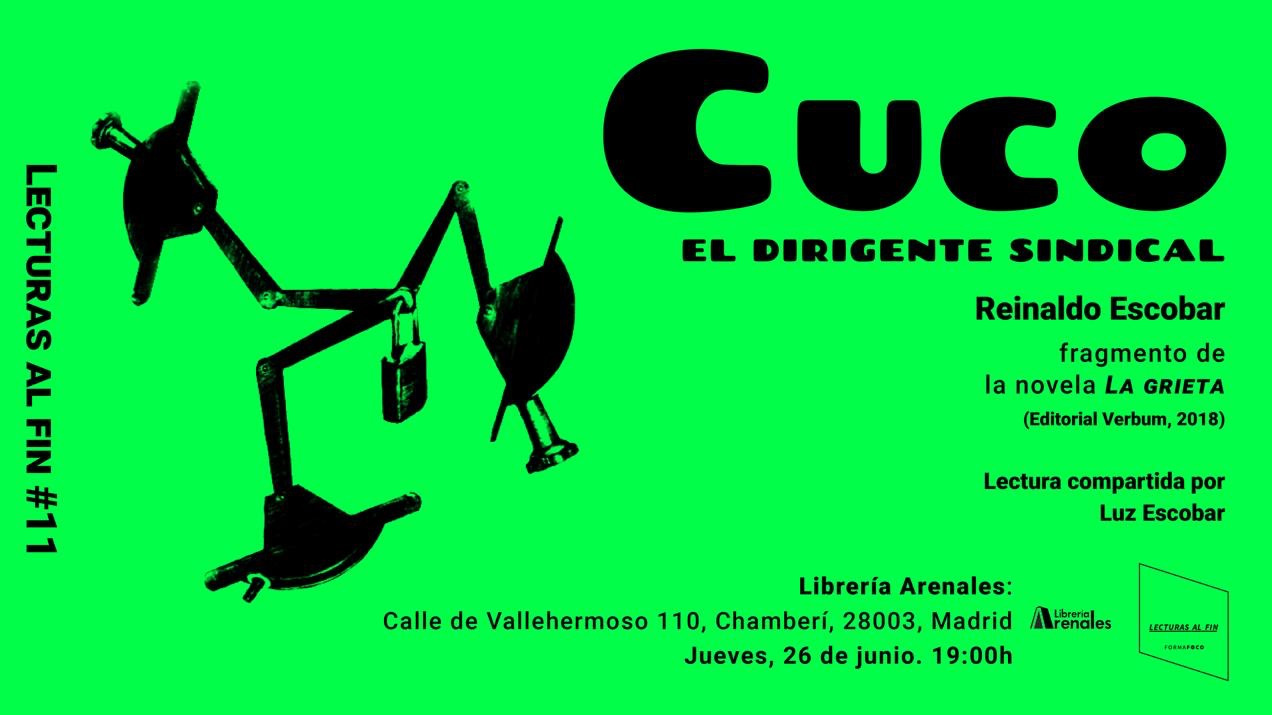
Presentation in Arenales of the Novel ‘La Grieta’, by Reinaldo Escobar

Promotional poster for the event / Courtesy of ’Forma Foco’

Date: 06-26-2025 / 7:30 pm – 9:30 pm

Address: Vallehermoso 110, Chamberí, Madrid

14ymedio, Havana, 23 June 2025 — The 11th and penultimate edition of the first season of Lecturas Al Fin, organized by the creative collective Forma Foco, arrives with “Cuco the Union Leader,” an excerpt from the novel La Grieta (Verbum Publishing, 2018) by Cuban journalist and writer Reinaldo Escobar, winner of the 2018 Ibero-American Verbum Novel Prize.

About La Grieta, Yoani Sánchez said: “In the style of a tropical Milan Kundera, Escobar unravels the successive masks that many of the characters put on to survive professionally and socially. Opportunism, indolence, and even radicalism are some of the obligatory masks for the political carnival of which he is a part.

Sometimes he manages to glimpse the face beneath and feels the overwhelming desire to flee in terror. […]// This novel is, for all that, the description of a professional and social suicide. The timely narration of how the flame of a utopia scorched the wings of a generation of Cubans, with the consent and approval of many of them. Reinaldo Escobar, who burned in that fire, has had the courage to tell it.”

Reinaldo Escobar (Camagüey, 1947) is a journalist and editor of the online newspaper 14ymedio. He was expelled from official journalism in Cuba for “ideological weaknesses” and has since been a key figure in independent Cuban journalism, having practiced the profession for over 50 years. His first novel, “La grieta,” was written in 1993, confiscated by State Security, and rewritten from memory more than two decades later.

The reading will be shared by the journalist and daughter of the author, Luz Escobar.

____________

COLLABORATE WITH OUR WORK: The 14ymedio team is committed to practicing serious journalism that reflects Cuba’s reality in all its depth. Thank you for joining us on this long journey. We invite you to continue supporting us by becoming a member of 14ymedio now. Together we can continue transforming journalism in Cuba.

Cuban Band ‘Porno Para Ricardo’ to Perform in Prague

Promotional poster of the event / Facebook

14ymedio, Prague, 23 June 2025

Date: 06-26-2025 / 8:00 pm – 10:00 pm

Address: Vinohradská 63, Prague / Doors open at 7:00 pm

14ymedio, Prague, 23 June 2025 — Porno para Ricardo emerged in late 1998 in Havana, bringing a casual, entertaining, and, above all, provocative and critical voice to the island’s very small punk-rock scene. Their lyrics frequently allude to sexual and libertarian themes and are primarily directed against the Cuban regime. Despite police harassment and censorship by the authorities, the band managed to reach an audience that would otherwise have virtually no access to their music: fans discovered their work primarily through the underground distribution of recordings.

The group became especially known for their rare live performances, where they combined music and theatrical elements with a single purpose: to connect and build a relationship with the audience through a wild and highly interactive experience.

See here for performance video with lyrics: No Coma Tanta Pinga Coma Andante / Porno Para Ricardo, Gorki Aguila

The Battle of El Uvero, a Simple Skirmish Turned Into an Epic

The Revolution has been an expert in turning defeats into victories – that is, in lying – and in exaggerating its triumphs, however small they may have been.

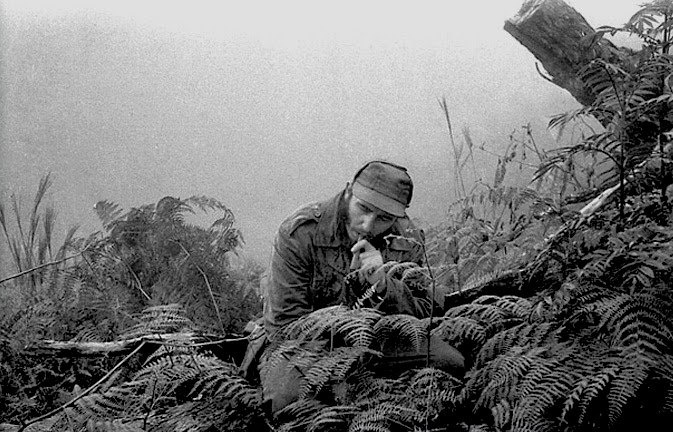
The survivors, including Fidel Castro, took refuge in the Sierra Maestra, where they began to reorganize and recruit new members. / EFE

14ymedio bigger14ymedio, Yunior García Aguilera, Madrid, May 30, 2025 — On May 28, 1957, in a far-off nook of the Sierra Maestra known as El Uvero, a skirmish took place that the official Cuban narrative has elevated to the altars of revolutionary epic. Historians of the regime describe it as “heroic,” and Díaz-Canel insists that today’s youth view it as a battle of titans, aware that many of them are more familiar with Marvel movies than with Cuban history itself.

The Revolution has shown remarkable skill in transforming defeats into victories—essentially, in distorting the truth—and inflating even the smallest triumphs. The battle of El Uvero has been portrayed as a turning point, the coming of age of the fledgling Rebel Army, and a display of exuberant courage by a few aspiring bearded fighters. Yet, when the events are examined more closely, a less heroic and far more grounded version of that encounter comes into view.

To grasp the true significance of El Uvero, one must situate it within its historical context. In late 1956, the 26th of July Movement suffered a disastrous landing at Alegría de Pío, where the majority of its fighters were either killed or captured. The few survivors—including Fidel Castro—sought refuge in the Sierra Maestra, where they began regrouping and recruiting new members.

What was a military barracks doing there? Primarily, it served to monitor the coastline and secure the area against smuggling. But above all, it was tasked with controlling a modest, makeshift airstrip.

In 1957, El Uvero could scarcely be called a “town” in the conventional sense. It was a fleeting settlement of perhaps fewer than 200 souls (a generous estimate), made up of a handful of shacks, a general store, a rural school that functioned sporadically, and a military barracks housing several dozen of Batista’s uniformed men. What was a military barracks doing there? Primarily, it served to monitor the coastline and secure the area continue reading

against smuggling. But above all, it was tasked with controlling a modest, makeshift airstrip.—useful for resupplying troops or dispatching goods like tobacco and timber, which did, in fact, circulate through the region.

The name hides no secret symbolism or conspiracy theory: simply, the area was rich in trees known as beach grapes (Coccoloba uvifera), which produce small, grape-like fruits. The name wasn’t the brainchild of a revolutionary poet, but rather of farmers with practical botanical acumen.

According to official accounts, the so-called “army” led by Fidel Castro launched an assault on a Batista regime garrison composed of just 53 soldiers. With roughly 80 fighters, the rebels managed to force the surrender of the barracks after nearly three hours of combat. The outcome: seven rebels killed and eight wounded, while government forces sustained 14 fatalities and 19 wounded.

When these figures are placed under scrutiny, an uncomfortable question emerges: can it truly be considered a heroic feat when a numerically superior force, bolstered by the element of surprise, overcomes a smaller, poorly equipped garrison?

In a recent television report, propagandist Gladis Rubio described El Uvero—her voice lofty, set against a swelling soundtrack—as a mighty bastion, complete with “fortresses made from the thick trunks of the oldest trees in the Sierra Maestra.” The flourish of language, however, was a transparent attempt to obscure the actual conditions: a ramshackle wooden barracks, scarcely fortified and feebly defended. She conveniently avoided mentioning the soldiers’ lack of training and the fact that they were taken by surprise. Yet even under such circumstances, it took Castro’s 80 combatants nearly three hours to subdue them.

Revolutionary propaganda has done what it does best: distort reality, creating a narrative that serves political ends more than historical truth.

Today, El Uvero remains a remote and semi-forgotten place, unnamed on Google Maps, only reached after hours of trail and patience.

While the victory was a modest achievement for the rebels, it is difficult to call it a feat. The numerical superiority of the attackers and the limited strategic importance of the barracks undermine any grandiloquence. In military terms, it was more a tactical operation than a decisive battle.

Today, El Uvero remains a remote and largely forgotten spot, unmarked even on Google Maps and accessible only after hours of arduous trail travel—and a good deal of patience. A modest monument commemorates the so-called “battle,” erected by the Revolution to ensure that the site wouldn’t fade from official memory, unlike so many others that never drew the glare of television cameras. A rural school bears a date as its name—a common stand-in when imagination runs short—and here and there, faded graffiti still clings to walls, quoting Fidel or Raúl. As for the uvero trees themselves, few have survived; coastal erosion and years of neglect have quietly erased them.

Díaz-Canel, however, seems desperate to claim—at the very least—his own Uvero. The gray-haired, clean-shaven successor can’t even muster a Pyrrhic victory. With the population teetering on collapse, the nation unraveling, and generals clamoring for a flicker of hope or a miracle, the hand-picked president might have no choice but to call on Gladis Rubio again—to craft a pseudo-poetic report extolling the monumental feat of… a lineman, perhaps?

Translated by Gustavo Loredo

____________

COLLABORATE WITH OUR WORK: The 14ymedio team is committed to practicing serious journalism that reflects Cuba’s reality in all its depth. Thank you for joining us on this long journey. We invite you to continue supporting us by becoming a member of 14ymedio now. Together we can continue transforming journalism in Cuba.