The Revolution has been an expert in turning defeats into victories – that is, in lying – and in exaggerating its triumphs, however small they may have been.
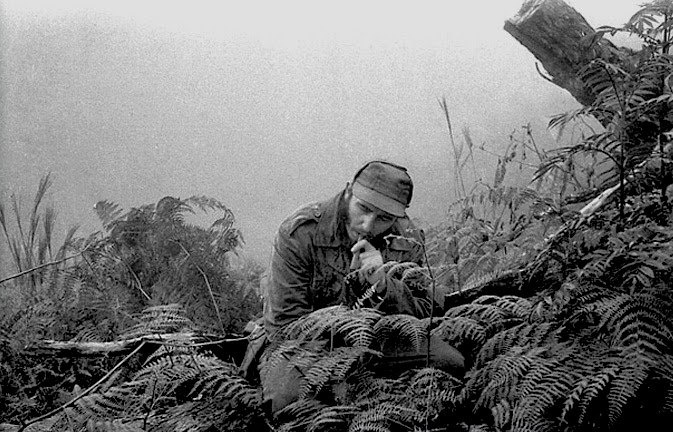
 14ymedio, Yunior García Aguilera, Madrid, May 30, 2025 — On May 28, 1957, in a far-off nook of the Sierra Maestra known as El Uvero, a skirmish took place that the official Cuban narrative has elevated to the altars of revolutionary epic. Historians of the regime describe it as “heroic,” and Díaz-Canel insists that today’s youth view it as a battle of titans, aware that many of them are more familiar with Marvel movies than with Cuban history itself.
The Revolution has shown remarkable skill in transforming defeats into victories—essentially, in distorting the truth—and inflating even the smallest triumphs. The battle of El Uvero has been portrayed as a turning point, the coming of age of the fledgling Rebel Army, and a display of exuberant courage by a few aspiring bearded fighters. Yet, when the events are examined more closely, a less heroic and far more grounded version of that encounter comes into view.
To grasp the true significance of El Uvero, one must situate it within its historical context. In late 1956, the 26th of July Movement suffered a disastrous landing at Alegría de Pío, where the majority of its fighters were either killed or captured. The few survivors—including Fidel Castro—sought refuge in the Sierra Maestra, where they began regrouping and recruiting new members.
What was a military barracks doing there? Primarily, it served to monitor the coastline and secure the area against smuggling. But above all, it was tasked with controlling a modest, makeshift airstrip.
In 1957, El Uvero could scarcely be called a “town” in the conventional sense. It was a fleeting settlement of perhaps fewer than 200 souls (a generous estimate), made up of a handful of shacks, a general store, a rural school that functioned sporadically, and a military barracks housing several dozen of Batista’s uniformed men. What was a military barracks doing there? Primarily, it served to monitor the coastline and secure the area against smuggling. But above all, it was tasked with controlling a modest, makeshift airstrip.—useful for resupplying troops or dispatching goods like tobacco and timber, which did, in fact, circulate through the region.
The name hides no secret symbolism or conspiracy theory: simply, the area was rich in trees known as beach grapes (Coccoloba uvifera), which produce small, grape-like fruits. The name wasn’t the brainchild of a revolutionary poet, but rather of farmers with practical botanical acumen.
According to official accounts, the so-called “army” led by Fidel Castro launched an assault on a Batista regime garrison composed of just 53 soldiers. With roughly 80 fighters, the rebels managed to force the surrender of the barracks after nearly three hours of combat. The outcome: seven rebels killed and eight wounded, while government forces sustained 14 fatalities and 19 wounded.
When these figures are placed under scrutiny, an uncomfortable question emerges: can it truly be considered a heroic feat when a numerically superior force, bolstered by the element of surprise, overcomes a smaller, poorly equipped garrison?
In a recent television report, propagandist Gladis Rubio described El Uvero—her voice lofty, set against a swelling soundtrack—as a mighty bastion, complete with “fortresses made from the thick trunks of the oldest trees in the Sierra Maestra.” The flourish of language, however, was a transparent attempt to obscure the actual conditions: a ramshackle wooden barracks, scarcely fortified and feebly defended. She conveniently avoided mentioning the soldiers’ lack of training and the fact that they were taken by surprise. Yet even under such circumstances, it took Castro’s 80 combatants nearly three hours to subdue them.
Revolutionary propaganda has done what it does best: distort reality, creating a narrative that serves political ends more than historical truth.
Today, El Uvero remains a remote and semi-forgotten place, unnamed on Google Maps, only reached after hours of trail and patience.
While the victory was a modest achievement for the rebels, it is difficult to call it a feat. The numerical superiority of the attackers and the limited strategic importance of the barracks undermine any grandiloquence. In military terms, it was more a tactical operation than a decisive battle.
Today, El Uvero remains a remote and largely forgotten spot, unmarked even on Google Maps and accessible only after hours of arduous trail travel—and a good deal of patience. A modest monument commemorates the so-called “battle,” erected by the Revolution to ensure that the site wouldn’t fade from official memory, unlike so many others that never drew the glare of television cameras. A rural school bears a date as its name—a common stand-in when imagination runs short—and here and there, faded graffiti still clings to walls, quoting Fidel or Raúl. As for the uvero trees themselves, few have survived; coastal erosion and years of neglect have quietly erased them.
Díaz-Canel, however, seems desperate to claim—at the very least—his own Uvero. The gray-haired, clean-shaven successor can’t even muster a Pyrrhic victory. With the population teetering on collapse, the nation unraveling, and generals clamoring for a flicker of hope or a miracle, the hand-picked president might have no choice but to call on Gladis Rubio again—to craft a pseudo-poetic report extolling the monumental feat of… a lineman, perhaps?
Translated by Gustavo Loredo
____________
COLLABORATE WITH OUR WORK: The 14ymedio team is committed to practicing serious journalism that reflects Cuba’s reality in all its depth. Thank you for joining us on this long journey. We invite you to continue supporting us by becoming a member of 14ymedio now. Together we can continue transforming journalism in Cuba.