Rafael Rojas: “Despite Everything, It Still Makes Sense To Talk About Left, Right, and Center”

The essayist warns that there is authoritarianism on all three sides and is pessimistic about the current situation.


Rojas published “History as a Weapon,” an essay that analyzes the role of Latin American intellectuals in the Cold War. / EFE

14ymedio biggerEFE (via 14ymedio), Gustavo Borges 23 June 2025 — Cuban-born essayist Rafael Rojas asserted this Sunday that despite the tendency toward authoritarianism on all three sides, it still makes sense to talk about left, right, and center in analyzing world politics.

“It still makes sense to talk about left, right, and center, more due to geography than ideology, because we find conservative traits, tendencies toward authoritarianism or autocracy, both on the left, the right, and the center,” the academic said in an interview with EFE.

Rojas, winner of the 2006 Anagrama Essay Prize, published History as a Weapon, an essay that analyzes the role of Latin American intellectuals in the Cold War and examines works such as Eduardo Galeano’s Open Veins of Latin America and Ángel Rama’s The Lettered City.

The text, published by Siglo veintiuno editores, analyzes the debates of the British publication New Left Review, reviews the reflections of intellectuals such as Alejo Carpentier and Marta Harnecker and reveals the symbols, myths and strategies of the Latin American narrative in the dispute that divided the world into two blocks.

“I’m talking about how difficult it is to talk about a left when we’ve had such diverse leaders in the same movement, such as Mujica, Boric, and Lula, and at the same time Maduro, Ortega, and Díaz-Canel.”

“In this essay, I talk about how difficult it is to talk about a left when we’ve had such diverse leaders in the same movement, such as José Mujica in Uruguay; Gabriel Boric in Chile; Lula da Silva in Brazil; and Nicolás Maduro in Venezuela; Daniel Ortega in Nicaragua; and Miguel Díaz-Canel in Cuba,” he observed.

For Rojas, a full member of the Mexican Academy of History, the Cold War was the third world war, and if we’re talking about the fourth, the world is already experiencing it, with simultaneous conflicts in several places.

“The third was the Cold War. The fourth is ongoing with Russia in Ukraine; Israel in Gaza; and in its disputes with Iran, Syria, and continue reading

Lebanon. We also have the conflict between China and Taiwan, which could escalate at any moment,” he stated.

The academic sees no signs of optimism regarding these wars because international organizations, starting with the UN and specifically the Security Council, are unable to put a stop to them.

“These wars are fueled by global geopolitical failures; the deterioration of the alliance between the United States and Europe; Europe’s internal crises with the rise of nationalist, neoconservative governments opposed to the idea of ​​a united Europe; while China and Russia are going their own way,” he reflected.

While accepting that there is little reason for optimism in today’s world, the editor of Historia Mexicana magazine considered that in some places pessimism could be tempered; for example, in the United States, where President Donald Trump doesn’t hold all the cards in his numerous disputes.

“Trump doesn’t have all the cards in his favor in his project to dismantle democracy. We’re seeing resistance at all levels, against the immigration raids, the military deployment, and judicial resistance from institutions, universities, and the public,” he noted.

“Trump doesn’t have all the cards in his favor in his project to dismantle democracy. We’re seeing resistance at all levels.”

The academic does not see any country led by a leader currently, although he observes democratic forces in Europe resisting the advance of new conservatisms, new nationalisms, and nostalgia for fascism.

“There are no leaders, but there are currents, and from them come leaders. The political power plays are gradually adjusting, shifting from one side to the other, and I wouldn’t rule out the emergence of democratic leaderships in the transition from the first quarter to the second of the 21st century,” he opined.

Regarding humanity’s tendency to follow alpha males, he said it has been a constant throughout history and that we only have to remember “the era of fascism, of left-wing and right-wing totalitarianism, with great warlords like Stalin, Hitler, Mussolini, and Franco, which was reproduced in the Cold War, and the long tradition of caciques [chieftains] that has existed in Latin America since the 19th century.”

____________

COLLABORATE WITH OUR WORK: The 14ymedio team is committed to practicing serious journalism that reflects Cuba’s reality in all its depth. Thank you for joining us on this long journey. We invite you to continue supporting us by becoming a member of 14ymedio now. Together we can continue transforming journalism in Cuba.
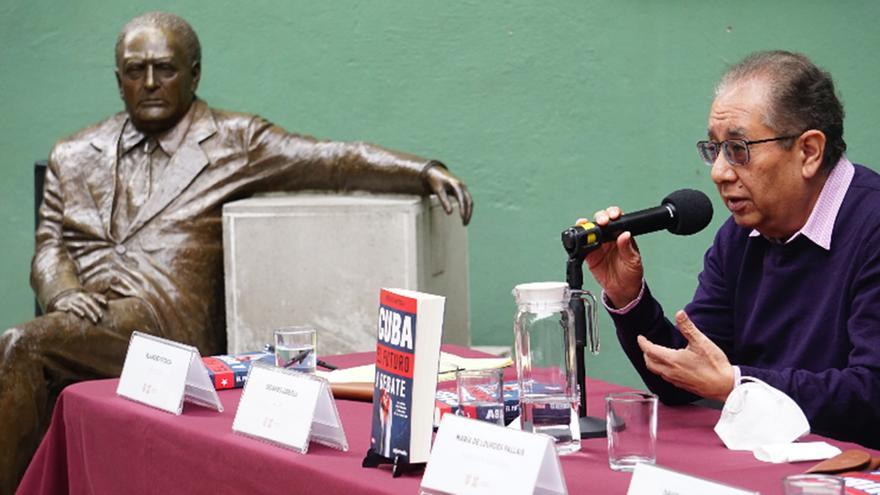
‘Cuba, the Future Under Debate,’ a Chronicle of Former Mexican Correspondent on the Island

Mexican writer and journalist Gerardo Arreola says that increased repression is not the way to solve the island’s problems. (Secretary of Culture in Mexico City)

14ymedio biggerEFE (via 14ymedio), Gustavo Borges, Mexico City, 20 March 2022 — The Mexican writer and journalist Gerardo Arreola, author of the book Cuba, the Future Under Debate, said this Sunday that the lack of decisions to solve the economic crisis and the increase in repression are not the way to solve the problems on the island.

“An absence of political decisions in economic matters and a reinforcement of repression through the courts does not seem to be the best way to move forward, said Arreola in an interview with EFE, reflecting on his work, a chronicle of the time of Raúl Castro in power and the challenges of the transition.

The volume, edited by Penguin Random House, is an analysis of the situation in Cuba by Arreola, a correspondent in the Caribbean country for more than 15 years.

As a witness to the events before and after Fidel Castro handed over power, Arreola recounted the Cuban reality in the last three decades, and focused on the death of the leader of the Revolution and its consequences.

“I tried to reflect that Cuban society is plural, there are those who are absolutely supporters of the government and do not admit criticism and there are critics of the government, without the possibility of dialogue, but in the middle there is an observant, polemicist, critical and active society; this is one of the novelties of the current Cuban situation,” he said.

Referring to the current economic crisis, the journalist considered that it may be greater than the ’Special Period’ in the 1990s which was a consequence of the collapse of the socialist camp, and he believes that the Government has lacked the will to apply measures that help the people. continue reading

“There is an absence of political will to accept proposals from researchers close and distant from the government, which are technically very similar,” he said, referring to debates by economists calling for freedom for state-owned companies, freeing economic space for agricultural producers and other alternatives.

When he was about to finish the book, Arreola had to extend it to refer to the massive protests on the Island against the Government, which occurred on July 11, 2021, repressed by the Government, which described the rebels as being at the service of the CIA, instead of acknowledging the disagreements.

“It is striking that the demonstrations of July last year have led to trials with high sentences, if one takes into account what happened. The background of the situation, recognized by the Government itself, is that there were dissatisfied people, outraged by the increase and spectacular rise in prices and shortages of basic products, perhaps aggravated by the pandemic,” he explained.

Arreola accepted that among the protesters there were violent ones who broke windows, but he wonders if, even in the case of the aggressive ones, they deserved harsh prison sentences.

“There are 16-17 year olds on trial,” he noted.

In his book, Arreola avoided judgments. He portrayed the Cuban situation from different angles, with topics such as the government’s relationship with the Church, the 2019 Constitution, the rise of the military in key government positions, and the issue of emigration.

Unlike other times, the internet has allowed the reality of Cuba today to appear on social networks, a blow to official censorship, on which the correspondent reflected.

“The criticism and observation of reality multiplied because there was a shot in the accounts on social networks. It is enough for something to happen in a corner of the Island for someone to record it,” he said.

Arreola believes that Cuba is bleeding to death with the departure of young people abroad, many of them high-level professionals, to which is added the aging of society, which in a few years will be the oldest in Latin America.

Another current issue is that of corruption in the Government, which Raúl Castro acknowledged in his presidency.

“Raúl pointed to corruption as something serious and over time it was identified as a national security problem. It has been recognized that corruption at high levels, with a considerable level of resources, is something that could become a political and governance threat,” he concluded.

____________

COLLABORATE WITH OUR WORK: The 14ymedio team is committed to practicing serious journalism that reflects Cuba’s reality in all its depth. Thank you for joining us on this long journey. We invite you to continue supporting us by becoming a member of 14ymedio now. Together we can continue transforming journalism in Cuba.