The company is suspending its routes to the island beginning September 2.
United Airlines has submitted a request to suspend service to the island while hoping to resume flights next summer. / (Facebook/Archive)
14ymedio, Havana, July 23, 2025 — As travel to Cuba continues to fall precipitously, airlines with flights to the island are beginning take a financial hit due to empty seats and low demand. This week, United Airlines — the only U.S. carrier with connections to Havana from Houston, Texas — announced that it will suspend flights beginning September 2 and will not resume service until the summer of 2026 at the earliest.
According to an article in “Aviation Week,” United Airlines has notified the U.S. Transportation Department (DOT) that it plans to suspend its exclusive nonstop scheduled service to Cuba in September, citing seasonal fluctuations in the number of passengers and low demand resulting from both countries’ tighter travel restrictions. Service would not resume until sometime after the upcoming winter travel season. The airline also requested a formal waiver of dormancy conditions from DOT to preserve its rights to resume the route no later than the start of the summer 2026 season.
United is the only US carrier with connections to Cuba from a city other than Miami. DOT granted the airline the right to operate the route in 2016. Two years later, it allowed the company to increase the number of flights. United currently offers seven flights a week between Houston and Havana, with each carrying up to 166 passengers. continue reading
The company’s weekly charter flights between Jacksonville and the Guantanamo naval base will continue without interruption
The article notes, however, that the company’s weekly charter flights between Jacksonville and the Guantanamo naval base will continue uninterrupted.
United is not the first US company forced to suspend service to the island. In early June, American Airlines — the company with the largest number of connections between the two countries — also requested DOT’s permission to reduce the number of routes to the island this summer, including those to Santiago de Cuba. It cited low summer demand and tighter restrictions imposed by both Washington and Havana.
The company’s request was made two days after the Trump administration restricted most Cubans with US visas from entering the country. “Given these current challenges, and with the goal of more efficiently deploying scarce aircraft, American is seeking to supplement the temporary suspension of a limited number of its services between the United States and Cuba for the remainder of the 2025 summer season,” the company stated. The routes most affected by the cuts would be those to Havana and Santiago, with the latter route possibly being eliminated in the coming months.
In the case of Havana, American Airlines was hoping to modify the concession Washington granted it in March by cutting back to a maximum of three flights a day —down from eight— on Mondays, Thursdays through Sundays, and no more than four on Tuesdays and Wednesdays.
Canadian tourists make up the largest group of visitors to the island on an annual basis, followed in much smaller numbers by Cubans living abroad, primarily in the United States. As for visitors from other countries, interest in Cuba has waned in recent years. As of June of this year, the number of foreign visitors to Cuba was barely one million. So far, only 120,423 Cubans living abroad and 67,044 Americans have arrived in the country, a decrease of 77.6% and 20% respectively compared to the same period in 2024.
Routes from other countries are also being impacted by the tourism slump. The Colombian airline Avianca announced in July that it was dropping its Bogota-to-Havana route after August 31, just before the start of peak tourist season. Like other carriers curtailing service to Cuba, it cited lower demand as the reason for its decision.
____________
COLLABORATE WITH OUR WORK: The 14ymedio team is committed to practicing serious journalism that reflects Cuba’s reality in all its depth. Thank you for joining us on this long journey. We invite you to continue supporting us by becoming a member of 14ymedio now. Together we can continue transforming journalism in Cuba.
It is the same number that Varadero alone used to host just three months before the pandemic.
Fewer and fewer foreigners are seen on the streets of Havana, sometimes followed by a cohort of beggars. / 14ymedio
14ymedio, Madrid, 21 July 2025 — In the boom years, Cuba’s official press used to celebrate the arrival of the first million tourists to Varadero after the first three months of the high season. Today, the “most beautiful beach in the world” is a desert, and data for the first half of 2025 reveal that only 981,856 visitors were registered nationwide, 25% fewer than the number who arrived in the same period last year (1,309,655).
Last month, a total of 119,513 international visitors were recorded, a lower number than in May and similar—even slightly lower—to the number recorded in June 2022, when global tourism was still recovering from measures related to the coronavirus pandemic.
By nationality, all countries have decreased except Colombia, which in any case is not one of the countries that sends the most tourists to the island (it fell from 16,234 in 2024 to 16,622 in 2025, in the first six months of the year). Canada continues to lead, however (with 428,125 travelers, almost 26% fewer than in 2024), followed by Cubans residing abroad (120,423, 77.6% of those who visited the island the previous year) and the United States (67,044, almost 20% fewer).
European tourists continue to decline
Mexicans and Argentines remain at similar numbers to those of 2024 (26,702 and 23,862, respectively, 12.4% and 7.1% less), but Europeans continue to fall: Germany (23,301 travelers, 35.9% less), France (22,048, 26.4% less) and Spain (20,822, 26.2% less).
This Onei report reinforces the presentation made by Tourism Minister Juan Carlos García Granda to Parliament last Tuesday. In it, he no longer mentioned COVID-19, as had been the case until now, as an explanation for the sector’s debacle. On the contrary, continue reading
García Granda linked the decline in visitors to the “shortage of supplies in the sector,” which he said began in 2023 and “worsened” during 2024.
“This has been the worst moment since the collapse of the Twin Towers in 2001, not counting the pandemic,” the Minister of Tourism asserted, in yet another meeting held prior to the fifth regular session of the National Assembly, which painted the darkest picture for the country.
There is an “inability” in production right now to meet tourism demand
The Minister of the Food Industry, Alberto López, went further: there is simply an “inability” in production right now to meet tourist demand. Hotel chains like Meliá know this well, having had its own importer, Mesol, since last year to guarantee food for guests. The Spanish hotel is one of the few partially saved from the collapse of the sector on the island. In the first quarter of the year, it recorded occupancy of 40%, compared to the miserable national average of 24.1% .
Other issues in the sector mentioned at the meeting included the fuel shortage and the state of the airports. Regarding the latter, they explained that an official report revealed “deficiencies that affect the quality of a fundamental service for mobility and tourism development.”
The report, which included an inspection of 19 of the island’s 22 civil airports and interviews with more than 400 people, found that despite “improvements in preventive maintenance” at international terminals like Havana, at the domestic terminals in Granma, Guantánamo, and Las Tunas, “the deterioration of runways has forced the partial closure or limitation of operations to small aircraft.”
“No tourists, no electricity. The Cuban economy remains far from showing any signs of recovery.”
Failures in basic services such as the water supply, poor hygiene in bathrooms, connectivity issues, poor cleaning even in VIP lounges, as well as delays in immigration and customs processes were among the problems rarely displayed by the authorities themselves before the Assembly.
The commission’s presentation coincided with the publication, also on Tuesday, of economist Pavel Vidal’s monthly report , which specifically highlighted the tourism disaster. “No tourists, no electricity. The Cuban economy remains far from showing any signs of recovery. The tourism industry in Cuba is experiencing its worst figures in its history since records began. This impacts the country’s shortage of foreign currency, while the Cuban government maintains a stance that evades any effort at profound transformation,” the specialist summarized in his report.
On the streets of Havana, the figures on paper are palpable in the flesh: fewer and fewer foreigners are seen. And it’s not unusual to see the dwindling number of travelers followed by a cohort of beggars.
____________
COLLABORATE WITH OUR WORK: The 14ymedio team is committed to practicing serious journalism that reflects Cuba’s reality in all its depth. Thank you for joining us on this long journey. We invite you to continue supporting us by becoming a member of 14ymedio now. Together we can continue transforming journalism in Cuba.
The Cubans were recruited by an army officer to fight with Russia in the war in Ukraine.
Cuban mercenaries on the Ukrainian front. / Mario Vallejo/Facebook
14ymedio, Pablo Padilla Cruz. Matanzas, 23 July 2025 — On May 12, 2025, Eduardo was released after spending a year and four months in Combinado del Sur, a maximum-security prison in Cuba’s Matanzas province. His crime: having purchased a ticket to Russia for February 2024 from the same agency and on the same flight as a group of 11 people currently being prosecuted in total secrecy for the crime of mercenarism
All those detained are being investigated for their alleged intention to participate as soldiers in the service of the Russian Army in the war against Ukraine. In Cuba, mercenarism is a serious crime, punishable by up to 30 years in prison under the Penal Code. Although the government has officially denied its involvement in the Russian-Ukrainian conflict, it has also acknowledged—ambiguously—the existence of recruitment networks to send Cuban combatants to the war front.
Eduardo denied knowing anyone involved, but they didn’t believe him, and he ended up in a cell with three members of the group that was about to travel to Russia. Among those arrested was a former member of the Ministry of the Interior, originally from Bayamo but living in Havana. His name is Amaury. He trained as a sniper at the military school and had continue reading
Another detainee, known as Tasé, is from Baracoa and was part of an alleged mixed martial arts team.
Another detainee, known as Tasé, is from Baracoa and was part of a supposed mixed martial arts team. He was traveling, according to his version, to participate in a “cultural exchange” in Russia, an alibi repeated in similar cases.
All of the detainees, except Eduardo, had some connection to the Cuban Armed Forces or the Cuban state security apparatus. Several possessed military titles, combat skills, or specialized training. One of them, arrested after confessing that war was “a possibility,” became a key player in the case. Although the investigation has not revealed formal employment contracts, accounts point to an informal recruitment network operating under the command of an officer nicknamed “El Maestro.”
Identified as a FAR officer, El Maestro was known for leading a paramilitary martial arts team. At least one of those implicated was a member of that group. According to sources close to the case, he is identified as the operational center of the network, managing flights, connections, procedures, and contacts. Although he is not incarcerated with the other detainees, his trial is being conducted in parallel from the Canaleta prison in Jovellanos, Matanzas—not to be confused with the prison of the same name in Ciego de Ávila. This separation has fueled the theory that his isolation is a control strategy: to prevent leaks between defendants or preserve hierarchies within the prison system.
“The Maestro had everything squared with the Russians,” says one of those involved.
According to one of the detainees at Combinado del Sur, whose comments reached 14ymedio through a relative, there is a suspicion that El Maestro was sacrificed as a scapegoat to calm the waters and disprove any state involvement when the scandal broke regarding the involvement of Cubans sent to the war broke. There is also the hypothesis that the recruiter acted independently. “El Maestro had everything arranged with the Russians,” comments one of those involved.
Some testimonies from those who did reach the battlefields demonstrate the effects left on them by the war. Francisco García, a 37-year-old Cuban, says his “life ended” when he discovered that the promised job—repairing buildings in exchange for a Russian passport and $2,594 a month—was nothing more than a lie to turn him into a mercenary. After witnessing the deaths of dozens of Cuban and Russian soldiers, subjected to psychological violence to act as a “robot on the battlefield,” he deserted in October 2024. García paid nearly $13,000 to a trafficker to flee to Greece and now lives on the streets of Athens, without help, lamenting the price of having survived a war that “has nothing to do with him.”
There is also the case of three young men from Matanzas who were arrested months ago on the Russian-Finnish border. They were trying to leave Russia when they were detained by immigration police and taken to a detention center where they were pressured to sign a military contract. The Cuban Embassy, they reported, never intervened. Only thanks to the their story going viral—through a video sent to their families and shared on social media—were they able to return to Cuba.
____________
COLLABORATE WITH OUR WORK: The 14ymedio team is committed to practicing serious journalism that reflects Cuba’s reality in all its depth. Thank you for joining us on this long journey. We invite you to continue supporting us by becoming a member of 14ymedio now. Together we can continue transforming journalism in Cuba.
“Justice was done” with the IACHR report accusing the Cuban regime of the deaths of Oswaldo Paya and Harold Cepero
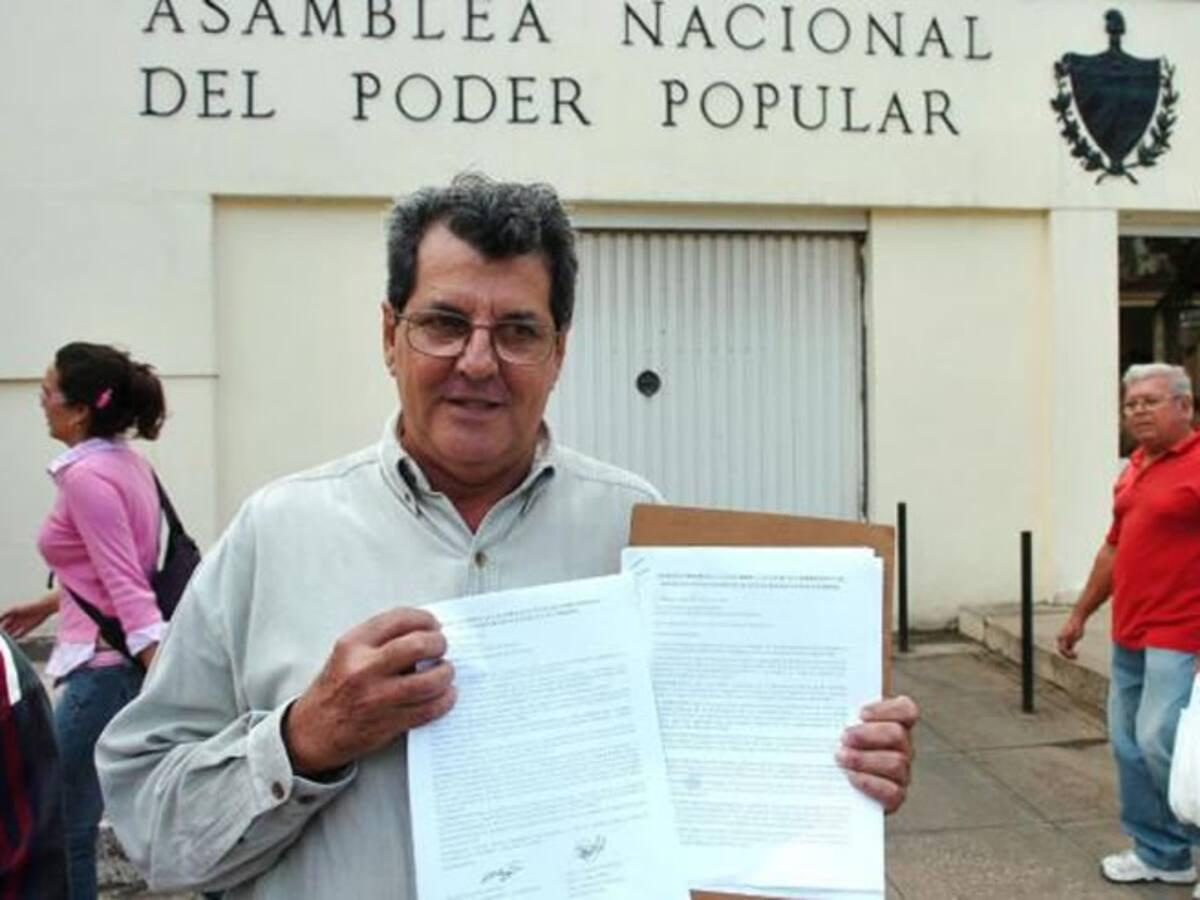
File photo of Payá during the presentation of signatures for the Varela Project before the National Assembly of People’s Power. / EFE
14ymedio, Madrid, 23 July 2025 — The tomb where Oswaldo Payá is buried, in the Colón Cemetery in Havana, received a visit on Tuesday, the thirteenth anniversary of his death, from the head of mission of the United States Embassy, Mike Hammer.
As Hammer usually does with all his visits to people and places on the island, the diplomat had himself recorded and the video was shared through the diplomatic headquarters’ social media. “This July 22nd, we remember and pay tribute to Oswaldo Payá and Harold Cepero, who sacrificed their lives for a better Cuba and in defense of human rights,” was posted on Facebook, along with the images.
Hammer, carrying a dozen showy red ginger flowers, briefly explains the purpose of his visit to the camera and then places the bouquet in front of the gate of the cemetery, after which he silently looks back at the camera, while forming the L for freedom with his index finger and thumb, a gesture continue reading
widely used by members of the Christian Liberation Movement (MCL) founded by Payá.
Mike Hammer, head of the U.S. mission in Cuba, at the grave of Oswaldo Payá this Tuesday. / Screenshot/Facebook
Outside the island, in the United States, other tributes to Payá took place this Tuesday. The most prominent was the posthumous presentation of the Medal of Service to Democracy by the National Endowment for Democracy (NED), at a ceremony attended by his daughter, Rosa María Payá, and his widow, Ofelia Acevedo.
In the video announcing the event, Damon Wilson , president and CEO of NED, referring to the Varela Project, recalled that Payá “led a peaceful citizens’ movement that mobilized thousands of people to demand free elections and fundamental rights.” For that courage, Wilson said, he paid “the ultimate price.”
Similarly, he referred to the June 2023 report in which the Inter-American Commission on Human Rights (IACHR), part of the Organization of American States (OAS), ruled that the Cuban regime was responsible for the deaths of Oswaldo Payá and Harold Cepero, stating that “justice was finally done.”
That detailed report, which included information provided by relatives and a direct witness to the accident that killed the opposition members on July 22, 2012, confirmed that the collision was caused by a State Security vehicle, contradicting the official version. Authorities concluded at the time that the driver of the car carrying Payá and Cepero, Spanish politician Ángel Carromero of the Popular Party, was responsible for causing the accident. As such, he was tried for involuntary manslaughter in a court on the island. However, upon returning to Spain, Carromero always maintained that he was coerced to corroborate the regime’s hypothesis.
“This bill will soon be voted on in both chambers, and it will become law that the Cuban Embassy will be located on Oswaldo Payá Street.”
Another memorial service for Payá took place this Tuesday in the U.S. Congress, where Republican Mario Díaz-Balart and Democrat Debbie Wasserman Schultz reintroduced the bill to rename the street in front of the Cuban Embassy in Washington after the opposition figure. The lawmakers sponsoring the bill are Republicans María Elvira Salazar, Carlos Giménez, and Nicole Malliotakis, and Democrats Frederica Wilson and Darren Soto.
Rosa María Payá, recently elected to the IACHR, expressed her hope to Martí Noticias : “We believe that this time we will achieve it, that very soon this bill will be voted on in both chambers and it will become law that the Cuban Embassy will be located on Oswaldo Payá Street.”
The activist, who heads Cuba Decide, thanked the NED on behalf of her mother and siblings for the medal awarded to her father, as well as another tribute that took place in the Senate, “on the 13th anniversary of that fateful Sunday, the state crime ordered by Raúl and Fidel Castro to try to block the path to liberation that my father paved the way for, and for which he worked alongside many other Cubans.”
____________
COLLABORATE WITH OUR WORK: The 14ymedio team is committed to practicing serious journalism that reflects Cuba’s reality in all its depth. Thank you for joining us on this long journey. We invite you to continue supporting us by becoming a member of 14ymedio now. Together we can continue transforming journalism in Cuba.
Congressman Carlos Giménez will name more of Havana’s “repressors, henchmen, and front men.”
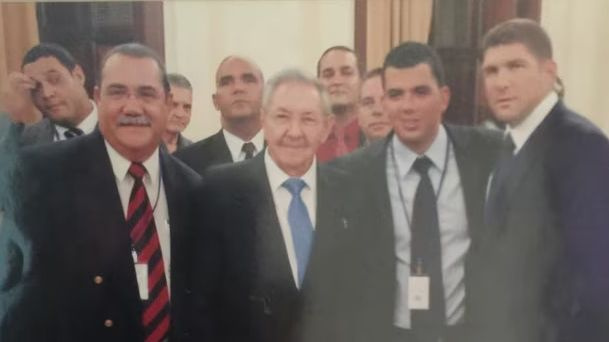
Rodríguez had been photographed with Raúl Castro and El Cangrejo during the 2015 official visit to New York. / Martí Noticias
14ymedio, Madrid, 23 July 2025 — Without specifying that Jorge Javier Rodríguez Cabrera arrested on Monday by the United States Immigration and Customs Enforcement (ICE), was on the list with more than one hundred names of Cuban repressors in the United States that he handed over a few months ago to the Department of Homeland Security (DHS), Carlos Giménez said he was “very happy” about the arrest of the former Cuban official, owner of a successful company in Las Vegas, and he predicts Rodríguez Cabrera will face a prompt deportation.
“Jorge Rodríguez was conducting business illegally with the Castro regime,” the legislator told journalist Mario J. Pentón, who had previously reported the Cuban’s arrest in Martí Noticias. “We know that this man was also a friend of Castro’s family, so I don’t know why he was here,” he said, referring to Rodríguez’s friendship with Raúl Guillermo Rodríguez Castro, alias El Cangrejo [The Crab] Raúl’s grandson and bodyguard.
“We know this man was also a friend of Castro’s family, so I don’t know why he was here.”
Giménez also hopes this is the first of many similar cases—of “many people who are conducting business with Cuba illegally,” he said—for which he is asking the federal government to deport them.
Likewise, he announced this Tuesday: “We will be providing the Department of Homeland Security with additional names of repressors, henchmen, and front men of the Cuban regime who have infiltrated our continue reading
country.”
According to information released by Pentón, Rodríguez was placed in expedited deportation proceedings, meaning he could be returned to Cuba within days. His ex-wife and children already have permanent residency in the US, but after a year of keeping a low profile, he reappeared with a business venture that has raised suspicions.
Of all the images on social media that demonstrate his closeness to the Castros, this was “the one that broke his back.”
The report published by Martí Noticias indicated that Rodríguez arrived in the United States in 2022 via the southern border, accompanied by his wife and minor children, and requested political asylum. However, he had worked at the Ministry of Foreign Affairs, in the diplomatic mail section, and had been photographed alongside Raúl Castro and El Cangrejo during an official visit to New York in 2015. According to Pentón, of all the images on social media that demonstrate his closeness to the Castros, this was “the one that broke his back.”
Just last November, Rodríguez founded Gran Azul LLC, a company registered in the state of Nevada dedicated to door-to-door shipping, logistics, tour packages to Cuba, and the sale of automobiles and food products. Official documents list him as the company manager, and also include the name Marcel Blanco Fernández. In a short time, Gran Azul deployed an aggressive marketing strategy and established a presence in key cities such as Miami, Orlando, Houston, and Phoenix. On its social media, the business promotes itself as a fast and reliable solution for Cubans in the diaspora seeking to help their families on the island, but behind the commercial facade lie its ties to power.
____________
COLLABORATE WITH OUR WORK: The 14ymedio team is committed to practicing serious journalism that reflects Cuba’s reality in all its depth. Thank you for joining us on this long journey. We invite you to continue supporting us by becoming a member of 14ymedio now. Together we can continue transforming journalism in Cuba.
“Authorities wait until the last minute to treat the detainee, regardless of their medical condition, and the outcome is loss of human life.”
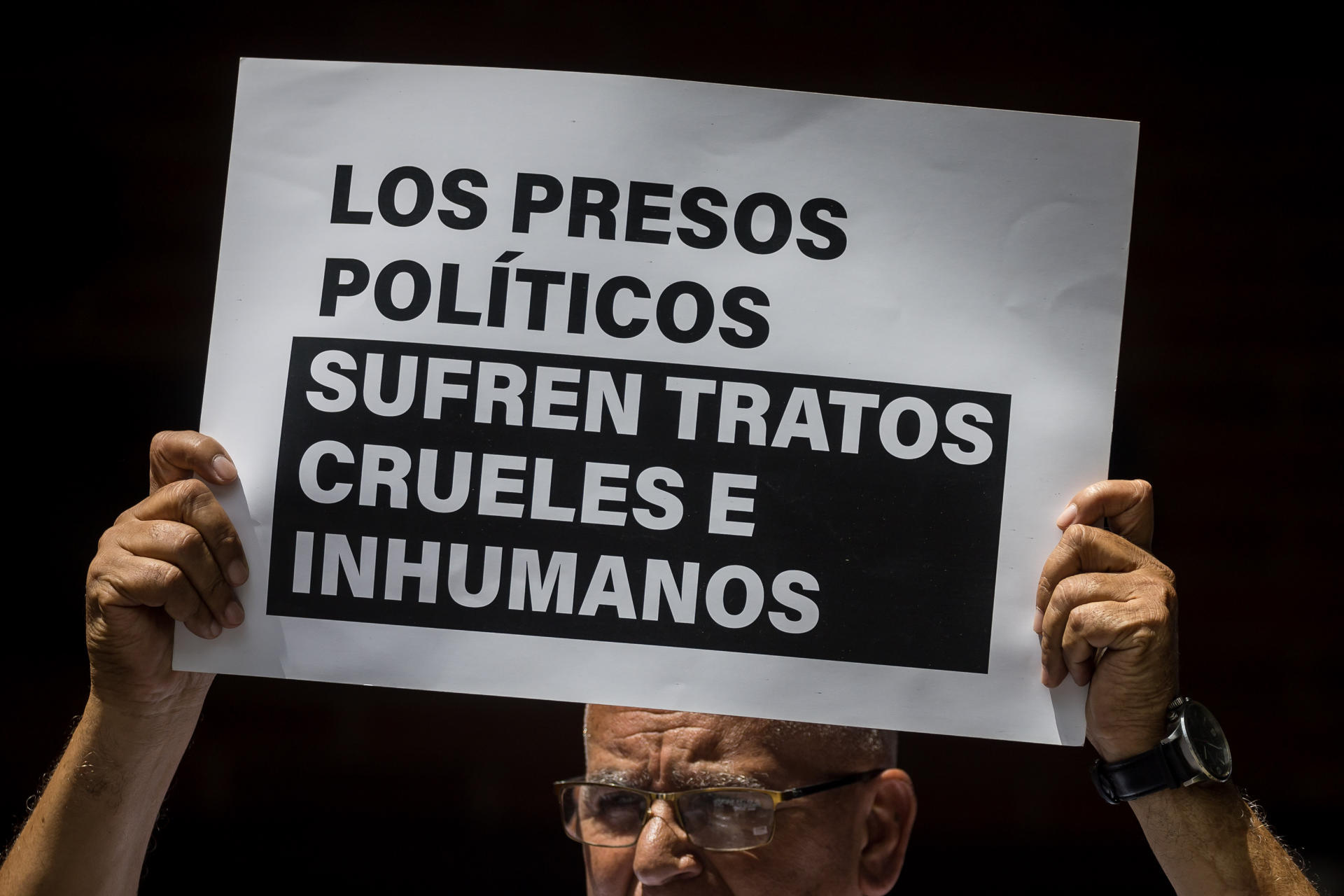
A man with his sign during a protest by relatives and friends of those considered political prisoners in Venezuela, in front of the Mexican embassy in Caracas, Venezuela. “Political prisoners suffer cruel and inhuman treatment” / EFE/Miguel Gutiérrez
EFE (via 14ymedio), Caracas, 22 July 2025 — The NGO Venezuelan Prison Observatory (OVP) reported Monday that 22 political prisoners have died in state custody since 2015, and warned that authorities are waiting until the “last minute” to treat detainees who report health problems.
“Unfortunately, in our prisons, authorities wait until the last minute to treat detainees, regardless of their clinical condition, and the outcome is loss of human life,” the NGO noted in its most recent report, “Without Separation or Autonomy of Powers: Prisons and Cells as a Tool of Torture.”
It also said that another practice is “misdiagnoses in prison, and illnesses that, if treated early, would have a good prognosis, but end in death.”
Of the 22 political prisoners, four were arrested following protests against the official results of the presidential elections held on July 28 of last year.
Of the 22 political prisoners, four were arrested following protests against the official results of the presidential elections held on July 28 of last year. The electoral body declared President Nicolás Maduro’s victory, a result questioned by the majority opposition and part of the international community.
The report also said that the urns of these detainees were “sealed and guarded by the same officials until they were buried.”
“Afterwards, the relatives were also pressured to stop making further statements to the media. We infer, the intention was to stop them from continuing to report the arbitrary acts,” it added.
Given this situation, the OVP urged the State to ensure that prisoners’ food is sufficient, balanced, and adequate, as well as guarantee effective access to healthcare, “through the timely provision of medical care, adequate medication supplies, and immediate transfer in cases of emergency.”
The organization also calls for an “independent, timely, and impartial” investigation into deaths that occurred in state custody, “guaranteeing access to truth, justice, and reparation for victims and their families, as well as the implementation of effective guarantees of non-repetition.”
The Maduro government says there are no political prisoners in the country and that those identified as such are incarcerated for “committing terrible punishable acts,” a claim denied by activists, NGOs, and opposition political parties.
____________
COLLABORATE WITH OUR WORK: The 14ymedio team is committed to practicing serious journalism that reflects Cuba’s reality in all its depth. Thank you for joining us on this long journey. We invite you to continue supporting us by becoming a member of 14ymedio now. Together we can continue transforming journalism in Cuba.
Cuba, with its Russian-aligned posture and its role as the Kremlin’s spokesperson in Latin America, is no longer a priority.
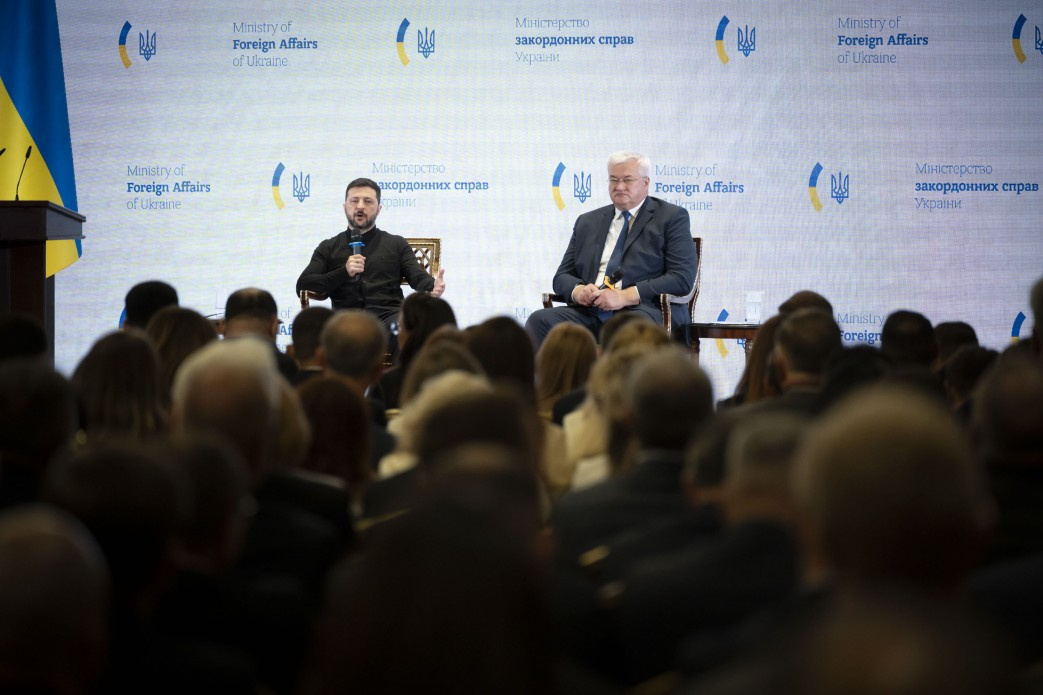
The conference was held under the motto “From the power of diplomacy to the diplomacy of power” / X / Volodymyr Zalenskyy
14ymedio, Havana, 22 July 2025 — The Ukrainian government announced this Monday a significant reduction in its diplomatic presence in Cuba, as part of a sweeping reorganization of its foreign network aimed at strengthening the country’s influence in Latin America and prioritizing key regions for its international strategy.
The decision was communicated by Ukrainian Foreign Minister Andriy Sybiha during the Annual Conference of Heads of Diplomatic Missions, held in Kyiv, which was attended by President Volodymyr Zelensky. The withdrawal from the island does not occur in a vacuum, but rather comes after more than three years of open support from Havana for Moscow in international organizations and amid the intensification of Ukrainian efforts to break the Russian diplomatic siege.
The withdrawal from the island comes after more than three years of open support from Havana to Moscow.
The conference, held under the theme “From the Power of Diplomacy to the Diplomacy of Power,” served as a platform for outlining Kyiv’s new foreign policy priorities. The guiding principle of the meeting was clear: Ukrainian ambassadors must not only represent their country’s interests abroad, but also become active players in the defense of every inch of their national territory. “The main task of our diplomacy is to protect the lives of our people,” Zelensky declared before more than 100 diplomats in attendance. “This is not just about bilateral relations or treaties, but about offensive actions in the political arena,” he added.
The decision to reduce staff at the Havana embassy is interpreted as an adjustment consistent with the political line the Cuban government has followed since Russia invaded Ukraine in February 2022. The Kyiv Foreign Ministry then protested the Cuban regime’s public support for the military continue reading
aggression. Shortly after, Ukraine’s then-Deputy Foreign Minister, Emine Dzheppar, posted a message on social media condemning Havana’s statements and asking it to urge Russia to end the aggression.
Cuba has consistently voted against or abstained from UN resolutions seeking to condemn the war.
Since then, Cuba has consistently voted against or abstained from UN resolutions seeking to condemn the war, demand the withdrawal of Russian troops, or seek reparations for the damage caused. In September 2022, Zelensky himself mentioned Cuba among the seven countries that voted against intervention before the UN General Assembly. “If this coalition is against our determination, then I congratulate all of them, because that means peace will prevail,” the Ukrainian president quipped.
Although it has not been specified how many staff members will be withdrawn from Havana, the embassy currently has five employees, including the ambassador and several secretaries. The staff reduction, as explained by Foreign Minister Sybiha, will free up resources that will be redirected to regions where Kyiv seeks a greater strategic presence.
As part of the new plan, Ukraine will open four embassies in Latin America before the end of the year: in the Dominican Republic, Ecuador, Panama, and Uruguay. In addition, the opening of more than ten new consulates is planned, as well as the modernization of the consular system, which will include connecting 40 diplomatic offices to a new digital platform.
“Our ambassadors must be leaders, not bureaucrats.”
Since July 7, Ukraine has adopted a new ministerial structure that, according to the government, responds to the needs of a country at war and to European standards. This transformation also seeks to strengthen ties with expanding Ukrainian communities in different regions of the world.
The strategy reflects a paradigm shift. After more than three years of war, Ukraine is not only engaged in a military conflict, but also in a battle on the terrain of diplomatic influence. For Kyiv, the battlefield includes embassy halls, international forums, and consular offices. “Our ambassadors must be leaders, not bureaucrats,” Zelensky said during the meeting, in a statement that resonated with those present.
Cuba, with its Russian-aligned posture and its role as the Kremlin’s spokesperson in Latin America, is no longer a priority. Instead, Ukraine is committed to a diverse Latin America where it can win allies, build bridges, and build bilateral relations that support its territorial integrity and sovereignty.
____________
COLLABORATE WITH OUR WORK: The 14ymedio team is committed to practicing serious journalism that reflects Cuba’s reality in all its depth. Thank you for joining us on this long journey. We invite you to continue supporting us by becoming a member of 14ymedio now. Together we can continue transforming journalism in Cuba.
Owner of a successful business in Las Vegas, Jorge Javier Rodríguez Cabrera is in deportation proceedings.
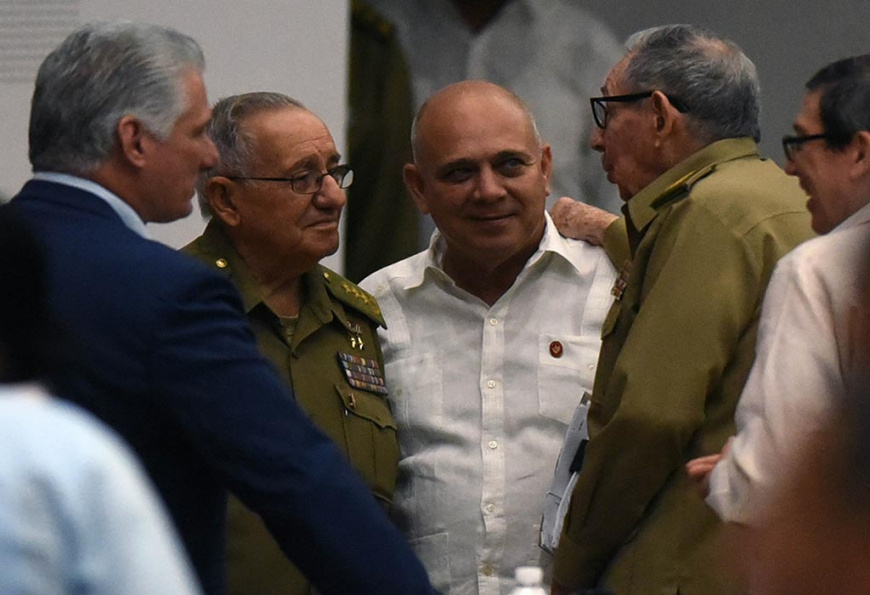
Rodríguez shared luxuries with “El Cangrejo” [center] that would be unthinkable for ordinary Cubans / Martí Noticias14ymedio, Havana, 22 July 2025 — Jorge Javier Rodríguez Cabrera was arrested this Monday in Las Vegas by U.S. Immigration and Customs Enforcement (ICE). He is a former Cuban official with close ties to the regime’s elite, particularly Raúl Guillermo Rodríguez Castro, known as ” El Cangrejo,” [The Crab] the grandson of General Raúl Castro and his personal bodyguard.
According to information reported by Mario J. Pentón in Martí Noticias, Rodríguez was placed in expedited deportation proceedings, meaning he could be returned to Cuba within days. His ex-wife and children already have permanent residency in the U.S., but after a year of keeping a low profile, he reappeared with a business venture that has raised suspicions.
Rodríguez arrived in the United States in 2022 through the southern border, accompanied by his wife and minor children, and requested political asylum.]]
The report published by the Cuban-American media outlet indicated that Rodríguez arrived in the United States in 2022 through the southern border, accompanied by his wife and minor children, and requested political asylum. At first glance, he was just another migrant fleeing the situation in Cuba. However, his diplomatic history told a different story. He had worked in the Ministry of Foreign Affairs, in the diplomatic mail section, and had been photographed alongside Raúl Castro and El Cangrejo during the 2015 official visit to New York. Another image of him briefly circulated on social media in 2021, when he attended a baseball game in a US stadium. His closeness to the highest circles of the Castro regime was clear.
In November 2024, he founded Gran Azul LLC, a company registered in the state of Nevada dedicated to door-to-door shipping, logistics, tour packages to Cuba, and the sale of automobiles and food products. Official documents list him as the company’s manager, along with the name Marcel Blanco Fernández. In a short time, Gran Azul deployed an aggressive marketing strategy and established a presence in key cities including Miami, Orlando, Houston, and Phoenix. On its social media, the business promotes itself as a fast and reliable solution for Cubans in the diaspora seeking to help their families on the island. But behind this commercial facade lie long-standing ties to power.
Rodríguez shared with ’El Cangrejo’ luxuries unthinkable for any ordinary Cuban.
Rodríguez was not only a close friend of El Cangrejo, but also shared luxuries unthinkable for any ordinary Cuban. In 2023, América TeVé released a video showing the two sailing on a yacht, drinking and eating lobster, in the company of their respective partners. The scene was recorded during one of Raúl Castro’s grandson’s frequent visits to foreign waters. In Cuba, access to private boats is reserved for a select few, and the images sparked outrage among many emigrants.
Sources close to the former official’s family explained that the friendship between Rodríguez and El Cangrejo continued even after the relationship between their respective wives ended.
Despite his visibility, Rodríguez always avoided the press. He never responded to interview requests, and after his arrest, his Instagram account disappeared. The silence surrounding the case has contributed to increasing concerns about the true origin of the funds used to build the company and its possible connection to Cuban power structures.
Many of the shipping companies to the island operate as fronts for businesses linked to the regime.
Experts on the subject have warned that many of the shipping companies to the island operate as fronts for businesses linked to the regime. The case of Tuambia, linked to the brother of former Deputy Prime Minister Jorge Luis Perdomo, is just one example of how these ventures can disappear or transform following a shift in the balance of power.
Rodríguez’s arrest raises the usual questions in such cases. Was this an attempt to penetrate the US economy using Castro’s influence networks? Who backed his business? How many others, like him, present themselves as exiles when they could be operating in the interests of the regime?
____________
COLLABORATE WITH OUR WORK: The 14ymedio team is committed to practicing serious journalism that reflects Cuba’s reality in all its depth. Thank you for joining us on this long journey. We invite you to continue supporting us by becoming a member of 14ymedio now. Together we can continue transforming journalism in Cuba.
While his mother tried to see him in prison, State Security left her a summons.
Duannis León Taboada has been on a hunger strike since last Friday / Facebook/Jenni M Taboada
14ymedio, Havana, 22 July 2025 — Duannis León Taboada has been a ’plantado’*, on a hunger and thirst strike since last Friday at the Combinado del Este Penitentiary in Havana, demanding “justice and freedom.” Yenisey Taboada Ortiz, the mother of the young man who has been is a political prisoner since 11 July 2021 (11J), tells 14ymedio that he drank water today, but “is very weak.”
This Monday, a lieutenant informed the woman that her son, who is serving a 14-year sentence for sedition for his participation in the protests, had just been registered as a striker and that until he was isolated (placed in a single cell), she would not be allowed to see him.
According to the mother, after exerting pressure and staying at Combinado del Este until seven at night, she was allowed a phone call. “I want my freedom, Mom,” Duannis told her, adding that he started the strike “for all the protesters and for the mothers who continue to suffer.”
Taboada managed to convince her son to at least drink water, since at the beginning of his protest the young man had decided to go on a hunger and thirst strike. “It’s important,” she says, recalling that León was born with kidney problems. “Not to mention that I’m against strikes, always respecting everything he’s going through, but I want my son alive,” she added.
In an audio recording shared by the Cultural Rights Observatory, the political prisoner’s mother can be heard saying: “I’m speechless. The only thing I can say and shout to the world is that I want my son alive. You took him from me alive.”
The NGO emphasized that “what is happening today with Duannis, 26, is the culmination of a process of profound depression in the face of a full-blown social crime, exacerbated by the abuses of State Security, which acts with total impunity, monopolizing not only military and police forces, but also civilian institutions that should adhere to their role as public servants.”
Yenisey Taboada Ortiz tells 14ymedio that while she was at Combinado del Este trying to see her son, State Security showed up at her house and left her a police summons. “I’m not going to go,” she warns. “They keep underestimating mothers.”
The striker’s mother admits she is overwhelmed: “Because when a child’s life is in danger, the world freezes, but I must be very strong.”
On the eve of the fourth anniversary of the massive demonstrations of June 11, Prisoners Defenders reported that of the 1,158 political prisoners serving sentences on the island, 65% (752) were arrested during those protests. In its report, it emphasized that the regime has continued to imprison its opponents with impunity—at a rate of 10 per month over the past 12 months, although several have been released—including eight new arrests last June, at least half of them during the protests on the 29th in Guanabacoa.
*Translator’s note: “Plantado’ — literally ’planted’ — is a term with a long history in Cuba and is used to describe a political prisoner who refuses to cooperate in any way with their incarceration. See also…
____________
COLLABORATE WITH OUR WORK: The 14ymedio team is committed to practicing serious journalism that reflects Cuba’s reality in all its depth. Thank you for joining us on this long journey. We invite you to continue supporting us by becoming a member of 14ymedio now. Together we can continue transforming journalism in Cuba.
In statements to ’14ymedio’, Mayor Alessandra Rojo proposes “a public auction” of these pieces to recover the $32,000 they cost.
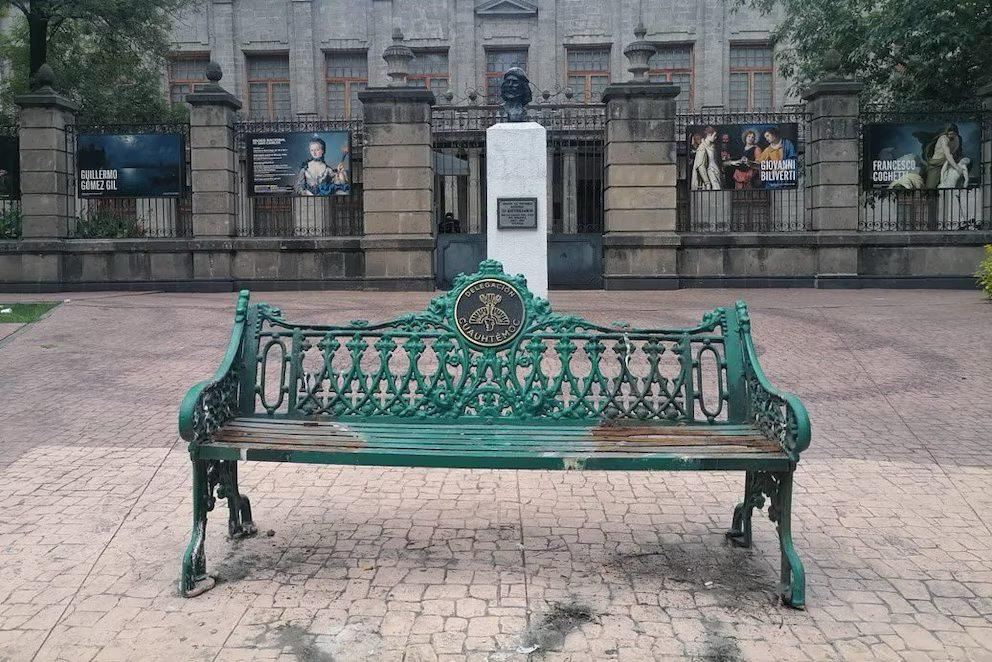
Tabacalera Garden Bench, in Mexico City, where the statues of Fidel Castro and Che Guevara once stood. / Cuauhtémoc City Hall
14ymedio, Mexico City, 22 July 2025 — The mayor of the Cuauhtémoc municipality in Mexico City, Alessandra Rojo de la Vega, wants to put up for public auction the statues of Fidel Castro and Ernesto Che Guevara that she ordered removed last week from the bench where they stood in the Jardín Tabacalera park . This is what the politician told 14ymedio, explaining that if this solution is possible, the auction would start at the original purchase price – 600,000 pesos, $32,000, in 2017 – “corrected for inflation in recent years,” with the money to be reinvested in the park.
“I want to return that money to the people, money which should have been used to improve their quality of life,” the mayor stated in a written response to questions from this newspaper. She also asserted that she had “had extensive discussions on the issue” with the mayor of the capital, Clara Brugada, and with the team of the country’s president, Claudia Sheinbaum, and that they are willing to hold a “working meeting” with lawyers. “Our team can reliably support the claim that the action was legal, consistent with good administration, and focused on addressing a citizen demand,” she asserted.
Rojo de la Vega says she is “willing to listen” to the position of the federal government and the ruling Morena party, “as long as it is focused on administrative debate and a solution that ensures the rights of the residents of the district.”
“I want to give people back that money, which should have been used to improve their quality of life.”
In one of her morning press conferences, President Sheinbaum had criticized the removal of the statues, arguing that the decision should be made “by a committee.” “You can’t remove a statue or monument like that. In this case, it wasn’t done by the institution.” At the same time, she opposed a possible auction of the works, created by sculptor Óscar Ponzanelli. “It would be a financial loss,” she declared, adding that she requested “that the monument be handed over and relocated.”
Rojo de la Vega responded to the Mexican president on social media, reminding her that in 2020 she had stated that “the ignominy in the city was coming to an end” and that homage would never again be paid to oppressors or dictators. “Fidel Castro and Che Guevara were exactly that: oppressors, representatives of a dictatorial regime, and responsible for thousands of deaths,” the mayor stated. continue reading
The politician, elected by a coalition opposed to the ruling party in the capital and the country, reiterated that 600,000 pesos were paid with resources from Chapter 5000 of the budget, an allocation that could have been used to “buy equipment for potholes or to replace streetlights.” She insisted that “the Constitution, which is much more than an administrative committee, establishes that we have the authority to manage the assets and properties belonging to the mayor’s office.”
“It has become clear that the Morena Party does not consider Che Guevara or Fidel Castro to be murderers.”
The removal of Fidel and Che Guevara came after an eight-month discussion, during which several residents expressed their discontent. “It’s a battle not for ideology, but for consistency,” she said.
In her exchange with 14ymedio on Monday, she also reported having received “many threats for complying with and enforcing the law,” including from “senators from the ruling party” and “a few government secretaries.”
“It seems that there is a double standard among some or many of its leaders. When criminals and human rights violators are their allies, what they did is not wrong. Only when they are their adversaries is it objectionable,” laments the mayor, who forcefully states, “It has become clear that the Morena Party does not consider Che Guevara or Fidel Castro murderers, that it defends the Cuban regime, that it believes that the political persecution of Cuba is not reprehensible, and that the mass exodus and forced displacements that have existed since the emergence of the Cuban dictatorship are not morally condemnable.”
That, she concludes, “is not the country, nor the project for which millions voted in the last elections, nor is it the city or country project that any Mexican wants.”
____________
COLLABORATE WITH OUR WORK: The 14ymedio team is committed to practicing serious journalism that reflects Cuba’s reality in all its depth. Thank you for joining us on this long journey. We invite you to continue supporting us by becoming a member of 14ymedio now. Together we can continue transforming journalism in Cuba.
Former Spanish President Rodríguez Zapatero participated in the operation that included the extradition of Dahud Hanid Ortiz, born in Venezuela and holding a US passport.
Dahud Hanid Ortiz, second from the right, behind, wearing a cap and carrying the American flag, along with nine other prisoners released by the government of Nicolás Maduro / X/@usembassyve
14ymedio, Madrid, 22 July 2025 — Of the more than fifty prisoners released by Venezuela through an exchange with the United States mediated by former Spanish President José Luis Rodríguez Zapatero, one is not only not a political prisoner, but a murderer. This is Dahud Hanid Ortiz, who in 2016 killed the Cuban women Elisa Consuegra and Maritza Osorio and Ecuadorian Pepe Castillo in Madrid in what is known as the Usera triple murder.
The newspaper El Debatestated this Monday that “someone hasn’t done their job” and denounced Zapatero’s collaboration, as a negotiator, in “the release of the murderer of three people stabbed in Madrid.” Víctor Salas, owner of the law firm where the murders took place and the true target of Hanid Ortiz, who was seeking revenge for his wife’s infidelity with the lawyer, told the Spanish news outlet he felt “terrified”: “That murderer is free on his way to the United States and could come and kill me at any moment.”
Hanid Ortiz, a former US military officer of Venezuelan origin and resident in Germany, showed up at the office of the Peruvian lawyer and discovered his wife was cheating on him on June 22, 2016. When he couldn’t find the lawyer he took his revenge on the two Cuban employees—one from Havana and one from Holguín—and a client, killing them with a crowbar and a knife, and later fled to Venezuela. continue reading
“That killer is free on his way to the United States and could come and kill me at any moment.”
He was arrested there in 2018 and sentenced to 30 years in prison in late 2023. Venezuelan authorities had refused to extradite him to Spain, claiming he was a Venezuelan citizen. After his sentencing, the Attorney General’s Office informed the judge that he would be transferred to Spain “for humanitarian reasons,” and the court granted the deportation, but the Spanish authorities objected.
The killer had arrived in Germany in 2011 as a first lieutenant in the US Army after serving in Iraq and Korea. On June 30, 2015, a US military court convicted him of using false documents to obtain the rank of Army officer. He was also sentenced for fraud against the state for pretending his family was still living in the US while he was stationed in Germany, which allowed him to receive $87,000 in social assistance to which he was not entitled.
US authorities released photographs and videos on Monday showing Hanid Ortiz alongside the other nine former prisoners with US citizenship or residency, now free. Smiling, wearing a cap and waving a US flag, he listens attentively as President Nayib Bukele thanks him. In exchange for their release, Bukele returned to Caracas 252 Venezuelan migrants deported to Central American prisons by the Donald Trump administration.
“It was a great decision, and I am very happy, very satisfied, and very grateful,” Zapatero can be heard saying over the phone in a video released by Nicolás Maduro. Maduro thanks him for his mediation and says he hopes “he will soon visit the country so that he can, as always, support the
Raúl Castro said: “When he completes his two terms, if he works well (…) he should remain” as first secretary of the PCC
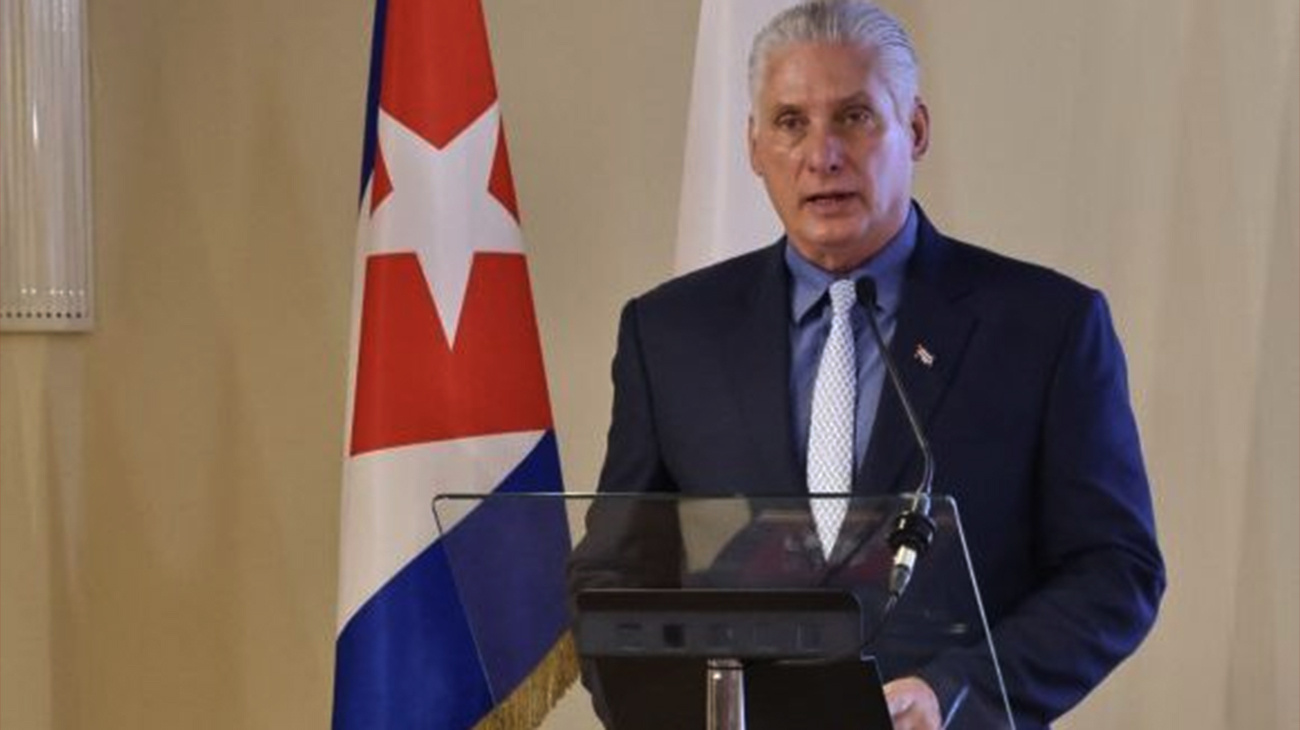
Cuban President Miguel Díaz-Canel. / Cubadebate
14ymedio, Reinaldo Escobar, Havana, 22 July 2025 — The elimination of the age limit as a requirement for being elected president of the Republic of Cuba has unleashed a wave of speculation about who will be hand-picked to this position, which, as we know, will not be an election.
It’s not necessary to quote Article 5 of the Constitution, which Fidel Castro drafted in its entirety, to recognize that, hierarchically, the position of First Secretary of the Communist Party of Cuba (PCC) ranks above that of President of the Republic. These two positions have traditionally been held by a single individual, with the exception of the period between April 2018 and April 2021, when Raúl Castro remained at the head of the party while Miguel Díaz-Canel held the office of President.
To confirm what is stated in the title of this commentary, we must recall Raúl Castro’s speech during Díaz-Canel’s inauguration on April 18, 2018, when he bluntly warned:
“When he completes his two terms, if he performs well and our Party’s Central Committee approves it (…), he should stay on. The same thing we are doing with him, he will maintain with his replacement. His ten years as president of the Council of State and ministers will be over, and for the three remaining years until the congress, he will remain as First Secretary to facilitate the safe transition and spare us the learning curve of his replacement until he retires to care for his grandchildren.” continue reading
Thus, the successor appointed to the presidency in 2028 will remain under the supervision and tutelage of Díaz-Canel until 2031.
The only thing that has changed is that the title of the position is now President of the Republic, which Díaz-Canel will hold until April 2028. The ninth Party Congress will be held between April 16 and 19, 2026, and barring a miracle or a curse, the current first secretary will be reelected for another five years, that is, until April 2031. Thus, the successor appointed to the presidency in 2028 will remain under the supervision and tutelage of Díaz-Canel until 2031.
The proposal to limit the holding of “fundamental political and state offices” to a maximum of two consecutive five-year terms was approved at the Sixth Party Congress in 2011 and ratified at the Seventh in 2016, but it wasn’t until the new Constitution was approved in 2019 that this proposal became legally valid. The peculiarity is that Article 126 merely states that the President of the Republic is elected for a five-year term and may only serve up to two consecutive terms, after which he or she may not serve again. The Constitution makes no mention of the tenure of the First Secretary of the Party.
The curious thing is that this detail is not specified in any of the PCC’s programmatic documents, not even in its statutes, where the furthest it goes in this regard appears in Article 21, which establishes that the renewal of leadership positions will be done “by establishing limits on tenure by time and age, according to the functions and complexities of each responsibility.”
At the time when the commander-in-chief ruled the country as he pleased, the question of who is coming after Fidel Castro couldn’t even be asked, because there was no one but himself. During Raúl Castro’s years, the consolidated generalship gained importance as a power behind the throne in the form of the Gaesa military conglomerate. The stigma of “hand-picked” that weakens Díaz-Canel’s leadership raises the question of whether he, from within the Party, will be the one to follow his presumed replacement, or whether the shadow of sabers will remain behind, or above, a fiction of civilian government.
COLLABORATE WITH OUR WORK: The 14ymedio team is committed to practicing serious journalism that reflects Cuba’s reality in all its depth. Thank you for joining us on this long journey. We invite you to continue supporting us by becoming a member of 14ymedio now. Together we can continue transforming journalism in Cuba.
The removal of the age limit for the presidency is a sign that a similar profile is being sought to ensure continuity.
Why would Morales Ojeda be the successor? Who is this individual? / Prensa Latina
14ymedio, Ramón Martínez, Orlando (Florida), 21July 2025 — Castro’s latest move to eliminate the 60-year age limit for accessing the office of President of the Republic, as provided for in the Constitution approved in 2019, was a predictable gesture.
The justifications given for approving this “constitutional amendment” are trivial, because what lies beneath is the need to appoint a person to that position for the next 10-year term who will guarantee the continuity of the regime and who will more or less follow the current ruler’s line, which, although disastrous across the board, has been successful in the one area where they cannot afford to make mistakes: continuing to hold the reins of power. The analysis should have focused then on the possibility that finding someone under 60 to fill that position would not be an easy task.
Miguel Díaz-Canel, who has governed the country since April 19, 2018, when he was appointed President of the Council of State and, also, President of the Council of Ministers, succeeding Raúl Castro, began serving as President of the Republic with effective date of the new Constitution on October 10, 2019.
The president shall serve a five year term and may be re-elected only once.
As stipulated in the Constitution, the president shall serve a five-year term and may be reelected only once. Thus, Díaz-Canel, who was reelected by the National Assembly of People’s Power in April 2023, must step down from office in the same month of 2028.
Apparently, as we can see, the next president of the Republic of Cuba will be Roberto Morales Ojeda (born Cienfuegos, June 15, 1967). He would turn 61 in 2028, when Díaz-Canel is due to leave (although if he is appointed to office in April, as is assumed, he would not yet have turned 61). But “the regime’s strategists,” — that group of shadowy thinkers who guide the Cuban ship with a firm hand toward no port — do not want to make months-long mistakes, so they have eliminated the 60-year-old requirement.
But why would Morales Ojeda be the successor? Who is this individual? Let’s have a look. continue reading
Morales Ojeda has been a member of its Central Committee since 2006 and of the Political Bureau since 2016.
After graduating in medicine in 1991, Morales Ojeda briefly worked in epidemiology before moving on to health administration (he served as municipal health director of Rodas and Cienfuegos, respectively) before beginning his rising career as a professional cadre of the Communist Party of Cuba (PCC). He has been a member of its Central Committee since 2006 and of its Political Bureau since 2016. He has served as First Secretary of the provincial party in Cienfuegos, a member of the Central Committee Secretariat, Deputy Minister and Minister of Public Health, and Deputy Prime Minister. In 2021, he was selected as Organizational Secretary of the PCC Central Committee.
But beyond his career and official positions, he has recently emerged as a media figure and has been very close to the current president-designate in most of the activities in which the latter participates. He is acts as a second-in-command, quietly following his boss, as if to “continue gaining experience.” And although he draws from a dry source, like everything that emanates from the mind and actions of the current president — “hand-picked” (as the popular slang goes) — his learning would be useful to fulfill the role of “firefighter” once the current president retires.
This individual, in his interventions and speeches, does not display, as expected, any differentiating nuance that separates him from the norm of continuity. He is an obedient, dull, and uncharismatic person, like the current president, so he would be his ideal replacement.
The ‘nomenclatura’ would be better off keeping Marrero in his current position.
But the regime’s strategists shouldn’t put all their eggs in one basket and rely solely on Morales Ojeda. The possibility of appointing Manuel Marrero, the current prime minister and also a member of the political bureau, who would be 65 in 2028, could also be a valid reason for eliminating the 60-year limit. However, the nomenclatura would be better served by keeping Marrero in his current position, as he could continue to be “elected” indefinitely. Although the term of office is also five years, as it is for the president, there is no limit to the number of times a person in that position can serve.
Thus, Morales and Marrero will be able to continue destroying the country with a heavy hand. A domino effect is almost a foregone conclusion.
It is not realistic to think that the elimination of this clumsy constitutional bureaucratic obstacle of 60 years was to give consideration to a “historical,” which conceptually are those characters linked to the regime since before its triumph or since the beginning of its establishment in 1959. Of the few that are still active, names like First Vice President Salvador Valdés (80), or the president of the National Assembly of People’s Power Esteban Lazo (81) — both also members of the political bureau of the PCC — would be unthinkable because they do not have the slightest capacity to overcome the adversities that the head of state in Cuba has to deal with.
One of the requirements to be elected president is to be a deputy of the National Assembly
As for José Ramón Machado Ventura and Ramiro Valdés, age could be a deterrent, since in 2028 the former would turn 98 in October, and the latter 96 in April.
Nor would it seem logical to appoint, when 2028 arrives, leaders who are little or not at all known, as might be the case with some other members of the political bureau who must be there to fill a quota and who, when the time comes, would be of a suitable age to serve as president.
At a slightly lower level, there is an exquisite pool of men and women, many of them rising stars, who are members of the Central Committee, but who should not yet be considered “presidential candidates.” Furthermore, one of the requirements to be elected president is to be a deputy. The age range of this large group is marked, ranging from young people in their 30s to elderly people over 80.
And although in this group there are some names that have had some relevance and appear more frequently than others in the public eye, it is no less true that it would be very surprising if any of them received the blessing of Raúl Castro, who would be 97 years old in 2028 (June 3, 1931).
There has already been a lot of Castro-military in power with Fidel (almost 50 years in power) and Raúl (10 years)
Nor would it be advisable to promote any of the military to the supposed top position of the Cuban State, especially the members of a general staff who are not yet advanced in age. For example, the names of the division generals of the Revolutionary Armed Forces (FAR) and member of the central committee, Raúl Villar (60), head of the Central Army, Eugenio Ravilero (60), head of the Eastern Army or Ernest Feijoo, head of the Western Army, and coincidentally also 60 years old, are key pieces in the maintenance of the framework of power and would only be 64 years old when the next president is appointed, therefore, it is better that they continue to be very useful in the positions they hold. They have a whole life ahead of them.
Much less to think about Lázaro Alvarez (62), a member of the political bureau, recently promoted to Army Corps General, who has been the Minister of the Interior since 2020 and is the person most responsible for maintaining internal order (a term that in real words means having the efficient repressive machinery of the dictatorship well oiled).
So there was already too much Castro-military power with Fidel (almost 50 years in power) and Raúl (10 years), to continue putting military personnel in charge, although in truth the transmutation from civilian to military in communist Cuba is only mediated by the change from a guayabera to an olive green uniform.
Of the heirs of the Cuban royal family, the one who has done the most to flirt with power is Alejandro Castro Espín.
Finally, among the heirs to the Cuban royal family (read: children or grandchildren of Fidel and Raúl), the one who has done the most to flirt with power is Alejandro Castro Espín (59), although he does not meet the requirement of being a deputy. The only son of Raúl Castro and Vilma Espín, he is a brigadier general in the Ministry of the Interior and works for the Intelligence and Counterintelligence Directorate of this shadowy ministry. He is possibly one of the members of the so-called “power behind the scenes,” as it is speculated exists on the island.
Castroism, which claims to be eternal, continues to renew itself, taking steps to guarantee its continuity. It was stupid to stipulate that a 60-year-old human being cannot aspire to the office of president of a republic, when at that age, one is supposed to reach adequate political maturity and possess the still optimal physical and intellectual performance if the person remains healthy. Hence, the dictatorial planners have rectified their position in time.
____________
COLLABORATE WITH OUR WORK: The 14ymedio team is committed to practicing serious journalism that reflects Cuba’s reality in all its depth. Thank you for joining us on this long journey. We invite you to continue supporting us by becoming a member of 14ymedio now. Together we can continue transforming journalism in Cuba.
The cancellation of the presentation of the students’ graduation short films marks the end of a free space for artistic creation.
The screen never lit up, the doors never opened, and no one gave a clear answer. / Instagram / Cynthia Deus Fagundo
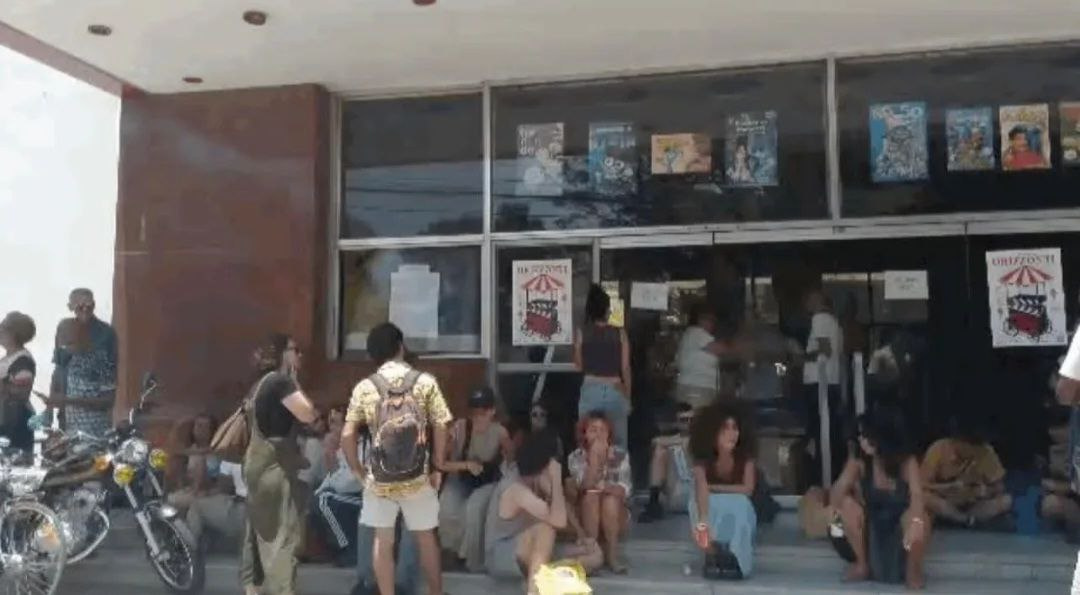
14ymedio, Havana, 21 July 2025 — What was supposed to be a celebration of young art and creative freedom ended with a slammed door, disguised as a “technical problem.” On Saturday, July 12, the students of the 30th Generation of the International School of Film and Television (EICTV), based in San Antonio de los Baños, showed up at the Acapulco Cinema in Havana with their graduation short films in hand, ready to share with the public the fruits of their talent, effort, and training. But the screen never lit up, the doors never opened, and no one gave a clear answer.
For more than three decades, the screening of graduates’ thesis projects has been a tradition that not only marks the end of the academic year but also allows new filmmakers to showcase their vision to the world from a public venue. This year, however, this right was denied without official justification, without visible interlocutors, and, above all, without transparency.
“An unprecedented event in the history of our school”
The students denounced the incident in a statement circulating on social media and supported by members of the national film industry, including the Assembly of Cuban Filmmakers. The cancellation, they said, was “an unprecedented event in the history of our school.” Two buses packed with students, family members, technicians, and teachers arrived at the Havana movie theater only to find closed doors, missing signs, and an institutional silence redolent of censorship.
Barely twenty minutes after the scheduled start time, a school official briefly announced that everything was canceled due to “supposed technical problems.” But the students, and anyone who has lived in Cuba long enough, recognized the strategy. There was no schedule, no projection continue reading
equipment, and no will to resolve or reschedule. There was only one familiar maneuver: passing it off as censorship ‘by accident’.
Susana Molina did not even offer explanations to the students.
This authoritarian gesture is not an isolated incident. As the Filmmakers’ Assembly rightly recalled, similar “technical failures” prevented the screening of films during the last Film Festival, with none of them subsequently rescheduled. It is also not new that the Ministry of Culture—through its network of institutions—maintains absolute control over the country’s theaters, determining what is and isn’t shown, and leaving in the lurch many filmmakers whose works never reach their audiences.
But what this case reveals with particular starkness is the level of institutional intervention and manipulation that EICTV, once a symbol of plurality and creative independence, has reached. Founded in 1986 by Gabriel García Márquez, Fernando Birri, and Julio García Espinosa—with the “protection” of Fidel Castro himself—the school was born with a Latin American and international vocation, open to dialogue between cultures and critical thinking through cinema. Today, its leadership seems to subordinate itself unquestioningly to the single Party and its mechanisms of control, relegating its founding principles to the archives of discomfort.
EICTV’s current director, Susana Molina, did not even offer an explanation to the students. She hung up the phone on a student representative when asked for an answer. Her silence, according to multiple voices in the union, is neither coincidental nor new. Her administration has been criticized as opaque, repressive, and serving political power. For many, she represents the face of an institution that, instead of defending its students, prefers to align itself with the bureaucrats who decide which films are worth seeing and which are not.
The students, far from passively accepting the situation, publicly demanded “explanations from the Ministry of Culture and the management of the EICTV; guarantees that the theses will be screened without restrictions; and respect for the school’s academic and artistic autonomy.” Their statement was clear and courageous: “We will not allow our cinema to be silenced.”
The EICTV Generation 30 is made up of 42 young people from more than a dozen countries.
Since June, students have been expressing their discontent over the deteriorating basic services and the school’s appalling infrastructure. The protests forced Fernando Rojas, former Deputy Minister of Culture and current direct advisor to the minister, Alpidio Alonso, to intervene. His presence on campus, and not that of representatives from the New Latin American Cinema Foundation—the entity that historically mediated the management of the EICTV—exposed a truth that had already been suspected: the school has come under the direct control of the Ministry of Culture. Today, far from being an autonomous space for artistic creation, the EICTV operates under the watchful eye of the government’s cultural commissioners.
In a country where public theaters are under state control and where the Youth Showcase has disappeared without explanation, censorship is not the exception, but the norm. EICTV’s Generation 30, made up of 42 young people from more than a dozen countries, is not only demanding their right to show what they have created. They are demanding respect for a promise: that school be, as the official press proclaims, “the school of all worlds,” and not just another cog in the machinery of silence.
____________
COLLABORATE WITH OUR WORK: The 14ymedio team is committed to practicing serious journalism that reflects Cuba’s reality in all its depth. Thank you for joining us on this long journey. We invite you to continue supporting us by becoming a member of 14ymedio now. Together we can continue transforming journalism in Cuba.
Little remains of the luxury and comfort that attracted such prominent figures as José Martí’s widow and son at the Campoamor Hotel.
The former Campoamor Hotel has signs everywhere warning of the “danger of collapse.” / 14ymedio
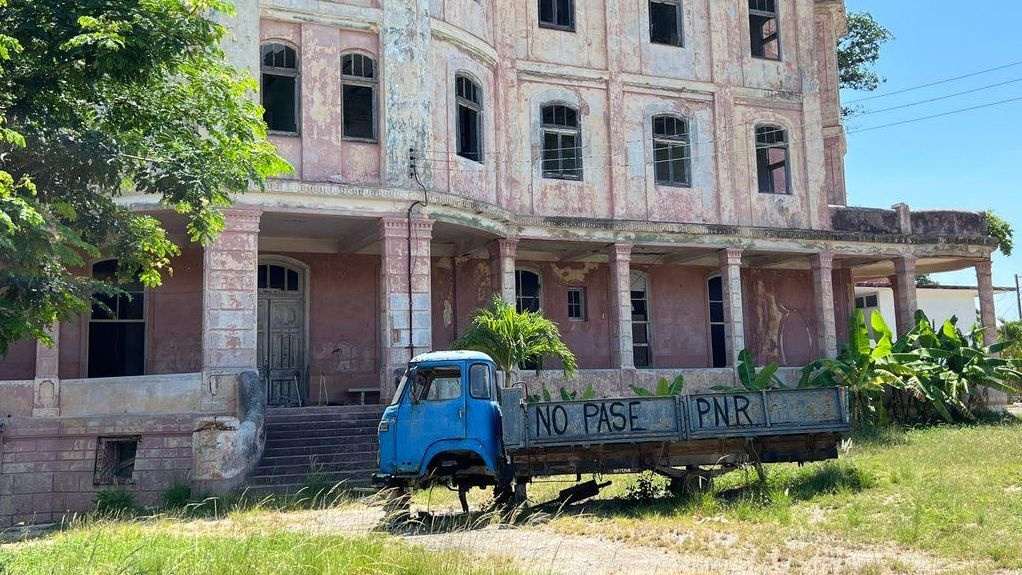
14ymedio, Darío Hernández, Cojímar (Havana), 19 July 2025 — “Do not enter. PNR.” The ‘People’s Revolutionary Police’ prohibition, written in large black letters on the back of an abandoned truck, is almost unnecessary when you look up at the building. Resembling a haunted mansion, the ruins of the former Campoamor Hotel, which housed a reformatory and had many other uses in Cojímar, make it clear to the passerby what awaits them if they cross the threshold.
Similar warnings hang on pieces of zinc from the fence that protects the building, which is “in danger of collapse,” and which has been reinforced with poles and barbed wire to keep out curious onlookers. Inside, in the old garden, rest a wheelless truck and a rusty bus whose frame bears the marks of scrap metal dealers, who have left only the shell of the vehicle.
“First it was a reformatory, then it was a separate school [for students with learning disabilities], and now it’s abandoned,” Pedro, 77, “born and raised in Cojímar,” explains to this newspaper. However, the fisherman only describes the chronology he knows, which is limited to the time the building was in the hands of the Revolution.
When it was built in 1907, its owners and architects wanted it to be the jewel of the capital’s seaside resort, where wealthy Creoles traveled and where the island’s great fortunes spent their summers. The story is even recorded by Ecured, the official Wikipedia , which awards the property to Pilar Samoano, a hotel entrepreneur who owns, among other buildings, the El Telégrafo hotel in Havana, which in 2022 became the first Cuban LGBTI+ friendly accommodation thanks to the Spanish chain Axel. continue reading
When it was built in 1907, its owners and architects wanted it to be the jewel of the capital’s resort. / 14ymedio
Purchased by the government of the Republic, a few years after its opening it became a sanatorium for tuberculosis patients until Fidel Castro came to power. Today, not even the Cuban on-line encyclopedia Ecured hides its dereliction: “After 1959, this building had various uses until, unfortunately, the lack of care and maintenance led it to a completely disastrous state, from which it will probably never recover.”
“It’s a shame,” Pedro agrees. “The government is letting it fall into disrepair. It needs to be repaired, and how many families couldn’t fit there? People who are living with their in-laws or don’t have anywhere to live,” the fisherman emphasizes, pointing to the gigantic structure that still has a faint pinkish hue.
With abandonment, the building has become a kind of greenhouse. Creepers eat away at the walls, attracted by the damp, ferns hang from the cracks in the balconies, and the green branches of several trees sprout from the top-floor windows, strong from years of peace. Their roots have destroyed the floor and erased the boundary between one level of the old hotel and the next.
A rusty bus whose structure shows the marks of scrap metal dealers, who have left only the shell of the vehicle / 14ymedio
Little remains of Campoamor’s luxury and comfort, which, in its day, attracted such prominent figures as José Martí’s widow and son, the Liberation Army captain José Francisco Martí Zayas-Bazán, heir to several lines of illustrious surnames on the island. “A few years ago, there were rumors that the Historian’s Office wanted to repair the building, but they said the foundations and structure couldn’t withstand complete repairs, and the plan was to demolish it. It seems they still haven’t decided what to do,” laments Pedro.
Meanwhile, garbage piles up against the wall of the building that faces Calle Real, Cojímar’s main street. The street has become a promenade of small dumpsters that appear on every corner and potholes that cars try their best to avoid.
The same fate befell other elegant buildings and mansions in Cojímar, which during the Republic belonged to businessmen and families of Havana’s upper class. This is the case with Quinta Pedralbes, which belonged to the Catalan businessman Joaquín Boada and was built by Mario Rotllan, a prominent exponent of Art Nouveau who had several workshops on the island.
With its walls peeling and its gardens overtaken by wild plants, the mansion barely survives as a refuge for several families. Palm trees and banana trees now sprout from the former gardens, where exotic plant species brought from all over the world once coexisted.
The same fate befell other elegant mansions in the Republic that belonged to businessmen and families of Havana’s upper class. / 14ymedio
____________
COLLABORATE WITH OUR WORK: The 14ymedio team is committed to practicing serious journalism that reflects Cuba’s reality in all its depth. Thank you for joining us on this long journey. We invite you to continue supporting us by becoming a member of 14ymedio now. Together we can continue transforming journalism in Cuba.

 14ymedio, Havana, July 23, 2025 — As travel to Cuba continues to fall precipitously, airlines with flights to the island are beginning take a financial hit due to empty seats and low demand. This week, United Airlines — the only U.S. carrier with connections to Havana from Houston, Texas — announced that it will suspend flights beginning September 2 and will not resume service until the summer of 2026 at the earliest.