Little remains of the luxury and comfort that attracted such prominent figures as José Martí’s widow and son at the Campoamor Hotel.
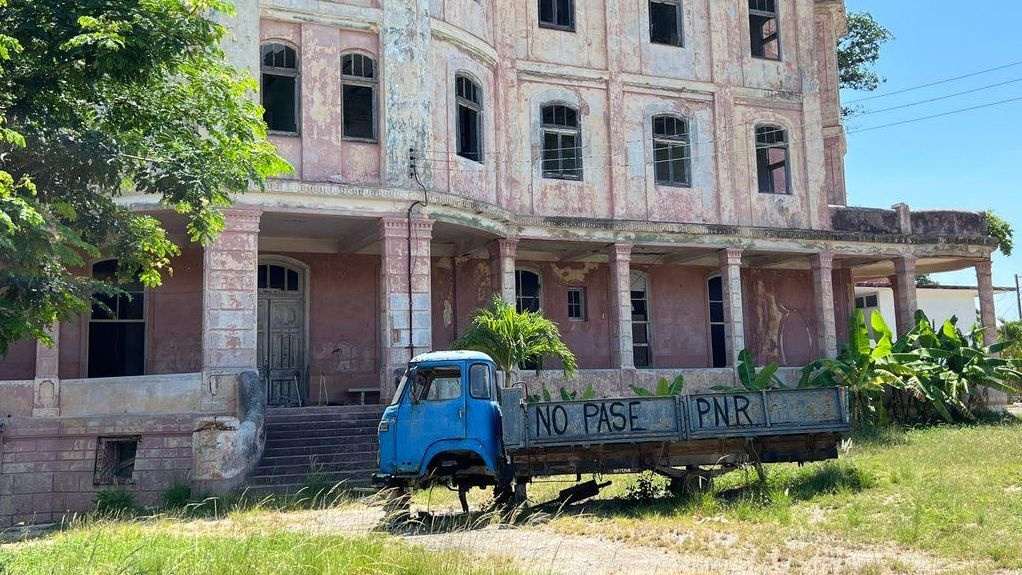
 14ymedio, Darío Hernández, Cojímar (Havana), 19 July 2025 — “Do not enter. PNR.” The ‘People’s Revolutionary Police’ prohibition, written in large black letters on the back of an abandoned truck, is almost unnecessary when you look up at the building. Resembling a haunted mansion, the ruins of the former Campoamor Hotel, which housed a reformatory and had many other uses in Cojímar, make it clear to the passerby what awaits them if they cross the threshold.
Similar warnings hang on pieces of zinc from the fence that protects the building, which is “in danger of collapse,” and which has been reinforced with poles and barbed wire to keep out curious onlookers. Inside, in the old garden, rest a wheelless truck and a rusty bus whose frame bears the marks of scrap metal dealers, who have left only the shell of the vehicle.
“First it was a reformatory, then it was a separate school [for students with learning disabilities], and now it’s abandoned,” Pedro, 77, “born and raised in Cojímar,” explains to this newspaper. However, the fisherman only describes the chronology he knows, which is limited to the time the building was in the hands of the Revolution.
When it was built in 1907, its owners and architects wanted it to be the jewel of the capital’s seaside resort, where wealthy Creoles traveled and where the island’s great fortunes spent their summers. The story is even recorded by Ecured, the official Wikipedia , which awards the property to Pilar Samoano, a hotel entrepreneur who owns, among other buildings, the El Telégrafo hotel in Havana, which in 2022 became the first Cuban LGBTI+ friendly accommodation thanks to the Spanish chain Axel.

Purchased by the government of the Republic, a few years after its opening it became a sanatorium for tuberculosis patients until Fidel Castro came to power. Today, not even the Cuban on-line encyclopedia Ecured hides its dereliction: “After 1959, this building had various uses until, unfortunately, the lack of care and maintenance led it to a completely disastrous state, from which it will probably never recover.”
“It’s a shame,” Pedro agrees. “The government is letting it fall into disrepair. It needs to be repaired, and how many families couldn’t fit there? People who are living with their in-laws or don’t have anywhere to live,” the fisherman emphasizes, pointing to the gigantic structure that still has a faint pinkish hue.
With abandonment, the building has become a kind of greenhouse. Creepers eat away at the walls, attracted by the damp, ferns hang from the cracks in the balconies, and the green branches of several trees sprout from the top-floor windows, strong from years of peace. Their roots have destroyed the floor and erased the boundary between one level of the old hotel and the next.

Little remains of Campoamor’s luxury and comfort, which, in its day, attracted such prominent figures as José Martí’s widow and son, the Liberation Army captain José Francisco Martí Zayas-Bazán, heir to several lines of illustrious surnames on the island. “A few years ago, there were rumors that the Historian’s Office wanted to repair the building, but they said the foundations and structure couldn’t withstand complete repairs, and the plan was to demolish it. It seems they still haven’t decided what to do,” laments Pedro.
Meanwhile, garbage piles up against the wall of the building that faces Calle Real, Cojímar’s main street. The street has become a promenade of small dumpsters that appear on every corner and potholes that cars try their best to avoid.
The same fate befell other elegant buildings and mansions in Cojímar, which during the Republic belonged to businessmen and families of Havana’s upper class. This is the case with Quinta Pedralbes, which belonged to the Catalan businessman Joaquín Boada and was built by Mario Rotllan, a prominent exponent of Art Nouveau who had several workshops on the island.
With its walls peeling and its gardens overtaken by wild plants, the mansion barely survives as a refuge for several families. Palm trees and banana trees now sprout from the former gardens, where exotic plant species brought from all over the world once coexisted.

____________
COLLABORATE WITH OUR WORK: The 14ymedio team is committed to practicing serious journalism that reflects Cuba’s reality in all its depth. Thank you for joining us on this long journey. We invite you to continue supporting us by becoming a member of 14ymedio now. Together we can continue transforming journalism in Cuba.