COLLABORATE WITH OUR WORK: The 14ymedio team is committed to practicing serious journalism that reflects Cuba’s reality in all its depth. Thank you for joining us on this long journey. We invite you to continue supporting us by becoming a member of 14ymedio now. Together we can continue transforming journalism in Cuba.
Upon learning of his passing, I couldn’t help but remember how close I was to shaking his hand, but the demons of political intolerance prevented it.
José Mujica, former president of Uruguay and emblematic figure of the Latin American left, has died at the age of 89 / EFE/ Gastón Britos
14ymedio, Yoani Sánchez, Generation Y, 14 May 2025 [delayed translation] – – This Tuesday, one of the few Latin American leaders who, after serving as president, maintained a regional prestige free of accusations and scandals, died. He had been a man who was a model for the politics of service so lacking on our continent. José Pepe Mujica, former president of Uruguay and emblematic figure of the Latin American left, passed away at the age of 89. Upon learning of his passing, I couldn’t help but remember how close I came to shaking his hand, but the demons of political intolerance prevented me from doing so.
It was 2015, and I was visiting Montevideo, invited by the local journalists’ association. The tour’s agenda included visits to media outlets, conversations with reporters and graphic artists, and an extensive cultural program that lasted late into the night. One of the highlights of that stay in Uruguay was, precisely, meeting Mujica, a respected political oracle who delivered opinions and teachings with great ease and a fair amount of authenticity. The moment was also transcendent.
That year, hopes for a possible democratic transition in Cuba had reached a peak. Just a few months earlier, in December 2014, a diplomatic thaw between Washington and Havana had been announced, and the world’s eyes were focused on what was happening on the island. Fidel Castro, recovering from the illness that removed him from power in 2006, barely received visitors, and Mujica was one of the few chosen to access Punto Cero, the heavily guarded estate where Castro spent his final years. The Uruguayan was very reserved about those encounters, but had begun to slip in criticism of the authoritarian nature of the Cuban model. continue reading
Talking to Mujica was an opportunity for me to hear the opinion of an informed and sincere political actor who knew my country closely and had a vision of everything that was happening in the region.
Talking with Mujica was, for me, an opportunity to hear the opinion of an informed and sincere political figure who knew my country closely and had a vision of everything that was happening in the region. But we were never able to have that conversation.
One day before the scheduled date for the exchange of views, Pepe told the event organizer that he had to travel a few weeks later to a tribute where he would receive at the Casa de las Américas in Havana. “You know how Cubans are; I don’t want any trouble with them,” he excused himself before canceling the meeting, alluding to the Cuban regime’s traditional intolerance toward any gesture of dissent. The journalist who heard that excuse later told me that the former president was embarrassed and annoyed at having to accommodate the sensitivities of the Castro regime.
That official tribute took place, and Mujica shone before the audience with his ease, but in the years to come, the Uruguayan increasingly distanced himself from the Cuban establishment. In an interview, he revealed part of the chasm that had opened between the pluralism he had embraced and the single party imposed by Castro. “It doesn’t work, this doesn’t work,” he declared with his usual frankness. Reading his words, I felt I was listening to him, and that frustrated meeting had, in fact, taken place, and that we had been talking in Montevideo or Havana for long hours about life, liberty, and the future. Buen viaje, Pepe.
COLLABORATE WITH OUR WORK: The 14ymedio team is committed to practicing serious journalism that reflects Cuba’s reality in all its depth. Thank you for joining us on this long journey. We invite you to continue supporting us by becoming a member of 14ymedio now. Together we can continue transforming journalism in Cuba.
“I haven’t cultivated hatred in my garden for decades, because I learned a hard lesson that life imposed on me: that hatred ends up making you stupid,” said Mujica.”
José Mujica on the farm where he lived for more than 35 years and asked to be buried. / EFE/ Sofía Torre
14ymedio, Federico Hernández Aguilar, San Salvador, 19 May 2025 [Delayed translation] — It is not easy to find balanced obituaries when certain public figures die. Some are praised or disparaged, sometimes without nuance, depending on the ideological radicalism of the person writing about them. Sometimes, these somewhat hasty words, cobbled together by journalists and columnists in the wake of a recent death, tell us more about their authors—their likes and dislikes—than about the figures being profiled. This has been no different with former Uruguayan President Pepe Mujica, who died of cancer on May 13.
I open the digital version of a newspaper that includes the word derecha— right—in its name and find the following headline: Pepe Mujica, the man who hid a past stained with blood and violence. The article criticizes the “wise peasant” and “pacifist grandfather” profile that the former Tupamaro leader has “sold,” reminding us that his guerrilla organization was responsible “for multiple acts of armed violence in the 1960s and 1970s.” Later, the article states that Pepe “did not show a single gesture of remorse for his crimes” nor did he apologize to the victims of his attacks. The final sentence is damning: “Mujica was not a hero: he was a terrorist recycled as a president.”
In another newspaper that includes the word izquierdo—left—in its name, the column I’m reading calls the former Uruguayan president a “repentant revolutionary” in its headline. Nor does this obituary—written from the opposite side of the street—offer its readers much room for maneuver either: Pepe was a “defender of the institutions of the capitalist system,” an “extreme expression” of a deradicalized Latin American left, and someone who “played a central role in reconciliation with the military responsible for crimes during the dictatorship.” The author describes Mujica’s speech as one that served as “a defeatist and disciplinary message (sic), which contrasts drastically with the revolutionary ideals of his youth.” continue reading
In another newspaper that includes the word “left” in its name, the column I read calls the former Uruguayan president a “repentant revolutionary” in its headline.
I recognize the interest aroused in me by the confrontation of these feverish obituaries, so completely separated by their respective ideologies and yet so unusually united in their contempt for the figure. I confess, I like the disgust that Pepe Mujica provokes at both ends of the Spanish-American ideological spectrum. The old man must have done something right, I imagine, for the reptilians on both sides to rush to criticize his legacy, portraying him as an unrepentant bloodthirsty man who should be given no credit, or as a shameful comrade who ended up sugarcoating the socialist ideal for which he had fired rifles and dropped bombs.
I suspect radicals have many reasons to feel uncomfortable with Mujica. They find it very difficult, for starters, to claim him as their own. No one who still believes in Marxist postulates about violence could explain why Pepe, toward the end of his life, spoke more about the great ethical battle of our time than about the Jurassic class struggle. “The old left,” he wrote, “lives too much on nostalgia… It has a hard time understanding why it failed and has great difficulty imagining new paths.”
On the other side, it also stings that Mujica was a living example of moral coherence. He challenged what he called the “culture of selfishness” with more than just catchphrases, embodying sobriety in countercultural, almost lacerating ways. Body and soul, he lived contradicting the atavistic desire for profit and luxury. “The poor are those who want more,” he said, “those who can’t afford anything. Those are the poor, because they’re in an endless race.” Someone so detached from all baggage, of course, hardly fits in anywhere.
But without a doubt, the worst burden Pepe shed was hatred. In his days as a guerrilla and criminal, hatred for those who thought differently was an indispensable condition for struggle. Che Guevara, in those chilling words addressed to the Tricontinental (1967), granted the revolutionary legitimacy that was the cloak of that youthful criminal fury: “Hatred as an element of the struggle; a relentless hatred of the enemy, impelling us over and beyond the natural limitations that man is heir to and transforming him into an effective, violent, selective and cold killing machine. Our soldiers must be thus; a people without hatred cannot vanquish a brutal enemy.”
That’s why he went so far as to say that Venezuela and Nicaragua were “indefensible,” accusing their leaders of “playing at democracy” while perpetrating electoral fraud.
Upon his release from prison in 1985, however, Mujica had also freed himself from the mental shackles that justify excess. And he never again yielded to them. That is why, last year, he once again distanced himself from the “dictatorship of the proletariat” entrenched in Cuba for more than 60 years with two words: “It’s useless.” That’s why he went so far as to say that Venezuela and Nicaragua were “indefensible,” accusing their leaders of “playing at democracy” while perpetrating electoral fraud.
That is why, upon leaving his seat in the senate in 2020, he recalled that, although he had many flaws, there was one he was proud of redeeming. “I’m passionate,” he said then, “but I haven’t cultivated hatred in my garden for decades, because I learned a hard lesson that life imposed on me: that hatred ultimately makes us stupid, because it makes us lose objectivity in the face of things. Hate is blind like love, but love is creative, and hatred destroys us.”
Due to ideological distortion and historical inertia, socialists have gardens littered with corpses because resentment has taken over their consciences. Pepe Mujica understood, with a stroke of clarity, that it is impossible to change the world this way. And his lesson is everlasting.
____________
COLLABORATE WITH OUR WORK: The 14ymedio team is committed to practicing serious journalism that reflects Cuba’s reality in all its depth. Thank you for joining us on this long journey. We invite you to continue supporting us by becoming a member of 14ymedio now. Together we can continue transforming journalism in Cuba.
In 2024 a general decline was recorded in almost all of the country’s cultural indicators: in production, creativity, active spaces and audience attendance.
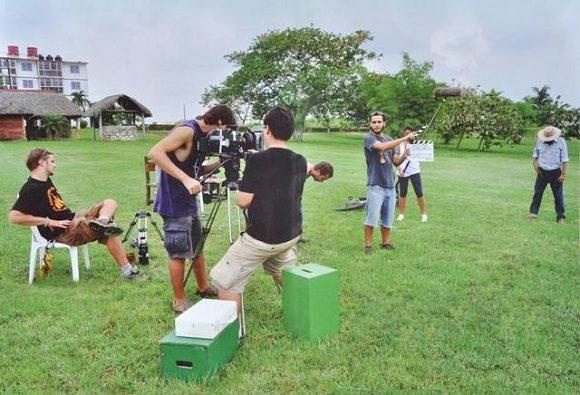
Archive image of film production organised by independent producers in Cuba. / Cubadebate
14ymedio, Yunior García Aguilera, Madrid, 18 July 2025 – A nation’s culture is not measured in kilowatts, but when the lights go out in its theatres, its libraries and its cinemas, the resulting darkness has no need of metaphors. And even if artistic quality doesn’t figure in any quantifiable economic indicators of state, the coldness of the numbers is enough to illustrate a map of the disaster. Cuba’s 2024 Statistical Yearbook offers a cold but revealing picture of the structural deterioration that the nation’s cultural ecosystem is suffering.
The diagnosis is severe. Data from the National Office of Statistics and Information (Onei) shows a general fall in almost all cultural indicators: production, creativity, active spaces and audience attendance. But among all the headlines, the one concerned with books destroys any triumphalist speeches given by Alpidio Alonso – head of Culture – who comes precisely from the book sector himself. Whilst in 2023 six million book copies were printed in Cuba, in 2024 the figure fell dramatically to 1,355,500. It isn’t just down to a shortage of paper, but a shortage of political will, and priorities.
Cinema, for its part, confirms the sombre tone. In 2024 there were 6,647 fewer screenings than in the previous year, and 15 cinemas completely disappeared from the map. Production contracted in size too: there were fewer shorts produced and the overall total of animation films was reduced. continue reading
According to the Onei itself, not one feature film was actually completed – a statement contradicted however by the actual facts themselves
According to the Onei itself, not one feature film was actually completed – a statement contradicted however by the actual facts themselves: at least two films were recognised by critics as being the best films of the year: ’An Evening With the Rolling Stones’, by Patricia Ramos; and ’Maisinicú, Half a Century Later’, by Mitshell Lobaina. Both productions, completed in 2024 under the hallmark of the Cuban Institute for Art and Cinema (Icaic), were simply ignored in the official figures, which – it’s worth adding – are compiled using data from the Ministry of Culture.
The lack of insight goes even further when you look at independent filmmaking. Invisible for the Art & Cinema Institute, the National Office of Statistics, the state-run media and all the state-run cinemas of the country, this sector develops audiences beyond the usual margins – at international festivals or on digital platforms. Two titles particularly stand out in this area: the documentary ’Cronicles of the Absurd’, by Miguel Coyula, and the fiction debut of director Marcos Díaz Sosa, ’Natural Phenomena’. Two works which demonstrated that, even if they didn’t cross the thresholds of the national cinemas, art itself needs no permission to exist.
And theatre, traditional object of suspicion and censorship by the cultural police, has also given ground. Although the number of venues increased marginally, from 85 to 87, more general figures invite pessimism. 48 actual theatre companies were lost, along with 440 professionally-active performers (reducing from 2,103 to 1,663). The country registered a deficit of 1,205 performances, and 195,700 fewer theatre attendances than in the previous year. Neither the heroic efforts of theatre creators nor the enthusiasm of loyal theatre audiences have been able to reverse the decline.
Music is suffering a parallel fate. Some 334 bands disappeared and there were 1,691 fewer working musicians than there were in 2023. The number of live concerts, clubs and related cultural activities decreased from 90,033 to 62,162 – an equivalent loss of more than 6 million concert attendances. The silence is not only falling upon theatres but also on parks, cultural centres and community spaces.
Music is suffering a parallel fate. 334 bands disappeared and there were 1,691 fewer working musicians than there were in 2023
This newspaper has monitored complaints from musicians across a number of provinces, many of whom are victims of prolonged outstanding payments from state entities such as Artex. Some artistes have gone for months without pay, whilst the company boasts about an optimistic balance sheet. The paradox is revealing: company income is growing but cultural activity is decreasing. They are saving on culture, as though culture were something dispensable. Even worse, the company (state-run, ’socialist’, so they say) gets richer, whilst its artistes are exploited and go unpaid.
Geographical inequalities are also notorious. Holguín survives with just one theatre. Las Tunas is seeing its network of cinemas and libraries diminish. In Mayabeque some libraries are barely managing to cling onto existence. Ciego de Ávila turns out to be the province with fewest museums, and Sancti Spíritus has only hung on to two art galleries. Beyond the larger urban centres, culture has been reduced to mere wreckage and nostalgia.
So 2024 was more than just a poor year for culture, it was a year of cultural famine and darkness. Not for a lack of cultural creatives, nor through any public apathy, but because of a worn out model that administers culture as though it were just another office of state. What the National Statistics Office can’t measure – nor dares even to name – is the spiritual price of this shutdown. And as they’re so keen to quote José Martí so often, they ought also to remember this one: “The mother of decency, the lifeblood of liberty, the conservation of the Republic and the solution to all its ills is, above all else, the propagation of culture”.
Translated by Ricardo Recluso
____________
COLLABORATE WITH OUR WORK: The 14ymedio team is committed to practicing serious journalism that reflects Cuba’s reality in all its depth. Thank you for joining us on this long journey. We invite you to continue supporting us by becoming a member of 14ymedio now. Together we can continue transforming journalism in Cuba.
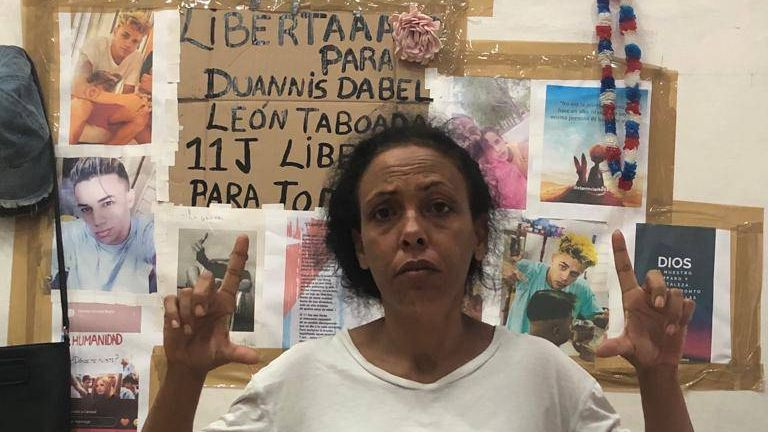
Duannis León Taboada’s mother obtains a promise to see her son, sentenced to 14 years in prison for 9/11.
Rapper Nando OBDC, arrested for “propaganda against the constitutional order,” is also in custody.
Yenisey Taboada Ortiz, mother of political prisoner Duannis León Taboada. / Facebook
14ymedio, Madrid, 25 July 2025 — Yenisey Taboada Ortiz, mother of 11J political prisoner Duannis León Taboada, who is a on hunger strike at Combinado del Este in Havana, managed to get the warden of the maximum-security prison to give her “his word” that she would be able to see and speak with her son this Friday. The woman had spent several hours “planted” at the prison gates the day before.
According to a report this Friday from the activist Tania Tasé, a resident of Germany, a doctor examined Taboada, who had “low blood pressure and chapped lips,” and determined that his general health was “good.” The appointment for the “dynamic” she was promised, with Duannis in attendance, will be at noon today.
“I am calm, but make no mistake, I am steadfast. I cannot keep waiting for a call. What do you want, for my son to die?” the woman told Martí Noticias after announcing that she wouldn’t leave the prison gate until she was allowed to see Duannis. “As a mother, I need to see him, to do everything possible to get him to end his strike, because his life is a priority for me.” continue reading
According to the Cultural Rights Observatory, Duannis León remains in his usual cell without medical attention.
According to the Cultural Rights Observatory, citing sources from other inmates, Duannis León, who has been held incommunicado since Monday, remains in his usual cell without medical attention. “In the morning, they said he was weak but stable, lying in his bed. By the afternoon, the prisoners reported that he could barely open his eyes,” was one of the statements collected by the organization.
Duannis León Taboada, who is serving a 14-year sentence for sedition for his participation in the 11 July 2021 protests, went on a hunger and thirst strike a week ago. His mother told 14ymedio on Tuesday that he drank water that same day but felt “very weak.”
After exerting pressure and staying at Combinado del Este until seven at night, they allowed her a phone call, the woman also said. “I want my freedom, Mom,” Duannis told her, adding that he started the strike “for all the protesters and for the mothers who continue to suffer.”
The young man, who will turn 27 on August 19, was working as a self-employed barber when he participated in the massive Island-wide protest, specifically at the emblematic Toyo corner, where an overturned police patrol car and protesters waving the Cuban flag became a symbolic image of that day. The Diez de Octubre Court that tried him, along with 32 other defendants, in January 2022, was implacable with the sentences, which reached up to 30 years in prison.
Rapper ’Nando OBDC’ has been in pretrial detention for almost seven months without the Prosecutor’s Office even issuing a request.
Another prisoner on hunger strike is rapper Fernando Almenares Rivera, known as Nando OBDC, who has been in pretrial detention for almost seven months without the Prosecutor’s Office even issuing a petition. According to his wife, Adrianna Machado, “he’s been there since the 20th.” The artist is accused of “propaganda against the constitutional order,” for being involved in “subversive activities,” and for having ties to people who promote “terrorism against the Cuban state.”
Nando OBDC was arrested on December 31, 2024, at his home in the Havana municipality of La Lisa and held in Villa Marista, the State Security headquarters, for over a month. He was later incarcerated in the mixed prison for AIDS patients Cuba-Panama in Güines, Mayabeque, whose conditions have been denounced by organizations such as Cubalex.
____________
COLLABORATE WITH OUR WORK: The 14ymedio team is committed to practicing serious journalism that reflects Cuba’s reality in all its depth. Thank you for joining us on this long journey. We invite you to continue supporting us by becoming a member of 14ymedio now. Together we can continue transforming journalism in Cuba.
If someone wants to find out what is really happening in Venezuela or Cuba, the healthiest thing is still to change the channel.
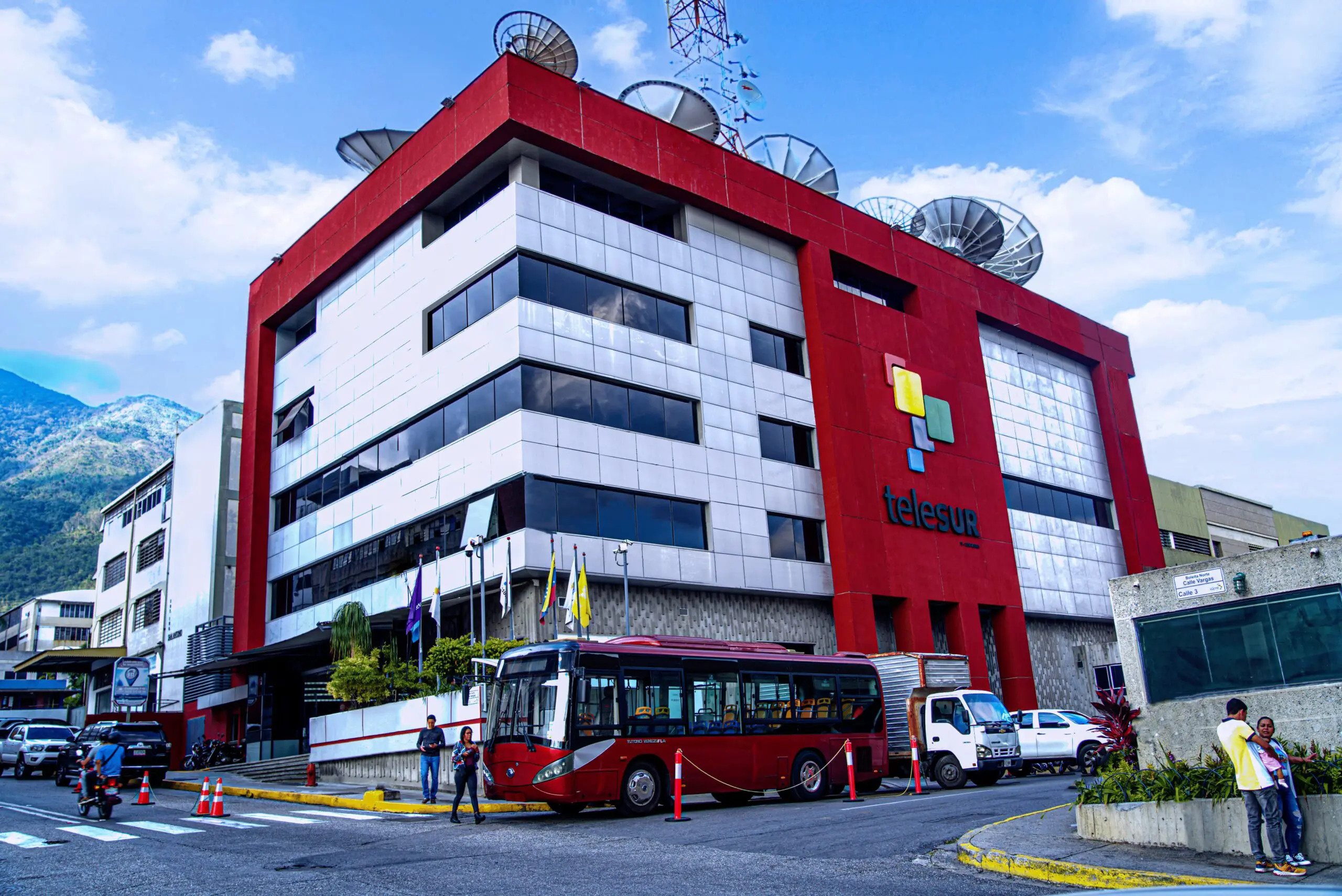
Telesur was founded in 2005 as a move by then Venezuelan President Hugo Chávez to counteract “the media hegemony of imperialism.” / Telesur
14ymedio, Yunior García Aguilera, Madrid, 25 July 2025 — For two decades, Telesur has insisted on calling itself “Latin America’s news channel.” But just five minutes of viewing is enough to notice that they don’t even hide their bias. Their editorial line is a rearview mirror stuck in the dystopia of 21st-century socialism. What they present as journalism is, in reality, a script written by Castro’s ideologues and dressed up with Bolivarian histrionics. If anyone wants to find out what’s really happening in Venezuela or Cuba, the best course of action is still to change the channel. Or better yet, turn off the television.
The multi-socialist-state company was born in 2005 as a move by Venezuelan President Hugo Chávez to counter “the media hegemony of imperialism.” They dreamed of a kind of Caribbean CNN, with a guerrilla accent and insurgent spirit. What they created, however, was an audiovisual tableau where each bulletin seems like an act of faith, and each presenter an evangelist of failure.
However, even the most fervent revolutionaries have to pay rent. And Telesur, like every socialist project, is burdened by unpaid bills, job insecurity, favoritism, and a staff that increasingly disbelieves in what it broadcasts. Journalists from the English-language station have denounced years of falling wages, subsistence working conditions, and a toxic environment where the only ones who prosper are the loyal, not the talented. To ‘resolve’ the problem, as we Cubans say, they turned to students from the island to provide translations and subtitles for prices so low they would make even the most greedy capitalist blush. continue reading
Even those who once believed in the project and still retained their dignity ended up jumping ship.
Even those who once believed in the project and still retained their dignity ended up jumping ship. Leandro Lutzky, an Argentine journalist and the news program’s prominent figure, resigned when the channel applauded the Venezuelan elections as if they were a demonstration of Scandinavian civility. Seeing Telesur declare that Maduro was elected “transparently” in 2024 was, for Lutzky, the limit. He left. And he said it out loud.
And then there’s Walter Martínez, the man with the eye patch, who for years greeted “the crew of our beloved, contaminated, and only spaceship” from Dossier. A journalist with decades of experience and a memory that ended up bothering the amnesiacs in power.
Martínez accused former minister Andrés Izarra, the channel’s first director, of appropriating other people’s ideas and the public funds that were intended for Telesur’s infrastructure and the launch of the Simón Bolívar satellite. “Izarra embezzled the State,” Martínez said. In his calm style, he made it clear: surviving in that ecosystem today requires “very agile hands.” And everyone understood.
But the most personal part would come later. In 2020, Martínez denounced the station’s current president, Patricia Villegas, for withholding payments, hiring fellow citizens with salaries in dollars, and excluding him from the Venezuelan Television (VTV) channel under the pretext of protecting him due to his age during the pandemic. “She doesn’t want to compensate me for my work, but she brings in fellow citizens paid in dollars,” he said. And as always, there was no response.
Martínez also revealed that Villegas requested eight million dollars to establish a Telesur channel in Ecuador, because—according to her—that country “deserved more media coverage than Venezuela.” A statement that, coming from the president of a supposedly Venezuelan channel, spoke volumes.
From the forced departure of Aram Aharonian to the current silent purge of journalists, the channel has shown that the only thing it does not allow is dissent.
Censorship also came knocking on Martínez’s door. His program was taken off the air on VTV by order of Minister Jorge Rodríguez after he attempted to interview an opposition figure. The guest was yelled off the channel. And Martínez’s microphone was turned off.
According to him, Patricia Villegas runs the channel as if she were more powerful than Maduro himself. She calls assemblies, appoints vice presidents, distributes resources—in dollars, of course—and acts with the tacit support of the leadership. She doesn’t run a television station; she administers a doctrine.
From the forced departure of Aram Aharonian, one of its founders, to the current silent purge of inconvenient journalists, the channel has shown that the one thing it doesn’t allow is dissent.
If it was once a promise, today it’s merely a caricature, a monotonous newsletter where pluralism is a crime. And like any dogmatic sect, it has only two options for apostates: exile… or invisibility.
____________
COLLABORATE WITH OUR WORK: The 14ymedio team is committed to practicing serious journalism that reflects Cuba’s reality in all its depth. Thank you for joining us on this long journey. We invite you to continue supporting us by becoming a member of 14ymedio now. Together we can continue transforming journalism in Cuba.
Ottawa bans Yosniel Alginis Villalón López from entering the country despite his marriage to a Canadian woman.
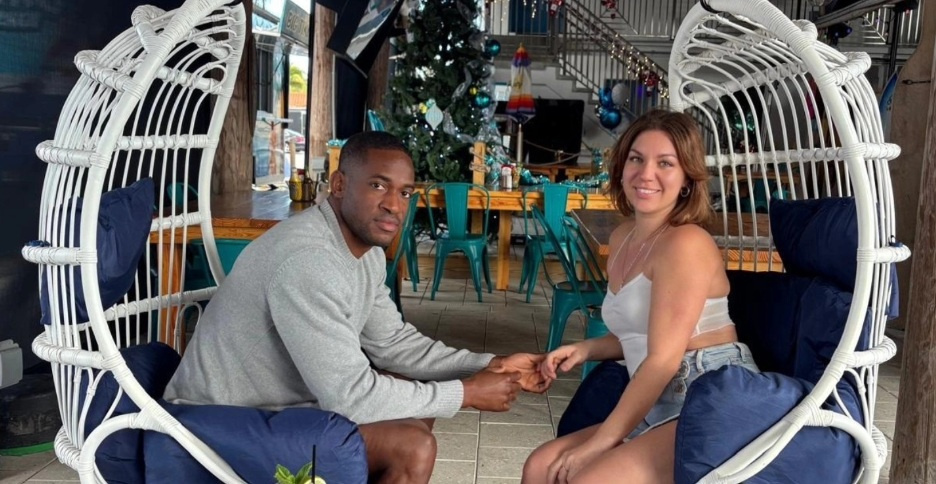
Yosniel Alginis Villalón López and his wife Stéphanie Penta. / Facebook/Stephanie Penta
14ymedio, Havana, 25 July 2025 — The future of former Cuban judge of the Havana Provincial Court, Yosniel Alginis Villalón López, is in limbo. Canada denied him legal entry on July 2 and a day later handed him over to Immigration and Customs Enforcement (ICE). He is being held at the detention center in Buffalo, New York, where he awaits his deportation hearing in late August. If he is returned to the island, he could be charged with treason for refusing to condemn the 11J protesters.
Villalón took office as a judge just a month before the outbreak of the Island-wide protests that shook the Cuban streets on 11 July 2021. “It represents a great honor for me, an award I receive in return for so many years of study, dedication, and sacrifice,” he told the official outlet Tribuna at the time. “It represents growth in my profession with the great responsibility of administering justice from the bench.”
Upon reaching the US border, he applied for asylum and settled in Miami, Florida.
Threats from the regime and harassment from State Security, which reminded him of his refusal to join the Cuban Communist Party, led Villalón to go into exile in early 2022. Upon reaching the US border, he applied for asylum and settled in Miami, Florida. The 34-year-old Cuban received a work permit, performing various activities in the mornings and cleaning a courthouse at night.
In October 2024, he met Canadian Stéphanie Penta through social media. After several months, the woman traveled to Miami to meet him. The relationship became more formal when Villalón met his partner’s daughters and in May, they decided to get married.
According to Villalón López, who spoke to the Montreal Gazette , an immigration lawyer informed them that Villalón qualified under the family exception to the Safe Third Country Agreement (STCA), so he decided to move. On July 2, he headed to the Lacolle crossing in Quebec, one of Canada’s busiest land borders. However, what he thought would be the start of a new life ended in a nightmare. continue reading
Yosniel Alginis Villalón López during the swearing-in ceremony for Havana’s permanent professional judges in June 2021. / Roly Montalván
Immigration experts told the Canadian newspaper that the Cuban’s case is part of “a growing wave of failed crossings” at the Canada-U.S. land border. This is because the STCA requires an individual to apply for asylum in the first safe country they reach—in this case, the United States.
Villalón presented the Canada Border Services Agency agent with a marriage certificate, a criminal background check, and joint bank statements, among other documents. The interview focused on his relationship with Stéphanie, his personal history and asylum claim in the United States, and whether their marriage was genuine.
“He said Stéphanie and I got married so I could immigrate to Canada.”
Villalón showed the agent a photo of himself with Stéphanie and their daughters in New York, but the officer felt it wasn’t enough. “He said Stéphanie and I got married so I could immigrate to Canada.”
Ottawa immigration lawyer Heather Neufeld noted that it is common for border officials to say an individual doesn’t have the correct visa when they don’t believe the marriage is real.
The Canadian Immigration Minister’s office defended the official interpretation of the STCA in handling asylum applications. While the agreement allows for family-based exceptions, “the burden of proof rests with the asylum seeker.”
The lawyer has tried to reach an agreement with the Canadian authorities.
The case of the former Cuban judge is being defended by attorney Hana Marku, who acknowledged that the appeal could take more than a year. She has therefore attempted to reach an agreement with Canadian authorities so that her client can re-enter Canada and present his case again.
The problem is that ICE must release him first, and starting only this month it has tightened its rules: “Immigrants should be released on bond before their hearings only in exceptional circumstances.”
____________
COLLABORATE WITH OUR WORK: The 14ymedio team is committed to practicing serious journalism that reflects Cuba’s reality in all its depth. Thank you for joining us on this long journey. We invite you to continue supporting us by becoming a member of 14ymedio now. Together we can continue transforming journalism in Cuba.
A politician points out that “cases of abandonment continue to multiply” among the group of 370 health workers from the island deployed in Calabria.
Cuban healthcare workers with Governor Roberto Occhiuto / Facebook/Roberto Occhiuto
14ymedio, Madrid, 25 July 2025 / The political opposition in Calabria, Italy has lashed out against the regional government for hiring Cuban doctors after a local newspaper, La Nuova Calabria, reported that at least five Cuban physicians had left the public hospitals where they had been working. This week, Ernesto Alecci, a council member from the opposition Democratic Party, formally asked Governor Roberto Occhiuto of Forza Italia (the right-wing party founded by Silvio Berlusconi), to clarify the entire cooperative healthcare arrangement the region has with Cuba.
Alecci cited the case of a Cuban orthopedist who recently left his job at the Jazzolino Hospital in the town of Vibo Valentia for a position at Villa dei Gerani, a private clinic. “Just the tip of the iceberg” is how the Calabrian media outlet that reported the story described the incident. “This new case of job-hopping is one of many. In addition to those who have left for the private sector, there are others who have gone on vacation and never returned, those who preferred the Spanish healthcare system and those who simply disappeared.” said Alleci, who claims that “the numbers do not seem to be adding up.”
He points out that in its 2022 agreement with Calabria, the Cuban state-owned company Comercializadora de Servicios Médicos S.A. agreed to provide the region with 497 doctors. However, as of May there were only about 370 on duty, “with cases of quitting continuing to multiply.” This led Alecci to submit his letter to the regional government. “I am trying to determine how many Cuban doctors are still working in Calabria, how many have left, what controls have been put in place to monitor the program’s progress, and whether there are plans to review the terms of the contract, which provides for a gross salary of approximately €4,700, of which only €1,200 is goes to the doctor,” he said, referring to the conditions of the Cuban healthcare workers, who are accredited by international continue reading
organizations such as Archivo Cuba, Prisoners Defenders, and Human Rights Watch.
“Given the circumstances, it is worth asking if this form of cooperation adequately benefits the Cuban doctors
“Given the circumstances, it is worth asking if this form of cooperation adequately benefits the Cuban doctors serving in our hospitals,” he says. “If we care about public health, we must do more than simply ’import’ doctors. We must make them feel part of a program in which they are on par with their Italian colleagues.” To Alecci it makes sense that , upon arriving in Calabria, some health workers “realize they can find better opportunities elsewhere.”
The former president of the Calabrian Regional Council, Domenico Tallini (a member of the same party as Occhiuto), also questioned the governor’s agreement with Cuba. In La Nuova Calabria he writes that the reported “escape” of two specialists from Vibo Valentia— one of them the aforementioned the orthopedist—”only raises doubts about the contractual arrangements put forward by various international associations, under which the Caribbean doctors hired by President Occhiuto receive only a fraction of the enormous sums the region of Calabria is paying. The rest ends up in the pockets of the regime in Havana.”
Hence the request for “a sincere word” with the governor, asking him to explain to the people of Calabria where the resources allocated to the Cuban operation are going.” Tallini asks, “Why did the two Cuban doctors working in Vibo Valentia choose other career options?” Was it because the thought of handing over the bulk of their income to Havana became intolerable?” He notes that President Occhiuto chose not to respond.”
However, the newspaper Sierra Maestra, a “friendly Italian-Cuban association,” did respond. It expressed surprise that a former official such as Tallini would have access to “sensitive data that should be held exclusively by the Regional Health Department” and that he would be demanding explanations about the procedures carried out by Cuban doctors instead of “concerning himself with with dignity of their compatriots.”
In a “careful reading” of the figures, the Sierra Maestra article raises some issues: “If Cuban doctors only participate in medical activities — for example, the 7,103 surgical interventions mentioned — it means that they are simply helping their Italian colleagues. In such a case, the region of Calabria is paying a considerable amount of money to cover the salaries of Cuban doctors, who are simply relieving the workload of Italian doctors. Only the Ministry of Health can clarify this crucial aspect to determine whether the contract with Cuban doctors was a good investment.”
According to La C, a local Calabrian media outlet, at least three other physicians have left their posts in addition to the two in Vibo Valentia. They had been working in the areas of Cosenza, Corigliano Rossano, Cetraro and Paola. “There has been no news of them and no one has seen them return to work for months. The other members of the team deployed to Corigliano Rossano are living quietly in a prominent hotel in the center of town and can often be seen walking towards the nearby Hospital Giannettasio,” La C reported.
The article reveals, however, another possible though prohibited reason for one doctor’s disappearance: marriage
The article reveals, however, another possible though prohibited reason for one doctor’s disappearance: marriage. It claims his colleagues were even invited to the wedding. “Such a union might prevent him from ever returning to Cuba,” the La C report concludes.
La C cites an in-depth investigation by the independent, Miami-based news site CubaNet, which reported on June 27, 2024 how Havana had flouted Calabrian law by “finding ways to make withholding of 71% of professionals’ salaries and other forced labor practices look legal.”
Rather than scaling back, Calabrian officials seem proud of their agreement with Cuba. Last April, they even attended the 5th International Cuba-Health 2025 Convention, where they reiterated their desire to “deepen bilateral collaboration.”
“The Cuban healthcare model, with its focus on primary care and prevention, is similar to ours and has been essential for guaranteeing service in remote areas,” said Francesco Lucia, director of Prevention and Public Health in Calabria. The region first imported Cuban doctors in 2023 due to a personnel shortage.
____________
COLLABORATE WITH OUR WORK: The 14ymedio team is committed to practicing serious journalism that reflects Cuba’s reality in all its depth. Thank you for joining us on this long journey. We invite you to continue supporting us by becoming a member of 14ymedio now. Together we can continue transforming journalism in Cuba.
Why is this so terrible? Why this agony of a joyful country?
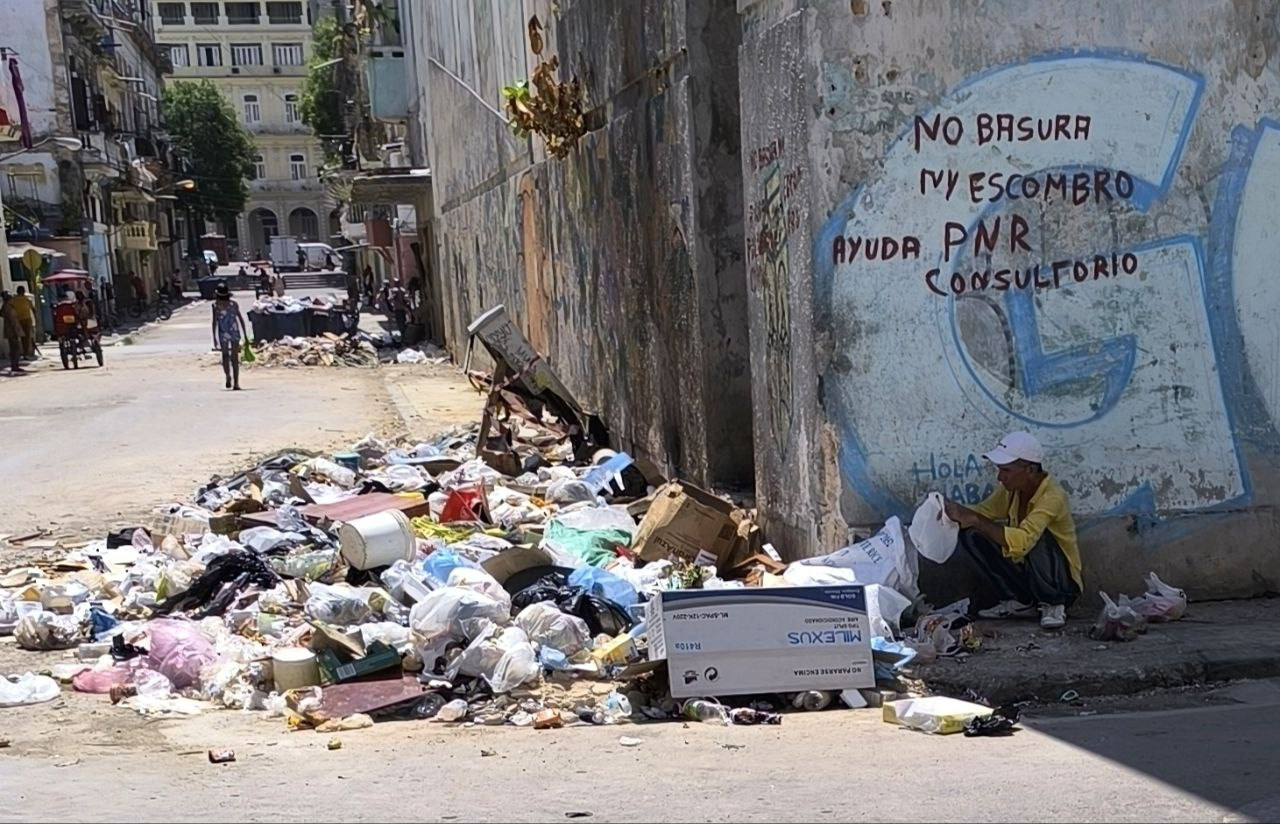
Garbage dump behind what used to be the Musical Theater in Central Havana. / 14ymedio
14ymedio, Juan Ernesto Cambiaso, Buenos Aires, 24 July 2025 — Over the years—I’m 81—I’ve been to Cuba five or more times. From the Special Period to the ongoing extermination. I’ve logged hundreds of hours reading about Cuba, enjoying its writers, visual artists, and its formidable music. I can find no reason to have done so except for love at first sight on my initial visit, years ago, which still lingers, transformed into mourning for a loved one. It was an absolute absurdity of the finest Bohemian crystal. Its fineness condemned it to be brittle.
I saw their houses in a state of abandonment, then deterioration, then ruin, and finally collapsed upon themselves because the beams and pillars had been pulverized by the salty wind from the sea.
On my last trip, shortly before the pandemic, I tripped over a tree root that had pierced the sidewalk, creating a trap for walkers. I fell to the ground and hurt my knee. I was bleeding profusely. Luckily, I wasn’t alone, as my son was with me. Not knowing what to do, we hailed a taxi, and the driver kindly took us to the diplomatic pharmacies and other pharmacies he considered privileged, looking for alcohol, hydrogen peroxide, gauze, and adhesive tape to keep the bandage in place. I couldn’t find anything I was looking for. A young man from the Ambos Mundos Hotel gave me the best possible solution: we poured rum on it. I extrapolated my accident to Cuban citizens in general and was terrified.
I saw the most capable flee their beloved homeland first, and then those whose abilities were diminished as time went on.
I saw the most capable flee their beloved homeland first, followed by those whose abilities were diminished as time went on. Those who remained in Cuba were the least prepared, without special skills or the strength of character to face the path that sometimes crossed the Darien Jungle.
Today’s photos and videos posted on social media, coupled with the insistent pleas from friends to not even consider visiting Cuba unless I was determined not to leave the hotel due to the unsanitary streets and squares, where filthy garbage accumulated and would endanger my health, led me to put an end to my visits to my beloved Havana. The pieces of Bohemian crystal lay on the ground.
These losses rob you of sleep. And in the darkness of the endless night, with open eyes, the “whys” appear, followed by a question mark. Why this terrible thing? Why this agony of a joyful country? Are those who have governed Cuba since the beginning of the Revolution stupid, clumsy, or evil? Because the prediction that everything was going to fall apart and stop working was increasingly proven over the decades. China and Russia proved it. And the more I thought, the less I found the answer. Until in an instant, the light dawned, fiat lux — let there be light — and I understood that I had refused to see the simple answer.
Those in power were and continue to be stupid, clumsy, and evil, all at the same time. Clumsy, because they inexplicably missed the path. Clumsy, because they walked the wrong path with such clumsiness that the error turned into a catastrophe. And bad, because they have been and continue to be indifferent to the suffering of the people whom they see decomposing and suffering, without batting an eye, knowing for a fact what must be done to make people better.
____________
COLLABORATE WITH OUR WORK: The 14ymedio team is committed to practicing serious journalism that reflects Cuba’s reality in all its depth. Thank you for joining us on this long journey. We invite you to continue supporting us by becoming a member of 14ymedio now. Together we can continue transforming journalism in Cuba.
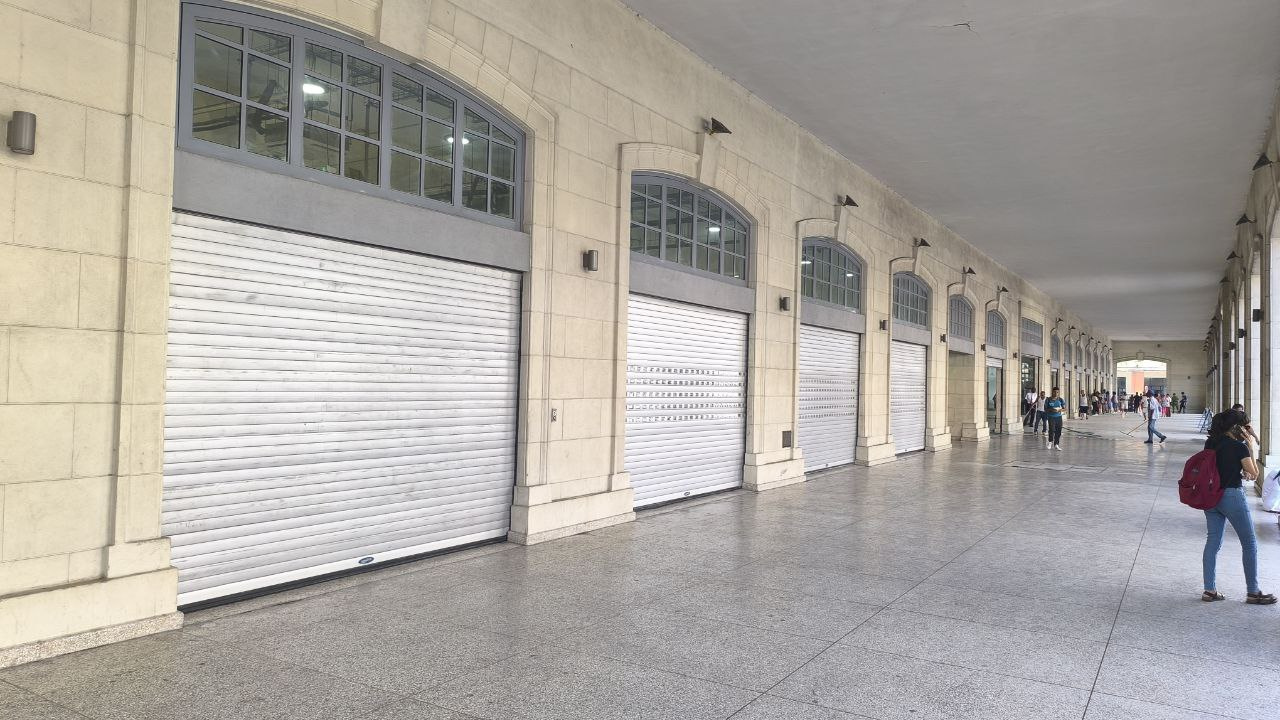
Havana’s largest and oldest market is closed and will no longer sell in freely convertible currency.
Cuatro Caminos Plaza in Central Havana is closed and about to be dollarized. / 14ymedio
14ymedio, Natalia López Moya, Havana, 24 July 2025 — A confluence of municipalities, a crossroads of avenues, Havana’s Cuatro Caminos is more than the colossal building that bears its name; it is also the name given to an area where commerce has traditionally been the reason for existence and the livelihood of its residents. Now, everyone who passes by notices that the market that gives life to the neighborhood has closed. “When it reopens, it will be in dollars,” a security guard tells 14ymedio.
With virtually all entrances blocked by metal doors, only one store on the upper floor, dedicated to the sale of household goods, remains operating at half capacity. The rest, including the supermarket, has already entered the racetrack that inevitably leads to dollarization, a path that several of Havana’s most important businesses have taken. The freely convertible currency (MLC), in which their merchandise was sold, failed to keep the spacious halls stocked with products.
The news was seen coming. A month ago, a butcher shop owned by Richmeat opened its doors in dollars, under the agreement signed with Cimex to manage an entire retail complex under the name La Favorita, as some of its products are called.
In recent years it was grim to wander through the shops located in the imposing building that occupies the entire block.
In recent years, it was grim to wander through the shops located in the imposing building that occupies the entire block and see the empty spaces, the deserted shelves, and the unlit lamps. The breath of the fula (US dollar) snorted in the neck of what was once the main market in the Cuban capital. With its two horns of plenty carved into the facade, the prosperous cornucopia was not reflected in its increasingly undersupplied interior. A commercial anemia that ended up affecting the entire area. continue reading
“Here we live off reselling and wheeling and dealing,” says a nearby lighter repairman who, between injecting gas into a lighter or changing the flint to create a good spark, hawks his tiny tubes of instant glue, a few packets of powdered soda, and “the little razors you can’t live without.” When the market supply dwindled, “people stopped coming from other neighborhoods to get hardware supplies, boxes of chicken, or paint for their homes,” he tells this newspaper. “Fewer customers, less business.”
The commercial weakness affected everyone. The elderly man who took advantage of the red light to clean the windshields of those arriving to buy a bathtub; the santera who read cards on the opposite sidewalk and received more customers when they stocked the butcher’s refrigerators; and the young man with a disability who, when turning the corner, set up a table with used plumbing parts to supply those looking for a sink or a drain, but the price in the store seemed too high. As word spread that the mall was “deprived,” everyone’s income also dried up.
Now, the hope is that the dollar will revive the so-called Single Market. “The next battle of Cuatro Caminos will be between people who have dollars,” quips the matchbox repairman. But it’s hard to believe that, as in November 2019, an angry mob will once again break down the doors, run up the stairs, ravage the shelves, and ravage the most prized merchandise. There aren’t that many Cubans with dollars, nor do they have that many ‘Lincolns’ in their pockets.
____________
COLLABORATE WITH OUR WORK: The 14ymedio team is committed to practicing serious journalism that reflects Cuba’s reality in all its depth. Thank you for joining us on this long journey. We invite you to continue supporting us by becoming a member of 14ymedio now. Together we can continue transforming journalism in Cuba.
A Holguín family shares their desperation over the shortage of products to fight the invasion.
Bedbug outbreaks have become frequent news in the island’s independent media. / 14ymedio
14ymedio, Miguel García, Holguín, 23 July 2025 — “He who blinks loses,” repeats Joel, as he explains his discomfort at having bought only one tube of permethrin, just before the bedbug infestation ravaging the city of Holguín caused the medication to disappear from the black market. “That same night I felt the first bites, and since then I haven’t slept a full night.”
“It was my wife who warned me they were bedbugs,” the 49-year-old Holguín resident told 14ymedio. “I thought they were mosquitoes, but she turned on the light and showed me the mattress seam, which was full of bugs.” It was a matter of days, or even hours, before the insects reached Joel and his family’s home. “We had heard the neighbors say their houses were infested, and we even saw some people throwing away their mattresses.”
“We take extreme hygiene measures because our child is autistic and also suffers from several severe allergies.”
Despite the stories they heard, Joel and his wife thought they wouldn’t be affected by the epidemic. “We take extreme hygiene measures because our son is autistic and also suffers from several severe allergies,” he tells this newspaper. “That’s why we’re constantly cleaning, washing, boiling bed linens, and dusting furniture.” However, the plague bypassed all those “safety rings,” he admits.
The bedbug, an insect that feeds on the blood of humans and other animals, has become an unwelcome visitor in many Cuban homes, where overcrowding, a lack of cleaning products, and poverty have multiplied its appearances in recent years. Outbreaks in provinces such as Santiago de Cuba, Sancti Spíritus , and Havana have become frequent news in the continue reading
island’s independent media.
“There’s nothing in any state pharmacy to treat this; you have to go to the black market or a private sales stand.”
One of the main problems faced by those affected by the arrival of these pesky insects is the lack of products to repel the infestation. “No state pharmacy has anything to treat this; you have to go to the black market or a private sales stand that, although not authorized to sell medicines, may have these types of products.”
Although the bed bug is a common insect in tropical areas, its spread into Cuban homes has coincided with the economic crisis, the loss of purchasing power of many families who can no longer maintain the hygiene they once had, and the collapse of the public health system, which is influencing the decline in the supply of pharmaceutical products.
Now, even at the city’s main private sales fairs and informal sales networks, permethrin “has disappeared,” Joel says of the insecticide, acaricide, and insect and lice repellent. “I went back to buy more and they told me they were out of stock and that customers kept coming in asking for the same thing.”
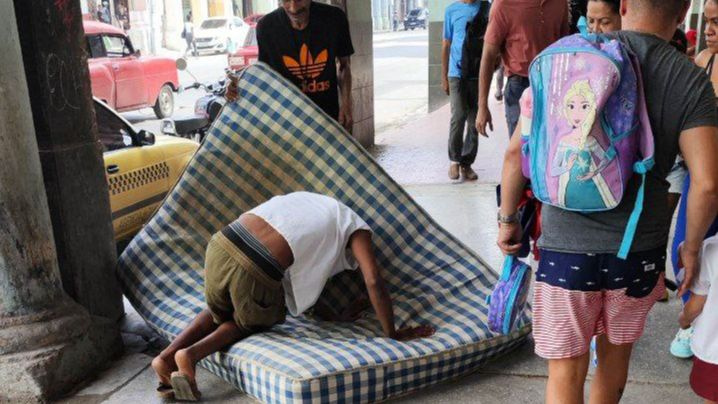
They took the mattress out onto the patio “so it gets sun all morning to see if the bugs go away.”
To avoid sitting idly by waiting for the medication to reappear, Joel and his wife moved the mattress out onto the patio “to get some sun all morning to see if the bugs go away.” But the experience of some nearby neighbors doesn’t offer much hope. “In this neighborhood, some people have had to burn their sofas, throw their mattresses into the river, and throw away their pillows; nothing is safe.”
Desperation is also dangerous. Last March, a burning mattress ended up causing a fire that affected residents of the Villanueva and La Aduana neighborhoods. The flames spread from a garbage dump to the riverbank and into the waters of the Miradero River, contaminated by fuel oil spilled by a nearby factory. Shortly afterward, it was discovered that the mattress had been infested with bedbugs.
“He who blinks loses”
The luckiest Holguín residents can appeal to their relatives abroad to buy them a tube of cream, similar to the one Joel bought for about 600 pesos, for about $15 on one of the many commercial websites that offer food and medicine delivery on the island.
“He who blinks loses,” the man repeats, and after blaming himself for his shortsightedness, having bought only one tube of the cream. He ends up mixing the syllables into a litany that torments him as he checks the mattress under the July sun. “He who blinks loses ,” he concludes.
____________
COLLABORATE WITH OUR WORK: The 14ymedio team is committed to practicing serious journalism that reflects Cuba’s reality in all its depth. Thank you for joining us on this long journey. We invite you to continue supporting us by becoming a member of 14ymedio now. Together we can continue transforming journalism in Cuba.
Exactly twelve years had passed since the accident. Since that date that never happened.
Image of a 1954 Chevrolet Bel Air. / bringatrailer
14ymedio, Milton Chanes, Berlin, 26 July 2025
It was raining.
Again.
Every November 12, the sky seemed to remember it for him.
Twelve full years had passed since the accident. Since that date that never happened. Since Ana fell — absurdly, inevitably — beneath the hood of an old ’54 Bel Air.
A silly accident, they said. Just another coincidence amid the chaos.
But he knew it wasn’t.
Since then, he had lived among hypotheses, stopwatches, and regrets.
Twelve years of silent research, of sleepless nights, of formulas scribbled in margins and wrinkled time maps.
He had lost everything: jobs, health, youth.
He had aged without noticing. Or perhaps he had.
He had given up his time… in exchange for time itself.
Now he only wanted to get close.
Brush against the moment.
Be there one second earlier, with the exact gesture.
Change everything without altering a thing.
A whisper, a warning—then vanish.
The leap through time was almost painless. Like closing your eyes in a blink that lasted just a bit too long.
And then, he was there.
It was raining.
More than he himself remembered.
That afternoon at the café, he had barely noticed the raindrops sliding down the fogged windows.
But now, standing in the middle of the street, the rain was something else entirely: a dense, living presence that soaked him in the past.
On the avenue, the cars raised a fine gray spray that hovered like low mist, diffusing lights, blurring silhouettes.
The drops drummed against the awnings like impatient fingers.
The asphalt gleamed like wet skin, streaked with trembling reflections of streetlamps and traffic lights.
Nothing seemed to have changed.
And yet, everything was different.
Time hadn’t gone backward—it had closed in around him.
The pavement shone like a broken mirror.
The same puddle at the corner.
The same bare trees.
The whole city seemed suspended, held in the breath before something repeated itself.
And then he heard it.
In the distance, the familiar roar: the ’54 Bel Air, seafoam green, its white roof weathered with rust.
It moved with the proud clumsiness of old giants. The engine wheezed, as if it knew the gearbox was about to jam again.
It was Usnavy driving, José Ramón’s son, with that kind of patience you only have for a car you’ve inherited and loved.
Sometimes the gear would stick in third. And then came the ritual: stopping abruptly, stepping out, lifting the hood, reaching in to find the stiff lever beneath the steering column, and forcing it until it gave way.
It could’ve happened any day.
But that day was the worst.
And then he saw her.
Ana.
She was walking quickly.
A firm, almost resolute step—like someone who doesn’t want to be late for something important.
She looked stunning. Radiant.
Her dark coat hugged her figure, her hair loose and drenched by the rain, her lips painted a soft red that stood out against the pale afternoon.
And something more.
Heels.
Heels on a rainy day.
He understood instantly.
He knew.
Ana had chosen to dress elegantly that afternoon because she sensed something special was about to happen.
They had shared months of uninterrupted love, of tender gestures, of words heavy with promises.
Perhaps she felt that he—his younger self—was going to propose to her that day.
That’s why the dress.
That’s why the heels, despite the overcast sky and the treacherous pavement.
His heart trembled.
He only had to warn her. Nothing more.
One second before disaster.
A shout—and time, for once, would yield.
“Ana!” he cried.
And it was his voice that unleashed everything.
She stopped abruptly, right at the edge of the curb.
She turned her head, confused.
She saw him. But not the man she was expecting.
She saw someone else.
The same man… but with years etched on his face, a grown beard, eyes emptied by countless sleepless nights, a body bent by time—and by all that time had taken from him.
She was frightened.
Her heel slipped.
The movement was clumsy, slight—but enough.
She stumbled into the street.
And in that exact instant, the Bel Air lurched to a halt, tilting slightly to the right.
The impact was sharp.
The chrome bumper struck her at the temple.
Ana fell.
Twelve seconds.
It all happened in twelve seconds.
He ran to her, this time without shouting.
He knelt in the rain, held her gently.
There was no blood—only the same silence as back then.
His hands trembled.
He had come back to save her.
And it was his shout, his aged face, his unexpected presence that had startled her.
It was because of him.
Again.
The Bel Air was still there, idling like a wounded animal.
The engine continued to hum beneath the hood.
“Forgive me,” he whispered.
He said it as if she could hear.
As if time—capricious and cruel—could understand.
Because in the end, love may defy the laws of the universe.
COLLABORATE WITH OUR WORK: The 14ymedio team is committed to practicing serious journalism that reflects Cuba’s reality in all its depth. Thank you for joining us on this long journey. We invite you to continue supporting us by becoming a member of 14ymedio now. Together we can continue transforming journalism in Cuba.
The restrictions imposed on private businesses (MSMEs) mean that this sector represents only 4.5% of private employment.
Among those with jobs, almost 50% (48.8%) are between 45 and 64 years old. / 14ymedio
14ymedio, Madrid, 23 July 2025 — It is pointless for Cuba’s official press in reporting the most recent employment survey published this Tuesday by the National Office of Statistics and Information (ONEI), to highlight that the island has one of the lowest unemployment rates in the region (1.7%). The weight of reality begins to dawn in the second paragraph: more than half of Cubans over the age of 15 are either unemployed or not looking for work.
The official State newspaper Granma doesn’t put it that way either, but rather affirmatively: “Around 50% of the population aged 15 and over is part of that workforce, while the rest is outside of it for reasons such as studies, retirement, disability or other conditions.” The Onei figures are clear: of the 8,433,226 Cubans aged 15 and over in 2024, 4,227,333 people were not part of the workforce, compared to 4,205,893 who were (50.1% compared to 49.9%). Of the latter, however, 69,333 are unemployed.
This represents an employment rate—the percentage of people of working age who have a job—of just 49%, one of the lowest in the region. As EFE reports, the average in Latin America and the Caribbean last year was 58.9%, according to the International Labor Organization (ILO).
Other characteristics of the Cuban labor market, as pointed out by Granma, include “the aging of the workforce, structural imbalances, and informal employment.” More than half of those employed are over 45 years old, and the average age of those employed is 44.3.
Other characteristics of the Cuban labor market, as pointed out by Granma, include “the aging of the workforce, structural imbalances, and informal employment.”
Among those with jobs, nearly 50% (48.8%) are between 45 and 64 years old, while 47.3% of unemployed Cubans are in the younger age bracket, between 15 and 34. This is consistent with overall population figures more than a quarter of Cuba’s 9.7 million residents are 60 or older, making the country one of the oldest in the region.
In addition to highlighting that “52.1% of the working population is ‘aged’,” Juan Carlos Alfonso Fraga, deputy head of the National Institute of Statistics and Census (ONEI), stated that one of the survey’s “novel” indicators is the “presence of 20.1% of employed people in informal employment,” defined as “work for pay or profit, but lacking links to Social Security, depending on whether they are owners or employees, both within and outside the informal sector.”
Of these, the official highlighted that 58.5% “are associated with the self-employed category,” that is, the private sector, where “seven out of ten workers” are “in the informal sector.”
Cuban economist Pedro Monreal, who lives in the US, highlights another issue in this regard: the “fragility” of non-state employment, “concentrated in self-employment” (TCP*). “Almost four years after MSMEs [Micro, Small and Medium Enterprises] were legalized, they only account for 4.5% of non-state employment, while TCP accounts for almost two-thirds of non-state employment.” This indicates, for the specialist, “minimal progress in the adoption of a more advanced private institutional format than TCP.”
Several experts and MSME business owners themselves point out that the stagnation in this sector is due to the restrictions imposed by the government, which continues to prioritize the state sector.
Monreal warns of the perverse effects of this policy: “Maintaining two-thirds of non-state employees in the TCP segment relegates the non-state sector to functioning as a very low-productivity appendage of the state economy.”
*TCP = Trabajo por Cuenta Propia. Literally “working on one’s own account,” i.e. self-employment.
____________
COLLABORATE WITH OUR WORK: The 14ymedio team is committed to practicing serious journalism that reflects Cuba’s reality in all its depth. Thank you for joining us on this long journey. We invite you to continue supporting us by becoming a member of 14ymedio now. Together we can continue transforming journalism in Cuba.
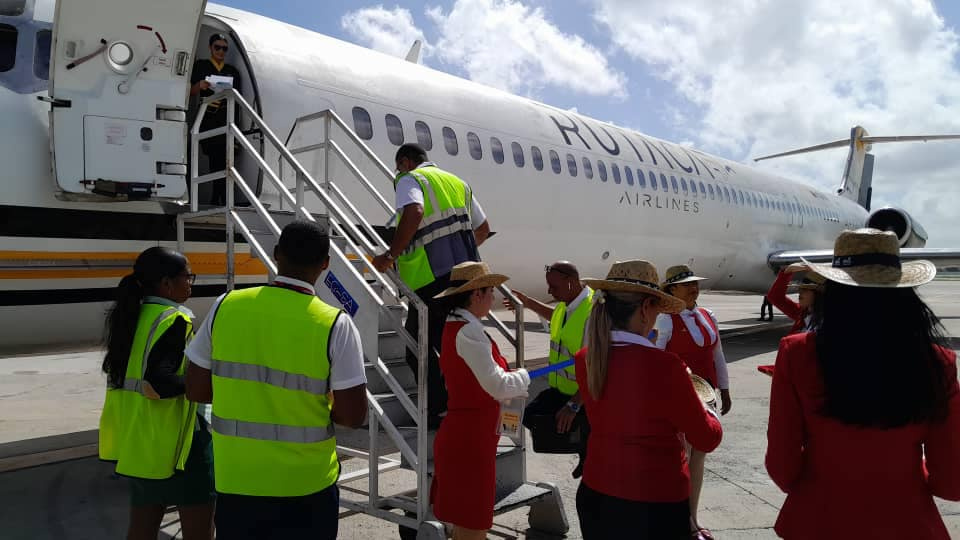
Rutaca Airlines inaugurated its Havana-Valencia connection on Friday, and Turpial Airlines will launch its Caracas-Varadero connection on the 28th.
Inaugural flight of the Havana-Valencia route by Venezuelan airline Rutaca Airlines last Friday. / Facebook/José Martí International Airport
14ymedio, Madrid, 24 July 2025 — While major international airlines are suspending their routes to Cuba due to a lack of travelers, smaller Venezuelan airlines are moving in the opposite direction. Two of them, Turpial and Rutaca, have announced new direct flights to the island in recent days.
The latter launched a twice-weekly service between Havana and the provincial city of Valencia last Friday, as Havana’s José Martí International Airport itself celebrated on Facebook. The company advertised on its social media platforms the July offer of two suitcases of up to 23 kilograms each and one carry-on bag of up to 8 kg at no additional cost.
The fact that the airline is offering, even “for a limited time,” free double baggage allowance demonstrates its interest in promoting the travel of Cuban ’mules’, just as the tourism crisis continues to deepen. The same is evident in the low cost of tickets: $450 round-trip.
The official press, which boasted about the new routes, alludes to none of this. On the contrary, they refer to the visit to several Venezuelan cities by executives from the Cuban Ministry of Tourism who “presented the country’s attractions.” continue reading
The island signed agreements with Caracas at a meeting of tourism ministers from the ALBA (National Tourism Association) to “boost the development of the sector.”
Sol de Cuba highlighted that last May, the island signed agreements with Caracas at a meeting of tourism ministers of the Bolivarian Alliance for the Peoples of the Americas (ALBA) to “boost the development of the sector.”
Turpial Airlines, which markets itself as the main airline for the state of Carabobo in northern Venezuela, will begin operating routes between Caracas and Varadero, Matanzas, on July 28. Its flights to Juan Gualberto Gómez Airport will be weekly, and the return to Caracas can be made from any of the company’s other destinations, including Havana (three flights a week) and Santiago de Cuba (one).
As Sol de Cuba reports, Turpial was founded in 2016 and with Panama as its first international destination and began operating routes to Cuba three years ago. What it doesn’t mention is that the airline, which has three aircraft, is owned by former Chavista colonel Pedro del Valle Cestari Navarro, something revealed by the Colombian magazine El Tiempo in 2022. At that time, Turpial made headlines for receiving permission from Colombia to fly to its territory, instead of Conviasa, which was sanctioned by the US Office of Foreign Assets Control (OFAC).
Venezuela is one of the destinations Cubans choose to purchase items they later resell within the island. Margarita Island is a major destination, with a program in place since 2022 to encourage commercial tourism. In the first year alone, Cubans spent approximately $17 million there for “the purchase of various items,” said José Gregorio Rodríguez, president of the Nueva Esparta Chamber of Commerce, who estimated the number of visitors from the island at 5,000 by August 2023. The success was such that the organizers decided to begin chartering cargo planes to increase the volume of passenger purchases.
According to data released by the Venezuelan Ministry of Tourism last February, nearly 30,000 Cubans had visited Margarita Island by that date. The requirement to apply for a tourist visa, which costs $50, does not deter Cubans.
Meanwhile, international tourism in Cuba is languishing hopelessly—this year, as of June, it hasn’t even reached one million travelers —and this is reflected in the withdrawal of major airlines.
United Airlines, the only US airline connecting Havana with Houston (Texas), announced this week that it will suspend flights starting September 2 and at least until the summer of 2026, something that American Airlines had already decided in early June. Similarly, Colombian airline Avianca announced it would abandon its Bogotá-Havana route starting August 31, just before the start of the peak tourist season. The reason is the same one that has led other operators to abandon travel to Cuba: low flight occupancy.
____________
COLLABORATE WITH OUR WORK: The 14ymedio team is committed to practicing serious journalism that reflects Cuba’s reality in all its depth. Thank you for joining us on this long journey. We invite you to continue supporting us by becoming a member of 14ymedio now. Together we can continue transforming journalism in Cuba.
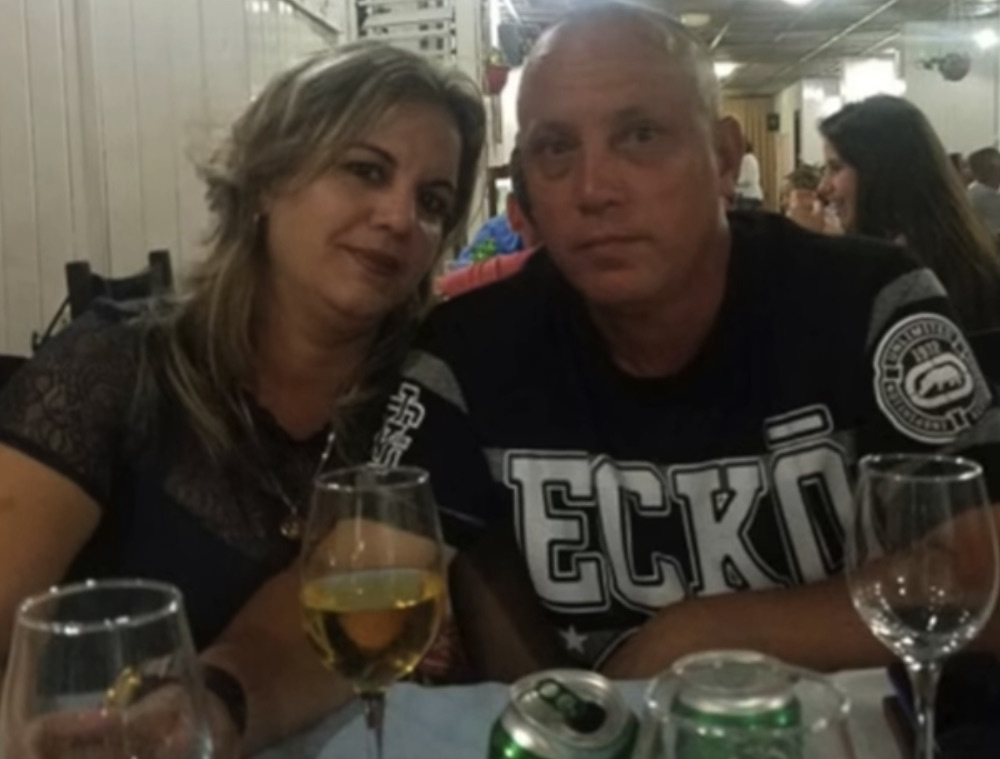
This is Jorge Luis Vega García, former lieutenant colonel of the Ministry of the Interior, accused of torture in prisons.
Jorge Luis Vega García, with his wife, in an image released by ’Martí Noticias’. / Martí Noticias
14ymedio, Miami, 24 July 2025 — Former Cuban Interior Ministry Lieutenant Colonel Jorge Luis Vega García now resides in the United States, where he arrived with humanitarian parole on January 20, 2024. According to what Mario J. Pentón revealed Thursday in Martí Noticias, the former official entered the United States through Tampa Airport, Florida, with his wife and son, and was able to benefit from the Cuban Adjustment Act. His history as “one of the most feared repressors” was not detected during the immigration investigation process.
Some of his victims, such as Pablo Pacheco, Fidel Suárez, Blas Giraldo Reyes, and Benito Ortega, who served time in prisons such as Agüica and Canaleta, in Matanzas, where Vega García served, testify about him.
“There are faces from these years in prison that are unforgettable, it’s like a tattoo on your soul,” explains Pablo Pacheco, imprisoned during the Black Spring, in a video published by Pentón. The former political prisoner recounts in these images that “Veguita,” as he was known, was then captain and second-in-command of the Agüica prison, and wore “his short, Nazi-style hairstyle.” “You could see the evil in his face,” the former prisoner adds.
“Veguita is one of the many murderers in Cuba”
Fidel Suárez asserts: “Veguita is one of the many murderers in Cuba.” Along with other officials, such as Emilio Cruz, from the prison where the opposition leader was held, he continues, he was beaten nineteen times in one month. “They permanently disfigured my right side, from my leg almost to my neck,” Suárez claims.
Blas Giraldo Reyes, for his part, said that he tortured both political and common-law prisoners. They all described him as “an executioner.”
“The man asked me, ’Are you thinking of getting out of here someday?’” Suárez says Vega asked him, to which the dissident replied: “It’s not that I’m thinking of getting out, it’s that I’m out, because I’m a free man. You’re the prisoners here, when continue reading
tomorrow comes and justice is done.” All the soldier did, he recounts, was “laugh and say that the Revolution was eternal, that it wouldn’t fall and no one could overthrow it.” If that moment ever came, the officer concluded, they would “tear everyone’s head off together and fill the halls with blood.”
Benito Ortega recounts the time Vega García prevented him from attending his mother’s funeral, demanding that he go dressed as a prisoner, which the opposition member refused to do.
Martí Noticias offers images of two documents signed by Jorge Luis Vega García that prove the signature is the same: one in Cuba in 2010 and another in the US this year. Sources with access to classified information assure Pentón that the regime erased the former military officer’s personal file from the island’s immigration system, a common practice, the journalist explains, to facilitate the “discreet departure” of trusted individuals.
“If you defended communism so much, if you identified so much with communism, what are you doing here, in the country you criticized so much?”
In a call, which he promptly disconnected, Vega García denied to Martí Noticias that he had ever been a member of the Cuban prison system, after which he blocked his phone number. “I’m convinced it’s him,” Pacheco stated, adding with bitter irony: “If you defended communism so much, if you identified so strongly with communism, what are you doing here, in the country you criticized so much, attacked so much? You don’t deserve to be here.”
Vega García’s case joins others like that of Daniel Morejón García, a US resident identified as a repressor by the Foundation for Human Rights in Cuba, who was detained by Immigration and Customs Enforcement (ICE) and deported to the island on May 30.
More than 100 Cubans linked to the regime appear on a list that Congressman Carlos Giménez submitted to the Department of Homeland Security a few months ago. It allegedly includes Jorge Javier Rodríguez Cabrera — a friend of Raúl Guillermo Rodríguez Castro, known as “El Cangrejo” — who was arrested by ICE on Monday in Las Vegas, where he had built a successful business.
Following this arrest, Giménez expressed his “great pleasure” and predicted that other arrests of “many people who are conducting business with Cuba illegally” are on the way.
____________
COLLABORATE WITH OUR WORK: The 14ymedio team is committed to practicing serious journalism that reflects Cuba’s reality in all its depth. Thank you for joining us on this long journey. We invite you to continue supporting us by becoming a member of 14ymedio now. Together we can continue transforming journalism in Cuba.