The Norwegian Academy highlights her struggle “to achieve a just and peaceful transition”
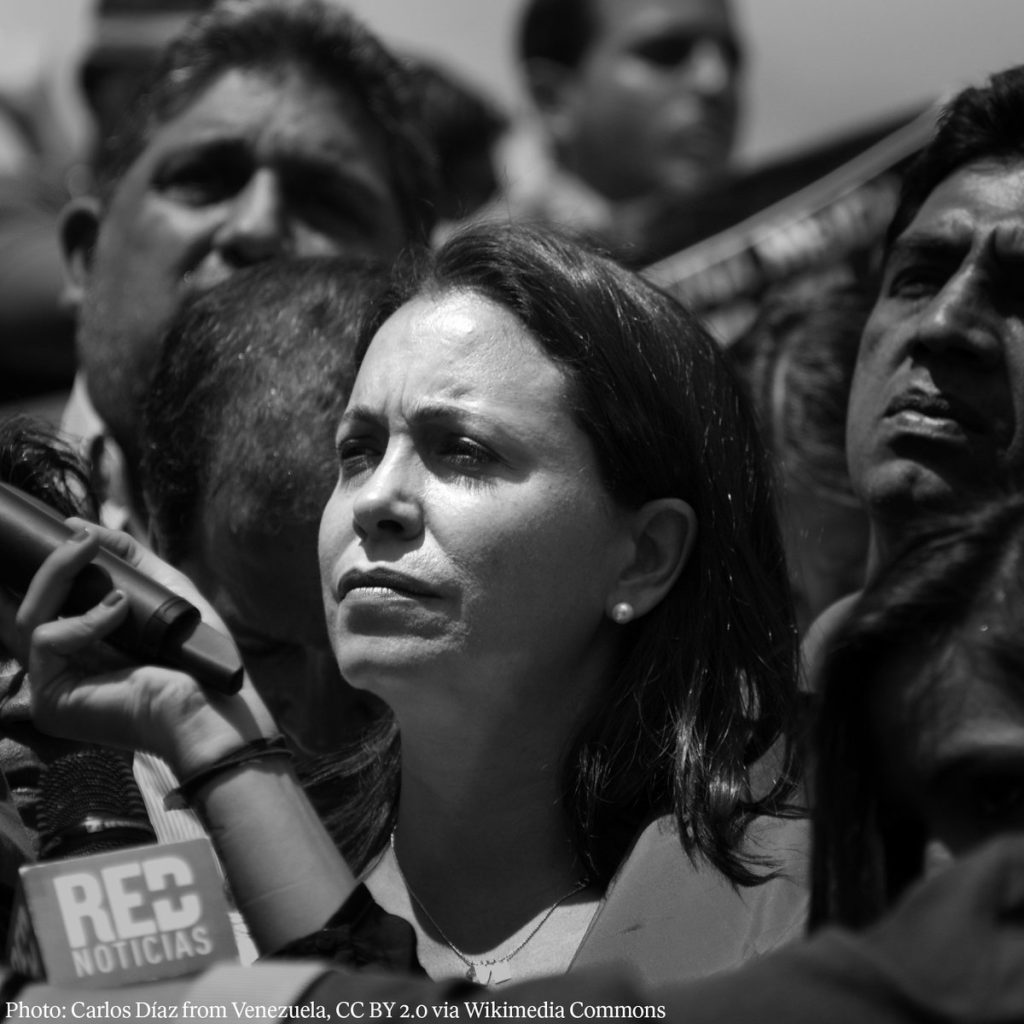
Archive photo of the Venezuelan opposition leader María Corina Machado. / EFE/Ronald Peña
14ymedio, Madrid, October 10, 2025 — The Norwegian Academy has awarded the 2025 Nobel Peace Prize to the Venezuelan opposition leader María Corina Machado “for her tireless work in promoting the democratic rights of the Venezuelan people and for her struggle to achieve a just and peaceful transition from dictatorship to democracy.”
Jørgen Watne Frydnes, chairman of the Norwegian committee, began the announcement at 11:00 am with these words: “The 2025 Nobel Peace Prize is awarded to a courageous and committed peace advocate: a woman who keeps alive the flame of democracy in the midst of a growing darkness.”
Next, Watne, a human rights lawyer by profession, gave the name of the Venezuelan opposition leader and justified the decision, which was taken by considering Machado, 58, “a figure of unity in a political opposition that was previously divided.”
“As leader of the democratic movement in Venezuela, María Corina Machado is one of the most extraordinary examples of civil courage in Latin America in recent times,” the committee said.
“As leader of the democratic movement in Venezuela, María Corina Machado is one of the most extraordinary examples of civil courage in Latin America in recent times,”
According to the document, read during the brief but ceremonial act, the Venezuelan opposition found a point of consensus in the demand for free elections. “This is precisely the essence of democracy: our shared will to uphold the principles of popular will, even if we disagree.”
The committee has described briefly but harshly the situation in Venezuela, which it has referred to as a country that was “relatively democratic and prosperous,” which has evolved into “a brutal and authoritarian state now suffering from a humanitarian and economic crisis. The majority of Venezuelans live in extreme poverty, while a few at the top get rich. The state’s violent machinery is directed against its own citizens. Almost eight continue reading
million people have left the country. The opposition has been systematically repressed through electoral fraud, legal persecution and imprisonment.”
The committee highlighted the political work that Machado has done, first as the founder of Súmate, defending judicial independence, human rights and popular representation. “She has spent years working for the freedom of the Venezuelan people.” Despite this, she found her candidacy blocked, and it had to be taken over by Edmundo González Urrutia.
The chairman of the committee recalled how the election campaign for the presidential elections of July 2024 took place, in the midst of risks, arrests and torture, with the support of hundreds of thousands of volunteers who helped document the election result “before the regime could destroy the ballots and lie about the result.”
The text unequivocally supports the electoral victory of the Venezuelan opposition and recalls that there was support from international observers. “However, the regime refused to accept the election result and clung to power,” it adds.
From X: In the past year, #NobelPeacePrize laureate Maria Corina Machado has been forced to live in hiding. Despite serious threats against her life she has remained in the country, a choice that has inspired millions of people. When authoritarians seize power, it is crucial to recognise courageous defenders of freedom who rise and resist. Democracy depends on people who refuse to stay silent, who dare to step forward despite grave risk, and who remind us that freedom must never be taken for granted, but must always be defended – with words, with courage and with determination.
The Norwegian Committee, through the Venezuelan opposition, has defended democracy, which it considers “in retreat” worldwide. “Democracy is a prerequisite for lasting peace. Yet we live in a world where democracy is in decline, where more and more authoritarian regimes defy the rules and resort to violence. The iron control of power by the Venezuelan regime and its repression against the population are not unique in the world. We see the same trends worldwide,” it states. Although 2024 was an eminently electoral year around the world, the committee has highlighted that these processes are becoming less and less free and fair.
“Last year, Mrs. Machado was forced to go into hiding. Despite serious threats to her life, she has remained in the country, a decision that has inspired millions of people. When authoritarians take power, it is crucial to recognize the brave defenders of freedom who rise up and resist. Democracy depends on those who refuse to keep quiet, who dare to step forward,” said Watne.
According to the committee, María Corina Machado meets the three criteria set out in Alfred Nobel’s will for the selection of a Nobel Peace Prize: uniting the opposition, not wavering in her resistance and supporting the transition to democracy.
With this decision, Machado becomes the seventh Latin American to receive the award. She is preceded by the Argentines Carlos Saavedra Lamas and Adolfo Pérez Esquivel, the Mexican Alfonso García Robles, the Costa Rican Oscar Arias, the Guatemalan Rigoberta Menchú and the Colombian Juan Manuel Santos.
Translated by Regina Anavy
____________
COLLABORATE WITH OUR WORK: The 14ymedio team is committed to practicing serious journalism that reflects Cuba’s reality in all its depth. Thank you for joining us on this long journey. We invite you to continue supporting us by becoming a member of 14ymedio now. Together we can continue transforming journalism in Cuba.
According to the official newspaper ‘5 of Septiembre’, these vehicles transport 80% of the passengers in the province
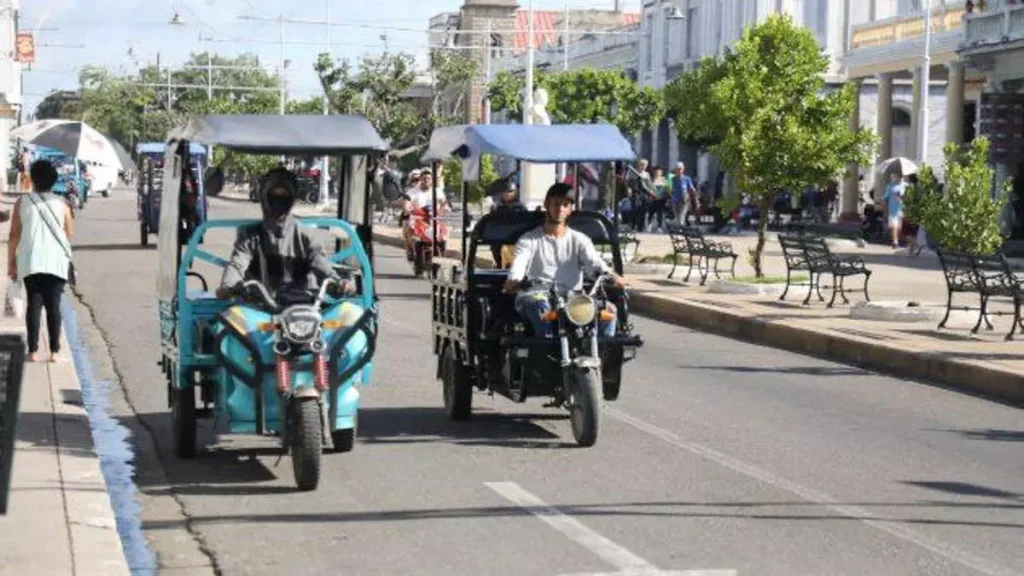
Many circulate without a license to transport people. / 5 de septiembre
14ymedio, Havana, October 10, 2025 –This Friday, the official press of Cienfuegos launched a diatribe against the drivers of private electric tricycles. Although at a time of “extinction of urban buses” vehicles represent a relief in passenger transport, their presence in the province has gone out of control and spreads “disorder, chaos, speculation, scams, excessive fees to the people and collisions that can be avoided.”
For one kilometer of road, 5 of Septiembre criticizes, from Avenue 36 to the funeral home of the capital city, the drivers can charge 200 pesos per passenger, an amount that the newspaper calls “irrational,” which increases if the route extends just five more blocks. The “urban road landscape, depressed” by the lack of public transport and fuel, has been the perfect scenario for speculators to proliferate, and fares rise without any price cap.
The newspaper also wonders why, despite the number of tricycles that have been added to the city’s routes, prices do not go down. The answer, it argues, is because they agree “to charge more and more for really insignificant stretches.”
“It is known today that about 80% of the movement of people here is done thanks to these electric tricycles. From their inception, the Ministry of Transport identified them as a real possibility to move personnel, authorizing their conversion for this purpose, provided that the standards and the same requirements for each electric vehicle were met. Thus, their presence in the cities has multiplied, both legal and illegal, on and off the main arteries.”
However, what is unacceptable, the newspaper stresses, is that the streets of Cienfuegos become an “uncontrolled jungle” thanks to them
However, the newspaper stresses that what is unacceptable is that the streets of Cienfuegos become an “uncontrolled jungle” thanks continue reading
to them. “Their owners have added them to the local fauna on wheels, competing with private and state transport, in the struggle to see who gets paid more in very short stretches.”
These actions are to the detriment of citizens, it claims, “already bored by so many failed inventions that only affect their pocketbooks.” The reason for the high fares, the drivers defend, is the high price they pay not only for the vehicle but also its batteries, which are usually of poor quality and don’t last long.
As if that were not enough, 5 de Septiembre claims that many “circumvent” the traffic laws and circulate without a license to carry passengers. “There are hundreds that circulate without such a license, something that can be seen in the poor driving by some of the drivers,” adds the newspaper.
This may be due, it admits, to the “sometimes very long” delays in the technical testing of tricycles and the certification required for them to serve as public transport, which leads drivers to start driving without the necessary permits.
In many cities, as in Cienfuegos, it is the private ones that transport the largest mass of passengers daily
Sold on online platforms, mostly in dollars, the electric tricycles have been widely purchased by Cubans whose families abroad can afford to buy them. Business owners and MSMEs* also started buying them to use in the movement of goods. Recently, they have become vehicles to carry passengers with the approval of the State, which lacks the means to take care of public transport on its own.
In many cities, such as Cienfuegos, it is the private sector that transports the largest mass of passengers on a daily basis, since buses have disappeared, and the State tricycles, imported from China and distributed throughout the country in small quantities, usually do not last long or don’t suffice.
Even with the “help” of private individuals, transport in Cuba is at its worst. According to data published in September by the National Statistics and Information Office (ONEI), in the first half of this year, 407.9 million passengers were transported in the country, 10.2% fewer than a year earlier.
Not only does the number of people being transported by conventional means decrease but there are also fewer travelers using “alternative means,” such as animal-powered cars, bicitaxis, trucks and private cars. Between January and June 2025, there were 169.1 million, compared to 191.5 million in the same period of 2024, some 11.7% fewer.
*Translator’s note: Literally, “Micro, Small, Medium Enterprises.” The expectation is that it is also privately managed, but in Cuba this may include owners/managers who are connected to the government.
Translated by Regina Anavy
____________
COLLABORATE WITH OUR WORK: The 14ymedio team is committed to practicing serious journalism that reflects Cuba’s reality in all its depth. Thank you for joining us on this long journey. We invite you to continue supporting us by becoming a member of 14ymedio now. Together we can continue transforming journalism in Cuba.
The RAE dictionary does not yet recognize the meaning of the verb that defines life on the Island under real socialism.
Admiration does not fall on those who work hard, but on those who solve the best problems. / 14ymedio
14ymedio, José A. Adrián Torres, Malaga (Spain), 5 October 2025 — Cuba—like so many other nations—proudly displays its national symbols: the national bird, the tocororo; the national tree, the royal palm; the national flower, the white butterfly. And even a musical group, with the mordacity that comes with Creole humor, dared to add to the list what should be the national mammal: the pig.
But the island also has an emblem that no other country would dare proclaim and that doesn’t appear in civics manuals or on propaganda posters: its national verb. That verb, which isn’t conjugated in the dictionaries of the Royal Spanish Academy (RAE) with the precise meaning it has in Cuba, but which has explained daily life for more than three decades: To resolve.
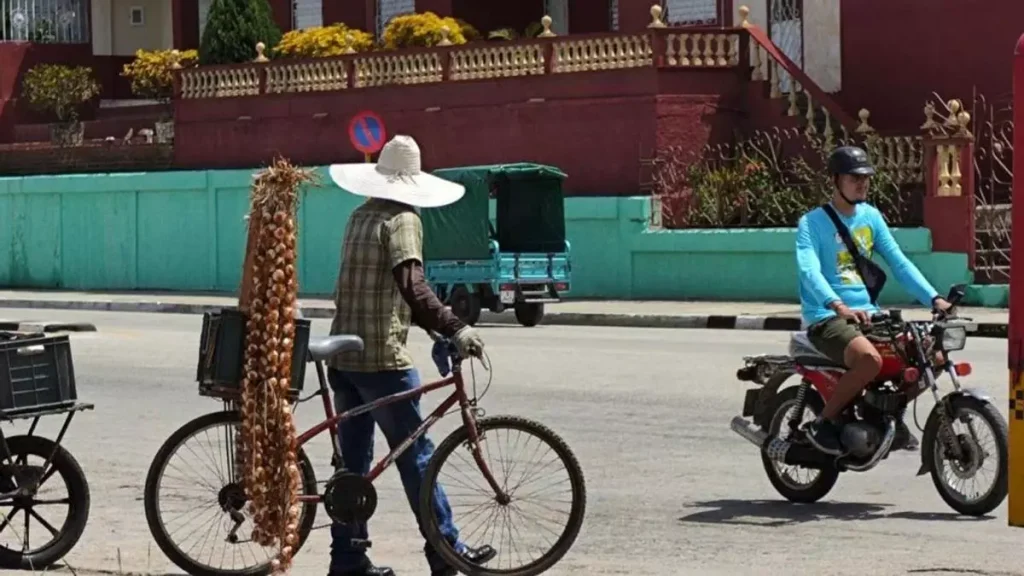
Because if anything has characterized the average Cuban since the Special Period, it’s the need to solve problems. To resolve is not “solving a problem,” as the Academy in Madrid still insists. Solving problems, in Cuba, is finding what is missing, with ingenuity, connections, or cunning. Solving problems means putting food on the table when the state doesn’t guarantee it; it is getting gasoline in the shadow of the Cupet*; it is finding a spare part for the old Lada; it’s “inventing” whatever comes along. Solving problems isn’t a technique: it is an art of survival.
Before getting to that verb, it is worth remembering that Cuba has given the world much more than official symbols. Its music crosses borders: from Lecuona to Formell, from son to mambo, from danzón to bolero, leading to the omnipresent salsa and reggaeton that resonate on every corner today.
Its literature left universal names: Martí, Carpentier, Lezama, Padura. Even sports were patriotic: baseball, adopted on the island and transformed continue reading
into a continental passion—until the more recent arrival of soccer fans.
And in language, the island and its Caribbean neighbors added treasures that the RAE eventually accepted: huracán from Taíno; guateque for the campesina festival; maraca and bongó for instruments that are now universal; and ñángara, which already sounds like an ideological relic—although some will remain.
The verb crystallized in the 1990s, when the collapse of the Soviet Union left Cuba without subsidies, and with an economic black hole.
But alongside these established contributions, the most “essential” is missing, the most genuine, the one that encapsulates the experience of several generations: To resolve. This verb crystallized in the 1990s, when the collapse of the Soviet Union left Cuba without subsidies and with an economic black hole. Where there was scarcity, nothingness appeared. And with it, the obligation to invent, scrounge, and hustle. The Special Period transformed millions into acrobats of ingenuity and gave them a verb that governs their lives to this day.
An old Cuban friend, who endured those years with resignation and now lives in Miami, summed it up this way: “Cubans don’t steal, my friend; they take what’s coming to them. It’s just that they haven’t gotten it yet.” The phrase encapsulates a twisted but coherent ethic: the State promised, failed to deliver, and the citizen feels entitled to take what they need. They don’t steal: they resolve.
And among the middle-ranking “cadres,” those second-tier leaders and rank-and-file militants, another recurring justification circulated when it came to “interfering” in something: “Cadre, defense is allowed.” It was like saying: ” You can be unfaithful, but not disloyal.” My friend claims to have heard it thousands of times. Phrases like that shaped the socialist morality of the “New Man,” in which to resolve was articulated with egalitarianism and other supposed “values” of the Revolution.
This ethic has disrupted the scale of prestige. In Cuba, true prosperity lies not in a university diploma or an academic degree, but in access to the circuit of the resolvable. The social pyramid is inverted—although perhaps it would be more accurate to say that there is no pyramid, but rather that there are only those at the top and those at the bottom: doctors and engineers survive on symbolic salaries, while the hotel bartender, the taxi driver who charges in dollars, or the person who handles tourism contacts earn more than a doctor in Physics. Medicine is prestigious, but tourism—and remittances and other junk—resolve, at least until recently they did. And everyone knows that.
That’s why on the island the national verb is conjugated like a calling card: “How do you resolve it?”, “Did you resolve it?”, “That guy really resolved it.” The admiration falls not on the one who works hard, but on the one who resolves it the best. It becomes a national championship of cunning, where cheating ceases to be shameful and becomes a social virtue.
The cost, of course, is high. To resolve erodes any notion of legality, merit, or professional ethics. It normalizes living on the blurred borders of what is permissible, turning “invention” into a system and precariousness into a culture. To resolve is the verb of lack, but also the shield that justifies everyday deception.
The cost, of course, is high. To resolve erodes any notion of legality, merit, or professional ethics.
The paradox is that a country that enriched Spanish with musical and Taino voices, that contributed poetry, rhythms, and universal symbols, has been reduced to a verb that the Academy doesn’t recognize with the nuance that the Cuban street brings to it. It would be fair to add:
To resolve, in Cuba: refers to the art of surviving under real socialism.
That definition would say more than many official reports. After all, dictionaries capture what people use and experience. And Cubans have been conjugating that verb in the present tense for over thirty years: “I resolve, you resolve, he resolves.” In the plural, it sounds even clearer: “You all resolve.” And those who go into exile continue to carry it with them, as a mark of origin: they resolve in Miami, Madrid, or Cancún.
Meanwhile, the island continues to present its symbols: the tocororo, the royal palm, the white butterfly, the pig as an informal emblem. But more than any other symbol, what defines Cuba today is a verb. And that verb, ironic and sad, is not to sing, not to dance, not to dream: it is to resolve.
COLLABORATE WITH OUR WORK: The 14ymedio team is committed to practicing serious journalism that reflects Cuba’s reality in all its depth. Thank you for joining us on this long journey. We invite you to continue supporting us by becoming a member of 14ymedio now. Together we can continue transforming journalism in Cuba.
The annual increase in 2024 was two million people of Latino origin
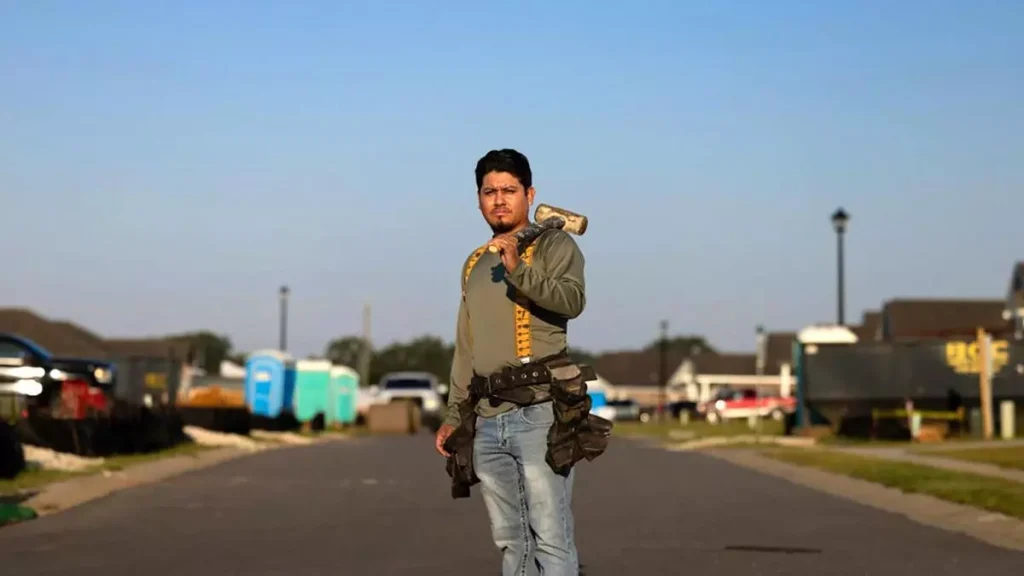
Latino American worker Leonardo García Venegas, in Baldwin County, Alabama (USA). / EFE/Institute of Justice
EFE (via 14ymedio), Miami, October 8, 2025 — For the first time in history, one in five U.S. residents is of Latino origin, for a total of 68 million people, according to a report Tuesday from the Latino GDP project of the University of California Los Angeles (UCLA) and California Lutheran University.
The study found an annual increase of two million people of Latino origin in 2024 by analyzing updated data from the Census Bureau, which reports a total of 340 million inhabitants in the United States.
This means that the Latino community grew by 2.9% from 2023 to 2024, a rate equivalent to 5.8 times the increase in the population of other origins, the report detailed.
To explain the increase, the study cited “natural population change,” which results from subtracting deaths from births, implying a cumulative growth of 3.2 million Latinos from 2020 to 2024, compared to a decrease of 1.3 million people from other demographics over the same period.
The report also noted a record year-over-year increase of 5.5% in the Latino workforce in 2024 to 35.1 million workers.
“This is an extraordinary difference of 4.5 million people. Latinos withstood the extraordinary challenges of the (COVID-19) pandemic and were responsible for maintaining the positive natural population continue reading
shift in the United States overall,” the report noted.
The report also noted a record year-over-year increase of 5.5% of the Latino workforce to 35.1 million workers in 2024, an increase of 46.5% since 2010, a growth rate 7.2 times faster than the rest of the population.
The labor force participation rate among Latinos also reached a record high of 69%.
“Time and again, we find that hard work, self-reliance, optimism, and perseverance are characteristics that underlie the strength and resilience of Latinos in the United States,” said Matthew Fienup, executive director of the Center for Economic Research and Forecasting at Cal Lutheran.
These findings follow another study in April by Latino GDP, which revealed that the gross domestic product (GDP) of Latinos in the United States reached $4.1 trillion, the fifth highest in the world, ahead of India.
But this study also comes after it was revealed that the United States lost 1.4 million migrants in the first six months of the Donald Trump administration, marking the first decline in the immigrant population since the 1960s, according to a Pew Research Center report in August.
____________
COLLABORATE WITH OUR WORK: The 14ymedio team is committed to practicing serious journalism that reflects Cuba’s reality in all its depth. Thank you for joining us on this long journey. We invite you to continue supporting us by becoming a member of 14ymedio now. Together we can continue transforming journalism in Cuba.
Residents fear that the epidemiological crisis affecting other provinces will spread to their city.
Garbage collection truck in the city of Guantánamo. / 14ymedio
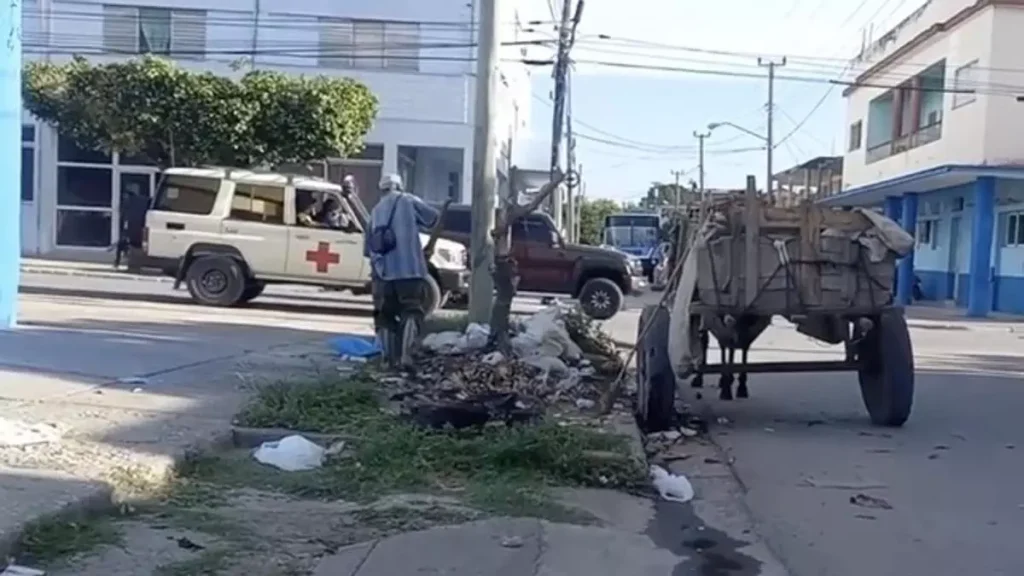
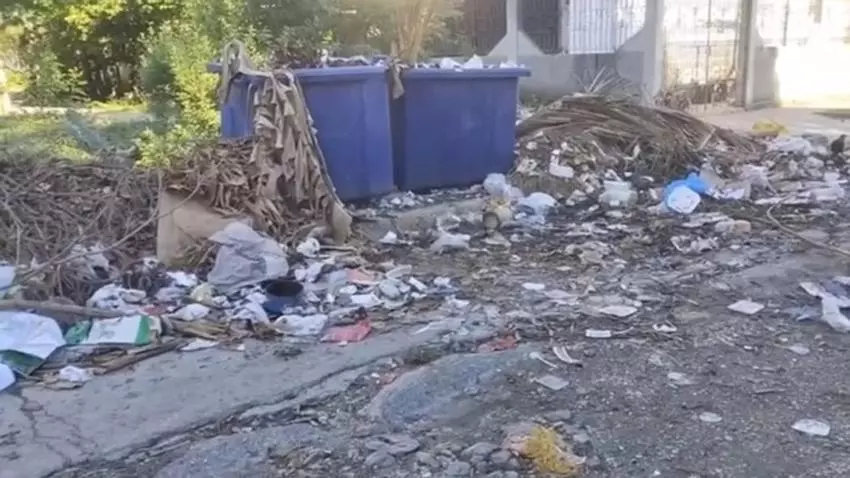
14ymedio, Guantánamo, 9 October 2025 — “There’s garbage everywhere,” Guantánamo resident Héctor López Pérez summed up with dismay. The trash piling up everywhere has turned a city that was once considered “among the cleanest in Cuba” into a series of mountains of waste that mar its streets and threaten the health of its inhabitants.
With the epidemiological alert caused by the outbreak of dengue, chikungunya, and oropharynx in the province of Matanzas, residents of Guantánamo fear that the presence of these diseases will also gain ground in their homes. “The carts don’t come to collect the garbage,” Alain Lobaina Laserie warned 14ymedio, faced with the reality of street corners littered with waste.
Among the inhabitants of the city, which produces 1,200 cubic meters of solid waste per day, there is a widespread belief that the ‘Ordering Task‘ was the final blow to the private workers who worked with their carts collecting garbage. “They changed the payment system, with the currency exchange they implemented, and they all disappeared because their wages went down,” emphasizes Héctor López Pérez, adding: “Everything has gone up for the horses, from grass to horseshoes.” continue reading
Among the city’s inhabitants there is a widespread belief that the Ordering Task was the final blow to the private workers
Implemented in January 2021, the Ordering Task was presented as a necessary monetary and exchange rate reform that sought to eliminate the dual currency (CUC and CUP) and restructure income, prices, and subsidies. However, it ended up contributing to the devaluation of the peso, triggering inflation and fueling popular unrest.
The sector’s own executives acknowledge that “they have experienced various reorganizations,” and only this year did the municipal company convert from a budgeted unit to a business entity, a status that should give it greater flexibility in hiring staff, managing salaries, and other initiatives that can help revive the diminished workforce and purchase supplies.
Earlier this year, Rodolfo Sánchez Suárez, a hygiene specialist at the Municipal Communal Services Company, admitted to the local press that the entity only had “six tractors and three specialized garbage collection carts, and of these, only two of the former and one of the latter are operational; the remaining equipment is idle due to a lack of tires and spare parts.”
Since then, the situation has only worsened, and Guantanamo residents are trapped between the inefficiency of the Municipalities and the waste piling up everywhere. “There isn’t any, there isn’t any, and everything is just nonsense,” warns López Pérez, tired of hearing the same explanation that the country doesn’t have the foreign currency to import everything from gloves for employees to compaction trucks.
Overflowing garbage dumps in Guantánamo. / 14ymedio
For Eriberto Téllez Reinosa, the problem lies in the fact that the authorities are completely overwhelmed by a problem that has been growing in severity in recent years. “The system can no longer support” waste management in the current situation, says the man, who sees no solution through state mechanisms that have consistently demonstrated their inability to efficiently handle waste collection.
Horse-drawn carts, run by private individuals, would not solve the whole problem either. “The specialized cart not only collects waste, but also compresses it, allowing it to maximize the amount it can transport in a single trip. It is capable of collecting up to 60 cubic meters of compressed garbage, while tractors use open carts, with a loading capacity of only 17 cubic meters per trip,” warned the newspaper Venceremos last January .
At the end of August, faced with the worrisome situation, official media outlets once again addressed the issue, appealing to the “collective conscience” of Guantanamo residents and urging them not to wait for community services to do their part. “Preventing an epidemic outbreak is easier than dealing with its consequences later,” they warned, but the time for focusing on precaution seems to be over. The viruses are already here, and the consequences are being felt now.
Guantánamo, a city turned into a garbage dump / 14ymedio
____________
COLLABORATE WITH OUR WORK: The 14ymedio team is committed to practicing serious journalism that reflects Cuba’s reality in all its depth. Thank you for joining us on this long journey. We invite you to continue supporting us by becoming a member of 14ymedio now. Together we can continue transforming journalism in Cuba.
The province is reorganizing its services to monitor the sick, while the population is reluctant to go to emergency rooms because of their condition.
At least three other provinces are taking action, including Havana.
The students had to leave school abruptly, according to some reports. / 14ymedio
14ymedio, Matanzas, October 9, 2025 — The dormitories of the University of Medical Sciences in Matanzas have been emptied and converted into a makeshift hospital to deal with the epidemiological situation in the province. As confirmed by 14ymedio in a visit to the center, near the Faustino Pérez hospital, students have been sent home to make room for pediatric care rooms. Some were still seen around on Thursday with packages and backpacks. While they were leaving, the sick children who could not be treated in the Eliseo Noel Caamaño Provincial Pediatric Hospital, which was 100% full, were being brought by bus to the university for admission.
On social media, several people have alluded to the “abrupt expulsion” of the university students. “Now they have taken the students from Medical Sciences, whose building is next to the Hospital Faustino Pérez, to extend both the pediatric ward and the hospital itself because they are overwhelmed,” commented a woman on Facebook at the bottom of the epidemiological article published daily by Dr. Francisco Durán.
Reporter Niover Licea also published a comment from a student. “We were ordered to evict without notice. It’s disrespectful. There is no food for those who stay, and they want to solve at once what they did not prevent from the beginning. This crisis will end when we are all sick.” According to him, the university authorities asked the students to be discreet and warned them against possible reprisals for disseminating data on the health situation.
The provincial newspaper, Girón, indicated on Wednesday afternoon that the capacity of the Provincial Children’s Hospital Eliseo Noel Caamaño is at 100%. “We have a complex epidemiological scenario where arbovirosis joins other viral infections, such as rotaviruses that cause diarrhoeal diseases, which increases the demand for care,” said the center’s director, Anaelis Santana Alvarez.
The university is near the Faustino Pérez Provincial Hospital. / 14ymedio
Currently, there is a reinforcement of the distribution of patients and human resources, possibly –although it is not indicated– as a result of the dispatch of health personnel that the authorities announced last Monday. Dr. Santana stated, however, that the total occupancy of the hospital is nothing more than the result of protocols requiring compulsory admission of children under 10 years old with fever and suspected arbovirosis, “regardless of whether they present complications or not.”
The staff reinforcement plan includes, in any case, specialists and emergency room residents as well as students to assist in consultations. The hospitals of Cárdenas and Colón have been mobilized to provide care for children over age five “without warning signs,” in order to decentralize care and alleviate the burden. The Eliseo Noel Caamaño Hospital is, therefore, left with those who do present such warning signs and infants under one year, in addition to the most serious symptoms, which according to the directive have not occurred so far.
“There has been no lack of resources to care for the children, nor does the province have serious or critical arbovirosis,” he said, while categorically denying that there are cases of cholera, as has circulated on social networks. “The current diarrheal disease is caused by seasonal rotavirus.”
Julio Ernesto Hernández, director of Medical Assistance in the province, said that there are 75 beds in Matanzas to care for feverish patients and they are ready to expand by 100 more. “The fundamental thing for the population is to go to the doctor when continue reading
there are any symptoms,” he said, the same idea that had previously been highlighted by the director of the pediatric department. He expressed his confidence in the system and a vigilance that, in his opinion, works, so that there have been no deaths, while asking the families to remain calm, because the specialists are trained for their task.
The citizens’ distrust is not, in any case, in the doctors. The lack of drugs and reagents to detect the specific disease is now a cause of discomfort and disgust among the population. However, the main obstacle in this scenario is the poor hygienic condition which exists in many hospital centers and which profoundly discourages patients from seeking help.
The lack of drugs and reagents to detect specific diseases is now a cause of discomfort and disgust among the population
In this respect, households are not much better protected either. Julio Ernesto Hernández urged the population to “maintain general measures in housing, self focus, adequate intake of liquids and to watch for possible warning signs.” However, the lack of running water in countless houses, together with the garbage that floods the streets, do not create the best scenario for halting the spread of this type of disease.
“After the capital, the dirtiest city in garbage collection is Matanzas. Do not invest more money in making parks and allocate the budget to clean up the city: that is quality of life, that is vector zero. Please, are there no leaders with vision in the 21st century? The formula is easy: clean city, zero diseases,” reacted a user on the site of the newspaper Girón.
More than 100 people responded, warning that the epidemiological situation in the city has been serious for weeks and the reaction is late and precarious. “One arrives with sick children and they abuse you and leave you lying there, not to mention the poor hygiene in bathrooms and clinics,” reproached another. Many comments reveal family-wide contagion.
Although the epicenter of this panorama is Matanzas, the rest of the island is not saved, and Havana, in particular, is worried because of its its high population and density. The authorities have continued to report sanitation work, including the removal of garbage, which already has reached 90,000 cubic meters, compared with 35,000 at the weekend. The capital city is also facing a viral outbreak, and new reports are coming to this newspaper every day: patients with very high fevers, severe muscle aches and rashes.
Sources from the Hospital Clínico Quirúrgico Salvador Allende, better known as La Covadonga, told Cibercuba on Wednesday that a public health commission visited the center with the idea of enabling it for patients of arbovirosis
It has not been officially reported, but sources from the Hospital Clínico Quirúrgico Salvador Allende, better known as La Covadonga, told Cibercuba this Wednesday that a Public Health Commission visited the center with the idea of enabling it for patients with arbovirosis, similar to the Matanzas pediatric hospital, but for adults. For this, it would be necessary to close the departments of Internal Medicine, Ophthalmology, Urology, Orthopedics and Geriatrics, in which patients with dengue, chikungunya and other diseases transmitted by mosquitoes would be admitted. The six operating rooms would remain open, but outpatient consultations would be suspended if the plan is implemented.
Ciego de Ávila has also announced, in this case formally, a strengthening of surveillance for the same reason. For the time being, efforts will focus on fumigation and waste clearance, especially in the most affected areas: Morón, Ciego de Ávila and Venezuela. The decision is taken on the basis of the spread that leaves two health areas as the epicenter of the disease, the Belkis Sotomayor polyclinic in the capital city and the Morón South polyclinic.
The same strategy is planned, for now, in Bayamo, Granma province, where there are many cases of arbovirosis. There, the authorities have required the population and companies, state and private, to comply with their part in “the strategy of sanitation and disposal of sewage, weeds and landfills,” including the obligation to facilitate the entry of health personnel who carry out door-to-door searches. Otherwise, remember, there will be “the imposition of fines or other punitive measures in cases where necessary.”
Translated by Regina Anavy
____________
COLLABORATE WITH OUR WORK: The 14ymedio team is committed to practicing serious journalism that reflects Cuba’s reality in all its depth. Thank you for joining us on this long journey. We invite you to continue supporting us by becoming a member of 14ymedio now. Together we can continue transforming journalism in Cuba.
In these stores you can’t get aspirin or dipyrone, but vitamins or cough syrups are available at stratospheric prices.
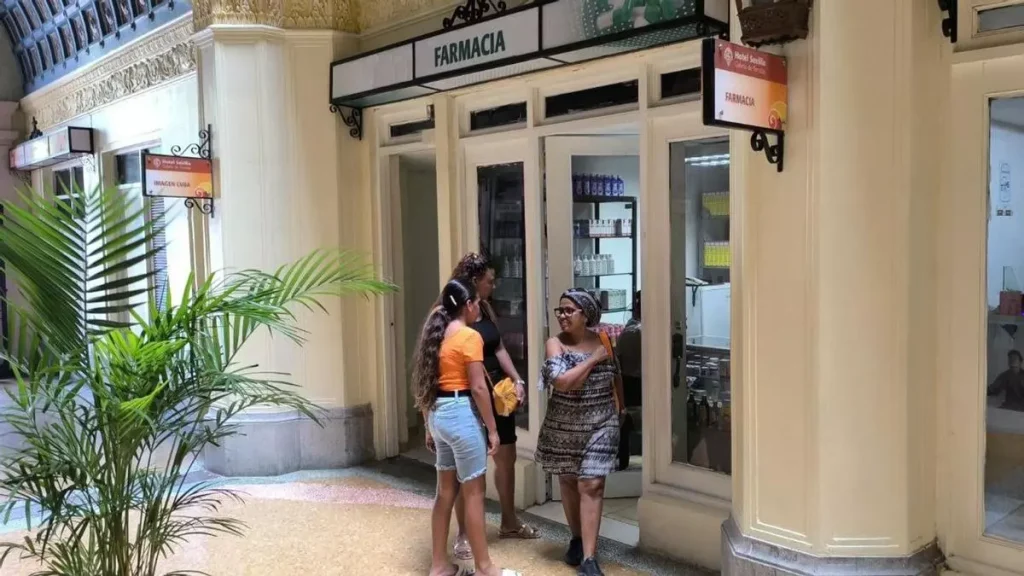
Pharmacy on the ground floor of the Sevilla Hotel in Havana. / 14ymedio
14ymedio, Olea Gallardo, Havana, October 9, 2025 — “Payment in dollars, starting October 1st.” This information surprised the few customers of the Sevilla Hotel pharmacy on Tuesday, the employees heard. Until just a few days ago, it was an establishment where payments could be made in freely convertible currency (MLC), but now only fula [US dollars], foreign credit cards, or the Classic prepaid card are allowed.
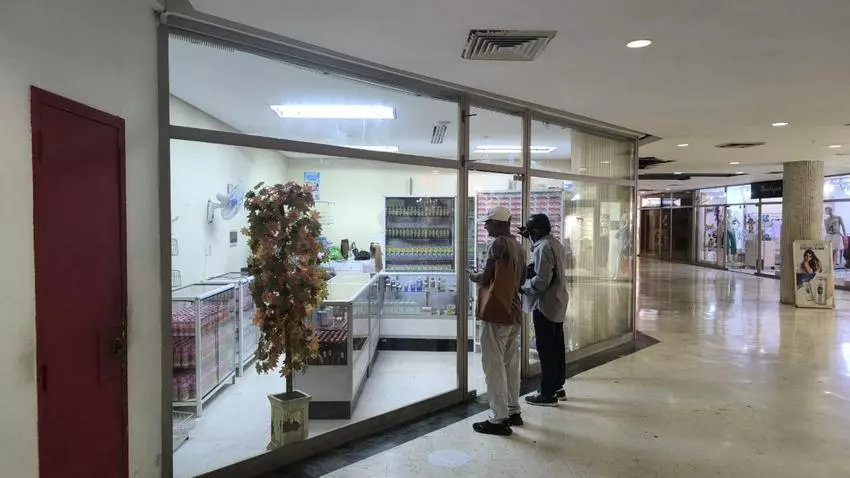
According to the same workers, the same thing is happening in all the “international” pharmacies, like the one on the ground floor of the Habana Libre Hotel. Calling them pharmacies, in any case, is an exaggeration, as the selection is limited and mostly focuses on vitamin supplements.
Shoppers were even more surprised to learn that they didn’t have aspirin or dipyrone*, common medicines. As for the prices, the high prices are no longer surprising. Cough syrups range from $13 to $19, laxatives at $11, vitamins—even those manufactured in Mexico, like Troffin—at more than $20. As is often the case in other state-run continue reading
stores, the items fill the shelves even if they are of the same type.
“International” pharmacy on the ground floor of the Habana Libre Hotel. / 14ymedio
“Antibiotics, painkillers, and other necessary things like that are very easy to get ‘on the left’ . No one is going to buy those things from them,” explained a woman accustomed to this type of transaction. “They’ve come late to wanting to get dollars from selling medicines, and they know perfectly well that the black market has cornered them.”
Indeed, the list of medicines for sale on “specialized” Telegram channels and WhatsApp groups resembles a real pharmacy, at lower prices than the official ones. A young man who regularly buys his mother’s diabetes medication through these channels comments: “Those pharmacies are going to fail.”
*Note: [from the ‘web’] “Metamizole, also known as dipyrone, is a strong analgesic and antipyretic that is available in many countries but is not authorized for use in the United States. It is marketed under hundreds of brand names by numerous manufacturers globally. ‘
Translated by Regina Anavy
____________
COLLABORATE WITH OUR WORK: The 14ymedio team is committed to practicing serious journalism that reflects Cuba’s reality in all its depth. Thank you for joining us on this long journey. We invite you to continue supporting us by becoming a member of 14ymedio now. Together we can continue transforming journalism in Cuba.
The U.S. Embassy in Havana suspended its consular services today due to the demonstration led by Díaz-Canel at the ‘Anti-Imperialist Tribune’
Miguel Díaz-Canel, leading the Palestinian rally at the Anti-Imperialist Tribune this Thursday in Havana / EFE/Ernesto Mastrascusa
14ymedio, Havana, October 9, 2025 — Barely hours after US President Donald Trump announced the peace agreement between Israel and Hamas, the Cuban regime continued mobilizing its forces to demonstrate for Palestine this Thursday at the so-called Anti-Imperialist Tribune in Havana, in front of the US Embassy.
The sun hadn’t even risen yet when workers from the Cuban Electricity Union (UNE) and the Ministry of Energy and Mines appeared on the scene, according to their social media accounts, to “express their firm support for the Palestinian people and their just cause.” One user commented at the bottom of the post: “I started reading with hope that they were demonstrating in support of the Cuban people, and their own families who don’t have electricity. Arms crossed on the part of the UNE workers, that’s what it takes.”
On the neighborhood “cadre” channels, they announced in capital letters the “denouncement of the genocide being committed against the dignified and courageous Palestinian people” at a demonstration scheduled for four in the morning. “Let’s not be complicit, see you tomorrow at the Tribune,” it said, without mentioning the recent peace agreement reached between Israel and Hamas with the mediation of the United States and the support of numerous Arab countries.
“No, I don’t like it at all. Much less an agreement coming from the United States, which will always have ulterior motives.”
“The regime informed us late on Thursday, October 9, 2025, that access to the Embassy will be blocked due to an activity in front of the Embassy building,” the embassy reported on its social media channels, without specifying the type of “activity.” Therefore, consular services would be suspended today, as well as tomorrow, due to a local holiday, and Tuesday, October 14, due to a US holiday. The embassy requested: “Information regarding rescheduled appointments will be provided directly to applicants; please do not call the Embassy.”
The rally was attended by President Miguel Díaz-Canel, as well as other senior officials from the government and the Communist Party (PCC). The call had been made earlier this week, before it was announced Wednesday night that Israel and the terrorist group Hamas had agreed to commit to the first phase of Washington’s peace plan, which includes releasing the hostages in exchange for Palestinian prisoners and the withdrawal of the Israeli army from certain parts of the enclave.
The Cuban regime, a traditional ally of Palestine, has not commented. The announcement of the agreement caught several attendees off guard. Many were unaware of the details of the pact, while others received the news with skepticism because it was a plan proposed by Trump, as EFE was able to verify.
“No, I don’t like it at all. Much less an agreement coming from the United States, which will always have ulterior motives. The complete intention is to take over the Strip,” Gustavo García, a 20-year-old international relations student, told the Spanish news agency.
He also asserted that if Hamas is disarmed, one of the 20 points in Trump’s peace plan, “we could already be facing the last remnants of the Palestinian resistance.” Emmanuel, 19, expressed a similar tone, acknowledging that, although the “geopolitical context” is different, he prefers the plan proposed at the UN by Colombian President Gustavo Petro, which consists of creating a “Salvation Army” for the Palestinian people with military personnel from different countries.
____________
COLLABORATE WITH OUR WORK: The 14ymedio team is committed to practicing serious journalism that reflects Cuba’s reality in all its depth. Thank you for joining us on this long journey. We invite you to continue supporting us by becoming a member of 14ymedio now. Together we can continue transforming journalism in Cuba.
The athletes arrived in the Dominican Republic and are already training in academies.
Seven players from the U-15 team left the island and are seeking a chance in the Major Leagues in the Dominican Republic. / Pepe Morejón
14ymedio, Havana, 8 October 2025 — The exodus of Cuban baseball players seems endless. Pitcher Pedro de Jesús Castillo arrived in the Dominican Republic on Tuesday. The dream of landing a contract with a Major League team has led “seven members of the U-15 national team that qualified for the 2026 World Cup in that category” to emigrate, journalist Francys Romero emphasized.
Castillo “was the pitcher who displayed the greatest velocity on the Cuban team during the U-15 World Cup, with a fastball of 88 miles per hour,” the broadcaster recalled.
Before player José Muñiz, a native of Granma province, arrived in the Dominican Republic, his performances had already earned him the title of Most Valuable Player at the World Cup Qualifiers. The athlete, considered by scouts to be one of the best players in his class, will be represented by major leaguer Alex Sánchez and will train at his academy in Santo Domingo.
At the beginning of October, the departure of the best pitcher in the U-15 category, Carlos Sarduy, was confirmed. The Matanzas native, who stands 1.87 meters tall, will present himself to academy recruiters in January with an average pitch of between 86 and 88 miles per hour.
Baseball players José Muñiz and Cristopher García are also in academies in the Dominican Republic. / Francys Romero
The players joined slugger Cristian Aguilera and infielder Damián Díaz. According to Francys Romero, the athletes are eligible to sign starting on January 15, 2027.
Cuban baseball continues to bleed while authorities fail to find a way to retain its promising players. In 2024, 19 of the 20 players from the U-15 team that participated in the 2022 World Cup for that age group, held in the state of Sonora, Mexico, broke away from the sport, considered a cultural heritage.
Yordan Rodríguez was the last of that group to travel to the Dominican Republic. Last January, the Guantanamo native formalized his contract with the Athletics, a deal that included a $400,000 bonus.
In The Dream and Reality. Stories of Cuban Baseball Emigration (1960-2018), Romero explains that the average age of baseball players leaving the island decreases each year. It was 24.4 years old in 2015; three calendar years later, it had dropped to 17.9.
This Wednesday, the departure of Aniel Oscar Ramírez, a member of the U-10 team, was also confirmed. He will train at Javier Rodríguez’s academy. Seven other players have also left the team.
____________
COLLABORATE WITH OUR WORK: The 14ymedio team is committed to practicing serious journalism that reflects Cuba’s reality in all its depth. Thank you for joining us on this long journey. We invite you to continue supporting us by becoming a member of 14ymedio now. Together we can continue transforming journalism in Cuba.
Rapper Fernando Almenares Rivera, known as ‘Nando OBDC’, is another victim of the repression denounced by the Cuban Observatory of Human Rights in its September report.
Fernando Almenares Rivera, alias Nando OBDC. / Facebook
14ymedio, Havana, October 7, 2025 — After more than nine months in prison without trial, the mother of rapper Fernando Almenares Rivera, known as Nando OBDC, managed to obtain the formal indictment. “In the end, I had to come to court to photograph them because they were never able to send them by mail,” Eva Rivera lamented to 14ymedio, to whom she showed the document, dated June 17.
In it, the Prosecutor’s Office is requesting a six-year prison sentence for the crime of “propaganda against the constitutional order.” According to the Orwellian account of the events, at the end of August last year, Almenares wrote the words “Cuba First in the streets for human rights,” “We want changes now, Cuba First,” and “Cuba First” on pieces of sheeting “using a pinkish substance,” and then hung them “between the Combinado del Este bridge and the bridge in the town of Santa Fe, Guanabacoa municipality, Havana, a busy thoroughfare at all hours of the day, where even the capital’s public transportation buses circulate.”
For the prosecution, these are “phrases with counterrevolutionary content,” placed “in a place where they could be seen by passersby, with the purpose of causing social unrest, disturbing public peace, and creating discontent among the population. Each of these phrases also highlights the objectives pursued by an organization not legally recognized in Cuban territory, thus inciting against the social order established in the country by the Constitution of the Republic.”
These are “phrases with counterrevolutionary content,” placed “in a place where they could be seen by passersby, with the purpose of causing social unrest.”
The indictment emphasizes that the artist “maintained relations” with “members of the counterrevolutionary organization Cuba Primero” — an organization to which Daniel Alfaro Frías, José Antonio Pompa López and Lázaro Mendoza García belong, who were sentenced to nine, eight and five years in prison this week — and asserts that it was that organization, through the “Cuban-American citizen Armando Labrador Coro,”who sent Nando OBDC “the sum of 200 dollars” at the beginning of September 2024.
The formal accusation contradicts the authorities’ initial version, which justified Almenares Rivera’s arrest on December 31 of last year at his home in La Lisa as being for acts of “terrorism” related to “a fire that occurred in Lenin Park on December 30,” in which he allegedly participated.
The legal document also lists the properties confiscated from the rapper, which would constitute evidence of the crime: a “blue Samsung brand cell phone with a black case,” 545 pesos that “were deposited at the disposal of the Court at the Banco Metropolitano bank branch,” and “four pieces of sheeting with counterrevolutionary texts painted on them, which are attached to the proceedings as evidence.”
The prosecutor’s petition also states that Almenares is being held in Combinado del Este prison, although he is currently in the Cuba Panamá prison in Güines, Mayabeque, designated for HIV/AIDS patients. His mother has publicly denounced his continued incarceration there, given that he does not have the condition.
“There’s tuberculosis, bedbugs, scabies, all kinds of diseases in there, and I told Fernando not to let anyone inject him because they could give him the virus,” Eva Rivera told Martí Noticias last September. She explained that the prison warden reproached her for her son’s refusal to receive the therapy given to other inmates. “The therapy they give to those patients, who have their treatment, their medicine,” Rivera clarified, claiming to have told the warden: “Under my responsibility, I don’t allow Fernando to inject himself or take any kind of therapy, because Fernando doesn’t have any kind of illness.”
At the end of July, the rapper went on a hunger strike to protest being held incommunicado in prison.
The musician’s activism had been under scrutiny by authorities for some time. In November 2021, he was summoned to the Seventh Unit of the National Revolutionary Police for his social media posts.
Last September alone there were at least 212 repressive actions against the civilian population in Cuba, of which 39 were arbitrary arrests.
Penalties and repression against freedom of expression, in a country where citizens only demand a minimum wage, have become harsher in recent years. The Madrid-based Cuban Observatory of Human Rights (OCDH) reported this Tuesday that last September alone, there were at least 212 repressive actions against the civilian population in Cuba, 39 of which were arbitrary detentions.
Most of these cases were “short-term (27)” and were related to the peaceful demonstration in Gibara (Holguín) on September 13, where residents took to the streets shouting demands such as “Electricity and food!”, “The people united will never be defeated!” and “Freedom, freedom!”.
“It has been a dark month for freedom of expression, due to convictions and trials. The regime seeks to instill terror in the face of its resounding socioeconomic failure and its inability to find solutions,” the OHCHR stated.
According to the report, in September, “the Cuban regime intensified the criminalization of freedom of expression on social media and peaceful demonstration. We learned of the sentencing of Ana Ibis Trista Padilla and Jarol Varona Agüero, which condemned them to 14 and 13 years in prison, respectively, for ‘propaganda against the constitutional order’ and ‘other acts against state security.’ And for ‘propaganda against the constitutional order,’ Félix Daniel Pérez Ruiz (five years) and Cristhian de Jesús Peña Aguilera (four years) were sentenced, all for sharing on social media a call for a peaceful demonstration that, in fact, never took place,” the observatory recalled.
Since last January, there have been 2,462 repressive actions against the population in Cuba “with the aim of preventing or limiting the exercise of civil and political rights. Of these, 461 have been arbitrary arrests.”
____________
COLLABORATE WITH OUR WORK: The 14ymedio team is committed to practicing serious journalism that reflects Cuba’s reality in all its depth. Thank you for joining us on this long journey. We invite you to continue supporting us by becoming a member of 14ymedio now. Together we can continue transforming journalism in Cuba.
Reports collected by ‘CubaNet’ speak of two detainees and indicate that the majority of the protesters were women.
Residents of Marianao in the streets, Tuesday night. / X/Capture
14ymedio, Madrid, October 8, 2025 — Dozens of people took to the streets Tuesday night in the municipality of Marianao (Havana) to demand an end to the blackouts. In a video shared on social media, residents can be seen banging on pots and pans [a cacerolazo] in the middle of a street where they have stopped traffic and set fires.
According to local residents’ accounts collected on the scene by CubaNet, the incident occurred at 51st and 88th Street in the Santa Felicia neighborhood, and the police arrived immediately. “There are two young men detained,” Karelia Ibáñez stated “Not only did they bang on pots but there was a demonstration. Nothing official was planned before the convoy arrived, so they went all out.”
A few minutes later, they also reported, power was restored to the neighborhood. “They had been turning the power on and off every 10 or 15 minutes for four days, at dawn and throughout the morning,” says Lissette de las Mercedes Quintero Flores. “They banged pots and pans all over the neighborhood, but as always, someone called the police, and a police van came.”
“For four days the power went on and off every 10 or 15 minutes, at dawn and throughout the morning”
Sami Mayde Sánchez provides more details, but agrees with many comments: “People, mainly women, burned things on the street. When I passed there were many policemen and everything was quiet, but there were still a lot of people.” For his part, Mario Miguel Lago Leyva specifies that “the demonstration left from Finlay” and then “joined together” other areas. He continues: “A police convoy and colonel arrived, a van, five patrol cars, two snitches and one citizen continue reading
who was arrested without cause. Ah, and then the mayor of the municipality. After that they turned on the power and gave a political speech of unfounded justifications.”
In recent weeks, protests have been multiplying, not only over the blackouts but also over the lack of water and garbage collection. Last week, 14ymedio recorded a cacerolazo in the middle of a blackout in the vicinity of the Ciudad Deportiva, known as an area “where the lights go out.”
Similarly, a group of women closed down Monte Street in the heart of Havana, loaded down with their children and empty buckets, expressing their anger at the lack of services. Although several police officers confronted them, moments later a water truck arrived, guarded by a patrol car.
The blackouts are not the only affliction in Marianao. Just three days ago, State television reported on the “sanitization” campaign in the municipality, for which the government has put officials of all ministries to work, and neighbors were talking to the cameras openly about their situation. “There are several problems; if there was only one, fine, but it’s the water, it’s the garbage, it’s the power,” complained Orfareina Bien Jiménez, a resident in the neighborhood of Pocitos.
“We have been without water for 36 days,” said Talía Leyé, who added “the issue of garbage, the issue of the polyclinic, that there are no medicines.” Garbage is collected every month “or every two months,” said another neighbor, Pedro Miguel González. “That’s the problem. If they collected the garbage more often, there wouldn’t be all the diseases.”
More than 27,000 inhabitants live in Marianao, reported Canal Caribe, “and the situation with the water supply is critical.”
Translated by Regina Anavy
____________
COLLABORATE WITH OUR WORK: The 14ymedio team is committed to practicing serious journalism that reflects Cuba’s reality in all its depth. Thank you for joining us on this long journey. We invite you to continue supporting us by becoming a member of 14ymedio now. Together we can continue transforming journalism in Cuba.
Cuban businessman Mike Fernández believes the thaw with the U.S. failed because of “the fear of older Cuban leaders, who are afraid of change.”
Fernández, 73, has fought all kinds of battles and now leads the umpteenth skirmish, this time from Miami and out of respect for migrants. / 14ymedio
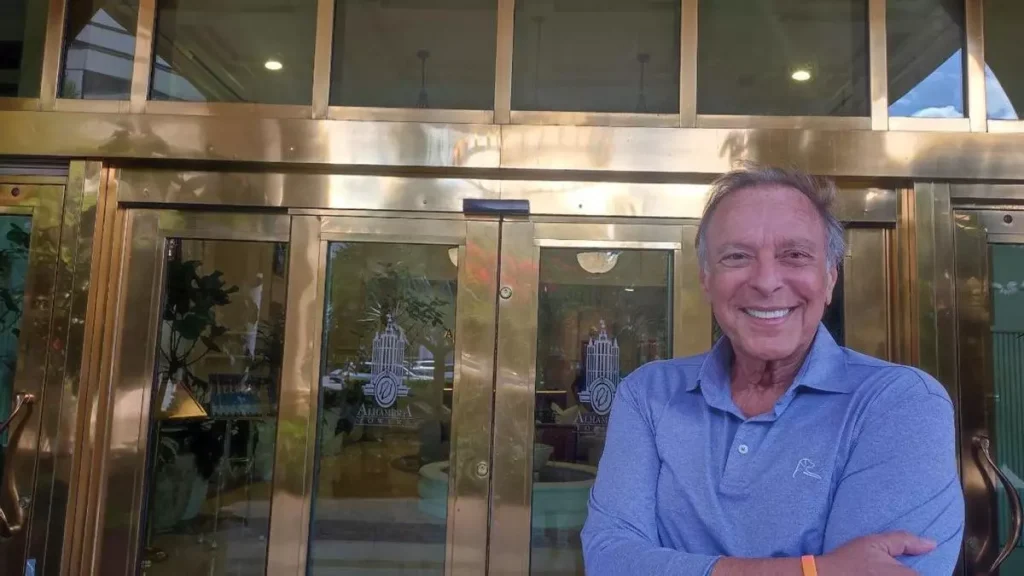
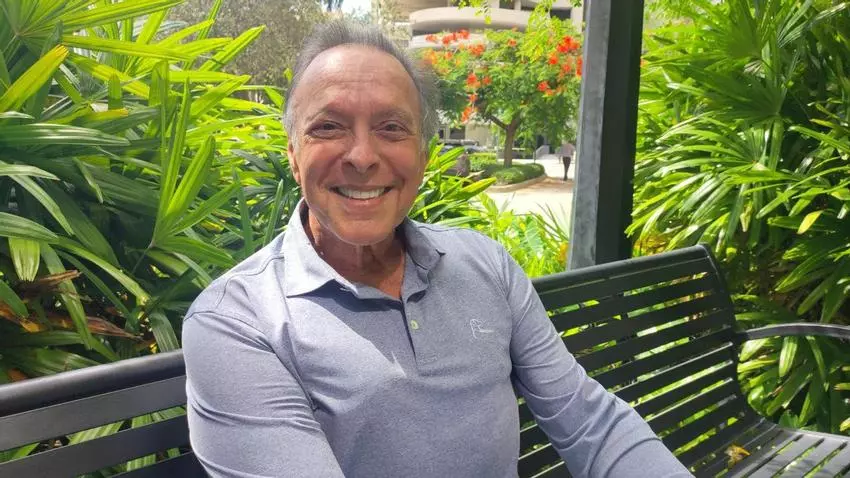
14ymedio, María Casas, Miami, 8 October 2025 — From time to time, he still gets a whiff of the guava jam a neighbor used to make in his hometown of Manzanillo, even though much has happened between that childhood and the prosperous businessman Miguel Mike Fernández is today. Along the way, this 73-year-old Cuban has fought all kinds of battles and now he’s leading the umpteenth skirmish, this time from Miami and out of respect for migrants.
The pharmaceutical magnate welcomed 14ymedio to his office this Tuesday to discuss his crusade of recent months and the challenges facing the island.
14ymedio: Where does your sensitivity toward migrants come from?
Fernández: When my family left Cuba in 1964, we landed in Mexico, and the Mexicans helped us a lot. They gave us a roof over our heads and invited us to meet some nuns who provided protection and services to Cuban migrants like us. On Fridays, we went to that convent to get powdered milk, cheese, and other food items in little boxes they prepared. Six months later, we arrived in New York City, living in a very poor area. At first, I had a good time playing in the streets and attending school, but then winter came, and we realized we weren’t prepared.
A Mexican man, who was a waiter in a restaurant, gave me my first coat and a pair of snow boots that had belonged to his son. So, my life has been touched by the generosity of others from the beginning. In those difficult times, they offered me their help, and I consider it my obligation to serve those who now need me.
14ymedio. What led you to fund these billboards critical of Donald Trump and Cuban-American congressmen, which have caused so much controversy in Miami?
Fernández. As a Cuban, and living in a city with so many Cubans, it pains me to say that most of my fellow citizens have closed the door, as if to say, “I’m in, and that one who just arrived can stay out.” It pains me that my people don’t defend migrants, that they don’t protect them. That’s why I wanted those who support our representatives to realize that they’re not doing us any good by working in Washington. continue reading
“Now I’m contributing to The Dreams US organization, which helps many of these young people continue their education.” / 14ymedio
For these politicians to be elected, they have to raise money and votes. I’ve contributed a lot, and others have too. I always considered this a contract that says, “You want my money and my vote, I want your voice in Washington to represent me.” But they’re not representing us, nor are they representing us in the case of Cuba, nor are they representing us in Miami. They’re not defending the rights of the people who brought them to that position. It was important to say that publicly.
14ymedio. What was the reaction?
Fernández. At first, I didn’t say who was financing the billboards. We spent close to a million dollars, and for months no one knew. Cuban-American representatives even said they had been organized by George Soros’s leftist party, and it was then that I felt compelled to come forward so they would realize I wasn’t a leftist, a socialist, and much less a communist. I was a capitalist, a Cuban, a resident of Miami, and a taxpayer.
14ymedio. You have a letter signed by Donald Trump in your office. What does that framed document on the wall say?
Fernández. Donald Trump is not a good person. I met him years ago and I disliked him like a sore thumb, as my father would say, to the point that I got up from the table and left. I didn’t have lunch with him because of the way he treated the Central American waiter who was serving us food at his club in Palm Beach. I called him out and said, “Forgive me, Don, but that young man has already suffered so much to get here. You can’t imagine what he must have gone through in his country to be able to work at this private club. So don’t mistreat him, do me a favor. Treat him well, that kid is going to become something you can’t even imagine; this is just a stop on his life.” Trump’s response was, “He works for me,” and I got up and left.
14ymedio. And what does the letter say?
Fernández. When he first decided to run for president, he was giving speeches all over the country, and I decided to put up several billboards. One had a picture of Senator John McCain that said “our hero.” Next to it was a picture of Donald Trump that said “our snake.” From then on, I started getting these threatening letters telling me to stop. So I simply sent him a copy with the amount of my annual taxes and said, “If you want to keep sending me letters, it’s going to cost us both.” I didn’t get any more; the one on the wall was the last one.
I simply sent him a copy with the amount of taxes I pay annually and said, “If you want to keep sending me letters, it’s going to cost us both.”
14ymedio. And will all this activism you are currently displaying lead to a political career?
Fernández. I have no interest in politics. I’m doing it because my parents raised me to care for others, to be responsible for what happens around me. After a certain age, I’ve had a privileged life and feel an obligation to give back. This is costing me capital, time, and headaches.
14ymedio. Reactions and retaliation for your actions?
Fernández. About two weeks ago, I was having lunch in a restaurant, and a Cuban man came up to me, with a sour face, and said, “You’re a communist in disguise.” I stood up to shake his hand, but he wouldn’t give it to me, so I asked him if he liked fishing. When he replied that he did, I told him that if he and I were on a yacht in the middle of the sea and we came across a rowboat. The Castro brothers were on the bow. They had no water and were asking for help. There were two small children in the stern. “Would you give them water even though you knew the two old people were going to drink too?” I asked him. The man replied, “Let them all die of thirst.” I can’t be like that.
14ymedio. Aren’t you afraid?
Fernández. I’m afraid of what might happen after the attacks I’ve received, but I’m also receiving very positive calls and comments congratulating me on what I’m saying publicly.
14ymedio. You recently helped place a sculpture near La Ermita de la Caridad in Miami. Who does the piece honor?
Fernández. Every year, my family and I spend at least a month in Europe, and while visiting the Vatican, I see this sculpture of a boat filled with people. It touched me emotionally because they were of all races, from all over the world. When I returned to the United States, I tracked down the artist Timothy Schmalz, and told him I thought it would be interesting to place a piece like that in Miami, where there are so many cultures and several languages spoken, a city built by migrants. The one we put up here is smaller than the one in the Vatican, and the ideal place to put it was right in that church where so many Cubans, Venezuelans, and Nicaraguans go.
14ymedio. “No dogs, no Cubans,” read a sign outside the rental houses when you first arrived in Miami. And now?
Fernández. Unfortunately things are getting very hot.
Unfortunately things are getting very hot.
14ymedio. You recently withdrew funds you donated to Florida International University (FIU). Will you use those resources for any other educational initiatives?
Fernández The Florida government decided to increase the tuition paid by children of migrants not born in the U.S. Many people who were in their final years of college have been forced to drop out because they can’t afford it. It hurts a lot because that document on that wall [pointing to a couple of framed sheets of paper] is the law that was passed in 2011 in this state to charge the child of an undocumented migrant the same as a child born in this country. That was reversed this year.
I’m now contributing to The Dreams US organization , which helps many of these young people continue their education.
14ymedio. You’ve written a book, you’ve walked the Camino de Santiago five times, touched the lives of thousands of people, have five children, a multimillion-dollar business, and have cared for countless dogs throughout your life. What’s left on your personal to-do list?
Fernández. Helping others. I see my life as a book in which I write a page each day, and on that page, I have an obligation to do something for someone each day. Whether it’s a shoe salesman or a mayor. I don’t seek publicity or fame.
14ymedio. Where does this desire to serve come from?
Fernández. From my parents and my Catholic upbringing. My father taught me how to confront evil, and my mother how to be generous. The Jesuits, with whom I studied at school, told me to be a “man for others.”
14ymedio. What is your most vivid memory of your childhood in Cuba?
Fernández. Climbing onto the roof of my house at dusk, lying face up to the sky, and turning on a small radio I’d made myself out of a tobacco box, a magnet, and a speaker. Those were the happiest days of my life.
14ymedio. Any advice for those who run the Cuban economy?
Fernández. Open the doors.
14ymedio. Have you worked for that opening on the Island?
Fernández. I’ve never mentioned it, but a few years ago, I approached the US government about creating an investment fund of around $300 million for Cuba. I met with Cuban officials and told them I had no interest in investing a cent in government projects; I wanted to help private entrepreneurs. That initiative had to be approved by the Office of Foreign Assets Control, and that’s where it remained, in that process. I don’t think an idea like that could prosper right now, and unfortunately, Cuba has a bad reputation for not paying its debts.
They became afraid of the words Obama spoke.
14ymedio. Why did the diplomatic thaw between Washington and Havana fail?
Fernández. I was there for Obama’s speech at the Grand Theater of Havana, and something that caught my attention was that every time he said an important phrase, the officials sitting in the audience first looked at Raúl Castro to see if he would applaud. Only if Castro applauded did they applaud back. Cuba’s future would have changed completely if they had continued to foster that relationship with the US rulers, but that process was destroyed by the fear of the older Cuban leaders, who feared change. They became afraid of the words Obama spoke.
14ymedio. On your return trips to Cuba, have you been to Manzanillo?
Fernández. Yes, I was there once in 1999 and reunited with some childhood friends. One of them still had the bicycle I gave him when my family and I had to go into exile in 1964. It was a very emotional reunion. At first, I didn’t remember much about the city, but as I got closer, the memories began to flood back, and I knew where I had to go to find those friends I’d been inseparable from.
14ymedio. It is better not to return to a place where you were happy… Would you go back to live in Cuba?
Fernández. As long as there’s no political change on the island, I don’t see a future for Cubans or for myself. I hope to be alive when that change occurs. I was in the Vietnam War, and 20 years later, I met a Vietnamese general in Washington. We started talking, and I asked him how his country had managed to establish a capitalist economy. The man pointed to a book nearby and said, “Turning the page.”
14ymedio. So Mike Fernández’s farm, with cows and horses, in Manzanillo… won’t be coming for the time being.
Fernández. No, they would confiscate my cows.
____________
COLLABORATE WITH OUR WORK: The 14ymedio team is committed to practicing serious journalism that reflects Cuba’s reality in all its depth. Thank you for joining us on this long journey. We invite you to continue supporting us by becoming a member of 14ymedio now. Together we can continue transforming journalism in Cuba.
Despite the good performance of a Vietnamese company, only 10% of national consumption was covered in 2024
The private sector has gone from contributing 40% of the rice to more than 50%. / El Artemiseño
14ymedio, Madrid, October 8, 2025 — The participation of the private sector in rice production has grown so much that it has already exceeded the State’s contribution. Based on official information, the economist Pedro Monreal deduces that private deliveries increased from 40.8% to 50%, while the State’s share fell from 55.7% to less than 50%.
“The non-State sector contributes 50% of the rice program, which helps to reduce imports of rice,” the leaders of the sector admitted in passing, participating on Tuesday in the television program Mesa Redonda to explain the agricultural production.
The overall picture is very bleak, even with this vital contribution from the private sector. According to the authorities, the new campaign again will not be good, even with outside help. In 2024, Cuba produced 80,000 tons, just over 10% of its domestic consumption.
The drought that the island has suffered throughout the year does not help at all, although the managers hope that the more recent rains, which have improved the filling of some reservoirs, allow for some optimism. Currently, the reservoirs are at 45% on average, “which does not favor rice activity.” However, the forecast for the cold season is to increase the planting in about 20,000 hectares. continue reading
Currently, the reservoirs are at 45% on average, “which does not favor rice activity “
“Work is being done on the productive chain between two large enterprises and forms of non-state management, which guarantee the inputs necessary for the campaign, while rice-growing enterprises provide irrigation systems, drainage and industrial infrastructure,” they explained yesterday, recalling that there is foreign investment with “significant impact” in two provinces.
They referred, predictably, to the projects of Pinar del Río (in Los Palacios and Consolación del Sur) and Artemisa, where the Vietnamese company Agri VMA owns land in usufruct, with yields evident to Cuban farmers: 7 tons per hectare compared to the country’s average of 1.5, although this rose to 3.5, thanks to the use of bio-fertilizers to solve the shortage of chemicals.
But it will take more than that to improve production. The managers of Agriculture explained that tractors are being leased -probably those provided by Belarus in exchange for rum and coffee, among other things- and “progress is being made on the opening of six comprehensive logistics centers to sell supplies to producers. The first one, they specified, will open in Pinar del Río, offering seeds and technology packages.
It was not specified in which currency these purchases can be made, since a little more than two weeks ago in the same province a shop opened with “more than 100 supplies and products necessary to guarantee production for the tobacco industry and improve the living conditions of producers.” This is how Tabacuba promoted the store, but the goods can only be bought in freely convertible currency (MLC).
As the authorities warn, “all components of the technology package are not yet available, so agricultural yields will remain low.” In Granma province, they said, 12,000 hectares will be sown during the cold season, with the goal of reaching 30,000 in spring, a “figure not reached since 2018.”
To alleviate this bad omen, which the new non-quantified donation of rice from South Korea will not solve either, it is planned to produce more crops that require less water for their cultivation, such as cassava or bananas. Another protagonist of the cold campaign will be corn, both for direct consumption and feed. According to the managers of the sector yesterday, national production of animal feed is “practically nil.”
Cuba spends more than $1.2 billion annually in the import of five products, one of which is corn
Cuba spends more than $1.2 billion annually on imports of five products, one of which is corn. For this reason, the use of transgenic seeds, which give a better harvest, has been promoted for several years but is not very widespread, as the official newspaper Granma regretted last September.
They plan to plant 1,000 hectares of yucca and as many hectares of banana, while recovering the old areas that specialized in this product in Camagüey, Matanzas and Ciego de Ávila. “We are working this year to rescue those historic areas, which at the time were national references for their productive results,” said Julio Gómez Moldón, vice president of the Agricultural Business Group.
The latter again highlighted the task of two of its best known companies, Ceballos and La Cuba, which this year managed to cultivate 4,000 hectares of bananas, the largest figure in its history. In total, this product is one of the few that meet the projections, and by August more than 16,000 hectares were planted throughout the island.
The managers mentioned more projects that are “dynamic,” from the Yabú Valley, in Villa Clara, to the company of Horquita, in Cienfuegos. But Cubans will have to wait to see the fruits of the planted hectares, and if there is a way to bring them to their tables.
Translated by Regina Anavy
____________
COLLABORATE WITH OUR WORK: The 14ymedio team is committed to practicing serious journalism that reflects Cuba’s reality in all its depth. Thank you for joining us on this long journey. We invite you to continue supporting us by becoming a member of 14ymedio now. Together we can continue transforming journalism in Cuba.
The US accuses the Cuban regime of torturing him: “They beat him and subject him to unbearable conditions for demanding basic rights”
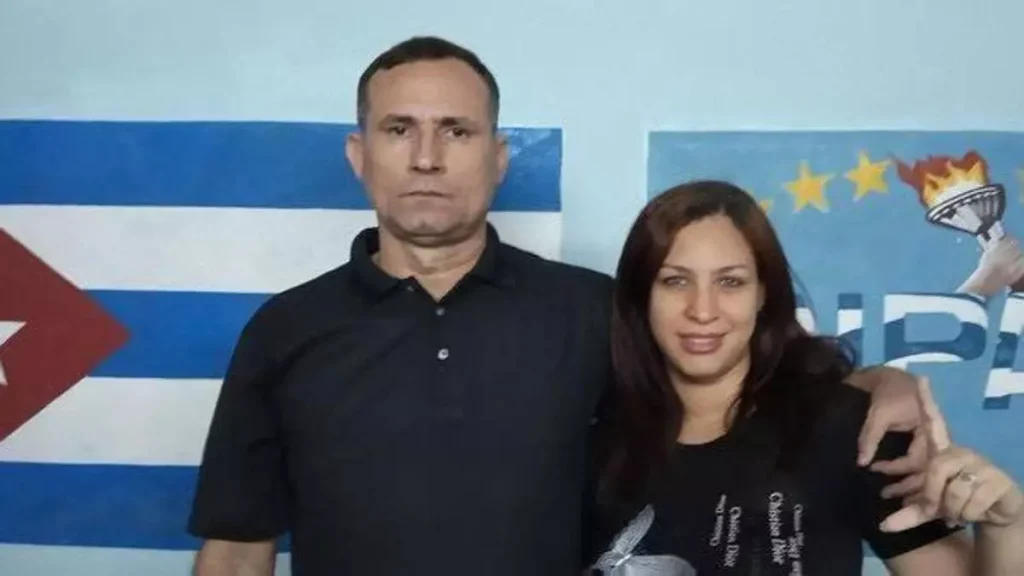
José Daniel Ferrer with Nelva Ismarays Ortega Tamayo in a stock photo. / Facebook
14ymedio, Madrid, October 7, 2025 — The uncertainty about the immediate future of the leader of the Patriotic Union of Cuba, José Daniel Ferrer, is extreme since the possibility came to light on Friday that he would accept exile in order to leave the prison of Mar Verde, in Santiago de Cuba, where he has been since his release was revoked in April. On Monday, his wife, Nelva Ismarays Ortega Tamayo, was detained for several hours after demanding explanations for being denied a conjugal visit this week.
Ana Belkis Ferrer, sister of the opponent, said on Monday that Ortega Tamayo went to the prison to visit her husband, but Captain Liván Laguart Riquelme refused her entry “for no clear reason.” At 12:30 pm, with Ferrer’s wife standing in front of the entrance to protest the decision, four agents of the Ministry of the Interior arrested her, saying that she should accompany them to the Research and Operations Center in Versalles so that someone could explain why she was not allowed to visit.
After taking her there, they kept her for almost half an hour inside the patrol car under the sun. They then drove her to an office where the aforementioned repressors were located: Major Raúl, another with a camera filming and another who initiated the threats. “According to them,” said Ferrer’s sister, “this was her last warning about going on social networks and publishing against the authorities and institutions of the regime, in addition to the current situation of my brave brother. And if another video or publication came out everything would go backwards in terms of the exit process, both for him and for the family, and she would be imprisoned.” She adds continue reading
that her sister-in-law returned home around 2:00 pm in the afternoon.
“According to them, this was her last warning about going on social networks and publishing against the authorities and institutions of the regime, in addition to the current situation of my brave brother”
The leader of UNPACU published a letter on Friday through his relatives in which he explained why he has taken the decision to accept the insistent demands of State Security for him to leave Cuba. In recent months, he said, “the dictatorship’s ruthlessness against me has exceeded all limits,” with “beatings, torture, humiliation, threats and extreme conditions,” as well as “the theft of my food and toiletries” and threats against his family.
However, he explained in the letter, “since they began the procedures to achieve this end, as always happens, the agents of the regime have been playing very dirty: they continue with the plan of harassment, threats, humiliations, thefts and extreme conditions.” Ferrer argued that the authorities want him to demand a dialogue between the Catholic Church and Washington, among other things, something he refuses to carry out, putting his exit in check.
In this context, on Tuesday the pro-Castro media Cubainformaciónpublished an article entitled “The front, the table and the script: The truth behind the speech of dignity and persecution about José Daniel Ferrer.” It brings to mind the video that the authorities published in 2019 with the intention of discrediting him during his arrest, in which he was seen with allegedly self-inflicted injuries. The text insists that he is not “a ‘persecuted patriot’ forced to leave Cuba by the ‘Castro dictatorship'” but runs an organization of “subversive” character that receives money from abroad “as part of the strategy to destabilize our country.”
Furthermore, the article states that Ferrer – who was imprisoned during the 2003 Black Spring – has been in prison not as an opponent but as a “mercenary” and adds that he practices a “destabilizing activism, with subsequent arrests for repeated provocations against the Cuban institutional order.” The report categorically denies that he was tortured, which explains why it was published.
On Monday, hours before the article came out, the US had insisted on condemning the ill-treatment and “torture” suffered by the opponent. In a statement sent to Martí Noticias, the State Department said that “the Cuban regime continues to brutally repress” Ferrer, who is “a leading voice for freedom on the Island.”
“The United States is with him and will continue to act against the illegitimate and oppressive regime in Cuba until all political prisoners are released”
“The Cuban regime tortures José Daniel Ferrer, beats him and subjects him to intolerable conditions for demanding basic rights. But neither the beatings nor the isolation have succeeded in silencing him,” said the State Department. “The United States is with him and will continue to act against the illegitimate and oppressive regime of Cuba until all political prisoners are released.”
The spokesperson also refused to make statements on whether there are any efforts to facilitate the departure of Ferrer and his family. “We have nothing to share right now,” he said.
Translated by Regina Anavy
____________
COLLABORATE WITH OUR WORK: The 14ymedio team is committed to practicing serious journalism that reflects Cuba’s reality in all its depth. Thank you for joining us on this long journey. We invite you to continue supporting us by becoming a member of 14ymedio now. Together we can continue transforming journalism in Cuba.
The families of Daniel Alfaro Frías, José Antonio Pompa López, and Lázaro Mendoza García accuse the trial of being “rigged.”
José Antonio Pompa López was sentenced to eight years in prison / Facebook
14ymedio, Havana, 6 October 2025 — The Havana Provincial Court has sentenced opposition figures Daniel Alfaro Frías, José Antonio Pompa López, and Lázaro Mendoza García to nine, eight, and five years in prison, respectively. The Cuban American National Foundation reported this Monday, acknowledging the family members’ complaint that the trial was “rigged.”
Prosecutor Niurka Margarita Tabares Valdés had requested up to 10 years in prison for “propaganda against the constitutional order,” “association,” “meeting,” and “illegal demonstrations.” For this reason, the official was added on August 12th to the list of Cuban repressors compiled by the Foundation for Human Rights in Cuba.
The evidence presented at trial consisted of 95 stickers with the logo “Act Against Violence,” “nine membership cards of the opposition movement For a New Republic,” and seven shirts, two of them black and five white, bearing the logo of the organization Cuba Primero, with the phrase Violence and an X above them.” In its report, the Prosecutor’s Office argued that one of them, Pompa López, “has received funding from abroad.”
The evidence presented at trial consisted of 95 stickers bearing the logo “Act Against Violence”
Relatives of the three convicted men told Martí Noticias that they will pursue every last resort for their defense. They have five days to file an appeal, starting the day after the ruling is notified.
“They are three peaceful men who have fought against this regime for more than 15 years, demanding freedom for our people and continue reading
demanding that human rights not be violated. It is all because they are part of the Cuba First movement, but they have always shown, and we have always shown, that our struggle is peaceful,” said Suarmi Hernández, Pompa López’s wife.
The three convicted men were held in pretrial detention without trial for more than a year and a half in the Guanajay and Combinado del Este prisons, where they were interned in early 2024.
“Their crime is having distributed anti-government leaflets, being financed and directed from abroad, because it cannot be publicly admitted that Cubans on the island are rebelling against a regime that keeps them mired in the worst crisis in Cuba’s history, suffering from hunger, blackouts, lack of water, medicine, and housing, amid rampant insecurity, and that clings to power through sheer repression,” stated the Foundation for Human Rights in Cuba when including the prosecutor on its list of repressors.
“It cannot be publicly admitted that Cubans on the island are rebelling against a regime that keeps them subservient.”
Dozens of Cubans have been sanctioned so far for inciting against the constitutional order since the new Penal Code was approved in 2022, the foundation said, questioning whether anyone could be charged with these types of crimes “simply for recording their political opinion in writing on social media.”
The organization has been compiling this list for years, which includes, among many others, prison officials who have made decisions that harmed or damaged the physical and moral integrity of political prisoners; judges and prosecutors—many of them based in the United States —who have made unfounded or simply unfair accusations against opponents; doctors who refused to provide treatment options abroad; and, of course, military personnel and members of the Party and government who are part of the regime’s top leadership.
____________
COLLABORATE WITH OUR WORK: The 14ymedio team is committed to practicing serious journalism that reflects Cuba’s reality in all its depth. Thank you for joining us on this long journey. We invite you to continue supporting us by becoming a member of 14ymedio now. Together we can continue transforming journalism in Cuba.
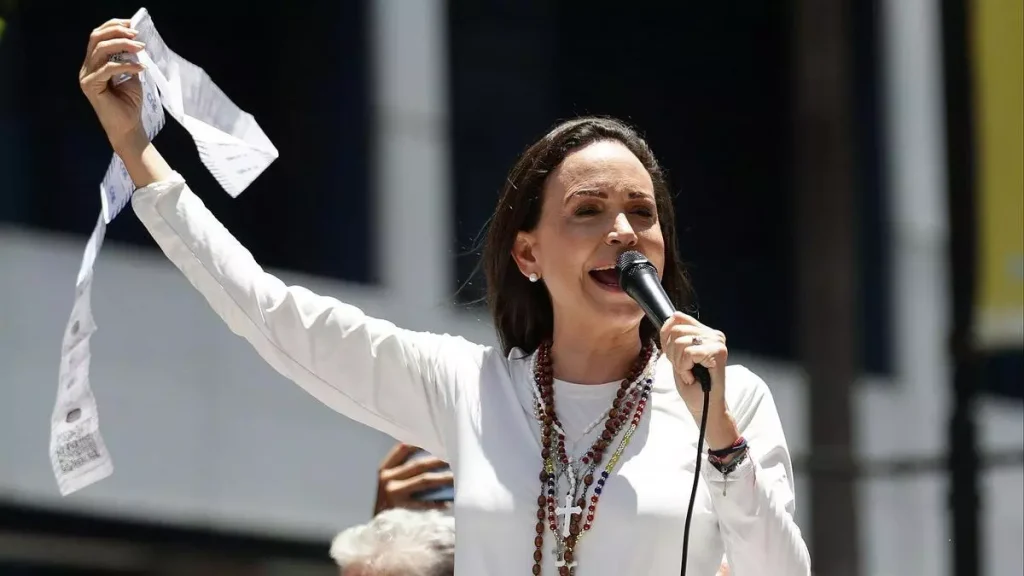
 14ymedio, Madrid, October 10, 2025 — The Norwegian Academy has awarded the 2025 Nobel Peace Prize to the Venezuelan opposition leader María Corina Machado “for her tireless work in promoting the democratic rights of the Venezuelan people and for her struggle to achieve a just and peaceful transition from dictatorship to democracy.”