- The healthcare system is using modified screws to compensate for the lack of basic supplies in fracture surgeries.
- To obtain suitable materials, families turn to the informal market, where a single piece can cost over 10,000 pesos.
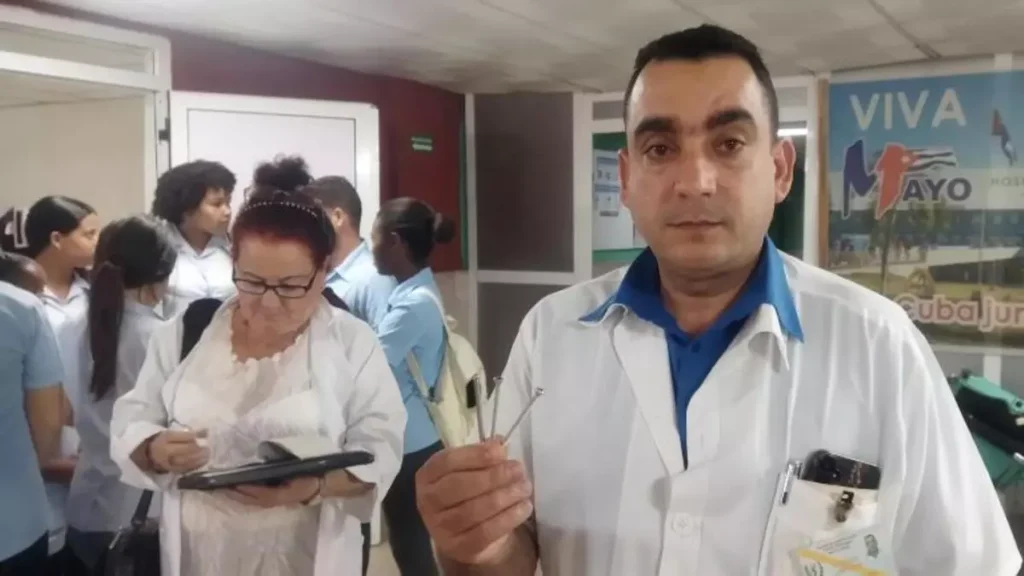
 14ymedio, Madrid, April 25, 2026 — The story of the 4.5-millimeter cortical screw “adapted” in Sancti Spíritus has been presented by Cuba’s official propaganda as a feat of medical ingenuity. But, upon closer examination, the news describes a healthcare system incapable of guaranteeing a basic orthopedic supply and forced to transform one implant into another in order to operate on hip fractures. Are we witnessing a true medical innovation or a desperate measure, technically risky and politically disguised as an achievement?
Dr. Audrey Gutiérrez López himself, when consulted by media outlets in Sancti Spíritus, frankly acknowledged that “the country has been unable to acquire these screws for some time.” He also admitted that “surgeries were suspended for a period in many provinces” and that “currently, many provinces are not performing surgeries because the screws are unavailable.” State media, however, avoid focusing on the disruption of surgeries due to the lack of a standard device and prefer to present the solution to the shortage as an “ingenious achievement” of Cuban science.
The solution described involves taking a cancellous bone screw—specifically designed to be fixed in cancellous bone, the softer, more porous inner layer of bone—and machining its smooth shank to convert it into a 4.5 mm cortical screw—designed to be fixed in cortical bone, the harder, more compact outer layer of bone. The doctor insists that “we are not creating a new material” and that it is merely “an adaptation.” But from the perspective of implant safety, that distinction is fragile.
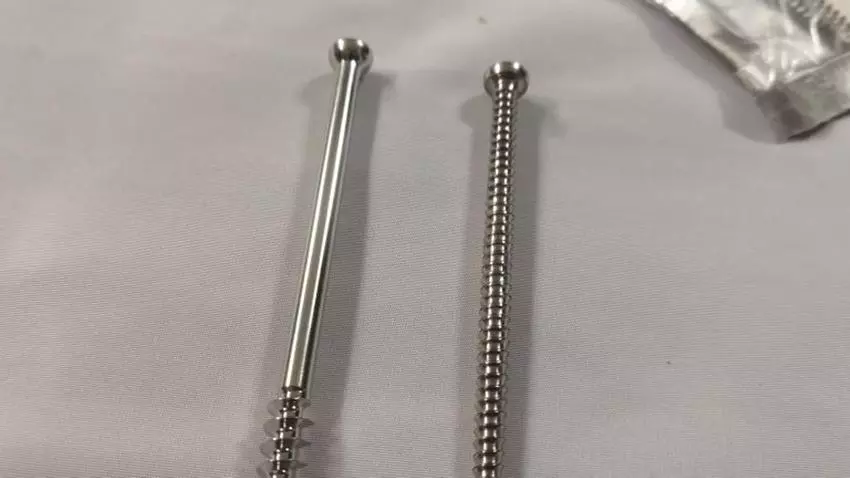
A Cuban surgeon consulted by this newspaper emphasizes the importance of materials. “There is reason to be alarmed,” warns the specialist, who is based in Spain. “Steel for use in human surgical procedures is a special type of steel, with a specific composition, and is subject to specific regulations that must meet minimum standards. In fact, the current trend is for surgical steel devices to be temporary. For more complex and permanent procedures, titanium is preferred.”
The question, therefore, is not whether the original screw was biocompatible, but whether after being machined, threaded, polished and sterilized it retains the properties required for an implant subjected to load within the bone.
Contemporary orthopedics has learned, sometimes at a high human cost, that no implantable material should be assumed to be safe by analogy. Even industrially manufactured technologies used in countries with robust regulatory systems can reveal harm in the medium term. These experiences compel us to view with greater caution a surgical screw remanufactured in Cuba from another implant, given the lack of publicly available independent studies on fatigue, corrosion, sterility, biocompatibility, and clinical follow-up studies.
Another specialist—this time European—who also spoke with 14ymedio, admits he doesn’t understand the reason for this innovation. “Rather than bold, it seems reckless to me,” he says. “I struggle to understand why they are doing it; I suppose it’s due to the limitations of the embargo,” although he admits he’s not familiar with the Cuban context. Finally, he asks: “Don’t they always say in Cuba that they’re a medical powerhouse?”
Nor does the embargo argument, alone, does not support the official explanation.
However, the embargo argument alone does not support the official explanation. US sanctions complicate payments, banking, insurance, logistics, and suppliers, but they do not absolutely prohibit the export of medical devices to Cuba. Section 746.2 of the US Code of Federal Regulations states that exports of medicines and medical devices to Cuba “shall generally be approved,” except for specific exceptions.
Furthermore, the 4.5 mm cortical screw is neither an exotic nor an unattainable component on the international market. In India, 4.5 mm cortical screws are offered from 35 rupees (US$0.40) per unit by some wholesale suppliers. Other Indian manufacturers offer them for 50 rupees per piece. In secondary markets or among Western distributors, Synthes 4.5 mm screws appear for US$7, US$10, US$12, US$20, or US$31, depending on length, brand, condition, and channel. Even in the European veterinary sector, 4.5 mm screws are sold for around €5 per unit. These are reference prices—they may vary depending on certification, sterility, supplier, volume, freight, and regulatory procedures—but they are sufficient to show that this is neither a rare nor prohibitively expensive technology.
Meanwhile, families in Cuba end up buying the same materials on the black market. Gutiérrez López himself acknowledges this: “Many families have to go out and buy this type of osteosynthesis material on the black market.” And he adds that others “can’t,” so “they can’t operate on their patient.” He also admits that the screw reached a price of more than 10,000 pesos on the informal market.
“You can’t treat a human hip like you treat the boiler of a thermoelectric plant.”
A third specialist consulted by this newspaper, this time within Cuba, empathizes with his colleagues in Sancti Spíritus and their search for solutions, but maintains his reservations. “You can’t treat a human hip like you treat a thermoelectric boiler,” the doctor warns. “Modifying the geometry of a surgical screw changes the surface, the thread, the stress concentration points, the fatigue behavior, the interaction with the plate and bone, and potentially the resistance to corrosion and contamination.”
“The risks to the patient are real,” the specialist asserts. “Calling a hastily adapted screw a ‘wonder’ or a ‘miracle’ is, at the very least, irresponsible.”
International literature also offers reasons to be wary of these practices. A classic study on fatigue failures in cortical screws found that all the screws analyzed failed at the root of the thread, precisely a critical area when the thread of an implant is machined or altered.
Another study on reprocessed pedicle screws found corrosion, grease, soap, and other contaminants in implants that had undergone reprocessing cycles. The authors warned that these residues could contribute to surgical site infections or inflammatory responses.
The official account speaks of “patients operated on so far,” but does not present a single documented clinical case.
What independent validation exists regarding the threading, polishing, cleaning, passivation, sterilization, mechanical strength, and biocompatibility of these adapted screws?
Cuban official sources mention Tecal, in Camagüey, as a company involved in the production of prostheses and implants, and highlight that it manufactures partial hip prostheses as part of an import substitution policy. It has also been reported that the Ministry of Public Health, the Union of Military Industries, universities, and the Center for State Control of Medicines, Equipment and Medical Devices participated in the partial prosthesis project, and that the regulator authorized the exceptional use of this prosthesis in November 2022. However, exceptional authorization for a prosthesis does not automatically equate to independent certification for converting cancellous screws into cortical screws.
The official narrative speaks of “patients operated on so far,” but it doesn’t present a single documented clinical case that would allow for evaluating results, follow-up, or the safety of the procedure. The ultimate question isn’t whether surgeons are trying to save lives with these solutions. Obviously, they are. The question is why a country turns a basic deficiency into a propaganda epic.
Screwing bolts in military facilities to resume surgeries demonstrates that we’re not dealing with technological sovereignty, but rather with a supply collapse, regulatory opacity, and the transfer of risk to the patient’s body.
______________________
COLLABORATE WITH OUR WORK: The 14ymedio team is committed to practicing serious journalism that reflects Cuba’s reality in all its depth. Thank you for joining us on this long journey. We invite you to continue supporting us by becoming a member of 14ymedio now. Together we can continue transforming journalism in Cuba.