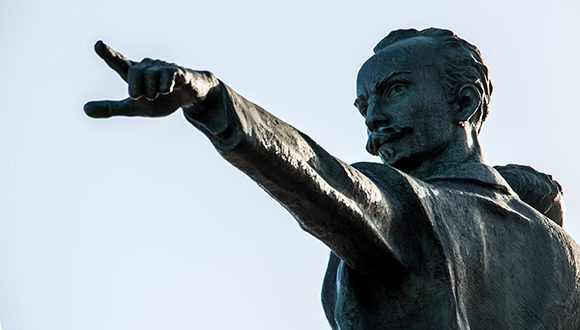
In the early years of his tyranny, Fidel Castro attributed to José Martí all imaginable civic virtues, not out of respect for the patrician, but to use him as a wild card in the construction of the totalitarian system.
 14ymedio, Pedro Corzo, Havana, 27 July 2025 — I have the firm conviction that one of the most regrettable events in the history of Cuba, with grave repercussions in numerous countries far from our shores, was and is the 26th of July 1953, the date of the attack on the Moncada Barracks and the day Fidel Castro entered national history to destroy the future of a now-defunct republic.
Fidel Castro, since his days as a university gang member, counted on a small following of loyalists, but he never enjoyed the popular support to achieve any of the many elected positions he always aspired to, including the presidency of the University Student Federation (FEU), or the same position in the Faculty of Law, or Representative to the House of Representatives, the latter ambition cut short by the disastrous military coup of March 10, 1952.
It is presumed that Castro welcomed the military coup. His many failures in the electoral races convinced him that it was easier to fight with arms than to participate in an electoral contest in which the loser disappeared ingloriously and the winner had to periodically submit to the popular will.
Hence, one of his first slogans, on the very days of the attack on the barracks, was that “José Martí is the intellectual author of this revolution.”
In the early years of his tyranny, Castro attempted to diminish the historical value of our wars of independence, arguing that the patriots had acted out of petty interests, excluding only Martí, to whom he attributed every imaginable civic virtue, not out of respect for the patrician, but to use him as a wild card in the construction of the totalitarian system. Hence, one of his first slogans, on the very days of the attack on the barracks, was that “José Martí is the intellectual author of this revolution.”
Castro, a notable disciple of the best propagandists of Marxism and fascism, loudly proclaimed the virtues of Martí, constantly claiming that the Maestro had been his inspiration while denying one of the apostle’s* most sublime thoughts: “Let us place around the star, on the new flag, this formula of triumphant love: With all, and for the good of all.”
Castro’s lies and the usurpation of Martí’s life and work to justify totalitarianism led Carmen Gómez de Toro to organize a conference with scholars specializing in the life and work of this eminent Cuban, which she later compiled and published under the title we have hijacked for this column.
In the introduction to her book, Gómez de Toro affirms aspects of Martí’s gospel, such as freedom, sovereignty, and human dignity, which are diametrically opposed to the Cuban totalitarian system. She reminds us of the apostle’s comment: “The right of the worker can never be the hatred of capital; it must be harmony, conciliation, and a common understanding of one another.” She adds that Martí divided men into two camps: “those who love and build, and those who hate and destroy,” as has been the result of Fidel Castro’s life and work, which devastated lives and property.
Castro’s lies and the usurpation of Martí’s life and work to justify totalitarianism led Carmen Gómez de Toro to organize a conference with scholars specializing in the life and work of this eminent Cuban
The scholars on José Martí’s life who participated in the conference were Eduardo Lolo, José Raúl Vidal, Emilio Sánchez, and Daniel Pedreira, who demonstrated in their respective presentations that this first slogan of Castro’s totalitarianism is a fallacy without the slightest semblance of authenticity.
In the book, Dr. Emilio Sánchez states: “The distortion of José Martí’s ideas for political purposes immediately emerges upon a careful reading of his splendid work.” Dr. Eduardo Lolo, for his part, notes: “A revolution is still necessary, one that does not make its leader president, the revolution against all revolutions.”
This approach to José Martí, sponsored by Carmen de Toro, is further enriched by the expression also recalled by Dr. Daniel Pedreira: “The homeland belongs to no one, and if it belongs to anyone, it will be, and this only in spirit, to the one who serves it with the greatest selflessness and intelligence.” The book closes with a lecture by a young Cuban, José Raúl Vidal y Franco, who, although he grew up under totalitarianism, had the intelligence and courage to free José Martí from the slanderous lies of Castroism, recalling a fragment of what the illustrious Cuban wrote about Karl Marx upon his death: “The task of casting men upon men is terrifying.”
*Martí was and is referred to as the “Apostle of Cuban Independence”
____________
COLLABORATE WITH OUR WORK: The 14ymedio team is committed to practicing serious journalism that reflects Cuba’s reality in all its depth. Thank you for joining us on this long journey. We invite you to continue supporting us by becoming a member of 14ymedio now. Together we can continue transforming journalism in Cuba.