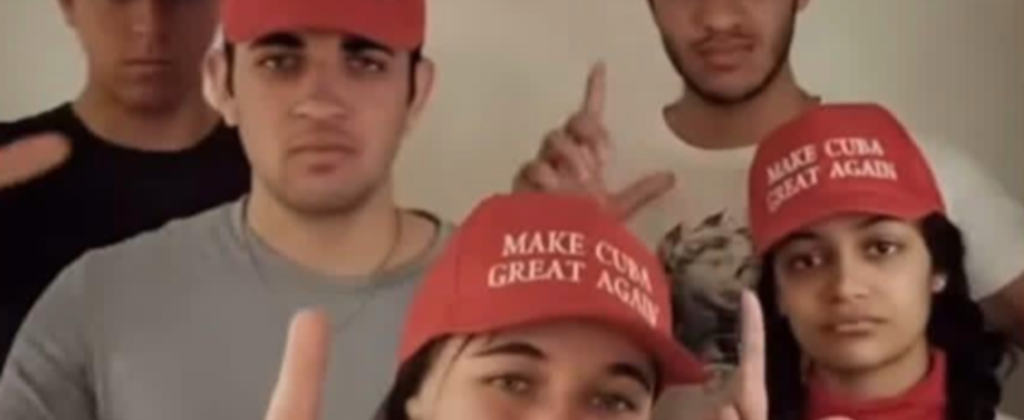
MIGUEL COYULA / “Looks like AI” was the comment from an American friend, a Democrat, on sending me a photo of young Cubans with red MCGA caps (Make Cuba Great Again). Certainly when I saw the image, I instinctively felt a profound sense of unease.
EXTRAMUROS: CUBA SPECIAL
At first, I thought the caps were a collage, then that they had been made in Miami. Then I considered the possibility that the Cuban regime had created them with AI to discredit the internal opposition. If the caps were real, would any small or medium-sized enterprise (SME) have risked making them in Cuba, or would they have been sent from abroad? But in reality, the image contained a much more disturbing artificiality, the extrapolation of which almost bordered on cognitive dissonance. After almost 70 years under the most recent and enduring dictatorship, young Cubans were alluding to a symbol that had become dogma for another authoritarian and fascist-like government. Absolute devotion to ideologies leads to a creed, a religion. The heralds of communism and capitalism preach political dogmas that some embrace fanatically, while for others, the definitions of left and right are exchanged at will, in an increasingly ephemeral way and subject to economic interests.
To mention just a few examples, Donald Trump (at one time a member of the Democratic Party) is now a convicted Republican president, has supported the genocide in Gaza, is responsible for releasing his followers who stormed the Capitol of his country, killing police officer Brian Sicknick. Two more recent deaths are those of citizens Renee Good and Alex Petrie, whose uniformed assassins have yet to be brought to justice. ICE, Trump’s personal army, has propagated xenophobia and repression, deporting more than three million immigrants, including Cubans. His desire for global economic domination, disguised as a “liberator” was already evident in Venezuela and Iran, and it appears that Cuba and Greenland are next.
Trump’s anti-intellectual posture has led some academics to declare him an idiot. His favorite author, Ayn Rand, erected a monument to egotism. I always found it revealing when Roark, the protagonist of The Fountainhead, declares, “No one has a right to a minute of my time,” before dynamiting a housing complex intended for low-income residents. It seemed also to served as inspiration for Elon Musk when he recently said that empathy is a weakness, as if the heroic entrepreneurs of Atlas Shrugged were revealing their true colors.
Roark’s case is interesting because his compulsive determination to preserve his individuality initially resonates with any young person unwilling to follow dogmas. His arrogance could have portrayed him as full of contradictions, a tragic antihero. But the dramatic premise collapses due to Rand’s insistence on turning him into a heroic figure, to the point of becoming inhuman, a kind of ventriloquist of Objectivism, complete with a happy ending. Personally, I’ve never been interested in heroic narratives; I don’t believe in them in art, much less in politics. I’m much more interested in Nietzsche, for his interest in the contradictions of the individual, and not claiming to have the final answer regarding a social model. Perhaps that is why, unlike Marx, his ideas didn’t generate a massive political movement, or in Rand’s case, why her Objectivism has taken root among the neoliberal elites.
Trump isn’t an idiot, but he certainly knows how to talk to idiots. While Fidel Castro sold humanist ideals, Trump promised neoliberal materialism with economic prosperity for all. Both are aligned with seemingly opposing ideologies, yet equally abstract in their physical manifestation. The sociopathic traits of both point to rampant megalomania. One at the helm of a small island, the other leading an empire through executive orders.
Fidel Castro also had expansionist ambitions, in Algeria, Congo, Ethiopia, Angola… He was criticized by many who today call for a military intervention in Cuba by a foreign power. Perhaps underdevelopment, as Edmundo Desnoes wrote, is the inability to connect things and accumulate experiences. It may also be that many have no problem whatsoever with annexationism.
Latin America has historically been the United States’ backyard. Simultaneously, the failure of the Cuban revolution is now more evident in the cultural and political illiteracy of the majority of influencers. The immediacy of the Cuba they present generally appears as an isolated phenomenon, divorced from global complexities and subject to binary reductionism. One of the MCGA guys says that the mayor of New York is a communist, which suggests that his only source of information is Fox News. And in an even more absurd contradiction, they claim not to idolize any politician. Cuba and its problems are, for them, the center of the universe, the worst place in the world, the only one worth talking about and saving. The reality is that Cuba has never been “Great.” There was a republic, yes, led by former liberators from the War of Independence, most of whom became thieves or dictators.
MCGA, MAGA’s new affiliate in Cuba, seems to ignore this. Its Fuera de la caja, Outside the Box, movement derives from an alien ideology and language, unintentionally confining itself to another box due to its own lack of authenticity and of new ideas, something one would naturally expect from a young person.
The reasons these young people invoke Trump’s slogan could be many: naiveté, ignorance, opportunism, cynicism, or simply something far more disturbing… emptiness. The Cuban people are so fed up with the current dictatorship, their senses so dulled, that if Hitler were to rise from the dead and promise to “liberate Cuba,” some might even wear swastikas. That, too, is the new man. Beings incapable of feeling and thinking as citizens of the world, who embrace the nearest invasive globalization as a symbol of freedom in the face of the material and political suffocation of the Cuban regime. They ignore that the violation of sovereignty means a green light for the expansive techno-feudalism of other empires: Russia over Ukraine, China over Taiwan. But the political sense of this Cuban seems to be governed by the programmed range of a traffic light. There is no long-term vision in their thinking. Fortunately, there are other young people on the island who also oppose the regime from a completely different perspective. Unfortunately, they are the minority in a sea of slogans, taken from what could be an Ayn Rand libertarian manual, corrupted by Javier Milei.
I’ve heard automated justifications from various people, such as, “I don’t care. What I want is for the dictatorship to end and for the political prisoners to be freed.” Perhaps if you’re an activist or a politician, that’s the ideal stance: “Unite instead of divide.” But by prioritizing a top-down goal, you’re eliminating the critical thinking necessary to prevent history from repeating itself.
The Cuban government has ineptly announced sanctions, prohibiting pro-Trump demonstrations in Cuba, as if unaware that its unpopularity will provoke a backlash from many. From a conspiratorial perspective, such ineptitude might appear to be a transitional strategy in the face of another kidnapping, stampede, or negotiated surrender.
That said, raiding a home, arresting a person, intimidating them, professionally destroying them, or inducing them into exile simply for expressing a political opinion is unacceptable.
We have endured almost seven decades of similar abuses by a system that still preaches a facade of social justice, blaming the embargo as the sole cause of all its inefficiency, internal corruption, and systematic violation of citizens’ rights.
My great-grandfather was a delegate to the constituent assembly in 1939. During the drafting of the Constitution, despite being an atheist, he proposed the initial invocation of God in consideration of the beliefs of the majority of the population. I am not my great-grandfather. I am not a politician. I am simply a citizen who distances himself from another imminent creed, in the same way that I have distanced myself from the Cuban regime. I believe in the freedom of expression of the young MCGA members, as well as in my own. We share the desire for the end of this regime, but I want to make it clear that they do not represent me. They are not the cause but rather the consequence of the failure of the left, championed by the Cuban regime for its global marketing. The reason for this text is to put an end, in this era of imminent change, to the attempts to align me with Trumpism (the only US president, at least recently, to have a political movement named after him) through private messages, petitions, and invitations to forums. But this also is not nationalism. I’ve always considered myself an iconoclast. I reject anything that smacks of uniform, be it Che Guevara berets or MAGA caps. Perhaps these three stills from my film Blue Heart (2021) best illustrate my point.


The recently concluded Málaga Film Festival was the scene of controversies. Actor Jorge Perugorría, a resident of Cuba, spoke about how the Trump administration’s new measures were suffocating the island. He was criticized by filmmaker Ian Padrón, who lives in the United States, for not mentioning the Cuban government’s responsibility as the true culprit. Both have a point, but neither side tells the whole story. Certainly, the dysfunction of the Cuban regime is undeniable. But the recent measures implemented by the Trump administration have also profoundly affected the daily lives of Cubans. The restriction on oil imports has led to greater fuel shortages, hindering public transportation and driving up the prices of private transport. Electricity is even more intermittent, affecting food refrigeration and water supplies. The prices of food and medicine have increased. The humanitarian crisis already existed, but it is impossible to deny that it is now more severe, and that it is the people, not the rulers, who suffer the most in their daily lives.
Trump’s strategy seems like manipulating animals in a coliseum, starving them so they devour the gladiators. On the same topic, filmmaker Pavel Giroud, who lives in Spain, commented in Málaga that “the enemy of my enemy is my friend,” arguing that during World War II no one questioned Europe’s alliance with the United States. This raises an interesting point, because these days one can’t speak of an alliance with the country, but rather with Trump personally. This president usurps the three branches of government established in the nation’s constitutional principles, dictating, or rather, firing off executive orders without consultation. But his followers exclaim, “He’s not a dictator!” Another colleague in Madrid privately remarked, “Transitions are always a mess.” These are all comments divorced from the physical reality of the island.
Cuba produces 40% of its national crude oil. Faced with this suffocation, it is the people who continue to suffer under this blockade, not the elite leaders, nor the police or the army. They will always be given priority in repressing an increasingly weakened population. Meanwhile, the Cuban regime, which had already lost considerable credibility, is now being revived for the reactionary left as a victim of imperialism in the form of humanitarian aid that never questions the island’s rulers, perpetuating a David-versus-Goliath struggle that further weakens the already diminished internal opposition.
Finally, there’s the human question. Every day I see vulnerable people driven to despair by the escalating crisis, but all of this seems to be considered mere collateral damage. I have lived abroad, and it is true that time, distance, and social media with its algorithms distort and polarize reality.
Facebook is a necessary evil, but its use must be limited. Lynn Cruz recently blocked Humberto Castro, a Cuban painter and fervent supporter of Donald Trump’s policies. We have also deleted or blocked followers or collaborators of the Cuban regime. Our work is barely exhibited in Cuba or Miami, but fortunately, we haven’t needed either of those powers to make our way in the rest of the world. Until very recently, I didn’t truly understand that making a living doing what we love without compromising artistic integrity could be an enviable freedom. Since Castro was a painter, one would think that perhaps art would unite them, but curiously, their only interaction—reactive interaction—is about politics. So, if there is nothing in common, what’s the point of virtual friendship? Some people complain when we delete them, but it’s nothing personal. With our terrible internet connection, receiving a notification to load a page can be torture, especially when you end up facing a repeated message.
I almost always use Facebook sporadically, just to share news about my films, festivals, awards, reviews, etc. When I shared the first version of this text, a user on the site named Jacobo Londres tagged me on his page while sharing my text, saying, “Bah, same old soft crap. Coyula wants Cuba freed, but doesn’t want it to be Trump.” Since he wasn’t my friend, his eloquence made me think he was just another troll, and I simply blocked him to avoid further notifications. Later, Lynn told me that Londres was a virtual alter ego of Javier Marimón, a writer with whom I had exchanged a couple of emails more than two decades ago regarding a possible film adaptation of one of his texts. When I replied that I was busy adapting Memorias del desarrollo (Memories of Development), he responded, “They say it’s utter crap.” I never heard from him again until now, 20 years later. Just before finishing this piece, I had just shared the video that Cinema Tropical had asked me to make to announce Crónicas del absurdo as the best Latin American documentary of the year at the annual awards ceremony held at Lincoln Center. In that video, I criticized the Cuban regime and Trump’s techno-feudalist policies; perhaps that’s where the unease began. In any case, the fact was revealing: In all these years of posting cultural news, Marimón’s only reaction, now living in London, was prompted by this, a political opinion piece, which seems to highlight his true motives.
To a certain extent, I can understand why many Cuban emigrants applaud Trump, but in doing so, they declare themselves indifferent to the physical reality of their compatriots, friends, and family on the island. An island where most never dared to dissent while living under the iron grip of its institutions. And this Castro-Trumpist limbo of reconcentration (to quote Lynn Cruz) could extend indefinitely, just as the conflict in Iran has, projecting itself as a process of attrition similar to Vietnam. While the US economy begins to collapse, many continue to applaud the world’s policeman, the conqueror of the universe, with his brand-new Department of War, the same person to whom María Corina Machado gifted her Nobel Peace Prize.
In this case, the burden falls on the Cuban people, not their leaders. Everyone hopes for Cuba’s liberation, unaware that they will most likely witness only a change of facade, the removal of the repressive figure who issued the order to attack the population on July 11th, but, as in Venezuela, replaced by another Delcy Rodríguez who will sign off on economic submission to Trump. Those who expect a president who bypasses Congress and the Senate to be interested in bringing democracy to Cuba are deluded. This demonstrates that true freedom is of interest to very few. The sad truth is that the promise of economic improvements is enough for a silent majority to tolerate yet another dictatorship. Mike Hammer, the US mission chief in Havana, was recently cheered at the Church of Our Lady of Charity in Regla, announcing the spread of the gospel as another weighty dogma on the political chessboard of the imminent new-archaic-society heir to all Latin American corruptions, quoting the cynical protagonist of my novel The Vertical Island: “An ideal of progress that we would live after the change that many called democratic.”
As a filmmaker, I make movies controlling every detail of their staging. But unfortunately, being able to appreciate them in a theater, the format for which they are designed, is something I’ve only been able to do outside the island. After years of censorship, change would benefit me. Even as a source of inspiration, I’d finally have new politicians to rail against. But I’m thinking about more than just myself. I wish that in the midst of this situation, an independent, internal political voice would emerge, someone who doesn’t follow in the footsteps of Castro or the volatile Trump. The social democracy of many Nordic countries, while not perfect, I consider to be the most humane model currently available. The ideal model hasn’t been created yet, nor can I, or intend to, imagine it. I think the best governments are those that are unobtrusive. Good administrators don’t have to worry about being strident. I know that’s probably another utopia: We are Cubans.
Miguel Coyula (1977) is a Cuban filmmaker and writer. He has created his work without institutional support, employing a multidisciplinary approach. His notable films include Red Cockroaches (2003), Memories of Development (2010), and Blue Heart (2021). His work is banned in Cuba. The magazine Cineaste describes him as “…someone whose innovative and challenging way of understanding cinema is not here to appease or flatter. It is here to sting.”