If someone wants to find out what is really happening in Venezuela or Cuba, the healthiest thing is still to change the channel.
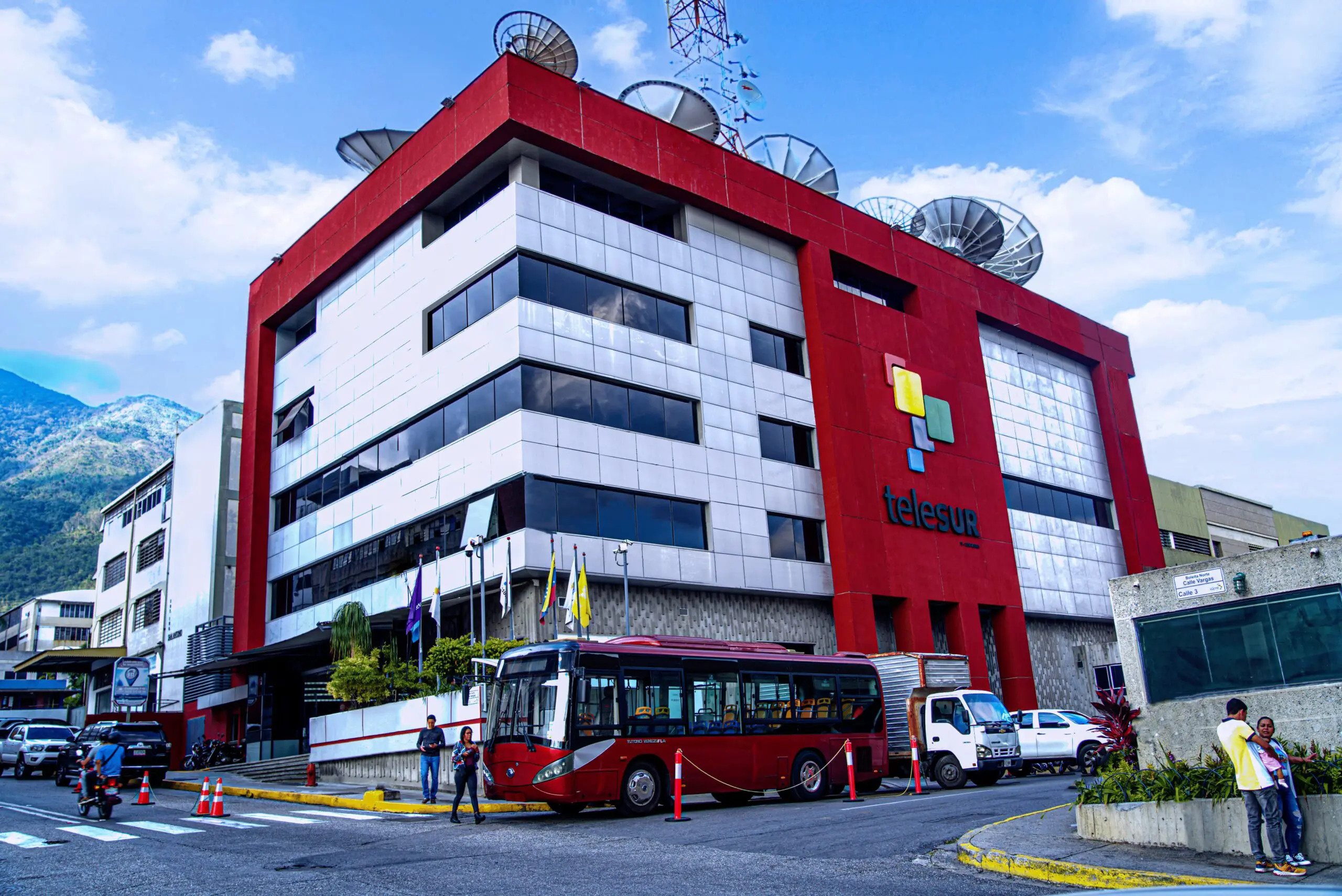
 14ymedio, Yunior García Aguilera, Madrid, 25 July 2025 — For two decades, Telesur has insisted on calling itself “Latin America’s news channel.” But just five minutes of viewing is enough to notice that they don’t even hide their bias. Their editorial line is a rearview mirror stuck in the dystopia of 21st-century socialism. What they present as journalism is, in reality, a script written by Castro’s ideologues and dressed up with Bolivarian histrionics. If anyone wants to find out what’s really happening in Venezuela or Cuba, the best course of action is still to change the channel. Or better yet, turn off the television.
The multi-socialist-state company was born in 2005 as a move by Venezuelan President Hugo Chávez to counter “the media hegemony of imperialism.” They dreamed of a kind of Caribbean CNN, with a guerrilla accent and insurgent spirit. What they created, however, was an audiovisual tableau where each bulletin seems like an act of faith, and each presenter an evangelist of failure.
However, even the most fervent revolutionaries have to pay rent. And Telesur, like every socialist project, is burdened by unpaid bills, job insecurity, favoritism, and a staff that increasingly disbelieves in what it broadcasts. Journalists from the English-language station have denounced years of falling wages, subsistence working conditions, and a toxic environment where the only ones who prosper are the loyal, not the talented. To ‘resolve’ the problem, as we Cubans say, they turned to students from the island to provide translations and subtitles for prices so low they would make even the most greedy capitalist blush.
Even those who once believed in the project and still retained their dignity ended up jumping ship.
Even those who once believed in the project and still retained their dignity ended up jumping ship. Leandro Lutzky, an Argentine journalist and the news program’s prominent figure, resigned when the channel applauded the Venezuelan elections as if they were a demonstration of Scandinavian civility. Seeing Telesur declare that Maduro was elected “transparently” in 2024 was, for Lutzky, the limit. He left. And he said it out loud.
And then there’s Walter Martínez, the man with the eye patch, who for years greeted “the crew of our beloved, contaminated, and only spaceship” from Dossier. A journalist with decades of experience and a memory that ended up bothering the amnesiacs in power.
Martínez accused former minister Andrés Izarra, the channel’s first director, of appropriating other people’s ideas and the public funds that were intended for Telesur’s infrastructure and the launch of the Simón Bolívar satellite. “Izarra embezzled the State,” Martínez said. In his calm style, he made it clear: surviving in that ecosystem today requires “very agile hands.” And everyone understood.
But the most personal part would come later. In 2020, Martínez denounced the station’s current president, Patricia Villegas, for withholding payments, hiring fellow citizens with salaries in dollars, and excluding him from the Venezuelan Television (VTV) channel under the pretext of protecting him due to his age during the pandemic. “She doesn’t want to compensate me for my work, but she brings in fellow citizens paid in dollars,” he said. And as always, there was no response.
Martínez also revealed that Villegas requested eight million dollars to establish a Telesur channel in Ecuador, because—according to her—that country “deserved more media coverage than Venezuela.” A statement that, coming from the president of a supposedly Venezuelan channel, spoke volumes.
From the forced departure of Aram Aharonian to the current silent purge of journalists, the channel has shown that the only thing it does not allow is dissent.
Censorship also came knocking on Martínez’s door. His program was taken off the air on VTV by order of Minister Jorge Rodríguez after he attempted to interview an opposition figure. The guest was yelled off the channel. And Martínez’s microphone was turned off.
According to him, Patricia Villegas runs the channel as if she were more powerful than Maduro himself. She calls assemblies, appoints vice presidents, distributes resources—in dollars, of course—and acts with the tacit support of the leadership. She doesn’t run a television station; she administers a doctrine.
From the forced departure of Aram Aharonian, one of its founders, to the current silent purge of inconvenient journalists, the channel has shown that the one thing it doesn’t allow is dissent.
If it was once a promise, today it’s merely a caricature, a monotonous newsletter where pluralism is a crime. And like any dogmatic sect, it has only two options for apostates: exile… or invisibility.
____________
COLLABORATE WITH OUR WORK: The 14ymedio team is committed to practicing serious journalism that reflects Cuba’s reality in all its depth. Thank you for joining us on this long journey. We invite you to continue supporting us by becoming a member of 14ymedio now. Together we can continue transforming journalism in Cuba.