Daniel Santovenia is Freed After 27 Years in a Cuban Prison

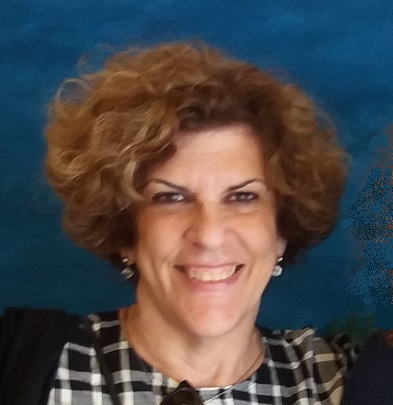
Daniel Santovenia in a recent photo.

14ymedio bigger14ymedio, Havana, 8 October — Daniel Santovenia was released this Saturday after 27 years in prison, according to the writer Angel Santiesteban who confirmed it in his Facebook account. The opponent of the regime was captured in 1991 when he arrived clandestinely in Cuba to start a campaign of sabotage on the island.

“As of today he will no longer sleep while imprisoned, except inside the big prison that is the island of Cuba,” wrote Santiesteban on his wall of that social network. “We hope that soon he will be truly free when he arrives in Miami”, he added.

63 years old, Santovenia Fernandez was sentenced to 30 years and spent 22 years in common cells, while for another five he was interned in a “minimum security” camp, according to the Martí News website. continue reading

The arrest of Santovenia Fernández occurred on December 29, 1991 near the city of Cárdenas, in Matanzas, when he arrived on a boat from Miami. He was accompanied by Pedro Álvarez Pedroso and Eduardo Díaz Betancourt and during the capture the agents found weapons and ammunition.

The three detainees were sentenced to death, but in the case of Santovenia Fernández and Álvarez Pedroso the maximum sentence was commuted.

Daniel Santovenia was captured in 1991 when he arrived clandestinely in Cuba to start a sabotage campaign. (OCDH)

Diaz Betancourt appeared in images before the court reading from a notebook that was found on him containing the names and addresses of three well-known opponents, Gustavo and Sebastián Arcos and Yanes Pelletier, members of the Cuban Committee for Human Rights ( CCPDH). Shortly thereafter pro-government picket lines surrounded the houses of the Arcos brothers shouting insults and slogans.

The three members of the CCPDH were associated with the case by the Ministry of the Interior, according to Cuban television, and were arrested hours before the announcement of the sentences.

Petitions for clemency to commute the death penalty of the three defendants came not only from the US Government, which denied any connection to the alleged terrorist mission, but also from the then presidents of Nicaragua and Spain, Violeta Chamorro and Felipe González.

The Cuban Commission for Human Rights and National Reconciliation, based in Havana, also made repeated calls to improve the prison conditions of the two convicts who avoided the firing squad. However, Díaz Betancourt was executed on January 20, 1992.

Translated by Wilfredo Díaz Echevarria

____________________________

The 14ymedio team is committed to serious journalism that reflects the reality of deep Cuba. Thank you for joining us on this long road. We invite you to continue supporting us, but this time by becoming a member of 14ymedio. Together we can continue to transform journalism in Cuba.


Political Discrimination / Fernando Damaso

Fernando Damaso, 30 August 2018 — The need to eliminate the various types of existing discrimination is constantly discussed and written-about in Cuba. Among them: race, gender, sexual orientation, region or country of origin, physical or mental disabilities, etc., etc. Even so, nothing is said or noted about getting rid of political discrimination. Apparently, just as the “irrevocable socialism” article–appended to the previous Constitution and also present in the current one–says, it possesses a like character.

Political discrimination has been a constant practice, applied from the highest levels of the Party and the State towards any such citizen who does not agree with the party line, and it can be seen–in its most fanatic, dogmatic and unhealthy extremes–in the Union of Young Communists, and in the student and youth organizations ruled and controlled by it.

Its leaders, advised and directed by their party and government “elders,” shout outdated slogans, rattle on about subjects of which they know nothing, and regularly use physical violence to impose their retrograde ideas on the rest of the young people.

They have tied them to the past, swindling them out of their present and compromising their future. For them there is no such thing as respectful dialogue, nor civilized engagement with differing opinions, because they have been brought up in the perpetual monologue: that of themselves with themselves.

Translated by: Alicia Barraqué Ellison

Pacts / Regina Coyula

Regina Coyula

Regina Coyula, Havana, 5 October 2018 — State Security has not only forbidden me to travel to Spain (where I should have been on the 25th of September), but “el compañero who attends me” (i.e. my own personal State Security minder) has been promising me since Tuesday the 25th that this prohibition would be lifted, a falsehood that discredits his institution still more, and at the very least calls into question his professionalism.

Contrary to my desire, I have postponed this trip I’d dreamed of. If this were a country of laws and rights, someone would have to compensate me, because I don’t have so much as a citation for stepping on the grass, much less is there a reason to limit my movements, but being a dissenter – and writing about it – makes me an enemy of the State.

All that’s left for me – because I didn’t do the thing they told me not to do – is to lodge a complaint with the Citizenship Service of the Ministry of the Interior and make it known among my friends.

Alcides already expressed it in an epigram: The pacts between bandits and knights do not work and the knight ends up in jail. The bandit will never become a knight but the knight ends up becoming a bandit.

With the Detention of the Rapper Maykel ‘El Osorbo’, Do We Have Legal Certainty in Cuba? / Cubalex

Cubalex, 29 September 2018 — The District Attorney’s office in Havana Vieja is trying to revoke the decision taken 3 months ago by the police to fine the rapper Maiquel Castillo 1000 pesos. The rapper was violently arrested last 22nd June. They accused him of threatening the authorities when he filmed a house search in Cristo Park.

The law enforcement authorities have kept Maiquel Castillo, also known as “Maiquel El Osorbo”, locked up since 25th September 2018, to get back at him for joining the campaign against Decree 349. His case is evidence of the lack of legal certainty in Cuba.

The criminal law authorises the police to interpret it and apply it as if they were judges, in the nearly 27% of offences they deal with. These officers, instead of remitting the cases to a tribunal, judge them and apply fines. continue reading

What we do know is, if he accepts the imposition of a fine, he would be acknowledging his guilt (destroying his own presumption of innocence). The police do not take the trouble to declare that they “will refer the matter to the competent authorities (…)” only when the “offender requests it or does not pay the fine”.

Receipt for payment of a 1,000 peso fine.

Returning to the case of “Maiquel El Osorbo”, who paid the fine the same day that it was imposed, the law says “if the offender pays the fine (…) within 10 working days of its imposition, the matter will be considered as closed, and will not be recorded as an offence.”

Most people accept the fine, “doing an 8.3”, as it is commonly known, to get the matter finished with. The truth is that there is no difference between a judgement by a  policeman (who has hardly made it to the ninth grade) and a judge (law graduate), who is subject to all sorts of influence by State Security and the Ministry of the Interior. Anyway we all know how we will end up if we take it into our head to get the better of a policeman, and that nothing will come of it.

So we have to ask whether the tribunals and district attorneys should adhere to a decision taken by a policeman to impose a fine? And as and when they may be satisfied, whether this decision should have the same value as a definitive judicial sentence?

Or whether, on the contrary, can a policeman, district attorney or tribunal be at liberty to change their opinion, regarding a decision already taken, to revoke it, and consider an act to lack “social danger because of  its limited consequences and the social condition of the author of the act”?

For the crime of assault, there is an expected prison term of from one to three years. In such a case, the police should require the approval of the district attorney, as set out in the criminal code. Can the attorney’s office go against its own decisions?

Can a citizen have confidence that the observation of and respect for legal procedures will be maintained in every case, in accordance with the legal framework of the country? And, what happens if you are not of that view?

Translated by GH

A Time That Should Not Be Forgotten / Fernando Damaso

Fernando Damaso, 25 September 2018 — When I argue that the Cuban Communist Party lacks aby historical endorsement for calling itself the “leading force of society and of the state,” I do so based on concrete facts of its trajectory. One of them is in reference to their current acceptance of sexual diversity.

Although, before 1959, the original Communist Party was never homophobic (it had in its ranks important figures and homosexual militants of both sexes), after 1959, with its new leadership, this liberal policy changed and it became homophobic, devoting itself to rejection, persecution and repression of homosexuals and of those who seemed to be so, in all spheres of society, beginning with the artistic and intellectual world.

Do not forget the infamous “gray decade,” where important artists and intellectuals were marginalized and repressed due to their different sexual preferences. Although, later, the blame for this was attributed to certain characters, used as “scapegoats,” these had been placed in office by the Party and the Government and, simply, they obediently executed the discriminatory policy they were ordered to apply. continue reading

The National Council of Culture, the Cuban Radio and Television Institute and the universities are good examples. But not only was the artistic and intellectual sector was affected: in workplaces, institutions of secondary and pre-university education, mass governmental organizations (the so-called current civil society), military units and, as was logical, in the Party and in the Union of Young Communists themselves, many Cubans with different sexual preferences were publicly questioned and expelled.

The Military Units in Aid of Production, the infamous UMAP, interned not only homosexuals, but also those who wore long hair, wore tight trousers or listened to the music of The Beatles, because these later behaviors were considered “attributes” of the former. Those who professed some religion also fell in the raids.

The facts are there and also the many lives destroyed. None of the primary leaders has asked for forgiveness from the Cuban people for all these barbarities.

In these critical moments the Party, unanimously, supported and executed all these arbitrary measures promulgated by its leaders, although now, also unanimously, under the influence of the daughter of the current First Secretary (Mariela Castro, daughter of Raul Castro), it proclaims itself a defender of sexual diversity and even of marriage between persons of the same sex.

These extremist swings in its history, together with many other well-known ones, invalidate the Party establishing itself in the constitution as a “leading force of society and of the state.”

Embracing a Brother After 12 Years / Ángel Santiesteban, Amir Valle

Ángel Santiesteban-Prats with Amir Valle in Berlin. Photo by Anna Weise.

Amir Valle, September 16, 2018 — Embracing a brother after 12 years of separation imposed by a dictatorship is a special, unforgettable moment. We both have advanced in our literary and civlc careers: Ángel from Cuba, as an intellectual opponent, and I from the exile into which I was forced in 2005. But nothing has managed to destroy all the things that unite us like brothers since we knew each other from the time we were kids and had the luck to read each other’s first stories. More than half our lives together, in good times and bad, and now we rediscover each other in Berlin. Here we are together, in a photo taken by a friend, the German photographer Anna Weise.

Amir Valle

Translated by Regina Anavy

Cuba Will Issue Stamps with Fidel Castro Despite Legal Prohibition

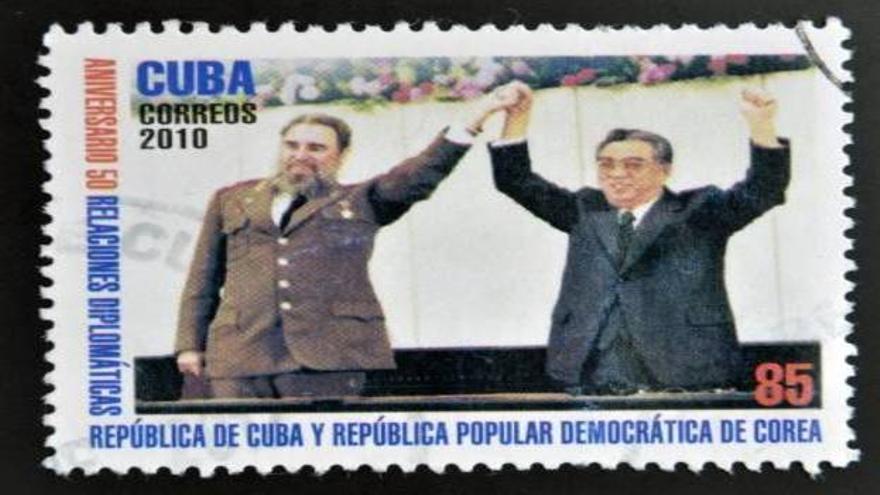
Stamp to be issued in the Island to commemorate the relations between Cuba and North Korea. (123rf.com)

14ymedio biggerEFE/14ymedio, Havana, 4 October 2018 – Next week Cuba will issue the first stamp dedicated to Fidel Castro since the death of the former leader almost two years ago, according to reports from the state entities Correos de Cuba (Cuba’s Post Office) and the Federación Filatélica (Philatelic Federation) speaking to media in Havana.

A month after the death of the former leader, in November of 2016, the National Assembly of People’s Power unanimously approved a bill which prohibited marketing Fidel’s image and the use of his name in public spaces, but this has not prevented the post office from publishing a new stamp. continue reading

The stamp dedicated to Fidel will be part of a postal series dedicated to emblematic patriots of Cuba — among them José Martí, Carlos Manuel de Céspedes, Ignacio Agramonte and the Maceo family — whose inaugural printing will take place on Tuesday October 9 in the city of Bayamo, in Granma provinces, the entities told the ruling party newspaper Trabajadores (Workers).

The series will be issued to commemorate the 150th anniversary of the October 10, 1868 uprising, which marked the beginning of the struggles for Cuban independence from Spain.

Born in 1926, Fidel Castro governed Cuba from the 1959 Revolution until he fell ill in 2006, when he left power in the hands of his brother Raúl, and he died a decade later on November 25, 2016.

The first stamps with a young Fidel date from shortly after the Revolution as part of the state’s policy to support the cult of personality of the leader, but since his death no stamps had been issued with the face that exercised absolute power in Cuba during more than four and a half decades.

Translated by Wilfredo Díaz Echevarria

__________________________

The 14ymedio team is committed to serious journalism that reflects the reality of deep Cuba. Thank you for joining us on this long road. We invite you to continue supporting us, but this time by becoming a member of 14ymedio. Together we can continue to transform journalism in Cuba.

Speaking of Inviability / Fernando Damaso

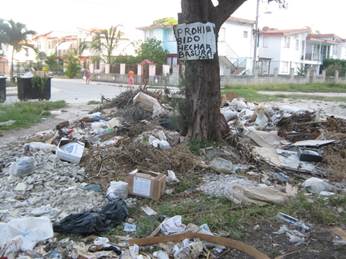
Sign on tree: Forbidden to throw trash.

Fernando Dámaso, 3 October 2018 — Five reasons that demonstrate the inviability of socialism in Cuba.

1. In 1958, Cuba occupied the 29th place among the largest economies in the world. After 60 years of the socialist experiment, it has come to occupy one of the last places, both for its economy and its GDP.

2. From being the largest sugar producer in the world, with annual productions that grew from a few thousand to 7 million tons in 1952, with an annual average of 4-5 million, for years the country now produces a figure similar to that of 1894, which was 1,054,214 tons. continue reading

3. From having, in 1837, the first railroad in Ibero-America and the third in the world, it now has the worst railroad, with obsolescence in railroads and equipment, incapable of even working badly and providing an elementary service. The same has happened with vehicular transport in roads and towns and cities, with roads in terrible condition and insufficient car parking.

4. From having, in 1958, important light industry, where more than 10,000 different articles were manufactured, which satisfied most of the national demand, today everything has to be imported, including items as simple as toilet paper, detergents and jams.

5. From being a hygienic country, characterized by cleanliness and the state of conservation of its towns and cities, it has become an unhygienic, dirty country with ruined buildings, with 45% of the homes at the national level, in a “bad and regular” state.

There are many more economic, political and social reasons to demonstrate the nonviability, shown by chain of failures of socialism in Cuba, but these five are more than enough.

In short, socialism has shown its unviability wherever it has been tried, including China and Vietnam, where they have had to adopt the market economy to get out of arrears and achieve development, although they still maintain their political-partisan status.

Our Golden Years / Rebeca Monzo

Artwork by Rebeca Monzo

Rebeca Monzo, 30 September 2018  — I was preparing for my golden years with the expectation that they would be enriching, that my social life that would be an active one. I collected books and music which I would share with friends. I certainly did not expect to face a very difficult financial situation. My expectations were predicated on the assumption that I would enjoy a minimum level of comfort. It would also be the time when I could most enjoy my family. There was nothing to suggest that I would not be able to continue working to support myself, that my children would no longer live in Cuba, or that I would barely know my granddaughters or not be able to care for them. I have had to rethink my life, to look for other options while weighing the cost of starting over.

By the end of the 1980s I had decided to quit working for the country’s sole employer: the state. I was able to join the Association of Cuban Artists and Artisans. This decision improved my quality of life and provided me a modicum of independence. My income was no longer tied to a job that paid poverty level wages. continue reading

An artist does not grow old; she remains creative her entire life. This has allowed me to remain financially solvent. Even though I have not been able to achieve all my aspirations, I am happy with everything I do.

Today, I consider myself to be a reasonably independent person, someone who has achieved a lot. I don’t get stuck, I don’t get depressed, I don’t get lonely. Instead, I change course. I spend what little free time I have with friends, which partially fills the enormous void.

But in spite of all my physical and emotional efforts, I still do not have the basics. I cannot count on having a good diet. My clothing, a refection of foreign fashion trends, is provided by relatives who live overseas. Even thinking about a vacation is out of the question. Going to Varadero, or even to a hotel pool, is a luxury. In spite of advances in telecommunications, family interactions are practically nonexistent given the very underdeveloped state of technology here. Because I lack the necessary support and am horrified by local hospitals, I live in fear of getting sick. Given the imbalance between income and prices, it is impossible to save. The most basic, routine expenditures are major concerns. As a person who has always tried to do the right thing, I find all this frustrating.

I move in a social circle of elderly people which is shrinking. The loss of friends becomes ever greater. Many leave for Miami, others for the cemetary. Relations with younger people are also reduced because they have other interests and, it should be added, few of them like to spend time with us. They often see us as a hindrance, in a general sense, and believe our disappearance would improve the quality of their lives.

In the 1960s those of my generation lost a large portion of their families and friends to large scale emigration. We had to build new families and make new friends. Then in the 1990s we had to do this all over again.

Near the end of 2000 I was able to travel to Miami where I met with lost family members as well as friends from childhood and adolescence. As childeren they had been evacuated out of Cuba as part of Operation Peter Pan, with hand-painted signs pinned to their chests. They are all retired now and enjoy a high standard of living. They have nice homes and modern cars. When they came to see me, they were well dressed and, with great tact, gave me a lovely wallet with cash inside. Me, the “barbarian” who had stayed in Cuba.

Who is the real barbarian? There were no outright rebukes but I felt I had been brought down a notch.

In Cuba the old class structure was replaced by one based on absolute power.

I belong to a generation that remains trapped between a pre-1959 Cuba and one that has no relationship to established social norms. This makes us misfits, unable to adjust to the current chaos. We are paid our insignificant salaries and pensions in Cuban pesos but are expected to live as though we were paid in convertible pesos.

More Than Half of the Activists Arrested in Cuba in September Were Women

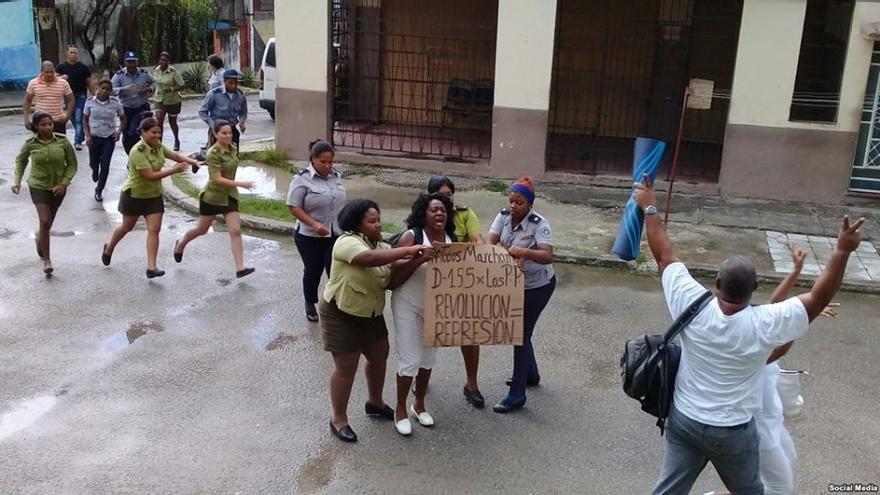
Berta Soler (center, holding cardboard sign), leader of the Ladies in White (Damas de Blanco), was arrested during a demonstration in Havana. (Ladies in White)

14ymedio bigger14ymedio, Havana, 3 October 2018 — More than half of those arrested for political reasons in Cuba this September were women, according to the report of the Cuban Commission for Human Rights and National Reconciliation (CCDHRN). The organization counts 224 arbitrary arrests this month.

“Peaceful dissidents and activists of the independent civil society” were confined, “under generally inhumane and degrading conditions, in police stations or other authorized places,” detailed the document prepared by the independent organization based in Havana.

“The number of arbitrary detentions registered in September was practically the same as in the previous month of August (229)” and “some detentions extended for more than 24 hours,” detailed the CCDHRN. continue reading

The report pays special attention to the case of the leader of the Ladies in White, Berta Soler, who “this Sunday, September 30 was arrested with unusual violence and a dangerous injury to in her right eyeball.”

“Much more than half of the arrests were of women, most of them members of the Ladies in White movement,” says the report. The Commission also recorded during September “23 harassments and 4 physical aggressions against opponents who were not detained.”

“The situation of Tomás Nuñez Magdariaga, an activist of the Patriotic Union of Cuba, who has been on hunger strike for 49 days, in protest at the 1-year prison sentence imposed on him, is particularly disturbing,” denounces the report. The CCDHRN labeled the opponent’s trial “rigged and arbitrary.”

The Commission intends to start this week “the international procedure established to declare prisoners of conscience of five Ladies in White confined in prison, under subhuman conditions, due to their peaceful activities in defense of human rights.”

The Ladies in White who remain in prison are Marta Sánchez, Nieves Matamoros, Aimara Nieto, Yolanda Santana and Xiomara Cruz.

On Monday, a representative of this female opposition group denounced to the Inter-American Commission on Human Rights (IACHR) the situation of her female colleagues and asked the commission for help.

Blanca Reyes went to the hearing Reports on the criminalization against social activists and journalists in Cuba where she talked about the “cruelty” of the Government of Cuba; the meeting was held at the University of Colorado, in Boulder.

“In Cuba there is a special demonstration of cruelty by the totalitarian Communist Government against the entire female population and, in particular, against the Ladies in White,” she said. Her words appear to be supported by the data from the CCDHRN.

“Women who belong to that organization are sent to prison, they directly suffer the threat of being taken to a cell, heavy fines are imposed on them for their public activities, and their relatives, including their children, are also victims of the political police’s unpunished behavior,” Reyes said.

Last June, the CCDHRN estimated the number of political prisoners on the island at 120. Among them, the case of Eduardo Cardet Concepción, leader of the Christian Liberation Movement, stood out.

Meanwhile, the Cuban Observatory of Human Rights (OCDH), based in Madrid, made public its data for this September. According to this organization, which has a network of observers on the island, there were 129 repressive actions against women and 69 against men. In addition, it denounced a “greater number of acts of harassment and intimidation against members of civil society and activists.”

The Observatory uses its monthly recount to reject the international strategy followed by President Miguel Díaz-Canel in recent days in New York, as well as the reception that some institutions and personalities have given him.

“In the days before his visit to the United Nations, in New York, where he received honors from some filmmakers, musicians and ecclesiastical authorities, his government ordered the closure of the La Madriguera cultural center in Havana. (…) As a result, at a concert the police arrested rapper Maykel Castillo Pérez, known as El Osokbo,” charges the OCDH. The center was closed because of a protest against Decree 349.

The organization accuses the European Union, Spain in particular, and several personalities in the United States of a failing to weigh in or take action, which only generates “a scenario of greater impunity for violators of human rights.”

“The personalities that treat [Diaz-Canel] as if he were a celebrity, without demanding the cessation of the violation of fundamental rights on the island, act in an indolent manner in the face of repression and without empathy with the victims,” they accuse.

 _________________________

The 14ymedio team is committed to serious journalism that reflects the reality of deep Cuba. Thank you for joining us on this long road. We invite you to continue supporting us, but this time by becoming a member of 14ymedio. Together we can continue to transform journalism in Cuba.

Dengue Fever is in Havana

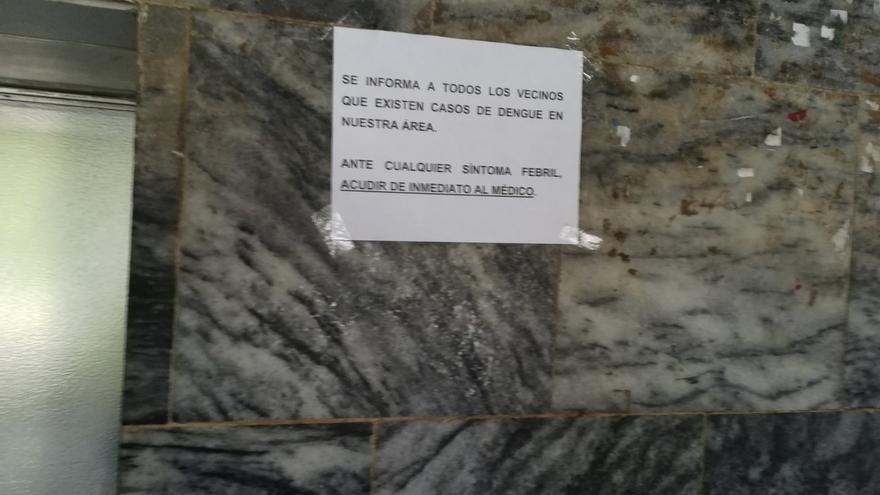
The authorities alert people about dengue fever with signs and advisories in public buildings> Sign: “We inform all residents that there are cases of dengue in our area. If you have any symptom or fever go immediately to the doctor.” (14ymedio)

14ymedio bigger14ymedio, Zunilda Mata, Havana, 3 October 2018 — In public buildings and places, health authorities in Havana are warning the population of the presence of dengue fever in numerous neighborhoods of the Cuban capital while, in hospitals, patients with symptoms of having contracted the virus crowd clinics and admitting stations.

The warnings call for a reinforcement of prevention measures against the propagation of the Aedes aegypti mosquito, a transmitter of diseases like dengue fever, as well as chikunguña and the zika virus. The mosquitoes have rebounded in recent weeks due to the frequent rains that have characterized this summer on the island.

“They have warned us of outbreaks of infestation in several areas,” confirms Jorge Blanco, a worker in the anti-vector campaign in the Plaza de la Revolución municipality. “The city is being fumigated with small planes and trucks that go through neighborhoods, but if the population does not get involved it is very difficult to detect where the mosquito is hiding,” he says. continue reading

As soon as the sun rises, the buzz of a plane breaks the monotony of the city, the most populated in the country, and one with many health problems that aggravate the situation. “We have too many water leaks and in the yards of the houses many objects strewn about are filled with rain and in that clean water is precisely where the Aedes aegypti female lays her eggs,” Blanco says.

Despite the posters pasted in various parts of Havana and the alarm that has spread in the health centers, the official press has been cautious when talking about the problem. So far, there are hardly any published reports on the number of cases of dengue detected or the areas most affected by the virus. Only a  local media, Escambray, reported on Friday the hygienic-epidemiological alert declared in Sancti Spíritus about the high risk and the presence of isolated but serious cases of dengue hemorrhagic fever.

As a general rule, the media, all controlled by the Communist Party, avoid offering data on health problems that affect the population. A practice with which they seek to not cause alarm among Cubans and also to prevent foreign tourists from canceling their trips to the island at a time when the arrival of visitors is stagnating.

Silvia, a fictitious name for this report, is one of the patients who has been hospitalized for suspected dengue. “Small spots appeared everywhere and I began to feel very bad,” she explains to this newspaper. “They kept me one week in the Calixto García Hospital but so far they have not given me the results of the analysis.”

The tests to detect dengue may take weeks and then the patient is notified through his polyclinic or family doctor’s office about the result. “Many times the answer never arrives and the patient does not know if what he had was dengue or not,” laments Silvia.

In the same room in which she was hospitalized, Silvia had to take additional measures to protect herself. “There were many mosquitoes and I had to spend all day under the mosquito net to avoid infecting other people*,” she says. “When I was discharged, I was very happy because the place is in terrible condition and the food is very bad.”

The Government has decreed an Action Week against these insects, in line with the campaign developed by the Pan American Health Organization (PAHO) in the Americas. The offensive has coincided with a time when all the conditions for the proliferation of the mosquito are present: heat, humidity and stagnant water, the National Director of Hygiene and Epidemiology of the Ministry of Public Health (Minsap), Francisco Durán, explained to the official press.

In the airports, controls are being reinforced on travelers arriving from areas where Aedes aegypti is also a problem. “We are reviewing especially those who come from Central America and the Caribbean islands,” confirmed a doctor on Monday who gave a form to all passengers arriving at terminal 3 of the José Martí International Airport. “The problem is that no one reports if they feel bad, all the forms they give us say they do not have any symptoms,” explains the doctor.

The form should only be filled out by domestic passengers because “foreigners are followed up in the hotels where they stay,” says the doctor. “Each national who fills out this form will be required by his polyclinic or by the family doctor of his neighborhood to report if he has continued to feel good or if he shows any alarming symptoms.”

According to figures from the Ministry of Public Health in 2017, cases of dengue on the island were reduced by 68% compared to the previous year. The reports confirm that autochthonous* transmission of Zika was detected in 14 municipalities of the country, while Chikungunya patients were not registered.

In the same year, dengue was present in two municipalities and 11 healthcare areas in the provinces of Holguín and Ciego de Ávila, while Zika was located in 38 healthcare areas of Havana, Mayabeque, Villa Clara, Sancti Spíritus, Ciego of Ávila, Camagüey, Las Tunas and Holguín.

*Translator’s note: Dengue is not passed directly from person to person, but a person who is in infected can be bitten by a mosquito, which then contracts the virus and can pass it on to the next person it bites, likely to be someone in close physical proximity to the already infected person.

_______________________

The 14ymedio team is committed to serious journalism that reflects the reality of deep Cuba. Thank you for joining us on this long road. We invite you to continue supporting us, but this time by becoming a member of 14ymedio. Together we can continue to transform journalism in Cuba.

Complaints About the Adulteration of Weight In Sales of Frozen Chicken

Halfway through 2016 authorities decreed a reduction in the prices of various foods, among them pieces of frozen chicken that are sold in boxes of between 10 and 23 kilograms. Sign: “Special Offer Sale of Boxes of Chicken With Price Reduction of 6%” (14ymedio)

14ymedio bigger14ymedio, Marcelo Hernández, Havana, October 2, 2018 — He arrived home hopeful, after five hours in a long line, with a box of frozen chicken thighs that he bought at the Plaza Carlos III center in Havana. When he opened it, the customer realized that it was missing at least six pieces and in their places pieces of ice had been added to fill up the holes and maintain the weight of the package.

The adulteration of the quantity of a product is a common practice in the network of stores using convertible currency in Cuba, and it has been aggravated by the commercialization of wholesale merchandise. The substitution of part of the food with ice, cardboard, or plastic is hardly surprising anymore to the indignant buyers who see how their money vanishes as they pay for a weight that isn’t the same as the real one.

This Monday, at least four customers protested being robbed of pieces of chicken in the apparently sealed boxes sold at the butcher shop on the bottom floor of Plaza de Carlos, as 14ymedio confirmed. The administration has recommended that shoppers check the weight of the package before “leaving the unit.” However, weighing it doesn’t prevent fraud. continue reading

“It’s no use to check the weight because they take out pieces and put in ice so that the box shows up on the scale at the same weight that it says on the package,” laments Omara, a 47-year-old Havana resident who claims to have suffered the loss of at least eight pieces of chicken thighs from a box that she got at the place. “It’s not just here, it happens everywhere,” she assures.

“They adulterate cleaning detergent by adding water and now we are going to have to develop x-ray vision to be able to detect if a package that seems sealed is missing chicken,” laments Omara. “Even the ones that my daughter buys via the Internet, that emigrants sell, come diluted.”

The loss of a good part of Venezuela’s economic support has aggravated the shortages and some food products have disappeared from store shelves altogether or are frequently missing.

“The boxes have the weight stamped and here there is no time to change anything inside because as soon as we load them off the truck they are sold, we don’t even warehouse the product from one day for the next because right now there is a lot of demand,” responds an employee of the shopping center who asked to remain anonymous. “If when the customer opens them, they’re missing something, it wasn’t here that it was taken out.”

The worker blames the distribution warehouses and possible robberies at the port. “Everyone blames us but this is a problem that also affects us because we have to listen to the complaints and accusations,” he explains.

In the central office of the Cimex corporation in Havana, an official tells this newspaper that it’s a matter of “imported chicken that is sold sealed,” so that the customer finds himself before “the original quality of the merchandise, which has passed through a procedure of wet freezing” which has result in “those pieces of ice that they see when they open the package.”

Nevertheless, he recognizes that “irregularities” have been found in the “surprise inspections that are carried out in the warehouses and receiving centers.” If the protocols are followed “there shouldn’t be any adulteration,” specifies the official, who didn’t want to give his name over the phone.

“Often they say that there is adulteration, but there isn’t.” The administration imposes sanctions if they detect this kind of irregularity, among them the loss of jobs, to avoid eventual removals.

Luis Jorge, 36, a regular buyer of frozen chicken pacakges for a restaurant where he works as a messenger, disagrees with the Cimex official. “If you pay close attention, you can detect where the package was opened to put in the pieces of ice,” he insists. “They’re true masters of fraud, those who do this, but even so they still leave traces.”

Halfway through 2016 the authorities decreed a light reduction in the prices of various foods. Among the products that benefited were pieces of frozen chicken sold in boxes of between 10 and 23 kilograms, a measure that incentivized buying, especially among small private businesses that offer chicken on their menus.

As months passed many families began to get the packages of chicken parts to guarantee supply amidst the shortage. Lines to buy it can last hours and most times one only finds packages of thigh and leg meat. Packages of breasts or whole chickens are the ones that are in shortest supply.

In June of this year the sale of frozen chicken was rationed in stores in convertible pesos in the Villa Clara province and they stopped selling complete packages of the product. Local authorities decreed the measure as a result of the damages caused by the subtropical storm Alberto and presented it as a short-term solution to the shortage of food. Villa Clara residents waited several weeks to be able to buy once again greater quantities of the product.

Cuba imports between 60% and 70% of the food consumed on the island, an operation that costs around $2 billion each year and which has become more complicated with the problems of liquidity that the Island is experiencing. From the United States the foods that arrive most frequently are, precisely, frozen chicken and certain grains.

During his recent visit to New York, the Cuban president Miguel Díaz-Canel met with American businessmen linked with the agricultural sector. “Buying food, which is known to be of good quality, produced by you for us would represent convenience and opportunities,” specified the leader during the meeting.

Translated by: Sheilagh Carey
_____________________________

The 14ymedio team is committed to serious journalism that reflects the reality of deep Cuba. Thank you for joining us on this long road. We invite you to continue supporting us, but this time by becoming a member of 14ymedio. Together we can continue to transform journalism in Cuba.

Six Years in Prison for Violating the Embargo

The Ubiquiti NanoStation M2 amplifies the signal of a wifi network and is used in Cuba to bring internet to homes. (bionic)

14ymedio bigger14ymedio, Havana, October 2, 2018 — Bryan Evan Singer, 46, was sentenced last Thursday in the United States to 78 months of prison for violating the Cuban embargo by trying to take hundreds of electronic devices to the Island from the south of Florida. Additionally, the convicted man was accused of making false declarations to federal authorities and lying about the quantity of merchandise.

Singer attempted to travel to the Island on May 2, 2017 aboard La Mala, according to the statement from the Southern Florida District court. Law enforcement officials, in an inspection before the vessel set sail from Stock Island, found a hidden compartment underneath a screwed-down bed in the boat’s cabin.

In the compartment they found hundreds of electronic devices, among them more than 300 Ubiquiti NanoStation M2, valued at more than $30,000. continue reading

The Ubiquiti Nanostation Networks are devices that amplify wifi signals up to several kilometers, which are often used to give internet coverage in big concerts and rural areas. Each one of the devices can receive or send wifi signals at a distance of six miles into the surrounding area.

“These devices require a license to be exported to Cuban because their capacities threaten national security. Singer never applied for nor obtained a license to export these devices to Cuba,” pointed out the office of the Southern District.

Since the Cuban Government installed the first wifi zones in the Island’s parks in 2013, dozens of clandestine networks have appeared. Cubans use the NanoStation to bring wireless signals from the wifi zones to other areas without coverage, in order to surf the internet from home, because of which the Cuban Government prohibits their import as well as that of other devices with a similar function. Until now the country has around 700 points of wireless connection and the state-owned monopoly, Etecsa, charges the equivalent of a dollar for an hour of connection, close to a day’s wages for the average Cuban worker.

Singer told the Miami Herald that it wasn’t the first time that he had taken merchandise to Cuba and that he had a person on the island “to leave it with,” although he maintains that he never did business with shipments and that he was doing it to “support the Cuban people.”

“On September 27, 2018, the lead judge of the District Court of the United States, K. Michael Moore, sentenced Singer to 78 months of prison, to be followed by supervised release,” stated the Court.

Translated by: Sheilagh Carey

_____________________________

The 14ymedio team is committed to serious journalism that reflects the reality of deep Cuba. Thank you for joining us on this long road. We invite you to continue supporting us, but this time by becoming a member of 14ymedio. Together we can continue to transform journalism in Cuba.

The Constitutional Debate at My Local Assembly

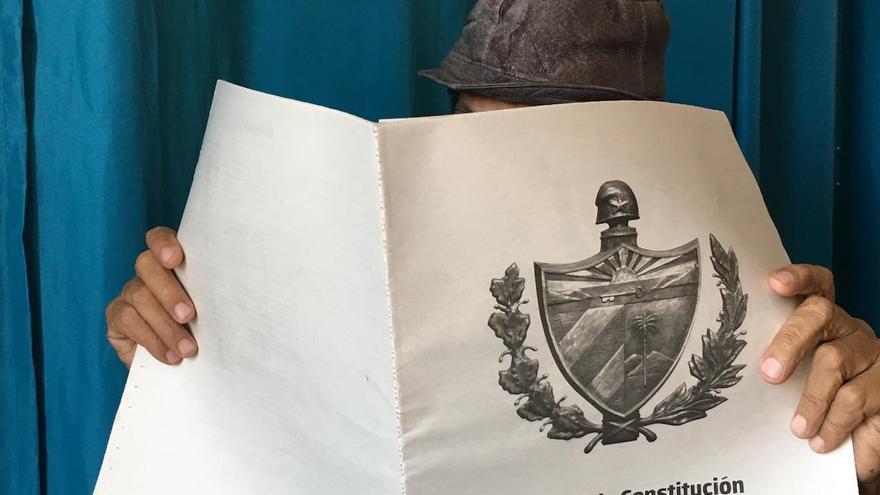
I read my opinion on article 3, which describes the country as a socialist and reintroduces the concept of irreversibility of the socialist system. (14ymedio)

14ymedio bigger14ymedio, Reinaldo Escobar, Havana | 18 September 2018 —  I was preparing for this discussion with the energy and discipline of a high performance athlete who intends to break some sporting record. I arrived at the basement of my building five minutes before eight o’clock in the evening, the agreed upon time to hold the meeting to debate the constitutional reform project.

At this hour only the Party militants were there. I had the strange feeling of being the invisible man. Then came the others, with whom I exchanged the usual jokes. Then the baritone shouted: Attention! And we started singing the national anthem.

The person designated to lead the meeting was a man of only 25 who, with impeccable diction and a firm voice, read the almost 1,500 words of the introduction of the project. Then in groups we parsed the 675 paragraphs of the text. continue reading

At the table where the proposals were written down, there was a high value team: a senior official of the Central Committee of the Party, coincidentally a neighbor from the 12th floor, and his daughter Lisi, whom I lost track of afterwards, when she was no longer the president of the Federation of Students of the Secondary Education (FEEM) in the high school where my son studied.

She was the first to intervene to request the restoration of a paragraph from the preamble to the Constitution of ’76, which mentions “the ultimate goal of building a communist society.”

The leader of the meeting asked if there were any comment on Chapter 1, called Fundamental Principles of the Nation, precisely the subject on which I had a couple of “papers.” So I raised my hand to ask for the floor.

From there I read my opinion on Article 3, which describes the country as socialist and reintroduces the concept of irreversibility of the socialist system. I also proposed the elimination of Article 5, which proclaims the role of the Party as “the leading force of society and of the State.”

I had overcome my fear because in a previous inspection I carried out of the surroundings I could see that there were no indications that something similar to a repudiation rally would take place or that the restless boys of State Security would charge me or prevent me from attending to the debate.

I just had to appeal to the essential “nerve” that is required to raise your voice when you know you are in a clear minority.

The young man who ran the meeting, with better skills as an announcer than a polemicist, made a faint reply that said something like socialism was essential for the future of the country. The official from the 12th floor offered a long dissertation to convince the audience that thanks to socialism our children have schools and anyone can have surgery in a hospital without being asked how much they earn or what position they occupy in the Government.

He was followed by a senior officer of the Armed Forces who, in an emotional speech, recalled that socialism had been created with the blood of the heroes in the Sierra Maestra, in Girón and other battles and that, out of respect for the dead, the system would have to be irrevocable. Others piled on citing Fidel Castro, Raúl and even Miguel Díaz-Canel.

Out of elementary respect before so many angry people I left in my pocket the papers where I had written my diatribe against the Communist Party and its pretensions of being the leading force over the laws and the Constitution itself.

A young mother, who did not take the trouble to read the reform project, took the opportunity to complain that she had not been able to get a wheelchair when her 10-year-old son suffered a fracture and could not take him to school.

A desperate worker asked when there was going to be talk about the little that the working people earn, and a retired spy expressed her disgust before the article 215 that, when defining the functions of the armed institutions of the State, only mentions “the armed formations of the Ministry of the Interior” instead of simply saying “the Ministry of the Interior.”

There is a complacent way to disagree with the current draft of the constitutional reform. The two examples starred the baritone, who said he was against the idea that people who hold high positions can only govern for only two terms and that he did not like the 65-year age limit to be president of the Republic. Later he proposed that to the controversial Article 68, which opens the possibility of equal marriage, we should add the explicit prohibition that these people could adopt a minor.

That was the occasion when Antonio, a Cuban recently repatriated after living for a long time abroad, demanded an explanation of the motives of his proposal. “I am a homosexual,” he said, “and I have all the moral conditions to educate a child.”

The debate was about to be shipwrecked in the meanderings of a confrontation between the baritone and the returnee, until the young leader of the assembly closed the matter with a Solomonic sentence: “Here each one person can give their opinion if it seems appropriate to say it.”

After an hour and a half, there was no interest in deciphering the intricacies of Title VIII, dedicated to the local organs of the People’s Power. Only the young Lisi had something to say when she mentioned her displeasure at the title of “governor” for the person in charge of the government of a province, because that reminded her of “what the Yankees call those who run a state.”

It all ended with a loud applause and, as always happens in these cases, the groups of those who remained silent throughout the debate drew their own conclusions as they dispersed on the ground floor of our fourteen floors.

*******

Below I leave the arguments I read aloud to rebut article 3.

I propose to reformulate Article 3 of the constitutional draft to read as follows:

ARTICLE 3. The defense of the homeland is the greatest honor and supreme duty of every Cuban.

Treason is the most serious of the crimes, and whomever commits it is subject to the most severe sanctions.

Citizens have the right to fight by all means, including armed struggle, when no other recourse is possible, against any external aggression that threatens the sovereignty of the nation.

FOUNDATION

The proposal is aimed at eliminating allusions to the political system based on an ideology.

The homeland does not need political surnames because it belongs to everyone, those who believe in socialism and those who do not believe in it; those who defend it as an option and those who want to change it for another model. This was our homeland long before socialism was proclaimed in Cuba.

When you add the qualification of socialist to the country it is inferred that not being in agreement with that system and exercising the right to substitute another system can be considered an act of treason to “the socialist homeland” and, consequently, a Cuban patriot may be subject to “the most severe sanctions” just for trying to modify the system.

This proposal also involves withdrawing what is referred to as “the irreversibility of socialism” and for that I appeal to the following four arguments:

The first argument:

Establishing the irreversibility of the system is in contradiction with Article 16 of the chapter on International Relations, which states that the right to self-determination of peoples is expressed “in the freedom to choose their political, economic, social and cultural system,” which implies the possibility of changing at any time, by popular will, the system that is in force.

We can not recognize for the rest of the peoples of the world a right that we are denying ourselves.

The second argument:

The current generation of Cubans has no right to prevent future generations from living under another type of system, which will surely be infinitely better than what we can imagine today.

The third argument:

Even in the glossary that accompanies the printed brochure of the project, it is not clear what this socialism is that is irreversible.

Since this amendment was introduced in the constitutional reform of 2002 to impose the system’s irrevocability to date, there have been notable conceptual changes, among them, the disappearance of the term communism and no mention of the socialist conquest of eliminating the exploitation of man by man. These changes have been introduced not only in this constitutional project, but also in the conceptualization of the model approved in the Seventh Congress of the Cuban Communist Party (PCC).

In the system under which we Cubans are living in the second decade of the 21st century, the rule of giving back to the worker with the formula “to each according to his work” is not fulfilled because what everyone receives today as a salary is barely enough to sustain the energies used in the productive process.

The fundamental law of socialism which is “to satisfy the ever-increasing needs of the population” is still far from being fulfilled. Instead, we see the insistence with greater force that state companies must “make a profit” which is the supreme law of capitalism.

Of socialism as a system, which now is intended to be declared irrevocable, all that remains is the social property of the fundamental goods of production and the planning of the economy and even then these bases are undermined by accepting the role of the market and private property.

The fourth argument, which can be better defended by communist militants, is based on the following:

Not satisfied with having eliminated the term communism in this reform of the Constitution, the drafters of the project go so far as to prohibit it constitutionally, by declaring socialism as irrevocable.

In any basic course of Marxism-Leninism one learns that socialism is a transition to communism and that in fact, when the State is eliminated, in that superior stage that is communism, the dictatorship of the proletariat, the undisputed essence of socialism, is revoked. To declare the irrevocability of socialism forever constitutes an explicit renunciation of the final goal, although in public declarations outside the constitutional text, the opposite is said.

By the way, from Article 224 dedicated to the reform of the Constitution the reference to the fact that “in no case are the pronouncements on the irrevocability of socialism and the political and social system established in Article 3,” should be eliminated.

 ______________________________

The 14ymedio team is committed to serious journalism that reflects the reality of deep Cuba. Thank you for joining us on this long road. We invite you to continue supporting us, but this time by becoming a member of 14ymedio. Together we can continue to transform journalism in Cuba.

Tania Bruguera Brings Viewers to Tears With Her Work on Immigration in the Tate Modern

The exhibition takes place in the Turbinas room of the Museum of Contemporary Art in London. (Tate Modern)

14ymedio biggerEFE via 14ymedio, London, 1 October 2018 — Tania Bruguera brings her viewers to tears with her work about the victims of the crisis of immigration that opened this Monday at the Tate Modern in London. it will be on until 24 February 2019. The work of the artist, who lives between Havana and New York, has many surprising elements and tries to make people think about the migratory crisis through several “furtive interventions” that the visitor finds when walking through the Turbinas room of the contemporary art museum.

The title of the work is the number of immigrants who traveled from one country to another in the last year, plus those who have died to date, a changing figure that will not be displayed on the event posters, but will be stamped daily on the wrists of the visitors to the gallery. Today’s number was 10,142,926.

Other “actions” aimed at provoking reflection include a room in which visitors are brought to tears when they come into contact with an organic compound that irritates the eyes, with which the artist wants to force “an emotional response.” continue reading

Bruguera has also arranged the portrait of a Syrian immigrant on the floor of the Turbinas room, which is only activated through the heat generated if several people touch it at the same time.

The artist has involved the activist community of the London neighborhood where the Tate is located for this work, and their names will appear for several months in one of the rooms in the center of London.

The work presented today also has some sound effects, made in collaboration with the artist Steve Goodman or Kode9, which give the visitor a feeling of uneasiness or the sense that something is about to happen.

 __________________________

The 14ymedio team is committed to serious journalism that reflects the reality of deep Cuba. Thank you for joining us on this long road. We invite you to continue supporting us, but this time by becoming a member of 14ymedio. Together we can continue to transform journalism in Cuba.