Fired Cuban Journalist Asks for Asylum in the US

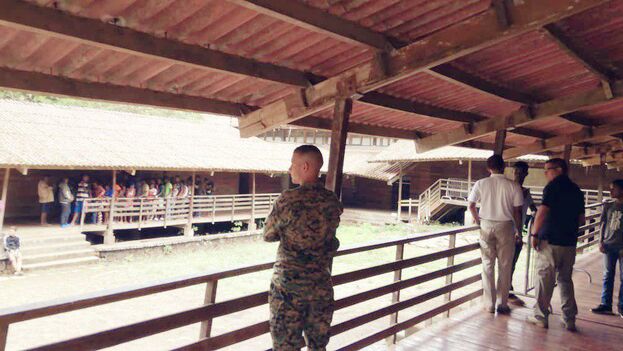
Ramírez Pantoja minutes before leaving the Mexican border behind. (14ymedio)

14ymedio bigger14ymedio, Mario J. Pentón, 8 May 2019 — José Ramírez Pantoja, who was expelled in 2016 from Radio Holguín for a publication the government found uncomfortable, requested political asylum in the United States on Wednesday, convinced that “escape” is his only option.

“They left me without work or sustenance, without caring about the years I worked as a journalist just for reporting. Then came the threats, pressures, they wanted me to stop working for the independent press and at the same time they continued to censor my work in the official press,” recounts Ramírez Pantoja by telephone minutes before leaving the Mexican border behind.

The journalist made public the content of a meeting in which Karina Marrón, deputy director of the official newspaper Granma, warned of “mass protests” similar to that of the 1994 Maleconazo, should there be a repeat of the “Special Period” in Cuba. continue reading

After his dismissal from the official press, the Popular Municipal Court of Holguín ratified the judgment against him. The National Ethics Committee of the Union of Journalists of Cuba also failed to reverse it. From officialdom, voices with power inside the media accused him of wanting to move “to the Miami press” and unleashed a campaign against those who dared to defend him, like the Uruguayan journalist Fernando Ravsberg, who at that time was publishing from the Island.

“After I was expelled from my job, I had to work as a domestic servant, because the State controls all the media in Holguín, I worked for room and board. It seems that what I published about Karina Marrón bothered them so much that they persecuted me and threatened me” adds Ramírez Pantoja.

After a series of appeals and letters begging to be readmitted to the circle of official journalists, Ramírez Pantoja ventured into the independent press, writing for El Toque, OnCuba and 14ymedio , sometimes under his own name and sometimes under a pseudonym.

“When I started writing for the independent press, the threats multiplied, and State Security officials told me they had not imprisoned me in 2016 because they had not wanted to, but they told me I lived alone and anything could happen to me,” he says.

The case of Ramírez Pantoja was included in the 2016 report published by the Committee to Protect Journalists (CPJ). The organization, based in New York, then warned of an increase on the Island of arrests, confiscations of work tools and the imposition of police warning letters to reporters.

Last year, Ramírez Pantoja was accredited by the independent magazine El Toque to cover the Gibara Film Festival. According to his story, two State Security officers cornered him and forced him into an office where they reproached him for “selling himself to imperialism for $10.”

“At that moment they told me that they knew that I worked under a pseudonym for the independent press, and that I mustn’t ’continue talking shit talking about the Revolution’ because that would have consequences. They also tried to blackmail me with alleged evidence against me and suggested that it would be better if I just remained tranquil until my sanction ends,” he denounces.

The journalist left the country on January 31 of this year after receiving a scholarship to do a PhD in History at the Autonomous University of Baja California. “I am afraid that when I finish my legal stay in Mexico, I will be returned to Cuba, that’s why I made this decision,” he adds.

The number of Cubans who appear in the southern border of the United States to request asylum continues to increase, according to the latest figures presented by the U.S. Border Patrol. In the 2018 fiscal year, 7,079 Cubans were counted, while from October 1 to February 19, 6,289 reached the border.

Last October, the US authorities granted political asylum to independent journalist Serafin Morán after he spent six months in a detention center in Pearsall, Texas. The reporter had to overcome a long judicial process to prove that his life was in danger in Cuba.

____________________

The 14ymedio team is committed to serious journalism that reflects the reality of deep Cuba. Thank you for joining us on this long road. We invite you to continue supporting us, but this time by becoming a member of 14ymedio. Together we can continue to transform journalism in Cuba.


Cenesex and the Political Police Coordinate to Block the LGBTI March

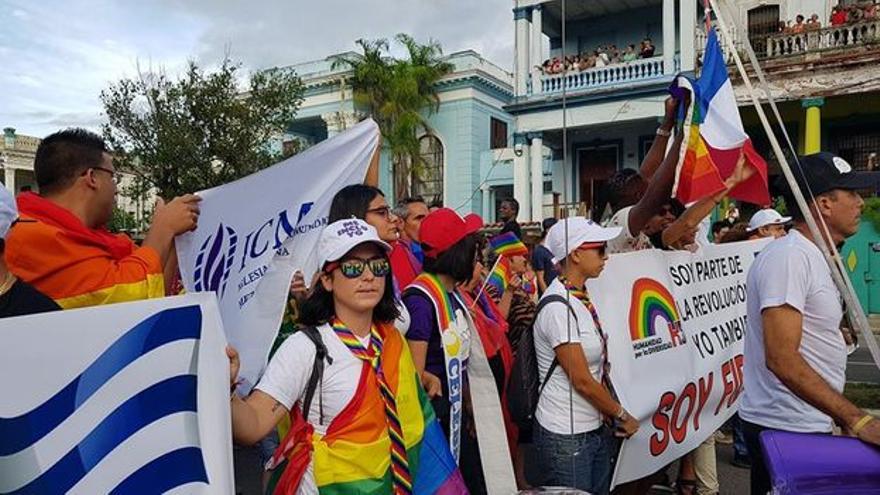
Members of the Metropolitan Community Church parade in La Conga against homophobia and transphobia. (Facebook / Archive)

14ymedio bigger14ymedio, Havana, 9 May 2019 — A few hours after the National Center for Sexual Education (Cenesex), led by National Assembly deputy Mariela Castro, denounced that the independent march called for this Saturday in the Central Park of Havana had been organized from Miami, some activists have suffered harassment of the Political Police to prevent them from attending the march.

“A few minutes ago a [State] security agent called my phone without identifying himself, and in an aggressive voice repeated several times that I would be imprisoned if I continued with the call to march for LGBTI rights on May 11. He told me that I was being watched,” wrote Zekie Fuentes, an LGBTI rights activist and collaborator of Cubanet and Cibercuba, on his Facebook page.

“Once again, freedom of the press, expression and conscience is intimidated or at least, that’s what they are trying to do. Once again LGBTI rights remain in a dark tunnel that does not see the light,” Fuentes added. continue reading

The call for an independent demonstration by the LGBTI movement came after Cenesex canceled the traditional Conga against Homophobia citing “tensions in the international and regional context.”

In a note published on Thursday in Cenesex’s social networks, the organizing team of the Days Against Homophobia and Transphobia attributed the cancellation of the Conga to “the aggravation of aggression against Cuba and Venezuela.”

“Those who really want to defend the institution can close ranks with the Cenesex and the organizing committee of this twelfth edition, to ensure its successful development, and not join politically biased provocations or attacks,” writes Cenesex.

“Some opposing groups,” adds Cenesex, “use what happened with the conga as a weapon against our institution, and through it, against the State, the Government and the Party.”

“We exhort them, therefore, to make these Cuban Days against Homophobia and Transphobia a space for unity, in the defense of the Revolution and socialism, as the only social project that defends the true inclusion of all people,” concludes the text.

Independent journalist Maykel González Vivero was also threatened so that he would not attend the independent demonstration on Saturday. “Everything has a purpose, Maykel, but you do not see it that way. You’ll see what will happen on Saturday,” was the Twitter response to the call made by the LGBTI reporter and activist. This is not the first time that the Cuban State Security has used false profiles in social networks to frighten journalists and activists.

On Wednesday, the government denied entry to the country to Michael Lavers, a reporter for the oldest LGBTI+ newspaper in the United States, the Washington Blade, founded in the middle of the gay liberation movement, in 1969.

This is not the first time that the Cuban LGBTI community has called for an independent march. On May 28, 2015, a march for International Gay Pride Day was organized at the Prado in Havana, by organizations such as Puertas Abiertas (Open Doors), Shui Tuix, the Foundation for LGBTI Rights, Divina Esperanza (Divine Hope) and Arcoíris Libre de Cuba (Free Rainbow of Cuba).

Many of those who answered the call to march were not able to get there. At least five people were detained for 24 hours and several of the main organizers reported that a police patrol prevented them from leaving their homes under the threat that they would be arrested.

Four years earlier, in the same place and for the first time, the Cuban authorities tolerated the celebration of such an activity, outside the scope of Cenesex. That first LGBTI Pride Walk was organized by the Cuban Observatory of LGBT rights, a non-governmental organization. The event took place under heavy police surveillance, but without serious incidents.

__________________

The 14ymedio team is committed to serious journalism that reflects the reality of deep Cuba. Thank you for joining us on this long road. We invite you to continue supporting us, but this time by becoming a member of 14ymedio. Together we can continue to transform journalism in Cuba.

Silvio Rodriguez Criticizes the Repression of the LGBTI March in Havana

In the midst of a strong police operation, 300 people paraded without incident through the central Paseo del Prado to Havana’s Malecon. (14ymedio)

14ymedio biggerEFE (via 14ymedio), Havana, 13 May 2019 — Singer-songwriter Silvio Rodríguez endorsed, on Sunday, the criticism published by singer-songwriter Vicente Feliú about the “absurd, shameful, dangerously evocative repression” of the LGBTI demonstration held on Saturday in Havana by independent activists and without permission from the authorities.

“With my eyes wide open, I subscribe to every word of what Vicente said on his Facebook,” the artist wrote in the comments section of his blog, Segunda Cita, which has become for many intellectuals and citizens point of meeting and debate about the news of Cuba.

Hours earlier, Feliú had published in his account of that social network that “the absurd, embarrassing, dangerously evocative repression” of the gay march “is definitely indefensible.” continue reading

LGBTI activists and State Security agents clashed on Saturday during a demonstration called without permission after the annual gay pride march organized by the official National Center for Sex Education (Cenesex), led by Mariela Castro, daughter of ex-president Raúl Castro, was cancelled.

Mariela Castro, who is a deputy to the National Assembly, wrote on Sunday on her Facebook account that the march was a ’show’ that was “supported by officials of the US embassy and covered by the foreign press.”

Castro added the above comment when reposting a comment from the Chilean activist, Víctor Hugo Robles, who said that “advances in the rights of LGBTIQ communities always have contradictions.”

Robles also said that “the images of the march of diversity in the streets of Havana this Saturday May 11, 2019 hide not only the legitimate desire for greater spaces of rights for everyone, but the staging of an orchestrated operation that seeks to question the outstanding and essential work of CENESEX.”

This is the first time in decades that a demonstration without official permission has taken place in Cuba, in an unprecedented challenge from the independent civil society to the authorities of the Island.

In the midst of a strong police presence, about 300 people paraded without incident through the central Paseo del Prado but at the end of that avenue and, when the marchers headed towards the Malecón, many policemen in uniform and plainclothes ordered the march to disperse.

The activists refused on the grounds that they did not need permission to walk around Havana and that was when clashes took place with police and State Security agents forcibly detaining between four and seven people, according to eyewitnesses. There were no official reports about the total number of people arrested.

The announcement this week that the traditional conga against homophobio would be suspended, with the justification that the country is preparing to face a serious economic crisis, caused a great deal of discomfort in the LGBTI group, which questioned why other mass activities, such as the recent May Day parade celebrating Labor Day, were carried out as usual.

Had it gone forward, the cancelled conga would have been the first one held after the approval, in April, of the new Constitution. Initial drafts of the document included a modification that opened the doors to equal marriage on the Island, but ultimately this was not included in the final text.

That issue was one of the most controversial in the popular debates on the Constitution and provoked a strong campaign against the measure by the evangelical and Catholic churches.

The LGTBI collective has been gaining visibility during the last decade in Cuba, in contrast to the first years of the Revolution when homosexuals were persecuted and sent to work camps, one of the darkest chapters in the recent history of the Island.

__________________

The 14ymedio team is committed to serious journalism that reflects the reality of deep Cuba. Thank you for joining us on this long road. We invite you to continue supporting us, but this time by becoming a member of 14ymedio. Together we can continue to transform journalism in Cuba.

"For That Price Nobody Here is Going Anywhere"

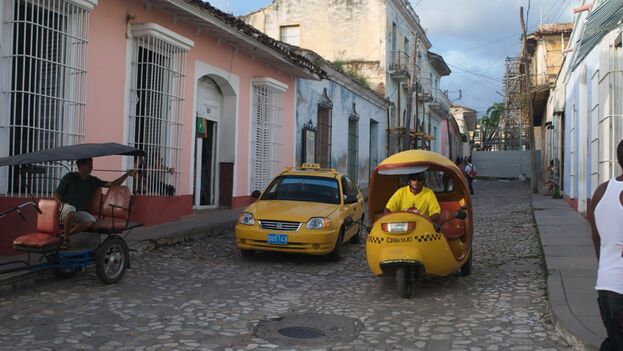
The majority of the vehicles of the state-owned company Cuba Taxi must use the meter, but their drivers hardly ever turn it on. (Nycecile)

14ymedio bigger14ymedio, Marcelo Hernandez, Havana, May 14, 2019 — The rearview mirror is too long and hides the meter that marks the price that the customer must pay at the end of the trip. Confused and disoriented, the tourist, recently arrived in Cuba, will attempt to look for those universal red numerals that increase as the vehicle goes forward, but he will not succeed. “It’s 10 CUC,” the driver will tell him tersely before he gets out.

In recent years the practice of agreeing on a price for the section traveled and not using the meter has been extended among the taxis of the Cuban state-owned sector. Unlike privately managed cars that traditionally do not have those measuring devices, the vehicles associated with the Taxis Cuba Company still have them and the regulations require that they be supplied with a meter or a visible official pricing.

However, reality is far from what the law says. In practice, the yellow cars with white roofs that offer services in convertible currency, along with the friendly Cocotaxis that make trips inside cities and the olf Russian-made Ladas that are still taking passengers in national currency, hardly ever use that device to establish their prices. continue reading

“They’re as likely to ask you for 8 CUC to go from Parque Central to Ciudad Deportiva as they are 10,” complained a customer who this Sunday was trying to get a bouquet of flowers to his house to celebrate Mother’s Day. “I’ve spent more than an hour looking for a taxi to take me but when I ask them if they are free and can take me, right away they tell me a price for the trip and they are not going to turn on the meter.”

A situation that, according to what 14ymedio was able to confirm, is the same at most of the taxi stands for those popularly called Panataxis, continuing the use of the official name with which they appeared when the arrival of thousands of foreign visitors for the 1991 Pan American Games in Havana obliged Cuban authorities to create a transportation system in hard currency.

“When we began, one of the premises of the service was precisely that the customer could see at all times the price [up to that point] that was being shown on the taxi meter,” recalls now Raquel Villanueva, who for more than two decades worked for the Panataxi company. “That was very important because shortly after that the circulation of the dollar was allowed and it was important that the passenger knew how much he was spending.”

“I remember that several times I had Cuban or foreign clients who would tell me a destination but would ask me to let them out before because they realized from the meter that they weren’t going to be able to pay the full price to get to the end,” she remembers. “All that was lost and relaxed until we arrived at the current situation where it’s really rare to find a taxi that regulates the price by kilometer.”

On trips within the city, these cars in have currency have prices by mileage that vary between 0.45 and 0.76 CUC per mile depending on the comfort and size of the vehicle, among which even minibuses are included. On round trip highway journeys, the fare goes from 0.45 CUC to 0.50, while an hour’s waiting time is charged at between 7 and 8 CUC.

Villanueva attributes the current situation to several factors, but especially to the new system in which these drivers are working. “Now those taxis are under a leasing concept and the driver has to take care of everything, from paying for the parking to covering repair costs,” explains the ex-employee of Taxis Cuba. “For that reason, now they are the ones who decide how they are going to charge the customer and even though it is still required for them to do it by the meter, the Government doesn’t enforce that.”

For several years state-owned taxis have been on a leasing system and the drivers must take care of repairs. (14ymedio)

An administrative resolution in 2018 confirms Villanueva’s statements. “The taxi drivers’ vehicles, owned or leased, must have a taxi meter or official price list, the Taxi badge and sign or a sticker that authorizes them to provide services and use the taxi stands that the corresponding public administration authorizes for this end,” specifies the text of the law.

Among the facilities these vehicles receive is the ability to buy tires, batteries, lubricants, and other parts in state-owned stores at preferential prices. But many drivers complain that at those places the most in-demand parts are in short supply and that the majority of the spare parts have to be acquired on the retail or black markets.

“In Havana we have fixed fares established from the airport, which go between 25 and 30 CUC, depending on the place in the city where the passenger is going,” says Ricardo Pajés, driver of one of these state taxis who drives under a leasing scheme. “That makes things a lot easier because the majority of clients who arrive already know — because they looked it up on the internet — how much they have to pay.”

Pajés believes that not using the taxi meter is not an “irregularity.” “These cars operate however the driver chooses, and I can even decide I don’t want to out to work one week,, although in any case afterwards I will have to pay the State for the lease which is almost 50 CUC daily.” For that reason, “with that much money that we have to pay daily, we are almost forced to agree on fares verbally.”

The leasing rates that each driver has to pay have been established according to demand for taxi service in the territory where they operate. The legislation determines that there is a high demand in Havana and Matanzas; medium in Pinar del Río, Cienfuegos, Villa Clara, Sancti Spíritus, Ciego de Ávila, Camagüey, Holguín, and Santiago de Cuba; and low demand in Artemisa, Mayabeque, Las Tunas, Granma, Guantánamo, and the special municipality Isla de la Juventud.

“Nobody can drive one of these taxis, pay for the lease, and have enough money left if they go by what the taxi meter says,” a driver who works frequently at the taxi stand outside the Inglaterra hotel affirms categorically. “We have to be on the safe side on each trip because if we don’t make enough money we lose the lease,” he laments. The taxi driver says that he works “between 14 and 16 hours daily and often at the end of the day I haven’t made even half of the money needed to pay the State.”

Outside the Central Train Station several yellow taxis wait for customers who want to go to the beach. “From here it’s 15 CUC to Santa María and 20 CUC to go to Guanabo,” Maykel, a young man who has been leasing a state vehicle for more than a year, tells this newspaper. “It’s mostly foreigners who want to get quickly to the beach who contract this service.”

The same trip measured by the taxi meter would be below 12 for the former and 15 for the latter, recognizes the driver, but he warns, “for that price nobody is going anywhere here because we are offering comfort, air conditioning, and security, that has a price.” None of the cars waiting for a tourist has a meter visible.

“That is no longer used, it’s there but it’s as if it weren’t there. Very few customers get difficult and demand to see the meter because by now almost everyone knows how this works,” Maykel points out. “Whoever wants to see numbers can take the bus, which has a number on the outside.”

Translated by: Sheilagh Herrera

___________________

The 14ymedio team is committed to serious journalism that reflects the reality of deep Cuba. Thank you for joining us on this long road. We invite you to continue supporting us, but this time by becoming a member of 14ymedio. Together we can continue to transform journalism in Cuba.

The Cuban Crisis and the Cycle of Survival

The coolers of the neighborhood stores remain empty and in the only “meat” available to buy is canned sardines. (14ymedio)

14ymedio bigger14ymedio, Yoani Sanchez, Generation Y, 15 May 2019 — From a balcony, the woman sees the refrigerated truck that supplies the store on the corner. She doesn’t lose a second and shouts: “Maricusa, the chicken arrived!” In a few minutes the whole neighborhood is a hive of people running with bags in hand to the small state market where, for three weeks, they have not supplied any type of meat product. They will still have to wait three hours while the merchandise is unloaded and then there will be a limit of two packages per person.

This scene can occur in Havana, Santiago de Cuba, the city of Camagüey or any small town on this island. The food shortage that has worsened in recent months has made the harsh daily life of 11 million people more complicated. If before you could barely escape the cycle of survival of looking for money — often by illegal means — to be able to buy food, wait for hours at a bus stop and immerse yourself in the black market to buy certain products; now the time needed to put something on your plate has multiplied by three and the difficulties to find it, by ten.

At first, there was no flour, so at the end of 2018 the greatest difficulty was buying bread or cookies. As the Christmas holidays neared, the alarm bells began to go off that the shortages were increasing. Pork, a virtual Dow Jones of the domestic economy, soared in price and by April had reached 70 Cuban pesos a pound, the equivalent of two days’ salary for a Cuban professional. Chicken, ground meat, hamburgers and hot dogs followed. These latter were the food that for years had supported the daily life of hundreds of thousands of families, because it was the product with a greatest proportion in number of units (10 sausages per package) relative to its price.

Cuban officialdom has justified such absences with a mixture of triumphalist and evasive rhetoric. They attribute the deficit to problems with international suppliers, the poor state of the milling industry to the processing of imported wheat, and blame those who monopolize merchandise as the cause of food shortages for all. In parallel, the Plaza of the Revolution avoids using the word ‘crisis’ and has also censored in the national media any mention of the concept of the ‘Special Period’, the euphemism applied to the economic disaster suffered by the island in the ‘90s after the disintegration of the USSR and the socialist camp.

In parallel with the refrigerators in the stores continuing to be empty, the ideological discourse rises in tone. This more incendiary rhetoric seeks to blame the US embargo for the shortages, although economists and analysts agree that the real cause of this fall comes from Venezuela, which has significantly cut oil shipments to the island. Havana resold a part of the crude it received from Venezuela on the international market and thus obtained fresh currency, an injection of life for an economy with low productivity and an excessive state apparatus, inefficient and expensive to maintain.

While many expected that the harsh circumstances would lead the administration of Miguel Diaz-Canel to promote an opening in the private sector, relax controls, lower taxes to promote entrepreneurship and relax the draconian customs regulations, the authorities have, in fact, moved in the opposite direction and have proceeded to ration many foods that until recently could be bought in an uncontrolled way. These measures have awakened the worst ghosts of a population traumatized by what they experienced less than two decades ago.

Meanwhile, discontent has not been made to wait, and this time it is powered by the new technologies that are allowing Cubans to report on and present images of the worsening quality of life. Thus, a one hundred percent Cuban challenge has recently emerged in social networks. With the hashtag #LaColaChallenge [TheLineChallenge], Facebook and Twitter are flooded with photos of lines, crushes of people trying to buy food, and annoyed customers waiting for hours outside a store.

Unlike during those hard years after the fall of the USSR, Cubans now seem unwilling to endure the crisis in silence. Mobile phones and the recently opened mobile web connection service have significantly changed the way the island is narrated. While food is scarce and expensive, citizen dissatisfaction is everywhere in sufficient quantities to become a mechanism of pressure.

___________________

This text was originally published in the Deutsche Welle for Latin America.

The 14ymedio team is committed to serious journalism that reflects the reality of deep Cuba. Thank you for joining us on this long road. We invite you to continue supporting us, but this time by becoming a member of 14ymedio. Together we can continue to transform journalism in Cuba.

The Spanish Government Closes the Door on Property Claims Between States

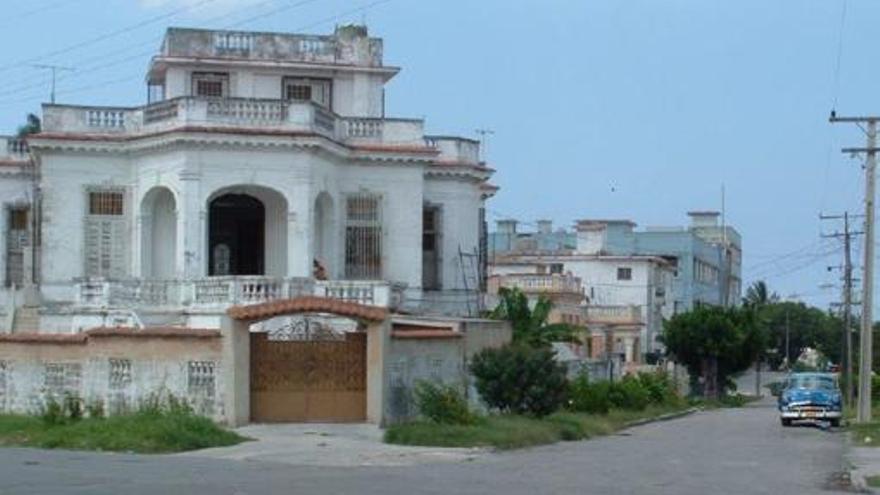
This house in Havana was the property of the Spaniard Raúl Lesteiro, according to his relatives, who are making a claim from Spain for its loss. (D.R.)

14ymedio bigger14ymedio, Madrid, 13 May 2019 — The Spanish government closes the door on claims between states in relation to properties seized by Castro after the Revolution, and says that they should be dealt with on an individual basis, according to this Sunday’s ABC newspaper.

Sources in the Ministry of External Affairs, quoted in the newspaper, indicate that the proposal by the United States administration, “imposing an extra-territorial law cannot be reconciled with the European approach.” As far as Spain is concerned, the matter was agreed in 1986 and there is no case for reopening it.

“Cuba and Spain signed an accord between the two states in 1986, which established a compensation scheme, for those people affected, and reopening it would be out of the question,” said ABC´s source, adding that “any claim which may be lodged would have to be solely on a private basis.” continue reading

Spain and Cuba signed an agreement on 16 November 1986, through which Havana would pay Spain 5,416 m pesos (some 32.5 m Euros, in current terms) “as final compensation and settlement for all properties, rights, actions and interests of Spanish private persons and companies affected by laws, regulations , and measures ordered by the Cuban government from 1 January 1959, up to and including the signing of the present agreement,” of which a third part is to be paid in cash, and the rest in kind.

At that time, many of the potential claimants rejected the agreement, considering that the amount fixed was hardly a fifth of the true value of what had been confiscated. Others did not claim because they had no knowledge of the pact.

Two decisions of the Spanish Supreme Tribunal supported the accord although they added that it did not affect the “hypothetical right of any individuals to reclaim confiscated property, or receive fair compensation, either from the present, or a future Cuban government.”

According to ABC, there are some 450 Spanish families forming the 1898 Compañía de Recuperaciones Patrimoniales, who hope to recover what was stolen.

Translated by GH

_________________

The 14ymedio team is committed to serious journalism that reflects the reality of deep Cuba. Thank you for joining us on this long road. We invite you to continue supporting us, but this time by becoming a member of 14ymedio. Together we can continue to transform journalism in Cuba.

The Right to Nationalize vs. the Right to Confiscate

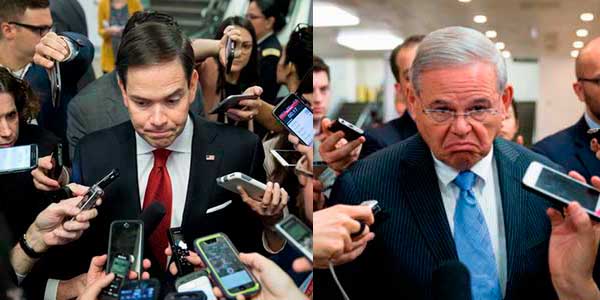
The article written by Lázaro Barredo and published in Cuban government media, was illustrated with this picture with the caption “dos camajanes” (colonialists), referring to U.S. Senators Marco Rubio and Bob Menendez, both of Cuban extraction. (Bohemia)

14ymedio biggerElías Amor Bravo, Economist, 7 May 2019 — In a recent article Lázaro Barredo rails against “camajanes” or colonialists. I cannot think of a more embarrassing epithet to use in discussing Fidel Castro’s nationalizations. From my own personal point of view, I cannot disagree more.

Many lies have been written about the confiscations, which were neither expropriations nor nationalizations, carried out by the Castro regime from 1959 until 1968, when the so-called “revolutionary offensive” came to an end. Rivers of ink were used to create demagogic propaganda which was written to confuse and create a hostile environment for the legitimate owners of financial assets and real estate, who are the real victims in this story.

How does one assess the systematic and organized theft of property — large, medium and small — from all Cubans, which dates back to the start of the Revolution? What rational basis or justification was there for undertaking a structural transformation of the economy, which led to its decline and loss of value, as has been evident for the last 60 years? continue reading

Not even Cuba’s original revolutionary warriors, the Mambisas, behaved this way towards the Spaniards, who controlled all the country’s assets at the start of independence in 1898. Quite the opposite. The young republic was honest and generous with all its children. It had a clear enough vision of the future to respect the existing legal framework of property rights established four centuries earlier. These were the foundations for the development of a great nation that was lost forever in the dark days of the Castro regime.

Respect for private property and property rights are enshrined in the UN’s Declaration of Human Rights, specifically Article 17, which states that “everyone has the right to own property alone as well as in association with others” and that “no one shall be arbitrarily deprived of his property.”

Respect for this right would have provided many advantages and few disadvantages as the Cuban economy evolved after 1959. The violation of this right by the communist regime injured many people, who were not able to recover their losses because the regime never had any intention of compensating them, however much it now tries to say otherwise.

There was no reason for such disproportionate action against the right to property other than communism’s totalitarian ambitions and the desire to plunge Cuba into chaos. Nor was there justification for the confiscation of “embezzled” property or property owned by foreigners and US citizens who had businesses in Cuba. It was the opening of a new  and ultimately unsuccessful front in an ongoing conflict.

Initially, the Argentine ambassador acted as mediator between the Cuban government and the Eisenhower administration in an initial effort to win some sort of compensation for the confiscated properties. In the end, however, it was Cuban citizens —in greater numbers than  Americans and other foreigners — whose properties were confiscated. They were expelled from the country and forced into an impoverished exile by their own government just as many were beginning to enjoy a well-deserved rest after a lifetime of work, effort and dedication.

These are not “frantic attacks stemming from years of pent up frustration with the many policy failures that has led to uncontrolled rage.” What is happening in regards to Cuba with enforcement of Title III the Helms-Burton Act is nothing more and nothing less than a process that has been long anticipated but was delayed for reasons that are now of no interest. It reflects a process born of a desire for justice, not revenge.

Secondly, it has nothing to do with scaring away foreign investors. I would hope they might be able to develop their projects in Cuba with total freedom and in sectors they themselves choose, not in properties that were confiscated. Opportunities exist, but the communist regime does not make them available. Why is that?

I see no need to discuss here the powers governments have to nationalize property. Of course, they exist and are used routinely, but they are based on legal procedures whose main objective is respect for private property whose ownership is to be transferred to the state for the social good and in exceptional circumstances. How else would highways, telecommunications networks, airports, railways, hydro-electric dams, renewable energy plants and the like get built?

A state acquires title to financial assets through expropriations, generally of real estate, which allows it to take on these projects. Because they are essential to national development, the United Nations recognized their legality in 1974 but stipulated a fair price must be paid, in a timely and reasonable manner, for the expropriated property.

However, what was done in Cuba after 1959 in no way complied with international norms. Rather than being examples of nationalization or expropriation, they must correctly be referred to as expropriations. It was a move clearly intended to provoke tensions with the United States with the malevolent intent of transferring all private property to the state at no cost, then managing those assets using Stalinist planning methods and state control of the economy. The results in Cuba are plain to see.

A negotiation with the United States — carried out publicly and with transparency, without ad hoc and unsupportable claims over the costs of a so-called “blockade” or “embargo,” and with payment based properties’ true, current monetary value, duly verified by independent international organizations (unlike the Castro regime’s ludicrous agricultural reform junk bonds paying 4.5% over twenty years, pieces of paper in which no one puts any faith) — would, at the very least, serve as a reasonable starting point towards better relations between the two countries. Had the United States been given such an offer, no one would have been surprised if it had cancelled the sugar quota in 1960. Any other creditor would have done the same.

But, in fact, not only did Fidel Castro have no interest in resolving the conflict, he actually wanted to make it worse in order to build his power base on the pretense of seeking justice. The communist regime falsely claimed it had come up with some proposal which involved real, objective compensation. An example of this approach is the embarrassing negotiation with the socialist government of Felipe Gonzalez in 1986 involving claims over property seized from Spanish citizens, a case better left forgotten.

The implementation of Title III of the Helms-Burton Act represents an exercise in justice, not an attempt to cause embarrassment over the seizure of private property in Cuba after 1959. It is good that this provision is now being enforced because it sends a clear and transparent message to any government, regime or dictatorship of any ideology which believes it has an absolute right to confiscate the financial assets of its citizens. The law establishes not only the permanence of the human right to property, but the primacy of the private over the public when governments behave illegally, as the Cuban communists did after 1959.

There is no justification for what has been done. But history marches on and it is impossible to keep a country sealed in a time capsule, as though it were still in the Cold War. In an era of globalization and the start of a fourth industrial revolution, countries need to demonstrate credibility and confidence to attract investors, capital and talent. None if this is possible in Cuba because its interventionist and totalitarian stance frustrates any efforts at economic freedom, rationality, a better life and prosperity for its citizens, who are the keys to national development. The regime maintains a suicidal position

Even if the confiscations were truly done with the best of intentions — “to give the Cuban people a decent quality of life” — it is quite obvious that the result did not turn out as expected. Despite the promises of “free education and health care” (which are subsidized, and highly subsidized, with tax and non-tax revenues totaling almost 70% of GDP), Cubans who remember what the country was like before 1959 know there few countries in the world whose evolution has been in reverse.

And Cuba is the most significant case of economic regression, one characterized by low salaries, ongoing rationing, lack of choice and decimated real estate. After sixty years, the aspiration of many Cubans is to leave country for a different life abroad based on progress and well-being.

Since that is quite impossible in Cuba, those who oppose Helms-Burton and demand that the Castro government stand firm in the face of legal claims should reflect on whether or not it is worth it to remain fixed in their positions and refuse to change. All they have to do is look around; the conclusion cannot be more obvious. Cuba’s “patriotic and pro-independence” aspirations would fare better in an environment of freedom, choice and property rights. Let’s try it out.

_________________

The 14ymedio team is committed to serious journalism that reflects the reality of deep Cuba. Thank you for joining us on this long road. We invite you to continue supporting us, but this time by becoming a member of 14ymedio. Together we can continue to transform journalism in Cuba.

More Than 30 Cuban Migrants Seek Refugee Status in Panama

According to statistics from the US Customs and Border Protection Office, 10,910 Cubans have presented themselves at the border so far this fiscal year. (Migración Panamá)

14ymedio biggerMore than thirty Cubans have sought refuge in Panama from the National Office for Refugee Care, according to a statement from the National Migration Service of that country.

The 34 migrants, who were part of the Controlled Flow operation, which the Panamanian government is implement to confront the migratory crisis in the region, are in a shelter in Gualaca, in Chiriqui province. They crossed the border from neighboring Colombia with the purpose of continuing to the United States.

According to statistics from the US Customs and Border Protection Office, 10,910 Cubans have presented themselves at the border so far this fiscal year (which started 1 October 2018), a figure that exceeds the 7,079 Cubans who requested asylum in the previous year. continue reading

“As an entity of State Security, the National Migration Service coordinates this type of procedure in a regular manner in response to the request of foreigners of different nationalities,” Migración Panamá said in the statement.

Panama is a transit route for the thousands of Cubans who every year seek to reach US territory to ask for political asylum. The economic crisis on the island, aggravated by the debacle of the government of Nicolás Maduro, Cuba’s main ally and benefactor, has increased the number of Cubans trying to emigrate.

Panama has been forced to manage three major migratory crises in which thousands of Cubans who were on their way to the United States have been stranded on their territory. In both crises, the Panamanian government mediated a solution for migrants with the US, Mexico and the island.

Many Cubans take advantage of visas offered by Panama to shop in the Colón Free Zone and to visit as tourists. Others also use this route to emigrate to the United States, crossing the borders of Central America and Mexico. This year 9,666 Cubans have arrived at Panamanian airports and have not returned to the island, according to official statistics.

According to Migración Panamá, Cubans constitute the largest number of returnees by nationality. So far in 2019, almost 600 Cubans have been returned to the island for reasons that include “inconsistency in the interview, lack of financial solvency, no valid passport or no visa.”

After Cubans, the next most commonly deported nationalities are Colombians with 465 returns and Venezuelans with 305 repatriations. Cubans also lead the number of immigration detentions in Panama. According to official figures, 171 Cubans have been detained in field operations.

_______________________

The 14ymedio team is committed to serious journalism that reflects the reality of deep Cuba. Thank you for joining us on this long road. We invite you to continue supporting us, but this time by becoming a member of 14ymedio. Together we can continue to transform journalism in Cuba.

Citizenship and Connectivity in Cuba, an Explosive Mixture

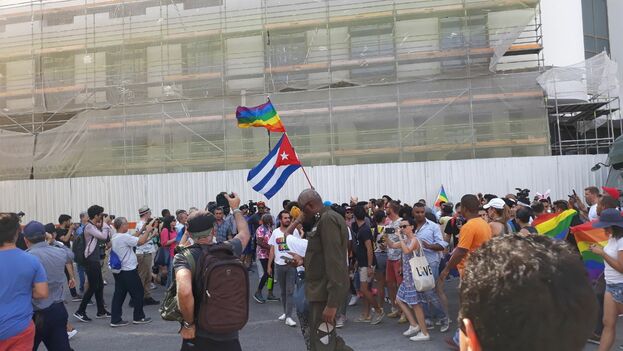
A military officer (brown uniform, foreground) organizes the repression while dozens of activists film the unprecedented LGBTI march this Saturday in Havana. (14ymedio)

14ymedio bigger14ymedio, Yoani Sanchez, Havana | 12 May 2019 – If, on the eve of opening up internet access from mobile phones, Cuban officialdom had written a paper listing its five biggest fears about giving Cubans greater connectivity, those panic points would have been far below what has actually happened. In less than six months, we have experienced on this island a series of unprecedented events powered by social networks, events that defy the strict controls that have marked our society for too long.

This Saturday, the call to an LGBTI march showed the strength of a call to action that is achieved in digital spaces. The regime, nervous and with the intention of demonstrating a show of force, did what it does best: suppress, which multiplied the reach of the event and left a trail of repudiation even among some of the pro-government supporters. The rejection of the police attack against this pilgrimage has been almost unanimous. The march was organized after the cancellation of the march traditionally carried out under the supervision of the National Center for Sex Education (CENESEX).

The march that was planned to go peacefully, was marred by a disproportionate police siege, with dozens of State Security agents dressed in civilian clothes and the arrest of at least seven participating activists. The repressors did not restrain themselves despite the extensive presence of foreign press and the many tourists who traditionally roam Havana’s Parque Central. For State Security, it was about sending a message: in social networks, yes, but in the streets, no. continue reading

Despite that “twentieth century mentality” of believing that what happens on the internet stays on the internet, those who follow Cuban politics and the performance of the police forces, saw that the police committed yesterday one of their worst mistakes in decades. There is no way to defend their actions from any angle, not even from evangelical groups that reject the LGBTI agenda, because in this case it is not only about sexual preferences or the demand for legalization of equal marriage. We are facing a violation of the right to gather and to demonstrate, something that concerns every citizen beyond the banner he or she defends.

In advance of the events in Central Park, social networks had already gained muscle. In less than two weeks they ruined the reputation of commander Guillermo García Frías, whom the Plaza of the Revolution has honored for more than half a century. Jokes quickly went viral about his unfortunate statements related to the “cultivation” (sic) of ostriches, jutias [giant rats] and crocodiles as food sources for the population, and the internet will not stop raining jokes and memes.

García does not have time to reverse the stigma now attached to him of “commander ostrich,” posted on Facebook and Twitter, nor will the most powerful official propaganda machine ever manage to clear his name. Nor can it erase the image of Miguel Díaz-Canel’s caravan accelerating in response to the demanding cries of the victims of the tornado in the Havana municipality of Regla, no matter how many times they publish in the national press a daily photo of the ruler surrounded by people. With one click, all the ideological scaffolding that elevated him to the presidency received a devastating blow.

Last week, the arrest of a reporter also served to show the ability of social networks to unite, in a campaign, different and very varied groups of civil society. From political opponents, to independent journalists, ordinary citizens and even to people who until then had not spoken a single criticism against the authorities in public, pressures for the release of 14ymedio reporter Luz Escobar, were assumed by a surprising diversity of individuals and organizations.

What will come next? Many more calls born in that virtual world that the political police have tried to distance from reality for more than a decade, since the first independent blogs were born and a handful of Cubans opened their accounts on Twitter and Facebook, then labeled in the official media as “tools created by the CIA.”

The time between the cases in which the internet users of this Island come together in a common initiative, launch a hashtag to demand something, and force the authorities to respond is getting shorter. Each day the time between the click that gives birth to a proposal and its materialization in our streets grows shorter. It also increasingly involves more people and more varied sectors of society. So, in the coming weeks, smartphones and police batons will face off again.

____________________

The 14ymedio team is committed to serious journalism that reflects the reality of deep Cuba. Thank you for joining us on this long road. We invite you to continue supporting us, but this time by becoming a member of 14ymedio. Together we can continue to transform journalism in Cuba.

Cuban State Security Represses the Independent LGBTI March in Havana

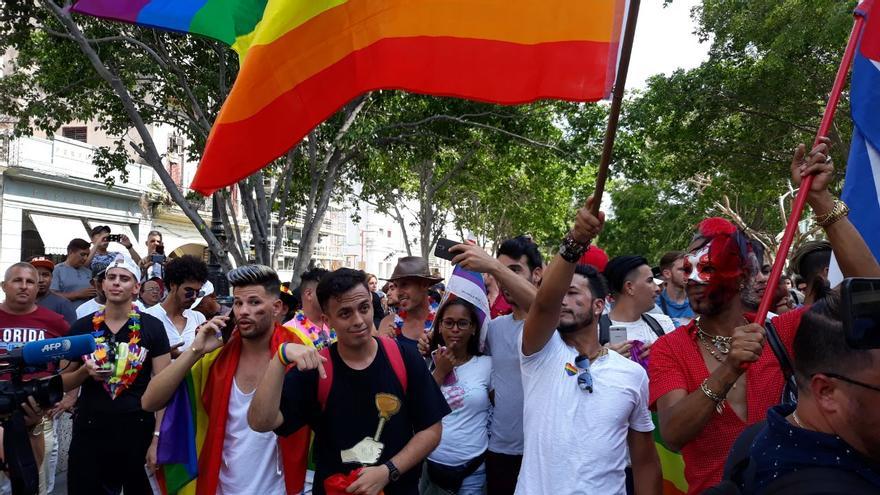
More than 100 activists from the LGBTI community demonstrated in Havana’s Parque Central. (14ymedio)

Note: See links at end of post for numerous photos and videos of the day.

14ymedio bigger14ymedio, Luz Escobar and Mario J. Pentón, Havana, 11 May 2019 — State Security agents clashed with activists of the LGBTI community and sympathizers of this group who went to Havana’s Central Park on Saturday to demonstrate in favor of diversity on the island. At least seven people were violently arrested, according to what 14ymedio was able to confirm.

Among the detainees were the activists Iliana Hernandez, Oscar Casanella, Ariel Ruiz Urquiola and Boris Gonzalez Arenas, all released before midnight.

The march had been called by independent activists in response to the cancellation of the traditional Conga Against Homophobia, organized by the National Center for Sex Education (Cenesex) directed by Mariela Castro, daughter of ex-ruler Raúl Castro and deputy to the National Assembly. continue reading

Cenesex had called for a boycott of the independent march, insisting that it had been organized from Miami. Many LGBTI activists were frustrated by the reasons given by the ruling party cor cancelling the annual conga, among which where that it could be exploited by “groups opposed to Cenesex using what happened with the conga as a weapon against our institution, and through it, against the State, the government and the [Communist] Party. ”

At dawn on Sunday the deputy Mariela Castro, director of the Cenesex, described the march as a “show convened from Miami and Matanzas” that was supported by “officials of the US embassy and covered by the foreign press.”

A few hours before four in the afternoon dozens of activists were gathering in Parque Central in the Cuban capital to march against homophobia. There was a visible police deployment in areas of Centro Habana and according to what this newspaper has been told, there were police every 50 yards in the area where the demonstration was planned, with some 300 people gathered, among activists and supporters.

Under the slogan “for a diverse Cuba” a growing number of activists gathered in Parque Central before the eyes of the police. Around 4:30 p.m. the group began to walk towards the Malecón by way of Prado with multicolored flags and shouting “Yes we can.” Along with the protesters was the singer Haydée Milanés, among other artists.

The activist Yasmany Sánchez Pupo told 14ymedio before beginning the demonstration that it was “a peaceful march” and that the first purpose was that “Cubans are not afraid to do something for themselves without needing anyone else.” He also said it was a march “for equality” and to “look for a space in society” for LGBT activism. “I’m scared but it does not matter, I’m here,” he added.

Sánchez Pupo was vilently arrested and taken to a patrol car when the march reached Prado and San Lázaro.

At that point of the march, State Security forces, who until then had only observed, used violence and force to prevent the march continuing to the Malecón, doling out beatings and arrests. All arrests were made by agents of the State Security dressed as civilians in coordination with police officers who cordoned off the area, and with the patrols and paddy wagons of the Ministry of the Interior.

The activists Isbel Díaz Torres and her partner Jaime Martínez were arrested on Saturday morning when they left their home to attend the march and were released this morning after 24 hours of arbitrary arrest.

In conversation with this newspaper Martinez said, “We are already home, they caught us yesterday at about eight in the morning when we left the house and ready with our flags.” He states that “it was State Security” who carried out the arrest and then took them to a patrol car to the Aguilera police station where “there was no interrogation or anything” and they remained in separate cells all the time.

From Madrid the Cuban Observatory of Human Rights (OCDH) condemned “the arrests, the use of violence and the repressive siege deployed by the Government” against the participants.

The Cuban Foundation for LGBTI Rights, also based in Madrid, denounced the “repressive deployment” of State Security and held the regime responsible for “the physical integrity of the prisoners.”

“We condemn the repressive position of the Cuban government in restricting the freedoms of demonstrations and expression of a community that has been harassed and discriminated against for 60 years,” the organization said. “Once again, the lack of political will and the lack of interest in responding to the demands of the LGBTI community are exposed.”

— Mónica Baró (@MnicaBar2) 11 de mayo de 2019 [See video of the march here] Eight police officers between 12th and Paseo, by Linea. A patrol stops on Paseo next to the taxi in which I travel and the taxi driver asks the police driver: What’s going on here that it’s full of police? Police response: The transvestites want to party.

— Luz_Cuba (@Luz_Cuba) 11 de mayo de 2019 [See picture here]

— Luz_Cuba (@Luz_Cuba) 11 de mayo de 2019 #Cuba moment when they were arrested at @ilianahcuba [See picture here]In an attempt to continue the march by Malecon, the police intervened and violently arrested Boris González Arenas, Óscar Casanella and Iliana Hernández. 

— Camilo Condis (@camilocondis) 11 de mayo de 2019 The PNR [People’s Revolutionary Police] offers a bus (the same one that arrived full of police) to take those who are here to the party of CENESEX in Echeverría, which makes them laugh a lot. “Riding on the bus? None of that!” [See video here]

— Patrick Oppmann CNN (@CNN_Oppmann) 11 de mayo de 2019 Gay rights march being halted at Malecón and Prado. Police arriving and have made two arrests. [See picture here]

__________

The 14ymedio team is committed to serious journalism that reflects the reality of deep Cuba. Thank you for joining us on this long road. We invite you to continue supporting us, but this time by becoming a member of 14ymedio. Together we can continue to transform journalism in Cuba.

This is Life for the Victims of the Tornado That Devastated Havana

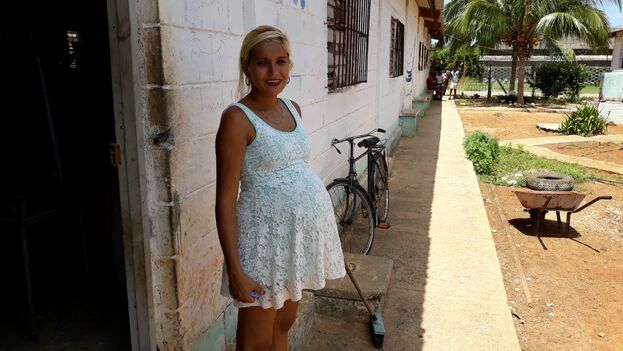
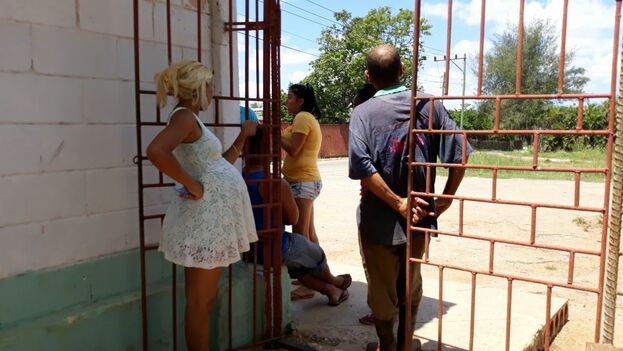
Ailena, 22, pregnant and about to give birth, is one of the victims of the tornado. (14ymedio)

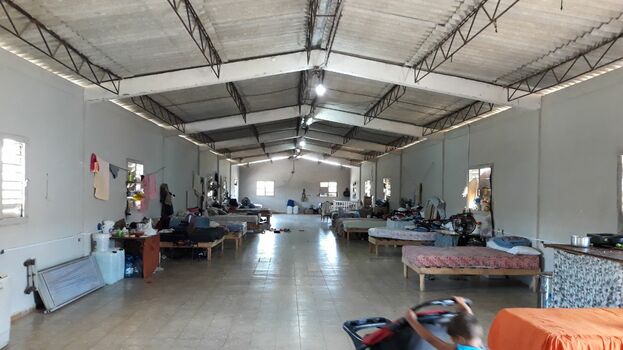
14ymedio bigger14ymedio, Luz Escobar, Havana, 11 May 2019 — To get to the shelter you have to walk more than two kilometers under Havana’s inclement sun. No bus route takes you there. There is not a single sign indicating how to get there. The site doesn’t even have a name. Nobody would remember that old warehouse of the Villena Revolution school if it were not for the twenty people who now inhabit it, since a tornado struck Havana last January.

Overcrowded, in unhealthy conditions, these victims had no choice but to accept the government’s proposal to live temporarily in this shelter. Many of them are considered “illegal” for having emigrated from the poorest regions of the country to the capital in search of better opportunities for their children.

“This is not life. We’ve been here three months. The conditions are terrible, we have no privacy. We sleep in beds next to each other. We look like pigs,” says Yudelmis Urquiza, one of the displaced who lived for 15 days in a warehouse after she lost her home, until the government brought her to this place. continue reading

Urquiza is mixed race, thin, and very loquacious. She seems possessed by a rage that she can not hold back. She wants to explain why she feels insulted at the shelter and can not contain her words. She explodes in descriptions.

The guard of the shelter looks at her out of the corner of his eye. It bothers him that she speaks so freely. He blocks her attempt to give a tour of site but Urquiza passes the camera to a boy who photographs everything those living in the shelter want to denounce.

Since the tornado passed, more than 20 people live in this warehouse without any privacy. (14ymedio)

“The bathrooms are latrines. There is one that is blocked and the shit runs over without stopping. The other latrines are full of eye gnats [the disease-carrier Liohippelates] and other insects. Here all the women have acquired vaginal parasites and no matter how much we complain, nobody pays attention to us,” she says.

She is 29 years old and has two children, aged 11 and nine months. She’s a single mother. Her house on Concha Street, between Infanzón and Pedro Perna, collapsed with the first winds of the tornado. Like half the city, the building was not in good condition. If the tornado had not taken it would have been the rains or a cold front.

On Wednesday the sun was falling vertically on the fiber cement roof tiles of the shelter. The heat was unbearable and a few drops of sweat slid down Urquiza’s face. “Breakfast has not arrived yet,” she yells. The authorities forbid the tornado victims to cook. The food is free, but they are not satisfied with the quality.

“The food is terrible. The Congrí Rice is hard and the picadillo comes with fly poop. The children have had diarrhea and vomiting. One of the pregnant women couldn’t eat for two days because the food was spoiled,” she says.

Instead of toilets they have latrines, some of them in deplorable conditions. (14ymedio)

By this time a group of shelter residents has congregated at the door of the premises. The guard was still stationed at the entrance, undaunted, but the conversation took on the connotation of a formal neighborhood assembly. Everyone wanted to participate.

“The ham comes green. We’ve even found cockroaches in the rice,” said a young man with a thin beard and slicked-down hair. “There are pregnant women here, there are children who need to eat well. They bring food when they feel like it and we have to adapt to their schedules,” he adds.

The drinking water comes from a tank of asbestos cement that is found in the common patio. According to the shelter residents, the health authorities warned them that the water was not chlorinated, but since they are not allowed cooking utensils, they can’t boil it either.

“At first we were afraid, but now we are giving the children that water. We also drink it ourselves. What else can we do?” says another resident of shelter, resigned.

The doctors of the Boyeros polyclinic prescribed the children some tablets of mebendazole [Vermox], a drug for intestinal parasites, but according to the residents, so far they have not been able to find the drug in any pharmacy.

At times the interview became like a formal neighborhood assembly and everyone wanted to complain. (14ymedio)

“It is very hard for a mother to see her children living without sanitary conditions. They have had fever and diarrhea. The same doctors from the policlinic said this place was uninhabitable, but we continue living here,” laments one of the residents.

They all say they have written letters to the authorities of the government and the Communist Party asking for a solution to their case, but nobody has answered the letters. Ailena, a 22-year-old pregnant woman about to give birth approached the authorities to ask for help for her “special situation.”

“They told me that this was my a problem. That I had become pregnant and, therefore, I had to solve my own problem,” she says distressed.

“A wind blew off the roof tiles the other day and now when it rains everything gets wet. We spend our lives being careful not to get the mattresses the Church gave us wet,” says the pregnant woman.

The displaced people say that a television report showing victims receiving new houses caused them to start dreaming. “We immediately called Bárbara Agón Fernández, the president of the Municipal Assembly of the People’s Power of Diez de Octubre. She had promised us that after they did a census of us, they would build housing for us,” they say.

However, the official clarified that the aid was only for the “legal” ones. Those who did not have an address in Havana [formally registered with the government] would remain at the shelter indefinitely. They did not even know what they were going to do with them, said Agón, who also urged them to thank the Revolution because “if they were in another country, they would be on the street.”

The water the residents drink is not chlorinated. (14ymedio)

The shelter residents took out an old propaganda poster of Fidel Castro with his famous concept of Revolution. “Revolution is being treated and treating others as human beings,” said a woman with a slightly mocking tone. The guard, bad-tempered, lost patience and called the police. “Are we imprisoned?” the victims remonstrate. The man does not respond. Minutes later a police patrol with two uniformed officers announced that the interview was over.

“Your journalist’s credential? You have to accompany us to the police station to clarify this situation,” said an officer bluntly.

_____________________

The 14ymedio team is committed to serious journalism that reflects the reality of deep Cuba. Thank you for joining us on this long road. We invite you to continue supporting us, but this time by becoming a member of 14ymedio. Together we can continue to transform journalism in Cuba.

#LaCola[Line]Challenge is About the Long Lines in Cuba

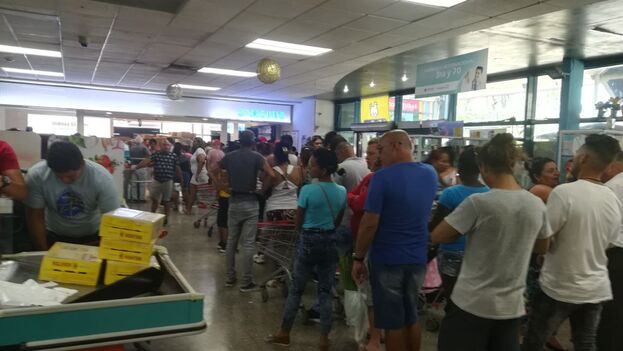
Facebook and Twitter have begun to fill with images taken by passers-by of dozens of people waiting to get some milk powder. (14ymedio)

14ymedio bigger14ymedio, Marcelo Hernandez, Havana, 10 May 2019 — The so-called “challenges” that abound in social networks are reaching Cuba. One of the first to land on the national scene was the Ice Bucket Challenge (involving dumping a bucket of ice water over your head) to raise awareness about Amyotrophic Lateral Sclerosis (ALS), a neurodegenerative disease with a fatal prognosis. Recently, the Trash Challenge succeeded in getting dozens of citizens to start cleaning beaches, illegal dumps and the banks of several rivers.

However, the first one hundred percent Cuban challenge was born just a few weeks ago. #LaColaChallenge (“cola” means “line”) mixes complaints to and criticism of the authorities with humor and a desire to narrate the Cuban reality. It is a call to portray the long lines to buy food that, in recent months, have become an everyday event on this island.

Thus, Facebook and Twitter have begun to fill with images taken by passers-by who see dozens of people waiting to get some milk powder, selfies in the line to buy frozen chicken, or annoyed customers relating that they spent three hours in line at the market to get one liter of vegetable oil.

The real challenge this hashtag represents is living in a collapsed society and in an economy in permanent crisis. The challenge is not to stand in the line, but to buy something.

___________________

The 14ymedio team is committed to serious journalism that reflects the reality of deep Cuba. Thank you for joining us on this long road. We invite you to continue supporting us, but this time by becoming a member of 14ymedio. Together we can continue to transform journalism in Cuba.

My Interrogator Didn’t Come Because He Had No Gas

Luz Escobar was arrested at a school where, dozens of people who lost their homes in the Havana tornado of Havana live crammed together. (14ymedio)

14ymedio bigger14ymedio, Luz Escobar, Havana, 9 May 2019 — As journalists we must follow up on the issues we publish articles about, and that effort took me, this Wednesday, to a school in the municipality of Rancho Boyeros. Dozens of people who lost their homes when a tornado destroyed several neighborhoods in Havana last January now live crowded together in one of the school buildings.

Some of them met me while I was searching for testimonies among the ruins of Luyanó, one of the areas most affected by the winds. That’s why I was not surprised when my phone rang yesterday morning and a woman’s voice gave me the directions to get to the Villena Revolución school, next to the José Martí International Airport. In her words you could feel the despair.

The route is complicated and, to reach the shelter, you have to walk more than two kilometers on foot from Rancho Boyeros Avenue until you come across the entrance to the school. There were several women waiting for me, one of them pregnant. The site is controlled by several watchtowers with guards. continue reading

Later I understood that my presence there did not go unnoticed by the custodians who control the entrance, perhaps because of a “leak” of the telephone call from the morning which could have alerted the security personnel. Hence, the hostility with which I received by the man stationed in the second sentry box.

A rope was strung across the street to prevent passage and the guard, with imposing authority, asked who I was. The people living in the shelter tried to say that it was only a relative who was coming to visit them, but I preferred to say that I was a journalist and that I was making a brief visit. The man stuck to the group like a shadow, something that provoked demands from some of the hurricane victims for privacy and the right to receive visits. “We’re not in jail, right?” one of them said.

At the door of the shelter there was another “surveillance fence” made up of three men whom nobody had seen before and who said they were school workers. One specified that he was a member of the Communist Party in the school. The situation became very uncomfortable, because they blocked access to the door. The victims began to demand loudly that they let me in and the three men responded by appealing to a regulation that they were unable to quote.

That’s when technology came to my aid. As I could not access the place to take photos and know the conditions of the room where everyone sleeps crowded together, I asked one of the people sheltering there to take pictures and pass them to my mobile through the application Zapya, widely used in Cuba to transfer files via Wifi. I stayed outside compiling the testimonies, something that did not please the party militant.

Visibly upset, the man asked another of the guards to call the police. I thought he was just saying it to scare me and I sat at the foot of the shelter entrance doing the interviews.

A few minutes later the police patrol arrived with two uniformed officers. They asked for my identity card and I told them I was a journalist. Then they asked me if I had a credential, something impossible for an independent reporter, because the authorities do not recognize or issue permits for those of us who work in the media who do not join the official state media. “You have to accompany us to the unit to clarify this situation,” the officer said bluntly.

I tried to calm the group of shelter residents, among whom the outrage had grown, as they shouted at the policemen not to arrest me and said that if they took me they had to “take everyone.” At that time I internalized the importance of my presence there for these people. I was the voice that could tell a story that would never be published in the Granma newspaper or come out in in the discussion on the Roundtable TV show.

One of the young people in the group filmed the entire arrest with the cell phone and the policeman was so upset that he spit out some swear words, snatched the cell phone from his hands and demanded that he erase the video. A women interceded and managed to return the cell phone to the young man without losing his witnessing. Before entering the police car I managed to give them the phone number of the 14ymedio newsroom so that the residents could notify my colleagues.

They took me to the police station in Santiago de las Vegas, where I spent almost an hour sitting on the reception bench. A very emotional moment was when a group of the women from the shelter arrived to demand my release. The minutes passed and, when I inquired about my situation, they answered that I had to wait for the “specialist” from State Security for an “interview.”

They put me in a cell for the “classification” process. There they take the data of the newly arrested. While I was in that cubicle with grille and padlock I heard stories that bordered on the absurd and others worthy of a meticulous report, like that of a young Cuban girl recently arrived from Chile and arrested at the airport because she had once lost a cell phone, made a complaint and was left with a notation “involved in a theft case,” although she was the plaintiff. Her impeccable white clothes clashed with the gray shabbiness inside the dungeon.

It was my turn. I handed over my earrings, my ring and everything I had in my backpack. I waited another hour. The telephone rang and I knew, from the reaction of the policemen that it was Camilo, the alias of the Political Police officer who has been harassing me for months, summoning me for interrogations and threatening me and telling me that I can not cover public events.

The reaction of the officers of the National Revolutionary Police was very curious. It was clear that they were not happy with the situation and the one who answered the seguroso’s call said to the other: “the skinny guy will not come, because he does not have gas,” for his motorcycle. My situation was in a limbo, I was still under arrest but the police did not know what to do with me because it was not their “case,” but rather State Security’s.

So, they looked for a formula to get rid of the problem. The head of the unit sat down nearby and for more than 20 minutes he explained to me why I can not practice independent journalism. “You do not have a credential,” and that “violates the Constitution,” he reiterated several times. Actually, the first blow to the Constitution had been my arbitrary arrest. “Without authorization you can not go around doing interviews,” he remarked.

They returned my belongings and, after five hours there, I enjoyed the Havana sun on my skin. Only once I was outside did I learn about all the solidarity raised in social networks by my detention. It was the second time that day that technology came to my aid.

__________________

The 14ymedio team is committed to serious journalism that reflects the reality of deep Cuba. Thank you for joining us on this long road. We invite you to continue supporting us, but this time by becoming a member of 14ymedio. Together we can continue to transform journalism in Cuba.

The Government Invokes “International Tensions” to Cancel the Annual Conga Against Homophobia

The conga had become one of the fixed events of the program of activities against homophobia. (EFE/Archive)

14ymedio bigger14ymedio, Havana, May 7, 2019 — The National Center of Sex Education (Cenesex) announced this Monday that the conga against homophobia that is organized every year was canceled “by order“ of the Minister of Public Health.

The communication of the institution, headed by deputy Mariela Castro, justifies the decision by some “determined circumstances that are not helping successful development,” neither in Havana nor in Camagüey, where the marches were programmed for May 11 and 17, respectively.

“New tensions in the international and regional context directly and indirectly affect our country and have tangible and intangible impacts on the normal development of our daily lives and the implementation of the Cuban State’s policies,” said the note about the ministry’s reasons, which were published on Cenesex’ Facebook page. continue reading

According to Cenesex, this change in the program doesn‘t mean the suspension of the rest of the planned activities, like the academic forums.

The conga has taken place since the beginning of these celebrations, which now are 12 years old, always in the context of the Cuban Day against Homophobia, held in May.

The LGBT activist and official journalist, Francisco Rodríguez, known also for his blog Paquito el de Cuba, responded to the abrupt cancellation with a post entitled La Conga va pro dentro o Nadie nos quito la bailado y por bailar (The Conga will happen inside or No one takes away the dancers and our right to dance), in which he requests that “such a setback“ not spoil the party.

“The conga burst upon the scene as the initial activity of the first days, and its percormance has become a whole tradition, as the main moment of visibility for LGBT people in Cuba,” he said.

The announcement of the cancellation sparked reactions on the activist social networks of the LGBT community.

The independent journalist and director of the digital magazine Tremenda Nota, Maykel González Vivero, lamented the briefness of the note and the fact that it ”doesn’t offer a clear argument” for the cancellation.

The activist and general coordinator of the Alianza Afro-Cubana, Raúl Soublett López, wonders why they didn’t cancel the May 1 parade and sees an excuse in the allusion to international tensions because “they’ve always been the order of the day,” he adds.

For his part, the activist Adiel González Maimó wonders if the measure is the result of  pressure brought by the religious community against equal marriage rights. “What happened? Did the fundamentalists get afraid?” he asks. “This is unforgivable, a lack of respect. I don’t understand why they didn’t also suspend the May 1 march. . . . It‘s for this reason that LGBT activism in Cuba can’t be linked anymore with the State. It can’t be.”

Translated by Regina Anavy

______________

The 14ymedio team is committed to serious journalism that reflects the reality of deep Cuba. Thank you for joining us on this long road. We invite you to continue supporting us, but this time by becoming a member of 14ymedio. Together we can continue to transform journalism in Cuba.

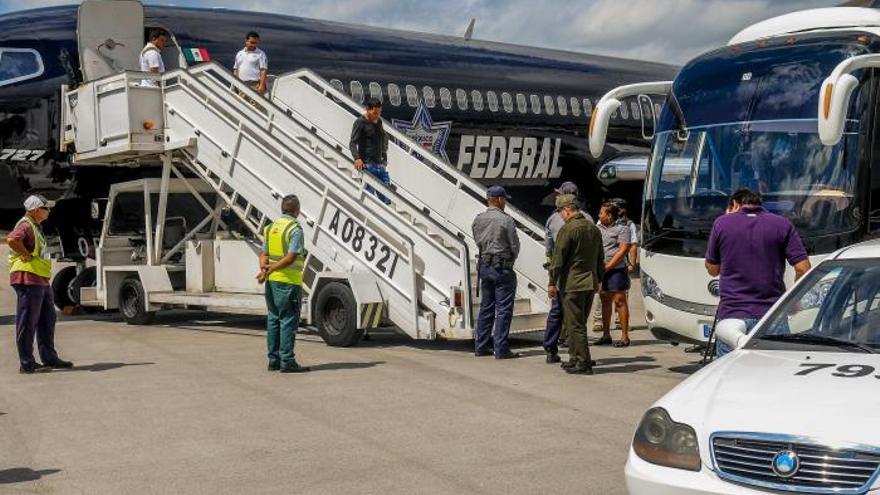
Mexico Repatriated More Cubans in Two Days Than in All of 2018

In just three days Mexico deported more than double the Cubans deported in all of last year. (Granma)

14ymedio bigger14ymedio, Havana, May 6, 2019 — In only three consecutive days in May, Mexico repatriated a total of 228 Cubans, spread out in a first group of 93 on Thursday, 77 on Friday, and 58 on Saturday. In barely three days the figures for all of 2018 were surpassed, according to statistics from the National Migration Institute (INM) gathered by the newspaper La Razón.

In the five months of 2019, the López Obrador administration has repatriated 541 people by air to Cuba, triple that of the entire last year. Excluding the massive deportations of this May, the figures had already been elevated since March. Although between January and February only eight people were deported, between March and April the expelled added up to 305 people, meaning an average of 78 per month, some 500% more than the monthly average of 2018.

This Saturday, after the deportation of 58 Cubans, a new escape happened at the Tapachula station, on the southern border of Mexico, from which at least 90 islanders managed to escape after forcing a metal barrier and assaulting the Federal Police. continue reading

The escape occurs one week after a similar one in which a thousand migrants left the station, known as Century XXI, encouraged, according to Mexican authorities, mainly by the group of Cubans.

The Mexico Commission of Help for Refugees (Comar), La Razón points out, placed 796 Cuban applications for asylum in