School Break Week Stresses Transit System in Camaguey

14ymedio bigger14ymedio, Ricardo Fernández, Camagüey, 20 April 2019 — Camagüeyanos have struggled this week to get around, due to the high demands on public transit as a result of school breaks at every level of education. Families turn to private carriers, which raise prices for the occasion, given the limited availability of state buses.

According to official figures, more than 1.7 million students travel around the country during this holiday period. The inefficiency of the state transport monopoly and the scarce fleet of private vehicles, this year, like every year, overwhelms the transit system resulting in  frequent long and exhausting lines.

The network of commerce and places for leisure and recreation, also in the hands of the State for the most part, collapse under the sudden increase in customers. Trips to the coast of Camagüey are frequent at this time when people travel from the provincial capital to the coast in increasing numbers. continue reading

The long lines to buy a ticket at the State-run Astro bus company and waiting lists several days long, cause many travelers to give up on using the state transport network. Individuals, on the other hand, offer trips in trucks rebuilt to serve as buses, but the fares are close to 10 CUC per person for the Camaguey-Havana route, half of a monthly salary.

The capital is a frequent destination for families seeking a wider range of recreational options. In Havana, the attractions include two zoos, the historic center, the National Aquarium and the Eastern Beaches, among other places to enjoy in the summer.

The week of school recess in April has been maintained for several decades and was ratified by Resolution 36 of 2017, based on an agreement of the Executive Committee of the Council of Ministers. This month’s break is established for both educators and students, the first one after the New Year’s break in a school year with a total of 46 weeks of study.

At the beginning, it was officially called “Girón week” because it coincided with the events of the Bay of Pigs in 1961, but over time many called it Holy Week because it coincides with the festivities and celebrations of Lent. Only since the visit of Pope Benedict XVI to the island, in 2012, has Good Friday been established as a holiday.

Until the 1990s, schools continued to be open with recreation activities for students whose parents did not have work holidays during those days or who did not have the ability to organize field trips. However, with the coming of the economic crisis known as the Special Period, after the collapse of the Soviet Union, this service has waned and in some places disappeared completely, so now families must take care of their children during the school break week.

These days the option of watching state television shows dedicated to children and teens is on the wane, replaced in many homes by watching programming available through the ’Weekly Packet’.

___________________

The 14ymedio team is committed to serious journalism that reflects the reality of deep Cuba. Thank you for joining us on this long road. We invite you to continue supporting us, but this time by becoming a member of 14ymedio. Together we can continue to transform journalism in Cuba.

Are Those Painful Years Returning?

Liván Hernández and his brother Orlando ’El Duque’ Hernández.

14ymedio bigger14ymedio, Ernesto Santana, Havana, 15 April 2019 — The documentary Brothers in Exile rings true these days in a way that we might find regrettable, because it presents the 1990s, the so-called Special Period in Cuba, along with the desire to play in the best baseball in the world, which led many Cuban players to escape from the country in any way they could.

The first to open the door to the Major Leagues at the beginning of the decade was René Arocha, but then there was the spectacular case of the two brothers, both pitchers, Orlando and Liván Hernández. Their story shocked fans and was picked up in this 2014 film, co-produced by ESPN Films and MLB Productions, directed by the Puerto Rican Mario Díaz.

It is a kind of fairy tale that does not seem to be taken from real life: two exceptional athletes who overcome the most hostile circumstances and end up rewarded with glory and fortune. But this beautiful fable was made possible by that trafficking of athletes that the recently canceled agreement between Major League Baseball (MLB) and the Cuban Baseball Federation aimed to eradicate. continue reading

Liván Hernández dreamed since he was 13 years old of playing in the Major Leagues in the United States, but only the hardships and humiliations of the time drove him to leave the Cuban team when it played in Mexico. Joe Cubas, the famous sports agent, was the architect of the process that ended in a young Livan signing a contract with the Florida Marlins in February 1996.

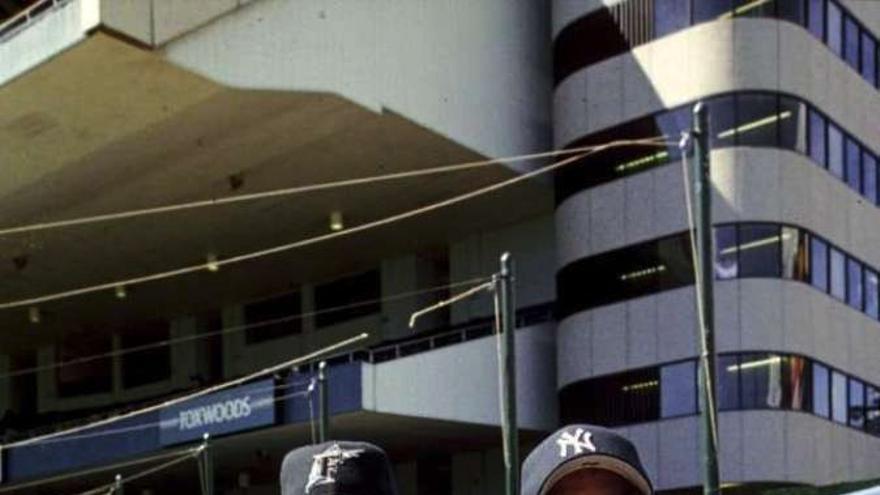
His brother, ten years older, the most valuable pitcher in the country in those days and one of the most brilliant in the history of Cuban baseball, Orlando El Duque Hernández, was expelled from the sport and even banned from entering the stadiums. The police harassed him at his home and mocked him: “You’re nobody anymore.” El Duque devoted himself to playing street ball, wearing the Yankees shirt that someone had given him.

Meanwhile, after an uncertain start, Livan had a dazzling year in 1997, won the World Series with the Marlins and was named that year’s MVP. El Duque, who followed his success from the purgatory to which he had been condemned by Cuban sports authorities, decided he would also leave Cuba at Christmas that year.

It was a dangerous adventure that turned out well, thanks to chance and to the skills of Joe Cubas. “If I had to do it again, I would not do it, what I experienced was more than enough,” confesses El Duque in the documentary. The rest is legend. From 1998 he was a three-time consecutive champion in the World Series with the New York Yankees. In 2005, he was crowned again playing for the Chicago White Sox.

Joe Cubas had glimpsed a promise of fortune when he saw Arocha’s contract with the Major Leagues. His masterful move was to take the players to a third country to be considered free agents. His parents had fled the Revolution and now he, as an agent, was pleased with an activity that displeased Fidel Castro, and one that, above all, earned him a lot of money.

Unfortunately, the ’escape’ from a third country to the United States was the mandatory path for many players who have pursued the dream of playing in the best baseball on the planet and being free citizens. But this documentary does not exalt that tricky road, quite the opposite. “As a Latino filmmaker, I hope that the Brothers in Exile will have a human impact, cutting through the paralysis that has characterized relations between the United States and Cuba for decades,” said the director.

Today, the Cuban official press attacks the “unjustifiable” political intentions with which Donald Trump, Marco Rubio and John Bolton have frustrated the agreement [between Cuba and the United States to allow Cuban players to play in the US without ’defecting’], but never alludes to the role played by sports and political authorities in the situation that leads to our players choosing such a dangerous path to escape from the power of the Cuban authorities and fulfill their dreams.

Now, the new president of Cuba’s National Institute of Sports (Inder), Osvaldo Vento, has announced loudly: “We are going to fill the country with the equipment and ballparks for the practice of baseball and, if specialists are missing, we will look for volunteer activists.” But, even with equipment, ballparks and coaches, not much will be achieved, considering the new great crisis into which the country is now entering.

“Attacks with political motivation against the agreement harmed the athletes, their families and the fans,” says the Cuban Baseball Federation (FCB). But many believe these authorities have the opportunity to demonstrate, at this moment, the moral superiority they brag of. They should simply renounce the profits and pave the way for each player to play independently for the Major Leagues.

Some formula must be found so that, leaving the Government out of the equation, the agreement can go forward, because without it there looms a new era of despair and uncontrollable diaspora for Cuban baseball, today, and the painful years that resulted in the story told in Brothers in Exile could be repeated today.

____________________

The 14ymedio team is committed to serious journalism that reflects the reality of deep Cuba. Thank you for joining us on this long road. We invite you to continue supporting us, but this time by becoming a member of 14ymedio. Together we can continue to transform journalism in Cuba.

Repression in the Time of Shortages

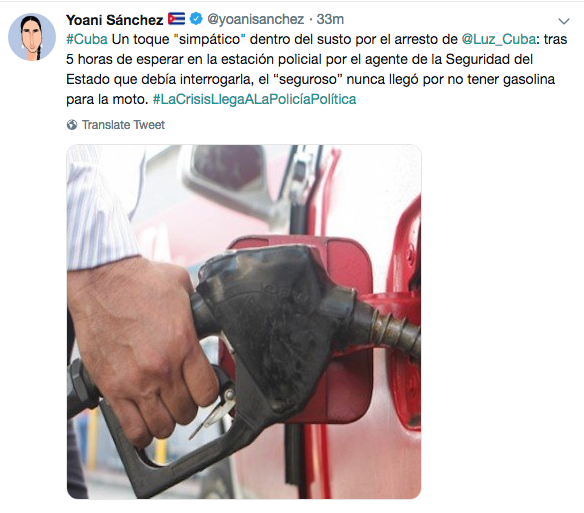
Yoani Sanchez, via Twitter, Havana, 8 May 2019 — A nice “touch” in the fright of the arrest of @Luz_Cuba (Luz Escobar): After waiting five hours at the police station for the State Security agent to arrive to interrogate her, the “seguroso” never arrived because he didn’t have gas for his motorcycle. [#The Crisis Comes to the Political Police]

See also:
14ymedio Reporter Luz Escobar Arrested In Cuba / CiberCuba

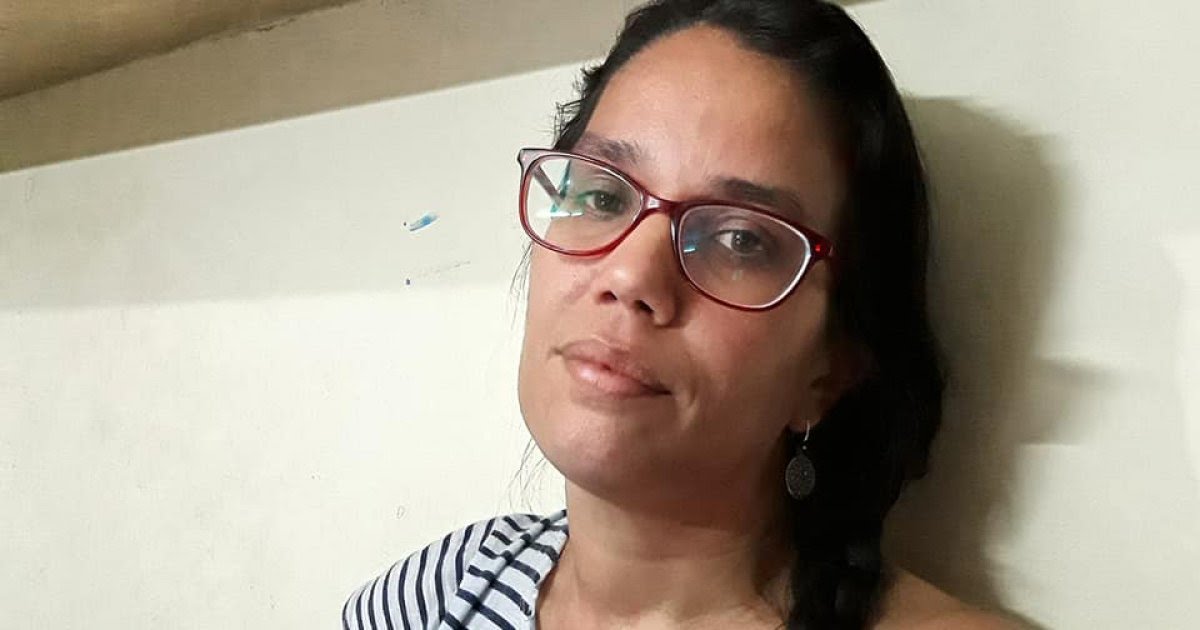
Luz Escobar, Reporter for 14ymedio, Released After 5 Hour Detention in Cuba

Luz Escobar, Reporter for 14ymedio, Released After 5 Hour Detention in Cuba

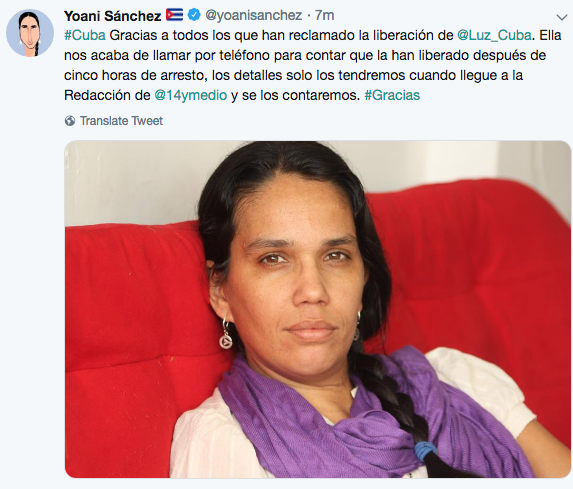
Yoani Sanchez, Havana, 8 May 2019 — Thanks to all those who demanded the release of @LuzCuba (Luz Escobar). She just called us on the phone to say that she had been released after being under arrest for five hours. We will only have the details when she arrives at the 14ymedio newsroom and we speak with her. THANK YOU.

14ymedio Reporter Luz Escobar Arrested In Cuba / CiberCuba

Luz Escobar, a reporter for the independent Cuban newspaper 14ymedio

CiberCuba, May 8, 2019 – 15:08 (GMT-5)

Cuban police arrested journalist Luz Escobar, a reporter for the newspaper 14ymedio, on Wednesday.

Escobar was taken to the police station in the Santiago de Las Vegas municipality, in Havana, after she was arrested while interviewing residents of a shelter for victims in that area.

“Regrettably, we have confirmed that our colleague, Luz Escobar, a reporter for the newspaper 14ymedio, was arrested and taken to the police station in Santiago de las Vegas, in Havana. One of the residents of the shelter for victims where she was collecting testimonies called our office to confirm it,” wrote Yoani Sánchez, director of 14ymedio, on her Facebook page.


Loyalty in Venezuela in Times of Crisis

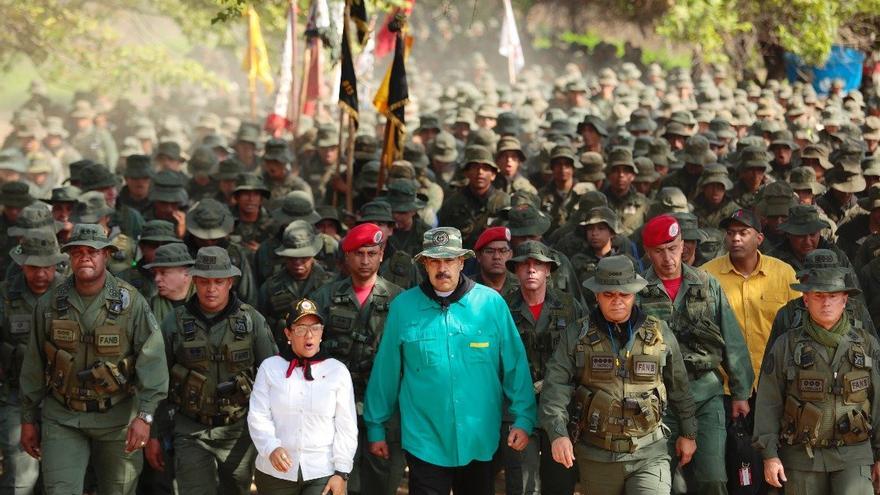
Maduro trusts only in “los cubanos.” They made him the hier into “Comandante eterno” (Hugo Chavez) and they maintain him in power, opines Montaner. (@NicolasMaduro)

14ymedio bigger14ymedio, Carlos Alberto Montaner, Miami, 6 May 2019  / Translation from Latin American Herald Tribune — Leopoldo López says that some generals came to his home to express some kind of solidarity. It must be true. For now, Manuel Ricardo Cristopher Figuera, the former head of the SEBIN (Bolivarian Intelligence Service), is hiding. López fled his home, where he was under house arrest, thanks to the complicity of some SEBIN members.

It is very difficult to be loyal to Maduro. He is not a serious guy. What he does best is to dance salsa with his not-so-holy wife, the narco-aunt Cilia Flores. Everyone knows that Maduro talks to the birds and suffers from severe dyslexia mixed with a mild expression of Tourette Syndrome that leads him to confuse the “loaves and fishes” with the “penises and the fishes” while addressing the “miembras” (female members) of his party.

Nobody ignores the episode of the narco-nephews or the “disproportionate” corruption of Maduro and his regime. Chavismo has stolen more than 300 billion dollars. Just walking in Venezuela is enough to notice that it is the worst governed country in the world. The blackouts, the hyperinflation, the lack of food and medicine, in one of the richest nations of the planet, can only be explained by a combination of absolute incompetence and the shameless theft of public resources. continue reading

Loyalty and obedience originate in respect or fear and Maduro is neither respected nor feared. Not only the opponents maintain that attitude. It is shared by military leaders, the regime’s apparatchiks and those people around who serve them. That’s why Maduro only trusts “the Cubans.” They made him the heir of the “eternal Commander” and they keep him in power.

It’s the same thing that happened to Hugo Chávez in April 2002, when he was forced to relinquish power. The most servile military were conspiring. It was since that episode that Chávez totally surrendered to Fidel Castro. The Cuban dictator didn’t feel respect or fear, but there was a loyalty with a price. Fidel despised him, but at the same time he needed him. After the death of Ubre Blanca, Fidel’s dairy cow, Chávez was the replacement.

Mike Pompeo does not totally lie when he says that Maduro was ready to leave for Cuba and the Russians forbade it. That, surely, was communicated by a Venezuelan high-rank source to his CIA “handler.” It was his best excuse to explain the obedience of Venezuela’s high officials toward Maduro, a man who is neither feared nor respected.

However, John Bolton, the US National Security Advisor, is wrong when he says that the military will not shoot at the people. As long as the structure of command is kept, the armies are disciplined killing machines. They are trained to become that. It was evident when armored cars deliberately crushed several demonstrators.

Besides, the “Milgram and Zimbardo experiments” leave no room for doubt. Just an order from “the authority” is almost always enough to make disappear the moral judgments of those who have to fulfill the order. This sinister characteristic of human beings became evident in the concentration camps during World War II. Murder and vileness are at everybody’s reach. Armies kill and disembowel if they are forced to do it.

The phenomenon disappears when the chain of command is broken. I was able to experience it when Batista fled from power on the night of December 31, 1958. The next day, on January 1, 1959, a police patrol stopped us after a monstrous violation of traffic regulations (I and three other boys were in a car driving on the sidewalk, full of joy after the dictator’s flight). The day before we would have been shot. That day they treated us with courtesy. They respectfully recommended that we go on the street, not the sidewalk, they asked for the revolutionary bracelets and they gave us a military salute. The chain of command had broken.

President Juan Guaidó and Leopoldo López, his political boss, are right when they say that soon there will be a new military attempt, and another, and another, until Maduro leaves of power, dead or alive. They do not fear him or respect him. But to achieve this, it is very convenient that Venezuelans do not leave the streets and ignore the proposal of Padrino López (now the man from Havana): Maduro leaves, in exchange for no foreign intervention. That obscene proposal would mean the permanence of the narco-dictatorship, as the analyst Jorge Riopedre points out.

_____________________

The 14ymedio team is committed to serious journalism that reflects the reality of deep Cuba. Thank you for joining us on this long road. We invite you to continue supporting us, but this time by becoming a member of 14ymedio. Together we can continue to transform journalism in Cuba.

The Increase in Taxes Affects the High Prices of Pork

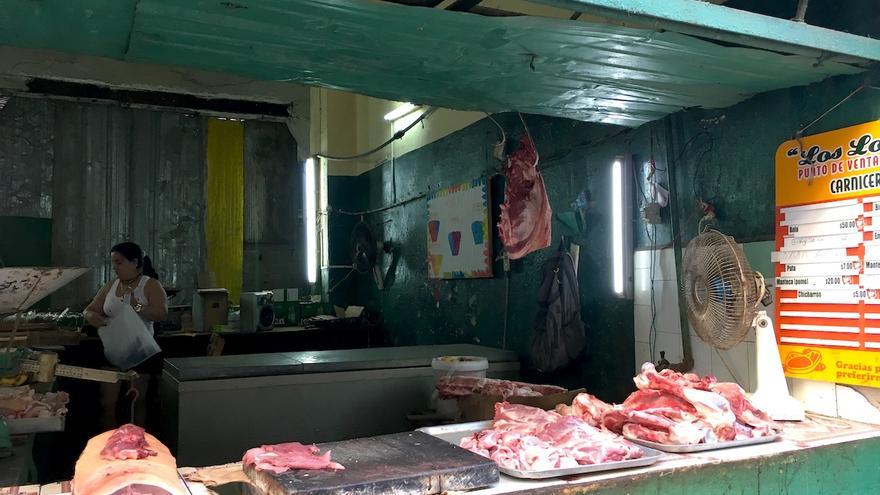
A pound of boneless pork now costs 70 Cuban pesos (CUP) in several markets on the island. (14ymedio)

14ymedio bigger14ymedio, Havana, 6 May 2019 — The shortage of animal feed and the implementation of a tax on the income of pork producers led to a lower supply of pork and higher prices in the markets, according to a report published on Monday in Cubadebate.

It will still take time for the shortage of pigs to be solved and the “availability” of the product “will not see a breakthrough in a few months,” the official media explains. Meanwhile, a pound of boneless pork has reached 70 Cuban pesos (CUP) in several markets of the Island.

The official version admits that pork production started very badly this year because the state stores in the municipalities did not deliver the feed for the animals in time. The distribution of feed is a state monopoly and national production is scarce and based on substitutes. continue reading

The lack of the product is attributed to the failure to deliver “essential feed” contracted with international suppliers. “It did not arrive in time” at its destination or “never arrived,” points out the text, published after the rise in prices of pork was widely reported in independent media and social networks.

In the last few days, complaints from Cuban Internet users who posted photos showing the prices of pork on market stalls across the country became frequent on Facebook and Twitter. Along with criticism, some used irony to explain the absence of pork in the agricultural markets.

“Someone is talking nonsense here and blamng the price of pork on African Swine Fever,” commented Camilo Condis on his Twitter account in reference to an article on BBC World with the title: Why the price of pork skyrockets worldwide.

The publication insists that Brazil and Argentina decided not to send cargoes already contracted to Cuba, a decision that the head of the Porcine Technological Division of the Livestock Business Group, Yasser Hamed Jassén Santiesteban, attributed to “the effects of the economic, commercial and financial blockade of U.S.”

In December of 2018, Brazil froze a credit line that allowed Cuba to acquire a variety of products, especially food. The cancellation was due to the lack of payments from Havana, a fact that is not mentioned in the Cubadebate report.

On the island, local producers have not been able buy this type of feed — based mainly on corn and soybeans — from the State since last September, and only at the beginning of April 2019 did the State began distributing the product. A reality that affected the more than 14,000 pork producers belonging to the private and cooperative sector. The latter were forced to distribute their meat through the state company Acopio, an intermediary between the breeders and the markets.

Another blow that caused a steep decline in the availability of pork in the markets, and has contributed to its price skyrocketing, was the application at the beginning of this year of a tax on the person income of pig farmers, on a progressive scale that goes from 10% for those with earnings of up to 12,000 pesos, and reaches up to 45% if the producer earns more than 150,000 pesos.

This measure has upset those who consider that the levies are excessive and discourage the raising of animals, in the midst of the adverse economic landscape that the country is experiencing. Many of these producers also pay other taxes related to the activity they perform and the labor force they hire.

_________________________________

The 14ymedio team is committed to serious journalism that reflects the reality of deep Cuba. Thank you for joining us on this long road. We invite you to continue supporting us, but this time by becoming a member of 14ymedio. Together we can continue to transform journalism in Cuba.

Cuban Police Have Their Eyes on the Tourist Guides in Old Havana

A fall in the number of reservations for tours through the state-run companies may be one of the reasons why the Government has decided to intervene in a practice before which, until now, it ignored. (14ymedio)

14ymedio bigger14ymedio, Luz Escobar, Havana, 7 May 2019 — Things have become complicated for the independent tour guides in Havana in recent weeks. Accustomed to operating for years without a license, they see how the authorities are now trying to curb their activities to protect the monopoly of state companies, such as Cubanacan or Havanatur.

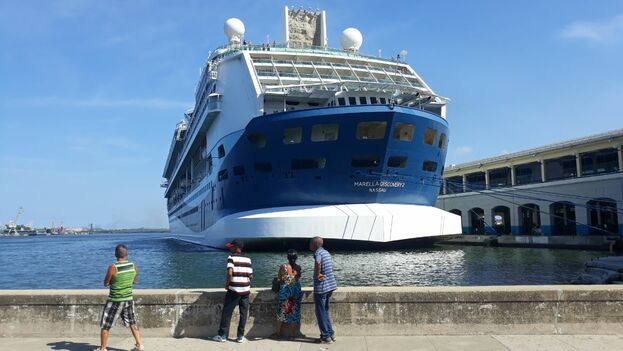
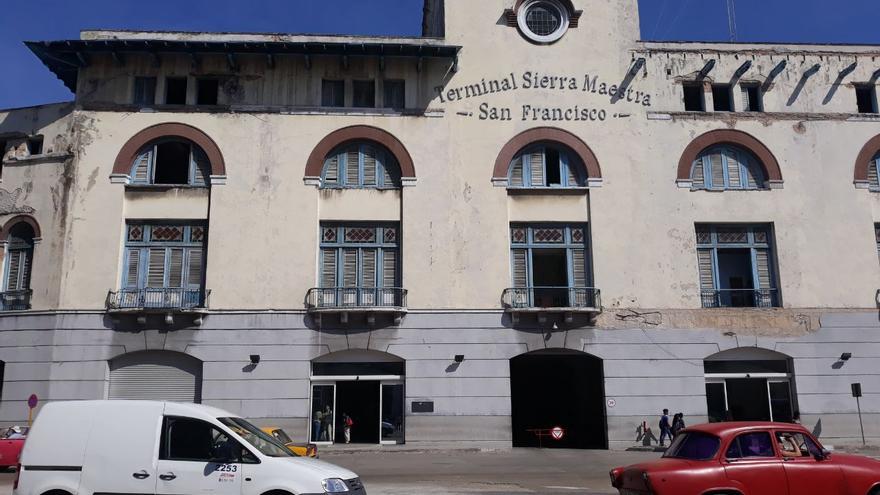
“We must avoid all streets near the cruise terminal, but the truth is some days are more complicated than other,” a freelance guide who prefers not to reveal his name tells 14ymedio. According to his testimony and that of another of his colleagues, in the last month several colleagues have been arrested and taken to the police station at Cuba and Chacón streets or fined by the authorities.

“It has already happened to me twice, encountering the police with customers along the routes. It’s a terrible shame, but I tell them all the truth, that we are in a legal limbo and that’s why they can stop us,” explains the guide, an English language graduate from the University of Havana who prefers to work on his own. continue reading

According to official figures, the Island has received two million international visitors from the first of the year to 4 May. (14ymedio)

The lack of government issued licenses for tourist guides prevents the practice of this specialty within legal channels, as professionals would prefer. “Many of us do not have a license because it does not exist, I, in particular, have a photographer, and when the police ask I always tell tourists that they hire me to accompany them on their tour and take pictures of them. So far it has worked for me but some of my friends have had problems with this ruse,” he says.

The profession of dance teacher is another of the licenses most requested by those who, in reality, use the license to act of a tour guide on the main streets of Havana.

Luis, driver of a luxury car that offers tours from Old Havana to the Plaza of the Revolution says that “the guides are tremendous targets. They are detained, they are fined, and then fined again. When they are fined for the third time, they are given a warning notice and that means they have a criminal record and it is impossible for them to travel in areas where there is tourism.”

The history of the raids against the guides runs by word of mouth among those who make a living in the Historic Center area. A parking lot attendant from the Lonja del Comercio attributes it to the fact that the cruise companies that arrive in Havana are receiving fewer reservations for tours and have complained because “the guides picked up clients from the cruise when they exit through Customs.”

The attendant admits that although there are many professionals in the business, there are also “many scammers” who take advantage of the situation and are not prepared for the job. “A few weeks ago here there was a big raid, they took about 20 in a trip, they grabbed everyone, small-time jineteros (male prostitutes) and guides who have been doing this for years,” he says.

Today we reached 2 million visitors, 12 days earlier than year, we will have a Foreign Administration Workshop, in the afternoon a Cuba-Spain Business Forum, tonight the gala at the Alicia Alonso Theater and tomorrow we will inaugurate FITCuba 2019 at the Palace of Conventions. pic.twitter.com/qBVJYTYAaT    –  Manuel Marrero Cruz (@MMarreroCruz) May 6, 2019

According to official figures, the Island has received two million international visitors since the beginning of 2019 until May 4. The Minister of Tourism, Manuel Marrero, published the data in his Twitter account and said that this shows “a higher rate” of arrivals compared to the same period last year.

The official press highlighted on Monday that the United States remains the second “origin market” despite “the [United States] Government’s policy.” By the end of April, 257,500 Americans had arrived in Cuba, 55% in cruises,” an option that continues to rise and grows 48% this year,” while arrivals by air grows 45%.

__________________

The 14ymedio team is committed to serious journalism that reflects the reality of deep Cuba. Thank you for joining us on this long road. We invite you to continue supporting us, but this time by becoming a member of 14ymedio. Together we can continue to transform journalism in Cuba.

Trumpa’s “Pressure Cooker” Policy

Caption: Cuban demonstrators in the spontaneous protest known as the maleconazo in 1994. (Karl Poort)

14ymedio bigger14ymedio, Ariel Hidalgo, Miami, May 4, 2019 — The comings and goings of Trump officials in Florida lately to meet with exiled Cubans and Venezuelans, and the measures taken against the Maduro dictatorship and Castroism, clearly have an electoral interest, which is very common.

All politicians, Republicans and Democrats, have always done the same thing. What is new is the application of Titles III and IV of the Helms-Burton Law, which no president, since Clinton and Obama, has dared to apply before now, because it would affect the interests of many allies—above all, in Europe.

Now this extreme step has the tinge of a last resort, because the possibilty of presidential reelection seems less clear, especially because the Democrats now have a majority in the House. And Florida, as we know, will determine whether Trump gets a second term. continue reading

Limitations on trips and remittances were added, supposedly to reduce what reputedly is the principal source of the Havana Regime”s hard currency. And, as if this weren’t enough, Trump threatens a “total embargo,” all part of a repressive policy that has failed for more than half a century.

The theory of many defenders of the hard line is based on thinking it will work this time, because the measures would be added to the profound economic crisis that, according to clear indications, will give rise to a new Special Period of calamities in what was once called the Pearl of the Antilles, and that the country would not be able to withstand a sequel.

And maybe they’re right, not only because “sequels are never good” but also because since that time the citizens have advanced in many ways, as much in frustration at so many false expectations and unfulfilled promises as at lack of access to new communication technologies. The final objective of this policy has always been to do whatever explodes the pressure cooker, so that the multitudes throw themselves into the streets against the dictatorship until it bursts.

As it is offered—like many other times—on a silver platter to the octogenerarian leaders as an opportunity to make “the Empire” responsibile for all of Cuba’s economic problems, they repeat the illusion that the main problem of Cubans is the contradiction between a great power and the small, heroic country that it wants to subdue. By this logic, it’s possible that people might actually take to the streets, but I don’t know if many would do it to demonstrate against the dictatorship or to curse Trump and imperialism. And although this reaction might seem logical, I suspect that the result would be worse than the illness.

A maleconazo multiplied by ten or twenty not only would provoke a devastating destruction but also would be accompanied this time by an incalcuable number of wounded and dead. Examples, although perhaps on a minor scale, can be seen in the demonstrations in recent years in Venezuela and Nicaragua.

Did anything good come of them? The only good thing has been the experience of what shouldn’t be done. It appears that the Venezuelan opposition has assimilated this very well, and Juan Guaidó’s message has been clear: no violence, although it can’t be avoided that there are those on the periphery of the movement who didn’t get the message.

Furthermore, the main people affected will be employees, private entrepreneurs, retirees, everyone. But none of these people have the right to vote in elections in Florida.

One day, someone asked Manuel Moreno Fraginal why such a rebellious and heroic people as the Cubans weren‘t rebelling against the dictatorship, and the prestigious author of El Ingenio answered: “Because in Cuba for some time there has been no middle class, which has always been the leader in these events.” It’s true. The middle class has nothing to lose, nor any economic strings attached.

This class has begun to emerge in Cuba for some years with private entrepreneurs, the black market, artists, bloggers and independent journalists who don’t have ties to the State. They could lead a broad, peaceful movement in favor of change, like the pre-revolutionary Third Republic in France. But now, with the Trump administration’s policy, this process might come to a halt.

If the President is removed by a political trial because of his blunders or loses the election, since many voted for him only to oppose the “Establishment” and, in particular, the politicians, these measures probably won’t last, but if he wins, we’ll have them for a long time.

But with or without Trump, the historic leadership of Cuba will be involved in the dilemma of having to make major concessions like what has happened up to now, if it wants to avoid grave dangers and the headaches that follow. Cuba could rise and thrive in very little time.

It would be enough to liberate and stimulate the creative forces of Cubans. But that would mean renouncing the monopolistic control of the rich. If the leaders don’t do it, others will have to, and those others won’t be just the dissidents but all of civil society: academics, professionals, students, independent journalists, bloggers, writers, film makers and other artists, agreeing to draw up a joint, agreed-upon program of necessary changes and raising their voices high.

This is not a wish or a whim but an emergency and a duty for all Cubans if they want to avoid the tragedy that is approaching.

Translated by Regina Anavy

______________________________

The 14ymedio team is committed to serious journalism that reflects the reality of deep Cuba. Thank you for joining us on this long road. We invite you to continue supporting us, but this time by becoming a member of 14ymedio. Together we can continue to transform journalism in Cuba.

May 1, Exaggerations and Contradictions / Somos+, German Gonzalez

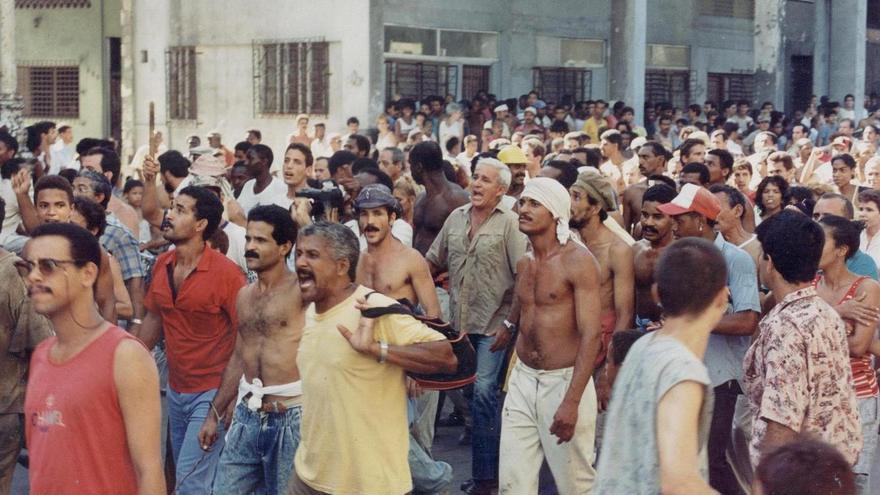
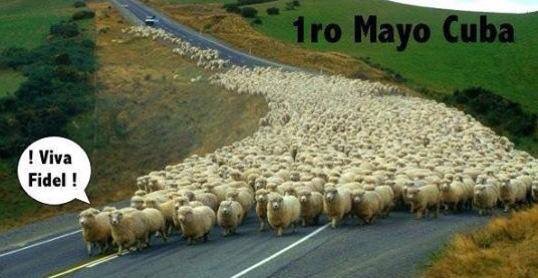
Somos+, Germán M. González, 2 May 2019 — In its broadcast on May 1, 2019, NTV reported that six million Cubans attended the parade celebrating International Workers’ Day. This is impossible given it would amount to more than fifty percent of the island’s population, or a much higher proportion if you discount the sick, disabled, elderly, working people, security personnel, small children, those living abroad, etc. In that case the figure would approach close to 80% or more of possible attendees.

In Cuba we are used to seeing these types of large-scale events and, compared to what has been observed on many previous occasions in Havana, no more than 200,000 to 250,000 thousand people could have attended the parade.

To reach NTV’s reported figure, 1.2 million people, or 50% of the city’s total population, would have been needed, which obviously was not the case. The same scenario would have had to play out in the provinces. continue reading

Personal observation, however, contradicts this. In the town where this writer lives, a town with 49,000 residents, no more than a thousand people showed up. One can then deduce that, in all of Cuba, probably less than a million people, or about 10% of the population, participated. And that is being generous.

Other contradictions are no less obvious. NTV broadcasts images of the celebration from countries where the rights of workers, including salary levels, are seriously compromised. Millions of people emigrate from Cuba, Venezuela and North Korea annually, as confirmed by the United Nation’s Human Development Program in its Index of Human Development. These are countries with repressive regimes, where workers, along with the rest of their populations, do not enjoy most universally recognized rights.

Knowing the reality of Cuba, we could ask ourselves: What are they celebrating? In countries which accept migrants such as France, Spain, Germany and the United States, people march in the streets for various reasons. It is worth asking ourselves, Do those who are better off protest because they can do so, because it is a right they enjoy and exercise?

Conversely, do we celebrate publicly because the right to protest is restricted or denied? The countries who protests NTV reports also happen to be in the top ranks of the aforementioned index and are countries where the rule of law is fully respected.

Most likely, participation rates at public events in countries where attendance is mandatory for state-employed workers and students — population segments which are subject to obvious pressures — are exaggerated. In Cuba a black mark from the union or the Committees for the Defense of the Revolution for not attending a rally may jeopardize a spot at a university or workplace, threaten a job promotion or, even worse, a trip abroad due to an unexcused absence.

It is also obvious that there is exaggeration about the magnitude of protests in places where this right is exercised. In these places the only motivation people have to attend is to protest since the rest of their rights — a living wage and other labor benefits — are taken for granted, seen as something normal and come with no strings attached.

There is no need to participate in a parade except for pleasure. A seeming contradicion is the presence of many immigrants at these protests, something they would not dare to do in their countries of origin — generally dictatorships — because of the associated dangers. But they can do so in their host countries, which are generally democracies.

Unfortunately, very few Cubans, conditioned from early childhood by decades of indoctrination and propaganda from official news outlets, which are the only kind we have, have not asked these questions. Until now.

May Day in Cuba With Little to Celebrate

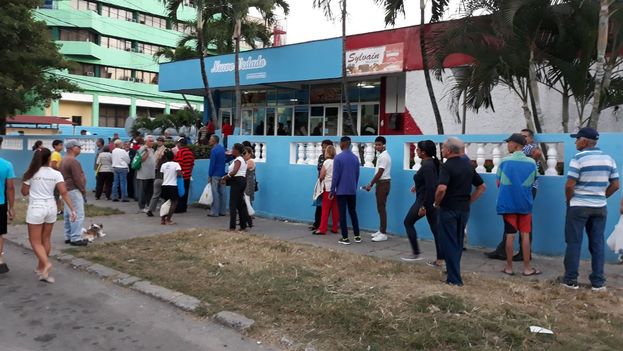
Shortages of food have made the daily routine difficult for Cubans who now have to stand in long lines to buy it. (14ymedio)

14ymedio bigger14ymedio, Elías Amor Bravo, Economist, 1 May 2019 — The relationship between Cuba’s communist regime and the world of work has been difficult. Therefore, there is not much to celebrate this May Day, nor has there been on previous ones. This relationship has always referred to, by the Cuban government, as “adverse times, characterized by the resurgence of aggression, threats and lies by Yankee imperialism and its lackeys,” but the reality is quite different.

There is no external reason to explain why Cuban workers have become the great defeated of a regime which, nevertheless, has wanted to present itself to the world as the “workers’ paradise.” Forget all that. Let’s go back to the beginning.

A bit of history can serve to illustrate what is we’re talking about. After the process of revolutionary transformations that upset the Cuban economy and its position in the world, one of the recurring nightmares of Fidel Castro was the low productivity of labor in the economic system that he himself designed. Without understanding that this fact is a direct consequence of the revolutionary structures, the patches that were placed on the system over several generations, far from resolving the situation, made it worse. continue reading

It is worth remembering that it was that distant August 2, 1961 when the fledgling regime announced a change in the labor legislation and the role of the unions. In an attempt to control the “Cuban Workers Center” (CTC) — as the only legal union, totally controlled by the government, was called –the regime adopted in Cuba the labor relations model of the communist countries.

Until then, most of the companies not expropriated or nationalized maintained a labor framework similar to the one before 1959. But this year saw the real start of the disaster when all Cuban workers became, at one stroke, “employees of the state.”

From then on, the problem became how to produce more, despite the absolute control of the economy by the communists. So much so that only one year later, on March 3, 1962, the first “work card” was created to register the work history of each worker, which ultimately resulted in an assessment of their acceptance of the new regime. and willingness to participate in the activities organized by it. Che Guevara did not take long to question the quality of production, while rationing and shortages were extended to all products.

Four years later, at the congress of the CTC, a document was published in which low productivity and absenteeism were noted as the two main ills of the Cuban labor world. And thereafter, the issue began to be increasingly serious and a must-solve for Fidel Castro, who launched the theme, little thought through and hasty, of the “moral stimuli” as a solution to increase productivity.

The 1968 “Revolutionary Offensive” that led to the nationalization of 50,000 small private businesses was of little use, rather it finished poff the economic system, which had barely survived until then.

From then on, the lack of food became an additional concern for the authorities, who did not want to understand the origins of this. In August of that year, the labor minister ended up imposing, compulsorily, the much-criticized “work cards,” which would openly report the behavior and political attitudes of the workers.

Popular trials in the workplace spread all over the country. The failure of the “Ten Million Ton [Sugar] Harvest” was a leap into the void, mobilizing all of the country’s economic resources in a goal that was known to be unattainable, but that would have negative conclusions for the world of Cuban labor.

Nothing in all this could end well, and in May if 1970, taking advantage of the fiesta for May Day, Castro announced a strong attack on the unique union, denouncing the problems of productivity and absenteeism as responsible for the failure  of the zafra (sugar harvest), at the same time announced a reorganization, hidden in the call to “democratize the union.”

A year later, and on the exact same date, Castro announced that from then on wages would be established based on workers’ contribution to production, breaking forever with the revolutionary principle of equality.

In the new tradition of giving each year a name, 1972 was called “The Year of Socialist Emulation” in what was interpreted as an approach to the Soviet institutionality.

However, in July of 1973 Fidel Castro announced in a speech that in Cuba the socialist principle of “to each according to his work, from each according to his needs” would be applied as of that moment, in what was interpreted as a retreat forced by events.

In the CTC congress in November of that year, the regime returned to the idea of material stimuli and the unions recovered part of the lost relevance, with the election of Lazaro Peña as general secretary, but he died only six months later.

From that point forward, things went from bad to worse. The institutionalization of the regime after the approval of the Soviet-inspired 1976 constitution was a failure, and provoked the outbreak of social protest in the Peruvian embassy and the subsequent exit by way of the Port of Mariel of hundreds of thousands of Cubans in the Mariel Boatlift.  This was the first major emigration since the revolutionary times of Camarioca and the “freedom flights.”

In any case, the system created by Fidel Castro continued to expel people from the island, but it was no longer “the rich, the exploiters and collaborators of Batista” who were clinging to the boats leaving from Mariel to flee the country. The arguments were over. The failure of the “workers’ paradise” had been shown clearly before the world.

But the “Special Period” took care of the rest, that time after the collapse of the Soviet Union and the loss of its subsidies plunged the Cuban economy into deep crisis. During those years, Cuban workers found themselves imprisoned by the contradictions of a regime locked in its ideological postulates, which one day said yes, and another sais no, to the same measures and performances.  Now, without Soviet help, the culprit of all evils was the blockade or the embargo, decreed by Kennedy, of which nobody had paid attention to before the collapse of the Berlin Wall.

In its congress of 1990, the CTC, for the first time, had to analyze the problem of unemployment in Cuba, which it tried to explain by the “lack of raw materials,” and only a month later, Instruction 137 of the People’s Supreme Court urged the denouncement of those who had a high standard of living, persecuting and repressing the coleros and macetas, as people who were seen to “line their pockets” were called.

The social outbreak was immediate, and led hundreds of thousands of Cubans to escape the island in rafts, causing another conflict with the US in the waters of the Straits of Florida. There was an attempt to solve the problem by assembling those who fled the island on the US Naval Base in Guantánamo, from which most were eventually allowed to leave for the United States.

This historical record confirms that Cuban workers have not seen a solution to their aspirations in Cuba, and all those who have been able to do so have chosen to leave the country in search of a place where they can make their dreams come true.

In the current situation, in which the regime is paralyzed as a result of the end of aid from Venezuelan, and the failure of the Raulist measures to improve the functioning of the economy, another social explosion is possible. The question is whether there will be a viable way to escape from the country under the current conditions. Castroism remains determined to implement, without democratic support, an economic model different from what they call “savage capitalism,” a model which no longer exists in any country in the world, and so it goes.

If we really want Cuban workers to help promote economic development and improve the quality of life and prosperity of the nation, we must restore a different system of labor relations, because the one that exists does not work. Otherwise, on the 1st of May, the Castro regime will always have little to celebrate.

___________________________

The 14ymedio team is committed to serious journalism that reflects the reality of deep Cuba. Thank you for joining us on this long road. We invite you to continue supporting us, but this time by becoming a member of 14ymedio. Together we can continue to transform journalism in Cuba.

The Doctor of Cubanness / Fernando Damaso

Ramón Grau San Martín. Source: Wikipedia

Fernando Dámaso, 15 April 2019 — Dr. Ramón Grau San Martín was the seventh President of the Republic. He governed from 10 October 1944 to 10 October 1948. During the very month he took office, a fierce hurricane struck the Island, causing great destruction. For many citizens, this natural phenomenon constituted an important omen: the Grau government was kicking off with stormy winds — and a stormy government it would be, despite being established amidst the prosperity produced by World War II, when sugar came to achieve a high price on the world market.

Grau, who promised to achieve a “government of Cubanness,” and who liked to say, “Cubanness is love” — and that, besides, in his administration, women were “in charge” — promulgated the Law of the Sugar Differential to benefit the industry’s  workers, fixing the producers’ share of the final molasses (a statute of indisputable social utility).

He also launched a vast Public Works Plan that notably improved many neighborhoods in the city of Havana — despite some projects being so poorly constructed that they eventually had to be demolished and rebuilt. He established the compulsory licensure of degreed and non-degreed professions, a summer schedule for businesses, a lawyers’ pension, and retirement funds for workers in the textile, sisal and tobacco industries, among others. continue reading

From the start of his administration, Grau tried to associate it with the “hundred days” (9/10/1933-1/15/1934) and lend it continuity via social measures — although many contained a high dosage of demagoguery, so much that he became popularly known as “the Divine Gallimaufry.”

At the same time, in a moment of weakness, he allowed certain armed groups (remnants of the 1933 Revolution’s action groups who had been unable to insert themselves normally in the subsequent political process, and who practiced violence and carried out shady dealings) to roam the streets, primarily, of Havana.

This infinite tolerance for gangsterism revived the anarchic episodes of that prior period — which, during the previous administration, had seemed a thing of the past — thereby demonstrating the terrible current state of relations between the Executive and Legislative powers, which had suffered a great decline.

Grau abandoned the semi-parliamentarism instituted by the previous adminisration and went back to a presidentialist style of government, ignoring what had been established by the Constitution of the Republic in this regard.

In addition, his presidency was characterized by some picturesque, even extravagant, successes that reduced his credibility and respectability — such as the strange disappearence of the diamond embedded in the floor of the Capitol (which, some time later, one fine day, with no coherent explanation, appeared on the table in his office, and which he nonchalantly returned to its rightful place as if nothing had happened, without revealing who had masterminded such a misdeed).

Among the tragic events occurring in those years, one that merits pointing out is the so-called “Battle of Orfila,” more like a slaughter, wherein the two most important action groups that operated in the city of Havana vented their personal and business rivalries with bullets, resulting in a great number of dead and injured.

On the international plane, Grau allowed the formation of a clandestine army – the so-called Legion of the Caribbean — which established its base of operations in Cayo Confites and was aimed at overthrowing dictatorships in the region, in frank violation of international laws in force then.

Notwithstanding all these errors, which discredited the government as well as the President himself (turning him into a cartoon-like figure), there was always an absolute respect for civic liberties and freedom of expression — and, as he liked to say, in his government, all Cubans “had five pesos in their pockets.”

Grau was a President subjected to great opposition — not just the traditional kind, but also that of Dr. Eduardo R. Chibás, dissident leader of the Partido Revolucionario Cubano-Auténtico (PRCA), who went on to head it when he was not selected by Grau as the party’s candidate for the upcoming presidential election.

Chibás, a charismatic and populist politician who had directed Grau’s campaign during the so-called “glory days” that had swept him to power in 1944, felt discriminated against, and he became Grau’s most fierce critic and impugner — with and without cause.

On 6 January 1948, general elections were held in which the following candidates participated: for the PRCA, Drs. Carlos Prío Socarrás and Guillermo Alonso Pujol; for the Coalición Socialista Democrática, Drs. Emilio Núñez Portuondo and Gustavo Cuervo Rubio; for the Partido del Pueblo Cubano-Ortodoxo, Drs. Eduardo R. Chibás and Emilio Ochoa; and for the Partido Socialista Popular, Dr. Juan Marinello.  The winning ticket was that of the PRCA.

President Ramón Grau San Martín, a popular figure who aroused great hopes in the citizenry (as much for his support of culture as for his performance during the government of the “hundred days” following the overthrow of Gerardo Machado’s dictatorship), who assumed the presidency with a great majority of the population in his favor — little by little, due to his political weaknesses, began to lose prestige and turn into more of a folk character than a head of state.

As a result, even with the prevailing economic boom during his six years of governing and the many constructive works accomplished with the objective of improving our towns and cities, the people did not feel totally satisfied. A monument or bust was never erected in his memory.

Translated by: Alicia Barraqué Ellison

The April 30 Rebellion in Venezuela: Another Hypothesis

Juan Guaidó and Leopoldo Lopez accompanied by military deserters outside the Carlota military base on April 30. 

14ymedio bigger14ymedio, Jorge Hernández Fonseca, Lisbon, May 3, 2019 — As we now know, the rebellion in Venezuela on April 30 against the Maduro regime did not achieve its goal of overthrowing the dictatorship. Several likely hypotheses have emerged to explain what happened. In my opinion, however, the actual course of events to date does not support them. I think as Cubans we have a much clearer idea of what is likely to have happened.

We know that there were high level contacts between Juan Guaidó’s team and the United States on the one hand and between senior officials close to Maduro on the other, suggesting a conspiracy. Senior commanders would support Guaidó in overthrowing Maduro, apparently through military action. But according to this hypothesis, the designated date was delayed, frustrating action by the high command and leaving Guaidó on the sidelines.

Cubans know all too well that the main tactic of the island’s secret services is to infiltrate the ranks of its enemies. On the other hand, Cuban counterintelligence plays a dominant role in Venezuela. Therefore, it is not difficult to imagine that Cuban intelligence agents were aware of contacts between Guaidó’s team and senior government officials, which would have allowed them to put together a plan to thwart the scheme. If so, it appears Maduro’s high command followed it faithfully. continue reading

Personally, I find it highly unlikely that there were contacts between Maduro’s military and Guaidó’s men, or contacts with the outside world, since none were detected by the intelligence services. Rather than being aware of such contacts, I think it is much more likely that the intelligence services promoted the idea.

There is a senior official, the head of the Venezuela’s intelligence service, who for personal reasons has broken with Maduro. Though not one of the conspirators, logic suggests he will be replaced as the price for the “broken plates” of having allowed the release Leopoldo Lopez. Freeing Lopez has been one of the plan’s successes, and not an insignificant one.

Given the nature of this case, I understand that there is a lot of disinformation that has deliberately made public and that, therefore, no one has yet to come up with a plausible hypothesis. Nevertheless, I submit this as a contribution to the debate, confident that many Cubans will share my belief that, knowing how Cuba’s secret services operate, infiltration is behind these actions.

_________________

The 14ymedio team is committed to serious journalism that reflects the reality of deep Cuba. Thank you for joining us on this long road. We invite you to continue supporting us, but this time by becoming a member of 14ymedio. Together we can continue to transform journalism in Cuba.

One Year of Diaz-Canal: Continuity as the Norm

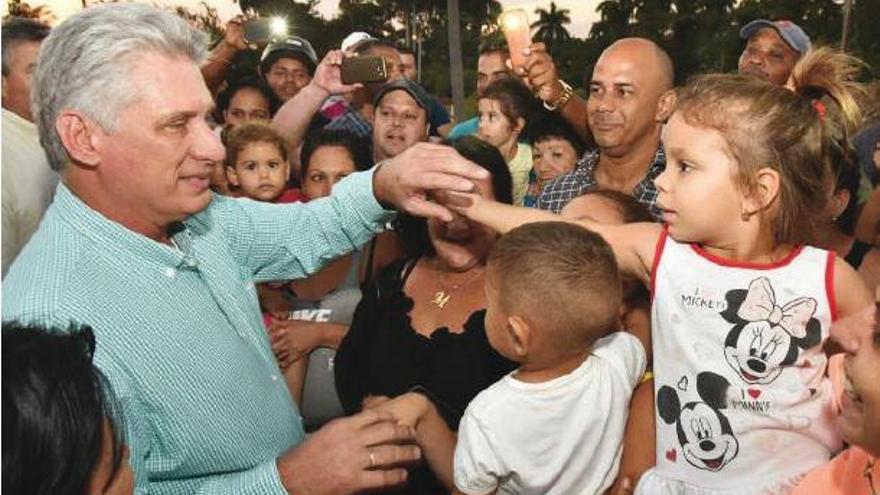
Regardless of how it is seen by the population, the official media has strived in a campaign that borders on the cult of personality where it is seen applauded by people, carrying children and sharing with workers. (Granma)

14ymedio bigger14ymedio, Havana, 19 April 2019 — When completion of his first year in the post of president of the Councils of State and Ministers, the performance of Miguel Diaz-Canel Bermúdez is mediocre, with more stepping on the brakes than progress in the field of reforms, with the shadow of Raúl Castro dulling his prominence.

For most Cubans, it has been twelve months in which the scarcity of basic products has increased, in which the official discourse has become more belligerent and in which the country has become increasingly isolated. Instead of the desired economic reforms, the 58-year-old engineer has tried to more strongly control the private sector and also the artistic expression.

The phrase Díaz-Canel repeats most frequently alludes to the continuity of his management with the principles left to him by the so-called historical generation. His constant allusion to “the teachings of Fidel” and “the accurate leadership of Raúl” show him as a ruler lacking in his own ideas who aims only to stand out for a more collegiate style of work. continue reading

The international situation has been extremely adverse, with an upsurge in pressure from the Donald Trump administration and the recent package of measures to reinforce the US embargo. The loss of allies in the region coupled with the weakening of some such as Venezuela and Nicaragua — suffering their own internal crises — have reinforced his diplomatic solitude.

The worst moment of Diaz-Canel’s mandate occurred when the caravan in which he traveled was booed by the population as it passed through the municipality of Regla, one of the areas most affected by last January’s tornado. The armored vehicles and the extensive security operation just managed to redouble their speed and leave the place. The short video that recorded the scene went viral in the social networks and unleashed a flood of memes that penetrated deeply in the collective imagination.

The most significant event of his mandate was this year’s discussion and approval of a new Constitution of the Republic, but this document, ratified in a referendum, is seen as a rigid corset left by Raúl Castro so that Díaz-Canel can not undertake major changes, or engage in a process of true democratization.

Arbitrary arrests of activists, police repression and reprisals against opponents and independent journalists have remained, with slight variations. Censorship against independent digital sites and travel restrictions against dissidents continue to be some of the most widely used strategies to control the freedoms of expression, association and the press.

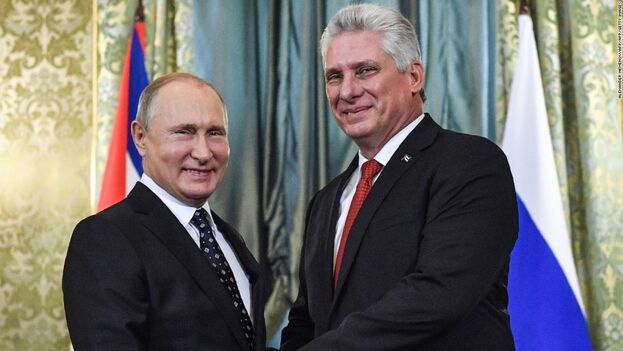
In the international arena, the current president visited the United States to speak at the headquarters of the United Nations, but most of his trips have been in the territory of Cuba’s allies and in very controlled spaces. Thus, he visited Vladimir Putin’s Russia, Nicolás Maduro’s Venezuela, the China of Xi Jinping and North Korea under the iron fist of Kim Jong-un.

Since he became president, he has promoted the presence of officials and ministers in social networks, especially on Twitter. His tweets are characterized by slogans, attacks against the United States and statements of loyalty to Fidel and Raúl Castro. One of the most used labels is, in fact, #SomosContinuidad (We Are Continuity).

he Cuban leader, Miguel Díaz-Canel, along with his Russian counterpart Vladimir Putin. (Kremlin)

Regardless of how it is seen by the Cuban people, the official media has put forth an effort in a campaign that borders on the cult of personality, where he is seen being applauded by people, carrying children and visting with workers. He has spent most of his time visiting provinces and meeting with executives of state companies. In reality the results are lean, but those trips try to send the message that Díaz-Canel “works” and that he is “tied to the people.”

Several tragic events, such as the crash of an airplane where 112 people lost their lives, the fall of a meteorite on the western part of the island, and the unexpected tornado that hit several municipalities in Havana, fueled popular superstition around Diaz-Canel, whom many consider a messenger of bad luck.

The jokes, the nicknames and the epithets are, in Cuba, a kind of “proof of life” for everyone who occupies a position in the official spheres. The first joke that circulated from the first day of his inauguration alluded to that his having taken “command” of the country but not having been given the batteries to be able to operate it.

Subsequently, and after several negative events, popular humor has rebaptized him “sack of salt,” (spilling salt is bad luck). Having not been elected by the vote of citizenship, opponents refer to him as “hand-picked” or “designated” instead of the respectful “president-elect.”

The most suspicious insist that after the approval of the new Constitution, Diaz-Canel will become the president of the Republic, a new position established as of April 10. When he is sworn in for a  first term in that position, this year that has passed will not count agains the decade that, according to the legislation, one person can remain at the helm of the country. If so, these will have been just twelve months of trial and testing.

__________________

The 14ymedio team is committed to serious journalism that reflects the reality of deep Cuba. Thank you for joining us on this long road. We invite you to continue supporting us, but this time by becoming a member of 14ymedio. Together we can continue to transform journalism in Cuba.

Residents of Boulevard D’25 Win the Battle Against Noise

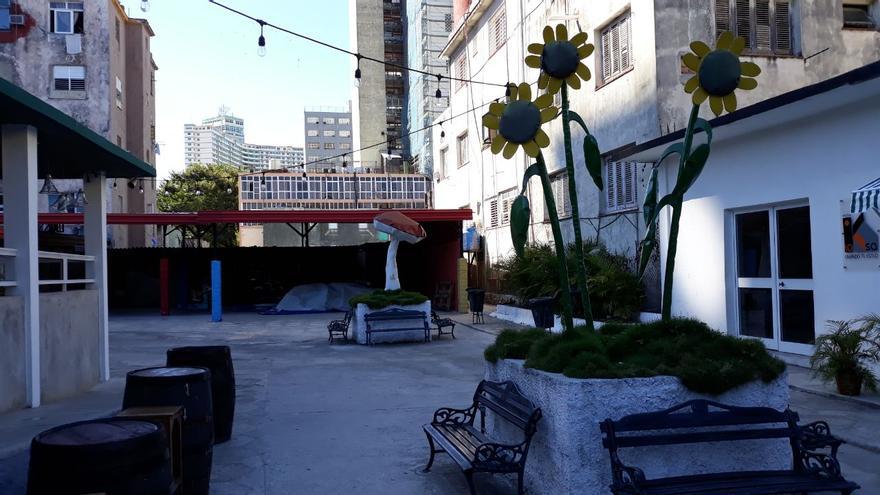
There is a notable decrease in the influx of people since the playground was closed. (14ymedio)

14ymedio bigger14ymedio, Luz Escobar, Havana, 24 April 2019 — Where once the hustle and bustle of children’s voices resounded at all hours of the day, silence now reigns. Most entertainment devices for the little ones have disappeared and those that are installed are covered with tarps or disconnected.

“The park was closed because the neighbors of the building next door were very upset by the noise,” one of the clerks in the arts-and-crafts shops told 14ymedio.

The place where there used to be an old state parking lot for vehicles, is now converted into an area to where the self-employed can rent spaces. Outskirts of each restaurant or cafe elegant young men show the menus where they announce “excellent dishes.” As for the playground, “That closed because it bothered a neighbor who convinced the whole building to protest,” says one of the waiters. continue reading

For the residents the question was not in dispute. Their health was affected due to “sound pollution,” and this was reflected in many of their demands to the Ministry of Public Health and the Provincial Government of the capital. The pressure they brought to bear, with complaint letters detailing the problems, caught the attention of the authorities, who agreed to close the playground.

According to the Facebook page Vecinos de La Rampa (Neighbors of La Rampa) there are several, not just one, residents whose complaints about the noise led them to close the park. One of them is Dr. Alina Arcos, who works in the Emergency Department of a hospital and lamented that she could hardly rest when she arrived home after more than nine hours of work.

“For three years, the residents of the community to which I belong have sent letters, complaints and denunciations to any organization, institution or official that might have any role in this, and except for a temporary solution, the rest have been useless. The businesses that operate there violate the commitments made by the Government and the Party with the community before its opening, multiple existing rules are openly breached and this puts our health at risk,” said Arcos in a post for the month of March.

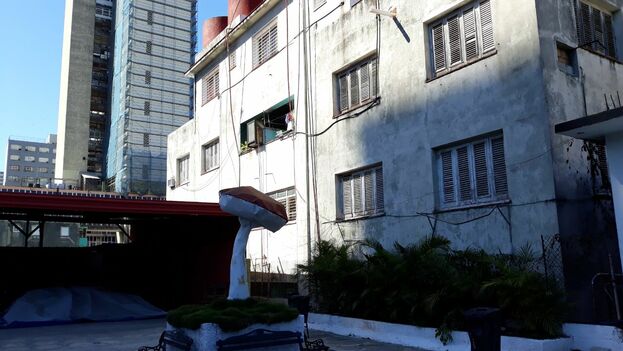
Facade of the building without posters. (14ymedio)

After several complaints in different instances made over more than three years and on social networks, the neighbors decided to show their discontent by hanging fabrics from their balconies, which they have now removed. “On this Boulevard, profits matters more than the welfare of the community, enough is enough!” Said one, and, “This Boulevard violates our right to live in peace,” said another.

“We all worked together and our efforts won. My parents, who lived tormented by the situation, now feel relieved,” a young man who lives in the building told 14ymedio an Thursday afternoon.

It is not the first time that the neighbors managed to close the park with their demands. The authorities had already ordered the closure of the park on a previous occasion, although the owners decided to ignore it and reopened it despite not having the required permits .

“We neighbors just discovered that the Boulevard does not have — hear this — has not and never has had a health license for the use that it has been put to,” denounced another of the neighbors in the neighborhood Facebook group.

On April 13, just before the school break, the park closed. “Days before there was a meeting here with more than 20 neighbors in which the president of the Municipality of Plaza de la Revolución participated,” says another neighbor who plays with her grandson in the inner courtyard of the building located on N Street between 23rd and 25th.

Before getting the facilities closed, Dr. Arcos pointed suspiciously at “corruption,” “abuse of power” and “influence peddling” as the causes that could explain the State’s delay in this case when it comes to protecting citizens.

This week one of the vice-presidents of the Plaza Municipal Assembly of the Power, Pedro Pablo Herrera, was dismissed from his position. Although the reasons are unknown, two sources claim that Herrera participated in at least one of the Assemblies that was held with the residents of Boulevard D’25 to try to solve the noise problem.

_________________

The 14ymedio team is committed to serious journalism that reflects the reality of deep Cuba. Thank you for joining us on this long road. We invite you to continue supporting us, but this time by becoming a member of 14ymedio. Together we can continue to transform journalism in Cuba.