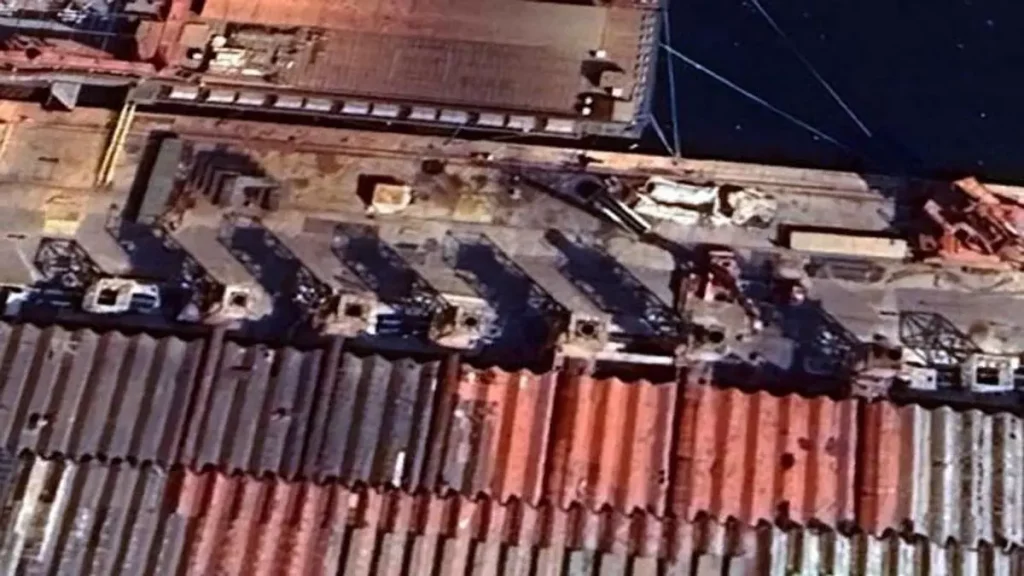
A Satellite Photo Reveals That the Asticar ‘Patana’ [Turkish Power Plant] in Havana Will Have Nine Engines

The authorities are secretive about the port facilities, while giving great publicity to the construction of solar parks

Satellite photo taken in March of the chimneys still being installed / Jorge Piñón/Google Earth

14ymedio bigger14ymedio, Havana, October 5, 2025 — The Asticar power plant, located on the docks of Astilleros del Caribe in Havana, has been under construction since at least the beginning of this year. A satellite photo taken in March, shared with this newspaper by University of Texas expert Jorge Piñón, shows the progressive construction of the chimneys.

Mentioned only a couple of times by the authorities of the National Electric Union (UNE), the power plant — which, unlike other Turkish patanas is not floating and is on land — remains a mystery. Located on a dock of the state shipyard belonging to the Gemar Group of the Ministry of Transport, it is unknown where the engines came from, what generation capacity they have and how much Havana disbursed — unless they were donated- – to acquire them.

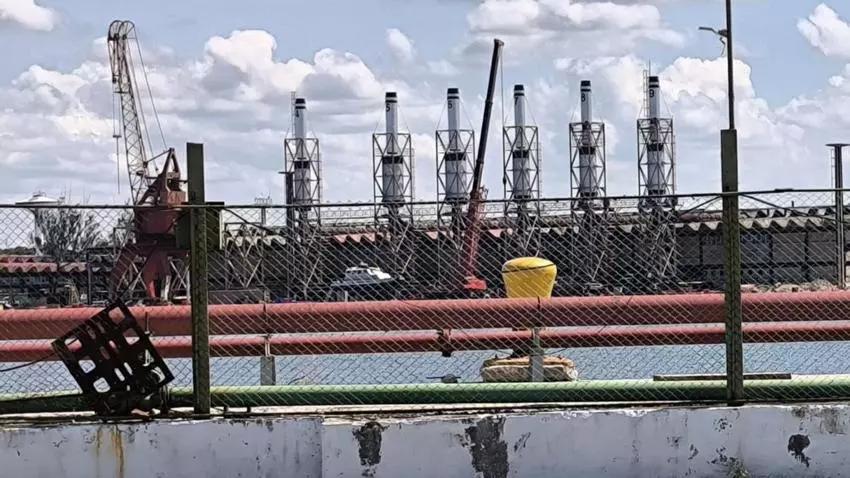
However, it is clear that the Asticar plant is still under construction. So far it has only six visible chimneys, numbered 4 to 9 on the top, suggesting that at least three more are missing. Photos taken by 14ymedio show three other scaffoldings similar to those supporting the chimneys just at the side, indicating that towers 1, 2 and 3 are still under construction.

About the origin of the patana, located a short distance from where the Turkish Suheyla Sultan used to be, which left in August, taking with it the 240 megawatts (MW) it produced, Piñón ventured several hypotheses. Looking at the date of construction of the chimneys, the engines may have continue reading

arrived on board Karpowership’s floating power plant Cankuthan Bey in December 2024.

Photo of the visible chimneys of the plant, numbered from 4 to 9, taken on October2 / 14ymedio

As the UNE reported at the time, the Cankuthan Bey arrived in Havana on December 8, 2024, “to begin work on its units and, once completed,” left Cuba in September.

Another theory is that the generation units of the Asticar plant — or at least part of them — arrived on board the heavy cargo ship OK last May, although the satellite image, which shows the half-built chimneys, suggests that the placement of the patana began months before.

As for the origin, everything points to the chimneys being Turkish, although they could also be one of the many donations made by China to Cuba in recent months, or even by a third partner that the regime refuses to reveal. In the first case, points out Piñón, each of the nine engines, similar to those of the floating power plants, would have a capacity of 15 or 20 MW, which would give a total generation of 135 or 180 MW.

The mention of the “Asticar patana” at the beginning of this week in a breakdown report from the Havana Electric Company also suggests that the patana could be running at half capacity while they finish installing the corresponding engines and chimneys.

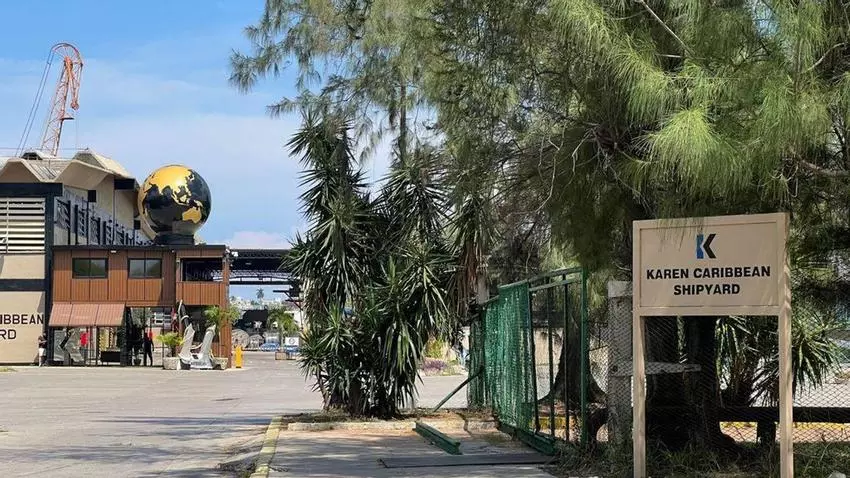
The entrance of the Turkish yard in the Karen Caribbean Shipyard in Havana / 14ymedio

The secrecy with which the authorities act has also been reflected in the agreements signed with the Turkish company Karpowership (Karadeniz Holding) since the arrival of the first patana, in 2019. The cost to Cuba was never known, although by August 2023 it was estimated that the bill amounted to more than $100 million.

Faced with Havana’s inability to pay this amount, the Turks gradually withdrew their patanas and managed to get compensation. Of the eight in Cuba, only one remains, in Regla. Although this is again a secret agreement, it is known that the Turkish shipping company Karen Caribbean Shipyard was awarded a port concession for part of the docks in the state-owned Caribbean Shipyards (Asticar), where they are installing the new engines to produce power.

The silence surrounding this plant and its installation does not fit with the authorities’ desire to show, at all costs, that “work is being done” in the country to reduce the hours of blackouts. The best example is the delivery of Chinese solar panels and industrial generators, which the official press has announced on each occasion with great hype, assuring that every extra MW that arrives at the National Electric System (SEN) relieves the burden of the overexploited thermoelectric plants of the Island.

However, neither the photovoltaic with its thousands of panels installed nor the Chinese generators have been able to alleviate the enormous deficit that the Island experiences on a daily basis. The lack of power has normalized in the country to such an extent that the 1,570 MW deficit forecast for this Sunday by the UNE seems a relief from the 1,840 registered last Tuesday.

Translated by Regina Anavy

____________

COLLABORATE WITH OUR WORK: The 14ymedio team is committed to practicing serious journalism that reflects Cuba’s reality in all its depth. Thank you for joining us on this long journey. We invite you to continue supporting us by becoming a member of 14ymedio now. Together we can continue transforming journalism in Cuba.

Cuba Faces an Outbreak of Viral Diseases Amid Shortages of Supplies and Reagents

“A hospital that does not guarantee the basics for the diagnosis and follow-up of dengue is seriously failing its population,” writes a doctor from Cárdenas

The authorities again make the population responsible for the cleaning of patios and waste management  / ‘Invasor’

14ymedio bigger14ymedio, Havana, October 5, 2025 — Viral infections caused by the Aedes aegypti mosquito continue to spread in Cuba. In Ciego de Ávila, oropouche is the one that caused the authorities to issue a health alert last Friday. “During the last few weeks there has been a remarkable increase in febrile cases,” the official press reported.

Doctor José Luis López González, Deputy Director of Epidemiology of the Provincial Center for Hygiene, Epidemiology and Microbiology, reported the circulation of oropouche in all municipalities, except in Primero de Enero.

In view of the increase in cases, the authorities assure that antivectorial actions have been “reinforced,” but they again make the population responsible for cleaning patios and waste management, without giving details on the effectiveness of state fumigation campaigns or the actual availability of resources to deal with the epidemic.

Authorities assure that the anti-vector actions “remain reinforced”

The effect of the rains in recent weeks has favored the spread of the mosquito that transmits not only oropouche but also dengue and chikungunya. Concern has risen throughout the Island, since an epidemiological alert was announced in late September in Cárdenas (Matanzas), with symptoms showing up in all the Popular Councils.

From the same province, Doctor Miguel Alejandro Guerra Domínguez, a physician suffering from the shortage of reagents in the Territorial Hospital of Cárdenas, reported on his social networks that he had not been given the tests required for the evolution and follow-up of this disease. “A hospital that does not guarantee the basics for dengue diagnosis and follow-up is seriously failing its population,” he said on his Facebook page. continue reading

A clinical laboratory technician in Holguín, who requested anonymity, repeated the same thing: no reagents, no PCR kits, no basic supplies. “We do not have disposable items such as gloves, syringes or needles. And it’s the same everywhere, from polyclinics to hospitals. We practically come in just to punch a clock. There’s nothing to work with.”

The lab technician, from Holguín, who also carried out internationalist missions in countries in Africa and Latin America, warns: “Official statistics are not reliable at all. If we had to inflate the data to justify the need to keep Cuban doctors there, imagine what is being done inside the country to support the myth of Cuba as a medical power.”

“If we had to inflate the data to justify the need to keep Cuban doctors there, imagine what is being done inside the country”

Although the official discourse constantly blames US sanctions for shortages, this explanation does not address the structural causes underlying the problem. Lack of transparency in the availability and management of resources, insufficient investment in infrastructure and migration of health personnel are key factors aggravating the crisis.

BioCubaFarma Group, responsible for supplying 62 per cent of the Island’s basic range of medicines, has expanded its exports to 41 countries through joint ventures and cooperation agreements, and this export frenzy is detrimental to the domestic market.

The export of medical services, the Cuban State’s main source of income, also has no impact on improving health in the country. For example, in 2022, revenues from human health and social care services reached $4,882 million, representing 69% of total exported services, according to official figures from the National Bureau of Statistics and Information. However, the budget for hotel construction was four times higher than that spent on agriculture, education and health last year.

“Is dengue not an emergency? Does not a thrombocytopenia or hemoconcentration that is not detected in time put the patient’s life at risk? It is a total lack of respect for patients and medical practice,” lamented Dr Guerra in his public complaint. And he concludes: “A hospital that refuses to do the minimum tests required for a life-threatening disease is simply failing in its duty. And what’s more regrettable is that all the doctors who work here, by accepting and normalizing this situation, become accomplices to this health disaster.”

Translated by Regina Anavy
____________

COLLABORATE WITH OUR WORK: The 14ymedio team is committed to practicing serious journalism that reflects Cuba’s reality in all its depth. Thank you for joining us on this long journey. We invite you to continue supporting us by becoming a member of 14ymedio now. Together we can continue transforming journalism in Cuba.

A Mural Against Cuban President Miguel Díaz-Canel Was Painted on a Wall in Guanabacoa

“It’s very tense here with the blackouts. I’m sure they painted it in the dark because we haven’t slept for two nights due to the power outage,” explains a neighbor.

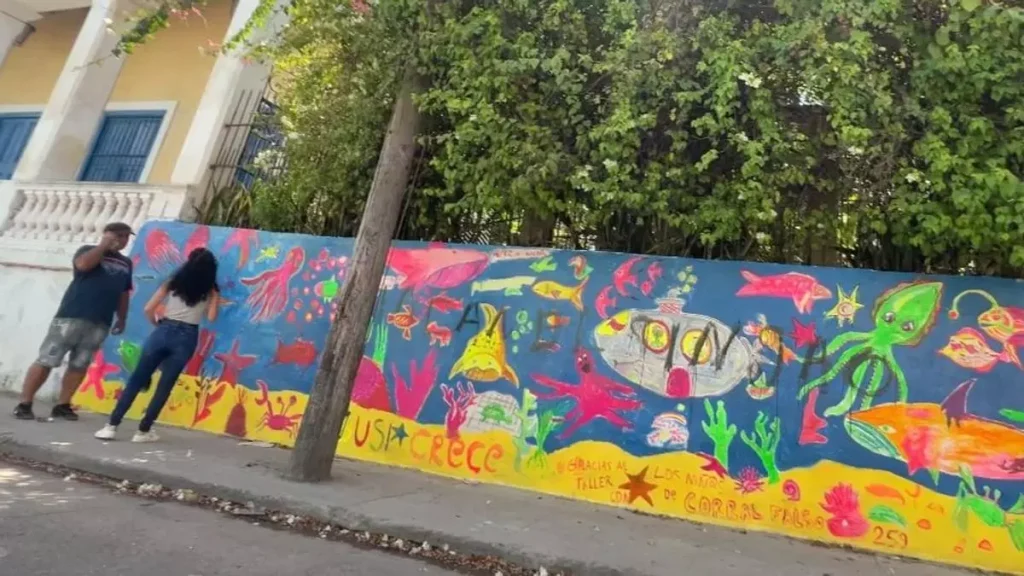
The slogan was written on colorful drawings curated by the Corral Falso Gallery, located at 259 Corral Falso Street. / 14ymedio

14ymedio bigger14ymedio, Darío Hernández, Havana, 4 October 2025 — A graffiti with marine motifs became the improvised canvas on which a poster against the Cuban leader appeared this Saturday. In Guanabacoa, Havana, someone painted “Díaz-Canel singao” [motherfucker], one of the phrases most frequently used to express Cuban discontent. The slogan was written on colorful drawings curated by the Corral Falso Gallery, located at 259 Corral Falso Street. Among fish, octopuses, and reefs, the insult to the Cuban president stood out in the eyes of passersby..

“That childish painting hadn’t even been on that wall, which was once ugly and faded,” a neighbor told 14ymedio. “As soon as we noticed, a man and a woman arrived and started making calls to someone to come and cover up the sign.” The two people inspected the area and stayed on the sidewalk waiting for the brigade, which traditionally paints over anti-government signs. Police experts will probably also arrive to try to take fingerprints at the scene.

“It’s very tense here with the blackouts. I’m sure they painted it in the dark because we haven’t slept for two nights due to the power outage,” explains a nearby resident. In Guanabacoa, a municipality with a low-income population, protests against the lack of electricity and water have multiplied in recent years. With pot-banging and street closures, residents have expressed their weariness with a crisis that worsens every day. “They’re going to have to put a guard on every wall,” summarizes a vendor who approached the Corral Falso graffiti, where, between a whale and a shark, three words challenged the regime this Saturday.

____________

COLLABORATE WITH OUR WORK: The 14ymedio team is committed to practicing serious journalism that reflects Cuba’s reality in all its depth. Thank you for joining us on this long journey. We invite you to continue supporting us by becoming a member of 14ymedio now. Together we can continue transforming journalism in Cuba.

In the Midst of a Deep Publication Crisis, Nine Volumes of the ‘Selected Works’ by Raúl Castro Are Presented

The general did not attend the presentation but did attend the ceremony for the anniversary of the Central Committee of the Party

Photo of Raul Castro during a different event, a celebration at the PCC / X/Miguel Díaz-Canel

14ymedio bigger14ymedio, Havana, October 4, 2025 — With the publication this Friday of his Obras escogidas [Selected Works], Raúl Castro intends to go down in history, imitating his brother not only as a political leader but also as a thinker. In nine volumes, said one of the editors, Cubans can approach “the personality, ability and sensitivity of Raúl.” However, the general did not show up at the presentation of the books, although he did appear at the celebration of the 60th anniversary of the creation of the Central Committee of the Communist Party, supporting Miguel Díaz-Canel and banishing for the umpteenth time the rumors of his death that were circulating in September.

Castro’s books are, as expected, privileged among the few Cuban publications. According to Cubadebate, the volumes have “a quality commensurate with the historical significance they capture.” Their selection was very careful and each one contains an analytical index and “QR code that refers to images corresponding to the period described, thereby incorporating contemporary technological resources.”

Soon, reported the media, they will be available in libraries and institutions, which will allow access to “more than 500 documents” and “2,000 specific situations and contexts.” Digital versions are also available on the Party’s official website. If this publication feat was possible on an island without paper and with few functional printing presses, it is because China financed a run of 3,000 copies.

The publication blackout in Cuba is represented in numbers: While in 2023 more than 6,000,000 pages were printed in Cuba, in 2024 that figure dropped dramatically to 1,355,500. The shortage is not only of paper but also of political will. However, the legacy of the historic figures of the Revolution has always had priority.

The Selected Works are also promoted by Díaz-Canel, who attended the presentation at the José Martí Memorial

In the words of Abel Prieto, director of Casa de las Américas, with these books Editions Celia is making available to Cubans “70 years of an exemplary and heroic life, which we now have as a formidable guide of ethical behavior in revolutionary action.” continue reading

The Selected Works are also promoted by Díaz-Canel, who attended the presentation at the José Martí Memorial of the Plaza de la Revolución along with other high officials of the PCC: the Secretary of Organization of the Central Committee, Roberto Morales Ojeda; Vice-President Salvador Valdés Mesa and Prime Minister Manuel Marrero Cruz.

The books contain unpublished documents, speeches, letters and the campaign diary that Castro wrote in the Sierra Maestra, divided by years in each volume.

In Prieto’s hand, the books became a “compass” for “teachers, professors and student organizations” to combat the “phenomenon of dumbing things down and the erasure of memory.” Castro, he said, constantly addresses the issue in those pages, which warn against the “misrepresentation of history.”

“Prieto specifically referred to counterrevolutionary materials circulating on social networks, where artificial intelligence is used to show a Havana embellished with symbols such as a “giant McDonald’s” in the case of the Revolution’s defeat,” highlights Cubadebate, quoting the director of Casa de las Américas when he calls this a phenomenon of “illness” or “primitive fascism.”

Prieto also urged reporters to spread the book’s ideas. “You, the journalists, must work hard, see what ideas of these can be used for short audiovisuals and post them on the networks”

“An ethical sensibility runs through the whole book, from the first pages, when Raúl was very young, to the last. I discovered Raúl again with this collection and am very grateful. He was in all the battles: in the construction of the Party, in the Revolutionary Armed Forces (FAR),” said the official.

Prieto also urged reporters to spread the book’s ideas. “You, the journalists, must work hard, see what ideas of these can be made into short audiovisuals and post them on the networks. We must work with the networks to create a daily vindication of Cuba,” he ordered.

The leader raised the tone even more: “We are in the midst of a very serious cultural and ethical crisis. The main victims of these offensives are the new generations. Their memory is being erased, along with their national identity, their origins, their sense of belonging to a culture. Therefore, texts such as that of Raúl’s diary and, in general, these Selected Works, are weapons in this contemporary war,” he insisted.

Raúl, for his part, did not attend the book presentation. His attention was directed to the celebrations of the Communist Party, where his frequent presence is intended to calm — in addition to the rumors of his illness and death — the discontent towards the government.

Translated by Regina Anavy

____________

COLLABORATE WITH OUR WORK: The 14ymedio team is committed to practicing serious journalism that reflects Cuba’s reality in all its depth. Thank you for joining us on this long journey. We invite you to continue supporting us by becoming a member of 14ymedio now. Together we can continue transforming journalism in Cuba.

Neither Ration Stores nor Cattle Are Saved From the Increase of Crime in Holguín, Cuba

The “Frontier” case in Cacocum, where a group armed with machetes and shotguns stole 61 cattle, is highlighted

In Holguín, 1,672 criminal acts were recorded in September, according to the provincial authorities. / Ahora

14ymedio bigger14ymedio, Holguín, October 3, 2025 — Crime is rampant in Holguín, and the official statistics confirm this. During the Provincial Plenary held on Thursday at the Expo Holguín fairground, it was reported that in September alone 1,672 criminal acts were recorded, an increase compared to August, with seven municipalities affected. Calixto García, Moa and Sagua de Tánamo top the list as the most problematic.

Among the homicides, robberies with force and the recurring theft of cattle, the local authorities met and presented a deluge of worrying figures, adorned with calls for “revolutionary vigilance” and criticism of the managers of ration stores and state entities, which apparently have become the favorite prey of thieves and opportunists.

Of all the cases presented, the one that attracted the most attention was the one baptized as “Frontier.” On September 1, in the town of Limoncitos (Cacocum), a custodian aged just 28 decided that caring for cows was less profitable than stealing them. And with the complicity of 12 other people, he planned the theft of 61 cattle from the dairy where he worked.

Mounted on horseback, dressed in black, with balaclavas, three shotguns and several knives, the thieves burst in as if it were a western movie. The plot ended with 13 detainees, although one, the main organizer, remains at large. The authorities claim that some of the perpetrators were arrested after an “intensive interrogation process.”

The robberies of ration stores were also at the center of the debate. In September, five incidents were reported in the municipalities of Holguín and Báguanos. continue reading

The criminals are not only aware of when the rice arrives, but could also be taking advantage of help from the workers themselves

The curious thing, officials said, is that the thefts coincided with the distribution of rice, which suggests that the criminals are not only aware of when the rice arrives, but may also be taking advantage of help from the workers themselves, or the information disseminated on Telegram.

For Joel Queipo Ruiz, First Secretary of the Party in the province, the problem is not so much the thieves but the administrators who “don’t take measures,” and the lack of “revolutionary vigilance.”

Nor do the crime statistics for state entities offer much comfort. In September, 50 events were recorded, bringing the total to 894 so far this year. The municipality of Holguín accounts for 38.2% of the incidences, with a predominance of robbery, theft and, again, the eternal problem of livestock.

The perpetrators of these crimes have shown increasing violence

Some 54.5 percent of crimes were concentrated in strategic sectors such as agriculture, trade, public health, education and water resources. To top it all off, the perpetrators of these crimes have shown increasing violence, according to the police report.

Mayarí, Urbano Noris and Banes accompany Holguín province as the most affected territories. Lack of lighting, vacant security positions and administrative mismanagement complete a scenario conducive to the increase in crime.

Finally, Queipo praised the importance of the Fourth Crime Prevention and Confrontation Exercise, held in September throughout the country, as a way to “ensure citizen peace, respect for internal order, stability and social discipline.”

Holguín, one of the most populous provinces in the country, today displays a map of insecurity that resists being whitewashed with harangues.

Translated by Regina Anavy

____________

COLLABORATE WITH OUR WORK: The 14ymedio team is committed to practicing serious journalism that reflects Cuba’s reality in all its depth. Thank you for joining us on this long journey. We invite you to continue supporting us by becoming a member of 14ymedio now. Together we can continue transforming journalism in Cuba.

“Beatings, Torture, Humiliation and Death Threats” Lead José Daniel Ferrer To Accept Exile from Cuba

The leader of UNPACU also points out his “frustration at the disunity, sectarianism and lack of effectiveness of the opposition inside and outside Cuba”

José Daniel Ferrer, leader of the Patriotic Union of Cuba, in one of his live broadcasts before being arrested again / Stock photo/Facebook

14ymedio bigger14ymedio, Madrid, October 3, 2025 –The opponent José Daniel Ferrer, leader of the Patriotic Union of Cuba (UNPACU), accepts his exile from Cuba. He has expressed this in a handwritten letter published by his family on their social networks and sent from the prison of Mar Verde, in Santiago de Cuba, where he has been since his parole was revoked, April, 29, after having been released for three months.

Before that date, when the “last assault” on his home occurred, Ferrer explains, he had already made up his mind. “This decision was taken for the safety of my family and because of the frustration that I felt when I came out of prison to confirm the disunity, sectarianism and lack of effectiveness of the opposition inside and outside Cuba in the struggle for freedom and the well-being of our homeland,” he says, referring to his months of release.

“For years I have been subjected to brutal beatings, torture, humiliation, death threats and other cruel, inhuman and degrading treatment by henchmen and other instruments of the worst dictatorship that the American continent has known,” begins his letter. “All with the intention of forcing me to leave my country or to renounce the non-violent struggle for freedom, democracy and human rights and the well-being of my homeland.”

In the last few months that he has been in prison, “the brutality of the dictatorship against me has exceeded all limits”

In the last few months that he has been in prison, “the brutality of the dictatorship against me has exceeded all limits.” He lists “beatings, tortures, humiliations, threats and extreme conditions,” as well as “theft of my food and toiletries” and threats against his wife, Nelva Ortega, and her children. “All with the intention of forcing me to leave continue reading

my homeland,” he says. “In the face of constant efforts by the political police to get me out of Cuba, I ended up agreeing to go into exile.”

However, he states, “since the procedures to achieve this end began, as always happens, the agents of the regime have been playing dirty: they continue with the plan of harassment, threats, humiliations, robberies and extreme conditions.” As an example, he mentions the pressure they exerted to have his marriage with Nelva take place on the “birth day of the deceased dictator,” August 13, and the “videos and recordings” that Ferrer claims they took “with the intention of producing publications that call into question our commitment to the struggle for freedom in Cuba.”

He also states that they tried to compel him to make statements and ask the Catholic Church to mediate between Havana and Washington, a dialogue, he defines, “leading to the shameful negotiation of other times: release of political prisoners in exchange for lifting sanctions and other benefits for the dictatorship.”

The opponent clarifies: “If my life and that of my family depend on me asking for such things, I prefer my death in this Nazi-style concentration camp and even the sacrifice of my family.” And he adds, without making it clear whether his departure can take place in the short term, “I leave Cuba, only with my dignity and my head held high, and not for long.”

“He deserves a welcome worthy of a hero and will receive it,” said Cuban-American congressman Mario Díaz-Balart

Nelva Ortega, who confirmed to Martí Noticias the authenticity of the letter, reiterates that the decision to accept exile “was taken after months of torture, beatings and extreme conditions of imprisonment” and that “it was the only way to protect the family and prevent them from responding with violence in such inhumane circumstances.” However, she did not clarify when the departure would occur, which, according to Ferrer in his letter, would be to the United States. In his view, it is the only country that “maintains a firm stance against the communist regime and is truly in solidarity with the peaceful opposition and the Cuban people.”

Cuban-American congressman Mario Díaz-Balart spoke on X about the opponent’s decision, calling him a “hero” and saying, “After years of imprisonment, beatings, physical and psychological torture and persecution by the murderous regime in Cuba simply for demanding freedom, he is being forced into exile. He deserves a welcome worthy of a hero and will receive it.”

For her part, the sister of the UNPACU leader, Ana Belkis Ferrer, told Spanish news agency EFE that her brother “accepted the banishment, but we do not yet know if it will be implemented because the dictatorship wants to profits from it, and José Daniel is not going to agree to any negotiations.”

The initial joy of the family for the possible release of Ferrer from prison turned into “something very frustrating,” reports EFE from its conversation with the activist’s sister, who said: “Not every human being would be willing to go through that: it’s a constant martyrdom.”

“Not every human being would be willing to go through that: it’s a constant martyrdom”

The Council for the Democratic Transition in Cuba (CTDC), of which the UNPACU leader is president, also spoke in favor of the opponent’s decision. “We know what it will have cost him to take it,” they say in a statement. “He has the right to his own life and to be with his family.” The platform stresses that it is a determination “intimately linked to the horrors of prison where he has been treated like an animal, subjected to beatings, physical and psychological torture, which only a person of great physical strength, emotional and spiritual like his, has allowed him to endure.”

The CTDC adds that Ferrer “is and will always be, wherever he lives, an icon and an example for all of us.” The “clarity” of the opponent, they warn, “will not be undermined by any disinformation campaign of a structurally lying regime very comfortable with the ecosystem of deep fakes, fakes news and post-truth.”

On previous occasions, Ferrer had spoken out against leaving the country, as offered by State Security in exchange for not keeping him in prison and under torture. The opponent was informed of the charges against him -propaganda against the constitutional order and contempt of Díaz-Canel- two weeks after he was imprisoned.

Ferrer was violently removed from his home, also the headquarters of UNPACU, in Altamira, Santiago de Cuba, after three months of constant harassment. According to his family, the State Security agents “completely ransacked” the house and took him away, along with Nelva Ortega and their young son, Daniel José, although they were released hours later.

On the same day, April 29, Félix Navarro was also arrested with his wife, the Dama de Blanco [Lady in White] Sonia Álvarez, during a visit to the prison in Mantazas where their daughter Sayli Navarro is being held.

Both opponents were part of the group of prisoners released last January under an agreement between the regime and the Vatican and returned to prison eight days after the death of the previous pope, Francis.

Translated by Regina Anavy

____________

COLLABORATE WITH OUR WORK: The 14ymedio team is committed to practicing serious journalism that reflects Cuba’s reality in all its depth. Thank you for joining us on this long journey. We invite you to continue supporting us by becoming a member of 14ymedio now. Together we can continue transforming journalism in Cuba.

Cubans Lead the Caravan of Nearly 1,500 Migrants Denouncing Extortion in Mexico

The group is heading to Mexico City and asks for support from the authorities to regularize their immigration status

The Cubans lead the caravan that left this Wednesday from Tapachula and is heading to Mexico City. / EFE

14ymedio bigger14ymedio, Mexico City, Ángel Salinas, October 2, 2025 — There is no life for migrants in Tapachula,” Yamila Sarmiento, 38, tells 14ymedio. The woman is one of almost 500 Cubans who are part of the so-called “Caravan for Freedom,” with more than 1,500 migrants from Guatemala, Honduras, Venezuela, El Salvador and Haiti, who left this Wednesday for Mexico City. “We want papers to be able to work, because money is the thing,” she says.

Sarmiento decided to join because she has been listening to the same speech at the Mexican Commission for Aid to Refugees (Comar) for eight months: “We are understaffed; you have to wait for the message for your interview.”

She says that a couple of Venezuelans paid $1,800 to a lawyer for an interview with Comar. “The man already has papers; those of us who don’t have resources are left in a heap. In Tapachula, if you pay lawyers you can resolve things with the agents; as for the rest of us, we’re fucked.”

Rebeca García, also Cuban, told Diario del Sur that migrants are exploited and the pay is bad. They receive between 180 ($9.75) and 200 ($10.84) pesos a day . “So we can’t help our families; we left our country for them. For that reason we are leaving Tapachula, and going to the US is impossible now.”

The migrants denounce extortion by immigration agents and accuse the lawyers of collusion. / EFE

Yovani de Jesús, from Venezuela, complained that the immigration authorities “denied me the documents to regularize.” He told EFE that he has been going to Comar for seven months, first because the response did not arrive in the promised 14 working days. He was told to wait. After another long wait, he came and was given a digital piece of paper that loads but has no validity: he is still “illegal” in Mexico and without work.

Last August, a Cuban named Figueredo, 28, told this newspaper that in order to avoid “extortions” he went to the migration headquarters in mid-June. “I stood there every day for a week to get an appointment,” he complains. “You’re there, in line, and at the end they ask you to wait for the response from Comar. It never arrives; everything is corruption.” continue reading

Tapachula, even before the caravan, became a second home for 13,779 Cubans. However, as of July 5,959 of these people still did not have their immigration status regularized, confirmed a Migration employee to 14ymedio. “There are no officials in Comar, so they have delayed the delivery of documents, and this will go on for another two months,” says Yaniel Ponce de León, who still has not received his humanitarian visa.

Attorney José Luis Pérez denounced the apathy of the immigration authorities with regards to speeding up the processing of these Cubans. “Migration has violated the rules and kept thousands of people in uncertainty, stranded in Mexico. With the arrival of Donald Trump to the presidency of the U.S., the American dream was cut short. The only thing that migrants want is an opportunity.”

Holding up a blanket that says “With papers we can contribute more to Mexico,” the migrants intend to follow the coast of Chiapas and pass through the municipalities of Huehuetán, Huixtla, Villa Comaltitlán, Escuintla, Mapastepec, Pijijiapan, Tonalá and Arriaga.

Tapachula, even before the caravan, became a second home for 13,779 Cubans. / EFE

Some of the migrants obtained motorcycles and bicycles to help the women and children. They plan to pass through twice a day: first at 4:00 am with a rest stop at 1:00 pm. The second pass-through would be at 2:00 pm, with a rest stop at 8:00 pm.

Mexico City has become a critical destination for hundreds of migrants, who remain stranded in the absence of documents. Between fear and mistrust of institutions, they are aggravating the migration crisis.

The so-called “border effect,” which was previously concentrated in border cities such as Tijuana and Tapachula, is now being felt in the country’s capital, given the new migratory restrictions in the US since the return of Donald Trump to the White House in January.

In Tapachula, some migrants are still dealing with the scams. Jean Philippe Alexis, from Haiti, reported charges of up to 22,000 pesos ($1,200) for obtaining an interview at Comar, where he says “migrants are being used and denigrated.”

Philippe Alexis left his country because of “hunger” and to help his family. “If my country was okay, I wouldn’t have to be in Mexico,” he says. “If I get arrested for not having money, I don’t know what I’m going to do.” The Haitian says that officials do not understand that “without papers there is no work or money.”

Translated by Regina Anavy

____________

COLLABORATE WITH OUR WORK: The 14ymedio team is committed to practicing serious journalism that reflects Cuba’s reality in all its depth. Thank you for joining us on this long journey. We invite you to continue supporting us by becoming a member of 14ymedio now. Together we can continue transforming journalism in Cuba.

Surveillance at the ISDI Ruins Arrives Late: Doors and Windows Have Already Been Removed

The remains of the building are sold among the neighbors of the area

The Higher Institute of Industrial Design (ISDi), this Thursday. / 14ymedio

14ymedio bigger14ymedio, Havana, 3 October 2025 / The Higher Institute of Industrial Design (ISDi), in the heart of Centro Habana, was under guard on all four sides by plainclothes officers on Thursday. The security came late, and just after graphic designer Esteban Aquino, in a message on social media illustrtaed  with photos, reported that numerous documents from the institution — including theses, books, and catalogs — were scattered in the nearby Carlos J. Finlay Park.

“These archives were, and are, the historical and technical reference for the academic training of students. The work of those who are today excellent exponents of design, professors, tutors, authors, and great personalities is coming to an end,” lamented Aquino, himself an ISDi graduate. Sadly, he exclaimed: “The truth is, I don’t know who is inside that building, nor do I know what they do, much less what the fate of the building will be, but I believe that being ignorant does not mean being insensitive. Not knowing is not synonymous with disrespect.” And he asked: “What is the motivation that drives these people who, supposedly, were educated with principles based on respect for social property, education, and culture? What values ​​are we talking about?”

What the undercover police are now guarding, in any case, is nothing more than a place being slowly “cannibalized,” as one neighbor told 14ymedio. “The scavengers were going to demolish the entire building,” says the woman, who watched day after day as people crept in through the gap left at the back by one of the building’s partial collapses. “They had already taken the windows and were taking the doors. If you let them, they’ll end up taking the bricks one by one.”

“I’ve been offered doors, toilets, blinds, and even bars.”

Another neighbor, who lives a few meters from the nearby bus stop, has also witnessed the building’s dismantling. “I’ve been offered doors, toilets, blinds, and even bars,” she tells this newspaper, referring to the informal market that has been fueled by ISDI spoils in recent months. “There are houses here that look like a small school inside because they’ve been built with whatever came out of there,” she says, pointing to what remains of the structure. continue reading

For decades, neighborhoods where an official institution or state building is falling into disrepair have been nourished by its remains or construction materials. “I have a neighbor who reinforced her bed frame with a slate board, and in this same tenement there are now several doors of the same color, all taken from there.”

The most deteriorated wood has also yielded benefits. “The other night, when we had a very long power outage, the neighbors around the corner built a bonfire in the street to cook on with some ISDI planks.” Despite the momentary benefit, the woman fears that the ruin will end up becoming a huge dump, and “this whole neighborhood will look even dirtier than it is.”

The building, which was originally a military hotel and officers’ club for the Spanish Army, later served as the headquarters of the Cadet School (1874-1878), the Widows and Orphans’ Asylum, the General Staff headquarters during the First American Occupation, and even the Ministry of Health before the Revolution.

Rear of the ISDI, with fences blocking access. / 14ymedio

In 1982, it was transformed into the headquarters of the Polytechnic Institute of Industrial Design, the precursor to ISDI, and, despite its great architectural, historical, and educational value, it was left to die over decades of neglect, poor renovations, and lack of maintenance.

In March 2022, the building was closed after an “architectural flaw” was discovered that endangered students and workers. “The Revolution founded the universities and always stood by them,” the official statement read, as if words alone were enough to sustain the cracked columns.

That narrative literally collapsed in July 2024, when part of the interior facade collapsed. And in January 2025, another partial collapse left an elderly woman injured and four families without access to their homes. Despite no fatalities, the symbolic impact was profound: not just a building, but a promise, an institution, and an era, had collapsed.

Even more accurate were the words of architect Lourdes Martí, founding rector of ISDi until 1988, who in 2022 had issued a public denunciation: “What happened during these last 33 years? Was it never maintained again? What architectural flaw is this that prevents the building, or part of it, from being restored? Is the goal being to destroy the building or eliminate the training of Industrial and Information Designers? Are we witnessing the end of the country’s industrial development?”

____________

COLLABORATE WITH OUR WORK: The 14ymedio team is committed to practicing serious journalism that reflects Cuba’s reality in all its depth. Thank you for joining us on this long journey. We invite you to continue supporting us by becoming a member of 14ymedio now. Together we can continue transforming journalism in Cuba.

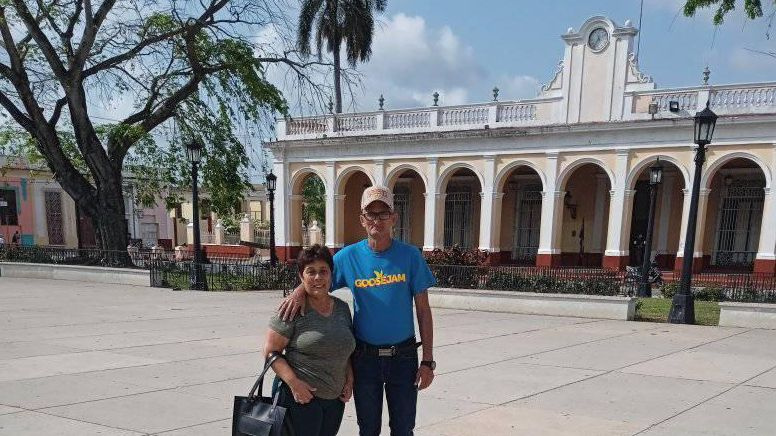
“What the Agencies Are Doing to Tourists in Cuba is a Scam”

Twenty years after an idyllic first trip to the island, Marina from Spain discovers a destroyed country and deplorable service in five-star hotels.

The outdoor cafeteria of the Iberostar Selection Havana hotel, in the so-called K Tower, is empty. / 14ymedio

14ymedio bigger14ymedio, Yaiza Santos, Madrid, 1 October 2025 — Mountains of garbage on street corners, power outages, expensive hotels with insufficient food,  towels with holes, mosquito infestations, beggars, sad streets, and people everywhere with only one plan: to leave Cuba. The island Marina visited this summer with her family bears little resemblance to the one she saw in 2004.

With that idyllic memory in mind, last August she booked a trip that included Havana and Cayo Santa María (Villa Clara) through an agency in her hometown in Andalusia, which she prefers to withhold. The experience, however, was so disastrous that the group filed a complaint with the tour operator upon their return.

To begin with, they were greeted at José Martí International Airport by a power outage , something she hadn’t expected to experience in the terminal itself and something that was unthinkable twenty years ago. Once in the capital, they were surprised by the uncollected trash everywhere. “The stench it transmits is unbearable,” she told 14ymedio. “And it’s a hotbed of disease, really.”

The palpable hunger also cconfused her, specifically the line of elderly people, women and children at the doors of El Asturianito

The palpable hunger also confused her, specifically the line of elderly people, women, and children outside El Asturianito, waiting for the employees of the popular restaurant, located across from the Capitol, to distribute the customers’ leftovers. “We didn’t see that the other time, we didn’t see that.”

Marina never imagined that in two decades, the historic center had not only not improved, but had worsened to the point of complete disrepair. Nor that the city would continue reading

no longer be that place where old-fashioned Cuban music flowed from every corner: “Havana was filled with live musicians playing everywhere all day long, and now we could only enjoy that at Floridita and La Bodeguita del Medio, and that’s it.” Nor did she imagine they would barely encounter any foreign visitors.

“We asked what was happening, why everything was so abandoned, and they told us that tourism was run directly by the Armed Forces, and since the Armed Forces started managing it, it has been deteriorating a lot,” says Marina, without knowing for sure that, in 2016, the military had indeed taken over the most successful companies from Habaguanex — a subsidiary of the Historian’s Office then headed by Eusebio Leal — and placed them under the umbrella of the Business Administration Group (Gaesa).

Marina found the absence of tourists even more striking at the Hotel Nacional, where they stayed overnight, just as she had the first time she visited Cuba, at a time when Cubans were banned from these establishments. The lack of international guests contrasted with the number of Havana residents “who came to have a drink, listen to music, and also quite a few who went to the pool.” What the guides told them was that these occasional hotel guests “are rather sympathetic to the government.”

Not everyone can afford the 6,000 pesos per person (almost $14 at the informal exchange rate) entrance fee to the National Stadium pool — 4,000 of which is for compulsory food service — when the average monthly salary doesn’t reach 7,000.

“We felt the weight of the State there. Everyone was silent. We tried to talk to people, but they were secretive.”

Dollarization is something that also shocked Marina, who says that money changers approached them inside the hotel. “People came up to us and said, ‘If you want to change, I’ll give you the exact amount,’” she explains. And that “exchange” coincided with the information reported daily by El Toque. How is it possible that a state-run establishment offers to buy foreign currency on the cheap? Marina explains that she saw the situation as “delicate”: “We felt the weight of the state there; everyone was silent. We tried to talk to people, and they were secretive.” That said, she says, was like 20 years ago.

Very different from ordinary Cubans, who, unlike in 2004, dare to talk about everything. “They knew exactly what was happening in Spain, because everyone wants to come here, and they ranted about how it’s impossible to stay there anymore, that it’s terrible.”

“Every now and then you’d find someone who’d say, ‘I’m going to Spain on such and such a date,’ or ‘I already have a flight, I’m going to Huelva, my wife is waiting for me, she’s been there for two months, and my daughter is already at school,’ or ‘I got a job as a glazier thanks to some friends I have there,’” Marina continues, highlighting the exodus taking place because of the Democratic Memory Law, which grants Spanish nationality to descendants of emigrants and whose application period expires this month. “They were very overwhelmed because they had to expedite all the paperwork, because it ends in October.”

The stories of the people she encountered gave meaning to something she observed on the plane to and from Madrid: “There were far more Cubans than there were tourists.”

“We were eating yogurts that were warm and ice creams that were completely melted.”

There were no blackouts in Havana, she says, something the hotel staff had already assured her: “They told us their power outages were minimal because they had their own generators, something others did not. In fact, on the second day we saw the NH [the Capri] completely dark, it was about 9 p.m. I imagine the people there would be affected by that situation.”

Regarding the hotel’s conditions, she says among the friends in the group everyone was saying, “Look, we paid so much, and this is like a three- or four-star hotel, because of course, the maintenance is good, but not what it should be.” They couldn’t have imagined that the worst was yet to come, in Cayo Santa María, where they stayed not in just any hotel, but in one that bills itself as five-star: Iberostar Selection Ensenachos. “The Nacional is ultra-luxurious in comparison!” she asserts.

“We were very surprised by the total neglect of maintenance,” says Marina. She lists: “The gardens with green puddles, with millions of mosquitoes swarming and biting like crazy, the blue crabs from the mangroves invading everything, taking over the complex, some tiny black birds that look like little crows [totíes] on the tables taking food…”

Being a Spanish hotel, the woman denounces, “European standards are not being met there.” The contrast with the first time she stayed at the same establishment was glaring. “Back then, everything seemed quite clean, very, very proper. Not now: they cover your plate with a piece of plastic wrap . It doesn’t have the required refrigeration. We were eating hot yogurts and completely melted ice cream.” The fact that the presentation of the dishes was crumbly and there was no one there to fix it was the least of the problems.

“They don’t have any staff. They’re maintained by four people who are already bitter and have no desire.”

There wasn’t even enough food at the all-you-can-eat buffet. “When we arrived and went to the restaurant, they told us: ‘Everything’s gone, all we have left are two sausages and two hamburgers.’” There were six people in the group. Every day, they saw that there was always the same food: hamburger, sausage, and chicken; at most, some fish. “What was happening? The sauces changed, the colors changed, but it was always the same. It was junk food,” she says. “One day I ordered a salad, and I think they took the salad from the trash can and put it on my plate, because it was so horrible.” The group’s biggest fear was getting gastroenteritis or, worse, dengue fever.

Marina continues with the grim anecdotes: “Everywhere, so dirty. The towels had holes in them. In the bathroom, a tiny little soap, not even wrapped. In a five-star hotel!” In a way, she saw the logic behind what was happening, “because they don’t have staff. It’s maintained by four people who are already bitter and have no desire.”

On the second day, they began to think about leaving, and on the third, they spoke with their agency in Spain about moving their departure a day earlier. They paid for the night they were supposed to spend in Ensenachos, according to their package, out of pocket at the Nacional, back in Havana. More than 200 euros.

“We’ve demanded that our travel agency at least refund us the money for the night we didn’t stay in the Keys,” she laments. “And we’ve also told them that what happened to us, what they’re doing to the tourists, is scamming.” A small agency, she continues, can’t afford to send people to places without information. “Why do tour operators continue selling travel packages knowing that the power is out, that not enough food is arriving, that the hotel complexes are abandoned?”

Abandoned “like ghost ships,” she says, giving as an example the Iberostar Selection Havana , which occupies the tallest building in the city, the controversial Torre K. “They told us that it was paid for with government money, that it cost I don’t know how many millions of dollars, and that they’ve given it to Iberostar to manage. But from the outside it looked like it was closed, we didn’t see much movement,” asserts Marina, who adds: “But I would never go there in my life, because it scares me, it’s a horrible place.”

The woman confesses that she had read in the press that things in Cuba were bad, “but not that bad.” The testimony she gives to 14ymedio, in any case, illustrates firsthand the official figures that, month by month, account for the dwindling tourism . Between January and August of this year, Cuba received a total of 1,259,972 international visitors, 21.64% fewer than the same period in 2024, while in the boom years, between 2015 and 2019, more than double that number arrived.

What she said also illustrates the difficult situation facing Spanish hotel chains on the island, notably Meliá and Iberostar, about which Cinco Días published a harsh article last month. For this financial daily, these tourism giants, who, despite all odds against them, “continue to redouble their commitment to maintaining and growing in Cuba,” had been hit by a “perfect storm.” There’s no way they can make ends meet on the island.

Thus, the Barceló group, also Spanish, awarded a trip to Cuba this past September to a total of 400 of its travel agents from Spain and Portugal as a reward for having promoted sales to the island since the beginning of the year. This news may answer Marina’s questions about the tour operators’ practices.

Despite everything, she maintains that she will return. “Because I love it, because nature is a luxury, because that is the future of Cuba,” she explains. “But of course, I will return when I am no longer being ripped off.”

____________

COLLABORATE WITH OUR WORK: The 14ymedio team is committed to practicing serious journalism that reflects Cuba’s reality in all its depth. Thank you for joining us on this long journey. We invite you to continue supporting us by becoming a member of 14ymedio now. Together we can continue transforming journalism in Cuba.

Peruvian Mandarins Return a Lost Flavor to Cubans

The price is 1,300 pesos a pound, almost half of a monthly pension

When the seller told her the prices of the imported products, which also included California onions, the woman’s face became a grimace. / 14ymedio

14ymedio bigger14ymedio, Juan Diego Rodríguez, Havana, October 2, 2025 — First was the garlic from the US, then came the beans from Mexico, and the mandarins and oranges from Peru have now landed in Cuba . This Thursday, a street vendor near Central Park in Havana offered his glossy merchandise with the new sticker that points to the origin and the company responsible for its trade. For 1,300 pesos a pound, almost half of a monthly pension, the client could take that piece of flavor home that was lost for ages to Cubans.

“I don’t think I’ve seen a mandarin in more than five years,” said a sweet old lady who came up. When the seller told her the prices of the imported products, which also included California onions, the woman’s face became a grimace. A young man, who appeared to be more financially solvent, also approached the cart and ended up buying two pounds of mandarins. “I’ve really missed these, I don’t remember the last time I saw them,” he explained, justifying the expense.

Street vendor in Havana selling imported fruits and vegetables / 14ymedio

The steep fall in domestic agricultural production and the high prices of food, together with the attractive foreign fruit that is often cleaner and more carefully presented, have pushed diners to prefer imported fruits and vegetables, even though they cost more. Citrus fruits, which were once the pride of official propaganda, are among the most affected in recent decades by pests, hurricanes, the loss of international markets and State inefficiency.

I don’t know whether to eat them or hunt them,” the young man joked with his bag of freshly bought mandarins. “My mom tells me that when continue reading

she was a child she ate a lot of them and always had that smell on her hands, so I bought them to surprise her.” From the Murcott variety, often called Mandarina Gold, the fruits that are sold these days in the Cuban capital are much appreciated for their juicy pulp, their sweet and intense flavor, their reddish orange skin and the fact that they are easy to peel and have few seeds.

Marketed by the company Inkagold, it is unlikely that, at the time of their collection, the agricultural workers who tore them from the branches imagined that those mandarins would end up in Cuban homes. The image of the Island is associated not only with sun, beaches and catchy music, but also with citrus fruits, like the lemon used in the mojito or the oranges enjoyed at the the seashore. But this idyllic tourist postcard is far from a reality where mandarins make everyone who passes in front of a truck driver raise their eyebrows, emit sounds of amazement and salivate profusely.

Translated by Regina Anavy

____________

COLLABORATE WITH OUR WORK: The 14ymedio team is committed to practicing serious journalism that reflects Cuba’s reality in all its depth. Thank you for joining us on this long journey. We invite you to continue supporting us by becoming a member of 14ymedio now. Together we can continue transforming journalism in Cuba.

In September, Cuba Received the Largest Amount of Venezuelan Crude Oil of the Year, in Addition to Oil From Russia

Despite the 52,000 barrels per day received from Pdvsa, the Island still suffers a fuel deficit

Caracas has problems taking on the volume of exports due to the shortage of ships. / Pdvsa

14ymedio bigger14ymedio, Madrid, October 2, 2025 — Venezuela exported 52,000 barrels per day (bpd) to Cuba this September, the largest known quantity so far this year and coinciding with the record of exports of the Venezuelan state oil since February 2020, which exceeded one million bpd by far. This is, to date, the only month in which the Island has received an amount close to what was agreed between the two countries in 2000. In March it was almost 50,000 bpd, but low amounts have dominated the first nine months of the year, meaning that Caracas will again have broken the pact between Hugo Chavez and Fidel Castro.

This, at least, comes from the data available and provided monthly by the Reuters agency, although it doesn’t rule out the possibility that Havana is receiving fuel from Pdvsa outside of official channels, according to an alleged secret plan mentioned by President Miguel Díaz-Canel and Energy Minister Vicente de la O Levy. In addition, last week the Akademik Gubkin arrived in Cuba with 740,000 barrels of Russian oil.

Despite the escalation of hostilities between the regime of Nicolás Maduro and the Administration of Donald Trump, the results for the oil industry are going full steam ahead for Venezuela

Cuba has suffered this September from huge shortages of electricity, although in the last days of the month a slight relief has been noted, according to reports from different provinces. De la O Levy said weeks ago that the biggest problem this time has been the shortage of lubricants rather than that of fuel.

Despite the escalation of hostilities between the regime of Nicolas Maduro and the Administration of Donald Trump, the results of the oil industry are in full swing for Venezuela. Sales to the US have also continue reading

reached considerable volumes: in September it received 108,000 bpd from Pdvsa, well above the 60,000 bpd that it imported the previous month but still far from the 294,000 that it bought in January 2025, a record to date.

That month, shortly after the inauguration of the US president, the White House announced the end of the license that the administration of Joe Biden had granted to the company Chevron to operate in Venezuela. The first date set for the extinction of the document was April 3, but it was later agreed to extend it until May 27.

A few days before the deadline, the American press announced that the Government had negotiated a new “minimum activity license” under which “essential maintenance operations” could be carried out, but no new investments and no oil exports.

At the end of July, the new concession came to fruition. Nothing has been known about the details, other than the alleged intention that a significant part of the money from the sale of oil cannot be transferred in any way to the Government of Nicolás Maduro or deposited in frozen accounts outside of Venezuela. Last week, several specialized media published that one of the conditions imposed by the US consists of a cap on the volume of sales, which cannot exceed 50% of what Chevron extracts from its wells.

Last week, several specialized media published that one of the conditions imposed by the US consists of a cap on the volume of sales, which cannot exceed 50% of what Chevron extracts from its wells

In total, exports from Venezuela reached 1,093,667 bpd, even more than in May, when it reached 1.06 million. The quantity sold this September is 13% more than in August and 39% more when compared to September 2024, which shows that the sanctions have not affected the situation of Pdvsa.

The main buyer, once again, has been China, which took 84% of Venezuelan oil exports, either directly or indirectly, because, recalls Reuters, these exchanges are carried out through “little-known intermediaries” trading in crude oil to circumvent sanctions.

During that second quarter, Pdvsa accumulated a good amount of oil in the Orinoco Belt, the country’s main producing region, which it is now exporting, says Reuters. Meanwhile, it has been importing from Russia and China naphtha and light crude oil, which are essential to dilute the extra heavy oil that Venezuela produces. The latter is reflected in total imports of diluents, which rose from 99,000 bpd in August to 41,000 bpd in September.

Translated by Regina Anavy

____________

COLLABORATE WITH OUR WORK: The 14ymedio team is committed to practicing serious journalism that reflects Cuba’s reality in all its depth. Thank you for joining us on this long journey. We invite you to continue supporting us by becoming a member of 14ymedio now. Together we can continue transforming journalism in Cuba.

Parish and Pharmacy: The Catholic Church Tries to Alleviate the Medication Shortage in Sancti Spíritus

“I don’t even go to state pharmacies because I know there’s nothing like that.”

Outside the Major Parish Church of the Holy Spirit, patients and family members of chronically ill people gather every Saturday. / 14ymedio

14ymedio bigger14ymedio, Mercedes García, Sancti Spíritus, September 7, 2025 — Some have gray hair while others are young, united by their need for some of the medications in short supply at government-run pharmacies. Outside Holy Spirit Church, patients and relatives of the chronically ill gather every Saturday looking for drugs to treat fevers, diabetes, or asthma. These medications are distributed free of charge here upon presentation of a medical prescription.

At the corner of Boulevard and Honorato del Castillo Park, Belkis is one of the more than 2.5 million Cubans with hypertension waiting in line. “I came to see if they have enalapril or some other medication that will help me control my blood pressure because right now I have good days and others with very dangerous spikes.” The 66-year-old Sancti Spiritus resident has been coming here for months in search of the pills she needs.

“I have a card but, since the beginning of this year, I haven’t been able to buy all the medicines I need at the pharmacy. Sometimes they have them and some times they don’t,” she says. Cuba’s drug shortage primarily continue reading

affects products manufactured on the island, which accounts for 80% of the basic supply. “To say that this situation will be resolved in the next few days would be irresponsible,” Health Minister José Ángel Portal Miranda admitted last year. The situation has only worsened since then.

Caption — Medical accessories and devices to alleviate the pain of bedridden patients are also distributed at the facility / 14ymedio

For Belkis, the service provided by the city’s Catholic Church has made the difference between “ending up in a hospital emergency room every week or leading a more or less normal life.” The facility also distributes medical supplies and devices for bedridden patients. “I came for some disposable diapers for my grandmother, who has been bedridden for over a year,” explains a young man who has received gauze, cotton and cream to alleviate the elderly woman’s bedsores. “I don’t even bother with the government’s pharmacies because I know they don’t have any of those things.”

Other religious communities, such as the growing number of evangelical groups, also offer medications, vitamins, nutritional supplements and supplies for hospital patients. While the black market offers a wide array of pharmaceuticals and healthcare products, public health officials warn of the dangers of buying these items there. “I feel safer coming here than looking for them on the street,” admits Belkis as she waits her turn in line at the small parish dispensary. If she can get some enalapril this Saturday, she will have a few worry-free days ,” she claims.
____________

COLLABORATE WITH OUR WORK: The 14ymedio team is committed to practicing serious journalism that reflects Cuba’s reality in all its depth. Thank you for joining us on this long journey. We invite you to continue supporting us by becoming a member of 14ymedio now. Together we can continue transforming journalism in Cuba.


The US Issues a Travel Alert for Cuba Because of the Increase of Chikungunya

In addition to infants, those over 65 and those with diabetes or heart disease are at high risk

Matanzas polyclinic, which a few days ago issued a health alert because of the increase of Chighungunya, dengue and oropouche / 14ymedio

14ymedio bigger14ymedio, Havana, September 30, 2025 — This Tuesday, the US Embassy in Havana issued a health alert for anyone who wants to travel to Cuba due to the outbreak of Chikungunya throughout the entire island. The risk is determined at Level 2, which requires “extra precautions.”

In its statement, issued in English and Spanish, the diplomatic headquarters warns that this virus is transmitted by mosquitoes, and that symptoms, mainly fever and joint pain, appear between three and seven days after the bite.

Other symptoms, they indicate, may be headaches or rashes. “Most people recover within a week; however, some may experience severe joint pain for months or years after such an acute illness.” There is no specific treatment for Chikungunya, and, although death from this disease is rare, newborns infected at the time of delivery are at risk of suffering a more serious illness. Therefore, pregnant women are asked to “reconsider” traveling to the Island.

continue reading

The media of that province added to this risk another one that the Washington Embassy does not mention: dengue fever

In addition to infants, people over 65 and those with diabetes or heart disease are also at risk. 

The US Embassy publishes this alert days after the Matanzas press issued its own for the territory, because of “the high incidence of chikungunya.” The media of that province added to this risk another one that the Washington Embassy does not mention: dengue fever. Both viruses are caused from bites by mosquitoes of the genus Aedes Aegypti.

Then, Andrés Lamas Acevedo, director of the Provincial Center for Hygiene and Epidemiology in Matanzas, denied that there was a mysterious disease in Cárdenas, after weeks of reports by communities that were decimated by a condition that those sickened described as “very debilitating” and that “causes joint inflammation, high fever and general discomfort.”

The official specified that the viruses recorded were dengue (serotypes 3 and 4), Chikungunya and, to a lesser extent, Oropouche. However, the lack of reagents in crowded polyclinics means that many patients go through the disease without knowing for sure what they have. Washington’s focus on Chikungunya sheds light.

Translated  by Regina Anavy

____________

COLLABORATE WITH OUR WORK: The 14ymedio team is committed to practicing serious journalism that reflects Cuba’s reality in all its depth. Thank you for joining us on this long journey. We invite you to continue supporting us by becoming a member of 14ymedio now. Together we can continue transforming journalism in Cuba.

Capping Prices in Agro-Markets in Havana Is a New Attempt ‘To Regulate Marketing’

“When they say they’re going to lower prices, the products disappear,” complains the population

The measure is announced just one day after the end of the Island-wide illegality control exercise. / 14ymedio

14ymedio bigger14ymedio, Havana, September 30, 2025 — After closing the fourth exercise of control of illegalities last Sunday, the government of Havana announced on Monday a new price cap on various foods. This is the umpteenth “effort to regulate the marketing of agricultural products and ensure greater equity,” a strategy that has so far yielded few results.

Signed by the governor of Havana, Yanet Hernández Pérez, the resolution, whose date of entry into force is unclear, repeals all previous rules in this regard and imposes a new system of maximum prices for the retail sale of 29 products marketed at agricultural fairs. Among the most prominent are yucca, sweet potato, frying plantain and fruit plantain, as well as pumpkin, which may not exceed 25 pesos per pound. Guava was estimated at 20, while pineapples and a pound of plantain was estimated at 35.

For the rest of the products, prices go up: rice to 155, charcoal to 800, malanga can be sold for 55 or 75 pesos depending on the variety, and beans, if inputs were delivered to the producer, are at 196 pesos. Otherwise, they will be sold at a maximum of 285 per pound.

In these cases there were 19 products with higher maximum prices

Maximum retail prices were also imposed on truck drivers, tradespeople, non-agricultural cooperatives and “supply and demand markets managed by Acopio.” In these cases, 19 products had higher maximum prices. continue reading

A pound of cassava, for example, can be sold at 45 pesos, almost twice what is required for agricultural fairs. Other products follow the same trend: frying and fruit plantain, cucumber and guava at 40 pesos; malanga at 75 or 110 and plantain at 50. However, others like rice, beans and some vegetables have the same price.

Price lists are established on the basis of three types of marketing: purchase from the producer, wholesale and retail. For example, the farmer must sell a pound of yuca for 20 pesos to the wholesaler, who will market it for 24 pesos, while the retailer will offer it for 30 pesos.

The list also includes sweet potato, frying and fruit plantain, in addition to pumpkin, which all have the same price cap as cassava. The rest varies between 25 and 250 pesos depending on the product and from which entity it is purchased.

The new price caps will take effect in all municipalities of the capital, adds the resolution, which insists that its purpose is to “improve transparency in the marketing of food, protect consumers and strengthen State control over prices in a challenging economic context exacerbated by the intensification of the blockade.”

“If instead of capping prices, they made it easier for farmers…”

It is no accident that prices are being controlled just after the State deployed its inspectors throughout the country for a whole week. According to the results published by the official press upon the closure of the exercise against illegalities, one of the violations most frequently found was precisely the sale of food at “abusive prices.”

However, the residents of Havana already see the disappearance of the regulated products and their sale on the black market, as happens every time the State announces a price cap. “When they say they’re going to lower prices, the products disappear. The private stores have all the goods, and the State ones have nothing and also sell at high prices. We can give the example of the potato: they only gave it to us once in the so-called basic basket. The rest was sold by street vendors at high prices. Here we hardly trust anything, we only have to wait and see,” said a reader in the comments section of the Tribuna de La Habana page on Facebook.

“If instead of capping the price, they should make it easier for the farmers to grow crops; for example, giving them fuel to prepare the land, fumigation products and fertilizers, and facilitating the movement of goods to the city. They can talk about lowering prices, but this is what makes farmers leave and do something else,” criticized another from the point of view of the farmers. They, like many sellers, have complained many times that prices do not cover the investment needed to plant or buy food.

However, the State seems to be more focused on imposing standards than on solving the problem at its root, and, in the long run, the fines collected for price violations bring in millions of pesos.

Last week alone, 7,500 fines were imposed throughout the Island as part of the illegal activity control exercise resulting from more than 12,000 inspections. The sanctions amount to almost 24 million pesos collected, to which are added seizures of all types of products that go to the State companies responsible for marketing them.

Translated by Regina Anavy

____________

COLLABORATE WITH OUR WORK: The 14ymedio team is committed to practicing serious journalism that reflects Cuba’s reality in all its depth. Thank you for joining us on this long journey. We invite you to continue supporting us by becoming a member of 14ymedio now. Together we can continue transforming journalism in Cuba.

In Placetas, a Woman Is Killed by Her Husband, Who Then Takes His Own Life

The killer of a young man in Ciego de Ávila had a previous relationship with the victim’s partner.

The bodies were discovered by a neice in their home, near Tabaquería Reloba. /Facebook

14ymedio bigger14ymedio, Havana, August 25, 2025 (delayed translation) — The murder of Rosa Delia Morales and the subsequent suicide of her husband and assailant in Placetas, Villa Clara, has not yet been reported in the official press. However, the Alas Tensas Observatory confirmed the crime, which took place on 22 August. Also, as usual, friends and relatives shared their grief on social media. One of her friends, Diamara Bosch, corroborated the facts to 14ymedio.

“She was an excellent person and very special,” said the woman in a private message. According to reports on Facebook, it was a niece who discovered the bodies in the couple’s home, located on Calle 4 del Norte, between 4 and 5 del Oeste, near the Tabaquería Reloba, according to a neighbour. Morales’ throat was slit and the scene was “Dantesque”, according to other witnesses.

The victim was a native of the town of Villaclare and worked at the Chiquitico Fabregat sugar mill.

“A noble and good person who did not deserve this”, said Milagros Núñez Martínez, who explained she was a friend of hers from when they were at school together in the Lidia Doce camp in Remedios. The victim was a native of that town in Villaclare and worked at the Chiquitico Fabregat sugar mill.

Regarding the partner, Rubén Caña, nicknamed El Caña, he is said to have worked in the Ministry of Sugar, both in the transport base and in the administration of a camp site, and he is from Placetas itself.

One of the pages that reported the news criticised the “authorities’ inadequate response” after the tragedy: “The police arrived late, without mortuary boxes or adequate transport to lift the bodies, which made people angrier and frustrated”. It continued: “This poor response not only shows a lack of resources, but also the absence of proper procedures for dealing with this kind of emergency, leaving the victims and their families even more helpless”. continue reading

Yisan Arrechea, 32, received “multiple stab wounds”.

Another crime involving partners, but with a man as the victim, was committed in Lugones , in Ciego de Ávila. According to a report on the Crímenes y Desaparecidos en Cuba website, Yisan Arrechea, 32, was “stabbed multiple times” and then had his throat slit by two men, one of them a former prisoner who had had a previous relationship with his victim’s partner.

The assailants are on the run, according to the sources who reported the incident, which has also not been mentioned by the official media .

Translated by GH

____________

COLLABORATE WITH OUR WORK: The 14ymedio team is committed to practicing serious journalism that reflects Cuba’s reality in all its depth. Thank you for joining us on this long journey. We invite you to continue supporting us by becoming a member of 14ymedio now. Together we can continue transforming journalism in Cuba.