“When they say they’re going to lower prices, the products disappear,” complains the population
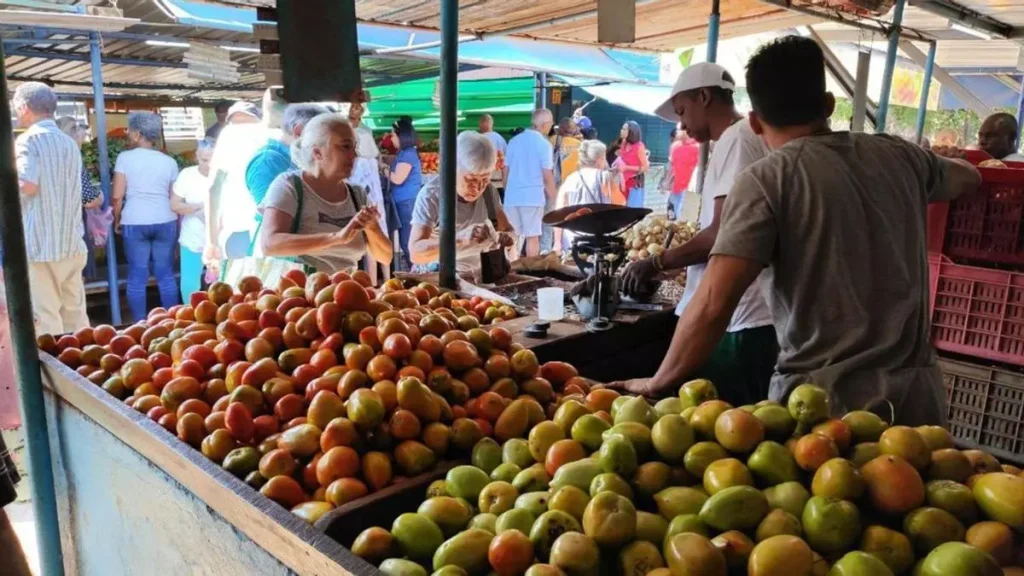
 14ymedio, Havana, September 30, 2025 — After closing the fourth exercise of control of illegalities last Sunday, the government of Havana announced on Monday a new price cap on various foods. This is the umpteenth “effort to regulate the marketing of agricultural products and ensure greater equity,” a strategy that has so far yielded few results.
Signed by the governor of Havana, Yanet Hernández Pérez, the resolution, whose date of entry into force is unclear, repeals all previous rules in this regard and imposes a new system of maximum prices for the retail sale of 29 products marketed at agricultural fairs. Among the most prominent are yucca, sweet potato, frying plantain and fruit plantain, as well as pumpkin, which may not exceed 25 pesos per pound. Guava was estimated at 20, while pineapples and a pound of plantain was estimated at 35.
For the rest of the products, prices go up: rice to 155, charcoal to 800, malanga can be sold for 55 or 75 pesos depending on the variety, and beans, if inputs were delivered to the producer, are at 196 pesos. Otherwise, they will be sold at a maximum of 285 per pound.
In these cases there were 19 products with higher maximum prices
Maximum retail prices were also imposed on truck drivers, tradespeople, non-agricultural cooperatives and “supply and demand markets managed by Acopio.” In these cases, 19 products had higher maximum prices. A pound of cassava, for example, can be sold at 45 pesos, almost twice what is required for agricultural fairs. Other products follow the same trend: frying and fruit plantain, cucumber and guava at 40 pesos; malanga at 75 or 110 and plantain at 50. However, others like rice, beans and some vegetables have the same price.
Price lists are established on the basis of three types of marketing: purchase from the producer, wholesale and retail. For example, the farmer must sell a pound of yuca for 20 pesos to the wholesaler, who will market it for 24 pesos, while the retailer will offer it for 30 pesos.
The list also includes sweet potato, frying and fruit plantain, in addition to pumpkin, which all have the same price cap as cassava. The rest varies between 25 and 250 pesos depending on the product and from which entity it is purchased.
The new price caps will take effect in all municipalities of the capital, adds the resolution, which insists that its purpose is to “improve transparency in the marketing of food, protect consumers and strengthen State control over prices in a challenging economic context exacerbated by the intensification of the blockade.”
“If instead of capping prices, they made it easier for farmers…”
It is no accident that prices are being controlled just after the State deployed its inspectors throughout the country for a whole week. According to the results published by the official press upon the closure of the exercise against illegalities, one of the violations most frequently found was precisely the sale of food at “abusive prices.”
However, the residents of Havana already see the disappearance of the regulated products and their sale on the black market, as happens every time the State announces a price cap. “When they say they’re going to lower prices, the products disappear. The private stores have all the goods, and the State ones have nothing and also sell at high prices. We can give the example of the potato: they only gave it to us once in the so-called basic basket. The rest was sold by street vendors at high prices. Here we hardly trust anything, we only have to wait and see,” said a reader in the comments section of the Tribuna de La Habana page on Facebook.
“If instead of capping the price, they should make it easier for the farmers to grow crops; for example, giving them fuel to prepare the land, fumigation products and fertilizers, and facilitating the movement of goods to the city. They can talk about lowering prices, but this is what makes farmers leave and do something else,” criticized another from the point of view of the farmers. They, like many sellers, have complained many times that prices do not cover the investment needed to plant or buy food.
However, the State seems to be more focused on imposing standards than on solving the problem at its root, and, in the long run, the fines collected for price violations bring in millions of pesos.
Last week alone, 7,500 fines were imposed throughout the Island as part of the illegal activity control exercise resulting from more than 12,000 inspections. The sanctions amount to almost 24 million pesos collected, to which are added seizures of all types of products that go to the State companies responsible for marketing them.
Translated by Regina Anavy
____________
COLLABORATE WITH OUR WORK: The 14ymedio team is committed to practicing serious journalism that reflects Cuba’s reality in all its depth. Thank you for joining us on this long journey. We invite you to continue supporting us by becoming a member of 14ymedio now. Together we can continue transforming journalism in Cuba.