
When the Rebellion of the Cuban Barbers Failed, David Left by the ‘Route of the Volcanos’

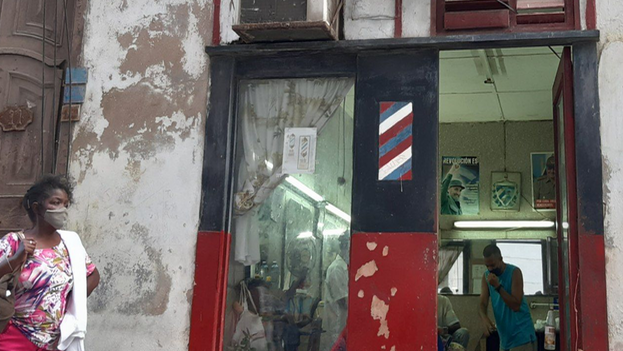
Private barbershops in Havana haven’t escaped the crisis of shortages, and some are forced to resort to the black market, where they pay prices of gold. (14ymedio)

14ymedio bigger14ymedio, Alejandro Mena Ortiz, Miami, 30 October 2022 — David left his dream of being a dentist to open a barbershop in Havana in 2016, one of the best years in Cuban’s recent history, with the visit of Barack Obama, tourism reaching the sky and hopes for more lively changes than ever. Six years later, and after a traumatic journey on the “route of the volcanos,” he tells 14ymedio how he had to leave the Island and his prosperous business due to the regime’s persistent refusal to open the domestic market.

“I started from scratch like everyone, with the basics. The business was growing, and in 2018 you could expand and hire a worker. I was gaining experience and customers, improving, because I had to prepare, and I passed styling courses,” he says from his new residence, in Naples, Florida, where he arrived in March 2022.

Until that moment, and like so many Cuban barbers, David had to resort to the black market to acquire his products. The Government’s resistance to creating wholesale markets for self-employed businesses limited (as it continues to limit) the ability of entrepreneurs to obtain materials to work with and pushed them to immerse themselves in illegality, exposing them to all kinds of fines and inspections.

“The barbers communicated in a WhatsApp group where we helped find work material that in Cuba is very difficult to get; for example, a razor blade had to be bought on the black market, because there are none. They don’t exist. So, how do you justify your work? And that’s a basic material, because for every customer you need a blade,” he explains. At that time, the price was 15 pesos each, and David is convinced that, currently, the price will have climbed vastly, and everything was brought from other countries. continue reading

The only formula authorized by the Government for barbers to buy their work materials was to acquire it, sporadically, in stores in freely convertible currency (MLC), but they were paid in national currency. If things were complicated before the Ordering Task*, with monetary unification and galloping inflation, the situation went from bad to worse.

“To buy from the State, which exchanged 24 pesos for a dollar, I had to lose money, because I had to buy it on the black market [where from the beginning the currency was double the official rate]. In addition, I have to justify it, put everything on paper to declare my taxes. How do you justify something like that, if on the street no one is going to give you a voucher?” David explains that the things he needed to acquire in the informal market were not occasional but basic, from the aforementioned blades to talc or cologne and even cloths to clean the floor — although, “well, we Cubans are always inventing and can clean with an old T-shirt,” he says.

The worst, despite everything, was the price cap that the Government of Havana decreed at the beginning of 2021. The maximum price for a cut was 25 pesos, as the local press said in an article mentioning the fines imposed for violating the regulations. “At the Los Amigos Barbershop, a rented unit on 17th and H, the entrepreneur was fined 8,000 pesos, in line with the provisions of Decree Law 30, for charging 50 pesos for a haircut, when the established price is 25,” the text said.

David remembers that case perfectly. “A week ago a law had passed saying  that a cut couldn’t be more than 25 pesos, and the barbers began to protest. They spent three months harassing the barbers, that little boy who works in front of 17th and H complained a lot. His place belongs to the State, but you are the one paying him. I can’t allow someone to tell me how much I have to charge for my service. I can have competition and that forces me to match my price, because if I charge 100 here and someone else charges 80 for the same thing, I will lower it. But not if someone comes and tells me that I have to charge so much for that,” laments the barber.

“I preferred to charge less and take care of myself before they fined me 8,000 pesos and withdrew my license, because [the cost of that] is four minimum wages, so to pay it was a lot of work,” says David, who recalls the failed rebellion of the barbers. “Those who worked in State premises demonstrated, but they didn’t solve anything.”

That combination — the impossibility of buying products to maintain his business legally, the price cap and the risk of being fined — took away his enthusiasm for his work and encouraged him to leave the Island through Nicaragua.

The journey was not easy. David suffered the fear of being discovered by the authorities of the countries he had to cross, and saw a person die a few feet from him at the crossing of the Rio Grande that, at the age of 29, marked him very hard. But leaving was a necessity, especially since on July 11 he saw how many young people were arrested and imprisoned for dozens of years simply for protesting and demanding their rights.

Now, from quiet Naples, Florida, he deals with the American bureaucracy to legalize his situation, but things are getting better. “I had my birthday in March. My family all gathered and took me to a very big fair, where there were gadgets and games. I went to eat a pizza with my cousin and I look back and see a policeman behind me. Of course, I came with the idea that such a guy, in your country, represses you,” he reflects.

He invites Cubans to reflect before following the path he took because he considers emigration to be a very personal decision, as well as risky. He tells them: “Open your eyes, see your own reality and do what you have to do to escape, you won’t regret it. It’s hard, because you lose many things, friendships, family, you lose something that is part of you, but there is nothing more beautiful than living in freedom.”

*Translator’s note: The “Ordering Task” is a collection of measures that include eliminating the Cuban Convertible Peso (CUC), leaving the Cuban peso as the only national currency, raising prices, raising salaries (but not as much as prices), opening stores that take payment only in hard currency which must be in the form of specially issued pre-paid debit cards, and a broad range of other measures targeted to different elements of the Cuban economy. 

Translated by Regina Anavy

____________

COLLABORATE WITH OUR WORKThe 14ymedio team is committed to practicing serious journalism that reflects Cuba’s reality in all its depth. Thank you for joining us on this long journey. We invite you to continue supporting us by becoming a member of 14ymedio now. Together we can continue transforming journalism in Cuba.
Cuban Dissidents Should Enter the Electoral Arena

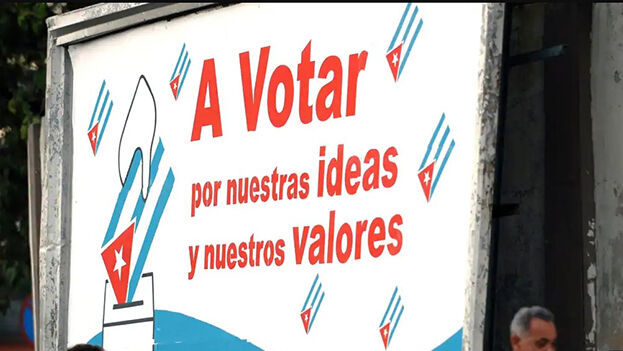
“Vote for our ideas and our values.” On November 27th elections for Cuba’s municipal assemblies will be held, the first step in designating provincial governors and vice-governors. (EFE)

14ymedio bigger14ymedio, Ariel Hidalgo, Miami, 30 October 2022–The proposals by the internal opposition in Cuba, announced by the Council for a Democratic Transition as well as the newly created D Frente, to promote candidates to the municipal elections are not naïve as some critics have said. Rather, it could be said that those who believe so are more naïve. The proponents know perfectly well the barriers and risks they will face. Even if they were convinced of the impossibility that any of the candidates could reach any of the levels of that official institution, it is worth fighting for other reasons.

To understand this, it’s sufficient to review the experiences offered by the history of the dissident movement itself, such as that of the first Cuban who accepted this electoral challenge.

The first time an opposing candidate ran in an election in Cuba was 1989. Roberto Bahamonde Massot, an engineer and doctor of pedagogy, member of the Party for Human Rights in Cuba, which was one of the first dissident organizations, nominated himself as a candidate. However, his own group refused to support him, as they believed that it legitimized fraudulent elections.

Bahamonde was undaunted and decided to run in his personal capacity; he made several copies of his candidate program and distributed them in the neighborhood. On March 9th of that year, he arrived at the meeting for the candidates for delegate of District 2 in the area of La Fernanda, in San Miguel del Padrón. When it came time for nominations, he nominated himself, which caused a great stir in the asembly because he was someone who had been arrested four times by State Security and they refused his candidacy. But he did not give up and challenged the legality of the procedures. The commission agreed to repeat the meeting. He competed against the Minister of the Interior and lost with 31 votes in favor, 60 against and 59 abstentions, which was a great victory in the country of unanimity.

The fact that back then Bahamonde “lost” while obtaining over half as many votes as the officialist candidate, and that 59 people abstained despite the closed campaigning orchestrated by State Security against him, is very significant. It was clear that those who abstained did not want to vote for the officialist candidate, but did not have the courage to vote for the dissident. Were it not for that fear, Bahamonde would have flat out won with no fewer than 80 votes.

The question to ask now is: If that occurred in 1989, what would occur nowadays when almost no one is hopeful that this leadership and this model will improve the desperate conditions for the population that has launched into protests in the streets in almost every city in the country?

It does not mean they will win some seats now, because, for the same reasons, repression and fraud will be on levels greater than before. What matters is the political costs they will have to pay when they realize this, not only when facing the people, but also in international public opinion.

For those who think that these costs don’t matter to them, I want to remind you that faced with an economic situation so severe, they are in no condition to continue losing foreign aid, or deserters from among the skeletal base of popular support. Success depends, of course, on the one hand, on the opponents succeeding at reaching the population with their candidacy programs and those of the opposition in general. On the other hand, foreign lobbying is important so that any benefits the government negotiates with powerful institutions are conditioned upon allowing the presence of international impartial election observers.

The greatest support that exiles who fight for their country’s freedom can provide is not so much to exhort their compatriots on the archipelago to abstain from arguing that the elections would be fraudulent, nor to pressure governments to strictly deny any concessions to the Cuban government, but rather to exhort them to vote for opposition candidates and, better yet, aim for foreign governments to condition foreign aid on the acceptance of those observers. If the oppressors refuse, they not only lose that aid, but also what little credibility they still have.

The true battles will not really be at the polls, but rather, in the streets, in the population’s peaceful protests in defense of the rights of the people’s true candidates, all of which would further nourish the ranks of unsatisfied citizens. On the other hand, in the international arena, we’d gain allies while the oppressors get cornered further.

For my part, I’d view such a victory not only as a precursor to the final triumph of the libertarian ideals of so many Cuban fighters, but also the best way to honor the memory of that forerunner who, I know, died after being forgotten in exile.

Translated by: Silvia Suárez

____________

COLLABORATE WITH OUR WORKThe 14ymedio team is committed to practicing serious journalism that reflects Cuba’s reality in all its depth. Thank you for joining us on this long journey. We invite you to continue supporting us by becoming a member of 14ymedio now. Together we can continue transforming journalism in Cuba.
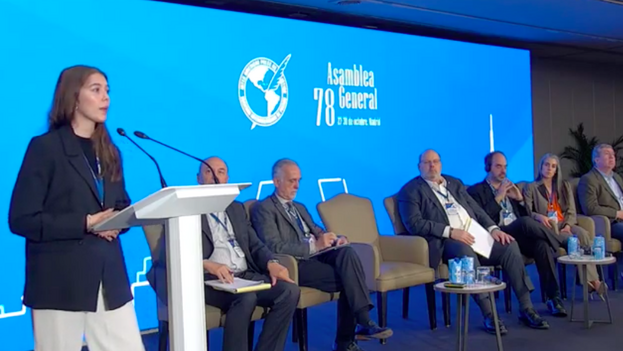
IAPA Asks for Suspension of New Cuban Penal Code Which Punishes Press Freedom

The IAPA’s declaration is consistent with the 2022 Chapultepec Index on press freedom issued by the organisation during its General Assembly. (EFE)

14ymedio bigger14ymedio, Madrid, 2 November 2022 — The Inter American Press Association (IAPA) denounced the “systematic repression of the independent press in Cuba”, in a resolution published during its 78th General Assembly in Madrid from 27 to 30 October.

The document exposes the “incessant harassment” by the Cuban government of anyone who defends freedom of the press and expression, and points out the lack of respect for foreign journalists.

The IAPA considers it urgent that the regime desists from going ahead with its new Penal Code, which will come into force on 1 December, and forsees the “categorisation of new ’crimes’, custom-made for their repressive policies”. This act will be an even further assault on the practice of independent journalism”, they add.

The denouncement was preceded by a number of considerations on the plight of independent reporters on the Island, in particular that of Lázaro Yuri Valle Roca, detained in 2021 and condemned to 5 years in prison for “continuous enemy propaganda, and resistance”.

The IAPA considers that Valle Roca’s “grave state of health” is a consequence of the “severe punishment given to critics of the government”, which will only get worse with the implementation of the new Penal Code. continue reading

The organisation also mentions the extortion of journalists: agents of the Ministry of the Interior  propose an “exit from the country in exchange for a public renunciation of the independent media”;  those who refuse are prohibited from leaving the Island.

Another means of government repression is the imposition of “onerous fines” for internet or social media reporting of any events which are problematical for the government.  They say the digital sphere has become a centre for spying and censorship by the state communications company”, Etecsa.

Also, they say, “the arrest of journalists continues to be the order of the day”, a situation exemplified by the case of Camagüey reporter Henry Constantín, director of media company La Hora de Cuba and regional vice president for Cuba of the IAPA. They note also the frequency with which house arrest is practiced, and the hounding of journalists and their families.

Finally, they detail the gravity of the political and social crisis on the Island, the huge exodus of Cuban people, and the reinforcement of repressive apparatus, from the police force to the legal system and surveillance.

The IAPA declaration is consistent with the 2022 Chapultepec Index on press freedom, published by the organisation during its General Assembly, in which Cuba occupied twentieth place, near the bottom of the list, surpassed only by Venezuela and Nicaragua. The three countries are the only ones marked out as being in the category of “no freedom of expression”.

Translated by Ricardo Recluso

____________

COLLABORATE WITH OUR WORKThe 14ymedio team is committed to practicing serious journalism that reflects Cuba’s reality in all its depth. Thank you for joining us on this long journey. We invite you to continue supporting us by becoming a member of 14ymedio now. Together we can continue transforming journalism in Cuba.
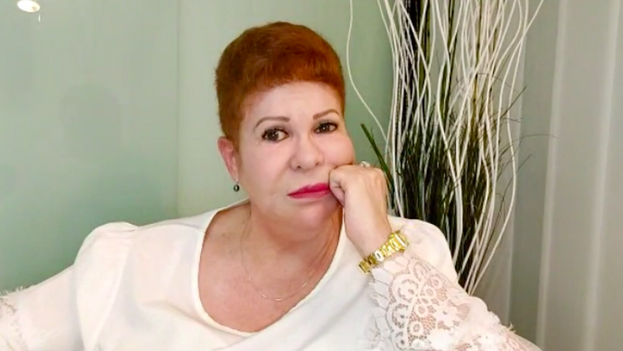
Economy Minister Alejandro Gil is the ‘Most Hated’ Person in Cuba, Along with Diaz-Canel, Says His Sister

“Vicky,” as she is also known, said that State Security monitors and controls all the content of Cuban Television. (Screen Capture)

14ymedio bigger14ymedio, Havana, 29 October 2022 — On Wednesday, Former Cuban Television presenter María Victoria “Vicky” Gil Fernández, resident of Tenerife, gave an extensive and controversial interview on the YouTube channel “The World of Darwin,” in which she offered biographical details about her brother, Alejandro Gil, the Minister of Economy of Cuba, and her former colleague, Edmundo García.

She considered her statement on the Miami channel an “obligation” to Cubans, and said that she had the “right to be able” to defend herself. She noted her 35 years of work as a presenter of the program De la gran escena [The Big Scene] and considered her interview as “a vindication.”

Vicky, as she is also known, said that State Security monitors and controls the content of Cuban Television. “Everything that is said goes through a sieve; everyone knows that,” she admitted, before sharing personal anecdotes about the censorship of several broadcasts of De la gran escena. “There is no freedom of the press nor of ideas in a dictatorship,” she said bluntly. “No one is afraid to say it: it’s a dictatorship,” although, she added ironically, “of the proletariat.”

The presenter commented on her ties with journalist Edmundo García, one of the most controversial characters linked to the Cuban government from the United States. “He was imposed” on the television program in the forced replacement of Omar Moynelo, she remarked.

She described García as a guajiro [peasant] from the interior of the country who quickly entered the world of art trafficking as he gained fame on the program, Vicky commented. “According to him, his friends were Vargas Llosa, Miguel Barnet, and his way of life was of the high bourgeoisie.” He had bodyguards, mobile phones and cars when no one could have them, she claimed. continue reading

“His life was not that of a communist, and he acquired a fortune in the International Financial Bank” from money he obtained in his business of buying and selling paintings. Gil detailed how she also participated in art trafficking and obtained her slice, although not at the level of García, who was often arrested by the police and released shortly after thanks to his connections.

She said that García, with the complicity of journalist Ciro Bianchi Ross and the family of Antonio Núñez Jiménez, was responsible for the sale of a fake Picasso painting to an Italian collector. For the scam, Gil said, they earned $200,000. The Italian, of course, returned to Cuba to file a complaint, but the participants were left unpunished “for absence of evidence.”

“They removed him from the program without doing anything,” says Gil, who also wasn’t clear about the causes of Edmundo García’s expulsion and didn’t know anything about his “mission” in Miami.

In the second segment of the interview, the presenter referred to her brother, Alejandro Gil, whom she considers “a communist.” “My brother has no need to be where he is,” she said, but “he blindly believes that he will be able to move the country forward.”

Alejandro Gil graduated as an engineer in Maritime Transport Development from the Technological University of Havana (CUJAE), a profession that has little relation to his current position as Minister of Economy. “I can’t exempt him from his responsibility,” Vicky acknowledged, alluding to the current crisis in every sector that the country is going through. “I can’t even say that I’m a puppet sister.”

“The Cuban economy has always been led by incompetent people,” she concluded. “Political will has always triumphed over economic reality.” She added that Cuba can only grow financially through “its beaches, nickel and the poor doctors.” María Victoria Gil discredited the Ordering Task*, whose failure could be easily predicted.

“Give me time,” has always been her brother’s response, “convinced” that his recipe to save the economy is the right one, according to her.

“My brother was a tycoon,” she says unequivocally, recalling his very successful career in a maritime insurance company in the United Kingdom. He was a member of several international clubs in London, Russia and Havana. He “left everything,” she explains, “for communism and stupidity.” Back in Cuba on one of his trips they made his head spin with flags and honors, and he became part of the government apparatus. “My family wanted to kill him,” she said.

Vicky defended herself from the accusations of being “a figurehead of the Castros” and said she had bought a small, charming place of just 150 square feet in Tenerife, Canary Islands, with the money of a cousin, who lives in Spain.

Gil analyzes Fidel Castro with the same indulgence and describes him as a “human being who was wrong,” although he did admit that he was “too self-centered.” She commented that there are many rumors about the leadership of Cuban power, and many are true, such as those that refer to Raúl Castro’s grandson, Guillermo Rodríguez Castro, El Cangrejo [The Crab].

María Victoria Gil regrets that her brother “was involved in that problem” at the age of 58, because he’s the person who’s “most hated” by the people, along with Miguel Díaz-Canel and Manuel Marrero. She said that he lives in a tenement “that is falling down” and suffers from the blackouts, although other sources point to a comfortable house in the neighborhood of La Víbora, in the Havana municipality of Diez de Octubre.

“I hope he finds a way out, or leaves at the right time,” she said. “He will have to leave Cuba if there is a big change.”

Translated by Regina Anavy    

*Translator’s note: The “Ordering Task” is a collection of measures that include eliminating the Cuban Convertible Peso (CUC), leaving the Cuban peso as the only national currency, raising prices, raising salaries (but not as much as prices), opening stores that take payment only in hard currency which must be in the form of specially issued pre-paid debit cards, and a broad range of other measures targeted to different elements of the Cuban economy.   

____________

COLLABORATE WITH OUR WORKThe 14ymedio team is committed to practicing serious journalism that reflects Cuba’s reality in all its depth. Thank you for joining us on this long journey. We invite you to continue supporting us by becoming a member of 14ymedio now. Together we can continue transforming journalism in Cuba.
The Pinar del Rio Black Market Scoffs at the Cuban Government’s Warnings

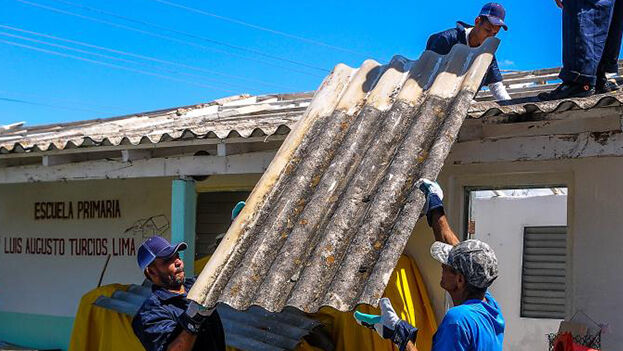
Pinar del Río was the area most affected by Hurricane Ian at the end of September, where there are still 108,000 unrepaired homes. (José M. Correa/Granma)

14ymedio bigger14ymedio, Havana, 1 November 2022 — The threat launched by the Cuban Government against “illegalities, corruption and indiscipline” has had little impact on the informal market of Pinar del Río. A Facebook message on Monday proposing the sale of construction supplies that the authorities reserved for victims of Hurricane Ian received a challenge: “I have tiles for sale privately, call me.”

The “tiles,” actually temporary zinc plates, were marketed through the Ventas Pinar group, where hardware products, household supplies, cell phones, clothing and food — shrimp, cookies, coffee — are  in high demand but scarce in state stores.

More than a month after the scourge of Hurricane Ian, work to rebuild the damaged infrastructure is progressing slowly due to the shortage of construction products on the Island. In Pinar del Río, the area most devastated by the climate event, there are still more than 108,000 unrepaired homes, according to the official newspaper Granma, which reacted with alarm to see that the few materials provided by the Government had already appeared in the informal market.

“Unfortunately, this isn’t an isolated case. On the site itself, and on others that have proliferated taking advantage of the expansion of Internet access, offers of all kinds of goods of ’doubtful’ origin have become commonplace for years, in sight of everyone who wants to look,” says the newspaper. continue reading

The newspaper gives the example that even induction cookers, which are sold in a regulated manner in the pinareña province for families who have been left without equipment, can be found in Facebook or WhatsApp groups at prices six times higher than the official value, about 20,000 pesos.

The harsh government warnings against the black market “do not seem to change” social media sales groups, recognizes the newspaper, which admits that, by informal means, “the most diverse assortments can be obtained, the result of corruption, lack of scruples and lawlessness.”

The shortage of food and basic products on the Island causes distortions that contribute to fueling illicit trade, through which electronic items as well as medicines can be accessed, but at exorbitant prices. Miguel Díaz-Canel has recognized that this happens “in plain sight” of his administration and the Communist Party.

In that sense, in recent days, several operations have been carried out against the informal market and traders who sell their products at prices above the fixed prices. Last week, the Municipal Inspection Directorate (DIM) in the Havana municipality of Playa imposed fines of up to 8,000 pesos on sellers who offered a pound of tomatoes, peppers and carrots at a price of up to 300 pesos.

The Government of Havana also reported that it imposed fines of up to 8,000 pesos on two bakeries in Ciudad Libertad, a neighborhood of the Havana municipality, after it was detected that they sold the standard bread with a weight below that established in the technical quality standards. In another operation in the Lido neighborhood, the inspectors confiscated from sellers several products from the basic basket [ed. note: i.e. the rationed goods allocated to each individual/family] that, the municipal government said, will be delivered to social institutions.

Translated by Regina Anavy

____________

COLLABORATE WITH OUR WORKThe 14ymedio team is committed to practicing serious journalism that reflects Cuba’s reality in all its depth. Thank you for joining us on this long journey. We invite you to continue supporting us by becoming a member of 14ymedio now. Together we can continue transforming journalism in Cuba.
Cuba and Vietnam: Where’s the U.S. Blockade?

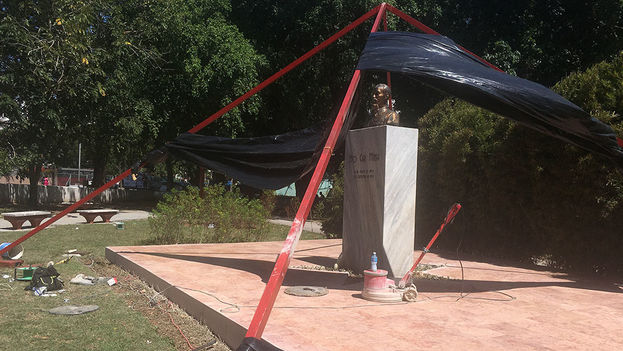
The bust dedicated to the Vietnamese leader Ho Chi Minh in a Cuban park being refurbished among general indifference. (14ymedio)

14ymedio biggerElías Amor Bravo, Economist, 22 April 2022 — Not even they can clarify it. In the morning, the Cuban communist leaders get tangled up in furious attacks on the United States over the blockade/embargo, blaming it for all the island’s economic problems, and, in the afternoon, they issue clear instructions to the official press to say the exact opposite.  See if it isn’t true; the article in in the State newspaper Granma titled “Vietnam, second Asian partner in the Major Antilles”. This is where the state that “in spite of the geographic distance, the commercial bilateral trade is going well, and now Vietnam has four projects in operation in Cuba with a capital value of 44 million dollars”. Not a word or mention of the blockade/embargo. Congratulations. Therefore we have to ask again, where is the blockade?

Let’s take it one step at a time. Maybe the Cuban communists don’t speak Spanish.  Don’t think so. So, perhaps it’s best to go to the definition of “blockade” in the Real Academia de la Lengua dictionary, and there blockade is defined as the action “to block”, and so, if we look for the definition of this verb, we find the following entries:

1. tr. Intercept, obstruct or close the way. This is clearly not what is happening.

2. tr. Prevent the normal operation of something. Unthinkable.

3. tr. Make difficult, or hinder the carrying out of a process. That’s really difficult.

4 tr. Hinder, paralyse a person’s mental faculties. Well, that’s beside the point.

5. tr. Carry out a military or naval operation to cut communications to a place, a port, a territory, or an army. Yes, this happened over three or four days when dozens of Soviet nuclear missiles arrived in Cuba in ships, and Kennedy gave the United States navy the order to prevent their passage and force them to turn around.

It can be seen that this image has stayed with us from the start of the ’60’s of the last century. Can the term “blockade” or “to block” really be applied to the present situation in Cuba? Difficult. And if not, ask the Vietnamese. continue reading

And if they don’t agree, what does the dictionary say about “embargo” or, “to seize”, which is the other hackneyed term used by the Cuban communists. This is more of a fine point.

1.m. Prohibition of trade and transport of arms and other equipment for use in war, decreed by a government. Nothing of the sort.

2. m. Retention, sequestration of assets, on the orders of a judge or competent authority. Nothing of the sort.

3. m. archaism. Indigestion, stomach upset. Hardly.

4.m. archaism. Damage, inconvenience. Well, this could mean anything.

To sum up, none of this seems to exist in Cuba at the moment, and the communist allusions to blockade and embargo are more a reverie about the past and a desideratum than anything else. The Vietnamese know it and don’t have the slightest problem in trading with the Cuban regine leaders. Nor do they care about the supposed threats. In the same way, 190 other countries in the world, including the United States, the target of the Cuban communist attacks, with whom it is possible to trade, so long as you pay in cash.

Granma points out in their article that Vietnam “has become  Cuba’s second largest Asian partner (obviously, China is the first), with the trade transfer between the two countries reaching 102 million dollars in 2020”. This information was made known in the seminar in Ho Chi Minh City to promote investment in the Mariel Special Development Zone (ZED Mariel).

But, if we analyse the statistics, we need to lower these claims. In Quarter 1, there are presented the exports and imports between Cuba and Vietnam since 2015 and the result (in index numbers with 2015 as base = 100) is nothing to write home about. One can see an important decline from the levels achieved in 2018. The trade is not going well.

Quarter 1.- Trade between Cuba and Vietnam (index 100 = 2015)

Therefore, this seminar organised by the Ho Chi Minh City Center for Promotion of Trade and Investment and the office representative of the Cuban logistics operator Almacenes Universales S.A. offered Vietnamese and Cuban companies the opportunity to update the strategic changes and benefits of the Vietnam-Cuba Commercial Accord. That’s to say, “reset” the deal with absolute freedom and without limits. And all that in spite of the embargo/blockade and the COVID -19 pandemic.

An open and shut case. Even a news agency, Vietnam Plus, has stated regarding “this gathering in the Indochinese country has as its aim increased economic cooperation, in terms of investment, commerce, tourism and health between this Asian centre and Cuban regions”, some economic relations that as can be seen in Graphic 1, collapsed during the Covid-19 pandemic.

Supported by what the state press calls “ties of friendship, brotherhood and mutual confidence between Vietnam and Cuba” they have arranged a series of projects and commercial accords which are very interesting for the island, because they permit the reinforcement of the eternal ideological message against the United States.

It is hard to believe that the Vietnamese, commercial partners with that country, with which they maintain excellent economic and financial relations, would allow themselves to be trapped in the Cuban communist verbiage. But, the fact is that there we have the results and see the business between the island and the Asian country on the increase.

This climate of economic relations has been preceded since last year by a series of political meetings between communist leaders of the two countries, leading some analysts to think that the Cuban leadership is contemplating an exit from the serious crisis by way of a Doi Moi (ed. note: programme of economic reforms implemented in Vietnam in 1986), which permitted Vietnam to get past its periods of hunger and convert itself into the emerging power that it is today.

It doesn’t seem as if that was to be the way forward. The Cuban and Vietnamese communists have spoken more about help, contributions, cooperation and solidity, than about structural changes in the economy. A shame.

And that was in spite of the fact that a spokesman for the Cuban regime said that “we are interested in continuing to study the experiences in Vietnam which could be useful for the updating of the Cuban economic and social model, including food security and the attraction of direct external investment”, precisely the type of “experience” of the least help to the Cuban economy in overcoming its backwardness.

The two countries, apparently, and according to official information, have established accords in distinct sectors of food, biotechnology, communications, tourism, and energy, but, without doubt, the most important element has been the help sent by Vietnam for combatting Covid-19, especially the supply of 18,000 tons of rice. Cuba, for its part, sent anti-Covid vaccines.

Translated by GH

____________

COLLABORATE WITH OUR WORKThe 14ymedio team is committed to practicing serious journalism that reflects Cuba’s reality in all its depth. Thank you for joining us on this long journey. We invite you to continue supporting us by becoming a member of 14ymedio now. Together we can continue transforming journalism in Cuba.

Cuba: ‘That Was Not An Accident, It Was Murder’

Elizabeth Meizoso, Héctor’s niece who died in the event last Friday.

14ymedio bigger14ymedio, Yoani Sánchez, Havana, 1 November 2022 — Héctor Meizoso’s life has taken a tragic turn since last Friday. Ten of his relatives were traveling in the boat sunk by the Cuban Border Guards north of Bahía Honda, in Artemisa, and three of them died in the attempt to leave the island, in an incident that the man classifies as “murder.”

“They [the rescue brigades] are no longer searching. The relatives are the ones who are finding the deceased,” the young man, a graduate of the Maritime Fishing Institute, in Mariel , told 14ymedio . “That was not an accident, that was murder, because it was on purpose,” insists the Artemiseño, who lost his niece Elizabeth Meizoso and his cousins ​​Yerandy García Meizoso and Aimara Meizoso in the sinking.

“They had to have let it [leave],” he now reflects on the boat in which at least 25 people were trying to leave the country and reach the shores of the United States, seven of them have been confirmed dead and at the moment one is missing . “In any case, it was not the first and it will not be the last,” adds the young man, who confirms that several of the survivors are still being questioned by the police.

The girl’s mother, Diana Meizoso, told Radio Martí that the boat they were traveling in received a premeditated impact from the Border Guards. “We got on the boat and, when we got out, he [driver] slowed down because he was closed on all sides, because another one was coming. When we passed them by, he [the Border Guard officer] said: ‘Now I’m going to split you in the middle, and then he rammed us’.”

The days that have passed since that October 28 have been for Diana’s brother and Elizabeth’s uncle “a nightmare and constant pain, since among those people who were on the boat ten are my family and three of them are among the deceased,” he tells this newspaper. continue reading

Meizoso fondly remembers his niece, whom he affectionately calls “fluff” in an emotional text he posted on his Facebook account a few hours after learning that the girl had died. “Thank you for learning to say uncle before you go, my life, beautiful,” he added along with a group of photos that review the little girl’s brief life.

In Bahía Honda, dozens of residents joined the funeral procession of several of those who died that day. The municipality “is in shock, nothing else is being talked about,” Maritza, a local resident who knows the Meizoso family and feels “devastated” by what happened, told 14ymedio by telephone.

“A lot of people are leaving along this coast, every day you find out about someone who left on a raft or that they came looking for them, but nobody thought that the Border Guards were going to do something like that. Nobody thought it,” reflects the woman. “Here people are going through a lot of trouble and young people have no future.”

Maritza considers that there is “a lot of popular unrest in Bahía Honda, because this thing about the dead girl has emotionally touched a lot of people, especially families who have small children and who know what it means to lose such a young life,” laments the neighbor, who adds that there is “a lot of solidarity with the relatives of the deceased and a lot of rejection of what the government did.”

However, the majority prefers to avoid voicing their opinion out loud because “this town has already been completely taken over by State Security since Saturday.” Along with the interrogations of the survivors, the neighbors detail “threats to people who were near the coast when all this happened, people who know what happened.”

“In Bahía Honda nothing happened. Here, the ordinary day was spent standing in lines, buying food, knowing that a neighbor’s son went along the route of the volcanoes or jumped into the sea, but this type of thing, it doesn’t happen. That they kill people like that, without them having weapons, without their shooting at the border guards. That can’t be.”

____________

COLLABORATE WITH OUR WORKThe 14ymedio team is committed to practicing serious journalism that reflects Cuba’s reality in all its depth. Thank you for joining us on this long journey. We invite you to continue supporting us by becoming a member of 14ymedio now. Together we can continue transforming journalism in Cuba.
Murdered Cuban ‘Balseros’ Increase to Six and Those Responsible Are Named on the List of Repressors

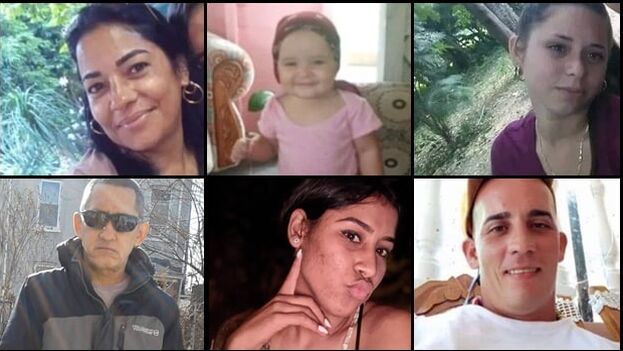
From left right and from top to bottom, Aimara Meizoso León, Elizabeth Meizoso, Indira Serrano Cala, Omar Reyes Valdés, Nathali Acosta Lemus and Yerandy García Meizoso. (Collage)

14ymedio bigger14ymedio, Madrid, 31 October 2022 — There are now six* fatalities from the sinking of a boat by Cuban border guards last Friday. As reported on Sunday by La Hora de Cuba, the most recent one identified is Indira Serrano Cala, only 18 years old and originally from Guane, Pinar del Río.

An anonymous source told the independent Camagüey media that there was a vigil over the body of the motherless young woman, in that same town yesterday afternoon.

This Sunday they also identified another of the deceased, Yerandy García Meizoso, whose body was found a few kilometres away, reported Mario J. Penton from Miami.

The other victims are Nathali Acosta Lemus, Omar Reyes Valdés (the boat driver), Aimara Meizoso León and the little girl Elizabeth Meizoso, only two years old.

Meanwhile, the Foundation for Human Rights in Cuba (FDHC) has included two officers from the Border Guard Troops on its list of repressors for being responsible for what it considers a “cold-blooded murder.” continue reading

In a statement made public this Sunday, the NGO based in the United States confirmed the names of the other deceased, none of whom had been mentioned by the Cuban authorities, who have not offered their condolences for what they consider a “painful act” that occurred because of the “hostile and cruel policy of the US Government against Cuba.”

Raidel Rodríguez López, head of Operations of the Northwestern Detachment of Border Guards, which covers the Bahía Honda area, Artemisa, where the events took place on the night of October 28, and Lieutenant Colonel Leovanys Cutiño Rodríguez, chief of the General Staff of the same detachment, have also joined the list of repressors.

Both are named by the FDHC as responsible for these “murders,” after attacking a boat with 23 people on board. The survivors, the organization recalls, “say that they were sunk on purpose.”

The NGO also attributes responsibilities in this event to General Jorge Argelio Samper Muarra, in charge of the Head of Border Guard Troops of the Ministry of the Interior since 2017, and to Colonel Jorge Luis Navarro Nolasco, head of the Northwest Detachment of the same police force, both previously on the list of repressors.

The two are guilty by the positions they occupy, “for several acts of violence by the troops under their command against Cuban balseros [rafters] on rustic boats, endangering their lives or causing them injuries and even death.”

The story also confirms that this is just another crime against humanity perpetrated in cold blood in the solitude of the sea by the communist regime,” argues the FDHC, which mentions several similar tragedies, such as the bombing of civilians aboard the XX Aniversario boat on the Canímar River, in July 1980; the sinking of the 13 de Marzo tugboat on July 13, 1994, which resulted in 37 dead, including 10 children, and the death of William Padrón Maza, from Avila, on March 1 of this year, from serious injuries received after being rammed by the Cuban Border Guard Troops 11 miles from Cayo Coco, when he was in a speedboat that was stranded.

In its document, the NGO reports that “eye-witness accounts by dozens of survivors attest to the fact that the border guards systematically attack them in the boats that carry men, women and children in their attempt to escape from hell.” It’s a “cruel method of preventing irregular exits by sea,” says the FDHC, which is being carried out “especially now, when the regime doesn’t want anyone leaving that way.”

That was the reason, the NGO concludes, for the “brutal repression” at the end of August in the Artemiseño hamlet of El Cepem, where several residents were prevented from going to sea on rustic boats: “They lie when they blame the Cuban Adjustment Law, when they know that those who are intercepted at sea are repatriated.”

Translator’s note: As of the date of this translation, the number has continued to rise.

Translated by Regina Anavy

____________

COLLABORATE WITH OUR WORKThe 14ymedio team is committed to practicing serious journalism that reflects Cuba’s reality in all its depth. Thank you for joining us on this long journey. We invite you to continue supporting us by becoming a member of 14ymedio now. Together we can continue transforming journalism in Cuba.
Ruben Martinez, the Cuban Pilot who Arrived in Florida After Escaping With a Russian Plane, Will Continue to be Detained

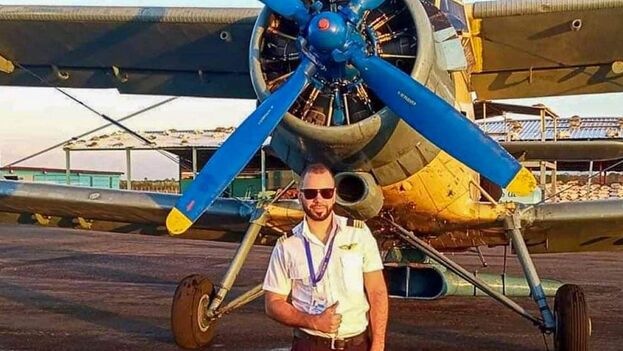
Rubén Martínez in front of the plane he was flying before leaving the Island last Friday the 21st. (Facebook)

14ymedio bigger14ymedio/EFE, Madrid, 31 October 2022 — Rubén Martínez Machado, the Cuban pilot who arrived in Florida last Friday, October 21, after leaving Cuba in a Russian-made Antonov aircraft, must remain detained for the time being, according to his lawyer, Eduardo Soto.

The 29-year-old Cuban had his first appearance today before an Immigration Court in Pompano Beach, Florida, which decided to keep him in the Broward County detention centre, at least until his next appointment next week.

In today’s hearing, according to Telemundo, the judge didn’t set bail for Martínez because the Prosecutor’s Office wasn’t ready to present its case.

“It seems to me that he has a very good case, but I’m not the one who has the last word,” Soto told EFE last week, after pointing out that both he and his defendant are confident about obtaining a positive verdict on the asylum application in court.

This Monday, Maile Díaz, a close friend of the pilot, who doesn’t have relatives in Miami, told Telemundo that if the young man “sets foot in Cuba, he’ll never see the sun again.” continue reading

“He will always be persecuted by the Government. He has now betrayed the State and stolen a very important piece of equipment,” added the woman, saying that Martínez’s mother “is desperate.”

Martínez was a pilot for the Cuban Air Services Company, which belongs to the Cuban Aviation Corporation, and he left the Island from Sancti Spíritus. He  took a selfie next to the plane when he arrived at Dade-Collier Training and Transition Airport in Florida.

The customs agents interrogated the pilot as soon as he landed and placed him in the custody of the authorities, who later took him to the prison, where he remains.

His lawyer pointed out at the end of last week that Martínez feared being returned to the Island, due to the serious danger this would pose to his life, so he is applying for political asylum.

“In Mr. Martínez’s case, they will put him directly before an immigration judge, and he will have the right to seek asylum without having to establish a credible fear,” Soto told the Miami press.

The pilot is accused of illegal entry into the United States; in Cuba he is accused of air piracy.

On the Island, his relatives have sent their best wishes to the young man. “The only thing I want is that you fulfill your dream and that you can stay there. I am happy because I know that you are well and you are where you wanted to be,” said Elsa Padrón, his 85-year-old grandmother, according to Univision.

“I am very grateful to all the people and lawyers for what they have done for you,” his aunt, Diana Rosa Machado, told Noticias 23.

Much more critical was his mother, Elisa Machado Padrón, a worker at the Villa Clara Electric Company, who confirmed the illegal departure of her son by taking the plane. “I do not approve of his decision, but above all he is still my son,” she said.

Translated by Regina Anavy

____________

COLLABORATE WITH OUR WORKThe 14ymedio team is committed to practicing serious journalism that reflects Cuba’s reality in all its depth. Thank you for joining us on this long journey. We invite you to continue supporting us by becoming a member of 14ymedio now. Together we can continue transforming journalism in Cuba.
Cuban-American Entrepreneurs will Attend the Havana International Fair

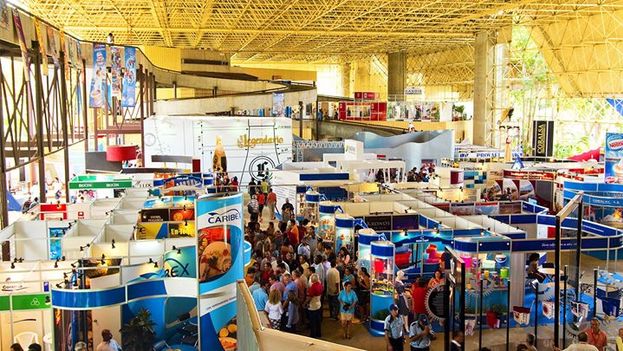
The Fair has not been held since 2019; in 2020 and 2021 it was replaced by a business forum and a virtual event. (FIHAV)

14ymedio biggerEFE (via 14ymedio), Havana, 31 October 2022 — The Havana International Fair (FIHAV) will be attended by Cuban investors residing abroad, especially those based in the United States, the Minister of Foreign Trade and Foreign Investment, Rodrigo Malmierca, said on Monday.

In addition to the participation of Cuban-American entrepreneurs – who, for the first time in the 38 editions of the event, will have their own panel. American companies will also attend, something that has already happened in previous years.

The event, the most important commercial exchange in Cuba since its first edition in 1983, will be held from November 14 to 18 at the Expocuba fairgrounds, in the island’s capital.

So far, delegations from more than 60 countries and about 570 companies, 400 of them foreign, have confirmed attendance at Fihav, according to the organizers. continue reading

The presence of Cuban investors in the United States is confirmed in the midst of an intensification of relations between the island and the US.

“There is no restriction on the Cuban side, but there has always been a kind of taboo about whether Cubans residing abroad can invest or not in Cuba,” Malmierca said.

He also added that the present edition of the FIHAV is designed “specifically so that they will know better what can be done” and “to give them all the information so that they can do business with Cuba.”

The minister recalled that due to U.S. sanctions on the country, American firms that wish to do business with companies on the Island must ask for permission from the Office of Foreign Assets Control (OFAC).

Last week, the Island hosted the Cuba-United States Business Forum, a summit of businesspeople from both countries that had not been held since 2016, during the rapprochement known as the “thaw.”

At that time, Cuban President Miguel Díaz-Canel declared that his Government is open to dialogue with the United States, but on equal terms and with respect for the “sovereignty” and “integrity” of the Island.

“I believe all this confirms that, despite the blockade, the very economic difficulties that Cuba faces, and the situation of the global crisis derived from COVID-19, the world continues to trust the Cuban market,” concluded the head of the Ministry.

During the fair, the V Foreign Investment Forum will be held to present the Portfolio of Business Opportunities.

Also, there will be the presentation of Cuba as the headquarters of the Latin American Integration Association (Aladi).

FIHAV was replaced in 2020 and 2021 by a business forum and a virtual fair. The last edition, in 2019, was attended by more than 4,000 participants from about 55 countries, of which Spain was the most represented with 110 companies, according to official data.

Operating in Cuba are 280 foreign companies from about 40 countries, including Spain, Canada, and China.

The capture of foreign investment is important for the Cuban economy, in the midst of a crisis exacerbated by the tightening of U.S. sanctions and errors in national economic management, among other factors.

Translated by Regina Anavy

____________

COLLABORATE WITH OUR WORKThe 14ymedio team is committed to practicing serious journalism that reflects Cuba’s reality in all its depth. Thank you for joining us on this long journey. We invite you to continue supporting us by becoming a member of 14ymedio now. Together we can continue transforming journalism in Cuba.
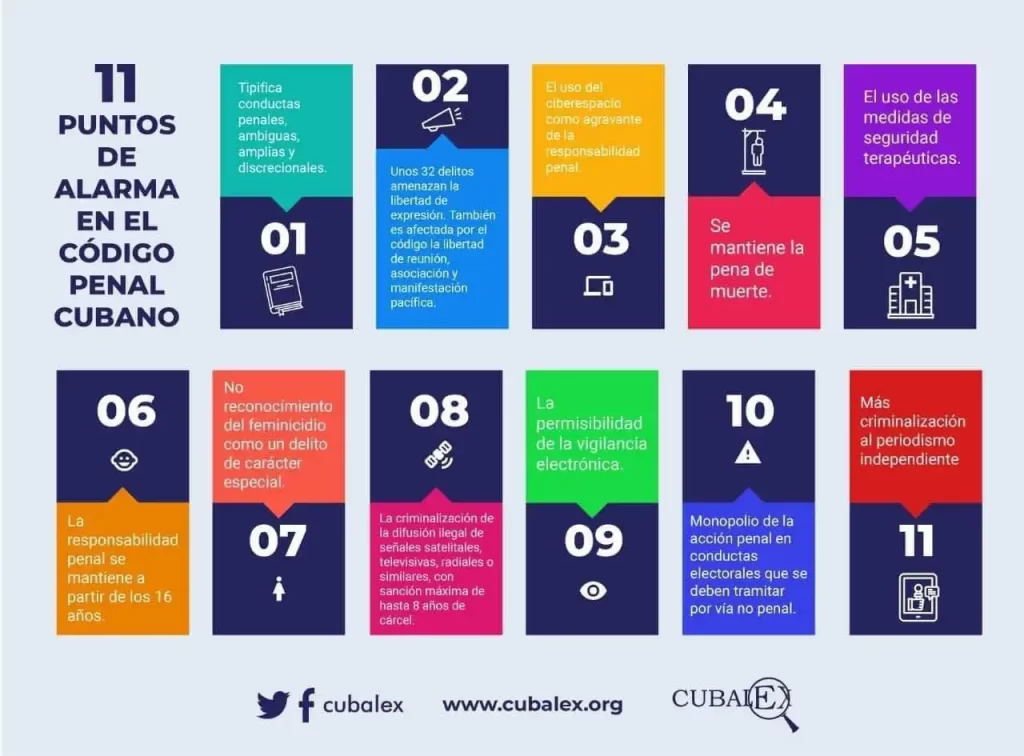
Why Should This Code Worry Us as a Society? / Cubalex

Cubalex, 20 October 2022 — The Cuban government wants nothing to escape its supervision. Nothing, that might shake its power, has been left unregulated or uncriminalized.

Why should this Code worry us as a society?

#1 It categorizes criminal behaviour in a broad, ambiguous and discretionary manner.

#2 There are around 32 ’crimes’ which threaten freedom of expression.

#3 The use of cyberspace as an aggravation of criminal responsibility.

#4 The ’crime’ of practicing independent journalism.

#5 It maintains the death penalty.

#6 The use of ’therapeutic’ security measures.

#7 Age of criminal responsibility is maintained at 16 years.

#8 No recognition of femicide as a specific crime in its own right.

#9 Criminalization of the illegal transmission of satellite, television, radio or similar signals.

#10 Electronic surveillance is sanctioned.

#11 Monopoly of criminal action on electoral conduct, which should be processed in non-criminal ways.

Translated by Ricardo Recluso 

Patmos Prize Awarded to Protestant Pastor Lorenzo Rosales, Imprisoned for Protests of 11 July 2021

Pastor Lorenzo Rosales Fajardo has sent his thanks for the award, from prison.

14ymedio bigger14ymedio, Havana 31 October 2022 — Lorenzo Rosales, the Cuban protestant pastor condemned to seven years in prison after joining the 21 July 2021 anti-government protests, has been awarded the Patmos prize, which is given out annually by the Cuban Institute of the same name.

The annual award, now in its ninth year, is presented every 31 October in honour of a Cuban follower of the faith on the Day of the Protestant Reformation. Rosales, who is serving his sentence at the maximum security prison in Boniato, Santiago de Cuba, gave thanks for his award by letter. Previous recipients have been: José Conrado Alegría, a Oscar Elías BiscetDagoberto Valdés HernándezEduardo Cardet ConcepciónRoberto de Jesús Quiñones HacesMartha Beatriz Roque Cabello and Ernesto Borges Pérez.

“It’s a privilege, on a day like today after more than a year of unjust incarceration in a maximum security prison, to receive this award. I don’t believe any human being would ever be able to get used to being in this place. Prison life is very hard, and it’s worse when you know it’s an injustice, but I’m not afraid”, Rosales wrote after hearing the news.

The award, said the pastor, means a lot to him. “It tells me that I haven’t been forgotten in this hole I’m in, not by God, not by yourselves. I know how much you are fighting for my freedom. Thank you, to every brother in the faith community for every prayer, support and material assistance; your Christian love for me and my family has been boundless. You are all in my prayers”. continue reading

Rosales went onto the streets on 11 July last year to support those who were demonstrating for more freedom and crying out against the health emergency and the crisis of basic supplies suffered on the Island. He was immediately arrested and taken to El Energético — a detention centre based in a former schoolhouse — along with his son David Lorenzo, 17.

Two days later he was beaten, whilst being transferred to the Investigations Unit in Versalles, to such an extent that, as he reports, he lost consciousness. After a habeas corpus application was rejected, in August the pastor was transferred to the prison in Boniato, where he is held amongst ordinary prisoners.

At the beginning of May his sentence was made public — seven years, for incitement to commit crime, ’disrespect’, and violent attack. The trial had taken place at the end of December.

The Patmos Institute has denounced the restrictions placed on the pastor’s religious rights, as he is not given the appropriate attention he requires and on Saturday 9 April he was not able to attend a service held by evangelical chaplains, authorised by the government. In the face of his complaints about this exclusion Rosales was locked up for five days in a punishment cell just before Easter week.

Translated by Ricardo Recluso

____________

COLLABORATE WITH OUR WORKThe 14ymedio team is committed to practicing serious journalism that reflects Cuba’s reality in all its depth. Thank you for joining us on this long journey. We invite you to continue supporting us by becoming a member of 14ymedio now. Together we can continue transforming journalism in Cuba.
Cuba and Brazil: First Economic Points of Lula’s Victory

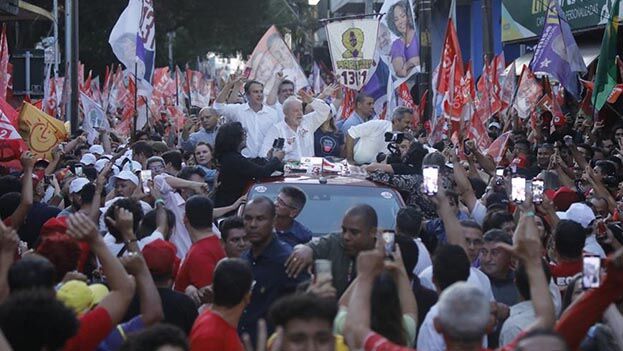
Presidential candidate Luís Inácio Lula da Silva salutes followers at a campaign in Fortaleza (Brazil), prior to the election. EFE/ Jarbas Oliveira

14ymedio bigger14ymedio, Elías Amor Bravo, Economist, 31 October 2022 — The Cuban communist state press reacted quickly to Lula’s victory in Brazil’s presidential elections. Díaz-Canel, recovering from his speech to the communists gathered in Havana on the occasion of the XXII International Meeting of Communist and Workers Parties, didn’t miss a moment to congratulate Lula, calling his victory one of “Latin American and Caribbean unity, peace and integration.”

The words of Díaz-Canel resonated to old chants like those spoken by economically-ruined Fidel Castro during the Special Period to a triumphant Chávez in Venezuela, who over time became a source of subsidies for the Cuban extractive economy. Perhaps Díaz-Canel believes that history repeats itself, and hence his joy at the triumph of the left in Brazil, with Lula at the forefront.

But sometimes things don’t go the way you want. They happen in another way. And many of us fear that this Lula, in his second presidential period, will not embark on dangerous operations that might return him to the courts he knows so well.

In fact, in his victory speech, he already worried about making his objectives clear: combating Brazil’s misery and poverty and uniting society after very divisive elections. How he does it and, above all, his appeal to the enormous potential of the Brazilian economy, will be a matter to take into account.

He reiterated his commitment to the environment and announced that he will resume the protection of biomass in the country, especially the Amazon. This is a rough matter, especially if he wants to receive support from the Chinese, whose model of global exploitation has little to do with protecting the environment. This bet takes him away, perhaps without knowing it, from those who could be his main allies in this new stage.

With an agenda like the one proposed by Lula, the position of the Cuban communist regime will be weakened. The failure of the Mariel weighed a lot on the state of economic relations between the two countries. The data is eloquent. continue reading

In 2016, Brazil represented 2.8% of exports and 5.2% of Cuban imports. Five years later, the respective percentages were 0.11% and 2.8%, respectively, bringing along a trade deficit and increasingly reduced trade. There is little business for a country like Brazil, with more than 200 million inhabitants. Exports fell by 96%, imports by 48%.

Regarding tourism, out of the 35,000 Brazilians who arrived on the Island in 2016, there were 416 in 2021, in the midst of the pandemic. Unlike other tourism markets in Cuba, Brazil didn’t register the highest value in 2019, and in 2018, reaching 41,000 tourists, it was barely 0.87% of the total. Compared to the country’s population potential, tourism from Brazil to Cuba is insignificant.

And more data could be offered, all of them equally eloquent. The powerful Brazilian economy has little, scarce interest in what Cuba can offer, and also, Cuba’s purchasing potential is insignificant to sustain a stable framework of relations with Brazil. So between the two countries, the flows of capital and business leave much to be desired.

Can it happen that Lula changes the character of these tendencies? Of course, that’s what Díaz-Canel wants, but is Lula in a position to mortgage the future of Brazil to someone who doesn’t pay or who does it late and badly? What benefit can Lula obtain from the Cuban communist regime located at the antipodes of this national reconciliation project of which Lula speaks? What does Cuba have to offer Lula, besides doctors, spies, coaches, etc.?

Some advisor to Díaz-Canel should have listened to Lula’s victory speech in a little more detail, especially when he said that his victory is “for all women and men who love democracy and want freedom,” and then added clearly that “it’s not a victory for me or the PT (Workers’ Party).” Díaz-Canel’s opportunistic message of congratulations to Lula was along the opposite line, when he said, “but they could not prevent you from winning with the people’s vote. The Workers’ Party of Brazil returns; social justice will return.” This is just what Lula doesn’t want to hear, in search of that unity he talked about. With this type of leftist and radical approach, Cuba and Brazil will not go very far. Time will tell.

It’s evident that there is a clear difference between the speeches of the two leaders, and the impression is that Brazil will go it alone and not show a particular interest to the Cuban communist. It’s enough to listen to another of Lula’s speeches to realize his intention to govern for all. “This is a victory for all women and men who love democracy, who want freedom, who want culture, education, fraternity and equality.” In short, it’s a clear concern about “how to begin defining and repairing this country.” The messages of “decadent capitalism, the victory of socialism, the recovery of the ideas of Marx, Engels and the Communist Manifesto,” and other stupidities enunciated by Díaz-Canel at the meeting in Havana, were not even heard in Lula’s speech. He has learned his lesson. We’ll see how everything ends.

Translated by Regina Anavy

____________

COLLABORATE WITH OUR WORKThe 14ymedio team is committed to practicing serious journalism that reflects Cuba’s reality in all its depth. Thank you for joining us on this long journey. We invite you to continue supporting us by becoming a member of 14ymedio now. Together we can continue transforming journalism in Cuba.
Cuba Extends Tourism Visas for 90 Days in an Attempt to Improve Results in this Sector

Until now, the tourist visa, which is mandatory, allowed a maximum duration of 30 days, which could be extended for one more month. (14ymedio)

14ymedio bigger14ymedio, Havana, 31 October 2022 — Beginning this Tuesday, Cuba will grant tourist visas for 90 days, instead of the 30 days in effect before. The announcement was made this Sunday on Twitter by the Minister of Tourism, Juan Carlos García Granda, and now is on official pages.

In his tweet, García Granda also said that the visa will be “extendable only once for the same period,” that is, that tourists will be able to stay in Cuba for a total of 180 days.

Until now, the tourist visa, which is mandatory, allowed a maximum duration of 30 days, which could be extended for one more month, provided that the change was made one week before the visa’s expiration at the nearest Immigration and Aliens Office, including the postponement of the return flight and the payment for accommodation.

The new measure is made public just over a week after the closure of the Medical Tourism and Welfare Fair in Havana, one of whose main claims was the relaunch of the Island as a health destination. Allowing travelers to stay in the country for up to six months would favor this goal.

Just a few days ago, the Cuban Government acknowledged that it will be impossible to meet the tourism goal it had planned. Compared to the two and a half million travelers it had insisted that the Island would receive during 2022, the year will close with 1,710,000 travelers, according to the Minister of Economy, Alejandro Gil Fernández. continue reading

It was a featured article, reflecting the tourism data of the first nine months of the year. If by September 1,074,814 international travelers arrived on the Island, between October and December, the remaining 1.4 million would have to arrive to reach the forecast, not taking into account that the high season begins in November. It would have been necessary to triple each of the three months the best data of the year, the 152,480 travellers in July.

Also, the director of Consular Affairs and Attention to Cubans Living Abroad of the Foreign Ministry of Cuba, Ernesto Soberón, announced on Sunday that the Government is preparing a “citizenship law” that “works to promote relations with emigrants.”

The official recalled, according to official media, that the 2019 Constitution allows more nationalities apart from the Cuban one but said that this “needs legislation.”

Soberón, who held a meeting with Cubans living in Uruguay, recognized that “the current migratory flow has demographic impacts in a nation with low birth rates.”

In addition, he announced that “for the next legislature of the Parliament, draft laws on passports and foreigners must also be approved.” The official assures that other measures are “under study” on issues of interest to emigrants, including the streamlining of procedures and their participation in socioeconomic development, since the number of Cubans living abroad interested in investing in their country is growing.”

The minister did not provide any data to confirm this alleged desire in the current circumstances of deep crisis and in the absence of solid legal guarantees in favor of private investment.

Translated by Regina Anavy

____________

COLLABORATE WITH OUR WORKThe 14ymedio team is committed to practicing serious journalism that reflects Cuba’s reality in all its depth. Thank you for joining us on this long journey. We invite you to continue supporting us by becoming a member of 14ymedio now. Together we can continue transforming journalism in Cuba.
The Cuban Government Acknowledges its Failure to Revive Tourism

Cuban tourists in Varadero. (Roma Díaz)

14ymedio bigger14ymedio, Madrid, 28 October 2022 — The Cuban Government has surrendered to the evidence and now reduces the tourism forecast to no more and no less than 790,000 more travelers this year. At the beginning of the year, the authorities had projected the arrival of 2.5 million foreign visitors, and, until a few days ago, systematically refused to review the figure. But this Wednesday, during the meeting of the Council of Ministers, Alejandro Gil Fernández finally announced that he expects 2022 to close with 1,710,000 travelers.

The news was leaked this Thursday in an article published in the official press that gives a detailed account of the Government meeting the day before. Focused on the “countering of illegalities,” the information hides in a brief paragraph the acceptance of the shipwreck of the country’s main source of foreign exchange — apart from the sale of medical services and remittances — and the one on which the authorities concentrate most of their investments and strategies.

“It’s less than the 2.5 million that we projected in the Economy Plan,” said the deputy prime minister and head of the economy, words that fell short of defining the disaster, especially if compared to the data from the years before the pandemic, with the record 4.7 million international visitors in 2018, and the prospect of reaching 5 million soon.

A little more than a week ago, when the tourism data for the first nine months of the year came out, it was obvious that it would be impossible to achieve the goal. According to the calculations, if 1,074,814 international travelers arrived on the Island through September, between October and December there had to be 1.4 million to reach the forecast, not even taking into account that the high season begins in November. It would have been necessary to triple each of the three months with the best data of the year, the 152,480 travelers in July. continue reading

When in February of this year Russia invaded Ukraine and the European Union began to apply sanctions that Moscow didn’t think it would dare to, including closing its airspace to flights from that country, Revolution Square could have begun to discount travelers from its projections. The Russian market, although not the main one in Cuba, was one of the fastest growing.

In 2017, the number of Russian tourists to Cuba registered an enormous increase, 40% compared to 2018, and in 2019, the increase was 30% compared to 2018. The braking came with the pandemic. The number of travelers from Moscow was still growing, but the Russians began to bet on the Dominican Republic as their preferred destination, confirming the good strategy of the country, whose tourism sector suddenly recovered from the COVID-19 blow, surpassing 2019 data in the first month of its reopening.

Cuba, however, has not been able to recover. From its best years (2017 and 2018), when it received around 4.7 million foreign travelers, in 2019 the amount fell to 4.2 million. In 2020, with the pandemic already underway, the number was barely 1,085,920 million, while in 2021, the worst year of COVID-19 for the Island, the figure reached only 682,411.

The Government’s hope was to overcome the previous disasters this year, once the health crisis was gone. Throughout 2022, the authorities have triumphantly displayed the percentages of monthly growth, which sometimes exceeded 400%. But comparing tourism accounts with 2021, when COVID impacted the data, was a self-deception, as had been warned.

The Minister of Tourism, Juan Carlos García Granda, has stubbornly maintained the 2.5 million outlook, even contradicting Manuel Marrero, his predecessor of 15 years in office and current prime minister, who was the only one to sound the alarm last May, when he said that until 2023 there would not be a real recovery.

It didn’t require his experience in office or relying on monthly data to see that the forecast was not good, but García Granda insisted to such an extent that only a month ago, at the Varadero Gourmet Marrero Festival, he supported the goal of 2.5 million when it was an open secret that this was an impossible achievement.

The latest data show that the enormous investment in the construction of luxury hotels and the diversion of meat and fresh fruit to tourism, to the detriment of the population, have not had the effect hoped for by the Government.

Translated by Regina Anavy

____________

COLLABORATE WITH OUR WORKThe 14ymedio team is committed to practicing serious journalism that reflects Cuba’s reality in all its depth. Thank you for joining us on this long journey. We invite you to continue supporting us by becoming a member of 14ymedio now. Together we can continue transforming journalism in Cuba.