The Cuban Regime Tries To Project Normality Regarding Its Doctors in Venezuela

Canal Caribe airs a report in the country, with statements from Venezuelan patients, amid uncertainty over the future of a mission that traded work for oil


Report on Canal Caribe about Cuban doctors in Miranda, Venezuela. / Screenshot

14ymedio bigger14ymedio, Madrid, January 14, 2026– Uncertainty hangs over the thousands of Cuban doctors who remain in Venezuela, and rumors are multiplying in the absence of information. What will happen now to the agreement signed by Hugo Chávez and Fidel Castro in 2000 to exchange oil for health personnel? Explicit mention has been made of a request from the White House for the new interim government of Delcy Rodríguez to break ties with China, Russia, Iran, and Cuba, which would of course imply the withdrawal of intelligence and security personnel from the country.

U.S. President Donald Trump also said this Sunday that “Cuba survived for many years thanks to Venezuela’s oil and money. In exchange, it provided ‘security services’ to the last two Venezuelan dictators.” The president then said there would be “no more oil” for the Island, and although he did not specifically mention PDVSA’s crude, that was how it was understood.

But the exchange also included health workers, and the question is whether Trump’s threat will materialize, reducing crude shipments to Havana to zero and, if so, what incentive Cuba would have to maintain a deployment of some 14,000 personnel whose absence, at this moment, would be significant for Venezuela.

What incentive would Cuba have to maintain a deployment of some 14,000 personnel whose absence, at this moment, would be significant for Venezuela?

In the absence of concrete information from those involved, rumors are flying, especially after the numerous flights of the Ilyushin Il-96-300 with registration CU-T1250 recorded by radars in recent days, which have led some to think the numbers are already declining.

On social media and in the independent press, testimonies of alleged defections have appeared. According to sources confirmed by 14ymedio, the situation depends on the location of the health workers, since some have been confined to barracks while others have continued to carry out their duties with a degree of normality. Last week, the provincial newspaper of Sancti Spíritus sought to curb the rumors and published a brief interview with the local head of the brigade, who made it clear that health workers had stopped working where there were risks but had continued working continue reading

in the rest of the country.

That was insufficient, and the week has continued to be filled with all kinds of comments, prompting the Cuban government to once again roll out its propaganda. Canal Caribe went to the Comprehensive Diagnostic Center La Urbina, in Petare, part of Miranda state near Caracas, to produce a short report aired on Tuesday’s newscast, showing doctors attending patients, several of whom were put on camera to praise the Cubans.

“No one goes home without being treated, regardless of the hour and much less the circumstances,” says the reporter, who speaks with some Venezuelans. “We are very grateful for the care given by the Cuban doctors because the poor people of the community come here and receive good care,” says one. “They fulfill their duty, as they should and as established by what they were contracted to do, and truly they are wonderful people,” says another patient.

The physicians also explain how good they feel in the country, without any mention of the current situation. “We feel deep pride and great solidarity, since we come with the mindset of internationalism, solidarity, and humanism that characterizes all Cubans,” says specialist Yarelis Cutiño. “We are going to provide the support that the Venezuelan people need for as long as they want, for as long as they decide,” she continues.

Nurse Anisleidis Martínez also looks straight into the camera and mentions how “at this moment our presence has a very important meaning” in Venezuela, which they will continue, she says, to support for as long as necessary.

The same spirit runs through the Facebook groups of Cuban doctors in the country, where “the recent difficult events” are mentioned more explicitly, in the face of which “solidarity becomes medicine”

The same spirit runs through the Facebook groups of Cuban doctors in the country, where “the recent difficult events” are mentioned more explicitly, in the face of which “solidarity becomes medicine,” says a message from the Agua Viva Medical Brigade in Lara state. “The Cuban medical brigade, together with its Venezuelan sisters and brothers, reaffirms its commitment to be where it is most needed: at the side of the people, caring for lives, offering hope. Health knows no borders. When people embrace, strength multiplies. Today, doctors from Cuba and Venezuela work shoulder to shoulder, demonstrating that unity is the best antidote to adversity,” says a poster that seeks to inject forced morale.

“Blah, blah, blah. This is how Cuba’s medical missions work, especially in Venezuela. Everyone is forced to post stupidities in favor of communism,” replies a single comment. The account shows a torrent of short videos of patient thank-yous.

In 2019, the newspaper Granma placed the number of Cubans on mission in Venezuela at 29,505, of whom 20,000 were health workers spread across the 25 states. By 2026, estimates put the number at around 14,000, among other reasons due to the decline in oil shipments. If the U.S. effectively forces Delcy Rodríguez to stop delivering oil, the 2000 agreements will be officially broken, and Venezuela will have to face the abrupt loss of thousands of doctors, with no clear idea of how they could be replaced in the short term.

Translated by Regina Anavy

____________

COLLABORATE WITH OUR WORK: The 14ymedio team is committed to practicing serious journalism that reflects Cuba’s reality in all its depth. Thank you for joining us on this long journey. We invite you to continue supporting us by becoming a member of 14ymedio now. Together we can continue transforming journalism in Cuba.

Cuban Faces 2025: Repressors Returned to Cuba

This was the year of the systematic deportations of those same migrants who were loyal servants of the Havana regime.

Former Cuban judge Melody González Pedraza was deported in September. / Facebook

14ymedio bigger14ymedio, Havana, 24 December 2025 — If in 2024 Cubans saw hundreds of former regime officials settle in the United States , the quintessential enemy country, 2025 was the year of systematic deportations of those same migrants who were loyal servants of the Havana regime.

Shortly after President Donald Trump took office in January, the new administration, with Marco Rubio as Secretary of State, revoked the executive order issued by Joe Biden in the final hours of his presidency, removing Cuba from the list of state sponsors of terrorism. Subsequently, the new administration reinstated Cuba’s Restricted List and also suspended the visa application process for officials of the Cuban regime .

The first high-profile deportation was, in February, that of influencer Cinthya Medrano, known as La Cintumbare, controversial for having praised President Miguel Díaz-Canel in some of her broadcasts and criticizing the mothers who protested for food in the midst of the crisis.

Back in March, former Cuban intelligence agent Tomás Emilio Hernández Cruz, 71, was arrested. He had rebuilt his life in West Park, Florida, and had lied on his residency application. The former official was held in the custody of Immigration and Customs Enforcement (ICE) at the Broward County Detention Center until his deportation last Friday. continue reading

It was just after Cuban-American Congressman Carlos Giménez sent a letter to the Department of Homeland Security (DHS) asking for an investigation and immediate deportation of more than 100 people with ties to the Castro regime and residence in the US, whose names he attached.

One of them was Daniel Morejón García, a repressor listed by the Foundation for Human Rights in Cuba, who was returned to the island in May. The former official, implicated in the repression of the July 11, 2021 protests in Cuba, had been detained in April by ICE.

Also deported in September was Melody González Pedraza, the former Cuban judge known for her role in the trials of the July 11 protesters, after losing her asylum case. Before her, her husband, William Hernández Carrazana, and her brother, Ruber González Pedraza, were returned. All of them had entered the US in 2024 on humanitarian parole .

This is how Jorge Luis Vega García, known as Veguita , a former lieutenant colonel in the Ministry of the Interior, entered U.S. territory. He had been implicated for decades in acts of violence in Cuban prisons. Arrested in August, he was deported on November 6 .

The same fate awaits other former regime officials, such as Yuniel Báez Pedrera, who was once the leader of the Union of Young Communists in Havana and later became a businessman in Florida. He was arrested in late November upon his arrival in Miami from a trip to the island.

____________

COLLABORATE WITH OUR WORK: The 14ymedio team is committed to practicing serious journalism that reflects Cuba’s reality in all its depth. Thank you for joining us on this long journey. We invite you to continue supporting us by becoming a member of 14ymedio now. Together we can continue transforming journalism in Cuba.
The U.S. Will Not Prevent Mexico from Supplying Oil to Cuba

  • A White House official tells CBS News that the administration is not seeking the regime’s collapse, but rather that it “abandon its communist system.”
  • University of Texas expert Jorge Piñón estimates that during the first 13 months of Mexico’s Sheinbaum administration, the average was 8,700 barrels.
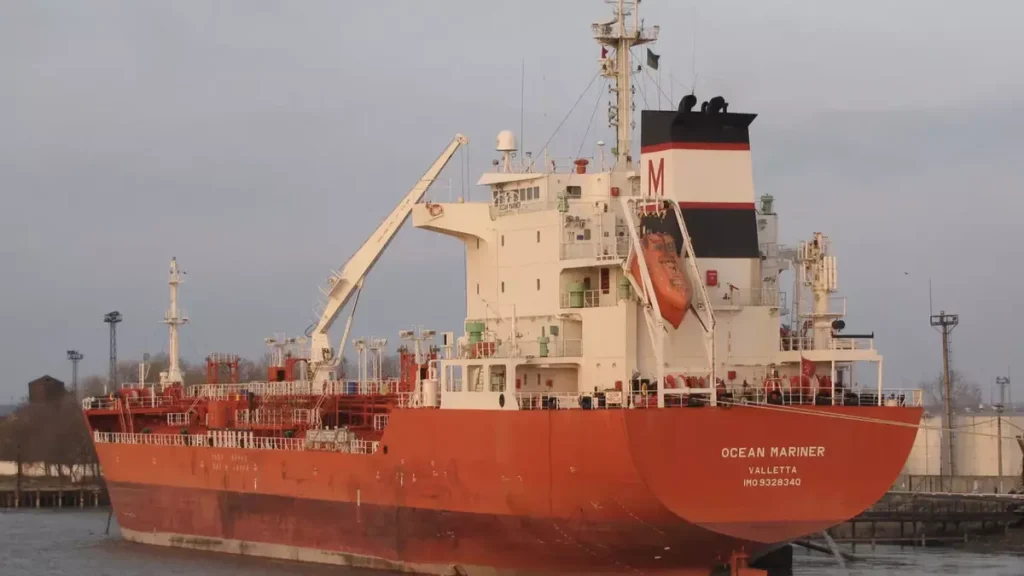
El ‘Ocean Mariner’, con capacidad de 83.000 barriles, forma parte de la flota que va y viene entre la Isla y México / Marine Traffic

14ymedio bigger14ymedio, Madrid, January 13, 2026 — The U.S. government will not prevent Mexico from supplying oil to Cuba, Energy Secretary Chris Wright said in an interview with CBS.

Despite President Donald Trump’s remarks on Sunday, when he said on social media that “there will be no more oil or money for Cuba: zero,” the official stated that the policy will be to “allow” Mexico to continue delivering crude oil to Cuba.

In addition, another official told the network, speaking anonymously, that the administration is not seeking the government’s collapse, but rather that it “abandon its communist system.”

The U.S. believes, this official said, that a total cutoff or embargo on Cuba would be a “shock to the already overloaded and decrepit power grid,” which posts deficits of more than 1,500 megawatts (MW) almost daily. This same Monday, an impact of more than 1,700 MW was expected during peak hours, and the main cause was, as is now customary, the lack of fuel, which left 1,020 MW out of service.

The U.S. believes, the official said, that a total cutoff or embargo on Cuba would be a “shock to the already overloaded and decrepit power grid.”

“The economic condition of Cuba is serious,” the official told CBS News, reminding the network that the Island has been selling Venezuelan oil to China to obtain some liquidity. With the fall of Nicolás Maduro following the U.S. attack on January 3, there was uncertainty over whether the U.S. would allow crude to continue reaching Cuba.

Mexican President Claudia Sheinbaum held a conversation on Monday with her U.S. counterpart in which they discussed security issues, just days after Trump threatened continue reading

to attack Mexican cartels on the ground. “We had a very good conversation with the president of the United States, Donald Trump. We talked about various issues, including security with respect for our sovereignties, reducing drug trafficking, trade, and investments,” Scheinbaum said in a message posted on her social media early in the morning.

Shortly afterward, when asked during her morning press conference, Sheinbaum offered herself as a “vehicle of communication” between the U.S. and Cuba, a topic that, as she herself clarified, was not part of the issues discussed.

“Obviously, if Mexico were to become a vehicle for communication between the United States and Cuba, both parties would have to accept it, evidently,” she said.

Trump had said on Sunday that there were talks with Cuba and that more would be known soon, but hours later Miguel Díaz-Canel assured that such contacts do not currently exist, beyond the usual conversations the two governments maintain on migration issues.

“We have always been willing to engage in serious and responsible dialogue with the different governments of the United States, including the current one, on the basis of sovereign equality, mutual respect, principles of international law, reciprocal benefit, non-interference in internal affairs, and full respect for our independence,” he added.

Not obstructing oil shipments from Mexico could be a mechanism for the U.S. to force negotiations in which, in light of officials’ comments, the Cuban government would have to open itself to eventual democratization and/or economic liberalization.

Not obstructing oil shipments from Mexico could be a mechanism for the U.S. to force negotiations in which, in light of officials’ comments, the Cuban government would have to open itself to eventual democratization

On January 9, the tanker Ocean Mariner arrived at the port of Havana with around 85,000 barrels of fuel from Veracruz, marking Pemex’s first crude shipment to Cuba this year.

In 2023, exports amounted to about 16,000 barrels per day (bpd) of oil and derivatives, worth around $300 million. In 2024, cooperation increased to 20,100 bpd, a 20% rise, although derivatives fell by 18%, with an estimated total value of $600 million.

Between January and September 2025, Mexico supplied Cuba through the Pemex subsidiary Gasolinas Bienestar with around 19,200 barrels per day to Cuba, divided, according to official documents, into 17,200 barrels of crude and 2,000 of derivatives. University of Texas expert Jorge Piñón estimates that during the first 13 months of the Sheinbaum administration (between October 2024 and November 2025, the average was 8,700 barrels per day.

Sheinbaum has stated on more than one occasion that all governments prior to hers have supplied oil to the Island, including those of Enrique Peña Nieto and Felipe Calderón, and that the commitment to Cuba is “historical,” not ideological.

Translated by Regina Anavy

____________

COLLABORATE WITH OUR WORK: The 14ymedio team is committed to practicing serious journalism that reflects Cuba’s reality in all its depth. Thank you for joining us on this long journey. We invite you to continue supporting us by becoming a member of 14ymedio now. Together we can continue transforming journalism in Cuba.

The End of Venezuelan Oil Supplies Affects Sherritt’s Nickel Mines in Cuba

In addition, it reduces the natural gas production of the Canadian company that supplies Havana.

Sherritt needs oil in order to operate the mines it runs in Moa, Holguín. / Sherritt International

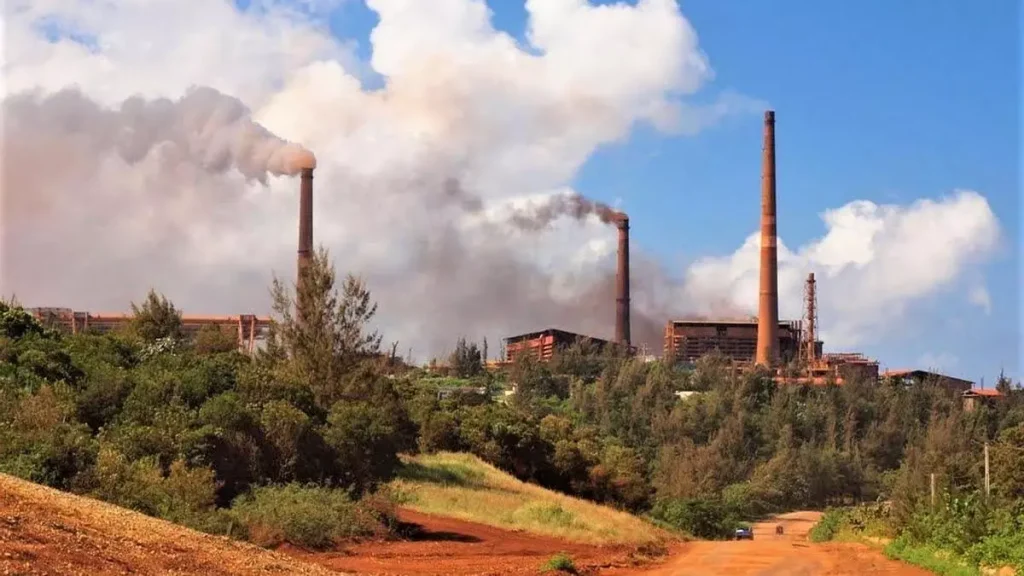
14ymedio bigger14ymedio, Madrid, January 12, 2026 — The warning by U.S. President Donald Trump that he would cut off Venezuela’s oil supply to Cuba—more than plausible after the capture on January 3 of President Nicolás Maduro and his wife, Cilia Flores—threatens to exacerbate Sherritt International’s problems on the Island. The Canadian giant needs imported fuel to operate the nickel and cobalt mines it runs in Moa, Holguín, which, according to William Pitt, have been the company’s economic backbone.

“This company was the best foreign investment Cuba has ever had,” observes the U.S. businessman, whose family had multiple mining properties expropriated by the regime in 1960. As Pitt explains to 14ymedio, although historically the power plants and gas wells associated with Sherritt, which operates in cooperation with the state-owned Energas, have produced “the most reliable and best-managed energy services” in the country, this is no longer the case.

“Sherritt has lost so much money that it is undergoing a shareholder revolt in Canada,” says the U.S. businessman, referring to the recent replacement of Leon Binedell as the company’s chief executive officer (CEO) just four years after his appointment, by “personnel from another competing company.”

“Sherritt has lost so much money that it is undergoing a shareholder revolt in Canada”

According to a Sherritt statement dated December 8, he continue reading

has been replaced on an interim basis by Peter Hancock, “an experienced mining industry executive with more than 35 years at Glencore plc, where he led nickel mining operations and participated in the development and commercialization of process technologies.”

The corporate text refrains from criticizing the outgoing Binedell, but makes clear that recent times have not been easy: “Since his appointment in June 2021, Mr. Binedell has guided Sherritt through one of the most challenging periods in its history, overseeing progress on several key strategic initiatives, including the expansion of the Moa joint venture, the implementation of the cobalt exchange agreement, the optimization of the energy division, and the completion of debt and equity transactions earlier this year.”

Indeed, in its report last year, the Canadian multinational had already warned of the risks of operating in Cuba, where blackouts, fuel shortages, natural disasters, and the loss of workers threatened its profitability. In the second quarter of 2025, the company posted multimillion-dollar losses—from $51.4 million in the same period the previous year to $43.7 million—along with a sharp drop in production and significant cuts to its workforce in Canada, as operating conditions in Cuba deteriorated.

As Pitt rightly recalls, without electricity Cubans depend on gas for cooking

Last year, there were several occasions when the Energas–Sherritt plant in Boca de Jaruco (Mayabeque) went out of service due to breakdowns, seriously affecting the national electric system (SEN). With a usual contribution of between 100 and 120 megawatts (MW), the thermal plant is vital to the SEN. In fact, the two plants operated by the Canadian company in Cuba—Boca de Jaruco and Varadero in Matanzas—have been key to restoring electricity to the Island during the several total system collapses it has suffered since late 2024.

Beyond that, as Pitt rightly notes, without electricity Cubans depend on gas for cooking. In most of the country this means liquefied petroleum gas (LPG), sold in cylinders, and in Havana additionally natural gas delivered by pipeline to the capital from wells located to the east, near Varadero, Puerto Escondido, and Boca de Jaruco. The latter is produced entirely by Sherritt International, the businessman emphasizes.

Thus, whatever the Canadian company suffers will also be suffered by Havana residents, especially those living in the municipalities of Plaza de la Revolución, Cerro, Centro Habana, Habana Vieja, Diez de Octubre, Playa, and Marianao. “Without bottled gas or piped gas for cooking, and without electricity to cook on electric stoves, Cubans who have enough money will be able to cook with charcoal (if they can find it, since there isn’t much), and if they cannot find charcoal or do not have the money, with firewood,” Pitt concludes.

Translated by Regina Anavy

____________

COLLABORATE WITH OUR WORK: The 14ymedio team is committed to practicing serious journalism that reflects Cuba’s reality in all its depth. Thank you for joining us on this long journey. We invite you to continue supporting us by becoming a member of 14ymedio now. Together we can continue transforming journalism in Cuba.

Cuban Filmmaker Miguel Coyula Receives the Award for Best Documentary at the Cinema Tropical Awards

The feature film ‘Chronicles of the Absurd’ uses sound recordings to reconstruct the experiences of cultural resistance of independent artists

Coyula continues to establish himself as one of the most unique voices in contemporary documentary film. / Miguel Coyula / Facebook

14ymedio bigger14ymedio, Havana, January 13, 2026 – The feature film Chronicles of the Absurd (2024), by Cuban filmmaker Miguel Coyula, was recognized as Best Documentary at the Cinema Tropical Awards, held on January 7 at Film at Lincoln Center in New York. The 77-minute film reconstructs the lives of independent artists in Cuba using clandestine audio recordings, graphic transcriptions, and archival footage. Coyula closely follows his own experiences and those of his partner, actress and writer Lynn Cruz.

The documentary is divided into ten elliptical chapters that combine audio recorded with mobile phones and images that accompany the sound without directly illustrating it, without interviews or voice-overs . This approach allows ambient sounds and disembodied voices to convey the burden of living under censorship, showing a daily life marked by surveillance, scarcity, and ideological weariness.

In Coyula’s own words, the work is “ugly” out of necessity: it could only be documented through a clandestine approach, which protects those who participated and reflects the reality of working outside of Cuban institutions.

In Coyula’s own words, the work is “ugly” out of necessity: it could only be documented through a clandestine approach.

Chronicles of the Absurd had its international premiere continue reading

in November 2024 at the International Documentary Film Festival Amsterdam (IDFA), where it won the Best Film Award in the Envision Competition. The jury praised the use of the audio track as a political diary and the radical way in which the documentary blends sound recordings, images, and graphic transcripts to convey the tension of life under surveillance. The film then continued its run at festivals around the world, where it has received numerous awards.

Coyula recently explained in an article published in Rialta* that the motivation for making the film stemmed from the need to document the lives of artists outside of any official institution and to preserve the story of Lynn Cruz, who suffered dismissals, surveillance, and censorship. She noted that the film “is not a Manichean tale of heroes and villains, but an essay on absurdity and resistance, with touches of dark humor, political thriller, and psychological horror.”

At the New York ceremony, the filmmaker thanked the jury and everyone involved in making the documentary, and dedicated the award especially to Lynn Cruz, whom he recognized as the protagonist of the work and a central figure in the creative process that gave rise to the film.

With this recognition, Coyula continues to consolidate himself as one of the most unique voices in contemporary Latin American documentary cinema.

*Translator’s note: READ THIS ARTICLE. Your browser will allow you to automatically translate it into English (or other languages).

____________

COLLABORATE WITH OUR WORK: The 14ymedio team is committed to practicing serious journalism that reflects Cuba’s reality in all its depth. Thank you for joining us on this long journey. We invite you to continue supporting us by becoming a member of 14ymedio now. Together we can continue transforming journalism in Cuba.

Six Dead and Five Injured in Collision Between Van and Tricycle in Holguín, Cuba

The crash occurred in Moa at around 4 p.m.

Condition of both vehicles after the collision. / Cubadebate

14ymedio bigger14ymedio, Madrid, 13 January 2025 — The collision between a van and a tricycle claimed the lives of six people on Monday in Moa, in the province of Holguín. Five of them died at the scene of the accident and another died at Dr. Guillermo Luis Fernández Hernández-Baquero Hospital, where the injured were taken.

The crash occurred around 4 p.m. on the Baracoa road, on a stretch leading to the Comandante Ernesto Che Guevara factory. At this time, it is unknown what conditions led to the collision, but the consequences were fatal, as can be seen—in addition to the numerous victims—in the images showing the condition of the vehicles.

The official press has released the identities of the deceased. They are Andys William Mendoza Ferrer, 41, a resident of Reparto Aeropuerto, Frank País; Enoelio Borges Reyes, 50, a native of Moa, Cayo Grande de Yamanigüey; Maria Carla Noguera Despaigne, 19, from Avenida Lenin, Reparto 26 de Julio; Emmanuel Rodríguez Igarza, 23, and Eloina Reyes González, 69, both residents of Punta Gorda Arriba; and Liolvis Lofforte Alpajón, 33, from Cayo Grande de Yamanigüey.

In addition, six people were injured, including the two drivers. They are Sandro Medina Oliveros, 52, a resident of Reparto Miraflores, reported to be in serious but stable condition; Yanet Rodríguez Reyes, 49, from Punta Gorda Arriba, with a head injury but in stable condition; Omar Breff Blanco, 58, a resident of Reparto Armando Mestre, who was the driver of the tricycle and is in serious condition; Liset Suárez Lovaina, 29, a resident of Quemado del Negro, stable with non-serious injuries; and Eroeldis Borges Alpajón, 23, from Cayó Grande de Yamanigüey, in serious but stable condition. continue reading

At present, it is unclear what conditions led to the collision, but the consequences were fatal, as can be seen in the images showing the condition of the vehicles.

In addition to the emergency services, rescue and salvage teams from the nickel industry attended the scene to treat the injured and identify and remove the deceased.

The causes of the accident, which is the second major accident so far this year, are currently under investigation. The first occurred on Wednesday, 7 January, in Camagüey, when two of the 38 passengers on a bus died after the vehicle, which was transporting workers from the Mariel Special Development Zone, veered off the road.

Between January and August 2025, there were 502 transportation-related fatalities on the island. Although the total for that year is still unknown, at that point alone the number had already risen to 80% of the total for 2024. By comparison, last year 1,119 people died on Spanish roads, just over twice as many as on the island in only eight months, with a population six times larger.

The poor condition of roads and vehicles contributes to any distraction, recklessness or speeding – the causes attributed to most crashes – having fatal consequences. In addition, the shortage of transport in good condition forces a large part of the population to travel in precarious conditions that lack any safety measures.

Translated by GH

____________

COLLABORATE WITH OUR WORK: The 14ymedio team is committed to practicing serious journalism that reflects Cuba’s reality in all its depth. Thank you for joining us on this long journey. We invite you to continue supporting us by becoming a member of 14ymedio now. Together we can continue transforming journalism in Cuba.

Amid the Fuel Shortage, Cuba Denies Suspension of Activities

In a statement allegedly from the Presidency that went viral on social media, it was said that these measures were being adopted “in light of the escalation of hostile actions by the United States”

Before the arrest of Nicolás Maduro and the pause in the flow of Venezuelan oil to the Island, fuel shortages were already a constant / 14ymedio

14ymedio bigger14ymedio, Havana, January 12, 2026 — The Government denied this Sunday rumors about the suspension of all labor and social activities starting this Monday on the Island. In a brief informational note, the Presidency stated that the information attributed to it, which had spread like wildfire on social media hours earlier, was not true and urged people to inform themselves “through official channels.”

The disavowed communication, which was headed with the phrase “Presidency of Cuba, official statement,” claimed that “all activities not considered of national priority are suspended.” The text added that state entities and companies would operate “only with indispensable personnel to guarantee essential services and the continuity of strategic activities.”

It further stated that there would also be no classes “at all educational levels (primary, secondary, pre-university, universities, and technical training) until further notice.”

Using language close to the tone of official communications, the supposed statement from the Presidency asserted that these measures were being adopted “in light of the escalation of hostile actions by the government of the United States” and urged Cubans to “remain calm and united.” continue reading

The alleged information from the Presidency claimed that these measures were being adopted “in light of the escalation of hostile actions by the United States”

In addition to the Presidency’s denial, some ministries, such as Labor and Education, also joined in the rebuttal, and dissemination relied on the full apparatus of state media, both on websites and on social media.

On Cubadebate, many readers responded to the note and pointed out that there was anxiety within the Cuban community abroad due to that statement. Nevertheless, the forum was also used by some to ask when information would be provided about the distribution of liquefied gas cylinders at points of sale. “Electricity continues to be heavily affected in the provinces,” wrote a user named El avileño.

This false statement surfaced amid a new threat by U.S. President Donald Trump toward the Castro regime. The Republican leader said this Sunday that Cuba must “reach an agreement” with Washington or face the definitive rupture of the economic ties that have sustained the Island for decades. Through his social network Truth Social, he added that “there will be no more oil or money for Cuba: zero!” in direct reference to the flow of crude oil and resources that Venezuela had supplied to Havana for years.

“There will be no more oil or money for Cuba: zero!” in direct reference to the flow of crude oil

Despite everything, the fuel shortage is beginning to be felt not only in the electricity generation deficit. Most gas stations in Havana are no longer dispensing fuel, as 14ymedio reported this Sunday. In East Havana, only 11 gas stations were offering service; another 10 were completely out of fuel. In the west of the capital, seven service stations had closed on Friday.

Uncertainty over Venezuelan oil shipments following the capture of Nicolás Maduro by U.S. troops on January 3 has further strained daily life, which was already marked by scarcity.

Another consequence of the lack of fuel was also felt in the capital last week. Hundreds of Havana residents were affected after almost all GAZelle minibuses operating in the city were taken out of service. Authorities reported last Wednesday that “only a small group” of these minibuses was operating and that “the few that are operational will not be able to carry out all planned trips.” Uncertainty was total, as the statement added that the lack of transportation would continue “until fuel allows it.”

Translated by Regina Anavy

____________

COLLABORATE WITH OUR WORK: The 14ymedio team is committed to practicing serious journalism that reflects Cuba’s reality in all its depth. Thank you for joining us on this long journey. We invite you to continue supporting us by becoming a member of 14ymedio now. Together we can continue transforming journalism in Cuba.

The Most Cuban Season Ever for Pisa SC in Italy’s Series A

Young players Francesco Coppola and Brando Bettazzi, both born in Italy to Cuban mothers, have received several call-ups this season for the cup and the league.

Francesco Coppola is a 20-year-old center back, 6’5″ tall / Instagram

14ymedio bigger 14ymedio, Matanzas, Andy Lans, January 12, 2026 — Players Francesco Coppola and Brando Bettazzi, both born in Italy to Cuban mothers, have received several call-ups to Pisa SC’s first team for the Coppa Italia and the current edition of Serie A, the top level of Italian football [soccer].

Pisa SC’s season has not been one for fireworks. After earning a commendable promotion in the previous campaign, the team currently finds itself in the relegation zone this season.

The squad includes well-known veterans such as Colombian international Juan Cuadrado and former Real Madrid player Raúl Albiol. However, a wave of injuries has also allowed head coach Alberto Gilardino, former AC Milan striker and member of Italy’s 2006 World Cup winning team, to add a Cuban flavor to the pitch.

In Francesco Coppola’s case, he comes from a very sports-oriented family. His older brothers, Domenico and Alessandro, have also been involved in football. Francesco played in Juventus’s youth system between 2019 and 2022, arriving from Torino. Nevertheless, it is in Pisa SC’s youth ranks that the now 20-year-old, 6’5″ tall center back has made his greatest progress. continue reading

It is in Pisa SC’s youth system where the now 20-year-old, 16’5″-tall center back has made his greatest progress.

In the 2023–2024 season, the young player became indispensable to the Under-19 squad, and in 2024–2025 he was sent on loan to Vis Pesaro of Serie C to gain experience at senior level. He started 35 matches in Italy’s third division and scored three goals, proving he was ready for more demanding professional challenges. Pisa had called him up for several Serie B and Serie A matches before, but his debut in Italy’s top flight did not come until the past week. On January 6, Coppola started and played the full 90 minutes in a 0–3 loss to Como, and on Saturday the 10th he came on at 90+4’ in the 2–2 draw against Udinese. Without a doubt, very important steps in his career.

Meanwhile, Brando Bettazzi is an 18-year-old left-footed attacking midfielder, physically strong, with a mother from Havana. His résumé includes six years in Empoli’s youth system. Later, in 2021, he began with the amateur club Margine Coperta, until in 2023 Pisa signed him for its Under-17 team. From 2024 to the present, he has played 38 matches with his current club’s Under-19 team in Primavera 2, scoring five goals and earning consideration for the first team. Gilardino has not yet given him his Serie A debut. In league play, he has had to watch matches from the bench. However, he was given nine minutes with the senior side on September 25 in the Coppa Italia, in a 0–1 loss to Torino.

Coppola and Bettazzi are eligible to represent the Cuban national team because their mothers were born on Cuban soil, as established by current world football regulations. Cuba, as has been reported, has relaxed its policies on calling up players born abroad to the senior national team. Nevertheless, in the cases of Francesco and Brando, early exposure to top-level football may further fuel their dream of representing their motherland.

Translated by Regina Anavy

____________

COLLABORATE WITH OUR WORK: The 14ymedio team is committed to practicing serious journalism that reflects Cuba’s reality in all its depth. Thank you for joining us on this long journey. We invite you to continue supporting us by becoming a member of 14ymedio now. Together we can continue transforming journalism in Cuba.

Cuba Records Real Annual Inflation of 70% in 2025, but the Government Puts It at Just 14%

The island is experiencing a combination of gross domestic product contraction and rising prices, which is affecting food in particular.


Inflation has tripled prices on the island in the last five years. / 14ymedio

14ymedio bigger14ymedio, Havana, 10 January 2026 — Cuba closed the last month of 2025 with year-on-year inflation of 14.07% in the formal market, according to data published by the National Office of Statistics and Information (Onei). The figure, presented as a sign of a “slowdown,” is 10 percentage points below that recorded in December 2024, when the consumer price index (CPI) grew by 24.88%. However, for most economists and for most people’s pockets that number does not reflect everyday reality.

The official methodology itself excludes the informal market, which is now larger and better stocked than the state market. By incorporating these prices, real inflation in 2025 would be “around 70%,” according to estimates by Cuban economist Pavel Vidal. The gap between the two measurements is the chasm that separates the state’s statistics from the daily experience of millions of Cubans.

According to ONEI, the monthly variation in December was 0.88% compared to the previous month, and the cumulative inflation for the year coincided with the year-on-year figure (14.07%). By category, the largest increase was recorded in Alcoholic Beverages and Tobacco (69.82%), followed by Restaurants and Hotels (21.46%), Education (17.22%), Housing Services (14.47%) and Food and Non-Alcoholic Beverages (13.9%). Communications (0.46%) remained the least inflationary item, despite the sharp increase in web browsing rates applied on 30 May, which sparked protests over the rise in mobile phone top-ups.

The contrast between official data and real life becomes more evident when looking at the entire period since 2020. The government’s own statistics acknowledge that inflation has tripled prices on the island continue reading

in five years: 77% in 2021, 39.07% in 2022, 31.34% in 2023, 24.88% in 2024 and now 14.07% in 2025. The sequence suggests a slowdown, but the cumulative level remains very high, especially in an economy that is not growing.

In fact, Cuba is experiencing simultaneous stagnation and inflation. Economist Pedro Monreal warns that 2025 was “the worst year of stagflation since 2020,” a combination of gross domestic product (GDP) contraction and high inflation. The economy contracted by 1.1% in 2024 and has accumulated an 11% decline over the last five years, according to official figures. ECLAC also forecasts that GDP will return to negative growth.

Economist Pedro Monreal warns that 2025 was “the worst year of stagflation since 2020”.

Monreal stresses that the government has used the “delay” in wages and pensions compared to inflation as an anti-inflationary tool. In practice, this strategy reduces purchasing power, cools demand and has a recessionary effect that ultimately deepens the crisis. For the economist, the problem is not only the pace of prices, but also the “questionable reliability” of their official measurement, which tends to underestimate inflation by excluding the markets where the population actually shops.

Food prices illustrate this gap well. Between May and December 2025, rising food prices accounted for an average of 58.1% of the increase in overall inflation. In seven of the eight months of that period, the food price index grew more than the total CPI. And it is not just imported products: in December, there were notable increases in foods that can be produced domestically, a sign of structural problems in the national supply.
The crisis that has been dragging on for more than five years is evident in the shortage of basic goods – food, medicine, fuel – in the growing dollarisation, in the prolonged power cuts and in the sustained loss of purchasing power. Added to this picture are the effects of the pandemic, the tightening of US sanctions since Donald Trump’s first administration, and a series of failed economic and monetary policies that have been unable to stabilise prices or revive production.

The result is profound social unrest. Protests, which had been rare for decades, have become commonplace in recent years, and mass migration – unprecedented in its scale and duration – has become an escape valve for those who see no other way out. In this context, talking about 14% inflation may sound like statistical relief, but it does not explain why wages evaporate within days of being paid.

Translated by GH

____________

COLLABORATE WITH OUR WORK: The 14ymedio team is committed to practicing serious journalism that reflects Cuba’s reality in all its depth. Thank you for joining us on this long journey. We invite you to continue supporting us by becoming a member of 14ymedio now. Together we can continue transforming journalism in Cuba.
Cuban President Díaz-Canel Denies the Talks With the US Announced by Trump

  • Venezuela expresses its support for the island in a statement that conspicuously lacks any mention of oil.
  • The US president suggests he will keep ExxonMobil “out” of Venezuela after a comment by its CEO that displeased him.
Collage / 14ymedio

14ymedio bigger14ymedio/EFE, Madrid, January 12, 2026 — Confusion reigns regarding the situation in Cuba hours after US President Donald Trump declared that the island would no longer receive money or oil from Venezuela. In brief remarks aboard Air Force One, the president stated he was in contact with Cuban authorities and maintained that news would be forthcoming, information that the regime denied on Monday.

“We are talking with Cuba, and you will know very soon. One of the things I want to take care of, one of the groups I want to protect, are the people who came from Cuba, who were forced to leave under coercion, and today are great citizens of the United States. We have many people who were unjustly expelled from Cuba, so we are going to preserve what is most important right now, which is the people who came from Cuba, who are U.S. citizens or are in our country,” he said.

Trump didn’t mention anything concrete, neither dates nor people involved in the alleged talks, nor any timeframes; but the island’s official press has reported the news as mere speculation. Furthermore, Cubadebate presents the information not as its own, but with Alma Plus TV—a channel linked to the Latin American left—as its source, and it also fails to offer a denial or an alternative version from the regime, as one might expect from a state-run media outlet.

It wasn’t until Monday morning that the Cuban regime’s position became known, and they denied the existence of any such contact. “There are no talks with the US government, except for technical contacts in the area of ​​migration,” Miguel Díaz-Canel wrote in X.

“We have always been willing to hold a serious and responsible dialogue with the various US governments, including the current one, on the basis of sovereign equality, mutual respect, principles of International Law, reciprocal benefit, without interference in internal affairs and with full respect for our independence,” he added.

President Díaz-Canel attributed the excessive migration, which has serious consequences, to the “extreme tightening of the embargo” and the “privileges of the Cuban Adjustment Act.” “They are now victims of the change in policies toward migrants and the betrayal of Miami continue reading

politicians. There are bilateral migration agreements in force that Cuba scrupulously adheres to. As history demonstrates, for relations between the U.S. and Cuba to move forward, they must be based on international law instead of hostility, threats, and economic coercion,” he concluded.

Meanwhile, the mystery remains about what economic relations with the government of Delcy Rodríguez will be like from now on, which on Sunday released a statement of support for the island but without any practical commitments.

“The relationship between the Bolivarian Republic of Venezuela with the Caribbean and the Republic of Cuba has historically been based on brotherhood, solidarity, cooperation and complementarity,” the text states.

Caracas reaffirms its “historical position within the framework of relations with the Republic of Cuba, in accordance with the Charter of the United Nations and international law, regarding the free exercise of self-determination and national sovereignty.”

Furthermore, it concludes by saying: “Venezuela reaffirms that international relations must be governed by the principles of international law, non-intervention, the sovereign equality of States, and the self-determination of peoples. We reiterate that political and diplomatic dialogue is the only way to peacefully resolve controversies of any nature.”

Beyond politics and diplomacy, the statement omits any reference to the closest link between the two countries and the one at the heart of the controversy: oil.

The government of Delcy Rodríguez has spent the entire week moving in an ambiguity that combines political gestures – from demands for the release of the one she publicly considers the legitimate ruler, Nicolás Maduro, to acts such as the awarding of medals to the Cubans who died defending Maduro – with facts, such as the meeting she will hold with Trump, as confirmed this Sunday by the president.

“We are working very well with the leadership, and we’ll see how it all turns out,” Trump told reporters aboard Air Force One, adding that Rodriguez offered the United States “50 million barrels of oil” that are on their way to the country.

At the moment, it is unknown whether there will be any kind of agreement between the three parties to allow oil to reach Cuba, after Trump said that the island has been “living for years” thanks to Venezuelan money and crude in exchange for “security services” for the “last two dictators (Hugo Chávez and Nicolás Maduro).”

“BUT NO MORE!” Trump exclaimed on his Truth Social network, where he stressed that “most of those Cubans are DEAD from the latest US attack” and Venezuela now has the “most powerful” army in the world, that of the United States, to protect itself.

Cuban authorities responded by asserting that they “do not receive and have never received” monetary or material compensation for security services provided to any country and insisted on demanding that Washington end the “brutal kidnapping” of Maduro and Flores, which they labeled “illegal” and a “judicial and media farce”.

Cuban authorities responded by stating that they “do not receive and have never received” monetary or material compensation for security services provided to any country.

Furthermore, Foreign Minister Bruno Rodríguez asserted Cuba’s right to import fuel from markets “willing to export it,” as well as its right to develop its trade relations “without interference or subordination to unilateral coercive measures by the United States.” “Law and justice are on Cuba’s side,” he declared.

What is known is that the US oil companies Chevron and Shell, the Spanish company Repsol and the Italian company ENI will “immediately increase” their investment in Venezuela, according to US Energy Secretary Chris Wright.

“We had Chevron, Shell, Repsol, and ENI—four of the world’s largest oil companies—saying, ‘We will immediately begin to increase our investments and grow our production.’ I have a team of American oil prospectors who say they’re going there this week,” he told Fox News.

Wright’s remarks come after Friday’s meeting between Trump and oil executives at the White House, where the president asserted that there will be an investment of “at least $100 billion of their own capital, not government money,” to revitalize Venezuela’s infrastructure.

However, Exxon CEO Darren Woods opined that the South American country “is uninvestable today,” something that has earned him threats from Trump.

“I didn’t like Exxon’s response. We have many who want it. I would probably be inclined to leave Exxon out. I didn’t like their response. They’re trying to be clever,” said the US president.

Wright, for his part, asserted that Exxon’s opinion is “atypical,” stating that there are “at least a dozen” companies ready to return to Venezuela. This includes “five large” companies that are already “there and will quickly increase their production, and probably between six and a dozen others” that are “ready to enter.”

“I didn’t like Exxon’s response. We have many who want it. I’d probably lean towards leaving Exxon out. I didn’t like their response. They’re trying to be clever.”

“So the speed at which we will see investment and change in the trajectory of Venezuela’s production is impressive,” the secretary said.

Energy analysts have expressed skepticism about Trump’s plan for Venezuela, which apparently has the world’s largest reserves, equivalent to 364 billion barrels or 17% of the total, but production that only represents 1% globally, according to data from Standard & Poor’s (S&P).

Among the reservations cited were the obsolescence of Venezuela’s infrastructure and political uncertainty. In this context, Trump declared a “national emergency” this Saturday to protect Venezuelan oil revenues held in U.S. Treasury accounts, preventing Venezuelan creditors from claiming the funds.

Following the oil expropriation, there have been nearly 60 arbitrations against Venezuela since 2000 for an estimated total value of $30 billion, almost 15% of its international debt, according to data from the Center on Global Energy Policy (CGEP) at Columbia University.

____________

COLLABORATE WITH OUR WORK: The 14ymedio team is committed to practicing serious journalism that reflects Cuba’s reality in all its depth. Thank you for joining us on this long journey. We invite you to continue supporting us by becoming a member of 14ymedio now. Together we can continue transforming journalism in Cuba.
How Would Cubans React to U.S. Military Intervention?

Nonviolent resistance in Cuba, while morally admirable and politically necessary, has never brought about the collapse of the regime.

Los cubanos, tanto dentro como fuera de la Isla, que anhelan la libertad, darían la bienvenida a los libertadores / 14ymedio

14ymedio bigger14ymedio, Julio M. Shiling, Miami, January 11, 2026 — For more than six decades, U.S. policy toward Cuba has generally oscillated between containment, engagement, sanctions, and rhetorical support for democratic aspirations. What has remained largely unchanged is the assumption—shared by many well-intentioned observers—that peaceful civic resistance, international pressure, and gradual liberalization could ultimately bring about regime change. History has shown otherwise. In totalitarian systems, particularly Marxist–Leninist regimes modeled on Cuban state doctrine, non-violent strategies alone do not dismantle power. They merely coexist with it.

The Trump administration’s renewed emphasis on reversing communist gains in Latin America reflects a strategic recalibration long overdue. The naval presence in the Gulf of Mexico and Caribbean, combined with decisive action against socialist strongholds in Venezuela and potentially elsewhere in the hemisphere, signals a recognition of a fundamental reality. Force, when legitimate and intelligently applied, remains the only proven mechanism for overthrowing entrenched totalitarian regimes.

Pacifist regime-change strategies have succeeded primarily in democratic or semi-democratic systems. These are states where power holders are constrained by law, public opinion, or institutional accountability. Non-violent movements can compel concessions in such environments because governments fear electoral loss, reputational damage, or judicial consequences. Totalitarian regimes fear none of these. They are afraid only of the loss of coercive control.

Cuba is not an authoritarian system in transition; it is a mature totalitarian state.

Cuba is not an authoritarian system in transition; it is a mature totalitarian state. Its intelligence services, internal security forces, military hierarchy, and political institutions are unified under a single party whose legitimacy rests not on consent but on ideological continue reading

permanence and repression. The regime survived the collapse of the Soviet Union, decades of economic isolation, mass emigration, and recurring social unrest precisely because it is structurally immune to civic pressure. The use of alternate schemes for financing its operations upon the fall of the USSR, such as Venezuelan oil, drug-trafficking income, neo-slave labor leasing, and intelligence information trafficking, has shown that Castro-Communism can be resourceful when it comes to pillaging for survival’s sake.

This is why nonviolent resistance in Cuba, while morally admirable and politically necessary, has never produced regime collapse. Protest movements—from dissident intellectuals to the island-wide demonstrations of July 2021—have exposed the regime’s fragility and brutality, but they have not dislodged it. Instead, they have been met with arrests, exile, amplified surveillance, and expanded repression. In totalitarian contexts, grievance campaigns do not force concessions. They merely test repression thresholds.

That does not render nonviolent action useless. On the contrary, it plays a critical preparatory role. Civic resistance delegitimizes the regime, fractures elite consensus, weakens ideological cohesion, and signals popular willingness for change. But these effects only become decisive when paired with a coercive catalyst—either internal military defection or external force. No communist dictatorship has fallen solely because citizens protested peacefully.

Historical precedent confirms this. From Eastern Europe to Central America, totalitarian systems collapse when force—explicit or implicit—enters the equation. The Reagan Doctrine aggressively challenged Soviet communism. Military action against global Marxism was fought hard and with determination. The fall of the Berlin Wall was no accident. U.S. military interventions in Grenada and Panama dismantled Marxist and kleptocratic regimes that diplomacy could not. In each case, civic resistance mattered—but it was not the ultimate deciding factor.

Cuba today presents conditions uniquely favorable to a limited, intelligence-driven U.S. operation.

Cuba today presents conditions uniquely favorable to a limited, intelligence-driven U.S. operation. The regime faces severe economic exhaustion, demographic decline, energy shortages, and waning ideological loyalty among younger generations. Its international patrons are stretched, distracted, or unreliable. Unlike during the Cold War, Havana no longer enjoys a superpower security guarantee. What remains is a brittle, coercive apparatus holding together a collapsing state.

Crucially, modern military operations need not resemble Cold War invasions or prolonged occupations. Advances in intelligence gathering, cyber capabilities, precision force, and information warfare allow for targeted interventions aimed at decapitating regime leadership, neutralizing security command structures, and enabling a rapid internal transition. The objective is not occupation but disruption, creating a power vacuum that domestic democratic forces, previously suppressed, can fill. In other words, the stage is set for Cuba’s liberation.

With U.S. naval assets already positioned in the Gulf, a precision incursion—targeting key leaders like Miguel Díaz-Canel—would exploit internal fractures. Cubans, both inside and outside the island, long yearning for freedom, would welcome liberators. Intelligence reveals regime vulnerabilities: economic collapse, youth disillusionment, and military defections. Technology ensures low-risk execution—cyber hacks to paralyze defenses, special ops to secure Havana. Cuba is the real measure of the success of the Trump Doctrine.

Opponents of such action argue that military intervention risks instability or backlash. Yet instability already defines Cuba’s trajectory. Managed disruption, followed by an internationally supported transition framework, is less dangerous than indefinite stagnation under a collapsing totalitarian state. Moreover, there is substantial evidence that a decisive intervention would be welcomed by large segments of the Cuban population, including elements within the military whose loyalty is transactional rather than ideological.

There is substantial evidence that a decisive intervention would be welcomed by large segments of the Cuban population.

A U.S. operation against the Cuban communist regime would not be an act of imperialism but a strategic intervention aligned with hemispheric stability and democratic norms. It would signal that totalitarian entrenchment in the Americas is no longer tolerated, and that regimes sustained by repression, not consent, cannot rely indefinitely on diplomatic paralysis. The successful arrest of communist Cuba’s puppet dictator, Nicolas Maduro, and the apparent takeover of the Chavista regime affirm the viability of affirmative U.S. action.

The lesson is clear: pacifism alone does not overthrow communism. It prepares the ground, exposes injustice, and mobilizes conscience. However, the final breach of totalitarian power requires force. If the United States is serious about reversing socialist rule in the Western Hemisphere, neutralizing a key ally of American domestic terrorism, and promoting peace in the region, Castro-Communism must go. Cuba must not be the exception and remain untouched by this bold U.S. foreign and moral policy initiative. Cuba is the paradigmatic test case.

____________

COLLABORATE WITH OUR WORK: The 14ymedio team is committed to practicing serious journalism that reflects Cuba’s reality in all its depth. Thank you for joining us on this long journey. We invite you to continue supporting us by becoming a member of 14ymedio now. Together we can continue transforming journalism in Cuba.
Cuban Faces 2025: The Students Who Rose Up Against Etecsa Were Defeated

Those outraged by Etecsa’s rate hikes, many of them “the revolutionary vanguard,” gave the regime more than one headache this year.

But this revolt came at a price: State Security soon began harassing these young people. / EFE

14ymedio bigger14ymedio, Havana, 28 December 2025– The Cuban government has managed to end 2025 without being overwhelmed by a turbulent front that took its breath away mid-year: the student movement. Governments around the world have known for at least a century that there is no group more dangerous to them than angry university students, from Soviet Prague to Mao’s Beijing, by way of Franco’s Spain and the pacifists against the Vietnam War. Those outraged by the state telecommunications monopoly Etecsa’s rate hikes — dubbed el tarifazo — many of them “the revolutionary vanguard,” gave the regime more than one headache this year when they erupted against the  steep changes in the prices for internet access.

It all began on Friday, May 30th , because the Palace of the Revolution, sometimes, doesn’t do anything without a reason. With the weekend upon us and the end of the school year fast approaching, a piece of news broke the monotonous pattern of blackouts, inflation, and migration: the state telecommunications monopoly was updating its rates, and the increase was unprecedented, multiplying some prices by as much as thirteen. In short, top-ups in national currency were limited to 360 pesos per month, and packages purchased from abroad—that is, in foreign currency—were incentivized. A 7GB package, for example, cost more than the average monthly salary.

Not even a Friday could stem the tide of a tsunami that surged from the very heart of the Revolution. The Federation of University Students (FEU) at the Faculty of Mathematics and Computing of the University of Havana took less than half a day to issue its opinion: “It is a tremendous lack of respect for the Cuban people.” They were the ones initially most affected. Their need to access the internet was not just that of ordinary users—also terribly annoyed—as a means of communication or entertainment, but also that of a student who needs to find information, research, and continue reading

practice.

“We consider Etecsa’s attitude untimely and imprudent,” the organization stated, which soon gained supporters from the fringes of the ruling party.

“We consider Etecsa’s attitude untimely and imprudent,” the organization stated, quickly gaining support not only from the fringes of the officialdom—such as Mariana Camejo, director of La Joven Cuba —but also from one of the most combative pro-Castro voices on social media, El Necio. Etecsa executives soon had to come out and justify themselves, trying to calm the waters with the golden rule: the blockade necessitates sacrifices, and if we want to modernize the network, we have to pay. The effect was precisely the opposite of what they intended. Seeing that there was no correction, the discontent began to spread like wildfire, and one after another, faculties at various universities across the country called for strikes in protest.

But opening a rift within the ruling party is no laughing matter. This outburst was followed by an internal battle between those who believed it was essential to make the state monopoly reconsider a regulation that was unfair to the population and aimed at further widening the gap between those who had access to a relative abroad willing to finance the expense, and those who thought it was essential to close ranks with the government against any “media manipulation [and] attempts to disrupt the normalcy of university life.”

While some were promoting meetings with Etecsa executives to find solutions, others were calling for a complete halt to classes until their demands were met. Things escalated to such a degree that the dreaded graffiti appeared on a wall of the University of Sancti Spíritus: “Down with the dictatorship.”

The government tried to pull out all the stops, using various programs to explain why the drastic increase in calls to order was necessary for Roberto Morales Ojeda, a member of the Political Bureau and Secretary of Organization of the Central Committee of the Communist Party. But the playbook proved ineffective in the face of each new challenge, to the point that law students from the University of Holguín—the birthplace of the Castros—filed a lawsuit against Etecsa , an unprecedented move in the country’s history. The students argued that the rate hike was “exclusionary, classist, and contrary to the law,” basing their argument on the Constitution, the Penal Code, and other norms of Cuban law. In other words: within the law. “Every jurist, whether already trained or in training, has the duty to wage battle against three giants: fear, injustice, and ignorance,” proclaimed one aspiring lawyer.

“Every lawyer, whether already trained or in training, has the duty to wage battle against three giants: fear, injustice, and ignorance,” proclaimed a budding lawyer.
The first two weeks of June were filled with university debates, both in person and online, and the students garnered support from doctors , artists, prominent professors , parish priests , and even the world-famous Spanish singer-songwriter Alejandro Sanz , who didn’t hesitate to come to the defense of the rebellious students. But this revolt came at a price: State Security soon began to harass these young people who, even while convinced that the Communist Party was the best and only possible governing body for the island, felt it was necessary to rise up against a decision they believed was wrong.

As the weeks passed, the fear of punishment, meetings with Etecsa, and a few minor concessions from the company gradually eased the discontent, which disappeared by the end of July without further consequences. Summer arrived , and the government, in the end, did not get its Vietnam.

See also: Cuban Faces 2025: The 14 Faces That Marked the Pulse of Cuba in 2025

____________

COLLABORATE WITH OUR WORK: The 14ymedio team is committed to practicing serious journalism that reflects Cuba’s reality in all its depth. Thank you for joining us on this long journey. We invite you to continue supporting us by becoming a member of 14ymedio now. Together we can continue transforming journalism in Cuba.

Old Cold War MiG-15s Fly Over Sancti Spíritus, Cuba

Militias and civilians participate in drills across the island to “increase the capacity to respond to US interference and the real possibility of an attack against the country”

Hundreds of people participated in the exercises around the island / ACN

14ymedio bigger

14ymedio, Havana, January 11, 2026 — The Cuban government, showing signs of concern over a potential military aggression, used Territorial Defense Day this Saturday to flex its muscles. In addition to the rhetoric of defending “the Homeland” disseminated across all official media outlets, several provinces staged armed response drills involving militia members and civilians, many in street clothes.

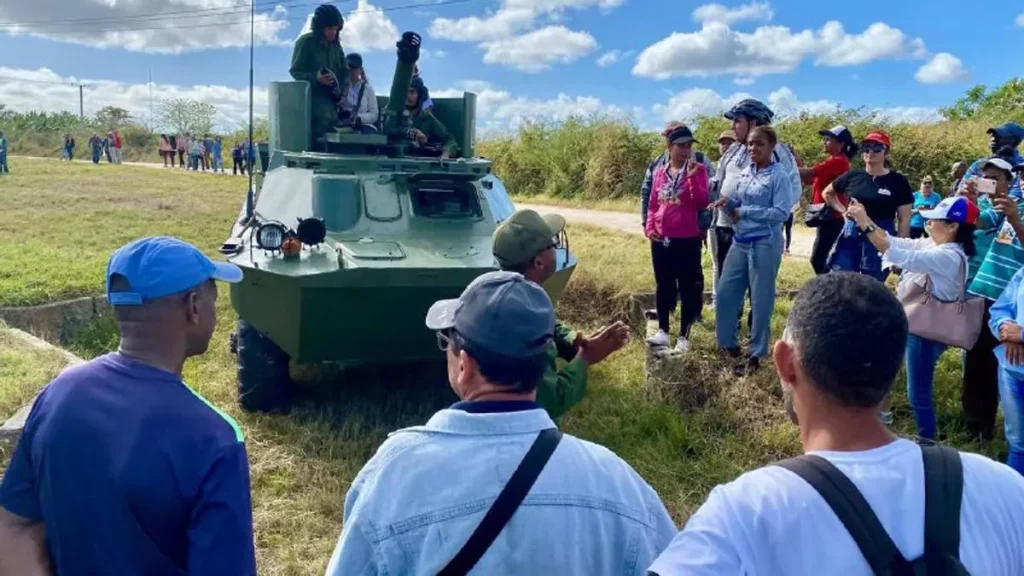
In cases like Sancti Spíritus, the exercises generated fear among the population. Residents of the province told 14ymedio that the city “woke up frightened after the gunfire and bombs that were being dropped” from early morning. Adding to the unease, Soviet MiG-15 fighter jets from the Cold War era were seen flying over the area.

Faced with the anxiety and lack of information provided by the authorities, residents began asking what was happening via Facebook. Journalist Elsa Ramos, a columnist for the newspaper Escambray and a critical voice within the government, shed some light on the situation, stating on Radio Sancti Spíritus that combat exercises were being conducted near the city.

Deivy Pérez Martin, president of the Provincial Defense Council, highlighted the importance of these exercises “to achieve the best preparation of the Production and Defense Brigades, in order to have a well-trained people to stop and defeat any attempt by the enemy to continue reading

take over the nation,” according to Sancti Spíritus’ provincial newspaper.

There was “a compendium of comprehensive actions aimed at raising the preparedness of all components of the province in the face of risk situations”

Another province that carried out these actions was Matanzas. There was “a comprehensive set of actions aimed at increasing the preparedness of all components of the province in the face of situations of risk, threat, or aggression, within the framework of the doctrine of the Guerra de Todo el Pueblo [War of the Entire People],” Girón reported, in a text accompanied by photographs showing smoke after some detonations.

The exercises included combined classes in military units and tactical maneuvers with shooting exercises and practical cases of the air defense units.

In Havana, exercises were also carried out in all 15 of the capital’s municipalities. “During the day, drills, tactical training, and logistical and civil defense support actions were conducted.” Women in civilian clothes and shoes, as well as children, participated.

These scenes were replicated in the special municipality of Isla de la Juventud. There, according to the newspaper Victoria, with triumphalist language, the people demonstrated “their high level of preparedness, patriotism, and unwavering conviction in victory against the threats of the enemy.”

The medium called for “continuing to fight for the defense of the Homeland, sovereignty, solidarity and a better future where unity, equality and social justice prevail, using as a basis the values ​​instilled by our historical leaders,” accompanied by a large number of images showing land and sea exercises.

In Villa Clara, they carried out shooting practice with different weapons, including rifles and artillery.

In Villa Clara, they conducted shooting practice with various weapons, including rifles and artillery. Additionally, the Air Defense Brigade carried out various aircraft and drone detection exercises, “as well as combat drills against them.”

“Given the interference of the United States and the real possibility of an attack against the country, it is essential to increase our response capacity.” This was the prevailing sentiment in Cienfuegos, where they conducted shooting exercises, “field movements, and the testing of transportation and communication systems.” The premise, according to 5 de Septiembre, is that “the neighborhood must be a trench protecting the gains of the Revolution.”

From Holguín, with heavy artillery included in the exercises, they trained “to face situations of risk or threat to internal security, in a scenario of unconventional warfare and enemy invasion.”

The Ciego de Ávila newspaper Invasor reported that these maneuvers were carried out to “pay tribute to the 32 Cubans who lost their lives in the line of duty in recent events” in Venezuela and in response to “the threats and pressure exerted by the United States government against Cuba and other nations in the region.” From some of the trenches, several young men took up arms and practiced shooting.

Finally, in Santiago de Cuba, invoking Fidel Castro and with the slogan that “the best way to avoid war is by preparing ourselves,” it was mostly women who carried out the exercises, which aimed to be ready “for the fulfillment of missions in times of aggression.”

These exercises took place hours before a new threat from US President Donald Trump, who on Sunday issued an explicit warning to the Castro regime: Cuba must “reach a deal” with Washington or face the definitive severing of the economic ties that have sustained the island for decades. The Republican president stated on his social media account, Truth Social, that “there will be no more oil or money for Cuba: zero!”— a direct reference to the flow of crude oil and resources that Venezuela supplied to Havana for years.

____________

COLLABORATE WITH OUR WORK: The 14ymedio team is committed to practicing serious journalism that reflects Cuba’s reality in all its depth. Thank you for joining us on this long journey. We invite you to continue supporting us by becoming a member of 14ymedio now. Together we can continue transforming journalism in Cuba.

The Presence of a US Drone Deters the Cuban Ilyushin From Landing in Venezuela

Havana keeps this aircraft’s flights secret, using it for special missions.

The Cubana de Aviación IL-96-300 aircraft with registration number CU-T1250, in a file photo. / Flightaware/Gerry Barron

14ymedio bigger14ymedio, Havana, 8 January 2025 — The Ilyushin Il-96-300 with registration number CU-T1250, Cubana de Aviación’s only long-haul four-engine aircraft, returned to the island on Thursday after a failed attempt to land in Caracas. As analysts warned On the basis of movements recorded on flight tracking websites, analysts said the aircraft flew in circles for several minutes in the morning off the coast of Venezuela, probably waiting for permission to land, and then turned around, but towards the east of the island. It had departed from Havana, although the airport did not appear on satellite tracking, which is common for this aircraft.

According to Venezuelan media outlet La Patilla, an MQ-4C Triton reconnaissance drone had been flying over the same area where the Cuban aircraft decided to change course. The “unarmed stealth drone,” the outlet reports, took off from Jacksonville Naval Air Station in Florida and remained over the Caribbean Sea for hours.

Last Monday, the same IL-96-300 took off from Havana, also bound for Caracas, and did not appear on satellite websites. For these, it is often a “ghost plane” because it travels with its radar turned off.

A knowledgeable source revealed to 14ymedio that the flight was “full of military personnel” and assumed that “they are going to stay there.” The same person said that the flight was going to collect the bodies of the agents who died on the island during the US operation that resulted in the capture of President Nicolás Maduro and his wife, Cilia Flores, but this did not happen. According to Flightradar24, the Cubana four-engine aircraft also made a trip to Venezuela yesterday, although the reason for this is unknown. continue reading

The trajectory of the US MQ-4C Triton drone, in red, on the right, in the Caribbean, in front of the Cubana de Aviación IL-96-300. / Flightradar24

Normally used to transport senior regime officials, military personnel and important equipment, it may be being used to repatriate Cuban doctors scattered throughout Venezuelan territory. This Thursday, the Ministry of Health reported that “after a period of logistical disruption, the flow of health professionals providing services in the Bolivarian Republic of Venezuela returning to Cuba has been normalised”.

The note, published in the official press, attempts to “sell” the information as simply the start of a well-deserved holiday. It states that in the last months of 2025, travel was affected “by difficulties in air transport, a situation that was subsequently complicated by the closure of Venezuelan airspace and the consequent suspension of all commercial flights,” and that this led to a “temporary accumulation of employees who had completed their work commitments or were due for their rest period” and had been unable to return to Cuba.

Route taken on Thursday by Cubana de Aviación’s IL-96-300. / Flightradar24

This week, the text continues, “in an organised and progressive manner, flights have resumed, allowing these workers to return to their country,” since “with the re-establishment of international air operations to and from Venezuela, mechanisms were immediately activated to resolve the accumulated backlog.”

Apart from the fact that not all airlines have resumed flights to Venezuela, the article makes no mention of the main change that has taken place in the Caribbean country in recent days, in which the US government, after capturing Maduro, has forced the establishment of a “transitional government” headed by Delcy Rodríguez.

The new situation poses a serious threat not only to the island’s energy survival, which has depended on crude oil donated by Caracas for more than a quarter of a century, but also to the regime itself, which is deeply intertwined with the Chavista government, as demonstrated by the identities of the Cubans who died in the US operation and despite decades of denial by both sides of the presence of troops from the island in Venezuela. Belonging to Maduro’s circle of protection, most of them were senior Cuban intelligence officials.

Translated by GH

____________

COLLABORATE WITH OUR WORK: The 14ymedio team is committed to practicing serious journalism that reflects Cuba’s reality in all its depth. Thank you for joining us on this long journey. We invite you to continue supporting us by becoming a member of 14ymedio now. Together we can continue transforming journalism in Cuba.

“There Will Be No More Oil or Money for Cuba: Zero!” Trump Threatens

Cuba’s foreign minister accuses the U.S. of behaving “like a criminal, out-of-control hegemon that threatens world peace and security”

“Cuba provided security services to the last two Venezuelan dictators. But no more!” Trump wrote. / EFE

14ymedio bigger14ymedio, Havana, January 11, 2026 — U.S. President Donald Trump issued an explicit warning to the Castro regime this Sunday: Cuba must “reach an agreement” with Washington or face the definitive rupture of the economic ties that have sustained the Island for decades. The Republican president stated on his social network Truth Social that “There will be no more oil or money for Cuba: zero!” in a direct reference to the flow of crude oil and resources that Venezuela supplied to Havana for years.

Shortly before, Trump shared on Truth Social a post by an X user suggesting that Secretary of State Marco Rubio could become “president of Cuba,” adding a comment that did not go unnoticed: “Sounds good to me!”

Trump expanded on his message: “For many years, Cuba lived off large amounts of oil and money from Venezuela. In return, Cuba provided security services to the last two Venezuelan dictators. But no more!” he wrote.

The U.S. president went even further when referring to the consequences of the recent military operation in Caracas. “Most of those Cubans are dead from the U.S. attack last week, and Venezuela no longer needs the protection of the thugs and extortionists who held it hostage for so many years,” he added, in one of the harshest statements to date against continue reading

the Cuban presence in Venezuela.

The bluntness of the message comes at a moment of maximum geopolitical tension in the region following the capture of Nicolás Maduro. The action has triggered a series of statements, warnings, and strategic realignments involving not only Washington and Caracas, but also Havana.

According to public records from Flightradar24, several U.S. military aircraft conducted flights near the northern coast of Cuba.

Since Saturday, January 3, Trump’s statements have oscillated between an emphasis on regional control and direct warnings to historic allies of Chavismo. In recent interviews, the president has said that the Cuban regime “is very close to falling” due to the loss of its main source of oil and financial backing, though he has avoided publicly committing to a direct military intervention on the Island.

Added to this verbal escalation in recent hours was an unusual movement in the regional airspace. According to public Flightradar24 records, several U.S. military aircraft, identified by their speed, altitude, and flight patterns, carried out flights near Cuba’s northern coast without entering Cuban airspace. The routes, visible in real time on the platform, showed paths parallel to the coastline and repeated turns off strategic points in the north of the Island, a deployment that analysts interpret as a signal of pressure and deterrence amid the hardening of Washington’s rhetoric. The aerial presence was widely discussed on social media and reinforced the perception that Trump’s warning to Havana is not limited to rhetoric alone.

Secretary of State Marco Rubio has reinforced that message. Of Cuban-American origin and a long-time critic of the Havana regime, Rubio has repeatedly stated that Cuba played a key role in the survival of Chavismo and that Venezuela’s security structure was “basically full of Cubans.” In conferences and press briefings following the operation in Caracas, he emphasized that without that support, Maduro’s regime would have collapsed much earlier.

Official figures on casualties during Maduro’s capture vary by source, but dozens of Venezuelan security personnel and at least 32 Cuban soldiers and agents were officially reported as killed during the operation. The Cuban government ultimately acknowledged this figure after repeatedly denying any military presence in Venezuela.

The Cuban regime and its spokespeople respond with the usual repertoire of denial, victimization, and confrontation

This death toll comes amid a climate of sustained repression within Cuba, where hundreds of political prisoners continue to languish in the country’s jails for exercising basic rights such as freedom of expression, assembly, or peaceful protest.

Trump’s warning this Sunday also fits into a context of economic and social collapse that experts describe as unprecedented in the Island’s recent history. Cuba is experiencing an unparalleled crisis, marked by mass emigration, structural failures in essential services such as health care and education, and an exhausted economic model that no longer manages to cover the population’s basic needs.

The end of Venezuelan subsidies, which in 2025 supplied the Island with an average of some 27,000 barrels of oil per day, represents an additional blow to an economy already burdened by frequent blackouts, domestic production at historic lows, and chronic shortages of food and medicines.

The regime’s foreign minister, Bruno Rodríguez Parrilla, rejected Washington’s accusations on the social network X and denied any economic link to security services provided abroad. “Cuba does not receive nor has it ever received monetary or material compensation for the security services it has provided to any country,” he wrote.

In his message, Rodríguez contrasted that position with that of the United States, which he accused of “mercenarism, blackmail, and military coercion against other states,” and invoked the Island’s right to import fuel “from those markets willing to export it.” The foreign minister closed his statement with the customary rhetoric, calling the U.S. a “criminal, out-of-control hegemon” that threatens peace and security not only for Cuba and the hemisphere, but “for the entire world.”

Faced with pressure from the United States, the Cuban regime and its spokespeople respond with the usual repertoire of denial, victimization, and confrontation. But the clock, politicians and analysts warn, is rapidly running against Havana’s interests.

Translated by Regina Anavy

____________

COLLABORATE WITH OUR WORK: The 14ymedio team is committed to practicing serious journalism that reflects Cuba’s reality in all its depth. Thank you for joining us on this long journey. We invite you to continue supporting us by becoming a member of 14ymedio now. Together we can continue transforming journalism in Cuba.