In Spite of the Economic Crisis, Cuba Stages an Expensive International Wine Festival

Cuban officials have spared no expense to impress their guests. (Excelencias Gourmet)

14ymedio bigger14ymedio, Havana, October 5, 2023 — International businessmen from the wine world gathered this week at the Hotel Nacional in Havana for the government-sponsored XXII Wine Fair. The presentation of the most recent products and most expensive wines from the Spanish brands Torres and Juvé & Camps – the stars of the event – will allow to Cuba consolidate its related businesses with other European liquor giants attending the event.

The delegation from Juvé & Camps presented three premium sparkling wines: Reserva Brut, Essential Púrpura; Gran Reserva Brut Nature, Reserva de la Familia; and Gran Reserva Brut, Gran Juvé & Camps. These wines will soon be available for purchase on the island though it is likely that their prices, which were not revealed, will put them out of reach of most Cuban consumers.

According to the food and wine magazine Excelencias Gourmet, other Spanish wineries also participating were Vallformosa, Grupo Freixenet, Roqueta Origen, Joan Sardá and Destilerías MG. On the Cuban side, Havana Club International S.A. was in attendance along with several Cuban winemakers and the marketing firm Inversiones Pucara S.A. continue reading

Officials announced that at least six ballrooms and three restaurants at the Havana hotel will be used to hold tasting, pairings and presentations

Officials announced that at least six ballrooms and three restaurants at the Havana hotel will be used to hold tasting, pairings and presentations. Conferences and workshops, however, will be held in the famous Salon 1930, also known as the Compay Segundo Room. The event will also coincide with the opening of the Capablanca Bar, named in honor of the Cuban chess player, on the hotel’s rooftop.

In early August, the newspaper OnCuba announced that a group of Italian and Mexican wineries had shown interest in participating in the festival and were awaiting final approval from the Cuban Chamber of Commerce. However, recent articles about the event have not made reference to any other companies apart from the aforementioned Spanish wineries and France’s Pernod Ricard, which manages – along with a Cuban partner – the Havana Club brand.

While not as extravagant as the Habano Cigar Festival, this costly fair comes at a moment when the country is experiencing a structural crisis in which one of the sectors most affected is food. Cuban officials, however, have spared no expense to impress their guests. Cheeses, wines, rums of the highest caliber, and other delicacies are piled high on the Hotel Nacional’s tables.

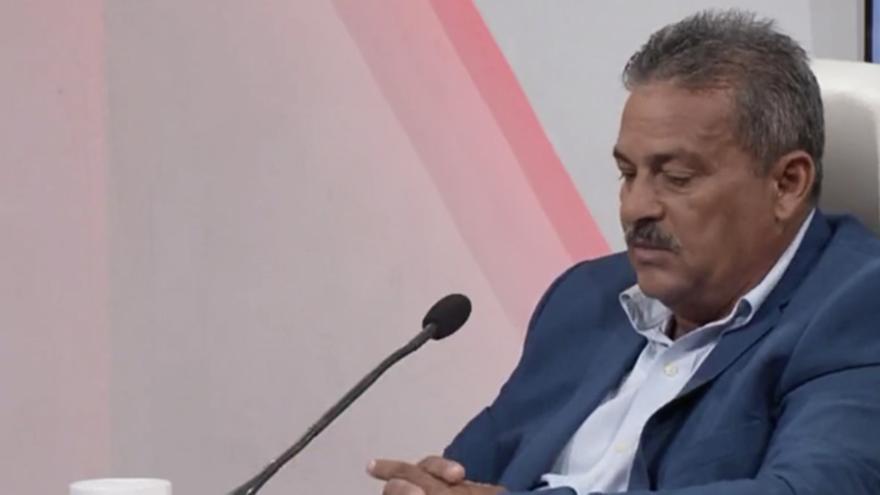
During the Wednesday night broadcast of the TV interview program Mesa Redonda (Roundtable), the minister of Domestic Commerce, Betsy Diaz Velazquez, announced that at least eight essential, rationed products, all of them food items, would not be available in the coming months. Not even vulnerable families, the elderly, pregnant women, or women who are breastfeeding are safe from hunger.

____________

COLLABORATE WITH OUR WORKThe 14ymedio team is committed to practicing serious journalism that reflects Cuba’s reality in all its depth. Thank you for joining us on this long journey. We invite you to continue supporting us by becoming a member of 14ymedio now. Together we can continue transforming journalism in Cuba.

Celia Cruz, Joined With ‘Patria Y Vida’, the Anthem of the Protests in Cuba

Celia Cruz, in an image of the video clip of the new version of Patria y Vida. (Capture)

14ymedio bigger14ymedio, Havana, 3 October 2023 — Since this Monday, Celia Cruz and Patria y Vida (Homeland and Life), two of the greatest Cuban musical symbols of recent times, are united in a new video clip of the song that became a dissident anthem since its premiere, in February 2021. In this new version, the song incorporates in some fragments the voice, recreated with artificial intelligence, of the Queen of Salsa, who died in 2003.

The song also features the interpretation of the trumpeter Arturo Sandoval. The short film, directed by actor Carlos Ever Fonseca, includes images of the original version, directed by Asiel Babastro and of the duo Gente de Zona, Eliexer Márquez El Funky, Maikel Castillo Osorbo and, without singing, the activist Luis Manuel Otero Alcántara, wrapped in the Cuban flag of the San Isidro Movement.

The video contains a few words of tribute to these last two artists, who are serving nine- and five-year sentences, respectively, in Cuban prisons after the island-wide protests of 11 July 2021 (11J). “Patria y Vida” was, precisely, one of the most repeated screams on that day of demonstrations. continue reading

Celia wants to stay alive in her music and her fight for the rights of Cubans,” said the Spanish Beatriz Luengo, one of the authors of Patria y Vida

The Spanish actress Beatriz Luengo, Romero’s wife,  published on her social networks a thank you to the heirs of Celia Cruz, who agreed to add the Guarachera of Cuba’s voice to the song. “We started by going to Omar Pardillo (Cruz’s producer) and her heirs to ensure that they also considered it appropriate to do so,” Luengo explained.

“Celia wants to stay alive in her music and her fight for the rights of Cubans,” Luengo continued. “As a woman, I have loved that Patria y Vida has a female representation. It was already significant that five Afro-descendant boys put the regime in check. Now there are five Afro-descendants and a woman.”

Through their social networks, both Cruz’s heirs and her producer thanked Luengo and Romero for their work with the short film and the recovery of the Cuban artist’s voice.

Last February, Luengo herself announced the premiere of a documentary about Patria y Vida and the “hard reality of the Island.” “The interesting thing about the documentary is that it is about a living movement. Movies are usually made when things have already happened,” Luengo said in an interview with EFE in Miami, less than a month before the premiere of Patria y Vida: The Power of Music.

This September several media announced the nomination of the documentary for the Latin Grammy 2023, an award that the song itself received in 2021, in two categories, after it became the anthem of the massive protests that have come to be known simply as “11J”.

Translated by Regina Anavy

____________

COLLABORATE WITH OUR WORKThe 14ymedio team is committed to practicing serious journalism that reflects Cuba’s reality in all its depth. Thank you for joining us on this long journey. We invite you to continue supporting us by becoming a member of 14ymedio now. Together we can continue transforming journalism in Cuba.

Bimbom Reopens under Private Management with the Most Expensive Ice Cream in Cuba

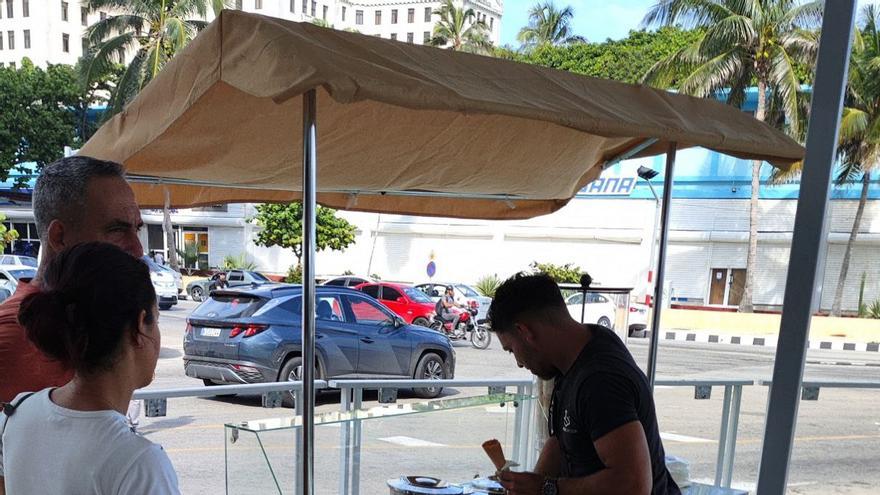
According to one source, the place will be called Bueníssimo Soda Gourmet. (14ymedio)

14ymedio bigger14ymedio, Juan Diego Rodríguez, Havana, 6 October 2023 — A scoop of ice cream is a good indicator of the rate of inflation in Cuba. After being closed for more than a year, the former BimBom — previously one of Havana’s most popular meeting spots  — had a sort of dress rehearsal on Friday in anticipation of its latest reopening. With a pushcart, an umbrella and a new name, Bueníssimo Soderia Gourmet will soon begin selling its ice cream at prices that startled the first curious onlookers who stopped to check it out.

“They say it’s a local business but at those prices…” says one startled woman as she quickly walks away from the cart at the entrance to the store, located at 23 Infanta Street in Vedado. An artisinal chocolate, strawberry, yogurt or berry ice cream cones goes for a hefty 195 pesos.

It already promises to top the list of privately managed businesses that have opened recently in central Havana whose prices seem more geared to tourists than to locals. According to the pushcart vendor, the store — it has been undergoing renovation for several months and construction workers can still be seen coming and going — is expected to open at the end of the month. continue reading

Its latest reopening could signal a resurgence of privately-run businesses in this Havana enclave. Whether or not it succeeds given its high prices remains a mystery

Buenísimo Soda Gourmet is the successor to the famous BimBom, which opened during the dollarization frenzy of the 1990s. It quickly evolved from a simple ice cream parlor into a destination for young people and the LGBTQ community. From its strategic location on the corner where bustling 23rd Street meets the Malecón, it boosted the nightlife in the area between the sea, the Rampa cinema and the fountain running down the rockface alongside the Hotel Nacional.

But the good times came to an end and BimBom had to close its doors. Then, in 2020, the state-owned business conglomerate Cimex reopened it, selling a wide variety of Italian ice creams that, though expensive, did sell. Unfortunately, currency unification and broken machinery spelled doom for the famous ice cream parlor. With the once desirable Rampa area around it in serious decline by the summer of 2022, it closed its doors again.

Its latest reopening could signal a resurgence of privately-run businesses in this Havana enclave. Whether or not it succeeds given its high prices remains a mystery. About a mile and a half away, on San Rafael Street in Central Havana, is Monte Freddo, an ice cream parlor with a product superior to that of Bueníssimo, where two scoops go for 330 pesos.

The portions are much smaller than those at the new place in Rampa. Curiously, however, it was exactly two years ago that 14ymedio published an article, “The Sky-High Price of Ice Cream”, on the spectacular price increases at Monte Freddo caused by currency unification. At that point, a single scoop had gone from 50 to 70 pesos. Little did we know the nightmare had only just begun.

____________

COLLABORATE WITH OUR WORKThe 14ymedio team is committed to practicing serious journalism that reflects Cuba’s reality in all its depth. Thank you for joining us on this long journey. We invite you to continue supporting us by becoming a member of 14ymedio now. Together we can continue transforming journalism in Cuba.

Where Are You Going, Colombia?

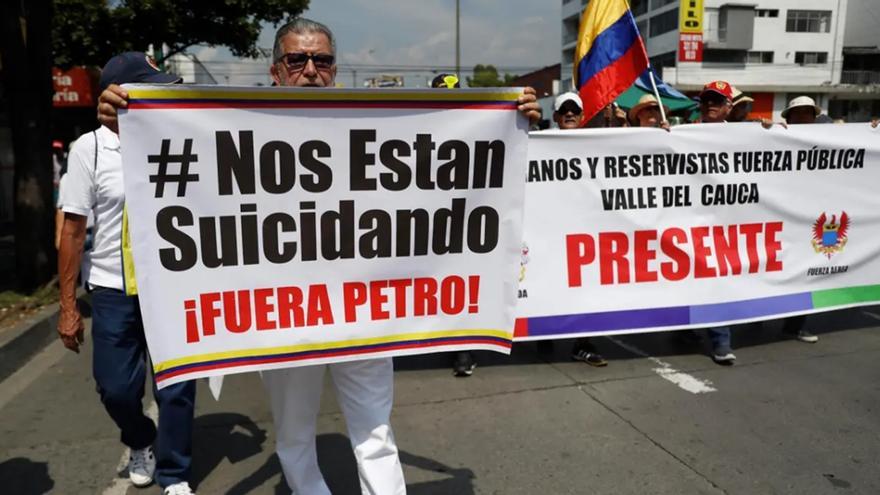
Protesters with banners and speeches against the Government walk the streets in Cali (Colombia). (EFE/Ernesto Guzmán Jr.)

14ymedio bigger14ymedio Pedro Corzo, Miami, 7 October 2023 — I visited Colombia a few days ago on a tourist and family trip. In both visions I could see that the Government doesn’t have much sympathy. A significant number of those who say they voted against President Gustavo Petro seriously question those who elected him. Even more, I saw graffiti on historic walls that, among other criticisms, asked the president why the cost of living had become so expensive.

When I traveled to Venezuela for the recall referendum, in 2004, I told my Venezuelan friends that I had the perception that, with or without cheating, Hugo Chávez would win. Now I wonder how Petro won the elections last year if most of the people I talked to, almost entirely unknown, spoke against him. I did not see any fear of the authorities, since the individuals talked freely.

My first stay was in the fabulous Cartagena de Indias. It is a city full of contradictions. Its historic walls always move me, but what pleasantly impressed me was the progress in the modern area called Bocagrande. Hopefully Gustavo Petro will not be determined to destroy the development achieved, as his peers in Cuba, Venezuela and Nicaragua did when they took power. Their eagerness to curtail freedoms and end economic and social advances is unhealthy and criminal. continue reading

When I traveled to Venezuela for the recall referendum, in 2004, I told my Venezuelan friends that I had the perception that, with or without cheating, Hugo Chávez would win

Bocagrande – or South Miami, as some call it – is beautiful, vibrant and rich, with the busiest beaches in that part of the country, although I confess that I still prefer the walled city, with its convents and its legends of apparitions. By the way, the assistant in a bar we visited told us that she would never be alone in that place because she had already had a scare. In addition, the churches, aged buildings, car rides and the San Felipe de Barajas castle transport us back in time.

The history of that part of the city is that of the entire hemisphere, of our most emblematic villas of the colonial era, in which at least two Cuban cities are distinguished, Havana and Trinidad. By the way, one of the guides told us that a certain Cuban was considered a hero in colonial times, for his leadership in an insurrection.

In Cartagena, at one of the restaurants where we had lunch, I sampled my first coconut lemonade, a real feast for the palate. There, inadvertently, politics broke out. The lady who served us, realizing that we were all Cubans with the exception of my wife, brought out her artillery against the president. She described how much life in the region had changed for the worse and the many fears about the future that overwhelmed the citizenry, both rich and poor. She was critical of the presidential flirtation with irregular groups, including drug traffickers, and of his approach to the dictatorship of Nicolás Maduro.

Our arrival in Medellín coincided with Petro’s visit to the United Nations, where he was snubbed and overshadowed by the remarks against the mayor of the city, Daniel Quintero, an ally of the president.

Quintero is noted for having forged a strong business alliance with Venezuelans who enriched themselves under the autocracies of Hugo Chávez and Nicolás Maduro

Quintero is noted for having forged a strong business alliance with Venezuelans who enriched themselves under the autocracies of Hugo Chávez and Nicolás Maduro. A harsh report by the newspaper El Colombiano describes a network of interests, which offers grounds for a judicial investigation so that a conscious electorate does not vote for the candidate who supports the current office holder.

In the capital of Antioquia, in the face of renewed criticism of Petro, I asked again how he had been elected. The answer did not surprise me: my interlocutors said that it was the vote of the young people, trusting in the Petrist promises, that brought him to power. A pity, because the leaders resemble the brothers Castro, Chávez, Maduro, Daniel Ortega and Evo Morales, in my opinion Gustavo Petro’s fellow travelers, the ones who most damage the possibilities of achieving a society like the one that the despots promise in their speeches.

I told my friends Horacio and Consuelo Puertas that Colombia enjoys spaces that no longer exist in the Castro-Castrochavista States, with a very energetic civil society that will be difficult to crush. However, I suggested with great respect that they could not be negligent, because “the shrimp that falls asleep is carried away by the current.”

Translated by Regina Anavy

____________

COLLABORATE WITH OUR WORKThe 14ymedio team is committed to practicing serious journalism that reflects Cuba’s reality in all its depth. Thank you for joining us on this long journey. We invite you to continue supporting us by becoming a member of 14ymedio now. Together we can continue transforming journalism in Cuba.

1,053 Athletes Have Fled Cuba in a Decade, 82 of Them So Far This Year

The general director of Inder High Performance, José Antonio Miranda, says that Cuba is living “an atypical year” due to the escapes of athletes. (Capture/Mesa Redonda)

14ymedio bigger14ymedio, Havana, 6 October 2023 — “The migration of athletes and coaches has affected us,” acknowledged the general director of High Performance of the National Institute of Sport, Physical Education and Recreation (Inder), José Antonio Miranda, at the Round Table last Tuesday.

From 2022 to September 2023, 191 athletes broke off their relationship with the sports authorities. As of Tuesday, Miranda counted the escape of 78 athletes. As usual for the Cuban authorities, the main cause of the desetions is the American “blockade,” to which he added the “complex economic scenario” that the country is going through.

The official said that “solutions are being sought” to retain athletes. So far these options have been a failure. The same day he talked about the “atypical year” they were having, it was confirmed that baseball player Yobanys Millán escaped from the Hilton Garden Inn hotel in Yucatan (Mexico), where the Alazanes de Granma team stayed while participating in the Baseball Champions League of the Americas (BCL).

Among the strategies to prevent escapes and abandonment, the Cuban Baseball Federation offered 80 players to talent scouts from Japan, South Korea, the Dominican Republic and Ecuador at the beginning of September. continue reading

The so-called first international baseball tryout represented a source of income for the Island. It came just as the sports authorities confirmed the suspension of the National U-23 Baseball Series due to the “difficult economic situation facing the country.” The crisis also forced the cancellation of the national championship for 9-10-year olds, the final stage of Baseball 5, the Women’s National Baseball Cup and the U-18 National Championship, which has not even concluded.

Yariel Rodríguez Yordi, who broke his contract with the Japanese team Dragones de Chunichi, reached an agreement to be a free player. (Dragones de Chunichi)

Among the Cuban talents in the first tryout was the right-handed pitcher of the Industriales team, Silvano Hechevarría. This 20-year-old habanero, 6 feet 4 inches tall, was followed by the headhunters who attended the Latin American Stadium in Havana, but no specific offer was presented.

Days later, on September 27, Hechevarría boarded a flight to the Dominican Republic, where he will train until he obtains free agency and be able to show himself to headhunters of teams from the Major Leagues of the United States.

“Cuban baseball players continue to leave the country. No possible hope of a contract or of pursuing a career in Cuba keeps them there. Cases like Hechevarría’s are the test,” journalist Francys Romero published in Baseball FR!

The salary for players on the Island is unattractive. In 2020, before the Ordering Task,* a member of the national pre-selection who participates in the National Series receives 3,725 Cuban pesos (19 dollars) monthly; a member of the Reserve of the National Pre-selection and National Series receives 2,400 (12 dollars).

The escape of athletes does not stop. The 11-year-old players, Kendry Enrique Abreu and Mario Serra, who participated in the 2023 Pan American U-12 in Mexico, are in the Dominican Republic, where they seek to perfect their skills to get an opportunity in a U.S. Major League team.

On Wednesday, the arrival in the United States of the Cuban triple jumper Davisleydi Velazco was confirmed. The gold medalist at the U-20 Pan American Games in Peru (2017), the NACAC U-23 championship in Querétaro (Mexico) and the Alba Games in Venezuela (2023) made a 19-day journey.

Cuban triple jumper Davisleydi Velazco arrived in the United States last Wednesday after a 19-day journey. (Instagram)

On the same day, baseball player Franky Quintana left the pre-match hotel, between Cuba and Curaçao, in the Caribbean Baseball Cup in Puerto Rico. With Quintana’s escape, there are 51 Cuban athletes who have left behind contracts or delegations in 2023, said baseball specialist Francys Romero.

Quintana had been selected by Armando Ferrer to reinforce the Cocodrilos de Matanzas in the second edition of the controversial Elite League.

The figures on escapes of Cuban athletes are devastating. In January, the official weekly Trabajadores counted the abandonment of 862 athletes in a decade, of which 635 were baseball players. If the recent data offered by the Inder are added, there are already 1,053 athletes who abandoned the sport.

The general director of Inder High Performance, José Antonio Miranda, said that the escape from the Island happened before the Pan American Games in Chile, which will be held from October 20 to November 5. “That impact has been felt,” he said.

Cuba brings to Chile a very “young” delegation made up of 362 athletes (187 women and 175 men). For “62% of the athletes, this will be their first competition in the Pan American Games,” he said. “This didn’t happen to us in previous cycles.”

Miranda was measured when talking about the medals. “Cuba’s main potential is between 18 and 22 gold medals. On that basis we will be working, although the scenario will decide how far we can fulfill that purpose.”

*Translator’s note:  The Ordering Task is a collection of measures that include eliminating the Cuban Convertible Peso (CUC), leaving the Cuban peso (CUP) as the only national currency, raising prices, raising salaries (but not as much as prices), opening stores that take payment only in hard currency, which must be in the form of specially issued pre-paid debit cards, and a broad range of other measures targeted to different elements of the Cuban economy.

Translated by Regina Anavy

____________

COLLABORATE WITH OUR WORKThe 14ymedio team is committed to practicing serious journalism that reflects Cuba’s reality in all its depth. Thank you for joining us on this long journey. We invite you to continue supporting us by becoming a member of 14ymedio now. Together we can continue transforming journalism in Cuba.

The Cuban Authorities are Cruel to Luis Robles, the ‘Young Man with the Placard’

The political prisoner’s mother hoped that her son’s process would progress at a good pace until he was granted conditional release. (Facebook/Yindra Elizastigui)

14ymedio bigger14ymedio, Havana, 6 October 2023 — Luis Robles Elizastigui, known as “the young man with the placard,” has been imprisoned since December 2020 in the Combinado del Este prison, in Havana, and has not yet received the change to a minimum security regime in the La Lima camp, in Guanabacoa, as the authorities promised at the end of August.

In a publication on social networks, Robles’ mother, Yindra Elizastigui, said that in conversations with the young man he regretted the delay. “He tells me that he is happy when he sees or finds out that they have taken someone to the camp, but that he still cannot explain why they have delayed his transfer,” she says.

The woman also denounced the injustice committed against Robles as part of “psychological torture” towards her family. “I have also suffered and continue to suffer from the unjust imprisonment to which my son Luis is subjected,” said Elizastigui who, after suffering memory loss as a result of a temporary ischemia, fears that by the time her son is released she will no longer be able to recognize him.

In addition, the young man has a son, she explained, whose mother is also imprisoned, although not for political reasons. “His son needs him now more than ever (…) and it is something that should be taken into account.” continue reading

Last August, when Elizastigui told this newspaper about the change of regime for Robles, she warned that the measure had only been approved then by the authorities of the Combinado del Este and confirmation from other entities such as State Security was still required.

“I, as a mother, hope that they approve his transfer, because Luis is in there because of them, whose conscience imprisoned him. What he [Robles] did is his right, which is in the Constitution. His imprisonment is unjust,” said Elizastigui.

The political prisoner’s mother, who hoped that her son’s process would progress at a good pace until he was granted parole, also mentioned that the young man was suffering from health problems. “We must take into account his health (…), which has worsened due to the injustices that have been committed.”

“He has had good behavior, and this has been reported to me by the prison authorities themselves and by Gerardo, the Security agent assigned to him. So let’s hope that [the measure] is complied with,” the woman then insisted. She had pinned her hopes on her son’s good behavior to earn him a quick exit from the prison to La Lima.

____________

COLLABORATE WITH OUR WORKThe 14ymedio team is committed to practicing serious journalism that reflects Cuba’s reality in all its depth. Thank you for joining us on this long journey. We invite you to continue supporting us by becoming a member of 14ymedio now. Together we can continue transforming journalism in Cuba.

Instead of a Day of Mourning in Cuba, a Conga Carnival a Few Blocks From the Fatal Lamparilla Building Collapse

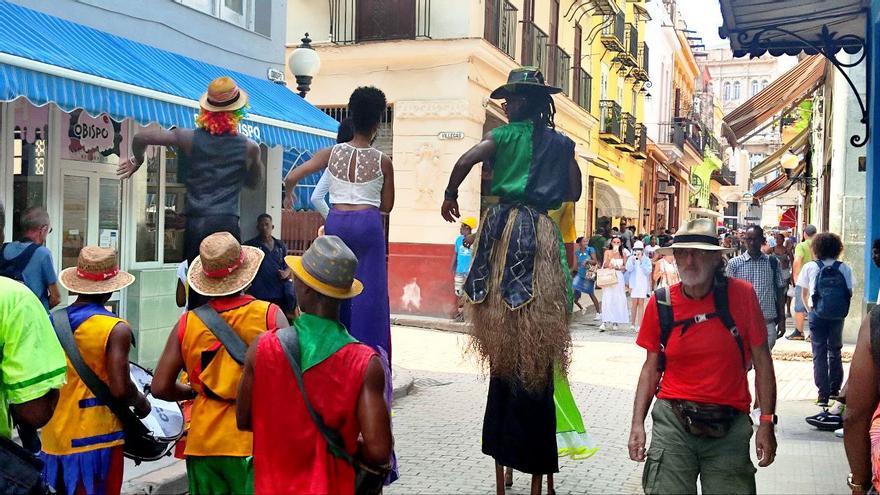
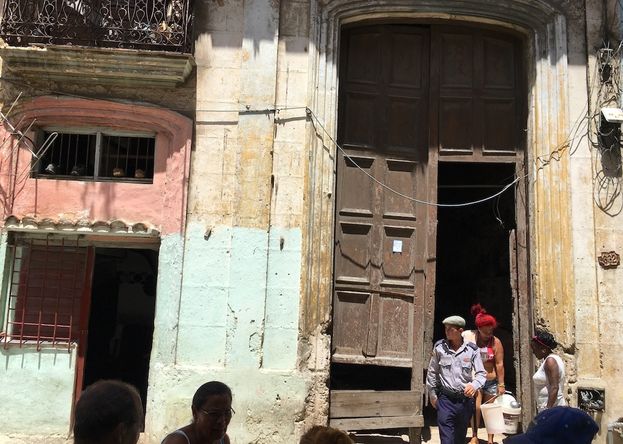
Conga Carnival on Obispo y Villegas Streets, in Old Havana, a few blocks from the collapsed building on Lamparilla where people died. (14ymedio)

14ymedio biggerJuan Diego Rodríguez, Havana | 5 October 2023 — “Farewell, oh, oh, farewell.” The conga troupe going up and down Obispo Street this Thursday in Old Havana was the same one that every day, accompanied by stilt walkers, playing drums and singing, cheer up the tourists, always plentiful in the historic center of the capital. The difference is that today is not like every day nor is Obispo Street just any place.

Today is just one day after a building collapsed on Lamparilla Street, taking with it three lives, those of firefighters Yoandra Suárez López and Luis Alejandro Llerena Martínez, and that of an elderly man, Ramón Páez Frómeta.  And Obispo Street, where the conga is parading this Thursday, is just two blocks from the site of the tragedy, walking a little down Villegas Street.

Obispo Street, where the conga is parading this Thursday, is just two blocks from the site of the tragedy, walking a little down Villegas Street

“The dead man to the hole and the living man to the chicken”*, an onlooker exclaimed under her breath as she saw the musicians passing by, dressed in bright colors. “I’m not saying that they declare National Day of Mourning, but at least have a little respect and say: “hey, no conga today,” the lady continued.

In the corners adjacent to the collapsed building, located on Lamparilla, between Aguacate and Villegas, a strong police operation continues this Thursday, although they lifted the one at La Plaza del Cristo. When she saw the number of agents, the woman on Obispo Street said: “The only thing they are interested in is that tourists do not come to the collapse and take photos of what this place is really like.”

 *Translator’s note: El Viejo al hoyo y el hombre al pollo.  Popular Cuban phrase meaning someone dies and life goes on.

____________

COLLABORATE WITH OUR WORKThe 14ymedio team is committed to practicing serious journalism that reflects Cuba’s reality in all its depth. Thank you for joining us on this long journey. We invite you to continue supporting us by becoming a member of 14ymedio now. Together we can continue transforming journalism in Cuba.

Encounters of the Third Kind with Cuban State Security

Artists being arrested by police in Havana for protesting in front of the Cuban Institute of Radio and Television on July 11, 2021. (EFE)

14ymedio bigger14ymedio, Yunior Garcia Aguilera, Madrid, 4 October 2023 — Those of us who have been a target of the State Security often make two serious mistakes. On the one hand, we overestimate them. They are not the X-Men. They do not have all the latest technology nor are they omnipresent. Their officers come off as increasingly clumsy, ill-prepared, with a progressive decline in cultural awareness. That feeling that you can’t even trust your pillow because they know every time a leaf moves in Cuba, that is a myth they themselves perpetuate in order to paralyze us. It’s not as though their gears operate like those of a Swiss watch — they’re more like those of the National Energy System — no matter how much some government minister beats his chest on TV claiming otherwise.

But neither should we make the mistake of underestimating them. State Security’s founders were trained by the KGB and the Stasi. They inherited manuals and techniques whose effectiveness still stand the test of time. They have penetrated and control every grassroots organization in the country, which is really their greatest strength. From the Federation of Cuban Women to the Committees for the Defense of the Revolution, from the National Artists and Writers Union to the National Association of Small Farmers, from the labor unions to the Federation of University Students. Every day these organizations report their findings to State Security and act as its eyes, ears and fists. continue reading

They have penetrated and control every grassroots organization in the country, which is really their greatest strength

The first time I was “interviewed” by a counterintelligence official was in Holguín, shortly after firing off fifteen questions, which automatically made me a target. I learned from others that the aforementioned individual had been ordered to approach me, though he himself admitted to feeling unprepared. So he spent a few weeks visiting the Provincial Council for the Performing Arts, getting a crash course in drama that, if we’re being honest, didn’t help him much.

His first words were: “We know you’re not collaborating but we would still like to know what you’re doing because we have lots of collaborators around you.” Apparently, I was on a list of young opinion makers and they wanted to warn me that they were watching me closely, trying to stoke fear, paranoia and paralysis in me. But they chose the wrong officer. The man’s lower left eyelid quivered, his words sounded scripted and he seemed eager to be done with his uncomfortable mission as quickly as possible. Instead of working like an anesthetic, it had the opposite effect.

They did not make the same mistake twice. After November 27, they sent Yordan, a cross between U.S. basketball legend Michael Jordan and Cuban wrestler Mijaín Lopez. The guy was over six-and-a-half-feet tall. Standing in front of my house, putting on his scariest face, he told me that I could not leave until he decided I could leave. I have to admit that, this time, the guy was convincing. But State Security also didn’t want to run the risk of him scaring me to the point it radicalized me.

At that time, I still had all the naivetee of someone who had not yet looked into the eyes of Satan. So, a few hours later, they sent in the “good cop.” This time they chose an officer who had been trained overseas, who had more self-confidence and a less limited vocabulary. He said his name was Rodrigo and he took the opportunity to compliment me in an effort to boost my ego. All the while, he was ripping to shreads all the other known activists. He then deployed the “you’re not an enemy, you’re just confused” strategy.

Although at first I swore not to touch anything on that table, eventually I gave into hunger

Later came my first abduction. They took me to one of those houses with curtains on all the walls (and cameras behind them). On the table before me lay all the things that were in short supply in the stores: coffee, cans of soft drinks, candies, even shellfish. Actually, they asked me almost nothing. Again, they just talked bad about everybody and left me alone for long periods of time. Although at first I swore not to touch anthing on that table, eventually I gave into hunger.

I have often asked myself what exactly that scene was all about. What was up with the shellfish? What tidbits were they looking for? I later realized that they just wanted some visuals for their files. If, at some future point, they had to take things further and I publicly accused them of physical violence, all they would have to do would be to take out those videos of me eating shrimp. They know how the mind of the average Cuba works. They knew that, upon seeing those images on national television, some people would say, “I want them to torture me too!”

State Security officials often use several categories to classify their victims: possible agents, willing or unwilling collaborators, confused revolutionaries or incorrigible revolutionaries. They also take into account your ability to influence people and the types of people who could be motivated to follow you. There is a particular approach for each case. But when it comes to good-natured, kind or helpful people, you get the same rough treatment. It doesn’t matter if you are an intellectual or a dock worker.

Once they have made the decision to destroy you, they will do it one step at a time. Possibly, you will first be subjected to cyber attacks. They will accuse you of being a mercenary because money was added to your cell phone account from overseas. Then there will be the disrupted internet, the interrogations, the home surveillance. They will disparage you at your school, at your workplace, to friends and family, and especially to other activists. They will look for ways to exploit egos, jealousies, prominence, and human misery. If you are having an impact online, they will ask TV newscaster Humberto Lopez or the Con Filo lap dogs to tear you apart on the small screen. That will be accompanied by acts of repudiation and a guard permanently stationed at your front door to keep you from leaving the house.

If you are having an impact online, they will ask TV newscaster Humberto Lopez or the Con Filo lap dogs to tear you apart on the small screen

With me, in particular, they resorted to an alleged Afro-Cuban curse. They decapitated two pigeons on my metal fence and smeared feathers, blood and dirt across the doorstep. Several housing department and electric company inspectors also came to visit, allegedly because of complaints of illegal activities that they were never able to prove. Then the public prosecutor’s office will threaten you with sentences that could amount to decades in prison for crimes such as “subversion.” By this point, you are clearly the enemy. And they will try to annihilate you.

There are five ways of finishing you off. Turn you into a non-person, someone with no friends, no family, no internet, no freedom of movement. Fry your brain, making you anxious, paranoid, single-minded, extremist and spouting rhetoric so radical that you elicit no empathy. Force you into exile, where it does not matter if you continue posting online because, if you are not there, you are not relevant. Throw you into prison, where some will advocate for you but the vast majority will get on with their business. And finally, kill you. Cuba’s recent history has no shortage of “accidents,” after which nothing happened.

Cubans have two options. We could act the Swedes, avoiding everything that could happen to us and leave the problem to our children, who would be the ones to take the risk later. Or we could swallow our fear and try to do what we have to do as a generation. It doesn’t matter that hundreds of us have failed before. Someone could do it right and that person could be you.

____________

COLLABORATE WITH OUR WORKThe 14ymedio team is committed to practicing serious journalism that reflects Cuba’s reality in all its depth. Thank you for joining us on this long journey. We invite you to continue supporting us by becoming a member of 14ymedio now. Together we can continue transforming journalism in Cuba.

Cuba Registers 62 Femicides So Far This Year, Adding Two New Confirmed Cases

From left to right, Olaida Casanova and Nectaly Aguirre. (Facebook)

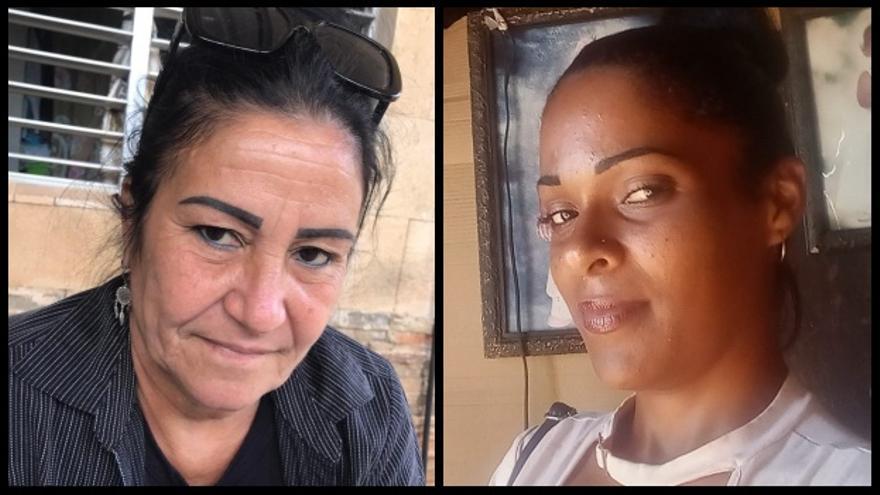
14ymedio bigger14ymedio/EFE, Havana, 5 October 2023 — The independent Cuban platforms https://www.yositecreoencuba.org/ (YSTC) and Alas Tensas confirmed two new femicides on the Island on Thursday, bringing the number of sexist murders verified so far this year to 62. The latest victims were Olaida Casanova and Nectaly Aguirre, 30, reported by activists on the social network X (Twitter).

According to the report, the first woman was murdered by her partner on September 21 in Cárdenas (Matanzas), while the murder of Nectaly occurred between the 27th and 29th of the same month in the province of Holguín.

The report expressly denounced “the disappearance and extreme violence” to which Aguirre was subjected, although they did not offer more details, and they regretted that this young woman left four minor daughters. continue reading

The activists also warned of five sexist assassination attempts and a similar number of cases that require access to the police investigation.

The joint under-registration of these platforms that collect data on femicides – in the absence of official statistics on sexist violence – accounts for 62 cases verified so far in 2023.

The activists also warned of five sexist assassination attempts and a similar number of cases that require access to the police investigation.

At the end of September, 23-year-old Yolanda Justiz Utria was allegedly murdered by her ex-partner on the 24th of that month in Guantánamo. The Yo Sí Te Creo and Alas Tensas platforms also lamented the murder of the victim’s eldest son, 11 years old.

The number of 34 femicides in Cuba verified in 2022 has already been exceeded in 2023.

The work of these feminist groups and their dissemination in the unofficial media have contributed to focusing on the cases of sexist murders and disappearances of Cuban women in recent years.

Activists insist on declaring a “state of emergency for gender violence”

The activists insist on declaring a “state of emergency for gender violence” and regret that the Government does not take action in this regard.

In addition, they advocate a comprehensive law against gender violence. Sexist murder is not in the Criminal Code; nor is the implementation of protocols to prevent these events, as well as the creation of shelters and rescue systems for women and children in danger.

Last April, the president of Cuba, Miguel Díaz-Canel, assured that there would be “zero tolerance” for sexist violence.

The official Cuban Women’s Federation created at the beginning of June the Cuban Observatory on Gender Equality, which includes statistics on “women who have been victims of intentional homicide as a result of gender violence in the last 12 months.”

This record totaled 18 cases in 2022 – compared to the 34 verified by independent platforms – a figure that coincides with the number of convictions for murder handed down in that year and linked to gender violence, according to the People’s Supreme  Court.

Translated by Regina Anavy

____________

COLLABORATE WITH OUR WORKThe 14ymedio team is committed to practicing serious journalism that reflects Cuba’s reality in all its depth. Thank you for joining us on this long journey. We invite you to continue supporting us by becoming a member of 14ymedio now. Together we can continue transforming journalism in Cuba.

A Cuban Baseball Player Escapes in Puerto Rico and a Triple Jump Medalist Arrives in the United States

Cuban baseball player Franky Quintana took advantage of an oversight in hotel surveillance in Puerto Rico and escaped. (@francysromeroFR)

14ymedio bigger14ymedio, Havana, 5 October 2023 — Cuban baseball player Franky Quintana escaped this Thursday from the hotel where the Island’s team is staying to participate in the fifth edition of the Caribbean Baseball Cup in Puerto Rico. The athlete “didn’t report with the group” to board the bus that took them to the Francisco Negrón Díaz stadium, located in Las Piedras, for the match against Curaçao, published El Nuevo Día.

The Baseball Federation of Puerto Rico confirmed to the same media that the Cuban authorities were already “investigating the matter.” The athlete would have left the hotel at night.

Journalist Francys Romero specified that with Quintana’s escape, there are 51 Cuban athletes who have left behind contracts or delegations in 2023. He said that the native baseball player of Isla de la Juventud was part of the Cuba pre-selection that was present in the World Classic and also toured Asia with the team.

Before traveling to Puerto Rico, Quintana had been selected by Armando Ferrer to reinforce the Crocodilos de Matanzas in the second edition of the controversial Elite League. In National Series he got 14 wins and 29 saves in 123 games. continue reading

The Cuban team, led by coach Armando Jhonson, had been highlighted by sports managers as the “most competitive team in recent years.” This group will define the backbone of the Cuban team that will attend the Pan American Games in Santiago de Chile.

Cuban triple jumper Davisleydi Velazco shared on her social networks a video of her journey to the United States. (Instagram)

Cuba’s participation in the Caribbean Cup had been in doubt because of the delay in visas for the players.

The escape of Cuban athletes is already alarming. Last Sunday Yobanys Millán left the Hilton Garden Innde Mérida hotel, in the Mexican state of Yucatan, where the Alazanes de Granma team that participates in the Baseball Champions League of the Americas was staying.

On Tuesday, the departure from the Island by Enrique Abreu and Mario Serra was confirmed. The young men, born in 2011,  participated in the Pan American Under-12 of 2023 in Mexico. They are in the Dominican Republic seeking to perfect their skills to look for an opportunity in a U.S. Major League team.

This Wednesday, the arrival in the U.S. of the Cuban triple jumper Davisleydi Velazco was also confirmed. The gold medalist at the U-20 Pan American Games in Peru (2017), the NACAC U-23 championship in Querétaro (Mexico) and the Alba Games in Venezuela (2023) shared an image of her arrival in the United States on her Facebook page.

“Welcome to the USA,” was the message she shared in a video on her social networks where she has been posting images of her 19- day journey. “There are no words to express such satisfaction,” she wrote.

So far, Velazco’s best record was achieved at the Pan American Stadium in Havana in 2020, with a jump of 47.05 feet.

Translated by Regina Anavy

____________

COLLABORATE WITH OUR WORKThe 14ymedio team is committed to practicing serious journalism that reflects Cuba’s reality in all its depth. Thank you for joining us on this long journey. We invite you to continue supporting us by becoming a member of 14ymedio now. Together we can continue transforming journalism in Cuba.

The Disaster of the Communist Business Model in Cuba

Caption: The rising cost of food in Cuba strains the budgets of many families. (14ymedio)

14ymedio bigger14ymedio, Elías Amor Bravo, Economist, 5 October 2023 — In a recent discussion on the Cuban State TV Roundtable program, the issue of the relationship of the ’regulated family basket’ [the monthly allotment of rationed goods] to banking was addressed by the Minister of Internal Trade (MINCIN), Betsy Díaz. She spoke about the increase in the autonomy of the business sector since 2010, especially in the gastronomy sector, but which, after Covid, the international economic crisis, the limitations of the Cuban economy and the effects of the blockade, must face new challenges.

The main challenge is self-management. The minister acknowledged that gastronomy has worked mainly through self-management with other actors, not only the micro, small and medium-sized businesses (MSMES) and cooperatives, but also agricultural producers and state companies that produce in the foreign exchange market, but that it is not enough.

The second challenge is the autonomy of entrepreneurs, with the development of first- and second-category gastronomy units, which refer to the popular network of economic line products and fast food. A truncated and beaten-down process.

The third is the boost to the network of bodegas, the ration stores, which must become commercial units of the neighborhood, incorporating other alternatives and services to fill, to some extent, the gap in the state network. It will be difficult for the current bodegas to do that. continue reading

Any approach makes sense, excepting a market economy, free enterprise and property rights. Communists test different formulas, but they refuse to redirect the Cuban economy to the model that exists in most countries of the world.

Therefore, this communist model of Cuban commerce generates dissatisfaction, which, according to the minister, is concentrated on the quality of services, especially on customer service, which affects the offer and the way the service is provided. If only this were true.

Next, the minister devoted herself to explaining the evolution of the bidding process in the business sector, which aroused so much interest at the time.

In 2014, establishments that offered beauty services, barbershops, hairdressing and some gastronomy were tendered by the MINCIN, but like so many other experiments of the regime, the process was stopped for political reasons. It began again in 2021 with the direct participation of the Municipal Assemblies controlled by the communists, which meant single-party control of the process, while allowing local authorities could bid for specific activities to be developed.

The Communist Party took control, and they say that 78.6% of the goal has been reached, but no information was offered either. The 11 real estate management companies specialized in leasing, which supervise and guarantee the fulfillment of the projects presented, were cited as an example. It’s a really low figure for a country with Cuba’s population.

Surprisingly, the minister was more satisfied with the control carried out by the Party through the Assemblies than by the activity of her own ministry. She pointed out that the key is to make better use of the infrastructure and to work with economic actors, preventing them from doing business in inappropriate places and recognizing the preeminence of the Party throughout the process.

For the maximum reinforcement of control, a Central Commercial Registry was created, responsible for granting permits for business activity. All natural and legal persons who carry out this activity have to register, including the MSMEs.

With these initial forecasts, the minister explained the relationship between the digital transformation process and business activities. It’s hard to believe that in a business sector like the one that exists in Cuba – backward, obsolete and inefficient – computerization or digitization can make any sense, much less the use of electronic payments. But the hierarchical slogan is mandatory, and the minister used it to explain this issue.

First of all, she argued that, as incredible as it may seem, despite not having all the equipment and infrastructure from a technological point of view, workers have even contributed their means and resources to promote this activity. With regard to banking, payment by QR code was conceived, starting with the point of sale terminals or POS in construction materials stores, a difficult process, “because it meant a cultural change in a sector that has been collecting cash for 64 years.”

The minister said at the end of June, before Resolution 111 was issued, which represents the decision to apply banking reform practically all operations, there were 14,369 establishments with the QR code in their business networks, while in September there were 20,762 establishments, and although it grew by 6,000, there are still more  needed to ensure this form of payment. The distance that remains to be covered is long and complex, but the minister took the opportunity to give some data. In September, 4.1% of business sales went through electronic payment channels. There is a long way to go.

These are no longer privileged areas with technology but provinces where the commitment and purpose of advancing in electronic collections exist. Thus, the minister recognized that the sales people use their cell phones under a voluntarist principle, although she recognized the existence of errors in the design of the bonus actions, for example.

She spoke about the role of the bodegas as bank agents, a formula in which the bank gives the agent a peso for each transaction. An establishment that has performed 297,000 operations will receive 297,000 pesos, an income not related to its management nor to the offer of products. There were workers who earned from 300 to 2,000 pesos in incentives; this income should become part of the payment system. And she cited some examples, such as in La Rampa, the Plaza municipality where a cash deposit is penalized and an electronic payment is subsidized.

The minister believes that when all payrolls in the country are digitized, a legal norm will require that all natural and legal persons who carry out commercial activity, and who are subject to inclusion in the central commercial registry, provide an electronic payment channel to consumers. And this is not “obligatory.” In the end, all commercial activities of any kind, of any organization, must ensure that there are electronic payment channels. Ordered and commanded.

The minister said that it is about digitizing the greatest amount of financial flow, maintaining cash, but everyone who carries out commercial activity has to guarantee the means of electronic payment, and she said that a deadline will be given to that process. The subjects registered in the commercial registry will have a period of time to validate that they guarantee that means of payment to the population, even in places of difficult access, and all provincial capitals must have conditions for the deployment of what is being proposed.

The minister believes that there is a process of change in mentality and culture, where there are many things that have also changed in business. She pointed out that before, the ’basic basket’ was priced at 20 pesos, but today it costs 180 pesos. In an agricultural market, any product can exceed two pounds and 100 pesos, recognizing the serious inflation problem that exists in the Cuban economy that conditions the success of digitizing trade.

At this point she pointed out that in the digital transformation there are two fundamental areas: one is electronic commerce and the other is e-government.

But payment through these electronic payment channels is not e-commerce. In electronic commerce there is a debt to the population since it recognizes that the state system hasn’t managed to have stability in the virtual stores that began to work during Covid, due to a deficit of products and because the platforms have not been stable. However, it has not been renounced.

In the field of e-government, due to a call from President Díaz-Canel in the National Assembly in December 2018 regarding the computerization of offices, a process began that demonstrates how much it can grow. The process exists in the infrastructure of the Youth Club and in computer contracting infrastructure, and today the Consumer Registry is digitized by 93%. The cases that remain pending sometimes respond to the coincidence between what the citizen’s unique file says and what the Oficoda’s book has, which dates back to 60 years where calligraphy and so on… But the process must be concluded in the coming days to have everything digitized.

This digitization allowed an effective purification; that is, people who leave the country for more than ninety days are discharged from the consumer registry. This registry also provides a digital seal. Today all the Oficodas stamp documents and procedures with a digital stamp.

And she announced that when you have all the digital records and the media, they integrate that database with the database in the Institute of Occupational Safety and Health, to care for people in vulnerable situations and have the procedure online, but means are needed to achieve this goal.

With regard to the multiplication of the centers of population (nuclei) with more than ten people, based on a characterization of those nuclei, the minister said that at the end of September, 20,062 new nuclei have been created. For this it is not a requirement to have housing and is by individual decision. Sixty-two percent of the nuclei could do it or already have. She pointed out that in Pinar del Río and the special municipality Isla de la Juventud, all the planned nuclei were attended to, while the least number of requests were made for the breakdown of these nuclei in the provinces of Cienfuegos, Sancti Spíritus and Santiago de Cuba.

The minister said that for months medical diets have been reviewed with the Ministry of Public Health. The Oficoda system registers the medical diets and then supports the products. She did not recognize the existence of problems in the assurance of medical allowances, based on a legal norm from 1992. That legal norm was reviewed, to eliminate the requirement of renewal of diets for chronic diseases, and its lifelong character was established. She offered the figure of 837,980 consumers: 76% percent of the people who receive a medical diet.

At another point in the Roundtable discussion, the Minister of Internal Trade, Betsy Díaz Velázquez, referred to the population’s basic basket for the month of October and acknowledged that many programs are taken care of by the MINCIN, and the standard family basic basket is monitored daily, from different control mechanisms. However, its operation leaves much to be desired and is the source of many complaints.

She pointed out in this regard that the Minister of Economy, Alejandro Gil, recently explained how much dependence that basket has on imports and the cost of fuel, and she referred to the arrival on September 29 of the first rice shipment for the month of October, which coincided with a deficit of diesel fuel, which fundamentally moves freight transport. All territories, as a priority, said that they would begin a fractional distribution of the rice, with an extraordinary effort. But is it the only rice shipment for the whole month?

A total of 12,187 bodegas in the country, including in mountainous and hard-to-reach areas, have not received the rice, of which 88 are in the province of Granma, due to the rains.

In terms of distribution there is a problem with the oil, which had problems for July and August. The oil that began to be distributed in September is being completed. Today it is pending completion of its distribution in Pinar del Río, Matanzas, Holguín, Santiago de Cuba and Guantánamo. The rest of the provinces have concluded the distribution.

There are also problems with the distribution of sugar, with the decrease of one pound per consumer, which will have an impact in the months of September, October and November. The distribution is being completed in Pinar del Río, Artemisa, Havana, Mayabeque, Camagüey and  Santiago de Cuba.

She said that the product of compote is now stabilized, despite many difficulties at the beginning of the year.

As for the grains, which have also had to be replaced by peas, there is a boat currently operating in Cienfuegos, and the completion of distribution for September and October is assured.

She explained that the situation with fertilizers has forced more grains to be imported. In 2018, for example, the normal family basket was covered with domestically produced beans, and released beans were also sold. Today the dependence on imports is total.

Regarding coffee, the Minister said that eight provinces delivered their product to the wholesale system, and distribution is being made to the factories.

As for powdered milk, she said that it is being divided, even with an important contribution of fluid milk. The age groups have been split, prioritizing children up to six months old and those from six months to one year. Although sometimes outdated for a few days, the children’s milk has been guaranteed, but not for those on specialized diets and pregnant women.

The minister said that the most complex products in the basket are still the proteins. Chicken was offered for the months of July and August, and Havana received the August chicken in the month of September.

As for eggs, the distribution varies but is guaranteed for the month of October.

Later, the minister referred to the attention to vulnerable people in the tone of demagoguery. Cuba has received donations of a volume of food that has been distributed to the entire population, including products such as rice, pasta, grains, sugar and in some cases sardines and oil. At a certain point, it was decided to allocate these modules to families and people in vulnerable situations, pregnant women and underweight children.

Therefore, with food donated by friendly countries and the World Food Program, four food distributions have been made that complement the standard family basket to all the population centers of the country from July 2021 to date.

The minister said that in the family care system, more than 56,000 beneficiaries are served, who receive the standard family basket, and 18,000 of them are served by social assistance. That means that people in a situation of vulnerability can receive food in three ways.

As for the school uniforms and the basket, the Minister said that these two programs are very dependent on imports. For uniforms, the primary schools were prioritized, and practically all the fabric for the uniforms is financed, which has allowed the uniforms to be delivered gradually.

The basket has been a little more affected since August 2022, because there has been a deficit of textiles for mattresses. The situation is so serious that Marrero looked for alternatives and put the clothing manufacturers at their maximum capacity to participate with social responsibility in that program and be able to cover the cribs, the mattresses and the basket.

Translated by Regina Anavy

____________

COLLABORATE WITH OUR WORKThe 14ymedio team is committed to practicing serious journalism that reflects Cuba’s reality in all its depth. Thank you for joining us on this long journey. We invite you to continue supporting us by becoming a member of 14ymedio now. Together we can continue transforming journalism in Cuba.

Is There Anything that Works Well in the Cuban Economy?

The housing situation in Cuba is one of the biggest problems in the country. (14ymedio)

14ymedio bigger14ymedio, Elías Amor Bravo, Economist, 2 October 2023 — How well a country operates is a reflection of how healthy its economy is. When it stalls, or begins showing signs that something might be amiss, it may be an indication that disaster is imminent. There is a common belief that the way to solve a problem is to try out a lot of different solutions, the more the better. But that is not the solution. The key is to first get the diagnosis right and then take appropriate action.

The Cuban regime, however, spent years doing neither. Its diagnoses are based on a reactionary, communist, ideological position that does not allow for changes or modifications. The measures that do get adopted reflect a poor understanding of how things work in the real world. They do not solve anything; they just end up making the situation worse. The victims In this endless merry-go-round of fatalities are the Cuban people. One gets the impression that they are starting to get tired of so much spinning around. The regime has managed to set off the alarm too many times.

What to make of an article entitled “Council of Ministers Approves Regulations to Be Presented to National Assembly” that appears in a government publication? It mentions “several legislative documents dealing with issues related to Cuba’s social and economic development.” Apparently, these were reviewed and approved at the September meeting of the Council of Ministers. Considering how slowly time has moved in the last 64 years of communist rule in Cuba, this suggests a new sense of urgency.

The council, which meets once a month, has approved a spate of legislative actions that, according to the regime, it “has been in the process of implementing for several years.” Here is a series of reflections on the state of the economy that raises the question, “Is there anything that works well in the Cuban economy?” continue reading

They consist of three preliminary projects which, for the umpteenth time and without deviating one iota from Communist ideology, Cuba’s leaders say will bring about “national social and economic development.”

The first is a draft of a proposed public health law to be debated in December.

The First Vice-Minister of Public Health, Tania Margarita Hernandez, pointed out that the proposed legislation defines “public health as a civil right; establishes constitutional rights, guarantees and duties; and proposes services to cover the care, protection and recovery of health.”

In other words, more or less the same old nonsense. This raises the question, “What is the purpose of a law that says the same thing as previous legislation but has no teeth?” It guarantees rights that are still not being granted, or are simply being provided in an inadequate way.

The communists say, “The document updates the obligations of the state and the government to guarantee free, accessible, high-quality services; establishes functions and obligations at the local level; clarifies the meaning health, which was not well-defined in the previous law, and allows for a multi-disciplined approach.”

This simply perpetuates the same old lies about a healthcare system which, though free of charge, offers very little or nothing. A system which is financed with taxes that the state imposes on a population that cannot freely choose the financial system it wants.

It is true that the legislation includes clarifications on end-of-life issues, the principles and purposes of public health, and the operations of the National Health System. But these are bureaucratic issues that would not have required a new law. Its backers also claim it protects a healthcare model that, for years, has left much to be desired. Officials claim, “Multiple consultations were carried out, both with specialists in the healthcare sector and with others closely related to it. International documents and legal instruments of various kinds were also evaluated.” Yet despite all this, Cubans remain dissatified with this system.

The second matter taken up by the Council of Ministers was the policy regarding a special Social Security program for agricultural and forestry workers as well as the preliminary draft of a law that must ultimately be approved by the Council of State. The Minister of Labor, Taniris Hernandez, described this document as “comprehensive and all-encompassing.” It incorporates new subjects into the program, expands and unifies protections for covered risks, and provides varying approaches for determining a worker’s period of employment in agricultural production.

The purported purpose of the regulation is to correct the inequalities created by the three different social security programs that currently exist. They are aimed at businesses in the agricultural and forestry sectors, and deal with financing issues, the scope of protections, the rights they grant and the risks they cover. Differences that are difficult to take into account in a centrally planned economy but are there nonetheless.

The directors have nothing but positive things to say about this piece of legislation. The Minister of Agriculture, Ydael Perez, declared, “The proposals were drafted in consultation with producers and prioritize their work in the field.” Julio Garcia, president of the AzCuba business group, claimed, “[It] will have a very favorable impact, especially for many people in rural areas, since now all types of businesses will be operating on the same playing field.”

The issue is that, although agriculture employs more people than any other sector, it has the lowest productivity. Many workers leave and move to service jobs in urban areas. It seems unlikely that these types of regulations will solve those structural problems.

The third piece of legislation is the System of Protected Areas Law, which must still be approved by the Council of State. The Minister of Science, Technology and the Environment, Elba Rosa Perez, noted, “For] the first time, the areas declared protected are part of the Natural Heritage of the Nation.” The legislation provides other conservation measures for areas that are not officially protected, including biological corridors and the Turquino Plan. Its statutes also take precedence over any possible private property rights.

The regulation creates a new office, the administrator of protected areas, who is tasked with drawing attention to these places and to the fact that some of the protected areas are scenes of illegal activities, notably logging and poaching. These and other such activities have led authorities to strengthen the everlasting systems of surveillance, denunciation and control.

Another topic approved in this session was the proposal to “lessen the current problems of rural Cuba,” an effort which apparently began in February. The objective is to improve living conditions in rural areas, which the regime acknowledges “is a fundamental component of national identity and on which the most important sector of the economy is based.” Inequities between rural and urban areas are just beginning to be questioned by large segments of the population, which has taken the regime by surprise.

Jorge Luis Tapia predicted these actions would create a more favorable environment for rural inhabitants, encouraging them to remain in these areas. He also believes they will increase local food production and self-sufficiency, raise incomes and improve living conditions. But measures like these already have a long track record and none of them have ever managed to boost agricultural productivity. It is not measures like these that provide people with a decent living or encourage them to remain in the countryside. For that, they need property rights to the land they work.

The communists forget this. They think the actions to be taken by various governmental agencies, will insure economic investments are made in rural areas if they are appropriately implemented (even with less than 5% of the total investments going to the agricultural sector); that they will encourage housing development, increase the supply construction materials and equipment, and provide other incentives for professionals who live and work in rural areas; that they will revitalize agricultural communities established after the revolution. Lastly, they believe this legislation will bring students studying agriculture at technical schools and universities closer to the means of production in rural areas. While this means more spending on the agricultural sector, it is indirect. If implemented, it will not have the income multiplier effect that should come from such an investment.

It seems the idea of prioritizing rural areas came from Diaz-Canel Bermudez, who describes it as a matter of “economic, productive and social importance as it relates to demographics, support for farm workers, food production, and many other issues.”

The members of the Castro-appointed Council of Ministers also approved the compliance report on housing policy. It was presented as part of detailed, critical analysis of the program’s delayed implementation. Delays, the U.S. embargo and poor performance by the housing sector explain the weakness in the Cuban economy and its inability to act as a economic driver as it does in other countries.

The Director General of Housing, Vivian Rodriguez, took over the disastrous housing sector in 2019 and began implementing the policy. Since then, 127,345 homes have been completed and 106,332 have been rehabilitated. But here’s the bad news: the country currently has a housing deficit of more than 800,000 units, with the situation being more serious in Havana, Holguín, Santiago de Cuba and Camagüey.

She acknowledged that the biggest problem with housing policy is subsidies. Investments which were supposed to increase the supply of building materials have not materialized, nor has the necessary equipment to expand construction capacity and sustainability. It’s the same old story but with the further aggravation that, as the director admitted, “fulfilling the plan for the current year is at risk.”

Faced with a devastating diagnosis of the Cuban housing situation in 2023, the Council of Ministers could not come up with anything other than “the strategic redesign in each territory of local materiral production, with an increase in [the supply of] local raw materials that will guarantee independence in the production of materials and respond to the needs of the program.” In other words, things are getting worse and worse.

So again I ask, does anything work well in the Cuban economy?
____________

COLLABORATE WITH OUR WORKThe 14ymedio team is committed to practicing serious journalism that reflects Cuba’s reality in all its depth. Thank you for joining us on this long journey. We invite you to continue supporting us by becoming a member of 14ymedio now. Together we can continue transforming journalism in Cuba.

Havana Prohibits Dogs from its Beaches… Where There Are Hardly Ever Any Dogs

“The dogs left all these here, for sure”, says a lifeguard, pointing to all the empty drinks cans discarded on the sand. (14ymedio)

14ymedio biggerJuan Diego Rodríguez, 14ymedio, Havana, 22 September 2023 – Among the new measures dictated by the Havana government on hygiene and community services, one in particular has caused special irritation. It’s the one which prohibits pets or farm animals from the beach, similar to their prohibition from cemeteries or rubbish dumps, which can entail, according to the resolution which came into force on Wednesday, a fine of between 1,500 and 2,000 pesos.

The Cuban Association for the Defence of Animals (Ceda) declared its  “complete disagreement” with the article in a posting on its social media pages, as, they argue, it goes against the law’s Animal Wefare Decree. This states expressely that “pet owners should clear up their pet’s waste”, they explain in their text, where they propose that, “there can be beaches where pets are not allowed, or months of the year when they’re not allowed, or hours during the day. But it’s not acceptable to ban pets from areas where the families of their owners go to relax”.

Ceda also says that “thanks to the fact that there are people who look after the animals’ health and sustenance”, any animals that were in these locations, for example in cemeteries”, are not any “danger to society, and actually enhance the place because they enhance the sense of security, create a space that is more amenable for people and prevent us from becoming somewhat sterile beings”.

“We won’t accept that those who look after the few animals that actually cause no higiene problem are to penalised”  

In Cuba there are “millions of street animals”, the association concludes: “We won’t accept that those who look after the few animals that actually cause no higiene problem are to penalised, especially when there are no refuges nor any government solutions for mitigating the plight of so many other animals that are suffering and in critical conditions on the streets”. continue reading

Another animal activist, known on social media as Filoxiraptor, argued that: “The animals don’t mess up the beaches or their adjoining areas and I’ve never seen the authorities impose fines for non-compliance of this measure for native and legal people”.

He added also that if there are “community animals” (on the streets) it is through “their being abandoned and there being a lack of awareness about it in the country”, and that, also, “the majority of vets, because of the lack of resources, recommend actually taking them to the beach, to heal their skin problems, tone their muscles and rehabilitate them”.

When 14ymedio visited the three beaches of Santa Maria, Mar Azul and Megano – to the east of the capital – on Friday, they found no pets there. However, it wasn’t because they’d started to rigorously enforce the new law, rather it was simply because that’s how it normally is.

“It’s not usual to bring animals, because most people come by public transport, where they’re prohibited”, explained a bather, who told us he left his two dogs at home in Central Havana, but that he doesn’t agree with the new ruling. “It’ll be because of the mess that the animals leave everywhere”: he indicates with irony the mountain of empty drinks cans discarded on the sand: “Yeah, all the dogs left all these here, sure they did”.

“There’s no need to worry if there are no police about, just imagine the inspectors”, the lifesaver reasoned

Furthermore, when asked about the new law, a lifeguard suggested that there would be no problem bringing pets to the beach. “There’s no need to worry if there are no police about, just imagine the inspectors”, the man reasoned.

The article referring to pets is not the only one that has awakened discontent: the ruling also includes fines of 2,000 to 3,000 pesos for anyone not putting their rubbish into the bins in time. Comments on the official site Cubadebate demonstrate this.

“These measures are very good and I’m glad they’ve introduced them but I want them to tell me where I’m to put my rubbish when all the bins are full, because as far as I know the rubbish collectors don’t come by every day and the bins fill up in less than a day”, says one poster named Daniel. In the same way, Besteiro says: ” In my neighbourhood (EMBIL, Boyeros) it’s common for ten days or more to go by before they collect the rubbish, and with the container full where are you supposed to put yours?”

He asks himself: “What do they do with those who steal the wheels off the rubbish bins and later make handcarts with them and push them past the police? What do they do with the community workers who pull the bins off the wagons and, despite being new, break them?”

“Only mobilize the people’s awareness? And what about the others? The obligation of the Comunales as public servants and cause of this disaster, does that not count?” asks commentator Paloma, who lists: giant rubbish dumps, blocked drains, long-standing leaks, unswept streets, sewage spills, overgrown weeds, pavements destroyed by rubbish collectimg trucks, indifferent employees who mistreat the bins and leave the streets full of rubbish, and much more, has nothing to do with people’s awareness.”

Translated by Ricardo Recluso

____________

COLLABORATE WITH OUR WORKThe 14ymedio team is committed to practicing serious journalism that reflects Cuba’s reality in all its depth. Thank you for joining us on this long journey. We invite you to continue supporting us by becoming a member of 14ymedio now. Together we can continue transforming journalism in Cuba.

More Than 60 Cubans Have Been Tried for Illegal Gold Mining in Ciego De Avila This Year

A man looks for gold in Holguín. (14ymedio)

14ymedio bigger14ymedio, Madrid, 4 October 2023 — More than 60 people have been tried in Ciego de Ávila since February of this year for crimes related to the illegal extraction of gold. A much lower number than in 2021, when 300 individuals were forced to pay fines and other penalties, in addition to the confiscation of the materials used in their work, including tools and vehicles.

In the province, the problem is long-term. In January, the Minister of Energy and Mines, Vicente de la O Levy, was in the municipality of Baraguá, one of the most affected, where he asked them to face the problem with “rigor, rationality and systematicity.” The official alluded to the dangers of this practice, which puts health at risk due to the lack of adequate equipment, but also to the impact on the local economy, where gold is used as a currency, further devaluing the peso.

The local magistrate has been of little use, and the Municipal Court of Baraguá has had to deal with 16 cases of this type, including a complaint of disobedience and a trial for bribery, linked to illegal mining and punishable by up to eight years in prison. Humberto González Figueroa, a specialist in Criminal Law and president of the Provincial Popular Court of Ciego de Ávila, told all this to the newspaper Invasor.  continue reading

To these cases are added five trials for soil contamination, in which six people were convicted

To these cases are added five trials for soil contamination, in which six people were convicted. Three received prison sentences and another two, correctional sentences.

In addition, there are nine pending trials for that same crime, and the accused remain either in pre-trial detention or have been released on bail.

Invasor, more than an informative piece, has dedicated a moralizing article to the matter, admitting in spite of everything that “no one learns from someone else’s mistakes.” The provincial newspaper explains the articles of the Criminal Code and the Mining Law that punish this type of activity and points out that Camagüey, Las Tunas and Holguín are also among the territories that suffer the most from these crimes.

“Those who feel encouraged by the easy enrichment and conquest of gold, in the style of the North American West, must also keep in mind that the short, medium and long-term effects of exposure to mercury and silica dust are well documented by specialists, not only for them, but also for their families and even nearby populations,” the report concludes, trying to paralyze illegal mining through alarmism.

Beyond the health concerns, the Government is concerned about the pillaging suffered by its mines in the center of the country

Beyond the health concerns, the Government is concerned about the pillaging suffered by its mines in the center of the country, almost all of them handed over to concessionaires such as the Australian Antilles Gold, which in March 2022 presented a project to partner with the state-owned GeoMinera S.A. and carry out surveys in several sites on the Island, three of them in Ciego de Ávila, one in Camagüey (La Unión), another in Holguín (Aguas Claras) and La Demajagua, in Isla de la Juventud.

The problem of illegal gold mining in Cuba began to worry the official press in 2018, when the official newspaper of the Communist Party published a report about the deaths of several people due to this activity.

“In search of a quick fortune, illegal miners not only take illicit advantage of the national heritage and damage the environment, but they also endanger their lives,” Granma’s text said.

By that time, this newspaper had already published, in its first months of life, a report in which it addressed the phenomenon, specifically in Holguín, where the miners themselves spoke about their working methods and the risks that stalked them.

Translated by Regina Anavy

____________

COLLABORATE WITH OUR WORKThe 14ymedio team is committed to practicing serious journalism that reflects Cuba’s reality in all its depth. Thank you for joining us on this long journey. We invite you to continue supporting us by becoming a member of 14ymedio now. Together we can continue transforming journalism in Cuba.

Cuba Identifies 9 of the 10 Who Died in the Accident in Mexico, but Refuses To Give Their Names

Eleven Cubans, who were injured in the accident in Pijijiapan (Chiapas), were discharged. (Cuban Embassy in Mexico)

14ymedio bigger14ymedio, Ángel Salinas, Mexico, 4 October 2023– Cuban authorities have identified nine of the ten people who died last Sunday in a traffic accident in Pijijiapan (Chiapas), but at the moment they have not publicly said who they are. According to the consul in Mexico City, Miguel Ángel Moreno Carpio, “all the deceased will be repatriated shortly.”

In a video uploaded to the diplomatic headquarters’ Facebook account, the consul mentioned that he is “working diligently” together with the Mexican authorities to identify the missing victim of the incident.

A nurse at the Pijijiapan hospital, where some of the injured are being treated, confirms to 14ymedio that among the deceased are Dayanes Morales Piedra, 23 years old, Naelis Carrillo Rodríguez, Aylen Moreira Guimarais, María Fernanda Lara (12), Zulema de la Caridad Amarral Valverde (16), Alicia de la Caridad Rodríguez Montero (22) and Shakira Martínez. The nurse does not have authorization to provide the other three names.

Selena, Shakira’s sister, requested the help of the authorities for the repatriation of her sister’s body. The deceased young woman, originally from Holguín, left Cuba more than a month ago in the company of her sisters with the purpose of reaching the United States, commented independent reporter Neife Rigau, a friend of the young women. continue reading

“I don’t understand why they don’t release the list. They asked us not to report anything without consular authorization,” the nurse tells 14ymedio. “Each of the cases have been detailed to the authorities. Among those hospitalized there are several minors who required specialized care and had to be transferred to other institutions.”

Immigration agents take data from two Cubans who were traveling in the truck that crashed last Sunday in Pijijiapan (Chiapas). (Migration’s national institute)

The injured have been treated at Huixtla, Mapastepec and Tonalá hospitals, as well as Pijijiapan. The initial list included Damelos Talavera Sánchez, 32, Mailen Melissa Aliaga Tamayo (24), Ariany Velasco Moreira (7), Yaritza Alen Cuitc (44), Eliani Dueña Carrillo (6), Melissa Guilarte Cerrando (18), Elisa Mauro Chávez Prieto (20), Sonia Tamayo Rosales (53), Daykenia Rodríguez (46), Diana Iris Lozano Moleón (26), Armando Cárdenas Césped (60), Alejandro Adrián Velasco (12), Yorlaine Valverde Pastor (17), Ross Liz Cortina Mandearable (18), and Félix Arriaga Suárez (46).

The Cuban consul did say that 11 people were discharged and another “six receive personalized medical assistance.” Among them is a minor who “receives treatment for lung involvement.”

The nurse explained to this newspaper that the difference in the figures occurs because two of the injured “did not need hospitalization.” Two of the patients, she said, “were admitted with the diagnosis of serious illness to the General Hospital of Huixtla.”

The Chiapas State Prosecutor’s Office opened an investigation file for the crime of reckless homicide in “traffic events” against the person or persons responsible for this incident.

____________

COLLABORATE WITH OUR WORKThe 14ymedio team is committed to practicing serious journalism that reflects Cuba’s reality in all its depth. Thank you for joining us on this long journey. We invite you to continue supporting us by becoming a member of 14ymedio now. Together we can continue transforming journalism in Cuba.