Mijain Lopez Beats Up a Cuban Who Asked for ‘Freedom’ for Cuba in the Pan American Games

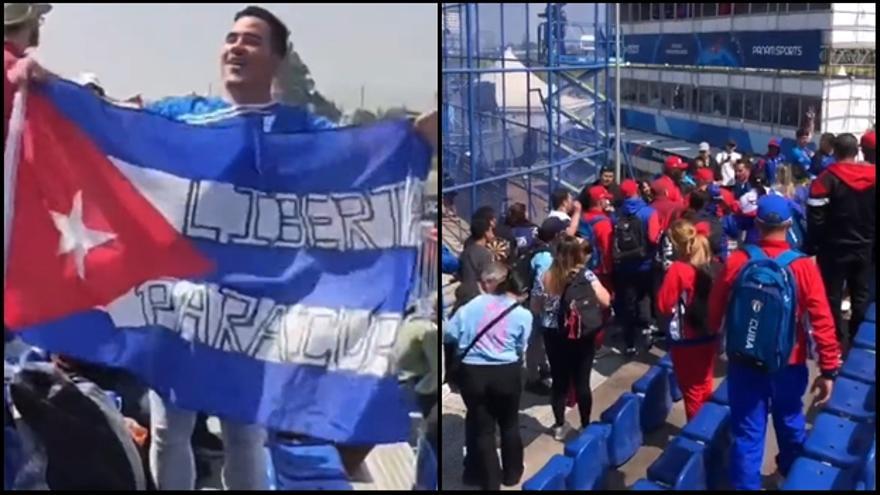
The young man said he was going to file a complaint against Mijaín López. (Collage)

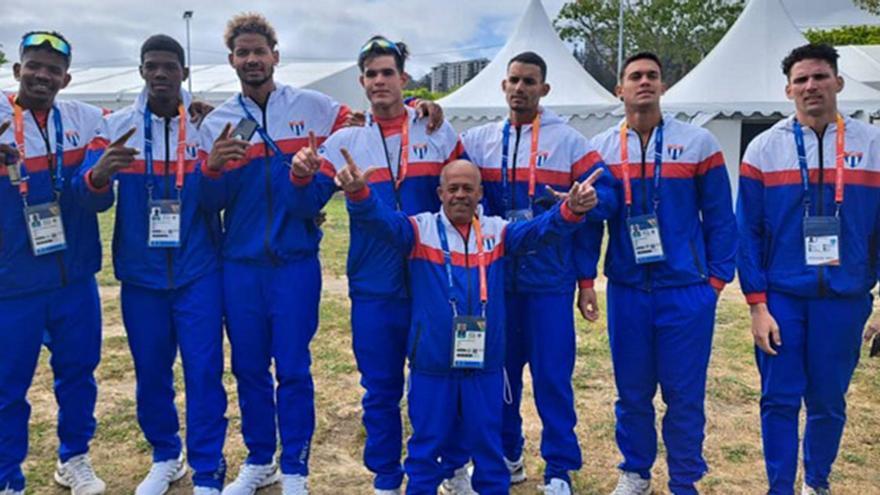
14ymedio bigger14ymedio, Havana, 25 October 2023 — The instability caused by the escapes of players continues to affect Cuban baseball, which on Tuesday suffered a defeat against Brazil (2-4), leaving it out of the medals at the Pan American Games Santiago de Chile 2023. However, the worst grade, shameful for the delegation, was given to the four-time Olympic champion in Greco-Roman wrestling, Mijaín López, in the stands of the Bicentenario Cerrillos stadium where the game took place. The five-time world gold medalist couldn’t bear that a compatriot would fly a flag with the slogan “Freedom for Cuba.”

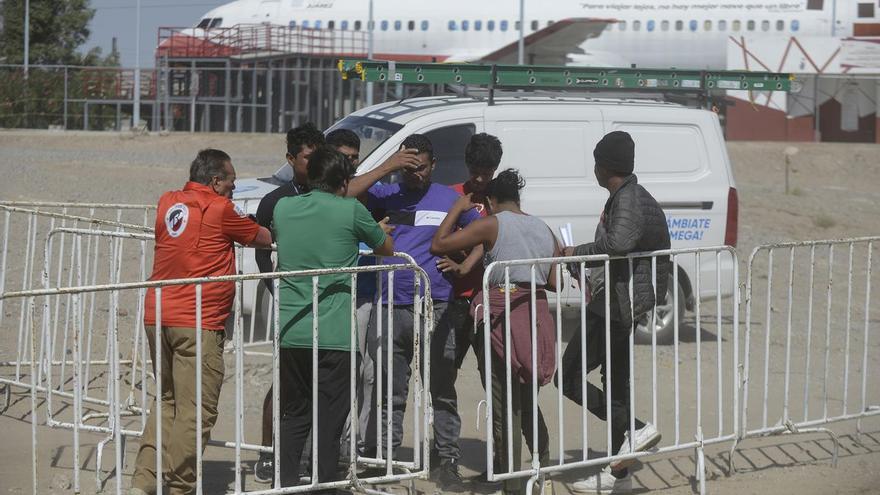
At the end of the game, López, also a deputy of the National Assembly of People’s Power, pounced on the young man. He rebuked him, and in that back and forth of words, he threw a blow. The athlete was accompanied by other members of the Island delegation, who also pushed the Cuban emigrant identified as Damián.

“I only had the flag in my hands,” the young man said in a video that was shared by Omar De La Paz-Molina on his Facebook account. “I didn’t yell anything at them or disrespect them,” he stressed. Their anger was because I was demonstrating for “freedom.” continue reading

#Ahora! [Breaking news!] Altercation in the Pan-Americans… several Cubans were in the stadium to shout “freedom,” and at the end, the Olympic medalist and deputy of the regime, Mijaín López, assaulted one of them. The police had to intervene to remove Damián from an angry group of Cubans. Despite this, he said he was going to file a complaint against the four-time Olympic champion. “I’m going to prove injuries. I walk alone and you know that they are rats.” Info. Marcel Valdés  — Mag Jorge Castro (@Mjorgec1994) October 25, 2023. 

Mijaín López decided not to compete in the Pan American Games, recognizing that his preparation was not as successful as he would have liked, and “I had to lose a lot of weight.” The 41-year-old athlete said he will focus on the Paris 2024 Olympic Games, in which he still aspires to win a fifth medal in the 287-lbs. category.

His presence in the stadium is due to the fact that López, like Javier Sotomayor, is part of a group of Cuban athletes invited to the Pan American Games. In July, in addition, the four-time Olympic champion in wrestling was chosen as one of the 11 new members of Team Panam Sport.

Panam Sports selected him because, in addition to being “recognized” for his determination, skill and performances, he also represents “the Olympic values both inside and outside the sports venues.”

“Being an ambassador of Team Panam Sports is something very big and important to me. Any athlete from the Americas would be proud to belong to this Team, so I am very happy that they have given me that opportunity as an athlete from Cuba,” López said at the time.

Translated by Regina Anavy

____________

COLLABORATE WITH OUR WORKThe 14ymedio team is committed to practicing serious journalism that reflects Cuba’s reality in all its depth. Thank you for joining us on this long journey. We invite you to continue supporting us by becoming a member of 14ymedio now. Together we can continue transforming journalism in Cuba.
The Cuban Rowing Team Wins Gold in Chile, Despite Multiple ‘Desertions’

The rowing team anticipated competition at the Pan American Games in Santiago de Chile 2023. (Jit)

14ymedio bigger14ymedio, Havana, 23 October 2023 — With a delegation diminished by desertions and with few renowned athletes, the Cuban authorities did not dare to predict more than 18 gold medals for these Pan American Games in Chile. Much less was it imagined that, a few days after the start of the sporting event, the athletes would earn three gold medals in rowing, weightlifting and rapid-fire with an air gun, categories in which they had little hope. “We didn’t have this crown in the plans,” acknowledged the president and national rowing commissioner, Ángel Luis Fernández.

The director told the official media Jit that they had little chance in the face of “the strength of Uruguayans, Americans and Chileans.” However, the members of the eight-man, long-oar sculling boat  — Roberto Paz, Luis León, Henry Heredia, Francisco Romero, Andrey Barnet, Leduar Suárez, Carlos Ajete, Reidy Cardona and Juan C. González — went through the 1,640 feet in 1:22.72 minutes; through the 3,281 in 2:47.68, through the 4,921 in 4:15.34 and through the finish line in 5:37.89 in the Laguna Grande San Pedro de la Paz.

The same team in Lima 2019 won 10 medals: two gold, three silver and five bronze. However, the escapes of several of its members – Maykol Julio Álvarez (in April), Yoelvis Javier Hernández and Osvaldo Pérez – made the authorities doubt their good performance in this edition of the games. continue reading

Álvarez and Hernández deserted after winning the silver medal in the four-pair category (4X) and rejecting the ticket to Chile that their achievement had granted them. In November 2022, rowers Jorge Patterson and Yudisleidys Rodríguez fled after one of their training sessions on the Virgilio Uribe Olympic track, in Mexico City.

Before the escapes of Patterson and Rodríguez, came Ernier Tamayo, Alexei Carballosa and Nayala Torres on November 17, 2022, while preparing in Mexico City for the Central American and Caribbean Championship that began six days later in El Salvador.

This Sunday, Leuris Pupo also won gold in rapid-fire. The veteran lost the bronze medal in the last Central American and Caribbean Games of San Salvador 2023, because the regulations state that one country cannot win the first three places in case a challenge is presented, and the bronze medal will go to fourth place – although it was returned by the Mexican athlete Fidencio González. The silver and bronze medals went to the Venezuelan Douglas and the American Leverett, with scores of 26 and 23, respectively.

On Saturday, Arley Calderón (weightlifting), whom coaches gave few chances to even get a bronze, won gold in the 135-lbs. category at the Chimkowe gym. The silver and bronze medals were won by the Mexican Víctor Guemez and the Peruvian Luis David Bardales.

Other Cuban medalists of this edition of the Pan American Games are Arlenis Sierra, with the silver obtained in the time trial of road cycling, Olfides Sáez in weightlifting (196 lbs.) and Kelvin Calderón in taekwondo (176 lbs.).

Translated by Regina Anavy

____________

COLLABORATE WITH OUR WORKThe 14ymedio team is committed to practicing serious journalism that reflects Cuba’s reality in all its depth. Thank you for joining us on this long journey. We invite you to continue supporting us by becoming a member of 14ymedio now. Together we can continue transforming journalism in Cuba.

Customs is Not at the Service of the Cuban Economy. Quite the Opposite

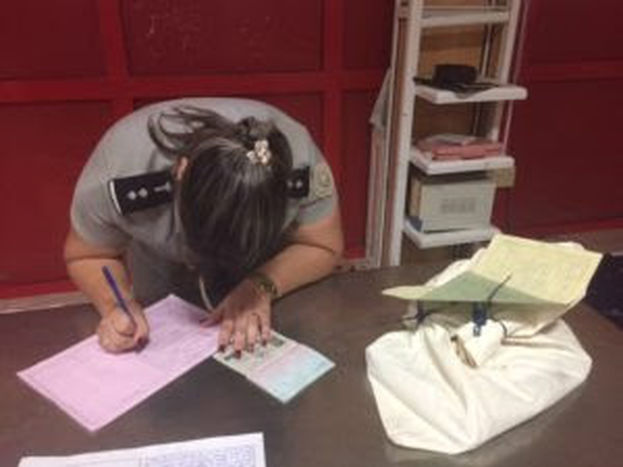
Customs Officer in the process of confiscating the belongings of Eliecer Avila. (Somos+)

14ymedio biggerElías Amor Bravo, Economist, 8 October 2023 — The richest areas of the planet are committed to free trade, the absence of tariffs and customs taxes. Competitiveness and tax collection are normally favored by this type of fiscal design. It so happens that in Cuba the communists go in the opposite direction, and thus, the regime boasts of the control exercised by customs management, considered as a “guarantee of safe trade”.

Nothing could be further from the truth. The growing threat of illicit activities such as smuggling, drug trafficking and terrorism, which the regime’s leaders use as arguments to defend the interference of the customs system in the functioning of the economy, does not correspond to the observation of reality. For example, in the European Union, where customs have been demolished for decades, nobody is thinking about smuggling, drugs or terrorism, with higher levels than in other areas of the planet. The argument of the Cuban authorities is not supported by reality, like many other communist ideological maxims inserted in the mechanisms of political control that the Castro regime possesses.

Instead of lightening the customs burden, Cuban communists have embarked on a process of attempting to perfect both customs processes and the application of tools that guarantee compliance with the responsibilities and functions of Customs, which, far from benefitting trade, employment, and economic activity, serves to impose control and surveillance upon economic actors that try to open spaces in the heavy bureaucratic structure of the economy.

Many Cubans were victims of those practices and were dispossessed of their scarce belongings through pillaging practices, orchestrated by the communist party with customs officers at their service to appropriate items that were later redistributed

Cubans know well what the Customs General of the Republic represents, as if, since the beginnings of the revolutionary process, it took a path of repression and sanctioning that accompanied those who were fleeing communist oppression until the last minute of searches carried out in continue reading

airports. Many Cubans were victims of those practices and were dispossessed of their scarce belongings through pillaging practices, orchestrated by the communist party with customs officers at their service to appropriate items that were later redistributed.

The confiscation practices of those revolutionary moments reached such dimensions that I remember that, during the Special Period, a compatriot that was visiting the island was able to verify that jewels that had belonged to his family were being auctioned off at hotels in the capital. It’s incredible how time sorts things out. So no one should find it surprising that Cubans view their Customs as nothing other than one more repressive instrument at the service of the regime’s state security.

For that reason, however much propaganda seeks to clean up this image, it is not an easy task. Customs is not seen as a public service that serves the citizens or as an instrument to collect indirect taxes in order to fulfill state customs policy for international traffic of transportation, goods and travelers. Nobody thinks of it that way– Customs is seen in a completely different light.

The regime wants customs management to serve the protection and security of the borders, but, in Cuba, this activity is carried out by practically the entire institutional and party organization, including the CDR’s (Committees in Defense of the Revolution) and popular organizations at the service of the regime, thus the practical sense of Customs is of no interest– it is redundant. It is just an agency that generates abundant employment, not well-paid of course, similar to many others that make up the budgeted sector, and not much more.

Another turn of the screw to further control and surveil economic actors, just the opposite of economic freedom and the opening of borders, which is what economic efficiency demands

The state press has included statements from Nelson Cordovés, head of Customs, who said that “all of the regulations related to the border are being reviewed in order to ensure security in trade, as well as transparency and agility in these processes”. It’s enough to make one tremble. Another turn of the screw to further control and surveil economic actors, just the opposite of economic freedom and the opening of borders, which is what economic efficiency demands.

The communists want Customs to be a guarantee of safe trade and that, in light of the “growing threat of illicit activities such as smuggling, drug trafficking and terrorism, customs processes must be improved and strategies must be applied to ensure compliance with the responsibilities and functions of Customs”. A reasoning that is based on an erroneous assumption and turns into a statement that generates more than a few doubts and uncertainties.

Specifically, the leaders intend to implement a series of measures in customs management.

The first is to improve the “confrontation” system by acting on “the selection and updating of risk profiles, the physical recognition model with the requirements and instructions for the execution of red channels, the employment of canine methods, and the utilization  of images and the interpretation of the x-ray screening of containers, in addition to achieving a consolidation of the Global Container Control Program”.

More control and bureaucracy in the “confrontation” that will lead many to stop their activities, diminishing the products and goods that enter the country through this route. The communists have offered data on inspections carried out in the last months and have entertained  themselves by enumerating the sanctions applied to “errors in the country of origin, of classification, in the invoice value, in the filling out of the Goods Declaration (Declaración de Mercancías or DM), the distribution of expenses; surplus merchandise not legalized  with customs; incorrect use or non-use of preferential agreements; and not concluding the processing of documents in the Single Customs Window (Ventanilla Única de la Aduana or VUA)”. Unbelievable.

Because if they were to follow protocol, at least 75% of the Customs staff would have to be cut

The second has to do with eliminating obstacles with an impact on customs clearance. Why only these and not all of them in general? Because if they were to follow protocol, at least 75% of the Customs staff would have to be cut. It’s important to remember that this entity extends its tentacles to actions related to the Ministry of Agriculture, and to the temporary admission of goods to be exhibited at fairs, exhibitions, and other similar events, which is usually given an opportunistic internal exit when the events in question are over. It also extends to foreign investment, focusing on aspects that influence the process of obtainment and certification by national regulatory bodies.

The third measure is related to the single window, whose new services that display the data and status of the Goods Declaration, settlement statement, error statement, summary of operations, time frames, and report on the information of the maritime and air manifests, among other options, allow a better use and presentation of documents of the declarant. The question is, how many actors would really benefit from this service, and above all, who? There would be surprises.

The fourth has to do with the increased inclusion of economic actors in the authorized economic operator program.

This is a certification granted by Customs to a company, in theory almost all state-owned companies dependent on the regime, which are part of the supply chain, and that comply with customs standards, in order to ensure the security of the foreign trade logistics chain.The entity is recognized as a safe and reliable operator in the supply chain for Cuba’s Foreign Trade, embedded in the changing dynamics of global trade and international standards. At the moment, the small and medium-sized enterprises or self-employed workers included in this certificate can be counted on one hand.

The fifth step involves making improvements in the management and procedures of customs revenue collection. Income has to be obtained by any means necessary because the state’s coffers are suffering from the weakness of the economy. Here, the communists are working to implement electronic payment through the Single Window, a further step in the process of hierarchical access to banking services imposed by the regime.

Customs, directed by the communist organization and under the ideological control of the regime, will do whatever it deems opportune, but we must say beforehand that none of this will benefit the functioning of the Cuban economy. Customs acts as a control and collection barrier that makes no sense and does not meet the efficiency requirements needed for an economy to prosper. With this type of Customs, the memory for many Cubans will continue to be the same as during the years of repression. It would be best to close it.

Translated by Lucie McCallum and Jesus Tunon as part of Spanish 321 (University of Miami)

____________

COLLABORATE WITH OUR WORKThe 14ymedio team is committed to practicing serious journalism that reflects Cuba’s reality in all its depth. Thank you for joining us on this long journey. We invite you to continue supporting us by becoming a member of 14ymedio now. Together we can continue transforming journalism in Cuba.

Maria Corina Machado and the Rescue of Hope in Venezuela

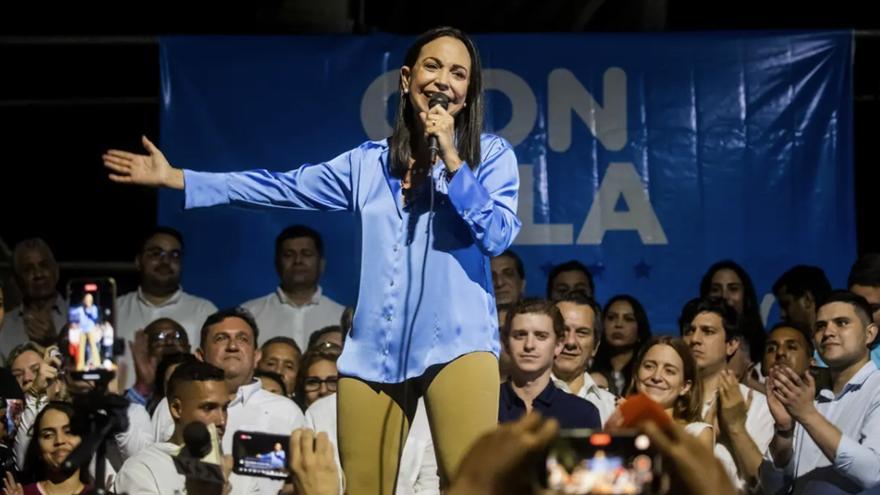
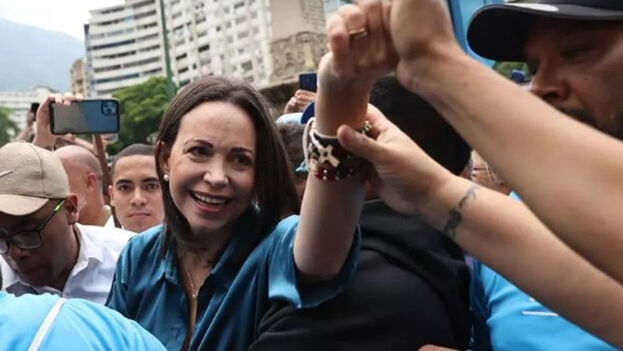
Former Venezuelan deputy María Corina Machado celebrates with allies and followers the results offered by the primary elections commission, in Caracas, on October 23, 2023. (EFE/Miguel Gutiérrez)

14ymedio bigger14ymedio, Pedro Corzo, Miami, October 29, 2023 — Venezuelans committed to democracy have once again set an example of perseverance and commitment to their country. An achievement in which the leadership of María Corina Machado, a woman with overflowing courage and convictions, has been essential.

Machado overwhelmingly defeated her rivals and enemies. Even more importantly, she managed to get her fellow citizens, both inside the country and abroad, to take to the streets to vote, a sovereign right that despots try to violate.

The electorate believed in her with such fervor that they voted massively in her favor, despite the difficulties implemented by the autocrats, among others, the disqualification of the candidate, a condition widely repudiated by the voters with the resounding support they gave her.

Castro-Chavismo breathes into its governed at least two terrible viruses: hopelessness and the certainty that the end of tyranny can only occur with foreign help. continue reading

The loss of hope is the most pernicious thing that a people can suffer

Hopelessness is caused by the high level of frustration of the governed. A feeling that is proportional to the duration of the mandate one suffers and corresponding to the enthusiasm generated by the demiurges who propose to be gods.

After the initial exaltation caused by a populist victory full of demagoguery and falsehoods, comes a daily life that demands work, discipline, probity and perseverance; a management in which the people of Venezuela, Cuba, Nicaragua and Bolivia have been able to confirm that their autocrats, in addition to being corrupt, have been inept.

The loss of hope is the most harmful thing that a people can suffer. It is true that there are those who do not stop fighting, even if the blackest darkness surrounds them; however, the majority of citizens need to see a light, however minimal, at the end of the road, a dawn that, evidently, María Corina Machado, an exceptional leader, has made it possible for her people to perceive.

My admired fellow prisoner, the ambassador Armando Valladares, wrote an anthological book about that feeling entitled Against All Hope. It is that in prison all hopes can die just as under tyrannies, although, unfortunately for tyrants, they are never lacking. Jose Martí’s white roses in the most lush field of thistles and nettles.

Machado spread hope among Venezuelans. She erased the many mistakes of these years, including those of her colleagues who timidly tried to reproduce the behaviors and speeches of their enemies. The candidate germinated confidence again and restored the certainty that it is possible to enjoy a better life, with a promising future for one’s children.

The journey was uphill, never without danger. She challenged Nicolás Maduro and Diosdado Cabellos, two individuals with a terrifying criminal record. However, the path that remains is no less complex and abrupt, which is why the candidate continues to need to count on the support of her forces and herself, to continue fully interpreting the feelings and needs of her supporters.

Hope has been recovered and I trust that the Cuban experience demonstrating that there are committed allies will become certainty for those who suffer regimes that perpetuate themselves because they know how to choose their enemies.

The candidate germinated confidence again and restored the certainty that it is possible to enjoy a better life, with a promising future for one’s children

Castro-Chavismo stigmatizes the opposition when it accuses it of being a foreign agent and it mutilates itself if it comes to believe that outsiders will be firm allies in its efforts, which motivated the apostle Jose Martí to write: “The enemies of the freedom of a people are not so much the strangers who oppress them, as the timidity and vanity of their own children.”

I was a partial witness of that magical Venezuelan enthusiasm. I shared with friends and strangers the joy of glimpsing a better future, even more so, the expectation of seeing the clouds covering El Ávila hill again or simply driving under the towers of Silencio.

I even dreamed that we Cubans, one day, would be able to have a similar experience and, suddenly, an aside from the poet Antonio Machado came to me, “Walker, there is no path, you make the path as you walk*.” In both Cuba and Venezuela, there has been no shortage of walkers who have given everything for their rights, and pilgrims like María Corina Machado, imitating the poet, with enough awareness to look back without repeating the path that leads to slavery.

*Translator’s note: From Antonio Machado, 1917

____________

COLLABORATE WITH OUR WORKThe 14ymedio team is committed to practicing serious journalism that reflects Cuba’s reality in all its depth. Thank you for joining us on this long journey. We invite you to continue supporting us by becoming a member of 14ymedio now. Together we can continue transforming journalism in Cuba.

October Books: Del Risco and Totalitarian Culture, Jorge Luis Arcos, Zoe Valdes, Juan Manuel Cao

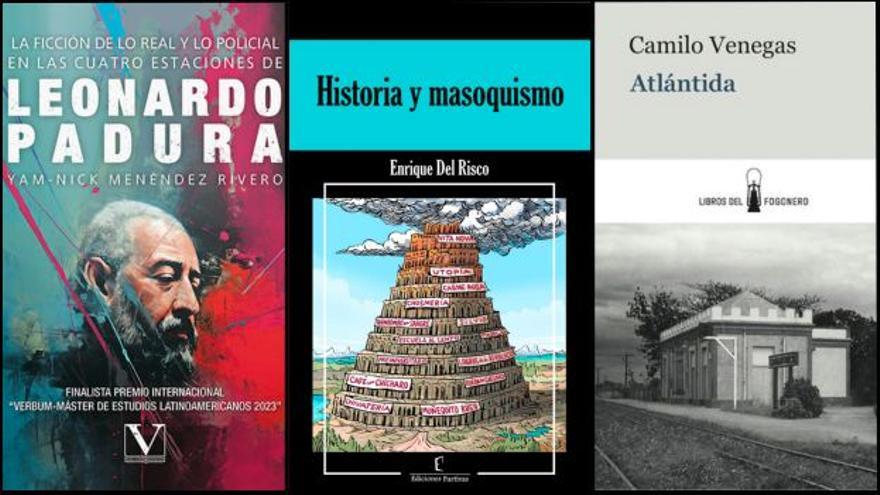
Covers of La ficción de lo real y lo policial, by Yam-Nick Menéndez, Historia y masoquismo, by Enrique del Risco, and Atlántida, by Camilo Venegas. (Collage)

14ymedio bigger14ymedio, Xavier Carbonell, Salamanca, 29 October 2023 — “When you see cartoons being burned, soak your constitution.” Enrique del Risco’s warning doesn’t stand up to scrutiny because of its lucidity, in the country of the hoax and the practical joke. It is sad that it arrives late, more than 65 years after – as Jorge Brioso observes in his prologue to Historia y masoquismo [History and Masochism] (Furtivas) – Fidel Castro’s recently released revolution censored a cartoonist for ridiculing the rebels of the Sierra Maestra.

Del Risco’s most recent book puts his finger on the Cuban’s most painful wound: its tendency to suffer – with pleasure – chasing utopias. The fervor for the voice of the tyrant, the speed with which intolerance is assumed, submission, the ability to humiliate, the cult of vigilance… the dark side of the Island has been as present in its history as the tropical humor.

Perhaps, in fact, both are symptoms of a deeper character defect that the word “masochism” is just beginning to express. Well, “totalitarianism,” as Del Risco says, is “more than a political regime; it’s a culture, a civilization, a custom.”

El castigo [The Punishment] (InCubadora), the “monster book” by Jorge Luis Arcos that won the Franz Kafka Essay/Testimony Award, has also arrived in bookstores. Of the volume, which has the purpose of reflecting or (re)constructing” the Cuban canon, Carlos Aguilera has said that it is “full of anecdotes and sketches about Cuban intellectual life,” and that it “speaks loudly, but also in a whisper.” continue reading

Perhaps, in fact, both are symptoms of a deeper character defect that the word “masochism” is just beginning to express

InCubadora recently published a fragment of the book, which contains an exchange of letters between Arcos and Lorenzo García Vega about the events that motivated the end of the magazine Encuentro de la Cultura Cubana [Meeting of Cuban Culture], and the resignation for “ethical reasons” by several members of its editorial staff in 2009.

Las Cuatro Estaciones [The Four Seasons] by Leonardo Padura – the narrative tetralogy that inaugurates the adventures of detective Mario Conde – are studied in detail by Yam-Nick Menéndez in La ficción de lo real y lo policial  [Reality and Police Fiction] (Verbum). The book applies several academic categories to the work of the Havana novelist and offers a conclusion: Conde’s stories are an underground, but not ineffective, manifestation of the tension between literature and totalitarianism.

En La Habana nunca hace frío [In Havana it is Never Cold] (Almuzara), by Zoé Valdés, takes place in the 70s on the Island. With a well-defined soundtrack – that of rock and the hippie movement – it narrates from nostalgia the lives of several young habaneros for whom freedom is a creed, and who face the intolerance of a puritanical and oppressive tyranny.

Atlántida [Atlantis] (Libros del fogonero), by the cienfueguero writer Camilo Venegas, refers to the same decade. The formula that guides the narrative also defines the country: “The struggle of the present against the past leaves many without a future.” For the author, a native of the Paradero de Camarones, the coastal town has its perfect metaphor in the ancient kingdom sunk in the sea.

‘Maine’ aims to fill an important gap: almost no historian has dealt with Masó, forgotten by all sides after the victory of 1898

Published by the exiled journalist Juan Manuel Cao, La gran locura [The Great Madness] (Universal) is a novel of “excesses, nonsense and lack of power.” Defined by its publisher as a grotesque story, with not a little of Cao’s life experience, its characters are “a tormented official, an eminent beauty, a delirious scientist and a boss with absolute power.”

Una historia develada [An Unveiled Story] (Universal), by José Ramón Fernández, who died in Coral Gables, Florida, in 2021, investigates the figure of Juan Masó Parra. The controversial mambí,* who left Havana five days before the blasting of the battleship Maine – which determined the entry of the United States into the war – after having proposed to the Spaniards to organize a Cuban brigade against the “invaders of the north.” The book aims to fill an important gap: almost no historian has dealt with Masó, forgotten by all sides after the victory of 1898.

On October 15, when publishers around the world paid tribute to Italo Calvino for his centenary, the cultural curators of the Island – where Calvino was born in 1923 – offered a forced “rehabilitation” to the writer. Funded by the Italian Embassy in Havana, which prepared an agenda for the anniversary, the trilogy Nuestros antepasados [Our Ancestors] will be the only book by Calvino to which Cubans have access. If true, unlike other occasions, copies will arrive at the bookstores.

*Translator’s note: The mambises were guerrillas who fought against Spain for Cuba’s independence in the Ten Years’ War (1868-1878) and the Cuban War of Independence (1895-1898).

Translated by Regina Anavy

____________

COLLABORATE WITH OUR WORKThe 14ymedio team is committed to practicing serious journalism that reflects Cuba’s reality in all its depth. Thank you for joining us on this long journey. We invite you to continue supporting us by becoming a member of 14ymedio now. Together we can continue transforming journalism in Cuba.

A Flight Arrives in Havana With 138 Irregular Migrants Returned From Mexico

Thousands of migrants continue to arrive in Mexico from the Island. (EFE)

14ymedio biggerEFE (via 14ymedio), Havana, 30 October 2023 — A group of 138 Cubans arrived in Havana this Sunday on a flight from Mexico as part of a bilateral agreement between the governments of both nations to return irregular migrants to their country of origin, official media reported.

The 92 men and 46 women deported on this day make up the 118th migrant return operation carried out so far this year, and with this group there are 4,779 Cubans returned from different countries in the region, according to a report by the Ministry of the Interior of the Island.

A week ago, the Mexican government returned 37 other Cuban irregular migrants to Cuba. continue reading

It is estimated that in 2022 around 4% of the Cuban population left the country

In recent days, 27 Cuban migrants were also deported from the United States and another six by the authorities of the Cayman Islands.

Cuba is experiencing an unprecedented migratory wave both for the volume of migrants and for its duration due to the serious economic crisis it suffers, with a great shortage of basic products (food, medicines and fuel), galloping inflation, frequent power cuts and a partial dollarization of the economy.

It is estimated that in 2022 around 4% of the Cuban population left the country, and this year’s figures could be similar according to those accumulated to date.

Translated by Regina Anavy

____________

COLLABORATE WITH OUR WORKThe 14ymedio team is committed to practicing serious journalism that reflects Cuba’s reality in all its depth. Thank you for joining us on this long journey. We invite you to continue supporting us by becoming a member of 14ymedio now. Together we can continue transforming journalism in Cuba.

The Foundations of the Unproductivity of Cuban Agriculture

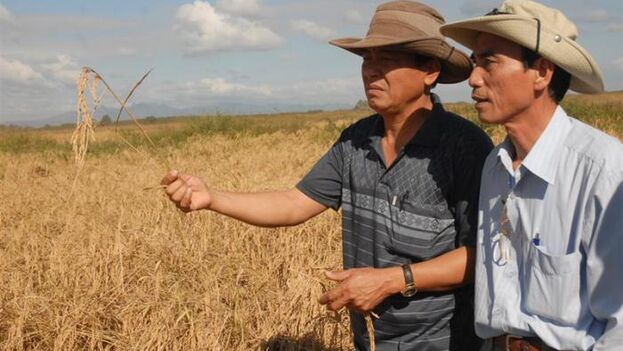
Vietnamese technicians in Sancti Spíritus. (Granma/Archive)

14ymedio bigger14ymedio, Elías Amor Bravo, Economist, 28 October 2023 — We’re back to where we started. Talking for the sake of talking. Now the regime wants to tell us how to bring agricultural products from the field to the table. And the talking has been done by none other than the Minister of Agriculture, Ydael Pérez Brito, the author of the “63 measures” that were going to make the Cuban agricultural sector take off, and you can already see how that’s going.

And as if it were a deja vu, which does not stop happening, the minister appeared on State TV on the Roundtable program — in which difficult questions are never asked to the powerful – to talk about the main challenges of the sector, the inadequacies and the main work actions. And by the way, to point out the key to bringing agricultural products from the field to the table.

Of course, as always happens, taking responsibility for the obvious failures is not part of the agenda for Cuban communist leaders. The minister said from the first moment that “one of the main factors impacting the sector’s performance is the global crisis resulting from COVID-19.” Totally false. The crisis began before COVID-19, and unlike what happened in other countries, it has continued after the disease was overcome, even worsened.

The crisis has its origin in the absurd so-called Ordering Task* and more recently, in Putin’s atrocious war in Ukraine with its impact on world markets, especially food, raw materials and intermediate goods. Cuban communists are trapped in their lies. continue reading

Pérez said that “corn used as animal feed has increased its value by 167%, soybean flour by 151%, monocalcium phosphate by 258% and methionine by 162%. Similarly, fertilizers and urea have seen a 300% increase in their prices, and other chemical herbicides and pesticides have doubled and tripled their prices.”

He is right about this, but those same price increases have impacted the Dominican Republic, Costa Rica, Panama and the rest of Latin American countries, and none of them lack food. There is something about Cuba’s production that turns the Island into a disastrous economy, where the agricultural sector is unable to meet the food needs of the population.

So, using any justification such as climate change to evade responsibility, Pérez cited migration from the countryside to the city as a factor that has a negative impact on the sector. And in that sense, he again gave half-truths, because it’s true that only 15% of the Cuban population lives in the countryside, but the employment of the sector is close to 20% with an average agricultural productivity of 20% of the total. A disaster.

Then, in this same argument, he blamed the blockade for the lack of availability of funding, and pointed out that “only 40% of the required diesel fuel, 4% of fertilizers and 20% of animal feed have been acquired.” Another falsehood. If the regime does not achieve financing, it is not because of the blockade, but because of its non-payment of debt, which prevents access to international markets. When will they realize Fidel Castro’s terrible inheritance as a debt evader?

From there, Pérez stressed “the need to increase the areas planted; however, this would require a greater use of fuels and people dedicated to the activity” that are not available, so they recommence in that vicious circle that they don’t know how to get out of, or do not want to.

And the rest of the program was a continuous narrative of misfortunes that could only lead viewers to a single conclusion: these people are not going to solve anything. For example, referring to the poultry program, Pérez Brito said that, in the best moments, “it was possible to have 8 million chickens” (without indicating when), but “today we only have an average of 2.9 or 3 million laying hens,” a decrease caused by the fact that vaccines could not be purchased and “the replacement program was stopped, which has caused us to be working with a very high percentage of aging chickens.”

And for this, they are “replacing 300,000 chickens per month and must end the year with a million replaced,” and he said again that “the program has had many obstacles with food, especially with soy and corn, whose prices have increased. As a result, production has decreased from 5 million per day in 2020 to 2.2 million. This only allows us to supply the current 5 eggs in the standardized family basket” [allocated through the ration system]. In short, the instability in the feed causes a decrease in the efficiency of the laying. And that’s why eggs have disappeared from the basic basket or are sold at very high prices.

Regarding the situation of the pig program in the country, the minister said that of a total pork production of 199,700 tons in 2017, the figures fell in 2022 to only 16,500 tons of production. An absolutely unpresentable collapse that has no possible explanation.

Again, the disaster occurred because there was less food for the pigs, which reduced the number of breeders from 96,200 in 2018 to 35,892 last year, a drop of nearly two-thirds, and now the recovery of this program is expected by increasing the planting and harvesting of animal feed in the country, as well as enhancing the planting of soybeans and a harvesting program to guarantee part of the necessary protein. In other words, things will take a long time.

Meanwhile, the regime is entertained by the recovery of the Multiplier Centers and Breeding Units and continues with the delivery of land for the production of pig feed “to produce 60% of the raw material.” They do not understand that the delivery of land for rent is not the solution, but rather a legal framework of private property rights for the land.

At this point, the minister surprised the audience when he said “that the country has relatively new infrastructure for the production of grains” and specifically, for rice: “More than 300,000 tons were produced in the country.” But then, as a result of the lack of inputs, such as fertilizers, production fell to 10%. So with less rice, he had to depend on external donations.

The minister then said that “we have to plant rice” because of the high cost in the international market, and many traditional producers have stopped exporting to meet the national demand, which makes it very difficult to supply abroad. This happens to Cuba, because other countries that import rice do not have these difficulties; they have financing and credit to do so. As always, communist ministers remain on the threshold of the problems.

In the case of beans, he said that more than 50,000 tons were delivered for the basic basket despite the lack of inputs to combat pests and other natural causes that caused a 9% decrease in production compared to 2016. He also quoted, with respect to corn in this case, a much greater drop of 30% in production.

To reverse this situation, the minister proposes ideas such as increasing the area under irrigation dedicated to grains by 35%, increasing yield using more productive varieties and hybrids and working with foreign investment and collaborative projects to acquire financing. As always, arriving late to the problem with a state interventionism that leads nowhere.

With regard to coffee production, the minister said that the demand to meet the basic basket and domestic consumption is 24,000 tons, but in 2023 the production will be about 9,000 tons, which represents only 38% of the demand. Looking out to a 2030 horizon, the situation will not improve significantly, so there will still be a lack of coffee. Cuban communists still believe in the “strengthening of the coffee program in the plains.”

And at this point, the minister spoke of the miraculous “Food Sovereignty and Nutritional Education Plan of Cuba,” according to him, “a national platform to achieve full sovereign food security, as a strategic contribution to national security.”

To this end, the law of the same name proposes an agri-food development of Cuba, based on projections for the development of food production in the socio-economic cultural field, from processing and marketing to the final consumer. In other words, more of the same, as usual. Passing over the problems, without getting into them.

But in addition, it is alarming that the minister says that “we must make a change in agriculture, in the way we manage it, taking into account the current economic conditions of the country and also the climatic conditions.” Because no one has any illusions. Nothing about strengthening the private sector and entrepreneurship.

The minister wants to change the management to promote “the relationship of the municipality, the province and the nation, which are as a whole the agricultural system, so that production is at the local level and the importing matrix is changed, for security and sovereignty.” A commitment to a scale of production that does not take advantage of increasing returns at scale and impedes any possible increase in productivity in the medium and long term.

Food sovereignty is not achieved in this way, one which only relies on failed structures of the communist model, such as the OSDE [Superior Business Management Organization] of agriculture and the business system in the sector, whose improvement only involves decapitalizing them with fewer employees and activity. The same can be pointed out for the companies served by the municipal governments, which is nothing more than hiding the state in the municipal.

Cubans will have to continue waiting for that sovereignty and food security, because the path chosen does not serve to advance the nation’s ability to produce, as the minister said, “food in a sustainable way and give the entire population access to sufficient, diverse, balanced, nutritious, safe and healthy food, reducing dependence on external means and inputs, with respect for cultural diversity and environmental responsibility.” That will continue to be unattainable if production conditions do not change.

During his long appearance on the Roundtable, the Minister of Agriculture dedicated time to saying that “in addition to the State and the business structure, another of the backbones of the agricultural system is the producer,” and he pointed out what seems evident, that “the whole system revolves around him” so that “ways must be found for him to develop and feel more stimulated, so that the amount in the Cuban fields increases.”

The minister must be made aware that these ways are well known and that if he wants to check, he just has to go to Vietnam and ask about the Doi Moi, where he will find that producers don’t have to be “motivated, trained, expand their capacities or be advised and change mentalities.”

All that is a waste of time. What producers want is to own the land they work so that any improvement they make on it allows them to earn money from their commercialization or expansion. The path is the consolidation of a legal framework of private property rights. There is no alternative.

The solution of putting the municipality into production, or developing it in a more organic way by applying differences between the territories, only makes sense if the producers manage to appropriate the income they generate.

Therefore, the projects that the regime is managing, such as the food program, with the development of the extra-dense banana, under the principles of science and innovation imposed by Díaz-Canel’s doctoral thesis, still do not give practical results, and the young people of the country do not want to spend their lives in the agricultural sector.

To attract young people to the countryside, it is not enough to help them, give them credits, accompany them, or give priority to the best. The key remains in land ownership, especially for young people, who with a longer life cycle can expect a greater capitalization of the value of their properties.

And at this point, Pérez showed the contradictions of the communist regime, recognizing that “we have a lot of empty land, a lot of idle land, a lot of poorly exploited land and, at the same time, the need to produce food and bring the country forward,” confirming that the model is inefficient, does not work and must change.

He also referred to boosting the production of small livestock, where he acknowledged that the desired results are not achieved and proposed “to get producers to raise more.” For the same reason, they will raise more if they own the cattle and can determine their destination without state interference.

Of the agricultural cooperatives, he pointed out that there are more than 270 cooperatives with problems, of the more than 4,000 existing ones, a scenario that starts from the application of the Ordering Task and that remains unresolved. It seems to the minister that “it is only necessary to strengthen the search for links with producers, also taking into account relations with the non-state sector. We have to unite and make cooperative productions.” Nothing about the legal framework of property rights.

Regarding the MSMEs [“private” enterprises], he was pleased that his ministry has 27 state-owned, which has made it possible to complement some points of agricultural production. Really, it’s a result that leaves a lot to be desired.

In the final stretch of the program, Pérez returned to defending as a ministry that “we have to work better in our state functions; we have to be better as regulators and controllers of the State.” Not even a small space for private property, business and independent economic activity. For the minister, it is essential that “we should control the use and possession of land and livestock,” the same thing that the communist regime has been doing since the approval of the agrarian reform laws.

A good example was the announcement that the Ministry of Agriculture is now working together with the Ministry of the Armed Forces “with the aim of looking for more producers, helping more who deserve it and restoring legality where there is a problem.

We also are working to return the land to the management of the State when it is not well exploited.” The control of the agricultural sector by the communist army is a step backwards, an increase in repression and control, and an indicator that bad times, very bad, are coming for Cuban farmers.

*The Ordering Task is a collection of measures that include eliminating the Cuban Convertible Peso (CUC), leaving the Cuban peso (CUP) as the only national currency, raising prices, raising salaries (but not as much as prices), opening stores that take payment only in hard currency, which must be in the form of specially issued pre-paid debit cards, and a broad range of other measures targeted to different elements of the Cuban economy. 

Translated by Regina Anavy

____________

COLLABORATE WITH OUR WORKThe 14ymedio team is committed to practicing serious journalism that reflects Cuba’s reality in all its depth. Thank you for joining us on this long journey. We invite you to continue supporting us by becoming a member of 14ymedio now. Together we can continue transforming journalism in Cuba.

Cuba, Venezuela and a Hurricane Called Maria Corina Machado

María Corina Machado’s candidacy will be reviewed this week by the Prosecutor’s Office in Venezuela. (EFE)

14ymedio bigger14ymedio, Yoani Sánchez, Generation Y, Havana, 30 October 2023 — I met her in Madrid almost ten years ago. Hyperactive and direct, María Corina Machado was at that time one of the many figures of the Venezuelan opposition who were trying to insert themselves into the political scene after the death of Hugo Chávez. From that time until today, her country fell into the abyss of chronic crises and my Island contributed to that fall by sucking thousands of barrels of crude oil from Petróleos de Venezuela SA (PDVSA), which propped up the Cuban regime.

In that decade, Machado went through everything: the hard times and the bad times, never better said than when her main opponent, Nicolás Maduro, systematically cut off all avenues for an electoral and peaceful solution to his unpopular mandate. Surveillance, the assassination of her reputation, internal struggles between the opponents themselves, and much more, has been experienced by this woman who, last weekend, was chosen to face the heir of Chavismo at the polls. Her chances of being reinstated for the elections and competing for the presidency, with guarantees and security, are minimal, but hopeful.

All of us who were born under authoritarian political models know that no dictatorship is willing to risk its continuity at the polls

All of us who were born under authoritarian political models know that no dictatorship is willing to risk its continuity at the polls. If one thing is a part of the catechism that tyrants learn very early, it is that they should never allow dissidence or a ballot to distance them from the honey of power. History has excellent examples of resounding failures when a vain autocrat believed that he could subject his permanence in the presidential chair to elections, and ended up losing. continue reading

Maduro knows well what would happen if Machado wins. Not only will he have to leave the Miraflores Palace and hand over to public scrutiny the economic sectors that he has kept under lock and key, but he has a good chance of ending up on trial and behind bars for the atrocities committed during his administration. Like the rider on the tiger’s back, he is aware that if he gets off, the beast will devour him, but it is increasingly difficult for him to keep his legs clinging to the torso of the restless animal.

María Corina Machado has the most difficult months of her life ahead of her. Media attacks, legal accusations, hostility from competitors and physical dangers, all will intensify. Havana will also deploy its classic script that a CIA agent seeks to return Venezuela to the “neoliberal past” and, most likely, the political police of both countries will work together to try to destroy her image, prevent her name from appearing in the electoral process, and frighten her voters. Now, she is public enemy number one of both regimes.

What Castroism is risking with Maduro’s departure is no small matter. This year, oil shipments to Cuba average 57,000 barrels of oil per day from Venezuela

What Castroism is risking with Maduro’s departure is no small matter. This year, oil shipments to Cuba average 57,000 barrels a day from Venezuela. Despite the prominence gained by Mexican crude oil, led by Mexican President Andrés Manuel López Obrador, Caracas continues to be an essential support for the failed Castro model that fears that electrical blackouts, inflation and lack of freedoms will again light up the streets of the Island, as occurred on July 11, 2021.

María Corina Machado, the international community that calls for a democratic electoral process in Venezuela, and the voters who seek change in a country that has run out of illusions, are right now at the center of the concerns of the Cuban regime. The machinery of the political police greases its mechanisms to attack her with everything it has. It remains to be attentive and wish luck to the leader of Vente Venezuela. She’s going to need it, y mucho.

________________________

Editor’s Note: This article was originally published in Deutsche Welle in Spanish.

____________

COLLABORATE WITH OUR WORKThe 14ymedio team is committed to practicing serious journalism that reflects Cuba’s reality in all its depth. Thank you for joining us on this long journey. We invite you to continue supporting us by becoming a member of 14ymedio now. Together we can continue transforming journalism in Cuba.

The Decrease in the Number of Suicides in Cuba is the Only Good News in the Demographic Yearbook

In 2022, 22.3% of the Cuban population was over 60 years old. (14ymedio)

14ymedio bigger14ymedio, Havana, 26 October 2023 — Heart attacks and cancer were responsible for half of the deaths in Cuba in 2022. The “dizzying” aging of the population, the increase in traffic accidents, low fertility and disorders during pregnancy complete the demographic picture of the Island, which, according to official data, is anything but optimistic.

The 2022 Health Statistical Yearbook, according to the official media Cubadebate reporting on Thursday, warns that 48.3% of Cubans who died that year did so from “heart diseases” and complications after suffering from “malignant tumors” and other chronic non-communicable diseases. As a general rule, they add, men are more likely to die for these reasons than women, partly because they go to the doctor late and because of the amount of stress they are under.

Detailing this last aspect, the document also warns about the large differences between the mortality of one sex and the other in terms of suicides – the male rate is 5.1 times higher than the female rate – although the general rate for 2022 for which the State insists on calling “self-inflicted injuries” (12.9 suicides per 100,000 inhabitants) decreased compared to 2021, when 16 suicides occurred per 100,000 inhabitants.

There are also gender differences in death rates from cirrhosis and liver diseases, 3.3 times higher in men; due to tumors, 1.3 times higher; and for heart, respiratory diseases and accidents, 1.1 times higher. continue reading

During 2022, 856 deaths occurred due to car crashes, 142 more than the 714 the previous year

Women, on the other hand, are more likely to die from diabetes mellitus. However, both sexes are equal in the rate of deaths from cerebrovascular diseases. In general, life expectancy is 77.7 years: 80.1 for women and 75.3 for men.

Deaths due to traffic accidents were also highlighted by the press, as being the only one of these indicators that increased significantly during the past year and had an impact on the number of years of potential life lost (YPLL), which is generally calculated from the life expectancy of each sex.

According to statistics, 856 deaths due to car crashes occurred during 2022, 142 more than the 714 the previous year. The figures for other types of accidents, such as work accidents or drownings, did not change greatly.

The main concern of the press regarding the data from the National Statistics Office (Onei), however, is the great loss of population that the country has suffered since at least 2016, when Cuba went from having 11,239,224 inhabitants to losing – in just six years – about 150,000 people.

The causes: accelerated aging and low birth rates, they say. As expected, the official figures did not take into account in their calculation the large mass of Cubans who have emigrated in recent years and whose definitive departure from the country is not yet recorded in the statistics.

According to the yearbook, 22.3% of the Cuban population in 2022 was over 60 years old, 0.7% more than the previous year and almost 10% more than in 2000. This accelerated increase in the population of older adults, Cubadebate points out, translates into “challenges” for public health, social services, employment and equality and non-discrimination policies.

According to its forecasts, by 2025 the country is expected to have a population of 11,227,182

The counterpart to these statistics are births and fertility. However, this news is not encouraging either. Along with the increase in the elderly population comes a significant reduction in the number of people over 15 years of age.

This is because for more than 45 years the fertility of Cuban women has been below the replacement rate, which needs to be at least 2.1 children per woman (in her lifetime) to guarantee population renewal. In Cuba, according to 2022 data, the rate is 1.41 children per woman, lower than that of 2021, which was 1.45.

On the other hand, the birth rate for 2022 was 8.6 live births per 1,000 inhabitants, 3.4% lower than the previous year, when the lowest number had already been recorded since records began (99,096 births).

The fertility rate for women between 15 and 49 years old (considered the reproductive period) is 39.2 per 1,000. By age range, only fertility in women between 40 and 44 years old and between 15 to 19 years old increased. The irregularities between the overall fertility rate, which tends to decrease, and the adolescent fertility rate, with a tendency to increase especially in the eastern provinces, were highlighted by the press with a “worrying” aspect. In 2022, the fertility rate for adolescents between 15 and 19 years old was 50.6 per 1,000 women.

Despite the statistics that show a notable drop in the population, the Onei figures insist on showing a positive outlook. According to its forecasts, by 2025 the country is expected to have a population of 11,227,182, 137,000 more than today.

____________

COLLABORATE WITH OUR WORKThe 14ymedio team is committed to practicing serious journalism that reflects Cuba’s reality in all its depth. Thank you for joining us on this long journey. We invite you to continue supporting us by becoming a member of 14ymedio now. Together we can continue transforming journalism in Cuba.

Cuba in the Face of Growing Poverty

Poverty data has worsened very visibly in the last three years. (14ymedio)

14ymedio bigger14ymedio, Yaxys Cires, Madrid, 26 October 2023 — Some 28 months after the historic protests of 11 July 2021 in Cuba, with demands regarding political and social rights, the Island’s authorities continue to show no will to carry out the urgent changes that the country needs and that Cubans demand. The immobility of the regime in the face of serious problems, the accumulated crises and circumstantial factors have aggravated the situation of poverty and exclusion for the vast majority of the people.

According to the VI Report on the State of Social Rights in Cuba, considering total household income, 88% of Cubans live in extreme poverty and 62% of those consulted said they have problems buying the most essential things to survive.  Due to lack of money or scarcity, 78% said that they had skipped a daily meal, only 5% had obtained medicines from official pharmacies and 15% took expired medicines.

78% said that, due to lack of money or scarcity, they had skipped a daily meal, only 5% had obtained medicines in official pharmacies and 15% took expired medicines

It is evident that none of these figures have to do with the paradise that Cuban propaganda has sold for decades and that some Latin American leaders present to their fellow citizens as the model to imitate.

Is the unbearable Cuban situation the product of internal or external causes? Without a doubt, the main ones are internal, related, among others, to deficiencies specific to the communist system and the priorities of the Government.

It is very difficult to generate acceptable levels of decent living standards without economic freedom. With few nuances, the Cuban system continues clinging to the Stalinist scheme, with the State as the majority operator of the economy. The Communist Party, which the Constitution considers “the highest leading political force of society,” establishes that it will not allow “the concentration of wealth” (without it appearing that this norm affects its leaders). continue reading

These outdated formulas, which have never given good results anywhere in the world, prohibit – for example – the individual exercise of professions such as law or architecture, put absurd limits on how much money an entrepreneur can withdraw from a bank (currently the equivalent of 20 dollars a day), restricts farmers from owning land, directly or indirectly controls the wholesale market and import activity, and does not allow a Cuban exile to buy property in their native country.

But the problem is also one of priorities. Official data on investment (state, foreign, etc.) in the first half of 2023 reflect the predominance of activities articulated around the tourism sector, which is controlled by the military. This is the case of the items “business, real estate and rental services” (25%) and “hotels and restaurants” (5.6%), obviously focused on foreign currency.

In contrast, the total national agricultural investment was only 2.6%, in a country in which the main social concern is the serious food crisis

In contrast, the total national agricultural investment was only 2, 6%, in a country where the main social concern is the serious food crisis. The absence of civil and political liberties does not allow Cubans to criticize the many absurd things they see or to disapprove in democratic elections of those responsible for the disaster.

The Cuban people are talented and hardworking, but political repression, impoverishment and lack of future have driven millions of people into exile. It is time for power to begin the political, economic and social changes that the country needs, opening its hand to everyone who wishes to contribute to their own nation. As it was not when the Soviet Union existed, today it will not be its allies of Russian oligarchic capitalism who will get Cuba out of the quagmire. Neither will Venezuelan or Mexican oil.

The best thing about each country is its own people and a real openness to their talent.

Editor’s Note: The author is director of strategies of the Cuban Observatory of Human Rights, based in Madrid.

____________

COLLABORATE WITH OUR WORKThe 14ymedio team is committed to practicing serious journalism that reflects Cuba’s reality in all its depth. Thank you for joining us on this long journey. We invite you to continue supporting us by becoming a member of 14ymedio now. Together we can continue transforming journalism in Cuba.

Casablanca, Havana: Where Christ, ‘Che’ Guevara, Tourists and Beggar Children Gather

Against all odds, the hamlet remains standing, but it is one of the roughest places in the capital city. (14ymedio)

14ymedio bigger14ymedio, Juan Diego Rodríguez, Havana, 29 October 2023 — For Havana residents, Casablanca does not refer to the pristine residence of the president of the United States or to the film from the 1940s, but to the weak coastal neighborhood on the other side of the bay. Neither Che Guevara’s nicely-painted house – an attraction for tourists – nor the colonial fortress of La Cabaña have managed to give life to the place, where the poverty of Havana assertively shows itself, without make-up, to visitors.

On the hill where the town is built – belonging to the municipality of Regla – the Spanish once fought against the English. The slope became famous centuries later, in 1959, due to the “butcher” Guevara’s mass executions. The silhouette of Havana from Casablanca, the sea air and the tortuous path to the castle were, many times, the last sensations of those condemned to death.

Against all odds, the hamlet remains standing, but it is one of the harshest places in the capital. The saltpeter and the passage of time have been relentless to the constructions of Casablanca. The best preserved are the Catholic church and the small Antonio Govín lodge, dedicated to the Creole Freemason who defended liberalism on the Island during the 19th century.

Against all odds, the hamlet remains standing, but it is one of the roughest places in the capital

Among the propped-up, half-finished walls and fallen posts, the rest of the houses do not resist the onslaught of time. To get to the most recent buildings – makeshift dwellings on the hill – you have to avoid the ruins of the oldest ones, immersed in vegetation and garbage. continue reading

There is no one on the streets and the vehicles heading to the tourist area circle the town. An old man is the only one digging through the garbage, but that scene is not unique to Casablanca: any pile of garbage in Havana has its “divers.” There is also no one waiting for the train at the station, which is completely closed. The abandonment is such that the railway line is barely visible above the pavement.

Nor do dogs and cats walk among the portals of Casablanca. The only ones who question the visitors are the children. Weathered by misery and hardly shy, they repeat a formula when they see a tourist: “Give me a candy, come on. Give me a dollar.” If someone takes a bill out of their pocket, more children will appear, just as poor and ungainly, demanding theirs.

The only really resplendent thing in the town is Jilma Madera’s Christ, which stands out from behind the roofs. “On the horizon of Havana, Christ protects us,” says the official Ecured encyclopedia in a pious tone. The phrase sounds like sarcasm to those who travel the rugged path that leads to the top of the hill.

There is hardly anyone waiting for the train at the station, which is completely closed. The abandonment is such that the railway line is barely visible above the pavement

Inaugurated on Christmas 1958, the Christ brought bad luck – legend says – to Fulgencio Batista, and was never liked by Fidel Castro, who is speculated to have tried to remove it on more than one occasion. Beggar children also gather at the foot of the sculpture, and they are not the only ones who pay attention to any carelessness of visitors, no matter if they are national or foreign.

La Loma del Cristo, Christ’s Hill, is famous for assaults. There have been many who, in the blink of an eye, have seen themselves stripped of cameras, wallets and any other object at hand by a very fast Havana thief. The escape route – protected by the undergrowth on both sides of the road – is more than calculated: a little-known entrance to La Cabaña is the perfect hiding place for criminals on the run, after prior agreement with the Military Service recruits who guard the fortress.

Even so, tourists prefer to take their selfies near Christ’s sandals and not in the sinister residence of the “heroic guerrilla,” the statue’s neighbor. As a threat, which is not difficult to consider fulfilled in front of the dilapidated mansions of Casablanca, a phrase from Fidel Castro adorns a wall: “A revolution is more powerful than nature.”

____________

COLLABORATE WITH OUR WORKThe 14ymedio team is committed to practicing serious journalism that reflects Cuba’s reality in all its depth. Thank you for joining us on this long journey. We invite you to continue supporting us by becoming a member of 14ymedio now. Together we can continue transforming journalism in Cuba.

The Minister of Agriculture’s Magical Recipes to Put Food on Cuban Tables

Pork production has plummeted in the last 6 years. (14ymedio)

14ymedio bigger14ymedio, Madrid, 27 October 2023 —  The Minister of Agriculture, Ydael Jesús Pérez Brito, gave a new recital of magical thinking on national television this Thursday, where he insisted on the power of Cubans to achieve the impossible without offering a single proposal. “We ourselves have to be able to produce and satisfy food demands. We can achieve it, it has been proven that this is the case, even with fewer inputs. It is true that we have fewer chemicals, but at the same time we have healthier products.”

Perhaps by that moment, right at the end of State TV’s  Roundtable, program the viewers would have already wondered too many times where those healthy products were, since the first third of his speech was dedicated to the minister outdoing himself with some data that would be surprising, but was not because Cubans know what is not on their plates.

In 2022, Pérez Brito said, the quantity of pork was reduced to 16,500 tons, almost 92% less than five years ago

In 2017, 199,700 tons of pork were produced. It was not that it was easy (and cheap) to find it then, but looking back from today it could be considered a boom time. In 2022, Pérez Brito said, the quantity was reduced to 16,500 tons, almost 92% less than five years prior. Behind this poor data is, it was argued, was the collapse of pork — only 14% of the plan was delivered — which in turn led to the drop in the ’reproductive mass’, from 96,200 tons in 2018 to 35,892 tons last year.

The minister affirmed that work is being done to recover pig feed, but, without going any further, the large factory that began to be built in Santiago de Cuba six years ago still does not have a start date and the delivery of land to produce pig feed is still progressing slowly; of the 50,430 hectares required, 31,507 have been provided. continue reading

Perez Brito also referred to eggs, a product that has been on the lips of the regime for weeks after years of complaints from the population and the independent press. In this case, the loss has been notable in less than three years: from 5 million eggs a day in 2020 it went to 2.2 million. As a result, the number of eggs now included in the monthly ration is five.

The causes have also been explained, the chickens are old and stressed out; that is the chickens that are alive. Because since the good times that the minister cited – without giving a date – when there were eight million chickens, there are now only 2.9 million layers of which the official could only highlight that they are of “very good breed.”

Another food that is scarce and, consequently, more expensive: coffee. A distinguishing product of the Island and one whose best varieties are exported in gourmet quality, is experiencing more than low moments. By the end of the year, it is estimated that about 9,000 tons of beans will have been obtained, only 38% of the demand, which is 24,000 tons. With such a scenario, the minister began to predict that in 2030 it is expected to reach 30,000 tons through optimistic “technological innovation.”

The data on rice and beans were also devastating, even more so taking into account their importance in the Cuban diet and the caloric contribution they could provide compared to the tiny amount of animal protein available

The data on rice and beans beans were also devastating, even more so taking into account their importance in the Cuban diet and the caloric contribution they could provide compared to the tiny amount of animal protein available. Rice fell by 10% and it is increasingly more expensive to import – “families must be supported with popular planting practices,” the minister encouraged.

Beans have fallen by 9% compared to 2016, their best year, although it was possible cover the basic family basket, and corn, which exhibits the worst situation, totalled 30% less than seven years ago. For this section, Pérez Brito proposed increasing the area under irrigation for the cultivation of grains, diversifying the seed and promoting investments foreign investments and cooperation projects, in addition to “productive linkages” with private companies.

The minister attributed all this bad news, as expected, to international inflation, the pandemic, wars and the embargo. In the words of Cuban economist Pedro Monreal: “Self-criticism? Very good, thank you…”

Pérez Brito also regretted that the population lives in the cities and not in the countryside, where only 15% of Cubans reside. The explanation, in itself, sounded poor: they are barely 5% less than in the United States and 0.9% less than in Spain. The last usual suspects were fuel, of which 40% of needs could be purchased, and the lack of financing for raw materials, he specified.

The second half of the presentation was dedicated by Pérez Brito to a type of coaching for farmers. He asked them to get more involved, encourage local production, “improve themselves,” and unite and cooperate between the public and private sectors. He urged the officials of the area to make changes in management, encourage the guajiros, give them credits and change their mentality.

“We will only achieve food sovereignty and security if we advance the nation’s capacity to produce food sustainably and give the entire population access to sufficient, diverse, balanced, nutritious, safe and healthy food, reducing dependence on means and external inputs, with respect for cultural diversity and environmental responsibility,” he blurted out, probably leaving the spectators perplexed because everyone understands the lack of food.

“There has been a lost decade” – the economist Pedro Monreal said a few minutes before the start of the program. “With the exception of the food category, the production of seven important foods was lower in 2022 than the level recorded ten years ago. The crisis began before the pandemic and agricultural policy has been incapable of resolving it,” he advanced.

At the close of the Roundtable, the expert lamented the uselessness of the explanations. “Three comments: a) as if the ’63 measures’ had never been implemented, b) strange notion that ’the plan is the demand’, and c) a localist utopia of optimizing the food supply.”

____________

COLLABORATE WITH OUR WORKThe 14ymedio team is committed to practicing serious journalism that reflects Cuba’s reality in all its depth. Thank you for joining us on this long journey. We invite you to continue supporting us by becoming a member of 14ymedio now. Together we can continue transforming journalism in Cuba.

Cuban Authorities Ask for the Support of ‘MSMEs’ to Collect the Garbage in Havana

Garbage accumulates longer in small streets, away from large avenues. (Courtesy)

14ymedio bigger14ymedio, Havana, 27 October 2023 —  “We can’t even open the balcony door because the house is full of flies,” laments Clara, a resident of 30th Street at the corner of 37th, in the municipality of Playa, in Havana. A few meters from her home, a huge garbage dump has been growing for weeks without the Community Services Company collecting the waste. What was once a clean, quiet residential neighborhood “now looks like a garbage dump,” the woman complains.

Close to the Cira García international clinic, where tourists and diplomats are treated, the block where Clara lives does not have the luck of the large avenues. “In these most hidden streets we have not seen the collection trucks for more than a month,” this 43-year-old Havana resident describes to 14ymedio. “Every time we complain they tell us there is no fuel to move the vehicles.”

Neighbors in the area have taken photos of the garbage dumps “from all angles” and some of the images have reached the eyes of the municipal mayor. The residents themselves in the vicinity have proposed that electric tricycles be used to at least “alleviate the situation.” Some have even joked about the “selective lack of fuel,” which does not seem to affect police patrols.

“They should put a cart behind [the police cars] so that, while they do their surveillance rounds, they can also take advantage and evacuate some of the accumulated garbage,” says Clara, but she senses that her proposal will fall on deaf ears. “Every time we complain, they tell us they will work on it but we have been like this for weeks, surrounded by bad smells and flies.” continue reading

The problems they are experiencing in the neighborhood, with the accumulated waste, multiply throughout the city. In a meeting held this Thursday, the coordinator of Programs of the capital government, Orestes Llanes Mestres, described the crisis in garbage collection as “the main challenge of the city at the moment.”

The official assured that last Wednesday 17,000 cubic meters of waste were collected in Havana, which represents 74% of the total garbage generated daily in the city. But the volumes that have been accumulating on the streets demand more efforts and resources. The municipalities with the greatest problems are Cerro, Plaza de la Revolución, Marianao and Centro Habana.

At the meeting it was also announced that this weekend “waste collection actions will be intensified in Havana, with the support of companies from the Ministry of Construction and state and non-state micro, small and medium-sized enterprises (MSMEs).” The Havana authorities recognize that the garbage situation “is reflected in the status of the popular opinions that the Party and the Government analyze every day.”

Despite official statements, Clara and her neighbors have lost hope. “On this block there are no institutions or companies, tourists don’t pass by here either, there are only three- or five-story family buildings. They are not going to prioritize us,” she says. “Those who were saved are those who live around the Miramar House of Music, as many foreigners go there, so you don’t see this type of garbage dump out of control.”

The accumulation of waste has its own cartography. Residents on main avenues do not suffer it equally as those who live on less busy streets. But, if the current crisis in communal services has caused anything, it is that one corner of a poor area of ​​Central Havana and another of the previously exclusive Playa have been left equal by the mountain of waste, the plague and the flies.

____________

COLLABORATE WITH OUR WORKThe 14ymedio team is committed to practicing serious journalism that reflects Cuba’s reality in all its depth. Thank you for joining us on this long journey. We invite you to continue supporting us by becoming a member of 14ymedio now. Together we can continue transforming journalism in Cuba.

To Kill Marti?

For more than a century, José Martí has been the Cuban figure most likely to go from flesh to marble. (Civic Square, 1957)

14ymedio bigger14ymedio, Yunior García Aguilera, Madrid, 25 October 2023 — Judging from online chats, private conversations and articles in the independent press, more and more Cubans are coming down with Martían fatigue syndrome. For more than a century, José Martí has been the Cuban figure most likely to go from flesh to marble, from light to dust, from elegy to meme. He is the banner raised by opposing, irreconcilable ideologies. Many a fortune cookie contains a quote by him. For us, he is simultaneously the Cuban Christ, the Caribbean Plato and the Marilyn Monroe of national pop art.

In our collective postmodernist hangover, we hit the accelerator, desanctifying all the altars as quickly as possible. The hasty effort did produce a bit of valuable research but also a lot of Martíanoid sausage. The crowning touch was the ruling party designating former Cuban culture minister Abel Prieto and National Assembly delegate Yusuam Palacios as high priests of the sanctum sanctorum. The ensuing indigestion, along with the urge to try to kill off the hero once and for all, was predictable.

Speculations about suicide are not completely implausible, nor are they far-fetched given his romantic nature

Much has been written about that Sunday in May 1895 when Martí seemed to be looking for a way to die. Speculations about suicide are not completely implausible, nor are they far-fetched given his romantic nature. In his writings he described death as a victory, a celebration, a silver stripe laid upon black velvet. For a man plagued by diseases such as sarcoidosis, chronic catarrhal conjunctivitis with a drooping right eyelid, sarcocele and acute broncho-laryngitis, death in combat was more desirable than imminent death in a foreign bed.

In his 1933 biography Martí, the Apostle, Jorge Mañach asks three essential questions about his demise at the Battle of Dos Ríos. Was it caused by a fit of madness? Inexperience? Or was it just his time to go? Carlos Márquez Sterling attributes his loss to “providence itself.” Gonzalo de Quesada y Miranda comes back to the idea that it was his “appointed hour.” The Argentine writer and poet Ezequiel Martínez Estrada described his death as “enigmatic, absurd, inexplicable, unusual and improbable.” continue reading

Some have blamed Máximo Gómez for the desperation and clumsiness of that day, which were incomprehensible given his experience as a soldier. The generalíssimo himself acknowledged that he was very poorly prepared for battle and did not have time to worry about Martí. Others blame Baconao, the spirited white horse that José Maceo gave him. Quite a few blame the fatality on his wardrobe, which was more appropriate for a wedding than for the rigors of combat. The fact is that Martí — the newly appointed major general, the would-be lawmaker, the likely future president — was the only casualty the Cubans suffered in this militarily insignificant operation.

The hypothesis that he threw himself at the bullets to set an example makes no sense in light of the fact that only Ángel de la Guardia saw him fall and, even then, only felt compelled to rescue Martí’s hat and revolver. The theory that he disobeyed Gómez’s order to “fall back” presents us with an image of a reckless, adolescent Martí very much at odds with his intellect and demonstrated ability to not become self-absorbed when faced with disdain, contempt or even humiliation.

Three bullets pierced his flesh though the drum of his Colt was still intact

The Spanish soldiers could not believe it. They had heard that some “big birds” were among the rebel troops but they could not imagine that the main instigator of that war, which had only just begun, would be such an easy target. It was a firing squad. Three bullets pierced his flesh though the drum of his Colt was still intact. When giving his account of the incident, the Spanish captain Antonio Serra would murmur, “There is a mystery here.”

Another often discussed enigma is the Cuban connection to the shot in his chest. The trajectory of the bullet indicates that Martí was either bent over his horse’s neck or was shot when he was already on the ground. The latter is consistent with claims by a Cuban soldier, Antonio Oliva, who fought for the Spanish under the command of Colonel José Ximénez de Sandoval. Grandfather of the renowned Cuban painter Pedro Pablo Oliva, he boasted of having killed Martí with his own gun. But not everyone believed him. Maybe he was just looking for a medal and a pension.

Martí died face up, as he dreamed. But that night a two-hour downpour drenched his corpse while it was being carried away by his enemies. One-hundred twenty-eight years later he is still falling off his horse, in multiple ways, for a lot of different reasons. The truth is that we needlessly lost the man the future republic needed most. Or maybe not. If he had survived and had governed, the current ruling party would no doubt now be calling him corrupt and self-serving. Thousands of busts and statues of him would not exist, nor would so many Cubans on social media be trying in vain to finish off Martí.

____________

COLLABORATE WITH OUR WORKThe 14ymedio team is committed to practicing serious journalism that reflects Cuba’s reality in all its depth. Thank you for joining us on this long journey. We invite you to continue supporting us by becoming a member of 14ymedio now. Together we can continue transforming journalism in Cuba.

Eggs Are Scarce and Expensive Because Cuban Chickens Are ‘Very Sensitive and Stressed’

In the hands of some sellers, a single egg can cost 100 pesos. (Cubadebate)

14ymedio bigger14ymedio, Havana, 26 October 2023 — Cuba’s official press celebrated, this Thursday, the operation of the 28 de Enero state poultry farm, in Pinar del Río. A production of 49,000 eggs per day, 61,144 hens and roosters, and a computer that monitors the “feeding, ventilation and collection of excrement” of the animals day and night make up, Cubadebate assures, a “perfectly synchronized gear.” The problem, however, is that this is a unique case in a country affected by the shortage of eggs and the serious lack of inputs for their production.

There is another exception, also in Pinar del Río: the ’Base Business Unit’ [UEB] Miguel Cabañas, not far from 28 de Enero, one of the 30 poultry farms in that province. However, Hurricane Ian, in September 2022, left the industry battered, which after the cyclone lost 4,000 chickens – almost all of them in the evacuation process – and which now has 53,000 animals and only one warehouse still standing of the previous eleven.

At a lower level of production and despite the “setbacks” alleged by its administrators, the UEB Turcios Lima, also from Pinar del Río, has 35,000 birds. However, the managers regret not having enough better, a product made from the husks of the rice with which they feed the chickens, in addition to the feed. That in use today comes from Sancti Spíritus and “does not satisfy the demand,” they point out. There is also no money, they add, to buy zeolite or wood chips, alternatives to feed the animals.

Food deficiencies have had serious consequences. Due to a “vitamin deficiency problem,” explains a Turcios Lima technician after several detours, the chickens are dying. However, he assures that medications and supplements were applied to the offspring to reduce the mortality rate. continue reading

In addition to the health problems of the animals, the list of deficiencies that affect the entire production is notable: there is no food, but also no fuel or inputs to achieve the basic conditions of comfort for the hens, whose egg production experiences a brutal drop due to these factors.

The country would need twice as many animals – and for them to lay twice as many eggs – to achieve satisfactory productive performance, estimates Jorge Luis Parapar, president of the Food and Poultry Business Group.

Asked about the number of eggs he is expected to guarantee for the ration system’s basic family basket, Parapar excused himself, insisting that all products have been drastically affected by the “impacts of the blockade” and the “economic situation.” The cost to produce an egg is 5.60 pesos, the official alleged, while they are sold for 2.08 in the ration stores. That difference “causes million-dollar losses for the company,” he complained.

Parapar commented on the situation in the informal market, which he described as a “very difficult task.” He assured that clandestine producers have “open farms in out-of-the-way places, where sometimes strict control becomes a bit difficult.” He is aware, he said, that the price of a 30-egg carton of eggs is 3,000 pesos, for the moment.

As 14ymedio found this Thursday, this amounts to 100 pesos for just one egg. He also did not refer to the online stores that Cubans must resort to, through purchases made from abroad by their emigrated relatives. Supermarket23, one of the most requested markets, was also selling a carton of 30 imported units this Thursday for $9.89 dollars.

To guarantee an acceptable level of production, the first variable to eliminate is the cultivation of feed, which farmers prefer to sell on their own – after going through many difficulties – to the population. If the State wanted to intervene to solve these deficiencies, it would have to obtain “fuel, transgenic seeds, fertilizers, pesticides and cutting-edge technology that is not available at the moment,” Parapar listed.

If these conditions were met, “we could satisfy the demand and have 10 or 15 eggs per month per consumer as before,” said the manager. Even so, Parapar urged Cubadebate readers to have confidence: after all, the national agriculture program “was designed by Fidel,” and is proof of difficulties, including the “tense situation” of the blockade.

Parapar dedicated a section to the characteristics of Cuban chickens, which are “very sensitive and get stressed easily.” The fuel crisis causes feed to arrive late to the farm, which affects the “egg laying.” However, even if they have low performance, “they eat the same amount of food,” he lamented.

There are also chickens that are on the verge of “decrepitude” and that the country uses for food. The “old” ones, the manager insisted, do not have the performance that his company expects of them, and half of the animals it has are in those conditions.

“Sometimes you add fuel at two or three in the morning, and when you arrive at the factory there is no electricity, and then you have to wait three or four hours for the production process to resume. On the other hand, there is a looming bad period in poultry farming because sunlight is shortened and the hen is a photoperiodic animal,” was his final complaint.

____________

COLLABORATE WITH OUR WORKThe 14ymedio team is committed to practicing serious journalism that reflects Cuba’s reality in all its depth. Thank you for joining us on this long journey. We invite you to continue supporting us by becoming a member of 14ymedio now. Together we can continue transforming journalism in Cuba.