In Havana, the Former Varsovia Restaurant Becomes a Luxury Private Business

Nowhere in the new and exclusive complex can you read the old name by which Havana residents still know the place, el Varsovia (The Warsaw). (14ymedio)

14ymedio bigger14ymedio, Juan Diego Rodríguez, Havana, 2 November 2023 — Neither the gray sky nor the rain that fell at intervals on Havana this Thursday clouded the brand new figure of the old Varsovia [Warsaw] restaurant on the corner of 12th and 17th streets in Havana’s El Vedado district. With its freshly painted façade and shiny windows, the store has reopened, converted into a complex of private businesses with prices that, even in one of the most affluent neighborhoods of the Cuban capital, would scare anyone away.

The entrance on 17th Street introduces the customer to a bright environment. Blackboards written with chalk and a certain informal touch welcome buyers to the butcher shop area and warn them that they will have to pay 1,300 pesos for each pound of beef steak they wants to buy. If their desire is to sink their teeth into a steak again, then the price rises to 3,000, but they also finds out that there is no more brisket left and the steak is gone.

“I came in because I didn’t want to get wet,” a woman explains at the door, shaking her umbrella before completely crossing the threshold. “I can’t afford to pay for any of this but I have to say that the place turned out nice,” she points out, immediately adding: “It’s a shame that the exterior paint wasn’t enough for the entire building, because now it looks older and more destroyed, with the ground floor being so renovated.”

It’s a shame that the exterior paint wasn’t enough for the entire building, because now it looks older and more destroyed with the ground floor being so renovated.

On 12th Street there is another entrance to the complex, but this one leads to a small business that sells “household supplies.” A living room set with two armchairs costs a whopping 200,000 pesos, while an ornamental glass ball reaches 80,000. “I don’t think anything is sold here because I’ve never seen such high prices,” grumbled a young man who was exploring the establishment for the first time this morning. continue reading

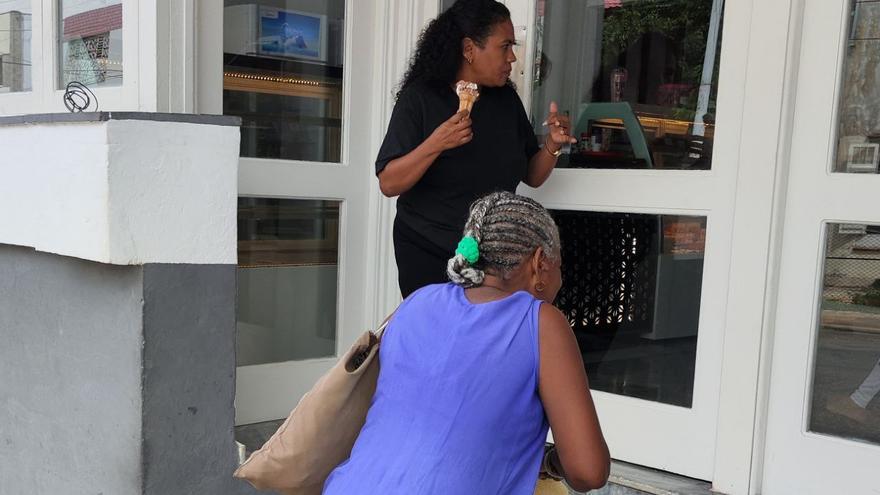
Outside, a woman and her daughter pressed their faces to the window to see the interior of the store, but the windows, suitably dark, barely allowed the goods for sale to be distinguished from the sidewalk. After a few seconds, the two crossed the street and directed their steps towards a nearby bus stop, protecting themselves from the rain with a piece of cardboard from a box a TV came in.

The restaurant area of ​​the new Varsovia, which is not yet operational, has six tables for four people each. This Thursday the employees were still cleaning that part and, a few meters away, the bakery, which only had bags of breadcrumbs, was already sending out deliveries. The market located in the building was well stocked with preserves, beers and soft drinks.

Sweets, chocolates and ice cream star in the new Varsovia complex. Candies, chocolates, fruit cakes and all types of jams, most of them imported, complete the syrupy offering in a country where diabetes rates are increasingly alarming and in a month in which sugar is the only product that has reached many of the ration stores.

“I can’t afford to pay for any of this but I have to say that the place turned out nice.” (14ymedio)

Nowhere in the new and exclusive complex can you read the old name by which Havana residents still know the place, but the reminder was not necessary for some of those who approached this morning to talk about “the new image of the Varsovia” or, as an old man declared: “Look what the Polish comrades have become!”

The former restaurant was baptized during the nominal fever that spread through Cuba when the Island’s alliance with the communist countries that made up the Council for Mutual Economic Assistance (CAME). In those years, restaurants with names of the capitals of the countries that orbited the Kremlin, such as Warsaw and Sofia, or named after the Soviet capital itself, such as Moscow, proliferated.

At the Varsovia, dishes allegorical to Poland were served but also Creole combinations accompanied by the emblematic fruit juices of Bulgaria, pears in syrup from Romania or sweets made from condensed milk imported from the German Democratic Republic. The spell of the world of the proletariat began to break in the late 1980s and by the 1990s the restaurant fell into a tailspin.

A woman and her daughter pressed their faces to the window to see the interior of the store, but the windows, suitably dark, barely allowed the merchandise to be distinguished from the sidewalk. (14ymedio)

“You couldn’t even come here, even at the time when they turned it into a restaurant [that took payment] in convertible pesos,” recalls Manolo, a resident of 12th Street. “It had red curtains that were never washed and cockroaches walked on the walls. The menu was very limited and state employees stole with both hands. There was a time when this was empty because they no longer had cooking supplies.”

Manolo says that the demise of Varsovia was accompanied by the crisis of the entire neighborhood. “This entire area is around what was the second most important corner in El Vedado after 23 and L. Here on 12 and 23 we had everything: cinema, pizzeria, a hamburger place, ice cream parlor, flower shops, bakery and stores.”

Now, some of the other establishments in the neighborhood are in decay, and others are under repair, the Varsovia shines with a particular light, that of the incandescent glow emitted by an 80,000 peso crystal ball.

____________

COLLABORATE WITH OUR WORKThe 14ymedio team is committed to practicing serious journalism that reflects Cuba’s reality in all its depth. Thank you for joining us on this long journey. We invite you to continue supporting us by becoming a member of 14ymedio now. Together we can continue transforming journalism in Cuba.

Cuban’s End of the Year Family Dinners Will Be Made With a Reduced Basic Basket

For November, only three pounds per person of brown sugar have been secured. (Invasor)

14ymedio bigger14ymedio, Havana, 2 November 2023 — The deficit of milk and the delay in its delivery to the bodegas [ration stores] continue to upset the residents of Ciego de Ávila. The authorities, for their part, acknowledged to the official press that there is little they can do to alleviate the situation, since the Dairy Products Company calculated last July a ’deficit’ of one million gallons of milk, and of the 2,000 provincial gallons that are distributed daily, about 800 come from Sancti Spíritus.

Yulema Yero Pérez de Corcho, director of the entity, explained to the newspaper Invasor that currently the greatest difficulty in the province is in the non-compliance with milk deliveries to the bodegas throughout the year, which has caused the deficit to increase significantly.

If the livestock sector served by independent producers is added, by September the figure already reached 1.2 million gallons.

The milk deficit has led leaders to demand “cattle counts” and hire as many producers as possible. The order, however, was not given until this summer, when the deficit reached several million gallons. With these figures, non-compliances with the bodegas are now foreseen, which can only guarantee the quota for children between one and seven years old, and those destined for Public Health and Education. continue reading

The most affected municipalities, according to Yero, are Baraguá, Venezuela and Bolivia, because due to “technical difficulties,” it is not possible to pasteurize milk, and it must be sent to other locations. Due to the delay in transportation, the industrial processing of dairy does not begin until midday, which translates into endless delays for the product to finally reach the bodegas.

The milk collection would be achieved one day in advance, which would easily allow the development of industrial treatment, and distribution routes would begin to be completed starting at midnight

“In conditions close to the ideal, the [milk] collection would be achieved one day in advance, which would easily allow the development of industrial treatment, and distribution routes would begin to be completed starting at midnight,” explains Invasor.

Regarding the delivery of bread, the problem, the newspaper warns, “is even greater,” since the industry depends on flour imports. The daily quota is delivered on a day-to-day basis, but there are no long-term guarantees that it will continue to be sold as soon as the current shipment runs out. In the worst case, the newspaper acknowledges, the situation of October would be repeated, when the smallest rolls were sold and there were days when it was not even marketed.

About the other products of the basic basket for November, the leaders don’t know when they will be able to count on them either. Only three pounds per person of brown sugar have been secured, and the seven pounds of rice plus one ’missing’ from the previous month’s ration will be delivered in the first half of the month, which will be free because it’s a donation. “There are still no guarantees for the rest of the products,” they say.

“There is also a need to distribute about 19 tons of peas, in the municipalities of Bolivia, Baraguá and Primero de Enero, to a total of 121 bodegas, which will be done in the coming days,” said Dianeidys Cañizares, director of the Commerce Business Group.

On those same dates, the authorities also foresee that the picadillo [ground meat] for children, medical diets and chicken for infants from zero to 13 years old (one pound) and for pregnant women (2.2 pounds) will also be delivered.

The fourth round of donation modules is currently being distributed for more than 13,000 pregnant women, underweight children and vulnerable families, consisting of two cans of sardines, 2.2 pounds  of pasta and sugar, and 4.4 pounds of rice and grains. Powdered milk for infants up to six months and jams are also being delivered.

With the aggravated food crisis and the increasing dependence on imported products, the complaints and desperation of citizens to find food at affordable prices have increased exponentially. The irregular assortment of the bodegas to deliver standardized products on time – of the few that the Cuban with an average salary can afford – only increases food insecurity.

The beginning of November, with the shortage of rice, the staple food of any Cuban cuisine, and other essential products, augurs a difficult winter for Cubans, who like to make end of year family dinners, which are increasingly difficult to arrange.

Translated by Regina Anavy

____________

COLLABORATE WITH OUR WORKThe 14ymedio team is committed to practicing serious journalism that reflects Cuba’s reality in all its depth. Thank you for joining us on this long journey. We invite you to continue supporting us by becoming a member of 14ymedio now. Together we can continue transforming journalism in Cuba.

Ricardo Cabrisas Travels to Moscow in Search of More Russian Investments for Cuba

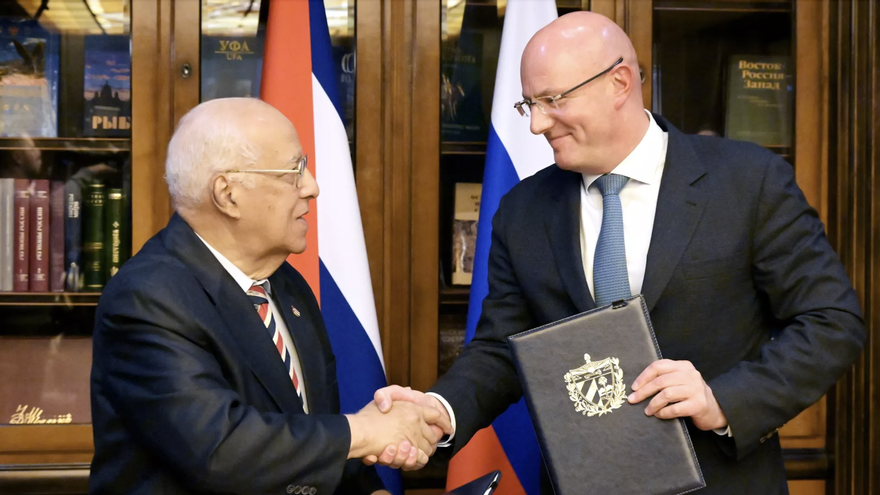
The Cuban Deputy Prime Minister, Ricardo Cabrisas (L), and his Russian counterpart Dmitri Chernishenko (R), during their meeting in Moscow. (Sputnik)

14ymedio bigger14ymedio, Havana, 2 November 2023 — The Minister of Foreign Trade and Foreign Investment, Ricardo Cabrisas, architect of the rapprochement between the Kremlin and Havana, traveled this Wednesday to Moscow to discuss new agreements to oxygenate the anemic Cuban economy. The plans discussed with his Russian counterpart, Deputy Prime Minister Dmitri Chernishenko, include the promise of a stream of investments that, as usual, will flow in only one direction: from Russia to the Island.

According to the Russian agency Sputnik, the meeting included the Kremlin’s business adviser, Boris Titov – who traveled to Havana last October – and officials of the Central Bank of Cuba. Several strategies were discussed to reaffirm bilateral alliances and obtain more investments.

“The priority course for the development of bilateral economic relations should be the creation of favorable conditions for Russian investments in the Cuban economy,” Chernishenko insisted, without clearly revealing what “conditions” he expects the Island to meet in order to be worthy of Kremlin funds. continue reading

Until now, the agreements, some already underway, says Sputnik, cover investments in the energy sector

Until now, the agreements, some already underway, says Sputnik, include investments in the energy sector, with the construction of photovoltaic parks on the Island, the development of fertilizers, and other “infrastructure projects” that they did not specify.

Mention was also made of the implementation of “a full-cycle agro-industrial company for the cultivation and processing of sugar cane.” They do not clarify, however, if it is the Uruguay sugar mill, located in Jatibonico (Sancti Spíritus), which has been under Russian management for at least a year.

In terms of energy, Moscow had also promised to contribute to the creation of new “capacities” in Cuban thermoelectric plants, so it is likely that the agreements involving the sector will continue along that line.

Tourism, another of the lines that Havana insists on improving despite the fact that Russians show little interest in traveling to the Island, has also been the subject of debate by the commission, which assumed as an achievement the visit of about 60,000 tourists from Russia in the first six months of 2023.

The Russian Ministry of Transport announced that it intends to increase the weekly frequencies of flights between the two countries to 10

In order to encourage the flow of travelers, the Russian Ministry of Transport announced that it intends to increase the weekly frequencies of flights between the two countries to 10 by the end of this year.

Although it is not clear what benefits Moscow obtains from Havana in exchange for the investments of the Government and some Russian businessmen, the truth is that both parties strive to demonstrate the good health of their relations and their ideological alignment in the international sphere.

Behind Venezuela and Mexico, Russia continues to be one of the largest suppliers of oil to the island. It has also made numerous donations through international organizations, such as the delivery of 650 tons of oil last September and the “aid” of four million dollars for an international fire center, a few days after the collapse of a multi-family building in Old Havana.

However, Sputnik did not say a single word about the presence of hundreds of Cubans working as mercenaries for the Russian Army in the invasion of Ukraine, allegedly in exchange for obtaining citizenship and several thousand rubles, nor the diplomatic and economic implications between the two States of this controversial issue. If Moscow and Havana have agreed on anything, after hackers leaked images of Cuban soldiers on the battle front, it is to remain silent.

Translated by Regina Anavy

____________

COLLABORATE WITH OUR WORKThe 14ymedio team is committed to practicing serious journalism that reflects Cuba’s reality in all its depth. Thank you for joining us on this long journey. We invite you to continue supporting us by becoming a member of 14ymedio now. Together we can continue transforming journalism in Cuba.

The Annual Condemnation of the U.S. Embargo Against Cuba Demonstrates the Ineffectiveness of the UN

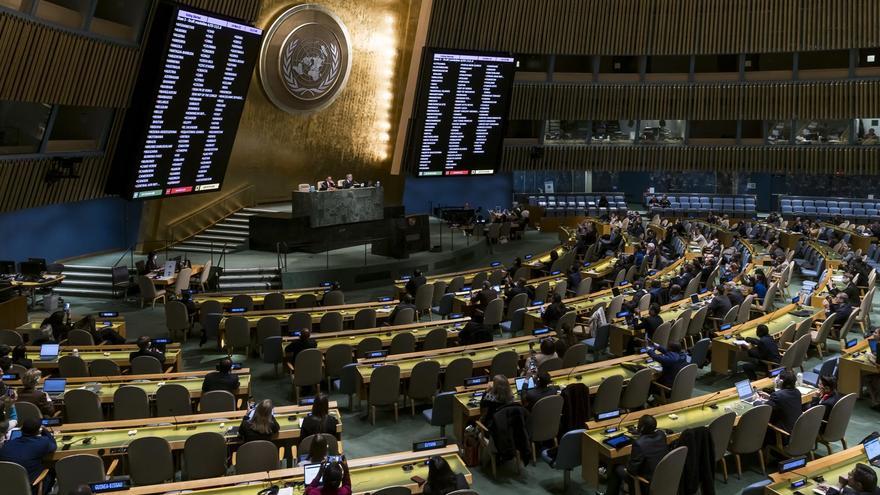
Archive photo of vote at the UN General Assembly. (EFE/Justin Lane)

14ymedio bigger14ymedio/EFE, Madrid, 2 November 2023 — One more year, and the UN General Assembly has again approved a resolution against the U.S. embargo on Cuba; the Cuban regime calls it a “new victory.”

This time, there were 187 votes in favor and two against: those of the U.S. and Israel. In addition, there was one abstention, that of Ukraine. Last year there were three abstentions and the same negative votes.

The sterile ritual takes place at a time, precisely, when the UN is demonstrating its inability to contribute to peace in the Middle East after the war unleashed by Hamas’ terrorist attack on Israel on October 7.

Cuban Foreign Minister Bruno Rodríguez, who spoke just before the vote in the Assembly, said that the blockade “violates the right to life, health, education and well-being of all Cubans,” and constitutes “an act of war in peacetime.” continue reading

The Assembly holds a specific session every year to request an end to the embargo, imposed in 1962, which prevents Cuba from making transactions in U.S. dollars, marketing with products that pass through the U.S. and have a minimum percentage of 10% of parts produced in the country, as well using the U.S. financial system.

The countries that vote in the Assembly in support of Cuba insist that the embargo is a “unilateral” measure, since it has not been decided by the Security Council, involves interference in other States and ends up punishing, above all, the population of Cuba, before the Government.

Everyone pretends to have forgotten that the embargo was decreed by Washington in response to the confiscations of companies and assets of American citizens by the Revolution

Everyone pretends to have forgotten that the embargo was decreed by Washington in response to the confiscations of companies and assets of American citizens by the Castro Revolution, a matter that is still pending.

The magnitude of the support that the Island receives in these annual votes is manifested in the fact that eight groups from different countries – Latin American, African, Islamic, Group of 77 plus China, among others – have presented this year particular motions to reject the embargo, and some intervene individually.

However, it also highlights the irrelevance of the General Assembly, which has been approving a practically similar resolution for 31 years without its making any dent in American politics.

Rodríguez regretted that Biden’s Administration has not changed one iota the policy of the embargo, which was hardened by his predecessor Donald Trump by including Cuba in its list of countries sponsoring terrorism.

The Foreign Minister did not say that some of the sanctions established by the current U.S. administration against Cuba have their origin in the repression unleashed by the regime after the massive peaceful protests of 11 July 2021.

For his part, President Miguel Díaz-Canel described the vote in the General Assembly as a “triumph of dignity… a new victory for the Cuban people and their Revolution. The recognition and support of the international community for the heroism and resistance of Cuba. The triumph of the dignity and courage of our people,” Díaz-Canel celebrated on the social network X (Twitter).

Similarly, after the vote, Díaz-Canel criticized the U.S. representative, who reiterated to the UN that the embargo aims to “promote democracy and promote human rights and freedoms” on the Island.

“How ridiculous the speech of the imperial representative. Full of lies, slander and hypocrisy. He should be ashamed of the immense majority condemnation of his genocidal, unjust and criminal policy. Our slingshot is David’s,” wrote the Cuban president, using the biblical metaphor of the fight against Goliath, which José Martí and Fidel Castro often repeated.

The text, presented by Cuba since 1992, always receives an overwhelming majority with hardly any votes against, beyond the U.S. and some of its allies.

Translated by Regina Anavy

____________

COLLABORATE WITH OUR WORKThe 14ymedio team is committed to practicing serious journalism that reflects Cuba’s reality in all its depth. Thank you for joining us on this long journey. We invite you to continue supporting us by becoming a member of 14ymedio now. Together we can continue transforming journalism in Cuba.

Cuban Totalitarianism’s Philosophy of Disposession

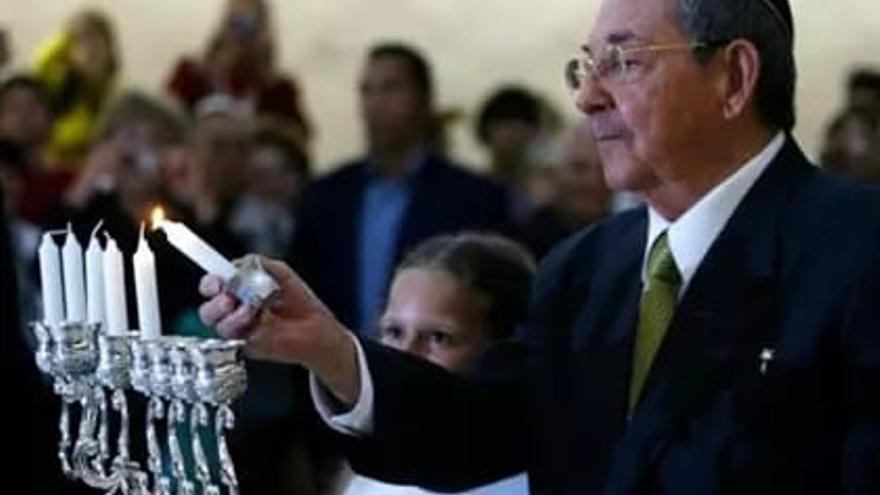
With Raúl Castro and his feint of a timid and fruitless opening, it seemed that the waters would calm down, but the general was only looking for Israeli investment. (Cubadebate)

14ymedio bigger14ymedio, Yunior García Aguilera, Madrid, 1 November 2023 — Unpopular Cuban President Miguel Díaz-Canel has called for “global action” to stop Israel. It is clear that the conflict in the Middle East is much more complex than sensational or biased headlines may show, but Cuba is far from being a neutral country in this story.

Cuba was the only country in Latin America that voted against the creation of a Jewish State, in 1947. Ramón Grau San Martín was governing at the time and his decision to oppose Resolution 181 responded to multiple reasons.

The Cuban intellectual Carlos Alberto Montaner met Dominique Lapierre, one of the authors of the famous book Oh, Jerusalem! When they talked about Grau’s decision, they referred to three fundamental reasons: the need to appear sovereign in the face of Washington’s dictates; the conviction that this would bring permanent instability in the region; and the corruption suffered by the Island, where many were willing to accept bribes from countries like Saudi Arabia. continue reading

Both political parties and civil society organizations, including the University Student Federation and the Cuban Workers Union, advocated for the recognition of Israel

However, Grau’s position did not enjoy great internal support. Both political parties and civil society organizations, including the University Student Federation and the Cuban Workers Union, advocated for the recognition of Israel. So, in 1949, the Jewish State was finally recognized and its admission as a full member of the United Nations followed a favorable vote.

Since 1959, the left wing of Zionism sympathized with Fidel Castro and his bearded men. They, for their part, decided to have a friendly relationship with Israel until the mid-1960s. Cuban socialists were fascinated with the kibbutzim, and Hebrew collectivists helped the Island in citrus production. But the submission of the young revolution to the interests of the USSR, as well as Arab pressures within the non-aligned movement, led Castro to break relations with Israel in 1973.

The decision had nothing to do with Zionist expansionism and everything to do with Cold War alliances. The closer Israel got to the United States, the more the Cuban regime became involved with the enemies of the Jewish state. Fidel Castro sent military advisors and instructors to Palestinian bases in Jordan to train the fedayeen. Cuba became the most belligerent non-Arab country against Israel at the UN, while it firmly supported the United States in its policy of sanctions against the Island. The Castro regime gave all its political and diplomatic support to the Palestinian Liberation Organization and Yasir Arafat was greeted with cheers in Havana in 1974.

With Raúl Castro and his feint of a timid and fruitless opening, it seemed that the waters would calm down. The general wore a kippah during his visit to the Shalom synagogue in Havana in 2010. He was invited to light the first of the five candles on the fifth night of the Hannukah, the Festival of Light. He also spoke of the “fabulous history” of the Hebrew people and took the Torah to his home. But what really interested Raúl was Israeli investment in Cuba’s disastrous agriculture. If those people were capable of planting crops in the desert, what couldn’t they achieve in our tropical lands?

With Díaz-Canel, ten steps have been taken backwards and now the unmentionable plays at being the leader of the non-aligned

For pleasure. Fidel’s little brother did not read the Torah nor were our lands filled with milk and honey. With Díaz-Canel, ten steps have been taken backwards and now the unmentionable plays at being the leader of the non-aligned, assuming the strongest anti-Israel rhetoric and justifying the terrorist attacks by Hamas, a group with which he maintains fruitful relations.

With his usual dyslexia, Díaz-Canel has read in front of cameras an official statement for “global action” against Israel. Orphaned by his own ideas, he has once again cited Fidel Castro and his “philosophy of dispossession” as the fundamental cause of wars. And this is repeated by the same regime that unconditionally supports Putin’s Russia in its invasion of Ukraine!

The same dictatorship that stripped Cubans of their property, their rights and their freedoms, now talks about philosophy. The same regime that has taken our native soil from us, pushing us into a mass exodus, now speaks of dispossession. One has to have a very hard face to talk about peace when, in response to the most peaceful protesters, they threatened to call out the tanks and crushed our white roses with combat orders.

____________

COLLABORATE WITH OUR WORKThe 14ymedio team is committed to practicing serious journalism that reflects Cuba’s reality in all its depth. Thank you for joining us on this long journey. We invite you to continue supporting us by becoming a member of 14ymedio now. Together we can continue transforming journalism in Cuba.

Maria Corina Machado Calls Venezuelan Supreme Court’s Decision To Suspend the Primaries a ‘Big Mistake’

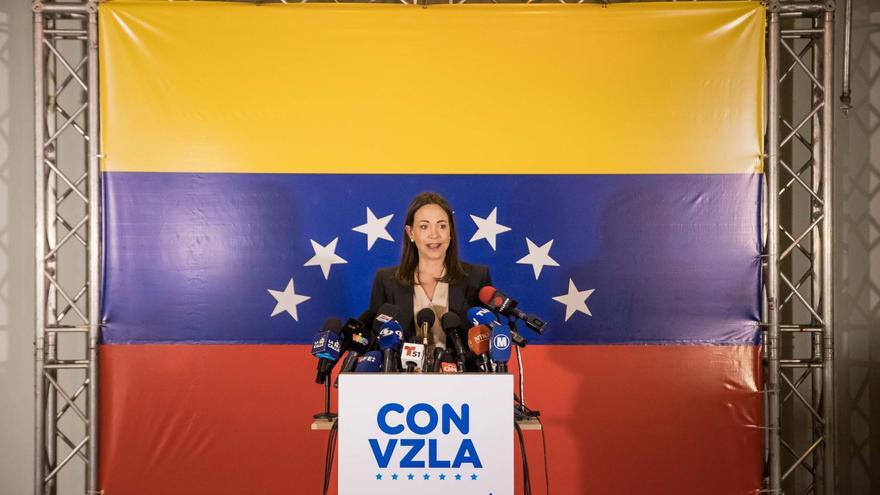
Former deputy María Corina Machado, last week in Caracas (Venezuela). (EFE/Miguel Gutiérrez)

EFE (via 14ymedio), 2 November 2023 — On Thursday, the winner of the Venezuelan opposition primaries, María Corina Machado, described as a “big mistake” the decision of the Supreme Court to suspend that process for all purposes.

In a telematic speech in English organized by the Inter-American Dialogue think tank in Washington, she maintained that this “big mistake” is the result of the “despair” of their not having expected that result or that level of participation.

The Supreme Court has ordered the suspension of “all effects” of the primaries, while the Prosecutor’s Office has opened an investigation against the National Primary Commission (CNP), organizer of the electoral process, which it accuses of “usurpation of functions” and “identity,” “money laundering” and “criminal association.”

Corina Machado said she was talking about Mexico, Colombia, Chile and Brazil and pointed out that it is in her interest to support the process

On October 22, in those elections, the anti-Chavista obtained 92.35% of the votes. continue reading

“We see that hope is growing and we had a great citizen organization,” said Corina Machado, who believes that those elections gave them the necessary legitimacy to continue the process and unite other groups and sectors.

In her opinion, it is now necessary to gain the trust not only of Venezuelans who did not vote that day, but also of other international actors, including those who “traditionally have been closest” to the current leader, Nicolás Maduro.

Corina Machado said she was talking about Mexico, Colombia, Chile and Brazil and noted that it is in her interest to support the process.

“I am sure that the end will be freedom,” said the Venezuelan politician, emphasizing that, as she noted that the United States has defended, “an election can only be free and fair if the candidate chosen by the people” is allowed go ahead.

____________

COLLABORATE WITH OUR WORKThe 14ymedio team is committed to practicing serious journalism that reflects Cuba’s reality in all its depth. Thank you for joining us on this long journey. We invite you to continue supporting us by becoming a member of 14ymedio now. Together we can continue transforming journalism in Cuba.

The Month Begins and the Lack of Rice Leaves the Ration Stores Empty in Cuba

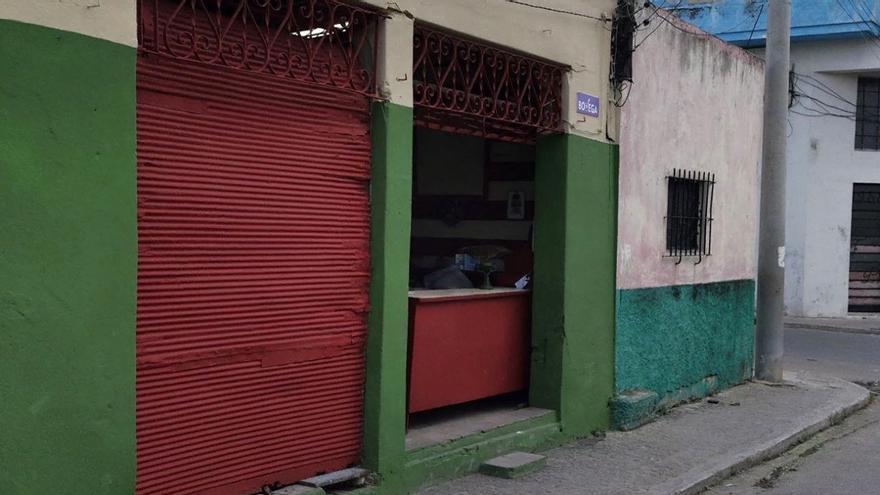
The bodega [ration store] on Arango Street, in the Havana neighborhood of Luyanó, November 1, 2023. (14ymedio)

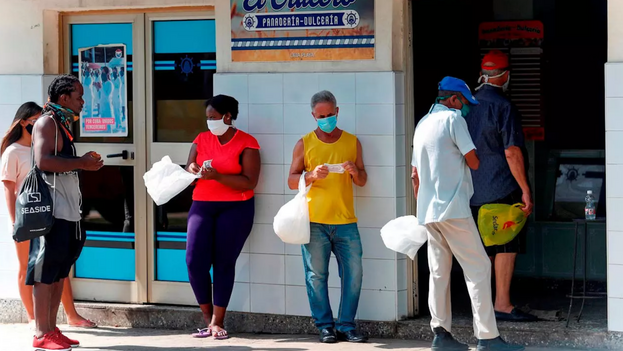
14ymedio bigger14ymedio, Juan Diego Rodríguez, Havana, November 1, 2023 — November has begun, and in front of the bodega [ration store] on Arango Street, in the neighborhood of Luyanó in Havana, you don’t see the usual crowding at the beginning of the month. There are no shouts, no pushes, no line of improvised stools for the customers, who wait for hours until it is their turn to buy. So far, only the rationed three pounds of sugar per person have arrived, but none of the most anticipated product: the rice.

With long faces and looking bored, the bodega employees don’t seem to enjoy this quiet panorama. Clueless neighbors approach, but most already know that the protagonist of Cuban meals has not yet arrived. “I was told by my mother who lives in Key West [Central Havana],” Lisandro, a father of two children, tells 14ymedio. “We are not the only ones affected.”

This newspaper found that in large areas of the municipalities of Plaza de la Revolución, Diez de Octubre, Cerro and Centro Habana, the bodegas have also not been supplied with the quota of rice that consumers receive monthly. The absence of rice is not something minor, because it forces families to buy food on the free market, in informal networks or in the newly opened premises managed by the MSMEs [micro, small and medium-sized businesses]. In all of them, one pound of the worst-quality rice exceeds 170 pesos, and it rises to 250 in its best version. continue reading

The basic basket in Cuba has been reduced over the years. Of more than 20 subsidized items that were once distributed through the bodegas, there are only a few left, which can be counted on the fingers of one hand. But rice had been the most constant in its arrival, due to the fact that its deficit dramatically decreased access to food in the Island’s homes. This November, the tall thin gentleman will be late to appear on the dishes of those who can only eat from the subsidized basic basket.

Behind closed doors, on Arango de Luyanó Street itself, some casseroles still have the luxury of containing some grains. Others wait for the shout of “the rice has arrived!” Trying to get there early, people throw themselves down the stairs and the bodega is again filled with people, stools and shopping bags.

Translated by Regina Anavy

____________

COLLABORATE WITH OUR WORKThe 14ymedio team is committed to practicing serious journalism that reflects Cuba’s reality in all its depth. Thank you for joining us on this long journey. We invite you to continue supporting us by becoming a member of 14ymedio now. Together we can continue transforming journalism in Cuba.

The Cuban Government Extends the Obligation To Operate With Bank Accounts to Farmers and Artists

The rule also affects those who have livestock but no land. (Escambray)

14ymedio bigger14ymedio, Madrid, 2 November 2023 — Food producers will be obliged to have and declare a tax bank account in Cuba through which they must carry out all operations related to their activity, a measure that also affects artists and intellectuals, communicators, usufructuaries [leasers] of state lands, owners of agricultural land and holders of livestock without land.

Any repair, maintenance, purchase of equipment, facilities and  services received from other private businesses or cooperatives, in addition to tax payments to State entities for the purchase of goods or provision of services, must be channeled through the account, which can be in national currency or freely convertible currency.

The new measure was published this Thursday in the Official Gazette and provides for a period of 180 days from November 2 to open and communicate the account to the authorities; otherwise, non-compliances will be sanctioned according to current tax legislation.

The text notes that, to date, some self-employed and “other forms of non-state management” were already obliged to operate with bank checking accounts. The rule was adopted at the end of 2018, and affected people dedicated to food services in bars, cafes and restaurants, those who rented homes or rooms, accommodation repair and, in Havana, collective transport. continue reading

The rest of the workers were exempt, but the efforts of the authorities with banking reform has forced this expansion. “In order to favor the ordering of financial movements between the different actors of the economy and strengthen fiscal control, it is necessary to extend the obligation to open and operate a tax bank account to all taxpayers who are natural persons,” explains the resolution from the Ministry of Finance and Prices.

This Thursday’s Gazette includes another rule, in this case from the Ministry of Internal Commerce, which is in line with what the regime calls “supporting the banking reform process.” The resolution imposes as a requirement for the registration of a business in the Central Commercial Registry that it have “payment facilities for the national gateways or point of sale terminals for the marketing of goods and provision of services to the consumer.”

Registration in this registry is essential to be able to trade on the Island and, from now on, includes this new requirement; the only exemptions are those who are in “zones of silence certified by the Telecommunications Company of Cuba.” One of the criticisms of the requirement to effectively implement electronic commerce is not only the total absence of connectivity of large areas of the Island, but the slowness of the service, its intermittency and the constant interruptions that prevent the completion of operations on many occasions in a satisfactory way, leading to conflicts.

In addition, as planned, the resolution affects those who appeared in the Registry before the regulations. They are required to make electronic payment channels available to customers if they have not already done so. The deadline is 60 days from the publication of the rule, which would reduce the time initially indicated. When the package of measures was announced at the beginning of August, it warned that the adaptation should be completed in six months, leaving the beginning of February as the deadline. However, with the new regulations, the last day would be January 2.

“After this period, the activity they carry out will be suspended,” the text says.

Translated by Regina Anavy
____________

COLLABORATE WITH OUR WORKThe 14ymedio team is committed to practicing serious journalism that reflects Cuba’s reality in all its depth. Thank you for joining us on this long journey. We invite you to continue supporting us by becoming a member of 14ymedio now. Together we can continue transforming journalism in Cuba.

‘There’s No Diesel Anywhere’ Cuban Taxi Drivers Complain

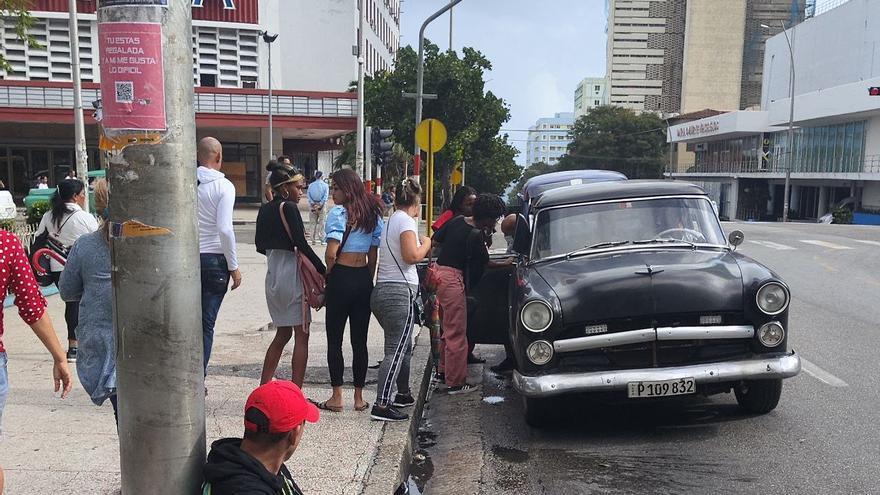
Several habaneros try to get into an ’almendrón’ (shared taxi) next to the Yara cinema. (14ymedio)

14ymedio bigger14ymedio, Madrid, November 2, 2023 — The fight for a seat in an almendrón* (shared taxi) has become more evident in recent days. The drivers go right by the eternal lines at the gas stations because all they have is gasoline. “There’s no place for us to buy, there’s no diesel* anywhere,” a taxi driver tells 14ymedio.

The fuel situation, far from what President Miguel Díaz-Canel claimed last Monday and as this newspaper verified, has not been resolved. After the fat times in September, with the shipment from Venezuela of 86,000 barrels per day (bpd) of crude oil, fuel oil, diesel and gasoline, October has brought lean times. According to Reuters data, Caracas sent its political ally barely 32,000 bpd in October, although it’s true that the cargo of two oil tankers (one with 300,000 barrels of crude oil and the other with 320,000 barrels of fuel oil), which arrived in Cuba at the beginning of October, was counted in the September data.

Export data are bad globally for the state-owned Petróleos de Venezuela (Pdvsa), which sent just 700,000 bpd of crude oil and its derivatives, compared to 812,000 bpd last month. As far as derivatives and other petrochemicals are concerned, the decline is also strong. From the 324,000 metric tons in September, it dropped to 228,500 in October. continue reading

Export data are bad globally for the state-owned Petróleos de Venezuela (Pdvsa), which sent just 700,000 bpd of crude oil and its derivatives, compared to 812,000 bpd in October

In this case, the fall is mainly due to the lack of dilutent and power outages. Just three days ago, in addition, the refining capacity of the Paraguaná plant collapsed. The plant had processed 955,000 bpd, but after a fire and the lack of raw material, it achieved only 94,000 barrels this Monday, 10% of the usual.

Of the four units in this refinery, one of them suffered a fire on Saturday in which there was no personal injury, but it drastically reduced production. It usually produces 30,000 bpd, according to Reuters sources, who maintained that work was already being done “in unsafe conditions and with diesel leaks before the fire.” In addition, low crude oil inventories forced one of the units of another neighboring refinery, Amuay, to stop.

The situation has led to a bad month for the accounts of PDVSA, which returned to sending most of the oil produced to China. The amount has not been specified, but it did exceed what was sent to the United States, which received 178,290 bpd, much more than the previous months. Thanks to the license obtained by Chevron from the Department of State, Venezuela sent 147,000 bpd in August and 145,000 bpd in September. Now, the amount has increased at a time when political tension rises again between the two countries.

Last month, Washington broadly eased sanctions on Venezuela’s oil and gold sectors, authorizing the country to export crude oil, fuel and gas freely for six months. The suspension of sanctions was subject to the Barbados agreements, signed between Venezuela’s chavismo and its opposition with the United States, the European Union and Canada as guarantors, to try to promote clean presidential elections.

“The Treasury Department is prepared to modify or revoke authorizations at any time, in case Maduro’s representatives do not comply with their commitments,” said the Department in charge of the measure.

Now, when Venezuela is trying to boycott the election of Maria Corina Machado as an opposition candidate claiming that she was disqualified, the United States affirms that it will take measures “if Maduro and his representatives do not meet the commitments within the framework of the electoral road map.” Meanwhile, for his part, Diosdado Cabello, number two of the Venezuelan regime, maintains that it is Washington who does not fulfill its part, despite the fact that there was no pact between the two countries.

In the midst of this turbulence, and with Venezuela buying fuel outside its borders, Cuba continues to receive free of charge, with ups and downs, the amounts agreed between Hugo Chávez and Fidel Castro 23 years ago, estimated at an average of at least 55,000 bpd.

In addition, Havana continues to receive significant amounts from its renewed suppliers, Russia and, above all, Mexico, which has already become its second supplier, although Pemex is currently studying how to trade with the Island so as not to incur sanctions after sending 3,510,000 barrels of fuel, with a value of 258.8 million dollars since March 2023, calling it a “donation.”

*Translator’s note: Almendron borrows the Spanish word for ‘almond’ to refer to old American cars, and is derived from their ‘almond-shape,’ and has also come to mean taxi, as the cars commonly provide that service. Originally built to run on gasoline, over the years the almendrones have been converted to diesel.

Translated by Regina Anavy 

____________

COLLABORATE WITH OUR WORKThe 14ymedio team is committed to practicing serious journalism that reflects Cuba’s reality in all its depth. Thank you for joining us on this long journey. We invite you to continue supporting us by becoming a member of 14ymedio now. Together we can continue transforming journalism in Cuba.

Cuba: Private Businesses Are Finishing Off their State-Run Counterparts in Sancti Spíritus

State-run food service establishments have not been able to get cooking oil, pork and other products they need to operate.

14ymedio bigger14ymedio, Havana, 30 October 2023 — Government officials in Sancti Spíritus blame small and medium-sized privately owned businesses (MSMEs) for the debacle of the province’s food-service sector. In an article published on Monday in a state media outlet, they point out that, when it comes to the competition between MSMEs and state-run establishments, there is simply no comparison. The state, they explain, has ended up helping the former at the expense of their own businesses, which have been left to languish.

Rafael Aguado Rodríguez, director of Food Services for the Retail Business Group, told the provincial newspaper Escambray that it is becoming increasingly difficult for state-run operations to get by. The differences in the ways the private and public-sectors manage their businesses have yielded enormously divergent results.

The critical factor is the way raw materials are obtained and later sold to customers as finished products. “We have to buy them on the open market at the going rate, which determines what we can sell, which is always less than what a private restaurant provides,” explains Aguado, who acknowledges it is impossible for any money-losing business to stay afloat for long.

To make matters worse, he adds, food-service workers are constantly migrating to the private sector where “they can earn as much in one week as they earned in a month at their previous jobs.” The basic monthly salary of a state-sector worker is 2,500 pesos so it stands to reason that, in a country where a carton of eggs costs 3,000 pesos, they would look for more lucrative options. continue reading

Aguado also points out that, although his company hires new Food Processing and Food Service graduates every year, they end up leaving state-run facilities sooner rather than later in search of better working conditions which, he acknowledges, they usually find in the private sector.

He claims the public sector has tried to find a solution to the employment problem but, since the establishments which are still in operation generate few if any profits, they are not in a position to offer financial incentives to the remaining workforce.

Though food-service companies have been self-managed for years, the structural problems that are contributing to the current economic crisis make it difficult for them to find suppliers. Government leaders thought that, with the emergence of MSMEs, many of which import a wide array of raw materials and food, the public sector would finally get a break. But new banking regulations soon dashed those hopes and the the surging growth of the private sector is, unfortunately, not making life any easier for them.

For example, state-owned businesses are required to pay for any transaction over 5,000 pesos digitally. As a result, paying their private vendors, who will only accept cash, has had its “complications” and they have begun to lose suppliers.

Escambray claims that the difficulties the sector is experiencing could be resolved with motivation and a “culture of detail.” As it points out, however, “for more than a year, state-run food service establishments have not been able to get cooking oil, pork and other products, without which they cannot operate.”

In fact, given the steep decline in imports, the disaster that is domestic production and the fuel crisis, it is likely that the food-service sector has reached the point of no return. On Sunday, state media announced that almost 200 food production operations in Holguín province will begin using wood-fired ovens in an effort to conserve energy.

The “energy contingency”, as the newspaper Trabajadores (Workers) describes it, has also forced the more than 2,800 employees at these facilities to stop working during peak hours to save electricity. As for the ’firewood’ needed to operate the ’refurbished’ ovens, they will have to make do with sugarcane husks and coconut shells.

Just as state-run establishments close, newly minted entrepreneurs with greater financial resources are taking over the food-service market. Every week, they open bars and restaurants in the same locations that government-run companies had previously controlled. The Havana restaurant La Carreta, which had remained closed for seven years, reopened in June under private management.

However, the press has overlooked the obstacles that private businesses frequently encounter and the government’s efforts to keep them under control. From the time a would-be business files its first application to its launch, owners must pass ideological tests required by the regime, which is looking for individuals who can relieve them of their responsibilities but without the risk of having to deal with “problematic” businesspeople. Additionally, there are the difficulties of having to pay for things with foreign currency and of managing a dollar-based business in a country where the government refuses to let the few dollars it collects circulate.

In spite of this, owners of privately run restaurants seem to be making headway on the island. But while they have gained the support of the regime’s most senior officials, they still face resentment from low-level provincial directors, who see them as invincible competition.

____________

COLLABORATE WITH OUR WORKThe 14ymedio team is committed to practicing serious journalism that reflects Cuba’s reality in all its depth. Thank you for joining us on this long journey. We invite you to continue supporting us by becoming a member of 14ymedio now. Together we can continue transforming journalism in Cuba.

Who Controls the Cuban Economy?

Several people wait their turn outside a bakery in Havana. (EFE / Yander Zamora)

14ymedio bigger14ymedio, Elías Amor Bravo, Economist, 31 October 2023 — It seems like a lie, but now we are entering a new phase. For communist leaders, it is already recognized that even though the blockade continues to be the main threat to the economy, “there are many potentialities in different places that are not yet exploited.” That’s what President Díaz-Canel said at the meeting of the council of ministers led by Prime MinisterMarrero and echoed by the entire communist state press.

So Díaz-Canel now says that “the main call at this time has to be to produce more with our own effort, with our own talent and with our own abilities and potentialities. There is no other way out, because there are no magical measures that can change, from one moment to the next in the short term, the current situation that the country is experiencing.”

What a big lie. Of course there are recipes, and not magical but practical ones, based on the economic rationality alien to communist postulates. The Vietnamese are a good example of this. Something is occurring to the leader of Fidel Castro’s regime. At any moment, he will figure it out, if he hasn’t already. continue reading

According to Díaz-Canel, “in different places there are resources that are not yet taken advantage of, essential to promote popular participation in all processes; therefore, this also starts from having a dialogue, a permanent conversation with our population.” Anything except recognizing that market and private property rights are what’s needed.

And Cubans anxiously wonder, where will those resources come from? And the answer is clear: “From the savings, energy efficiency and adjustment in economic and social activity that were adopted to face the specific situation we had with the fuel deficit.” In other words, by tightening the regime’s belt that permanently suffocates any glimpse of economic activity. Instead of giving flexibility, opening spaces and releasing supply and demand, the communist solution is not to remove the leash but to tighten it even more.

And for this, the most dissimilar and controversial scenarios are proposed, like bakeries finding alternatives to ovens (wood and charcoal), or using transport more efficiently (animal power), both intended to conserve energy. These images envision a terrible return to the worst of the Special Period and the subsequent suffering of the people.

Díaz-Canel justifies those measures, because “they showed a result, because we managed to pass that stage, I would say with fewer effects than those that could exist for the severity that was presented to us in the last weeks of September.” You have to see how little he contemplates the reality that surrounds him. He has no idea.

Energy efficiency and savings become the axis of the communist leader’s speech, who at the same time announced his intention to “rectify everything that has not gone well, listening a lot to what the people propose and constantly attending to the population’s opinions,” and also to “the proposals being made by economists, experts, academics on the possible solutions to face the current situation.” Let’s see if it’s true.

Díaz-Canel believes that “we must demand that institutions fulfill their state functions in all areas, as well as give priority to working in an organized way and breaking the criterion that things are resolved from above, because by solving the problems of the municipality and the community, the problems of the province and the country are solved.”

And this, of course, leads him to the main role in the economy that he hopes to confer on the municipalities, pointing out that “they must work according to the implementation of national policies, provincial policies and municipal policies that are approved and agreed, but with the support, at the level that corresponds to them, of national institutions, provincial institutions and the institutions themselves and the actors that participate at the municipal level.” Someone must have considered that this is not an easy thing to accomplish with all these parts.

The leader also raised the need to “stimulate the production of goods and the supply of services, to produce food, because “that is the first thing that must happen according to the population, with better prices.” Here he returned to dissimilar proposals, such as “you have to produce food with agroecology techniques, knowing that efficiency is not going to be the same, but you have to produce.” That is, knowing that the efficiency will be zero, he insists on hitting the insurmountable wall.

Díaz-Canel said that the main source of food for the population “cannot be what the country imports centrally to distribute with a certain equity or social justice, which sometimes falls into egalitarianism.” Does this mean that non-central import will be used? When? Under what conditions? So that no one can expect anything new, attention is paid again to what happens at the local level, from the local balance sheets to everything else that matters to the country, a commitment to an inefficient technical scale that prevents taking advantage of increasing yields and productivity.

Díaz-Canel, referring to the entrepreneurial sector, believes that “it must be able to take advantage of all the potential that companies have, which is not always taken into account,” but he says this without the slightest knowledge of the forces that govern an economy. Specifically, he says that with the skilled labor they have, when the fuel deficit or other causes prevent them from carrying out their main purpose, they must “look for how other productions and services can be carried out to the population that we are not doing today.” By magic, the communist leader wants companies to do the impossible.

He also talked about promoting the creation of MSMEs [micro, small and medium-sized enterprises] in the state sector. There were a few, and we can see what happened. The more MSMEs believe that they are linked to political power, the greater the shadow of doubt about their belonging and/or relationship with the leadership: a bad business that can jeopardize the entire process of the MSMEs.

Díaz-Canel summarizes all this by saying, “We need businessmen to bet everything on the country, to think like a country, and of course that also carries a demand from the management structures of all organizations.” Nary a word about the institutions and the communist model that govern the economic destinies of the country. Everything is good.

He not only referred to reducing the inequalities in our society but also to the need to stop the exodus of the labor force, especially of the qualified workers. Let there be no confusion: the exodus for Díaz-Canel is the one that occurs from the state sector to the non-state sector.

He insisted on giving priority to health and education and improving the functioning of the social programs that exist in the country. And in an instant of clarity, he spoke of “correcting the measures that have been implemented as part of the Ordering Task* and have shown that they must be modified.”

The rest was last-minute vagueness repeating the same thing about the potentialities one doesn’t want to lose by “working in a different way.” At least he forgot about the blockade. Who knows why.

And of course, Minister Gil is still in office. And for this reason, he took care of presenting the situation of the Cuban economy in September to his colleagues in the council of ministers, glimpsing a gradual improvement in tourism. This was his own data, because the reality is very different, with the hospitality industry at barely 17% occupancy and many private businesses closed due to lack of demand. Playing with the data, when the ONEI [National Office of Statistics and Information] website is under permanent updating, is not very sensible. In the end, a liar can be caught very easily.

According to the minister’s figures, as of September, 1.8 million visitors had arrived in the country, just 75.5% of what was expected, and almost 55% of the figure for the same period in 2019. That is, the level of demand is almost half for that accounting year, when all destinations in the Caribbean have already recovered their pre-pandemic figures.

The even more serious Cuban case has to take into account that since those dates, they haven’t stopped building hotels and rooms, so with less demand and more supply, the occupancy levels, which have to do with profitability in the hotel business, remain at rock bottom. It is not useful that the minister has stated that exports of tourist services grew by some 46% if that increase is really due to prices and not to real activity.

And of course, since there is not much to hold onto, the rest of the minister’s presentation before his colleagues was devastating. Specifically, he said what everyone knows, that the national production of agricultural food has experienced a decrease in deliveries in practically all products, specifically rice, beef, fresh milk and eggs, without specifying figures and alluding only to problems that according to Gil are related to the deficit of inputs and fuel, low productivity, performance and organization.

And after saying all this, what should a responsible minister do? What should be done in a democratic and free country? Of course, never applaud or show solidarity with terrible management, but question and ask for explanations. Does anyone believe that this happened in the Council of Ministers or in the Cuban press? Not even in your dreams.

Without recognizing his own responsibility, the minister continued to ask for “greater self-management in the municipalities to support the population’s demand for food,” a suicidal strategy that this blog has warned about on numerous occasions, which also must be linked to the Economy Plan,” undoubtedly the main failure of the Cuban communist economy.

And since there was not much more to say about the situation of the economy, the council of ministers approved a new portfolio of foreign investment opportunities in the country, the umpteenth, which now aims to channel 729 projects, of which 139 were presented by local governments. This covers a lot, puts on the pressure, and for reasons exposed in this blog and in other posts, the portfolio of opportunities does not ensure foreign investment. Experience confirms it.

As much as the regime wants foreign investors to put their money into projects “to supply the domestic market with basic necessities and supplies,” the truth is that foreign capital is not on the same wavelength. The mismatch of criteria means that investment levels do not meet the needs of sectors such as food production, industry, mining, transport and logistics, among others. There is no point in opening the economy to foreign capital if the communist regime, first, does not put it at the service of Cubans.

*Translator’s note: The Ordering Task is a collection of measures that include eliminating the Cuban Convertible Peso (CUC), leaving the Cuban peso (CUP) as the only national currency, raising prices, raising salaries (but not as much as prices), opening stores that take payment only in hard currency, which must be in the form of specially issued pre-paid debit cards, and a broad range of other measures targeted to different elements of the Cuban economy.

Translated by Regina Anavy

____________

COLLABORATE WITH OUR WORKThe 14ymedio team is committed to practicing serious journalism that reflects Cuba’s reality in all its depth. Thank you for joining us on this long journey. We invite you to continue supporting us by becoming a member of 14ymedio now. Together we can continue transforming journalism in Cuba.

Prisoners Defenders Sees ‘Political Motivations’ in the Trial of Cuban Alina Barbara Lopez

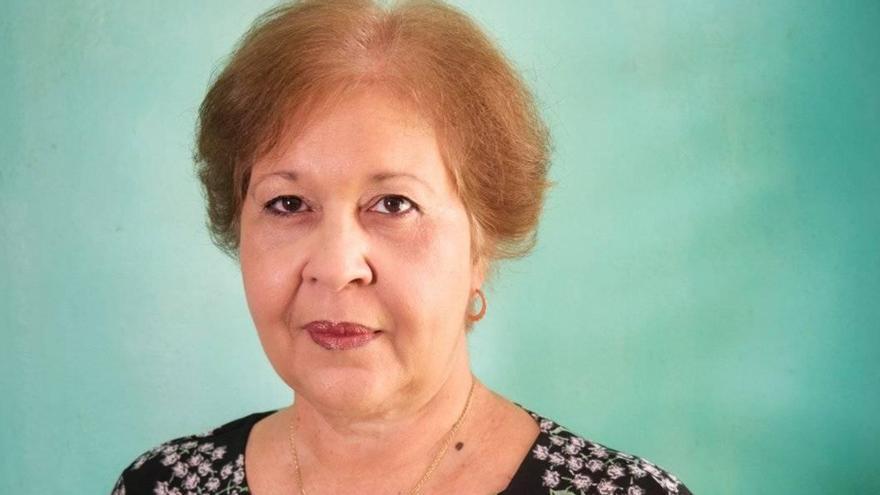
Cuban professor Alina Bárbara López Hernández has received the support of more than a dozen organizations. (Facebook)

14ymedio biggerEFE/14ymedio, Madrid, 31 October 2023 — The organization Prisoners Defenders denounced on Tuesday that the trial against Cuban intellectual Alina Bárbara López, accused of an alleged crime of disobedience, has “political motivations,” and said that “the final objective” of the trial is to “repress the exercise of rights and freedoms.”

The trial will begin on November 16, a day after Cuba undergoes the Universal Periodic Review (UPR), a mechanism of the UN  Human Rights Council.

In a statement, the NGO – based in Madrid – considered López a “victim of conscience” and described the written accusation of the Cuban Prosecutor’s Office, to which it had access, as “false.”

The intellectual, who defines herself as a socialist, was arrested last June after refusing to attend a police appointment because, she said, she did not have a legal obligation

The intellectual, who defines herself as a socialist, was arrested last June after refusing to attend a police appointment because, she said, she did not have the legal obligation as there was no open judicial process against her.

Last year, López had already managed to suspend a similar appointment after filing a formal complaint with the Prosecutor’s Office. continue reading

“(López) remained in custody for more than 12 hours without criminal justification. She was accused of alleged disobedience for not attending the previous day’s summons and resisting detention, a false accusation that many people witnessed, and was placed under a precautionary measure of home detention under threats by order of the Prosecutor’s Office without any judicial protection,” denounced Prisoners Defenders.

Subsequently, the crime of resistance was dismissed. However, it involves precautionary measures such as house arrest and a ban on movements, according to the NGO.

In the order of the Prosecutor’s Office she is pointed out for being “linked to the enemy press project La Joven Cuba, where she served as a writer and coordinator. Her association was marked from its beginning by a hypercritical language from the harmful perspective towards government management, denigrating and discrediting the achievements of the Revolution.”

Lopez maintained that her country “is at the final moment of a model of political, social and economic conception” and said that she did not believe it was “capable of reform under these conditions

In an interview with EFE in April, López maintained that her country “is at the final moment of a model of political, social and economic conception” and said that she did not believe it was “capable of reform under these conditions.”

Prisoners Defenders censored the high representative of the European Union for Foreign Affairs and Security Policy, Josep Borrell, for meeting with López during his visit to the Island at the end of May without making their meeting public.

The denunciation joins that of more than a dozen organizations that have already sued the Cuban authorities to annul the judicial process against the teacher.

The left-wing dissident organization CubaxCuba also called for the closure of the process and an end to the harassment of the activist. “Unfortunately, the intellectual is not the only one on the Island who suffers the violation of her rights. Also for political reasons, hundreds of citizens serve long sentences; others suffer discrimination, harassment and other forms of intimidation and punishment, while dozens have had to go into exile fleeing various forms of state violence,” the organization said.

Translated by Regina Anavy

____________

COLLABORATE WITH OUR WORKThe 14ymedio team is committed to practicing serious journalism that reflects Cuba’s reality in all its depth. Thank you for joining us on this long journey. We invite you to continue supporting us by becoming a member of 14ymedio now. Together we can continue transforming journalism in Cuba.

Mexico Insists on Vaccinating the Population With the Cuban Abdala Vaccine and Buys Almost 3 Million More Doses

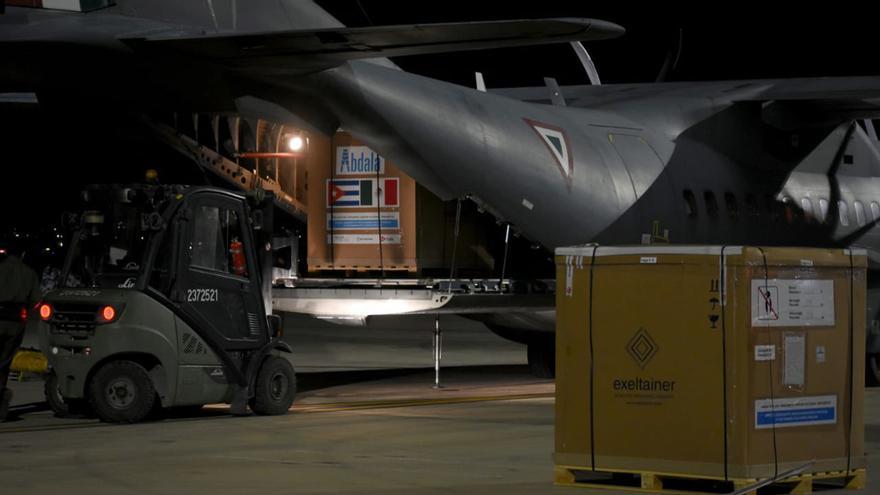
Between Friday and Saturday, about 3 million Cuban vaccines against Covid arrived in Mexico. (X/@SSalud_mx)

14ymedio bigger14ymedio, Mexico, 29 October 2023 — The Government of Mexico insists on buying Abdala vaccines from Cuba despite the fact that, of the 9 million doses it acquired in September last year, it had only applied 114,008 as of June 30, and despite the the population’s growing rejection of the Cuban formula and of local authorities for sending expired vaccines to the states. Between Friday and Saturday, two flights with 2,851,000 doses arrived at Military Air Base No. 1, in Santa Lucía, in the State of Mexico.

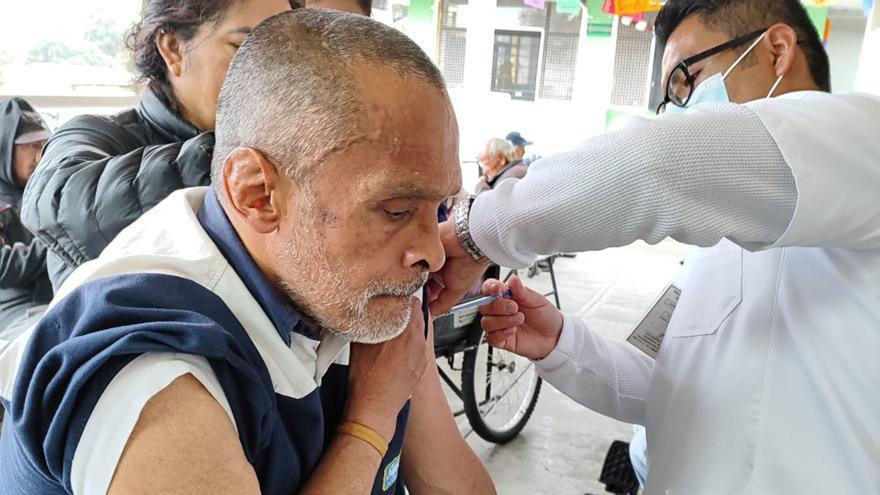
According to a brief statement from the Ministry of Health, these vaccines will be used as part of the national winter campaign, which began on October 16 and will end on March 31, 2024. In the vaccination scheme against Covid, the Russian drug Sputnik, which has not yet arrived in Mexico, will also be used.

The use of the Cuban vaccine has been questioned by specialists because it is not endorsed by the World Health Organization and was formulated against the original variant that emerged four years ago. “The virus over this time has been changing structurally,” warned the 2020 National Health Award and infectious disease specialist Francisco Moreno Sánchez, in statements to journalist Carmen Aristegui.

The specialist also reiterated that both Abdala and Sputnik “are not useful; their effectiveness is highly questioned”

“The vaccines that are currently applied are against the variant that is circulating now,” the specialist added and regretted that the Government of Mexico promotes the use of a formula that perhaps “is useless and continue reading

generates false security for the population.” He also reiterated that both Abdala and Sputnik “are not useful; their effectiveness is highly questioned.”

Health Personnel in Mexico apply a vaccine against influenza to a person in Mexico City. (X/@CDMX_IAPP)

The shipment was delivered to the Biological and Reactive Laboratories of Mexico (Birmex), which will be responsible for the distribution of the vaccine to all states.

After the newspapers AM and El Universal denounced the use of expired Cuban formulas in the state of Morelos and the cities of Fresnillo and Jerez (Zacatecas), the authorities of Guanajuato refused to apply Abdala to the population.

In the state of Quintana Roo, the College of Physicians joined the rejection against the Cuban vaccine. The president of the organization, Irma Archundia Rivero, said that according to a research program on epidemiological risks of the National Autonomous University of Mexico, there has been a wide circulation of the Covid-19 virus at the community level, so the authorities must check whether the biologicals they will be applying are the correct ones to stop these new strains.

However, the State Health Services promote the application of the Cuban vaccine, of which 50,000 doses arrived on October 19 at that institution, with priority for risk groups, children, the elderly and people with comorbidities.

Translated by Regina Anavy

____________

COLLABORATE WITH OUR WORKThe 14ymedio team is committed to practicing serious journalism that reflects Cuba’s reality in all its depth. Thank you for joining us on this long journey. We invite you to continue supporting us by becoming a member of 14ymedio now. Together we can continue transforming journalism in Cuba.

Cuban ’11J’ Prisoner is Transferred to the Melana Del Sur Prison After Protesting Abuses

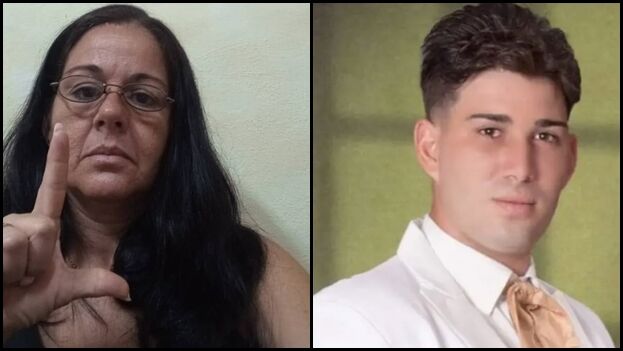
Layda Yirkis Jacinto and her son, the political prisoner, Aníbal Yasiel Palau Jacinto. (Collage)

14ymedio bigger14ymedio, Yoani Sánchez, Havana, 31 October 2023 — “Only today did I have faith in my son’s life,” Layda Yirkis Jacinto told 14ymedio, ref erring to her child Aníbal Yasiel Palau Jacinto, sentenced to five years in prison for participating in the popular protests of 11 July 2021 [’11J’. The political prisoner was transferred this weekend to a prison in Melena del Sur in the province of Mayabeque.

“It’s a Castro dungeon, you have to call things by their name,” the woman emphasizes. Palau, age 28, was transferred from the Quivicán prison along with fellow ’11J’ prisoner, Juan Enrique Pérez Sánchez. “We didn’t know that they had been transferred, I found out yesterday because another inmate called me, it was only when my son called me today that I found out that he was in Melena 2 prison.”

“Aníbal has been without shoes for a week, because he adopted this position as a form of protests against the repression they maintain against the 11th of July prisoners inside the prisons,” explains Jacinto. “The political prisoner Roberto Pérez Fonseca had adopted the same decision days before also due to the abuses of the guards.”

“Last Saturday they tried to force him to put on shoes so he could use his right to a phone call but he gave up the call and stayed barefoot.” In Melena 2 prison, Palau “maintains his protest and is very aware of what he is doing, he has a very firm character and he does not like injustice.” continue reading

Aníbal has been without shoes for a week, because he adopted this position as a form of protests against the repression they maintain against the 11 July prisoners

Of the other transferred prisoner, Juan Enrique Pérez Sánchez from the municipality of Vegas, in the same province, she reports: “he has not yet been able to communicate with his wife Dayana, she still does not know about his whereabouts, although my son told me that they were transferred together.”

From that day that changed their lives forever, Jacinto remembers that although the family is from San José de las Lajas, Palau was in Güines on Sunday, 11 July 2021, where he lived at that time. “He went out to demonstrate peacefully, like thousands of Cubans did in more than 300 points throughout the Island. On Monday the 12th he went out again to protest in the park.”

The young man’s arrest on that second day was brutal: “They beat him, gave him electric shocks and more than six black berets attacked him from behind, in addition to State Security officers dressed in civilian clothes with sticks. They hit him from the head down to his feet, they even sicced the dogs on him,” she remembers. “They disappeared for 17 days.”

“When I heard his voice for the first time, after that beating, he told me that he had received mistreatment, beatings and torture,” she details. “But during the trial against him, they never talked about the 12th of July, when they kidnapped him from the streets. In that rigged circus that the court set up, they invented a crime of attack that he never committed.”

“According to officer Yenislandi Medina Hernández, from State Security in Güines, my son attacked him, which is absolutely false. That man brought two police witnesses to trial but one said that he never saw Aníbal throw a stone and everything was “without evidence. Of the two years they asked him for, he ended up sentenced to five years in prison, although in the middle of the trial they had even asked for 12 more years for a robbery with force.”

“My son participated in the events at the Panorama store in Güines that same 11th of July, because he entered the store and came out through a broken window, although he did not break it, he did not throw stones. He came out with a bottle of oil and a kilogram of rice in his hand because, although he later told me that he didn’t need it, he felt that stores [that only take payment] in MLC [freely convertible currency] outrage the population, they don’t solve their problem.”

“When I heard his voice for the first time, after that beating, he told me that he had received mistreatment, beatings and torture”

“Since he has been in prison he has maintained his demand for freedom and considers that the ’11J ‘prisoners are innocent. In the Quivicán prison he was one of those who started a hunger strike by several political prisoners demanding their rights. We are anti-communists,” explains Jacinto.  “After that they tried to separate them to silence them.”

“They have also put pressure on me, they besiege my house, they threaten me when I go to visit him in prison. In Melena a guard told me that he was going to call the police because I complained that he threatened my son with spraying him in the mouth because Hannibal shouted ‘Patria y vida!’ Because he behaves as if he were free even though he is in prison.”

“When he called me this morning he asked me to denounce his situation. When they were transferred they were put in handcuffs and chains on their wrists and ankles. They threatened to send him to a prison in Guantánamo, but he is going to remain firm because he is fighting for freedom.” The mother’s conclusion is forceful: “¡Basta ya de abuso!” Enough of the abuse!

____________

COLLABORATE WITH OUR WORKThe 14ymedio team is committed to practicing serious journalism that reflects Cuba’s reality in all its depth. Thank you for joining us on this long journey. We invite you to continue supporting us by becoming a member of 14ymedio now. Together we can continue transforming journalism in Cuba.

Havana Will Control the Sale of Diapers by Municipalities To Curb Resellers

The purchase of diapers and wet wipes will be noted in the libreta [ration book] according to the municipality where they are available. (14ymedio)

14ymedio bigger14ymedio, Madrid, 31 October 2023 — Beginning this Wednesday, the sale of diapers and wet wipes in the Caribbean and Cimex Stores will be done in a controlled manner in the municipalities of Havana. The authorities seek to limit the maneuvering of the resellers, who have exponentially increased the price of the product on the black market by multiplying its cost by five.

To purchase these products it will be necessary to present the pregnancy card from week 26, or the child’s card up to 2 years, 11 months and 29 days, as announced on Monday by Julio A. Martínez Roque, objectives coordinator of the Government of Havana.

The measure implies the provincial decentralization of both products, so from now on it will be the Municipal Boards of Directors who decide, depending on availability, how often the two packs of diapers and one of wet wipes set by the regulations can be sold.

The acquisition will be noted in the libreta of the municipality where it is purchased or resides, ’as appropriate,’ explains the document, disseminated on the social networks

The acquisition will be noted in the libreta of the municipality where it is purchased or resides, “as appropriate,” explains the document, disseminated on the social networks of the local administration. The circular also empowers the Municipal Councils “to evaluate and decide the sale” to those who suffer from “chronic and acute diseases, which require such products.” continue reading

“Are they going to supply all the butts in Havana with wet wipes? Because in the peripheral municipalities it is impossible,” says a user in response to the post by the government of Plaza de la Revolución that denounces the bad practices of the workers of the stores themselves. “They are the ones who call the resellers, and it is easier for them to run out of the goods quickly, so as not to have to work. If that is the decision, I imagine it’s for all the stores, at least one per neighborhood in all of Havana, which I doubt.”

A few days ago, the official press denounced how in Havana, simultaneously, there was an enormous lack of diapers in the stores that take payment in national money, and the diapers were being sold on the black market at a price five times their cost. “Today I could say that there are people who have more packages of wet wipes in their homes than there are in the warehouses,” the note said.

The text was written from the personal experience of a Cuban journalist of Cuba Sí, Cynthia Hernández Mayol, mother of a baby, who tells how less than a month ago she had to “sacrifice a whole day to stand in line” in a store in El Vedado where the women who were waiting “began to sneak in front of each other and the store manager decided not to sell any more that day.”

The journalist said that the person in charge of the store herself scolded the women for coming “several times in the same week” and that, right there, she saw a young woman resell six packages of size 1.

By that day, the order that enters into force tomorrow, which is dated October 23 and has aroused a flood of comments among the habaneros who complain about the shortages that exist in most municipalities with the exception of the most central ones, had already been signed. “In Habana del Este, more specifically in Alamar and even in Conseja de Altura, those products have had to last a very long time due to their absence,” complains one user.

Also, the residents in those areas feel harmed, because people come from all over the city to buy, leaving the local residents with nothing. “Plaza is the only municipality where there are stores that sell to everyone, and those affected are the people who live there. Starting with Galerías Paseo and La Infancia, mainly,” protests another commentator.

I hope that this measure does away once and for all with the resellers. And we need them to stock a lot in all the stores in each municipality, because otherwise it all backfires

“I hope that this measure does away, once and for all, with the resellers. And we need them to stock a lot in all the stores in each municipality, because otherwise it all backfires,” says another.

The shortage of disposable diapers has become chronic in Cuba in recent times. In 2019, the State began producing them in the Mariel Special Development Zone through a contract with a Vietnamese company. The plant planned to produce 120 million diapers per year, but in mid-2022 there was a growing shortage, which forced the sale to be restricted. The director of Cimex held Thai Binh Global Investment Corporation responsible for the situation.

Yusleydi Lezcano Palmero said at the time that imports had been reduced to “improve Mariel’s supplier,” but the demand was excessive and there were problems acquiring the raw material. “Sometimes we have had potholes, because due to an internal logistical issue of the Vietnamese company, the wet wipes arrive minutes or hours later or do not arrive on the agreed day,” he said. Almost 95%, he admitted at the time, were destined for Havana, which is the province where their sale is now going to be controlled.

Meanwhile, on digital sites that sell products for emigrants to buy for their families on the Island, a person can buy, without limits, both disposable diapers and wet wipes. On these portals, customers who pay with foreign currency cards have the possibility to choose between different brands, packages of different quantities and  products designed for babies with allergies or other more conventional ones.

Translated by Regina Anavy 

____________

COLLABORATE WITH OUR WORKThe 14ymedio team is committed to practicing serious journalism that reflects Cuba’s reality in all its depth. Thank you for joining us on this long journey. We invite you to continue supporting us by becoming a member of 14ymedio now. Together we can continue transforming journalism in Cuba.