
The Minister of Economy Who Never Told the Truth (II)

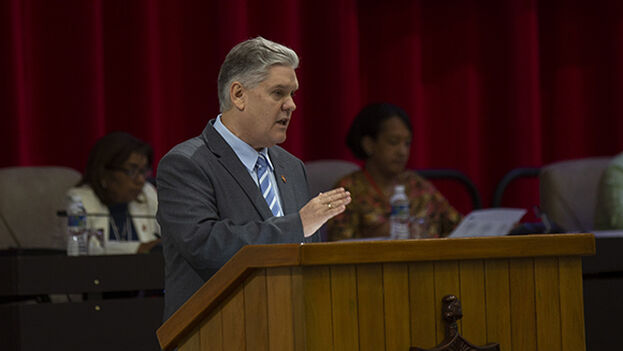
Alejandro Gil Fernández, Cuba’s deputy minister and minister of Economy and Planning, before the National Assembly of the People’s Power of Cuba. (14ymedio)

14ymedio bigger14ymedio, Elías Amor Bravo, Economist, 29 December 2023 — A good part of the State TV Round Table program was dedicated by Alejandro Gil, the Minister of Economy, to the SMEs [small- and medium-sized enterprises], of which he said that there is no stopping of the process or reprisals. Another lie. Because although it is true that in these two years the number of SMEs created has been important, the authorities have not provided data, and this is an essential indicator for evaluating the process. The functioning of SMEs has been conditioned by political action, and survival has been an obstacle course, which the regime, far from facilitating, has continuously complicated.

Along that line, the idea of transferring the powers of approval of SMEs to the municipalities must be interpreted as a control measure, which puts economic actors at the disposal of local communist leaders, who have little expertise in these matters and are obsessed with ideology. The idea of bringing the decision of the evaluation of those businesses, which are on a small scale, closer to their link with local, territorial development and municipal development strategies means that the SMEs will have limitations on their growth and scale and will operate at minimum unit costs, where profits are maximized.

The regime’s bet is that the SMEs remain small and weak, a measure that distances the Cuban economy from the free-market economy and sends a very clear message to those who do not want to see it. They say this process will be gradual, but it will not allow the consolidation of a strong private economic sector.

Local communist leaders have little expertise in these matters and are obsessed with ideology

Secondly, in addition to the transfer to the municipalities of the decision to approve SMEs, Gil announced the revision of the list of unauthorized activities for which they are carrying out an “in-depth analysis with the agencies and receiving criteria from the territorial governments.” In this regard, he said that “there will not be large annotations, but some issues will be corrected and clarifications made. There is no major transformation in the list of unauthorized activities.” Let no one expect much. continue reading

Third, Gil said that work is being done on the creation of an institute that will have as its function the coherent attention to the non-state sector of the economy and, later, be linked to the agencies of the Central State Administration for the promotion of policies and the implementation of certain rules. That is, on the one hand, competition is transferred to local powers, and on the other, a central bureaucratic body is created. What are we going to do? What is this tug-of-war?

It seems that this institute will exercise its functions over all non-state economic actors, not just for SMEs but also for non-agricultural cooperatives and self-employed workers. The institute will help lead the non-state economic actors, without direct intervention from the administrative point of view. Control and control. More bureaucracy where it is not needed.

And something that is noticed as soon as the organizational design is analyzed is that Gil’s Ministry of Economy is left out of this new, two-headed design of the national economy. It accesses an unexplored and critical terrain, whose final result is at least uncertain. However, the aim is to accentuate state control in the allocation of resources, fuel, currency and budgets, with attention to non-state economic actors, the national development plan and the country’s projected strategy. A communist hodgepodge that is difficult to digest.

It is hard to find in the world experiences like the ones that are proposed in Cuba. Another lie.

At this point, Gil said that there are sufficient experiences in the world that have been studied to identify the best way to proceed. It would help if he explained them, because it is hard to find in the world experiences like the ones that are proposed in Cuba. Another lie.

Fourthly, the Round Table has addressed the issue of subsidies on several occasions, because the economic system is unable to foresee their maintenance over time. The issue is whether to eliminate the subsidies or adapt them. No option has full support.

Progress has been made with respect to the past because Gil recognizes that subsidies aren’t free. Of course, in Cuban communism the Government pays for everything, and the price is high for the people and the economic entities because they must support a wasteful State. The subsidy to prevent the population from facing a certain high cost due to the productive inefficiency of the system has a direct cost in the state budget. Someone has to pay.

And of course, the communists finally recognize that when the State subsidizes, it’s a cost that falls on everyone

And of course, the communists finally recognize that when the State subsidizes, it’s a cost that falls on everyone. When the subsidy is assumed by the budget, it is assumed by the country. And when the country assumes it, all citizens pay for it, and this requires, almost always, an increase in the fiscal deficit.

And here comes another idea that the communists have finally figured out: If the fiscal deficit is expanded and money is issued in circulation to be able to support that deficit, inflation is created, which is a tax that falls, above all, on people with lower economic resources and the most vulnerable groups. The injustices of the economic system recognized by Gil is responsible for them. Here there is no reference to the embargo or blockade. It is an internal problem that undermines the bases of the model devised by Fidel Castro at the age of 65. Subsidies, deficits and inflation may end up breaking down the model.

One has the impression that the web of subsidies and prices for products such as energy, electricity and gas has entangled Gil, and with the weight of communist ideology he is unable to see an exit from the vicious circle. In one moment of the Round Table, the minister asked himself a series of questions that, obviously, he didn’t answer.

“First, if we don’t raise the price of fuel, the question is who pays for it. The State? With what money? With the same money that we are collecting via taxes or not allocating somewhere else? With what currency do we buy the fuel that we are going to sell after it is subsidized? With the same currency that we stopped dedicating to food? With the same currency that we stopped dedicating to medicines?”

Gil was referring to the issue of budget design, but the problem is in the justification of the budget. It is not a simple matter of passing money from one item to another with political criteria, but of eliminating items that distort the market reality of supply and demand. The resources of the people, as the minister says, are for other things. What Gil calls the correction of certain prices, which have high levels of subsidies behind them, are not only unsustainable for the country but also assumed to be equal for all. Only the market economy of supply and demand can correct the budget, and the definitive suppression of central planning.

In fifth place, continuing, Gil then addressed the issue of savings.

What is Gil talking about when salaries and pensions are the main sources of income for Cubans and are destroyed by the pressure of inflation?

It is melodramatic that in an economy like the Cuban one there is talk of saving and of identifying incentives for saving. What is Gil talking about when salaries and pensions are the main sources of income for Cubans and are destroyed by the pressure of inflation?

Gil maintains that abroad, due to the price of gas, people are obliged to save, but in Cuba, the high consumption of energy in the non-State sector makes saving measures difficult. And what about the blackouts, Minister? How do we interpret those mile-long lines at gas stations? What savings is the minister talking about, and what else does he want Cubans to stop consuming? Maybe they should return to the era of caves.

The minister wants people who consume more energy or fuel to pay a higher price and incorporate savings measures into their lives. Now, if they can’t stop consuming they have to pay a higher cost. The minister knows who the wasteful are: he just has to look at the state offices or local authorities, organizations, and other public entities to see where they can save. That’s where the waste resides, but just ask the mayor’s office or a State building for self-adjustment.

And at this point, without providing practical solutions to the issue of subsidies, the minister addressed, in sixth place, the situation of the foreign exchange market and said that “it is today one of the main distortions that the economy is facing.”

He acknowledged the obvious fact that he had not designed that informal or illegal foreign exchange market in the country. Of course, the communists had nothing to do with a market governed by supply and demand, which works efficiently.

The minister blamed the SMEs for being the only ones that have products because they can import and sell and have flexibility for prices, while the State companies have their hands tied. What is the minister waiting for to untie them? The solution is clear and the way forward as well. It is to turn the purchase and sale of the currency into a regular economic activity. And then, the alarm comes when Gil says that “we have to control it.”

In this regard, he points out that “among the measures proposed is to recover the management of foreign exchange by the State, because part of what is happening to us today, the fact that there is less State supply and more supply from the private sector, is because the private sector, in some way, is acquiring hard currency in the informal market, the illegal market, and that currency is not entering the national financial system. Therefore, State companies are practically running out of sources of currency allocation.”

It is worth reminding the minister that at the time the fixed exchange rate system was provided in the Ordering Task,*  which set the official exchange of 1 dollar to 24 pesos, this lasted less than three months before the Central Bank recognized its inability to assume the exchanges. Does he want the same thing to happen again? The currency shortage is now worse than at the beginning of 2021. Beware of experiments.

Gil recognizes that the State is sometimes not in a position to offer goods and services as it should be, because hard currency moves in another circuit, the informal one. And if that currency is not in the State’s sphere, it’s because the State is inefficient or incapable. Of course both currencies can function, but normally in all countries there is only one market, operated by private agents, with the law of supply and demand and regulated, without State intervention. That model in Cuba is possible if the communist State recognizes the informal market as the one that must operate and provide the service. That would not be neoliberal, but efficient. Doing things right.

So the intervention of the State, Gil’s answer to the distortions, will not serve to ensure the economic sustainability of the country, nor will it provide responsible and effective management of the economy. Gil knows this, and when he says otherwise, he is lying.

*Translator’s note: The Ordering Task is a collection of measures that include eliminating the Cuban Convertible Peso (CUC), leaving the Cuban peso (CUP) as the only national currency, raising prices, raising salaries (but not as much as prices), opening stores that take payment only in hard currency, which must be in the form of specially issued pre-paid debit cards, and a broad range of other measures targeted to different elements of the Cuban economy.  

Translated by Regina Anavy 

____________

COLLABORATE WITH OUR WORKThe 14ymedio team is committed to practicing serious journalism that reflects Cuba’s reality in all its depth. Thank you for joining us on this long journey. We invite you to continue supporting us by becoming a member of 14ymedio now. Together we can continue transforming journalism in Cuba.
Team Asere, Without a Homeland But With Love

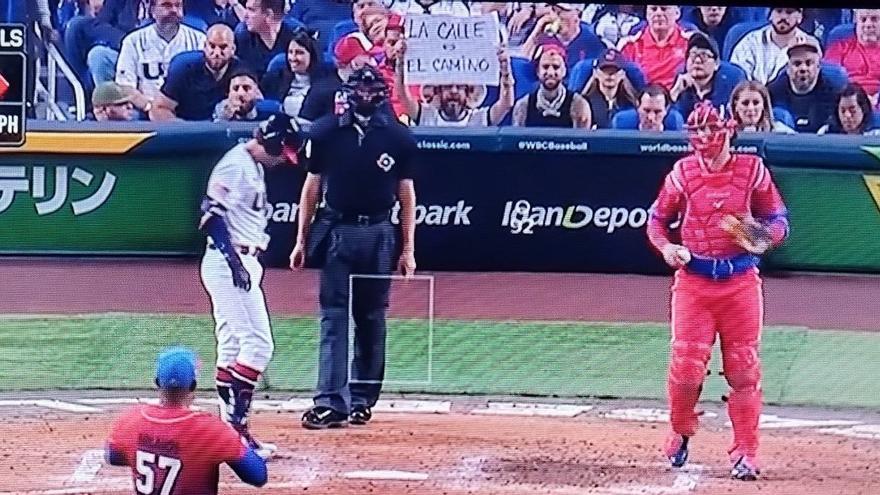
One of the moments of the live broadcast of the game between Cuba and the United States in the semifinal of the World Baseball Classic. (14ymedio)

14ymedio bigger14ymedio, Havana, 28 December 2023 — Rarely has the regime licked its wounds with as much vigor as after the defeat of Team Asere in the semifinal of the World Baseball Classic. The propaganda had turned the match against the U.S. national team into a political crusade, and, as most sports specialists had predicted, the shot backfired on Havana.

The team’s problem was, above all, one of concept. What did Team Asere represent? The best players of a dictatorship? An example of national reconciliation? An idiotic scheme  – as many called it – that tried to take the athletes who trained in the worn-out stadiums of the Island to the level in professional baseball that the emigrants had reached?

The Cuban-American community in Miami was categorical: Team Asere was a well-planned collection of “useful idiots,” puppets that – consciously or unconsciously – danced to the rhythm dictated in the dark propaganda offices of Havana. The exiles also made it clear in the LoanDepot Park stadium itself, with protests that the Cuban Foreign Ministry later described as “unfortunate and dangerous incidents.”

It was those “transgressive” groups, the regime argued, that caused Team Asere to become a cluster of nerves, unable to bat with quality and plan its continue reading

plays well. After the defeat, everything was “strongly denounced,” not only the “destabilizing elements,” but also the “difficult game” against a team with “technical superiority” like that of the United States. It was not difficult, the authorities lamented, to lose against such a “clearly winning” adversary.

Another blow to the mental tranquility of the Island’s authorities was having to broadcast the match on Cuban Television without being able to disguise the multiple posters against the regime held by the public. At the end of the game – although the moment did not reach the Cuban screens – the writer Carlos Manuel Álvarez and the artist El Sexto went down on the field carrying Cuban flags, which cost them a night in the police station. Things that happen in Miami, a city “that does not meet the minimum conditions to host an international event,” Havana said in defense.

The balance of the experiment leaves no room for optimism. Team Asere lost the match – after a series of successes in the contest that guaranteed their face to face with the United States, it must be said. But it opened the way for the commissioners of several Cuban sports, such as chess, to show themselves as “understanding” leaders: if other emigrated athletes wanted to play with the flag of their country of birth there would be no inconveniences, as long as they did so under the draconian conditions imposed by the regime.

But it wasn’t all regret and defeat. The trip to Miami bore fruit, even if it wasn’t harvested by the regime. The baseball players living on the Island arrived at José Martí International Airport loaded down with televisions, automobile tires and many suitcases, provisions to survive on an Island where only the privileged aseres* want to return.

*Translator’s note: A common word to greet a friend, asere is Cuban slang for “dude” or “buddy.”

Translated by Regina Anavy

____________

COLLABORATE WITH OUR WORKThe 14ymedio team is committed to practicing serious journalism that reflects Cuba’s reality in all its depth. Thank you for joining us on this long journey. We invite you to continue supporting us by becoming a member of 14ymedio now. Together we can continue transforming journalism in Cuba.
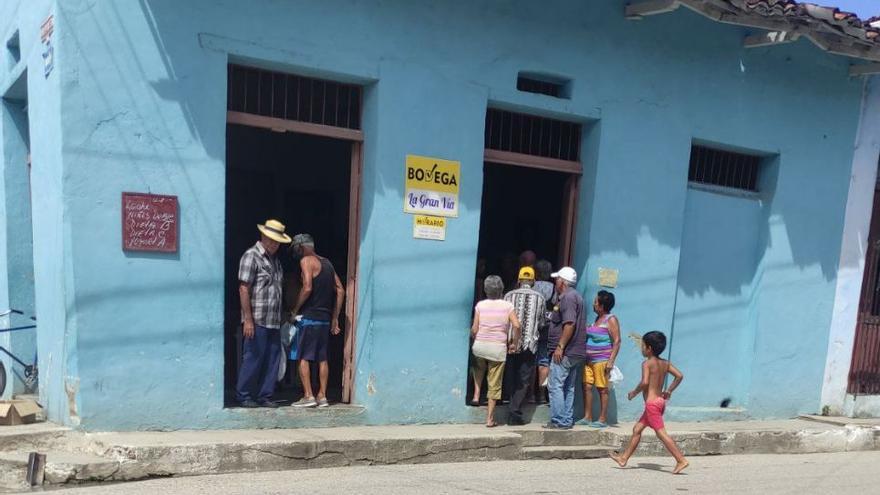
Suspension of Rationed Sale of Milk to Chronically Ill People in Sancti Spiritus

Last March, the local press announced that the sale of milk destined for medical diets was suspended. (14ymedio)

14ymedio bigger14ymedio, Mercedes García, Sancti Spíritus, 26 December 2023 — “It failed and failed until it stopped arriving,” this is how Nuria de las Mercedes describes the situation that the chronically ill patients of Sancti Spíritus have experienced with the supply of milk for medical diets. This December, for the second time in the year, consumers have been informed that the sale of dairy is suspended in state shops, and only the quota for children up to seven years old and pregnant women will remain.

Nuria, 74 years old, is diabetic, hypertensive and has kidney problems. Among the chronic patients who receive a liter of milk every three days, the elderly woman is in group C of the three groups [A, B and C], where beneficiaries are grouped according to their condition. “In recent months it was delayed, it was even weeks since it had arrived, and now we were told that they can’t guarantee it,” she tells this newspaper.

“They haven’t explained if it’s forever or a temporary measure,” complains the woman from Sancti Spíritus. Along with other customers who buy the rationed milk, Nuria is part of a WhatsApp group where information about the supply is shared. “In the group no one has explained about what’s going on, but now they’ve told me in the shop that it wasn’t coming.” continue reading

The state employees don’t offer a conclusive explanation. “We are in the season when traditionally there is less rain, less feed and less milk

The state employees don’t offer a conclusive explanation. “We are in the season when traditionally there is less rain, less feed and less milk,” an employee in the Kilo 12 district tells this newspaper. “At the beginning of the year the same thing happened, and then we went back to selling, although it has never returned to a normal or stable distribution.”

Last March, the local press announced that the sale of milk destined for medical diets was suspended. The announcement explained that it was a momentary measure and that the authorities of the territory had decided to “protect the allocations directed to children and pregnant women.”

Alberto Cañizares Rodríguez, director of the Río Zaza Dairy Products Company in the province, explained that the main reason for the cutback was the lack of animal feed and added that the country had not been able to import “the required levels of milk powder” to ensure coverage for chronically ill people.

However, this newspaper was able to confirm that last November, 50 tons of powdered milk expired in the provincial warehouses of Río Zaza. “It was not sold to the population and not distributed by another way, so they saw the merchandise had already expired and could not be marketed,” an employee of the company told 14ymedio at the time.

The bosses were furious when they found out and came here to try to break the chain on the weakest link

“The bosses were furious when they found out and came here to try to break the chain on the weaker link – that is, to blame us –  but the responsibility was theirs, because they told us to hold onto the product, and they did not take into account the expiration date. It was imported milk, and sometimes it is bought with little time left because that way it is cheaper on the international market.”

“Then they took samples of the milk to see if at least they could allocate it to some social program in which people can’t see the label (with the expiration date), but here that type of product suffers a lot from the heat,” he explains. “When the date expires, it usually already has a stale taste or has lost qualities to mix well with water, for example.” The product is still in the company’s warehouses.

For chronic patients, it remains for Río Zaza to process the flavored soy milk to cover the food deficit, but the product does not enjoy good acceptance and, for diabetics such as Nuria de las Mercedes, “it is more of a curse than a help because they add a lot of sugar, and it comes with dyes that are not recommended for those who have kidney problems.”

Until the beginning of 2023, Sancti Spíritus had been the only Cuban province that maintained the sale of milk for medical diets. Its status as a livestock territory assured it of the distribution, but “the year started badly and ends worse,” says Nuria. The illegal slaughter of cattle, the lack of grass in the fields and state laziness seem to be combined so that a glass of milk will not arrive on the tables of these patients in the coming months.

Translated by Regina Anavy

____________

COLLABORATE WITH OUR WORKThe 14ymedio team is committed to practicing serious journalism that reflects Cuba’s reality in all its depth. Thank you for joining us on this long journey. We invite you to continue supporting us by becoming a member of 14ymedio now. Together we can continue transforming journalism in Cuba.
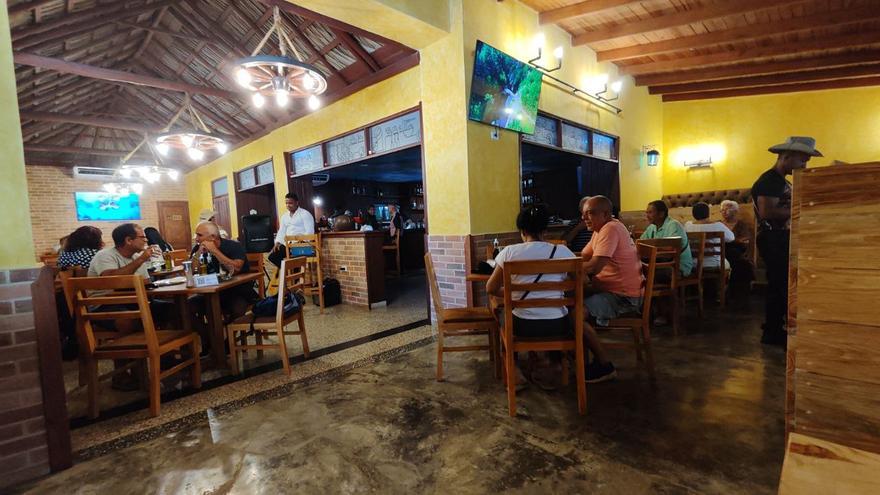
Cuban Faces of 2013: MSMEs, the Last Economic Hope for Cuba’s Dying Regime

Obel Martinez, a dual national who holds both Cuban and U.S. citizenship, now owns the iconic La Carreta restaurant in Vedado as well as the Mojito-Mojito bar in Old Havana. (14ymedio)

14ymedio bigger14ymedio, Havana, 25 December 2023 — They started popping up, little by little at the beginning of the year, without all the attendant publicity the official media usually gives to these sorts of places. Establishments that were once state-owned, that closed after languishing for years, have reopened overnight as mipymes (a Spanish acronym for micro, small and medium-sized businesses, or MSMEs in English).

Well-stocked stores, restaurants with good food, tastefully decorated boutique hotels. None of this would be strange in any place else of the world. On the contrary, it would be an excellent indication of the solid state of an economy that is committed to private initiative and the prosperity of small businesses. But Cuba is not just any place, and the issue is multi-faceted.

First, there is the opacity. Normally, if the state wanted to sell or rent out a property to an MSME, it would solicit bids. This is what Cuban law, specifically a resolution adopted in April 2022, requires but the government has done little to publicize it. This lack of transparency has fueled a lot of suspicion. Who owns these businesses and how did they get them? How were the new owners chosen if they did not have connections in the highest echelons of power?

Home Deli, a store that has three Havana locations, is owned by an Italian, Andrea Gallina, and his Cuban wife, Diana Sainz, who signs with a different surname than the one she inherited from her father, Ricardo Sáenz, one of continue reading

the founders of the Prensa Latina news agency and the magazine Bohemia. The couple also own Café Bohemia and the adjacent hotel, Estancia Bohemia, in Old Havana, as well as the Paseo 206 Boutique Hotel in Vedado and its ground-floor cafe, Ecléctico.

Though Cuban law and the U.S. embargo prohibit it, several emigrés have opened businesses in Cuba using other people’s names

Then there is the murkiness. For example, very little is known about the owners of the Diplomarket grocery store or the Antojos restaurant except that both are owned by Cuban nationals living in the United States. Diplomarket, which has been described as “the Cuban Costco” due to some similarities it shares with the American chain, belongs to the Miami-based Las Americas TCC Corporation, whose vice president is Frank Cuspinera Medina.

Though Antojos is owned by Reinaldo Rivero, the business is registered in the name of his ex-wife and managed by their son, Reinaldito. Rivero and a foreign partner provided capital not only for the bar but also for the company that provides security to both establishments, which are located on Espada Alley in Old Havana.

Obel Martinez, a dual national who holds both Cuban and U.S. citizenship, now owns the iconic La Carreta, a restaurant in Vedado, as well as the Mojito-Mojito bar in Old Havana.

Though currently a violation of both Cuban law and the U.S. embargo, several emigrés have opened businesses in Cuba using the names of other people on the island., in some cases in association with local officials. The regime seems to be counting on them to save it disastrous economy.

They have, however, been met with rejection by most of the public, who cannot afford their prices and who now realize that the revolution that was supposed to eliminate inequality has, in the end, created new class divisions.

Those who for decades were called worms, traitors and counterrevolutionaries are now the regime’s last great hope for prolonging its agony.

____________

COLLABORATE WITH OUR WORKThe 14ymedio team is committed to practicing serious journalism that reflects Cuba’s reality in all its depth. Thank you for joining us on this long journey. We invite you to continue supporting us by becoming a member of 14ymedio now. Together we can continue transforming journalism in Cuba.
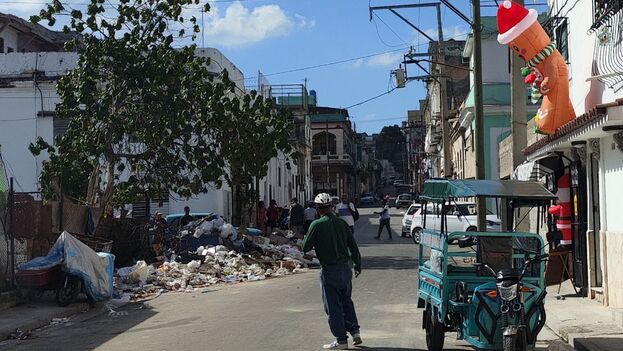
The Anguish of Cubans in the Face of the Government’s Economic ‘Paquetazo’

This Christmas, few dare to believe or say that next year will be better. (14ymedio)

14ymedio bigger14ymedio, Yoani Sánchez, Generation Y, Havana, 29 December 2023 –Few garlands, scarce Christmas trees and less popular enthusiasm are marking the last days of 2023 in Cuba. Apart from the occasional isolated celebration, the spirit of this December seems more marked by uncertainty than by celebration. Added to the long economic crisis and the mass exodus are fears about the great economic paquetazo* that the Island’s authorities have announced for 2024.

Although President Miguel Díaz-Canel has already come out to try to stop the rumors and insists that the cuts are not part of a “neoliberal” process, we all know that Cuban leaders have their own glossary of terms. For decades they have labelled the unemployed with the almost friendly euphemism of “available workers”; the crisis of the 90s was labeled the “Special Period“; and the onslaught that confiscated all private businesses in 1968, even including the boxes of the shoeshine boys, was given the heroic moniker of the “Revolutionary Offensive.”

Miguel Díaz-Canel insists that the cuts are not part of a “neoliberal” process; we all know that Cuban leaders have their own glossary of terms

Knowing this appetite for naming things their own way, it is clear that the authorities do not like it at all when someone gets ahead of them in naming the phenomena and moments that the Cuban reality has gone through. But, it only took a few minutes after Prime Minister Manuel Marrero began to explain before Parliament the economic adjustments that will come with the new year, for the word “paquetazo” to spread through the networks and instant messaging services. This little word names the snips that will be aimed at cutting subsidies while, on the other hand, prices are increased.

This group of actions would also fit well with the definition of “shock plan,” another of the phrases that the official Cuban press likes to use when talking about other countries. What is coming, broadly speaking, includes an increase in the prices of products and services and the end of the universal subsidy for the basic food basket. Following Marrero’s statements, several officials have rushed to assure us that the rationed market “booklet” will not be eliminated, but without guaranteeing that, continue reading

after 60 years of existence, it will be maintained for all consumers.

The paquetazo also includes a 25% increase in the electricity rate for the 6% of the residential sector that consumes the most and charging tourists for fuel in foreign currency. The cost of the water supply will triple for those who do not have a metering device and the price of a liquefied gas cylinder will increase by 25%. New rates will also be applied to passenger transportation services. In addition, Marrero warned of a “review” of the number of people currently on the state payroll, which predicts numerous layoffs.

The announcements before Parliament have raised a wave of concern among both ordinary people and the officials themselves.

It is evident that in a society where welfarism, crude egalitarianism and the rationed market have been used not only as mechanisms for the distribution of goods and products, but also as a form of social and political control, the announcements before Parliament have raised a wave of concern among both ordinary people and the officials themselves. While inside homes there is fear of an even greater increase in the cost of food and basic products, in the air-conditioned offices of institutions and ministries they suspect that the measures will fuel popular protests or accelerate emigration, which hits the labor sector hard, especially the workforce of qualified workers.

Apprehension is in the air. An inquietude that Cubans express these days at an end of the year with few parties and few Christmas trees. When they pass a friend or acquaintance on the street, they don’t even dare to use one of those ready-made and formal phrases that are customary to say these days. No one utters the sarcastic prediction that 2024 “will be better.”

*Translator’s note: “Paquetazo” is basically ‘package’, but the ending ‘azo’, signifying a blow, adds a certain heft to it. (See “Maleconazo“) See also from Spanishtogo.app: “Paquetazo, a term used predominantly in Latin America, refers to a package of economic reforms implemented by the government that often includes a series of austerity measures. Over time, it has become a popular term among citizens to express discontent with these policies.”

______________

Editor’s Note: This text was originally published by Deutsche Welle’s Latin America page .

____________

COLLABORATE WITH OUR WORKThe 14ymedio team is committed to practicing serious journalism that reflects Cuba’s reality in all its depth. Thank you for joining us on this long journey. We invite you to continue supporting us by becoming a member of 14ymedio now. Together we can continue transforming journalism in Cuba.
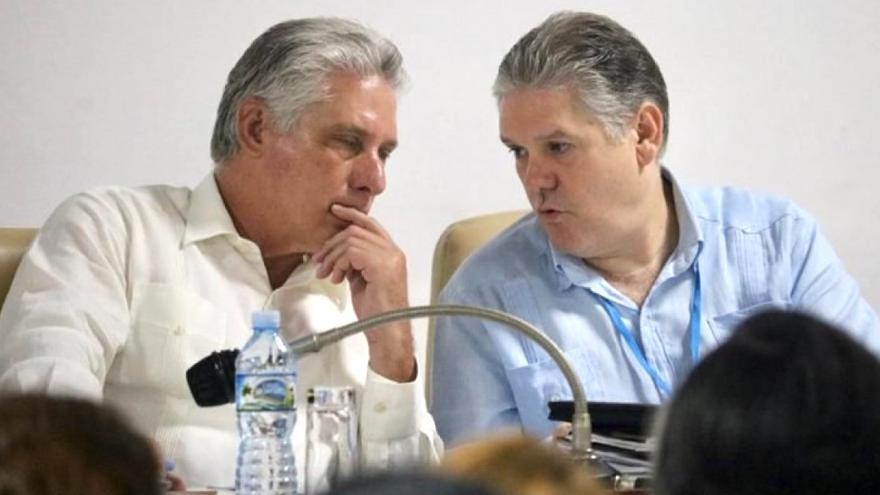
The Ideological Endogamy of the Cuban Regime

Inauguration of the eye hospital in Anhui, China. (Consulate of Cuba in Shanghai)

14ymedio bigger 14ymedio, Yunior García Aguilera, Madrid, 28 December 2023 — Endogamy is the practice of marrying in closed groups, between individuals of common ancestry. Reproduction between parents who are closely related greatly increases the chances that the offspring will be affected by recessive traits or genetic impairments. One of the most notorious cases was King Charles II of Spain, known as the Bewitched.

The multi-pathological monarch was not able to learn to walk or talk until he was between six and nine years old. He died just shy of his 40th birthday, without any of the attempts to exorcise him being successful. His autopsy described “a heart the size of a peppercorn, corroded lungs, putrid intestines, a single coal-black testicle, and a head full of water.” His death, leaving no descendants, marked the end of the House of Austria.

Another case that has recently achieved notoriety is that of the Whittakers, in West Virginia. Its members suffer from various physical and mental anomalies and are known as the most endogamous family in the United States. Mark Laita, who introduced them to us, claims that they communicate with each other with howls and growls. His controversial documentary on YouTube has been seen by more than 40 million people.

As the model reproduces in a closed circle, it generates anomalies, recessive traits, philosophical and structural deterioration

Regimes that insist on maintaining a kind of ideological endogamy also run the risk of their system suffering the same ailments as Charles II of Spain continue reading

and the Whittakers. As the model reproduces in a closed circle, it generates anomalies, recessive traits, philosophical and structural deterioration. Single-thinking systems breed increasingly mediocre leadership, not to mention the suffering they cause in the body of the societies they try to lead.

That is why the Cuban model is doomed to disappear, because its stubborn inbreeding, far from maintaining a supposed “ideological purity” that ensures power, is reproducing the same error code, with increasingly worse symptoms. From the Process of Rectification of Errors we moved to the Special Period, from the disastrous Battle of Ideas to an even worse Ordering Task, from an endless Coyuntura [roughly ‘temporary sitaution’] to an eternal Contingency, from a very poor Creative Resistance to the current (and ridiculous) War Economy.

Who knows what name they will give to this very long and incurable crisis in 2024. If Díaz-Canel was the smartest sperm generated by the Single Party, what can be expected from the most lagging gametes? There we have Alejandro Gil, perhaps the worst Minister of Economy on the planet, who does not blush when giving the same message of failure, year after year, without anyone thinking of doing him the favor of dismissing him.

There we have Gerardo Hernández Nordelo, the ill-fated former spy who today posts imbecilities from a position as useless as that of presiding over the most grotesque and impoverished mass organization of all those created by the regime to monitor us.

And things get worse if we look at the “new marabous” (they cannot be called “pines”). At least one limits oneself by launching very strong criticisms towards characters like Michel Torres Corona or Pedro Jorge Velázquez. It is not politically correct, in these times, to emphasize their disabilities. Although, in reality, theirs is more about political mountaineering and impudence.

The terrible thing is that all of us, even if we have escaped from the prison island, run the risk of reproducing its practices. The extreme polarization and algorithms of social networks lead us to consume ideas very similar to our own. And we can easily end up locked in circles that reproduce exclusive new thoughts.

Debate is almost an obsolete word. The ’cool’ thing is to say that so-and-so “swept the floor” with so-and-so, or vice versa

Debate is almost an obsolete word. The cool thing is to say that so-and-so “swept the floor” with so-and-so, or vice versa. This obsession with headlines related to the same domestic task shows a great lack of imagination, but it is the result of the intellectual laziness of our time. No one wants to get tangled up in the conflict of having to decide between two divergent opinions. The correct one, a priori, is whoever thinks like me, period.

So, if you can’t reason with another, insult him. If you run out of arguments, launch a smear. If you can’t see the curvature on the horizon, shout that the earth is flat! Most have never climbed so high and they may even applaud you.

I already know that pluralism is not fashionable. But perhaps, just perhaps, respecting the diversity of opinion is the only effective remedy to eradicate, once and for all, that ideological endogamy that we carry in our blood.

____________

COLLABORATE WITH OUR WORKThe 14ymedio team is committed to practicing serious journalism that reflects Cuba’s reality in all its depth. Thank you for joining us on this long journey. We invite you to continue supporting us by becoming a member of 14ymedio now. Together we can continue transforming journalism in Cuba.

Selling Gold and Silver Olympic Medals Is a Means of Subsistence for Professional Cuban Athletes

The Cuban boxer Mario Kindelán subsisted on the Island with 7,400 pesos. (Capture/Documentary ’Lucha’)

14ymedio bigger14ymedio, Havana, 28 December 2023 — Double Olympic boxing champion Mario Kindelán sold the gold medal he won at the 2000 Sydney Olympics because he “had practically nothing to eat” and to “support” his daughters. The confession of the legendary athlete, during an interview given to Play-Off Magazine at the beginning of December, is not the only testimony of athletes who had to give up their prizes for the sake of survival. Like others, the boxer – who also sold the gold medal he obtained in Athens 2004 – insists that he doesn’t regret it.

According to Kindelán, who also spoke in the documentary Lucha,* produced by the American production company Society, it was preferable to exchange his medals for “a television or a refrigerator.” The media reports that he sold his Sydney medal for $400 and used the money to support his family “for a while.”

The boxer described the precarious state in which he was living as “critical,” so much so that he and his wife divorced. Through Facebook and to help him, Kindelán was contacted to train young people at the Grappling Club of Bahrain, a country in the Persian Gulf, where he is currently located. Now Kindelán provides a fact that gives the measure of his poverty: on the Island he received 7,400 pesos for his status as Olympic champion, which “was not enough to buy candy for his children or have the security of eating.” continue reading

Yarelys Barrios sold the silver medal he won in Beijing 2008 for $11,600, on eBay

At the beginning of December, the boxer tried to sell his gold medal won in Athens 2004. Former British boxer Amir Khan, who admires Kindelán, donated $5,000 to the Cuban to build a house for his mother on the Island. According to Khan, the Cuban, in a moment of “despair,” told him to keep the medal he won in 2012, after defeating the British in Athens.

Kindelán is not the only athlete who has had to give up his medals to overcome poverty in Cuba. The discus thrower Yarelys Barrios sold the silver medal he won in Beijing 2008 for $11,600, on e-Bay. The case was announced after the International Olympic Committee reported that the athlete tested positive for the use of the doping substance acetazolamide, a diuretic and prohibited masking agent, and he was unable return the prize.

The cases of the boxers Roniel Iglesias, Carlos Banteux and Sixto Soria, the Greco-Roman wrestling athlete Juan Luis Marén, the shooter Leuris Pupo, the long-jumper Iván Pedroso and the baseball player Miguel Caldés are different: their medals appeared as part of the auction lots of RR Auction with few explanations about their provenance.

In January, as part of the Olympic Memorabilia lot, the gold medal that boxer Roniel Iglesias won at the Tokyo 2020 Olympic Games was sold. For the prize, which has the legend “Boxing, male welterweight (63-69 kg)” inscribed on the edge, RR Auction obtained $83,188; it is not known if the Cuban received any of this money.

In January, as part of the Olympic Memorabilia lot, the gold medal that boxer Roniel Iglesias won at the Tokyo 2020 Olympic Games was sold

In that same auction, Carlos Banteux’ silver medal, won at the 2008 Beijing Olympics in the 69-kilogram division, sold for $25,000.

In 2021, an American auction house sold for $71,335 the gold medals that Iván Pedroso won in hurdles in Sydney 2000, and those of the shooter Leuris Pupo, for $73,205.

On that same day, the silver medals of Cuban wrestlers were sold, that of Yasmany Lugo, which he won in Rio 2016 for $25,000 and that of Juan Luis Marén, which he won in Sydney 2000 for $10,000.

*Translator’s note: Lucha can be translated as “fight” or “struggle,” as in the daily struggle to get by.

Translated by Regina Anavy 

____________

COLLABORATE WITH OUR WORKThe 14ymedio team is committed to practicing serious journalism that reflects Cuba’s reality in all its depth. Thank you for joining us on this long journey. We invite you to continue supporting us by becoming a member of 14ymedio now. Together we can continue transforming journalism in Cuba.

Cuba: A Missing Young Man is Found Dead in Mayari, Holguin

Several relatives shared photos of the young man on social networks to facilitate the search. (Facebook/Alejandro Ramírez)

14ymedio bigger14ymedio, Havana, 28 December 2023 — This Thursday, the lifeless body of 25-year-old Eugenio García, who had been missing since last Tuesday in the municipality of Mayarí, province of Holguín, was found. The young man had left his house last Tuesday, taking 1,300,000 pesos with him to buy foreign currency in the informal market.

The journalist Mario J. Pentón, a resident of Miami, confirmed with family sources that the young man had been found dead. The reporter shared some images in which dozens of people are seen around the area where García’s body was found.

“He was under a bridge, as confirmed by the family,” adds Pentón, who was in contact with García’s sister. “He was beaten to death,” the relatives said, although the police authorities of the municipality have not yet pronounced on his initial disappearance or the discovery of the young man’s body.

Previously, in a video, filmed on Wednesday night, dozens of people were seen organizing to search in different parts of the area. “We’re going down, continue reading

in the alley, there, we’re going to look,” was heard in several voices. “Perhaps near the ice cream factory,” says another about where they should search.

For her part, the young man’s sister also released a video thanking the neighbors of Mayarí: “Thanks to the Mayari people, many people have gone into the street. More than a hundred people are helping us look for him.”

The young woman, who recorded the video “outside the police station” then pressed the officers to get dogs and do their job to find him. “I don’t see the police doing anything, I don’t see a breakthrough, I don’t see an answer,” she said with pain.

“It can’t be that the people are doing the job of the police,” the woman stressed. “They have come to support us, looking in the rivers and everywhere”

“It can’t be that the people are doing the job of the police,” the woman stressed. “They have come to support us, looking in the rivers and everywhere. I’m calling the Minint [Ministry of the Interior], the firefighters. What are they waiting for? For him to show up dead? We are wasting time.”

Pentón also reported that the police had arrested a suspect and published a series of messages, sent through Facebook Messenger, which the person in custody exchanged with García on the day of his disappearance to coordinate the informal transaction. The young man wanted to buy $4,000 to, among other things, celebrate his nephew’s birthday.

The suspect urged García to meet him at 8:00 pm on Tuesday, in an area known as Arroyo Hondo, a community belonging to the popular council of Chavaleta in the municipality of Mayarí.

Cases of missing persons are becoming more frequent in Cuba. Social networks have become a loudspeaker for families to report the absence of elderly people who, senile, walk away from their homes; women who, after going out, do not return home and people who left on their motorcycle or with large amounts of money and never return.

In 2022, the case of the murder of Santiago Morgado in Sancti Spíritus shook national public opinion. The teacher was killed with a stick and a stone to steal his vehicle. The attackers also used two pieces of agricultural machinery to submerge the teacher’s body in a well that was 10 feet deep. Subsequently, they sold the motorcycle for 200,000 pesos.

Translated by Regina Anavy

_____________

COLLABORATE WITH OUR WORKThe 14ymedio team is committed to practicing serious journalism that reflects Cuba’s reality in all its depth. Thank you for joining us on this long journey. We invite you to continue supporting us by becoming a member of 14ymedio now. Together we can continue transforming journalism in Cuba.
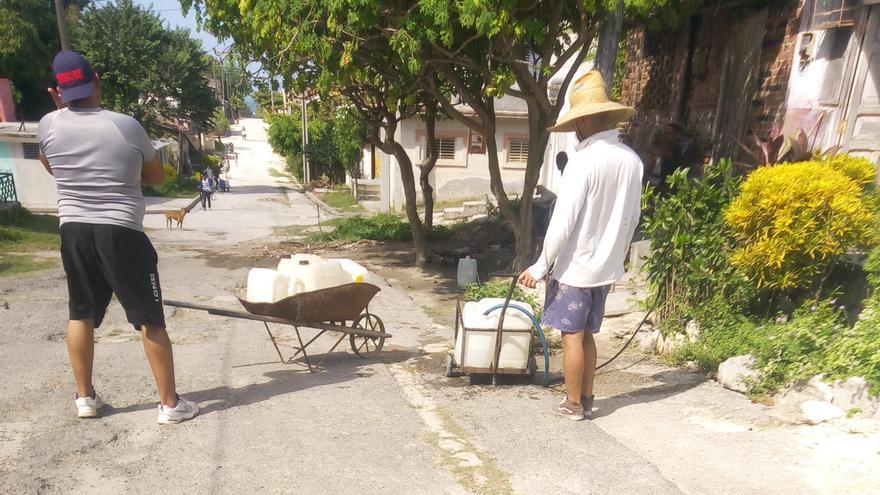
Manzanillo Cuba Is Without Water, With a Deteriorated Aqueduct and a Single Water Truck That Circulates Through Its Streets

If the water truck is not sent by Communal Services but must be paid for by the families themselves, it is not uncommon for a single 55-gallon tank to cost 400 pesos. (14ymedio)

14ymedio bigger14ymedio, Juan Matos, Manzanillo (Granma province) | December 27, 2023 — When the families of Manzanillo, in the province of Granma, see a water truck parked on the corner of any neighborhood, the line takes only a few minutes to form. With a sudden drought, which compromises all the lines of production and daily life, arriving first – gallon container or bucket in hand – is not a matter of well-being or comfort, but of survival.

Even the streets of Manzanillo are eloquent about the water shortage. Dusty and yellow, when a pipa [water truck] spills a little water on the pavement, the dogs rush to lap up the liquid. If the water truck is not sent by Communal Services but must be paid by the families themselves, it is not uncommon for a single 55-gallon tank to cost 400 pesos*. At the end of the day, the business owner makes a good profit, and demand is increasing.

The lack of supply is inversely proportional to the price of products in the municipality, especially when it comes to fruits and vegetables. In a province with many farmers, the scarcity of resources has skyrocketed the price of a pound of beans to 500 pesos, a pound of rice to 150 pesos and that of pork – for whose rearing and hygiene water is indispensable – to 450. The work that is done so that an arid and battered land bears fruit, say the farmers, is titanic, although it cannot be expressed in numbers. continue reading

Nature has also begun to take its toll on the people of Manzanillo, whose authorities have been neglecting the province’s hydraulic infrastructure for decades. Last April, as a desperate measure to achieve the “sanitation” of dry areas such as Manzanillo, Deputy Prime Minister Inés María Chapman accepted from the hands of the Chinese ambassador to Havana, Ma Hui, a donation of 449 pieces of aqueduct and sewer system equipment.

Although the equipment – whose cost was 27.8 million dollars – was destined for the entire Island, the municipality of Granma topped the list of potential beneficiaries of the project, which included 93 water trucks, 60 unclogging trucks with high-pressure hoses and tools to repair leaks.

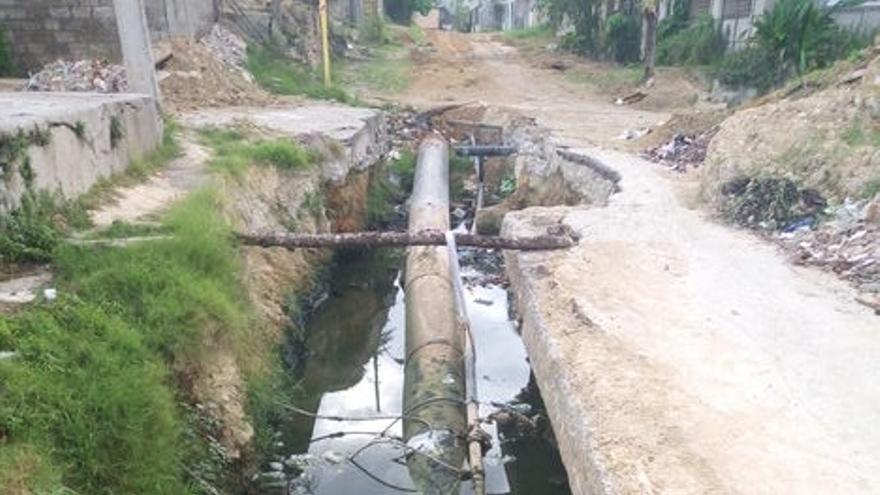
A pocos pasos de ahí, un tramo de acera en derrumbe da la medida de la insalubridad en el municipio y el estado de su red hidráulica. (14ymedio)
A few steps away, a section of collapsed sidewalk gives the measure of the unhealthiness in the municipality and the state of its hydraulic network. (14ymedio)

Of the formidable investment, as announced by the official media at the time, little actually reached Manzanillo, through whose avenues a single water truck was circulating this week. With hats and shirts – the sun of eastern Cuba does not give respite even in December – the neighbors get in line with wheelbarrows, jars and cans. Although there are young people in line, those who have the time and patience to wait their turn for several hours, often having traveled great distances, are the elderly, housewives and even children.

A few steps away, a collapsed stretch of sidewalk gives the measure of the unhealthiness in the municipality and the state of its hydraulic network. From a stagnant puddle full of garbage emerges, patched, one of the pipes that transport the town’s water, when there is some. The earth-colored liquid arrives in homes, and any precautions, such as boiling or chlorinating, are few.

Fainting or fatigue of the elderly who, poorly fed, carry a bucket to their homes is not uncommon. But there is no remedy: no one knows when the water truck will pass again, and they need to carry as much as possible. The free distribution points, opened by the Government in the vulnerable communities of Manzanillo, are not always supplied.

Although the entire Island faces the same problem of deterioration of its aqueducts and sewers, the east of the country has been especially affected by the drought. The province that has generated the most headlines has been Las Tunas, whose governor had to be held accountable last Friday to Parliament for the water crisis in municipalities that no longer know how to ask the Government for help.

The situation, according to the official press, has reached a “critical point,” in particular due to the extreme deterioration of pumping equipment. The local authorities, who depend on the “directions” from Havana, said that they could only make “patches” to the devices, which “can break at any time.”

Despair due to the lack of water reaches all parts of the eastern provinces, from the most populated cities such as Santiago de Cuba and Holguín, to the most humble hamlets of Guantánamo and Granma. Unable to solve the problem, the authorities call, of course, for “solidarity among neighbors”: “The situation is difficult, and no one can be certain. If you have a well, provide water to your neighbor, and if you have a cistern, save,” was the empty advice, of a manager of Aqueducts and Sewerage in Las Tunas.

*Translator’s note: Figures for December 2023: The minimum pension in Cuba stands at 1,528 pesos per month; that is, less than 60 euros, and the minimum wage at 2,100 (80 euros).

Translated by Regina Anavy 

____________

COLLABORATE WITH OUR WORKThe 14ymedio team is committed to practicing serious journalism that reflects Cuba’s reality in all its depth. Thank you for joining us on this long journey. We invite you to continue supporting us by becoming a member of 14ymedio now. Together we can continue transforming journalism in Cuba.
The Dominican Republic Received 10 Million Tourists This Year, Cuba Just Over 2 Million

Ariana Guilak, the 10 millionth passenger, was received with honors in the Dominican Republic. (EFE)

14ymedio bigger14ymedio, Madrid, 27 December 2023 — Ariana Guilak got off an American Airlines flight from Miami this Tuesday in Punta Cana and found a surprise. David Collado, Minister of Tourism of the Dominican Republic, and Frank Rainieri, businessman of the founder of the Punta Cana Group, were waiting for her at the foot of the plane. Both gave her a bouquet of flowers, a flag of the country and a commemorative band: she was the passenger who symbolically marked the milestone of 10 million tourists in 2023.

The fact, spread by international media, has a devastating headline for the Cuban authorities, in the magazine Reportur, the most read in the sector in Latin America: Cuba is moving away from tourist records while the Dominican Republic pulverizes themit says, without mercy. The subtitle is not far behind: Heads and tails of Caribbean recovery.

“With this flight, the Dominican Republic has 10,031,000 visitors in 2023, the result of the work of the public and private sectors. Our country is celebrating today. This is an achievement of all Dominicans and we should all feel proud,” said Minister Collado at the event, which was repeated in the other two main airports in the country – Santo Domingo and Santiago – as well as at the two largest cruise terminals. continue reading

The sector contributed more than 20% to the Gross Domestic Product (GDP), a record in Latin America, and places the Dominican Republic as the second most visited Latin American destination, behind Mexico

The good news did not stop there. In December alone, the figure of 850,000 tourists arriving in the country by plane will be reached. The sector contributed more than 20% to the Gross Domestic Product (GDP), a record in Latin America, and places the Dominican Republic as the second most visited Latin American destination, behind Mexico. Furthermore, in 2022 it was a leader in the recovery of tourism in the region, with twice as many international travelers as giants such as Colombia, Brazil and Argentina.

With so much joy, it is not surprising that Frank Rainieri told Reportur that the goal should now be to achieve 15 billion dollars annually starting in 2030; this year foreign currency worth about 11 billion has been generated. “You stop at the store in the new terminal and there they sell 1,200 products from Dominican artisans and more than 400 bottles of mamajuana,” said the businessman, who put arrivals on December 24 at 18,000.

The news – which could be foreseen due to the good results of the Dominican Republic in recent years – must not be sitting very well with Cuba’s Minister of Tourism, Juan Carlos García Granda, who remains in office even though under his leadership the sector has sunk, notwithstanding its status as the authorities’ most-favored sector.

If none of his colleagues in the Council of Ministers can be happy with his management, the case of the head of tourism is the most bloody, since he received a department with dazzling figures: 4,750,000 international travelers in 2018, despite the increase in vaunted sanctions. He watched it fall in his first year in office (down to 4.3 million in 2019) and has been unable to recover it in the two years after the worst of the pandemic (which was 2021 for the Island) despite enjoying the greatest share of investments and having the rest of the sectors at its service, from food production to banking.

García Granda had to go through the trouble of telling Parliament last week that as of October 2,450,000 visitors had arrived on the Island “a growth of 50% compared to 2022, but that still represents 64% of what was achieved in 2019.” The data had a catch, since the minister was counting all travelers and not tourists, who as of the end of November numbered only 2,177,830, well below the 3.5 million expected, although close to the projections, made by the economist Pedro Monreal, who, applying mathematical logic, warned as early as April of the need to rectify.

In the absence of December data – predictably optimal, as it is the best month in the sector – the scenario described by the expert as “pessimistic” will prevail

“A simple exercise of scenarios – not a forecast – that could certainly be improved, would indicate a possible range between 2.3 and 3.1 million, with an intermediate scenario of 2.9 million,” he said in his X account. In the absence of December data – predictably optimal, as it is the best month in the sector – the scenario described by the expert as “pessimistic” will prevail.

García Granda blamed the “absence of a systems approach for the integrated management of the destination, the restriction in the forms of payment for services and offers, the deterioration of infrastructure to support tourism activity, the insufficient preparation of local governments to guarantee the tourism management of their territories and the difficulties with human capital.” He also used classic excuses such as Covid-19 and the embargo.

“Our main competition in the area, Mexico and the Dominican Republic, have recovered at a faster speed than us, but 50% of their tourists are Americans. Cuba cannot benefit from the main market in the region,” he lamented.

He was, however, able to take comfort in talking about the Canadian market, an origin that still slightly resists the Dominican Republic: it has received some 783,000 Canadians so far this year, compared to 557,000 in 2022, a very positive increase but one that falls short when compared to Cuba, which doubles the number of Canadian tourists, going from 428,146 to 822,825 this year, despite the alert activated by Ottawa this October.

“Canadians love our country so much that, despite the orchestrated campaigns against Cuba and distorted information about our reality, this year we will reach the figure of more than 950,000 visitors, with a recovery well above the rest of the markets,” García Granda added, while setting his sights on what are now two promising points: the growing Russian market and the highly desired Chinese one, with the exception of Taiwan.

____________

COLLABORATE WITH OUR WORKThe 14ymedio team is committed to practicing serious journalism that reflects Cuba’s reality in all its depth. Thank you for joining us on this long journey. We invite you to continue supporting us by becoming a member of 14ymedio now. Together we can continue transforming journalism in Cuba.

Cuba Acquires 100 Ambulances To Improve the ‘Depressed Health Sector’

Some of the vehicles are from the German brand Mercedes-Benz and the rest from the Chinese brand Foton (Capture/Caribbean Channel)

14ymedio bigger 14ymedio, Havana, 27 December 2023 — The Cuban authorities celebrated on Tuesday the import of 99 ambulances for “the gradual improvement of health services in the country.” The lot, with 50 new units and 49 in use, had an approximate value of four million dollars that was paid by the Government in full, clarified the ministers of Public Health, José Ángel Portal Miranda, and of Transport, Eduardo Rodríguez Dávila.

In a report made by Canal Caribe, officials avoided at all costs declaring the origin of the vehicles, but some of the Mercedes-Benz ambulances – presumably those in use – still had on their sides the name of their previous owner, the Valencian Community (Spain).

The second part of the lot is of the Chinese brand Foton, although it is not known if they were acquired directly in China or through a third country. Each province, including the municipality of Isla de la Juventud, will be assigned between three and four ambulances. continue reading

During the interview, the head of Transport highlighted the importance of the arrival of these vehicles, which will mostly be destined for emergency hospital services

During the interview, the head of Transport highlighted the importance of the arrival of these vehicles, which will mostly be destined for emergency hospital services, “at a time when the (Health) service is really depressed.” Rodríguez Dávila also pointed out that the vehicles are the first installment of a program that promises more lots.

For his part, Abel González Palmero, director of basic transport services at the Ministry of Public Health, acknowledged that the ambulances received “do not cover the needs of the provinces,” but softened the comment explaining that this is “a step forward” for the country.

The company in charge of managing the imports, as well as maintaining second-hand vehicles before the new ones are put into service, is MCV Comercial, a joint entity between the Ministry of Transport and Mercedes-Benz.

The manager of the company in Cuba, Ayman Makran, explained to the official channel that MCV will be in charge of checking the vehicles before incorporating them into the national fleet. “If any tire is worn, you have to change it; if any battery is old, you have to change it. We also need to incorporate more ambulances into the fleet, since it is aged,” the businessman said.

Established in 1995, MCV Comercial has been one of the arms of the regime to acquire vehicles abroad. In addition to the Mercedes-Benz brand, which is part of the joint venture, the company also imports the German cars Fuso; the Chinese Foton; Randon, Moura and Stemac from Brazil; Himoinsa and Lucas Diesel from Spain; and ZF and Voith, from Mercedes-Benz.

In addition, MCV has introduced equipment of the German brand MTU in Cuba, used in electricity generation and in industrial, maritime, rail, mining, construction and agriculture systems.

The company also has numerous Mercedes-Benz dealers on the Island, being the only one authorized to sell this brand, and some thirty workshops to repair the vehicles.

In its virtual store there are supplies available for the repair of the body, paints and tools

In its virtual store there are supplies available for the repair of the body, paints and tools. However, the products can hardly be purchased by Cubans, since they are charged in US dollars and at stratospheric prices.

It is not the first time this year that the Government has acquired ambulances. Last September, the official press announced a donation of four of these vehicles from Italy. However, the number of vehicles never seems to be enough to meet the demand of the health institutions, as the authorities of the sector themselves have admitted.

This December, vehicles were imported from Miami through the company Maravana Cargo, founded by the Cuban-American Alejandro Martínez with a license from the U.S. Treasury Department for the shipment of packages, appliances and other goods, without suffering sanctions.

The price for importing cars to the Island is determined by the regime itself, and so far it ranges between $20,000 and $56,000, depending on the model, year of manufacture and other variables. Much of this value remains in the hands of the Government, while Maravana retains an average of $8,000 per exported vehicle, which covers transport costs, insurance and the procedures.

Translated by Regina Anavy 

____________

COLLABORATE WITH OUR WORKThe 14ymedio team is committed to practicing serious journalism that reflects Cuba’s reality in all its depth. Thank you for joining us on this long journey. We invite you to continue supporting us by becoming a member of 14ymedio now. Together we can continue transforming journalism in Cuba.

The Body of a Cuban Who Drowned in His Attempt To Reach the United States is Recovered

The body of the Cuban Alejandro Díaz Albert was recovered by firefighters from the city of Brownsville (Texas). (Screen capture)

14ymedio bigger14ymedio, Havana, December 27, 2023 — On Monday, firefighters from the city of Brownsville (Texas) recovered the body of Cuban Alejandro Díaz Albert, 28, who drowned while trying to cross the Rio Grande to reach the United States. The rescue coordinator, Francisco Ponce Lara, told 14ymedio that the migrant had been reported missing by people who accompanied him.

The journalist Mario J. Pentón had been informed by one of the Cubans who accompanied Díaz Albert of his disappearance when he jumped into the river to try to hide from the U.S. Border Patrol. “When we were on the road to the river, the police on the U.S. side put their flashlights on us,” a woman said in an audio shared by the Pentón on his YouTube channel. “They began to speak in English, warning us that a migration van was coming for us from Saltillo (Coahuila) Mexico.

As she told Pentón, “they had to go down a ravine” to jump into the river. “At that moment it was everyone for himself.” Díaz Albert, “apparently didn’t know how to swim and sank.” continue reading

According to the rescue coordinator, the young man’s body was identified thanks to the papers he brought with him

According to the rescue coordinator, the young man’s body was identified thanks to the papers he brought with him. “The authorities are in charge of contacting the family, but I don’t know if contact has been made.”

Díaz Albert left behind a wife, a one-year-old daughter, his parents and his grandmother in Cuba. Pentón, who works for América TeVé, mentioned that the options for the family are the possibility of a humanitarian visa “so that some of them can come to the funeral and say goodbye.” However, “this procedure is carried out through local congressmen; for example, his parents or his wife could come.”

The other option, Pentón said, is to “cremate the body and send the ashes to Cuba,” a situation that the family is considering.

The rescue coordinator, Francisco Ponce, said that after recovering the body of the Cuban migrant, the authorities found another person dead on the banks of the Rio Grande at the junction of Tamaulipas Avenue and the Republic of Cuba.

Translated by Regina Anavy

____________

COLLABORATE WITH OUR WORKThe 14ymedio team is committed to practicing serious journalism that reflects Cuba’s reality in all its depth. Thank you for joining us on this long journey. We invite you to continue supporting us by becoming a member of 14ymedio now. Together we can continue transforming journalism in Cuba.

50 Years Ago He Diverted a Plane to Cuba and Now He Wants to Return to Argentina

Suffering from depression, with difficulty communicating and several after-effects of strokes, Mazor regrets being trapped in Cuba. (Infobae)

14ymedio bigger14ymedio, Havana, December 27, 2023 — With two strokes, a poorly shaved beard and a nervous wreck, no one would say that the patient Basilio José Mazor, awaiting death in the municipality of Artemisa, is the same young Argentinean who, on 4 July 1973, hijacked a Boeing 737 and forced its landing in Havana. Now, after spending his entire life in the country whose regime he revered, the impossibility of a decent old age has motivated his son to demand Mazor’s return to his native country.

Mazor starred in the “most forgotten air hijacking in Argentina,” the digital Infobae recalled this Tuesday, along with some photographs that show the deplorable state of the former “air pirate.” A sympathizer, although not a member, of the People’s Revolutionary Army – the military arm of the Marxist-oriented Revolutionary Workers Party – he boarded the Aerolíneas Argentinas plane that took him to Cuba at the age of 24 with a shotgun under his poncho.

He had a son in 1972, whom he named Basilio, and who now – after several decades of separation – he is the one who requests his return to Argentina

He was born in 1949 in the town of Pergamino, not far from Buenos Aires. He had a son in 1972, whom he named Basilio, and who now – after several decades of separation – is the one asking for his return to Argentina. The boy had to live with his grandparents from the time Mazor bought the ticket and boarded Aerolíneas Argentinas flight 558, from the capital to Jujuy, on the border with Chile.

The hijacking was covered down to the last detail, since a journalist and a photojournalist from Siete Días magazine were also traveling on the plane. Mazor, with his strange clothing (a 16-gauge double-barreled shotgun, a continue reading

cartridge belt across his chest and a poncho with Inca motifs) and an attack of nerves, claimed when asked why he was shaking that it was the first time he had flown in his life.

At noon, Mazor got up from his seat and went to the captain’s cabin, displayed his shotgun and said: “I am from the People’s Revolutionary Army. We are going to go first to Córdoba, where there will be an evacuation, and then we will head to Chile and then to Cuba.” The flight attendants tried to stop the panic, with little success: Mazor also announced the presence of a bomb on the aircraft. “It will explode when I want,” he threatened.

At noon, Mazor got up from his seat and went to the captain’s cabin. (Infobae)

The plane experienced numerous difficulties reaching its destination, with a stopover in Chile. There, President Salvador Allende provided it with fuel to reach Cuba, as he had done on other occasions with several ship hijackers. Mazor, as he later confessed, hoped that this “action” would earn him the respect of the leaders of the People’s Revolutionary Army and the Havana regime. “If Cuba does not protect a commander of an armed group, I would say that socialism is failing in its very cradle,” he repeated.

At the José Martí International Airport they disarmed him. The soldier to whom he handed the weapon then discovered that the kidnapper’s shotgun didn’t even work. The plane returned to Buenos Aires shortly after. Mazor, however, ended up in a prison in Pinar del Río.

His son Basilio, whom he abandoned when he was 15 months old, told Infobae that his life, more than the plot of a spy novel, is a soap opera. He entered the Island on his left foot, and after several decades “he is not living well,” he laments. The event cost the family left behind dearly. They received threats and, in a small town like Pergamino, they were marked, he says.

For his part, Mazor was released shortly after, and was issued a ration book and some clothing. He worked as a children’s soccer coach and was married twice. He had daughters from both marriages, but they emigrated to Mexico and Miami, respectively. Taking advantage of his status as a foreigner, for a time he dedicated himself to buying items and food in the so-called diplotiendas to resell them later. That business, however, also came to an end.

The plane returned to Buenos Aires shortly after. Mazor, however, ended up in a prison in Pinar del Río. (Infobae)

Mazor is alone in Artemisa and has said more than once that, after living in Cuba, not a day goes by without him regretting having hijacked the plane. “I only wanted to draw attention without hurting anyone,” he alleges, adding: “I hope the end of my life is not tragic. I would like to be able to live with my daughters and visit Argentina, which is why I insist so much on the forgiveness of Argentinians.”

Suffering from depression, with difficulty communicating and with several consequences from his strokes, Mazor regrets being trapped in the current crisis on the Island at the age of 74 and wants to leave. He never talks about what happened on July 4, 1973. His old friend Rody Piraccini, a journalist from Pergamino, summed up his life this Wednesday in a phrase that sounds like an epitaph: “He thought that in Cuba he would be a hero, but they put him to work in the sugarcane.”

____________

COLLABORATE WITH OUR WORKThe 14ymedio team is committed to practicing serious journalism that reflects Cuba’s reality in all its depth. Thank you for joining us on this long journey. We invite you to continue supporting us by becoming a member of 14ymedio now. Together we can continue transforming journalism in Cuba.
Leptospirosis Skyrockets in Cuba, the Country of Rats and Mountains of Garbage

The insalubrity of Cuban cities is the main cause of disease, say citizens. (14ymedio)

14ymedio bigger14ymedio, Havana, December 26, 2023 — Cases of leptospirosis are increasing, the health authorities of Guantánamo announced on Monday, after informing the official press that this year 44 people are suspected of having contracted the disease, 12 more than those counted in 2022. So far, they acknowledged, two deaths have been reported in the municipalities of Imías and Maisí.

In addition, the municipalities with the highest incidence of leptospirosis in the province are Baracoa, Maisí, Guantánamo and Yateras, the local newspaper Venceremos reported. Mileidys Gómez, head of the Zoonosis program of the Provincial Directorate of Hygiene, Epidemiology and Microbiology, told the media that many of the people who are infected end up suffering serious symptoms because they do not immediately go to the doctor.

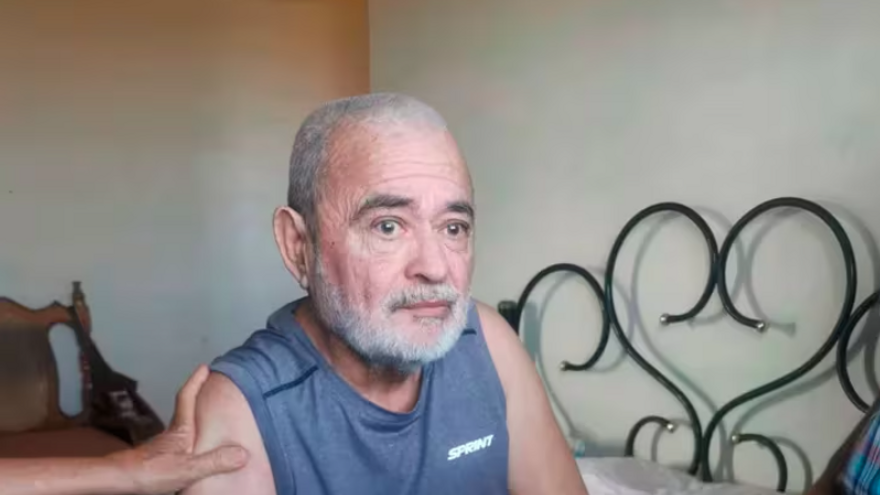
However, Yamilé, a 45-year-old woman from Havana interviewed by 14ymedio, says that the official is not telling the truth about the sick people. A few months ago, she says, she went to the hospital because she suspected that she had contracted the disease. “The first thing they told me was that if I had leptospirosis I would have to rest and drink a lot of water, because there were no medicines,” says Yamilé, while questioning why the authorities insist that “it is people’s fault for not going to hospitals if there is not even anything to treat them with.” continue reading

After being scared in the hospital, where they finally told me that it was not leptospirosis that I had, I decided to ’harvest’ the rats  

The truth, she explains, is that “these diseases, such as leptospirosis, dengue or cholera arise from the poor hygiene of Cuban cities, where garbage piles up in any corner and rots there for days.” This, she adds, happens not only in Havana, but in any part of the country where “the same unhealthy situation exists.”

“After being scared in the hospital, where they finally told me that I didn’t have leptospirosis, I decided to ’harvest’ the rats that got into my house on the street or in the neighboring courtyards,” says the woman. “The first day I bought the traps, seven little rats were trapped. They had my yard full of tunnels to go from one house to another.”

“It’s just that with the level of dirt in this country, it’s no wonder. Rats must be partying. Our building is surrounded by four huge garbage dumps that are about to shake hands and close the circle,” she continues. “There are side streets where Communal Services sometimes take weeks to collect the garbage, and in the meantime, the plagues of cockroaches and rodents begin to infest the houses. The sellers of traps and poisons are going to get rich,” she says.

Yamilé has another concern, which is that for months she has not seen anyone selling poison or traps. “Before there were some old men who sold syringes with liquids to kill rats or balls of poison. Now you have to buy everything from [the classifieds website] Revolico. For example, a set of three strips of rubberized cardboard to treat rodents costs more than 2,000 pesos. Almost no one can afford this, because they need the money to eat,” she explains.

According to the habanera, by simply having adequate hygiene the Cuban neighborhoods could get rid of the plague of rats, but this is not possible either, since the mountains of garbage are added to the lack of cleaning products. “Even domestic animals end up sick,” she says.

Most end up dying, because if there is no medicine for people, imagine for animals”  

“A couple of months ago, my neighbor’s dog contracted leptospirosis, and in the veterinary clinic itself a worker told her that cases of this disease have increased a lot lately among pets. Most end up dying because, if there is no medicine for people, imagine for animals,” Yamilé says. The vaccine against leptospirosis in dogs is barely found in the country’s veterinary offices, and its price in the informal market is high, so many pet owners rule out immunizing them.

Far from the cities, in the fields and food warehouses, the plague of rats is also a pressing problem. This was recognized by the authorities of Guantánamo, who revealed that many of the cases of leptospirosis in the province were contracted while carrying out “agricultural work on moist land highly infested with rodents” that already carry the disease and transmit it through urine or other secretions.

“The lack of rat poison, the breeding of animals in urban communities without hygienic conditions and the non-use of means of protection for those permanently exposed” are other causes of the high rate of infection, Venceremos said.

Unfortunately, “the deficit of antileptospirotic vaccines” and the “low perception of the population in the face of risk conditions and the appearance of symptoms” make it impossible for the Health and Epidemiology system to treat in time or prevent the increase in cases, the health authorities acknowledged.

Translated by Regina Anavy

____________

COLLABORATE WITH OUR WORKThe 14ymedio team is committed to practicing serious journalism that reflects Cuba’s reality in all its depth. Thank you for joining us on this long journey. We invite you to continue supporting us by becoming a member of 14ymedio now. Together we can continue transforming journalism in Cuba.

Two Prospects and a Former Baseball Player Leave Cuba To Try Their Luck in the United States and the Dominican Republic

Robier Hernández won the silver medal in the Under-15 World Cup in 2022. (X/@francysromeroFR)

14ymedio bigger 14ymedio, Havana, 26 December 2023 — Sixteen-year-old Cuban pitcher Robier Hernández arrived in the Dominican Republic, in the middle of the Christmas Eve celebration, with the aim of being recruited by a team from the American Major Leagues. Days earlier it was known that retired baseball player Danger Guerrero had traveled to the United States with his 9-year-old son, who was part of the Cuban national team in the 9-10 pre-world tournament in Culiacán (Mexico), in search of sports opportunities for both of them.

The departure of both prospects and Guerrero, who has participated in 17 national series – and could, consequently, be an excellent coach – is eloquent about the reality of Cuban baseball: the stampede not only of professional players, but also of the relievers.

Hernández, baseball journalist Francys Romero reported, stood out in Cuba as an opening pitcher, has a good arm and is able to throw a straight at 90 miles per hour. With him, there are 17 players his age who left Cuba this year. Romero says it’s an alarming figure, since it represents 85% of the generational base that would relieve the current players of the different national teams of the Island.

For his part, Guerrero – the father – was part of the Havana and Mayabeque teams. In his statistics are 2,944 turns at bat, 821 hits, a batting average of .279 and 59 home runs. For his son, the stay in the United States will allow continue reading

him to develop his game and be seen by the headhunters who are responsible for recruiting young players for the Major Leagues from their own schools.

Danger Guerrero al lado de su hijo, ambos ya se encuentran en EE UU. (Facebook/Francys Romero)
Danger Guerrero with his son, both of them now in the United States. (Facebook/Francys Romero)

One figure gives the measure of the disaster facing the country: of the young people who represented Cuba in the U-15 World Cup, held in Mexico in 2022, only three players remain on the Island: Yordan Rodríguez, Yaidel Ruíz and Maikol Rodríguez.

Romero lists those who have left: Alejandro Cruz, Alex Santiago, Pedro Danguillecourt, Jaider Suárez, Dulieski Ferrán, Ernest Machado, Yosniel Menéndez, Roberto Peña, Segian Pérez, Alejandro Prieto, Danel Reyes, Ronald Terrero, Jonathan Valle, Yunior Villavicencio, Cristian Zamora and Mailon Batista.

“Those numbers show the state of despair of young players and their families,” the communicator stressed. “The Cuban State has not been able to provide a future for its citizens. Therefore, the response to this prolonged failure of the system has been the exodus,” he added.

The attempts of the Cuban Baseball Federation to retain young athletes have failed. In September, it organized the first international tryout with talent scouts at the Latin American Stadium in Havana. Representatives of Japan, South Korea, Dominican Republic and Ecuador observed 80 players, but there was little interest in them.

Although it has not acknowledge it, the Federation wants the talent scouts of professional leagues in Latin America – mainly from Mexico – and Asia to recruit their baseball players. In return, they take a percentage of the agreement if it is finalized.

Translated by Regina Anavy

____________

COLLABORATE WITH OUR WORKThe 14ymedio team is committed to practicing serious journalism that reflects Cuba’s reality in all its depth. Thank you for joining us on this long journey. We invite you to continue supporting us by becoming a member of 14ymedio now. Together we can continue transforming journalism in Cuba.