The Cuban Research Institute (CRI) could be one of the departments affected, according to the local press. (FIU)
14ymedio, Madrid, 25 December 2023 — Cuban researchers will not be able to work for Florida International University (FIU), which has decided to pause, immediately, the hiring of citizens of six countries considered “worrisome” by the government of that state, according to an email obtained by the WLRN radio station. Cuba is accompanied on the list by Venezuela, China, Russia, Syria, Iran and North Korea.
According to WLRN on Tuesday 19, Andrés Gil, Vice President of Research for the university and Dean of its graduate school wrote to the deans, department heads, directors of postgraduate programs and people involved in human resources that, due to the new laws announced in the state, it is necessary to “immediately pause any job offer or attempted hiring” that involves individuals from the “worrisome countries.”
Any offer that has been made and any active recruitment must be stopped until we have good control over the process
“Any offer that has been made and any active recruitment must be stopped until we have good control over the process, so that it is communicated properly to the candidates and is specifically indicated in our letters,” the text points out.
One of the affected departments, according to the local press, could be the Cuban Research Institute (CRI) of FIU, which works closely with Cuban – and Venezuelan – opponents for events, scholarships, programs, courses and all kinds of collaborations in which there may be vacancies if the continue reading
situation is prolonged. “Unpaid research fellows” are also affected by the rule, a situation in which many Cubans find themselves. There are also a multitude of Chinese researchers hired during their postgraduate studies affected by this standard.
Governor Ron DeSantis has approved several rules that affect higher education during 2023. Among them, this rule has the objective of “combating those who try to infiltrate the American university system from countries of concern,” although there may be “exemptions” that must be examined on a case-by-case basis to move forward with hiring.
Gil, who fears that the measures will decapitalize the university, specifies in his email that the university is not the “final approval body” of the candidates, something that falls to the Board of Governors of the state, whose members are appointed by DeSantis as are other FIU positions in turn. “The process for each candidate will take several months, and we cannot guarantee any employment or position for individuals from countries of interest,” he adds.
“The directors of postgraduate programs and deans will receive instructions on what to communicate in relation to this process to newly admitted graduate students and/or others potentially interested in obtaining a postgraduate assistant. Human Resources and Academic Affairs will communicate to the deans and staff of Human Resources the impact for those employees who were currently in an incorporation process,” he says.
The media of the Sunshine State have not provided further clarification since they had access to FIU, which has been more restrained than the University of Florida (UF), in Gainesville, about the consequences of this measure.
More than 300 professors from the University of Florida have protested against a rule that, in their opinion, prevents them from recruiting the best students for the sole reason of their nationality, according to Science magazine.
Teachers made public a letter stating that this law “could negatively influence the long-term development, reputation and leadership of UF”
Teachers made a public letter stating that this law “could negatively influence the long-term development, reputation and leadership of UF.”
“Restricting or even preventing the hiring of postgraduate, postdoctoral assistants and visiting professors from these countries would have a devastating impact on our graduate programs and research activities; in addition, it could negatively influence the long-term development, reputation and leadership of UF,” they explain.
Although the United States Department of State was already investigating foreigners before granting them study or investigation visas, Florida’s state rule requires an allegedly more conscientious process.
The law was approved this summer along with another regulation that restricts the purchase of housing by foreigners from the same countries in areas close to critical infrastructures, such as airports, ports or power plants.
Translated by Regina Anavy
________________________
COLLABORATE WITH OUR WORK: The 14ymedio team is committed to practicing serious journalism that reflects Cuba’s reality in all its depth. Thank you for joining us on this long journey. We invite you to continue supporting us by becoming a member of 14ymedio now. Together we can continue transforming journalism in Cuba.
Cuban professor and historian Alina Bárbara López Hernández. (Facebook)
14ymedio, Havana, 24 December 2023 — After the Hermanos Saíz Association (AHS) censored, in October 2022, the event The Worst Generation, with a poster of artists who had begun to question the regime, Alina Bárbara López Hernández began to be the object of attention by State Security. The professor and historian was going to moderate that debate, in addition to prefacing a book that would have the same title and that the regime also prevented from being carried out.
She herself reported the harassment through social networks and, after receiving several requests from the political police to appear for questioning, she presented a “formal complaint and annulment action against the official summons” to the Provincial Prosecutor’s Office of Matanzas, where she resides.” With this, the teacher achieved something unprecedented: State Security annulled the summons.
Her actions and arrests have been reflected in Havana by the writer and journalist Jorge Fernández Era, with whom she collaborated on the digital magazine La Joven Cuba. In January 2023, inspired by Matanzas, Fernández Era presented a similar demand for nullity in the capital, after receiving a summons to appear, and did not attend the scheduled meeting.
She was tried for “disobedience,” and declared guilty on November 28
In April, López Hernández was detained for several hours by State Security after protesting another detention of continue reading
Her requests would be, month after month, several, among them “a democratically elected National Constituent Assembly to draft a new Constitution,” “freedom for political prisoners without mandatory exile” and “cessation of harassment of people who exercise their freedom of expression.”
The historian’s demands faced the usual reception in the regime: censorship and repression. She first discovered, when going to renew her passport for an academic trip to the United States – where she had traveled without problems before – that she was ’regulated’ [i.e. forbidden to travel] and could not leave the Island. Afterwards, she was put on trial for “disobedience,” of which she was found guilty this November 28.
Although her case has been reported by various international organizations, she was sentenced to pay 250 installments of 30 pesos, or 7,500 pesos, if she wants to see her “mobility limitations” lifted. The professor not only did not accept the ruling but she stated, once again, her reasons in public: “we are not subjects of a monarchy, we are citizens of a republic.”
COLLABORATE WITH OUR WORK: The 14ymedio team is committed to practicing serious journalism that reflects Cuba’s reality in all its depth. Thank you for joining us on this long journey. We invite you to continue supporting us by becoming a member of 14ymedio now. Together we can continue transforming journalism in Cuba.
A Migration agent at the time of returning their passports to 13 Cubans. (Capture Facebook/Epicentre Chiapas RyTv Official)
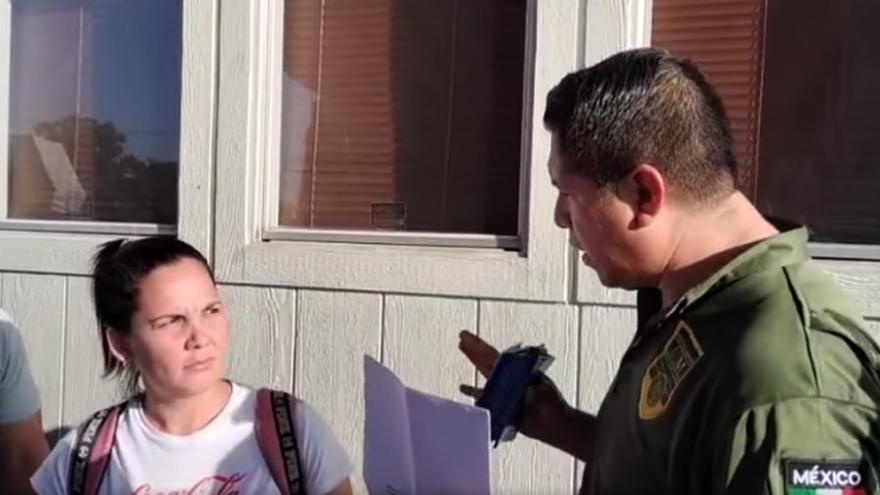
14ymedio/EFE, Mexico, December 25, 2023 — “Do you want to continue? You must pay 1,500 Mexican pesos (88 dollars),” said a Migration agent who withheld the passports of 13 Cubans on Monday at the checkpoint located in the municipality of Viva México (Chiapas). According to Zuselmi García López, they were traveling to join the caravan that left Tapachula on the same day with more than 10,000 migrants.
García López told local media that the agents first said that they were going to give them transport to Tuxtla Gutiérrez and that there they would “do the legal papers to continue.” This is the method that the officers use to dissolve the caravans. They put the migrants on trucks and return them to Tapachula; others take them to the Siglo XXI immigration station where they are detained for days.
At Cubans’ insistence to recover their passports, another officer told them that Admiral Roberto González would give them their passports when the caravan arrived. García López insisted that they wanted to continue with the group led by Luis García Villagrán, director of the Center for Human Dignity. That’s when they were told that they had to pay if they wanted to get their passports back.
Before the caravan arrived at the checkpoint in Viva Mexico, the Cubans denounced the attempt at extortion before some media that were at the continue reading
scene. In front of the camera, García López accused Admiral González while recording the officers of the National Guard.
With the arrival of the caravan, García Villagrán used a loudspeaker to address Admiral Roberto González. “We asked for the passports to be returned to this group of Cubans. Why don’t you want to give them to them?” said the activist. Minutes later, the documents were returned to Zuselmi García López.
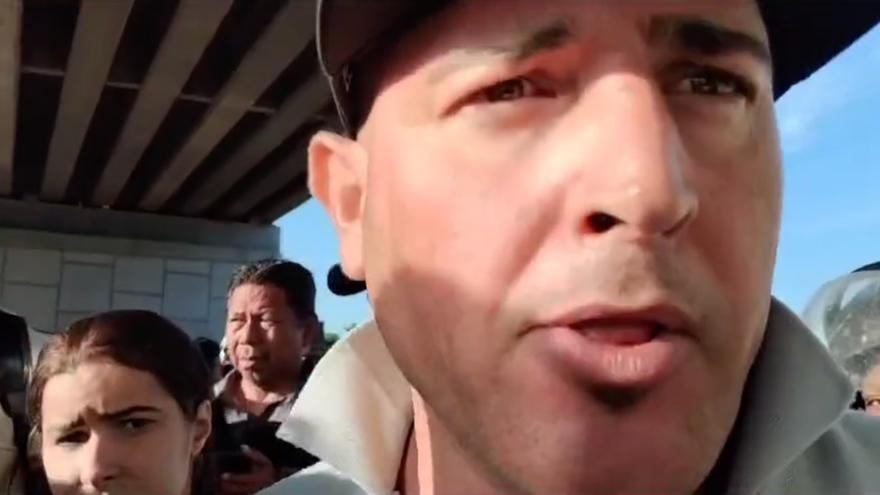
Another of the Cubans, who didn’t give his name, also denounced the Migration agents in Tapachula. (Facebook/Epicentro Chiapas RyTv Oficial)
According to Luis Rey García Villagrán, this caravan is the largest exodus of this year and could exceed 15,000 people who will walk for days to reach Mexico City as its first point. “We are leading this group, which has become a human traffic jam, and we tell the Mexican state that it leaves us no choice but to walk on the road until Migration and the president, Andrés Manuel López Obrador, tell us yes or no.”
García Villagrán stressed that “today we, the poorest of the poor, are walking, those who are at the peak of need, those who do not have money to pay for visas or coyotes.”
The Venezuelan Jesús Silva, who is traveling with his wife, told EFE that in Ciudad Hidalgo the Migration agents took him to the Siglo XXI Migration station, where an officer told them to leave Mexico.
“Really the only option is to walk. I rely on the caravan, because that’s where we feel the safest, with Latino brothers who have left their countries with a new dream, with hope of a better life,” Silva shared.
The Honduran José Wilmer Fernández Caballero, who showed his “positive resolution” paper from COMAR, the Mexican Commission for Aid to Refugees, has tried to leave Chiapas, but the immigration authorities tell them that his paper is worth nothing and doesn’t work.
“It didn’t help to spend so much time in Tapachula; it was lost time. They always take me back. We have the positive resolution paper with us, but they always take me out of the van and tell me that it’s not worth anything,” he said.
Translated by Regina Anavy
____________
COLLABORATE WITH OUR WORK: The 14ymedio team is committed to practicing serious journalism that reflects Cuba’s reality in all its depth. Thank you for joining us on this long journey. We invite you to continue supporting us by becoming a member of 14ymedio now. Together we can continue transforming journalism in Cuba.
We have focused on the people who left a mark, sometimes light and beautiful; others heavy and destructive. (14ymedio)
14ymedio, Havana, 24 December 2023 — If instead of choosing faces, at the end of 2023 we had compiled the objects that best represent Cubans this year, we would have included in the list a suitcase, some police handcuffs, a baseball, a judge’s gavel, a keyboard, a microphone and graffiti on some facade.
Every presence leaves traces and the protagonists of these 12 months that conclude could also be followed through the tools, supports and infrastructures that they have used. But this is the list of the protagonists, not their things. We are not compiling the tools they used but rather their personal responsibility for certain events. It is not even the mural of the victims or the perpetrators, but the canvas of those responsible who drew the lines of what we have experienced.
For this reason, we have focused on the people who left a mark, sometimes light and beautiful; others heavy and destructive. Nor is this a “doomsday” glossary, but rather a list of those who impacted our lives this year, for better and worse. Sometimes they helped us fashion wings and other times, unfortunately, they built anchors that made it more difficult to regain civic, economic and personal flight. But, in addition to their intentions, the snapshot we have captured of their faces and their stories forces them to share space.
In these 14 faces there is everything. Those who promoted and those who blocked. There are those who entered the list because they were fully exploring life, and others because they left this existence just in time
Most likely, the majority of them, if they had been consulted, would refuse to appear on a list with any of the others. But to be a public figure is, in some way, to stop belonging to oneself. Judgments, evaluations and labels are part of what awaits everyone who has moved away from the stillness of the anonymous individual and has crossed the red line to express their opinion and create “out loud.” All those mentioned here are children of that impulse: to remain silent or to speal; hide or show; let the story take its course or try to influence it.
Not everyone deserves applause. It is not enough to act. There is a minimum ethic to respect and, under a dictatorship, those points are very clear: you will not betray, you will not repress the freedom of another, you will avoid acting as a gag, scissors or shackle. There is everything in these 14 faces. Those who promoted and those who blocked. There are those who entered the list because they were fully exploring life, and others because they left this existence just in time. This is not an obituary but neither is it a podium with medals.
These that are read here are, simply, the names of those who shaped this year, 2023, in which we live in the limbo of political and economic uncertainty. There is no better image than theirs to tell of this “no man’s land” that we have inhabited in these months and to put a face to the advances and setbacks that an entire nation has experienced.
We present the anatomy of 2023.
[To our TranslatingCuba readers – We will update this list with the links to the English articles, as they become available. For now, here is the entire list, mostly ‘still to come’ in both languages.]
4- Ricardo Cabrisas, el gran maquinador del régimen cubano
5- La Asamblea de Cineastas desafía la censura en Cuba
6- Las tribulaciones de Buena Fe en España
7- Los cubanos emigrados con el ‘parole’
8- Los que se quedan en Cuba
9- Idalys Ortiz, judoca
10- El Team Asere, sin patria pero con amo
11- Yasmany González Valdés, el “culpable” perfecto para la Seguridad del Estado
12- Rubén Remigio Ferro, cancerbero de “la ley y el orden” en Cuba
13- Bruno Rodríguez, ministro de la Desinformación
14- ‘Invasor’ se sale del redil
____________
COLLABORATE WITH OUR WORK: The 14ymedio team is committed to practicing serious journalism that reflects Cuba’s reality in all its depth. Thank you for joining us on this long journey. We invite you to continue supporting us by becoming a member of 14ymedio now. Together we can continue transforming journalism in Cuba.
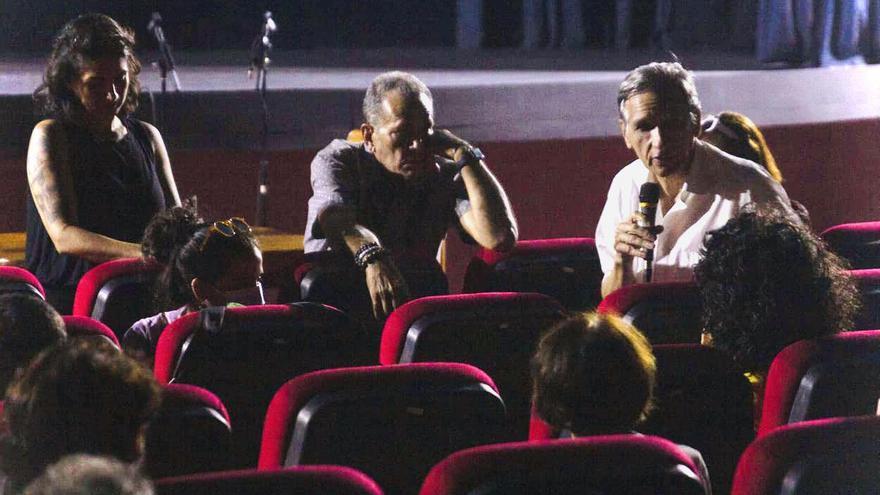
One of the debates of the Assembly of Filmmakers of Cuba. (Facebook)
14ymedio, Havana, 26 December 2023 — After perpetrating numerous acts of censorship against the works of several filmmakers at the beginning of the year, the Ministry of Culture topped it all off last June. The broadcast on Cuban Television of an unauthorized version of the documentary La Habana de Fito (Fito’s Havana), directed by Juan Pin Vilar, unleashed a swell of protests in the guild, which ended with the formation of the Assembly of Cuban Filmmakers (ACC).
The signing, by more than 600 filmmakers, of a letter condemning the actions of the authorities caused the regime to agree to meet “peacefully” with the filmmakers.
However, if on the side of the creators there were renowned figures such as the director Fernándo Pérez, the ministry could not be left behind. Alpidio Alonso and Fernando Rojas, minister and deputy minister of Culture, respectively, in addition to the first deputy minister Inés María Chapman and the head of the ideological department of the Communist Party, Rogelio Polanco, escorted Ramón Samada, then president of the Cuban Institute of Cinematographic Art and Industry (ICAIC), to the meeting with the filmmakers.
From the duel between bureaucrats and artists, unfortunately, not many solutions to the claims of the guild were born. On the contrary, the meeting only recalled the tension in the atmosphere and the intensity with which Samada demanded that the conversation not be recorded. Miguel Coyula, one of the directors present, turned a deaf ear and recorded, in audio and video, several of the official’s warnings: “No one was forbidden anything continue reading
here. Let’s not challenge ourselves.”
Ignoring the suspicion and official warnings, the filmmakers continued to meet, asking for the rehabilitation of the censored works and the emigrated filmmakers, consolidating their internal organization and demanding transparency.
When the Ministry of Culture finally dismissed Samada because he couldn’t “enlist” the filmmakers, they also protested. “Cuban cinema does not belong to a ministry or an institution. [The institutions] have to put themselves at the service of the artists and not the other way around,” they claimed.
Gradually, the public interventions of the ACC were diminishing while its ranks decreased. Several of the filmmakers who ended up forming the board of directors of the Assembly now live outside the Island. What seemed to be an advance of the world of culture against power was left in timid reproaches that, once again, stumbled against the wall of silence of the authorities.
Translated by Regina Anavy
____________
COLLABORATE WITH OUR WORK: The 14ymedio team is committed to practicing serious journalism that reflects Cuba’s reality in all its depth. Thank you for joining us on this long journey. We invite you to continue supporting us by becoming a member of 14ymedio now. Together we can continue transforming journalism in Cuba.
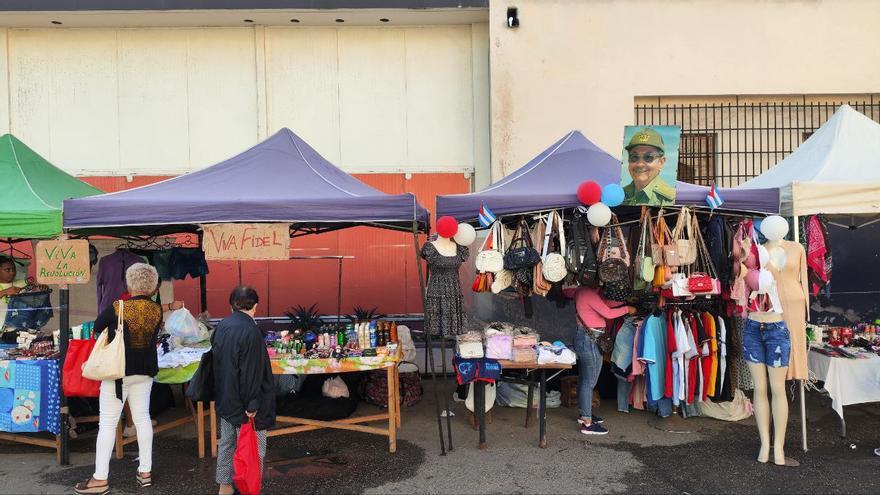
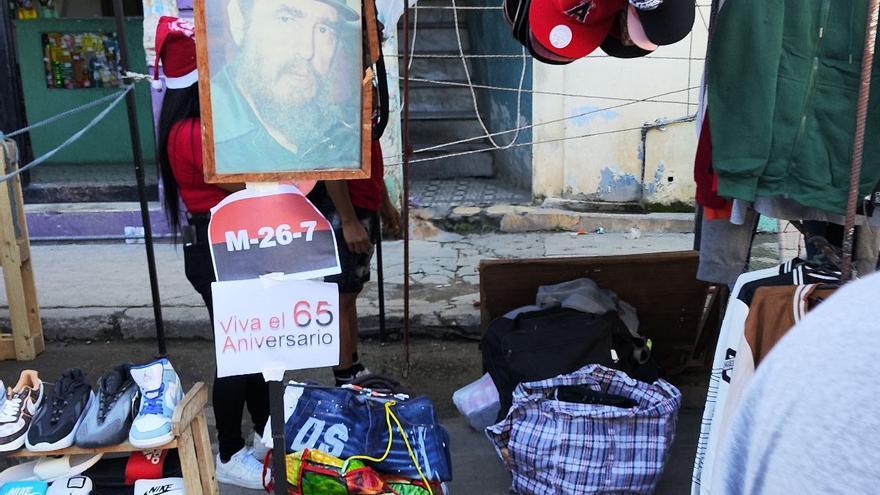
Authorities instructed the merchants that they should place some slogan, flag or photo of the leaders. (14ymedio)
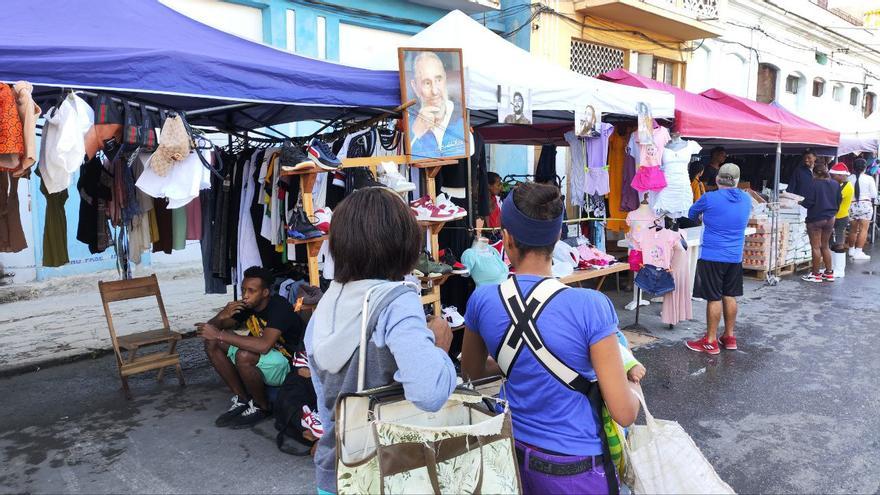
14ymedio, Juan Diego Rodríguez, Havana | 23 December 2023 — This Saturday morning, a portrait of Fidel Castro waited for the curious people who approached one of the kiosks at the New Year’s Eve fair on Zanja Street in Central Havana. Next to the image, a pair of tennis shoes, a poor copy of the Nike brand, cost 16,000 Cuban pesos, four months’ salary for a professional. Authorities instructed the merchants to place some slogan, flag or photo of the leaders of the Communist Party in each stall.
“A lot of propaganda but everything is very expensive,” complained a young man who came to the fair to buy a new wallet. “Mine was stolen yesterday and now I’m doing the paperwork for a new identity card”, he lamented. Traditionally, during the end of the year, thefts spike “because everyone is desperate for money”, the man considers. “I’m going to have to add what I am going to spend here to what I lost because of the thief”.
“A lot of propaganda but everything is very expensive,” complained a young man who came to the fair to buy a new wallet. (14ymedio)
Others came to the fair searching for food for the Christmas celebrations. The Cuban capital’s authorities had announced the sale of agricultural products as a “salute to the upcoming 65th anniversary of the Cuban Revolution”, but at the Zanja Street Fair the supply of food, vegetables and meat was very scant. Some withered lettuce and some dirty beets made up the assortment to put on the plate. The rest were caps, clothing, footwear and personal hygiene products. continue reading
“At what price are they going to sell the broth?” an old man asked two men who were stirring a steaming pot behind a sign announcing “our challenges and our victories”. “It’s going to take a while, grandpa, because we’re starting now and when we get it out it will be 50 pesos a glass”, one of the improvised cooks responded. Under a photo of Raúl Castro, women’s handbags were displayed at prices between 1,500 and 3,000 pesos, depending on the size and the material.
Guarded by an image of Ernesto Guevara, cigar in mouth, a set of clothing for girls combined pink tones with the faces of Disney characters. Later, next to a July 26 flag, beach flip-flops were offered, also imitations of well-known brands, such as Adidas and Tommy Hilfiger. A few meters away, a Mipyme kiosk sold soft drinks and frozen chicken, all imported.
This Saturday, a few meters from the fair, the end of year summed up what Cubans are experiencing, trapped between inflation and the excesses of political propaganda.
The fair represents Cubans, trapped between inflation and the excesses of political propaganda. (14ymedio)
____________
COLLABORATE WITH OUR WORK: The 14ymedio team is committed to practicing serious journalism that reflects Cuba’s reality in all its depth. Thank you for joining us on this long journey. We invite you to continue supporting us by becoming a member of 14ymedio now. Together we can continue transforming journalism in Cuba.
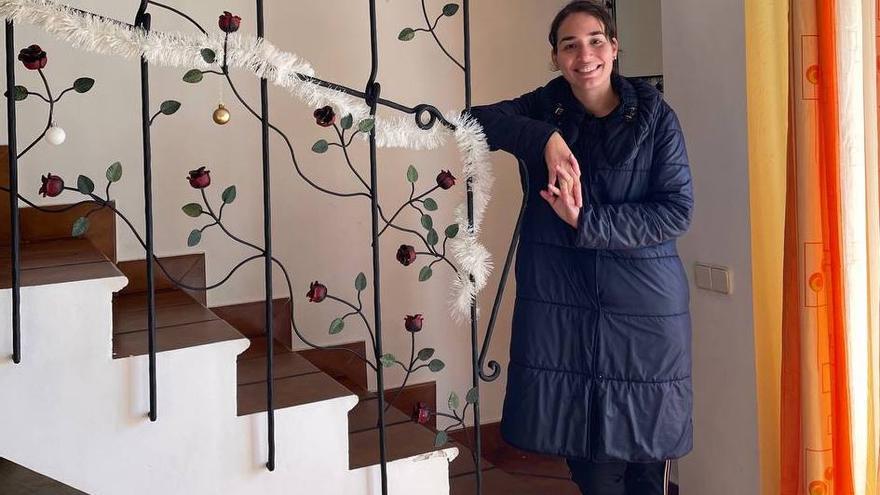
Amelia Calzadilla, in the house where she lives with her husband and three children in Spain. (14ymedio)
14ymedio, Yaiza Santos, Madrid, 24 December 2023 — Intending to violate the 7,500 kilometers of distance between Havana and Madrid, a message from State Security arrived last week for Amelia Calzadilla and her husband, Antonio Díaz. Both are regulated — the regime’s term of choice to mean ’forbidden to travel’ — and will not be able to return to Cuba. The communication did not arrive by regular mail or by e-mail, nor on letterhead, with an official seal and firm signature. It was a simple WhatsApp from Major Luis, the political police agent who attended to the couple until they left the Island, she with her three children last month, he in September.
Amelia tells 14ymedio almost at the end of a conversation that takes place between her house and a walk, in the quiet town on the outskirts of Madrid where the family now lives, and, for the first time, her eyes glaze over: “They know that it is a very harsh punishment, because I don’t have anyone in Spain, my whole family is in Cuba.” But she immediately recovers: “It’s hard, but nothing, it’s a punishment for telling the truth.”
For her, the decision of the political police was the direct result of the network broadcast she made on December 10, in which, once again, she expressed solidarity with other mothers on the Island who do not have a way to feed their children and denounced not only the economic management that has plunged the island into disaster but also the lies of the regime “that no one believes anymore.”
“They know that it is a very harsh punishment, because I don’t have anyone in Spain, my whole family is in Cuba”
“I was talking to the mothers, and to them that empathetic speech that we women manage to have, especially when we are mothers, that sensitivity that exists in the word when you are a mother and another mother understands you and you can put yourself in her place, it terrifies them, and continue reading
then they take these types of measures,” she explains.
Serene and calm, Amelia Calzadilla differed greatly in that video from that other one, in June 2022, from her home in the municipality of Cerro, a video ignited with indignation and the hope of a new citizen protest in Cuba. Almost a year had passed since the massive demonstrations of 11 July 2021, and unease had settled on the Island after the repression and the open mass exodus via Nicaragua as an escape valve. And there was this mother of three small children, raised in the middle of the Special Period — after the collapse of the Soviet Union and the loss of its subsidies to Cuba — a woman who graduated in the English Language, beside herself, giving the highest government officials a shout-out for not delivering for the people they had so promised to serve.
She immediately became a target of State Security, which tried to discredit her through the official press. “In the space of 72 hours, with all the discredit campaign they created in my name, I was forced to do a second direct to vindicate my image, because what was happening didn’t make any sense.”
After that, she was summoned to the municipal government of Cerro by the authorities. When leaving the meeting, at that time, she said that they simply promised to solve her problems with the gas supply. Now, in this exile that they did not seek but that they are grateful for, both Amelia Calzadilla and Antonio Díaz, sitting in the dining room of their house, tell what really happened that day. “There they talked about everything except gas,” Antonio begins. “It was, by the book, an intelligence interrogation. There was a representative from the Ministry of Energy and Mines and all the others were military dressed as civilians.”
“They were not careful to show me that they were there, because they needed to intimidate me,” continues Amelia, who, as the daughter of a soldier, attended high school at an Army academy and “recognized the pattern.”
“It was, by the book, an intelligence interrogation. There was a representative from the Ministry of Energy and Mines and all the others were military dressed as civilians”
Before reaching the municipal government building, where they were surprised by the number of foreign journalists stationed in front, they already noticed something strange. In the populous neighborhood where they live, there was not a soul that morning. “They had a police force, the streets were closed,” says Antonio, who also remembers “a truck of special troops and a chain of police officers on the avenue.”
That “conversation” was, Antonio asserts, “to do a psychological profile.” As Cubans who have been subjected to harassment and repression within the Island know, those first approaches pass calmly, and with those mentioned they play at being good police officers. “What you are is confused,” Amelia repeats about what they told her. “Your problem is an ideological confusion, but obviously you are not against the Revolution.” It was, she repeats, “by the book”: “There is never a recognition of the problems that the country has, because it would be succumbing to the idea that socialism does not solve the social problems of a nation.”
As clear as the outlook was, Amelia, however, confesses that she was not prepared for the role that, unintentionally, she already played. “They automatically considered me as an opponent and I didn’t see myself that way, but as a person dissatisfied with the economic and social reality that the country was experiencing,” she says. “Also because of a maturity problem in terms of politics. Nobody starts out like I started, like that, sitting in front of the phone, screaming.”
That intimidation, whatever it was, achieved its objective, and Amelia did not broadcast again for several months. The following October, she was at it again, claiming that authorities were trying to falsely frame her for stealing some neighbors’ electricity. That reason was just the last straw. In the time that she was “silent,” there were what she calls “unfortunate actions,” which were “nothing in particular” but which “could not be coincidences.”
During the time she was “silent,” there were what she calls “unfortunate actions,” which were “nothing in particular” but which “could not be coincidences”
After the interrogation in Cerro’s government, the entire family fell ill with Covid-19. The couple is convinced that among those who attended the meeting, there were people with the virus there on purpose. As a result, Amelia developed pneumonia. Later, in a neighborhood where there were no cases of dengue, she and two children suffered from it. Amelia, with the hemorrhagic variant, which left her with an inflamed liver for half a year. “Every time there was a government visit, we got sick,” says Antonio. “And the last thing was the contamination of the cistern water,” continues Amelia, who saw how the children came down with gastroenteritis. “While I was recovering from hepatitis, the electric company workers came to the house to accuse me of stealing some neighbors’ electricity and I said: this is enough.”
In that direct message in which she resumed the complaints, she also said that they were trying to hinder her from traveling to the Spanish city of Salamanca, to pursue a master’s degree in translation for which she had obtained a scholarship. “That was one of the unfortunate events that I think they had something to do with,” Amelia narrates. She had been examined for those studies before taking any direct action.
A week after publishing her first video, the results were published: she had been selected. As she presented all the documentation, the problems arose: “First, the Spanish Consulate did not send me credentials to be able to apply for the visa, it took about two months, and when I received the credentials to go to the visa appointment, with all the paperwork, family roots, the letter from the university, everything, they denied my visa. Very strange.”
Likewise, for both Antonio and her, job doors were closing. “I had the possibility of continuing to work with individuals, but neither of us were hired, both of us being professionals – he has a degree in Economics, I as a translator. No one wanted to give us work because they were very afraid of pointing themselves out to the Security of the State.” They said it explicitly, hse specifies: “We prefer to give you money directly than to give you work, because they already came to knock on our door and ask us why you come here so much, why you come here.”
At this point, Amelia becomes indignant again: “If they really did surveillance work, they would know that people are involved in nothing, that they are not associated with anything, that they are simply disenchanted, that they are disappointed, that they can’t take it anymore, that there comes a time when they say this is unsustainable and it must be changed, inevitably.”
If they really did surveillance work, they would know that people are involved in nothing, that they are not associated with anything, that they are simply disenchanted, that they are disappointed, that they can’t take it anymore
At the same time, the young mother began to be strongly attacked by the most strident part of the exile in Miami, especially the influencer Alexander Otaola, she still does not know why. “Criticism is very affecting when it is unfair,” she says sincerely. “There were opponents who attacked me saying I had to take a position, saying either you are with me or you are against me,” which, in her opinion, “is a mistake.” However, it was not her intention to confront the activist. “It was unintentional. It wasn’t my intention to attack him, but well, it’s over. He had messed with me on other occasions. And look, if I wasn’t going to put up with Díaz-Canel’s nonsense, who could put me behind bars, am I going to put up with Otaola?”
She wasn’t willing to shut up. Direct to direct, her position “was already beginning to be a little clearer.” And she was losing her fear, until she published a video in which she expressed solidarity with Nelva Ortega, wife of José Daniel Ferrer, and asked for proof of life of the leader of the Patriotic Union of Cuba, imprisoned since the 11J protests.
“I didn’t even know about the situation of political prisoners the day I made my first statement,” she confesses. “I began to learn about the human rights problems associated with ideology within Cuba later.”
And she explains: “The same social and economic climate prevents you from being able to connect with another type of mentality, from being able to analyze all the legal problems we have, the problems of human rights, freedoms, commercial freedom. You can’t think about it because you are all time thinking ’I have to buy chicken, I have to buy chicken, I have to buy chicken’. This is also a mechanism to entertain yourself. That absolute misery is a mechanism to keep you in control, because you are in the basics. You can’t think beyond it.”
“That absolute misery is a mechanism to keep you in check, because you are in the basics. You can’t think beyond it”
Weren’t there people who approached Calzadilla after her first broadcasts to join some opposition cause? “There were people, yes, but in a personal capacity, not organizations,” she responds. “My private mailbox was jammed for a long time, with messages of all kinds. From people who wanted to help me, send me money. I immediately refused to let anyone give me a peso because I didn’t know where that money came from. Furthermore, I wasn’t asking for money. It was a message that I also tried to convey to the people of Cuba: the problem of our society is not related to the purchasing power.”
Before that video showing solidarity with Nelva Tamayo, she says, she was surprised that they never went looking for her: “I think it was a very intelligent game. On the one hand, to show the opponents that I could be playing at two ends and that it discredited me in front of the opposition. On the other hand, it had the objective of disproving the image that they attack those who oppose them.”
But Ferrer is a huge issue for the regime, which put an end to Amelia Calzadilla. They didn’t stop her at first, but they stopped Antonio on the street for an alleged irregularity with the car he was driving. While Major Luis was holding him in the fourth unit of Cerro, she, who had already warned online that she was going to look for her husband, was detained two blocks from her house. “They throw me into the boat like that, literally, a patrol car, an operation, wow, of Osama bin Laden.” Amelia takes it with humor, but her story does not hide the violence.
“When they detained me, my mother insisted on going with me. There were many stories of people who said that relatives disappeared and that terrified her. In fact, it was that in my case. Everyone knew that I was going to the fourth unit from Cerro, but my family called all the police stations, all of them, and in all of them they told them that they had no arrest report on me. They took me to a unit as far away as they could find. If they could have to take me to Matanzas, they would have taken me there. They spent the world’s fuel and more going around all over Havana.”
I wasn’t asking for money. It was a message that I also tried to convey to the people of Cuba: the problem of our society is not related to the purchasing power
After all this, her father showed up at the unit where Antonio was. The old soldier, “an 82-year-old oak,” as Amelia describes him, was told the truth, although only half: “She is detained. We had to move her from here because she thought of posting on social media that she was already coming over here.” Nothing to do with what had happened because she never arrived at the Cerro unit.
Where they were holding her, they locked her in a cell while they entertained her mother. “They didn’t tell me anything, neither the reason for which I was detained, nor if I was arrested. Of course, they couldn’t put me in jail because they didn’t have an arrest warrant against me. They put me in a very unpleasant cell, because it was a corridor that had cells with men. In my cell I was alone, but in front of me I had a man who was masturbating. You always have that thing that it can’t be coincidence.”
When it seemed like enough confinement, they took her to an office, where they began what they do not call a conversation or an interrogation, but rather an “intimidation process.”
She tried to maintain a phlegmatic attitude, but inside she was sick. “I told myself, my God, if I don’t get out of here today, what are they going to say to my children? If I end up in prison, I’m going to scar my children for life, because in Cuba the prisoner’s family is banned. “How to demand that they be good human beings and at the same time explain that because I am a good human being I am imprisoned. Those things go through one’s mind.”
In my cell I was alone, but in front of me was a man who was masturbating. You always have that thing that cannot be coincidental
In the office, with all the detours and circumlocutions to which they are prone, they gave her to understand that with her public speech she was “calling on people for a national strike,” which could imply a crime of “inciting to commit a crime.” That is, if she continued with her broadcasts, she would end up in prison. Before leaving, they forced her to sign a document putting in her own handwriting what she agreed to.
“I didn’t want to be sarcastic, but that’s what language is for. I told them that I was committed to maintaining the same social behavior that I had had all my life. They are very frustrated by ambiguity. I know that it kills them, because it is the room that intelligence gives you to make fun of them, and that really upsets them.”
They let her out at six in the afternoon and took her home. “In a military car. I imagine that they also did it with the objective of sowing doubt in others about who I worked for. After that came a sequence of calls that supposedly had the objective of demonstrating that they were fully prepared to help me with any problem I had, but it was something very grotesque, because I knew it was a mechanism of control, of siege. And that’s how it was until I left.”
The arrest was the point of no return. “Somehow, you start to feel a little small and you start to feel a bit alone too. You get disappointed, because you feel like only you are putting yourself at risk.”
Antonio had just obtained Spanish nationality under the new Democratic Memory Law and the whole family began to pressure them to leave, especially for the children. “Before, with the issue that I couldn’t work, we had thought about it, but I didn’t want to leave Cuba. In fact, I have suffered a lot leaving Cuba, a lot. There are days when I get up, look at the ceiling and say “What am I doing here? It gives me back the certainty that I had to emigrate to see my daughters, who love this country, who are happy.”
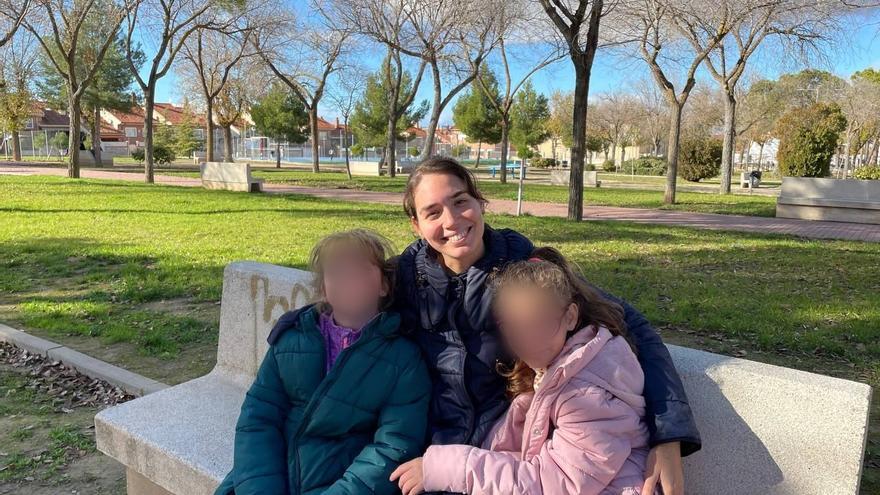
Amelia sees her children frolicking in the park: “I think they still can’t understand that this is for life, that it is not a walk.” (14ymedio)
At the door of the children’s new school, a large enclosure, with several doors and buildings, and music to encourage the children to leave, another Cuban father approaches to greet them. And if they came to this town, small and far from the center of the capital, surrounded by vineyards and olive trees, with a Renaissance church, it was because of a compatriot friend of Antonio’s, who had been living here for more than ten years. As usually happens with migratory movements, there is a large community of citizens of the Island in the place. “When I arrived here, to my surprise, the Cubans at school knew me from the networks,” Amelia says with a smile. “They saw me and immediately told me ’mija, but what are you doing here, we’re going to help you’, and they helped me with everything, to get settled.”
There are things about Spain that she is “perplexed” about, such as the school her children, almost 10, 7 and 4 years old, go to. “It is a public school where there is no blackmail for being public,” she explains, because in her country “there is a process of imposing ideology.” In this regard, she gives a beautiful example, the day that her first-born daughter, studying history, asked her: “But mami, who came to Cuba first, Christopher Columbus or Fidel Castro?”
Safety is another of the fundamental elements why she is glad to have left. She comments on it happily while a local agent walks in front of her: “The Police here are something else. Besides, for me they are selected in a modeling casting call.” And Christmas! “It’s so beautiful how people live it and decorate everything, regardless of whether they believe or not.”
“I think that they still cannot understand that this is for life, that it is not just a trip, because sometimes they say ’oh, mami, this is something to take with me to my room in Cuba’.”
After school, on the days that Antonio is free from work – he is a clerk at a tobacco and cigarette store in the center of Madrid – the five of them go to the park before eating. Amelia sees them frolicking: “I think they still can’t understand that this is for life, that it’s not just a trip, because sometimes they say ’oh, mommy, I’ll take this to my room in Cuba’.”
It is a beautiful day. “The day I arrived there was a sun like that, so beautiful, but at the same time it was cold,” and she repeats what she told her mother on the phone: “Mami, in Spain the sun is a yellow light bulb: it shines but warmth, it warms up, nothing.” When Amelia talks about her mother, her expression saddens. “I miss her a lot and she misses me too. I am an only child and my mother is a very devoted mother. It’s not that I don’t have the possibility of bringing her, it’s that at the moment I can’t, including because of the economic factor.”
I think on many occasions that despite any intellectual capacity I may have, I am going to end up cleaning floors and windows. They make you doubt your ability”
Amelia, in all seriousness, speaks of the psychological damage that a dictatorship causes, a damage that “few people talk about, which is even more cruel than any other type of damage that is done to you,” and which is responsible for an almost anthropological insecurity.
“It has affected me. I am a professional, in a non-English speaking country, where I have opportunities, because not many people speak English, and even so, it is difficult for me to believe that I can function in this society as a professional. I think on many occasions that despite any intellectual capacity I may have, I am going to end up cleaning floors and windows. They make you doubt your ability. And then they keep you ignorant in so many ways, that going out into the world is like walking for the first time, alone. That’s how I feel, like I’m learning to walk alone.”
Amelia, in all seriousness, speaks of the psychological damage that a dictatorship causes, a damage that “few people talk about, which is even more cruel than any other type of damage that is done to you”, and which is responsible for an almost anthropological insecurity. “It has affected me. I am a professional, in a non-English speaking country, where I have opportunities, because not many people speak English, and even so, it is difficult for me to believe that I can function in this society as a professional. I think on many occasions that despite any intellectual capacity I may have, I am going to end up cleaning floors and windows. They make you doubt your ability. And then they keep you ignorant in so many ways, that going out into the world is like walking alone for the first time. That’s how I feel, like I’m learning to walk alone.
____________
COLLABORATE WITH OUR WORK: The 14ymedio team is committed to practicing serious journalism that reflects Cuba’s reality in all its depth. Thank you for joining us on this long journey. We invite you to continue supporting us by becoming a member of 14ymedio now. Together we can continue transforming journalism in Cuba.
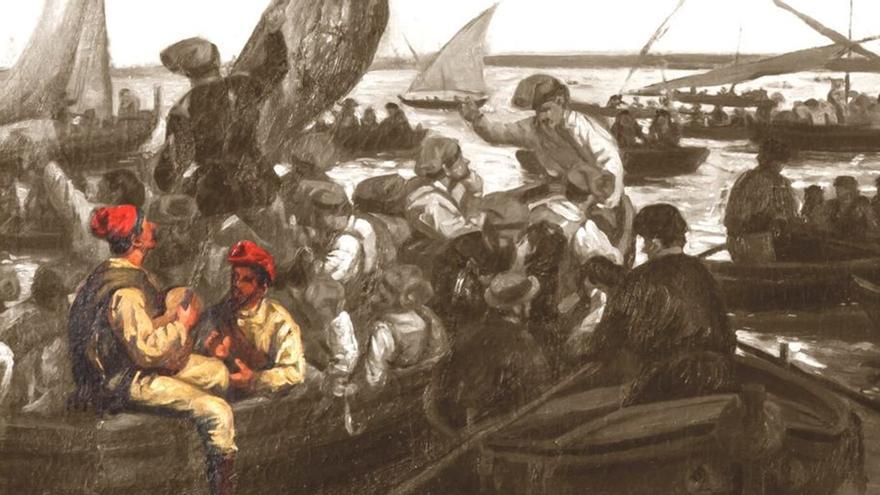
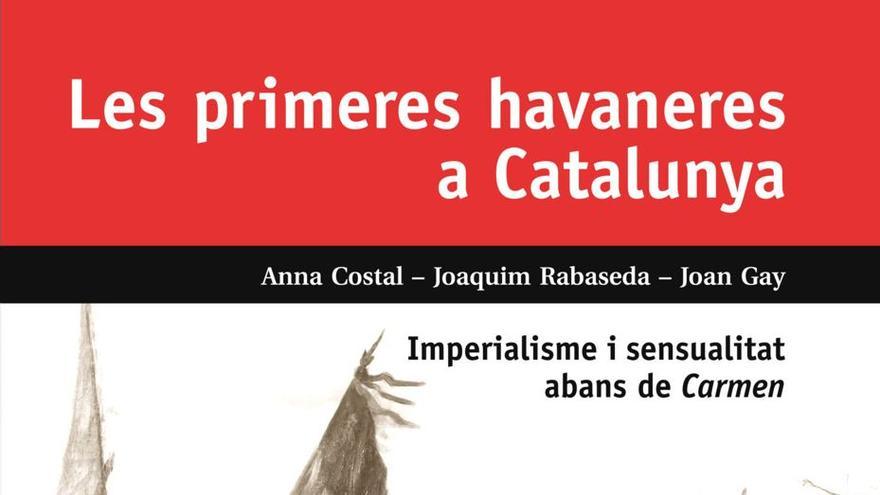
Detail from the cover of the book: ’The First Habaneras in Catalonia’. ((Rafael Dalmau Editor)
EFE (via 14ymedio), Barcelona, 9 December 2023 – Research, conducted by the musicologists Anna Costal, Joaquim Rabaseda and Josep Gay, has established the boom and the popularisation of habanera music as happening almost half a century before the Cuban War of Independence.
The research, collected together in the book, The first Habaneras in Catalonia (Rafael Dalmau, Editor), shows that “The habaneras passed through Madrid before arriving in Catalonia, and, coinciding with elation for the 1859 War of Africa, they became a gesture of national pride for the maintenance of Imperial Spain’s public image – the idea of a powerful kingdom, bellicose and colonial”.
The authors add that the habaneras also became a national symbol in Catalonia.
When, in 1881, the opera Carmen was performed in Barcelona for the first time, the main protagonist in the story grabbed the audience’s attention through her performing to the rhythm of the habanera.
Célestine Galli-Marié, the same mezzosporano who had premiered the opera six years earlier in Paris, enchanted the audience, and her powerful continue reading
stage presence was made even greater by “a rhythm which Catalans had known, had sung, and had danced to for decades”, the musicologists write.
When, in 1881, the opera Carmen was performed in Barcelona for the first time, the main protagonist in the story grabbed the audience’s attention through her performing to the rhythm of the habanera
Although, in the collective imagination, the habanera had been connected with the loss of Cuba, they nevertheless became enormously popular in the middle of the nineteenth century: “Fishermen would indeed sing them, but also factory workers, characters in light operas, professional singers, street musicians, the children of the ruling classes”.
Before Cuban independence, the war had already been a topic of habaneras, along with: Catalan soldiers, the unsettling sensuality of foreign women, and everything connected with the idea of romantic love.
The research collected together in the book shows that “The habaneras passed through Madrid before arriving in Catalonia”. (Rafael Dalmau Editor)
The habanera, known in Catalonia by the name of “Americana”, was the invitation to a slow dance, and its particular rhythm intensified the intimacy of the couples who danced to it – in theatres, dance halls, marquees, streets, and in town squares – and because of this, it was “associated with the idea of sinfulness, with social transgression and rebelliousness”.
The book presents the habanera as “an urban and contemporary phenomenon”, demarcated in the Catalan culture of the romantic era, and an active participant in the new mechanisms for creating, editing and distribution, in the world of nineteenth century show business.
The work describes the profiles of some of the composers of Catalan habaneras of the era: “musicians who had never been to Cuba and who were, generally, members of opera theatre orchestras and dance orchestras”.
The book presents the habanera as “an urban and contemporary phenomenon”, demarcated in the Catalan culture of the romantic era
It also puts into relief the role of women in the interpretation and diffusion of the early habaneras.
The authors make connections between the first habaneras sung in Catalan and Barcelona’s lyrical theatre, which was connected to the federal republicanism of the six-year democracy (1868-1874) and the acceptance of the abolition of slavery.
The current edition is the result of research promoted by the Ernest Morató Foundation, whose objective is the investigation, conservation, diffusion and promotion of the habanera genre.
Doctors of Musicology at the Autonomous University of Barcelona, and teachers at the Catalonia High School for Music, Anna Costal, Joaquim Rabaseda y Joan Gay have been working together on various aspects of Catalan music heritage for fifteen years, combining their study and revelations in a global reach.
Translated by Ricardo Recluso
____________
COLLABORATE WITH OUR WORK: The 14ymedio team is committed to practicing serious journalism that reflects Cuba’s reality in all its depth. Thank you for joining us on this long journey. We invite you to continue supporting us by becoming a member of 14ymedio now. Together we can continue transforming journalism in Cuba.
The Los Van Van orchestra during a performance in Mexico City in May 2023. (14ymedio)
EFE (via 14ymedio), 23 December 2023 — This Friday in Havana the mythical and multi-award-winning Cuban orchestra Los Van Van presented its most recent album, Modo Van Van, its first album in three years, dedicated to its recently deceased bassist Juan Carlos Formell. This is the fourth album released by the orchestra – which in 2023 celebrated 54 years since its foundation. Los Van Van’s previous album was released in 2020 with the title Mi songo, a journey through the five decades of the orchestra.
Speaking at a press conference, Samuel Formell, director of the group and son of Juan Formell, the group’s founder, said that the work, with nine songs written and recorded by Juan Carlos Formell before his death in May, “was made for dancing, to enjoy, and is a gift for the world.” “(In all our songs) he will always be present,” said the current director, percussionist, arranger and composer of the group.
This is the fourth album released by the orchestra since the death of Juan Formell in 2014
The band, founded by composer and guitarist Juan Formell (1942-2014), is, despite the passage of time, the preference of several generations of Cuban dancers, who follow the musical proposals of a group nicknamed El tren de la música cubana. This year, Los Van Van did a tour of cities in Spain, Germany, the United States and Japan. continue reading
The band also confirmed its participation in the 40th edition of the National Salsa Day of Puerto Rico, to be celebrated on March 17.
Los Van Van has an extensive recording history that brings together more than 40 albums, many of them nominated and awarded, such as the Latin Grammy for the best salsa music album received in 2000 for its title Llegó Van Van.
Translated by Regina Anavy
____________
COLLABORATE WITH OUR WORK: The 14ymedio team is committed to practicing serious journalism that reflects Cuba’s reality in all its depth. Thank you for joining us on this long journey. We invite you to continue supporting us by becoming a member of 14ymedio now. Together we can continue transforming journalism in Cuba.
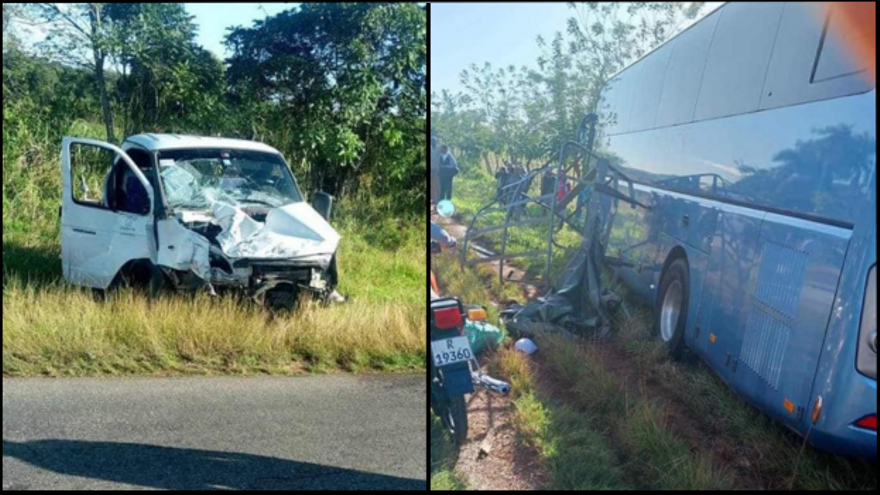
According to the official press, the van lost control trying to dodge, unsuccessfully, a third passenger transport vehicle. (TV Yumurí)
14ymedio, Havana, December 23, 2023 — At least five people died and another 20 were injured after the collision between a bus and a van of the state-owned Unión Cuba-Petróleo (CUPET) on a road in the municipality of Limonar, in Matanzas province According to the official press, the van lost control trying to dodge, unsuccessfully, a third passenger transport vehicle.
The accident occurred on a curve between Limonar and another town, Caoba, and was witnessed by several residents in the area. The Girón newspaper reported, in its most recent article on the situation, that 13 of the 20 injured are under treatment at the Faustino Pérez de Matanzas hospital. Two of them, according to health personnel, present “danger to life”; another four suffer from “injuries that require immediate attention” – fractures and bruises – and another 7 have minor injuries.
The accident included a 10-year-old, injured and reported in serious condition. According to the directors of the Provincial Pediatric Hospital of Matanzas, the child is “on a ventilator, and a CT scan was performed to continue reading
continue treatment.”
Three of the five deceased died at the scene of the event, Lieutenant Colonel Eddys Estevez Rodríguez informed the official press
Three of the five deceased died at the scene of the event, Lieutenant Colonel Eddys Estevez Rodríguez, head of Matanzas Traffic, told the official press. The other three patients died in the hospital.
Cuba recorded a total of 6,965 traffic accidents between January and October of this year, an increase of 12.8% compared to those that occurred in the same period of 2022 (6,175), according to official data.
Among the main causes of the accidents are speeding, distractions and lack of respect for traffic rules, according to the head of the specialized traffic body of the General Directorate of the Police, Colonel Roberto Rodríguez.
Translated by Regina Anavy
____________
COLLABORATE WITH OUR WORK: The 14ymedio team is committed to practicing serious journalism that reflects Cuba’s reality in all its depth. Thank you for joining us on this long journey. We invite you to continue supporting us by becoming a member of 14ymedio now. Together we can continue transforming journalism in Cuba.
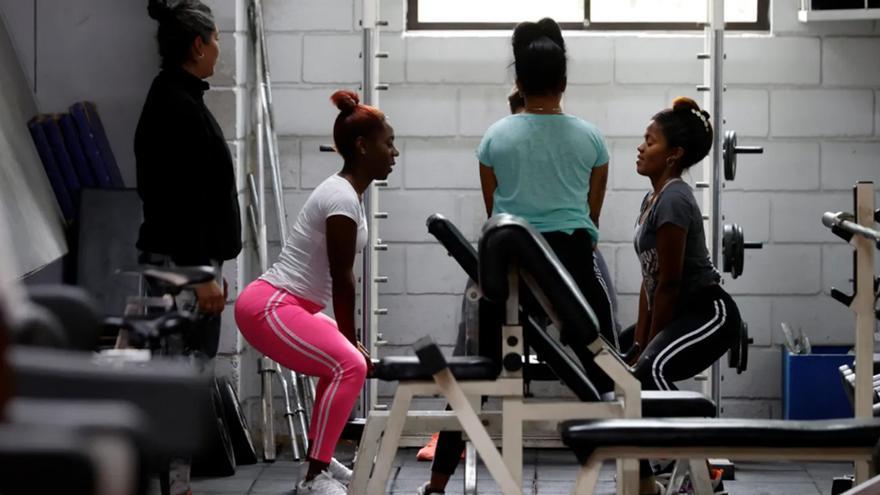
The grass hockey players Yunia Milanés, Jennifer Martínez, Yakira Guillén, Lismary González, Helec Carta and Geidy Morales stayed in Chile after the Pan-American Games. (EFE)
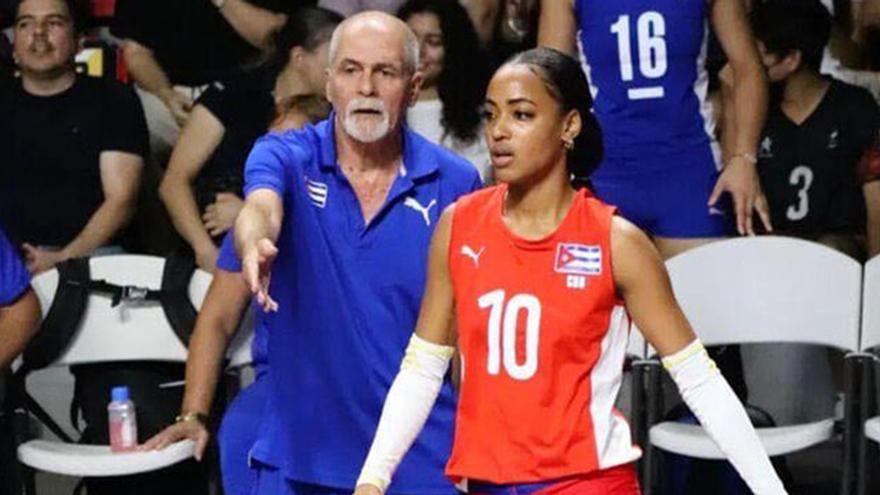
14ymedio, Havana, 23 December 2023 — Six medalists were part of the group of 77 athletes in international events who decided to break with Cuban sports in 2023. On the list, published by Cubalite, is Yoenlis Hernández Feliciano, double world champion in boxing in the 165-pound category. There is also the judoka Arnaes Odelín, winner in the 125-pound category at the Central American and Caribbean Games in San Salvador.
In addition Hangelen Llaanes, another gold medalist in the Salvadoran event, left the team’s training in Paris in September before traveling to Serbia. The escape of the habanera, who last year was distinguished as one of the most outstanding athletes in the discipline, left Cuba without the possibility of a medal in the 150-pound category in the Pan-Americans.
Ellemay Santa Miranda, with university studies in Physical Culture and Sports Sciences, stayed in Canada. (Facebook/Ellemay Santi Miranda)
Another of the blows that the regime received was the escape, in June, of the discus thrower Denia Caballero. The athlete broke relations with the Island after winning the silver medal at the Meeting Diputación de Castellón (Spain), with a throw of 207 feet. Journalist Francys Romero indicated that, since the beginning of this year, the Cuban Athletics Federation has “hindered” the athlete’s negotiations with Portugal.
In June, the bronze medalist at the Central American and Caribbean Games (Barranquilla 2018) and at the Pan American Games (Lima 2019), Arisleidy Márquez, escaped along with Yudisaday Rodríguez, Melisa Arias and Geidy Maceo. The athletes, handball representatives, left the training in France. continue reading
In addition, Yoao Illas Puentes, Pan-American bronze medalist in the 1,300-feet hurdles, took advantage of his stay in Chile last November to desert. The native of Bahía Honda, in the province of Pinar del Río, in April of this same year won the gold medal in the V ALBA Games (Venezuela) in the 4×1,300-feet test in mixed relay alongside Roxana Gómez, Lisneidy Veitía and Yoandys Lescay.
Hangelen Llanes was included by coach Filiberto Delgado in the team of 11 athletes who carried out their training in France in September. (Video/Jit capture)
In Chile, grass hockey players Yunia Milanés, Jennifer Martínez, Yakira Guillén, Lismary González, Helec Carta and Geidy Morales also fled. These athletes, according to journalist Francys Romero, “left the training … after completing the game for fifth place against Uruguay (3-0)” in the Pan-Americans. They were joined by handball representative Lidier Vergara.
In the same event, the blind swimmer Yunerki Ortega left the Pan-Americana Villa where the athletes were staying. “Passers-by helped him take a taxi to a service center near the National Stadium,” said T13 news in Chile.
The regime accepted in October that the desertions of athletes and coaches have affected Cuban sports, as recognized by the general director of High Performance of the National Institute of Sport, Physical Education and Recreation (INDER), José Antonio Miranda, speaking on State TV’s Round Table program.
The blind swimmer Yunerki Ortega left the Pan-American Village in Chile last November. (Jit)
Between 2022 and September of this year, 191 athletes broke their relationship with the sports authorities of the Island, the official said. As usual, according to the Cuban authorities, the main cause of the desertions is the American “blockade,” to which Miranda added the “complex economic scenario” that the country is going through.
The figures on the escapes of Cuban athletes are devastating. In January, the official weekly Trabajadores counted the abandonment of 862 athletes in a decade, of whom 635 were baseball players. By adding the recent data offered by INDER, there are now 1,053 athletes who have left the Island.
Translated by Regina Anavy
____________
COLLABORATE WITH OUR WORK: The 14ymedio team is committed to practicing serious journalism that reflects Cuba’s reality in all its depth. Thank you for joining us on this long journey. We invite you to continue supporting us by becoming a member of 14ymedio now. Together we can continue transforming journalism in Cuba.
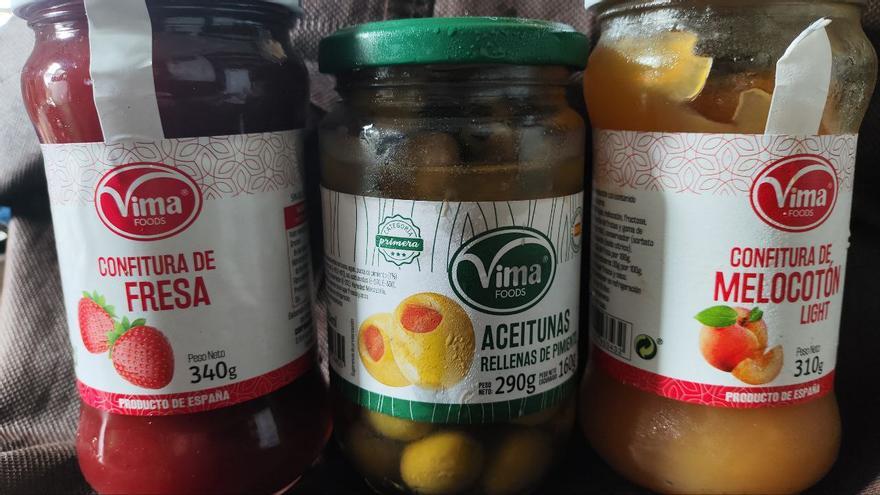
Vima’s products are prominently displayed on all the retail websites where customers overseas can make purchases for delivery in Cuba. (14ymedio)
14ymedio, Olea Gallardo, Havana, December 14, 2023 — The wedding last weekend in Havana of Víctor Moro Morros-Sarda and Alexandra Lacorne made the news in Spain’s gossip columns for having brought together several figures who frequently make appearances on their pages. Among the 400 guests were Tamara Falcó, Marchioness of Griñón, daughter of Isabel Preysler and sister of Enrique Iglesias; and her cousin, Álvaro Falcó, Marquis of Cubas. They were accompanied by their respective spouses, Íñigo Onieva and Isabelle Junot, the daughter of Philippe Junot, former husband of Princess Caroline of Monaco.
Only readers of Hola! and similar magazines would be interested in such an event were it not for two things: the luxurious wedding, which lasted several days, took place at a time when Cuba is going through one of its worst crises of the last quarter of a century, and the groom is the son of Víctor Moro Suárez, founder of Vima Foods, a brand of imported products which have been omnipresent in Cuban hard-currency stores for decades.
The company is described by Vanitatis as “an international food group” and by El Debate as “a multi-national distributor of food products with offices in Havana, New York, Coruña and other locations.” For the island’s residents Vima Foods is synonymous with low-quality at high prices.
I can only imagine that Vilma’s ham croquettes must be the worst in Spain because there’s nothing in them. They’re just flavored flour
“They seem like a scam to me,” says Mariam, a Havana native who has not bought any of the company’s products for two years after falling ill from eating a can of Vima tuna which she bought at a hard-currency store. “They are third or fourth-class products sold for high-class prices.” continue reading
Mayonnaise, mustard, tomato paste and other sauces, a wide variety of canned goods, cured meats, frozen foods (vegetables, fruits, meat, fish and shellfish, and even bread) pre-cooked foods, cheeses of various sizes, jams, syrups, powdered milk, yogurts, olives, cooking oils, legumes and grains are just some of the many Vima items for sale on the Island, all of them imported.
These products are prominently displayed on all the retail websites where overseas customers can make purchases for delivery in Cuba.
One of their most popular items is their croquettes. But Mariam has nothing good to say about them either: “I can only imagine they must be the worst in Spain because their ham croquettes have nothing in them. They’re just flavored flour.”
When people in other countries were asked how they perceived the brand, Carlos — who emigrated from Cuba two years ago — said, “I don’t know anyone in Spain who buys it. Fortunately, I myself have never seen it in a supermarket because I remember it was the worst.”
Vima World describes itself as a “family-run company founded in 1994” and a group “whose origens began in Galicia’s fishery sector.” On the same website it claims it operates not only in Spain but in forty other countries as well, and that it also has offices in Panama, the Domincan Republic, Mexico, the United States, China and Cuba.
Its founder has never hidden his ties to the island. Victor Moro Suarez (son of Victor Moro Rodriguez, who died in 2021) was a politician during Spain’s transition to democracy. He also headed a frozen food conglomerate. He spent more than twenty-five years in this country, where he served as president of the Association of Spanish Businessmen in Cuba.
What is murkier are the origins and expansion of his multimillion-dollar business. The so-called Panama Papers, a series of leaked documents obtained from the database of the Mossack Fonseca law firm by the International Consortium of Investigative Journalists (ICIJ) in 2016, revealed that Vima World was on the list of companies which had been registered in tax havens.
“I found a work niche in the Caribbean, starting in Cuba, and that circumstance led me to form this group of companies.” The ICIJ search engine indicates it was founded in January 1994 in the British Virgin Islands. However, Moro Suarez himself acknowledged in an interview with the local Galician press almost two decades ago that his empire started in Cuba. When asked by the journalist how he ended up with one hundred and sixty employees serving twenty million meals around the world, the businessman responds, “I found a work niche in the Caribbean, starting from Cuba, and that circumstance led me to form this group of companies.”
An article in La Voz de Galicia (The Voice of Galicia) four years earlier confirmed, “Vima was created in Havana in 1994 to take advantage of the opening of the Cuban market to tourist investment and became the main supplier to hotels and restaurants.” It reporthed that, in 2002, Vima World, “a distributor based in Vigo and 100% owned by Galicia’s Moro family” was the sector leader in Cuba, with control of 15% of food distribution and 25% of supplies to hotels. It is said to have earned 25 million euros in 2001.
How was a foreigner able to launch and then head a business in Cuba in the mid-1990s and achieve these results in just seven years? It is one of Vima’s unknowns. It is especially striking given that its appearance on the island happened to coincide with the Special Period — after the fall of the Soviet Union and the loss of its subsidies to Cuba — a time of dollarization and despair.
Also puzzling is how a firm like Vima World S.L., which has been around for almost thirty years, did not show up on the National Registry of Foreign Commercial Ventures until this past October.
The fact that official news outlets such as Cubadebate have reported that its Havana office is in the Berroa neighborhood — also home to the mysterious Diplomarket — traditionally under the control of Gaesa, the all-powerful business consortium run by the Cuban armed forces, only reinforces the the idea that it is well connected with officials in the highest echelons of power. The author of that article noted that, according to his sources, Moro Suarez has been seen seated alongside figures such as Fidel Castro and Cuban singer/songwriter Pablo Milanés.
The media outlets that reported on the Moro-Lacorne wedding mentioned none of this. They focused instead on other details such as the most recent photo of Moro-Suarez next to his wife, Mariquita Morros-Sarda, in the traditional Spanish mantilla worn by maids of honor.
The usual syrupy, superfluous prose was all about dresses and extravagant waste. Staying at the Gran Hotel Manzana Kempinski, one of the most expensive in the city, the guests enjoyed a “pre-wedding” party at the Tropicana cabaret, reserved solely for them for the occasion. They moved around in glittering vintage cars and attended a ceremony held in the Havana cathedral itself. Many of the guests, like the influencer Belén Barnechea, shared relaxed images of the streets of the capital, day and night, with shots that in no way illustrated the true and calamitous state of the city. A lavish Havana of glossy paper under the canopy of Vima Foods.
____________
COLLABORATE WITH OUR WORK: The 14ymedio team is committed to practicing serious journalism that reflects Cuba’s reality in all its depth. Thank you for joining us on this long journey. We invite you to continue supporting us by becoming a member of 14ymedio now. Together we can continue transforming journalism in Cuba.
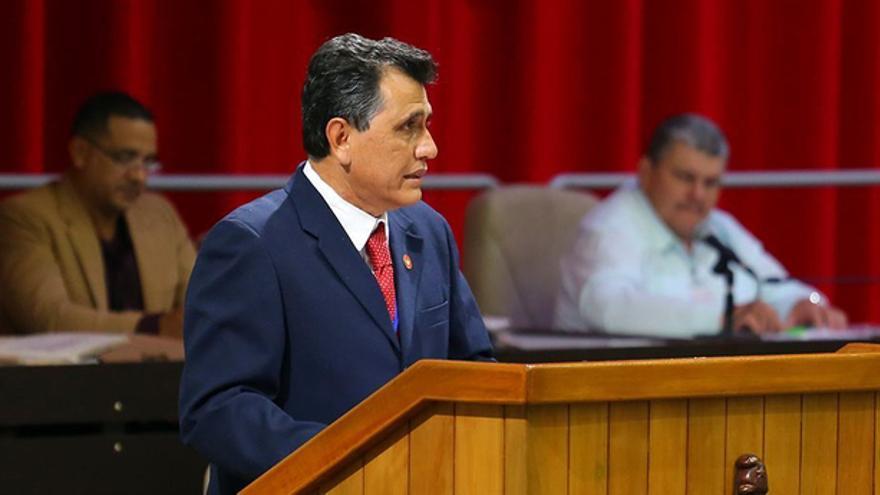
Jaime Chiang, governor of the province, reported to Parliament this Friday. (Periódico 26)
14ymedio, Havana, 23 December 2023 — The governor of Las Tunas reported to Parliament this Friday that 2023 has been one of the most disastrous years for the province in economic, health and social matters. With a contrite face and a thick report in his hand, Jaime Chiang translated into numbers the alarming infant mortality rate, state corruption, inflation and crime.
But not everything has been the fault of his administration, the politician warned, but also of the “situation of ungovernability and disobedience in the population” caused by the “enemies of the Revolution,” also responsible for the blockade and the “energy contingency,” he insisted. Hence, Las Tunas will lack 1,481 million pesos to fulfill its total net sales plan in the first half of the year, which remained at 5,289 million.
There are 34 entities responsible, the report specifies, due to “lack of demand, rigor and responsibility on the part of some cadres.” Among the recurring problems are the “deficient management of collections, “the “chain of non-payments” and the “insufficient economic and financial administration.”
Las Tunas, in short, spent 185 million pesos more than the state budget allowed, about 3,511 million
Food insufficiency, whose production was neglected by the provincial government, was especially serious for raw sugar, rum for export, corn and beef. Chiang complained that all these products had to be guaranteed by the continue reading
province under “order of the State,” and they couldn’t be. The production of another 99 “articles” also failed, almost all linked to the food industry and many to construction.
Las Tunas, in short, spent 185 million pesos more than the state budget allowed, about 3,511 million. Once again, Chiang was able to point out the specific culprits of the spending: the municipalities of Las Tunas, Puerto Padre, Manatí, Jesús Menéndez and Amancio. Forty-eight “disciplinary measures” were also applied, including three dismissals and multiple fines and warnings.
But it is in Public Health where the outlook is most worrying. The province’s infant mortality rate in 2023 was 7.83 per 1,000 live births, which represents an increase over the previous year, when a rate of 6.96 per 1,000 children was recorded. The cause of death in 73% of the cases was low birth weight.
As for health and education, Chiang was more vague and said that he hoped that next year 85 percent of teaching activities would have a “good” level, although for that a lot of “improvement” is needed.
Transport, another of the sectors in crisis, met only 37% of its plan. Of the more than 13 million “passengers to be transported” in the province during 2022, only 4.92 million were moved. The situation did not change in the first half of 2023, even with the modest target of 6 million: they only transported 2,495 million, not only because of the shortage of fuel but also “because of the lack of batteries and tires.” The domino effect was felt in the distribution of the basic family basket, especially in those areas of the province where people have to go by rail or boat.
But Las Tunas has won the title this year for being “the driest province in the country.” About 16 communities, which total 9,640 inhabitants according to the official report, are still without water, and when they receive it, it’s only thanks to the Communal Services watertrucks. Chiang did not say if the provincial government will take measures, next year, to resolve the situation once and for all.
About 16 communities, which total 9,640 inhabitants according to the official report, are still without water, and when they receive it, it’s only thanks to the Communal Services water trucks
More than 20,300 homes in the province are in poor condition, 10 percent of the province’s constructions, the report continues. In the 41 vulnerable neighborhoods registered, 829 families live in a situation that the State considers precarious. Here, once again, the provincial government apologizes but accuses the pandemic and the “insufficient supply of materials” available. “The main causes of non-compliance with the plan were the lack of cement, steel, finishing elements, sand and other dry materials, flooring and wood,” he added.
The one success in Las Tunas – as in the whole island – is in the “confrontation of crime,” which has proven to be a gold mine for the state coffers. About 8,488 “control actions” to collect overdue fines and detect financial irregularities contributed to raising 15,531 million pesos. But at this point Chiang could not claim victory either: “Despite the increase in all the indices of confrontation and imposition of fines, the directives have not been effective.”
Translated by Regina Anavy
____________
COLLABORATE WITH OUR WORK: The 14ymedio team is committed to practicing serious journalism that reflects Cuba’s reality in all its depth. Thank you for joining us on this long journey. We invite you to continue supporting us by becoming a member of 14ymedio now. Together we can continue transforming journalism in Cuba.
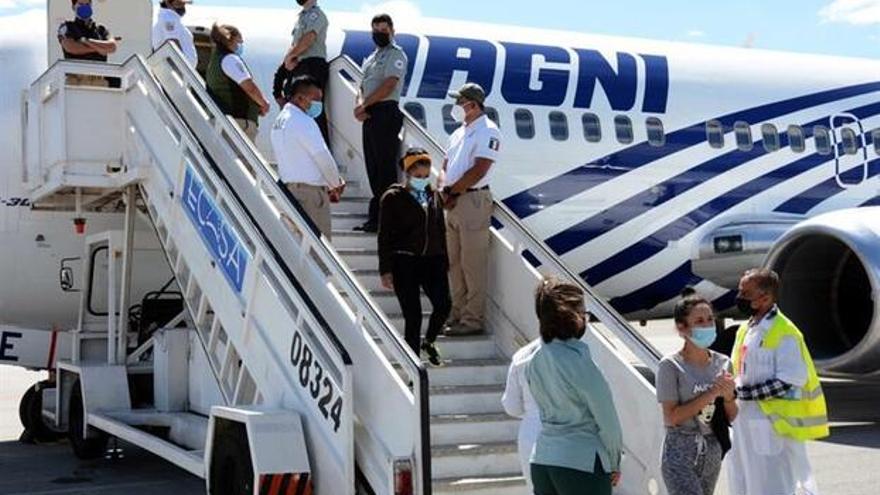
At the end of 2022, Cuba and the United States agreed to resume deportation flights for ’inadmissible’ people detained on the border with Mexico. (Prensa Latina)
EFE/14ymedio, Havana, 23 December 2023 –The U.S. Coast Guard Service (USCG) returned 45 Cuban rafters this Friday along with 5,210 irregular migrants deported to the Island from several countries in the region so far this year, according to official media.
This group includes 39 men and six women who left illegally from the province of Matanzas, according to the Ministry of the Interior on the social network X (formerly Twitter). The report indicates that the rafters were intercepted at sea by the U.S. Coast Guard and that this is the 129th repatriation operation of migrants from different nations in 2023.
The Cuban authorities assure that they stand “firm” in their commitment to a “regular, safe and orderly” migration, while warning of the danger and life-threatening conditions posed by illegal departures from the country by sea. Cuba and the U.S. have a bilateral agreement that all migrants arriving by sea will be returned to the Island.
Flights were added at the end of 2022, after Cuba and the U.S. agreed to resume deportation flights for “inadmissible” people detained at the border with Mexico. continue reading
During the last fiscal year, which began on October 1, 2022, more than 6,800 Cubans have been intercepted by the USCG on trips to the coast of Florida, according to official data.
During the last fiscal year, which began on October 1, 2022, more than 6,800 Cubans have been intercepted by the USCG on trips to the coast of Florida
This year, Cuba also received migrants deported from the Bahamas, Belize, the Cayman Islands, the Dominican Republic and Mexico.
Cuba is experiencing an unprecedented migratory wave both for the volume of migrants and for its temporary extension due to the serious economic crisis it suffers with a great shortage of basic products (food, medicines and fuel), galloping inflation, frequent power outages and a partial dollarization of the economy.
It is estimated that in 2022, around 4% of the Cuban population left the country, and this year’s figures could be similar according to those accumulated to date
Also, U.S. immigration authorities arrested more than 242,000 migrants and asylum seekers at the southern border in November, according to figures published this Friday by the Customs and Border Control Office (CBP).
The data for the month of November represent a slight increase, less than 1%, compared to October, but they maintain the trend of the high arrival of migrants on the border with Mexico that has been evident in recent months.
In fact, November was the third month with the most arrests of migrants at the border in the last 14 months, according to CBP data.
Most of the people arrested, more than 191,000, tried to cross into U.S. territory irregularly, according to the data.
The interim commissioner of CBP, Troy Miler, said in a statement that his agency faces a “significant challenge” and asked the U.S. Congress to approve more resources to “improve border security and national security.”
“The levels of migration are still historically high,” the statement stressed. In November, CBP recorded more than 64,811 arrests of people of Mexican nationality, followed by Venezuelans with 34,063 arrests and Guatemalans with 26,299.
According to the statistics for the end of November 2023, published by CBP, 20,076 Cubans arrived in the United States through border points
Since the middle of the year, when a migration restriction that had been imposed by the COVID-19 pandemic was lifted, the Democratic Administration has enacted a series of rules to try to limit the arrival of migrants at the border and restrict access to asylum.
According to the statistics for the end of November 2023, published by CBP, 20,076 Cubans arrived in the U.S. through border points, 72% at the Mexican border. This represents a record number of Cuban irregular migrants in a month, 44,079.
The report points out that during last November, 14,502 Cubans entered irregularly through the southern border of the United States. The number of Cubans who have reached American soil during fiscal years 2022 and 2023 is 650,000, to which are added more than 50,000 since Joe Biden assumed the presidency.
In addition, more than 60,000 Cubans have traveled to the U.S. through the humanitarian parole program, while the number of those who arrived through the CBP One appointments, where Haitian, Mexican and Venezuelan applicants lead, is not revealed.
Cuba is experiencing an unprecedented migratory wave both for the volume of migrants and for its temporary extension due to the serious economic crisis it suffers with a great shortage of basic products (food, medicines and fuel), galloping inflation, frequent power outages and a partial dollarization of the economy. It is estimated that in 2022, around 4% of the Cuban population left the country.
Translated by Regina Anavy
____________
COLLABORATE WITH OUR WORK: The 14ymedio team is committed to practicing serious journalism that reflects Cuba’s reality in all its depth. Thank you for joining us on this long journey. We invite you to continue supporting us by becoming a member of 14ymedio now. Together we can continue transforming journalism in Cuba.
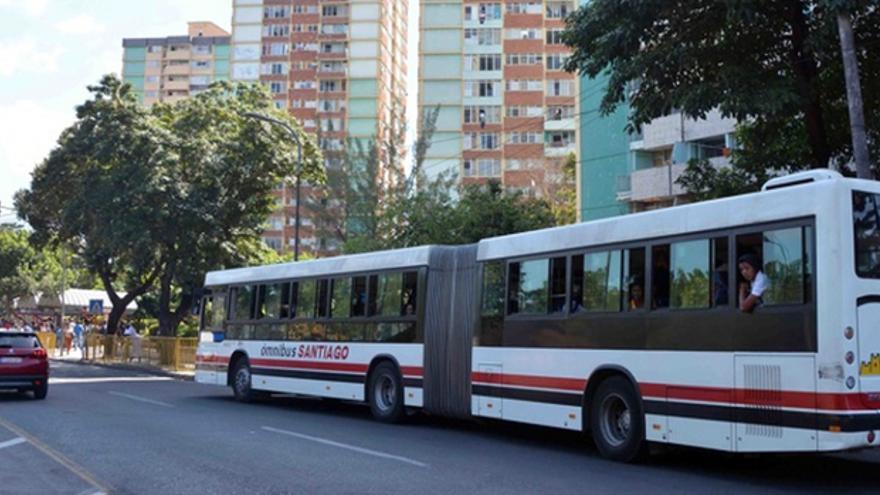
Articulated buses cover the most popular routes in the city. (Sierra Maestra)
14ymedio, Havana, 18 December 2023 — Only half of the public transport vehicles operate in Santiago de Cuba, mainly because of lack of fuel, according to the official newspaper Sierra Maestra, as reported by Yariannis Carrión, a specialist of the Provincial Transport Company.
The situation, however, is not recent. Last June, the same newspaper reported that only half of the vehicles were providing service due to a lack of spare parts, resources and fuel. The authorities, for their part, only succeed in putting pressure on state companies to use their own buses for their workers to transport passengers.
The article also explains that in December only five buses of the main routes are in operation – half of those available in the province – and of the Diana buses, of Chinese manufacture and assembled in Cuba, barely 18 out of a total of 36 are operational.
The local government also asked the inspectors – previously known as “yellows” and now called “blues” – to contribute to flagging down cars to pick up riders
The local government also asked the inspectors – previously known as “yellows” and now called “blues” – to contribute to flagging down the cars of state companies to collaborate in the transport of people. However, the authorities have pointed out that the drivers, on many occasions, ignore the signal to stop or lie about their final destination. continue reading
“All companies, whether Transport or not, have rented vehicles, and it’s expected that by 2024 this figure will increase and the fuel situation will improve,” Carrión added, although he did not offer any explanation about how much the costs of this type of transport have risen.
Traditionally in Santiago de Cuba, motorcycles have been a palliative to the critical situation of urban transport. However, the cost of spare parts and gasoline on the black market have raised the price of tickets to 100 pesos in short sections. For slightly longer distances, such as the 3.7 miles that separate Ferreiro Park from the town of El Caney, the price is around 300 pesos, always up to the driver.
On the other hand, the well-known pisicorres (old cars adapted to transport passengers), have prices established at 20 pesos, but the drivers try to circumvent the limit, increasing the rate to 50 pesos if there are no inspectors in sight.
This September, the local newspaper Escambray acknowledged that both rural and interurban routes were paralyzed in Sancti Spíritus
In other provinces the situation is similar. This September, the local newspaper Escambray acknowledged that both rural and interurban routes were paralyzed in Sancti Spíritus, and that there were hardly any buses in the provincial capital.
There have also been readjustments in Holguín. Speaking to the official newspaper Ahora!, Wilmer García Ramírez, director of the Transport Company in the province, said that the 21 routes that exist in the city remain operational, “but with fewer cars,” which reduces the frequency during the day.
Last February, the Minister of Transport, Eduardo Rodríguez Dávila, announced on State TV’s Round Table program that the Island was facing one of the worst moments of public transport in recent years.
Rodríguez Dávila explained that the Government does not have foreign currency to repair the means of transport: “It takes between 40 and 45 million dollars to maintain passenger transport services, not counting the money needed for new investments, and those figures cannot be guaranteed.”
In addition, the official admitted that to the difficulties in obtaining gasoline and oil is added the ruinous state of the roads throughout the country, which contributes to the rapid deterioration of the vehicles.
Translated by Regina Anavy
_______________
COLLABORATE WITH OUR WORK: The 14ymedio team is committed to practicing serious journalism that reflects Cuba’s reality in all its depth. Thank you for joining us on this long journey. We invite you to continue supporting us by becoming a member of 14ymedio now. Together we can continue transforming journalism in Cuba.
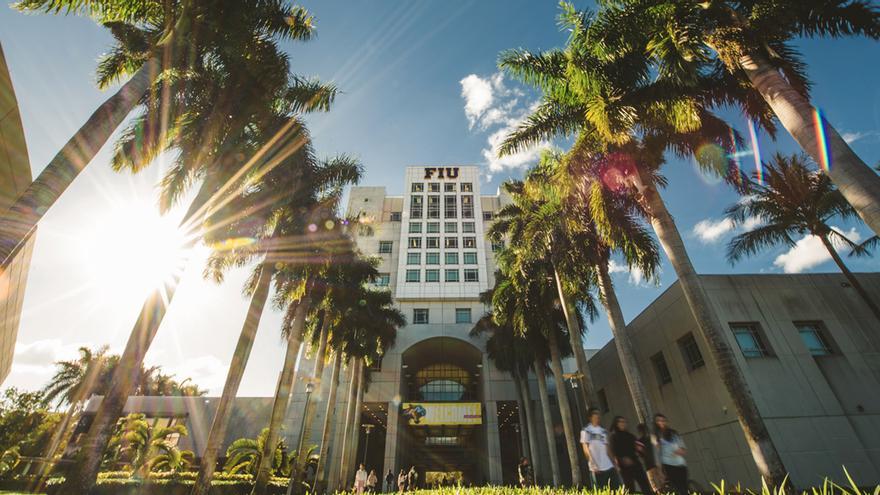
 14ymedio, Madrid, 25 December 2023 — Cuban researchers will not be able to work for Florida International University (FIU), which has decided to pause, immediately, the hiring of citizens of six countries considered “worrisome” by the government of that state, according to an email obtained by the WLRN radio station. Cuba is accompanied on the list by Venezuela, China, Russia, Syria, Iran and North Korea.