Only when popular rejection became massive did the regime decide to interpret the episode as a political problem
Feitó will be remembered for a long time as the functionary “disguised as a minister.” / Radio Rebelde
14ymedio, Havana, December 27, 2025 [delayed translation] — For years, Marta Elena Feitó embodied the ideal profile of a reliable figure within the Cuban system. She appeared disciplined, understated, effective at repeating the official line, and carefully avoiding any gesture that could be interpreted as dissent. From the Ministry of Labor and Social Security, one of the most sensitive portfolios in a country impoverished to the extreme, she defended statistics and slogans that increasingly clashed with the realities of Cuban life. In 2025, this disconnect between rhetoric and the realities on the ground made her one of the most significant figures of the year.
The breaking point came during a public address in which Feitó referred to the people wandering the streets as “in disguise,” implying that it wasn’t real poverty, but rather a staged performance designed to live “effortlessly” and discredit the Revolution. The phrase was a blatant summary of the official narrative that insists on denying the obvious. In a country where begging—officially “eradicated” for decades—has brutally flooded parks, doorways, and streets, those words sounded like the height of the ruling class’s delusion.
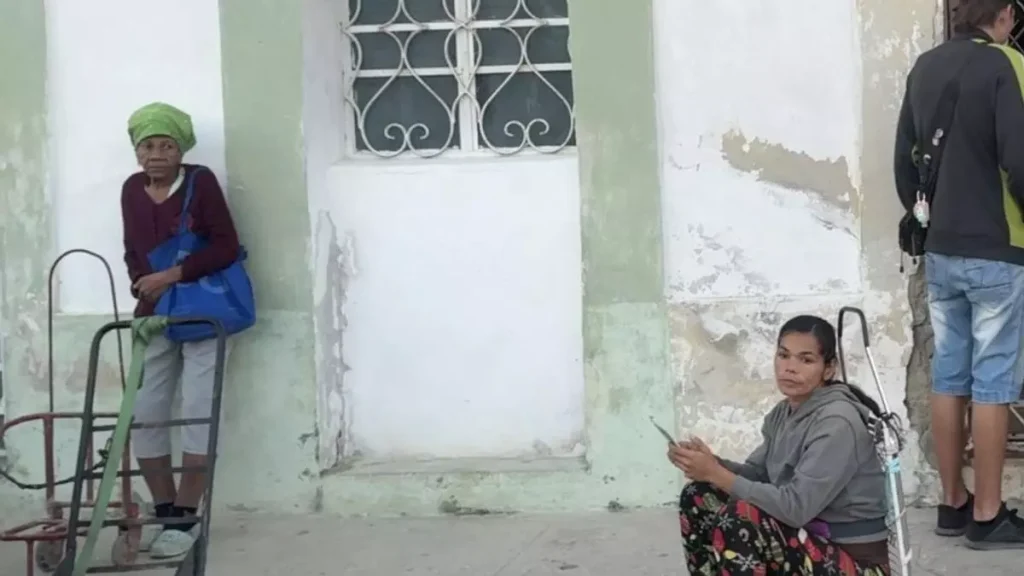
Images of elderly people scavenging in garbage, people with disabilities begging for alms, and adults and children sleeping on the streets are now an undeniable part of the urban landscape. Faced with this reality, the minister’s statement was not only insensitive but also politically clumsy. Denying poverty from a position specifically tasked with managing it exposed, without any filter, the disconnect between the government and the citizens it claims to represent.
None of those present contradicted her, corrected her, or expressed any objections. On the contrary, her words were met with agreement and applause.
During that speech, Marta Elena Feitó was not a lone voice in the chamber. None of those present contradicted her, corrected her, or expressed any objections. On the contrary, her words were met with agreement and applause. Among them was Deputy Yusuam Palacios, a figure constantly promoted by the regime as a young intellectual, a reliable continue reading
heir to the revolutionary discourse, and a renewed face of the cultural establishment. Palacios not only applauded but also endorsed a denial that was not foreign to him.
That immediate support made it clear that Feitó’s statements were not a personal error, but part of a political consensus. Only when popular rejection became massive—when social media, the independent press, testimonies, and public outrage transformed the phrase into a symbol of institutional contempt for the most vulnerable—did the regime decide to interpret the episode as a political problem.
The reaction was late and defensive. For days, outrage built up without any official body issuing a redress. Then came the dismissal, wrapped in the usual language: “the lack of objectivity and sensitivity with which he addressed issues that are central to current political and governmental management, focused on addressing real and never-desired phenomena in our society.” Feitó disappeared from the media scene without his name being mentioned again in the pro-government press.
Her departure was clearly a damage control operation. The minister ceased to be useful when her discourse, until then functional, began to generate political costs. Poverty, now a collective experience, could no longer be treated as a mere facade.
Nothing changed afterward. Begging continues to grow, wages remain insufficient, and social assistance—the direct responsibility of her ministry—proved incapable of responding to the magnitude of the collapse. The policies remained intact. They sacrificed one official, but not the structure. Feitó will be remembered for a long time as the civil servant “disguised as a minister.”
____________
COLLABORATE WITH OUR WORK: The 14ymedio team is committed to practicing serious journalism that reflects Cuba’s reality in all its depth. Thank you for joining us on this long journey. We invite you to continue supporting us by becoming a member of 14ymedio now. Together we can continue transforming journalism in Cuba.
The double standard as the foreign policy of Castroism
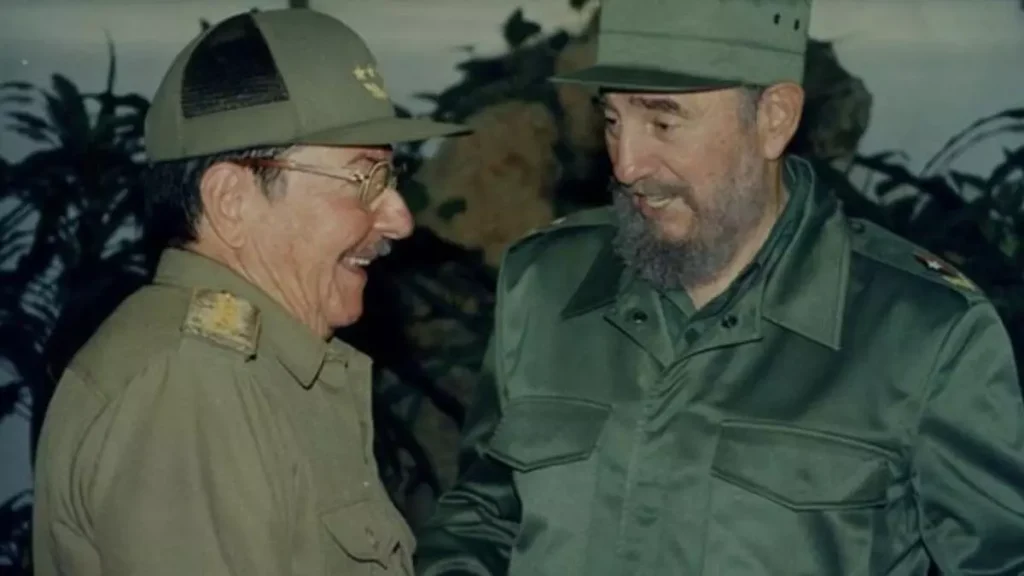
The most obscene example occurred in August 1968, when Warsaw Pact tanks crushed the Prague Spring. / Public domain image
14ymedio, Yunior García Aguilera, Madrid, 15 February 2025 — The Cuban regime has constructed much of its political narrative on two concepts it repeats ad nauseam: sovereignty and anti-imperialism. In practice, both function less as principles than as rhetorical crutches. A minimally honest look is enough to show that, in the real Cuba, sovereignty does not reside in the people nor is it expressed through freely elected representatives, but rather has been hijacked by the sectarian interests of a single party. Anti-imperialism, for its part, operates like a broken compass that points only toward Washington.
The most obscene example of this double standard was seen in August 1968, when Warsaw Pact tanks crushed the Prague Spring. While thousands of Czechoslovakians watched their attempt to build democratic socialism evaporate, Fidel Castro delivered a lengthy televised speech endorsing the invasion. All his previous rhetoric about self-determination and the sovereignty of the peoples vanished at once. After an elaborate ideological sleight of hand, he justified the entry of Soviet troops as a “necessary” measure to save socialism and prevent Czechoslovakia from “falling into the arms of imperialism.”
More than half a century later, the script was repeated with less grandiosity and greater cynicism. Following the Russian invasion of Ukraine in 2022, Miguel Díaz-Canel chose to blame NATO, denounce the so-called “Western military expansion,” and present the aggression as a defensive reaction. In official statements and declarations, the regime decided to align itself with “the just demands of the Russian Federation,” without ambiguity or shame, adopting the Kremlin’s narrative as its own.
Everything indicates that the same reasoning would apply to a potential Chinese attack against Taiwan. Cuban foreign policy has made it clear that its strategic loyalty in Asia lies with Beijing and Xi Jinping, not with the right of any people to freely decide their future. continue reading
In May 1987, units involving Cuban troops were implicated in repressive operations in Luanda, in the context of internal MPLA struggles.
The history of the Cuban Revolution is marked, also, by systematic interference in the internal affairs of other countries. Since the 1960s, Havana has promoted, trained, and financed guerrilla movements throughout much of Latin America. This amounted to an armed export of its political model, carried out without regard for the human cost or the social rejection it generated in the countries where it intervened.
In Africa, this policy reached the dimensions of conventional warfare. In May 1987, units that included Cuban troops were involved in repressive
In the transition to freedom and democracy, the White House should resist the temptation to undertake this task alone.
Castroism faces an unprecedented crisis, although the regime’s capacity to resist should never be underestimated. / 14ymedio
14ymedio, Federico Hernández Aguilar, San Salvador, February 13, 2026 – Faced with Cuba’s energy collapse and its foreseeable social consequences, practiclaly all analyses of the situation on the island agree on three very specific points: that Castroism is facing an crisis without precedents; that one should never underestimate, despite everything, the capacity of the regime to resist and reinvent itself, despite everything; and that, finally, it is impossible to predict what will happen after 67 years of dictatorship.
While largely agreeing with these preliminary deductions, it is worthwhile to risk some hypotheses that can contribute criteria and ideas to the public debate on Cuba and its future. Because the fundamental dilemma is not about setting an exact date for the death and burial of Castroism—whose political and economic model, de facto, expired several years ago after a long agony—but rather about trying to commit to a transitional alternative that enables democratic construction and minimizes the imaginable humanitarian impacts.
Cuba, to begin with, is not Venezuela. In Caracas, there weren’t enough compatriots willing to die alongside Nicolás Maduro: the vast majority of the dead were Cubans. On the island, there are indeed enough soldiers ready to sacrifice themselves, just as those who fell defending—at the last minute—Maduro, because they weren’t offering their lives for the Chavista dictator, but for an ideology instilled in them since childhood.
Cuba, to begin with, is not Venezuela. In Caracas, there weren’t enough compatriots willing to die alongside Nicolás Maduro: the vast majority of the dead were Cubans
These quasi-religious convictions have been fundamental to the maintenance of Castroism, and it is advisable to analyze them before undertaking any kind of military incursion into Cuba. The United States, on the other hand, even assuming it could orchestrate the regime’s implosion (through leaks and negotiations) with a popular uprising, would have to act quickly to limit the operational capacity of the official repressive apparatus. And that, while essential, is quite complicated. continue reading
While it is true that the charisma narrative of Castroism died with Fidel, the cohesion of the political and military elite has allowed for a level of control and surveillance unparalleled in Latin America. Dismantling this structure requires a high degree of lethality, delivered with agility and precision. Undoubtedly, the US possesses these capabilities, but exercising them on an island like Cuba could indefinitely delay decision-making. Meanwhile, tragically, citizens would be wondering what the difference would be between dying of hunger and going out into the street to be shot. It is impossible to write this without trembling fingers.
Regarding the transition to freedom and democracy, the White House should resist the temptation to undertake this task alone. Throughout the 20th century, ordinary Cubans didn’t speak of the aid the United States had given them in 1898 to achieve their independence; what they remembered was the Yankee occupation and the humiliating conditions imposed from Washington at the behest of Senator Orville Platt—hence the name of the famous 1901 Platt Amendment to the Cuban Constitution—which limited the island’s trade relations, forced it to cede portions of territory (such as Guantánamo), and exposed it to future interventions.
President Trump is likely unaware of this history, but his Secretary of State certainly is. Marco Rubio knows of Cuba’s tendency to view its large neighbor with suspicion, however much it now needs Cuba to shake off its tyranny. Washington, therefore, would be wise to lead a hemispheric alliance of nations willing to contribute, especially logistically and intellectually, to the arduous transition process in a country that has seen key figures killed, detained, or exiled. Chile, Argentina, El Salvador, and Paraguay, to name a few, are countries that have successfully transitioned from dictatorship or war to democracy. Requesting their collaboration would be an encouraging display of wisdom.
It would, therefore ,be in Washington’s best interest to take the lead in a hemispheric alliance of nations willing to contribute, especially logistically and intellectually, to the arduous transition process.
Meanwhile, clearly, the imposed president Miguel Díaz-Canel has asked Cubans, even though they’ve already suffered everything, to prepare to suffer even more. What are two hours of renewed calls for sacrifice to a guy who never stops eating exquisite food and using electric light bulbs?
Jorge Dalton, a prestigious documentary filmmaker and founder of the International Film School of San Antonio de los Baños, recently wrote on his social media: “I see officials giving sterile speeches and harangues, projecting a false pride that reminds me of that story about a man who is drowning in the sea and, with water already entering his mouth, instead of asking for help he shouts: What a beautiful Caribbean Sea I am swallowing!”
Castroism, in any case, has already been swallowed up by history. There was and will be no absolution for those who caused Cuban blood to flow—in torrents!—for a model that was incapable of recognizing its own demise.
____________
COLLABORATE WITH OUR WORK: The 14ymedio team is committed to practicing serious journalism that reflects Cuba’s reality in all its depth. Thank you for joining us on this long journey. We invite you to continue supporting us by becoming a member of 14ymedio now. Together we can continue transforming journalism in Cuba.
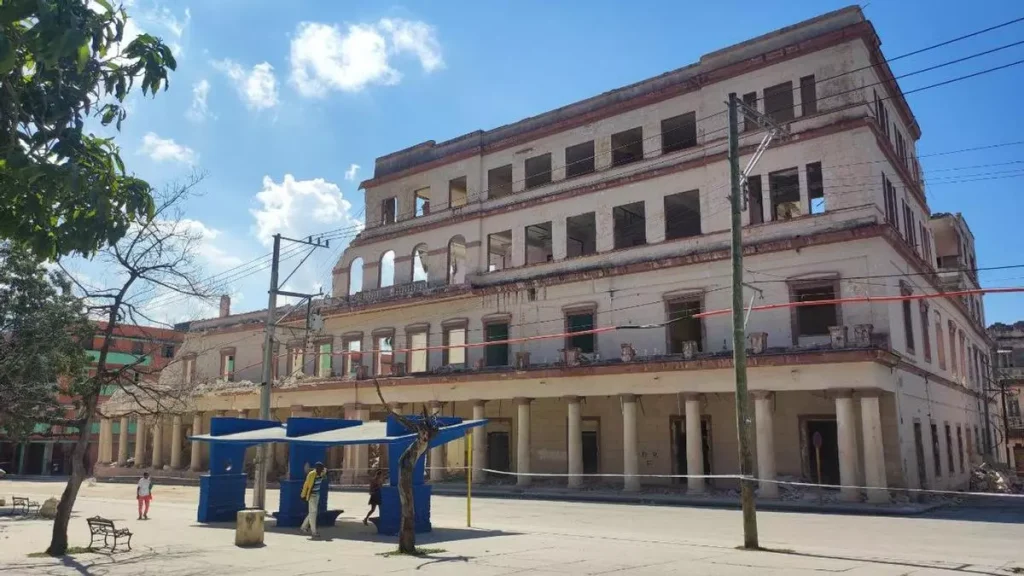
The imposing building on Belascoaín Street has become a garbage dump and a public toilet.
The nearby bus stop has also been cordoned off with warning tape, and passersby are quickening their pace for fear of another collapse. / 14ymedio
14ymedio, Natalia López Moya, Havana, 15 February 2026 — The dust covers Belascoaín Street in Central Havana. Several strips of yellow tape block the section in front of the former Higher Institute of Industrial Design (ISDi) building. The umpteenth collapse of part of its structure had left a trail of rubble that prevents vehicles from passing and endangers pedestrians who venture to cross the blocked area. On Saturday, the image of this stretch of avenue without vehicles was a stark reminder of a city gripped by a fuel crisis and the deterioration of its infrastructure.
In the nearby line to enter a restaurant on the corner of Reina Street, the conversation was all about the loud crash heard last week when a piece of the building located between Maloja and Enrique Barnet collapsed. Even now, fragments of its walls and columns are scattered around the area. The nearby bus stop has also been cordoned off with warning tape, and pedestrians walking along the sidewalk in front of the windowless, doorless structure quicken their pace for fear of another collapse.
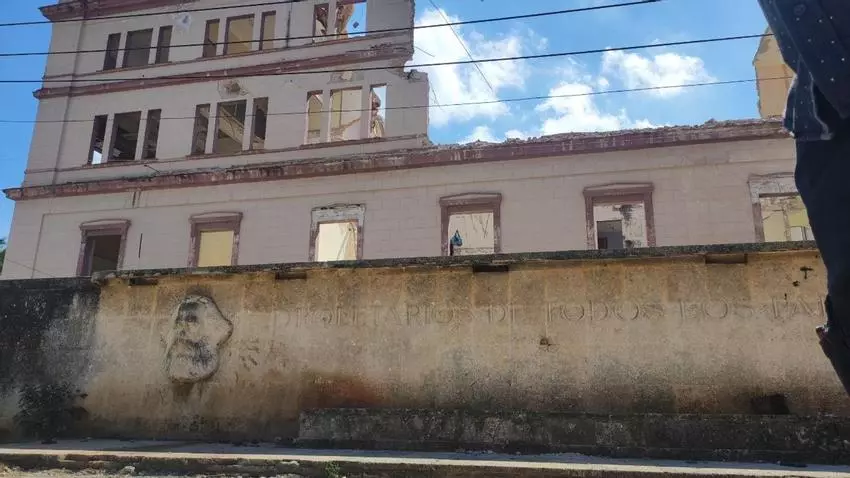
The building, which originally served as a military hotel and officers’ club for the Spanish Army, was also used as the headquarters of the Cadet School (1874-1878), a Widows’ and Orphans’ Home, the General Staff headquarters during the First American Occupation, and even the Ministry of Health before Fidel Castro came to power in January 1959. Graduates of ISDi remember it as a bright, welcoming space brimming with creativity. But for the closest neighbors, the building, which occupies an entire city block, has been a headache and a constant source of worry for years. continue reading
In a city with serious health problems, the former ISDi has become another “hotspot for infections” / 14ymedio
Carmita, a nearby resident, fears the destruction will continue for months or years without the authorities deciding to remove what remains of the structure. “It’s become a dump and a public toilet,” she laments. In addition to the danger of a piece of its walls falling on someone’s head, there are the epidemiological risks of ruins where mosquitoes, flies, and garbage all share the space. In a city with serious sanitation problems, the former ISDi has become another “hotbed of infection,” according to this Havana resident.
A flower vendor offers his wares to couples on Valentine’s Day. Carefully, he wipes down the glass containers where he keeps plastic roses and teddy bears. “This street is filthy,” the vendor laments as he dusts off the fine particles left in the air after the recent collapse of the once-colossal Belascoaín building.
____________
COLLABORATE WITH OUR WORK: The 14ymedio team is committed to practicing serious journalism that reflects Cuba’s reality in all its depth. Thank you for joining us on this long journey. We invite you to continue supporting us by becoming a member of 14ymedio now. Together we can continue transforming journalism in Cuba.
Four Cuban-American members of Congress sign a petition addressed to Donald Trump
The case of the downing of the planes has recently returned to the spotlight following the arrest in the US of Luis Raúl González-Pardo, one of the Cuban military pilots involved. / Escambray
14ymedio, Havana, 14 February 2026 — Cuban-American members of Congress have petitioned President Donald Trump to bring criminal charges against Raúl Castro for his responsibility in the 1996 shooting down of two Brothers to the Rescue planes and the death of their four crew members. The initiative adds to Washington’s policy of pressure to hasten the end of the Cuban regime and has sparked speculation about an unlikely operation to capture the 90-year-old general, similar to the one carried out against Nicolás Maduro.
In a letter dated 13 February, Congressmembers Mario Díaz-Balart, María Elvira Salazar, Carlos A. Giménez and Nicole Malliotakis asked Trump to have the Department of Justice consider formally charging Raúl Castro with the attack on the planes; they also suggested evaluating the issuance of an Interpol red alert against the then Cuban Minister of Defence.
In the letter published by Congressman Díaz-Balart, the legislators back up their accusation with information in the public domain—including a recording released by The Miami Herald—that incriminates Raúl Castro as responsible for the incident, having directly ordered the attack on the unarmed aircraft.
Along with the letter signed by the members of Congress, Díaz-Balart posted on his profile:
“President Donald Trump has been a staunch ally and a symbol of hope for the brave activists fighting for democracy, and he has stood firm against the ruthless dictators who oppress them.”
It emphasises Raúl Castro’s criminal responsibility and the need for justice after 30 years of inaction. It concludes: “We commend President Trump for prioritising US national security in his foreign policy decisions.” And referring to the Cuban regime: “The thugs who have oppressed, tortured and murdered must be brought to justice, and accountability must start at the top.”
February 24 marks the 30th anniversary of this tragedy in which four civilian activists from Brothers to the Rescue died: Armando Alejandre Jr., Carlos Costa, Mario de la Peña and Pablo Morales; three of them were US citizens and one was a permanent resident. All four were participating in a mission to assist Cuban migrants attempting to escape the regime in international waters.
The case of the downing of the planes has recently returned to the spotlight following the arrest in the United States of Luis Raúl González-Pardo, one of the Cuban military pilots involved. US authorities accused the former military officer of immigration fraud and continue reading
of concealing information about his ties to the regime during his entry process into the country.
Three decades have passed since this tragedy in which four civilian activists from Brothers to the Rescue died.
Gerardo Hernández, a former Cuban spy convicted in the United States – currently coordinator of the Committees for the Defence of the Revolution in Cuba – is singled out in the letter from the Congressmembers as the only person convicted to date for his participation in the conspiracy that ended with the attack on the planes, after sharing flight data and information on the activities of the group of exiles.
The former spy has responded to the legislators’ letter with mockery on social media: “It seems that the trio of congressmembers have not realised that the only legal argument the US could use – lying that the shooting down took place in international waters – they themselves have just ruined by approving Trump’s bombing of boats in international waters for ‘national security reasons’.”
The controversy over the exact location where the planes were shot down has been central to discussions surrounding the incident. The regime uses as a defence that Brothers to the Rescue was conducting provocative flights over national territory and that the action was taken for security reasons. However, the report by the International Civil Aviation Organisation (ICAO) concluded that the events took place outside Cuban airspace. This could open the door to US jurisdiction as it involves the death of US citizens outside its territory.
Cuban-American Congresswoman María Elvira Salazar emphasised in her X profile the importance of condemning Raúl Castro: “He was in charge. It is time to reopen the case, pursue the truth to the highest levels and bring him to justice.”
Another signatory to the petition, Republican Carlos A. Giménez – the only member of Congress born in Cuba – reaffirmed his position in an interview with Fox News. He argued that Cuba “is approaching its Berlin Wall moment” and that “the brutal Cuban regime is collapsing in real time.” Referring to US actions against the dictatorship, he said that “this is no time to blink. It is time to finish the job.” He added that the Cuban crisis is the sole responsibility of the regime and concluded with a resounding call to the US president: “President Trump, the time for a free Cuba is now.”
Translated by GH
____________
COLLABORATE WITH OUR WORK: The 14ymedio team is committed to practicing serious journalism that reflects Cuba’s reality in all its depth. Thank you for joining us on this long journey. We invite you to continue supporting us by becoming a member of 14ymedio now. Together we can continue transforming journalism in Cuba.
Should the international community look the other way while Cubans are thrown into prison, tortured, humiliated, or expelled from their own country?
¿Is a nation deliberately impoverished and forced to choose between living in silence while enduring illness, hunger, misery, and pain truly sovereign? // 14ymedio
14ymedio, Karel J. Leyva, Montreal, February 14, 2026 — The modern principle of sovereignty was formulated in 17th-century Europe, after the Peace of Westphalia, with a clear objective: to limit wars between powers and establish that each state would exercise authority within its borders without external interference. Sovereignty was thus born as a mechanism to reduce international violence and stabilize a system marked by constant conflict.
Over time, this principle became a cornerstone of international law. Without the rule of non-intervention, the international system would have continued to be dominated by preventive wars and constant disputes over jurisdiction. Sovereignty established a minimum boundary: each state governs within its territory, and others may not freely intervene in its internal affairs. This principle, though imperfect, allowed for a certain degree of stability and especially protected weaker countries from more powerful ones.
However, beginning in the mid-20th century, international law introduced a decisive shift. The United Nations Charter, the Universal Declaration of Human Rights, and the 1966 International Covenants affirmed that state authority has limits when life, physical integrity, and fundamental freedoms are at stake. Sovereignty ceased to be understood as an absolute principle and began to be understood as authority subject to obligations.
That a situation occurs within a state’s borders does not mean that any action by political power is automatically justified
The principle of the Responsibility to Protect, adopted by the United Nations General Assembly in 2005, clearly expresses this transformation: sovereignty implies not only rights but also responsibilities, including the obligation to protect populations from genocide, war crimes, ethnic cleansing, and crimes against humanity. When a state fails to fulfill that function, the international community may act, under particular circumstances.
This introduces a fundamental distinction: the fact that a situation occurs within a state’s borders does not mean that any action by political power is automatically justified. The “internal” character of a problem does not render the systematic violation of basic rights legitimate.
The Cuban case illustrates this clearly. For decades, political power has imprisoned opponents, repressed peaceful demonstrations, punished dissent through surveillance, harassment, and disproportionate sentences, and generated continue reading
economic and social conditions that keep broad sectors of the population in persistent structural precariousness. These are not isolated incidents or occasional excesses but part of a system of control spanning more than six decades.
Should the international community look the other way, hiding behind a conveniently interpreted principle?
For too many years, the Cuban regime has demanded respect for national sovereignty while brutally punishing its own people. Whom does the sovereignty they defend truly protect? The Cuban nation, a nation literally plunged into darkness, forced to live with its head bowed, dominated by fear? Is the nation not rather the victim of the success of sovereignist rhetoric? Is a nation deliberately impoverished, forced to choose silence while enduring illness, hunger, misery, and pain truly sovereign?
Is the sovereignty invoked by the Cuban Government the sovereignty of a free people or rather that of unchecked power, whose sole function is to preserve itself and guarantee the survival of the brutality and cynicism of an absolutist regime?
Should the international community look the other way, hiding behind a conveniently interpreted principle, while Cubans who attempt to express themselves freely are thrown into prison, tortured, humiliated, or expelled from their own country?
A principle created to limit war between states cannot become the pretext that legitimizes the systematic violence of a totalitarian state against an entire nation. If it does, it would lose all legitimacy and moral value. The sovereignty of impunity is not the sovereignty of a nation; it is the sovereignty of a tyrant.
Translated by Regina Anavy
____________
COLLABORATE WITH OUR WORK: The 14ymedio team is committed to practicing serious journalism that reflects Cuba’s reality in all its depth. Thank you for joining us on this long journey. We invite you to continue supporting us by becoming a member of 14ymedio now. Together we can continue transforming journalism in Cuba.
Those without dollars must wake up at dawn, endure long hours of waiting, and return when a blackout interrupts the work
Getting or correcting an identity document is no longer just a procedure: it’s a test of endurance. / Cubadebate
14ymedio, Julio César Contreras, San José de las Lajas, February 14, 2025 — At seven in the morning, when the identity card office in San José de las Lajas should be getting into rhythm, fatigue has already spread through the waiting room. The metal chairs, lined up with a discipline that contrasts with the disorder of the procedures, are occupied by resigned bodies: men in caps, women with large handbags, elderly people staring at the floor, and young people passing the time on their phones. In one corner, two little girls swipe at a screen, unaware of the errand that brought their mothers there. The ceiling fan turns slowly, as if it too were rationing energy.
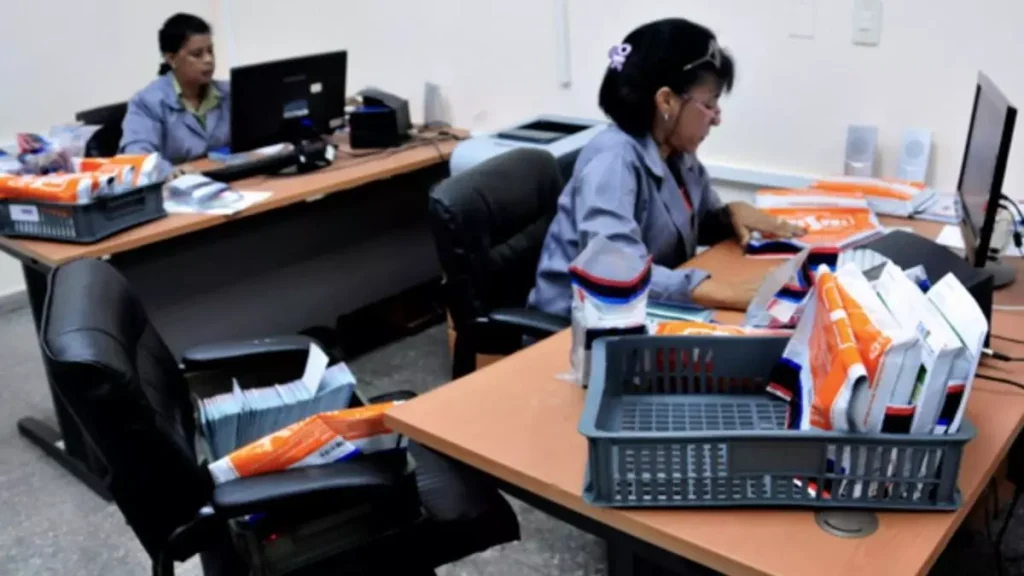
Handling any paperwork at this Ministry of the Interior office has become an exercise in endurance. Not only because of the usual bureaucracy, but because administrative collapse is now compounded by the so-called “reorganization program” the Government has imposed in response to the energy crisis. In practice, this means unexpected blackouts, interrupted schedules, computers shutting down in the middle of a procedure, and employees who frequently ask for patience as the only possible response.
Yesenia knows this well. She lives in the Jamaica neighborhood at the other end of town, and this is the third time she has repeated the same routine. “I come at five in the morning to get in line, spend three or four hours making sure no one cuts in front of me, and when I finally sit down at the computer, the power goes out or they tell me there’s no material to make the ID,” she says. She has been without identification for nearly a month after losing all her documents. Just getting to the office on 13th Avenue costs her no less than 500 pesos in transportation. “Once is complicated. Three times is disrespectful,” she sums up. continue reading
Just getting to the office on 13th Avenue costs her no less than 500 pesos in transportation.
At eleven in the morning, Yesenia finally manages to sit at the desk. The employee listens halfway and then gets up to go to another department, leaving her hanging. “It’s taking about forty minutes per procedure,” she comments, glancing at the clock. “You need infinite patience.” The official hours, from seven in the morning to four in the afternoon, are more of a theoretical reference. Blackouts, broken equipment, and lack of connectivity turn each day into a game of Russian roulette.
In this uneven game, not everyone is playing with the same cards. Sergio waits calmly in the room, with no sign of having arrived at dawn. “One of the girls here is going to help me,” he says quietly. He is applying for a passport and knows the process can take a month and a half or more, but he also knows there are shortcuts. “If you’re in a hurry, you have no choice but to pay for the stamps at whatever price they ask on the street and let something drop in here,” he explains. His son sent him dollars for that. “It’s the only way not to spend another New Year’s in Cuba.”
The gesture with which he greets the clerk when she enters the room confirms there are unwritten rules. Sergio expects to have his passport in about ten days. He doesn’t know exactly how his acquaintance speeds things up, but he is sure he’s not the only beneficiary. Meanwhile, others keep counting how many times they have come without resolving anything.
Isis carries a different story, though just as exhausting. She is trying to correct an error on her daughter’s ID card. First it was a misspelled last name. Then an accent mark missing from the first name. Now, a wrong number in the birth date. “I check the data on the screen and everything is fine, but when they print it, it comes out wrong,” she says, unable to hide her frustration. For her, the problem is not only the lack of resources but the total absence of empathy. “They don’t put any care into what they do,” she laments.
In four months she has been attended by different employees, almost all with evident difficulties handling the computer.
In four months she has been attended by different employees, almost all with evident difficulties handling the computer. “I don’t think they are properly trained,” she says. And she makes it clear that her case is not an exception. “You end up making new friends here from running into the same people so many times, all of us trapped by the bureaucracy.”
The images in the waiting room reinforce that sense of endless waiting. A television at the back plays without sound; the blinds let in a dull light that does little to ease the heat. Outside, the city continues at its slow pace, also marked by blackouts and fuel shortages.
In San José de las Lajas, getting or correcting an identity document is no longer just a procedure: it is a test of endurance. The “contingency plan,” as the authorities also call it, has added another layer of uncertainty to a system already full of obstacles. Between predawn lines, blackouts, repeated errors, and paid favors, residents learn that in order to exist on paper, they must first survive the wait.
Translated by Regina Anavy
____________
COLLABORATE WITH OUR WORK: The 14ymedio team is committed to practicing serious journalism that reflects Cuba’s reality in all its depth. Thank you for joining us on this long journey. We invite you to continue supporting us by becoming a member of 14ymedio now. Together we can continue transforming journalism in Cuba.
“If I work twelve hours, I can make more than 5,000 pesos a day, although it’s quite hard.”
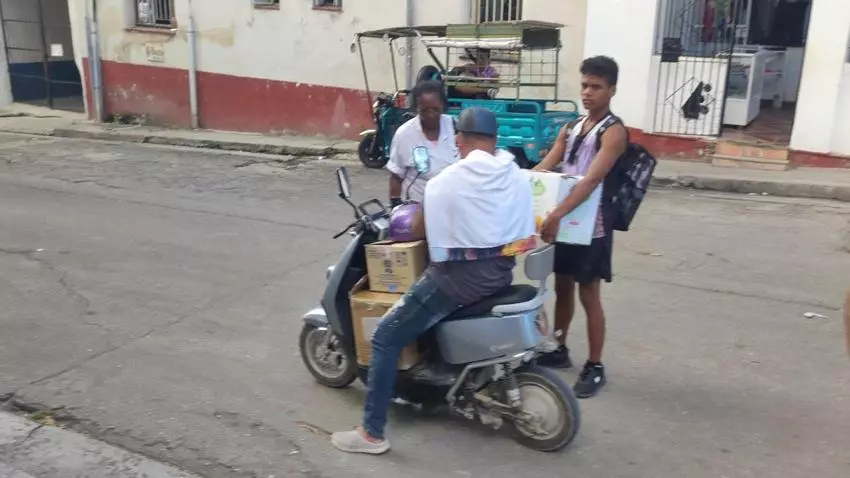
Motorcycles and bicycles are trying to fill the gap left for transporting goods. / 14ymedio
14ymedio, Havana, Natalia López Moya, February 14, 2026 – In a city that is practically at a standstill, some people never stop. You see them crossing empty streets, dodging the potholes along the Malecón or pedaling uphill on Tulipán with a backpack on their backs. They wear no uniforms and have no employment contracts, yet they carry much of Havana’s economy on wheels. They are the young delivery workers, a generation that in these days of fuel shortages has become indispensable in the movement of goods.
Yasiel, 26, delivers pizzas, medicines, and small packages. Orders reach him via WhatsApp from private businesses in the Cuban capital, desperate for the lack of messengers with cars or gasoline motorcycles. Sometimes they ask him for flowers, a cake, or even a plastic basin to bathe a baby. “Whatever can be strapped onto the rack,” he tells 14ymedio as he adjusts the bags on his bicycle that he will deliver to several points around the city. He has no self-employment license and does not belong to any small or medium-sized enterprise, yet he earns more than many professionals. “If I work twelve hours, I can make more than 5,000 pesos a day, although it’s quite hard.”
On Friday night, when only a few electric tricycles and some pedestrians who preferred walking on the asphalt rather than the neglected sidewalks were traveling along Rancho Boyeros Avenue, Yasiel was still making deliveries. An enormous backpack hung from his back and another, even larger, from his chest. He was coming from Playa municipality, near the Almendares River, heading to Nuevo Vedado. “I’m exhausted because I haven’t stopped pedaling all day. Could you give me a glass of water?” he asked one of his customers, nearly fainting.
The company Yasiel was delivering for, one of many that operate digital platforms where emigrants buy food and other basic supplies for their relatives on the Island, “is liquidating its merchandise ahead of what’s coming,” the young man says. The online shop has launched a 15% discount on all its products, and “if they’re frozen, you can get them for up to 25% less,” he explains. Fearing that blackouts will grow longer each day, “many people are avoiding buying anything that requires refrigeration.” continue reading
Some bicycle taxis have spent weeks transporting “more food than people.” / 14ymedio
This Friday, the deliveries Yasiel made were mainly canned goods, grains, and cookies. “There were jars of chickpeas that you could tell had been sitting in the warehouse for a while because of the dust on top.” Bags of flour, sardines, tuna, powdered milk, cereal, vegetable oil, and the ever-reliable cans of Spam rounded out the orders. “For the first time since I started this job, I didn’t move a single package of frozen chicken quarters today.” No one wants a power outage to turn their food into a stinking puddle of water and blood.
In Telegram groups with names like Delivery Habana 24/7 or Mensajeros de Plaza, workers share orders, routes, and clients. Sometimes they also share warnings: “Don’t go through Infanta, it’s pitch dark because of the blackout.” These are work forums, but also spaces of camaraderie. “Here we alert each other when a business is looking for workers, when the power is out, or if a street is closed for a march. We’re like a brotherhood, but without headquarters,” Yasiel explains.
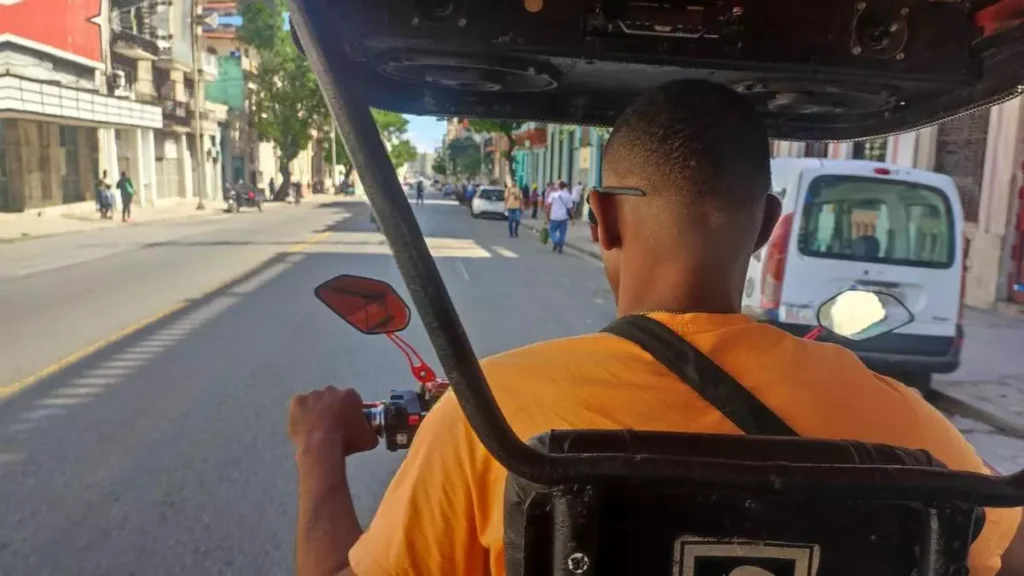
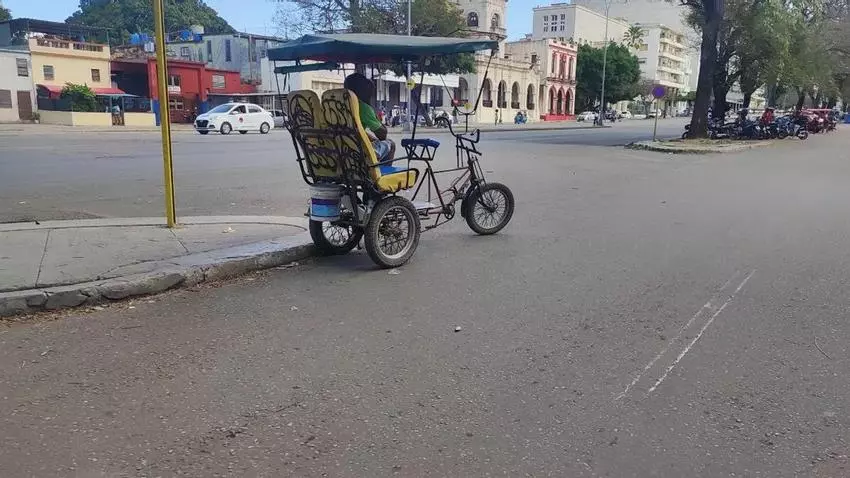
Marcos, 34, nicknamed El Ruedas [Wheels], has spent weeks transporting “more food than people” in his bicycle taxi. Originally from distant Banes in Holguín province, he has spent five years running passenger routes between Central Havana, Cerro, and Old Havana. At the beginning of February, he got a call from a friend who works for a digital site that distributes everything from food to hardware supplies. “He told me they needed bicycles or electric motorcycles because they had fewer and fewer cars due to the gasoline problem.”
Since then, Marcos has “combed Havana” from one side to the other transporting sausages, soft drinks, butter, and whatever a Cuban emigrant in Miami, Berlin, or Madrid buys for family members on the Island. “I’ve been lucky, and besides what they pay me, I’ve received good tips because when people see me arriving in the bicycle taxi, they reach into their pockets to give me something.” Where others fear a worsening fuel crisis, the Holguín native sees his niche: “Now it’s our turn, the ones who don’t need oil or electricity.”
“These are times when you have to stay very alert because people know we’re delivering food and items paid for in foreign currency. We’re a target.”
The day he remembers most gratefully was last Monday, when he delivered “coffee and some of those tubes used so bedridden patients can urinate” to a house in Casino Deportivo. “The little old lady who received me tipped me a dollar,” he recalls. That same day, the U.S. dollar was approaching 500 Cuban pesos on the informal market. “It’s things like that that keep me in this job, though there are bitter moments too.”
In the darkness of a street in the Cerro neighborhood, Marcos watches over his shoulder while handing over one of the orders. Using his phone’s flashlight, he checks the sheet listing products that a digital store has processed for a Havana family. “These are times when you have to stay very alert because people know we’re delivering food and items paid for in foreign currency. We’re a target when we do that.” To avoid complaints later, each product must be verified against the list in front of the recipient, a process that takes time and increases the risk.
Beyond robberies, Marcos’s biggest fear until this week was “that the strong heat would come and it wouldn’t be so easy to pedal from place to place.” However, in recent hours he has had three orders canceled, raising new concerns. “Several of those digital sites are closing off orders from abroad because they can’t guarantee delivery anymore. This is getting ugly.” If online purchases grind to a halt, it won’t matter how strong the messenger’s calves are: “I’ll have to go back to moving people, and dealing with flesh-and-blood customers is more complicated.”
The boom in informal delivery grew alongside the energy crisis and the collapse of state transport, but it reached its peak during the covid-19 pandemic. Now, with the near disappearance of fuel on the Island, after the executive order signed by Donald Trump penalizing countries that send crude oil to Cuba with tariffs, gasoline- and diesel-powered vehicles are becoming increasingly scarce, and electric tricycles can’t keep up. In that vacuum, motorcycles and bicycles are trying to fill the gap left in transporting goods.
With each trip, the messenger earns between 1,000 and 1,500 pesos, depending on the distance. / 14ymedio
“I used to work in a refrigeration repair shop, but this pays better,” Landy, 30, tells this newspaper. He coordinates a network of ten messengers. His “headquarters” is a WhatsApp chat. “The small and medium-sized businesses write to me, I pass along the address and calculate the commission. There’s no boss and no fixed schedule. If there’s no connection, I disconnect, and that’s it.” With each trip, the messenger earns between 1,000 and 1,500 pesos, depending on the distance. “There’s no contract, but there’s trust,” the entrepreneur adds. “They pay me my commission at the end of the day, based on the trips completed.”
Most are young men, though there are women as well. Some are university students, IT specialists, or engineers. All are trying to earn money to support their families, and they prefer the independence of not being tied to a state job and being able to work with several businesses at once. “I don’t want anyone bossing me around. I take a job when I need to, and when I don’t feel like it, I stay home,” sums up a 23-year-old delivery worker with an electric tricycle. “My boss is the battery.”
The job is full of risks. “Sometimes it runs out in the middle of the darkness, and I have to push the tricycle until I find a place where I can charge it,” explains a young man from San Miguel del Padrón who makes deliveries in what he calls “a tough area.” Wearing gloves, a helmet, and a black jacket with “Rider” on the back, he distributes packages for small businesses in the municipality, but also takes jobs from larger digital platforms.
The leading online store has announced that it is canceling all its orders starting this Friday. Supermarket, which had managed to extend its deliveries across nearly the entire Island, informed customers that it will only process orders already received. “Due to the current situation regarding fuel availability in Cuba, our logistics operations have been temporarily limited,” reads its website.
Yasiel refuses to let such announcements paralyze him. For Saturday, he has a full schedule of deliveries. “It’s Valentine’s Day, and I’m not going to stop pedaling. I’ll rest tomorrow.” The future is something he avoids thinking about in a country where announcements of cancellations, closures, and interruptions come one day after another.
Translated by Regina Anavy
____________
COLLABORATE WITH OUR WORK: The 14ymedio team is committed to practicing serious journalism that reflects Cuba’s reality in all its depth. Thank you for joining us on this long journey. We invite you to continue supporting us by becoming a member of 14ymedio now. Together we can continue transforming journalism in Cuba.
The poor condition of vehicles and roads are among the main causes of accidents in Cuba.
The accident occurred in virtually deserted streets, with much of the transport system paralysed. / Escambray.
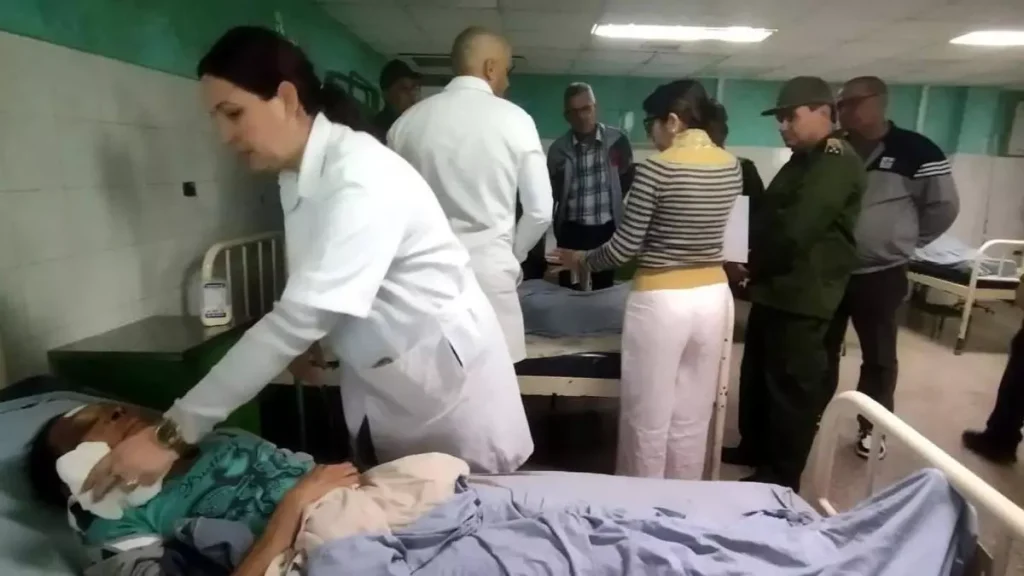
14ymedio, Havana, 13 February 2026 — A serious traffic accident on Thursday on the national highway, near the Zaza bridge in Sancti Spíritus, left at least four people dead and 17 injured, two of them in critical condition. The accident involved a Diana bus travelling between Havana and the east of the country.
It occurred at around 11:36 p.m. According to official reports published by the provincial media outlet Escambray, the driver lost control for reasons that are “under investigation,” a common phrase that rarely translates into verifiable information for the public.
The authorities identified the four fatalities in the accident as Edilberto Aldana García, 23, a resident of Vertientes, Camagüey; Conrado Peña López, 58, a native of Santiago de Cuba; Niurka de la Caridad Argelí Ladisté, 56, also a native of that province; and Ualter Chávez Galán, 30, a resident of the municipality of Cauto, in Granma province.
As for the injured, two remain in critical condition in the Intensive Care Unit. One of them underwent surgery after suffering severe head trauma with a frontal fracture, while the other has a right haemothorax and a liver laceration. The rest of the injured are progressing favourably, although they remain under hospital observation. Among them is a five-year-old boy, who did not suffer serious injuries and was transferred to the provincial paediatric hospital for specialised follow-up. continue reading
The latest figures on road accidents confirm a worrying increase
The accident occurred in virtually deserted streets, with much of the transport system paralysed. The measures adopted by the government in response to the loss of its main benefactor, Venezuela, and the impact of US President Donald Trump’s executive order on oil shipments to Cuba, have reduced mobility to historic lows.
The latest figures on road accidents confirm a worrying increase. In 2025, Cuba recorded 7,538 traffic accidents and 750 deaths, representing an 18.2% increase in deaths compared to 2024, when 634 deaths were reported. The number of injuries also rose slightly, from 6,613 to 6,718, according to data from the National Road Safety Commission.
But the most revealing statistic – and also the one most silenced by official discourse – is that 31% of drivers involved in crashes did not have a driving licence. This figure exposes a structural flaw in road safety control and training mechanisms which, far from being corrected, is worsening amid institutional deterioration and constant improvisation.
These vehicles operate for long hours, with minimal technical inspections and under pressure to meet increasingly unfeasible schedules.
Even more worrying is that, within this group of licences withdrawn for drink-driving, 98% belonged to state drivers. In other words, drivers of vehicles belonging to public institutions are over-represented in these accidents, a fact that rarely appears clearly in official reports or subsequent analyses.
Diana buses, assembled on the island from Chinese components, have been repeatedly singled out by passengers and drivers for technical problems, poor maintenance and overuse on long-distance routes. In a country where travelling between provinces has become an odyssey, these vehicles operate for long hours, with minimal technical inspections and under pressure to meet increasingly unfeasible schedules.
Added to this is the deterioration of the national motorway, with poor lighting, almost non-existent signage and asphalt damaged by years of neglect. It is no coincidence that many of the most serious accidents occur at night, when visibility is minimal and driver fatigue combines with poor road conditions.
Translated by GH
____________
COLLABORATE WITH OUR WORK: The 14ymedio team is committed to practicing serious journalism that reflects Cuba’s reality in all its depth. Thank you for joining us on this long journey. We invite you to continue supporting us by becoming a member of 14ymedio now. Together we can continue transforming journalism in Cuba.
In the absence of electricity, this has become an essential resource for cooking in neighborhoods without piped gas.
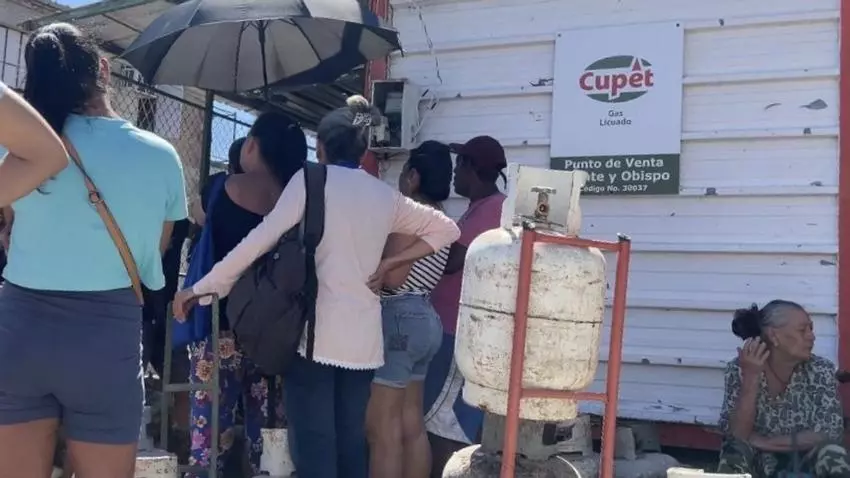
Most of those waiting to buy a small gas cylinder at Cupet establishments are elderly people. / 14ymedio
14ymedio, Havana, Darío Hernández, February 13, 2026 – As the sun begins to set in Regla, under a red sky, people remain crowded in a line that started forming well before 3:00 in the afternoon. Most of those waiting to buy a small gas cylinder at Cupet outlets are elderly; many use the empty tank or the small cart used to transport it as a seat to ease their fatigue.
At 6:00 in the evening, the truck loaded with gas arrives, and finally, two hours later, the crowd slowly begins to move forward amid arguments and commotion.
Not all lines in the capital are the same: some are better organized than others. A young woman scrolling through Facebook on her phone while she waits says loudly that “my mother in Cerro got her cylinder at 1:00 in the afternoon, just imagine,” without taking her eyes off the screen.
The protocol, published in a Telegram group, states that priority in line should be given to those who have gone the longest without refilling their cylinder; in this case, those whose last refill was in August. But in reality, organization depends on the judgment of the workers at each sales point. For example, on Obispo Street in Guanabacoa, “a huge commotion broke out,” neighbors told 14ymedio, because it was decided that only 150 gas cylinders would be sold to the first people who arrived. “Many of them have been marking their place for days or are messengers, so those from August were left without continue reading
a cylinder once again.”
The protocol, published in a Telegram group, states that priority in line should be given to those who have gone the longest without refilling their cylinder / 14ymedio
This Tuesday, the Liquefied Gas Company (GLP) announced the distribution of cylinders for residents of the provinces of Havana, Artemisa, and Mayabeque, with a projected 15,000 units per day, to be distributed “equitably,” supposedly prioritizing by geographic location the areas with the highest customer density. The document stipulates the sale of only one cylinder per contract, the organization of sales points based on customer records, and the date of the last purchase. Registered delivery agents would only be authorized to buy one cylinder per customer per day. However, the reality seen on the streets is far from what is established and reveals chaos well removed from the protocol.
Yamila, a resident of Nuevo Vedado who spoke with 14ymedio, feels very fortunate not to have to endure that “calvary”: “Luckily, the piped gas is working well; I don’t know if it’s because it’s domestically produced. It doesn’t cover the whole city or anything close to that, but for those of us who have it, it’s a blessing to count on that service.”
The growing demand for small gas cylinders, which on the informal market can now reach prices of up to 30,000 pesos, has surged over the past month as the energy crisis has worsened. Faced with shortages of both gas and electricity, many people have begun turning to charcoal and firewood for cooking, a practice long common in eastern Cuba but now increasingly frequent in some Havana neighborhoods.
Jamaica has traditionally supplied liquefied gas to Cuba, but after sanctions imposed by the Trump administration starting January 30 on any country supplying fuel to the Island, shipments were interrupted. On February 1, the Cuban tanker Emilia returned empty to the port of Cienfuegos after a failed attempt to purchase LPG in Kingston.
Translated by Regina Anavy
____________
COLLABORATE WITH OUR WORK: The 14ymedio team is committed to practicing serious journalism that reflects Cuba’s reality in all its depth. Thank you for joining us on this long journey. We invite you to continue supporting us by becoming a member of 14ymedio now. Together we can continue transforming journalism in Cuba.
Dozens of exiles line up with boxes and bags filled with food, toilet paper, and other basic goods at shipping companies in Miami’s Little Havana.
Cuban citizens wait beside boxes and bags containing food and essential supplies to send to their relatives on the Island this Friday in Miami, Florida. / EFE/Alberto Boal
14ymedio, Miami, Pedro Pablo Cortés (EFE), February 13, 2026 – Cubans in the United States are accelerating shipments of food and medicine to their families as the crisis on the Island deepens, where many depend on this aid to survive. At the same time, they told EFE they support President Donald Trump increasing restrictions if it means that “the regime falls.”
Dozens of exiles stand in line with boxes and bags containing food, toilet paper, and other essential goods at shipping companies in Little Havana, motivated by power cuts in Cuba and the sense that events may unfold quickly. Among them is Manuela Labori, who sends aid to her 90-year-old mother.
“What she’s eating is thanks to the children she has here—there are three of us—and the medicines she uses, we have to send them from here. She can’t even walk because of her knees; the cartilage is gone, it’s bone on bone, and in the hospitals there’s nothing to give her relief or to perform surgery,” she told EFE.
“It should be a total blockade, where everything is shut down, not even allowing us to send this, because that’s the only way the communist regime will fall.”
The UN Human Rights Office warned Friday that Washington is “failing to comply” with international law through the sanctions decreed in January to prevent the supply of oil to Cuba, which are causing the “dismantling” of the food, health care, and water supply systems. continue reading
But Labori, who has lived in Florida for more than 40 years, considers Trump’s measures “excellent” and calls for more, even if that means no longer being able to send aid to her family.
“It should be a total blockade, shutting everything down, not even allowing us to send this, because that’s the only way the communist regime will fall. Communism has no place anywhere. It should be ended forever,” she exclaimed.
U.S. humanitarian donations to Cuba nearly doubled in 2025, reaching an estimated value of $130.9 million compared to $67.8 million the previous year, including food, medicine, and clothing, according to a report by the U.S.-Cuba Trade and Economic Council.
Although many on the Island “depend heavily” on the exile community, former political prisoner Ángel de la Fana, leader of the group Los Plantados*, noted that “the vast majority do not have relatives in exile who can send them help.”
“Pressure must be increased because it’s not enough for those of us in exile to send aid to family. What we need is for the Cuban people to be free, to have the freedom to create wealth, to produce food,” he argued.
Cuban-American lawmakers from Florida have asked Trump to ban remittances to Cuba, flights, and licenses for companies “doing business with the regime,” while the cities of Miami and Hialeah are investigating hundreds of companies with possible ties to the Cuban government, including shipping agencies.
José Daniel Ferrer, a Cuban opposition leader who arrived in the United States last October, believes that shipments of “basic supplies” should “still be allowed”
José Daniel Ferrer, a Cuban opposition leader who arrived in the United States last October, believes that shipments of “basic supplies” such as “food, medicine, and hygiene products” should “still be allowed” because “many people need them,” but he calls for banning other items considered “luxury, entertainment, or pleasure.”
During a visit to several shipping agencies, employees and immigrants declined to speak with EFE out of fear of reprisals from the Cuban government or U.S. authorities.
Others, like Usmara Matamoros, fear that U.S. restrictions will not bring change to the Island and will only mean their relatives are left without the products sent from Miami.
“No, I don’t agree because just imagine how they’re going to live,” she told EFE. “Without us, they have nothing.”
Some send whatever they can regardless of the political context or specific requests for help, like Teresa Martínez, who sends “medicine, rice, milk, anything that can serve as food” whenever she has the chance.
“They don’t ask me; I send it because I know they need everything, and there are two little children I send things to every month,” she says through tears.
*Translator’s note: “Plantado’ — literally ’planted’ — is a term with a long history in Cuba and is used to describe a political prisoner who refuses to cooperate in any way with their incarceration.
Translated by Regina Anavy
____________
COLLABORATE WITH OUR WORK: The 14ymedio team is committed to practicing serious journalism that reflects Cuba’s reality in all its depth. Thank you for joining us on this long journey. We invite you to continue supporting us by becoming a member of 14ymedio now. Together we can continue transforming journalism in Cuba.
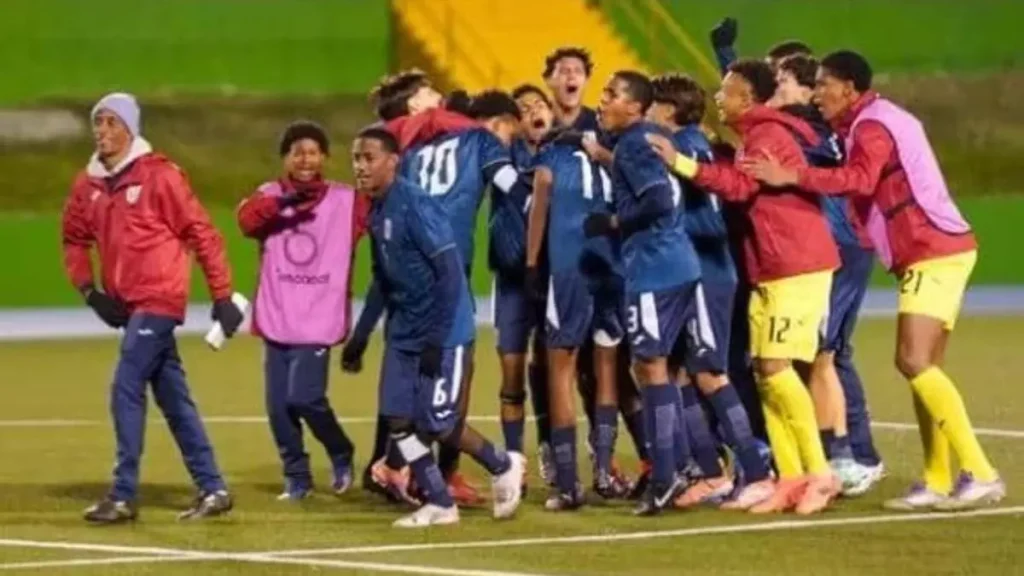
A draw against Belize placed the Island’s team at the top of Group F with seven points.
“It’s my first World Cup,” coach Sandro Sevillano told the newspaper El Gráfico after the match against Belize. / Cubadebate
14ymedio, Havana, February 12, 2026 – Cuba is returning to a soccer World Cup after 35 years of frustrated attempts, although not in the senior category. The achievement came this Wednesday when the Under-17 national team secured a scoreless draw against its counterpart from Belize at Cementos Progreso Stadium in Guatemala City. The feat was accompanied by a first-place finish in the group with seven points. The Island’s team joined Costa Rica, Haiti, Panama, and the United States, which had previously secured their qualification for Qatar 2026.
“It’s my first World Cup,” coach Sandro Sevillano told El Gráfico at the end of the match, emphasizing: “The key was that we focused the group’s mindset on the goal of qualifying for the World Cup.”
The Artemisa native, who has led the U-17 team since 2022, was instrumental in Cuba’s 1–0 victory over Curaçao thanks to a goal by Deibi Borrell. The team also defeated El Salvador 2–1 with a brace from Yankarlos Iglesias, a result that allowed them to reach the final match with an advantage in the standings. The draw against Belize secured the single point needed to confirm their ticket.
“Today it was our turn,” added the strategist, acknowledging that El Salvador also had a chance to advance but finished with six points, one behind the Island in Group F.
The Island’s team joined Costa Rica, Haiti, Panama and the United States, which had previously secured their qualification to Qatar 2026. / Cubadebate
In 1989, Cuba became the first Caribbean country to qualify for a U-16 World Cup (Scotland). Two years later, it did so again at Italy 1991. continue reading
Independent media outlets highlighted the Island’s accomplishment. “History has been made today in Cuban soccer. A dream come true,” published Por La Goma LLC.
Several of these young players have trained in the “ruins” of Pedro Marrero Stadium, part of Cuba’s National Soccer School, the Cuban National Soccer Team page denounced on Facebook earlier this February. According to the post, the youngsters “have to hang their belongings out to dry” in the stands and train in grass that reaches “above their ankles.”
Regarding the match, the same outlet acknowledged that against Belize “it wasn’t an attractive game,” but it was played intelligently. “Belize put up a fight, their goalkeeper Lucas Gallego had an inspired night, and Cuba couldn’t find the goal but they didn’t need it. The 0–0 tasted like glory, like qualification, like a World Cup.”
Translated by Regina Anavy
____________
COLLABORATE WITH OUR WORK: The 14ymedio team is committed to practicing serious journalism that reflects Cuba’s reality in all its depth. Thank you for joining us on this long journey. We invite you to continue supporting us by becoming a member of 14ymedio now. Together we can continue transforming journalism in Cuba.
Kamil Zayas Pérez and Ernesto Ricardo Medina face charges of “propaganda against the constitutional order” and “incitement to commit a crime”
People gathered outside the Holguín court this Thursday. / 14ymedio/Courtesy
14ymedio, Holguín, Miguel García, February 12, 2026 – More than 50 people, including relatives, friends, and activists, have gathered since the early hours of Thursday in front of the Provincial People’s Court of Holguín, where a hearing is being held in the case of the young creators of the independent project El4tico. The hearing responds to a habeas corpus petition admitted by the court itself on behalf of Kamil Zayas Pérez and Ernesto Ricardo Medina, who were detained on February 6.
Coinciding with the growing number of people gathered outside the court, internet outages occurred in the area, interrupting the arrival of messages and reports from the scene, while Zayas and Medina remained inside the building.
On its Facebook page, the Holguín Provincial Prosecutor’s Office justified its decision to open criminal proceedings against the platform’s creators. They are accused of “propaganda against the constitutional order” and “incitement to commit a crime” through posts that allegedly encouraged the public and members of the Armed Forces and the Ministry of the Interior to change the constitutional order and that “defamed state institutions.” The statement notes that Medina and Zayas are being held under the precautionary measure of pretrial detention while “investigative procedures continue to obtain evidence.”
The court day was preceded by a new act of harassment
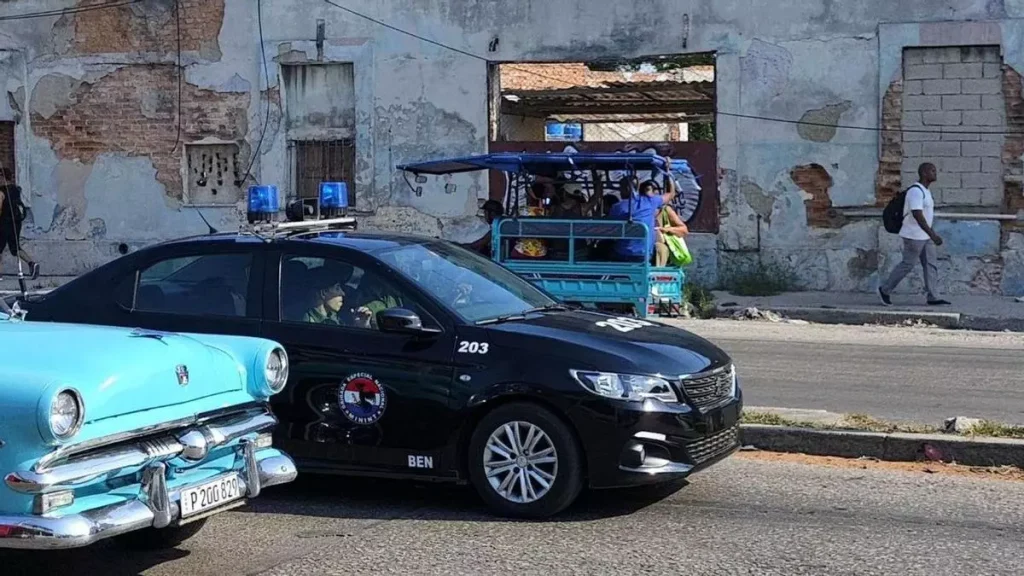
The judicial session was preceded by a new act of harassment. Activist Yanet Rodríguez Sánchez, who filed the habeas corpus petition on February 9 on behalf of the detainees, attempted to leave her home this morning to go to the court, but agents of the political police prevented her from doing so. At least two police patrol cars and a motorcycle were stationed outside her house, and two plainclothes agents blocked her from heading to the court. continue reading
Rodríguez Sánchez has also received intimidating phone calls and messages in recent hours. Since Thursday morning, she has remained cut off from communication and arbitrarily confined to her home, a form of de facto detention that Cuban authorities frequently use to prevent activists from participating in public demonstrations.
The admission of the habeas corpus petition by the First Criminal Chamber of the Holguín Provincial Court constitutes an uncommon event within the Cuban judicial system, where such petitions rarely succeed in cases involving politically motivated detentions. In Cuba, there is no real separation of powers, and the courts, like the rest of the public institutions, operate under the “guidelines” of the Communist Party, the only legal party.
The contrast with other recent cases is evident. In Havana, for example, a habeas corpus petition filed on behalf of Ankeilys Guerra Fis, a 23-year-old detained since January 14, 2026 and held incommunicado at Villa Marista, the headquarters of State Security, was denied. Guerra was violently arrested at his home for alleged critical expressions on social media. The court rejected the petition, citing the lack of information about the alleged crime, case number, or exact place of detention, information that the authorities themselves systematically refuse to provide.
The hearing requires the Prosecutor’s Office to formally present the charges, justify the legality of the detention, and explain the conditions under which the detainees are being held
In Holguín, relatives and close associates of Zayas and Medina have expressed concern both about the lack of official information and about the conditions of detention at the province’s Criminal Investigation Unit, a facility popularly known as “Todo el mundo canta” (“Everybody Sings”) due to the violence reportedly used during interrogations there. During the operation that led to their arrest, State Security agents confiscated computers, mobile phones, cameras, and other work equipment used by the young men to produce audiovisual content critical of the country’s political and social reality.
Thursday’s hearing obliges the Provincial Prosecutor’s Office to formally present the charges—if any—to justify the legality of the detention, and explain the conditions of confinement, as part of the judicial review resulting from the habeas corpus petition. The process has drawn the attention of human rights organizations, independent journalists, and activists inside and outside the Island, who view the case as a direct violation of freedom of expression and due process.
In recent hours, messages of solidarity have multiplied on social media under the hashtag #TodosSomosEl4tico, calling for the immediate release of the young men and denouncing judicial arbitrariness. In contrast, party authorities, including the first secretary of the Communist Party in Holguín, Joel Queipo Ruiz, joined a public smear campaign, calling the young men from El4tico “mercenaries” and “traitors,” among other insults common in official discourse.
Outside the court, the atmosphere remains peaceful, though tense and filled with expectation. Family members, including Doris Santiesteban Batista, Ernesto’s wife, continue to await news from inside the courthouse, hoping the day will mark a turning point in a case that once again highlights the use of Cuba’s judicial system as a tool of political control and punishment of dissent.
Translated by Regina Anavy
____________
COLLABORATE WITH OUR WORK: The 14ymedio team is committed to practicing serious journalism that reflects Cuba’s reality in all its depth. Thank you for joining us on this long journey. We invite you to continue supporting us by becoming a member of 14ymedio now. Together we can continue transforming journalism in Cuba.
There is another operation by the political police in the basement of our building to prevent us from leaving our homes.
Police patrol outside the home of Wilber Aguilar Bravo, in La Güinera (Havana). / Facebook
14ymedio, Havana, Yoani Sánchez, 3 February 2026 — The cold is the talk of the town in Havana. But dictatorships don’t understand low temperatures or freezing winds. This Tuesday, there’s a political police operation in the basement of our building to prevent us from leaving our homes. What’s the reason for this blockade that restricts our freedom of movement and condemns us to not being able to buy food or take out the trash? We don’t know. It is not a significant date on the official calendar, we are not invited to any diplomatic reception, and in our neighborhood, no visitors are expected other than the battalion of flies and mosquitoes that buzzes around the mountains of garbage.
A neighbor told us it might be the Cuban regime’s nervousness in the face of pressure from Washington and the events that have been unfolding in Venezuela for the past month. However, I struggle to define what danger my husband and I could pose on this international political chessboard where we are, at best, tiny, defenseless presences. Is some official coming to inaugurate a project amidst the dirty, dilapidated streets of this area? Is a military exercise about to take place in the trenches formed by the potholes in the sidewalks that surround us? Is the stench emanating from the garbage piled up on the street corners about to multiply in the coming hours?
With the thread of internet we have, we confirm that other journalists and activists suffer the same harassment at their homes.
We have no answer, because Cuban State Security behaves with impunity, failing to explain to citizens the reasons for violating their rights. continue reading
With the thread of internet we have, we confirm that other journalists and activists suffer the same harassment at their homes: Dagoberto Valdés in Pinar del Río, Wilber Aguilar Bravo in La Güinera, and Camila Acosta and Ángel Santiesteban in central Havana. From Camagüey, reports indicate the arrest of Henry Constantín, director of La Hora de Cuba , and Alejandra García, whose whereabouts remain unknown.
When a state blocks defenseless people from walking freely through a city, it demonstrates its fear. That repressive forces must spend hours stationed outside our building, disrupting our daily lives, reveals the fragility of a power that fears a couple of journalists armed only with their words.
____________
COLLABORATE WITH OUR WORK: The 14ymedio team is committed to practicing serious journalism that reflects Cuba’s reality in all its depth. Thank you for joining us on this long journey. We invite you to continue supporting us by becoming a member of 14ymedio now. Together we can continue transforming journalism in Cuba.
Last year also marked a historic record for Cuban nationals receiving Uruguayan ID cards: 13,852
Never before had so many Cubans entered Uruguay as last year, more than 22,000. / Unicef
14ymedio, Madrid, February 10, 2026 – Never before had so many Cubans entered Uruguay as last year—more than 22,000—nor had so many obtained the South American country’s national ID card, 13,852. According to data from the National Directorate of Migration (DNM), reported by local media, this latter figure places Cuban nationals as the largest group receiving identity documents, apart from Uruguayans themselves, quintupling Argentines (2,635), Brazilians (2,564), and Venezuelans (2,042).
The number of arrivals represents a significant jump compared to the previous year. In 2024, 13,118 Cubans entered Uruguay, according to the DNM. That year, 2,092 Cuban nationals obtained Uruguayan residency.
The organization Uruvene, which assists migrants arriving for the first time in that country, reported that in 2025 they assisted 942 Cubans, far ahead of Venezuelans, at 300. “We have noticed that they arrive in groups of five per family, entire family units,” said Yanitze Gutiérrez, a member of the organization, in statements to Telemundo Uruguay. “The situation in Cuba has become unbearable,” she added. “It’s not just going more than 14 hours without electricity and without access to food, but also that the money, even with what relatives send, is no longer enough.”
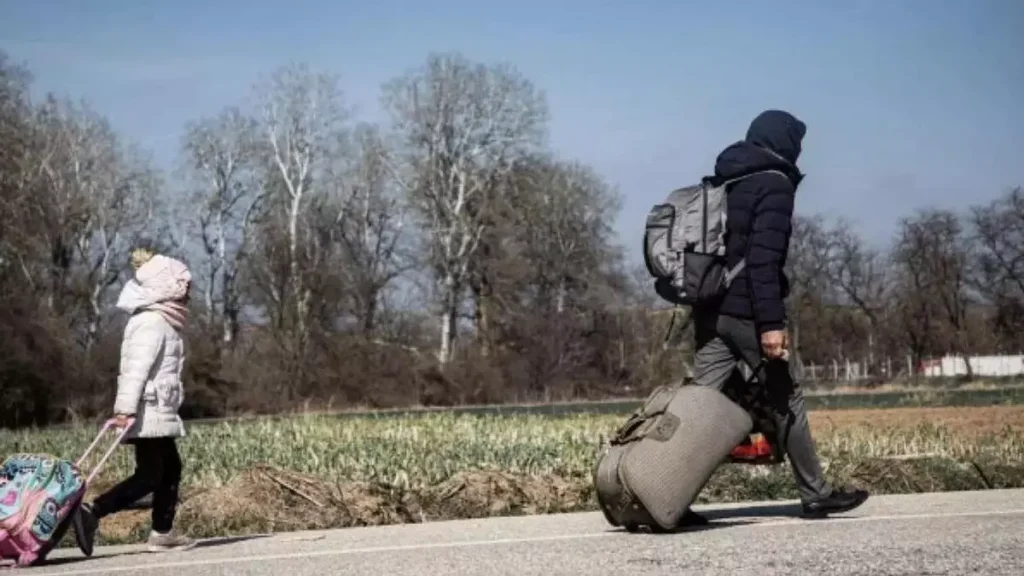
The migration route taking Cubans to South America has become firmly established in recent years
The migration route taking Cubans to South America has become firmly established in recent years amid growing difficulties in emigrating to the United States or transatlantic countries such as Spain. The journey does not carry the same dangers as the maritime route across the Florida Straits, organized crime in countries like Mexico or Guatemala, or the harsh Darién jungle, although it is not without risk. continue reading
As Globo reported a few days ago, since last November some 200 Cubans have been victims of a human trafficking organization operating on the Brazil–Guyana border that has since been dismantled by police. The number, sources told the local outlet, is believed to be higher, as the group had reportedly been operating for at least a year.
That total corresponds to Cubans who remained for three months in a clandestine hostel with more than 30 beds. Initially, those involved used their own homes to house migrants. As the flow increased, investigators indicated, a larger structure was set up.
Investigations suggest that the victims were recruited in Cuba and entered Brazil through the state of Roraima, passing through Lethem (Guyana) en route to Boa Vista.
Cuban nationals, as 14ymedio has reported, either remain in Brazil or continue farther south to Uruguay and, to a lesser extent, to Chile.
Translated by Regina Anavy
____________
COLLABORATE WITH OUR WORK: The 14ymedio team is committed to practicing serious journalism that reflects Cuba’s reality in all its depth. Thank you for joining us on this long journey. We invite you to continue supporting us by becoming a member of 14ymedio now. Together we can continue transforming journalism in Cuba.

 14ymedio, Havana, December 27, 2025 [delayed translation] — For years, Marta Elena Feitó embodied the ideal profile of a reliable figure within the Cuban system. She appeared disciplined, understated, effective at repeating the official line, and carefully avoiding any gesture that could be interpreted as dissent. From the Ministry of Labor and Social Security, one of the most sensitive portfolios in a country impoverished to the extreme, she defended statistics and slogans that increasingly clashed with the realities of Cuban life. In 2025, this disconnect between rhetoric and the realities on the ground made her one of the most significant figures of the year.