The imposing building on Belascoaín Street has become a garbage dump and a public toilet.
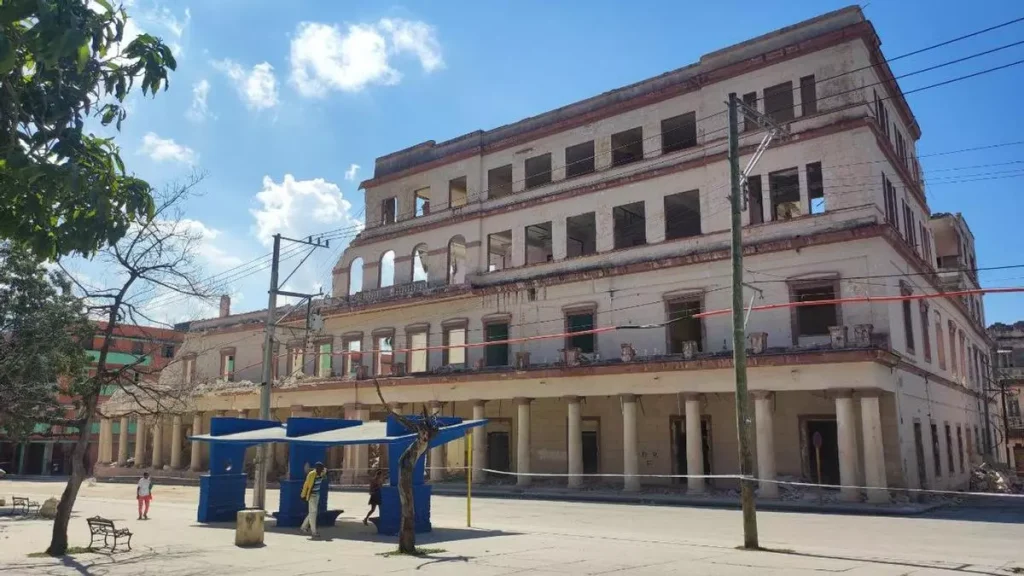
 14ymedio, Natalia López Moya, Havana, 15 February 2026 — The dust covers Belascoaín Street in Central Havana. Several strips of yellow tape block the section in front of the former Higher Institute of Industrial Design (ISDi) building. The umpteenth collapse of part of its structure had left a trail of rubble that prevents vehicles from passing and endangers pedestrians who venture to cross the blocked area. On Saturday, the image of this stretch of avenue without vehicles was a stark reminder of a city gripped by a fuel crisis and the deterioration of its infrastructure.
In the nearby line to enter a restaurant on the corner of Reina Street, the conversation was all about the loud crash heard last week when a piece of the building located between Maloja and Enrique Barnet collapsed. Even now, fragments of its walls and columns are scattered around the area. The nearby bus stop has also been cordoned off with warning tape, and pedestrians walking along the sidewalk in front of the windowless, doorless structure quicken their pace for fear of another collapse.
The building, which originally served as a military hotel and officers’ club for the Spanish Army, was also used as the headquarters of the Cadet School (1874-1878), a Widows’ and Orphans’ Home, the General Staff headquarters during the First American Occupation, and even the Ministry of Health before Fidel Castro came to power in January 1959. Graduates of ISDi remember it as a bright, welcoming space brimming with creativity. But for the closest neighbors, the building, which occupies an entire city block, has been a headache and a constant source of worry for years.
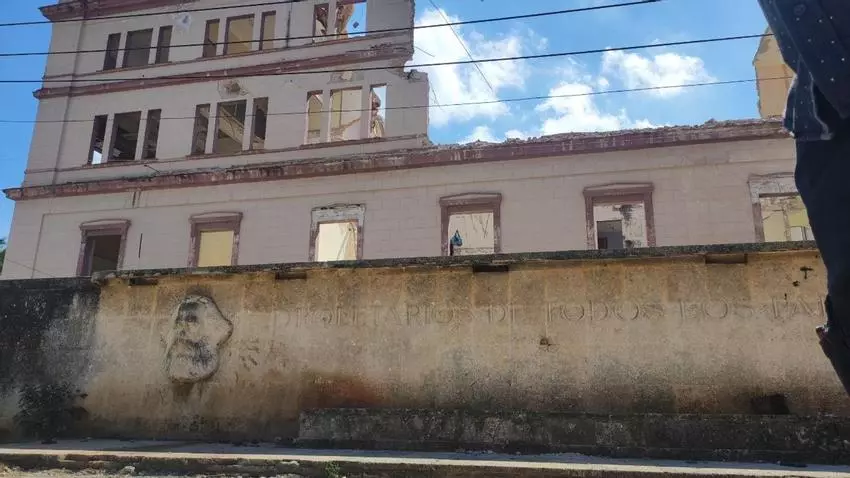
Carmita, a nearby resident, fears the destruction will continue for months or years without the authorities deciding to remove what remains of the structure. “It’s become a dump and a public toilet,” she laments. In addition to the danger of a piece of its walls falling on someone’s head, there are the epidemiological risks of ruins where mosquitoes, flies, and garbage all share the space. In a city with serious sanitation problems, the former ISDi has become another “hotbed of infection,” according to this Havana resident.
A flower vendor offers his wares to couples on Valentine’s Day. Carefully, he wipes down the glass containers where he keeps plastic roses and teddy bears. “This street is filthy,” the vendor laments as he dusts off the fine particles left in the air after the recent collapse of the once-colossal Belascoaín building.
____________
COLLABORATE WITH OUR WORK: The 14ymedio team is committed to practicing serious journalism that reflects Cuba’s reality in all its depth. Thank you for joining us on this long journey. We invite you to continue supporting us by becoming a member of 14ymedio now. Together we can continue transforming journalism in Cuba.