Cuba Extends the Tariff Exemption for Food, Medicines and Other Products

The import of duty-free food and medicines was approved in July 2021. (Cubadebate)

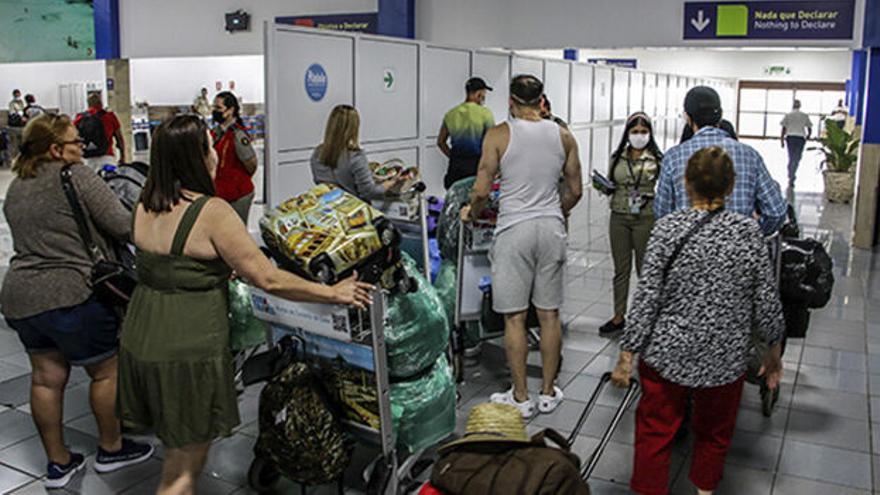
14ymedio biggerEFE (via 14ymedio), Havana, December 31, 2023 — The Cuban authorities announced this Saturday a new extension – until March 31 – to the tariff exemption for food, toiletries, medicines and even generators that travelers can bring to the Island for non-commercial purposes.

As a novelty of the measure taken in 2021 and prolonged several times, “the non-commercial import above the value established by the route of air, sea, mail and courier shipments of generators with a power greater than 900 watt-hour,” is allowed, according to the Ministry of Finance and Prices.

For the extension of the measure, “the persistence of the conditions that gave rise, in 2021, to its implementation” has been considered, according to the source.

Therefore, the tariff benefit will be maintained, which authorizes exceptionally, the non-commercial import, without limits in its value and exempt from the payment of customs duties, food, toiletries and medicines, through passengers as accompanied luggage. continue reading

The tariff benefit will be maintained, which exceptionally authorizes, the non-commercial import, without limits in its value and exempt from the payment of customs, food, toiletries and medicines

The import of food and medicines without tariff limits was a measure put into effect after the anti-government protests of 11 July 2021, which had as its main causes the scarcity and shortage of those basic products.

The law in force in Cuba on the import of luggage consists of a complex system of points and weight limits that establishes tariffs on excess items brought by travelers.

In the case of medicines, up to 22 pounds are allowed to be introduced into the country.

The economic crisis in Cuba was aggravated by the pandemic, the economic sanctions imposed by the United States and the failures in internal macroeconomic management.

Translated by Regina Anavy

____________

COLLABORATE WITH OUR WORKThe 14ymedio team is committed to practicing serious journalism that reflects Cuba’s reality in all its depth. Thank you for joining us on this long journey. We invite you to continue supporting us by becoming a member of 14ymedio now. Together we can continue transforming journalism in Cuba.

More Than 5,200 Cubans Were Deported to the Island in 2023 From Different Countries

The first flight of this year with deported Cubans arrived in Havana on April 24, with 123 people. (Cubadebate)

14ymedio bigger14ymedio/EFE, Havana, December 31, 2023 — A few hours before the end of 2023, the Ministry of the Interior reported that, in the last 12 months, 5,253 Cubans have been deported by air and sea from different countries in the region. Last Thursday, the U.S. Coast Guard returned nine rafters to Cuba on the ship Charles David Jr.

Among these deportations are those carried out by the United States. The most recent transfer flight to José Martí International Airport was last Thursday, with 31 Cubans who were arrested at the border.

According to Prensa Latina, in this group, made up of two women and 29 men, there were three people who had left the country illegally by sea. The rest, it reported, did so legally but “then took irregular routes to the U.S. border.”

Under the bilateral agreement between Cuba and the United States to return to the Island those who arrive by sea, eight transfers occurred to repatriate 426 Cubans since last April, when air expulsions resumed. continue reading

This year, Cuba has also received repatriated migrants from the Bahamas, Belize, the Cayman Islands, the Dominican Republic and Mexico

The first flight with this type of deportees arrived in Havana on April 24, with 123 people. On the last day of November, 37 Cubans were deported. Yoan Enríquez, who had a probation form I-220B, was one of the passengers who had to leave his wife and a three-month-old baby in Florida.

During the current fiscal year, which began on October 1, 2022, more than 6,800 Cubans have been intercepted by the U.S. Coast Guard on trips to Florida, according to official data.

This year, Cuba has also received migrants repatriated from the Bahamas, Belize, the Cayman Islands, the Dominican Republic and Mexico.

According to what was revealed to this newspaper, Cuba accepted the returns of its nationals from the month of October from Mexico, as long as the transfer expenses were covered by the Government of Andrés Manuel López Obrador. “A cost of 4,000 pesos (237 dollars) is handled for each migrant,” said lawyer José Luis Pérez.

Since Mexico resumed flights to Havana, it used the services of the airline Viva Aerobús. In total, it has transferred 435 Cubans in five connections. “Migration has a budget item for deportations. It’s not a new expense,” the official said.

Mexico also has a bilateral agreement with Venezuela for the deportation of migrants. This Sunday, a group of 122 migrants was returned to Venezuelan territory on the second repatriation flight, for a total of 329 people if you add the 207 who arrived in the early hours of this Saturday.

Since Mexico resumed flights to Havana, it used the services of the Viva Aerobús airline. In total, it has transferred 435 Cubans in five connections

The flight was carried out through the Vuelta a la Patria (Return to the Homeland) plan, a government program launched in 2018 to facilitate the return of migrants who were victims of xenophobia, according to the Venezuelan Government.

On X (formerly Twitter), the Ministry of the Interior, Justice and Peace pointed out that the migrants were received by a “comprehensive care command” in charge of verifying their data and providing medical assistance.

The Mexican government reported this Saturday the renewal of the repatriation flights of Venezuelans who are arrested on their way to the U.S. border.

It also indicated that they are working on the implementation of social programs in Venezuela, which will benefit, among others, repatriated people by linking them to productive projects and paid internships in workplaces.

Translated by Regina Anavy

____________

COLLABORATE WITH OUR WORKThe 14ymedio team is committed to practicing serious journalism that reflects Cuba’s reality in all its depth. Thank you for joining us on this long journey. We invite you to continue supporting us by becoming a member of 14ymedio now. Together we can continue transforming journalism in Cuba.

The Minister of Economy Who Never Told the Truth (I)

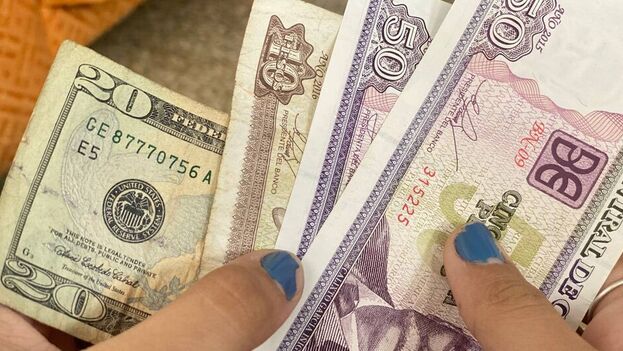
The bill on the left might buy something… the ones on the right, not much.

14ymedio bigger14ymedio, Elias Amor Bravo, Economist, December 28, 2023 — The facts speak for themselves. There is more than enough evidence that Alejandro Gil, Cuba’s Minister of Economy, knew since December 2020 and then from the first quarter of 2021, that the Ordering Task* could not go well, and that it would end up being a disaster for the weak Cuban economy. There are numerous testimonies of Spanish businessmen and investors in Cuba that confirm it.

In private, the communist leader did not welcome the economic “package” of the Ordering Task, but assuming that he had nothing against the Party or Marino Murillo, who even thought that he could succeed, or against anyone among the Cuban communist regime, he was silent and just waited for what was coming. This is not a recommended attitude for someone who is supposed to be at the head of an economy in serious crisis and locked in a vicious circle from which it is unable to exit.

That is why now, three years after the Cuban economy has lost critical mass, real GDP, investments, purchasing power and international attractiveness, it is very easy to go out on television with Randy Alonso and give a speech that aims to change the pace, not having them all with him and with an evident interference from Prime Minister Marrero. Are the Economy Minister’s days numbered? We’ll see. continue reading

Undoubtedly, it was a long Round Table program, in which Gil was accompanied by Regueiro Ale, another who is worth more for what he doesn’t say than what he does, and both undertook the unfortunate task of informing the people about the foundations of the regime’s decisions to correct the main distortions of the Cuban economy and relaunch it in 2024.

It involves two consecutive actions. First, to correct the distortions. Second, to give a boost to the economy; “reboosting” is another lie.

It is interesting to start from the distortions that Gil sees in the economy. And here, once again, the situation of the war economy is mentioned, caused by, and I quote verbatim, “the pressures of the intensified blockade, which hinders all the efforts we have to make for the economic performance of the country.”

A bad start, which loses perspective by spending energy on distortions. The intensified embargo/blockade does not prevent Cuba from developing its economic model, relating economically to 192 countries in the world, obtaining investments, tourists and most importantly, remittances, 90% from the country that “embargoes” the Cuban economy. This is a poor analysis of distortions if it is intended to find the way out of the tunnel from the available economic resources.

The second wrong idea is the mantra, repeated ad nauseam, that “we have to overcome, we have to find the alternatives by designing measures in accordance with our economic and social model, inclusive in our socialism, and that allow us, with objectivity, with realism, to get ahead.” This model failed all over the world, ask Vietnam or China, and which has been in Cuba for 65 years, a magnificent age for its retirement. If the government chooses the communist model to face the complexities, boost the economy and correct the distortions that are present in the country, in a year or two the situation may be even worse. Ministers Gil and Regueiro know it, but they are silent.

Nor does the argument work that the world economy is malfunctioning and this impacts Cuba. A simple look at the Caribbean resorts in the Dominican Republic or Costa Rica dismantles this argument. The hotels are 100% full  in this winter high season. In Cuba, they aren’t. Something is not right when the Germans, French and Swiss choose other destinations.

And of course, since there are no answers to the main questions, it’s interesting to talk about the second one, which has no solution: the regulated family basket.** Here the minister said that the population is against maintaining subsidies to all people equally since not everyone has the same purchasing power. This is a lie. What the population wants is to get rid of the regulated basket and be able to choose freely. As do many companies, too, because they could sell the products without dependence on subsidies, through the rules of supply and demand. The minister, on the other hand, says that he will review the basket, maintaining products at subsidized prices even if this is not an equitable distribution. The country’s imports for the basic basket cost more than 1.6 billion dollars as a result of increased prices in the international market.

The basket could be suppressed at any time and allow citizens to be free to choose. This is how Cuba worked before 1962, the date of the entry into force of the ration book that has been an instrument of social and economic control of communist design, which has increased poverty and misery in Cuba to levels not observable in other countries. Advances towards economic freedom are essential to relaunch the economy. Gil knows it, just as he knows that the Communist Party, committed to centralizing the decisions of choice of goods for Cubans, is the origin of the regulated basket. Any alternative to subsidized prices is seen as something negative.

And again he lies, when he says that “this doesn’t mean that the basket will disappear.” It won’t take long; it’s already happening.

Fuel is the second distortion, but Gil didn’t say why there is no oil in Cuba. Basically, two reasons. First, from the second half of 2019, Venezuela systematically reduced its oil shipments to the Island for internal reasons. Less subsidized oil forced the regime to resort to the international oil markets, but there it did not obtain financing because it wasn’t current on its debts. In Fidel Castro’s time that was possible, but in the time of Díaz-Canel either you pay or they don’t give you anything.

And by combining these two factors and attracting far fewer tourists to the Island, the ability to buy oil decreased significantly. And now Gil lies when he says that the population is worried about maintaining subsidized fuel prices, probably the lowest in the world compared to the prices of other countries. If the subsidized basket causes harms economically and socially, oil subsidies distort the energy decisions of all agents.

This is not an issue to review but to straighten out, as soon as possible. Without fuel, the economy and the country cannot function, and the dependence on oil makes Cuba a country with almost zero renewable energies. Blaming the absence of an internal mechanism of convertibility of currencies into national currency for fuel is not only a lie: it’s nonsense.

Third distortion: electricity. The same problem as fuel. Subsidized prices that prevent companies from obtaining profitability so that the quality of the service leaves much to be desired, and the lack of investment causes the network’s failures. Savings are not possible because, as a result of high prices, consumption levels are among the lowest in the world. It’s another area to be resolved with reforms in supply and demand. As in other goods and services, Gil now discovers that those who consume the most also affect those who consume the least, because when a blackout occurs, everyone suffers. It doesn’t discriminate between the largest and the smallest consumer. The solution of setting different rates depending on the level of consumption could be even worse.

He did not say it as such, but Gil incorporated the private enterprises into the list of distortions that have to be corrected by reciting some alleged opinions of the population that contribute little to the technical debate. Specifically, that those who want to buy a certain product have to go to the private companies. Why don’t Cubans find what they want in the State stores? Why is there rationing, scarcity, poverty? If the private businesses fill the need, although at a higher price, perhaps it is because this is the rule of the free market. By making the private companies fulfill a complementary function rather than a main function, the only thing achieved is that more merchandise is unavailable and people get hungry.

Then it was the turn of the distortion of the transport tariffs, which don’t earn enough to cover the costs of the State. If this is the scenario, the offer of services will fall and fewer goods and people will be transported as happened this year. Again, economic freedom is the solution, but the minister does not recognize it.

Gil pointed out that in the last four years “a group of measures has been adopted such as the incorporation of the non-State sector of the economy, the elimination of restrictions on the salaries in State companies and the removal of restrictions on distributing  profits,” but he acknowledged his poor success. He even questioned the legal rules for non-State economic actors that, in his opinion, were carried out without having a previous experience of their operation in the economy, taking as a reference the self-employed workers, which has nothing to do with the private companies. Another miscalculation, and on they go.

A special moment of the program was when Gil explained that, in the face of versions that the measures have a neoliberal character, “all decisions start from a broad process of consultation and analysis within government institutions, with the participation of academics, the Party militants and the analyses made from popular opinion.” Well, what a pity, because Vietnam, for example, thanks to well-designed neoliberal measures, overcame famines in five years and became a world’s leading exporter of rice. And what about China?

Cuban communists are the only politicians at the international level who continue to obsessively question neoliberalism, a doctrine that has given much better results than those applied by the communist model. If instead of criticizing without thinking, they reflected on what neoliberalism represents in 2023, another cock would crow.

Gil’s agenda affects the aspects that have been a failure, such as increasing the role of the State as a regulatory entity in the economy and intervening in the foreign exchange market by slowing down privatization. This gives the State a role that it cannot play because of its dependence on subsidies. Why does he lie over and over again? The market is the main mechanism for the allocation of resources in any economy, and that is neoliberal doctrine. I hope this is the way forward.

Gil’s next lie was to point out that these measures protect the social conquests of the revolution. It’s just the opposite. It is not possible to sustain a public expenditure of the dimension of the one that exists in Cuba if more wealth, employment and production are not generated. The chosen path has confirmed this for decades; a State-centralized distribution of resources goes against the trends of the world economy.

Neoliberalism, where it triumphs, does not lead the State to neglect taxes, but to liberate the markets, deregulate and act effectively. Inclusive measures to protect the people and the vulnerable need a solid economic base. Without growth, it is not possible to distribute.

So Gil is convinced that the measures will be able to correct distortions in time, and although the transformations have risks, they have to be assumed to be favorable for the revival of the economy, which is the other side of the coin.

If the intent is to lower the deficit, estimated at 18% and considered high, it must be corrected with taxes, prices and measures aimed in that direction.

It’s an important issue. Raising taxes goes against growth. If the main purpose is to accelerate the country’s economic recovery, increasing taxes is contrary to that objective. As for prices, inflation has moderated but remains high in food, recreation and transport. The minister is silent and does not tell the whole truth by assuming measures that will not give results and are poorly directed.

Part 2 is here.

Translator’s notes: 

*The Ordering Task is a collection of measures that include eliminating the Cuban Convertible Peso (CUC), leaving the Cuban peso (CUP) as the only national currency, raising prices, raising salaries (but not as much as prices), opening stores that take payment only in hard currency, which must be in the form of specially issued pre-paid debit cards, and a broad range of other measures targeted to different elements of the Cuban economy.  

**The monthly allotment of rationed goods.   

Translated by Regina Anavy

____________

COLLABORATE WITH OUR WORKThe 14ymedio team is committed to practicing serious journalism that reflects Cuba’s reality in all its depth. Thank you for joining us on this long journey. We invite you to continue supporting us by becoming a member of 14ymedio now. Together we can continue transforming journalism in Cuba.

Cubans in Manzanillo Try to Collect the Garbage Themselves Due to the Apathy of the Authorities

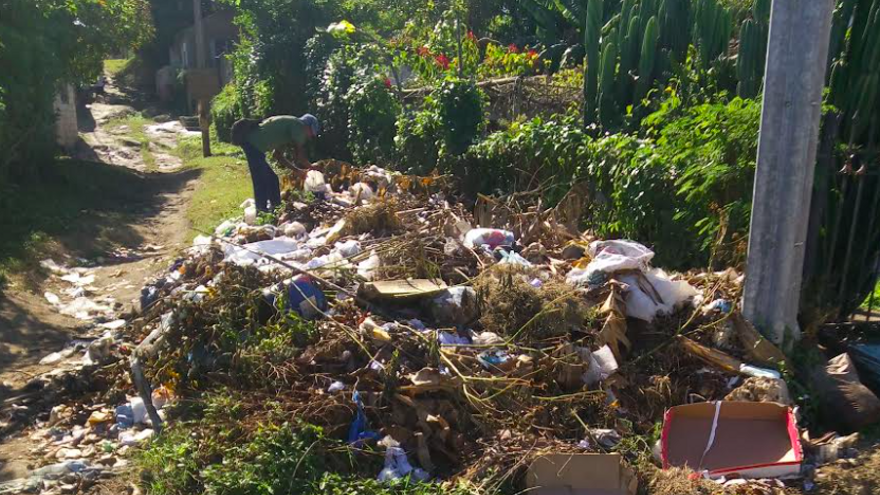
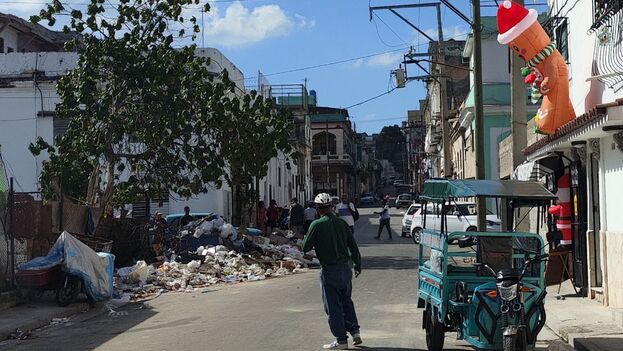
Without trucks, the wave of garbage threatens to become a tsunami. (14ymedio)

14ymedio bigger14ymedio, Juan Matos, Manzanillo (Granma Province), 31 December 2023 — It has been so many days since no one has collected the garbage on the streets of Manzanillo that the mountains of waste already have a uniform, ocher color. Due to the effect of the salt air and the indifference of the Community Services, the stench is ubiquitous in this coastal municipality in the province of Granma. The trucks that should clean the town are paralyzed due to lack of fuel or lie in a kind of scrap metal cemetery, while the landfills have become a den for countless vermin. The situation, resident agree, has reached an intolerable point.

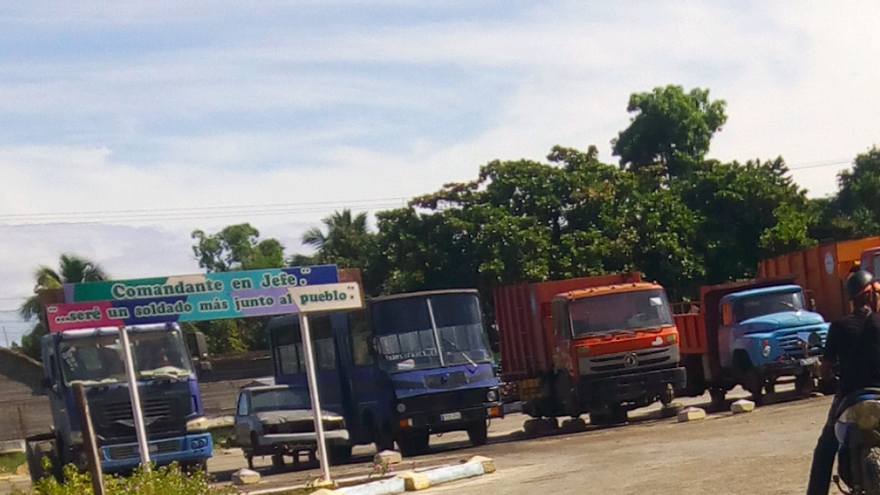
“The trucks piled up in a Communal Services parking lot give the measure of how serious this is,” Niurka, a manzanillera, tells 14ymedio in front of her house where guano, cans and cardboard boxes accumulate. She’s right. The rusty chassis of buses and the trash collection vehicles are reminiscent of large insects, lined up with martial rigor. In front of this scrapyard is a sign: “I will be another soldier with the people. Fidel.”

The logic of the dump, analyzes Niurka, is simple: “without fuel the trucks will not start, and without trucks, the wave of garbage threatens to become a tsunami that covers everything.” Currently, only one vehicle works to collect waste from the second most important city in Granma.

The scavengers do not lose sight of their objective, but they do not dare to go down until a “diver” examines the piles of waste. (14ymedio)

Manzanillo, a town that has always been green and rural, sees the crushing effects of dirt on nature, the woman observes. Arid fields, stagnant streams, roads blackened by liquid waste, mosquito breeding grounds – with the consequent “package” of diseases they transmit – not to mention the rats continue reading

that already roam around the town at their liesure, Niurka enumerates.

Not only do the animals “eat” the garbage, but the poorest Manzanilleros do as well says Jorge, a 57-year-old retiree who lives near the Comunales parking lot, speaking to this newspaper. Between mice and cockroaches, many “dive” in the landfill looking for food scraps, he adds.

Despair and hunger eclipse any scruples, and what was previously exclusive to Havana or other highly populated cities on the Island, is now common even in the most humble hamlets. “Everything depends on the Government’s management,” Jorge criticizes. “If a realistic goal is set to solve the problem, a contingency plan, this could begin to be resolved,” he says, optimistically.

The State continues to pay for the scrapyard’s custodians, who sit there for eight hours “doing nothing,” Jorge emphasizes. “That’s corruption. Why don’t they use that money to pay for gas and pick up trash?”

In front of the scrapyard is a poster with a quote from Fidel: “I will be another soldier with the people.”

Everything has been left in the hands of the residents, who in some neighborhoods, like Nuevo Manzanillo, work on collecting the trash on their own. But the solution is limited, the retiree acknowledges. In the long run, a large-scale, organized and systematic mechanism will be needed to control the garbage dumps. “That day has not come,” he says. In another neighborhood, once called “Golden” for its opulence, neighbors make jokes about how indisputable the victory of garbage has been.

Meanwhile, the plague and unhealthiness are on the rise. The landfills “gain in stability and organization,” Jorge jokes, citing the weather report. Above a landfill near the parking lot – located not far from the Guacanayabo hotel – the man sees a group of turkey vultures flying over. The scavengers do not lose sight of their objective, but they do not dare to go down to examine the piles of waste until a “diver” leaves. At the moment, says Jorge, “the garbage dump is occupied.”

____________

COLLABORATE WITH OUR WORKThe 14ymedio team is committed to practicing serious journalism that reflects Cuba’s reality in all its depth. Thank you for joining us on this long journey. We invite you to continue supporting us by becoming a member of 14ymedio now. Together we can continue transforming journalism in Cuba.

‘I Do Not Normally Post These Kinds of Publications’

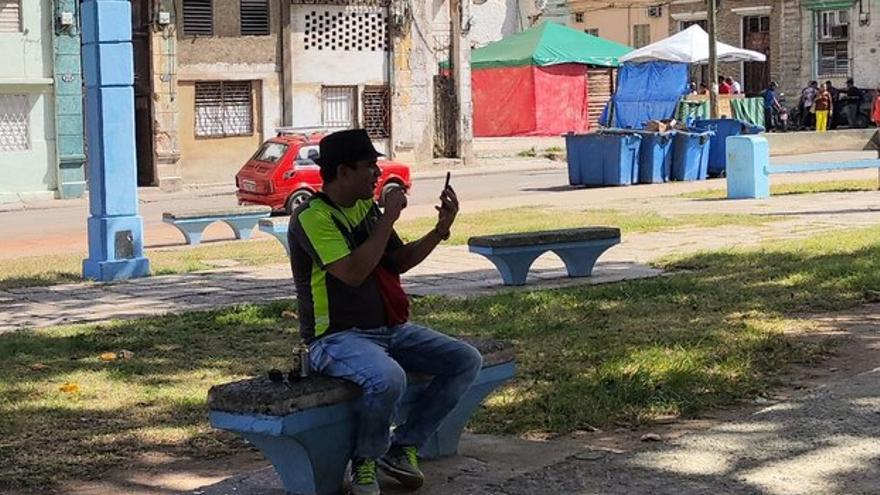
Las personas, ante el miedo, justifican lo que van a publicar con que no es una conducta habitual. (14ymedio)
People, in the face of fear, justify what they are going to publish by saying that it is not common behavior. (14ymedio)

14ymedio bigger14ymedio, Yoani Sánchez, Generation Y, Havana, 31 December 2023 — In my childhood, letters always began with “I hope upon receipt of this letter.” Now, many Cubans on Facebook warn in their first line: “I am not used to making this kind of publication.” Both formulas introduce a text and seek to create a link between the writer and their reader, but they are separated not only by the distance of decades but also by intentions. One is a mere cliché, the other is evidence of fear.

In Cuba, those who have expressed themselves freely through social networks have been penalized so much, in one way or another, that the fear of making a complaint visible, requesting medicine or reporting the state’s apathy is enormous. People feel that they have to apologize in advance for exercising their right to spread their opinions or to demand everything, from having food arrive at the ration store to having a hospital bathroom cleaned. The majority feel obliged to offer that disclaimer to make it clear that only in this extreme case are they appealing to make their annoyance or desperation visible.

They also want to distance themselves from activists, independent journalists and opponents who have made the virtual square the space to disseminate their actions, information or platforms. Before the inquisitive eyes of the political police that monitor the web, it must be clear that the Internet user in question has made an exception to their rules and has published their feelings this one time, only this once. If a co-worker were to check their Facebook wall to see what content they have shared, the colleague must also get the impression that this post is the result of urgency and will not become a habit. continue reading

The message is also intended for strangers. They will know that once the problem is solved and the personal crisis subsides, that Facebook account will go back to just posting family photos, ribbon-adorned hearts, and celebrity gossip. There should be no doubt that, after the current complaint, there will be no political positioning, no dissident attitude and, much less, the conversion of the individual into a digital leader that summons others and overshadows the prominence of officials and party leaders.

The “I do not normally post these types of publications” is a summary of the terror that has been instilled in us towards our own words. Using that formula goes beyond a platitude, it is perpetuating the gag that has been imposed on us.

____________

COLLABORATE WITH OUR WORKThe 14ymedio team is committed to practicing serious journalism that reflects Cuba’s reality in all its depth. Thank you for joining us on this long journey. We invite you to continue supporting us by becoming a member of 14ymedio now. Together we can continue transforming journalism in Cuba.

If You Want to Travel, Bring 3,000 Cuban Pesos to Bribe the Staff at the Villanueva Bus Terminal

With no money or particular skills, the majority of passengers just have to wait their turn. (14ymedio)

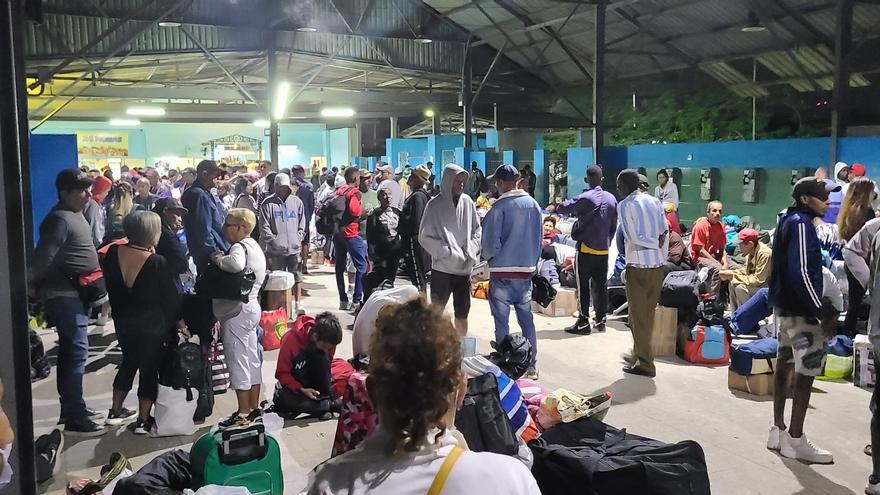
14ymedio bigger14ymedio, Havana, Pedro Espinosa, 29 December 2023 – Every day he comes into the Villanueva bus station in Havana knowing that, if it weren’t for his particular role, very few passengers would be departing from the city. A number of members of staff now don’t want to work with him. “You’re too noticeable” they tell him. But business goes on and is getting better and better. At this year’s end, for 3,000 pesos the “journey fixer” of Villanueva is able to get you a passage to any city on the island.

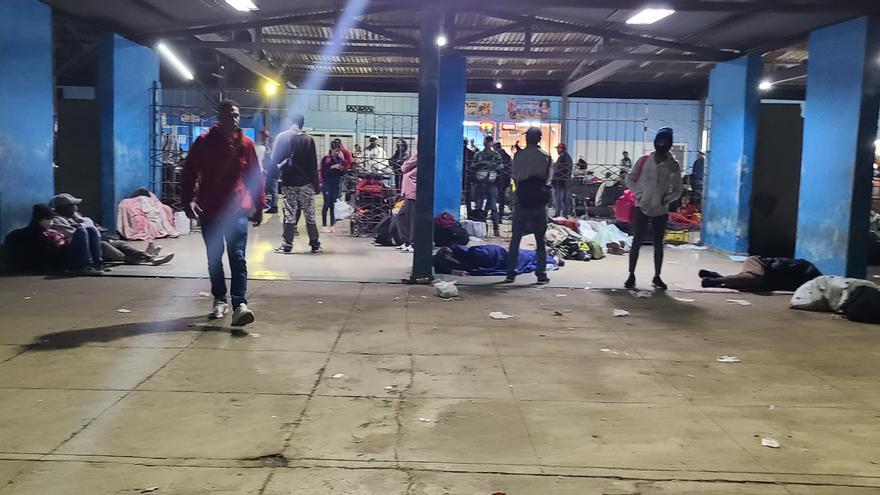
Desperate to get out of this terminal – a complete microcosm of the misery of the Cuban capital – whoever has the money also knows the tricks and passwords for finding him. The man arrives at Villanueva – a hive of people waiting, sleeping, talking – and looks for the staff member who will supply him with seats for resale that day.

They greet each other as if they don’t know one another and shortly after they enter the toilets. Here is where the first phase of the transaction takes place. The “journey fixer” then locates his client, takes a piece of paper from his pocket with a number on it – the number of his place in the waiting list – and asks him to be patient. After a moderate wait the terminal’s employee will call the client, reeling off his identity card number. This is the signal that the transaction is completed. He has paid 3,000 pesos instead of the 75 that it would normally cost him to get to Santa Clara, but it relieves him of the massive tedium of a long stay in the pigsty that is Villanueva. continue reading

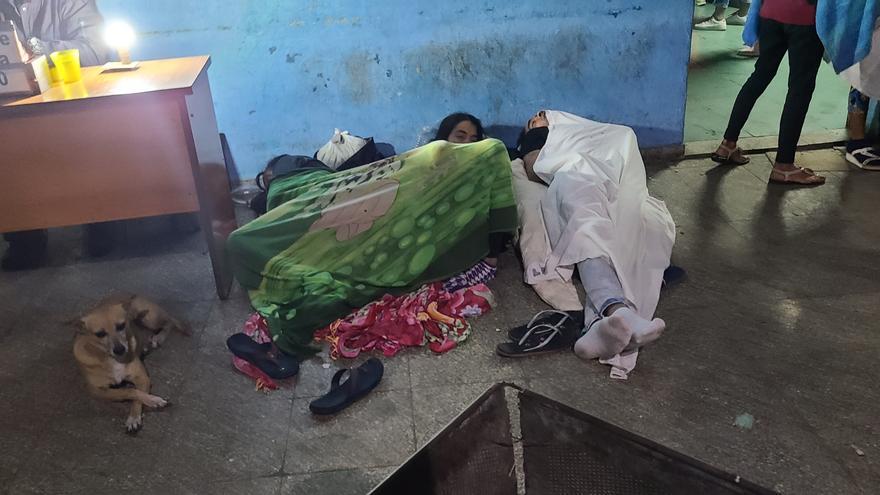
 La mugre del suelo, donde hasta los perros callejeros de la terminal se sienten incómodos, es la opción reservada para la mayoría. (14ymedio)
The majority of passengers have to put up with the filthy ground, which even the street dogs find uncomfortable. (14ymedio)

The “journey fixer” is the king of Villanueva. Everybody knows him – that’s his Achilles’ heel, but it’s also part of his modus operandi: he goes through the waiting area calling all his regulars “cousins” or “nephews”.

Outside of this “family”, and with no money or particular skills, the majority of passengers simply have to wait their turn. And that can take days. Before turning up at Villanueva the best thing to do is get yourself equipped with water, pillows and duvets. The experience is exhausting, especially for children and the elderly, who have to take it in turns to watch over and protect their luggage. Whole families often turn up at the terminal, intending to meet up – especially in holiday periods like this new year – with the extended family they left behind in the provinces where they were brought up.

The tenuous line that separates the state from the private sector passes through the cafeterias, which the government handed over to the mipymes [small/medium sized private businesses]. However, the number of customers they have is small, because a ham sandwich will cost you 150 pesos and a cookie and soft drink the same price. If you do have the money the better course of action is not to waste it on all this indigestible food at the terminal, but to use it to try and haggle a price with the “journey fixer”. Also, except in cases of emergency, the best thing is to avoid at all costs the toilets at Villanueva. The poor experience you’ll have there isn’t even free: the doorman will demand three pesos for using the facilities.

 El delicado ecosistema de Villanueva depende de la Policía y, en última instancia, del régimen, que por ahora deja hacer. (14ymedio)
The delicate ecosystem of Villanueva is dependent upon the police – and ultimately the regime – which for now leave him alone. (14ymedio)

In the microcosmic world of Villanueva, he who has managed to grab a seat is the winner. The majority of passengers have to put up with the filthy ground, which even the street dogs find uncomfortable. Recent arrivals spend hours standing around waiting on foot; the “veterans”, who have perfected the art of hunting down a seat, will sleep there: some of them even for as long as fifteen days.

In the meantime, even the “journey fixer” knows his time here is temporary. However many followers he brings together or clients he locates, the delicate ecosystem of Villanueva is dependent upon the police – and ultimately the regime – which for now leave him alone. Tomorrow? Nobody knows.

Translated by Ricardo Recluso

____________

COLLABORATE WITH OUR WORKThe 14ymedio team is committed to practicing serious journalism that reflects Cuba’s reality in all its depth. Thank you for joining us on this long journey. We invite you to continue supporting us by becoming a member of 14ymedio now. Together we can continue transforming journalism in Cuba.

Those Who Stay in Cuba

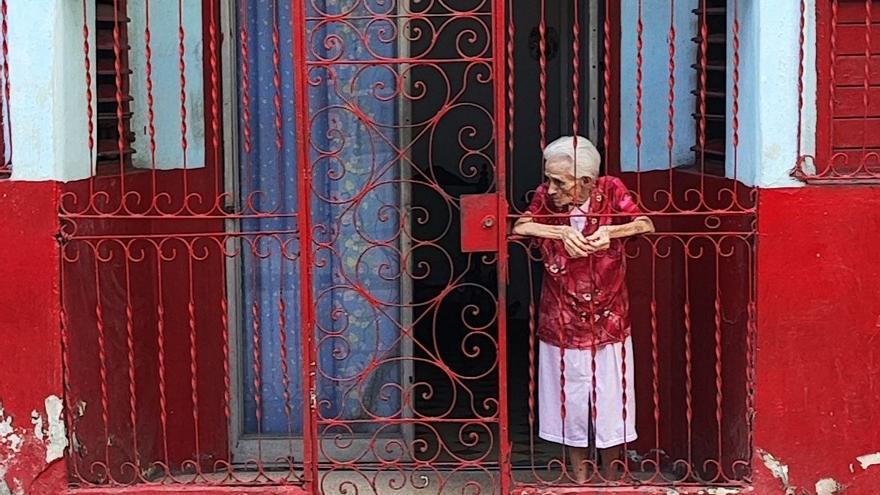
The most unfortunate people in Cuba have always been the same, before and after 1959 and until now. (14ymedio)

14ymedio bigger14ymedio, Havana, 27 December 2023 — Hundreds of thousands of Cubans have been able to leave the country for the United States during 2023 thanks to humanitarian parole; another tens of thousands are Spain-bound thanks to the new Democratic Memory Law. As the country empties, the streets are left with citizens whose faces are increasingly poorer, increasingly older, increasingly hopeless.

If that face had to be given only one color, it would undoubtedly be dark. Because the most unfortunate people in Cuba have always been the same, before and after 1959 and until now, in the middle of the unstoppable stampede: the black population.

They are evident in any city in Cuba, in the lines at increasingly scarce grocery stores, sitting on sidewalks begging for money, rummaging through garbage containers. Long ago, many of them served the regime with enthusiasm, but today, the Revolution, inexorably failed, turns its back on them and leaves them to their fate, like stray dogs.

Others are neither black nor elderly, but, even so, they have not wanted or been able to leave Cuba. Ernesto, a resident of Central Havana in his 40s, has a difficult time because he has no one to ask for “sponsorship” from the United States or from Spanish ancestors to qualify for the “grandchildren law.” A once-successful musician, not only in the theater, but in tourist shows, he survives by doing different jobs, such as delivering food for private businesses. He lives in a precariously balanced building, but he has no money or way to move out. He relies on his natural strength and some faith in something else. “I always say that God has to have something in store for me, I don’t know what, but I have to stay here.”

Emigration was very close in the case of Alberto, a 22-year-old young man from Cienfuegos, but it has not been possible yet. He signed up, together with his parents and his brother, for the Humanitarian Parole in the month continue reading

of January, when the program was announced to go into effect. Last April, his family received notification that they had been accepted, but his name was not included in the email in which they were told the good news. He is still in Cuba, but now, instead of living in the old manor house that belonged to his grandparents, he is staying at an aunt’s house, sleeping on her couch, since his parents sold their house before leaving.

Alberto’s family, with whom he speaks twice a day, insists that he must wait for his case to be resolved, but in recent weeks he has considered leaving by way of Nicaragua or using other means to emigrate. For the first time in his life, he will spend Christmas without his parents and his brother, who avoid sending him photos of the celebrations they are already having in exile in Miami, so as not to feed him the sparrow of nostalgia.

Emelia, a 78-year-old Public Health retiree, feels “still strong” but she does not plan to emigrate. Her two daughters and her granddaughters have left in the last two years, either to the United States or Spain, but she does not want to be a burden on them at a time when they are still “taking off” on their migratory path.

Another reason Emilia is that she is reluctant to leave the family home, which has been left under her sole care. The house that her parents bought when they got married and where she was born is located near Calzada del Cerro, in Havana. Although she could still sell it and use the money to buy “an apartment like a doll’s house, with new everything,” she considers herself the guardian of the family legacy. These rainy days, the leaks have not allowed her to sleep in the first room of the house, but she has four more… all empty.

The vast majority of emigrants are young people, professionals or small businessmen, those who the Cuban Government did not allow to flourish, or who were directly harassed and persecuted for being difficult. All of them are the work force, the drive and the motor, that countries other than the one where they were born are already benefitting from. The joy for each Cuban citizen who achieves freedom leaves a bitter question: who will be left to build a new Cuba?

____________

COLLABORATE WITH OUR WORK: The 14ymedio team is committed to practicing serious journalism that reflects Cuba’s reality in all its depth. Thank you for joining us on this long journey. We invite you to continue supporting us by becoming a member of 14ymedio now. Together we can continue transforming journalism in Cuba.

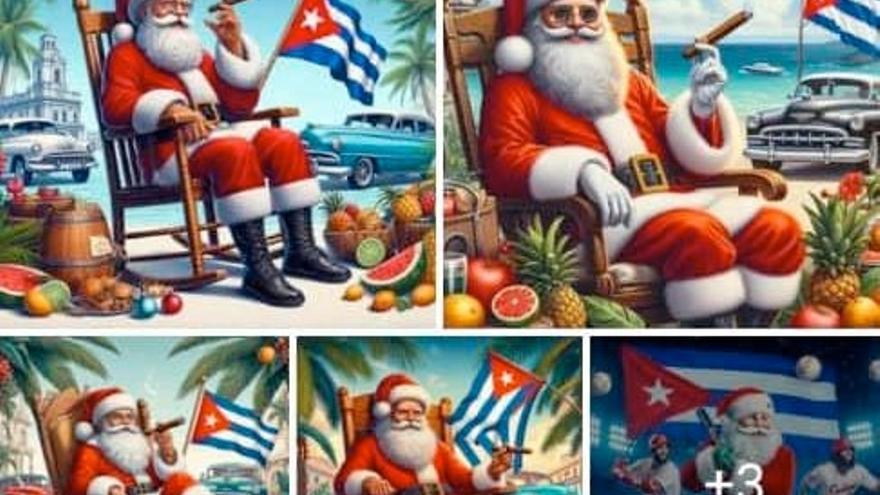
The Virulent Protests of the Radical Sector of the Cuban Regime Force Havanatur To ‘Kill’ Santa Claus

Image of Santa Claus disseminated in the tourist agency’s campaign. (Havanatur/Facebook)

14ymedio bigger14ymedio, Havana, December 30, 2023 — With a cigar in his mouth, playing baseball and distributing gifts to the children in front of the Havana Capitolio, a chubby Santa Claus promotes Cuba as a destination for Havanatur this December. The images, created with Artificial Intelligence, have unleashed a swell of criticism from the most extremist sectors, which accuse the tourist agency of succumbing “to colonizing seduction.”

The Cuban diplomat José Carlos Rodríguez Ruiz was one of those who reacted angrily to the campaign that the State company disseminated on its Facebook account, which it took down shortly after due to criticism. The former ambassador of the Island to Italy classified Santa Claus as part of the “colonizing icons and something alien to Cuban culture.”

Rodríguez’s text, which was also published by the official newspaper Tribuna de La Habana, said that “in the face of those who easily succumb to colonizing seduction, there is only one way, which is the same as our history to keep us independent and sovereign: to be alert and confront them.” The diplomat questions whether “they will have taken away the irresponsible people who thought it up, created it and published it. We don’t know. Havanatur didn’t even issue a note apologizing. They should have.” continue reading

The campaign images unleashed the anger of the most conservative followers of the Regime. (Havanatur/Facebook)

Rodríguez’s criticisms have been joined by those of fellow diplomat Orestes Hernández Hernández, who called to use, instead of the figure of the old man with a white beard dressed in red, characters from Cuban literature such as the puppet Pelusín del Monte, created by the writer Dora Alonso in 1956. For her part, the official journalist Ana Teresa Badia classified the tourism agency’s campaign as a “violation of all communication logic.”

A few hours after the first questions were published, the advertising disappeared from the Havanatur page; however, several users copied and disseminated the images in which Santa Claus swings in an armchair, smokes a cigar surrounded by tropical fruit, sunbathes on the shore of a beach and, in almost all the illustrations, is accompanied by an old American car.

Several commentators joined the angry reaction and classified Santa Claus as an “imperial construction” and “part of the war of symbols of the United States against Cuba.” However, the figure of the sympathetic old man has its origin in the second century A.D. when Nicholas of Bari was born into the bosom of a wealthy family in the Turkish city of Patara. When his parents died, he decided to distribute his wealth among the most needy and sought refuge from his pain in religion.

San Nicolás has a relationship with Havana that most Cubans ignore: he is the Greek Orthodox patron saint of the city

San Nicolás, in addition, has a relationship with Havana that most Cubans ignore: the Greek Orthodox community of the city adopted him as patron, because he is considered the protector of sailors and port cities. In fact, the Greek Orthodox cathedral of Old Havana is consecrated to him.

It is not the first time that this type of reaction has arisen to the use of foreign symbols or traditions. At the end of last October, the Maxim Rock Cultural Center, in Havana, organized a Halloween party in which an officer costume of the Nazi Schutzstaffel (better known by the acronym SS) worn by a contestant was awarded. The audacity cost the premises a temporary closure and sanctions to its managers, as later reported on social networks by the Cuban Institute of Music.

The entity then stated that the decision had been taken “given the seriousness of the fact and the evidence of the inability of the cultural institution to foresee it.” The note went beyond the specifics and took advantage of the controversy to put the festivity under the magnifying glass again. “The event (…) in addition to constituting a violation of the directives for cultural programming, puts the issue of the dangers of cultural colonization back on the table.”

Both the Cuban Institute of Music and the official spokespersons who criticized the event conveniently ignored that Halloween or Samhain, celebrated on the eve of All Saints’ Day, is a pagan festival of Celtic tradition that marked the end of the harvest season and the beginning of the new year. Irish emigrants imported it to the United States, where it was incorporated into popular culture with its own iconography. From there it has been re-exported all over the world, especially through the film industry.

That origin and the thousands of Cubans who disguise themselves every year to enjoy this holiday are systematically ignored by the Cuban authorities, who insist on identifying it exclusively with “the empire” and point to it as something foreign to the national culture, although the links of the Island with Celtic Galicia have been close for centuries.

Translated by Regina Anavy

____________

COLLABORATE WITH OUR WORK: The 14ymedio team is committed to practicing serious journalism that reflects Cuba’s reality in all its depth. Thank you for joining us on this long journey. We invite you to continue supporting us by becoming a member of 14ymedio now. Together we can continue transforming journalism in Cuba.

How Much Does 100 Dollars Weigh in Cuban Pesos?

Open the zipper, the content appears: 26,000 pesos, in thick chunks of 50-peso bills. (14ymedio)

14ymedio bigger14ymedio, Mercedes García, Sancti Spíritus | 30 December 2023 — Edith has been “hunting” for a few pounds of malanga and two pork shanks for weeks. This end of the year, her house in the Los Olivos neighborhood, in Sancti Spíritus, has become a base of operations. The budget: 100 dollars that her brother sent her months ago from the United States. Her objective: to change the currency with the utmost discretion and outside her neighborhood, where the military and cadres of the provincial government are not in short supply.

On the other side of the city, in the humble neighborhood of Jesús María, Carlos has been collecting pesos all year to buy an electric pressure cooker. Before acquiring the precious artifact, he has to get dollars, go to the bank and witness their transformation – painful after “letting go of the green” – into freely convertible currency (MLC), a currency invented by the Cuban regime.

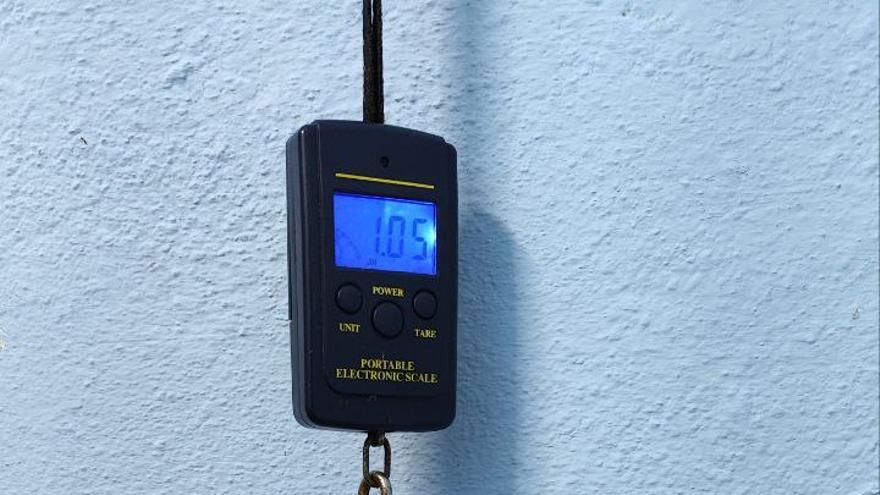
Thanks to social networks, Edith finds in Carlos the perfect candidate for her transaction. They meet at her house. With some embarrassment, Carlos deposits a worn black briefcase on the sofa that Edith examines with suspicion. He opens the zipper, the content appears: 26,000 pesos, in thick chunks of 50-peso bills with the face, repeated 520 times, of Calixto García.

The weight of the 520 banknotes of 50 pesos is 1.05 pounds. (14ymedio)

In turn, Edith gives Carlos the thin $100 bill, with a lonely Benjamin Franklin printed in green. In the room where the exchange takes place, the television is turned on at full volume – the old trick against the gossips of the neighborhood – with the Christmas speech of the first secretary of the Communist Party of Sancti Spíritus. continue reading

“All united we will be able to move towards a better year, where the dreams, achievements and aspirations of Sancti Spíritus in progress will consolidate the unity of our people and, surely, will lead us to achieve new victories, no matter how difficult the circumstances are,” says the leader from his air-conditioned office, protected by the picture of an already senile Fidel Castro.

“But the resistance of our people, their creativity, the day-to-day effort have not made us give up our dreams,” he continues, but Edith turns off the device and says goodbye to Carlos, who goes at full speed to the bank, and from there to the hard currency store, where – he trusts – he expects to find his coveted electric pressure cooker.

Before looking for the malangas and the meat, Edith picks up the 26,000 pesos from the sofa and places it on a scale. How much does a thin 100-dollar bill weigh in pesos? The answer – amazing – is on the screen of the device: 1.05 pounds of Cuban paper.

Translated by Regina Anavy

____________

COLLABORATE WITH OUR WORKThe 14ymedio team is committed to practicing serious journalism that reflects Cuba’s reality in all its depth. Thank you for joining us on this long journey. We invite you to continue supporting us by becoming a member of 14ymedio now. Together we can continue transforming journalism in Cuba.

The Minister of Economy Who Never Told the Truth (II)

Alejandro Gil Fernández, Cuba’s deputy minister and minister of Economy and Planning, before the National Assembly of the People’s Power of Cuba. (14ymedio)

14ymedio bigger14ymedio, Elías Amor Bravo, Economist, 29 December 2023 — A good part of the State TV Round Table program was dedicated by Alejandro Gil, the Minister of Economy, to the SMEs [small- and medium-sized enterprises], of which he said that there is no stopping of the process or reprisals. Another lie. Because although it is true that in these two years the number of SMEs created has been important, the authorities have not provided data, and this is an essential indicator for evaluating the process. The functioning of SMEs has been conditioned by political action, and survival has been an obstacle course, which the regime, far from facilitating, has continuously complicated.

Along that line, the idea of transferring the powers of approval of SMEs to the municipalities must be interpreted as a control measure, which puts economic actors at the disposal of local communist leaders, who have little expertise in these matters and are obsessed with ideology. The idea of bringing the decision of the evaluation of those businesses, which are on a small scale, closer to their link with local, territorial development and municipal development strategies means that the SMEs will have limitations on their growth and scale and will operate at minimum unit costs, where profits are maximized.

The regime’s bet is that the SMEs remain small and weak, a measure that distances the Cuban economy from the free-market economy and sends a very clear message to those who do not want to see it. They say this process will be gradual, but it will not allow the consolidation of a strong private economic sector.

Local communist leaders have little expertise in these matters and are obsessed with ideology

Secondly, in addition to the transfer to the municipalities of the decision to approve SMEs, Gil announced the revision of the list of unauthorized activities for which they are carrying out an “in-depth analysis with the agencies and receiving criteria from the territorial governments.” In this regard, he said that “there will not be large annotations, but some issues will be corrected and clarifications made. There is no major transformation in the list of unauthorized activities.” Let no one expect much. continue reading

Third, Gil said that work is being done on the creation of an institute that will have as its function the coherent attention to the non-state sector of the economy and, later, be linked to the agencies of the Central State Administration for the promotion of policies and the implementation of certain rules. That is, on the one hand, competition is transferred to local powers, and on the other, a central bureaucratic body is created. What are we going to do? What is this tug-of-war?

It seems that this institute will exercise its functions over all non-state economic actors, not just for SMEs but also for non-agricultural cooperatives and self-employed workers. The institute will help lead the non-state economic actors, without direct intervention from the administrative point of view. Control and control. More bureaucracy where it is not needed.

And something that is noticed as soon as the organizational design is analyzed is that Gil’s Ministry of Economy is left out of this new, two-headed design of the national economy. It accesses an unexplored and critical terrain, whose final result is at least uncertain. However, the aim is to accentuate state control in the allocation of resources, fuel, currency and budgets, with attention to non-state economic actors, the national development plan and the country’s projected strategy. A communist hodgepodge that is difficult to digest.

It is hard to find in the world experiences like the ones that are proposed in Cuba. Another lie.

At this point, Gil said that there are sufficient experiences in the world that have been studied to identify the best way to proceed. It would help if he explained them, because it is hard to find in the world experiences like the ones that are proposed in Cuba. Another lie.

Fourthly, the Round Table has addressed the issue of subsidies on several occasions, because the economic system is unable to foresee their maintenance over time. The issue is whether to eliminate the subsidies or adapt them. No option has full support.

Progress has been made with respect to the past because Gil recognizes that subsidies aren’t free. Of course, in Cuban communism the Government pays for everything, and the price is high for the people and the economic entities because they must support a wasteful State. The subsidy to prevent the population from facing a certain high cost due to the productive inefficiency of the system has a direct cost in the state budget. Someone has to pay.

And of course, the communists finally recognize that when the State subsidizes, it’s a cost that falls on everyone

And of course, the communists finally recognize that when the State subsidizes, it’s a cost that falls on everyone. When the subsidy is assumed by the budget, it is assumed by the country. And when the country assumes it, all citizens pay for it, and this requires, almost always, an increase in the fiscal deficit.

And here comes another idea that the communists have finally figured out: If the fiscal deficit is expanded and money is issued in circulation to be able to support that deficit, inflation is created, which is a tax that falls, above all, on people with lower economic resources and the most vulnerable groups. The injustices of the economic system recognized by Gil is responsible for them. Here there is no reference to the embargo or blockade. It is an internal problem that undermines the bases of the model devised by Fidel Castro at the age of 65. Subsidies, deficits and inflation may end up breaking down the model.

One has the impression that the web of subsidies and prices for products such as energy, electricity and gas has entangled Gil, and with the weight of communist ideology he is unable to see an exit from the vicious circle. In one moment of the Round Table, the minister asked himself a series of questions that, obviously, he didn’t answer.

“First, if we don’t raise the price of fuel, the question is who pays for it. The State? With what money? With the same money that we are collecting via taxes or not allocating somewhere else? With what currency do we buy the fuel that we are going to sell after it is subsidized? With the same currency that we stopped dedicating to food? With the same currency that we stopped dedicating to medicines?”

Gil was referring to the issue of budget design, but the problem is in the justification of the budget. It is not a simple matter of passing money from one item to another with political criteria, but of eliminating items that distort the market reality of supply and demand. The resources of the people, as the minister says, are for other things. What Gil calls the correction of certain prices, which have high levels of subsidies behind them, are not only unsustainable for the country but also assumed to be equal for all. Only the market economy of supply and demand can correct the budget, and the definitive suppression of central planning.

In fifth place, continuing, Gil then addressed the issue of savings.

What is Gil talking about when salaries and pensions are the main sources of income for Cubans and are destroyed by the pressure of inflation?

It is melodramatic that in an economy like the Cuban one there is talk of saving and of identifying incentives for saving. What is Gil talking about when salaries and pensions are the main sources of income for Cubans and are destroyed by the pressure of inflation?

Gil maintains that abroad, due to the price of gas, people are obliged to save, but in Cuba, the high consumption of energy in the non-State sector makes saving measures difficult. And what about the blackouts, Minister? How do we interpret those mile-long lines at gas stations? What savings is the minister talking about, and what else does he want Cubans to stop consuming? Maybe they should return to the era of caves.

The minister wants people who consume more energy or fuel to pay a higher price and incorporate savings measures into their lives. Now, if they can’t stop consuming they have to pay a higher cost. The minister knows who the wasteful are: he just has to look at the state offices or local authorities, organizations, and other public entities to see where they can save. That’s where the waste resides, but just ask the mayor’s office or a State building for self-adjustment.

And at this point, without providing practical solutions to the issue of subsidies, the minister addressed, in sixth place, the situation of the foreign exchange market and said that “it is today one of the main distortions that the economy is facing.”

He acknowledged the obvious fact that he had not designed that informal or illegal foreign exchange market in the country. Of course, the communists had nothing to do with a market governed by supply and demand, which works efficiently.

The minister blamed the SMEs for being the only ones that have products because they can import and sell and have flexibility for prices, while the State companies have their hands tied. What is the minister waiting for to untie them? The solution is clear and the way forward as well. It is to turn the purchase and sale of the currency into a regular economic activity. And then, the alarm comes when Gil says that “we have to control it.”

In this regard, he points out that “among the measures proposed is to recover the management of foreign exchange by the State, because part of what is happening to us today, the fact that there is less State supply and more supply from the private sector, is because the private sector, in some way, is acquiring hard currency in the informal market, the illegal market, and that currency is not entering the national financial system. Therefore, State companies are practically running out of sources of currency allocation.”

It is worth reminding the minister that at the time the fixed exchange rate system was provided in the Ordering Task,*  which set the official exchange of 1 dollar to 24 pesos, this lasted less than three months before the Central Bank recognized its inability to assume the exchanges. Does he want the same thing to happen again? The currency shortage is now worse than at the beginning of 2021. Beware of experiments.

Gil recognizes that the State is sometimes not in a position to offer goods and services as it should be, because hard currency moves in another circuit, the informal one. And if that currency is not in the State’s sphere, it’s because the State is inefficient or incapable. Of course both currencies can function, but normally in all countries there is only one market, operated by private agents, with the law of supply and demand and regulated, without State intervention. That model in Cuba is possible if the communist State recognizes the informal market as the one that must operate and provide the service. That would not be neoliberal, but efficient. Doing things right.

So the intervention of the State, Gil’s answer to the distortions, will not serve to ensure the economic sustainability of the country, nor will it provide responsible and effective management of the economy. Gil knows this, and when he says otherwise, he is lying.

*Translator’s note: The Ordering Task is a collection of measures that include eliminating the Cuban Convertible Peso (CUC), leaving the Cuban peso (CUP) as the only national currency, raising prices, raising salaries (but not as much as prices), opening stores that take payment only in hard currency, which must be in the form of specially issued pre-paid debit cards, and a broad range of other measures targeted to different elements of the Cuban economy.  

Translated by Regina Anavy 

____________

COLLABORATE WITH OUR WORKThe 14ymedio team is committed to practicing serious journalism that reflects Cuba’s reality in all its depth. Thank you for joining us on this long journey. We invite you to continue supporting us by becoming a member of 14ymedio now. Together we can continue transforming journalism in Cuba.

Team Asere, Without a Homeland But With Love

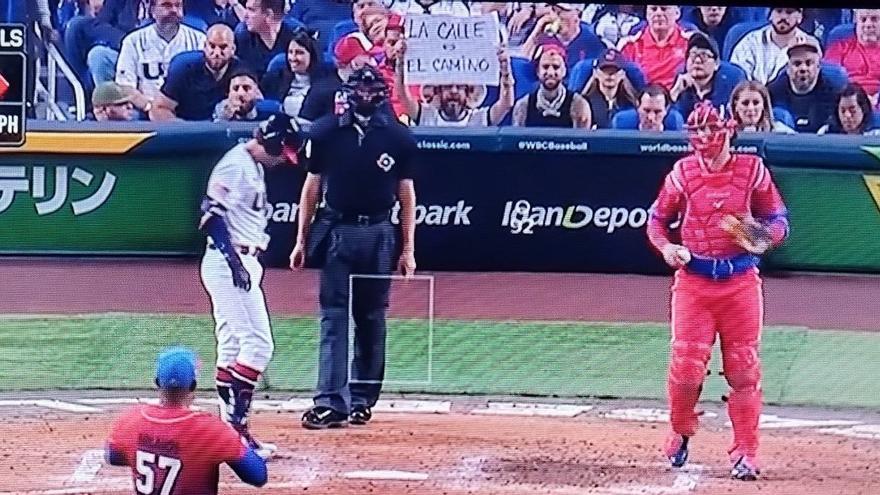
One of the moments of the live broadcast of the game between Cuba and the United States in the semifinal of the World Baseball Classic. (14ymedio)

14ymedio bigger14ymedio, Havana, 28 December 2023 — Rarely has the regime licked its wounds with as much vigor as after the defeat of Team Asere in the semifinal of the World Baseball Classic. The propaganda had turned the match against the U.S. national team into a political crusade, and, as most sports specialists had predicted, the shot backfired on Havana.

The team’s problem was, above all, one of concept. What did Team Asere represent? The best players of a dictatorship? An example of national reconciliation? An idiotic scheme  – as many called it – that tried to take the athletes who trained in the worn-out stadiums of the Island to the level in professional baseball that the emigrants had reached?

The Cuban-American community in Miami was categorical: Team Asere was a well-planned collection of “useful idiots,” puppets that – consciously or unconsciously – danced to the rhythm dictated in the dark propaganda offices of Havana. The exiles also made it clear in the LoanDepot Park stadium itself, with protests that the Cuban Foreign Ministry later described as “unfortunate and dangerous incidents.”

It was those “transgressive” groups, the regime argued, that caused Team Asere to become a cluster of nerves, unable to bat with quality and plan its continue reading

plays well. After the defeat, everything was “strongly denounced,” not only the “destabilizing elements,” but also the “difficult game” against a team with “technical superiority” like that of the United States. It was not difficult, the authorities lamented, to lose against such a “clearly winning” adversary.

Another blow to the mental tranquility of the Island’s authorities was having to broadcast the match on Cuban Television without being able to disguise the multiple posters against the regime held by the public. At the end of the game – although the moment did not reach the Cuban screens – the writer Carlos Manuel Álvarez and the artist El Sexto went down on the field carrying Cuban flags, which cost them a night in the police station. Things that happen in Miami, a city “that does not meet the minimum conditions to host an international event,” Havana said in defense.

The balance of the experiment leaves no room for optimism. Team Asere lost the match – after a series of successes in the contest that guaranteed their face to face with the United States, it must be said. But it opened the way for the commissioners of several Cuban sports, such as chess, to show themselves as “understanding” leaders: if other emigrated athletes wanted to play with the flag of their country of birth there would be no inconveniences, as long as they did so under the draconian conditions imposed by the regime.

But it wasn’t all regret and defeat. The trip to Miami bore fruit, even if it wasn’t harvested by the regime. The baseball players living on the Island arrived at José Martí International Airport loaded down with televisions, automobile tires and many suitcases, provisions to survive on an Island where only the privileged aseres* want to return.

*Translator’s note: A common word to greet a friend, asere is Cuban slang for “dude” or “buddy.”

Translated by Regina Anavy

____________

COLLABORATE WITH OUR WORKThe 14ymedio team is committed to practicing serious journalism that reflects Cuba’s reality in all its depth. Thank you for joining us on this long journey. We invite you to continue supporting us by becoming a member of 14ymedio now. Together we can continue transforming journalism in Cuba.

Suspension of Rationed Sale of Milk to Chronically Ill People in Sancti Spiritus

Last March, the local press announced that the sale of milk destined for medical diets was suspended. (14ymedio)

14ymedio bigger14ymedio, Mercedes García, Sancti Spíritus, 26 December 2023 — “It failed and failed until it stopped arriving,” this is how Nuria de las Mercedes describes the situation that the chronically ill patients of Sancti Spíritus have experienced with the supply of milk for medical diets. This December, for the second time in the year, consumers have been informed that the sale of dairy is suspended in state shops, and only the quota for children up to seven years old and pregnant women will remain.

Nuria, 74 years old, is diabetic, hypertensive and has kidney problems. Among the chronic patients who receive a liter of milk every three days, the elderly woman is in group C of the three groups [A, B and C], where beneficiaries are grouped according to their condition. “In recent months it was delayed, it was even weeks since it had arrived, and now we were told that they can’t guarantee it,” she tells this newspaper.

“They haven’t explained if it’s forever or a temporary measure,” complains the woman from Sancti Spíritus. Along with other customers who buy the rationed milk, Nuria is part of a WhatsApp group where information about the supply is shared. “In the group no one has explained about what’s going on, but now they’ve told me in the shop that it wasn’t coming.” continue reading

The state employees don’t offer a conclusive explanation. “We are in the season when traditionally there is less rain, less feed and less milk

The state employees don’t offer a conclusive explanation. “We are in the season when traditionally there is less rain, less feed and less milk,” an employee in the Kilo 12 district tells this newspaper. “At the beginning of the year the same thing happened, and then we went back to selling, although it has never returned to a normal or stable distribution.”

Last March, the local press announced that the sale of milk destined for medical diets was suspended. The announcement explained that it was a momentary measure and that the authorities of the territory had decided to “protect the allocations directed to children and pregnant women.”

Alberto Cañizares Rodríguez, director of the Río Zaza Dairy Products Company in the province, explained that the main reason for the cutback was the lack of animal feed and added that the country had not been able to import “the required levels of milk powder” to ensure coverage for chronically ill people.

However, this newspaper was able to confirm that last November, 50 tons of powdered milk expired in the provincial warehouses of Río Zaza. “It was not sold to the population and not distributed by another way, so they saw the merchandise had already expired and could not be marketed,” an employee of the company told 14ymedio at the time.

The bosses were furious when they found out and came here to try to break the chain on the weakest link

“The bosses were furious when they found out and came here to try to break the chain on the weaker link – that is, to blame us –  but the responsibility was theirs, because they told us to hold onto the product, and they did not take into account the expiration date. It was imported milk, and sometimes it is bought with little time left because that way it is cheaper on the international market.”

“Then they took samples of the milk to see if at least they could allocate it to some social program in which people can’t see the label (with the expiration date), but here that type of product suffers a lot from the heat,” he explains. “When the date expires, it usually already has a stale taste or has lost qualities to mix well with water, for example.” The product is still in the company’s warehouses.

For chronic patients, it remains for Río Zaza to process the flavored soy milk to cover the food deficit, but the product does not enjoy good acceptance and, for diabetics such as Nuria de las Mercedes, “it is more of a curse than a help because they add a lot of sugar, and it comes with dyes that are not recommended for those who have kidney problems.”

Until the beginning of 2023, Sancti Spíritus had been the only Cuban province that maintained the sale of milk for medical diets. Its status as a livestock territory assured it of the distribution, but “the year started badly and ends worse,” says Nuria. The illegal slaughter of cattle, the lack of grass in the fields and state laziness seem to be combined so that a glass of milk will not arrive on the tables of these patients in the coming months.

Translated by Regina Anavy

____________

COLLABORATE WITH OUR WORKThe 14ymedio team is committed to practicing serious journalism that reflects Cuba’s reality in all its depth. Thank you for joining us on this long journey. We invite you to continue supporting us by becoming a member of 14ymedio now. Together we can continue transforming journalism in Cuba.

Cuban Faces of 2013: MSMEs, the Last Economic Hope for Cuba’s Dying Regime

Obel Martinez, a dual national who holds both Cuban and U.S. citizenship, now owns the iconic La Carreta restaurant in Vedado as well as the Mojito-Mojito bar in Old Havana. (14ymedio)

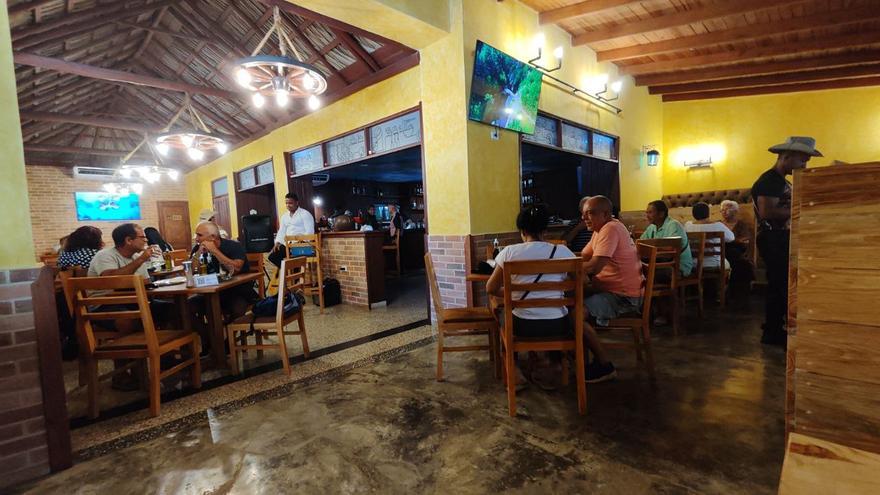
14ymedio bigger14ymedio, Havana, 25 December 2023 — They started popping up, little by little at the beginning of the year, without all the attendant publicity the official media usually gives to these sorts of places. Establishments that were once state-owned, that closed after languishing for years, have reopened overnight as mipymes (a Spanish acronym for micro, small and medium-sized businesses, or MSMEs in English).

Well-stocked stores, restaurants with good food, tastefully decorated boutique hotels. None of this would be strange in any place else of the world. On the contrary, it would be an excellent indication of the solid state of an economy that is committed to private initiative and the prosperity of small businesses. But Cuba is not just any place, and the issue is multi-faceted.

First, there is the opacity. Normally, if the state wanted to sell or rent out a property to an MSME, it would solicit bids. This is what Cuban law, specifically a resolution adopted in April 2022, requires but the government has done little to publicize it. This lack of transparency has fueled a lot of suspicion. Who owns these businesses and how did they get them? How were the new owners chosen if they did not have connections in the highest echelons of power?

Home Deli, a store that has three Havana locations, is owned by an Italian, Andrea Gallina, and his Cuban wife, Diana Sainz, who signs with a different surname than the one she inherited from her father, Ricardo Sáenz, one of continue reading

the founders of the Prensa Latina news agency and the magazine Bohemia. The couple also own Café Bohemia and the adjacent hotel, Estancia Bohemia, in Old Havana, as well as the Paseo 206 Boutique Hotel in Vedado and its ground-floor cafe, Ecléctico.

Though Cuban law and the U.S. embargo prohibit it, several emigrés have opened businesses in Cuba using other people’s names

Then there is the murkiness. For example, very little is known about the owners of the Diplomarket grocery store or the Antojos restaurant except that both are owned by Cuban nationals living in the United States. Diplomarket, which has been described as “the Cuban Costco” due to some similarities it shares with the American chain, belongs to the Miami-based Las Americas TCC Corporation, whose vice president is Frank Cuspinera Medina.

Though Antojos is owned by Reinaldo Rivero, the business is registered in the name of his ex-wife and managed by their son, Reinaldito. Rivero and a foreign partner provided capital not only for the bar but also for the company that provides security to both establishments, which are located on Espada Alley in Old Havana.

Obel Martinez, a dual national who holds both Cuban and U.S. citizenship, now owns the iconic La Carreta, a restaurant in Vedado, as well as the Mojito-Mojito bar in Old Havana.

Though currently a violation of both Cuban law and the U.S. embargo, several emigrés have opened businesses in Cuba using the names of other people on the island., in some cases in association with local officials. The regime seems to be counting on them to save it disastrous economy.

They have, however, been met with rejection by most of the public, who cannot afford their prices and who now realize that the revolution that was supposed to eliminate inequality has, in the end, created new class divisions.

Those who for decades were called worms, traitors and counterrevolutionaries are now the regime’s last great hope for prolonging its agony.

____________

COLLABORATE WITH OUR WORKThe 14ymedio team is committed to practicing serious journalism that reflects Cuba’s reality in all its depth. Thank you for joining us on this long journey. We invite you to continue supporting us by becoming a member of 14ymedio now. Together we can continue transforming journalism in Cuba.

The Anguish of Cubans in the Face of the Government’s Economic ‘Paquetazo’

This Christmas, few dare to believe or say that next year will be better. (14ymedio)

14ymedio bigger14ymedio, Yoani Sánchez, Generation Y, Havana, 29 December 2023 –Few garlands, scarce Christmas trees and less popular enthusiasm are marking the last days of 2023 in Cuba. Apart from the occasional isolated celebration, the spirit of this December seems more marked by uncertainty than by celebration. Added to the long economic crisis and the mass exodus are fears about the great economic paquetazo* that the Island’s authorities have announced for 2024.

Although President Miguel Díaz-Canel has already come out to try to stop the rumors and insists that the cuts are not part of a “neoliberal” process, we all know that Cuban leaders have their own glossary of terms. For decades they have labelled the unemployed with the almost friendly euphemism of “available workers”; the crisis of the 90s was labeled the “Special Period“; and the onslaught that confiscated all private businesses in 1968, even including the boxes of the shoeshine boys, was given the heroic moniker of the “Revolutionary Offensive.”

Miguel Díaz-Canel insists that the cuts are not part of a “neoliberal” process; we all know that Cuban leaders have their own glossary of terms

Knowing this appetite for naming things their own way, it is clear that the authorities do not like it at all when someone gets ahead of them in naming the phenomena and moments that the Cuban reality has gone through. But, it only took a few minutes after Prime Minister Manuel Marrero began to explain before Parliament the economic adjustments that will come with the new year, for the word “paquetazo” to spread through the networks and instant messaging services. This little word names the snips that will be aimed at cutting subsidies while, on the other hand, prices are increased.

This group of actions would also fit well with the definition of “shock plan,” another of the phrases that the official Cuban press likes to use when talking about other countries. What is coming, broadly speaking, includes an increase in the prices of products and services and the end of the universal subsidy for the basic food basket. Following Marrero’s statements, several officials have rushed to assure us that the rationed market “booklet” will not be eliminated, but without guaranteeing that, continue reading

after 60 years of existence, it will be maintained for all consumers.

The paquetazo also includes a 25% increase in the electricity rate for the 6% of the residential sector that consumes the most and charging tourists for fuel in foreign currency. The cost of the water supply will triple for those who do not have a metering device and the price of a liquefied gas cylinder will increase by 25%. New rates will also be applied to passenger transportation services. In addition, Marrero warned of a “review” of the number of people currently on the state payroll, which predicts numerous layoffs.

The announcements before Parliament have raised a wave of concern among both ordinary people and the officials themselves.

It is evident that in a society where welfarism, crude egalitarianism and the rationed market have been used not only as mechanisms for the distribution of goods and products, but also as a form of social and political control, the announcements before Parliament have raised a wave of concern among both ordinary people and the officials themselves. While inside homes there is fear of an even greater increase in the cost of food and basic products, in the air-conditioned offices of institutions and ministries they suspect that the measures will fuel popular protests or accelerate emigration, which hits the labor sector hard, especially the workforce of qualified workers.

Apprehension is in the air. An inquietude that Cubans express these days at an end of the year with few parties and few Christmas trees. When they pass a friend or acquaintance on the street, they don’t even dare to use one of those ready-made and formal phrases that are customary to say these days. No one utters the sarcastic prediction that 2024 “will be better.”

*Translator’s note: “Paquetazo” is basically ‘package’, but the ending ‘azo’, signifying a blow, adds a certain heft to it. (See “Maleconazo“) See also from Spanishtogo.app: “Paquetazo, a term used predominantly in Latin America, refers to a package of economic reforms implemented by the government that often includes a series of austerity measures. Over time, it has become a popular term among citizens to express discontent with these policies.”

______________

Editor’s Note: This text was originally published by Deutsche Welle’s Latin America page .

____________

COLLABORATE WITH OUR WORKThe 14ymedio team is committed to practicing serious journalism that reflects Cuba’s reality in all its depth. Thank you for joining us on this long journey. We invite you to continue supporting us by becoming a member of 14ymedio now. Together we can continue transforming journalism in Cuba.

The Ideological Endogamy of the Cuban Regime

Inauguration of the eye hospital in Anhui, China. (Consulate of Cuba in Shanghai)

14ymedio bigger 14ymedio, Yunior García Aguilera, Madrid, 28 December 2023 — Endogamy is the practice of marrying in closed groups, between individuals of common ancestry. Reproduction between parents who are closely related greatly increases the chances that the offspring will be affected by recessive traits or genetic impairments. One of the most notorious cases was King Charles II of Spain, known as the Bewitched.

The multi-pathological monarch was not able to learn to walk or talk until he was between six and nine years old. He died just shy of his 40th birthday, without any of the attempts to exorcise him being successful. His autopsy described “a heart the size of a peppercorn, corroded lungs, putrid intestines, a single coal-black testicle, and a head full of water.” His death, leaving no descendants, marked the end of the House of Austria.

Another case that has recently achieved notoriety is that of the Whittakers, in West Virginia. Its members suffer from various physical and mental anomalies and are known as the most endogamous family in the United States. Mark Laita, who introduced them to us, claims that they communicate with each other with howls and growls. His controversial documentary on YouTube has been seen by more than 40 million people.

As the model reproduces in a closed circle, it generates anomalies, recessive traits, philosophical and structural deterioration

Regimes that insist on maintaining a kind of ideological endogamy also run the risk of their system suffering the same ailments as Charles II of Spain continue reading

and the Whittakers. As the model reproduces in a closed circle, it generates anomalies, recessive traits, philosophical and structural deterioration. Single-thinking systems breed increasingly mediocre leadership, not to mention the suffering they cause in the body of the societies they try to lead.

That is why the Cuban model is doomed to disappear, because its stubborn inbreeding, far from maintaining a supposed “ideological purity” that ensures power, is reproducing the same error code, with increasingly worse symptoms. From the Process of Rectification of Errors we moved to the Special Period, from the disastrous Battle of Ideas to an even worse Ordering Task, from an endless Coyuntura [roughly ‘temporary sitaution’] to an eternal Contingency, from a very poor Creative Resistance to the current (and ridiculous) War Economy.

Who knows what name they will give to this very long and incurable crisis in 2024. If Díaz-Canel was the smartest sperm generated by the Single Party, what can be expected from the most lagging gametes? There we have Alejandro Gil, perhaps the worst Minister of Economy on the planet, who does not blush when giving the same message of failure, year after year, without anyone thinking of doing him the favor of dismissing him.

There we have Gerardo Hernández Nordelo, the ill-fated former spy who today posts imbecilities from a position as useless as that of presiding over the most grotesque and impoverished mass organization of all those created by the regime to monitor us.

And things get worse if we look at the “new marabous” (they cannot be called “pines”). At least one limits oneself by launching very strong criticisms towards characters like Michel Torres Corona or Pedro Jorge Velázquez. It is not politically correct, in these times, to emphasize their disabilities. Although, in reality, theirs is more about political mountaineering and impudence.

The terrible thing is that all of us, even if we have escaped from the prison island, run the risk of reproducing its practices. The extreme polarization and algorithms of social networks lead us to consume ideas very similar to our own. And we can easily end up locked in circles that reproduce exclusive new thoughts.

Debate is almost an obsolete word. The ’cool’ thing is to say that so-and-so “swept the floor” with so-and-so, or vice versa

Debate is almost an obsolete word. The cool thing is to say that so-and-so “swept the floor” with so-and-so, or vice versa. This obsession with headlines related to the same domestic task shows a great lack of imagination, but it is the result of the intellectual laziness of our time. No one wants to get tangled up in the conflict of having to decide between two divergent opinions. The correct one, a priori, is whoever thinks like me, period.

So, if you can’t reason with another, insult him. If you run out of arguments, launch a smear. If you can’t see the curvature on the horizon, shout that the earth is flat! Most have never climbed so high and they may even applaud you.

I already know that pluralism is not fashionable. But perhaps, just perhaps, respecting the diversity of opinion is the only effective remedy to eradicate, once and for all, that ideological endogamy that we carry in our blood.

____________

COLLABORATE WITH OUR WORKThe 14ymedio team is committed to practicing serious journalism that reflects Cuba’s reality in all its depth. Thank you for joining us on this long journey. We invite you to continue supporting us by becoming a member of 14ymedio now. Together we can continue transforming journalism in Cuba.