Desperate due to the lack of trucks, neighbors set the garbage on fire
At dawn or dusk, day or night, the neighbors set fire to the garbage without any restraint. / 14ymedio
14ymedio, Dario Hernandez, Havana, February 16, 2026 – – Just as mountains of garbage have proliferated on every corner of Havana in recent months, so too has the illegal burning of it. At dawn or dusk, day or night, neighbors set fire to the trash without any restraint. Smoke over the capital and black wisps falling like negatives of snowflakes are becoming commonplace, with the consequent health risks.
“I don’t think people are aware of how dangerous burning solid waste is,” says a nurse who lives in Central Havana. “But they don’t have any other choice. There are garbage dumps burning next to houses, parks, sports fields, everywhere.”
Another Havana resident from Guanabacoa told 14ymedio that on Saturday, returning home at night, he saw a curtain of smoke along his entire route on Vía Blanca. “At certain times of the day, the smell of burning is constant,” he said. Not only in his municipality, he explained, but throughout the city, burning trash “is now a widespread practice because the garbage trucks are delayed or simply don’t come at all.” continue reading
Returning home at night, he saw a curtain of smoke along his entire route. / 14ymedio
“The smell of burning is better than the stench of all that filth,” asserts a resident of Plaza de la Revolución. There’s no other way, she says, to light a fire to get rid of the flies.
From her tall building, she sees what she calls a “Sauron’s ring of waste,” referring to the villain from The Lord of the Rings: distinct garbage dumps that, due to a lack of trucks to collect them because of the critical fuel shortage—exacerbated by the US oil embargo in force since early January—have merged together. “The one that runs from Factor and Conill joins the one at Estancia and Conill, which in turn joins the one at Santa Ana and Estancia, which completes the circle with the one at Factor and Santa Ana,” she lists, lamenting that since the temperatures have begun to rise, the smell is unbearable. Ironically alluding to the plot of J.R.R. Tolkien’s novel, she concludes: “One ring to choke them all.”
Two weeks ago, the official newspaper Cubadebate published a report highlighting some figures on the collapse of waste collection: Havana has 10,000 garbage containers but needs between 20,000 and 30,000, and only between 16,000 and 17,000 cubic meters are being collected daily, whereas in the past between 25,000 and 30,000 cubic meters were collected.
“There’s no other way to get rid of the flies than to light a fire.” / 14ymedio
One of the main problems, the media outlet said, quoting officials, is not only the lack of fuel but also the poor condition of the equipment: of 106 collection trucks, only 44 are working. “We are between 37% and 44% technical availability, well below what is needed,” acknowledged Alexis González Inclán, an official from Municipal Services.
Another drawback is the lack of labor. There is little interest in being a street sweeper because the basic salary they received, which a few years ago was attractive, today, according to González Inclán, “is little more than 2,000 pesos,” while a carton of 30 eggs costs between 2,000 and 3,000 pesos or a pound of rice costs 300 pesos on the informal market.
In a meeting on the issue, President Miguel Díaz-Canel criticized his officials for not acting more quickly before the problem reached its current levels. The Havana government presented 49 measures to address the accumulated garbage piles, but so far, none have been implemented, either on paper or in practice.
_____________________
COLLABORATE WITH OUR WORK: The 14ymedio team is committed to practicing serious journalism that reflects Cuba’s reality in all its depth. Thank you for joining us on this long journey. We invite you to continue supporting us by becoming a member of 14ymedio now. Together we can continue transforming journalism in Cuba.
The event underscores the fracture between the Island’s exportable image and its life in ruins.
The previous edition of the Cigar Festival, held with a lavish gala dinner at the National Capitol, sparked widespread public backlash. / Habanos S.A.
14ymedio, Havana, February 15, 2026 – The Cigar Festival, considered the premier international showcase for Cuban premium tobacco, was suspended this Saturday with no new date set, amid the worst energy crisis the Island has experienced in decades. The state-owned company Habanos S.A., which holds the global marketing monopoly on the famous cigars, published a brief statement on its website announcing that the 26th edition of the festival, scheduled for February 24–27, has been “postponed,” with a new date to be announced “in due course.”
The official argument claims the decision seeks to preserve “the highest standards of quality and experience” for the event. The reality on the Island, however, has already hit rock bottom: severe fuel rationing, closures or cutbacks of basic services, and a collapsed economy barely able to sustain its most elementary operations.
A worker in the hospitality sector, who has participated in previous editions of the Festival and requested anonymity for fear of reprisals, told 14ymedio that the suspension also thwarted plans for even greater displays of ostentation than last year. “Imagine that this year the private party was going to be at El Morro. The Chinese businessman who organizes the whole thing planned that, at one point during the night, the lighthouse would ‘catch fire’ at the tip, all done with lighting effects, like it was a giant cigar. It would have been visible across the whole city,” she said. According to the source, the businessman is “quite furious” about the cancellation of an event whose reasons, she says, were not only the fuel shortage but also the negative political impact of holding it in the midst of the crisis and after the backlash left by the previous edition.
The worker added that many of the employees involved this year felt an intense conflict that was not felt in previous years. “On one hand, the money was badly needed, because they pay well and in foreign currency. But on the other, there was fear,” she confessed. Fear of possible protests, of being singled out or confronted while serving drinks and dishes to a foreign elite insulated from the blackouts and shortages. “After what happened with the Capitol, no one wanted to be at the center of a viral photo or an altercation,” she said.
Thousands of Cubans reacted angrily to the multimillion-dollar waltz for an elite, in stark contrast to a population condemned to darkness
The previous edition of the Cigar Festival, held with a lavish gala dinner at the National Capitol, provoked widespread public rejection that overflowed onto social media. While the country endured prolonged blackouts, food shortages, and a generalized deterioration of daily life, images of foreign guests toasting under restored chandeliers and luxuriously set tables in one of the Republic’s most symbolic buildings were seen as an obscene provocation. Thousands of Cubans reacted with anger continue reading
to the multimillion-dollar spectacle for an elite, in contrast with a population condemned to darkness, rationing, and daily hardship.
Each year, the Cigar Festival attracts millionaires, global distributors, and international aficionados to a celebration of selective glamour in colonial hotels and luxury halls in Havana. Its auction of exclusive humidors—artistic cases that preserve legendary cigars—has reached stratospheric figures. In the previous edition, a commemorative Behike Line humidor set a historic record by selling for 4.6 million euros, and the seven pieces auctioned totaled more than 16 million euros, destined, according to the Government, for Cuba’s public health system.
But that symbolic and real capital coexists grotesquely with a population pushed to the brink of destitution, following the interruption of oil supplies that Cuba imported mainly from Venezuela and Mexico. Thermoelectric plants, most of them obsolete, operate intermittently, and electricity generation never manages to meet national demand.
The decision to postpone the Festival comes at a time when Cuba’s economy is deteriorating rapidly due to multiple factors: the interruption of Venezuelan oil flows following the capture of Nicolás Maduro, the January 29 U.S. executive order threatening tariffs on those who supply fuel to the Island, and the chronic shortage of foreign currency that prevents the import of basic raw materials.
The suspension of the event confirms that outward-oriented luxury and the reality of the average Cuban have become a contradiction that is impossible to conceal
The energy crisis has also served as official justification for shortened workdays, strict gasoline and diesel rationing, temporary hotel closures, and alerts even at airports, where several airlines have canceled flights due to fuel shortages. At the same time, the regime has prioritized internal control, with systematic military exercises and a visible increase in repression.
The Government continues to blame the U.S. embargo and the tightening of oil restrictions for the crisis, presenting it as almost exclusively the result of blockade policy. But that narrative fails to dispel the widespread perception that the national economy is sinking due to internal mistakes and persistence in a failed model. While negotiations continue with foreign distributors and record sales figures are touted, such as the 827 million dollars earned from tobacco in 2024, Cubans’ daily lives unfold amid blackouts, shortages of food and medicine, and a health system on the brink of collapse.
In this context, the suspension of the event confirms that the luxury aimed at foreign audiences and the reality of the average Cuban have become a contradiction that is impossible to conceal. While humidors are auctioned for millions in gala halls, most neighborhoods in Havana and across the provinces survive at the brink. It is the stark contrast between showcase ostentation and everyday misery.
Translated by Regina Anavy
______________________
COLLABORATE WITH OUR WORK: The 14ymedio team is committed to practicing serious journalism that reflects Cuba’s reality in all its depth. Thank you for joining us on this long journey. We invite you to continue supporting us by becoming a member of 14ymedio now. Together we can continue transforming journalism in Cuba.
Three Cuban ships roam the Caribbean in a failed attempt to secure LPG, the gas used for cooking on the Island
The Gas Exelero, sailing under the Marshall Islands flag, is operating / StealthGas
14ymedio, Madrid, February 16, 2026 – The vessel Gas Exelero, dedicated to transporting liquefied petroleum gas (LPG) to Cuba and sailing under the Marshall Islands flag, is heading toward Jamaica after having been in Willemstad, Curaçao on Sunday. Its current draft, 4.2 meters, indicates that the tanker was unable to load LPG on the Dutch island and will attempt to obtain it in Kingston, where the Eugenia Gas failed on Saturday, according to University of Texas specialist Jorge Piñón.
The attempt cost the country some of its already scarce fuel reserves, the expert told this newspaper on Saturday, when the ship was returning to Santiago de Cuba after failing to approach the Petrojam refinery in the Jamaican capital. It was the second failure of the Cuban fleet in half a month, after the Emilia, sailing under the Cuban flag, was unable to acquire LPG in Kingston at the end of January.
Jamaica has been a regular supplier of the cooking gas used in Cuba, but that day an order signed by Donald Trump had just taken effect, threatening tariffs on any country delivering fuel to the Island. VesselFinder records indicated at the time that the Emilia left the Island with the same draft with which it returned.
Bloomberg published an analysis based on satellite images of the levels of light emitted by the Island, determining that the drop reaches 50% in cities such as Santiago de Cuba and Holguín
Fuel restrictions have worsened a situation that had already shown extreme fragility over the past two years. This weekend, the financial outlet Bloomberg published an analysis based on satellite images measuring the continue reading
levels of light emitted by the Island, concluding that brightness has fallen by as much as 50% in cities such as Santiago de Cuba and Holguín compared to historical averages. In rural areas, the situation is even worse, while Havana still showed a significant advantage at the time of the study, with the exception of the neighborhoods of Cojímar and Alamar, which were noticeably darker than the rest.
On Sunday, Cuba’s Electric Union reported peak-hour demand of 3,009 megawatts (MW) compared to a generation capacity of just 1,427 MW. The day was also marked by an incident that sparked laughter amid the dramatic situation.
Unit 1 of the Ernesto Guevara thermoelectric plant went offline due to a breakdown before noon, came back online around 3 p.m., and disconnected again just an hour later. At 5:28 p.m., it was reconnected once more, prompting irony from exhausted customers. “Now I can’t remember whether I was coming in or going out,” one said. “Like a Christmas tree: ‘on for a while, off for a while,’” joked another. “So it went out twice and came back twice. The joke tells itself. Thanks, SEN (National Electric System), because despite the criminal blackouts, you make us laugh every day,” commented one user.
Those sanctioned for failing to comply with the Government’s energy-saving plans are likely in less of a laughing mood. The official media outlet in the province of Las Tunas announced specific measures this weekend aimed at curbing energy consumption, a constant concern across most of the Island depending on local conditions and capacities.
“Like a Christmas tree: ‘on for a while, off for a while,’” joked another.
Among the measures announced by Maritza González Llorente, director of the National Office for the Rational Use of Energy in Las Tunas, is the “only punitive measure” to be applied to companies—both state-run and private—that fail to meet their assigned consumption plans: cutting off their electricity supply.
“Everyone who failed to comply with the January consumption plan is having their service cut off. This measure is notified 48 hours in advance. It is then applied for a minimum of 72 hours, and the maximum duration extends until the debtor recovers the excess consumption,” the official explained.
Disconnection will also be applied to businesses located on “non-blackout” circuits, which required identifying those benefiting from their proximity to hospitals or other vital services. “We will increase control actions on each of these non-blackout circuits, and we will check on weekends, from Friday to Monday, whether the switches are open, in order to report any irregularities,” the official warned.
Translated by Regina Anavy
______________________
COLLABORATE WITH OUR WORK: The 14ymedio team is committed to practicing serious journalism that reflects Cuba’s reality in all its depth. Thank you for joining us on this long journey. We invite you to continue supporting us by becoming a member of 14ymedio now. Together we can continue transforming journalism in Cuba.
A metaphor for the heart of ancient karate, where victory occurs before the fight
Sōkon Matsumura (1809–1899) is one of the founding figures of Tōde, the martial art that later gave rise to Okinawan karate. / Milton Chanes
14ymedio, Milton Chanes, 8 February 2026, Berlin
The Surrender
Shuri, Ryūkyū Kingdom — probably between 1820 and 1835
The king watched from the upper portico, leaning against the carved wooden backrest that overlooked the inner courtyard of Shuri Castle. He had summoned no one beyond a few courtiers and guards. It was not a formal audience. There were no documents, no seals, no affairs of state.
That morning, something else occupied his mind.
An idea that had taken root as useless decisions sometimes do: without cause or purpose, born solely of the boredom that accompanies power when it meets no resistance.
—They say Matsumura is the strongest man in the kingdom —he remarked, without addressing anyone in particular.
The silence that followed was immediate. At court, silence was a form of survival. The king knew that a poorly placed word was enough to turn a casual remark into an irrevocable order.
—They say —he repeated— that there is no one who can defeat him.
One of the advisers inclined his head slightly.
—That is so, Your Majesty. Matsumura Sōkon has served faithfully as royal protector for many years. His reputation—
The king raised his hand. He did not want reputations. He wanted spectacle.
—If he is as strong as they say —he interrupted—, he should be able to face a bull.
The adviser blinked. Not because he had misheard, but because he immediately understood the consequences of those words.
—Your Majesty…
—A fierce bull. One of the large ones. The kind that has killed men —the king added, with a faint smile—. I want to see it.
No one argued. No one asked why. In the Ryūkyū Kingdom, the king’s decisions were not explained; they were carried out.
When the order reached Matsumura, there was no surprise on his face. No indignation either. Only a slight nod, as if this absurd request were just another among the many he had accepted in silence throughout his life.
—When? —he asked.
—In ten days. Before the court.
Matsumura inclined his head and said nothing more.
That same afternoon, he asked to see the keeper of the stables.
The bull was an imposing animal. Black, muscular, its flanks marked by old scars. It had been used in fights, in trials of strength, in exhibitions where men proved their bravery by confronting a beast that knew no fear. Two of them had not survived.
Matsumura observed it in silence from the entrance to the stable. He carried his bō with him—a long staff of smooth wood, simple and unadorned, used both for walking and for combat. He rested it naturally against the ground, as if it were an extension of his body rather than a weapon. He did not step forward at first. He did not measure distance with his body, but with his eyes.
The bull lifted its head, snorted, struck the ground with a hoof. It was accustomed to men reacting—to stepping back, shouting, or brandishing weapons.
Matsumura did nothing.
When he finally entered, he did so slowly, with no visible tension in his shoulders or hands. He walked straight ahead, without hesitation, holding the bō lightly, as if the animal did not exist and, at the same time, as if it were the only thing that mattered.
The first contact was quick and dry.
Not a blow, but a precise touch with the end of the bō to the muzzle, right where an exposed nerve forces even the largest beasts to recoil by pure reflex.
The bull snorted, shook its head, took a step back.
Matsumura was already turning away.
He did not look back as he left.
The next day, he returned.
And the day after that.
Always at the same hour. Always with the same gesture. He entered, advanced without hesitation, touched once with the bō, and left. There was no challenge. No anger. No intent to dominate—only to establish a silent truth.
The bull began to change.
Not in its body, but in its gaze.
When it heard Matsumura’s footsteps, it stopped charging the stable walls. When it saw him cross the threshold, it tensed its muscles… and then hesitated. The touch always came before it could react.
For the animal, this was not a physical defeat, but a certainty: this man did not enter its game.
On the seventh day, Matsumura did not touch the bull.
He entered, advanced to within a few steps of the animal, and stopped. He set the bō on the ground, adopting no stance at all. The bull lowered its head by instinct, as if waiting for the impact that always came.
Nothing happened.
Matsumura turned around and left.
The same occurred on the days that followed. No blow. No gesture. And yet the bull prepared itself each time, tensing its body for an attack that no longer came.
On the day of the confrontation, the castle courtyard was full. Nobles, guards, and servants. The king sat in his place, satisfied. He had awaited that moment the way one awaits a diversion—with a curiosity born not of respect, but of the desire to see something break.
The bull was led to the center of the courtyard. It pulled against the ropes, snorted, struck the ground in fury. The crowd murmured. There was fear, but also anticipation.
Matsumura entered alone.
He was simply dressed. He wore no armor and no protection. Only his bō.
He walked until he stood before the animal and stopped.
For an instant, everything fell silent.
The bull lifted its head.
And recognized him.
There was no charge. No roar.
The animal took a step back. Then another. It lowered its head slowly, as if the weight of its own body had suddenly become unbearable. Finally, it bent its front legs and remained still. Not defeated. Surrendered.
A murmur ran through the court.
The king rose in his seat.
—What does this mean? —he asked, his voice tense.
Matsumura did not answer immediately. He did not look at the king. He did not look at the crowd. His eyes remained on the bull, which trembled slightly.
—Your Majesty —he said at last—, the fight already took place.
—Nothing happened! —the king retorted.
Matsumura then raised his gaze.
—Precisely.
There was no applause. No celebration. The king made a brusque gesture with his hand, ordering the animal to be taken away. The spectacle had ended without giving him what he expected.
But something had broken.
Not in the bull.
What had broken was the very idea of strength that had given rise to that whim.
That night, Matsumura returned to his home without a word. He did not consider himself victorious. Nor did he believe he had delivered a lesson. He had simply acted in accordance with a certainty that had accompanied him for years: that violence is always a belated form of resolution, and that the true contest is decided before the body ever has to intervene.
Some would later say he had humiliated the king. Others, that he had displayed supernatural power. Matsumura corrected no one.
He knew that words rarely reach where actions have already spoken.
Long afterward, when someone asked him what his greatest fight had been, he answered without hesitation:
—The one I did not need to fight.
For the art he had learned did not reside in the strike, but in the instant that precedes it: in reading time, in understanding the other, in the ability to enter a space without imposing oneself upon it.
Though to many the bull had been defeated, the truth is that the language of men is not the same as that of animals. It was not defeated, because it had first been understood. Matsumura did not confront it through force, but through knowledge of its impulses and of the silent laws that governed its world. He acted according to those laws, not against them.
And the king, though he never admitted it, learned something no throne can teach: that there are forces that do not bow to authority, but to calm— even when that calm has been built upon rules of its own, older than any power.
It was a victory without visible scars.
And perhaps for that reason, the only one that endures through time, even if it does so in the form of legend.
Written by Milton Chanes
Sōkon Matsumura (1809–1899) is one of the foundational figures of Okinawan karate. A warrior, strategist, and master, he served as bodyguard to the kings of the Ryūkyū Kingdom and as the custodian of a martial knowledge that went far beyond physical combat. In an era when weapons were forbidden and power was exercised from the shadows, Matsumura developed an art grounded in observation, control of timing, and understanding of the opponent.
Decades later, that legacy would reach Gichin Funakoshi, who, while still young, received Matsumura’s teachings indirectly through his disciples—most notably Ankō Itosu—and carried them into modern Japan, transforming them into what we now know as Karate-Dō. Although Matsumura and Funakoshi did not belong to the same active generation, the bond between them is profound: one embodied the original spirit of the art; the other translated it for the world.
The story that follows—the legend of the bull—is not merely a tale of strength or bravery. It is a metaphor for the heart of ancient karate: the victory that occurs before the strike, when violence is no longer necessary. To understand Matsumura is to understand that principle. And to understand that principle is to grasp where everything that followed truly began.
____________
COLLABORATE WITH OUR WORK: The 14ymedio team is committed to practicing serious journalism that reflects Cuba’s reality in all its depth. Thank you for joining us on this long journey. We invite you to continue supporting us by becoming a member of 14ymedio now. Together we can continue transforming journalism in Cuba.
On March 6, the Island will make its debut in the World Baseball Classic against Panama.
Cuba finished the regular phase with three wins and three losses and was humiliated in the semifinal. / Prensa Latina
14ymedio, Havana, February 15, 2026 – Cuba barely managed to secure third place in a second-tier tournament. On Friday night, Team Asere defeated Panama’s Las Águilas Metropolitanas 7–2 to claim the bronze medal in the second edition of the Serie de las Américas baseball tournament, a championship created as an alternative for winter league teams that do not participate in the Caribbean Series.
Filled with a narrative bordering on the epic, official media stated that “the Cubans turned every hit into an epic verse: they withstood the Panamanian flight, steadied their nerves and, like an Island that never surrenders, closed the tournament with a victory that tasted of honor and memory.”
The national team led by Germán Mesa, which last year ranked 12th in the World Baseball Softball Confederation (WBSC) standings—the worst position for the Island since this system was created in 2011—scored two runs in the first inning, setting the tone of the game early. However, the Panamanians tied it in the second inning with a home run by Edgard Muñoz.
In the third inning, Cuba again showed offensive power and drove in four runs. The game remained unchanged until the sixth inning, when Roel Santos brought in the Island’s seventh run of the afternoon.
“I’m happy because the work paid off and I was able to help the team. We knew this game was important and we came out fighting from the very first moment,” said Christian Rodríguez, one of Cuba’s standout players in continue reading
the tournament.
“It wasn’t an elite team, but it was a team that fought hard and won a medal. I’m very self-critical”
The celebratory mood was tempered by the Cuban manager’s final remarks, as he admitted that the squad “wasn’t an elite team, but it was a team that fought hard and won a medal. I’m very self-critical, I always want a little more, but the result is fine.”
Although Team Cuba leaves the tournament with a medal, the result falls short of ideal, given that the event is second-tier, as the region’s strongest teams were simultaneously competing in the Caribbean Series in Mexico. In this second edition of the Serie de las Américas, which is not sanctioned by the Caribbean Professional Baseball Confederation (CBPC), the participants included Cuba (represented by its national team), Panama (Águilas Metropolitanas), Nicaragua (Leones de León), Colombia (Caimanes de Barranquilla), Venezuela (Navegantes del Magallanes), Curaçao (Willemstad Cannons), and Argentina (Club Daom).
In the regular phase, Team Asere finished third with three wins and three losses. With those results, Germán Mesa’s squad advanced to the semifinals, where it was humiliated 9–1 by Navegantes del Magallanes, the team that went on to win the title 10–9 against Caimanes de Barranquilla, also on Friday night, at the Monumental de Caracas stadium.
Thus, Cuba began its road to the World Baseball Classic with a failure in Venezuela. The team will next travel to Nicaragua, where it will play exhibition games against opponents yet to be determined. The preparation schedule also includes two more games during spring training in Arizona: the first against the Kansas City Royals on March 3, and the following day against the Cincinnati Reds.
On March 6, the Island will make its World Baseball Classic debut against Panama at Hiram Bithorn Stadium in San Juan, Puerto Rico, provided that the United States grants the necessary visas, something Germán Mesa is confident about. Two days later, Cuba will face Colombia. On March 9, it will take on the host team and will close its participation two days later against Canada. Team Asere will try, at the very least, to match its most recent performance in 2023, when it finished fourth after losing to Mexico, though still far from its feat in 2006, when it reached the final and fell to Japan.
Translated by Regina Anavy
____________
COLLABORATE WITH OUR WORK: The 14ymedio team is committed to practicing serious journalism that reflects Cuba’s reality in all its depth. Thank you for joining us on this long journey. We invite you to continue supporting us by becoming a member of 14ymedio now. Together we can continue transforming journalism in Cuba.
Cubalex makes public the response of the OAS-linked organization regarding a request that was sent to it in 2018
Maykel Osorbo has been serving a nine-year prison sentence since May 2022 for contempt, assault, public disorder, and “defamation of institutions and organizations, heroes and martyrs” / Facebook
14ymedio, Havana, 11 February 2026 — The Inter-American Commission on Human Rights (IACHR) has demanded investigations “to clarify and determine the responsibilities” for the abuses against rapper Maykel Castillo Osorbo, imprisoned in Cuba since 2021. In a report analyzing the artist’s case, the organization also calls for full reparations for the human rights violations he has suffered.
The document, signed last December and made public this Tuesday by the legal advice center Cubalex, is a response to a request made by the NGO more than seven years ago, on October 4, 2018. In it, they outlined the case of the artist, who had recently been arrested at his home and charged with “assault.” That arrest came three days after he organized a concert at La Madriguera, the headquarters of the Hermanos Saíz Association, where, along with other artists, Osorbo spoke out against Decree 349, which criminalizes independent art in Cuba. [See also]
The artist received an 18-month prison sentence for that offense, although he was released in October 2019 and finished serving his sentence a month later while free. This is therefore a separate case from the one that landed him in prison in 2021, where he remains.
The Commission indicates that it documented the “arrests, threats, harassment and acts of violence” against Maykel Castillo
In its analysis, the Commission indicates that it documented the “arrests, threats, harassment and acts of violence” against Maykel Castillo and calls for “an immediate end to all types of persecution against Maykel Castillo, in particular, acts of harassment, stalking and attacks,” and for “the provision of the necessary physical and mental health care measures for the rehabilitation” of the rapper.
As Cubalex reports, the artist is currently in a vulnerable situation after being arbitrarily transferred and subjected to harassment, without clear official information or verifiable guarantees regarding his safety. On January 29, he was abruptly removed from the Kilo 5 y Medio prison in Pinar del Río, where he had been held since 2021, without any explanation being given to his family. Although the legal NGO confirmed the following day that he had been returned to the same prison, it reported that during the transfer he was deprived of his medication and his continue reading
only coat amidst a sharp drop in temperature, causing him to suffer from the flu and fever, which exacerbates the risks to his health.
Although it makes no reference to this situation because the subject of the petition dated from 2018, the IACHR report uses the Osorbo case to denounce that, “for more than three decades,” in Cuba there is “a marked intolerance in relation to artistic manifestations.”
“For more than three decades,” in Cuba there has been “a marked intolerance in relation to artistic expressions”
The organization points out that the repression against the rapper is framed “in a context where independent artists are victims of repression by the Cuban State, an aspect that has intensified since 2017 with restrictions on the use of public spaces and regulations that limit artistic creation.”
In response, the Commission states that the “creative potential of art also depends on respect for freedom of expression.” Its analysis points out that “the right to artistic or symbolic expression, to the dissemination of artistic expression, and to access to art in all its forms, is one of the forms of expression specifically protected by Inter-American instruments.”
The IACHR also maintains that art can constitute a form of protest. It adds that “the use of the imaginary and fiction must be understood and respected as an essential element of freedom indispensable for creative activity,” and reaffirms that it should not be restricted with the aim of protecting particular institutions or abstract notions, concepts, or beliefs such as national symbols.
Osorbo, one of the authors of the emblematic song “Patria y Vida” (Homeland and Life), which became a symbol of protest in Cuba and for which he won two Latin Grammy Awards that he was never able to accept, has been serving a nine-year prison sentence for contempt, assault, public disorder, and “defamation of institutions and organizations, heroes, and martyrs” since May 2022, although he had already spent 13 months in jail—since April 2021—which are deducted from his sentence. In the same case, the artist Luis Manuel Otero Alcántara was sentenced to five years.
He is serving a nine-year prison sentence for contempt, assault, public disorder and “defamation of institutions”
They are among the 1,207 political prisoners on the island, a record high, according to the most recent report published by Prisoners Defenders on February 5. Of these, 436 are seriously ill and 42 suffer from mental disorders without receiving medication.
Although the rapper has repeatedly expressed openness to being released on the condition of forced exile, this option has not materialized. He was also not released during the process brokered by Pope Francis, which resulted in the release of more than 500 people, fewer than half of whom were political prisoners, according to the government, “for the Jubilee Year.”
____________
COLLABORATE WITH OUR WORK: The 14ymedio team is committed to practicing serious journalism that reflects Cuba’s reality in all its depth. Thank you for joining us on this long journey. We invite you to continue supporting us by becoming a member of 14ymedio now. Together we can continue transforming journalism in Cuba.
Only when popular rejection became massive did the regime decide to interpret the episode as a political problem
Feitó will be remembered for a long time as the functionary “disguised as a minister.” / Radio Rebelde
14ymedio, Havana, December 27, 2025 [delayed translation] — For years, Marta Elena Feitó embodied the ideal profile of a reliable figure within the Cuban system. She appeared disciplined, understated, effective at repeating the official line, and carefully avoiding any gesture that could be interpreted as dissent. From the Ministry of Labor and Social Security, one of the most sensitive portfolios in a country impoverished to the extreme, she defended statistics and slogans that increasingly clashed with the realities of Cuban life. In 2025, this disconnect between rhetoric and the realities on the ground made her one of the most significant figures of the year.
The breaking point came during a public address in which Feitó referred to the people wandering the streets as “in disguise,” implying that it wasn’t real poverty, but rather a staged performance designed to live “effortlessly” and discredit the Revolution. The phrase was a blatant summary of the official narrative that insists on denying the obvious. In a country where begging—officially “eradicated” for decades—has brutally flooded parks, doorways, and streets, those words sounded like the height of the ruling class’s delusion.
Images of elderly people scavenging in garbage, people with disabilities begging for alms, and adults and children sleeping on the streets are now an undeniable part of the urban landscape. Faced with this reality, the minister’s statement was not only insensitive but also politically clumsy. Denying poverty from a position specifically tasked with managing it exposed, without any filter, the disconnect between the government and the citizens it claims to represent.
None of those present contradicted her, corrected her, or expressed any objections. On the contrary, her words were met with agreement and applause.
During that speech, Marta Elena Feitó was not a lone voice in the chamber. None of those present contradicted her, corrected her, or expressed any objections. On the contrary, her words were met with agreement and applause. Among them was Deputy Yusuam Palacios, a figure constantly promoted by the regime as a young intellectual, a reliable continue reading
heir to the revolutionary discourse, and a renewed face of the cultural establishment. Palacios not only applauded but also endorsed a denial that was not foreign to him.
That immediate support made it clear that Feitó’s statements were not a personal error, but part of a political consensus. Only when popular rejection became massive—when social media, the independent press, testimonies, and public outrage transformed the phrase into a symbol of institutional contempt for the most vulnerable—did the regime decide to interpret the episode as a political problem.
The reaction was late and defensive. For days, outrage built up without any official body issuing a redress. Then came the dismissal, wrapped in the usual language: “the lack of objectivity and sensitivity with which he addressed issues that are central to current political and governmental management, focused on addressing real and never-desired phenomena in our society.” Feitó disappeared from the media scene without his name being mentioned again in the pro-government press.
Her departure was clearly a damage control operation. The minister ceased to be useful when her discourse, until then functional, began to generate political costs. Poverty, now a collective experience, could no longer be treated as a mere facade.
Nothing changed afterward. Begging continues to grow, wages remain insufficient, and social assistance—the direct responsibility of her ministry—proved incapable of responding to the magnitude of the collapse. The policies remained intact. They sacrificed one official, but not the structure. Feitó will be remembered for a long time as the civil servant “disguised as a minister.”
____________
COLLABORATE WITH OUR WORK: The 14ymedio team is committed to practicing serious journalism that reflects Cuba’s reality in all its depth. Thank you for joining us on this long journey. We invite you to continue supporting us by becoming a member of 14ymedio now. Together we can continue transforming journalism in Cuba.
The double standard as the foreign policy of Castroism
The most obscene example occurred in August 1968, when Warsaw Pact tanks crushed the Prague Spring. / Public domain image
14ymedio, Yunior García Aguilera, Madrid, 15 February 2025 — The Cuban regime has constructed much of its political narrative on two concepts it repeats ad nauseam: sovereignty and anti-imperialism. In practice, both function less as principles than as rhetorical crutches. A minimally honest look is enough to show that, in the real Cuba, sovereignty does not reside in the people nor is it expressed through freely elected representatives, but rather has been hijacked by the sectarian interests of a single party. Anti-imperialism, for its part, operates like a broken compass that points only toward Washington.
The most obscene example of this double standard was seen in August 1968, when Warsaw Pact tanks crushed the Prague Spring. While thousands of Czechoslovakians watched their attempt to build democratic socialism evaporate, Fidel Castro delivered a lengthy televised speech endorsing the invasion. All his previous rhetoric about self-determination and the sovereignty of the peoples vanished at once. After an elaborate ideological sleight of hand, he justified the entry of Soviet troops as a “necessary” measure to save socialism and prevent Czechoslovakia from “falling into the arms of imperialism.”
More than half a century later, the script was repeated with less grandiosity and greater cynicism. Following the Russian invasion of Ukraine in 2022, Miguel Díaz-Canel chose to blame NATO, denounce the so-called “Western military expansion,” and present the aggression as a defensive reaction. In official statements and declarations, the regime decided to align itself with “the just demands of the Russian Federation,” without ambiguity or shame, adopting the Kremlin’s narrative as its own.
Everything indicates that the same reasoning would apply to a potential Chinese attack against Taiwan. Cuban foreign policy has made it clear that its strategic loyalty in Asia lies with Beijing and Xi Jinping, not with the right of any people to freely decide their future. continue reading
In May 1987, units involving Cuban troops were implicated in repressive operations in Luanda, in the context of internal MPLA struggles.
The history of the Cuban Revolution is marked, also, by systematic interference in the internal affairs of other countries. Since the 1960s, Havana has promoted, trained, and financed guerrilla movements throughout much of Latin America. This amounted to an armed export of its political model, carried out without regard for the human cost or the social rejection it generated in the countries where it intervened.
In Africa, this policy reached the dimensions of conventional warfare. In May 1987, units that included Cuban troops were involved in repressive
In the transition to freedom and democracy, the White House should resist the temptation to undertake this task alone.
Castroism faces an unprecedented crisis, although the regime’s capacity to resist should never be underestimated. / 14ymedio
14ymedio, Federico Hernández Aguilar, San Salvador, February 13, 2026 – Faced with Cuba’s energy collapse and its foreseeable social consequences, practiclaly all analyses of the situation on the island agree on three very specific points: that Castroism is facing an crisis without precedents; that one should never underestimate, despite everything, the capacity of the regime to resist and reinvent itself, despite everything; and that, finally, it is impossible to predict what will happen after 67 years of dictatorship.
While largely agreeing with these preliminary deductions, it is worthwhile to risk some hypotheses that can contribute criteria and ideas to the public debate on Cuba and its future. Because the fundamental dilemma is not about setting an exact date for the death and burial of Castroism—whose political and economic model, de facto, expired several years ago after a long agony—but rather about trying to commit to a transitional alternative that enables democratic construction and minimizes the imaginable humanitarian impacts.
Cuba, to begin with, is not Venezuela. In Caracas, there weren’t enough compatriots willing to die alongside Nicolás Maduro: the vast majority of the dead were Cubans. On the island, there are indeed enough soldiers ready to sacrifice themselves, just as those who fell defending—at the last minute—Maduro, because they weren’t offering their lives for the Chavista dictator, but for an ideology instilled in them since childhood.
Cuba, to begin with, is not Venezuela. In Caracas, there weren’t enough compatriots willing to die alongside Nicolás Maduro: the vast majority of the dead were Cubans
These quasi-religious convictions have been fundamental to the maintenance of Castroism, and it is advisable to analyze them before undertaking any kind of military incursion into Cuba. The United States, on the other hand, even assuming it could orchestrate the regime’s implosion (through leaks and negotiations) with a popular uprising, would have to act quickly to limit the operational capacity of the official repressive apparatus. And that, while essential, is quite complicated. continue reading
While it is true that the charisma narrative of Castroism died with Fidel, the cohesion of the political and military elite has allowed for a level of control and surveillance unparalleled in Latin America. Dismantling this structure requires a high degree of lethality, delivered with agility and precision. Undoubtedly, the US possesses these capabilities, but exercising them on an island like Cuba could indefinitely delay decision-making. Meanwhile, tragically, citizens would be wondering what the difference would be between dying of hunger and going out into the street to be shot. It is impossible to write this without trembling fingers.
Regarding the transition to freedom and democracy, the White House should resist the temptation to undertake this task alone. Throughout the 20th century, ordinary Cubans didn’t speak of the aid the United States had given them in 1898 to achieve their independence; what they remembered was the Yankee occupation and the humiliating conditions imposed from Washington at the behest of Senator Orville Platt—hence the name of the famous 1901 Platt Amendment to the Cuban Constitution—which limited the island’s trade relations, forced it to cede portions of territory (such as Guantánamo), and exposed it to future interventions.
President Trump is likely unaware of this history, but his Secretary of State certainly is. Marco Rubio knows of Cuba’s tendency to view its large neighbor with suspicion, however much it now needs Cuba to shake off its tyranny. Washington, therefore, would be wise to lead a hemispheric alliance of nations willing to contribute, especially logistically and intellectually, to the arduous transition process in a country that has seen key figures killed, detained, or exiled. Chile, Argentina, El Salvador, and Paraguay, to name a few, are countries that have successfully transitioned from dictatorship or war to democracy. Requesting their collaboration would be an encouraging display of wisdom.
It would, therefore ,be in Washington’s best interest to take the lead in a hemispheric alliance of nations willing to contribute, especially logistically and intellectually, to the arduous transition process.
Meanwhile, clearly, the imposed president Miguel Díaz-Canel has asked Cubans, even though they’ve already suffered everything, to prepare to suffer even more. What are two hours of renewed calls for sacrifice to a guy who never stops eating exquisite food and using electric light bulbs?
Jorge Dalton, a prestigious documentary filmmaker and founder of the International Film School of San Antonio de los Baños, recently wrote on his social media: “I see officials giving sterile speeches and harangues, projecting a false pride that reminds me of that story about a man who is drowning in the sea and, with water already entering his mouth, instead of asking for help he shouts: What a beautiful Caribbean Sea I am swallowing!”
Castroism, in any case, has already been swallowed up by history. There was and will be no absolution for those who caused Cuban blood to flow—in torrents!—for a model that was incapable of recognizing its own demise.
____________
COLLABORATE WITH OUR WORK: The 14ymedio team is committed to practicing serious journalism that reflects Cuba’s reality in all its depth. Thank you for joining us on this long journey. We invite you to continue supporting us by becoming a member of 14ymedio now. Together we can continue transforming journalism in Cuba.
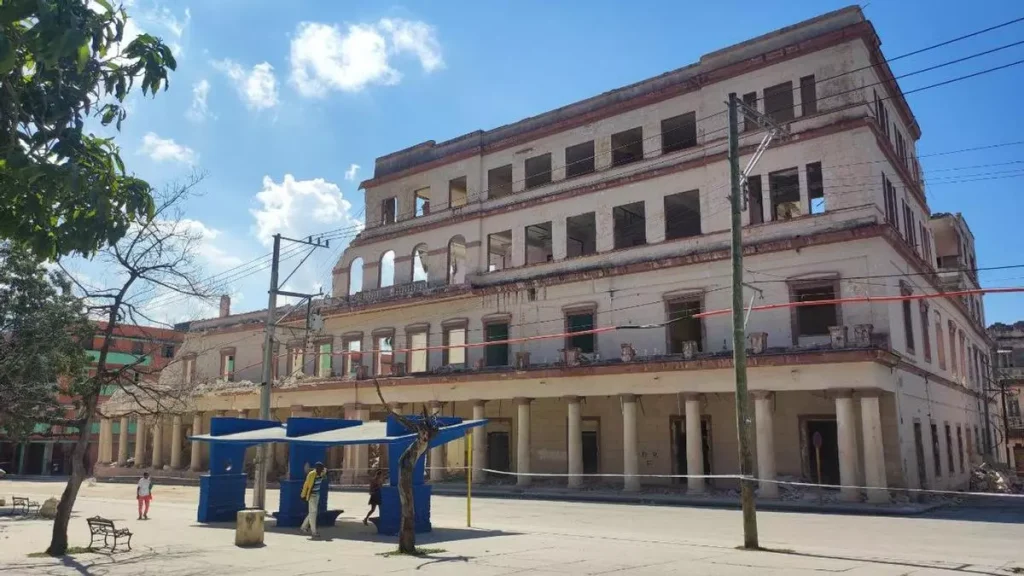
The imposing building on Belascoaín Street has become a garbage dump and a public toilet.
The nearby bus stop has also been cordoned off with warning tape, and passersby are quickening their pace for fear of another collapse. / 14ymedio
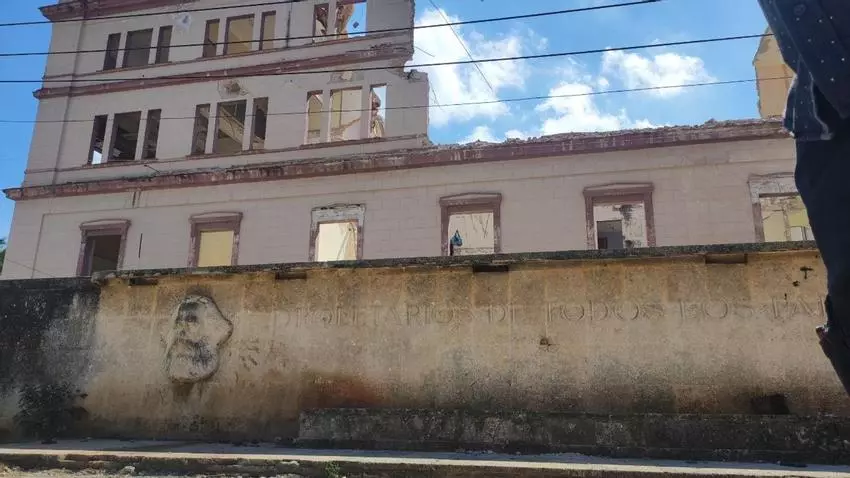
14ymedio, Natalia López Moya, Havana, 15 February 2026 — The dust covers Belascoaín Street in Central Havana. Several strips of yellow tape block the section in front of the former Higher Institute of Industrial Design (ISDi) building. The umpteenth collapse of part of its structure had left a trail of rubble that prevents vehicles from passing and endangers pedestrians who venture to cross the blocked area. On Saturday, the image of this stretch of avenue without vehicles was a stark reminder of a city gripped by a fuel crisis and the deterioration of its infrastructure.
In the nearby line to enter a restaurant on the corner of Reina Street, the conversation was all about the loud crash heard last week when a piece of the building located between Maloja and Enrique Barnet collapsed. Even now, fragments of its walls and columns are scattered around the area. The nearby bus stop has also been cordoned off with warning tape, and pedestrians walking along the sidewalk in front of the windowless, doorless structure quicken their pace for fear of another collapse.
The building, which originally served as a military hotel and officers’ club for the Spanish Army, was also used as the headquarters of the Cadet School (1874-1878), a Widows’ and Orphans’ Home, the General Staff headquarters during the First American Occupation, and even the Ministry of Health before Fidel Castro came to power in January 1959. Graduates of ISDi remember it as a bright, welcoming space brimming with creativity. But for the closest neighbors, the building, which occupies an entire city block, has been a headache and a constant source of worry for years. continue reading
In a city with serious health problems, the former ISDi has become another “hotspot for infections” / 14ymedio
Carmita, a nearby resident, fears the destruction will continue for months or years without the authorities deciding to remove what remains of the structure. “It’s become a dump and a public toilet,” she laments. In addition to the danger of a piece of its walls falling on someone’s head, there are the epidemiological risks of ruins where mosquitoes, flies, and garbage all share the space. In a city with serious sanitation problems, the former ISDi has become another “hotbed of infection,” according to this Havana resident.
A flower vendor offers his wares to couples on Valentine’s Day. Carefully, he wipes down the glass containers where he keeps plastic roses and teddy bears. “This street is filthy,” the vendor laments as he dusts off the fine particles left in the air after the recent collapse of the once-colossal Belascoaín building.
____________
COLLABORATE WITH OUR WORK: The 14ymedio team is committed to practicing serious journalism that reflects Cuba’s reality in all its depth. Thank you for joining us on this long journey. We invite you to continue supporting us by becoming a member of 14ymedio now. Together we can continue transforming journalism in Cuba.
Four Cuban-American members of Congress sign a petition addressed to Donald Trump
The case of the downing of the planes has recently returned to the spotlight following the arrest in the US of Luis Raúl González-Pardo, one of the Cuban military pilots involved. / Escambray
14ymedio, Havana, 14 February 2026 — Cuban-American members of Congress have petitioned President Donald Trump to bring criminal charges against Raúl Castro for his responsibility in the 1996 shooting down of two Brothers to the Rescue planes and the death of their four crew members. The initiative adds to Washington’s policy of pressure to hasten the end of the Cuban regime and has sparked speculation about an unlikely operation to capture the 90-year-old general, similar to the one carried out against Nicolás Maduro.
In a letter dated 13 February, Congressmembers Mario Díaz-Balart, María Elvira Salazar, Carlos A. Giménez and Nicole Malliotakis asked Trump to have the Department of Justice consider formally charging Raúl Castro with the attack on the planes; they also suggested evaluating the issuance of an Interpol red alert against the then Cuban Minister of Defence.
In the letter published by Congressman Díaz-Balart, the legislators back up their accusation with information in the public domain—including a recording released by The Miami Herald—that incriminates Raúl Castro as responsible for the incident, having directly ordered the attack on the unarmed aircraft.
Along with the letter signed by the members of Congress, Díaz-Balart posted on his profile:
“President Donald Trump has been a staunch ally and a symbol of hope for the brave activists fighting for democracy, and he has stood firm against the ruthless dictators who oppress them.”
It emphasises Raúl Castro’s criminal responsibility and the need for justice after 30 years of inaction. It concludes: “We commend President Trump for prioritising US national security in his foreign policy decisions.” And referring to the Cuban regime: “The thugs who have oppressed, tortured and murdered must be brought to justice, and accountability must start at the top.”
February 24 marks the 30th anniversary of this tragedy in which four civilian activists from Brothers to the Rescue died: Armando Alejandre Jr., Carlos Costa, Mario de la Peña and Pablo Morales; three of them were US citizens and one was a permanent resident. All four were participating in a mission to assist Cuban migrants attempting to escape the regime in international waters.
The case of the downing of the planes has recently returned to the spotlight following the arrest in the United States of Luis Raúl González-Pardo, one of the Cuban military pilots involved. US authorities accused the former military officer of immigration fraud and continue reading
of concealing information about his ties to the regime during his entry process into the country.
Three decades have passed since this tragedy in which four civilian activists from Brothers to the Rescue died.
Gerardo Hernández, a former Cuban spy convicted in the United States – currently coordinator of the Committees for the Defence of the Revolution in Cuba – is singled out in the letter from the Congressmembers as the only person convicted to date for his participation in the conspiracy that ended with the attack on the planes, after sharing flight data and information on the activities of the group of exiles.
The former spy has responded to the legislators’ letter with mockery on social media: “It seems that the trio of congressmembers have not realised that the only legal argument the US could use – lying that the shooting down took place in international waters – they themselves have just ruined by approving Trump’s bombing of boats in international waters for ‘national security reasons’.”
The controversy over the exact location where the planes were shot down has been central to discussions surrounding the incident. The regime uses as a defence that Brothers to the Rescue was conducting provocative flights over national territory and that the action was taken for security reasons. However, the report by the International Civil Aviation Organisation (ICAO) concluded that the events took place outside Cuban airspace. This could open the door to US jurisdiction as it involves the death of US citizens outside its territory.
Cuban-American Congresswoman María Elvira Salazar emphasised in her X profile the importance of condemning Raúl Castro: “He was in charge. It is time to reopen the case, pursue the truth to the highest levels and bring him to justice.”
Another signatory to the petition, Republican Carlos A. Giménez – the only member of Congress born in Cuba – reaffirmed his position in an interview with Fox News. He argued that Cuba “is approaching its Berlin Wall moment” and that “the brutal Cuban regime is collapsing in real time.” Referring to US actions against the dictatorship, he said that “this is no time to blink. It is time to finish the job.” He added that the Cuban crisis is the sole responsibility of the regime and concluded with a resounding call to the US president: “President Trump, the time for a free Cuba is now.”
Translated by GH
____________
COLLABORATE WITH OUR WORK: The 14ymedio team is committed to practicing serious journalism that reflects Cuba’s reality in all its depth. Thank you for joining us on this long journey. We invite you to continue supporting us by becoming a member of 14ymedio now. Together we can continue transforming journalism in Cuba.
Should the international community look the other way while Cubans are thrown into prison, tortured, humiliated, or expelled from their own country?
¿Is a nation deliberately impoverished and forced to choose between living in silence while enduring illness, hunger, misery, and pain truly sovereign? // 14ymedio
14ymedio, Karel J. Leyva, Montreal, February 14, 2026 — The modern principle of sovereignty was formulated in 17th-century Europe, after the Peace of Westphalia, with a clear objective: to limit wars between powers and establish that each state would exercise authority within its borders without external interference. Sovereignty was thus born as a mechanism to reduce international violence and stabilize a system marked by constant conflict.
Over time, this principle became a cornerstone of international law. Without the rule of non-intervention, the international system would have continued to be dominated by preventive wars and constant disputes over jurisdiction. Sovereignty established a minimum boundary: each state governs within its territory, and others may not freely intervene in its internal affairs. This principle, though imperfect, allowed for a certain degree of stability and especially protected weaker countries from more powerful ones.
However, beginning in the mid-20th century, international law introduced a decisive shift. The United Nations Charter, the Universal Declaration of Human Rights, and the 1966 International Covenants affirmed that state authority has limits when life, physical integrity, and fundamental freedoms are at stake. Sovereignty ceased to be understood as an absolute principle and began to be understood as authority subject to obligations.
That a situation occurs within a state’s borders does not mean that any action by political power is automatically justified
The principle of the Responsibility to Protect, adopted by the United Nations General Assembly in 2005, clearly expresses this transformation: sovereignty implies not only rights but also responsibilities, including the obligation to protect populations from genocide, war crimes, ethnic cleansing, and crimes against humanity. When a state fails to fulfill that function, the international community may act, under particular circumstances.
This introduces a fundamental distinction: the fact that a situation occurs within a state’s borders does not mean that any action by political power is automatically justified. The “internal” character of a problem does not render the systematic violation of basic rights legitimate.
The Cuban case illustrates this clearly. For decades, political power has imprisoned opponents, repressed peaceful demonstrations, punished dissent through surveillance, harassment, and disproportionate sentences, and generated continue reading
economic and social conditions that keep broad sectors of the population in persistent structural precariousness. These are not isolated incidents or occasional excesses but part of a system of control spanning more than six decades.
Should the international community look the other way, hiding behind a conveniently interpreted principle?
For too many years, the Cuban regime has demanded respect for national sovereignty while brutally punishing its own people. Whom does the sovereignty they defend truly protect? The Cuban nation, a nation literally plunged into darkness, forced to live with its head bowed, dominated by fear? Is the nation not rather the victim of the success of sovereignist rhetoric? Is a nation deliberately impoverished, forced to choose silence while enduring illness, hunger, misery, and pain truly sovereign?
Is the sovereignty invoked by the Cuban Government the sovereignty of a free people or rather that of unchecked power, whose sole function is to preserve itself and guarantee the survival of the brutality and cynicism of an absolutist regime?
Should the international community look the other way, hiding behind a conveniently interpreted principle, while Cubans who attempt to express themselves freely are thrown into prison, tortured, humiliated, or expelled from their own country?
A principle created to limit war between states cannot become the pretext that legitimizes the systematic violence of a totalitarian state against an entire nation. If it does, it would lose all legitimacy and moral value. The sovereignty of impunity is not the sovereignty of a nation; it is the sovereignty of a tyrant.
Translated by Regina Anavy
____________
COLLABORATE WITH OUR WORK: The 14ymedio team is committed to practicing serious journalism that reflects Cuba’s reality in all its depth. Thank you for joining us on this long journey. We invite you to continue supporting us by becoming a member of 14ymedio now. Together we can continue transforming journalism in Cuba.
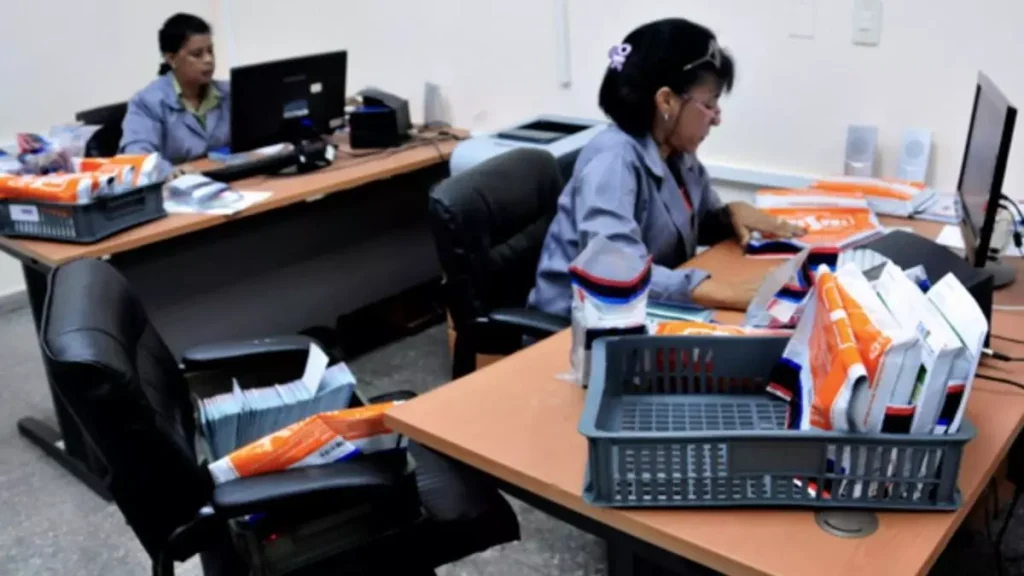
Those without dollars must wake up at dawn, endure long hours of waiting, and return when a blackout interrupts the work
Getting or correcting an identity document is no longer just a procedure: it’s a test of endurance. / Cubadebate
14ymedio, Julio César Contreras, San José de las Lajas, February 14, 2025 — At seven in the morning, when the identity card office in San José de las Lajas should be getting into rhythm, fatigue has already spread through the waiting room. The metal chairs, lined up with a discipline that contrasts with the disorder of the procedures, are occupied by resigned bodies: men in caps, women with large handbags, elderly people staring at the floor, and young people passing the time on their phones. In one corner, two little girls swipe at a screen, unaware of the errand that brought their mothers there. The ceiling fan turns slowly, as if it too were rationing energy.
Handling any paperwork at this Ministry of the Interior office has become an exercise in endurance. Not only because of the usual bureaucracy, but because administrative collapse is now compounded by the so-called “reorganization program” the Government has imposed in response to the energy crisis. In practice, this means unexpected blackouts, interrupted schedules, computers shutting down in the middle of a procedure, and employees who frequently ask for patience as the only possible response.
Yesenia knows this well. She lives in the Jamaica neighborhood at the other end of town, and this is the third time she has repeated the same routine. “I come at five in the morning to get in line, spend three or four hours making sure no one cuts in front of me, and when I finally sit down at the computer, the power goes out or they tell me there’s no material to make the ID,” she says. She has been without identification for nearly a month after losing all her documents. Just getting to the office on 13th Avenue costs her no less than 500 pesos in transportation. “Once is complicated. Three times is disrespectful,” she sums up. continue reading
Just getting to the office on 13th Avenue costs her no less than 500 pesos in transportation.
At eleven in the morning, Yesenia finally manages to sit at the desk. The employee listens halfway and then gets up to go to another department, leaving her hanging. “It’s taking about forty minutes per procedure,” she comments, glancing at the clock. “You need infinite patience.” The official hours, from seven in the morning to four in the afternoon, are more of a theoretical reference. Blackouts, broken equipment, and lack of connectivity turn each day into a game of Russian roulette.
In this uneven game, not everyone is playing with the same cards. Sergio waits calmly in the room, with no sign of having arrived at dawn. “One of the girls here is going to help me,” he says quietly. He is applying for a passport and knows the process can take a month and a half or more, but he also knows there are shortcuts. “If you’re in a hurry, you have no choice but to pay for the stamps at whatever price they ask on the street and let something drop in here,” he explains. His son sent him dollars for that. “It’s the only way not to spend another New Year’s in Cuba.”
The gesture with which he greets the clerk when she enters the room confirms there are unwritten rules. Sergio expects to have his passport in about ten days. He doesn’t know exactly how his acquaintance speeds things up, but he is sure he’s not the only beneficiary. Meanwhile, others keep counting how many times they have come without resolving anything.
Isis carries a different story, though just as exhausting. She is trying to correct an error on her daughter’s ID card. First it was a misspelled last name. Then an accent mark missing from the first name. Now, a wrong number in the birth date. “I check the data on the screen and everything is fine, but when they print it, it comes out wrong,” she says, unable to hide her frustration. For her, the problem is not only the lack of resources but the total absence of empathy. “They don’t put any care into what they do,” she laments.
In four months she has been attended by different employees, almost all with evident difficulties handling the computer.
In four months she has been attended by different employees, almost all with evident difficulties handling the computer. “I don’t think they are properly trained,” she says. And she makes it clear that her case is not an exception. “You end up making new friends here from running into the same people so many times, all of us trapped by the bureaucracy.”
The images in the waiting room reinforce that sense of endless waiting. A television at the back plays without sound; the blinds let in a dull light that does little to ease the heat. Outside, the city continues at its slow pace, also marked by blackouts and fuel shortages.
In San José de las Lajas, getting or correcting an identity document is no longer just a procedure: it is a test of endurance. The “contingency plan,” as the authorities also call it, has added another layer of uncertainty to a system already full of obstacles. Between predawn lines, blackouts, repeated errors, and paid favors, residents learn that in order to exist on paper, they must first survive the wait.
Translated by Regina Anavy
____________
COLLABORATE WITH OUR WORK: The 14ymedio team is committed to practicing serious journalism that reflects Cuba’s reality in all its depth. Thank you for joining us on this long journey. We invite you to continue supporting us by becoming a member of 14ymedio now. Together we can continue transforming journalism in Cuba.
“If I work twelve hours, I can make more than 5,000 pesos a day, although it’s quite hard.”
Motorcycles and bicycles are trying to fill the gap left for transporting goods. / 14ymedio
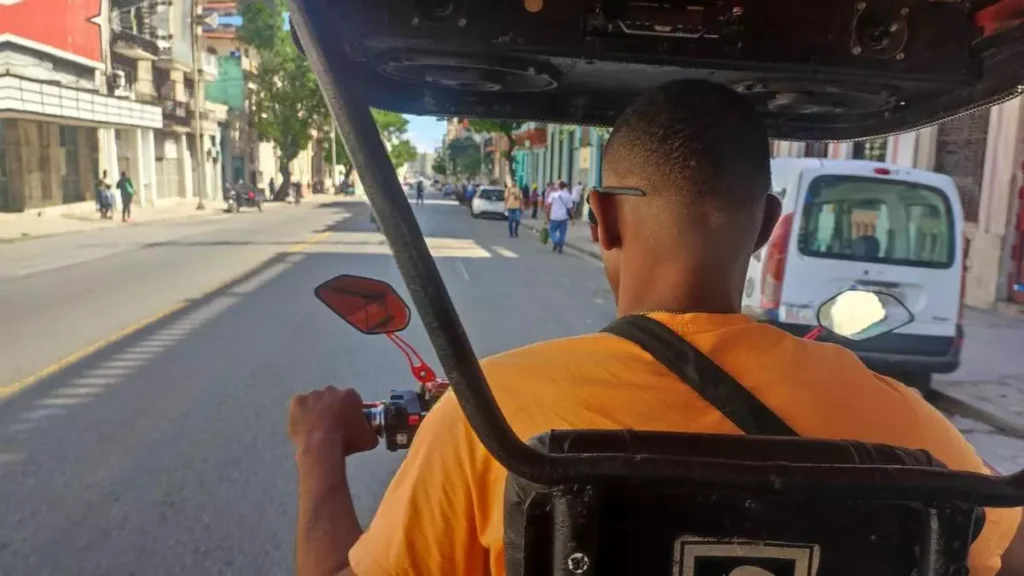
14ymedio, Havana, Natalia López Moya, February 14, 2026 – In a city that is practically at a standstill, some people never stop. You see them crossing empty streets, dodging the potholes along the Malecón or pedaling uphill on Tulipán with a backpack on their backs. They wear no uniforms and have no employment contracts, yet they carry much of Havana’s economy on wheels. They are the young delivery workers, a generation that in these days of fuel shortages has become indispensable in the movement of goods.
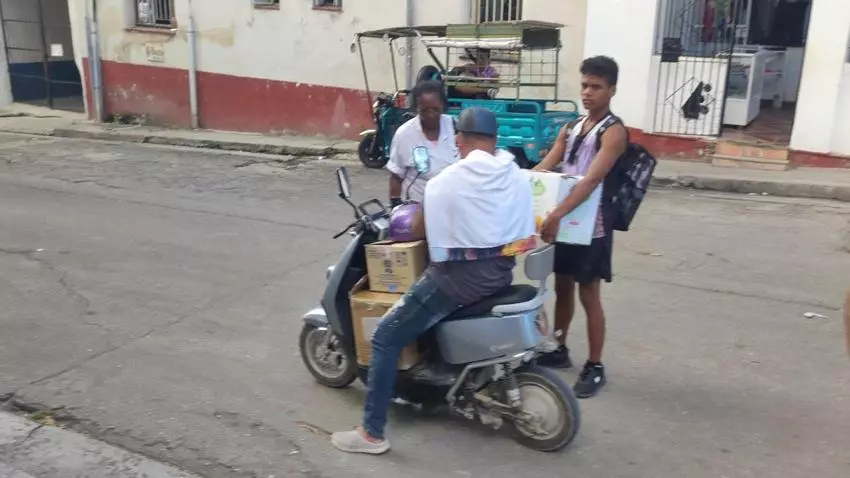
Yasiel, 26, delivers pizzas, medicines, and small packages. Orders reach him via WhatsApp from private businesses in the Cuban capital, desperate for the lack of messengers with cars or gasoline motorcycles. Sometimes they ask him for flowers, a cake, or even a plastic basin to bathe a baby. “Whatever can be strapped onto the rack,” he tells 14ymedio as he adjusts the bags on his bicycle that he will deliver to several points around the city. He has no self-employment license and does not belong to any small or medium-sized enterprise, yet he earns more than many professionals. “If I work twelve hours, I can make more than 5,000 pesos a day, although it’s quite hard.”
On Friday night, when only a few electric tricycles and some pedestrians who preferred walking on the asphalt rather than the neglected sidewalks were traveling along Rancho Boyeros Avenue, Yasiel was still making deliveries. An enormous backpack hung from his back and another, even larger, from his chest. He was coming from Playa municipality, near the Almendares River, heading to Nuevo Vedado. “I’m exhausted because I haven’t stopped pedaling all day. Could you give me a glass of water?” he asked one of his customers, nearly fainting.
The company Yasiel was delivering for, one of many that operate digital platforms where emigrants buy food and other basic supplies for their relatives on the Island, “is liquidating its merchandise ahead of what’s coming,” the young man says. The online shop has launched a 15% discount on all its products, and “if they’re frozen, you can get them for up to 25% less,” he explains. Fearing that blackouts will grow longer each day, “many people are avoiding buying anything that requires refrigeration.” continue reading
Some bicycle taxis have spent weeks transporting “more food than people.” / 14ymedio
This Friday, the deliveries Yasiel made were mainly canned goods, grains, and cookies. “There were jars of chickpeas that you could tell had been sitting in the warehouse for a while because of the dust on top.” Bags of flour, sardines, tuna, powdered milk, cereal, vegetable oil, and the ever-reliable cans of Spam rounded out the orders. “For the first time since I started this job, I didn’t move a single package of frozen chicken quarters today.” No one wants a power outage to turn their food into a stinking puddle of water and blood.
In Telegram groups with names like Delivery Habana 24/7 or Mensajeros de Plaza, workers share orders, routes, and clients. Sometimes they also share warnings: “Don’t go through Infanta, it’s pitch dark because of the blackout.” These are work forums, but also spaces of camaraderie. “Here we alert each other when a business is looking for workers, when the power is out, or if a street is closed for a march. We’re like a brotherhood, but without headquarters,” Yasiel explains.
Marcos, 34, nicknamed El Ruedas [Wheels], has spent weeks transporting “more food than people” in his bicycle taxi. Originally from distant Banes in Holguín province, he has spent five years running passenger routes between Central Havana, Cerro, and Old Havana. At the beginning of February, he got a call from a friend who works for a digital site that distributes everything from food to hardware supplies. “He told me they needed bicycles or electric motorcycles because they had fewer and fewer cars due to the gasoline problem.”
Since then, Marcos has “combed Havana” from one side to the other transporting sausages, soft drinks, butter, and whatever a Cuban emigrant in Miami, Berlin, or Madrid buys for family members on the Island. “I’ve been lucky, and besides what they pay me, I’ve received good tips because when people see me arriving in the bicycle taxi, they reach into their pockets to give me something.” Where others fear a worsening fuel crisis, the Holguín native sees his niche: “Now it’s our turn, the ones who don’t need oil or electricity.”
“These are times when you have to stay very alert because people know we’re delivering food and items paid for in foreign currency. We’re a target.”
The day he remembers most gratefully was last Monday, when he delivered “coffee and some of those tubes used so bedridden patients can urinate” to a house in Casino Deportivo. “The little old lady who received me tipped me a dollar,” he recalls. That same day, the U.S. dollar was approaching 500 Cuban pesos on the informal market. “It’s things like that that keep me in this job, though there are bitter moments too.”
In the darkness of a street in the Cerro neighborhood, Marcos watches over his shoulder while handing over one of the orders. Using his phone’s flashlight, he checks the sheet listing products that a digital store has processed for a Havana family. “These are times when you have to stay very alert because people know we’re delivering food and items paid for in foreign currency. We’re a target when we do that.” To avoid complaints later, each product must be verified against the list in front of the recipient, a process that takes time and increases the risk.
Beyond robberies, Marcos’s biggest fear until this week was “that the strong heat would come and it wouldn’t be so easy to pedal from place to place.” However, in recent hours he has had three orders canceled, raising new concerns. “Several of those digital sites are closing off orders from abroad because they can’t guarantee delivery anymore. This is getting ugly.” If online purchases grind to a halt, it won’t matter how strong the messenger’s calves are: “I’ll have to go back to moving people, and dealing with flesh-and-blood customers is more complicated.”
The boom in informal delivery grew alongside the energy crisis and the collapse of state transport, but it reached its peak during the covid-19 pandemic. Now, with the near disappearance of fuel on the Island, after the executive order signed by Donald Trump penalizing countries that send crude oil to Cuba with tariffs, gasoline- and diesel-powered vehicles are becoming increasingly scarce, and electric tricycles can’t keep up. In that vacuum, motorcycles and bicycles are trying to fill the gap left in transporting goods.
With each trip, the messenger earns between 1,000 and 1,500 pesos, depending on the distance. / 14ymedio
“I used to work in a refrigeration repair shop, but this pays better,” Landy, 30, tells this newspaper. He coordinates a network of ten messengers. His “headquarters” is a WhatsApp chat. “The small and medium-sized businesses write to me, I pass along the address and calculate the commission. There’s no boss and no fixed schedule. If there’s no connection, I disconnect, and that’s it.” With each trip, the messenger earns between 1,000 and 1,500 pesos, depending on the distance. “There’s no contract, but there’s trust,” the entrepreneur adds. “They pay me my commission at the end of the day, based on the trips completed.”
Most are young men, though there are women as well. Some are university students, IT specialists, or engineers. All are trying to earn money to support their families, and they prefer the independence of not being tied to a state job and being able to work with several businesses at once. “I don’t want anyone bossing me around. I take a job when I need to, and when I don’t feel like it, I stay home,” sums up a 23-year-old delivery worker with an electric tricycle. “My boss is the battery.”
The job is full of risks. “Sometimes it runs out in the middle of the darkness, and I have to push the tricycle until I find a place where I can charge it,” explains a young man from San Miguel del Padrón who makes deliveries in what he calls “a tough area.” Wearing gloves, a helmet, and a black jacket with “Rider” on the back, he distributes packages for small businesses in the municipality, but also takes jobs from larger digital platforms.
The leading online store has announced that it is canceling all its orders starting this Friday. Supermarket, which had managed to extend its deliveries across nearly the entire Island, informed customers that it will only process orders already received. “Due to the current situation regarding fuel availability in Cuba, our logistics operations have been temporarily limited,” reads its website.
Yasiel refuses to let such announcements paralyze him. For Saturday, he has a full schedule of deliveries. “It’s Valentine’s Day, and I’m not going to stop pedaling. I’ll rest tomorrow.” The future is something he avoids thinking about in a country where announcements of cancellations, closures, and interruptions come one day after another.
Translated by Regina Anavy
____________
COLLABORATE WITH OUR WORK: The 14ymedio team is committed to practicing serious journalism that reflects Cuba’s reality in all its depth. Thank you for joining us on this long journey. We invite you to continue supporting us by becoming a member of 14ymedio now. Together we can continue transforming journalism in Cuba.
The poor condition of vehicles and roads are among the main causes of accidents in Cuba.
The accident occurred in virtually deserted streets, with much of the transport system paralysed. / Escambray.
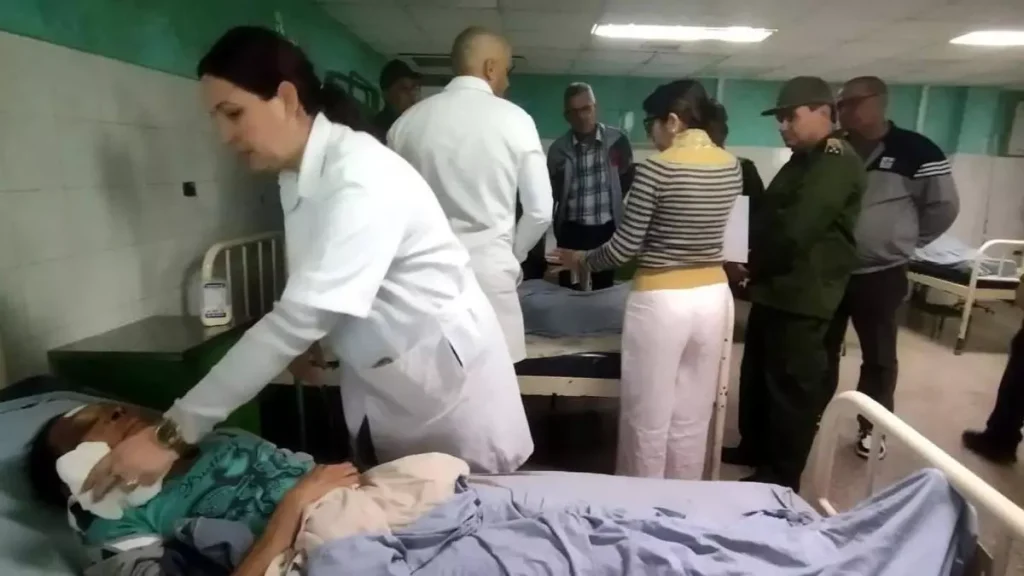
14ymedio, Havana, 13 February 2026 — A serious traffic accident on Thursday on the national highway, near the Zaza bridge in Sancti Spíritus, left at least four people dead and 17 injured, two of them in critical condition. The accident involved a Diana bus travelling between Havana and the east of the country.
It occurred at around 11:36 p.m. According to official reports published by the provincial media outlet Escambray, the driver lost control for reasons that are “under investigation,” a common phrase that rarely translates into verifiable information for the public.
The authorities identified the four fatalities in the accident as Edilberto Aldana García, 23, a resident of Vertientes, Camagüey; Conrado Peña López, 58, a native of Santiago de Cuba; Niurka de la Caridad Argelí Ladisté, 56, also a native of that province; and Ualter Chávez Galán, 30, a resident of the municipality of Cauto, in Granma province.
As for the injured, two remain in critical condition in the Intensive Care Unit. One of them underwent surgery after suffering severe head trauma with a frontal fracture, while the other has a right haemothorax and a liver laceration. The rest of the injured are progressing favourably, although they remain under hospital observation. Among them is a five-year-old boy, who did not suffer serious injuries and was transferred to the provincial paediatric hospital for specialised follow-up. continue reading
The latest figures on road accidents confirm a worrying increase
The accident occurred in virtually deserted streets, with much of the transport system paralysed. The measures adopted by the government in response to the loss of its main benefactor, Venezuela, and the impact of US President Donald Trump’s executive order on oil shipments to Cuba, have reduced mobility to historic lows.
The latest figures on road accidents confirm a worrying increase. In 2025, Cuba recorded 7,538 traffic accidents and 750 deaths, representing an 18.2% increase in deaths compared to 2024, when 634 deaths were reported. The number of injuries also rose slightly, from 6,613 to 6,718, according to data from the National Road Safety Commission.
But the most revealing statistic – and also the one most silenced by official discourse – is that 31% of drivers involved in crashes did not have a driving licence. This figure exposes a structural flaw in road safety control and training mechanisms which, far from being corrected, is worsening amid institutional deterioration and constant improvisation.
These vehicles operate for long hours, with minimal technical inspections and under pressure to meet increasingly unfeasible schedules.
Even more worrying is that, within this group of licences withdrawn for drink-driving, 98% belonged to state drivers. In other words, drivers of vehicles belonging to public institutions are over-represented in these accidents, a fact that rarely appears clearly in official reports or subsequent analyses.
Diana buses, assembled on the island from Chinese components, have been repeatedly singled out by passengers and drivers for technical problems, poor maintenance and overuse on long-distance routes. In a country where travelling between provinces has become an odyssey, these vehicles operate for long hours, with minimal technical inspections and under pressure to meet increasingly unfeasible schedules.
Added to this is the deterioration of the national motorway, with poor lighting, almost non-existent signage and asphalt damaged by years of neglect. It is no coincidence that many of the most serious accidents occur at night, when visibility is minimal and driver fatigue combines with poor road conditions.
Translated by GH
____________
COLLABORATE WITH OUR WORK: The 14ymedio team is committed to practicing serious journalism that reflects Cuba’s reality in all its depth. Thank you for joining us on this long journey. We invite you to continue supporting us by becoming a member of 14ymedio now. Together we can continue transforming journalism in Cuba.

 14ymedio, Dario Hernandez, Havana, February 16, 2026 – – Just as mountains of garbage have proliferated on every corner of Havana in recent months, so too has the illegal burning of it. At dawn or dusk, day or night, neighbors set fire to the trash without any restraint. Smoke over the capital and black wisps falling like negatives of snowflakes are becoming commonplace, with the consequent health risks.