Cubalex makes public the response of the OAS-linked organization regarding a request that was sent to it in 2018
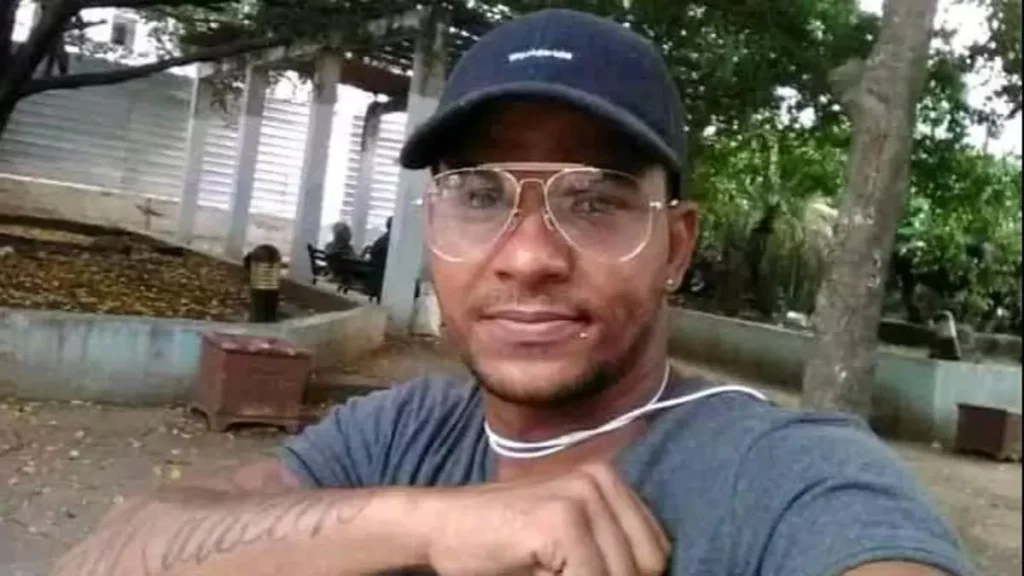
 14ymedio, Havana, 11 February 2026 — The Inter-American Commission on Human Rights (IACHR) has demanded investigations “to clarify and determine the responsibilities” for the abuses against rapper Maykel Castillo Osorbo, imprisoned in Cuba since 2021. In a report analyzing the artist’s case, the organization also calls for full reparations for the human rights violations he has suffered.
The document, signed last December and made public this Tuesday by the legal advice center Cubalex, is a response to a request made by the NGO more than seven years ago, on October 4, 2018. In it, they outlined the case of the artist, who had recently been arrested at his home and charged with “assault.” That arrest came three days after he organized a concert at La Madriguera, the headquarters of the Hermanos Saíz Association, where, along with other artists, Osorbo spoke out against Decree 349, which criminalizes independent art in Cuba. [See also]
The artist received an 18-month prison sentence for that offense, although he was released in October 2019 and finished serving his sentence a month later while free. This is therefore a separate case from the one that landed him in prison in 2021, where he remains.
The Commission indicates that it documented the “arrests, threats, harassment and acts of violence” against Maykel Castillo
In its analysis, the Commission indicates that it documented the “arrests, threats, harassment and acts of violence” against Maykel Castillo and calls for “an immediate end to all types of persecution against Maykel Castillo, in particular, acts of harassment, stalking and attacks,” and for “the provision of the necessary physical and mental health care measures for the rehabilitation” of the rapper.
As Cubalex reports, the artist is currently in a vulnerable situation after being arbitrarily transferred and subjected to harassment, without clear official information or verifiable guarantees regarding his safety. On January 29, he was abruptly removed from the Kilo 5 y Medio prison in Pinar del Río, where he had been held since 2021, without any explanation being given to his family. Although the legal NGO confirmed the following day that he had been returned to the same prison, it reported that during the transfer he was deprived of his medication and his only coat amidst a sharp drop in temperature, causing him to suffer from the flu and fever, which exacerbates the risks to his health.
Although it makes no reference to this situation because the subject of the petition dated from 2018, the IACHR report uses the Osorbo case to denounce that, “for more than three decades,” in Cuba there is “a marked intolerance in relation to artistic manifestations.”
“For more than three decades,” in Cuba there has been “a marked intolerance in relation to artistic expressions”
The organization points out that the repression against the rapper is framed “in a context where independent artists are victims of repression by the Cuban State, an aspect that has intensified since 2017 with restrictions on the use of public spaces and regulations that limit artistic creation.”
In response, the Commission states that the “creative potential of art also depends on respect for freedom of expression.” Its analysis points out that “the right to artistic or symbolic expression, to the dissemination of artistic expression, and to access to art in all its forms, is one of the forms of expression specifically protected by Inter-American instruments.”
The IACHR also maintains that art can constitute a form of protest. It adds that “the use of the imaginary and fiction must be understood and respected as an essential element of freedom indispensable for creative activity,” and reaffirms that it should not be restricted with the aim of protecting particular institutions or abstract notions, concepts, or beliefs such as national symbols.
Osorbo, one of the authors of the emblematic song “Patria y Vida” (Homeland and Life), which became a symbol of protest in Cuba and for which he won two Latin Grammy Awards that he was never able to accept, has been serving a nine-year prison sentence for contempt, assault, public disorder, and “defamation of institutions and organizations, heroes, and martyrs” since May 2022, although he had already spent 13 months in jail—since April 2021—which are deducted from his sentence. In the same case, the artist Luis Manuel Otero Alcántara was sentenced to five years.
He is serving a nine-year prison sentence for contempt, assault, public disorder and “defamation of institutions”
They are among the 1,207 political prisoners on the island, a record high, according to the most recent report published by Prisoners Defenders on February 5. Of these, 436 are seriously ill and 42 suffer from mental disorders without receiving medication.
Although the rapper has repeatedly expressed openness to being released on the condition of forced exile, this option has not materialized. He was also not released during the process brokered by Pope Francis, which resulted in the release of more than 500 people, fewer than half of whom were political prisoners, according to the government, “for the Jubilee Year.”
____________
COLLABORATE WITH OUR WORK: The 14ymedio team is committed to practicing serious journalism that reflects Cuba’s reality in all its depth. Thank you for joining us on this long journey. We invite you to continue supporting us by becoming a member of 14ymedio now. Together we can continue transforming journalism in Cuba.