Working for a Private Business While Waiting To Emigrate, the Fate of Cuba’s Recent Graduates

“The sad thing is, with the country the way it is now, we won’t even feel homesick.”

Many recent graduates migrate to the private sector in search of better job opportunities / IPS

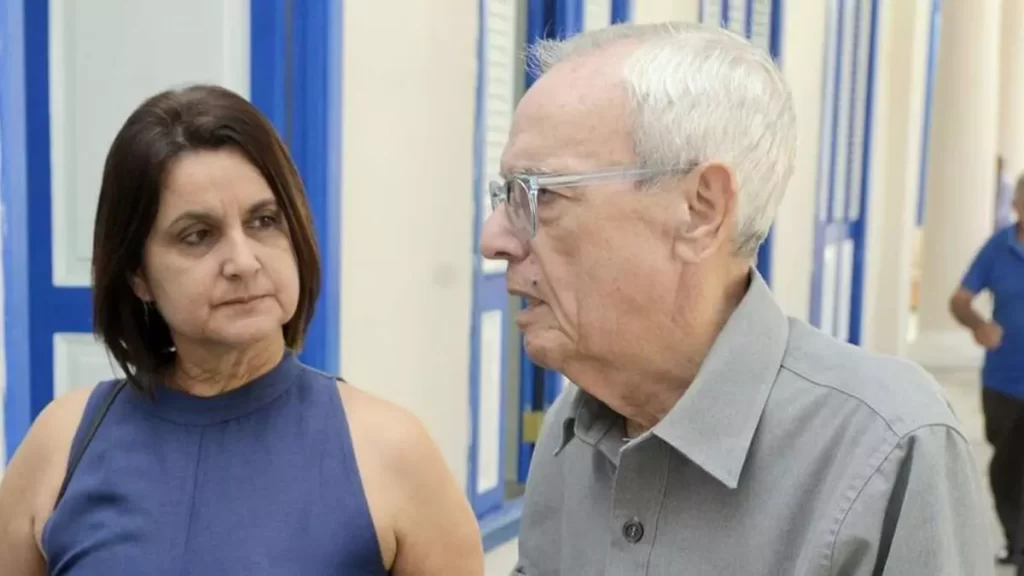
14ymedio bigger14ymedio, Julio César Contreras, Cienfuegos, July 24, 2024 — Amelia’s diploma from the Cienfuegos School of Medical Sciences has been hanging in her living room for exactly three years. That is about how long she has known that this was not a degree she would be using. Like many of her classmates, the 26-year-old fulfilled her social service obligations after graduation and now works as a waitress in a privately owned restaurant.

“All the while I was studying, I thought that a degree — even with all the problems like the teacher shortage and the outdated subject matter — would lead to a better future. But as soon as entered the real world, I was disappointed,” Amelia explains. At the end of her sixth year, her academic credentials should have landed her in one of the top spots for job placement. However, because of so-called “comprehensiveness” considerations — these take into account overall student performance, including participation in political events — many classmates with lower grades ended up with better jobs.

“I did manage, just barely, to land a job at the provincial hospital but ultimately I couldn’t handle the 24-hour shifts. Conditions were such that I had trouble eating, sleeping and bathing,” she recalls. Her salary was also not what she had expected. “I got the basic 4,200 pesos plus a little extra for working at night. The most I earned in one month was 7,000 pesos but it lasted only 15 days and I was exhausted from the daily grind. I’m not passionate about what I’m doing now but I earn almost twice as much,” she says. continue reading

Amelia earns 500 pesos a day working at a restaurant six days a week from 8:30 AM till 4:30 PM

Amelia earns 500 pesos a day working at a restaurant, Monday through Saturday, from 8:30 AM till 4:30 PM. That comes to 12,000 a month plus tips. “It’s still not much money but it allows me to both save and survive,” says Amelia, who is putting money aside for the same reason that she has never tried to specialize in a particular medical field. “I want to leave the country and, if I tried to get into surgery — which is what I would like to do — or something else, they would control me.”

Amelia’s sister Anet also works in a private-sector job. She got her chemical engineering degree five years ago but, like her sister, had to take a job with a privately owned business that sells wooden toys and other items. “As soon as I graduated, I was sent to a high school to teach contemporary history. I had studied chemical substances and processes but every day I had to talk about the October Revolution or the Second World War because there was a shortage of teachers,” she explains.

She did not dislike the job and stayed at the school for several year but had to quit once Covid hit. “Prices shot up, basic products disappeared and, by then, I had a very young son. I couldn’t stay at a place that paid me next to nothing,” she says.

Anet went through several private-sector jobs until a year ago when a friend, a business owner, suggested she sell her merchandise at the crafts fair

Anet went through several private-sector jobs until a year ago when a friend, a business owner, suggested she sell her merchandise at the crafts fair in the capital city. “They pay me well and the work is low-stress. It gives me time to do other things,” she adds.

A few months ago, Anet’s husband was approved for the US Humanitarian Parole Program. They both decided that he should go to the United States with their son while she stayed behind and waited her turn. I am happy because my son is with his dad but it was a very tough decision to make,” she says.

Anet bemoans the hardships that lead Cubans, especially young Cubans, to leave the country in search of a better life. And her case, she warns, is not even the worst. “I have classmates who managed to get scholarships in Germany or Chile and had to leave their families behind. It will take them years to get their children and partners out. At least I’ve already completed the paperwork and just have to wait for the answer.”

Engineers, doctors, intellectuals. . . the island’s list of professionals keeps getting shorter. “It’s a full-on brain drain. Almost everyone who studied with me and my sister now lives abroad,” says Anet. “Some will come back and apply what they learned but most of us will look for other ways to earn a living and have a decent life. The sad thing is, with the country the way it is now, we won’t even feel homesick.”

____________

COLLABORATE WITH OUR WORKThe 14ymedio team is committed to practicing serious journalism that reflects Cuba’s reality in all its depth. Thank you for joining us on this long journey. We invite you to continue supporting us by becoming a member of 14ymedio now. Together we can continue transforming journalism in Cuba.

A Court Will Review the Sentence Against Four Young Cubans Issued by a Judge Arrested in the United States

In Florida, Melody González Pedraza will have to prove, after a first failed attempt, that she is eligible for political asylum

Several human rights organizations have demanded the release of the young people sentenced by judge Melody González Pedraza / Facebook

14ymedio bigger14ymedio, Havana, July 27, 2024 — The Provincial Court of Villa Clara will review on August 9 the sentence issued in Cuba by former judge Melody González Pedraza — who is now imprisoned in a detention center for migrants in Broward, Florida — against four young people accused of throwing Molotov cocktails at a vehicle and other police property in 2022. González Pedraza, who has a history of collaboration with the regime from her position in the Municipal Court of Encrucijada, will face a legal process in the United States, where she arrived and applied for political asylum last May, after she was denied humanitarian parole. The former judge will have to prove, after a first failed attempt, that she is eligible for international protection.

González Pedraza sentenced Andy Gabriel González Fuentes, Eddy Daniel Rodríguez Pérez, Luis Ernesto Medina Pedraza and Adain Barreiro Pérez, whose families have never stopped protesting over the former judge’s attempt to enter American territory and have denounced her links with the regime.

González Pedraza alleged in an interview that she had acted according to instructions “from above”

In turn, González Pedraza alleged in an interview with Diario de Cuba that she had acted according to instructions “from above,” although the evidence against the young people was not conclusive. Now, their families are appealing Sentence 4/2024, signed by the former judge, a process that will take place in the Chamber of Crimes against State Security in the Provincial Court, according to Martí Noticias. continue reading

The appeal document, published by this newspaper, indicates that the hearing will be held at 9:00 am “with the reproduction of all the evidence that was carried out in the trial of first instance,” which will be submitted for review.

Captain Miguel Martínez, First Lieutenant Ricardo Domínguez, Lieutenant Colonel Jorge Luis Alfonso and a person identified as Ramón Benítez will testify as new witnesses – all members of the Police and State Security.

At the beginning of July, the Cuban Observatory for Human Rights (OCDH), based in Madrid, Spain, asked for the acquittal of the young people after González Pedraza’s statements and her application for asylum in the United States. The conviction handed down by the former judge, said OCDH, is based only on the retraction of the confession by one of the accused and on testimonies provided by officials of the Ministry of the Interior.

“They gave me precise indications; I decided that the defense lawyers had presented important evidence”

“They gave me precise indications; I decided that the defense lawyers had presented important evidence, especially witnesses. But the order I received was that the evidence of the Prosecutor’s Office was sufficient and had more value. We had to keep them in pre-trial detention and punish them,” the former official said in her interview with Diario de Cuba.

OCDH presented “new reasons for acquittal and revocation of the sentences,” since “it is evident that it was not lawful and just to pronounce a criminal sentence.” The organization prepared a report, with six recommendations, addressed to the appointed lawyers of the sentencing of the Municipal Court of Encrucijada and the members of the Governing Council of the Provincial Court of Villa Clara, among other agencies.

“There was a violation of guarantees and fundamental rights to the detriment of those convicted, as well as the absence of a crime and the serious judicial misconduct of convicting them without a sufficient minimum of evidence. We believe that there are sufficient elements for imminent freedom measures to be adopted in favor of the appellants, as a definitive measure in justice,” explained the OCDH.

Translated by Regina Anavy

____________

COLLABORATE WITH OUR WORKThe 14ymedio team is committed to practicing serious journalism that reflects Cuba’s reality in all its depth. Thank you for joining us on this long journey. We invite you to continue supporting us by becoming a member of 14ymedio now. Together we can continue transforming journalism in Cuba.

Surveillance, Reluctance and the Omnipresent Garbage Overshadow the Celebration of July 26 in Cuba

“They put a policeman every ten meters around the block where the Party’s hotel is located”

Overflowing garbage on the corner of Consulate and Trocadero, next to what was once José Lezama Lima’s home, in Central Havana / 14ymedio

14ymedio bigger14ymedio, Mercedes García/Juan Diego Rodríguez, Sancti Spíritus, 26 July 2024 — This Friday there is no rebellion but much reluctance and indifference to the most important anniversary of the regime. Cubans will not feel like celebrating, but the Police and Security remain as active as ever and have demonstrated it, not only in Sancti Spíritus – the site of the regime’s celebration – but also in other cities of the Island. July 26 has become National Surveillance Day.

Pablo lives a few blocks from the place where Miguel Díaz-Canel and the other hierarchs of the regime are staying, who held a kind of vigil this Thursday for the anniversary. Pablo witnessed a “strong operation” that began in the afternoon. “They put a policeman every ten meters around the block where the Party’s hotel is located,” he tells 14ymedio.

The secured area occupied 500 meters, estimates Pablo, who also saw agents in the vicinity. “We feel very well cared for in the neighborhood,” he says, sarcastically, referring to how the neighbors had to ask for permission to enter and leave the perimeter. “They asked us where we were going and other details,” he explains. continue reading

“They,” says Pablo, alluding to the main leaders of the country, “arrived around 5:00 pm.” The meals were not made there. They had lunch at the Cayería Norte, according to one of his neighbors, a hotel worker who saw how the traffic in the area was interrupted for the entourage to pass.

Raúl Castro and Ramiro Valdés Mesa participated in the event, and the official press reported that 5,000 people had been summoned

“The Party’s hotel is not a big deal,” Pablo clarifies, “but they always stay there by protocol. The building was fixed and painted recently. New lamps and fence, repairs in the pool, and more comfort inside.”

At the event, for which the official press reported that 5,000 people and 140 foreign “friends of Cuba” were summoned, there were Raúl Castro and Ramiro Valdés Mesa, two of the few survivors of the group that, led by Fidel Castro, failed to take the second most important military barracks in the country. Castro transformed that defeat into a propaganda machine that, 71 years later, is still active although agonizing.

Like last year, the leaders again waited for dawn in between long speeches and the play of lights projected onto the plaza. It was Cuban Vice President Salvador Valdés Mesa who was in charge of the celebration, which focused on Raúl Castro and the U.S. embargo. Less proactive than his government colleagues, Valdés Mesa said that Cubans will have to work “without waiting for miracles.”

This Friday, in the Cuban streets, no one expected a party or, even less, a miracle. On Obispo boulevard in Havana, only three people celebrated July 26. With the appearance of state workers or agents dressed in plainclothes, they walked the street again and again wearing red sweaters. On the back, a sentence on the fabric: “Nothing is impossible for those who fight. Fidel.”

In Havana there was little festive spirit, but there was a lot of garbage that no one will take care of “in greeting” to the anniversary. One of the most formidable trash dumps in Havana is on Trocadero Street, next to the battered house – today a museum – of the Cuban writer José Lezama Lima. Enthusiastic about the Castro Revolution in his first months, Lezama wrote a small text about July 26 in which he affirms that the date “brings happiness” to Cubans. This Friday, however, it has only brought garbage. And continuity.

Translated by Regina Anavy

____________

COLLABORATE WITH OUR WORKThe 14ymedio team is committed to practicing serious journalism that reflects Cuba’s reality in all its depth. Thank you for joining us on this long journey. We invite you to continue supporting us by becoming a member of 14ymedio now. Together we can continue transforming journalism in Cuba.

Where Are They? the Desperate Cry of Those Who Contributed to the Horror and Left

Anyone who has to confess some collaboration is better off doing it now, no matter how small it is, keeping it in only causes pain on both sides.

Check-in area of ​​Terminal 3 of Havana’s José Martí International Airport / 14ymedio

14ymedio bigger14ymedio, Yoani Sánchez, Generation Y, Havana, 27 July 2024 — It is not about revenge but about sincerity. I see them leaving every day, packing their bags, renouncing their ideology in silence and leaving behind the victims of their extremism, those punished by their ideological supremacy and those killed by their silence. No, it is not revenge, it is justice that they at least say something once they get out of the vicious circle in which they chose to be victimizers. Anyone who has to confess some collaboration is better off doing it now, no matter how small it is, keeping it to themselves only causes pain on both sides.

I have no list of names  with whom to settle accounts. The accounts have already been settled by life: we have seen so many die crossing the sea, thousands have fallen due to lack of effective medical care, leaving to say goodbye are many more as a result of the malnutrition that has taken over the homes of this Island and we are hanging by a thread, due to the unhealthiness that hits us from all sides. At this point there are no longer winners or losers, only shadows that wander around.

They have left us their dead and their ghosts, their empty houses, their political shells, their lies that cannot be sustained because there is no one left… or almost no one.

They should, for once, be honest. They should say that they were wrong, that they supported a system that plunged us into national, human and family ruin. They leave and, in addition, they leave us with their indifference. They leave and change their names, they rewrite their past, they pretend to be tolerant where before there was only extremism. They put on makeup, they have cosmetic-mental surgery, they no longer say “compañero” but “mister” but they have not made the necessary revision that all human improvement, all steps forward, implies. continue reading

They have left us their dead and their ghosts, their empty houses, their political shells, their lies that cannot be sustained because there is no one left… or almost no one. They leave and continue attending the meetings held by Cuban embassies around the world to gather solidarity with Castroism, applauding the regime, accepting the repression and tightening the shackles they put on us, who are still here, every day on the Island. They leave and continue to be our executioners. One can cut a throat in many ways: by brandishing the axe or by remaining silent when another brandishes it.

Where are their cries, their demands, their thoughts about the drama they left behind beyond sending remittances to their families or trying to get them off the island?

If we have lost 10% of the residents of this Island between 2020 and 2023, it cannot be that this number of people was “clean” of having committed an act of repudiation, of having chivateado — snitched on another through the perfidious mechanisms of the Committees for the Defense of the Revolution. It cannot be that this is the 10% most innocent of the barbarities that have been committed on this Island in this more than half a century. So, where are all these people? Where are their cries, their demands, their thoughts about the drama they left behind beyond sending remittances to their families or trying to get them off the Island? Where is their civility?

Is it perhaps that what remains is oblivion? Indifference? Every man for himself? I am here and I already see the worst scenarios. I am living them. Without the involvement, which entails an obligatory self-criticism, of those who were part of this machinery that suffocates us, I cannot imagine how we are going to get out of this. If we get out at all.
____________

COLLABORATE WITH OUR WORKThe 14ymedio team is committed to practicing serious journalism that reflects Cuba’s reality in all its depth. Thank you for joining us on this long journey. We invite you to continue supporting us by becoming a member of 14ymedio now. Together we can continue transforming journalism in Cuba.

Fifty Academics Demand That LASA Condemn the Repression in Cuba of Alina Bárbara López

It is the second time in eight months that the association has spoken out in support of the teacher

Alina Bárbara López Hernández during an interview in April 2023. (EFE)

14ymedio biggerEFE/14ymedio, Havana, July 5, 2024 — On Thursday, more than 50 academics from the Association of Latin American Studies (LASA) urged  the executive committee of that group to publicly condemn the “political repression” in Cuba after the allegations of police violence against the critical intellectuals Alina Bárbara López and Jenny Pantoja. It would be the second time that the Association, historically considered favorable to the Cuban regime, has raised its voice for the professor.

Among the signatories are Mexican professors and researchers Alejandro Monsiváis and Carlos Torrealba, the Cuban American economist Carmelo Mesa-Lago, the Brazilian sociologist María Hermínia Tavares, the Cuban economists Omar Everleny, Pavel Vidal and Pedro Monreal, as well as the historian Rafael Rojas, brother of the former Cuban Deputy Minister of Culture Fernando Rojas.

The text, advanced by the independent website CubaXCuba (CXC), calls for LASA’s condemnation of “the political repression in Cuba, intensified during the last year and increased,” against López, historian, editor and member of the group, and against the anthropologist Pantoja.

Among the signatories are Carmelo Mesa-Lago, Omar Everleny, Pavel Vidal and Pedro Monreal, as well as the historian Rafael Rojas

Regarding López’s case, subscribers point out that since October 2022, “she has suffered persecution and various violations of her rights to free movement, thought and expression, among others. continue reading

In addition, they say that the renowned academic “has been a victim of practices that qualify as torture, and cruel, inhumane and harmful treatment to human dignity. Just for writing, expressing her critical ideas about Cuban reality and civic formation, and demonstrating peacefully.”

In a recounting of the situations that the 58-year-old historian has confronted with the local authorities, the last two refer to physical aggressions that have caused her bodily injuries.”

“The harassment has intensified,” they argue, pointing out that both events occurred when she was trying to travel to Havana – on April 18 and June 18 – after which she was taken by the political police to a police station in the city of Matanzas, where she lives.

Specifically, the academics urge the LASA council to reiterate “its position in defense of the freedom of expression,” “condemn the political persecution” against López and Pantoja, and any other person, and express their solidarity with both intellectuals for their “unjust prosecution.”

In December 2023, LASA, after weeks of doubt, took the step that its members expected to “condemn political repression in Cuba” in general terms, although the pronouncement then also came “in particular” for López Hernández, who had been found guilty of a crime of disobedience in November.

This fact was unprecedented since the organization was historically linked to the regime. In 2015, 14ymedio published a column by Manuel Cuesta Morúa, who was satisfied with the “turn towards ideological plurality” that the association had made. In his opinion, the process began in 2011, when it started to “open up to criticism of the leftists in power from the intellectual left.”

In December 2023, LASA, after weeks of doubt, took the step that its members were waiting for to “condemn political repression in Cuba” in general terms

However, in May 2021, a large group of at least 300 people signed an open letter criticizing LASA’s lukewarm statement in the face of the repression against the imprisoned artist, activist Luis Manuel Otero Alcántara and several other Cubans. In addition, some of its members refused to continue being part of LASA.

That week, in a public statement, more than 200 writers and artists denounced the “police violence” against López and Pantoja during the arrests.

According to the account of both intellectuals, the police arrested them when they were going from Matanzas to Havana to protest. They were beaten, thrown to the floor, and forcibly put into a patrol car and taken to a police station, where they were held for hours.

López, who is co-director of CubaxCuba, has been arrested on several occasions in recent months for making symbolic protests. As a result of these actions, she was sentenced at the end of last year to pay a fine for the crime of disobedience.

The intellectual has declared herself in “contempt” of the sentence and refused to pay the fine, aware that this can lead her to jail, as she has written in different articles on social networks.

The NGO Prisoners Defenders, based in Madrid, said that the trial, “without guarantees,” had “political motivations” and sought only to “repress the exercise of the fundamental rights” of López, whom it described as a “victim of conscience.”

Translated by Regina Anavy

____________

COLLABORATE WITH OUR WORKThe 14ymedio team is committed to practicing serious journalism that reflects Cuba’s reality in all its depth. Thank you for joining us on this long journey. We invite you to continue supporting us by becoming a member of 14ymedio now. Together we can continue transforming journalism in Cuba.

With the Loss of 50 Percent of Its Income From Foreign Currency, the ‘Cuban System’ Has Collapsed

Cuba Siglo XXI publishes a report signed by economist Emilio Morales

While Cuba received only 2.4 million tourists in 2023, a neighboring country, the Dominican Republic, exceeded 10 million / 14ymedio

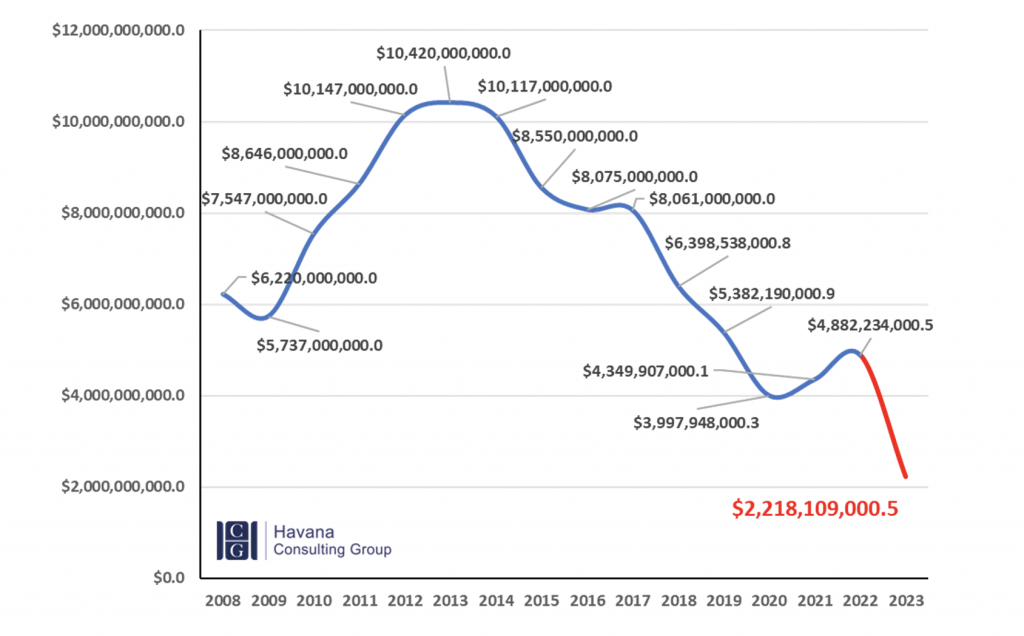
14ymedio bigger14ymedio, Madrid, July 25, 2024 — In three key points – the collapse of medical service exports, the fall in remittances and the debacle of tourism – economist Emilio Morales deciphers the collapse of the “Cuban system.” In the most recent report of the organization Cuba Siglo 21, based in Madrid, the researcher says that there has been a drop of more than 50% in the Government’s main sources of foreign currency, which will “reach the 71st anniversary of the assault on the Moncada barracks with a country in “countdown.” Published this Thursday, the report documents how one of the most powerful foreign exchange inflows that Cuba had – the export of medical services – fell by 78% since 2013, when it generated 10.42 billion dollars for the Regime.

According to the report to Parliament by the Minister of Finance and Prices, Vladimir Regueiro Ale, in 2023, Cuba lost 63.939 billion pesos, which, with the official exchange rate of 24 to 1, is equivalent to a loss of 2.664 billion dollars for the Island. The largest part of these revenues corresponds to medical services, managed by Gaesa, the economic arm of the Army, through the company Comercializadora de Servicios Médicos and the Banco Financiero Internacional y de Antex S.A, another company designed to handle contracts for the Cuban doctors in the exterior, says Morales.

Historical data on the income stream from the export of medical services, 2008-2023 / Havana Consulting Group

“Gaesa has pocketed no less than 69.8 billion dollars of the 108.5 billion it has collected from doctors’ salaries” between 2008 and 2023, summarizes the economist, who supports his conclusion with a graph. That money “never returned to the reconstruction of hospitals, acquisition of equipment and medical supplies, or to improve the conditions of patient care.” continue reading

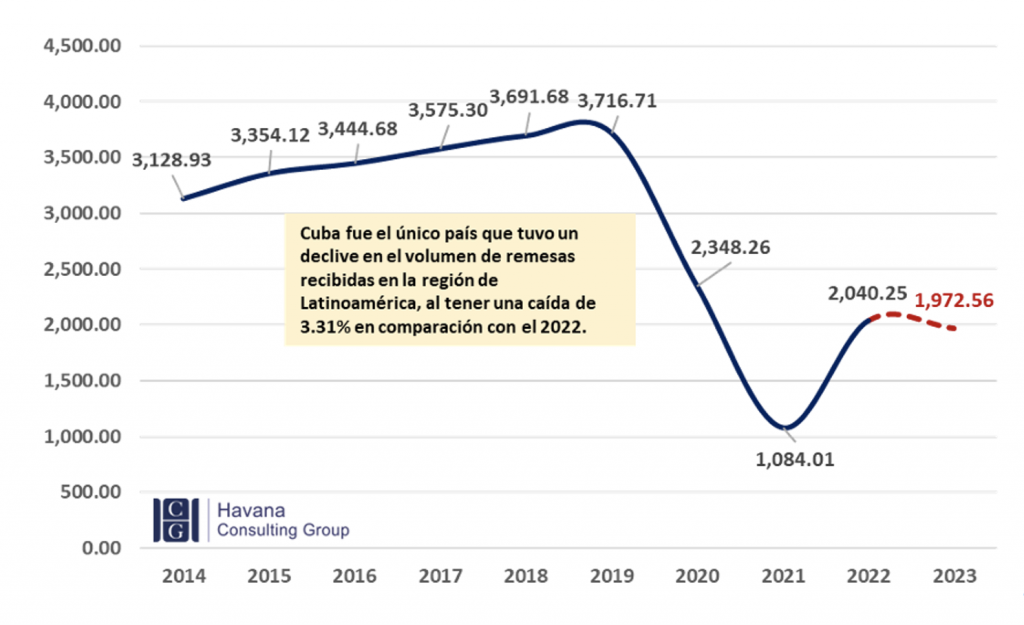
The Government, in fact, invested only 1.7 billion dollars in Public Health in 2023, a figure that contrasts with the 24.2 billion invested in the construction of hotels. On the other hand, remittances also decreased in 2023. The entry into the country of 1.972 billion dollars represented a fall of 2.31% compared to 2022, and 46% compared to 2019. The cause – which Morales has referred to on more than one occasion – is not a mystery to anyone: the massive stampede after 11 July 2021 and the economic crisis of recent years. In addition, those who emigrate, instead of sending money to those who stay, prefer to take them out of the country as soon as possible.

Morales summarizes the data recently offered by Cuban economist Juan Carlos Albizu-Campos, who estimates that between 2022 and 2023, 1.79 million people left Cuba. With that exodus, remittances also fell. “In 2023, it is estimated that the exiled and excluded Cuban diaspora spent between 1.8 and 2.2 billion dollars to take out of the country the 200,287 Cubans who emigrated to the United States, and tens of thousands of others who are still on the way,” he analyzes.

Remittances to Cuba, 2014-2023. Data in millions of dollars / Havana Consulting Group

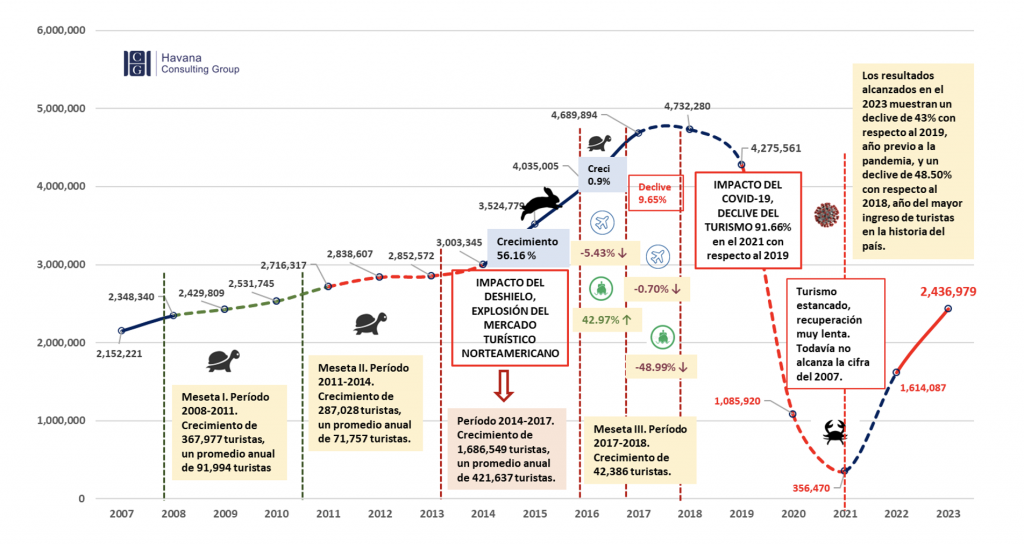
As for tourism, Morales analyzes its failure after the pandemic, in an international context characterized by the recovery of visitor levels. While Cuba received only 2.4 million tourists in 2023, a neighboring country, the Dominican Republic, exceeded 10 million. The regime has opted for Russian tourism, which, however, “has not compensated for the loss of European tourism, affected by Cuba’s support for Russia in the war against Ukraine,” explains the economist. To illustrate the debacle, Morales points out that the five main European countries – Italy, France, Germany, Spain and England – sent 67.45% fewer travelers to the Island. Cubans living abroad, indispensable for tourism, also decreased their number in 2023 by 42% compared to 2019: only 358,480 were c0unted.

The problem also has a political dimension, which is that both the Communist Party and the government structures in the country have been left without relief by the mass exodus, even of their own cadres. The Supreme Court, as recognized by the government, has only 69% of the judges it needs to operate in the country.

Arrival of tourists in Cuba, 2007-2023 / Havana Consulting Group

Morales blames Gaesa for the mismanagement of the country’s resources and says it has led a war against the MSMEs to limit their field of action and decrease their control. It is, clearly, a “dysfunctional” system, he says, which is pointed out even by Cuba’s allies, who no longer dare to launch a “large-scale economic rescue,” given the resistance to the change in leadership at the head of Cuban power. In a comatose state and grasping at partial and last-minute solutions, the Cuban Government – says the economist – has its days numbered.

Translated by Regina Anavy

____________

COLLABORATE WITH OUR WORKThe 14ymedio team is committed to practicing serious journalism that reflects Cuba’s reality in all its depth. Thank you for joining us on this long journey. We invite you to continue supporting us by becoming a member of 14ymedio now. Together we can continue transforming journalism in Cuba.
The Creole Lime, Another Item Missing From Cuban Tables

Like any scarce and desired product, in Cuba the lime has gone to the foreign currency stores or to nourish exports / Facebook

14ymedio bigger14ymedio, Mercedes García/Natalia López Moya, Sancti Spíritus/Havana, July 7, 2024 — No, lime is not the basis of everything but it is an essential ingredient in many recipes of Cuban cuisine and cocktails. The Creole mojo that is put on the cassava, the marinade that is plastered on the pork before cooking and the mojito that is inseparable from bars and celebrations need that acidic flavor that stings your eyes and awakens the soul.

However, Persian lime, or lemon as it is also called, has become in the last decade an elusive guest at the tables and bars on this Island. Counting on it to prepare a dish could end in defiance and frustration. To alleviate its absence, all kinds of subterfuges have emerged, from replacing it with vinegar in some preparations to making use of that artificial imposture that comes in a bottle and is called “lemon juice.”

In the last 12 months, in the Plaza Boulevard market in the city of Sancti Spíritus, the most appreciated citrus has made it clear that no one can take it for granted. From November 2023 until last April, it was absent from shelves, and in the last year, according to the weekly compilation done by this newspaper, its price went from 100 pesos per pound to the current 250 pesos. continue reading

When it was most needed, the lime was not there. It was not on Plaza Boulevard when customers arrived searching like crazy for something to marinate the pork for the Christmas holidays, or to throw over a salad on the night of December 31. Nor did it appear for the lemonade on Three Kings Day.

On February 14, couples had to settle for other less traditional cocktails or drink a mojito with “plastic lemon,” as they call those extracts supposedly made from citrus but that look more like a product synthesized in the laboratory than something taken from a fruit that was once hanging from a bush.

The luckiest made do on those dates with some hard lime rind, dark green and with very little juice that would serve more to break a window than to season a dish. That rickety and dry version has generated several culinary methods to try to get some liquid out of them. From immersing them in hot water before cutting and squeezing them, to placing them on the floor and, squeezed tightly under the foot, rolling them on the surface so that their interior softens and produces something.

However, almost always those methods are so disappointing that you end up throwing the lime in the trash between swear words and curses, most of them dedicated to those who manage the Cuban fields, to the terrible policies implemented in agriculture and to an official “wise man” who, without blushing, considered the lime as “the basis of everything.”

From those heights of the Government, they blame the frequent disappearances of the lime and also the plummeting supply of oranges, grapes and mandarins on the negative impacts of pests, hurricanes and the U.S. ‘blockade’*. Of those citrus productions, which exceeded one million tons three decades ago, currently only the memory remains. If in 1990 the land destined for its cultivation reached 145,000 hectares, by 2020 it was barely 11,907.

Like any scarce and desired product, in Cuba the lime has gone to the foreign exchange trade or to nourish exports rather than humiliate itself by ending up on local tables. In the digital portals that sell to emigrants to supply their families on the Island, the product can be found more frequently and stably, but yes, at a price of around five dollars a pound.

Also, the very vain limes travel rather than remaining in the homeland. In September 2020, the official press announced that a farmer from Mayabeque had become the first private producer in Cuba who managed to export limes to Spain through the company Frutas Selectas.

Meanwhile, some online shops, which sell in foreign currency, began to offer limes from Panama, Mexico and the United States in the catalog of goods that Cuban exiles use to buy for their parents, grandparents or children who have stayed on the Island. As if national consumers could no longer aspire to the citrus that sprouts from their land and should be content with foreigners buying it for them.

As good news, in the forums where opinions are exchanged about these virtual stores, a criterion is repeated again and again: “Those Mexican limes are good, they have juice and you don’t have to hit them or put them in hot water.” The cassava mojo is guaranteed in this way for certain Cuban tables, but the limes can no longer be called “creole.”

*Translator’s note: There is, in fact, no US ‘blockade’ on Cuba, but this continues to be the term the Cuban government prefers to apply to the ongoing US embargo. During the Cuban Missile Crisis the US ordered a Naval blockade (which it called a ‘quarantine’) on Cuba in 1962, between 22 October and 20 November of that year. The blockade was lifted when Russia agreed to remove its nuclear missiles from the Island. The embargo had been imposed earlier in February of the same year, and although modified from time to time, it is still in force.

Translated by Regina Anavy

____________

COLLABORATE WITH OUR WORKThe 14ymedio team is committed to practicing serious journalism that reflects Cuba’s reality in all its depth. Thank you for joining us on this long journey. We invite you to continue supporting us by becoming a member of 14ymedio now. Together we can continue transforming journalism in Cuba.
The Death of Ernesto Figueredo and the Urgent Demand for a Thorough Investigation / Cubalex

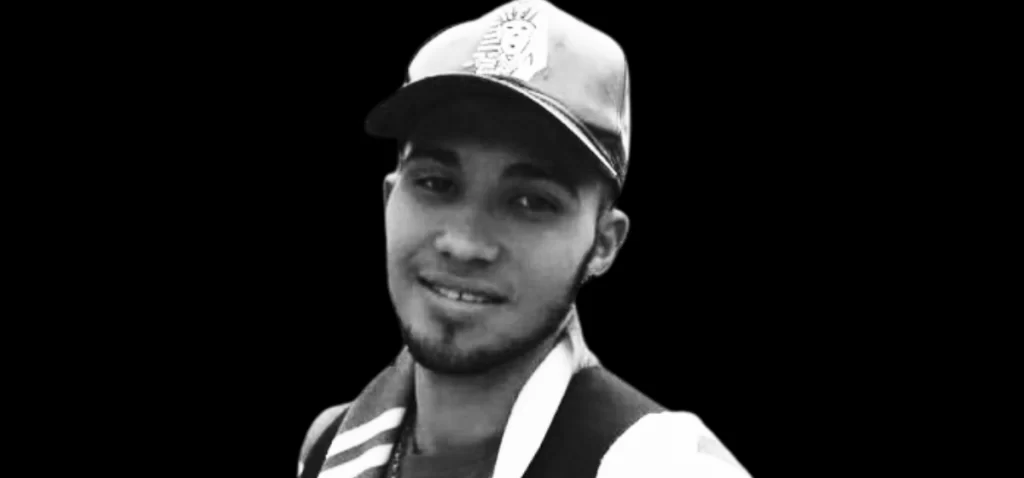
Ernesto Figueredo Alarcón

Cubalex, 25 July 2024 — In the field of human rights, every life lost in suspicious circumstances demands a robust response and a thorough investigation by the state. The recent death of Ernesto Figueredo Alarcón, a 23-year-old man, at the hands of a police officer raises serious concerns about the fulfilment of state obligations in Cuba and underlines the urgent need for a rigorous and transparent investigation.

Ernesto Figueredo Alarcón died last Friday after being shot in the head by a policeman known as “Chucho, El tirado”. According to CubaNet, the incident occurred in Ernesto’s house, located in the Rosa La Bayamesa neighborhood in Bayamo, Granma province, while the policeman and the victim were talking alone in a room.

Following the shooting, the young man was admitted to intensive care at the Carlos Manuel de Céspedes Provincial Hospital, where he was diagnosed as brain dead and was kept alive only on life support. Although the policeman responsible for the shooting was arrested, the authorities have not provided detailed information about the case, leaving the family with no clear answers. People close to the victim claim that the shooting was an accident and point out that the policeman had mental problems, suggesting that he was unfit to carry a weapon and unfit for duty. Despite these allegations, no official information has been received to confirm or refute these points. continue reading

The lack of transparency and opacity in the handling of the case raises serious concerns about the authorities’ handling of the case. This is especially critical when there are international obligations and protocols for cases that could represent potentially unlawful killings and, in particular, extrajudicial executions, which must be observed by states.

International human rights law, specifically the International Covenant on Civil and Political Rights (ICCPR), states in Article 6 that the right to life shall be protected by law and that no one shall be arbitrarily deprived of his or her life. In addition, the Minnesota Protocol calls for a rigorous investigation of all suspicious deaths to determine whether an extrajudicial killing has taken place. In this context, the State has a responsibility to thoroughly investigate these deaths, to adequately punish those responsible and to provide transparency and information to the families of the victims.

Extrajudicial executions are defined as the arbitrary deprivation of life committed, encouraged or condoned by the State, outside the framework of a fair trial and due process. They are characterised by the intentional use of lethal force without legal justification, the absence of a proper trial or due process and the involvement of State agents.

In the case of Ernesto Figueredo Alarcón, there are several elements that suggest the possibility of an extrajudicial execution. First, there is the involvement of a state agent, as he was shot by a policeman, which is a fundamental criterion for considering this type of execution. In addition, it must be assessed whether the use of lethal force was intentional and lacked legal justification, considering that there was no reported threat or situation of danger to justify it. It has also been pointed out that the police officer may have had mental problems, which would indicate state negligence in the supervision and allocation of weapons. Finally, the shooting occurred outside of due process or trial, with no indication that the youth was involved in criminal activity that would justify an armed intervention, nor was there any attempt at arrest or due process.

A thorough investigation to clarify all details of the incident, including the mental condition of the police officer and the precise circumstances of the shooting, is essential in order to reach a definitive conclusion on intentionality and possible state responsibility.

The lack of transparency and information from the authorities suggests a serious deficiency in the fulfilment of their obligations to adequately investigate and punish cases of potentially unlawful killings. It is essential that the Cuban state conduct an investigation in accordance with international standards, otherwise it would demonstrate complicity, negligence and lack of reparation to the victims.

References

United Nations (1989). Minnesota Protocol for the Investigation of Potentially Unlawful Deaths.

United Nations (1979). International Covenant on Civil and Political Rights.

United Nations (1990). Basic Principles on the Use of Force and Firearms by Law Enforcement Officials.

The post The death of Ernesto Figueredo and the urgent demand for a thorough investigation appeared first on Cubalex.

 Translated by GH

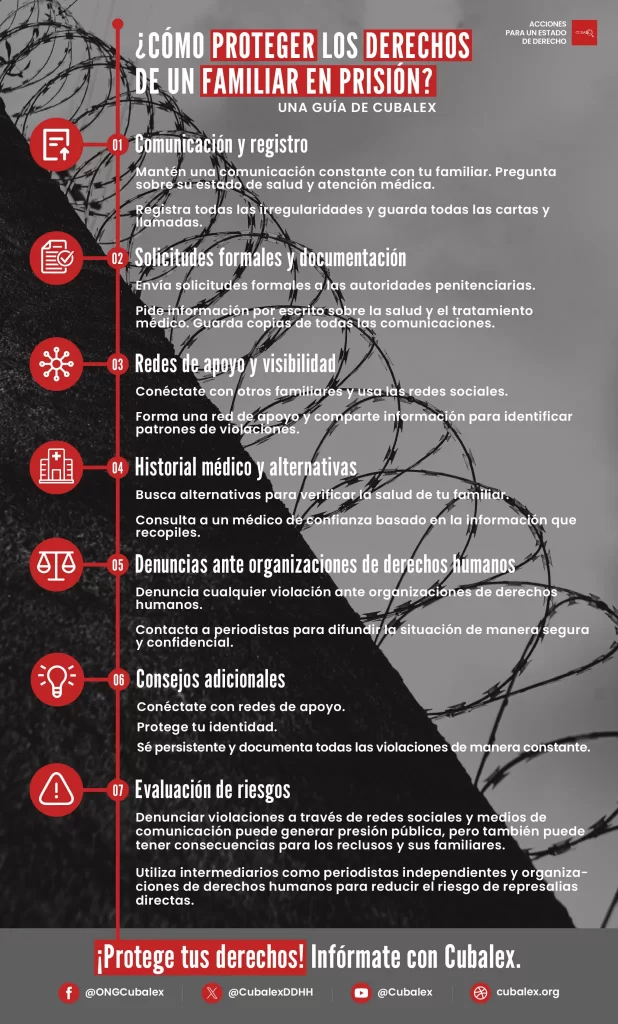
How To Protect the Rights of a Family Member in Prison? / Cubalex

Cubalex, 25 July, 2024 — The Cubalex legal team offers a practical guide with essential recommendations for identifying, documenting and denouncing human rights violations in the Cuban prison system.

Communication and registration

It is vital to maintain constant communication with your family member in prison. Ask regularly about his or her state of health and the medical care he or she is receiving. Take note of any irregularities he or she mentions and keep all letters, phone calls and any other form of communication. These records are crucial for reporting possible human rights violations.

Formal applications and documentation

Send formal requests to the prison authorities asking for information about your family member’s health and medical treatment. Make these requests in writing and keep copies of all communications. Informing local and international human rights organisations about your family member’s situation can provide guidance and support, and put pressure on the authorities.

Support networks and visibility

Connect with other family members of prisoners to form a support network. Sharing information and experiences can help identify patterns of violations and organise more effectively. Use the media and social networks continue reading

to raise awareness of your family member’s situation, but make sure to protect their privacy and safety by only sharing personal details when absolutely necessary.

 Medical history and alternatives

Although medical services in prison are under the control of the authorities, you can seek alternatives to check on your relative’s health. For example, you could:

    •  Seek the opinion of a trusted doctor outside the prison system: Although he or she may not have direct access to your family member, a doctor can help you understand the situation based on the information you gather.
    •  Review the symptoms described: Ask your family member to describe his or her symptoms in detail and share this information with a trusted doctor to get a preliminary assessment.
    •  Seek legal advice: Contact a human rights lawyer to help you put pressure on the prison authorities to improve medical care.

 Complaints and human rights organisations

It is important to report any human rights violations to international human rights organisations. These organisations can help escalate your complaint and put international pressure on prison authorities to fulfil their obligations. Contact independent journalists and human rights organisations to publicise your family member’s situation safely and effectively.

Additional advice

    •  Connect with support networks: Forming a support network with other family members can provide additional strength and resources.
    •  Protect your identity: When posting information online, be sure to protect your identity and that of your family member.
    •  Be persistent: Complaints may not receive an immediate response. Continue to document and report violations in a persistent manner.

 Risk assessment

Reporting violations through social networks and the media can generate public pressure, but it can also have serious consequences for prisoners and their families. Prison authorities may impose additional sanctions if they interpret these actions as disobedience or defiance. Use intermediaries such as independent journalists and human rights organisations to reduce the risk of direct reprisals.

The decision to report violations should be carefully planned to minimise risks. Using intermediaries and maintaining anonymity is crucial to protect prisoners from reprisals. Transparency and accountability are essential to improve prison conditions and ensure respect for human rights, but achieving these goals requires a strategic and well-informed approach.

These recommendations can help to identify, document and report human rights violations in the prison system, even in a context where knowledge of human rights is limited.

The post How to protect the rights of a family member in prison? appeared first in Cubalex.

Translated by GH

Anthropologist Jenny Pantoja, Close to Alina Bárbara López Hernández, Is Dismissed from the University of Havana

The Observatory of Academic Freedom accuses the decision of being an act of “censorship”

Jenny Pantoja, one of the founders of the Pro Amnesty Committee for political prisoners in Cuba / Facebook

14ymedio bigger14ymedio, Havana, July 25, 2024 — Anthropologist and activist Jenny Pantoja Torres has been dismissed from the Miguel Enríquez Faculty at the University of Medical Sciences of Havana (UCM-H). As reported on Thursday by the Academic Freedom Observatory (OLA), the decision was an act of “censorship” carried out by pressure from State Security.

The teacher was under contract and in a trial period; however, she had a positive assessment of her teaching performance, and her boss in the Department of Marxism and History had told her that her services were indispensable. Even so, she was dismissed in “an administrative maneuver to execute the cancellation of uncomfortable intellectuals,” the Observatory said.

The harassment against Pantoja, coordinator of the Pro-Amnesty Committee for political prisoners in Cuba, began a long time ago. On June 18, she was arrested and beaten along with Professor Alina Bárbara López Hernández. After several hours in the hands of State Security at the Playa Police Station, in Matanzas, they were released. Both were traveling to Havana, where they planned to demonstrate peacefully, as the historian does on the 18th of every month.

The harassment against Pantoja, coordinator of the Pro-Amnesty Committee for political prisoners in Cuba, began a long time ago. On June 18, she was arrested and beaten

A day earlier, through social networks, Pantoja Torres had reported that she received threats in a text message from a Cuban number. “Since you have arrived safely in Matanzas, I am warning you that it’s the last time you will,” said the message full of spelling mistakes. continue reading

In her post, the teacher explained that she was going to accompany López Hernández, since she could not leave her alone “on a trip to Havana in which she could suffer police abuse again. I hold State Security, the Cuban Government and its police forces responsible for anything that happens to me from now on. I have not committed any crime, nor do I have any legal action against me. I am only trying to do the best that I can for my country that suffers.” She also said that her house was being watched by the political police.

The siege, despite the fact that she was released, did not end. On June 21. OLA reported that “she was subjected to a new cycle of threats.” This time, the political police went to her house and threatened to “end her professional career, telling her that they would prevent her from developing her working life.”

According to the testimony, agent Ariel Arnau Grillet, who has “an extensive record as a repressor, was accompanied by agent Ariel.” At her home, they demanded that the historian allow access to her house to “let them discover what she and Alina are planning.”

The agents accused her of violating several articles of the Cuban Criminal Code, but the teacher ended the meeting by pointing out that she would not have a conversation without the presence of her lawyer. The agents left, but launched a threat: “Forget about working at the faculty and forget about everything.” Shortly after, they stationed themselves in the vicinity of Pantoja’s home and even followed her to her workplace.

A State Security agent showed up that day at the anthropologist’s home, prevented her from leaving and threatened to report her

The OLA reported a month later, on July 17, that a State Security agent showed up at the anthropologist’s home that day and prevented her from leaving. The policeman threatened to report her if she exposed what happened on social networks. According to the observatory, shortly after, a police “fence” of eight officers was deployed around her house: two police officers and six civilian officers, three men and three women.

At the beginning of July, more than 220 writers and artists signed an open letter in which they denounced the “police violence” against López Hernández and Jenny Pantoja. “The use of force, the criminalization of dissent and imprisonment do not solve our real problems. All Cubans have the right to propose our ideas to get out of this crisis,” said the signatories, including the writer Leonardo Padura, the Argentine musician and singer-songwriter Fito Páez and the film director Fernando Pérez.

Pantoja Torres is an experienced Cuban historian and researcher, in addition to being an activist, with Master’s degrees in the area of Social and Philosophical Sciences, specializing in religion.

She has done extensive work in teaching upper, secondary and higher levels, becoming an assistant professor at the University of Havana in the discipline of Anthropology. She has also given postgraduate courses and lectures as part of her time at institutions like the Cuban Institute of Anthropology.

Translated by Regina Anavy

____________

COLLABORATE WITH OUR WORKThe 14ymedio team is committed to practicing serious journalism that reflects Cuba’s reality in all its depth. Thank you for joining us on this long journey. We invite you to continue supporting us by becoming a member of 14ymedio now. Together we can continue transforming journalism in Cuba.
Given the Low Quality of Food in Cuba, the Spanish Hotel Company Meliá Will Import Its Products

The regime’s proposal to buy from farmers did not prosper due to the shortage of products

In 2017 Iberostar received a permit to create a joint import business with the Cuban Caribbean Hotel Logistics / Trip Advisor

14ymedio bigger14ymedio, Havana, July 24, 2024 — The Cuban Government’s inability to meet the demand for the most basic products also affects its trading partners. The large hotel companies installed on the Island have had to import, for years, part of the products they provide in their facilities. Since the escalation of the crisis after the pandemic, however, companies went from importing in order to “maintain luxury” to importing out of necessity.

The last to join the list was Meliá, which at the beginning of this year announced that it would create, with the permission of the State, its own import company. It was not until this Wednesday, however, that it revealed Mesol’s specific purpose: to supply its hotels with linen, sports and artistic equipment, kitchen utensils and even food, beverages and cleaning items.

The transport, distribution and storage of the products are also borne by the company, which for now has its main supplier in Spain but is looking for other suppliers in Latin America and the Caribbean, where invoices will be less expensive. continue reading

The “appropriate purchase and delivery flows,” the statement adds, will help maintain the quality of the service

The “appropriate purchase and delivery flows,” the statement adds, will help maintain the quality of the service, diminished by the lack of variety in the food, the low quality of the meals and the defective cleanliness, common complaints among those staying on the Island.

Other companies have taken similar measures. At the beginning of last year, when the Indian MGM Muthu Hotels reached 7,000 rooms on the Island, its adviser explained a plan to keep all the facilities supplied. “We are going to have two importers in Cuba to bring in products, not only beverages, but everything. It can be furniture and fittings, everything. We are already creating two companies for this,” he said in January, and in May, an importer from Portugal was already a reality.

“We have a trading company to import all kinds of supplies from Portugal. We are growing little by little, sin prisa pero sin pausa* — without haste but without pause,” he added.

In 2022, the Government granted Canadian Blue Diamond a license – accompanied by the exclusive management of 11 complexes in Cayo Largo del Sur – to bring in the necessary supplies to maintain them. Nutella, butter and ketchup, not very available in Cuba, were some of the products promised by the vice president of Sunwing Travel Group, owner of the hotel. “The right to import and to be able to control quality is a great thing,” he said.

“Importing cannot be the solution; the country must be able to provide domestic products to hotels”

That same year Granma published an article criticizing the hotels that imported much of the products they needed in their daily management, including food, when, it said, they could get them in Cuba. “Importation cannot be the solution, the country must be able to provide hotels with domestic products and thus ensure attention to the growing arrival of visitors, which favors economic chains,” it complained.

The text tried to explain the successful association between hotel companies and the producers of the locales where they are installed but forgot to point out that the contracts are always made through the Ministry of Agriculture, which lowers payments to the farmers and discourages them, at the same time that it fails to comply with its commitments and is unreliable in its business dealings with the hotels. companies.

In 2017, Iberostar received a permit to create a joint import business with the Cuban Logística Hotelera del Caribe (LHC). The Spanish chain did not clarify what it intended to import but explained that the company, located in the Special Development Zone of Mariel, would be dedicated to the wholesale trade of products for the hospitality industry and that Iberostar would not be the only beneficiary.

With tourism stalled in numbers similar to those of last year, in addition to the discredit that the Island has suffered internationally for its political and economic situation, companies like Meliá have decided to take the reins and try to improve the statistics of their hotels on their own. In 2023, Cuba was the only one of its destinations where revenues fell and hotel occupancy was lower than expected.

*Translator’s note: Sin prisa pero sin pausa — without haste but without pause — became a signature phrase of Raul Castro in reference to ‘fixing’ the problems of Cuba, after he assumed the presidency on the death of his brother, Fidel.

Translated by Regina Anavy

____________

COLLABORATE WITH OUR WORKThe 14ymedio team is committed to practicing serious journalism that reflects Cuba’s reality in all its depth. Thank you for joining us on this long journey. We invite you to continue supporting us by becoming a member of 14ymedio now. Together we can continue transforming journalism in Cuba.

A Group of Cubans Protest in Miami Against a Billboard That Compares Trump to Fidel Castro

The founder of Mad Dog PAC, responsible for the campaign, believes that the American wants to be a dictator “as evil” as the Cuban leader was.

The controversial billboard has caused outrage among some Cubans living in Miami. / EFE

14ymedio biggerEFE/14ymedio, Miami, June 20, 2024 — A group of Cubans protested Wednesday on a Miami highway because of a billboard in Spanish that compares former President and Republican candidate Donald Trump to the late Fidel Castro.

“No to dictators, no to Trump,” reads the huge sign with photos of both leaders, located next to a busy highway.

Outraged, members of the group Hispanos por América (Hispanics for America) called for a protest Wednesday afternoon on the Palmetto Expressway, in south Miami, against the announcement of Mad Dog PAC, a political action committee.

Outraged, members of the group called for a protest Wednesday afternoon on the Palmetto Expressway

Protesters in Miami, home to Cuba’s largest exile community, called the announcement “a lack of respect by Democrats for the personality and dignity of our President Donald Trump.”

The ad is one of many that Mad Dog PAC has installed in several states, including others with legends in English such as ’Loser’, ’It’s a Cult’ and ’Unfit’.

“Our mission is to defeat Donald Trump by exposing the truth about him,” PAC founder Claude Taylor told local NBC. continue reading

The activist told T51 Miami that he has spent time in Cuba, Florida and even Guantanamo Bay and considers that “Fidel Castro was a horrible dictator.” However, he adds: “In the opinion of my organization, Donald Trump would be an equally horrible dictator.”

“I think it’s very fair to compare Donald Trump, who, in his wildest dreams, aspires to be a Fidel Castro. He wants to be another dictator, and as evil as Fidel Castro was,” he added.

In response to the campaign, Trump’s Hispanic communications director, Jaime Florez, said in a statement that “if there is anyone who has shown us that he has no interest in being a dictator, it is President Trump, who has already been president of the United States.”

“It’s another sign of the desperation of President Biden’s campaign and the Democratic Party, who are realizing that they have failed miserably with Hispanics,” he added.

These ads are focused on states considered undecided ahead of the November presidential election, such as Nevada, Arizona, Georgia, North Carolina, Pennsylvania, Wisconsin and Michigan and there were already, since January, between 15 and 20 billboards of this type in Florida, which has, for Taylor, “special importance due to its association with Donald Trump”. The coordinator of Mad Dog PAC, who points out that his campaign is financed by ordinary people, warns that this has been the first in Spanish, but it will not be the last.

Translated by Hombre de Paz

____________

COLLABORATE WITH OUR WORKThe 14ymedio team is committed to practicing serious journalism that reflects Cuba’s reality in all its depth. Thank you for joining us on this long journey. We invite you to continue supporting us by becoming a member of 14ymedio now. Together we can continue transforming journalism in Cuba.
The Cuban Church Denounces at Least 50 Robberies in Catholic Temples Since March

Some 34 parishes and religious houses in the country have been affected by theft and vandalism

In addition to thefts, the Catholic Church reports that it is the victim of intimidation / EWTN

14ymedio bigger14ymedio, Havana, July 5, 2024 — In Cuba, at least 50 robberies have been recorded in 34 Catholic parishes and religious houses since March of last year, according to the Catholic news channel EWTN. The thieves, who often vandalize the premises, have taken all kinds of objects, from electrical equipment such as televisions, microwaves, laptops, fans and audio systems, to lamps and light bulbs with which the churches are illuminated.

The loot, according to information revealed by the Archdiocese of Havana, also includes propane tanks, refrigerators, farm animals, stoves, stoves, washing machines, bedding, tablecloths and even personal hygiene items such as soap. Religious images, Easter candles (large ceremonial candles) and donations collected during liturgical celebrations have also disappeared.

“So far we have not been notified of any results of the investigation,” the nun María Cristina Rivas explained to EWTN. This was in reference to the robbery suffered on March 1 by the congregation of the Carmelite Missionaries in Camagüey. That day there were two robberies: one in their community house and another in the parish they attend. continue reading

“They broke the window of the sacristy and entered the church through it. Once in the church, they broke the offering box that is near the image of Nuestra Señora la Virgen de la Caridad del Cobre. They took the money from the offerings of the aforementioned offering box (…) When we returned to our house, we found that, at that time, while we were in the parish, they also tried to enter our house and broke a fence of the house. They could not gain access because we were already arriving,” Rivas detailed.

Havana registers most of the cases reported by the Church

But it is in Havana where the vast majority of cases are registered, according to EWTN, and a single thief has robbed at least six churches of the Archdiocese so far this year. The man was caught by members of the community, on June 22, in the parish of Nuestra Señora de la Medalla Milagrosa, in the municipality of Diez de Octubre.

However, the police never came to the scene, so the parish priest had no choice but to let him go. The next day, the very same thief was caught trying to rob the church of Santa Rita de Casia, in Playa, where he again got away with it. Now, the channel explains, parishioners are left with only one option: to share a photograph of the thief in their WhatsApp groups, in order to be prepared against future robberies.

This is the message that the community of Nuestra Señora de la Medalla Milagrosa has shared in order to be alert / EWTN

Other cases have been registered in important places for the Catholic faithful in Cuba, such as the network of Loyola Centers, from which an image of Saint Lucia was stolen, as well as some electrical equipment. Robberies are also reported in the church of the Sacred Heart and San Ignacio de Loyola, in the church of Nuestra Señora de la Medalla Milagrosa de Santos Suárez or the parish of Cristo Redentor.

Many of these complaints can also be found on social networks, as is the case of a robbery suffered by the Sagrado Corazón church on Línea Street, in the capital’s Vedado neighborhood. This is where the priest Lester Rafael Zayas Díaz officiates – one of the most critical voices against the Cuban government within the Catholic Church – who wryly stated: “Once again ‘Brother Thief’ visits us, this time for the need of lamps and light bulbs. He is a thief who has keys and comes and goes as he pleases,” he denounced on Facebook on June 15.

The robberies are not only a reflection of the serious economic crisis that the island is going through and the precariousness to which it leads, but on many occasions, they go hand in hand with intimidating acts by the political police of the regime against priests who have raised their voices about the social situation.

EWTN was able to document some of the ’modus operandi’ of the robberies, which include forced entry / EWTN

This was one of the complaints contained in the 2023 report on international religious freedom prepared by the U.S. State Department – published last week – which shows in detail that all the persecution recorded on the island against religious groups, regardless of their denomination, is inescapably related to political dissidence with the regime.

Such harassment includes the use of repressive tactics against religious leaders and activists who oppose the Communist Party’s ideology through arrests, arbitrary fines, strict policing of their daily lives and, in some cases, exile. In addition to being denied licenses, religious visas or freedom of movement, they suffer physical and mental abuse.

“Every month, at least one stone, two stones, five stones are thrown against the windows of the church at a time when the perpetrators cannot be seen.” So said Kenny Fernández Delgado, pastor of the church of San Antonio de Padua, in Arroyo Naranjo, located in the Archdiocese of Havana, in an interview with the Catholic news agency.

The Cuban regime has a long history of repression of priests and members of the Catholic Church – lay or religious – which intensified after the protests of July 11, 2021 (11J). After the mass arrests, and even during the demonstrations, priests such as Lester Zayas, Alberto Reyes and José Castor Devesa, who spoke in favor of the citizens or marched alongside them, have frequently been called to explain themselves to State Security, harassed or reprimanded by their superiors under pressure from the government.

Given the scarcity and economic crisis that the island is going through, after the churches are vandalized, they have no choice but to fix the damage with what they have at hand, so it is common to see zinc or acrylic sheets replacing stained glass and windows. This way at least they manage to prevent the attackers from breaking the religious images of the church with the next stone throwing, and prevent anyone from getting hurt.

Translated by Hombre de Paz

____________

COLLABORATE WITH OUR WORKThe 14ymedio team is committed to practicing serious journalism that reflects Cuba’s reality in all its depth. Thank you for joining us on this long journey. We invite you to continue supporting us by becoming a member of 14ymedio now. Together we can continue transforming journalism in Cuba.
With a Director Trained in Moscow, the Office of the Historian Has Russians in Its Blood

Perla Rosales, who replaced Eusebio Leal, is the daughter of one of Fidel Castro’s generals

Russian came to the rescue at a difficult time / Néstor Martí/Facebook Naturaleza Secreta

14ymedio bigger14ymedio, Juan Izquierdo, Havana, July 21, 2024 — “When the Russians called us, Eusebio Leal used to say, ’Don’t even ask for my permission. Just go ahead.’” Perla Rosales, deputy-director of Havana’s Office of the Historian, leaves little doubt about Moscow’s role in the financial survival of her organization. “We work very well with the Russians,” she says in an interview with Russia Today (RT). “We have Russians in our blood.”

During the interview, which took place in Leal’s old office, Rosales made it clear that the post will not be filled anytime soon. “People wonder when there will be a new historian. No, no, no! Eusebio is still here,” she said. All its operations are now being handled by what she describes as “a very loyal team” over which she presides.

The daughter of one of Fidel Castro’s generals and acting-director of the organization since Leal’s death in 2020, Rosales was full of praise for Moscow, whose financing was decisive in 2016 when the agency’s parent company, Habaguanex, was taken over by GAESA, a business conglomerate controlled by the Cuban armed forces. GAESA was directed by Luis Alberto Rodríguez López-Calleja, former son-in-law of Raúl Castro, until his death in July 2022. continue reading

The daughter of one of Fidel Castro’s generals and acting-director of the organization since Leal’s death in 2020, Rosales was full of praise for Moscow

Rosales notes, with some satisfaction, that Habanaguanex “had a budget of 120 million dollars.” It restored and operated twenty-one hotels, which were always “at 90% occupancy.” At that time, Leal gave an interview to the Associated Press in which he alluded very discreetly to GAESA’s guardianship. Without mentioning anything about the reasons for the takeover, he said tersely, “I am handing over everything that I currently believe to be in optimal condition.”

“Leal decided that it was time for the business side to be run by a company under the auspices of a large holding company like GAESA so that he could focus his energies on the community and social welfare projects,” she said. GAESA pays the agency a portion of Habaguanex’ profits, which it reinvests in its own restoration projects.

Rosales says more than seven million “in hard currency” now goes to social welfare projects. They restore a hundred homes a year — down from 120 — with money contributed by “many partner countries.”

Russia came to the rescue at a difficult time for Leal, who was suffering from cancer. Fidel Castro, the person who had granted him — as Rosales puts it — “full authority,” had also died that same year. The project that gave the Office of the Historian new prestige was the restoration of Cuba’s National Capitol. “We have to mention that because we are a Russian channel,” said the RT interviewer.

The building was restored with help from the Kremlin in 2018. Leal claimed, according to Rosales, that only the Russians had what it took to gild the Capitol’s cupola. “The Italians submitted a bid and everyone else made us their best offer.” Then Leal made a decision: “That’s it. We’re going with the Russians. We work well together.” She says Russian specialists labored “day and night,” to finish the project, which was completed in 2019.

Gilding the Statue of the Republic, a work by the Italian sculptor Angelo Zanelli that sits in the main hall under the cupola, was not part of the plan but rather “a special request to the Russian girls.” Rosales reports Leal jokingly asking them, “Won’t you have a little gold left over?” It was left to her to work out the financial details with the Russian delegation. She claims Leal did not like the final result because he felt the gold leaf chosen by Cuban restorers was too garish.

The interviewer noted that Office of the Historian has been been “taken over by its women” and Rosales agreed

The interviewer noted that Office of the Historian has been been “taken over by its women” and Rosales agreed. “We, the team,” she clarified. She does not see herself as a replacement but as the leader of Leal’s successors, people who have worked there on different fronts. A close ally is the journalist Magda Resik, who is in charge of the communications. “Breaking down doors,” she says, is this army’s way of doing things and she believes that, even in Leal’s absence, the government respects the agency.

“Every day we ask ourselves, ’How would Eusebio do it?’” she says. To those who question whether Leal would have approved the conversion of its previous historic restorations into state-owned businesses like the one operating in Quinta de los Molinos, her answer is, “Yes, of course. We are sure that he would.” Her job, as she sees it, is to assist the government and the president. In fact, Leal’s final act, while in “unbearable pain,” was to dictate a letter to Raúl Castro.

Rosales also talked about studying architecture in the Soviet Union and her return to Cuba in the 1990s. “When I came back, I was a young woman who had just graduated,” she says. She rose rapidly through the ranks until Leal appointed her the office’s investment director following the resignation of her predecessor. With Raúl Castro’s approval and in anticipation of Leal’s death, she became deputy-director in 2013.

It is she who must now “shoulder the heavy weight.” However, Rosales’ tone when describing her “inheritance” is not one of grief. “He has not stopped working with us,” she says, pointing to Leal’s empty desk. “He is still here. We work with him here every day.”

____________

COLLABORATE WITH OUR WORKThe 14ymedio team is committed to practicing serious journalism that reflects Cuba’s reality in all its depth. Thank you for joining us on this long journey. We invite you to continue supporting us by becoming a member of 14ymedio now. Together we can continue transforming journalism in Cuba.
The Children Are Baptized and One Week Later They Leave, Complains the Catholic Church in Cuba

The anointing of the sick is the only sacrament that is increasing, another reflection of the demographic situation on the island

The priests do not offer official figures for baptized people on the Island. / Reynaldo La O /Havana Times

14ymedio bigger14ymedio, Havana, July 24, 2024 — The Catholic priest Ariel Suárez, secretary of the Cuban Episcopal Conference – and, in practice, its spokesman – said during an interview in Spain that in a parish like his, the sanctuary of the Virgin of Charity in Havana, 300 children can be baptized every month. The figure is not impossible, although optimistic, in a country weighed down by migratory stampede and low birth rate, according to the religious authorities of several Cuban dioceses interviewed by 14ymedio. In the parishes of the most important cities of Matanzas – Varadero, Cárdenas and Matanzas – they are far from that number, according to a source from their bishopric: about 15 children a month in Cárdenas and about 20 per priest, if he has to attend several parishes.

In Camajuaní, where several years ago dozens of children were baptized every Saturday, the current number is between 4 or 6 children each month. A member of the diocesan administration of Santa Clara explains to this newspaper that it is normal for families “to baptize the children and then leave the country one week later.”

In Camajuaní, where several years ago dozens of children were baptized every Saturday, the current number is between 4 or 6 children every month

Apparently, he says, they believe that the ritual provides some kind of protection or luck during the trip, or they have the superstition that it will facilitate the exit procedures. As for the data offered by Suárez, he says, “it could be real for that parish, because it is a sanctuary in the middle of Central Havana, although it seems too high.” continue reading

“In each diocese there are sacramental statistics. They are done every year. It must be borne in mind that each parish in Cuba is very different. In the city of Santa Clara, for example, the number of baptisms in a sanctuary like Buenviaje or in the cathedral is not the same as in the churches of La Pastora and Carmen,” he explains.

The decline in rituals is not only for baptisms: “There are few births, fewer baptisms, a lot of emigration, fewer confirmations – another sacrament -and there are also fewer religious marriages,” he summarizes. There is only an abundance of what is known as the “anointing of the sick” – formerly called extreme unction – because the “old people are left behind.”

In the archdiocese of Santiago de Cuba – where mountain communities abound – a source in the archdiocese tells 14ymedio that priests do not usually compile monthly statistics, only an annual figure that he did not reveal. He admitted, of course, that it tends to decrease. “People are attending Church because they are desperate,” he explains. “Many of the baptisms are just a number.”

During his interview, Suárez sounded amazed that “after so many years, of a social system that promulgated atheism with such force” and given the current circumstances, baptisms continue to be held in Cuba. “The parents of those children are young,” he added, and “they do not have a Christian foundation,” but – despite the indoctrination of the regime – they do not look at the Catholic Church with “hostility or indifference.”

The priest said he was aware of the migratory crisis, in which “Cubans of all ages leave, not only young people. Of course, the departure of young people is felt more in a nation, because they are supposed to be the ones who have projects and dreams for the future of a country and of the Church itself,” he said.

“People are attending Church because they are desperate,” he explains. “Many of the baptisms are just a number”

In addition, he made it clear that the Church in Cuba considers itself “vulnerable,” and he listed what, in his opinion, it has to lose: the “small but significant” education centers, nursing homes and care spaces for the sick, the elderly and the alcoholics.

In a context of extreme coldness in Church-State relations, Suárez has become a spokesman for an increasingly lethargic Episcopal Conference. Cuban bishops have not published a joint document that contains criticism of the Government or descriptions of the country’s situation for months. Last April, Suárez – interviewed by the American network NBC – again reminded the authorities that the Church was ready to have a conversation about the freedom of political prisoners.

In the protests of last March 17 – and in the previous ones – Suárez said that the pain “turned into a scream,” which was “listened to” and “accepted” by “all the authorities of the country.” At least everyone has agreed to consider that the cry reflected anguish, reflected despair, and that it was obviously asking for a different situation from what was being experienced,” he said, referring to the demonstrations in the city of Santiago de Cuba.

A source from the archdiocese of Havana told this newspaper that what Suárez expressed “is a subtle message” that the bishops send to the regime to say that the Church can mediate “despite the sorrows.” However, he acknowledged that “at the diocesan level, the tension with the Party’s Religious Affairs Offices is worse than ever.”

Translated by Regina Anavy

____________

COLLABORATE WITH OUR WORKThe 14ymedio team is committed to practicing serious journalism that reflects Cuba’s reality in all its depth. Thank you for joining us on this long journey. We invite you to continue supporting us by becoming a member of 14ymedio now. Together we can continue transforming journalism in Cuba.